UNIVERSAL MEDICALAND
BUSINESS COLLEGE,
DEPARTMENT OF PHARMACY
EMERGENCY WARD ATTACHMENT SEMINAR
IN Y12HMC
1/29/2024
1
CHRONIC LIVER DISEASE (CLD)
Prepared by: Eyael surafel
1/29/2024
2
OUTLINE
 INTRODUCTION
 EPIDMOLOGY
 RISK FACTOR
 Etiology
 Pathophysiology
 Clinical presentation
 Diagnosis
 complication
 Treatment
 Reference
1/29/2024
3
INTRODUCTION
 Definition- Chronic liver disease (CLD) is a
progressive decline of liver functions for more than
six months.
 Progressive destructions of liver parenchyma over 6
month lead to fibrosis and cirrhosis
 CLD includes: cirrhosis , alcoholic liver disease ,Non-
alcholic fatty liver disease(NAFLD), chronic Hepatitis
1/29/2024
4
FUNCTION OF LIVER
 Detoxification
 Albumin production
 Bilirubin conjugation
 Synthesis of cloting factor
 Estrogen metabolism
1/29/2024
5
EPIDEMIOLOGY
 An estimated 1.5 billion person have CLD
 There are 257 million people worldwide who are living
with chronic HBV.
 20% will die early of liver failure or hepatocellular
carcinoma. only 11% of infected persons are aware of
their infection, and 17% of those receive treatment.
 In Ethiopia, liver diseases accounted for 11.4% of all
medical admissions
1/29/2024
6
RISK FACTORS
 Heavy alcohol use.
 Obesity and metabolic syndrome
 Iv drug use and exposure to toxin
 Tattoos or body piercings.
 Injecting drugs using shared needles.
 Exposure to other people's blood and body fluids.
 Unprotected sex
 infection(viral hepitites, cmv)
1/29/2024
7
ETIOLOGY
1. Alcohol: common cause
2. Viral infection: except HAV $ HEV
3. NAFLD: metabolic syndrome (like obesity
,high cholesterol, TG,HTN)
4. Genetic
5. Autoimmune
6. Drug : phenytoin, Isoniazid, methotrexate,
amiodarone
7. idiopathic
1/29/2024
8
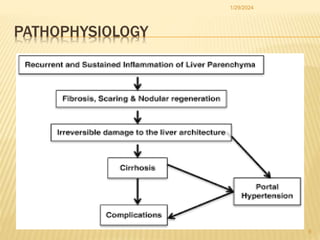
PATHOPHYSIOLOGY
1/29/2024
9
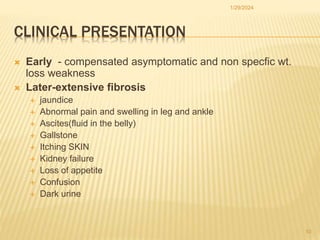
CLINICAL PRESENTATION
 Early - compensated asymptomatic and non specfic wt.
loss weakness
 Later-extensive fibrosis
 jaundice
 Abnormal pain and swelling in leg and ankle
 Ascites(fluid in the belly)
 Gallstone
 Itching SKIN
 Kidney failure
 Loss of appetite
 Confusion
 Dark urine
1/29/2024
10
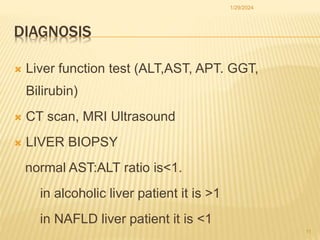
DIAGNOSIS
 Liver function test (ALT,AST, APT. GGT,
Bilirubin)
 CT scan, MRI Ultrasound
 LIVER BIOPSY
normal AST:ALT ratio is<1.
in alcoholic liver patient it is >1
in NAFLD liver patient it is <1
1/29/2024
11
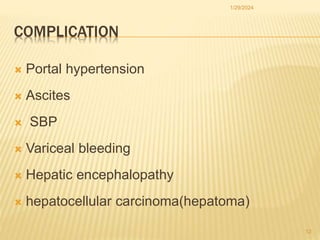
COMPLICATION
 Portal hypertension
 Ascites
 SBP
 Variceal bleeding
 Hepatic encephalopathy
 hepatocellular carcinoma(hepatoma)
1/29/2024
12
1) PORTAL HYPERTENSION
• is defined as elevation of hepatic venous pressure
>5mmhg.
• Clinically significant portal HTN occur >10mmhg.
• Risk of variceal bleeding increase beyond 12mmhg.
• Extra hepatic portal vein obstruction is usual source in
children and adolescence. while cirrhosis cause at least
90% of cases in adults
1/29/2024
13
TREATMENT
 Management in portal hypertension is aimed at
preventing and treating its complications.
 In the case of varices, this includes endoscopy
to screen for varices,
 nonselective beta blockers and/or endoscopic
variceal ligation to prevent bleeding, and
 treatment of active hemorrhage with endoscopic
therapy or transjugular intrahepatic
portosystemic shunt (TIPS) placement.
1/29/2024
14
2. ASCITES
 Is accumulation of fluid in peritoneal cavity.
 The decrease in LFT combine with portal HTN cause ascites
symptom.
 Symptom
 swelling of ankle
 Back pain
 SOB
 Fatigue
 Abdominal pain
1/29/2024
15
TREATMENT
 In patients with ascites, treatment often starts with dietary
sodium restriction and diuretics.
 Stop drinking alcohol
 Attainment of sodium balance
 dietary sodium restriction(<2gm/d)
 Fluid restriction(1.5L/d)
1/29/2024
16
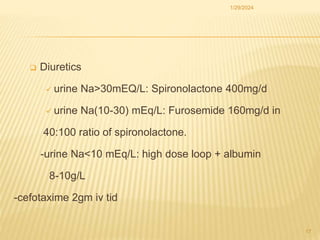
 Diuretics
 urine Na>30mEQ/L: Spironolactone 400mg/d
 urine Na(10-30) mEq/L: Furosemide 160mg/d in
40:100 ratio of spironolactone.
-urine Na<10 mEq/L: high dose loop + albumin
8-10g/L
-cefotaxime 2gm iv tid
1/29/2024
17
3. SPONTANEOUS BACTERIAL PERITONITIS (SBP]
 Is defined as bacterial infection of the ascetic fluid. Due to
enterobacteria or pneumococci
 SBP is defined as ascetic fluid polymorph nuclear leukocyte (PMN)
count level ≥ 250 cells/µL without a surgical, intra-abdominal cause
of infection
 Incidence: 10-30% of hospitalized patients with cirrhosis and ascites
 Clinical presentation: Fever, abdominal pain, nausea, vomiting,
diarrhea, rebound tenderness, and exacerbation of encephalopathy
1/29/2024
18
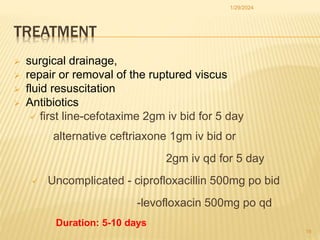
TREATMENT
 surgical drainage,
 repair or removal of the ruptured viscus
 fluid resuscitation
 Antibiotics
 first line-cefotaxime 2gm iv bid for 5 day
alternative ceftriaxone 1gm iv bid or
2gm iv qd for 5 day
 Uncomplicated - ciprofloxacillin 500mg po bid
-levofloxacin 500mg po qd
Duration: 5-10 days
1/29/2024
19
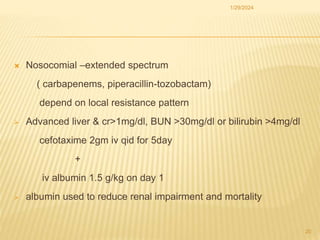
 Nosocomial –extended spectrum
( carbapenems, piperacillin-tozobactam)
depend on local resistance pattern
 Advanced liver & cr>1mg/dl, BUN >30mg/dl or bilirubin >4mg/dl
cefotaxime 2gm iv qid for 5day
+
iv albumin 1.5 g/kg on day 1
 albumin used to reduce renal impairment and mortality
1/29/2024
20
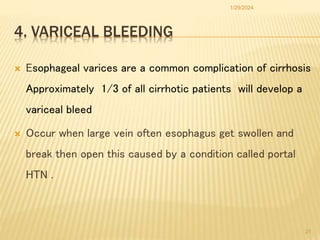
4. VARICEAL BLEEDING
 Esophageal varices are a common complication of cirrhosis
Approximately 1/3 of all cirrhotic patients will develop a
variceal bleed
 Occur when large vein often esophagus get swollen and
break then open this caused by a condition called portal
HTN .
1/29/2024
21
TREATMENT
 Vasopressin (0.2-0.4 U/min )
-Octreotide is a parenteral synthetic
analog of the naturally occurring hormones
omatostatis.
-sandostatin dose-50mcg iv bolus
* 20-50 mcg/hr infusion(1-
5day)
1/29/2024
22
5. HEPATIC ENCEPHALOPATHY
 Disturbance in CNS function by toxin
secondary to hepatic insufficiency
 Clinical presentation- confusion excess
sleepiness slurred speech
Altered mental status and progression to
coma if untreated
Asterixis: “Hand flap” – classic PE finding
1/29/2024
23
 abnormal metabolism most likely is a cause
(ammonia is the by product of protein
metabolism , healthy liver converts
ammonia
in to urea then excreted by kidney)
1/29/2024
24
TREATMENT
1.supportive care
2. identify the cause
3.treatment
 removing toxin from intestine(ammonia)
 Antibiotics (rifaximin)
 Lactulose(ammonia reduction)
30ml po qd/bid
1/29/2024
25
Antibiotics
Goal: intraluminal urease-producing
bacteria
*Neomycin 3-6 g/day 1-2 weeks; then
1-2 g/day
*Metronidazole 250 mg BID
*Rifaximin 400 mg tid
As effective as lactulose
Costly but better tolerated
1/29/2024
26
REFERENCE
 Fourth edition, Pharmacotherapy Principles &
Practice, E-book Marie A. Chisholm-Burns, Terry
L. Patrick M. Malone,
 By E, Alldredge BK, Affairs A, Francisco S,
Francisco S, Corelli RL, et al. Applied
Therapeutics The Clinical Use of Drugs TENTH
EDITION Edited
 Dipiro 9th edition
 Who guideline
 Up-to-date
 Medscape
1/29/2024
27

CLD EMER SEMINAR Eyael.pptx

  • 1.
    UNIVERSAL MEDICALAND BUSINESS COLLEGE, DEPARTMENTOF PHARMACY EMERGENCY WARD ATTACHMENT SEMINAR IN Y12HMC 1/29/2024 1
  • 2.
    CHRONIC LIVER DISEASE(CLD) Prepared by: Eyael surafel 1/29/2024 2
  • 3.
    OUTLINE  INTRODUCTION  EPIDMOLOGY RISK FACTOR  Etiology  Pathophysiology  Clinical presentation  Diagnosis  complication  Treatment  Reference 1/29/2024 3
  • 4.
    INTRODUCTION  Definition- Chronicliver disease (CLD) is a progressive decline of liver functions for more than six months.  Progressive destructions of liver parenchyma over 6 month lead to fibrosis and cirrhosis  CLD includes: cirrhosis , alcoholic liver disease ,Non- alcholic fatty liver disease(NAFLD), chronic Hepatitis 1/29/2024 4
  • 5.
    FUNCTION OF LIVER Detoxification  Albumin production  Bilirubin conjugation  Synthesis of cloting factor  Estrogen metabolism 1/29/2024 5
  • 6.
    EPIDEMIOLOGY  An estimated1.5 billion person have CLD  There are 257 million people worldwide who are living with chronic HBV.  20% will die early of liver failure or hepatocellular carcinoma. only 11% of infected persons are aware of their infection, and 17% of those receive treatment.  In Ethiopia, liver diseases accounted for 11.4% of all medical admissions 1/29/2024 6
  • 7.
    RISK FACTORS  Heavyalcohol use.  Obesity and metabolic syndrome  Iv drug use and exposure to toxin  Tattoos or body piercings.  Injecting drugs using shared needles.  Exposure to other people's blood and body fluids.  Unprotected sex  infection(viral hepitites, cmv) 1/29/2024 7
  • 8.
    ETIOLOGY 1. Alcohol: commoncause 2. Viral infection: except HAV $ HEV 3. NAFLD: metabolic syndrome (like obesity ,high cholesterol, TG,HTN) 4. Genetic 5. Autoimmune 6. Drug : phenytoin, Isoniazid, methotrexate, amiodarone 7. idiopathic 1/29/2024 8
  • 9.
  • 10.
    CLINICAL PRESENTATION  Early- compensated asymptomatic and non specfic wt. loss weakness  Later-extensive fibrosis  jaundice  Abnormal pain and swelling in leg and ankle  Ascites(fluid in the belly)  Gallstone  Itching SKIN  Kidney failure  Loss of appetite  Confusion  Dark urine 1/29/2024 10
  • 11.
    DIAGNOSIS  Liver functiontest (ALT,AST, APT. GGT, Bilirubin)  CT scan, MRI Ultrasound  LIVER BIOPSY normal AST:ALT ratio is<1. in alcoholic liver patient it is >1 in NAFLD liver patient it is <1 1/29/2024 11
  • 12.
    COMPLICATION  Portal hypertension Ascites  SBP  Variceal bleeding  Hepatic encephalopathy  hepatocellular carcinoma(hepatoma) 1/29/2024 12
  • 13.
    1) PORTAL HYPERTENSION •is defined as elevation of hepatic venous pressure >5mmhg. • Clinically significant portal HTN occur >10mmhg. • Risk of variceal bleeding increase beyond 12mmhg. • Extra hepatic portal vein obstruction is usual source in children and adolescence. while cirrhosis cause at least 90% of cases in adults 1/29/2024 13
  • 14.
    TREATMENT  Management inportal hypertension is aimed at preventing and treating its complications.  In the case of varices, this includes endoscopy to screen for varices,  nonselective beta blockers and/or endoscopic variceal ligation to prevent bleeding, and  treatment of active hemorrhage with endoscopic therapy or transjugular intrahepatic portosystemic shunt (TIPS) placement. 1/29/2024 14
  • 15.
    2. ASCITES  Isaccumulation of fluid in peritoneal cavity.  The decrease in LFT combine with portal HTN cause ascites symptom.  Symptom  swelling of ankle  Back pain  SOB  Fatigue  Abdominal pain 1/29/2024 15
  • 16.
    TREATMENT  In patientswith ascites, treatment often starts with dietary sodium restriction and diuretics.  Stop drinking alcohol  Attainment of sodium balance  dietary sodium restriction(<2gm/d)  Fluid restriction(1.5L/d) 1/29/2024 16
  • 17.
     Diuretics  urineNa>30mEQ/L: Spironolactone 400mg/d  urine Na(10-30) mEq/L: Furosemide 160mg/d in 40:100 ratio of spironolactone. -urine Na<10 mEq/L: high dose loop + albumin 8-10g/L -cefotaxime 2gm iv tid 1/29/2024 17
  • 18.
    3. SPONTANEOUS BACTERIALPERITONITIS (SBP]  Is defined as bacterial infection of the ascetic fluid. Due to enterobacteria or pneumococci  SBP is defined as ascetic fluid polymorph nuclear leukocyte (PMN) count level ≥ 250 cells/µL without a surgical, intra-abdominal cause of infection  Incidence: 10-30% of hospitalized patients with cirrhosis and ascites  Clinical presentation: Fever, abdominal pain, nausea, vomiting, diarrhea, rebound tenderness, and exacerbation of encephalopathy 1/29/2024 18
  • 19.
    TREATMENT  surgical drainage, repair or removal of the ruptured viscus  fluid resuscitation  Antibiotics  first line-cefotaxime 2gm iv bid for 5 day alternative ceftriaxone 1gm iv bid or 2gm iv qd for 5 day  Uncomplicated - ciprofloxacillin 500mg po bid -levofloxacin 500mg po qd Duration: 5-10 days 1/29/2024 19
  • 20.
     Nosocomial –extendedspectrum ( carbapenems, piperacillin-tozobactam) depend on local resistance pattern  Advanced liver & cr>1mg/dl, BUN >30mg/dl or bilirubin >4mg/dl cefotaxime 2gm iv qid for 5day + iv albumin 1.5 g/kg on day 1  albumin used to reduce renal impairment and mortality 1/29/2024 20
  • 21.
    4. VARICEAL BLEEDING Esophageal varices are a common complication of cirrhosis Approximately 1/3 of all cirrhotic patients will develop a variceal bleed  Occur when large vein often esophagus get swollen and break then open this caused by a condition called portal HTN . 1/29/2024 21
  • 22.
    TREATMENT  Vasopressin (0.2-0.4U/min ) -Octreotide is a parenteral synthetic analog of the naturally occurring hormones omatostatis. -sandostatin dose-50mcg iv bolus * 20-50 mcg/hr infusion(1- 5day) 1/29/2024 22
  • 23.
    5. HEPATIC ENCEPHALOPATHY Disturbance in CNS function by toxin secondary to hepatic insufficiency  Clinical presentation- confusion excess sleepiness slurred speech Altered mental status and progression to coma if untreated Asterixis: “Hand flap” – classic PE finding 1/29/2024 23
  • 24.
     abnormal metabolismmost likely is a cause (ammonia is the by product of protein metabolism , healthy liver converts ammonia in to urea then excreted by kidney) 1/29/2024 24
  • 25.
    TREATMENT 1.supportive care 2. identifythe cause 3.treatment  removing toxin from intestine(ammonia)  Antibiotics (rifaximin)  Lactulose(ammonia reduction) 30ml po qd/bid 1/29/2024 25
  • 26.
    Antibiotics Goal: intraluminal urease-producing bacteria *Neomycin3-6 g/day 1-2 weeks; then 1-2 g/day *Metronidazole 250 mg BID *Rifaximin 400 mg tid As effective as lactulose Costly but better tolerated 1/29/2024 26
  • 27.
    REFERENCE  Fourth edition,Pharmacotherapy Principles & Practice, E-book Marie A. Chisholm-Burns, Terry L. Patrick M. Malone,  By E, Alldredge BK, Affairs A, Francisco S, Francisco S, Corelli RL, et al. Applied Therapeutics The Clinical Use of Drugs TENTH EDITION Edited  Dipiro 9th edition  Who guideline  Up-to-date  Medscape 1/29/2024 27