SIOP:
Sheltered Instruction
Observation Protocol
Dr. Kelly Bikle
Winter 2008
Our objectives
• To learn about the SIOP as an effective planning tool
for educating ELLs
• To think about the elements of the SIOP in relation to
our particular planning needs
• To gather an array of teaching strategies that are
effective for working with ELLs
• To provide enough information to get you started as a
teacher for ELLs, AND to encourage you to continue
growing as a professional educator
What is the SIOP?
• A planning tool and observation protocol
representing an effort to define, develop
and test a model for sheltered
instruction (SDAIE)
– Research-based
– Designed as an observation instrument
– Adapted as a lesson planning tool
– Teacher-researchers involved in all
phases!!!!
SIOP: An Integrated
Approach
• Instructional methods integrate language and content
• Focus on identifying, explicitly teaching, and providing
opportunities to use the language necessary to access, to fully
participate in and to be successful with the curriculum
• Language instruction occurs within content instruction--not as an
“add-on”
Sheltered Instruction
Observation Protocol
Components
• Preparation
• Building Background
• Comprehensible Input
• Strategies
• Interaction
• Practice/Application
• Effective lesson delivery
• Lesson review/Assessment
Preparation
• Clearly defined content objectives
• Clearly defined language objectives *****
• Content concepts appropriate for age and
educational level of students
• Supplementary materials used to a high degree
• Adaptation of content to all levels of student
proficiency
• Meaningful activities that integrate lesson concepts
with opportunities to use language
Activity: Think, Write, Share
--Review reading from today (use your
book).
--Take notes on important points.
--Talk with your tablemates. Take notes on
what each person says.
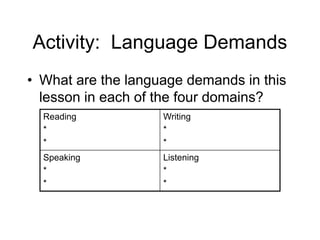
Activity: Language Demands
• What are the language demands in this
lesson in each of the four domains?
Reading
*
*
Writing
*
*
Speaking
*
*
Listening
*
*
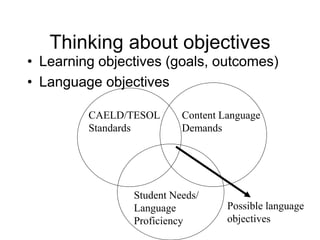
Thinking about objectives
• Learning objectives (goals, outcomes)
• Language objectives
CAELD/TESOL
Standards
Content Language
Demands
Student Needs/
Language
Proficiency
Possible language
objectives
Language Objectives
• Ask yourself, “Based on the language demands of the particular
lesson, my students needs, and the larger goals (unit plan,
district goals, standards, etc.), what do I want students to be
able to do at the end of the lesson?”
• Write objectives that have measurable outcomes, and are
specific to the language you would like to see your students
demonstrating in one or more of the four domains.
Activity: From Lg. Demands
to Lg. Objectives
• If you were going to ask a university-level ELL
to do this activity, what might you focus on
and how might you support work toward that
objective?
• With a partner, select a language demand,
write an objective and brainstorm ideas for
how you might support the objective.
Comprehensible Input and
Language Demands
• Speech appropriate for proficiency level
• Clear explanation of academic tasks
• A variety of techniques use to make content concepts
clear
Language Demands
• An analysis for language demands tells you what
students will need to do with language in order to be
success with the lesson/task. What else can you use
language demands for?
• Design mini-lessons around specific language skills (anything from
pronunciation to skills to enter a conversation)
• Know the challenges that students face and be ready to support students in the
areas that are of particular struggle (and note commonalities to use for future
planning)
• Adjust instruction to support students in the areas you anticipate will be
challenging
• Adjust assessments accordingly--take the language demands into account when
you look at student products.
Today’s strategies
• Sharing objectives
• Think-Write-Share
• Graphic organizer for note-taking
• Visual representation of information
• Moving from own experience to more abstract
• Structured reading response
• 3-2-1 Activity
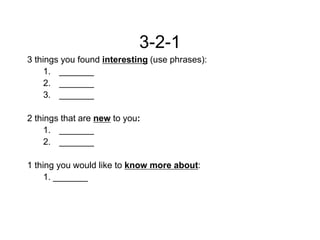
3-2-1
3 things you found interesting (use phrases):
1. _______
2. _______
3. _______
2 things that are new to you:
1. _______
2. _______
1 thing you would like to know more about:
1. _______

SIOP.ppt

  • 1.
  • 2.
    Our objectives • Tolearn about the SIOP as an effective planning tool for educating ELLs • To think about the elements of the SIOP in relation to our particular planning needs • To gather an array of teaching strategies that are effective for working with ELLs • To provide enough information to get you started as a teacher for ELLs, AND to encourage you to continue growing as a professional educator
  • 3.
    What is theSIOP? • A planning tool and observation protocol representing an effort to define, develop and test a model for sheltered instruction (SDAIE) – Research-based – Designed as an observation instrument – Adapted as a lesson planning tool – Teacher-researchers involved in all phases!!!!
  • 4.
    SIOP: An Integrated Approach •Instructional methods integrate language and content • Focus on identifying, explicitly teaching, and providing opportunities to use the language necessary to access, to fully participate in and to be successful with the curriculum • Language instruction occurs within content instruction--not as an “add-on”
  • 5.
    Sheltered Instruction Observation Protocol Components •Preparation • Building Background • Comprehensible Input • Strategies • Interaction • Practice/Application • Effective lesson delivery • Lesson review/Assessment
  • 6.
    Preparation • Clearly definedcontent objectives • Clearly defined language objectives ***** • Content concepts appropriate for age and educational level of students • Supplementary materials used to a high degree • Adaptation of content to all levels of student proficiency • Meaningful activities that integrate lesson concepts with opportunities to use language
  • 7.
    Activity: Think, Write,Share --Review reading from today (use your book). --Take notes on important points. --Talk with your tablemates. Take notes on what each person says.
  • 8.
    Activity: Language Demands •What are the language demands in this lesson in each of the four domains? Reading * * Writing * * Speaking * * Listening * *
  • 9.
    Thinking about objectives •Learning objectives (goals, outcomes) • Language objectives CAELD/TESOL Standards Content Language Demands Student Needs/ Language Proficiency Possible language objectives
  • 10.
    Language Objectives • Askyourself, “Based on the language demands of the particular lesson, my students needs, and the larger goals (unit plan, district goals, standards, etc.), what do I want students to be able to do at the end of the lesson?” • Write objectives that have measurable outcomes, and are specific to the language you would like to see your students demonstrating in one or more of the four domains.
  • 11.
    Activity: From Lg.Demands to Lg. Objectives • If you were going to ask a university-level ELL to do this activity, what might you focus on and how might you support work toward that objective? • With a partner, select a language demand, write an objective and brainstorm ideas for how you might support the objective.
  • 12.
    Comprehensible Input and LanguageDemands • Speech appropriate for proficiency level • Clear explanation of academic tasks • A variety of techniques use to make content concepts clear
  • 13.
    Language Demands • Ananalysis for language demands tells you what students will need to do with language in order to be success with the lesson/task. What else can you use language demands for? • Design mini-lessons around specific language skills (anything from pronunciation to skills to enter a conversation) • Know the challenges that students face and be ready to support students in the areas that are of particular struggle (and note commonalities to use for future planning) • Adjust instruction to support students in the areas you anticipate will be challenging • Adjust assessments accordingly--take the language demands into account when you look at student products.
  • 14.
    Today’s strategies • Sharingobjectives • Think-Write-Share • Graphic organizer for note-taking • Visual representation of information • Moving from own experience to more abstract • Structured reading response • 3-2-1 Activity
  • 15.
    3-2-1 3 things youfound interesting (use phrases): 1. _______ 2. _______ 3. _______ 2 things that are new to you: 1. _______ 2. _______ 1 thing you would like to know more about: 1. _______