Presented toTitle IIILeads
November 17, 2010
Magdalena Ruz Gonzalez, LACO and Lizette Diaz, SBCSS
Chapter 5: Programs and Practices for Effective
Sheltered Content Instruction
Jana Echevarria and Deborah Short
2.
Outcomes of thisChapter
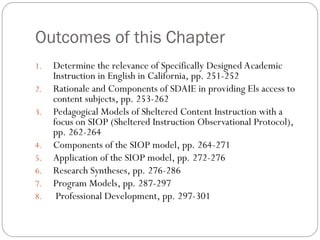
1. Determine the relevance of Specifically Designed Academic
Instruction in English in California, pp. 251-252
2. Rationale and Components of SDAIE in providing Els access to
content subjects, pp. 253-262
3. Pedagogical Models of Sheltered Content Instruction with a
focus on SIOP (Sheltered Instruction Observational Protocol),
pp. 262-264
4. Components of the SIOP model, pp. 264-271
5. Application of the SIOP model, pp. 272-276
6. Research Syntheses, pp. 276-286
7. Program Models, pp. 287-297
8. Professional Development, pp. 297-301
3.
Determine the relevanceof Specifically Designed
Academic Instruction in English in California
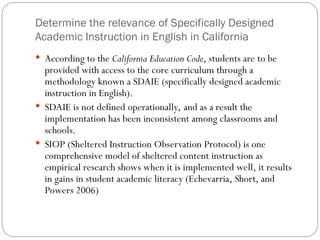
According to the California Education Code, students are to be
provided with access to the core curriculum through a
methodology known a SDAIE (specifically designed academic
instruction in English).
SDAIE is not defined operationally, and as a result the
implementation has been inconsistent among classrooms and
schools.
SIOP (Sheltered Instruction Observation Protocol) is one
comprehensive model of sheltered content instruction as
empirical research shows when it is implemented well, it results
in gains in student academic literacy (Echevarria, Short, and
Powers 2006)
4.
Rationale and Componentsof SDAIE in
providing Els access to content subjects
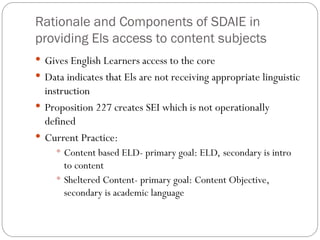
Gives English Learners access to the core
Data indicates that Els are not receiving appropriate linguistic
instruction
Proposition 227 creates SEI which is not operationally
defined
Current Practice:
Content based ELD- primary goal: ELD, secondary is intro
to content
Sheltered Content- primary goal: Content Objective,
secondary is academic language
5.
The Need forAcademic Language
Defining academic language is complex- the
intersect of language, content and tasks
TASK-Language & Task-Content & Language-
Content & Task (see 5.2 , p 261)
6.
Pedagogical Models ofSheltered Content Instruction with
a focus on SIOP
(Sheltered Instruction Observational Protocol)
CALLA (Cognitive Academic Language Learning Approach) was
created in the mid 1980s, (Chamot and O’Malley 1987,1994)
A model designed to develop academic English skills through
explicit instruction and use of language strategies
These learning strategies, characterized by Chamot and
O’Malley as metacognitive, cognitive and social/affective.
SDAIE (Specially Designed Academic Instruction in English)
California Teaching Credentialing defines SDAIE as “a
component of a comprehensive program for English learners,
consisting of strategies, materials and techniques to provide
those at intermediate and advanced level of English access to
grade-level core curriculum in English.”
However, while valuable these are not sufficient to ensure access
to content for English Learners…
7.
SIOP
SIOP (ShelteredInstruction Observation Protocol) has a research
base for over 10 years.
While it began as a lesson observation protocol to guide
researchers in 1996, it evolved into a lesson planning and delivery
approach.
This sheltered instruction model was field tested over four years
on teacher implementation and student effects.
Finally, in 2000, the final format consisting of 30 features
organized into 8 components was realized by Echevarria, Vogt
and Short 2000, 2004, 2008).
8.
The Evolution ofSheltered Instruction.
See figure 5.1 (p. 256)
Grammar translation approach
Direct Method- Audiolingual-Communicative approach
Content learning emphasis
English skill development in subject areas
Access through SDAIE strategies.
Content and language development emphasis
9.
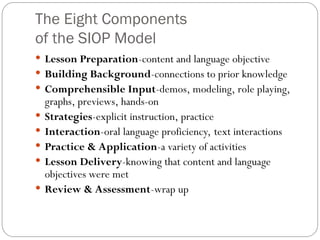
The Eight Components
ofthe SIOP Model
Lesson Preparation-content and language objective
Building Background-connections to prior knowledge
Comprehensible Input-demos, modeling, role playing,
graphs, previews, hands-on
Strategies-explicit instruction, practice
Interaction-oral language proficiency, text interactions
Practice & Application-a variety of activities
Lesson Delivery-knowing that content and language
objectives were met
Review & Assessment-wrap up
10.
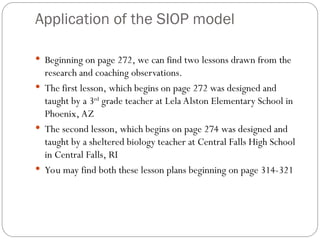
Application of theSIOP model
Beginning on page 272, we can find two lessons drawn from the
research and coaching observations.
The first lesson, which begins on page 272 was designed and
taught by a 3rd
grade teacher at Lela Alston Elementary School in
Phoenix, AZ
The second lesson, which begins on page 274 was designed and
taught by a sheltered biology teacher at Central Falls High School
in Central Falls, RI
You may find both these lesson plans beginning on page 314-321
11.
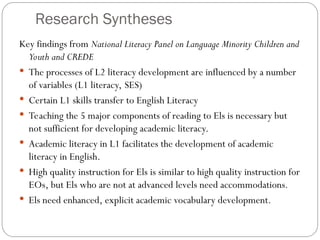
Research Syntheses
Key findingsfrom National Literacy Panel on Language Minority Children and
Youth and CREDE
The processes of L2 literacy development are influenced by a number
of variables (L1 literacy, SES)
Certain L1 skills transfer to English Literacy
Teaching the 5 major components of reading to Els is necessary but
not sufficient for developing academic literacy.
Academic literacy in L1 facilitates the development of academic
literacy in English.
High quality instruction for Els is similar to high quality instruction for
EOs, but Els who are not at advanced levels need accommodations.
Els need enhanced, explicit academic vocabulary development.
12.
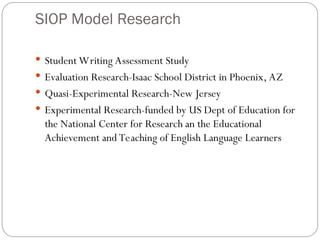
SIOP Model Research
Student Writing Assessment Study
Evaluation Research-Isaac School District in Phoenix, AZ
Quasi-Experimental Research-New Jersey
Experimental Research-funded by US Dept of Education for
the National Center for Research an the Educational
Achievement and Teaching of English Language Learners
13.
Future Research?
Placementof Els in sheltered courses
Instructional grouping configuration
Empirical research on other models of sheltered instruction
Most effective instructional features
Instruction for beginning speakers and Newcomers
14.
Program Models
ShelteredInstruction is both instructional pedagogy and program
design to help give access to the core content for Els.
Successful programs as discussed in other chapters of this book,
are designed around a district’s goals, resources and needs of their
Els students.
EL students may take a combination of program models, for
example ELD (English Language Development) and Sheltered
classes in the content areas.
Emperical evidence is not available to support whether EL
students should be grouped homogeneously in sheltered courses
or mixed with former Els and EOs.
15.
Program implementation should
consider:
Scheduling for students
Access to and completion of courses necessary to graduate
from HS
Flexible pathways into regular curriculum
Explicit timeline and set of coursework
Extension of the school day, before, after, or summer.
16.
Sheltered Instruction Programs
Goals where learners can acquire content knowledge, concepts, and
skills at the same time that they improve their English language skills.
Specifically developed curricula that include language goals supported
by strategies and techniques to support content standards and increase
literacy skills.
Els in Special Education benefit as well from these and other effective
instructional components that address their language needs.
Two case studies, Lela Alston Elementary School, Phoenix, AZ and
Hoover High School, San Diego, CA are highlighted
17.
Programs …continued
Newcomer
Designedfor recent immigrants with little or no English skills placed
in specialized language setting designed to accelerate the gaps in
their educational background and integrate them into the US school
system. Usually for a limited period of time, use of ESL, primary
language, bilingual or sheltered instruction.
General Education Classes
Els or former Els (Redesigned Fluent English Proficient) may have a
wide range of academic proficiency levels. Utilizing multiple data
sources, helps identify how to group students strategically. Partner
and group work help facilitate differentiation so students may work
at their own level. In practice, many teachers make little attempt to
differentiate lessons to meet the individual needs of Els.
18.
Professional Development
Effective SIOPProfessional Development includes:
-PLC
-Reflection on practices
-Discussing the implementation
-Coaching with knowledgeable trainers
-Modeling of lessons
-Refining lesson plans based on student assessment
-Agreed upon strategies implemented school-wide
19.
Conclusion
SIOP isa comprehensive model of instruction for lesson
planning, delivery, and reflection.Without systematic,
language development, students never develop the
requisite academic language skills needed for success in
mainstream classes, for meeting content standards and
for passing standardized assessments in their second
language.