Classification of Wounds
 Abrasions
 Avulsions
 Incisions
 Lacerations
 Punctures
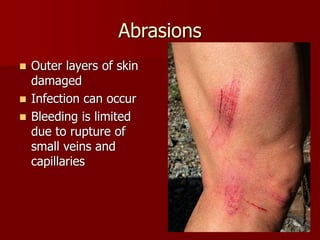
Abrasions
 Outer layers of skin
damaged
 Infection can occur
 Bleeding is limited
due to rupture of
small veins and
capillaries
Avulsions
 Forcible separation or
tearing of tissue from
the body
 Bleeding occurs
immediately
Incision
 Wound with smooth
sides/edges
 Caused by sharp
object
 Severe bleeding can
exist
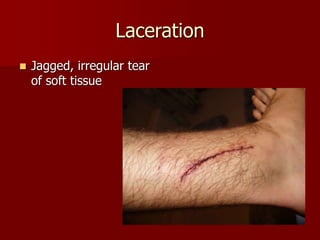
Laceration
 Jagged, irregular tear
of soft tissue
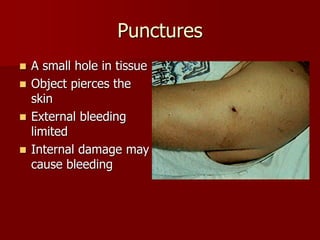
Punctures
 A small hole in tissue
 Object pierces the
skin
 External bleeding
limited
 Internal damage may
cause bleeding
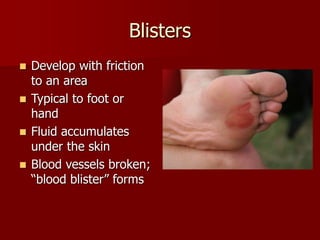
Blisters
 Develop with friction
to an area
 Typical to foot or
hand
 Fluid accumulates
under the skin
 Blood vessels broken;
“blood blister” forms
Blister Treatment
 2 types of treatment
– Pop blister
– Cover without popping
 If blister is open,
remove as much skin
as possible and keep
covered to prevent
infection
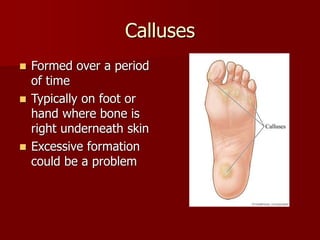
Calluses
 Formed over a period
of time
 Typically on foot or
hand where bone is
right underneath skin
 Excessive formation
could be a problem
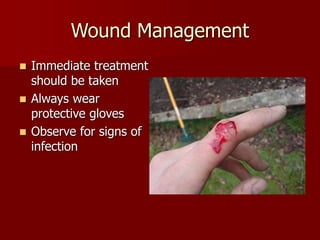
Wound Management
 Immediate treatment
should be taken
 Always wear
protective gloves
 Observe for signs of
infection
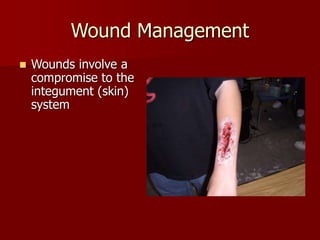
Wound Management
 Wounds involve a
compromise to the
integument (skin)
system
Signs of Infection
 Signs of Infection
– Pain
– Swelling
– Redness
– Heat
– Loss of function
– Fever
– Puss formation

Classification of Wounds.ppt