Chapter 3
Classification
Muhammad Umar
UIAI Lab
Table of Contents
 Introduction
 Dataset Exploration
 Loading and Preprocessing Data
 Confusion Matrix
 Precision Recall and F1 Score
 Comparison of Performance Metrices
 Error Analysis
 Summary
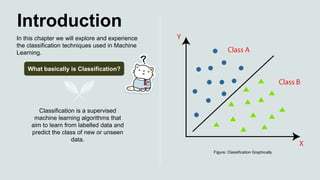
Introduction
Figure: Classification Graphically
What basically is Classification?
Classification is a supervised
machine learning algorithms that
aim to learn from labelled data and
predict the class of new or unseen
data.
In this chapter we will explore and experience
the classification techniques used in Machine
Learning.
MNIST Dataset
Dataset Images = 70000 images
28x28 pixels = 784 pixels (features)
Every MNIST data point has two parts:
• Image of the handwritten digit
• Corresponding label (0-9)
Figure: MNIST Dataset
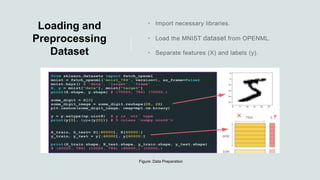
Loading and
Preprocessing
Dataset
•
•
•
Figure: Data Preparation
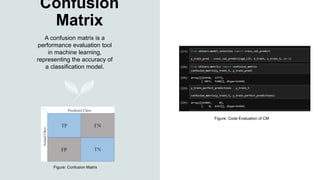
Confusion
Matrix
Figure: Confusion Matrix
A confusion matrix is a
performance evaluation tool
in machine learning,
representing the accuracy of
a classification model.
Figure: Code Evaluation of CM
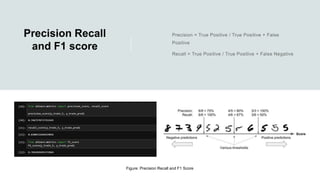
Precision Recall
and F1 score
Figure: Precision Recall and F1 Score
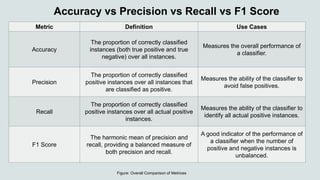
Accuracy vs Precision vs Recall vs F1 Score
Metric Definition Use Cases
Accuracy
The proportion of correctly classified
instances (both true positive and true
negative) over all instances.
Measures the overall performance of
a classifier.
Precision
The proportion of correctly classified
positive instances over all instances that
are classified as positive.
Measures the ability of the classifier to
avoid false positives.
Recall
The proportion of correctly classified
positive instances over all actual positive
instances.
Measures the ability of the classifier to
identify all actual positive instances.
F1 Score
The harmonic mean of precision and
recall, providing a balanced measure of
both precision and recall.
A good indicator of the performance of
a classifier when the number of
positive and negative instances is
unbalanced.
Figure: Overall Comparison of Metrices
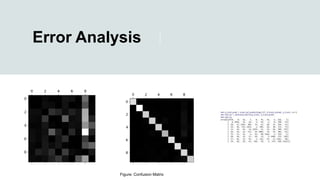
Error Analysis
Figure: Confusion Matrix
Summary
Accuracy metrics
Confusion Matrix
Precision
Recall
F1 Score
Error Analysis
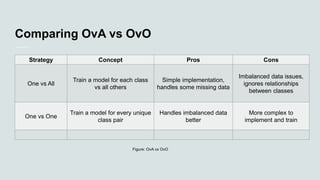
Comparing OvA vs OvO
Strategy Concept Pros Cons
One vs All
Train a model for each class
vs all others
Simple implementation,
handles some missing data
Imbalanced data issues,
ignores relationships
between classes
One vs One
Train a model for every unique
class pair
Handles imbalanced data
better
More complex to
implement and train
Figure: OvA vs OvO
Thank You

Classification Chapter 3 Hands on Machine Learning Book

  • 1.
  • 2.
    Table of Contents Introduction  Dataset Exploration  Loading and Preprocessing Data  Confusion Matrix  Precision Recall and F1 Score  Comparison of Performance Metrices  Error Analysis  Summary
  • 3.
    Introduction Figure: Classification Graphically Whatbasically is Classification? Classification is a supervised machine learning algorithms that aim to learn from labelled data and predict the class of new or unseen data. In this chapter we will explore and experience the classification techniques used in Machine Learning.
  • 4.
    MNIST Dataset Dataset Images= 70000 images 28x28 pixels = 784 pixels (features) Every MNIST data point has two parts: • Image of the handwritten digit • Corresponding label (0-9) Figure: MNIST Dataset
  • 5.
  • 6.
    Confusion Matrix Figure: Confusion Matrix Aconfusion matrix is a performance evaluation tool in machine learning, representing the accuracy of a classification model. Figure: Code Evaluation of CM
  • 7.
    Precision Recall and F1score Figure: Precision Recall and F1 Score
  • 8.
    Accuracy vs Precisionvs Recall vs F1 Score Metric Definition Use Cases Accuracy The proportion of correctly classified instances (both true positive and true negative) over all instances. Measures the overall performance of a classifier. Precision The proportion of correctly classified positive instances over all instances that are classified as positive. Measures the ability of the classifier to avoid false positives. Recall The proportion of correctly classified positive instances over all actual positive instances. Measures the ability of the classifier to identify all actual positive instances. F1 Score The harmonic mean of precision and recall, providing a balanced measure of both precision and recall. A good indicator of the performance of a classifier when the number of positive and negative instances is unbalanced. Figure: Overall Comparison of Metrices
  • 9.
  • 10.
  • 11.
    Comparing OvA vsOvO Strategy Concept Pros Cons One vs All Train a model for each class vs all others Simple implementation, handles some missing data Imbalanced data issues, ignores relationships between classes One vs One Train a model for every unique class pair Handles imbalanced data better More complex to implement and train Figure: OvA vs OvO
  • 12.