Classical Model White and Billings
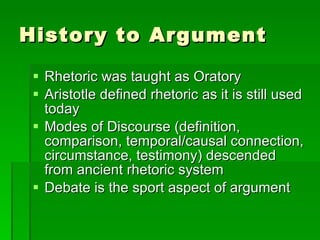
History to Argument Rhetoric was taught as Oratory Aristotle defined rhetoric as it is still used today Modes of Discourse (definition, comparison, temporal/causal connection, circumstance, testimony) descended from ancient rhetoric system Debate is the sport aspect of argument
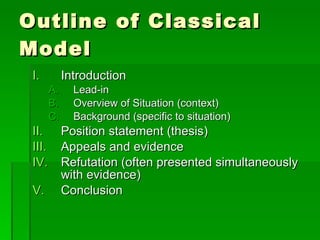
Outline of Classical Model Introduction Lead-in Overview of Situation (context) Background (specific to situation) Position statement (thesis) Appeals and evidence Refutation (often presented simultaneously with evidence) Conclusion
Exercise 3.1 pg 86 Read and answer questions 1-4
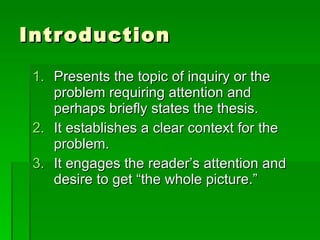
Introduction Presents the topic of inquiry or the problem requiring attention and perhaps briefly states the thesis. It establishes a clear context for the problem. It engages the reader’s attention and desire to get “the whole picture.”
Position Statement State the claim
Evidence and Appeals Pathos, Ethos, Logos Direct and Indirect Evidence DE consists of data from surveys, scientific experiments, case-in-point, etc IE consists of formal analytical and mathematical reasoning Example: Step-by-step analysis of causes that lead to inevitable effects
Use emotional appeals by playing on readers needs: Safety, love, youth, tradition, strength or power, compassion, etc.
Combining Appeals Evidence must be tested for Relevance, accuracy, thoroughness, and timeliness Relevance – evidence must relate directly to the claims being made Accuracy – Double-check, precision relevant to what is being argued Thoroughness – evidence must cover every facet or implication of the claim Timeliness – appropriately recent
Refutation Def: the reference to opposing viewpoints and rebutting them. The aim of refutation is to demonstarte the limitations or errors of challenging views.
Conclusion The minimal task of a conclusion is to provide a final wisdom about the thesis just argued.
Exercise 3.2  pg 100 Read and answer question 3
Exercise 3.3  pg 103 Read and answer questions 1-2

Classical Model of Argument

  • 1.
  • 2.
    History to ArgumentRhetoric was taught as Oratory Aristotle defined rhetoric as it is still used today Modes of Discourse (definition, comparison, temporal/causal connection, circumstance, testimony) descended from ancient rhetoric system Debate is the sport aspect of argument
  • 3.
    Outline of ClassicalModel Introduction Lead-in Overview of Situation (context) Background (specific to situation) Position statement (thesis) Appeals and evidence Refutation (often presented simultaneously with evidence) Conclusion
  • 4.
    Exercise 3.1 pg86 Read and answer questions 1-4
  • 5.
    Introduction Presents thetopic of inquiry or the problem requiring attention and perhaps briefly states the thesis. It establishes a clear context for the problem. It engages the reader’s attention and desire to get “the whole picture.”
  • 6.
  • 7.
    Evidence and AppealsPathos, Ethos, Logos Direct and Indirect Evidence DE consists of data from surveys, scientific experiments, case-in-point, etc IE consists of formal analytical and mathematical reasoning Example: Step-by-step analysis of causes that lead to inevitable effects
  • 8.
    Use emotional appealsby playing on readers needs: Safety, love, youth, tradition, strength or power, compassion, etc.
  • 9.
    Combining Appeals Evidencemust be tested for Relevance, accuracy, thoroughness, and timeliness Relevance – evidence must relate directly to the claims being made Accuracy – Double-check, precision relevant to what is being argued Thoroughness – evidence must cover every facet or implication of the claim Timeliness – appropriately recent
  • 10.
    Refutation Def: thereference to opposing viewpoints and rebutting them. The aim of refutation is to demonstarte the limitations or errors of challenging views.
  • 11.
    Conclusion The minimaltask of a conclusion is to provide a final wisdom about the thesis just argued.
  • 12.
    Exercise 3.2 pg 100 Read and answer question 3
  • 13.
    Exercise 3.3 pg 103 Read and answer questions 1-2