STRAW MAN
FALLACY
JENNILYN R. BALUSDAN
WHAT IS FALLACY?
WHAT IS STRAW MAN
FALLACY?
Define FALLACY
DEFINE STRAW MAN
FALLACY
OBJECTIVES:
Sharing of experiences
about straw man fallacy
WHAT ARE THE
EXAMPLES OF STRAW
MAN FALLACY?
Overcoming scenarios with
a straw man
HOW TO
COUNTER A
STRAW MAN?
WHAT IS FALLACY?
• a failure in reasoning which renders an argument
invalid.
• a mistaken belief, especially one based on unsound
argument.
• an idea which many people believe to be true, but
which is in fact false because it is based on
incorrect information or reasoning.
STRAW MAN
FALLACY
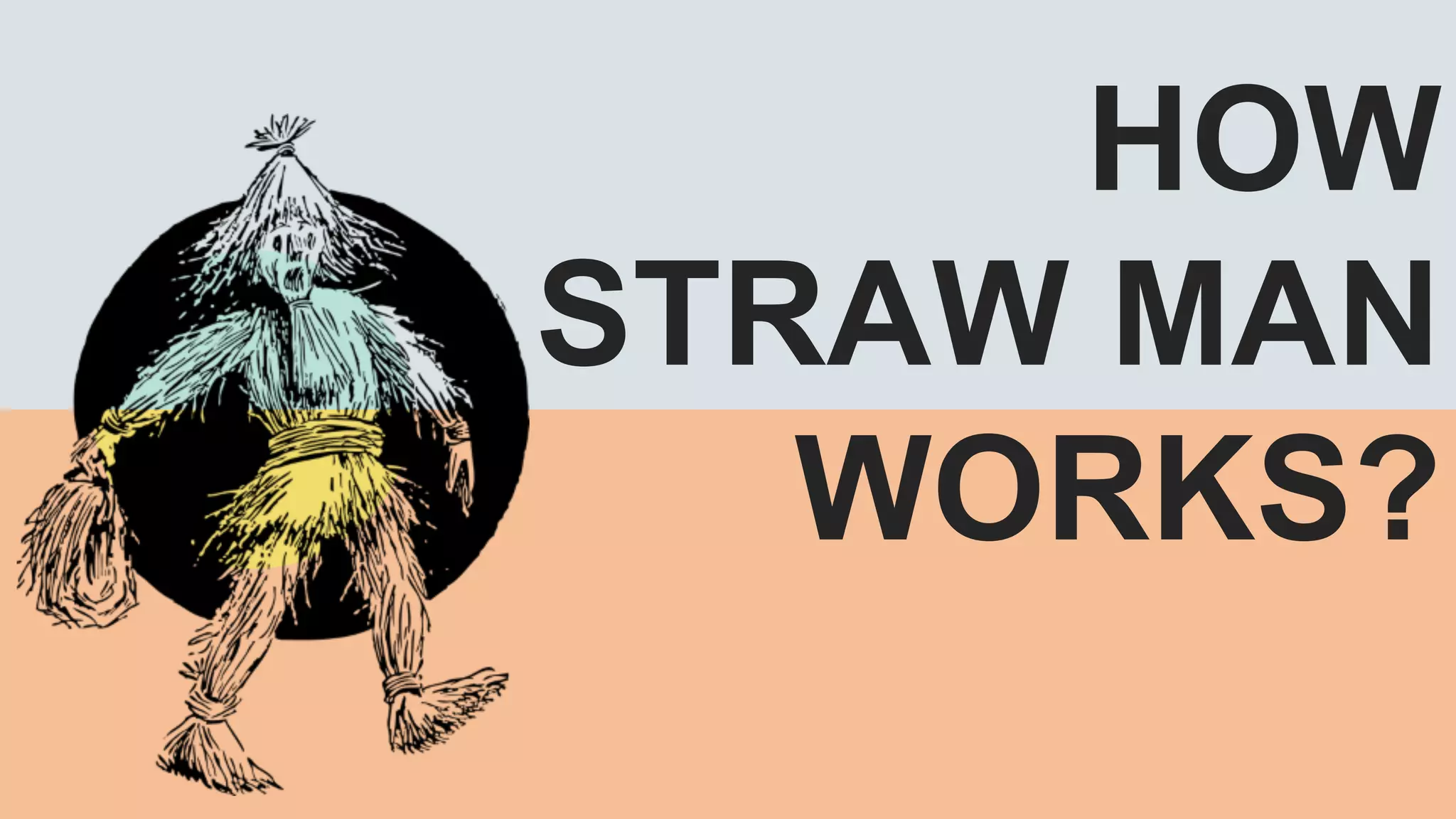
The straw man fallacy occurs when person B takes
an argument from person A and refutes a related but
more susceptible argument in the place of the original
argument.
A straw man fallacy occurs when
someone takes another person’s
argument or point, distorts it or
exaggerates it in some kind of extreme
way, and then attacks the extreme
distortion, as if that is really the claim
the first person is making.
HOW
STRAW MAN
WORKS?
In general, the use of a straw man consists of the following
three stages:
1. First, person A states their position.
2. Then, person B presents a distorted version of person A’s
original position, while pretending that there’s no
difference between the two versions.
3. Finally, person B attacks the distorted version of person
A’s position, and acts as if this invalidates person A’s
original argument.
Essentially, person B creates a strawman, which is
a distorted version of their opponent’s original argument,
which makes it easier for them to attack their opponent’s
S
T
R
A
W
M
A
N
F A L L A C Y
How to Spot a Straw Man Argument?
The straw man argument is sometimes tricky to spot when you
focus on the argument without looking at the whole context.
Another reason it’s difficult to spot is that straw man arguments are
a form of verbal manipulation.
But it’s essential to learn how to spot a straw man fallacy so you
know how to make a rebuttal. Here are some strategies people
use to create distorted images of a claim.
1.Oversimplifying or creating a hasty generalization.
2.Focusing on a few aspects of the argument.
3.Quoting parts of the claim out of context.
4.Arguing against extreme opinions which the opponent didn’t use.
EXAMPLES
OF STRAW
MAN
FALLACY
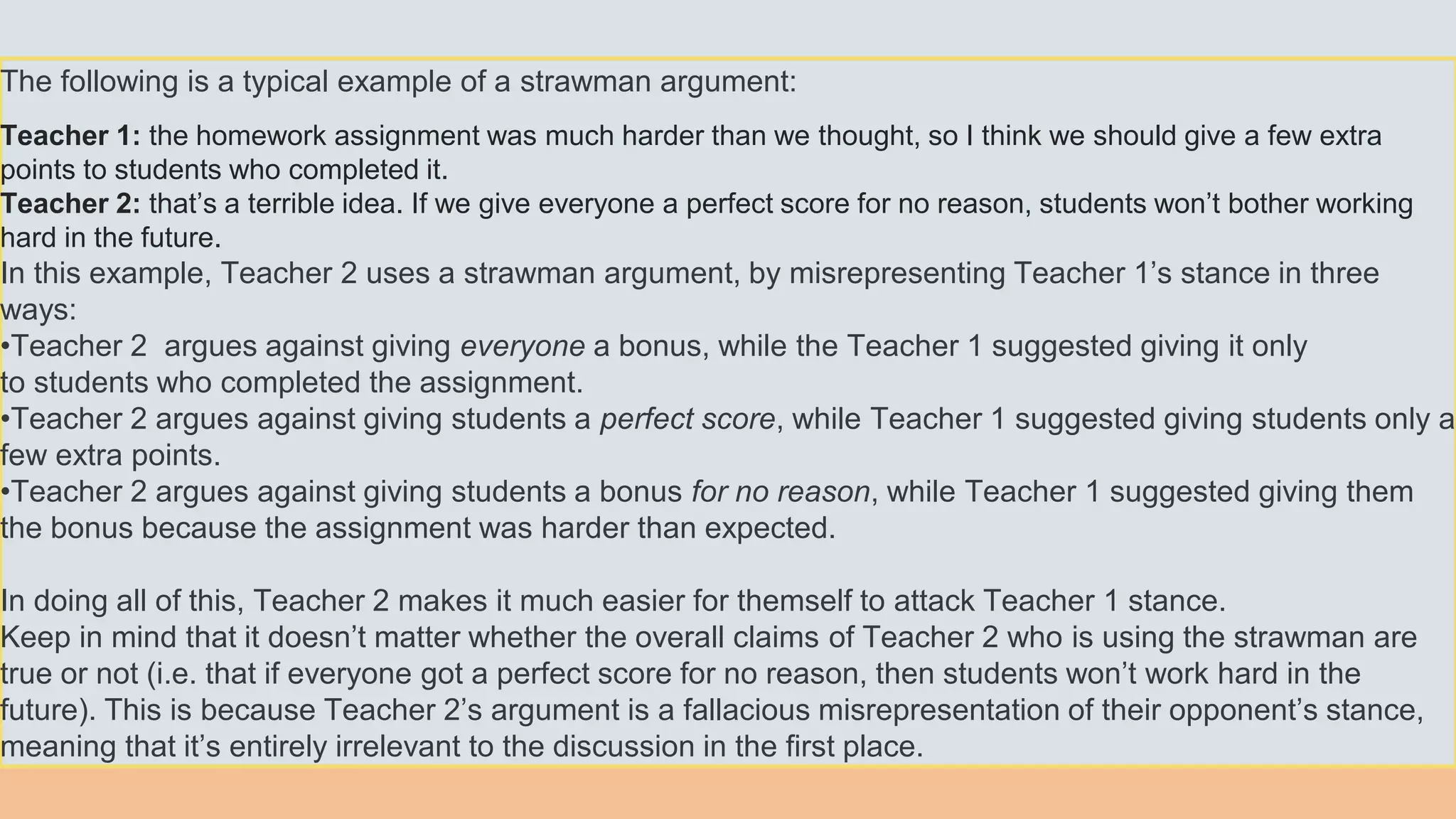
The following is a typical example of a strawman argument:
Teacher 1: the homework assignment was much harder than we thought, so I think we should give a few extra
points to students who completed it.
Teacher 2: that’s a terrible idea. If we give everyone a perfect score for no reason, students won’t bother working
hard in the future.
In this example, Teacher 2 uses a strawman argument, by misrepresenting Teacher 1’s stance in three
ways:
•Teacher 2 argues against giving everyone a bonus, while the Teacher 1 suggested giving it only
to students who completed the assignment.
•Teacher 2 argues against giving students a perfect score, while Teacher 1 suggested giving students only a
few extra points.
•Teacher 2 argues against giving students a bonus for no reason, while Teacher 1 suggested giving them
the bonus because the assignment was harder than expected.
In doing all of this, Teacher 2 makes it much easier for themself to attack Teacher 1 stance.
Keep in mind that it doesn’t matter whether the overall claims of Teacher 2 who is using the strawman are
true or not (i.e. that if everyone got a perfect score for no reason, then students won’t work hard in the
future). This is because Teacher 2’s argument is a fallacious misrepresentation of their opponent’s stance,
meaning that it’s entirely irrelevant to the discussion in the first place.
Have you engaged in a heated
argument, but they try to exaggerate
your stance? Then you might be a
victim of that person’s straw man
argument.
HOW TO
COUNTER
STRAW
MAN?
POINT OUT THE STRAWMAN
Call out your opponent on their use of the
strawman, by explaining why their argument is
fallacious, and how it distorts your original
stance. You can put them on the defensive by
asking them to justify why they believe that the
distorted stance that they present is the same
as the one that you originally proposed; since
the two are different, your opponent will either
IGNORE THE STRAWMAN
You can choose to ignore the distorted
version of your argument that your opponent
presents (i.e. the strawman), and continue to
advocate for your original position. This can be
effective in some cases, but if they continue to
focus on the strawman, you may have to use one
of the two other techniques mentioned here, in
order to ensure that the discussion progresses,
ACCEPT THE STRAWMAN
In some cases, it might be
necessary or preferable for you to
accept a strawman when you’re
defending your stance, meaning that
instead of arguing in favor of your
original stance, you could start
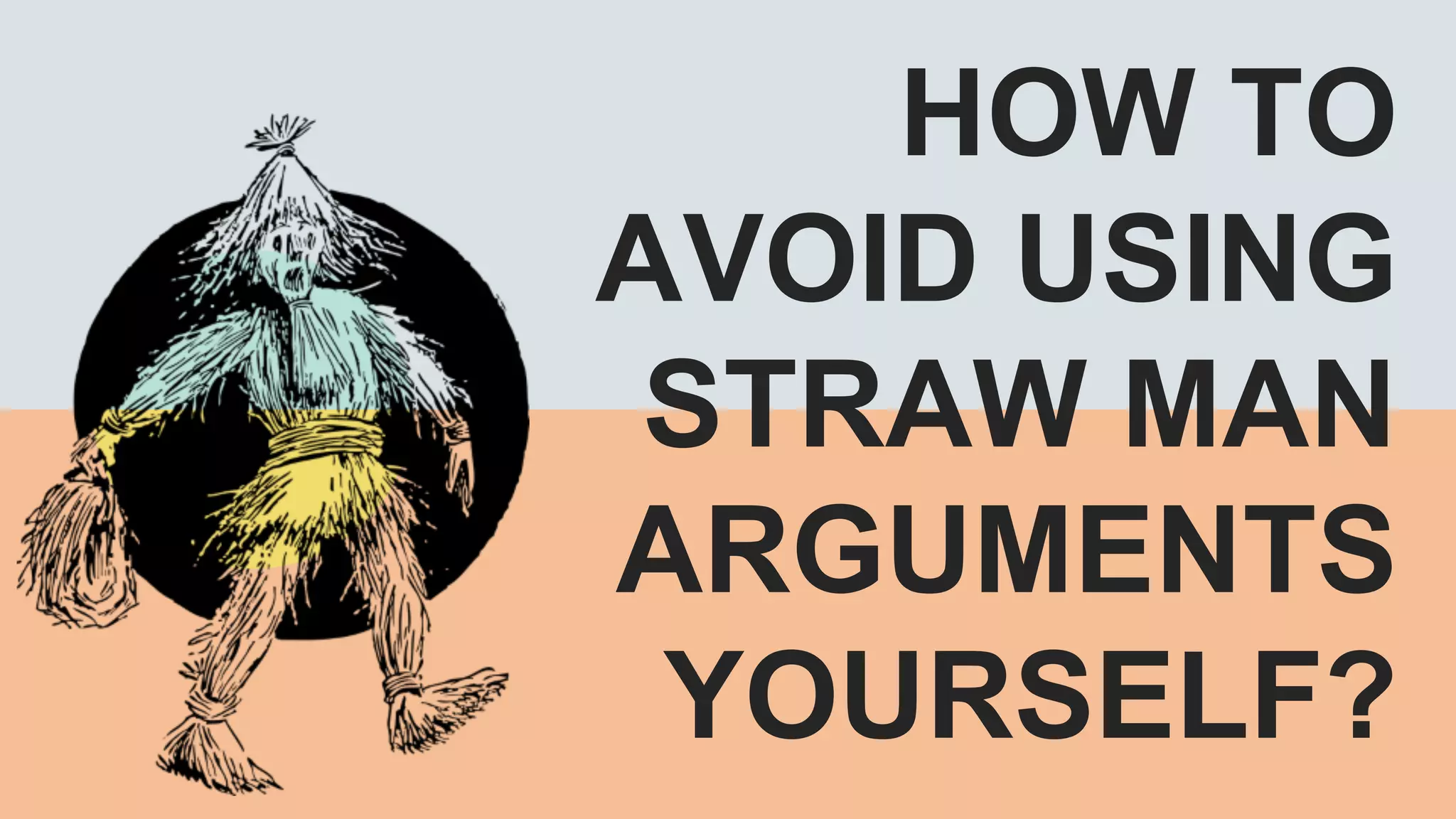
HOW TO
AVOID USING
STRAW MAN
ARGUMENTS
YOURSELF?
It’s important to remember that you might be using
strawman arguments unintentionally. If you identify cases where
this happens, and specifically if you notice instances where you
distort your opponent’s views in order to make them easier for you
to attack, try to keep this distortion in mind, and correct it before
approaching their argument again.
One way to ensure that you’re not using a strawman is to try to re-
express your opponent’s position, and then ask them whether they
agree with your description of their position before you start
arguing against it. This is the best way to make sure that your
opponent agrees with your formulation of their stance, and is a
good way to engage in productive discourse.
“Whenever we
want to combat our
enemies, first and
foremost we must start
by understanding them
rather than exaggerating
their motives”

Strawman Fallacy.pptx

  • 1.
  • 2.
    WHAT IS FALLACY? WHATIS STRAW MAN FALLACY? Define FALLACY DEFINE STRAW MAN FALLACY OBJECTIVES: Sharing of experiences about straw man fallacy WHAT ARE THE EXAMPLES OF STRAW MAN FALLACY? Overcoming scenarios with a straw man HOW TO COUNTER A STRAW MAN?
  • 3.
    WHAT IS FALLACY? •a failure in reasoning which renders an argument invalid. • a mistaken belief, especially one based on unsound argument. • an idea which many people believe to be true, but which is in fact false because it is based on incorrect information or reasoning.
  • 4.
  • 5.
    The straw manfallacy occurs when person B takes an argument from person A and refutes a related but more susceptible argument in the place of the original argument. A straw man fallacy occurs when someone takes another person’s argument or point, distorts it or exaggerates it in some kind of extreme way, and then attacks the extreme distortion, as if that is really the claim the first person is making.
  • 6.
  • 7.
    In general, theuse of a straw man consists of the following three stages: 1. First, person A states their position. 2. Then, person B presents a distorted version of person A’s original position, while pretending that there’s no difference between the two versions. 3. Finally, person B attacks the distorted version of person A’s position, and acts as if this invalidates person A’s original argument. Essentially, person B creates a strawman, which is a distorted version of their opponent’s original argument, which makes it easier for them to attack their opponent’s S T R A W M A N F A L L A C Y
  • 8.
    How to Spota Straw Man Argument? The straw man argument is sometimes tricky to spot when you focus on the argument without looking at the whole context. Another reason it’s difficult to spot is that straw man arguments are a form of verbal manipulation. But it’s essential to learn how to spot a straw man fallacy so you know how to make a rebuttal. Here are some strategies people use to create distorted images of a claim. 1.Oversimplifying or creating a hasty generalization. 2.Focusing on a few aspects of the argument. 3.Quoting parts of the claim out of context. 4.Arguing against extreme opinions which the opponent didn’t use.
  • 9.
  • 10.
    The following isa typical example of a strawman argument: Teacher 1: the homework assignment was much harder than we thought, so I think we should give a few extra points to students who completed it. Teacher 2: that’s a terrible idea. If we give everyone a perfect score for no reason, students won’t bother working hard in the future. In this example, Teacher 2 uses a strawman argument, by misrepresenting Teacher 1’s stance in three ways: •Teacher 2 argues against giving everyone a bonus, while the Teacher 1 suggested giving it only to students who completed the assignment. •Teacher 2 argues against giving students a perfect score, while Teacher 1 suggested giving students only a few extra points. •Teacher 2 argues against giving students a bonus for no reason, while Teacher 1 suggested giving them the bonus because the assignment was harder than expected. In doing all of this, Teacher 2 makes it much easier for themself to attack Teacher 1 stance. Keep in mind that it doesn’t matter whether the overall claims of Teacher 2 who is using the strawman are true or not (i.e. that if everyone got a perfect score for no reason, then students won’t work hard in the future). This is because Teacher 2’s argument is a fallacious misrepresentation of their opponent’s stance, meaning that it’s entirely irrelevant to the discussion in the first place.
  • 11.
    Have you engagedin a heated argument, but they try to exaggerate your stance? Then you might be a victim of that person’s straw man argument.
  • 12.
  • 13.
    POINT OUT THESTRAWMAN Call out your opponent on their use of the strawman, by explaining why their argument is fallacious, and how it distorts your original stance. You can put them on the defensive by asking them to justify why they believe that the distorted stance that they present is the same as the one that you originally proposed; since the two are different, your opponent will either
  • 14.
    IGNORE THE STRAWMAN Youcan choose to ignore the distorted version of your argument that your opponent presents (i.e. the strawman), and continue to advocate for your original position. This can be effective in some cases, but if they continue to focus on the strawman, you may have to use one of the two other techniques mentioned here, in order to ensure that the discussion progresses,
  • 15.
    ACCEPT THE STRAWMAN Insome cases, it might be necessary or preferable for you to accept a strawman when you’re defending your stance, meaning that instead of arguing in favor of your original stance, you could start
  • 16.
    HOW TO AVOID USING STRAWMAN ARGUMENTS YOURSELF?
  • 17.
    It’s important toremember that you might be using strawman arguments unintentionally. If you identify cases where this happens, and specifically if you notice instances where you distort your opponent’s views in order to make them easier for you to attack, try to keep this distortion in mind, and correct it before approaching their argument again. One way to ensure that you’re not using a strawman is to try to re- express your opponent’s position, and then ask them whether they agree with your description of their position before you start arguing against it. This is the best way to make sure that your opponent agrees with your formulation of their stance, and is a good way to engage in productive discourse.
  • 18.
    “Whenever we want tocombat our enemies, first and foremost we must start by understanding them rather than exaggerating their motives”