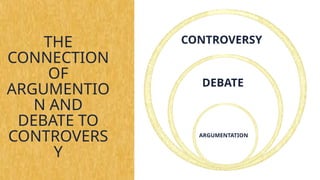
ARGUMENTATIO
N
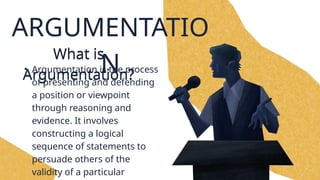
• Argumentation isthe process
of presenting and defending
a position or viewpoint
through reasoning and
evidence. It involves
constructing a logical
sequence of statements to
persuade others of the
validity of a particular
What is
Argumentation?
What is
Argumentation?
What is
Argumentation?
4.
ARGUMENTATION
Why is Argumentation
important?
•Argumentation is crucial because it fosters critical thinking,
enabling individuals to analyze information, evaluate
evidence, and construct logical arguments. It enhances
communication skills, allowing people to express their
ideas clearly and persuasively. In decision-making,
argumentation helps weigh different viewpoints to make
informed choices. It also plays a vital role in conflict
resolution by providing a structured way to address
disagreements rationally. In academic and scientific fields,
argumentation advances knowledge by challenging
existing theories and proposing new ideas. Additionally, it
is essential for persuasion in debates, negotiations, and
everyday conversations, and it underpins democratic
participation by facilitating informed public discourse and
Why is Argumentation
important?
Why is Argumentation
important?
Why is Argumentation
important?
Why is Argumentation
important?
Why is Argumentation
important?
Why is Argumentation
important?
Why is Argumentation
important?
Why is Argumentation
important?
Why is Argumentation
important?
Why is Argumentation
important?
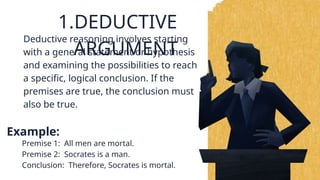
1.DEDUCTIVE
ARGUMENT
Example:
Deductive reasoning involvesstarting
with a general statement or hypothesis
and examining the possibilities to reach
a specific, logical conclusion. If the
premises are true, the conclusion must
also be true.
Premise 1: All men are mortal.
Premise 2: Socrates is a man.
Conclusion: Therefore, Socrates is mortal.
9.
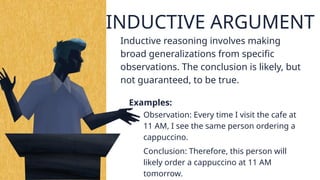
2. INDUCTIVE ARGUMENT
Examples:
Inductivereasoning involves making
broad generalizations from specific
observations. The conclusion is likely, but
not guaranteed, to be true.
Observation: Every time I visit the cafe at
11 AM, I see the same person ordering a
cappuccino.
Conclusion: Therefore, this person will
likely order a cappuccino at 11 AM
tomorrow.
10.
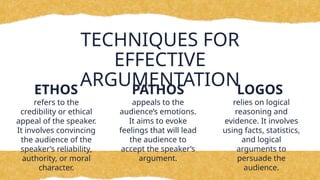
TECHNIQUES FOR
EFFECTIVE
ARGUMENTATION
ETHOS
refers tothe
credibility or ethical
appeal of the speaker.
It involves convincing
the audience of the
speaker’s reliability,
authority, or moral
character.
PATHOS LOGOS
appeals to the
audience’s emotions.
It aims to evoke
feelings that will lead
the audience to
accept the speaker’s
argument.
relies on logical
reasoning and
evidence. It involves
using facts, statistics,
and logical
arguments to
persuade the
audience.
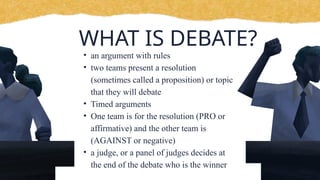
WHAT IS DEBATE?
•an argument with rules
• two teams present a resolution
(sometimes called a proposition) or topic
that they will debate
• Timed arguments
• One team is for the resolution (PRO or
affirmative) and the other team is
(AGAINST or negative)
• a judge, or a panel of judges decides at
the end of the debate who is the winner
13.
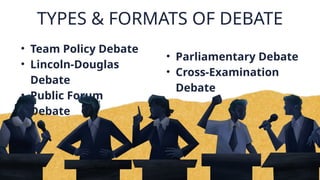
TYPES & FORMATSOF DEBATE
• Team Policy Debate
• Lincoln-Douglas
Debate
• Public Forum
Debate
• Parliamentary Debate
• Cross-Examination
Debate
14.
ADVANTAGES OF
DEBATE
• ImprovedCritical Thinking
Skills
• Enhanced Communication
Skills
• Development of Research
Skills
• Persuasion
• Teamwork and
Collaboration
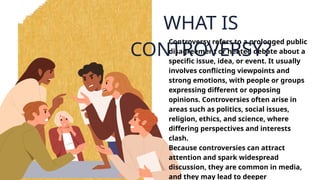
Controversy refers toa prolonged public
disagreement or heated debate about a
specific issue, idea, or event. It usually
involves conflicting viewpoints and
strong emotions, with people or groups
expressing different or opposing
opinions. Controversies often arise in
areas such as politics, social issues,
religion, ethics, and science, where
differing perspectives and interests
clash.
Because controversies can attract
attention and spark widespread
discussion, they are common in media,
and they may lead to deeper
WHAT IS
CONTROVERSY?
21.
TYPES OF CONTROVERSIES
•Political Controversies:
Examples and impact on
society.
• Social Controversies: Issues
related to social norms, ethics,
and values.
• Scientific Controversies:
Disputes in the scientific
community and their
implications.
• Cultural Controversies:
22.
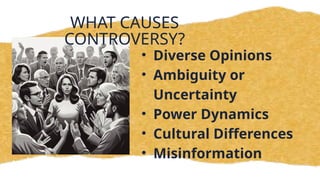
• Diverse Opinions
•Ambiguity or
Uncertainty
• Power Dynamics
• Cultural Differences
• Misinformation
WHAT CAUSES
CONTROVERSY?