Chapter 3
Classic Theories
of Economic
Growth and
Development
Copyright ©2015 Pearson Education, Inc. All rights reserved. 3-2
3.1 Classic Theories of Economic
Development: Four Approaches
• Linear stages of growth model
• Theories and Patterns of structural change
• International-dependence revolution
• Neoclassical, free market counterrevolution
Copyright ©2015 Pearson Education, Inc. All rights reserved. 3-3
3.2 Development as Growth and
Linear-Stages Theories
• A Classic Statement: Rostow’s Stages of
Growth
• Harrod-Domar Growth Model (sometimes
referred to as the AK model)
Copyright ©2015 Pearson Education, Inc. All rights reserved. 3-4
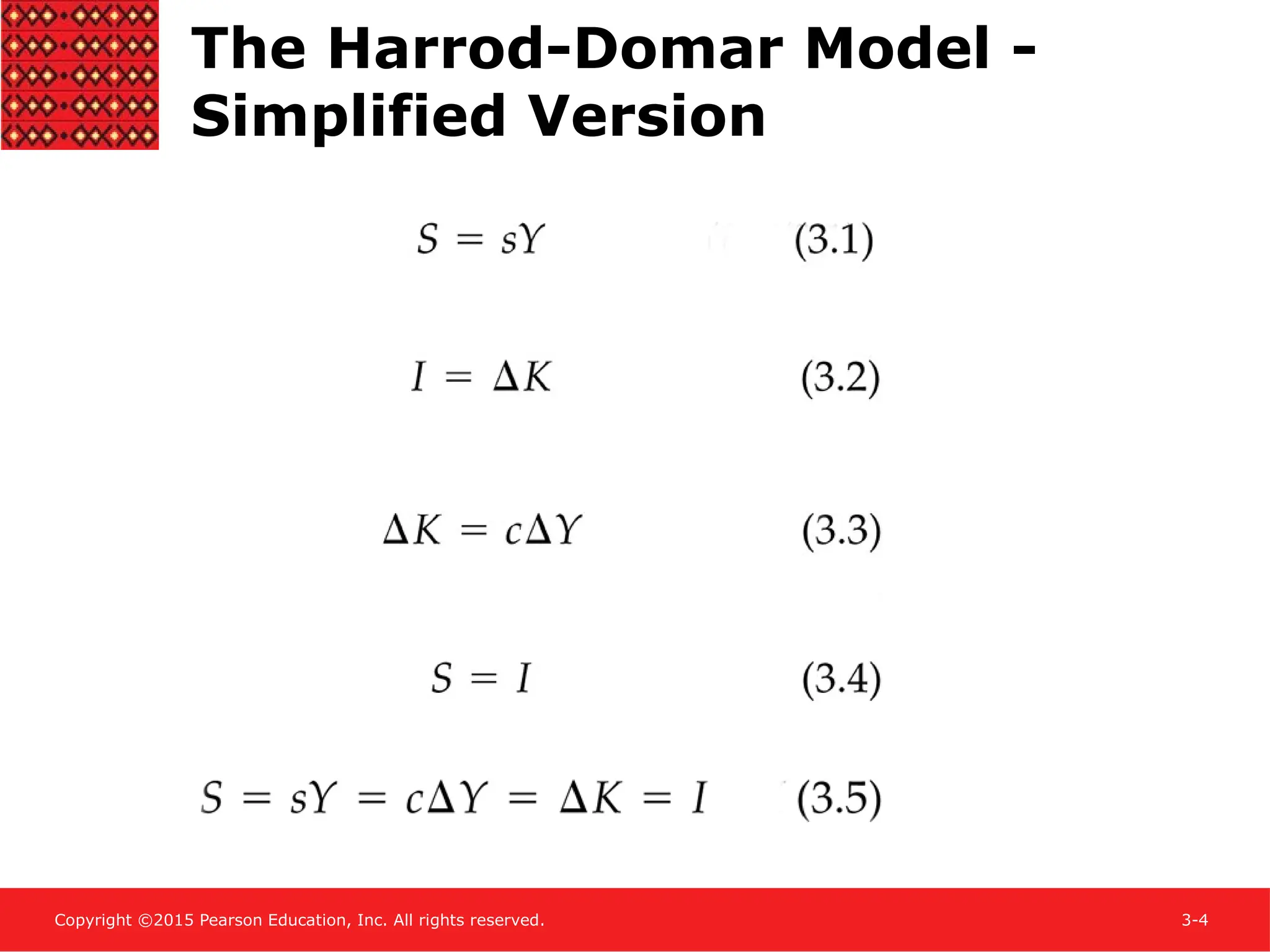
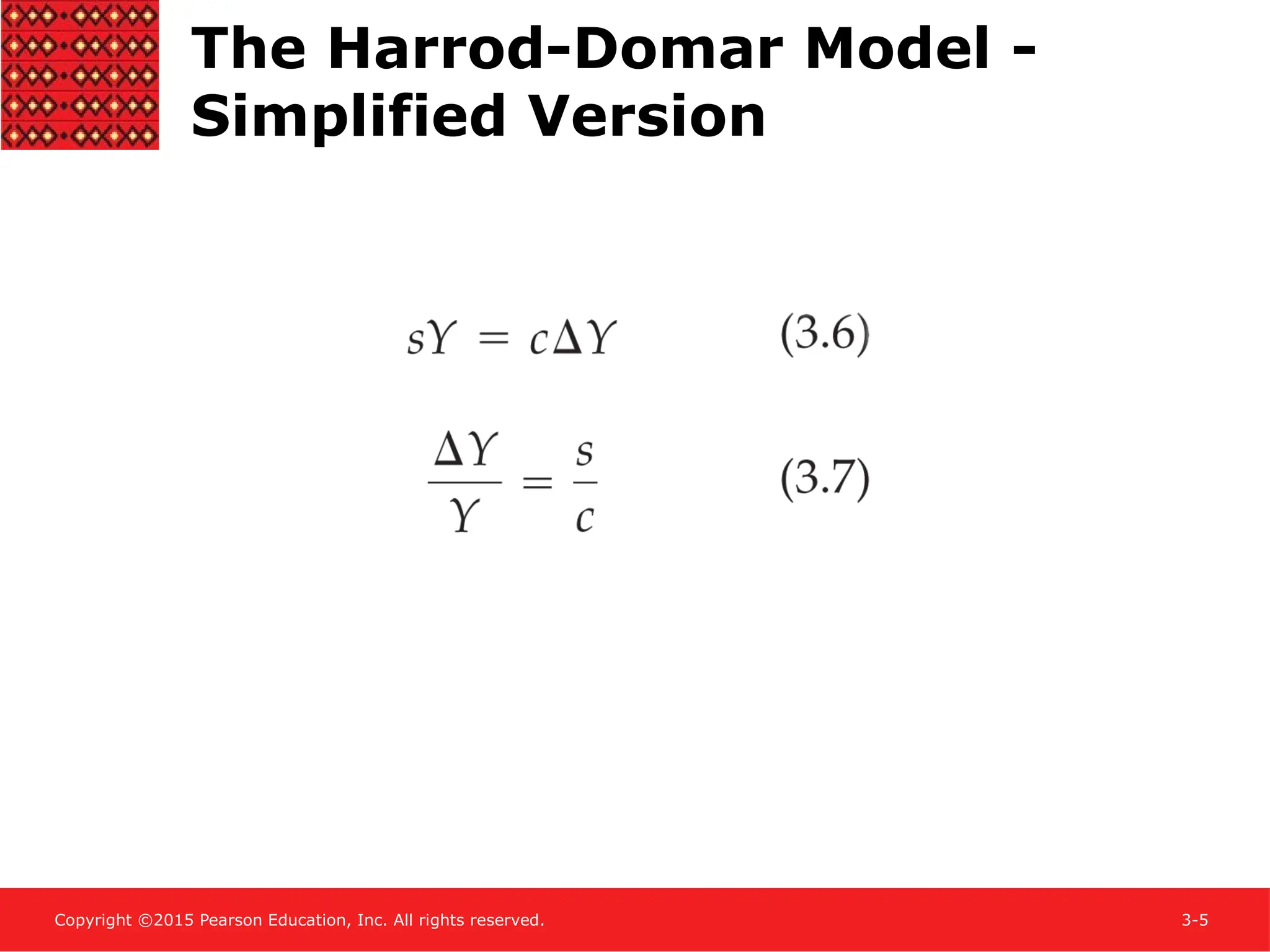
The Harrod-Domar Model -
Simplified Version
Copyright ©2015 Pearson Education, Inc. All rights reserved. 3-5
The Harrod-Domar Model -
Simplified Version
Copyright ©2015 Pearson Education, Inc. All rights reserved. 3-6
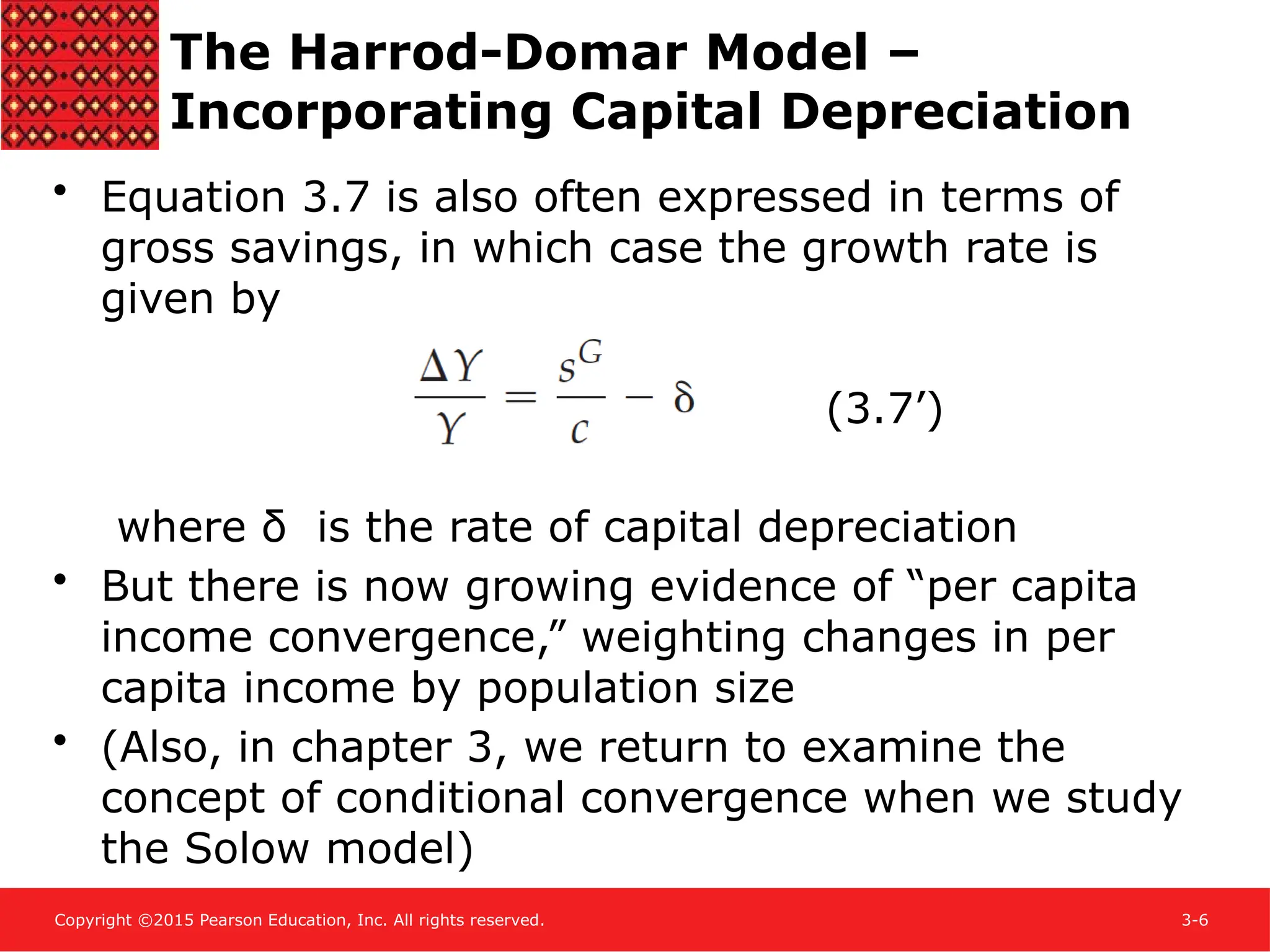
• Equation 3.7 is also often expressed in terms of
gross savings, in which case the growth rate is
given by
(3.7’)
where δ is the rate of capital depreciation
• But there is now growing evidence of “per capita
income convergence,” weighting changes in per
capita income by population size
• (Also, in chapter 3, we return to examine the
concept of conditional convergence when we study
the Solow model)
The Harrod-Domar Model –
Incorporating Capital Depreciation
Copyright ©2015 Pearson Education, Inc. All rights reserved. 3-7
Criticisms of the Stages Model
• Necessary versus sufficient conditions
Copyright ©2015 Pearson Education, Inc. All rights reserved. 3-8
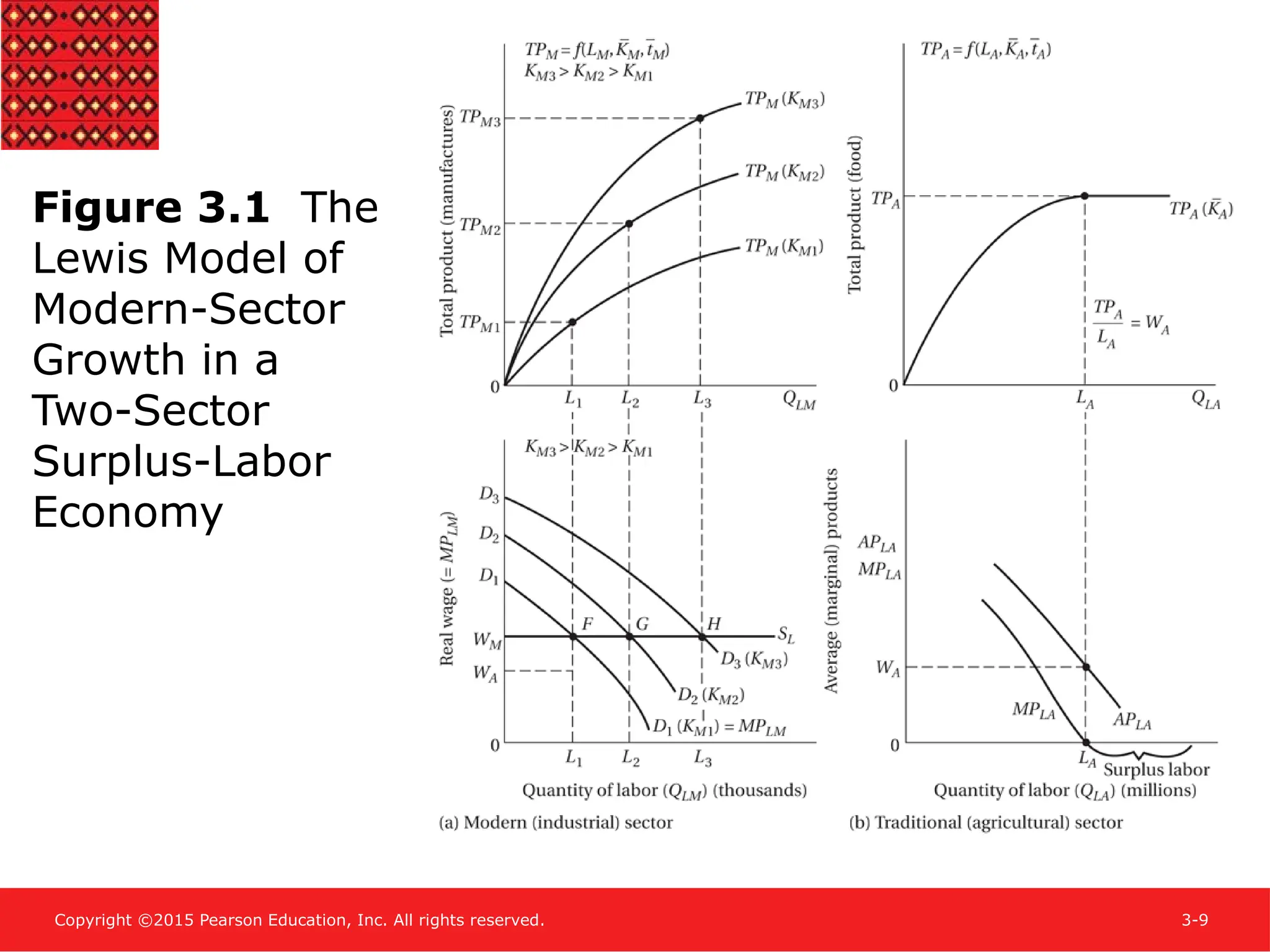
3.3 Structural-Change Models
• The Lewis two-sector model
Copyright ©2015 Pearson Education, Inc. All rights reserved. 3-9
Figure 3.1 The
Lewis Model of
Modern-Sector
Growth in a
Two-Sector
Surplus-Labor
Economy
Copyright ©2015 Pearson Education, Inc. All rights reserved. 3-10
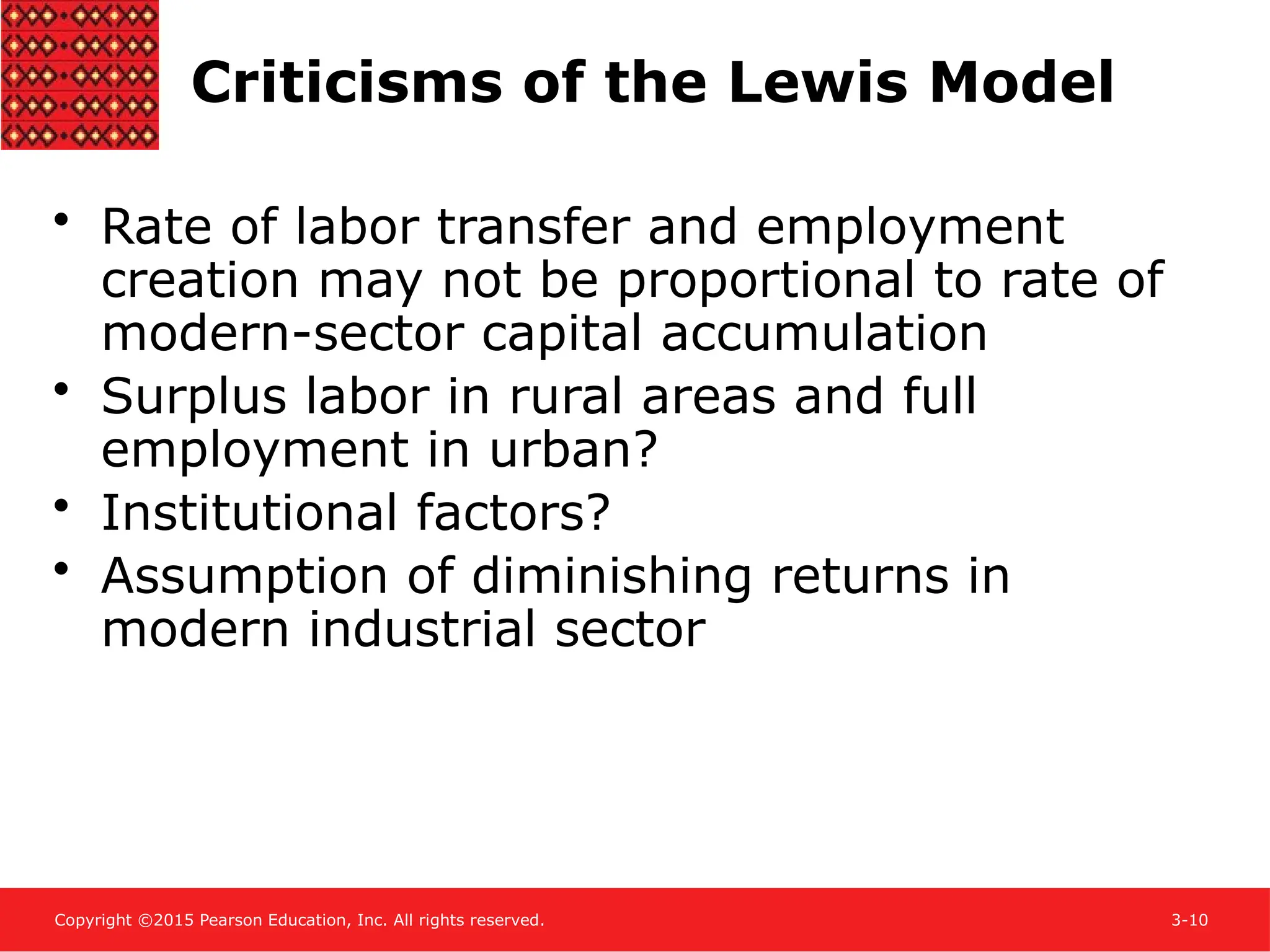
Criticisms of the Lewis Model
• Rate of labor transfer and employment
creation may not be proportional to rate of
modern-sector capital accumulation
• Surplus labor in rural areas and full
employment in urban?
• Institutional factors?
• Assumption of diminishing returns in
modern industrial sector
Copyright ©2015 Pearson Education, Inc. All rights reserved. 3-11
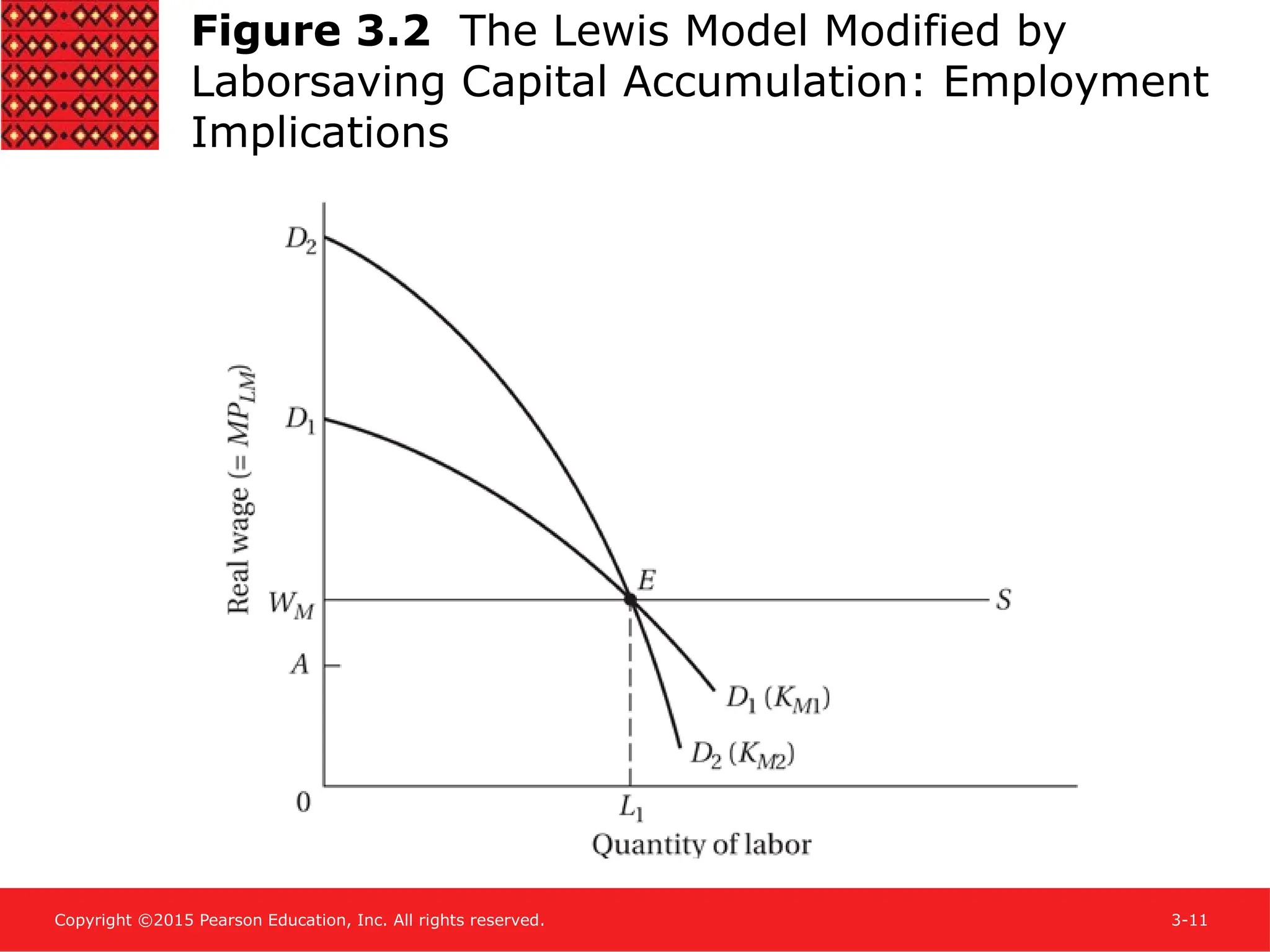
Figure 3.2 The Lewis Model Modified by
Laborsaving Capital Accumulation: Employment
Implications
Copyright ©2015 Pearson Education, Inc. All rights reserved. 3-12
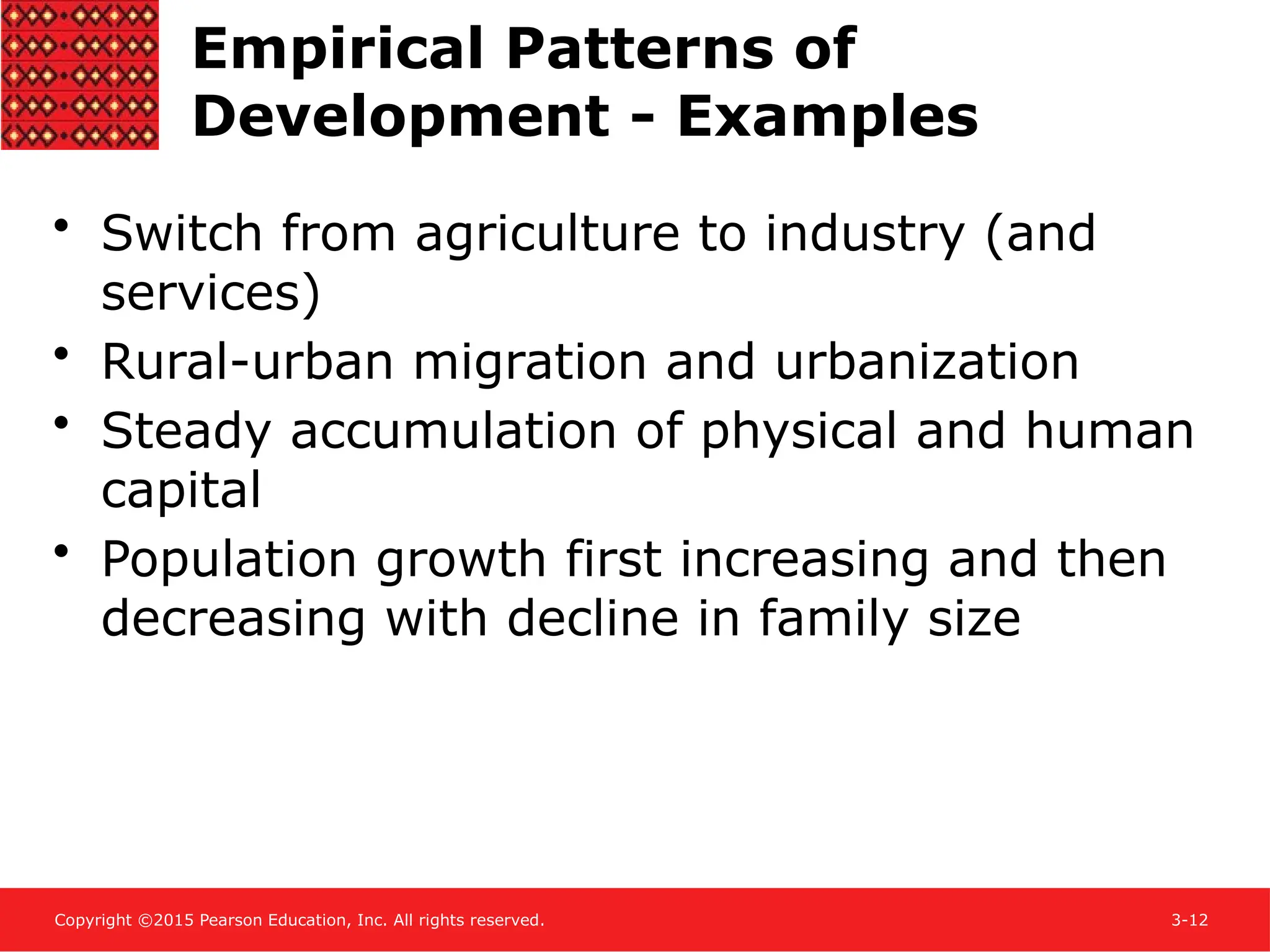
Empirical Patterns of
Development - Examples
• Switch from agriculture to industry (and
services)
• Rural-urban migration and urbanization
• Steady accumulation of physical and human
capital
• Population growth first increasing and then
decreasing with decline in family size
Copyright ©2015 Pearson Education, Inc. All rights reserved. 3-13
3.4 The International-
Dependence Revolution
• The neocolonial dependence model
– Legacy of colonialism, Unequal power, Core-periphery
• The false-paradigm model
– Pitfalls of using “expert” foreign advisors who misapply
developed-country models
• The dualistic-development thesis
– Superior and inferior elements can coexist; Prebisch-
Singer Hypothesis
• Criticisms and limitations
– Does little to show how to achieve development in a
positive sense; accumulating counterexamples
Copyright ©2015 Pearson Education, Inc. All rights reserved. 3-14
3.5 The Neoclassical Counterrevolution:
Market Fundamentalism
• Challenging the Statist Model: Free Markets, Public
Choice, and Market-Friendly Approaches
– Free market approach
– Public choice approach
– Market-friendly approach
• Main Arguments
– Denies efficiency of intervention
– Points up state owned enterprise failures
– Stresses government failures
– Traditional neoclassical growth theory - with diminishing
returns, cannot sustain growth by capital accumulation
alone
Copyright ©2015 Pearson Education, Inc. All rights reserved. 3-15
3.6 Classic Theories of Development:
Reconciling the Differences
• Governments do fail, but so do markets; a balance is
needed
• Must attend to institutional and political realities in
developing world
• Development economics has no universally accepted
paradigm
• Insights and understandings are continually evolving
• Each theory has some strengths and some weaknesses
Copyright ©2015 Pearson Education, Inc. All rights reserved. 3-16
Concepts for Review
• Autarky
• Average product
• Capital-labor ratio
• Capital-output ratio
• Center
• Closed economy
• Comprador groups
• Dependence
• Dominance
• Dualism
• False-paradigm model
• Free market
• Free-market analysis
• Harrod-Domar growth
model
• Lewis two-sector model
• Marginal product
• Market failure
Copyright ©2015 Pearson Education, Inc. All rights reserved. 3-17
Concepts for Review (cont’d)
• Market-friendly approach
• Necessary condition
• Neoclassical
counterrevolution
• Neocolonial dependence
model
• Net savings ratio
• New political economy
approach
• Open economy
• Patterns-of-development
analysis
• Periphery
• Production function
• Public-choice theory
• Self-sustaining growth
• Solow neoclassical growth
model
• Stages-of-growth model of
development
• Structural-change theory
• Structural transformation
• Sufficient condition
• Surplus labor
• Underdevelopment
Copyright ©2015 Pearson Education, Inc. All rights reserved. 3-18
Appendix 3.1: Components of
Economic Growth
• Capital Accumulation, investments in
physical and human capital
– Increase capital stock
• Growth in population and labor force
• Technological progress
– Neutral, labor/capital-saving, labor/capital
augmenting
Copyright ©2015 Pearson Education, Inc. All rights reserved. 3-19
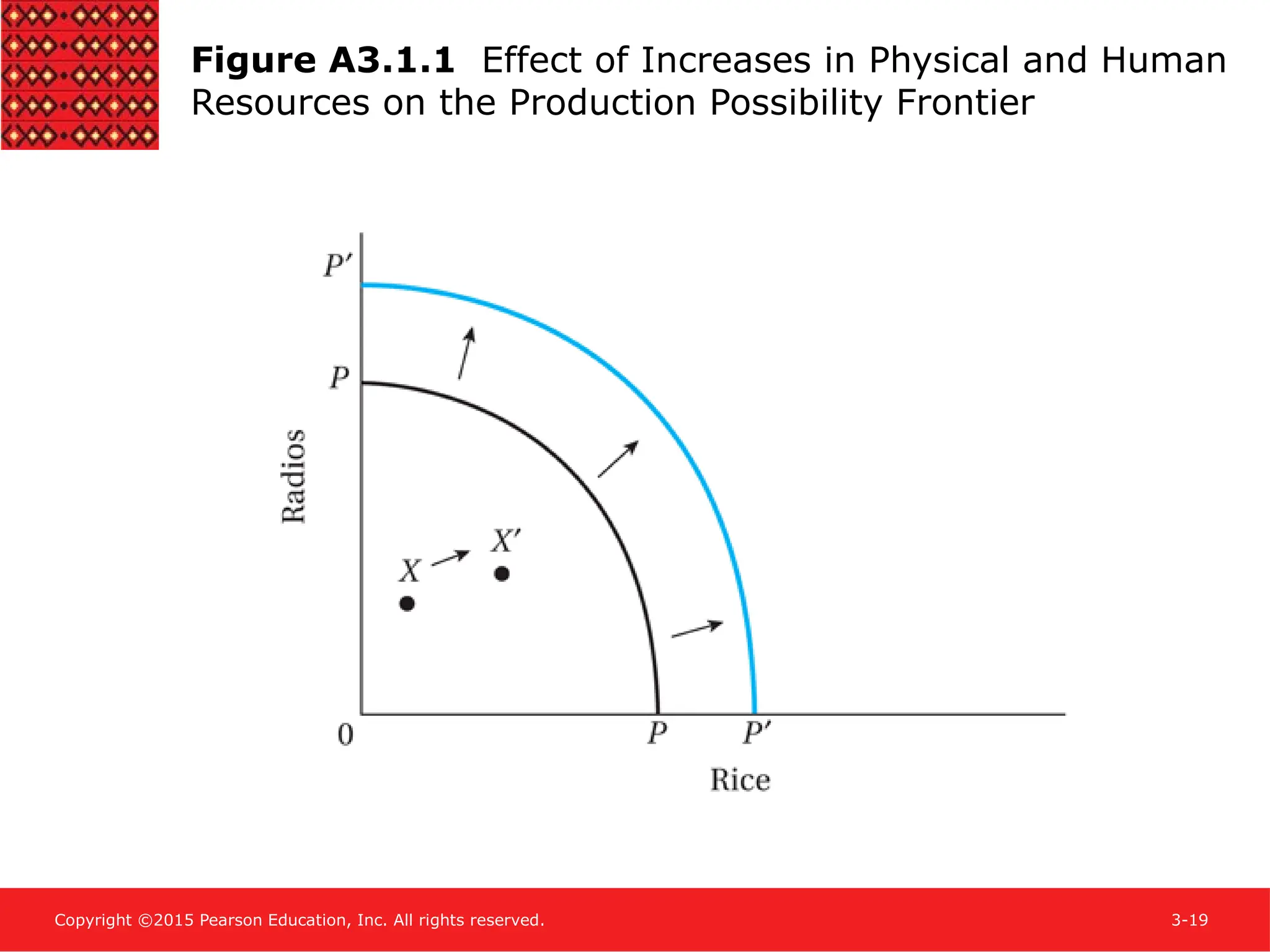
Figure A3.1.1 Effect of Increases in Physical and Human
Resources on the Production Possibility Frontier
Copyright ©2015 Pearson Education, Inc. All rights reserved. 3-20
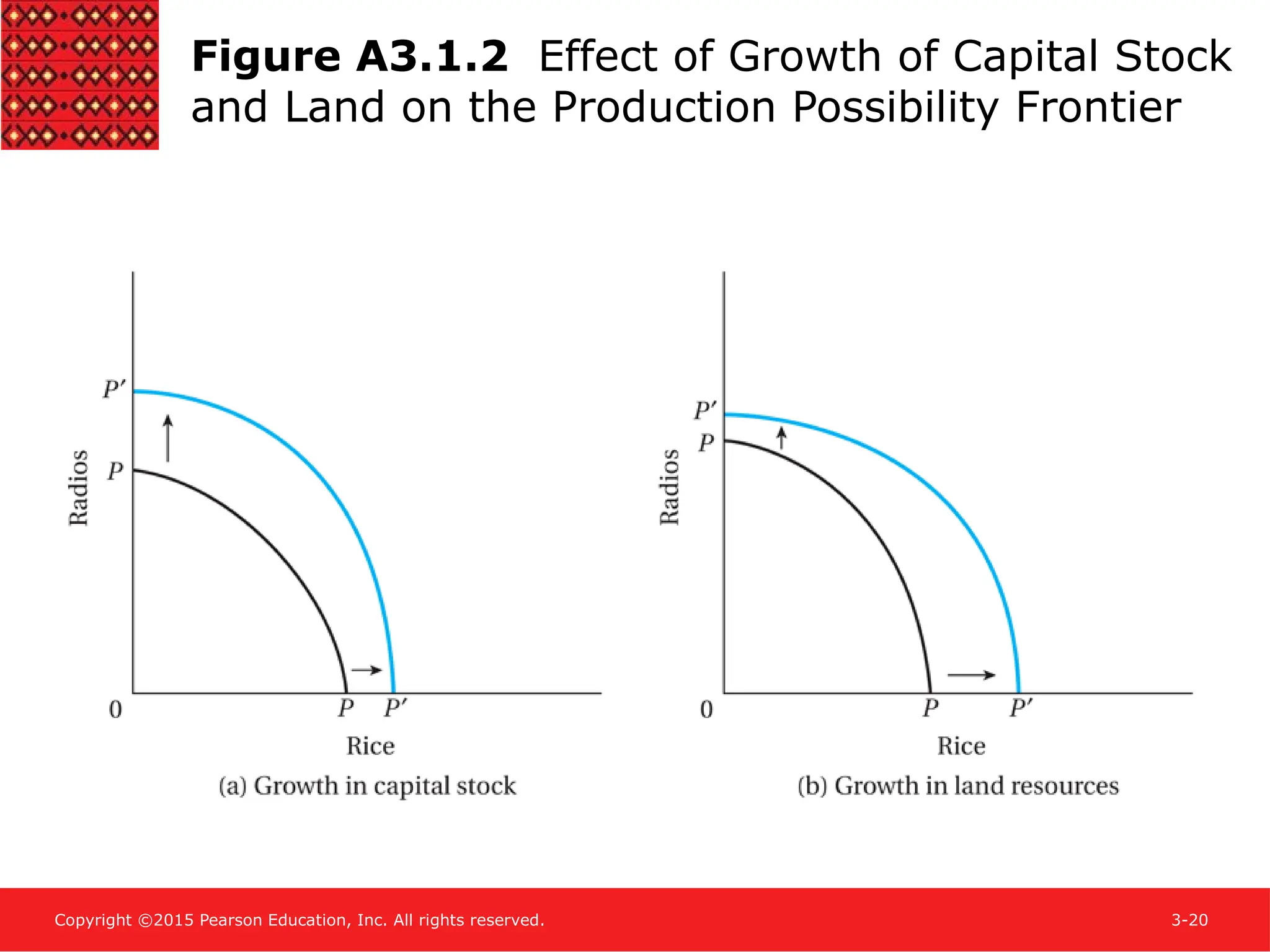
Figure A3.1.2 Effect of Growth of Capital Stock
and Land on the Production Possibility Frontier
Copyright ©2015 Pearson Education, Inc. All rights reserved. 3-21
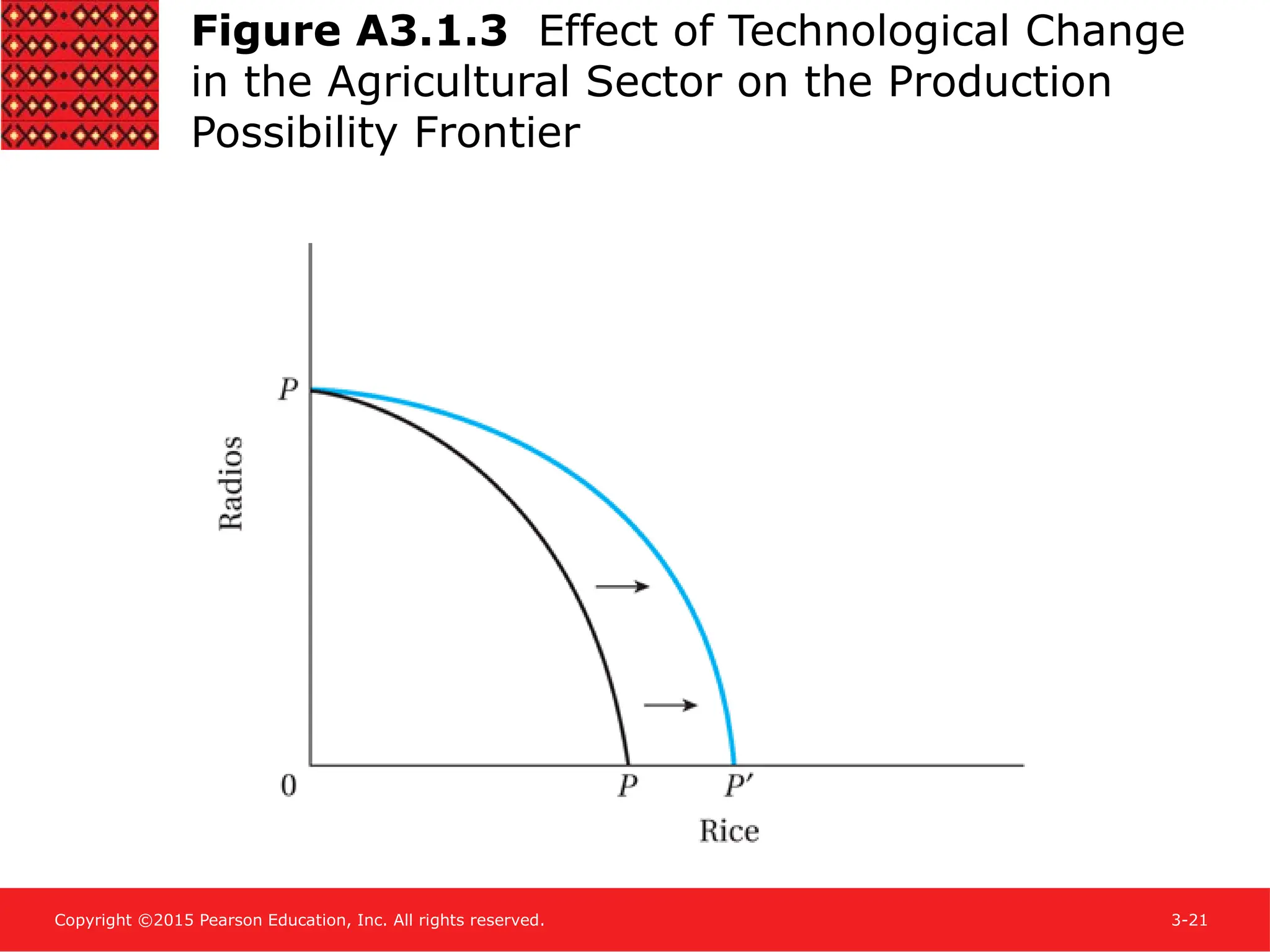
Figure A3.1.3 Effect of Technological Change
in the Agricultural Sector on the Production
Possibility Frontier
Copyright ©2015 Pearson Education, Inc. All rights reserved. 3-22
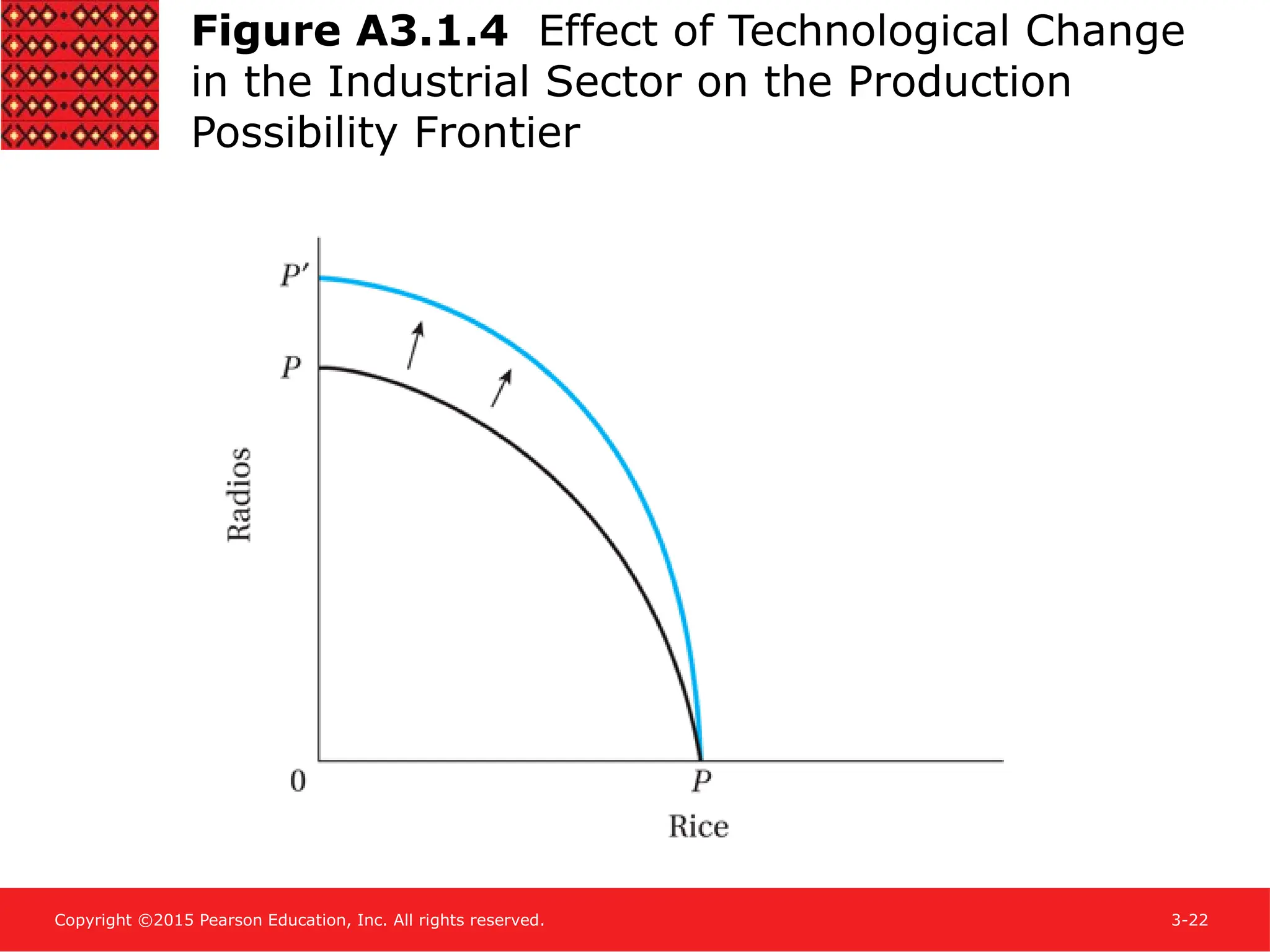
Figure A3.1.4 Effect of Technological Change
in the Industrial Sector on the Production
Possibility Frontier
Copyright ©2015 Pearson Education, Inc. All rights reserved. 3-23
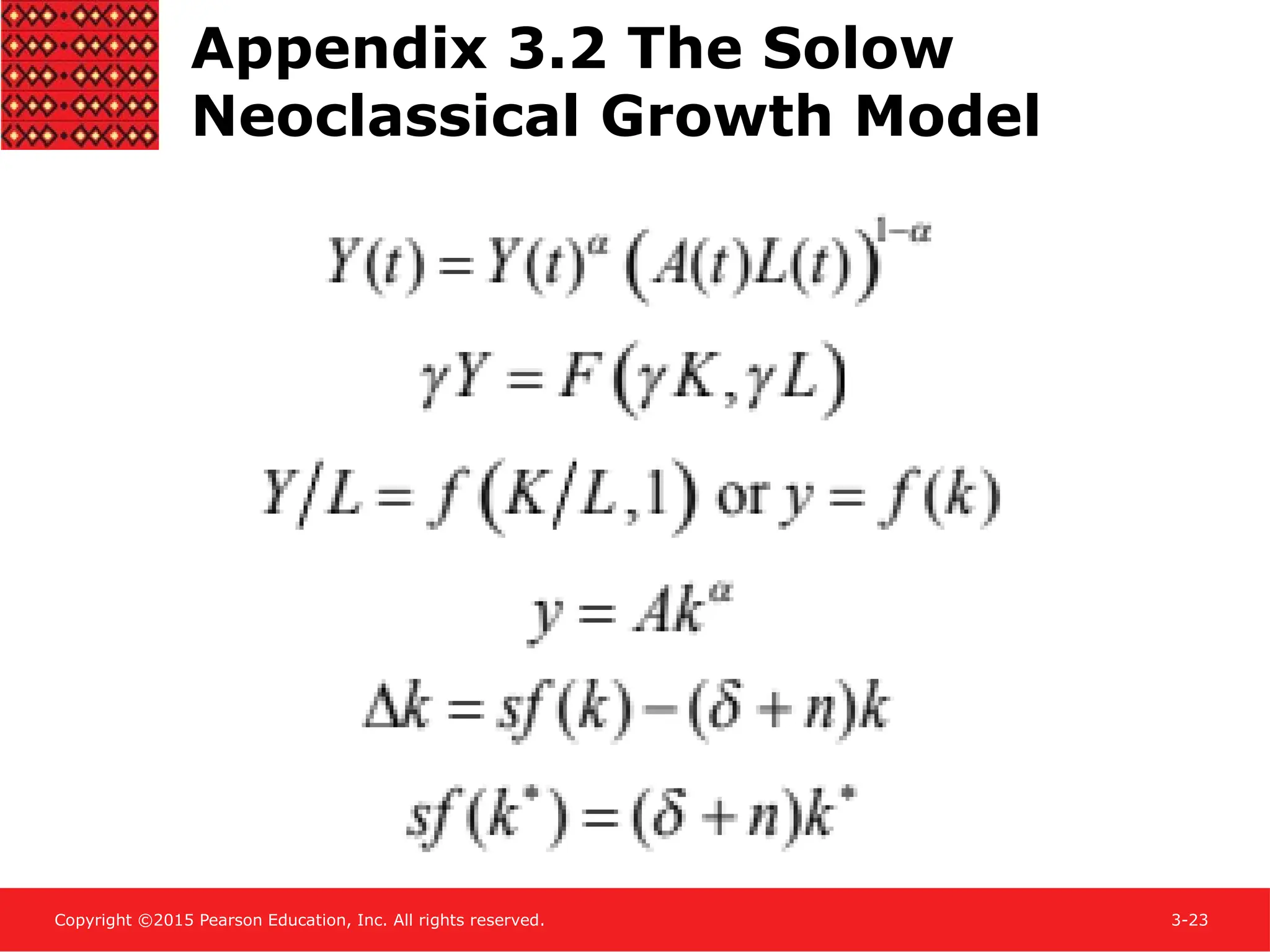
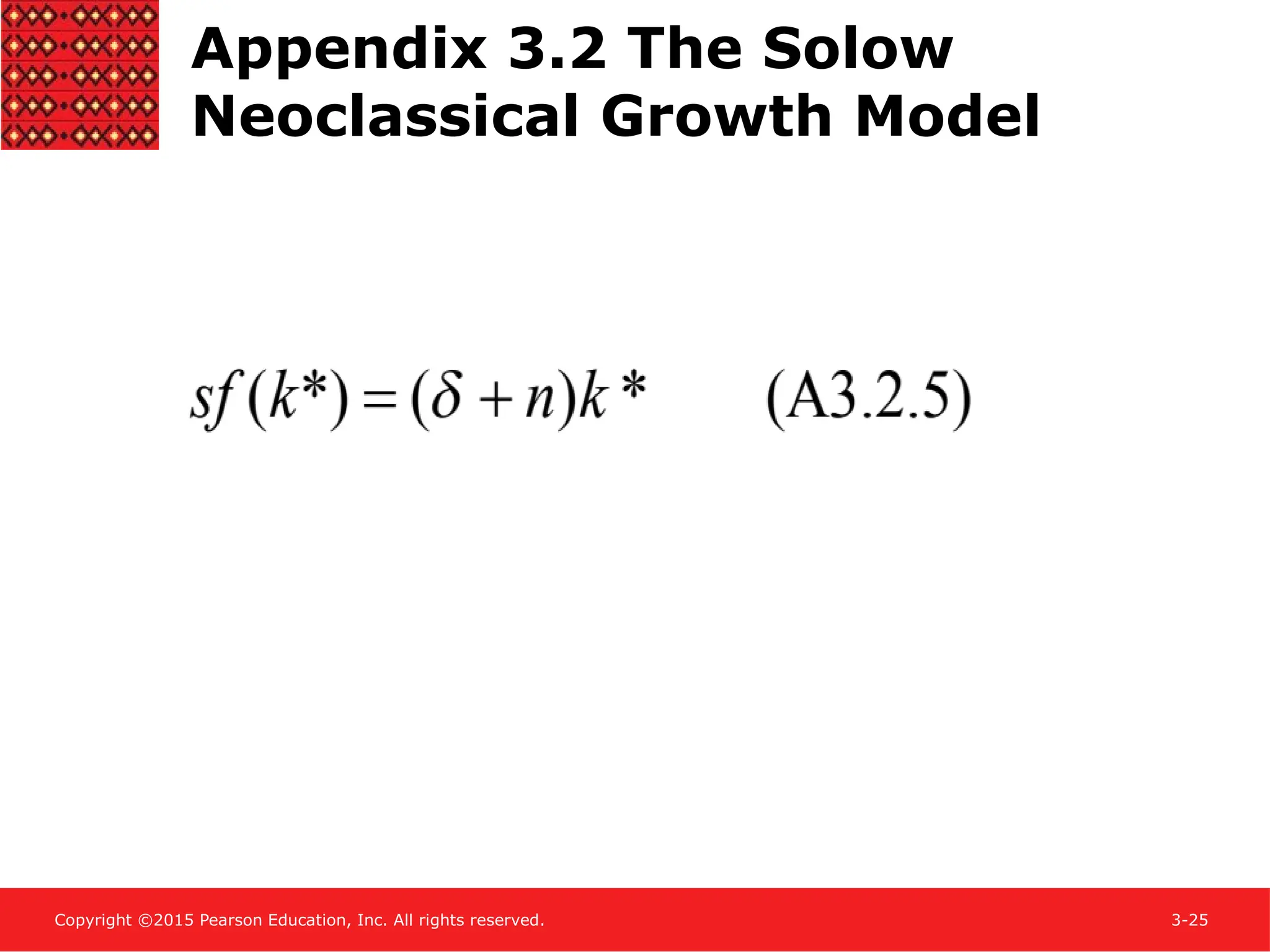
Appendix 3.2 The Solow
Neoclassical Growth Model
Copyright ©2015 Pearson Education, Inc. All rights reserved. 3-24
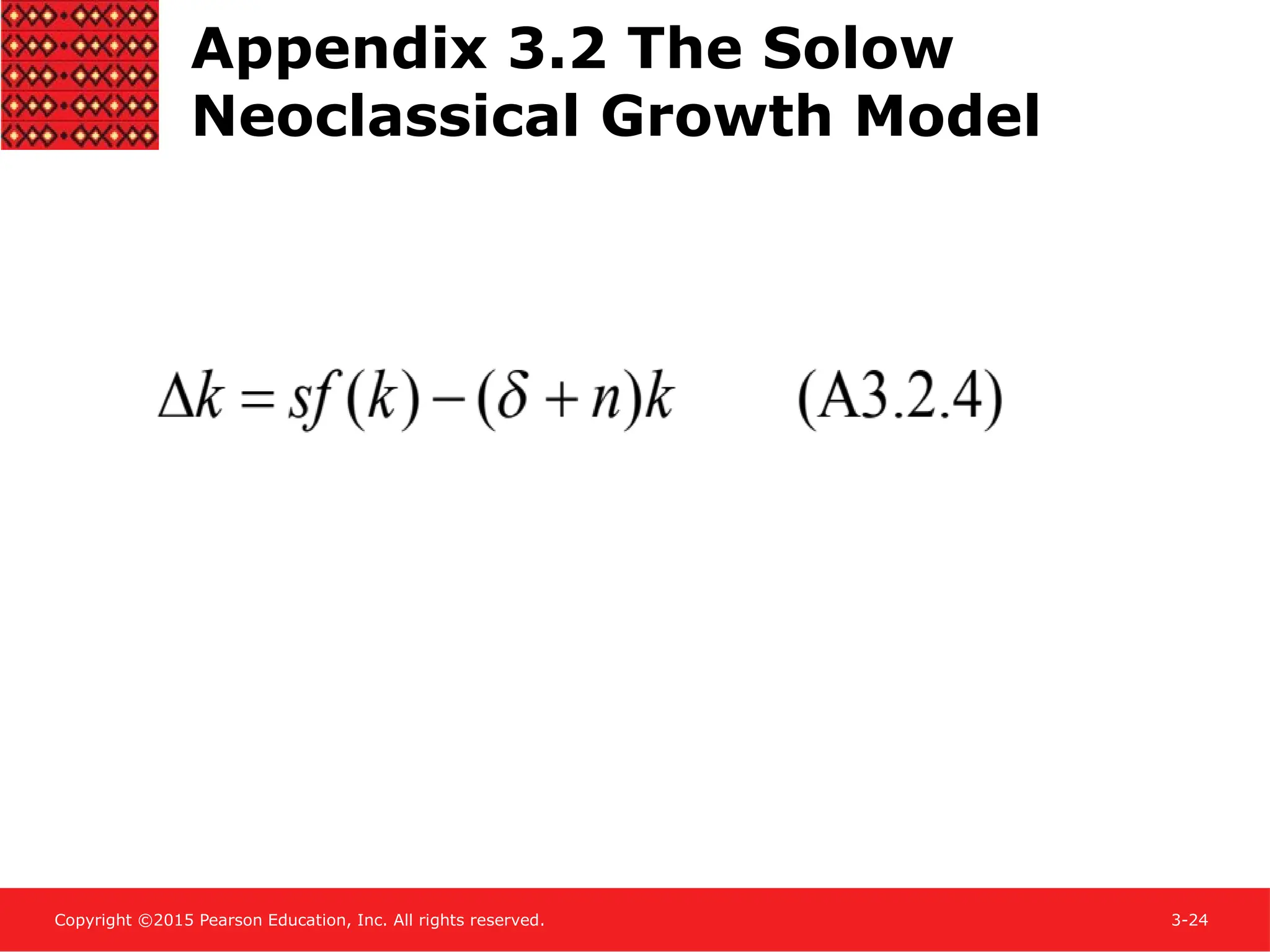
Appendix 3.2 The Solow
Neoclassical Growth Model
Copyright ©2015 Pearson Education, Inc. All rights reserved. 3-25
Appendix 3.2 The Solow
Neoclassical Growth Model
Copyright ©2015 Pearson Education, Inc. All rights reserved. 3-26
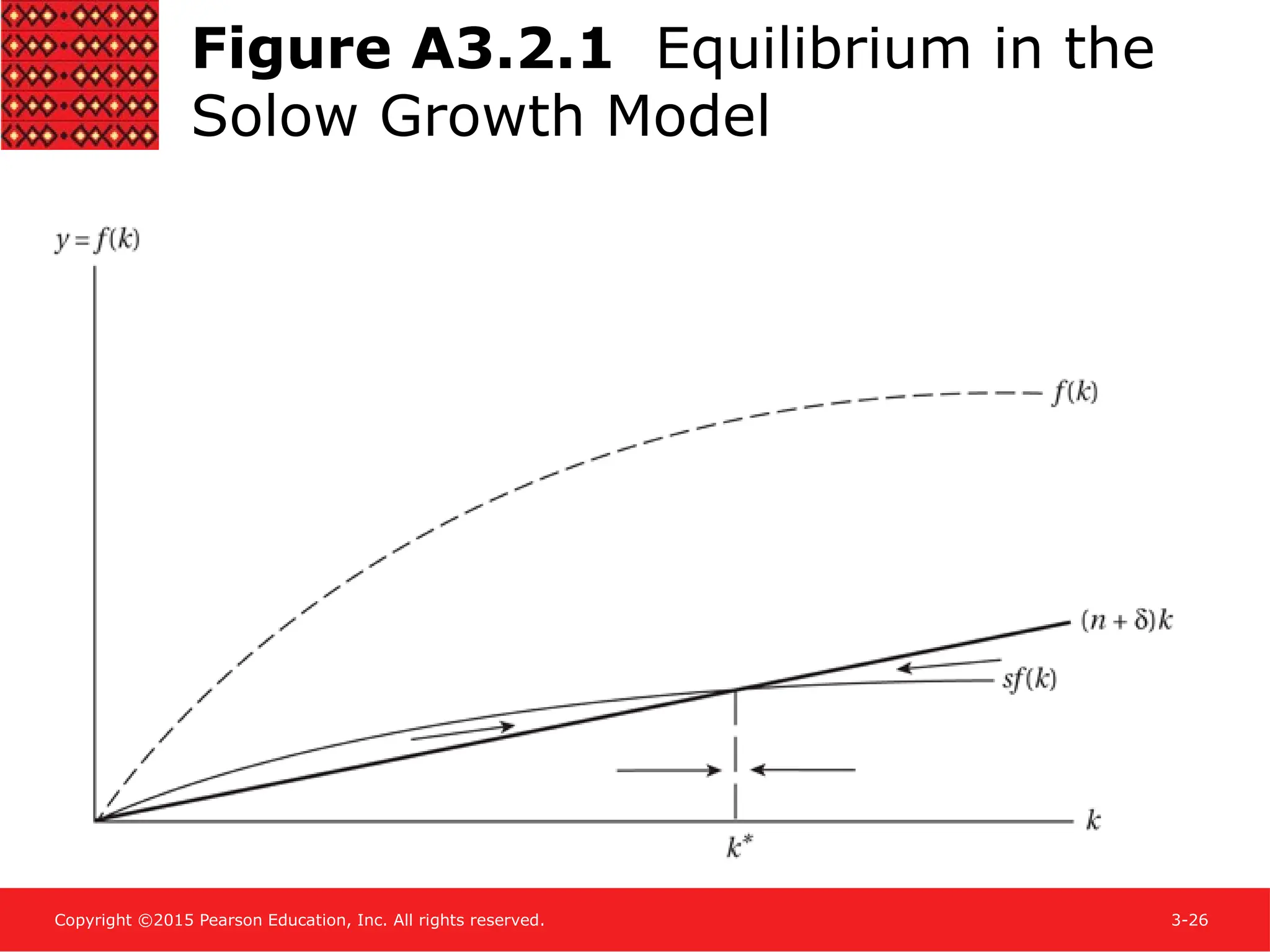
Figure A3.2.1 Equilibrium in the
Solow Growth Model
Copyright ©2015 Pearson Education, Inc. All rights reserved. 3-27
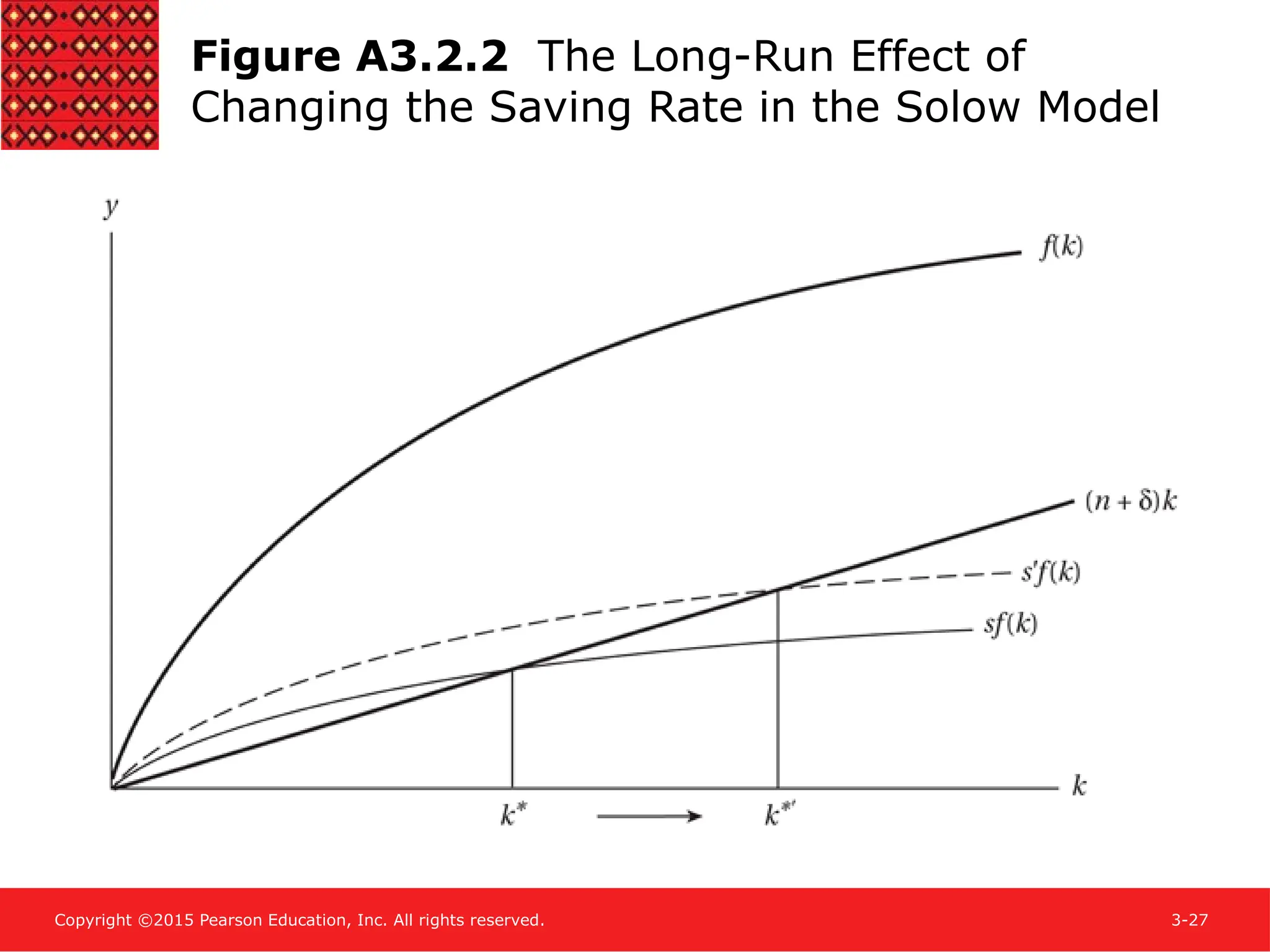
Figure A3.2.2 The Long-Run Effect of
Changing the Saving Rate in the Solow Model
Copyright ©2015 Pearson Education, Inc. All rights reserved. 3-28
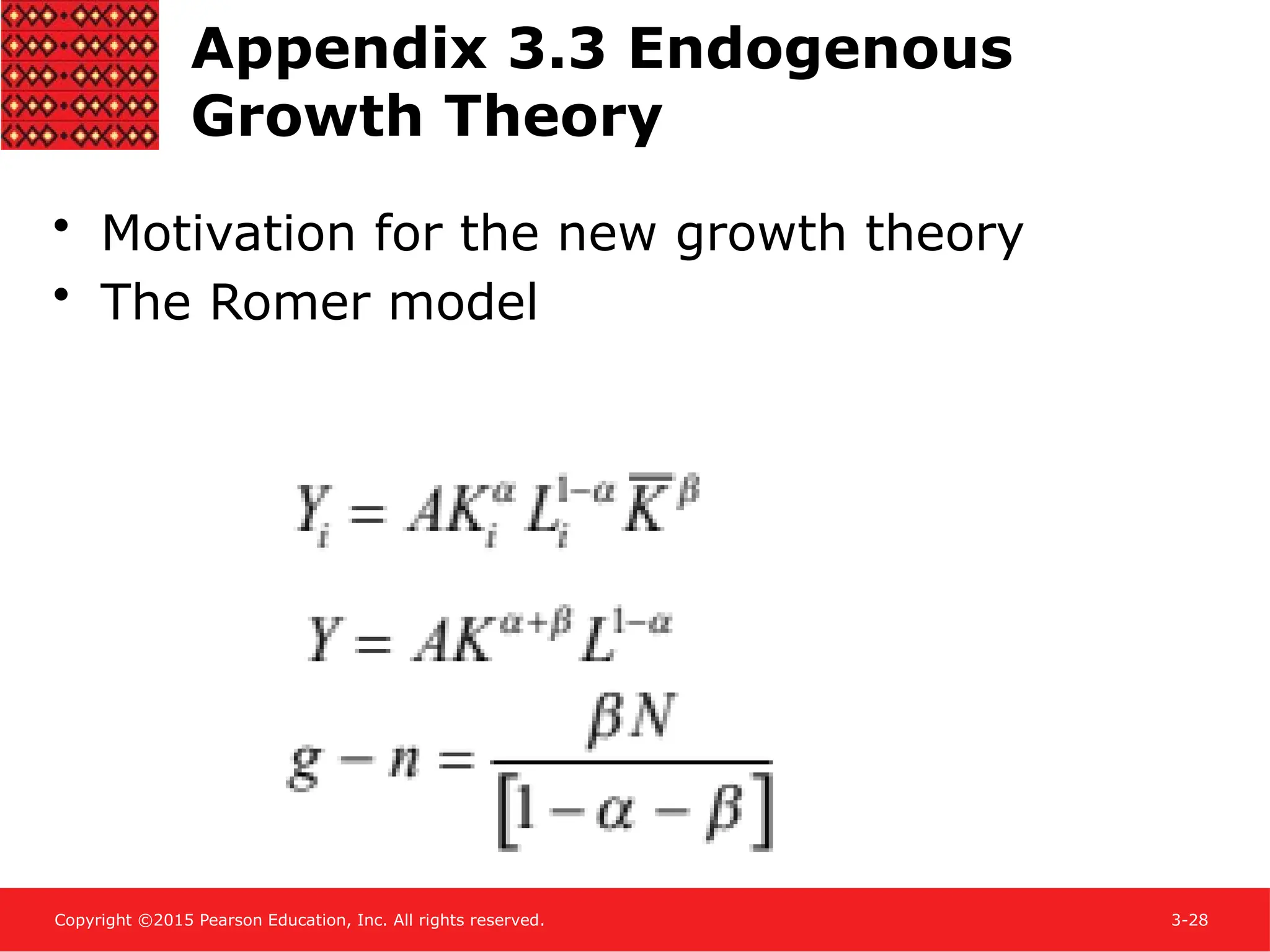
Appendix 3.3 Endogenous
Growth Theory
• Motivation for the new growth theory
• The Romer model

Classicial Theory of Economic Development.ppt

  • 1.
    Chapter 3 Classic Theories ofEconomic Growth and Development
  • 2.
    Copyright ©2015 PearsonEducation, Inc. All rights reserved. 3-2 3.1 Classic Theories of Economic Development: Four Approaches • Linear stages of growth model • Theories and Patterns of structural change • International-dependence revolution • Neoclassical, free market counterrevolution
  • 3.
    Copyright ©2015 PearsonEducation, Inc. All rights reserved. 3-3 3.2 Development as Growth and Linear-Stages Theories • A Classic Statement: Rostow’s Stages of Growth • Harrod-Domar Growth Model (sometimes referred to as the AK model)
  • 4.
    Copyright ©2015 PearsonEducation, Inc. All rights reserved. 3-4 The Harrod-Domar Model - Simplified Version
  • 5.
    Copyright ©2015 PearsonEducation, Inc. All rights reserved. 3-5 The Harrod-Domar Model - Simplified Version
  • 6.
    Copyright ©2015 PearsonEducation, Inc. All rights reserved. 3-6 • Equation 3.7 is also often expressed in terms of gross savings, in which case the growth rate is given by (3.7’) where δ is the rate of capital depreciation • But there is now growing evidence of “per capita income convergence,” weighting changes in per capita income by population size • (Also, in chapter 3, we return to examine the concept of conditional convergence when we study the Solow model) The Harrod-Domar Model – Incorporating Capital Depreciation
  • 7.
    Copyright ©2015 PearsonEducation, Inc. All rights reserved. 3-7 Criticisms of the Stages Model • Necessary versus sufficient conditions
  • 8.
    Copyright ©2015 PearsonEducation, Inc. All rights reserved. 3-8 3.3 Structural-Change Models • The Lewis two-sector model
  • 9.
    Copyright ©2015 PearsonEducation, Inc. All rights reserved. 3-9 Figure 3.1 The Lewis Model of Modern-Sector Growth in a Two-Sector Surplus-Labor Economy
  • 10.
    Copyright ©2015 PearsonEducation, Inc. All rights reserved. 3-10 Criticisms of the Lewis Model • Rate of labor transfer and employment creation may not be proportional to rate of modern-sector capital accumulation • Surplus labor in rural areas and full employment in urban? • Institutional factors? • Assumption of diminishing returns in modern industrial sector
  • 11.
    Copyright ©2015 PearsonEducation, Inc. All rights reserved. 3-11 Figure 3.2 The Lewis Model Modified by Laborsaving Capital Accumulation: Employment Implications
  • 12.
    Copyright ©2015 PearsonEducation, Inc. All rights reserved. 3-12 Empirical Patterns of Development - Examples • Switch from agriculture to industry (and services) • Rural-urban migration and urbanization • Steady accumulation of physical and human capital • Population growth first increasing and then decreasing with decline in family size
  • 13.
    Copyright ©2015 PearsonEducation, Inc. All rights reserved. 3-13 3.4 The International- Dependence Revolution • The neocolonial dependence model – Legacy of colonialism, Unequal power, Core-periphery • The false-paradigm model – Pitfalls of using “expert” foreign advisors who misapply developed-country models • The dualistic-development thesis – Superior and inferior elements can coexist; Prebisch- Singer Hypothesis • Criticisms and limitations – Does little to show how to achieve development in a positive sense; accumulating counterexamples
  • 14.
    Copyright ©2015 PearsonEducation, Inc. All rights reserved. 3-14 3.5 The Neoclassical Counterrevolution: Market Fundamentalism • Challenging the Statist Model: Free Markets, Public Choice, and Market-Friendly Approaches – Free market approach – Public choice approach – Market-friendly approach • Main Arguments – Denies efficiency of intervention – Points up state owned enterprise failures – Stresses government failures – Traditional neoclassical growth theory - with diminishing returns, cannot sustain growth by capital accumulation alone
  • 15.
    Copyright ©2015 PearsonEducation, Inc. All rights reserved. 3-15 3.6 Classic Theories of Development: Reconciling the Differences • Governments do fail, but so do markets; a balance is needed • Must attend to institutional and political realities in developing world • Development economics has no universally accepted paradigm • Insights and understandings are continually evolving • Each theory has some strengths and some weaknesses
  • 16.
    Copyright ©2015 PearsonEducation, Inc. All rights reserved. 3-16 Concepts for Review • Autarky • Average product • Capital-labor ratio • Capital-output ratio • Center • Closed economy • Comprador groups • Dependence • Dominance • Dualism • False-paradigm model • Free market • Free-market analysis • Harrod-Domar growth model • Lewis two-sector model • Marginal product • Market failure
  • 17.
    Copyright ©2015 PearsonEducation, Inc. All rights reserved. 3-17 Concepts for Review (cont’d) • Market-friendly approach • Necessary condition • Neoclassical counterrevolution • Neocolonial dependence model • Net savings ratio • New political economy approach • Open economy • Patterns-of-development analysis • Periphery • Production function • Public-choice theory • Self-sustaining growth • Solow neoclassical growth model • Stages-of-growth model of development • Structural-change theory • Structural transformation • Sufficient condition • Surplus labor • Underdevelopment
  • 18.
    Copyright ©2015 PearsonEducation, Inc. All rights reserved. 3-18 Appendix 3.1: Components of Economic Growth • Capital Accumulation, investments in physical and human capital – Increase capital stock • Growth in population and labor force • Technological progress – Neutral, labor/capital-saving, labor/capital augmenting
  • 19.
    Copyright ©2015 PearsonEducation, Inc. All rights reserved. 3-19 Figure A3.1.1 Effect of Increases in Physical and Human Resources on the Production Possibility Frontier
  • 20.
    Copyright ©2015 PearsonEducation, Inc. All rights reserved. 3-20 Figure A3.1.2 Effect of Growth of Capital Stock and Land on the Production Possibility Frontier
  • 21.
    Copyright ©2015 PearsonEducation, Inc. All rights reserved. 3-21 Figure A3.1.3 Effect of Technological Change in the Agricultural Sector on the Production Possibility Frontier
  • 22.
    Copyright ©2015 PearsonEducation, Inc. All rights reserved. 3-22 Figure A3.1.4 Effect of Technological Change in the Industrial Sector on the Production Possibility Frontier
  • 23.
    Copyright ©2015 PearsonEducation, Inc. All rights reserved. 3-23 Appendix 3.2 The Solow Neoclassical Growth Model
  • 24.
    Copyright ©2015 PearsonEducation, Inc. All rights reserved. 3-24 Appendix 3.2 The Solow Neoclassical Growth Model
  • 25.
    Copyright ©2015 PearsonEducation, Inc. All rights reserved. 3-25 Appendix 3.2 The Solow Neoclassical Growth Model
  • 26.
    Copyright ©2015 PearsonEducation, Inc. All rights reserved. 3-26 Figure A3.2.1 Equilibrium in the Solow Growth Model
  • 27.
    Copyright ©2015 PearsonEducation, Inc. All rights reserved. 3-27 Figure A3.2.2 The Long-Run Effect of Changing the Saving Rate in the Solow Model
  • 28.
    Copyright ©2015 PearsonEducation, Inc. All rights reserved. 3-28 Appendix 3.3 Endogenous Growth Theory • Motivation for the new growth theory • The Romer model