Fundamentals of
   Business & Financial Journalism
   Week 8: Covering Economic Events, part 2

    Jeffrey Timmermans


Monday, 19 November, 12
Economic goals of governments

   ✤    Full employment

         ✤    or at least as full as possible...

   ✤    Steady annual growth in output

         ✤    without overheating

   ✤    Stable prices (low but steady rise in prices over time)


Monday, 19 November, 12
Measuring economic performance

   ✤    Output of goods & services

   ✤    Changes in prices for goods & services over time

   ✤    Mood of consumers

   ✤    Employment

   ✤    Total supply of money

   ✤    Trade with other countries


Monday, 19 November, 12
Major economic indicators

   ✤    Gross Domestic Product

   ✤    Consumer Price Index

   ✤    Consumer Confidence Index

   ✤    Unemployment rate

   ✤    Money Supply

   ✤    Trade Balance


Monday, 19 November, 12
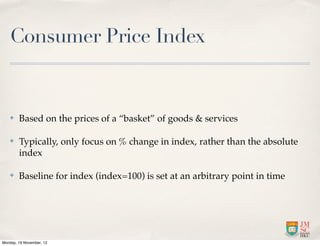
Consumer Price Index


   ✤    Based on the prices of a “basket” of goods & services

   ✤    Typically, only focus on % change in index, rather than the absolute
        index

   ✤    Baseline for index (index=100) is set at an arbitrary point in time


Monday, 19 November, 12
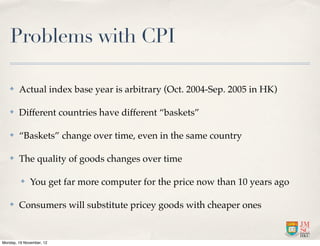
Problems with CPI

   ✤    Actual index base year is arbitrary (Oct. 2004-Sep. 2005 in HK)

   ✤    Different countries have different “baskets”

   ✤    “Baskets” change over time, even in the same country

   ✤    The quality of goods changes over time

         ✤    You get far more computer for the price now than 10 years ago

   ✤    Consumers will substitute pricey goods with cheaper ones


Monday, 19 November, 12
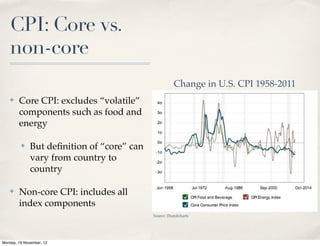
CPI: Core vs.
   non-core
                                                      Change in U.S. CPI 1958-2011
   ✤    Core CPI: excludes “volatile”
        components such as food and
        energy

         ✤    But definition of “core” can
              vary from country to
              country

   ✤    Non-core CPI: includes all
        index components
                                            Source: Thumbcharts


Monday, 19 November, 12
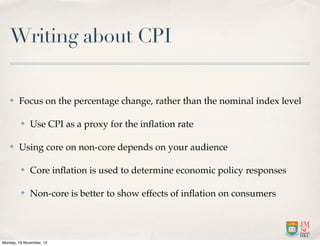
Writing about CPI

   ✤    Focus on the percentage change, rather than the nominal index level

         ✤    Use CPI as a proxy for the inflation rate

   ✤    Using core on non-core depends on your audience

         ✤    Core inflation is used to determine economic policy responses

         ✤    Non-core is better to show effects of inflation on consumers


Monday, 19 November, 12
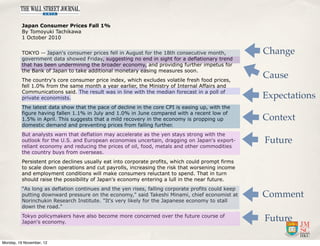
Japan Consumer Prices Fall 1%
          By Tomoyuki Tachikawa
          1 October 2010


          TOKYO -- Japan's consumer prices fell in August for the 18th consecutive month,           Change
          government data showed Friday, suggesting no end in sight for a deflationary trend
          that has been undermining the broader economy, and providing further impetus for
          the Bank of Japan to take additional monetary easing measures soon.
          The country's core consumer price index, which excludes volatile fresh food prices,
                                                                                                    Cause
          fell 1.0% from the same month a year earlier, the Ministry of Internal Affairs and
          Communications said. The result was in line with the median forecast in a poll of
          private economists.                                                                       Expectations
          The latest data show that the pace of decline in the core CPI is easing up, with the
          figure having fallen 1.1% in July and 1.0% in June compared with a recent low of
          1.5% in April. This suggests that a mild recovery in the economy is propping up           Context
          domestic demand and preventing prices from falling further.
          But analysts warn that deflation may accelerate as the yen stays strong with the
          outlook for the U.S. and European economies uncertain, dragging on Japan's export-        Future
          reliant economy and reducing the prices of oil, food, metals and other commodities
          the country buys from overseas.
          Persistent price declines usually eat into corporate profits, which could prompt firms
          to scale down operations and cut payrolls, increasing the risk that worsening income
          and employment conditions will make consumers reluctant to spend. That in turn
          should raise the possibility of Japan's economy entering a lull in the near future.
          "As long as deflation continues and the yen rises, falling corporate profits could keep
          putting downward pressure on the economy," said Takeshi Minami, chief economist at        Comment
          Norinchukin Research Institute. "It's very likely for the Japanese economy to stall
          down the road."
          Tokyo policymakers have also become more concerned over the future course of
          Japan's economy.                                                                          Future

Monday, 19 November, 12
CPI in Hong Kong

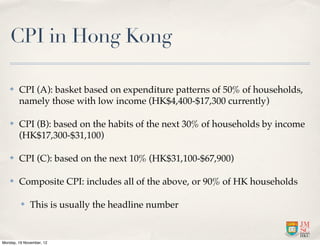
   ✤    CPI (A): basket based on expenditure patterns of 50% of households,
        namely those with low income (HK$4,400-$17,300 currently)

   ✤    CPI (B): based on the habits of the next 30% of households by income
        (HK$17,300-$31,100)

   ✤    CPI (C): based on the next 10% (HK$31,100-$67,900)

   ✤    Composite CPI: includes all of the above, or 90% of HK households

         ✤    This is usually the headline number


Monday, 19 November, 12
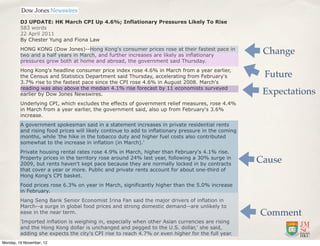
DJ UPDATE: HK March CPI Up 4.6%; Inflationary Pressures Likely To Rise
       583 words
       22 April 2011
       By Chester Yung and Fiona Law
       HONG KONG (Dow Jones)--Hong Kong's consumer prices rose at their fastest pace in
       two and a half years in March, and further increases are likely as inflationary
                                                                                                    Change
       pressures grow both at home and abroad, the government said Thursday.
       Hong Kong's headline consumer price index rose 4.6% in March from a year earlier,
       the Census and Statistics Department said Thursday, accelerating from February's             Future
       3.7% rise to the fastest pace since the CPI rose 4.6% in August 2008. March's
       reading was also above the median 4.1% rise forecast by 11 economists surveyed
       earlier by Dow Jones Newswires.                                                              Expectations
       Underlying CPI, which excludes the effects of government relief measures, rose 4.4%
       in March from a year earlier, the government said, also up from February's 3.6%
       increase.
       A government spokesman said in a statement increases in private residential rents
       and rising food prices will likely continue to add to inflationary pressure in the coming
       months, while 'the hike in the tobacco duty and higher fuel costs also contributed
       somewhat to the increase in inflation (in March).'
       Private housing rental rates rose 4.9% in March, higher than February's 4.1% rise.
       Property prices in the territory rose around 24% last year, following a 30% surge in
       2009, but rents haven't kept pace because they are normally locked in by contracts
                                                                                                   Cause
       that cover a year or more. Public and private rents account for about one-third of
       Hong Kong's CPI basket.
       Food prices rose 6.3% on year in March, significantly higher than the 5.0% increase
       in February.
       Hang Seng Bank Senior Economist Irina Fan said the major drivers of inflation in
       March--a surge in global food prices and strong domestic demand--are unlikely to
       ease in the near term.                                                                      Comment
       'Imported inflation is weighing in, especially when other Asian currencies are rising
       and the Hong Kong dollar is unchanged and pegged to the U.S. dollar,' she said,
       adding she expects the city's CPI rise to reach 4.7% or even higher for the full year.
         The government
Monday, 19 November, 12   has said it expects the CPI to rise 4.5% in 2011, above the 2.4%
Some other measures of inflation

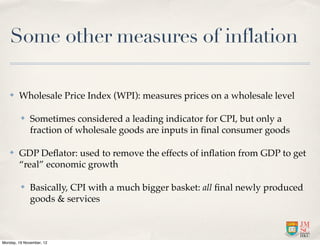
   ✤    Wholesale Price Index (WPI): measures prices on a wholesale level

         ✤    Sometimes considered a leading indicator for CPI, but only a
              fraction of wholesale goods are inputs in final consumer goods

   ✤    GDP Deflator: used to remove the effects of inflation from GDP to get
        “real” economic growth

         ✤    Basically, CPI with a much bigger basket: all final newly produced
              goods & services


Monday, 19 November, 12
Unemployment Rate


   ✤    Tracks the number of people in the labor force who don’t have jobs

         ✤    How do you define “labor force”?

   ✤    Usually expressed in percentage terms rather than an absolute
        number

   ✤    Full employment is a bad thing!


Monday, 19 November, 12
Problems with unemployment
   data

   ✤    Based on a household survey

   ✤    Doesn’t include people who have given up looking for work

   ✤    Definitions of “unemployment” vary among countries

         ✤    Japan’s definition is more restrictive than the U.S.’s


Monday, 19 November, 12
Consumer/Business Confidence
   Index
   ✤    A leading indicator of short-term consumer spending or investment
        by businesses

   ✤    Often presented as a diffusion index

         ✤    How many respondents are confident minus how many are
              pessimistic

         ✤    A reading of above 50 indicates optimism

   ✤    Compare to previous month/quarter for changes in sentiment


Monday, 19 November, 12
Problems with confidence indices


   ✤    Can have relatively large margin of error

         ✤    How big is the survey?

   ✤    Can mask dramatic changes in consumer or business sub-groups

         ✤    In the case of the tankan, check the sub-index for smaller businesses


Monday, 19 November, 12
Some other indicators

   ✤    Balance of Payments, including Trade Balance

   ✤    Industrial Production

   ✤    Retail Sales

   ✤    Tourist Arrivals

   ✤    Home Sales/Land Sales


Monday, 19 November, 12
Economic policy tools

   ✤    Fiscal policy               ✤   Monetary policy

         ✤    Taxation                  ✤   Interest rates

         ✤    Government spending       ✤   Reserve ratio


Monday, 19 November, 12
Taxation

   ✤    Changes to tax policy can alter economic incentives

         ✤    Broad-based tax cuts can incentivize spending

         ✤    Targeted tax cuts/exemptions/credits can affect investment
              decisions

               ✤   Mortgage tax exemption

               ✤   Capital gains taxes


Monday, 19 November, 12
Government spending


   ✤    To expand the economy, government spending must use borrowed
        money (deficit spending)

   ✤    The impact of government spending is multiplied, depending on how
        much people spend and how much they save

         ✤    As the economy begins to grow, businesses and consumers tend to
              invest and consume more


Monday, 19 November, 12
Monetary policy


   ✤    Now, typically the domain of central banks, independent from
        government control

   ✤    Central banks can change an economy’s benchmark interest rate by
        changing the supply of money via open-market operations

   ✤    Modern monetary policy focuses primarily on money supply


Monday, 19 November, 12
Roles of central banks


   ✤    Lender of last resort to domestic banks

   ✤    Regulator of domestic banking system

   ✤    Sets benchmark interest rate via open-market purchases of bonds

         ✤    Interest rates set to achieve steady economic growth with low
              inflation (price stability)


Monday, 19 November, 12
Required reserve ratio

   ✤    Central banks are also typically responsible for overseeing the
        country’s banking system

   ✤    Central banks tell commercial banks the percentage of deposits to
        hold as reserves so they have enough cash on hand to pay depositors
        who want to withdraw their money

   ✤    The higher the reserve ratio, the less banks can lend out

   ✤    Currently 10% in U.S., 20.5% in China from Feb. 24


Monday, 19 November, 12
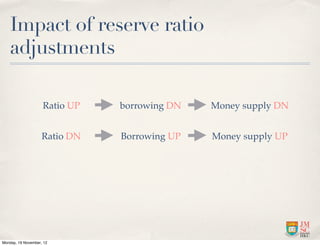
Impact of reserve ratio
   adjustments

                    Ratio UP   borrowing DN   Money supply DN


                    Ratio DN   Borrowing UP   Money supply UP


Monday, 19 November, 12
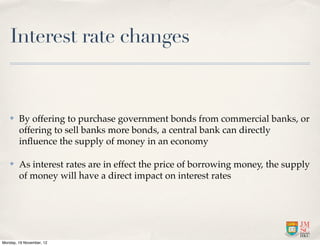
Interest rate changes


   ✤    By offering to purchase government bonds from commercial banks, or
        offering to sell banks more bonds, a central bank can directly
        influence the supply of money in an economy

   ✤    As interest rates are in effect the price of borrowing money, the supply
        of money will have a direct impact on interest rates


Monday, 19 November, 12
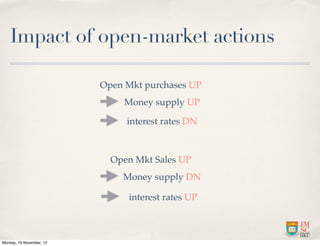
Impact of open-market actions

                          Open Mkt purchases UP
                               Money supply UP

                               interest rates DN


                            Open Mkt Sales UP
                              Money supply DN

                               interest rates UP


Monday, 19 November, 12
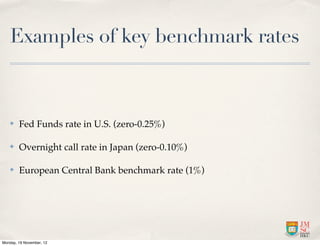
Examples of key benchmark rates


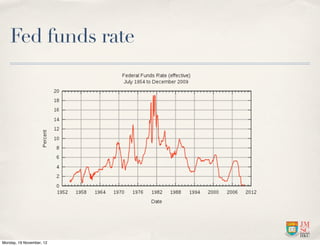
   ✤    Fed Funds rate in U.S. (zero-0.25%)

   ✤    Overnight call rate in Japan (zero-0.10%)

   ✤    European Central Bank benchmark rate (1%)


Monday, 19 November, 12
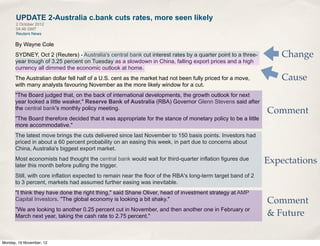
UPDATE 2-Australia c.bank cuts rates, more seen likely
       2 October 2012
       04:46 GMT
       Reuters News

      By Wayne Cole
      SYDNEY, Oct 2 (Reuters) - Australia's central bank cut interest rates by a quarter point to a three-       Change
      year trough of 3.25 percent on Tuesday as a slowdown in China, falling export prices and a high
      currency all dimmed the economic outlook at home.
      The Australian dollar fell half of a U.S. cent as the market had not been fully priced for a move,         Cause
      with many analysts favouring November as the more likely window for a cut.
      "The Board judged that, on the back of international developments, the growth outlook for next
      year looked a little weaker," Reserve Bank of Australia (RBA) Governor Glenn Stevens said after
      the central bank's monthly policy meeting.
                                                                                                              Comment
      "The Board therefore decided that it was appropriate for the stance of monetary policy to be a little
      more accommodative."
      The latest move brings the cuts delivered since last November to 150 basis points. Investors had
      priced in about a 60 percent probability on an easing this week, in part due to concerns about
      China, Australia's biggest export market.
      Most economists had thought the central bank would wait for third-quarter inflation figures due         Expectations
      later this month before pulling the trigger.
      Still, with core inflation expected to remain near the floor of the RBA's long-term target band of 2
      to 3 percent, markets had assumed further easing was inevitable.
      "I think they have done the right thing," said Shane Oliver, head of investment strategy at AMP
      Capital Investors. "The global economy is looking a bit shaky."                                         Comment
      "We are looking to another 0.25 percent cut in November, and then another one in February or
      March next year, taking the cash rate to 2.75 percent."                                                 & Future


Monday, 19 November, 12
Evolution of monetary policy

   ✤    Until the 20th Century, most currencies were tied to gold or silver at a
        fixed rate

         ✤    So governments fixed the price of their currency

   ✤    Now, most major currencies are allowed to float freely in value
        against other currencies

         ✤    And, now, central banks fix the quantity of their currency


Monday, 19 November, 12
Evolution of central banks


   ✤    The U.S. Federal Reserve was founded only in 1913

         ✤    It became fully independent only in 1951

   ✤    The Bank of England was created in the 17th Century

         ✤    It only became operationally independent in 1997


Monday, 19 November, 12
Fed funds rate


Monday, 19 November, 12
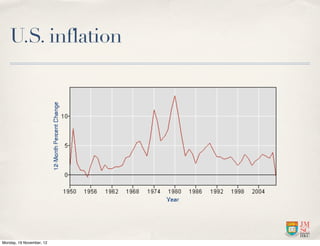
U.S. inflation


Monday, 19 November, 12
Quantitative Easing

   ✤    First used by the Bank of Japan from 2001 after a long period of
        near-zero short-term interest rates failed to kick-start the
        economy

   ✤    A central bank “expands its balance sheet” by offering to buy
        government or other bonds from commercial banks

   ✤    The central bank credits the account the commercial bank
        maintains with the central bank and holds onto the bond


Monday, 19 November, 12

Class8

  • 1.
    Fundamentals of Business & Financial Journalism Week 8: Covering Economic Events, part 2 Jeffrey Timmermans Monday, 19 November, 12
  • 2.
    Economic goals ofgovernments ✤ Full employment ✤ or at least as full as possible... ✤ Steady annual growth in output ✤ without overheating ✤ Stable prices (low but steady rise in prices over time) Monday, 19 November, 12
  • 3.
    Measuring economic performance ✤ Output of goods & services ✤ Changes in prices for goods & services over time ✤ Mood of consumers ✤ Employment ✤ Total supply of money ✤ Trade with other countries Monday, 19 November, 12
  • 4.
    Major economic indicators ✤ Gross Domestic Product ✤ Consumer Price Index ✤ Consumer Confidence Index ✤ Unemployment rate ✤ Money Supply ✤ Trade Balance Monday, 19 November, 12
  • 5.
    Consumer Price Index ✤ Based on the prices of a “basket” of goods & services ✤ Typically, only focus on % change in index, rather than the absolute index ✤ Baseline for index (index=100) is set at an arbitrary point in time Monday, 19 November, 12
  • 6.
    Problems with CPI ✤ Actual index base year is arbitrary (Oct. 2004-Sep. 2005 in HK) ✤ Different countries have different “baskets” ✤ “Baskets” change over time, even in the same country ✤ The quality of goods changes over time ✤ You get far more computer for the price now than 10 years ago ✤ Consumers will substitute pricey goods with cheaper ones Monday, 19 November, 12
  • 7.
    CPI: Core vs. non-core Change in U.S. CPI 1958-2011 ✤ Core CPI: excludes “volatile” components such as food and energy ✤ But definition of “core” can vary from country to country ✤ Non-core CPI: includes all index components Source: Thumbcharts Monday, 19 November, 12
  • 8.
    Writing about CPI ✤ Focus on the percentage change, rather than the nominal index level ✤ Use CPI as a proxy for the inflation rate ✤ Using core on non-core depends on your audience ✤ Core inflation is used to determine economic policy responses ✤ Non-core is better to show effects of inflation on consumers Monday, 19 November, 12
  • 9.
    Japan Consumer PricesFall 1% By Tomoyuki Tachikawa 1 October 2010 TOKYO -- Japan's consumer prices fell in August for the 18th consecutive month, Change government data showed Friday, suggesting no end in sight for a deflationary trend that has been undermining the broader economy, and providing further impetus for the Bank of Japan to take additional monetary easing measures soon. The country's core consumer price index, which excludes volatile fresh food prices, Cause fell 1.0% from the same month a year earlier, the Ministry of Internal Affairs and Communications said. The result was in line with the median forecast in a poll of private economists. Expectations The latest data show that the pace of decline in the core CPI is easing up, with the figure having fallen 1.1% in July and 1.0% in June compared with a recent low of 1.5% in April. This suggests that a mild recovery in the economy is propping up Context domestic demand and preventing prices from falling further. But analysts warn that deflation may accelerate as the yen stays strong with the outlook for the U.S. and European economies uncertain, dragging on Japan's export- Future reliant economy and reducing the prices of oil, food, metals and other commodities the country buys from overseas. Persistent price declines usually eat into corporate profits, which could prompt firms to scale down operations and cut payrolls, increasing the risk that worsening income and employment conditions will make consumers reluctant to spend. That in turn should raise the possibility of Japan's economy entering a lull in the near future. "As long as deflation continues and the yen rises, falling corporate profits could keep putting downward pressure on the economy," said Takeshi Minami, chief economist at Comment Norinchukin Research Institute. "It's very likely for the Japanese economy to stall down the road." Tokyo policymakers have also become more concerned over the future course of Japan's economy. Future Monday, 19 November, 12
  • 10.
    CPI in HongKong ✤ CPI (A): basket based on expenditure patterns of 50% of households, namely those with low income (HK$4,400-$17,300 currently) ✤ CPI (B): based on the habits of the next 30% of households by income (HK$17,300-$31,100) ✤ CPI (C): based on the next 10% (HK$31,100-$67,900) ✤ Composite CPI: includes all of the above, or 90% of HK households ✤ This is usually the headline number Monday, 19 November, 12
  • 11.
    DJ UPDATE: HKMarch CPI Up 4.6%; Inflationary Pressures Likely To Rise 583 words 22 April 2011 By Chester Yung and Fiona Law HONG KONG (Dow Jones)--Hong Kong's consumer prices rose at their fastest pace in two and a half years in March, and further increases are likely as inflationary Change pressures grow both at home and abroad, the government said Thursday. Hong Kong's headline consumer price index rose 4.6% in March from a year earlier, the Census and Statistics Department said Thursday, accelerating from February's Future 3.7% rise to the fastest pace since the CPI rose 4.6% in August 2008. March's reading was also above the median 4.1% rise forecast by 11 economists surveyed earlier by Dow Jones Newswires. Expectations Underlying CPI, which excludes the effects of government relief measures, rose 4.4% in March from a year earlier, the government said, also up from February's 3.6% increase. A government spokesman said in a statement increases in private residential rents and rising food prices will likely continue to add to inflationary pressure in the coming months, while 'the hike in the tobacco duty and higher fuel costs also contributed somewhat to the increase in inflation (in March).' Private housing rental rates rose 4.9% in March, higher than February's 4.1% rise. Property prices in the territory rose around 24% last year, following a 30% surge in 2009, but rents haven't kept pace because they are normally locked in by contracts Cause that cover a year or more. Public and private rents account for about one-third of Hong Kong's CPI basket. Food prices rose 6.3% on year in March, significantly higher than the 5.0% increase in February. Hang Seng Bank Senior Economist Irina Fan said the major drivers of inflation in March--a surge in global food prices and strong domestic demand--are unlikely to ease in the near term. Comment 'Imported inflation is weighing in, especially when other Asian currencies are rising and the Hong Kong dollar is unchanged and pegged to the U.S. dollar,' she said, adding she expects the city's CPI rise to reach 4.7% or even higher for the full year. The government Monday, 19 November, 12 has said it expects the CPI to rise 4.5% in 2011, above the 2.4%
  • 12.
    Some other measuresof inflation ✤ Wholesale Price Index (WPI): measures prices on a wholesale level ✤ Sometimes considered a leading indicator for CPI, but only a fraction of wholesale goods are inputs in final consumer goods ✤ GDP Deflator: used to remove the effects of inflation from GDP to get “real” economic growth ✤ Basically, CPI with a much bigger basket: all final newly produced goods & services Monday, 19 November, 12
  • 13.
    Unemployment Rate ✤ Tracks the number of people in the labor force who don’t have jobs ✤ How do you define “labor force”? ✤ Usually expressed in percentage terms rather than an absolute number ✤ Full employment is a bad thing! Monday, 19 November, 12
  • 14.
    Problems with unemployment data ✤ Based on a household survey ✤ Doesn’t include people who have given up looking for work ✤ Definitions of “unemployment” vary among countries ✤ Japan’s definition is more restrictive than the U.S.’s Monday, 19 November, 12
  • 15.
    Consumer/Business Confidence Index ✤ A leading indicator of short-term consumer spending or investment by businesses ✤ Often presented as a diffusion index ✤ How many respondents are confident minus how many are pessimistic ✤ A reading of above 50 indicates optimism ✤ Compare to previous month/quarter for changes in sentiment Monday, 19 November, 12
  • 16.
    Problems with confidenceindices ✤ Can have relatively large margin of error ✤ How big is the survey? ✤ Can mask dramatic changes in consumer or business sub-groups ✤ In the case of the tankan, check the sub-index for smaller businesses Monday, 19 November, 12
  • 17.
    Some other indicators ✤ Balance of Payments, including Trade Balance ✤ Industrial Production ✤ Retail Sales ✤ Tourist Arrivals ✤ Home Sales/Land Sales Monday, 19 November, 12
  • 18.
    Economic policy tools ✤ Fiscal policy ✤ Monetary policy ✤ Taxation ✤ Interest rates ✤ Government spending ✤ Reserve ratio Monday, 19 November, 12
  • 19.
    Taxation ✤ Changes to tax policy can alter economic incentives ✤ Broad-based tax cuts can incentivize spending ✤ Targeted tax cuts/exemptions/credits can affect investment decisions ✤ Mortgage tax exemption ✤ Capital gains taxes Monday, 19 November, 12
  • 20.
    Government spending ✤ To expand the economy, government spending must use borrowed money (deficit spending) ✤ The impact of government spending is multiplied, depending on how much people spend and how much they save ✤ As the economy begins to grow, businesses and consumers tend to invest and consume more Monday, 19 November, 12
  • 21.
    Monetary policy ✤ Now, typically the domain of central banks, independent from government control ✤ Central banks can change an economy’s benchmark interest rate by changing the supply of money via open-market operations ✤ Modern monetary policy focuses primarily on money supply Monday, 19 November, 12
  • 22.
    Roles of centralbanks ✤ Lender of last resort to domestic banks ✤ Regulator of domestic banking system ✤ Sets benchmark interest rate via open-market purchases of bonds ✤ Interest rates set to achieve steady economic growth with low inflation (price stability) Monday, 19 November, 12
  • 23.
    Required reserve ratio ✤ Central banks are also typically responsible for overseeing the country’s banking system ✤ Central banks tell commercial banks the percentage of deposits to hold as reserves so they have enough cash on hand to pay depositors who want to withdraw their money ✤ The higher the reserve ratio, the less banks can lend out ✤ Currently 10% in U.S., 20.5% in China from Feb. 24 Monday, 19 November, 12
  • 24.
    Impact of reserveratio adjustments Ratio UP borrowing DN Money supply DN Ratio DN Borrowing UP Money supply UP Monday, 19 November, 12
  • 25.
    Interest rate changes ✤ By offering to purchase government bonds from commercial banks, or offering to sell banks more bonds, a central bank can directly influence the supply of money in an economy ✤ As interest rates are in effect the price of borrowing money, the supply of money will have a direct impact on interest rates Monday, 19 November, 12
  • 26.
    Impact of open-marketactions Open Mkt purchases UP Money supply UP interest rates DN Open Mkt Sales UP Money supply DN interest rates UP Monday, 19 November, 12
  • 27.
    Examples of keybenchmark rates ✤ Fed Funds rate in U.S. (zero-0.25%) ✤ Overnight call rate in Japan (zero-0.10%) ✤ European Central Bank benchmark rate (1%) Monday, 19 November, 12
  • 28.
    UPDATE 2-Australia c.bankcuts rates, more seen likely 2 October 2012 04:46 GMT Reuters News By Wayne Cole SYDNEY, Oct 2 (Reuters) - Australia's central bank cut interest rates by a quarter point to a three- Change year trough of 3.25 percent on Tuesday as a slowdown in China, falling export prices and a high currency all dimmed the economic outlook at home. The Australian dollar fell half of a U.S. cent as the market had not been fully priced for a move, Cause with many analysts favouring November as the more likely window for a cut. "The Board judged that, on the back of international developments, the growth outlook for next year looked a little weaker," Reserve Bank of Australia (RBA) Governor Glenn Stevens said after the central bank's monthly policy meeting. Comment "The Board therefore decided that it was appropriate for the stance of monetary policy to be a little more accommodative." The latest move brings the cuts delivered since last November to 150 basis points. Investors had priced in about a 60 percent probability on an easing this week, in part due to concerns about China, Australia's biggest export market. Most economists had thought the central bank would wait for third-quarter inflation figures due Expectations later this month before pulling the trigger. Still, with core inflation expected to remain near the floor of the RBA's long-term target band of 2 to 3 percent, markets had assumed further easing was inevitable. "I think they have done the right thing," said Shane Oliver, head of investment strategy at AMP Capital Investors. "The global economy is looking a bit shaky." Comment "We are looking to another 0.25 percent cut in November, and then another one in February or March next year, taking the cash rate to 2.75 percent." & Future Monday, 19 November, 12
  • 29.
    Evolution of monetarypolicy ✤ Until the 20th Century, most currencies were tied to gold or silver at a fixed rate ✤ So governments fixed the price of their currency ✤ Now, most major currencies are allowed to float freely in value against other currencies ✤ And, now, central banks fix the quantity of their currency Monday, 19 November, 12
  • 30.
    Evolution of centralbanks ✤ The U.S. Federal Reserve was founded only in 1913 ✤ It became fully independent only in 1951 ✤ The Bank of England was created in the 17th Century ✤ It only became operationally independent in 1997 Monday, 19 November, 12
  • 31.
    Fed funds rate Monday,19 November, 12
  • 32.
  • 33.
    Quantitative Easing ✤ First used by the Bank of Japan from 2001 after a long period of near-zero short-term interest rates failed to kick-start the economy ✤ A central bank “expands its balance sheet” by offering to buy government or other bonds from commercial banks ✤ The central bank credits the account the commercial bank maintains with the central bank and holds onto the bond Monday, 19 November, 12