MEASURING INFLATION
PRICE INCREASE
• Price increase is a perennial problem of the economy. It affects the
economic decisions of households, business firms, and even the
government. The quantity and quality of goods and services can be
affected by price increase. People suffer because of the rising prices of
goods and services.
• The continuing increase in the general price level of goods and services is
called inflation. Price increase is part of everyday life. Inflation is a problem
which many countries in the world experience and face. This is not new.
Even during the medieval period, prices increased fourfold in Europe.
• As of now, inflation cannot be controlled. It remains a problem for the
economy. Basic commodities are affected by price increase. So many
consumers cannot afford to satisfy their basic needs in life
1
CAUSES OF INFLATION!
2
~Cost-push
Mandatory increase in wages,
increased cost of raw
materials, breakdown or
damage to machineries and
equipment, and the producer
increasing the prices of his
products to compensate for
the increased cost of
production to maintain profit
level while still supporting the
demand, cause the prices of
goods and services increase
~Demand Pull
All sectors of the economy,
households, business firms, and
government have their own
demands. The demand of these
sectors comprises the aggregate
demand of the economy. The
demand-pull inflation happens if
the sectors desire to buy
products and services more than
the available supply in the
market. In short, it is the
condition where aggregate
demand is more than the
aggregate supply.
~Structural Inflation
When the government implements new economic policy like tax reform, the
result is price increase. The increase in the normal price of commodities is a
result of an imbalance and abrupt increase of demand and supply of the different
sectors of the economy. There is competition among wage earners and profit
earners. There is competition between the private and public sectors in getting
their share of the country's resources. Every action and movement of each
economic sector causes an increase in the price of commodities. This is called
REASONS FOR INFLATION
Some people believe that price increase is a sign that the economy is
developing. As the economy is doing well, inflation cannot be
controlled nor avoided. Sometimes, inflation causes the poor to
become poorer in some countries. The hoarding of goods, which
causes inflation, happens when the market is controlled by a
monopoly or a cartel. Since the main concern of business is profit,
businessmen and producers prefer exporting raw materials and other
products rather than putting them in the market for local
consumption. Others businessmen resort to imported goods instead
of locally made products. As a result, we have lesser but more
expensive goods in the market.
In addition, we have this debt from the World Bank-
International Monetary Fund. A part of the national
budget is intended for the payment of foreign loans. Even
devaluation affects the price of the products in the
market. Devaluation means decrease in the value of peso
compared to a foreign money like the US dollars, Japanese
yen and others.
PEOPLE WHO BENEFIT
FROM INFLATION
• People without fix income
The incomes of individuals sometimes move in
accordance with price change. Their income may
increase rapidly at a higher rate than that of inflation.
• debtors
The incomes of individuals sometimes move in
accordance with price change. Their income may
increase rapidly at a higher rate than that of inflation.
• Speculators
The incomes of individuals sometimes move in
accordance with price change. Their income may
increase rapidly at a higher rate than that of inflation.
• people who are hurt from inflation.
A greater number of people lose their capacity to
purchase their basic needs due to high prices.
Creditors Individuals who give loans experience losses
if there is inflation. The interest on loans may not be
enough to cover the price increase.
• Individuals who save
Saving money is a good and meaningful activity of
man. But during inflation, the money in the bank
depreciates in value due to the low interest rate of the
bank. For example, Lita saves ₽5,000 in the bank with
15 percent interest per year. After a year, the amount of
savings will become P5,750. This can be tabulated as:
Principal amount = ₽5,000
Interest: = P5,000 x 15 percent
= P750.00
Total Savings after 1 year ₽5,750
With 15 percent interest rate per year, Lita earns 15
percent more money in the bank. However, with 17
percent inflation rate, the real value of the money after
a year becomes 2 percent lower than the principal
amount. Her money depreciates in value due to higher
inflation rate.
• People with fixed income
Workers and employees like clerks, janitors, nurses,
teachers, and others who receive a fix income every month
even during a price increase are negatively affected by
inflation. The quantity of products and services they can
buy decreases with every price increase.
MEASURING THE PRICE
INCREASE
• To be able to study the price change, the
government assigns and selects products to be
included in the basket of goods or market basket of
goods, which is usually purchased by an average
family for a specific period of time. From the market
basket of goods, a price index is formed. It
represents the total and average change in price of
all commodities. The price index depends on what
commodities would be examined.
• Wholesale Price Index and
Retail Price Index
It shows and calculates the
differences in the value of
finished products,
intermediate products, and
crude materials in wholesale
and retail trading. Wholesale
is the price for the volume of
goods while retail is the price
for every piece of goods.
.
• GNP Deflator or GNP Implicit Price Index
It is the average price index used to adjust the
current GNP/GNI against constant GNP/GNI..
The GNP/GNI deflator is being used to know the
value of GNP based on the previous year. This
formula is being used:
In short, it is used for any changes in price in the
computation of GNP/GNI
• Consumer Price Index (CPI)
It is the most popular instrument in measuring
inflation. The CPI measures the average
percentage in the change of retail prices of goods
and services usually purchased by consumers,
particularly the urban families. It describes the
present living condition of the consumers according
to changes in price. The CPI measures goods and
services which are included in the market basket of
goods.
• Computation of CPI
The prices of the items included in
the basket of goods are averaged to
get the CPI. Once the CPI is
determined each year, it is compared
to the price of the base year. Look at
Table No.1 for the example on how
the CPI is determined using the
hypothetical data on various
commodities. of the base year.
The prices of the said goods and
services are compared to the prices
THE IMPORTANCE OF CPI .
CPI is a vital instrument used in describing the economy.
Through it, the cost of living can be approximated.
The CPI shows the average prices of goods and services. .
The CPl is used to determine the Purchasing Power of Peso
(PPP) or the equivalent value at base year 2000; prices of
goods and services that a peso could buy at current prices.
It computes the actual amount of the peso in an assigned
time compared to a preferred year. As the CP| increases, the
purchasing power of peso decreases.
9
PURCHASING POWER OF
PESO (PPP)
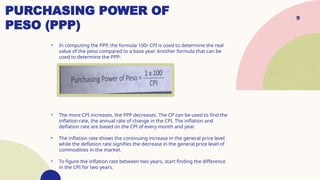
• In computing the PPP, the formula 100/ CPI is used to determine the real
value of the peso compared to a base year. Another formula that can be
used to determine the PPP:
• The more CPI increases, the PPP decreases. The CP can be used to find the
inflation rate, the annual rate of change in the CPI. The inflation and
deflation rate are based on the CPl of every month and year.
• The inflation rate shows the continuing increase in the general price level
while the deflation rate signifies the decrease in the general price level of
commodities in the market.
• To figure the inflation rate between two years, start finding the difference
in the CPI for two years.
COMPUTATION OF INLATION
RATE
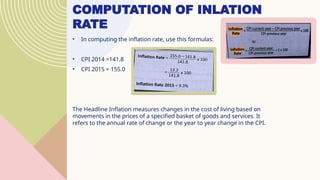
• In computing the inflation rate, use this formulas:
• CPI 2014 =141.8
• CPI 2015 = 155.0
The Headline Inflation measures changes in the cost of living based on
movements in the prices of a specified basket of goods and services. It
refers to the annual rate of change or the year to year change in the CPI.
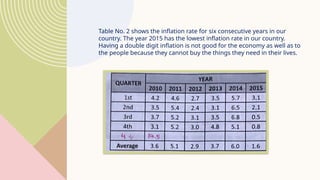
Table No. 2 shows the inflation rate for six consecutive years in our
country. The year 2015 has the lowest inflation rate in our country.
Having a double digit inflation is not good for the economy as well as to
the people because they cannot buy the things they need in their lives.
12
EFFECTS OF INFLATION
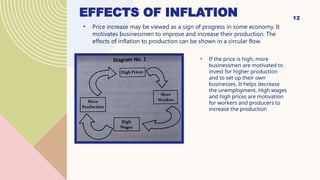
• If the price is high, more
businessmen are motivated to
invest for higher production
and to set up their own
businesses. It helps decrease
the unemployment. High wages
and high prices are motivation
for workers and producers to
increase the production
• Price increase may be viewed as a sign of progress in some economy. It
motivates businessmen to improve and increase their production. The
effects of inflation to production can be shown in a circular flow.
WAYS TO ADDRESS THE
INFLATION
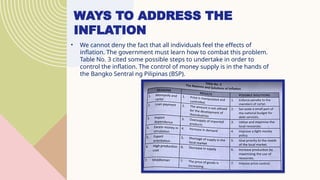
• We cannot deny the fact that all individuals feel the effects of
inflation. The government must learn how to combat this problem.
Table No. 3 cited some possible steps to undertake in order to
control the inflation. The control of money supply is in the hands of
the Bangko Sentral ng Pilipinas (BSP).
14
BANKO SENTRAL NG
PILIPINAS (BSP)
• Through its monetary authority, the BSP can control the money supply by implementing
tight money policy.
• Through the monetary policies of the BSP, businessmen and investors will be forced to
manage their bank loans. As an effect, the money in circulation will be controlled.
• The BSP can control the money supply by increasing the reserve requirement ratio to
force the banks to keep more of their deposits in reserve.
• The BSP makes the reserve requirement high to control the lending of money by the
banks. Also, the BSP sells treasury bills, a type of bond used as evidence of government
loans to the public.
• The selling of T-bills is done to reduce the money in circulation. Through these measures,
the entire financial sector is monitored and controlled by the. government through the
BSP.
• Through the concerted efforts of the government and the people, the effects of inflation
can be lessened.
THANK
YOU :3

Measuring inflation.................pptx

  • 1.
  • 2.
    PRICE INCREASE • Priceincrease is a perennial problem of the economy. It affects the economic decisions of households, business firms, and even the government. The quantity and quality of goods and services can be affected by price increase. People suffer because of the rising prices of goods and services. • The continuing increase in the general price level of goods and services is called inflation. Price increase is part of everyday life. Inflation is a problem which many countries in the world experience and face. This is not new. Even during the medieval period, prices increased fourfold in Europe. • As of now, inflation cannot be controlled. It remains a problem for the economy. Basic commodities are affected by price increase. So many consumers cannot afford to satisfy their basic needs in life 1
  • 3.
    CAUSES OF INFLATION! 2 ~Cost-push Mandatoryincrease in wages, increased cost of raw materials, breakdown or damage to machineries and equipment, and the producer increasing the prices of his products to compensate for the increased cost of production to maintain profit level while still supporting the demand, cause the prices of goods and services increase ~Demand Pull All sectors of the economy, households, business firms, and government have their own demands. The demand of these sectors comprises the aggregate demand of the economy. The demand-pull inflation happens if the sectors desire to buy products and services more than the available supply in the market. In short, it is the condition where aggregate demand is more than the aggregate supply. ~Structural Inflation When the government implements new economic policy like tax reform, the result is price increase. The increase in the normal price of commodities is a result of an imbalance and abrupt increase of demand and supply of the different sectors of the economy. There is competition among wage earners and profit earners. There is competition between the private and public sectors in getting their share of the country's resources. Every action and movement of each economic sector causes an increase in the price of commodities. This is called
  • 4.
    REASONS FOR INFLATION Somepeople believe that price increase is a sign that the economy is developing. As the economy is doing well, inflation cannot be controlled nor avoided. Sometimes, inflation causes the poor to become poorer in some countries. The hoarding of goods, which causes inflation, happens when the market is controlled by a monopoly or a cartel. Since the main concern of business is profit, businessmen and producers prefer exporting raw materials and other products rather than putting them in the market for local consumption. Others businessmen resort to imported goods instead of locally made products. As a result, we have lesser but more expensive goods in the market. In addition, we have this debt from the World Bank- International Monetary Fund. A part of the national budget is intended for the payment of foreign loans. Even devaluation affects the price of the products in the market. Devaluation means decrease in the value of peso compared to a foreign money like the US dollars, Japanese yen and others.
  • 5.
    PEOPLE WHO BENEFIT FROMINFLATION • People without fix income The incomes of individuals sometimes move in accordance with price change. Their income may increase rapidly at a higher rate than that of inflation. • debtors The incomes of individuals sometimes move in accordance with price change. Their income may increase rapidly at a higher rate than that of inflation. • Speculators The incomes of individuals sometimes move in accordance with price change. Their income may increase rapidly at a higher rate than that of inflation. • people who are hurt from inflation. A greater number of people lose their capacity to purchase their basic needs due to high prices. Creditors Individuals who give loans experience losses if there is inflation. The interest on loans may not be enough to cover the price increase. • Individuals who save Saving money is a good and meaningful activity of man. But during inflation, the money in the bank depreciates in value due to the low interest rate of the bank. For example, Lita saves ₽5,000 in the bank with 15 percent interest per year. After a year, the amount of savings will become P5,750. This can be tabulated as: Principal amount = ₽5,000 Interest: = P5,000 x 15 percent = P750.00 Total Savings after 1 year ₽5,750 With 15 percent interest rate per year, Lita earns 15 percent more money in the bank. However, with 17 percent inflation rate, the real value of the money after a year becomes 2 percent lower than the principal amount. Her money depreciates in value due to higher inflation rate.
  • 6.
    • People withfixed income Workers and employees like clerks, janitors, nurses, teachers, and others who receive a fix income every month even during a price increase are negatively affected by inflation. The quantity of products and services they can buy decreases with every price increase. MEASURING THE PRICE INCREASE • To be able to study the price change, the government assigns and selects products to be included in the basket of goods or market basket of goods, which is usually purchased by an average family for a specific period of time. From the market basket of goods, a price index is formed. It represents the total and average change in price of all commodities. The price index depends on what commodities would be examined. • Wholesale Price Index and Retail Price Index It shows and calculates the differences in the value of finished products, intermediate products, and crude materials in wholesale and retail trading. Wholesale is the price for the volume of goods while retail is the price for every piece of goods.
  • 7.
    . • GNP Deflatoror GNP Implicit Price Index It is the average price index used to adjust the current GNP/GNI against constant GNP/GNI.. The GNP/GNI deflator is being used to know the value of GNP based on the previous year. This formula is being used: In short, it is used for any changes in price in the computation of GNP/GNI • Consumer Price Index (CPI) It is the most popular instrument in measuring inflation. The CPI measures the average percentage in the change of retail prices of goods and services usually purchased by consumers, particularly the urban families. It describes the present living condition of the consumers according to changes in price. The CPI measures goods and services which are included in the market basket of goods. • Computation of CPI The prices of the items included in the basket of goods are averaged to get the CPI. Once the CPI is determined each year, it is compared to the price of the base year. Look at Table No.1 for the example on how the CPI is determined using the hypothetical data on various commodities. of the base year. The prices of the said goods and services are compared to the prices
  • 8.
    THE IMPORTANCE OFCPI . CPI is a vital instrument used in describing the economy. Through it, the cost of living can be approximated. The CPI shows the average prices of goods and services. . The CPl is used to determine the Purchasing Power of Peso (PPP) or the equivalent value at base year 2000; prices of goods and services that a peso could buy at current prices. It computes the actual amount of the peso in an assigned time compared to a preferred year. As the CP| increases, the purchasing power of peso decreases.
  • 9.
    9 PURCHASING POWER OF PESO(PPP) • In computing the PPP, the formula 100/ CPI is used to determine the real value of the peso compared to a base year. Another formula that can be used to determine the PPP: • The more CPI increases, the PPP decreases. The CP can be used to find the inflation rate, the annual rate of change in the CPI. The inflation and deflation rate are based on the CPl of every month and year. • The inflation rate shows the continuing increase in the general price level while the deflation rate signifies the decrease in the general price level of commodities in the market. • To figure the inflation rate between two years, start finding the difference in the CPI for two years.
  • 10.
    COMPUTATION OF INLATION RATE •In computing the inflation rate, use this formulas: • CPI 2014 =141.8 • CPI 2015 = 155.0 The Headline Inflation measures changes in the cost of living based on movements in the prices of a specified basket of goods and services. It refers to the annual rate of change or the year to year change in the CPI.
  • 11.
    Table No. 2shows the inflation rate for six consecutive years in our country. The year 2015 has the lowest inflation rate in our country. Having a double digit inflation is not good for the economy as well as to the people because they cannot buy the things they need in their lives.
  • 12.
    12 EFFECTS OF INFLATION •If the price is high, more businessmen are motivated to invest for higher production and to set up their own businesses. It helps decrease the unemployment. High wages and high prices are motivation for workers and producers to increase the production • Price increase may be viewed as a sign of progress in some economy. It motivates businessmen to improve and increase their production. The effects of inflation to production can be shown in a circular flow.
  • 13.
    WAYS TO ADDRESSTHE INFLATION • We cannot deny the fact that all individuals feel the effects of inflation. The government must learn how to combat this problem. Table No. 3 cited some possible steps to undertake in order to control the inflation. The control of money supply is in the hands of the Bangko Sentral ng Pilipinas (BSP).
  • 14.
    14 BANKO SENTRAL NG PILIPINAS(BSP) • Through its monetary authority, the BSP can control the money supply by implementing tight money policy. • Through the monetary policies of the BSP, businessmen and investors will be forced to manage their bank loans. As an effect, the money in circulation will be controlled. • The BSP can control the money supply by increasing the reserve requirement ratio to force the banks to keep more of their deposits in reserve. • The BSP makes the reserve requirement high to control the lending of money by the banks. Also, the BSP sells treasury bills, a type of bond used as evidence of government loans to the public. • The selling of T-bills is done to reduce the money in circulation. Through these measures, the entire financial sector is monitored and controlled by the. government through the BSP. • Through the concerted efforts of the government and the people, the effects of inflation can be lessened.
  • 15.