Economics for Journalists
    Week 5: Government Policy

    Jeffrey Timmermans


Monday, 20 February, 12
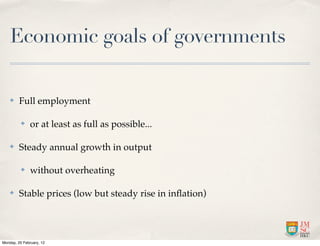
Economic goals of governments

    ✤    Full employment

          ✤    or at least as full as possible...

    ✤    Steady annual growth in output

          ✤    without overheating

    ✤    Stable prices (low but steady rise in inflation)


Monday, 20 February, 12
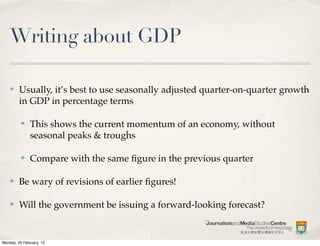
Writing about GDP

    ✤    Usually, it’s best to use seasonally adjusted quarter-on-quarter growth
         in GDP in percentage terms

          ✤    This shows the current momentum of an economy, without
               seasonal peaks & troughs

          ✤    Compare with the same figure in the previous quarter

    ✤    Be wary of revisions of earlier figures!

    ✤    Will the government be issuing a forward-looking forecast?


Monday, 20 February, 12
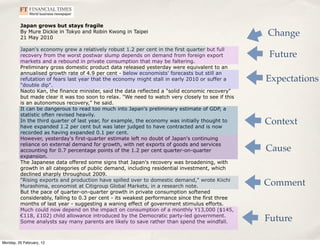
Japan grows but stays fragile
         By Mure Dickie in Tokyo and Robin Kwong in Taipei
         21 May 2010
                                                                                                  Change
         Japan's economy grew a relatively robust 1.2 per cent in the first quarter but full
         recovery from the worst postwar slump depends on demand from foreign export               Future
         markets and a rebound in private consumption that may be faltering.
         Preliminary gross domestic product data released yesterday were equivalent to an
         annualised growth rate of 4.9 per cent - below economists' forecasts but still an
         refutation of fears last year that the economy might stall in early 2010 or suffer a     Expectations
         "double dip".
         Naoto Kan, the finance minister, said the data reflected a "solid economic recovery"
         but made clear it was too soon to relax. "We need to watch very closely to see if this
         is an autonomous recovery," he said.
         It can be dangerous to read too much into Japan's preliminary estimate of GDP, a
         statistic often revised heavily.
         In the third quarter of last year, for example, the economy was initially thought to
         have expanded 1.2 per cent but was later judged to have contracted and is now
                                                                                                  Context
         recorded as having expanded 0.1 per cent.
         However, yesterday's first-quarter estimate left no doubt of Japan's continuing
         reliance on external demand for growth, with net exports of goods and services
         accounting for 0.7 percentage points of the 1.2 per cent quarter-on-quarter              Cause
         expansion.
         The Japanese data offered some signs that Japan's recovery was broadening, with
         growth in all categories of public demand, including residential investment, which
         declined sharply throughout 2009.
         "Rising exports and production have spilled over to domestic demand," wrote Kiichi
         Murashima, economist at Citigroup Global Markets, in a research note.                    Comment
         But the pace of quarter-on-quarter growth in private consumption softened
         considerably, falling to 0.3 per cent - its weakest performance since the first three
         months of last year - suggesting a waning effect of government stimulus efforts.
         Much could now depend on the impact on consumption of a monthly Y13,000 ($145,
         €118, £102) child allowance introduced by the Democratic party-led government.
         Some analysts say many parents are likely to save rather than spend the windfall.        Future

Monday, 20 February, 12
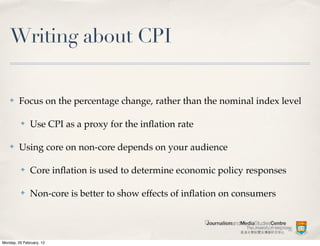
Writing about CPI

    ✤    Focus on the percentage change, rather than the nominal index level

          ✤    Use CPI as a proxy for the inflation rate

    ✤    Using core on non-core depends on your audience

          ✤    Core inflation is used to determine economic policy responses

          ✤    Non-core is better to show effects of inflation on consumers


Monday, 20 February, 12
Japan Consumer Prices Fall 1%
          By Tomoyuki Tachikawa
          1 October 2010


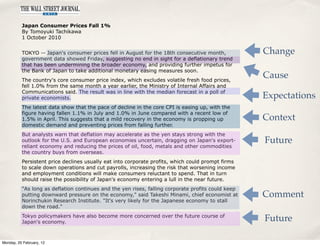
          TOKYO -- Japan's consumer prices fell in August for the 18th consecutive month,           Change
          government data showed Friday, suggesting no end in sight for a deflationary trend
          that has been undermining the broader economy, and providing further impetus for
          the Bank of Japan to take additional monetary easing measures soon.
          The country's core consumer price index, which excludes volatile fresh food prices,
                                                                                                    Cause
          fell 1.0% from the same month a year earlier, the Ministry of Internal Affairs and
          Communications said. The result was in line with the median forecast in a poll of
          private economists.                                                                       Expectations
          The latest data show that the pace of decline in the core CPI is easing up, with the
          figure having fallen 1.1% in July and 1.0% in June compared with a recent low of
          1.5% in April. This suggests that a mild recovery in the economy is propping up           Context
          domestic demand and preventing prices from falling further.
          But analysts warn that deflation may accelerate as the yen stays strong with the
          outlook for the U.S. and European economies uncertain, dragging on Japan's export-        Future
          reliant economy and reducing the prices of oil, food, metals and other commodities
          the country buys from overseas.
          Persistent price declines usually eat into corporate profits, which could prompt firms
          to scale down operations and cut payrolls, increasing the risk that worsening income
          and employment conditions will make consumers reluctant to spend. That in turn
          should raise the possibility of Japan's economy entering a lull in the near future.
          "As long as deflation continues and the yen rises, falling corporate profits could keep
          putting downward pressure on the economy," said Takeshi Minami, chief economist at        Comment
          Norinchukin Research Institute. "It's very likely for the Japanese economy to stall
          down the road."
          Tokyo policymakers have also become more concerned over the future course of
          Japan's economy.                                                                          Future

Monday, 20 February, 12
Unemployment Rate


    ✤    Tracks the number of people in the labor force who don’t have jobs

          ✤    How do you define “labor force”?

    ✤    Usually expressed in percentage terms rather than an absolute
         number

    ✤    Full employment is a bad thing!


Monday, 20 February, 12
Problems with unemployment
    data

    ✤    Based on a household survey

    ✤    Doesn’t include people who have given up looking for work

    ✤    Definitions of “unemployment” vary among countries

          ✤    Japan’s definition is more restrictive than the U.S.’s


Monday, 20 February, 12
Grim Milestone as Jobless Rate Tops 10%
      By Sudeep Reddy
      9 November 2009

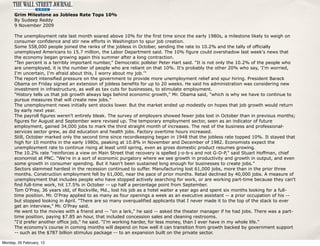
      The unemployment rate last month soared above 10% for the first time since the early 1980s, a milestone likely to weigh on
      consumer confidence and stir new efforts in Washington to spur job creation.
      Some 558,000 people joined the ranks of the jobless in October, sending the rate to 10.2% and the tally of officially
      unemployed Americans to 15.7 million, the Labor Department said. The 10% figure could overshadow last week's news that
      the economy began growing again this summer after a long contraction.
      "Ten percent is a terribly important number," Democratic pollster Peter Hart said. "It is not only the 10.2% of the people who
      are unemployed, it is the number of people who are reliant on that 10%. It's probably the other 20% who say, 'I'm worried,
      I'm uncertain, I'm afraid about this, I worry about my job.'"
      The report intensified pressure on the government to provide more unemployment relief and spur hiring. President Barack
      Obama on Friday signed an extension of jobless benefits for up to 20 weeks. He said his administration was considering new
      investment in infrastructure, as well as tax cuts for businesses, to stimulate employment.
      "History tells us that job growth always lags behind economic growth," Mr. Obama said, "which is why we have to continue to
      pursue measures that will create new jobs."
      The unemployment news initially sent stocks lower. But the market ended up modestly on hopes that job growth would return
      by early next year.
      The payroll figures weren't entirely bleak. The survey of employers showed fewer jobs lost in October than in previous months;
      figures for August and September were revised up. The temporary employment sector, seen as an indicator of future
      employment, gained 34,000 jobs to mark the third straight month of increases. The rest of the business and professional-
      services sector grew, as did education and health jobs. Factory overtime hours increased.
      Still, October marked only the second time since recordkeeping began in 1948 that the jobless rate topped 10%. It stayed that
      high for 10 months in the early 1980s, peaking at 10.8% in November and December of 1982. Economists expect the
      unemployment rate to continue rising at least until spring, even as gross domestic product resumes growing.
      The 10.2% rate "reinforces a view on Main Street that recovery is spelled j-o-b-s and not G-D-P," said Stuart Hoffman, chief
      economist at PNC. "We're in a sort of economic purgatory where we see growth in productivity and growth in output, and even
      some growth in consumer spending. But it hasn't been sustained long enough for businesses to create jobs."
      Sectors slammed hardest in the recession continued to suffer. Manufacturing lost 61,000 jobs, more than in the prior three
      months. Construction employment fell by 61,000, near the pace of prior months. Retail declined by 40,000 jobs. A measure of
      unemployment that includes people who have stopped actively searching for work, or are working part-time because they can't
      find full-time work, hit 17.5% in October -- up half a percentage point from September.
      Tom O'Pray, 36 years old, of Rockville, Md., lost his job as a hotel waiter a year ago and spent six months looking for a full-
      time position. Mr. O'Pray applied to as many as four openings a week as an executive assistant -- a prior occupation of his --
      but stopped looking in April. "There are so many overqualified applicants that I never made it to the top of the stack to ever
      get an interview," Mr. O'Pray said.
      He went to the movies with a friend and -- "on a lark," he said -- asked the theater manager if he had jobs. There was a part-
      time position, paying $7.85 an hour, that included concession sales and cleaning restrooms.
      "I'd prefer another office job," he said. "I'm working harder, for less money, than I ever have in my whole life."
      The economy's course in coming months will depend on how well it can transition from growth backed by government support
      -- such as the $787 billion stimulus package -- to an expansion built on the private sector.

Monday, 20 February, 12
Consumer/Business Confidence
    Index
    ✤    A leading indicator of short-term consumer spending or investment
         by businesses

    ✤    Often presented as a diffusion index

          ✤    How many respondents are confident minus how many are
               pessimistic

          ✤    A reading of above 50 indicates optimism

    ✤    Compare to previous month/quarter for changes in sentiment


Monday, 20 February, 12
Problems with confidence indices


    ✤    Can have relatively large margin of error

          ✤    How big is the survey?

    ✤    Can mask dramatic changes in consumer or business sub-groups

          ✤    In the case of the tankan, check the sub-index for smaller businesses


Monday, 20 February, 12
Some other indicators

    ✤    Consumer Confidence

    ✤    Balance of Payments, including Trade Balance

    ✤    Industrial Production

    ✤    Retail Sales

    ✤    Tourist Arrivals

    ✤    Home Sales/Land Sales


Monday, 20 February, 12
Two types of policy

    ✤    Fiscal policy               ✤   Monetary policy

          ✤    Taxation                  ✤   Discount rate

          ✤    Government spending       ✤   Open-market operations

                                         ✤   Reserve ratio


Monday, 20 February, 12
Taxation

    ✤    Changes to tax policy can alter economic incentives

          ✤    Broad-based tax cuts can incentivize spending

          ✤    Targeted tax cuts/exemptions/credits can affect investment
               decisions

                ✤   Mortgage tax exemption

                ✤   Capital gains taxes


Monday, 20 February, 12
Government spending


    ✤    To expand the economy, government spending must use borrowed
         money (deficit spending)

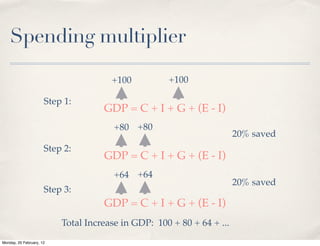
    ✤    The impact of government spending is multiplied, depending on how
         much people spend and how much they save

          ✤    As the economy begins to grow, businesses and consumers tend to
               invest and consume more


Monday, 20 February, 12
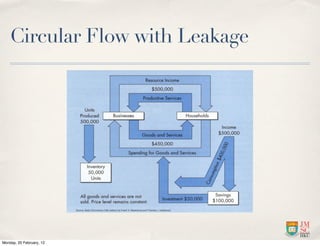
Circular Flow with Leakage


Monday, 20 February, 12
Spending multiplier

                                      +100          +100

                      Step 1:
                                    GDP = C + I + G + (E - I)
                                       +80 +80
                                                                       20% saved
                      Step 2:
                                    GDP = C + I + G + (E - I)
                                       +64 +64
                                                                       20% saved
                      Step 3:
                                    GDP = C + I + G + (E - I)
                          Total Increase in GDP: 100 + 80 + 64 + ...
Monday, 20 February, 12
Monetary policy


    ✤    Now, typically the domain of central banks, independent from
         government control

    ✤    Central banks can influence other interest rates by changing the
         supply of money

    ✤    Modern monetary policy focuses primarily on money supply


Monday, 20 February, 12
Roles of central banks


    ✤    Lender of last resort to domestic banks

    ✤    Regulator of domestic banking system

    ✤    Sets benchmark interest rate via open-market purchases of bonds

          ✤    Interest rates set to achieve steady economic growth with low
               inflation (price stability)


Monday, 20 February, 12
Discount rate


    ✤    Central banks can lend directly to commercial banks, in their role as
         “lender of last resort”

    ✤    The central bank’s discount rate is the interest rate it charges
         commercial banks on overnight loans

    ✤    The discount rate is explicitly set by the central bank


Monday, 20 February, 12
Examples of discount rates


    ✤    U.S. Fed discount rate (0.75%)

    ✤    HKMA base rate (0.5% or a half-percentage point above Fed Funds)

    ✤    Bank of Japan basic discount rate (0.3%)


Monday, 20 February, 12
Required reserve ratio

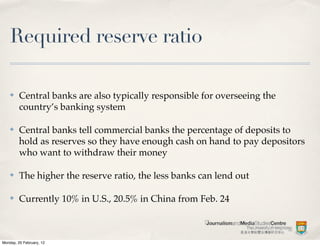
    ✤    Central banks are also typically responsible for overseeing the
         country’s banking system

    ✤    Central banks tell commercial banks the percentage of deposits to
         hold as reserves so they have enough cash on hand to pay depositors
         who want to withdraw their money

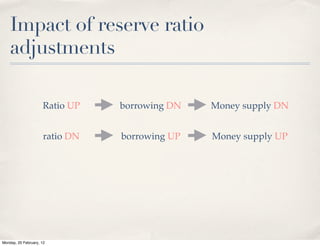
    ✤    The higher the reserve ratio, the less banks can lend out

    ✤    Currently 10% in U.S., 20.5% in China from Feb. 24


Monday, 20 February, 12
Impact of reserve ratio
    adjustments

                     Ratio UP    borrowing DN   Money supply DN


                      ratio DN   borrowing UP   Money supply UP


Monday, 20 February, 12
Open-market operations


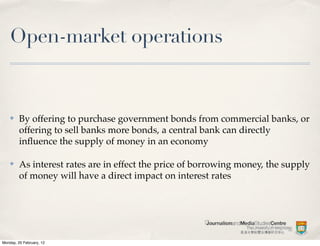
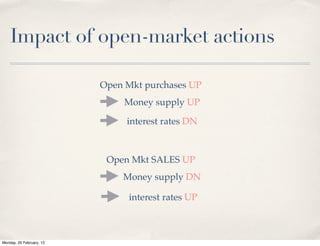
    ✤    By offering to purchase government bonds from commercial banks, or
         offering to sell banks more bonds, a central bank can directly
         influence the supply of money in an economy

    ✤    As interest rates are in effect the price of borrowing money, the supply
         of money will have a direct impact on interest rates


Monday, 20 February, 12
Impact of open-market actions

                          Open Mkt purchases UP
                               Money supply UP

                               interest rates DN


                           Open Mkt SALES UP
                              Money supply DN

                               interest rates UP


Monday, 20 February, 12
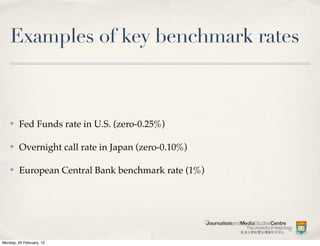
Examples of key benchmark rates


    ✤    Fed Funds rate in U.S. (zero-0.25%)

    ✤    Overnight call rate in Japan (zero-0.10%)

    ✤    European Central Bank benchmark rate (1%)


Monday, 20 February, 12
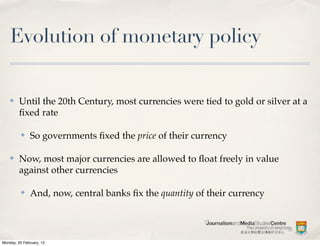
Evolution of monetary policy

    ✤    Until the 20th Century, most currencies were tied to gold or silver at a
         fixed rate

          ✤    So governments fixed the price of their currency

    ✤    Now, most major currencies are allowed to float freely in value
         against other currencies

          ✤    And, now, central banks fix the quantity of their currency


Monday, 20 February, 12
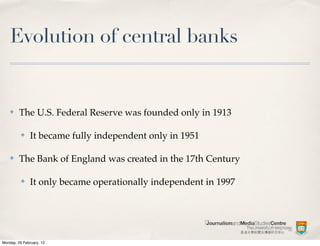
Evolution of central banks


    ✤    The U.S. Federal Reserve was founded only in 1913

          ✤    It became fully independent only in 1951

    ✤    The Bank of England was created in the 17th Century

          ✤    It only became operationally independent in 1997


Monday, 20 February, 12
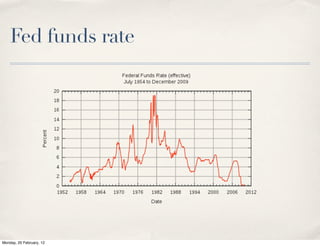
Fed funds rate


Monday, 20 February, 12
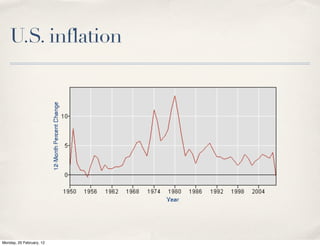
U.S. inflation


Monday, 20 February, 12
Quantitative Easing

    ✤    First used by the Bank of Japan from 2001 after a long period of
         near-zero short-term interest rates failed to kick-start the
         economy

    ✤    A central bank “expands its balance sheet” by offering to buy
         government or other bonds from commercial banks

    ✤    The central bank credits the account the commercial bank
         maintains with the central bank and holds onto the bond


Monday, 20 February, 12

Class5

  • 1.
    Economics for Journalists Week 5: Government Policy Jeffrey Timmermans Monday, 20 February, 12
  • 2.
    Economic goals ofgovernments ✤ Full employment ✤ or at least as full as possible... ✤ Steady annual growth in output ✤ without overheating ✤ Stable prices (low but steady rise in inflation) Monday, 20 February, 12
  • 3.
    Writing about GDP ✤ Usually, it’s best to use seasonally adjusted quarter-on-quarter growth in GDP in percentage terms ✤ This shows the current momentum of an economy, without seasonal peaks & troughs ✤ Compare with the same figure in the previous quarter ✤ Be wary of revisions of earlier figures! ✤ Will the government be issuing a forward-looking forecast? Monday, 20 February, 12
  • 4.
    Japan grows butstays fragile By Mure Dickie in Tokyo and Robin Kwong in Taipei 21 May 2010 Change Japan's economy grew a relatively robust 1.2 per cent in the first quarter but full recovery from the worst postwar slump depends on demand from foreign export Future markets and a rebound in private consumption that may be faltering. Preliminary gross domestic product data released yesterday were equivalent to an annualised growth rate of 4.9 per cent - below economists' forecasts but still an refutation of fears last year that the economy might stall in early 2010 or suffer a Expectations "double dip". Naoto Kan, the finance minister, said the data reflected a "solid economic recovery" but made clear it was too soon to relax. "We need to watch very closely to see if this is an autonomous recovery," he said. It can be dangerous to read too much into Japan's preliminary estimate of GDP, a statistic often revised heavily. In the third quarter of last year, for example, the economy was initially thought to have expanded 1.2 per cent but was later judged to have contracted and is now Context recorded as having expanded 0.1 per cent. However, yesterday's first-quarter estimate left no doubt of Japan's continuing reliance on external demand for growth, with net exports of goods and services accounting for 0.7 percentage points of the 1.2 per cent quarter-on-quarter Cause expansion. The Japanese data offered some signs that Japan's recovery was broadening, with growth in all categories of public demand, including residential investment, which declined sharply throughout 2009. "Rising exports and production have spilled over to domestic demand," wrote Kiichi Murashima, economist at Citigroup Global Markets, in a research note. Comment But the pace of quarter-on-quarter growth in private consumption softened considerably, falling to 0.3 per cent - its weakest performance since the first three months of last year - suggesting a waning effect of government stimulus efforts. Much could now depend on the impact on consumption of a monthly Y13,000 ($145, €118, £102) child allowance introduced by the Democratic party-led government. Some analysts say many parents are likely to save rather than spend the windfall. Future Monday, 20 February, 12
  • 5.
    Writing about CPI ✤ Focus on the percentage change, rather than the nominal index level ✤ Use CPI as a proxy for the inflation rate ✤ Using core on non-core depends on your audience ✤ Core inflation is used to determine economic policy responses ✤ Non-core is better to show effects of inflation on consumers Monday, 20 February, 12
  • 6.
    Japan Consumer PricesFall 1% By Tomoyuki Tachikawa 1 October 2010 TOKYO -- Japan's consumer prices fell in August for the 18th consecutive month, Change government data showed Friday, suggesting no end in sight for a deflationary trend that has been undermining the broader economy, and providing further impetus for the Bank of Japan to take additional monetary easing measures soon. The country's core consumer price index, which excludes volatile fresh food prices, Cause fell 1.0% from the same month a year earlier, the Ministry of Internal Affairs and Communications said. The result was in line with the median forecast in a poll of private economists. Expectations The latest data show that the pace of decline in the core CPI is easing up, with the figure having fallen 1.1% in July and 1.0% in June compared with a recent low of 1.5% in April. This suggests that a mild recovery in the economy is propping up Context domestic demand and preventing prices from falling further. But analysts warn that deflation may accelerate as the yen stays strong with the outlook for the U.S. and European economies uncertain, dragging on Japan's export- Future reliant economy and reducing the prices of oil, food, metals and other commodities the country buys from overseas. Persistent price declines usually eat into corporate profits, which could prompt firms to scale down operations and cut payrolls, increasing the risk that worsening income and employment conditions will make consumers reluctant to spend. That in turn should raise the possibility of Japan's economy entering a lull in the near future. "As long as deflation continues and the yen rises, falling corporate profits could keep putting downward pressure on the economy," said Takeshi Minami, chief economist at Comment Norinchukin Research Institute. "It's very likely for the Japanese economy to stall down the road." Tokyo policymakers have also become more concerned over the future course of Japan's economy. Future Monday, 20 February, 12
  • 7.
    Unemployment Rate ✤ Tracks the number of people in the labor force who don’t have jobs ✤ How do you define “labor force”? ✤ Usually expressed in percentage terms rather than an absolute number ✤ Full employment is a bad thing! Monday, 20 February, 12
  • 8.
    Problems with unemployment data ✤ Based on a household survey ✤ Doesn’t include people who have given up looking for work ✤ Definitions of “unemployment” vary among countries ✤ Japan’s definition is more restrictive than the U.S.’s Monday, 20 February, 12
  • 9.
    Grim Milestone asJobless Rate Tops 10% By Sudeep Reddy 9 November 2009 The unemployment rate last month soared above 10% for the first time since the early 1980s, a milestone likely to weigh on consumer confidence and stir new efforts in Washington to spur job creation. Some 558,000 people joined the ranks of the jobless in October, sending the rate to 10.2% and the tally of officially unemployed Americans to 15.7 million, the Labor Department said. The 10% figure could overshadow last week's news that the economy began growing again this summer after a long contraction. "Ten percent is a terribly important number," Democratic pollster Peter Hart said. "It is not only the 10.2% of the people who are unemployed, it is the number of people who are reliant on that 10%. It's probably the other 20% who say, 'I'm worried, I'm uncertain, I'm afraid about this, I worry about my job.'" The report intensified pressure on the government to provide more unemployment relief and spur hiring. President Barack Obama on Friday signed an extension of jobless benefits for up to 20 weeks. He said his administration was considering new investment in infrastructure, as well as tax cuts for businesses, to stimulate employment. "History tells us that job growth always lags behind economic growth," Mr. Obama said, "which is why we have to continue to pursue measures that will create new jobs." The unemployment news initially sent stocks lower. But the market ended up modestly on hopes that job growth would return by early next year. The payroll figures weren't entirely bleak. The survey of employers showed fewer jobs lost in October than in previous months; figures for August and September were revised up. The temporary employment sector, seen as an indicator of future employment, gained 34,000 jobs to mark the third straight month of increases. The rest of the business and professional- services sector grew, as did education and health jobs. Factory overtime hours increased. Still, October marked only the second time since recordkeeping began in 1948 that the jobless rate topped 10%. It stayed that high for 10 months in the early 1980s, peaking at 10.8% in November and December of 1982. Economists expect the unemployment rate to continue rising at least until spring, even as gross domestic product resumes growing. The 10.2% rate "reinforces a view on Main Street that recovery is spelled j-o-b-s and not G-D-P," said Stuart Hoffman, chief economist at PNC. "We're in a sort of economic purgatory where we see growth in productivity and growth in output, and even some growth in consumer spending. But it hasn't been sustained long enough for businesses to create jobs." Sectors slammed hardest in the recession continued to suffer. Manufacturing lost 61,000 jobs, more than in the prior three months. Construction employment fell by 61,000, near the pace of prior months. Retail declined by 40,000 jobs. A measure of unemployment that includes people who have stopped actively searching for work, or are working part-time because they can't find full-time work, hit 17.5% in October -- up half a percentage point from September. Tom O'Pray, 36 years old, of Rockville, Md., lost his job as a hotel waiter a year ago and spent six months looking for a full- time position. Mr. O'Pray applied to as many as four openings a week as an executive assistant -- a prior occupation of his -- but stopped looking in April. "There are so many overqualified applicants that I never made it to the top of the stack to ever get an interview," Mr. O'Pray said. He went to the movies with a friend and -- "on a lark," he said -- asked the theater manager if he had jobs. There was a part- time position, paying $7.85 an hour, that included concession sales and cleaning restrooms. "I'd prefer another office job," he said. "I'm working harder, for less money, than I ever have in my whole life." The economy's course in coming months will depend on how well it can transition from growth backed by government support -- such as the $787 billion stimulus package -- to an expansion built on the private sector. Monday, 20 February, 12
  • 10.
    Consumer/Business Confidence Index ✤ A leading indicator of short-term consumer spending or investment by businesses ✤ Often presented as a diffusion index ✤ How many respondents are confident minus how many are pessimistic ✤ A reading of above 50 indicates optimism ✤ Compare to previous month/quarter for changes in sentiment Monday, 20 February, 12
  • 11.
    Problems with confidenceindices ✤ Can have relatively large margin of error ✤ How big is the survey? ✤ Can mask dramatic changes in consumer or business sub-groups ✤ In the case of the tankan, check the sub-index for smaller businesses Monday, 20 February, 12
  • 12.
    Some other indicators ✤ Consumer Confidence ✤ Balance of Payments, including Trade Balance ✤ Industrial Production ✤ Retail Sales ✤ Tourist Arrivals ✤ Home Sales/Land Sales Monday, 20 February, 12
  • 13.
    Two types ofpolicy ✤ Fiscal policy ✤ Monetary policy ✤ Taxation ✤ Discount rate ✤ Government spending ✤ Open-market operations ✤ Reserve ratio Monday, 20 February, 12
  • 14.
    Taxation ✤ Changes to tax policy can alter economic incentives ✤ Broad-based tax cuts can incentivize spending ✤ Targeted tax cuts/exemptions/credits can affect investment decisions ✤ Mortgage tax exemption ✤ Capital gains taxes Monday, 20 February, 12
  • 15.
    Government spending ✤ To expand the economy, government spending must use borrowed money (deficit spending) ✤ The impact of government spending is multiplied, depending on how much people spend and how much they save ✤ As the economy begins to grow, businesses and consumers tend to invest and consume more Monday, 20 February, 12
  • 16.
    Circular Flow withLeakage Monday, 20 February, 12
  • 17.
    Spending multiplier +100 +100 Step 1: GDP = C + I + G + (E - I) +80 +80 20% saved Step 2: GDP = C + I + G + (E - I) +64 +64 20% saved Step 3: GDP = C + I + G + (E - I) Total Increase in GDP: 100 + 80 + 64 + ... Monday, 20 February, 12
  • 18.
    Monetary policy ✤ Now, typically the domain of central banks, independent from government control ✤ Central banks can influence other interest rates by changing the supply of money ✤ Modern monetary policy focuses primarily on money supply Monday, 20 February, 12
  • 19.
    Roles of centralbanks ✤ Lender of last resort to domestic banks ✤ Regulator of domestic banking system ✤ Sets benchmark interest rate via open-market purchases of bonds ✤ Interest rates set to achieve steady economic growth with low inflation (price stability) Monday, 20 February, 12
  • 20.
    Discount rate ✤ Central banks can lend directly to commercial banks, in their role as “lender of last resort” ✤ The central bank’s discount rate is the interest rate it charges commercial banks on overnight loans ✤ The discount rate is explicitly set by the central bank Monday, 20 February, 12
  • 21.
    Examples of discountrates ✤ U.S. Fed discount rate (0.75%) ✤ HKMA base rate (0.5% or a half-percentage point above Fed Funds) ✤ Bank of Japan basic discount rate (0.3%) Monday, 20 February, 12
  • 22.
    Required reserve ratio ✤ Central banks are also typically responsible for overseeing the country’s banking system ✤ Central banks tell commercial banks the percentage of deposits to hold as reserves so they have enough cash on hand to pay depositors who want to withdraw their money ✤ The higher the reserve ratio, the less banks can lend out ✤ Currently 10% in U.S., 20.5% in China from Feb. 24 Monday, 20 February, 12
  • 23.
    Impact of reserveratio adjustments Ratio UP borrowing DN Money supply DN ratio DN borrowing UP Money supply UP Monday, 20 February, 12
  • 24.
    Open-market operations ✤ By offering to purchase government bonds from commercial banks, or offering to sell banks more bonds, a central bank can directly influence the supply of money in an economy ✤ As interest rates are in effect the price of borrowing money, the supply of money will have a direct impact on interest rates Monday, 20 February, 12
  • 25.
    Impact of open-marketactions Open Mkt purchases UP Money supply UP interest rates DN Open Mkt SALES UP Money supply DN interest rates UP Monday, 20 February, 12
  • 26.
    Examples of keybenchmark rates ✤ Fed Funds rate in U.S. (zero-0.25%) ✤ Overnight call rate in Japan (zero-0.10%) ✤ European Central Bank benchmark rate (1%) Monday, 20 February, 12
  • 27.
    Evolution of monetarypolicy ✤ Until the 20th Century, most currencies were tied to gold or silver at a fixed rate ✤ So governments fixed the price of their currency ✤ Now, most major currencies are allowed to float freely in value against other currencies ✤ And, now, central banks fix the quantity of their currency Monday, 20 February, 12
  • 28.
    Evolution of centralbanks ✤ The U.S. Federal Reserve was founded only in 1913 ✤ It became fully independent only in 1951 ✤ The Bank of England was created in the 17th Century ✤ It only became operationally independent in 1997 Monday, 20 February, 12
  • 29.
    Fed funds rate Monday,20 February, 12
  • 30.
  • 31.
    Quantitative Easing ✤ First used by the Bank of Japan from 2001 after a long period of near-zero short-term interest rates failed to kick-start the economy ✤ A central bank “expands its balance sheet” by offering to buy government or other bonds from commercial banks ✤ The central bank credits the account the commercial bank maintains with the central bank and holds onto the bond Monday, 20 February, 12