Workshop on Representation Learning for NLP
11 August, 2016, Berlin, Germany
Making Sense of Word Embeddings
Maria Pelevina1
, Nikolay Arefyev2
, Chris Biemann1
and Alexander Panchenko1
1
Technische Universität Darmstadt, LT Group, Computer Science Department, Germany
2
Moscow State University, Faculty of Computational Mathematics and Cybernetics, Russia
February 15, 2017 | 1
Overview of the contribution
Prior methods:
Induce inventory by clustering of word instances (Li and Jurafsky, 2015)
Use existing inventories (Rothe and Schütze, 2015)
Our method:
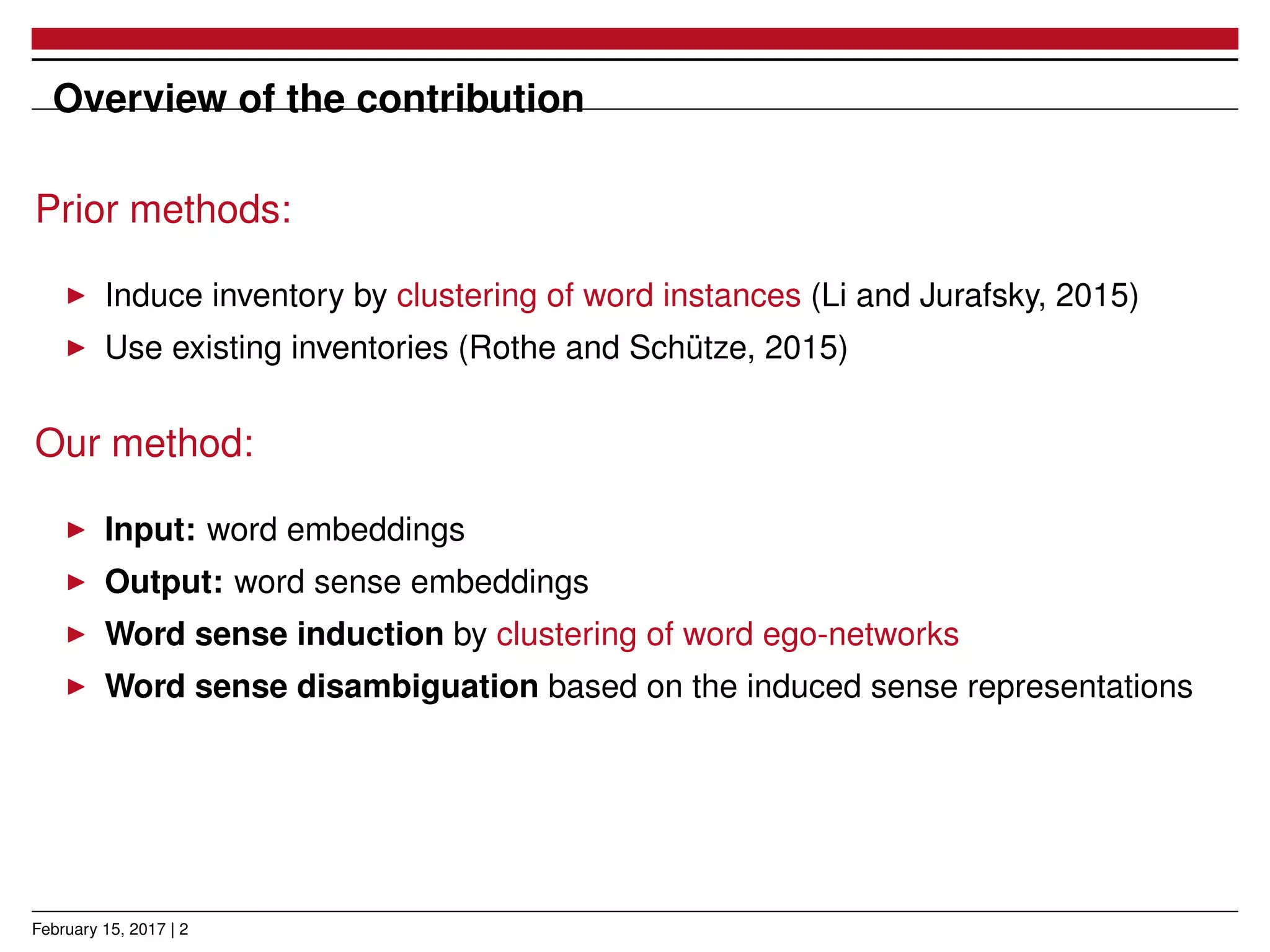
Input: word embeddings
Output: word sense embeddings
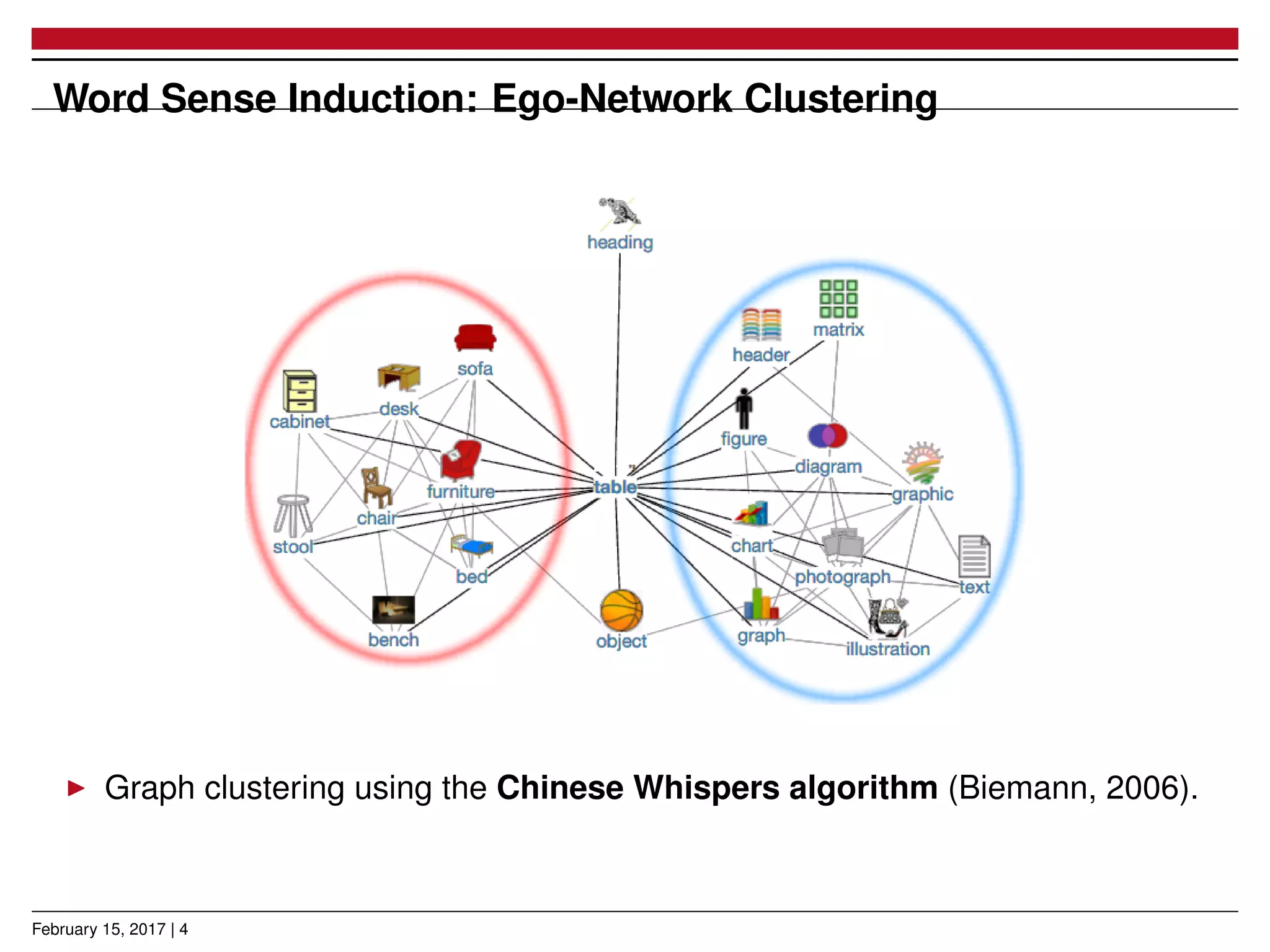
Word sense induction by clustering of word ego-networks
Word sense disambiguation based on the induced sense representations
February 15, 2017 | 2
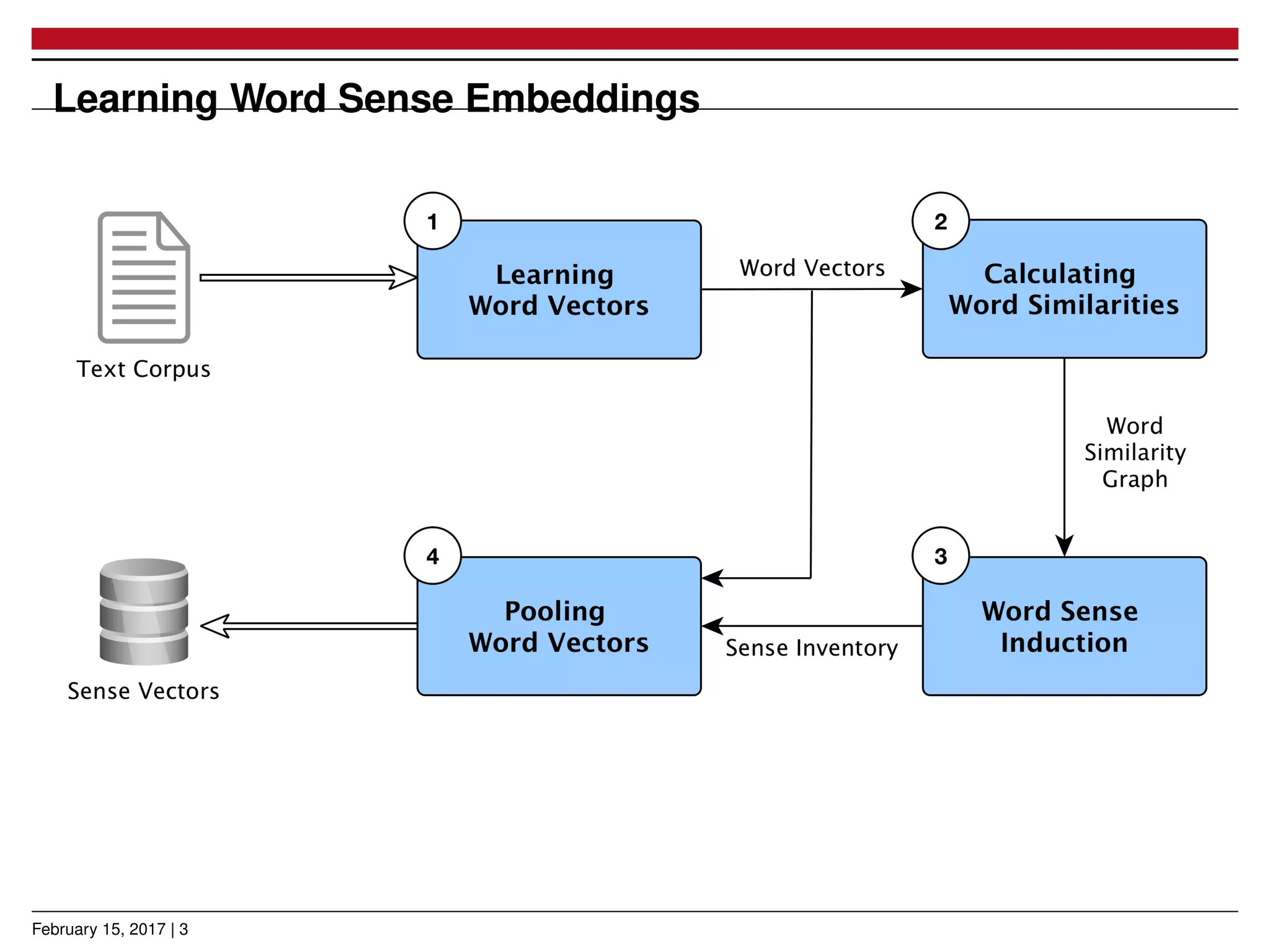
Learning Word Sense Embeddings
February 15, 2017 | 3
Word Sense Induction: Ego-Network Clustering
Graph clustering using the Chinese Whispers algorithm (Biemann, 2006).
February 15, 2017 | 4
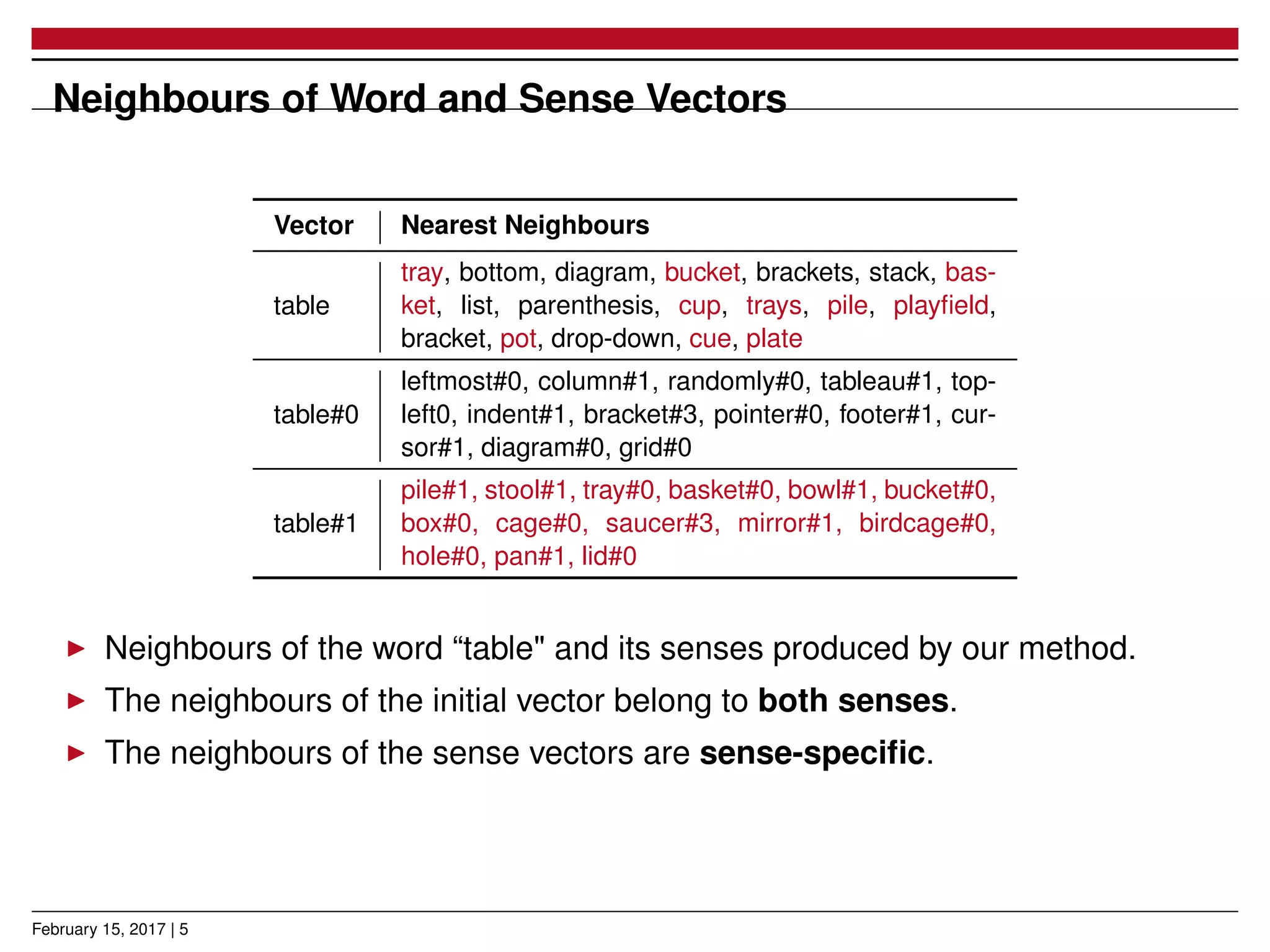
Neighbours of Word and Sense Vectors
Vector Nearest Neighbours
table
tray, bottom, diagram, bucket, brackets, stack, bas-
ket, list, parenthesis, cup, trays, pile, playfield,
bracket, pot, drop-down, cue, plate
table#0
leftmost#0, column#1, randomly#0, tableau#1, top-
left0, indent#1, bracket#3, pointer#0, footer#1, cur-
sor#1, diagram#0, grid#0
table#1
pile#1, stool#1, tray#0, basket#0, bowl#1, bucket#0,
box#0, cage#0, saucer#3, mirror#1, birdcage#0,
hole#0, pan#1, lid#0
Neighbours of the word “table" and its senses produced by our method.
The neighbours of the initial vector belong to both senses.
The neighbours of the sense vectors are sense-specific.
February 15, 2017 | 5
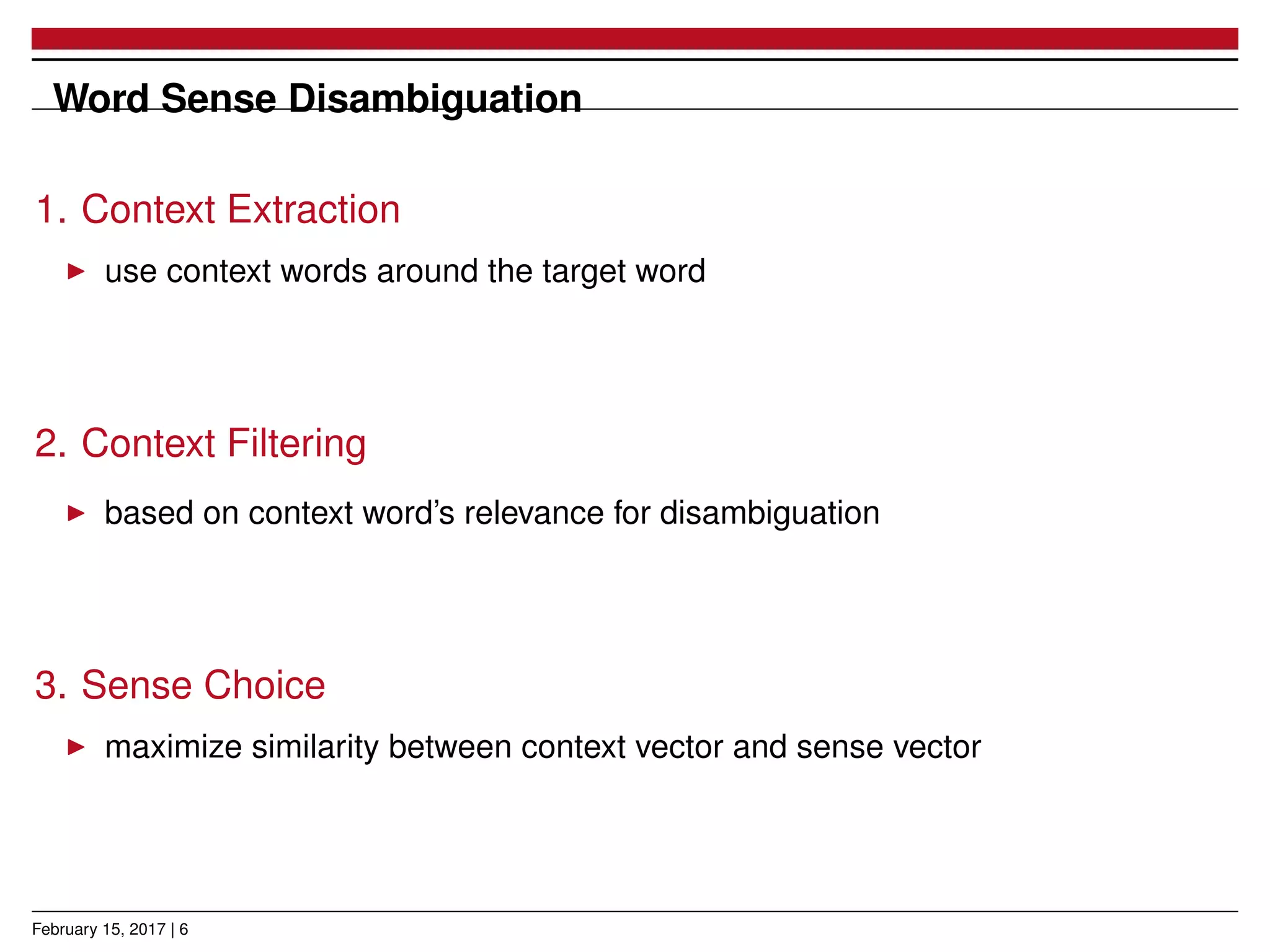
Word Sense Disambiguation
1. Context Extraction
use context words around the target word
2. Context Filtering
based on context word’s relevance for disambiguation
3. Sense Choice
maximize similarity between context vector and sense vector
February 15, 2017 | 6
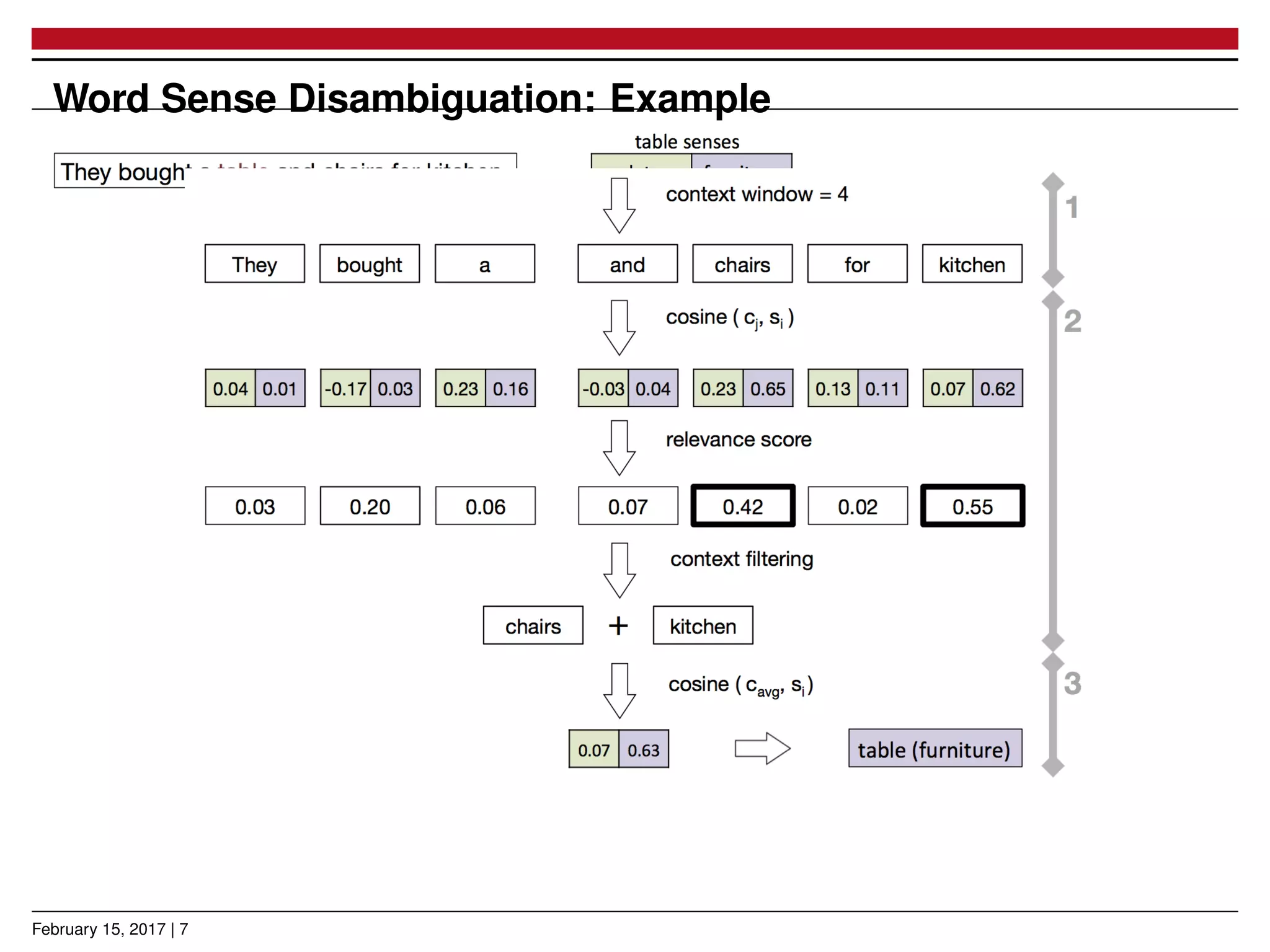
Word Sense Disambiguation: Example
February 15, 2017 | 7
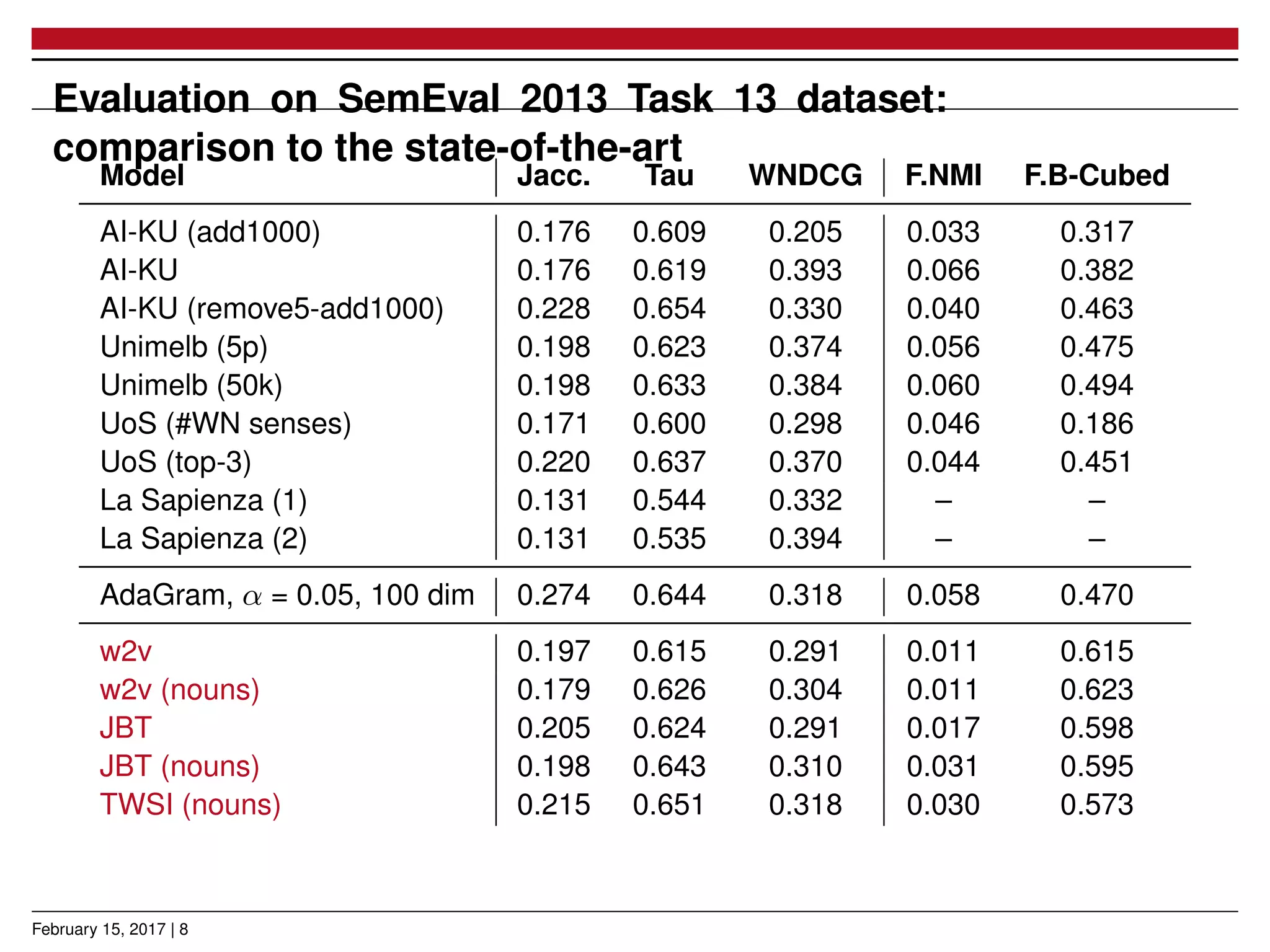
Evaluation on SemEval 2013 Task 13 dataset:
comparison to the state-of-the-art
Model Jacc. Tau WNDCG F.NMI F.B-Cubed
AI-KU (add1000) 0.176 0.609 0.205 0.033 0.317
AI-KU 0.176 0.619 0.393 0.066 0.382
AI-KU (remove5-add1000) 0.228 0.654 0.330 0.040 0.463
Unimelb (5p) 0.198 0.623 0.374 0.056 0.475
Unimelb (50k) 0.198 0.633 0.384 0.060 0.494
UoS (#WN senses) 0.171 0.600 0.298 0.046 0.186
UoS (top-3) 0.220 0.637 0.370 0.044 0.451
La Sapienza (1) 0.131 0.544 0.332 – –
La Sapienza (2) 0.131 0.535 0.394 – –
AdaGram, α = 0.05, 100 dim 0.274 0.644 0.318 0.058 0.470
w2v 0.197 0.615 0.291 0.011 0.615
w2v (nouns) 0.179 0.626 0.304 0.011 0.623
JBT 0.205 0.624 0.291 0.017 0.598
JBT (nouns) 0.198 0.643 0.310 0.031 0.595
TWSI (nouns) 0.215 0.651 0.318 0.030 0.573
February 15, 2017 | 8
Conclusion
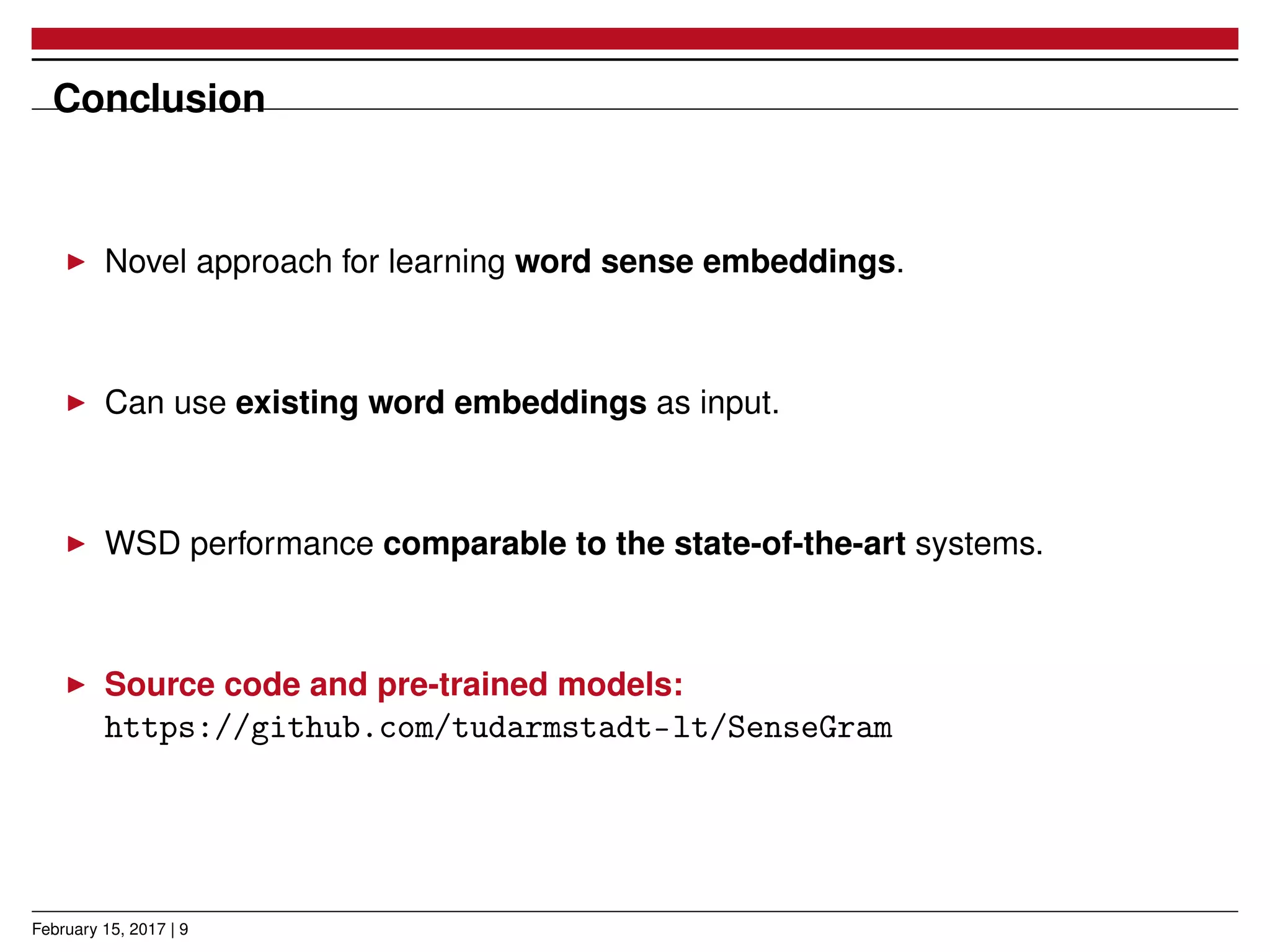
Novel approach for learning word sense embeddings.
Can use existing word embeddings as input.
WSD performance comparable to the state-of-the-art systems.
Source code and pre-trained models:
https://github.com/tudarmstadt-lt/SenseGram
February 15, 2017 | 9
Thank you and welcome to our poster!
February 15, 2017 | 10
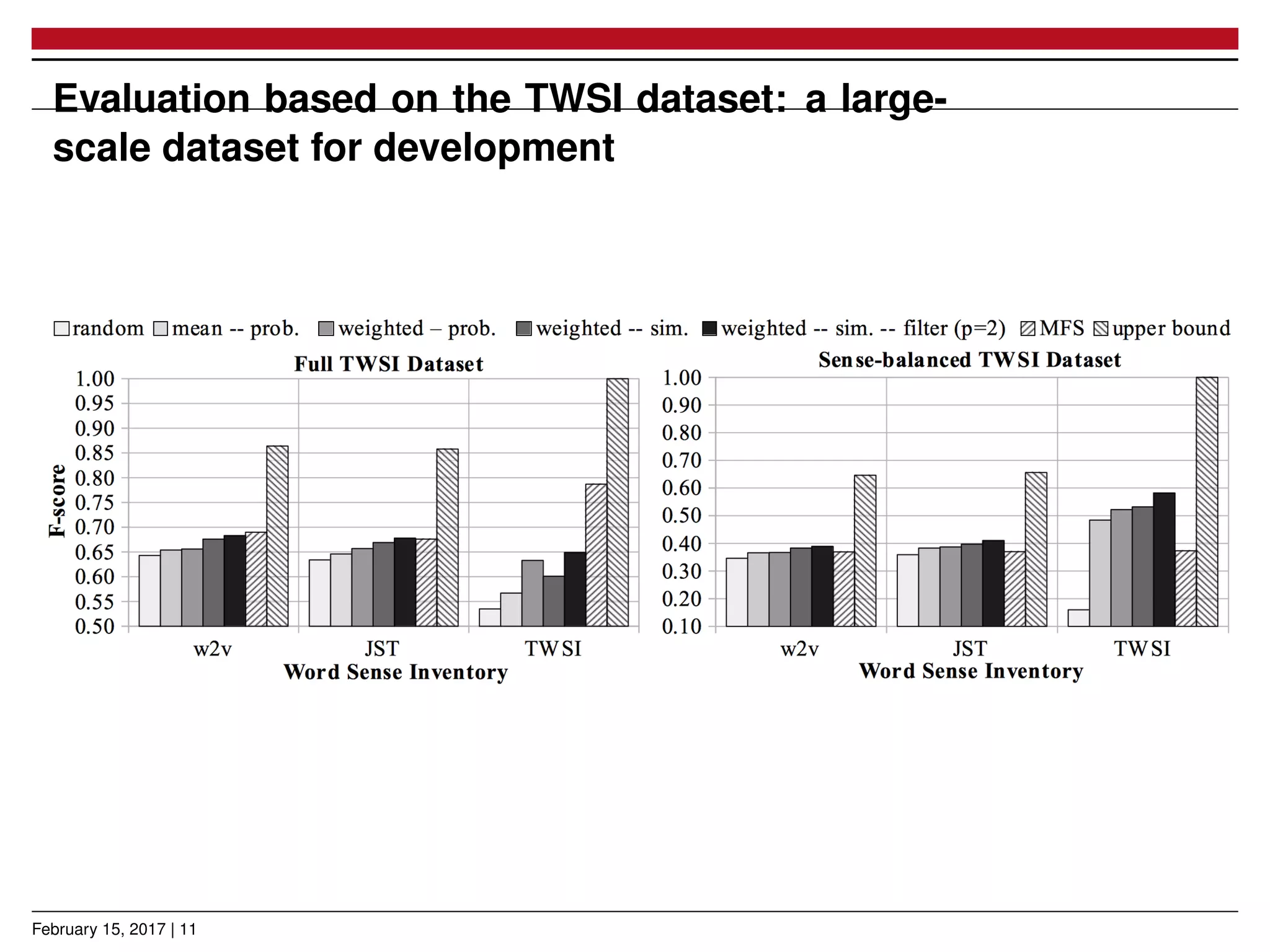
Evaluation based on the TWSI dataset: a large-
scale dataset for development
February 15, 2017 | 11

Making Sense of Word Embeddings

  • 1.
    Workshop on RepresentationLearning for NLP 11 August, 2016, Berlin, Germany Making Sense of Word Embeddings Maria Pelevina1 , Nikolay Arefyev2 , Chris Biemann1 and Alexander Panchenko1 1 Technische Universität Darmstadt, LT Group, Computer Science Department, Germany 2 Moscow State University, Faculty of Computational Mathematics and Cybernetics, Russia February 15, 2017 | 1
  • 2.
    Overview of thecontribution Prior methods: Induce inventory by clustering of word instances (Li and Jurafsky, 2015) Use existing inventories (Rothe and Schütze, 2015) Our method: Input: word embeddings Output: word sense embeddings Word sense induction by clustering of word ego-networks Word sense disambiguation based on the induced sense representations February 15, 2017 | 2
  • 3.
    Learning Word SenseEmbeddings February 15, 2017 | 3
  • 4.
    Word Sense Induction:Ego-Network Clustering Graph clustering using the Chinese Whispers algorithm (Biemann, 2006). February 15, 2017 | 4
  • 5.
    Neighbours of Wordand Sense Vectors Vector Nearest Neighbours table tray, bottom, diagram, bucket, brackets, stack, bas- ket, list, parenthesis, cup, trays, pile, playfield, bracket, pot, drop-down, cue, plate table#0 leftmost#0, column#1, randomly#0, tableau#1, top- left0, indent#1, bracket#3, pointer#0, footer#1, cur- sor#1, diagram#0, grid#0 table#1 pile#1, stool#1, tray#0, basket#0, bowl#1, bucket#0, box#0, cage#0, saucer#3, mirror#1, birdcage#0, hole#0, pan#1, lid#0 Neighbours of the word “table" and its senses produced by our method. The neighbours of the initial vector belong to both senses. The neighbours of the sense vectors are sense-specific. February 15, 2017 | 5
  • 6.
    Word Sense Disambiguation 1.Context Extraction use context words around the target word 2. Context Filtering based on context word’s relevance for disambiguation 3. Sense Choice maximize similarity between context vector and sense vector February 15, 2017 | 6
  • 7.
    Word Sense Disambiguation:Example February 15, 2017 | 7
  • 8.
    Evaluation on SemEval2013 Task 13 dataset: comparison to the state-of-the-art Model Jacc. Tau WNDCG F.NMI F.B-Cubed AI-KU (add1000) 0.176 0.609 0.205 0.033 0.317 AI-KU 0.176 0.619 0.393 0.066 0.382 AI-KU (remove5-add1000) 0.228 0.654 0.330 0.040 0.463 Unimelb (5p) 0.198 0.623 0.374 0.056 0.475 Unimelb (50k) 0.198 0.633 0.384 0.060 0.494 UoS (#WN senses) 0.171 0.600 0.298 0.046 0.186 UoS (top-3) 0.220 0.637 0.370 0.044 0.451 La Sapienza (1) 0.131 0.544 0.332 – – La Sapienza (2) 0.131 0.535 0.394 – – AdaGram, α = 0.05, 100 dim 0.274 0.644 0.318 0.058 0.470 w2v 0.197 0.615 0.291 0.011 0.615 w2v (nouns) 0.179 0.626 0.304 0.011 0.623 JBT 0.205 0.624 0.291 0.017 0.598 JBT (nouns) 0.198 0.643 0.310 0.031 0.595 TWSI (nouns) 0.215 0.651 0.318 0.030 0.573 February 15, 2017 | 8
  • 9.
    Conclusion Novel approach forlearning word sense embeddings. Can use existing word embeddings as input. WSD performance comparable to the state-of-the-art systems. Source code and pre-trained models: https://github.com/tudarmstadt-lt/SenseGram February 15, 2017 | 9
  • 10.
    Thank you andwelcome to our poster! February 15, 2017 | 10
  • 11.
    Evaluation based onthe TWSI dataset: a large- scale dataset for development February 15, 2017 | 11