Taeniarichosis
Arushi Gupta
Helminthes
A. Cestodaes (Tape Worm)
B. Trematodes ( Flukes)
C. Nematodes (Roundworms)
Cestodaes (Tape Worm)
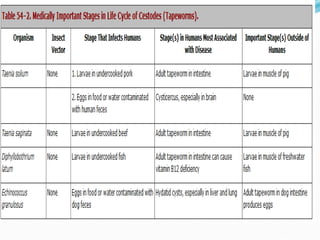
1.Taenia saginata=Beef Tape Warm
2.Taenia solium=Pork TW
3.Diphyllobotherium latum =Broad fish TW
4.Echinococcus granulosis=Dog TW
5.Hymenolepis nana =Dwarf TW
General properties of Helminthes
1.Helminthes:thes organisms differ from protozoa in the fact that there
are multicellular and contain internal organ system.
2.cestodes segmented Worm that primarily intestinal parasite.
3. They lack a digestive system and absorb soluble nutrient directly
through their cuticle, causing mechanical blockage of the intestine.
4. Adult worm consist of :
a. head or scolex, with hooks and sucker that function to attach the
worm to the intestinal wall.
B. neck is very short after scolex.
C. body segment (proglottids);each segment contain set of male and
female sexual organs (immature &mature & gravid segment). gravid
segment contain fertile eggs, these pass out of the body in the stool.
5.cestodes utilize more than one host.
6.The infection occur in human during ingestion the larva in mediated
host in most parasites ingestion the egg may be occur.
1.Taenia saginata=Beef Tape Warm
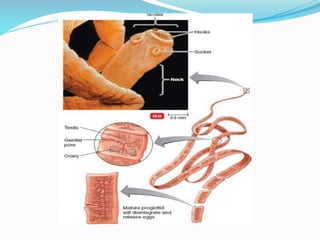
Adult worm develop in the small intestine, in human measure
about 5 m and the body consist of the following :scolex which is
rounded in shape &have 4 sucker, neck, immature segment
which the genital organ are not develop, mature contain full set
of sexual male &female organ ,gravid segment contain uterus
with lateral arms about (15-30 arm ) &fertile eggs. Eggs of this
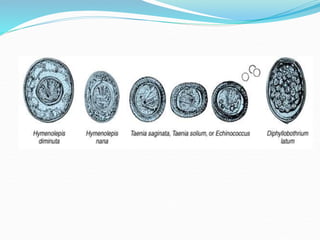
worm are spherical in shape & consist of 3 hexacanth embryo
and has three paris of hooklet.
T. saginata causes Taeniasis; this disease caused by the larval form
of T.saginata. this disease is transmitted by larvae in
undercooked or raw beef (mediated host is beef),most infected
individual are asymptomatic. Infective stage is cysticercus
bovis .Taeniasis dignosed by detection of proglottides or eggs in
stool.
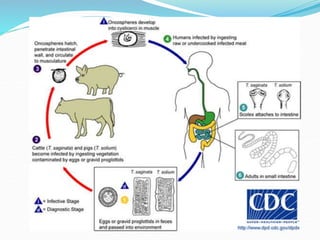
 Life cycle
 Infection with Taenia saginata occurs following ingestion
of raw / undercooked cow meat contaminated with a
cysticercus larva. Scolex attachment to the intestinal
mucosa occurs in the small intestine where maturation into
an adult worm occurs. The resulting adult multiplies ,
producing numerous eggs, some of which may be passed
into the feces. These eggs are then consumed by the proper
animal species (beef), where the onchosphere hatches. The
onchosphere then migrates via the blood to the animal
tissue and converts into the infective cysticercus larva stage
. A new cycle is initiated upon human ingestion of the
infected animal meat.
 Clinical symptoms
 Taeniasis / Beef Tape worm infection .
 Nondescript symptoms, such as diarrhea, abdominal pain,
change in appetite, and slight weight loss , may be
experienced by Taenia- infected patients . in addition ,
symptoms including dizziness, vomiting, and nausea may
also develop in such patients. Laboratory tests often reveal
the presence of a moderate Eosinophilia . The prognosis is
usually good .
2.Taenia solium=Pork TW
Adult worm develop in the middle of small intestine, in human
measure about 3 m and the body consist of the following: scolex
which is rounded in shape &have 4 sucker ,also has rostellum
and contain double circle and small hooks.
neck, immature, mature segment, & eggs are same in T. saginata ,
while gravid segment contain uterus with lateral arms about
(7-15arm ) &fertile eggs.
T. solium causes :
A: Taeniasis; this disease caused by the larval form of T. solium.
this disease is transmitted by larvae in undercooked or raw
pork(mediated host)this worm causes diarrhea ,most infected
individual are asymptomatic. Infective stage is cysticercus
cellulosae.Taeniasis dignosed by detection of proglottides or
egg in stool.
B:cysticercosis this disease follows by ingestion of T. solium eggs
from human feces & produces infection in the brain and eyes.
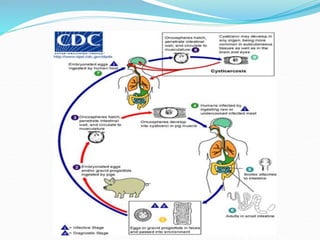
 Life cycle
 Infection with taenia solium occurs following ingestion
of raw / undercooked pork meat contaminated with a
cysticercus larva. Scolex attachment to the intestinal
mucosa occurs in the small intestine where maturation
into an adult worm occurs. The resulting adult multiplies
, producing numerous eggs, some of which may be
passed into the feces. These eggs are then consumed by
the proper animal species (pig), where the onchosphere
hatches. The onchosphere then migrates via the blood to
the animal tissue and converts into the infective
cysticercus larva stage . a new cycle is initiated upon
human ingestion of the infected animal meat.
 Clinical symptoms
 Taeniasis / pork Tape worm infection
 Nondescript symptoms, such as diarrhea, abdominal pain,
change in appetite, and slight weight loss , may be experienced
by Taenia- infected patients . in addition , symptoms including
dizziness, vomiting, and nausea may also develop in such
patients. Laboratory tests often reveal the presence of a
moderate Eosinophilia . The prognosis is usually good .
3.Diphyllobotherium latum =Broad fish TW
The length of D.latum about 10m-15m . scolex is spatulate shape
,it have contain 2 long sucking groove .eggs of D.latum are aval
shape &have opericulum at anterior end &have knobe in
posterior end. D.latum causes Diphyllobotheriasis, that
transmitted by larvae in
Diphyllobotheriasis is diagnosed by detection of
characteristic eggs in the stool undercooked or raw fish.
4.Echinococcus granulosis=Dog TW
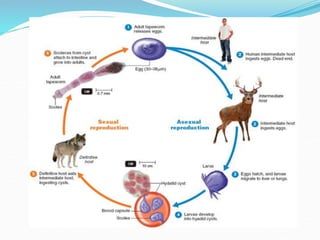
 E. granulosis causes Echinococcosis, infection produce large
hydatid cysts in liver, lung, brain. This disease follows ingestion
of egg in dog feces. Sheep often serve as an intermediate host.
Anaphylactic reaction to worm antigens can occur if the cyst
ruptures.
 The disease follows ingestion of eggs in dog feces. Sheep often
serve as an intermediate host. Echinococcosis is diagnosed by CT
scan or biopsy of infected tissue and is treated with albendazole
and surgical excision of cysts.
5.Hymenolepis nana =Dwarf TW
Adult worm is smallest tape worm of man it has length about 25-40 mm.
Scolex contain 4 sucker with short rostellum armed with circle of hook.
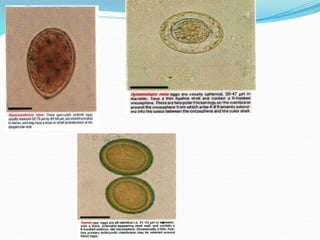
Eggs are oval in shape with hexanth embryo, 3 pairs of hooklet and has
polar thinking protect the embryo. H. nana causes Hymenolepiasis
Trematodes (flukes)
 Trematodes (flukes)
 Trematodes are small (about 1 cm), flat, leaf-like worms
that, depending on the species, infest various organs of the
human host (for example, intestinal veins, urinary bladder,
liver, or lung). All parasitic trematodes use freshwater snails
as an intermediate host.
 schistosomes (Blood flukes)
 Fasciolopsis buski (giant intestinal fluke) causes
Fasciolopsis. Live in Small intestine
 Fasciola hepatica (sheep liver fluke) causes Fasciolosis.
live in Liver (bile ducts, after migration through
parenchyma)
 1. Schistosomes (Blood flukes) has three sp.
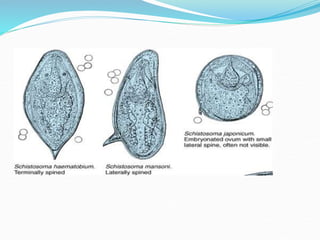
 A.S. haematobium: Shape of egg: oval, contain
terminal spine. Resident the vein surrounds the urinary
bladder. causes urinary bilhariziasis and hematuria,
fibrosis, granulomas. The disease is transmitted by
direct skin penetration. Diagnosis (egg in urine). It is
treated with praziquantel.
 B.S. msnsoni: Shape of egg: large, oval, contain lateral
spine. Resident the vein surround large intestine.
causes intestinal Schistosomiasis.
 C.S. japonicum: Shape of egg: oval, contain lateral blunt
projection spine. Resident the vein surround small
intestine. causes intestinal Schistosomiasis.
 The eggs of S. msnsoni & S. japonicum causes damage
in intestine and liver, gastrointestinal tract (GIT) bleeding
and diarrhea. Damage to the intestinal wall is caused by
the host's inflammatory response to eggs deposited at
that site. The eggs also secrete proteolytic enzymes that
further damage the tissue. The disease is transmitted by
direct skin penetration. Diagnosis (egg in stool). It is
treated with praziquantel.
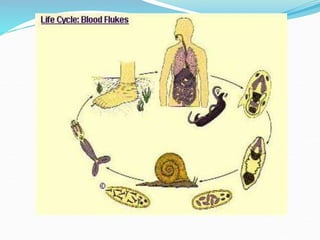
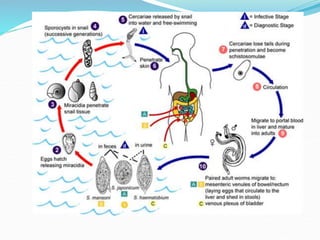
 Life cycle of schistosomes
 schistosomes have only one intermediate host (the snail).
schistosome cercaria acquired directly penetrating the skin
of swimmers in contaminated rivers and lakes. After
dissemination and development in the human host, adult
schistosomes take up residence in various abdominal veins,
depending on the species. schistosomes have separate,
distinctive sexes. male in which the smaller female resides
and continuously mates with the male. This mating takes
place in the human liver. Fertilized eggs penetrate the
human host's vascular walls and enter the intestine or
bladder, emerging from the body in feces or urine. In fresh
water, the organisms infect snails in which they multiply,
producing cercaria (the final, free-swimming larval stage),
which are released into the fresh water to complete the
cycle.
Arushi Gupta taenia.pptx

Arushi Gupta taenia.pptx

  • 1.
  • 2.
    Helminthes A. Cestodaes (TapeWorm) B. Trematodes ( Flukes) C. Nematodes (Roundworms) Cestodaes (Tape Worm) 1.Taenia saginata=Beef Tape Warm 2.Taenia solium=Pork TW 3.Diphyllobotherium latum =Broad fish TW 4.Echinococcus granulosis=Dog TW 5.Hymenolepis nana =Dwarf TW
  • 3.
    General properties ofHelminthes 1.Helminthes:thes organisms differ from protozoa in the fact that there are multicellular and contain internal organ system. 2.cestodes segmented Worm that primarily intestinal parasite. 3. They lack a digestive system and absorb soluble nutrient directly through their cuticle, causing mechanical blockage of the intestine. 4. Adult worm consist of : a. head or scolex, with hooks and sucker that function to attach the worm to the intestinal wall. B. neck is very short after scolex. C. body segment (proglottids);each segment contain set of male and female sexual organs (immature &mature & gravid segment). gravid segment contain fertile eggs, these pass out of the body in the stool. 5.cestodes utilize more than one host. 6.The infection occur in human during ingestion the larva in mediated host in most parasites ingestion the egg may be occur.
  • 4.
    1.Taenia saginata=Beef TapeWarm Adult worm develop in the small intestine, in human measure about 5 m and the body consist of the following :scolex which is rounded in shape &have 4 sucker, neck, immature segment which the genital organ are not develop, mature contain full set of sexual male &female organ ,gravid segment contain uterus with lateral arms about (15-30 arm ) &fertile eggs. Eggs of this worm are spherical in shape & consist of 3 hexacanth embryo and has three paris of hooklet. T. saginata causes Taeniasis; this disease caused by the larval form of T.saginata. this disease is transmitted by larvae in undercooked or raw beef (mediated host is beef),most infected individual are asymptomatic. Infective stage is cysticercus bovis .Taeniasis dignosed by detection of proglottides or eggs in stool.
  • 6.
     Life cycle Infection with Taenia saginata occurs following ingestion of raw / undercooked cow meat contaminated with a cysticercus larva. Scolex attachment to the intestinal mucosa occurs in the small intestine where maturation into an adult worm occurs. The resulting adult multiplies , producing numerous eggs, some of which may be passed into the feces. These eggs are then consumed by the proper animal species (beef), where the onchosphere hatches. The onchosphere then migrates via the blood to the animal tissue and converts into the infective cysticercus larva stage . A new cycle is initiated upon human ingestion of the infected animal meat.
  • 8.
     Clinical symptoms Taeniasis / Beef Tape worm infection .  Nondescript symptoms, such as diarrhea, abdominal pain, change in appetite, and slight weight loss , may be experienced by Taenia- infected patients . in addition , symptoms including dizziness, vomiting, and nausea may also develop in such patients. Laboratory tests often reveal the presence of a moderate Eosinophilia . The prognosis is usually good .
  • 10.
    2.Taenia solium=Pork TW Adultworm develop in the middle of small intestine, in human measure about 3 m and the body consist of the following: scolex which is rounded in shape &have 4 sucker ,also has rostellum and contain double circle and small hooks. neck, immature, mature segment, & eggs are same in T. saginata , while gravid segment contain uterus with lateral arms about (7-15arm ) &fertile eggs. T. solium causes : A: Taeniasis; this disease caused by the larval form of T. solium. this disease is transmitted by larvae in undercooked or raw pork(mediated host)this worm causes diarrhea ,most infected individual are asymptomatic. Infective stage is cysticercus cellulosae.Taeniasis dignosed by detection of proglottides or egg in stool. B:cysticercosis this disease follows by ingestion of T. solium eggs from human feces & produces infection in the brain and eyes.
  • 11.
     Life cycle Infection with taenia solium occurs following ingestion of raw / undercooked pork meat contaminated with a cysticercus larva. Scolex attachment to the intestinal mucosa occurs in the small intestine where maturation into an adult worm occurs. The resulting adult multiplies , producing numerous eggs, some of which may be passed into the feces. These eggs are then consumed by the proper animal species (pig), where the onchosphere hatches. The onchosphere then migrates via the blood to the animal tissue and converts into the infective cysticercus larva stage . a new cycle is initiated upon human ingestion of the infected animal meat.
  • 13.
     Clinical symptoms Taeniasis / pork Tape worm infection  Nondescript symptoms, such as diarrhea, abdominal pain, change in appetite, and slight weight loss , may be experienced by Taenia- infected patients . in addition , symptoms including dizziness, vomiting, and nausea may also develop in such patients. Laboratory tests often reveal the presence of a moderate Eosinophilia . The prognosis is usually good . 3.Diphyllobotherium latum =Broad fish TW The length of D.latum about 10m-15m . scolex is spatulate shape ,it have contain 2 long sucking groove .eggs of D.latum are aval shape &have opericulum at anterior end &have knobe in posterior end. D.latum causes Diphyllobotheriasis, that transmitted by larvae in Diphyllobotheriasis is diagnosed by detection of characteristic eggs in the stool undercooked or raw fish.
  • 14.
    4.Echinococcus granulosis=Dog TW E. granulosis causes Echinococcosis, infection produce large hydatid cysts in liver, lung, brain. This disease follows ingestion of egg in dog feces. Sheep often serve as an intermediate host. Anaphylactic reaction to worm antigens can occur if the cyst ruptures.  The disease follows ingestion of eggs in dog feces. Sheep often serve as an intermediate host. Echinococcosis is diagnosed by CT scan or biopsy of infected tissue and is treated with albendazole and surgical excision of cysts. 5.Hymenolepis nana =Dwarf TW Adult worm is smallest tape worm of man it has length about 25-40 mm. Scolex contain 4 sucker with short rostellum armed with circle of hook. Eggs are oval in shape with hexanth embryo, 3 pairs of hooklet and has polar thinking protect the embryo. H. nana causes Hymenolepiasis
  • 18.
    Trematodes (flukes)  Trematodes(flukes)  Trematodes are small (about 1 cm), flat, leaf-like worms that, depending on the species, infest various organs of the human host (for example, intestinal veins, urinary bladder, liver, or lung). All parasitic trematodes use freshwater snails as an intermediate host.  schistosomes (Blood flukes)  Fasciolopsis buski (giant intestinal fluke) causes Fasciolopsis. Live in Small intestine  Fasciola hepatica (sheep liver fluke) causes Fasciolosis. live in Liver (bile ducts, after migration through parenchyma)
  • 19.
     1. Schistosomes(Blood flukes) has three sp.  A.S. haematobium: Shape of egg: oval, contain terminal spine. Resident the vein surrounds the urinary bladder. causes urinary bilhariziasis and hematuria, fibrosis, granulomas. The disease is transmitted by direct skin penetration. Diagnosis (egg in urine). It is treated with praziquantel.  B.S. msnsoni: Shape of egg: large, oval, contain lateral spine. Resident the vein surround large intestine. causes intestinal Schistosomiasis.
  • 20.
     C.S. japonicum:Shape of egg: oval, contain lateral blunt projection spine. Resident the vein surround small intestine. causes intestinal Schistosomiasis.  The eggs of S. msnsoni & S. japonicum causes damage in intestine and liver, gastrointestinal tract (GIT) bleeding and diarrhea. Damage to the intestinal wall is caused by the host's inflammatory response to eggs deposited at that site. The eggs also secrete proteolytic enzymes that further damage the tissue. The disease is transmitted by direct skin penetration. Diagnosis (egg in stool). It is treated with praziquantel.
  • 22.
     Life cycleof schistosomes  schistosomes have only one intermediate host (the snail). schistosome cercaria acquired directly penetrating the skin of swimmers in contaminated rivers and lakes. After dissemination and development in the human host, adult schistosomes take up residence in various abdominal veins, depending on the species. schistosomes have separate, distinctive sexes. male in which the smaller female resides and continuously mates with the male. This mating takes place in the human liver. Fertilized eggs penetrate the human host's vascular walls and enter the intestine or bladder, emerging from the body in feces or urine. In fresh water, the organisms infect snails in which they multiply, producing cercaria (the final, free-swimming larval stage), which are released into the fresh water to complete the cycle.