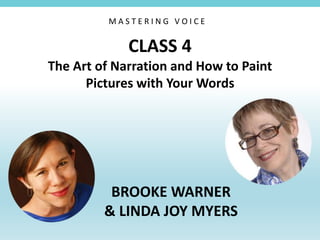
CLASS 4
The Art of Narration and How to Paint
Pictures with Your Words
BROOKE WARNER
& LINDA JOY MYERS
M A S T E R I N G V O I C E
• GUIDING NARRATOR: You are the guide (the one
who tells AND shows the reader what happened).
• REFLECTIVE NARRATOR: You are the reflector
(the one who makes sense of what happened).
• You use both narrative techniques to
tell your story and you choose whether
how you tell the story is told in a more
IMMEDIATE or DISTANT way.
Narration and Voice
• Painting pictures for your reader.
• Heightens prose through the use
of the senses—colors, sound, taste,
and texture.
• Sophistication and depth through
the use of strong nouns and verbs,
using adverbs and adjectives as a
spice.
• Strong storytelling.
What Narration Tries to Achieve
• Transitions guide the reader from one
timeframe or theme to another.
• Reveals intentionality of the story line—“the
reason I went there and did that,” connects the
dots of logic and causality.
• Narrative summary collapses time and allows an
overview.
• Flashbacks and flash-forwards are managed
through the guiding narrator.
GUIDING
The guiding narrator leads the reader through time,
summarizes the passage of time, and moves the reader
into different layers of the story, from action to reflection
and back and forth through time.
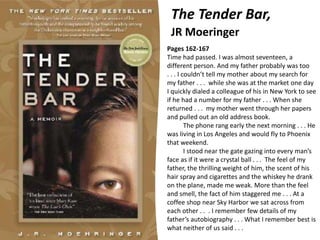
The Tender Bar,
JR Moeringer
Pages 162-167
Time had passed. I was almost seventeen, a
different person. And my father probably was too
. . . I couldn’t tell my mother about my search for
my father . . . while she was at the market one day
I quickly dialed a colleague of his in New York to see
if he had a number for my father . . . When she
returned . . . my mother went through her papers
and pulled out an old address book.
The phone rang early the next morning . . . He
was living in Los Angeles and would fly to Phoenix
that weekend.
I stood near the gate gazing into every man’s
face as if it were a crystal ball . . . The feel of my
father, the thrilling weight of him, the scent of his
hair spray and cigarettes and the whiskey he drank
on the plane, made me weak. More than the feel
and smell, the fact of him staggered me . . . At a
coffee shop near Sky Harbor we sat across from
each other . . . I remember few details of my
father’s autobiography . . . What I remember best is
what neither of us said . . .
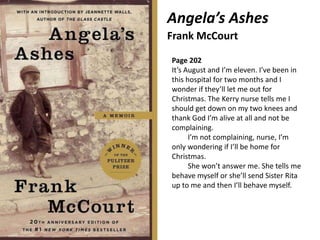
Angela’s Ashes
Frank McCourt
Page 202
It’s August and I’m eleven. I’ve been in
this hospital for two months and I
wonder if they’ll let me out for
Christmas. The Kerry nurse tells me I
should get down on my two knees and
thank God I’m alive at all and not be
complaining.
I’m not complaining, nurse, I’m
only wondering if I’ll be home for
Christmas.
She won’t answer me. She tells me
behave myself or she’ll send Sister Rita
up to me and then I’ll behave myself.
• Offers your reader a chance to explore and
understand your inner life and your
motivations.
• Explores what you think, feel, know, and
wonder, linking the action of the scene (what
happened) to your inner life (why it matters).
• Deepens the story and provides a framework
for transformation—since you (the character)
must transform over the course of the journey.
• “Tells”—how you felt, what you wanted, and
where your emotional milestones lead next.
REFLECTIVE
Reflection reveals insights and ahas, why the story
matters. The more you offer of your inner world,
the more the reader cares about you and connects with
your story emotionally.
Educated,
Tara Westover
Page 242
[Professor tells her she is valuable, and
she has a right to be at Cambridge, and
she can create the self she wants to be.]
I wanted to believe him, to take his
words and remake myself, but I’d never
had that kind of faith. No matter how
deeply I interred the memories [of the
past], how tightly I shut my eyes against
them, when I thought of my self the
images that came to mind were of that
girl, in the bathroom, in the parking lot.
I couldn’t tell Dr. Kerry about that
girl. I couldn’t tell him that the reason I
couldn’t return to Cambridge was that
being here threw into great relief every
violent and degrading moment of my life.
What Comes Next
and How to Like It,
Abigail Thomas
[Following a stressful interaction with
her daughter]:
Page 166
Despite my good intentions I find a
cigarette on the floor of the living room.
A cigarette is to smoke, so I smoke it
immediately. I feel the dark god of
nicotine raise himself on one elbow in
my bloodstream. What took you so
long, girl? he asks lazily. He has those
bedroom eyes.
• Tenses—sometimes the immediate is
present tense, but not always.
• Time markers—making it clear to the
reader where they are in time so they are
anchored, always, from one scene to the
next.
• Pacing—the now can feel more
immediate, with clipped, shorter
sentences, whereas your more distant
writing might have a more luxurious pace
to it, the pace of processing.
IMMEDIATE vs. DISTANT
You choose how you move readers through your story through
the lens of now and then, of immediate (now) vs. distant (you
providing distance through how you guide or how you reflect).
Where the Past Begins,
Amy Tan
Page 130
Many painful or poignant memories returned when I
started writing fiction. It takes effort to shed self-
consciousness, more so than it does to avoid
unpleasant thoughts, and effort in itself is
anathematic to what I seek. But once the fiction
writing mind is freed, there are no censors, no
prohibitions. It is curious and open to anything. It is
nonjudgmental and thus nothing it imagines is
wrong. It is not bound to logic or facts. It is quick to
follow any clues…But its most important trait is this:
it seeks a story, a narrative that reveals what
happened and why it happened. That is the divining
rod . . .
I’ve been thinking about something that
occurred when I was nine or ten. I sense the memory
in only the sketchiest outline. It took place in a car
with my family. There was tension. When I think
about this vague something I notice unpleasant an
sensation . . . My limbs go a little weak. It’s like a
warning from my subconscious to not go there . . . I
wonder if I can retrieve the original experience.
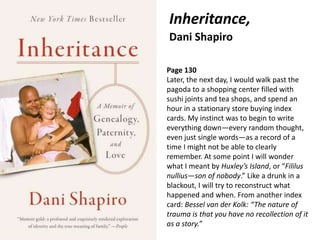
Inheritance,
Dani Shapiro
• TK
Page 130
Later, the next day, I would walk past the
pagoda to a shopping center filled with
sushi joints and tea shops, and spend an
hour in a stationary store buying index
cards. My instinct was to begin to write
everything down—every random thought,
even just single words—as a record of a
time I might not be able to clearly
remember. At some point I will wonder
what I meant by Huxley’s Island, or “Fililus
nullius—son of nobody.” Like a drunk in a
blackout, I will try to reconstruct what
happened and when. From another index
card: Bessel van der Kolk: “The nature of
trauma is that you have no recollection of it
as a story.”
Optional Exercises
EXERCISE: Write about something in the past from the point of view
of you at that age. Stay in that time frame to describe what
happened and how you felt about it.
EXERCISE: Write about the same incident from the point of
view of you now, moving back and forth in time.
Write Your Memoir with Us
July – December 2020
Write Your Memoir in Six Months
www.writeyourmemoirinsixmonths.com
$200 off for being with us in this course
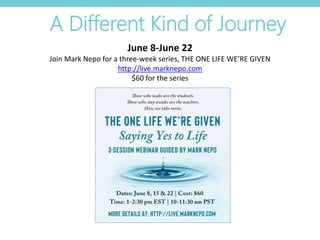
A Different Kind of Journey
June 8-June 22
Join Mark Nepo for a three-week series, THE ONE LIFE WE’RE GIVEN
http://live.marknepo.com
$60 for the series

Class 4. Mastering Voice

  • 1.
    CLASS 4 The Artof Narration and How to Paint Pictures with Your Words BROOKE WARNER & LINDA JOY MYERS M A S T E R I N G V O I C E
  • 2.
    • GUIDING NARRATOR:You are the guide (the one who tells AND shows the reader what happened). • REFLECTIVE NARRATOR: You are the reflector (the one who makes sense of what happened). • You use both narrative techniques to tell your story and you choose whether how you tell the story is told in a more IMMEDIATE or DISTANT way. Narration and Voice
  • 3.
    • Painting picturesfor your reader. • Heightens prose through the use of the senses—colors, sound, taste, and texture. • Sophistication and depth through the use of strong nouns and verbs, using adverbs and adjectives as a spice. • Strong storytelling. What Narration Tries to Achieve
  • 4.
    • Transitions guidethe reader from one timeframe or theme to another. • Reveals intentionality of the story line—“the reason I went there and did that,” connects the dots of logic and causality. • Narrative summary collapses time and allows an overview. • Flashbacks and flash-forwards are managed through the guiding narrator. GUIDING The guiding narrator leads the reader through time, summarizes the passage of time, and moves the reader into different layers of the story, from action to reflection and back and forth through time.
  • 5.
    The Tender Bar, JRMoeringer Pages 162-167 Time had passed. I was almost seventeen, a different person. And my father probably was too . . . I couldn’t tell my mother about my search for my father . . . while she was at the market one day I quickly dialed a colleague of his in New York to see if he had a number for my father . . . When she returned . . . my mother went through her papers and pulled out an old address book. The phone rang early the next morning . . . He was living in Los Angeles and would fly to Phoenix that weekend. I stood near the gate gazing into every man’s face as if it were a crystal ball . . . The feel of my father, the thrilling weight of him, the scent of his hair spray and cigarettes and the whiskey he drank on the plane, made me weak. More than the feel and smell, the fact of him staggered me . . . At a coffee shop near Sky Harbor we sat across from each other . . . I remember few details of my father’s autobiography . . . What I remember best is what neither of us said . . .
  • 6.
    Angela’s Ashes Frank McCourt Page202 It’s August and I’m eleven. I’ve been in this hospital for two months and I wonder if they’ll let me out for Christmas. The Kerry nurse tells me I should get down on my two knees and thank God I’m alive at all and not be complaining. I’m not complaining, nurse, I’m only wondering if I’ll be home for Christmas. She won’t answer me. She tells me behave myself or she’ll send Sister Rita up to me and then I’ll behave myself.
  • 7.
    • Offers yourreader a chance to explore and understand your inner life and your motivations. • Explores what you think, feel, know, and wonder, linking the action of the scene (what happened) to your inner life (why it matters). • Deepens the story and provides a framework for transformation—since you (the character) must transform over the course of the journey. • “Tells”—how you felt, what you wanted, and where your emotional milestones lead next. REFLECTIVE Reflection reveals insights and ahas, why the story matters. The more you offer of your inner world, the more the reader cares about you and connects with your story emotionally.
  • 8.
    Educated, Tara Westover Page 242 [Professortells her she is valuable, and she has a right to be at Cambridge, and she can create the self she wants to be.] I wanted to believe him, to take his words and remake myself, but I’d never had that kind of faith. No matter how deeply I interred the memories [of the past], how tightly I shut my eyes against them, when I thought of my self the images that came to mind were of that girl, in the bathroom, in the parking lot. I couldn’t tell Dr. Kerry about that girl. I couldn’t tell him that the reason I couldn’t return to Cambridge was that being here threw into great relief every violent and degrading moment of my life.
  • 9.
    What Comes Next andHow to Like It, Abigail Thomas [Following a stressful interaction with her daughter]: Page 166 Despite my good intentions I find a cigarette on the floor of the living room. A cigarette is to smoke, so I smoke it immediately. I feel the dark god of nicotine raise himself on one elbow in my bloodstream. What took you so long, girl? he asks lazily. He has those bedroom eyes.
  • 10.
    • Tenses—sometimes theimmediate is present tense, but not always. • Time markers—making it clear to the reader where they are in time so they are anchored, always, from one scene to the next. • Pacing—the now can feel more immediate, with clipped, shorter sentences, whereas your more distant writing might have a more luxurious pace to it, the pace of processing. IMMEDIATE vs. DISTANT You choose how you move readers through your story through the lens of now and then, of immediate (now) vs. distant (you providing distance through how you guide or how you reflect).
  • 11.
    Where the PastBegins, Amy Tan Page 130 Many painful or poignant memories returned when I started writing fiction. It takes effort to shed self- consciousness, more so than it does to avoid unpleasant thoughts, and effort in itself is anathematic to what I seek. But once the fiction writing mind is freed, there are no censors, no prohibitions. It is curious and open to anything. It is nonjudgmental and thus nothing it imagines is wrong. It is not bound to logic or facts. It is quick to follow any clues…But its most important trait is this: it seeks a story, a narrative that reveals what happened and why it happened. That is the divining rod . . . I’ve been thinking about something that occurred when I was nine or ten. I sense the memory in only the sketchiest outline. It took place in a car with my family. There was tension. When I think about this vague something I notice unpleasant an sensation . . . My limbs go a little weak. It’s like a warning from my subconscious to not go there . . . I wonder if I can retrieve the original experience.
  • 12.
    Inheritance, Dani Shapiro • TK Page130 Later, the next day, I would walk past the pagoda to a shopping center filled with sushi joints and tea shops, and spend an hour in a stationary store buying index cards. My instinct was to begin to write everything down—every random thought, even just single words—as a record of a time I might not be able to clearly remember. At some point I will wonder what I meant by Huxley’s Island, or “Fililus nullius—son of nobody.” Like a drunk in a blackout, I will try to reconstruct what happened and when. From another index card: Bessel van der Kolk: “The nature of trauma is that you have no recollection of it as a story.”
  • 13.
    Optional Exercises EXERCISE: Writeabout something in the past from the point of view of you at that age. Stay in that time frame to describe what happened and how you felt about it. EXERCISE: Write about the same incident from the point of view of you now, moving back and forth in time.
  • 14.
    Write Your Memoirwith Us July – December 2020 Write Your Memoir in Six Months www.writeyourmemoirinsixmonths.com $200 off for being with us in this course
  • 15.
    A Different Kindof Journey June 8-June 22 Join Mark Nepo for a three-week series, THE ONE LIFE WE’RE GIVEN http://live.marknepo.com $60 for the series