CLASS 2
Deciding What to Share and Understanding
the Many Layers of Self-Expression
BROOKE WARNER
& LINDA JOY MYERS
M A S T E R I N G V O I C E
• Your raw story—from freewriting,
poetry, dreams, journals, letters, your
archives, random phrases while driving.
• Your edited version(s)—a long process
which needs to be allowed and invited.
• Allow, invite several—many—drafts.
Read, read, read all kinds of literature.
What voices appeal to you or do you
admire?
• Copy/transcribe voices from books that
resonate, writing in your own hand or on
the computer. What does it feel like to
write those words?
Voice on the Page
Introduction
There are four ways to write a woman’s life:
the woman herself may tell it, in what she
chooses to call an autobiography; she may tell
it in what she chooses to call fiction; a
biographer, woman or man, may write the
woman’s life in what is called a biography; or
the woman may write her own life in advance
of living it, unconsciously, without recognizing
or naming the process.
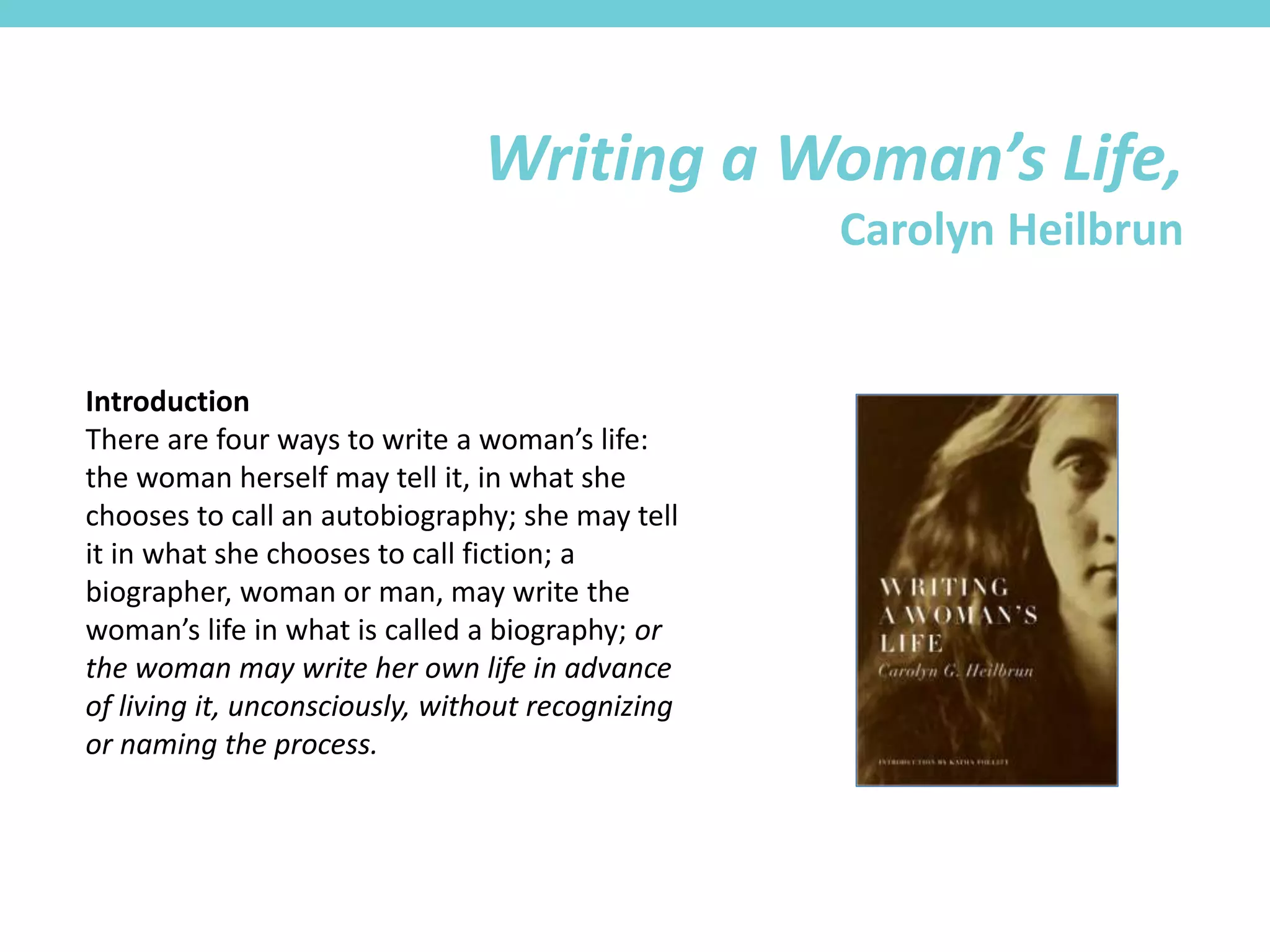
Writing a Woman’s Life,
Carolyn Heilbrun
From “The Moon and the Yew Tree,” p.41:
This is the light of the mind, cold and planetary.
The trees of the mind are black. The light is blue.
The grasses unload their griefs at my feet as if I were God,
prickling my ankles and murmuring of their humility.
Funny, spiritous mists inhabit this place
Separated from my house by a row of headstones.
I simply can’t see where it is to get to.
The moon is no door—it is a face in its own right,
White as a knuckle and terribly upset.
It drags the sea after it like a dark crime; it is quiet
With the O-gape of complete despair. I live here…
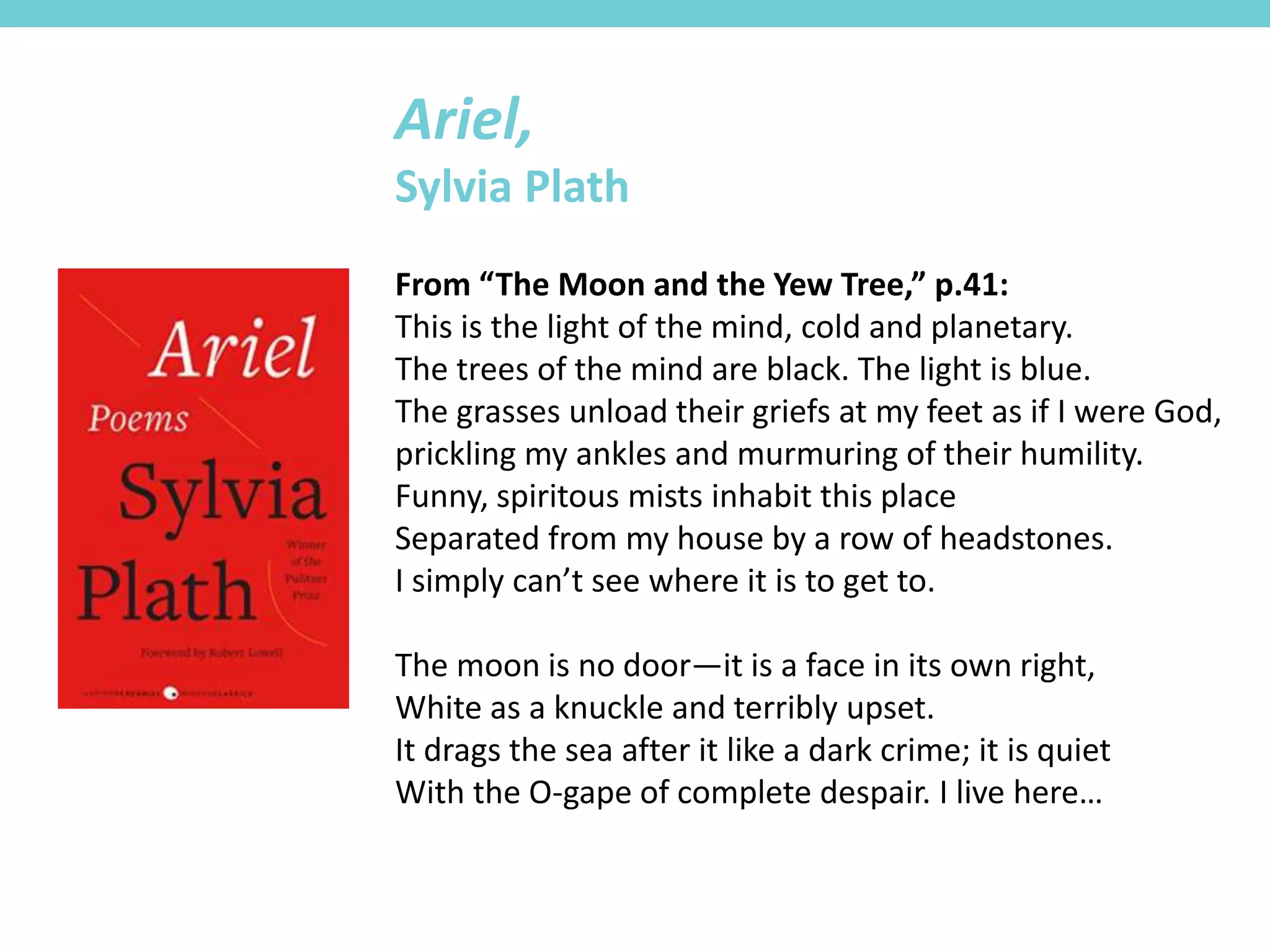
Ariel,
Sylvia Plath
From “Everything,” p. 54:
No doubt in Holland,
when van Gogh was a boy,
there were swans drifting
over the green sea
of the meadows, and no doubt
on some warm afternoon
he lay down and watched them,
and almost thought: this is everything.
What drove him
to get up and look further
is what saves this world,
even as it breaks
the hearts of men.
House of Light,
Mary Oliver
• Unchain yourself from primary school grammar lessons
—You can end a sentence in a preposition
—You can use improper grammar, especially in dialogue
—You can cuss!
• Listen to how people speak
—Sit in a café and listen
—Watch YouTube videos for regional accents
• Use freewriting exercises to get comfortable with your
natural voice, the one you use when you tell a good friend a
story—the unbridled you.
Memoirist, Uninhibited
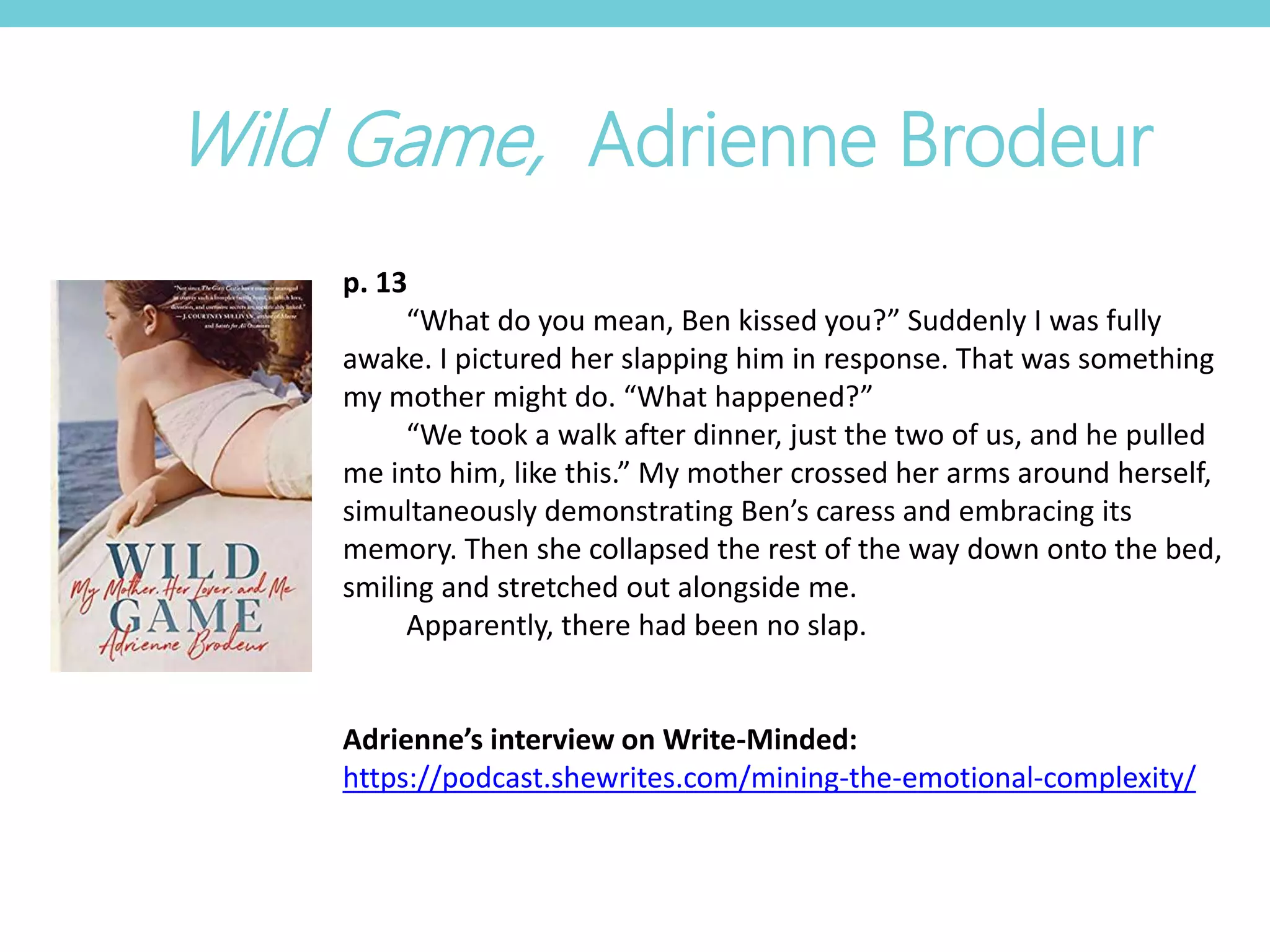
p. 13
“What do you mean, Ben kissed you?” Suddenly I was fully
awake. I pictured her slapping him in response. That was something
my mother might do. “What happened?”
“We took a walk after dinner, just the two of us, and he pulled
me into him, like this.” My mother crossed her arms around herself,
simultaneously demonstrating Ben’s caress and embracing its
memory. Then she collapsed the rest of the way down onto the bed,
smiling and stretched out alongside me.
Apparently, there had been no slap.
Adrienne’s interview on Write-Minded:
https://podcast.shewrites.com/mining-the-emotional-complexity/
Wild Game, Adrienne Brodeur
• In the first draft, write everything—the more you want to leave
something out, the more important it is to include it.
• Dorothy Allison said: Write what scares you, write the stuff that
makes you feel ashamed.
• Writing about secrets or abuse: if you can’t write it yet, list the
theme, perspective, outcome in a simple list. Come back to it later,
but don’t leave a hole in the story. If you can’t complete something
on the list, then write xxxx and come back to this.
What to Include and What
to Leave Out
“Your voice is your self in the story. Your distinct way of
looking at the world.” —Donald Maas
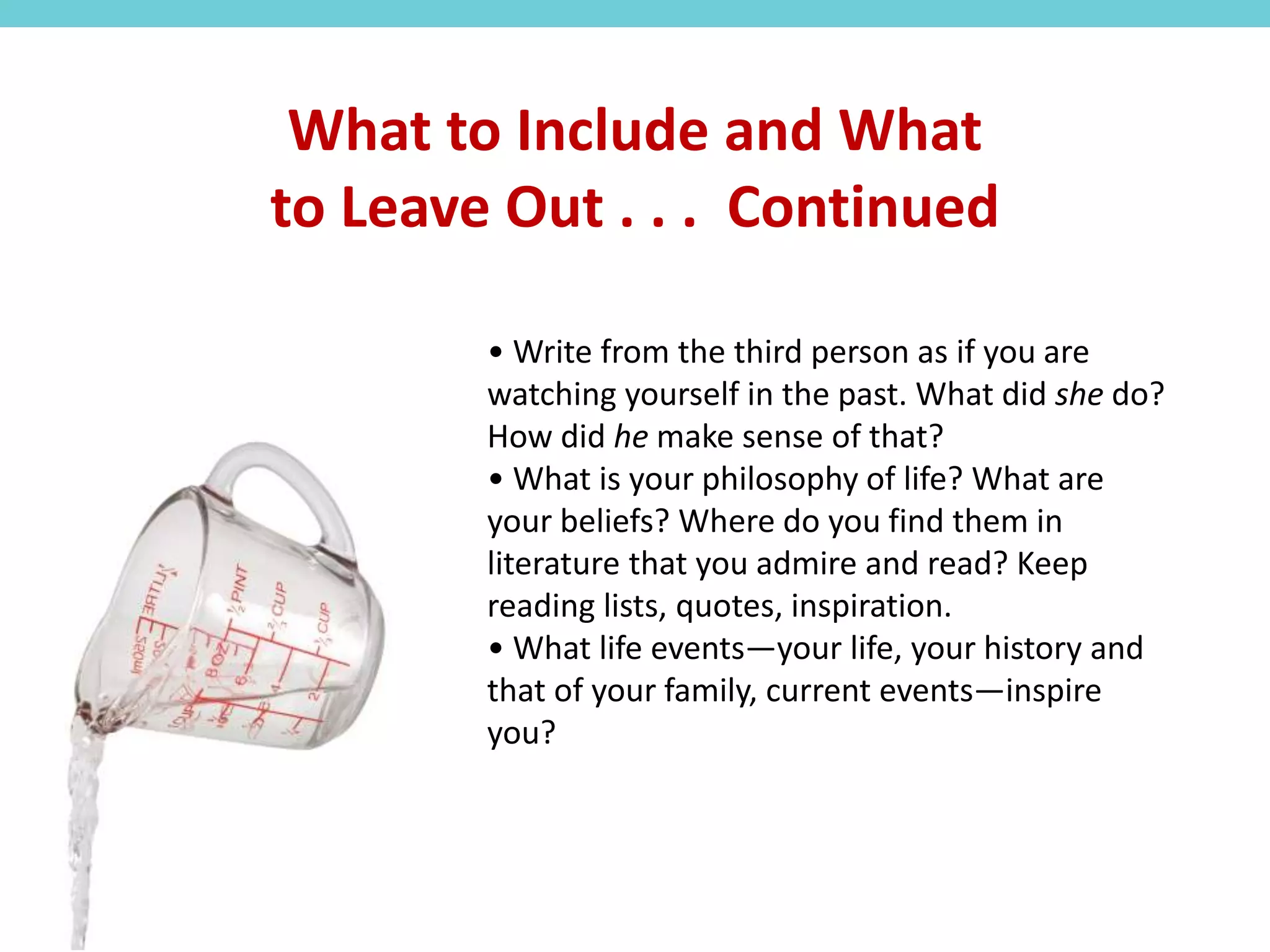
• Write from the third person as if you are
watching yourself in the past. What did she do?
How did he make sense of that?
• What is your philosophy of life? What are
your beliefs? Where do you find them in
literature that you admire and read? Keep
reading lists, quotes, inspiration.
• What life events—your life, your history and
that of your family, current events—inspire
you?
What to Include and What
to Leave Out . . . Continued
• Can you characterize other people’s voices?
—Linda Joy’s voice is poetic; sense of place and her place in
history. She writes with longing, nostalgia.
—Liz Gilbert writes matter-of-factly. She’s an astute observer,
very authentic on the page; didn’t “tell-all” in Eat, Pray, Love.
—Glennon Doyle (with a new book out) nearly bleeds on the
page; holds nothing back and many critics find her to be over-
involved in her process (aka, needy).
—Frank McCourt’s voice is of a place, of Ireland. It’s sing-songy,
funny and often dark; astute and unflinching.
Discerning What Voice Is
and How You Experience It
• Identify your own written voices—memoir, journal, social media.
What can you say about how you write?
—honest?
—free?
—when do you sound like you?
—uninhibited or guarded?
—raw?
• You don’t have to share all of yourself; you get to decide
• Do you want to be all out there on social media, or do you want to
present a ”persona,” which doesn’t necessarily mean inauthentic
• Is the voice you share with the world the same as the voice you use
to communicate to a friend, a lover, a family member?
• How intimate do you choose to be on the page—and online?
• You get to decide.
Authentic Selves, Personas, and Avatars—
How We Show Up in a Tell-All World
Optional Exercises
EXERCISE: Write scene from your point of view as a child; stay in the
child POV. Then write the same scene from the adult POV—what you
know now. Notice the difference in the voice.
EXERCISE: Write a scene about something important that
happened and write it to your best friend, and now write it to
someone in the family that you don’t know very well.
Next Week
Class 3: May 18
FINDING THE COURAGE TO CREATE A BRIDGE FROM
YOUR HEART TO THE PAGE
In this hour we’ll discuss yet another layer of voice—the opinions you
have, your feelings, your reactions and biases. Embracing this level of
voice and sharing typically triggers writers’ insecurities, and here we’ll
discuss how to stay the course, harness your courage, and write from
the heart.

Class 2. Mastering Voice

  • 1.
    CLASS 2 Deciding Whatto Share and Understanding the Many Layers of Self-Expression BROOKE WARNER & LINDA JOY MYERS M A S T E R I N G V O I C E
  • 2.
    • Your rawstory—from freewriting, poetry, dreams, journals, letters, your archives, random phrases while driving. • Your edited version(s)—a long process which needs to be allowed and invited. • Allow, invite several—many—drafts. Read, read, read all kinds of literature. What voices appeal to you or do you admire? • Copy/transcribe voices from books that resonate, writing in your own hand or on the computer. What does it feel like to write those words? Voice on the Page
  • 3.
    Introduction There are fourways to write a woman’s life: the woman herself may tell it, in what she chooses to call an autobiography; she may tell it in what she chooses to call fiction; a biographer, woman or man, may write the woman’s life in what is called a biography; or the woman may write her own life in advance of living it, unconsciously, without recognizing or naming the process. Writing a Woman’s Life, Carolyn Heilbrun
  • 4.
    From “The Moonand the Yew Tree,” p.41: This is the light of the mind, cold and planetary. The trees of the mind are black. The light is blue. The grasses unload their griefs at my feet as if I were God, prickling my ankles and murmuring of their humility. Funny, spiritous mists inhabit this place Separated from my house by a row of headstones. I simply can’t see where it is to get to. The moon is no door—it is a face in its own right, White as a knuckle and terribly upset. It drags the sea after it like a dark crime; it is quiet With the O-gape of complete despair. I live here… Ariel, Sylvia Plath
  • 5.
    From “Everything,” p.54: No doubt in Holland, when van Gogh was a boy, there were swans drifting over the green sea of the meadows, and no doubt on some warm afternoon he lay down and watched them, and almost thought: this is everything. What drove him to get up and look further is what saves this world, even as it breaks the hearts of men. House of Light, Mary Oliver
  • 6.
    • Unchain yourselffrom primary school grammar lessons —You can end a sentence in a preposition —You can use improper grammar, especially in dialogue —You can cuss! • Listen to how people speak —Sit in a café and listen —Watch YouTube videos for regional accents • Use freewriting exercises to get comfortable with your natural voice, the one you use when you tell a good friend a story—the unbridled you. Memoirist, Uninhibited
  • 7.
    p. 13 “What doyou mean, Ben kissed you?” Suddenly I was fully awake. I pictured her slapping him in response. That was something my mother might do. “What happened?” “We took a walk after dinner, just the two of us, and he pulled me into him, like this.” My mother crossed her arms around herself, simultaneously demonstrating Ben’s caress and embracing its memory. Then she collapsed the rest of the way down onto the bed, smiling and stretched out alongside me. Apparently, there had been no slap. Adrienne’s interview on Write-Minded: https://podcast.shewrites.com/mining-the-emotional-complexity/ Wild Game, Adrienne Brodeur
  • 8.
    • In thefirst draft, write everything—the more you want to leave something out, the more important it is to include it. • Dorothy Allison said: Write what scares you, write the stuff that makes you feel ashamed. • Writing about secrets or abuse: if you can’t write it yet, list the theme, perspective, outcome in a simple list. Come back to it later, but don’t leave a hole in the story. If you can’t complete something on the list, then write xxxx and come back to this. What to Include and What to Leave Out “Your voice is your self in the story. Your distinct way of looking at the world.” —Donald Maas
  • 9.
    • Write fromthe third person as if you are watching yourself in the past. What did she do? How did he make sense of that? • What is your philosophy of life? What are your beliefs? Where do you find them in literature that you admire and read? Keep reading lists, quotes, inspiration. • What life events—your life, your history and that of your family, current events—inspire you? What to Include and What to Leave Out . . . Continued
  • 10.
    • Can youcharacterize other people’s voices? —Linda Joy’s voice is poetic; sense of place and her place in history. She writes with longing, nostalgia. —Liz Gilbert writes matter-of-factly. She’s an astute observer, very authentic on the page; didn’t “tell-all” in Eat, Pray, Love. —Glennon Doyle (with a new book out) nearly bleeds on the page; holds nothing back and many critics find her to be over- involved in her process (aka, needy). —Frank McCourt’s voice is of a place, of Ireland. It’s sing-songy, funny and often dark; astute and unflinching. Discerning What Voice Is and How You Experience It • Identify your own written voices—memoir, journal, social media. What can you say about how you write? —honest? —free? —when do you sound like you? —uninhibited or guarded? —raw?
  • 11.
    • You don’thave to share all of yourself; you get to decide • Do you want to be all out there on social media, or do you want to present a ”persona,” which doesn’t necessarily mean inauthentic • Is the voice you share with the world the same as the voice you use to communicate to a friend, a lover, a family member? • How intimate do you choose to be on the page—and online? • You get to decide. Authentic Selves, Personas, and Avatars— How We Show Up in a Tell-All World
  • 12.
    Optional Exercises EXERCISE: Writescene from your point of view as a child; stay in the child POV. Then write the same scene from the adult POV—what you know now. Notice the difference in the voice. EXERCISE: Write a scene about something important that happened and write it to your best friend, and now write it to someone in the family that you don’t know very well.
  • 13.
    Next Week Class 3:May 18 FINDING THE COURAGE TO CREATE A BRIDGE FROM YOUR HEART TO THE PAGE In this hour we’ll discuss yet another layer of voice—the opinions you have, your feelings, your reactions and biases. Embracing this level of voice and sharing typically triggers writers’ insecurities, and here we’ll discuss how to stay the course, harness your courage, and write from the heart.