
VOICE EXCERPTS
from
Writing Through the Crisis
BROOKE WARNER
& LINDA JOY MYERS
Page 44
The music I am the most drawn to is more freely driven
by the story, and comes with full orchestrations and
dynamic extremes, which impart the emotional sweep
I love by literally sweeping from one section of the
orchestra to another violins to cellos, to woodwinds,
to percussion, and onward. The dark mood in music serves as
momentum. You see dark clouds and sense rain may come, and it does,
with gale force winds. The narrative moves forward in bad weather
people run for cover to escape lightning. If it’s sunny and people are
happy, less happens. People sit down for a picnic, followed by a long
nap.
When the music is played with the full orchestra, I experience the
story omnisciently. But the point of view is fluid and can switch to a
first-person narrator when the melody takes on the voice of a solo
instrument. And the instrument I love most is the piano.
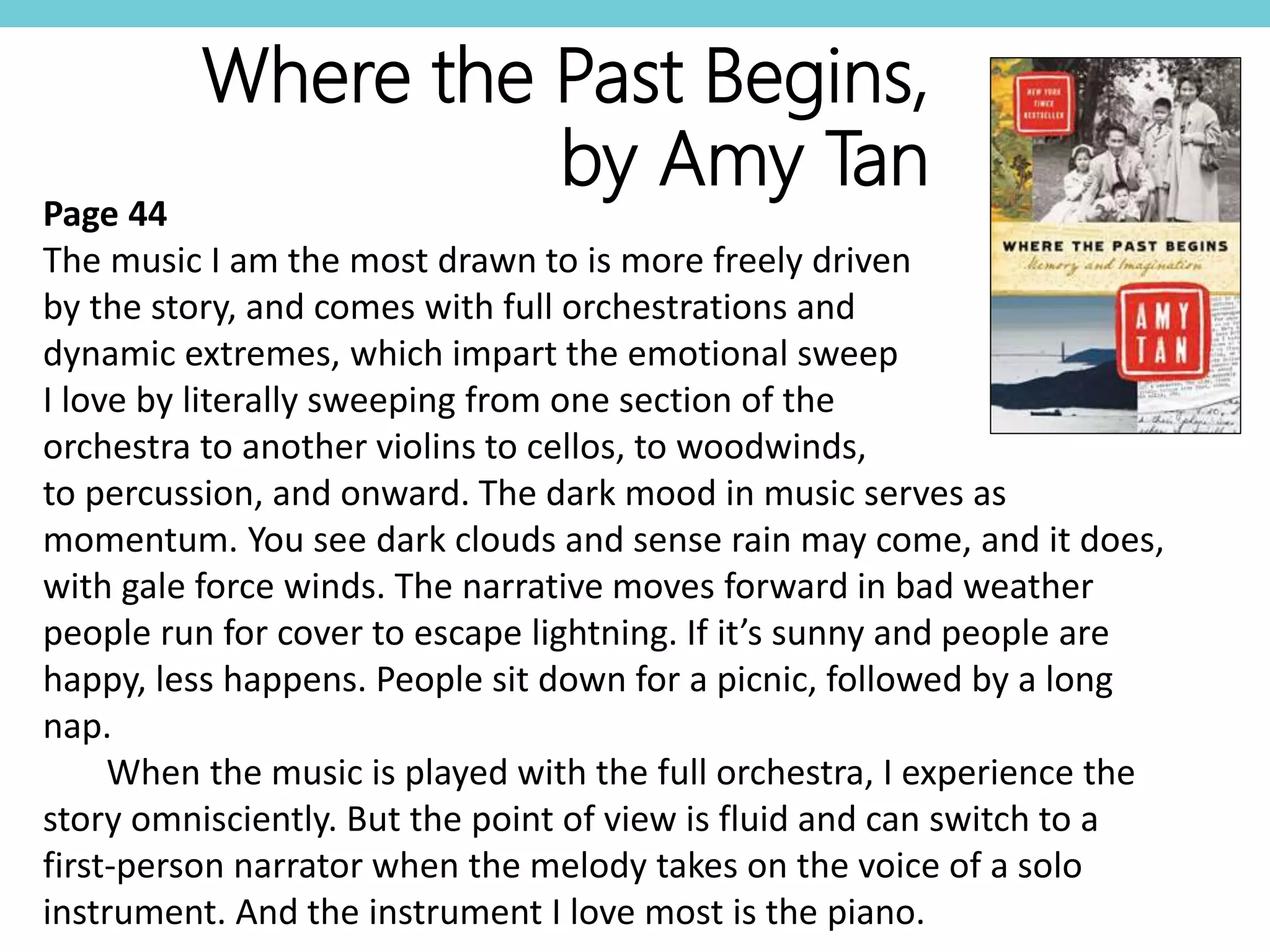
Where the Past Begins,
by Amy Tan
Blood, Bones & Butter,
by Gabrielle Hamilton
Page 180
Suddenly Michele swerved terrifyingly to avoid a
possum in the middle of the road. I was in the backseat
nursing Marco. Michele had been driving one hundred
and ten miles an hour, without even realizing it. The
wagon of the car left the asphalt for a second and I lost
my mind. A hot red ore of rage poured out of me in the shape of an
unpunctuated curse of Michele, of my mother, of Italians, of dying
brothers, lazy line cooks, crazy co-op officers, self-absorbed fathers,
Vermont farmers, possums, raccoons, and deerflies. In just the two
seconds of the tires leaving the asphalt we all discover, in a most colorful
way, that I am an intensely stressed new mother with a new infant and a
dead brother, a busy restaurant, an incompatible husband, and an
uptight, ferociously rigid mother. Who is just a few exits away.
Chapter 3:
When mother and I had taken off for college, Daddy had stood
on the back porch under the clothesline . . . and swore he’d
come visit his first vacation. He said Come Halloween, Pokey, at the
latest. Old Pete’ll come walking up the road, making the rocks fly high . . .
He spoke these words out of his own wet face, wiped with the back of
his rawboned hand, but it was all bullshit, his promise. I knew, and he knew
I knew. Between us stood the tacit contract that come vacation time, old
Red would need Daddy’s help nailing asbestos siding, or our backyard fence
would require mending or so-and-so would be laid up. He’d never set foot
on this campus. His drinking schedule had become too inviolable. Plus,
these college folks with whom I was hobnobbing wouldn’t know how to
speak to a man who’d graduated grade six and spent days off cleaning his
squirrel gun.
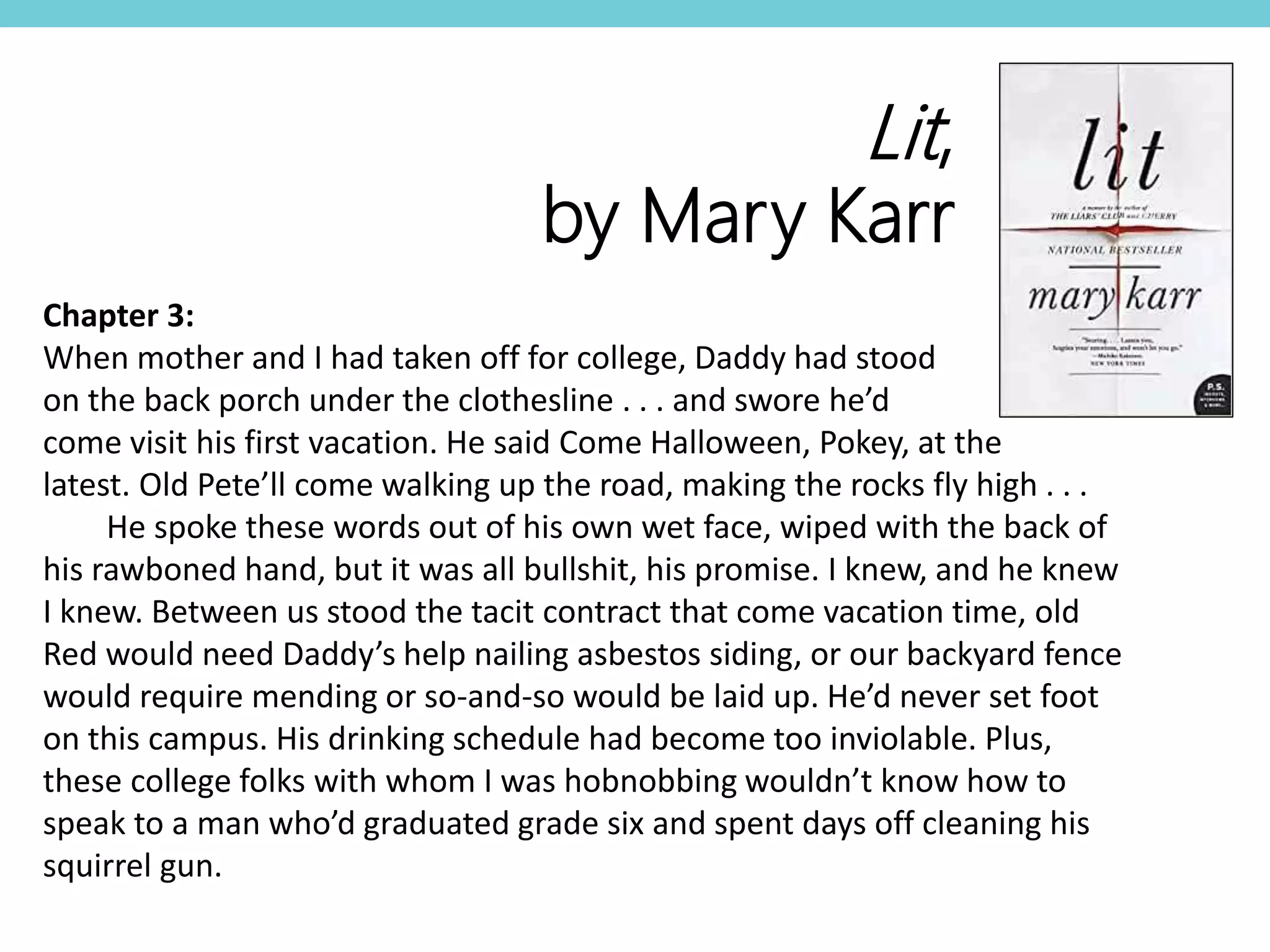
Lit,
by Mary Karr
Inheritance,
by Dani Shapiro
Page 49:
What it felt like: a sharp, overpowering aloneness. Susie’s
casual tone only increased my sense of being adrift in the
world. I was my mother’s daughter. Narcissistic personality
disorder. Borderline. I had read dozens of books over the years ranging from
complex psychoanalytic tomes to straight-up self-help as I tried to navigate the
difficulties of being my mother’s daughter. But my single best defense had
always been that I was my father’s daughter. I was more my father’s daughter. I
had somehow convinced myself that I was only my father’s daughter.
Now—as Michael and I headed to dinner . . . I felt cut loose from
everything I had ever understood about myself. The wind kicked up, and my
eyes began to tear. How could I survive this new knowledge that I was made up
of my mother and a stranger?
Chapter 1:
My granddaddy is the only black man I’ve ever met who
was never broke a day in his life. He ran an illegal liquor
house in Decatur, Georgia, selling moonshine for fifty cents
a shot from behind a bar he built himself out of plywood and
old scraps of carpet and red leather. Granddaddy’s real name
was George Walker, but folks called him Bear Cat or .38 for the two pistols
he kept in his front pockets. Granddaddy didn’t believe in banks and didn’t
trust anybody, either. He stored his jugs or corn liquor in the living room in
a beat-up old refrigerator the color of baby-shit yellow, which he locked up
with a thick metal chain. And he stashed his money in a dingy white athletic
sock he pinned to the inside of his pants. My brother Dre, who would steal
anything that wasn’t nailed down, used to say he’d be one rich mothafucka
if he could only get his hands on that sock full of paper. But Dre didn’t want
to swipe anything that hung so close to Granddaddy’s mangy balls.
Rabbit,
by Patricia Williams
Free Spirit,
by Joshua Safran
Chapter 1:
“At your birth . . .” my mother would sing to me,
“the room was lit only by candles.”
It was always: at your birth. It was never: when you
were born, because everyone went around getting born.
That was routine, just the normal prerequisite for admission into our world.
But at your birth meant that the beginning of my life was an event. Something
unique. Something unlike anything the world had ever seen before.
[. . .]
My mother enjoyed reciting the story as much as I loved hearing it. She
carried it with her wherever we went, telling it to me in the line at the Welfare
office or while waiting to hitch a ride by the side of the road. But mostly she
told it to me at bedtime. I heard the story so many times that I began
“remembering” my own birth, as if I had been one of the spectators, wedged in
somewhere between the coven of witches and the flute player.
p. 142
Whenever I was told to think about something, my mind
became a desert. But this time I had no need of thought
because the answer was already there. I was my mother’s
son. I could not be anyone else’s. When I was younger and having
trouble learning to write, she sat me down at the kitchen table and
covered my hand with hers and moved it through the alphabet for
several nights running, and then through words and sentences until
the motions assumed their own life, partly hers and partly mine. I
could not, cannot put pen to paper without having her with me. Nor
swim, nor sing. I could imagine leaving her. I knew I would someday.
But to call someone else my mother was impossible, I didn’t reason
any of this out. It was there as instinct . . . But she may have also
dreamed of flight and freedom . . . The human heart is a dark forest.
This Boy’s Life,
by Tobias Wolff
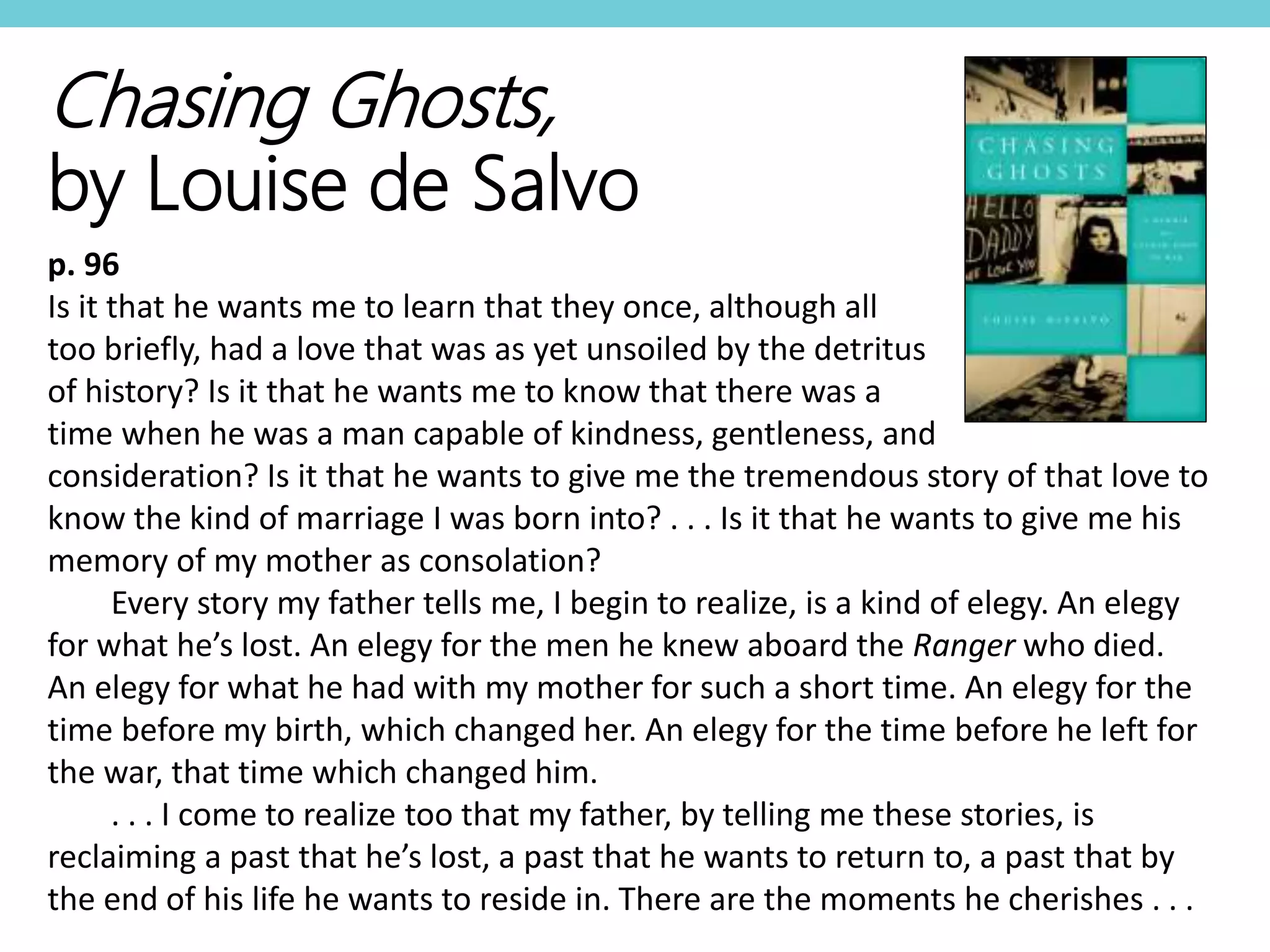
Chasing Ghosts,
by Louise de Salvo
p. 96
Is it that he wants me to learn that they once, although all
too briefly, had a love that was as yet unsoiled by the detritus
of history? Is it that he wants me to know that there was a
time when he was a man capable of kindness, gentleness, and
consideration? Is it that he wants to give me the tremendous story of that love to
know the kind of marriage I was born into? . . . Is it that he wants to give me his
memory of my mother as consolation?
Every story my father tells me, I begin to realize, is a kind of elegy. An elegy
for what he’s lost. An elegy for the men he knew aboard the Ranger who died.
An elegy for what he had with my mother for such a short time. An elegy for the
time before my birth, which changed her. An elegy for the time before he left for
the war, that time which changed him.
. . . I come to realize too that my father, by telling me these stories, is
reclaiming a past that he’s lost, a past that he wants to return to, a past that by
the end of his life he wants to reside in. There are the moments he cherishes . . .
Chapter 1:
I knew ICE was all around us and that a raid was just on the
horizon. But I couldn’t tell anyone what I was always watching
for, what I was always anticipating.
I could hear Ama’s words rattle in my head. “Never tell anyone.” She
didn’t need to remind me. I knew.
I saw them everywhere. I saw agents in trees, I saw their heads
popping out of the ground like tulips, I felt their hands touching every coin
in my pocket. But my mistake was that I always saw them outside—never
did I think I would one day find them inside my house. For some reason I
thought our house existed beyond the limits of the border, as if it was a
sovereign country of its own. It was the only place I didn’t have to scrutinize
myself, the only place the shaking stopped.
Children of the Land,
by Marcelo Hernandez Castillo
Eat, Pray, Love
by Elizabeth Gilbert
Chapter 2:
And since I am already down there in supplication on the
floor, let me hold that position as I reach back in time three
years earlier to the moment when this entire story began—
a moment which also found me in this exact same posture:
on my knees, on a floor, praying.
Everything else about the three-years-ago scene was different, though.
That time, I was not in Rome but in the upstairs bathroom of the big house in
the suburbs of New York that I’d recently purchased with my husband. It was a
cold November, around three o’clock in the morning. My husband was sleeping
in our bed. I was hiding in the bathroom for something like the forty-seventh
consecutive night, and—just as during all those nights before—I was sobbing.
Sobbing so hard, in fact, that a great lake of tears and snot was spreading
before me on the bathroom tiles, a veritable Lake Inferior (if you will) of all my
shame and fear and confusion and grief.
I don’t want to be married anymore.
p. 87
I would tell you I once received a massage from a blind
person but that would be a lie. She would read me like Braille,
her fingertips hovering on the raised points of my flesh, then
peel back the sheets of my skin, lay one finger on my quivering
heart. We could beat like that, two hummingbirds, and become very still.
Her hands might move across my abdomen, flick the scar below my belly
button. My eyelids would flutter at her touch, and my skin dissolve into hot
streams of tears.
I have never been touched by a blind person, but I have given whole
massages with my eyes halfway closed, and the bodies I touched became
something else. Their edges dissolved, and they spread out on the table, all
the borders gone . . .
Season of the Body,
by Brenda Miller
All the Strange Hours,
by Loren Eiseley
p. 5
The last time I had seen my mother’s mirror it had
been scarred. I had looked into the mirror as a child,
admiring the scrollwork on the silver. Finally it disappeared.
The face of a child vanished with it, my own face. Without
the mirror, I was unaware when it departed. Make no mistake,
everything in the mind is in rat’s country…They are merely carried, these
disparate memories, back and forth in the desert of a billion neurons, set down,
picked up, and dropped again by mental pack rats. Nothing perishes, it is merely
lost till a surgeon’s electrode starts the music of an old player piano whose
scrolls are dust. Or you yourself do it, tossing in the restless nights. Nothing is
lost, but it can never be again as it was. You will only find the bits and cry out
because they were yourself. Nothing can begin again and go right, but still it is
you, your mind picking endlessly over the splintered glass of a mirror dropped
and broken long ago.
Page 6:
I was nine years old when my mother threw me out of a moving
car. It happened on a Sunday. I know it was a Sunday because we
were coming home from church, and every Sunday in my childhood meant
church. We never missed church. My mother was—and still is—a deeply
religious woman. Very Christian. Like indigenous peoples around the world,
black South Africans adopted the religion of our colonizers. By “adopt” I
mean it was forced on us. The white man was quite stern with the native.
“You need to pray to Jesus,” he said. “Jesus will save you.” To which the
native replied, “Well, we do need to be saved—saved from you, but that’s
beside the point. So let’s give this Jesus thing a shot.”
Born a Crime,
by Trevor Noah
Heart Berries
by Terese Marie Mailhot
Chapter 2:
You had a hard-on for my oratory. Some of my stories were
fabricated. I had authority—a thing that people like you haven’t
witnessed. It comes from a traditional upbringing and regarding
my work as something more sacred than generations of effort or study. It’s
something on a continuum, so far reaching you know it came from an inhuman
place. Story is inhuman and beyond me, and I’m not sure you ever recognized
that. You knew to be excited in proximity to my power.
We started the affair in a small booth at Village Inn. I didn’t sleep well the
night before. You were my teacher, and we discussed my fiction. My work was
skeletal, before you. I waited for the right silence and then said flatly that I liked
you.
“Do we get a hotel?” you said.
Your hands were shaking. I reached out and touched them—they were
double mine and whiter.
On an otherwise pleasant summer evening in Michigan, I attend
a wedding reception held at a country club in Linden. I sit on a
folding chair at table 22, a yellow napkin in my lap . . . On the back
of the cardboard placard for table 22 is a photograph of the
bride’s dog. His face is dusted with snow. I later learn the photo
is snapped through a window, the dog outside, looking into the living room.
The dog’s right eye appears eager: The door will open soon. I will be in my
warm home. (Totally projecting human sensibilities onto an animal.) Yet the
dog’s left eye portrays such sadness I want to weep.…The dog’s photo
speaks to me—or maybe barks—especially the sad left eye. Often when I
should feel happy I’m despondent, convinced tragedy waits to strike.
Conversely, I’m content, if not actually happy, in a crisis—knowing things
can’t get worse. I hold the photo, stroking the paper image. I want the real
dog, in the fur, here with me now. I want to own the dog. I want to kidnap
him, bring him inside from the cold. I slip the photo into my purse.
How to Survive Death and
Other Inconveniences,
by Sue William Silverman
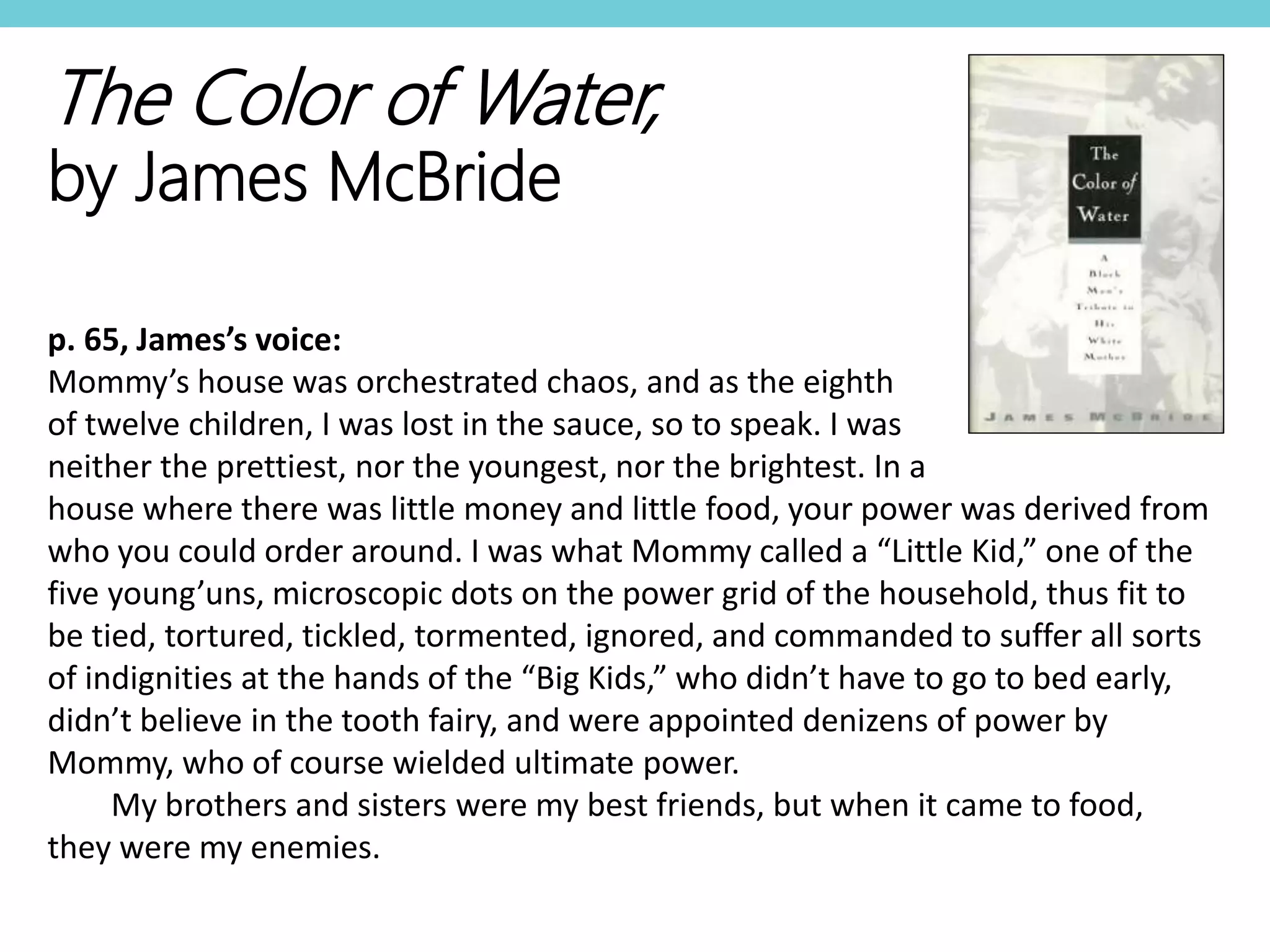
The Color of Water,
by James McBride
p. 65, James’s voice:
Mommy’s house was orchestrated chaos, and as the eighth
of twelve children, I was lost in the sauce, so to speak. I was
neither the prettiest, nor the youngest, nor the brightest. In a
house where there was little money and little food, your power was derived from
who you could order around. I was what Mommy called a “Little Kid,” one of the
five young’uns, microscopic dots on the power grid of the household, thus fit to
be tied, tortured, tickled, tormented, ignored, and commanded to suffer all sorts
of indignities at the hands of the “Big Kids,” who didn’t have to go to bed early,
didn’t believe in the tooth fairy, and were appointed denizens of power by
Mommy, who of course wielded ultimate power.
My brothers and sisters were my best friends, but when it came to food,
they were my enemies.
The Color of Water,
by James McBridep. 107, his mother’s imagined voice:
If there was one thing Tateh didn’t like more than gentiles, it was black folks. And if
there was one thing he didn’t like more than black folks in general, it was black men
in particular. So it stands to reason that the first thing I fell in love with in life was a
black man. I didn’t do it on purpose. I was a rebellious little girl in my own quiet way,
but I wasn’t so rebellious that I wanted to risk my own life or anybody else’s life. They
would kill a black man for looking at a white woman in the South in those days.
They’d hang him. And the girl, they’d run her out of town. Who wants trouble like
that?
But as I became a teenager, I wanted the same things any teenage girl wants. I
wanted love, nice clothes, a date. I never had that…[things changed.]
My boyfriend’s name was Peter, and he lived in one of the houses on the road behind
the store. He was a tall, handsome young man, dark skinned with beautiful teeth and
a beautiful smile.
I was naïve and young and before you know it, I fell in love with him. I loved that
boy to death and he loved me. At least, I thought he did. Who cared that he was
black? He was the first man other than my grandfather who ever showed me any
kindness in my life and he did it at the risk of his own.
pp. 44-45:
The enormity of the moral mission of medicine lent my early
days of med school a severe gravity. The first day, before we
got to the cadavers, was CPR training, my second time doing it. The
first time, back in college, had been farcical, unserious, everyone
laughing: the terribly acted videos and limbless plastic mannequins
couldn’t have been more artificial. But now the lurking possibility
that we would have to employ these skills someday animated
everything. As I repeatedly slammed my palm into the chest of a tiny
plastic child, I couldn’t help but hear, along with my fellow students’
jokes, real ribs cracking.
When Breath Becomes Air,
by Paul Kalanithi
p 230:
Not yet. There was still a long list of not-yets. I hadn’t killed
anyone yet, or lost my job yet, or ended up in jail yet. I hadn’t
wrapped my car around a telephone pole, or grabbed a gun and
shot someone in a bar, or gotten drunk and ended up raped by a
stranger. Not yet.
That’s what they’re called in AA: “yets,” all the things you didn’t
do when you drank but could have if you’d kept on going. Those
things could have happened so easily—one wrong turn, one false
move, a little girl’s skull absorbing the shock of a fall instead of my
knee [this is in reference to a time when she buckled while carrying
her friend’s daughter, piggy-back]. But they hadn’t happened. Not
yet.
YET. Some people in AA say it stands for You’re Eligible Too.
Drinking, A Love Story,
by Caroline Knapp

Voice Excepts from WRITING THROUGH THE CRISIS

  • 1.
    VOICE EXCERPTS from Writing Throughthe Crisis BROOKE WARNER & LINDA JOY MYERS
  • 2.
    Page 44 The musicI am the most drawn to is more freely driven by the story, and comes with full orchestrations and dynamic extremes, which impart the emotional sweep I love by literally sweeping from one section of the orchestra to another violins to cellos, to woodwinds, to percussion, and onward. The dark mood in music serves as momentum. You see dark clouds and sense rain may come, and it does, with gale force winds. The narrative moves forward in bad weather people run for cover to escape lightning. If it’s sunny and people are happy, less happens. People sit down for a picnic, followed by a long nap. When the music is played with the full orchestra, I experience the story omnisciently. But the point of view is fluid and can switch to a first-person narrator when the melody takes on the voice of a solo instrument. And the instrument I love most is the piano. Where the Past Begins, by Amy Tan
  • 3.
    Blood, Bones &Butter, by Gabrielle Hamilton Page 180 Suddenly Michele swerved terrifyingly to avoid a possum in the middle of the road. I was in the backseat nursing Marco. Michele had been driving one hundred and ten miles an hour, without even realizing it. The wagon of the car left the asphalt for a second and I lost my mind. A hot red ore of rage poured out of me in the shape of an unpunctuated curse of Michele, of my mother, of Italians, of dying brothers, lazy line cooks, crazy co-op officers, self-absorbed fathers, Vermont farmers, possums, raccoons, and deerflies. In just the two seconds of the tires leaving the asphalt we all discover, in a most colorful way, that I am an intensely stressed new mother with a new infant and a dead brother, a busy restaurant, an incompatible husband, and an uptight, ferociously rigid mother. Who is just a few exits away.
  • 4.
    Chapter 3: When motherand I had taken off for college, Daddy had stood on the back porch under the clothesline . . . and swore he’d come visit his first vacation. He said Come Halloween, Pokey, at the latest. Old Pete’ll come walking up the road, making the rocks fly high . . . He spoke these words out of his own wet face, wiped with the back of his rawboned hand, but it was all bullshit, his promise. I knew, and he knew I knew. Between us stood the tacit contract that come vacation time, old Red would need Daddy’s help nailing asbestos siding, or our backyard fence would require mending or so-and-so would be laid up. He’d never set foot on this campus. His drinking schedule had become too inviolable. Plus, these college folks with whom I was hobnobbing wouldn’t know how to speak to a man who’d graduated grade six and spent days off cleaning his squirrel gun. Lit, by Mary Karr
  • 5.
    Inheritance, by Dani Shapiro Page49: What it felt like: a sharp, overpowering aloneness. Susie’s casual tone only increased my sense of being adrift in the world. I was my mother’s daughter. Narcissistic personality disorder. Borderline. I had read dozens of books over the years ranging from complex psychoanalytic tomes to straight-up self-help as I tried to navigate the difficulties of being my mother’s daughter. But my single best defense had always been that I was my father’s daughter. I was more my father’s daughter. I had somehow convinced myself that I was only my father’s daughter. Now—as Michael and I headed to dinner . . . I felt cut loose from everything I had ever understood about myself. The wind kicked up, and my eyes began to tear. How could I survive this new knowledge that I was made up of my mother and a stranger?
  • 6.
    Chapter 1: My granddaddyis the only black man I’ve ever met who was never broke a day in his life. He ran an illegal liquor house in Decatur, Georgia, selling moonshine for fifty cents a shot from behind a bar he built himself out of plywood and old scraps of carpet and red leather. Granddaddy’s real name was George Walker, but folks called him Bear Cat or .38 for the two pistols he kept in his front pockets. Granddaddy didn’t believe in banks and didn’t trust anybody, either. He stored his jugs or corn liquor in the living room in a beat-up old refrigerator the color of baby-shit yellow, which he locked up with a thick metal chain. And he stashed his money in a dingy white athletic sock he pinned to the inside of his pants. My brother Dre, who would steal anything that wasn’t nailed down, used to say he’d be one rich mothafucka if he could only get his hands on that sock full of paper. But Dre didn’t want to swipe anything that hung so close to Granddaddy’s mangy balls. Rabbit, by Patricia Williams
  • 7.
    Free Spirit, by JoshuaSafran Chapter 1: “At your birth . . .” my mother would sing to me, “the room was lit only by candles.” It was always: at your birth. It was never: when you were born, because everyone went around getting born. That was routine, just the normal prerequisite for admission into our world. But at your birth meant that the beginning of my life was an event. Something unique. Something unlike anything the world had ever seen before. [. . .] My mother enjoyed reciting the story as much as I loved hearing it. She carried it with her wherever we went, telling it to me in the line at the Welfare office or while waiting to hitch a ride by the side of the road. But mostly she told it to me at bedtime. I heard the story so many times that I began “remembering” my own birth, as if I had been one of the spectators, wedged in somewhere between the coven of witches and the flute player.
  • 8.
    p. 142 Whenever Iwas told to think about something, my mind became a desert. But this time I had no need of thought because the answer was already there. I was my mother’s son. I could not be anyone else’s. When I was younger and having trouble learning to write, she sat me down at the kitchen table and covered my hand with hers and moved it through the alphabet for several nights running, and then through words and sentences until the motions assumed their own life, partly hers and partly mine. I could not, cannot put pen to paper without having her with me. Nor swim, nor sing. I could imagine leaving her. I knew I would someday. But to call someone else my mother was impossible, I didn’t reason any of this out. It was there as instinct . . . But she may have also dreamed of flight and freedom . . . The human heart is a dark forest. This Boy’s Life, by Tobias Wolff
  • 9.
    Chasing Ghosts, by Louisede Salvo p. 96 Is it that he wants me to learn that they once, although all too briefly, had a love that was as yet unsoiled by the detritus of history? Is it that he wants me to know that there was a time when he was a man capable of kindness, gentleness, and consideration? Is it that he wants to give me the tremendous story of that love to know the kind of marriage I was born into? . . . Is it that he wants to give me his memory of my mother as consolation? Every story my father tells me, I begin to realize, is a kind of elegy. An elegy for what he’s lost. An elegy for the men he knew aboard the Ranger who died. An elegy for what he had with my mother for such a short time. An elegy for the time before my birth, which changed her. An elegy for the time before he left for the war, that time which changed him. . . . I come to realize too that my father, by telling me these stories, is reclaiming a past that he’s lost, a past that he wants to return to, a past that by the end of his life he wants to reside in. There are the moments he cherishes . . .
  • 10.
    Chapter 1: I knewICE was all around us and that a raid was just on the horizon. But I couldn’t tell anyone what I was always watching for, what I was always anticipating. I could hear Ama’s words rattle in my head. “Never tell anyone.” She didn’t need to remind me. I knew. I saw them everywhere. I saw agents in trees, I saw their heads popping out of the ground like tulips, I felt their hands touching every coin in my pocket. But my mistake was that I always saw them outside—never did I think I would one day find them inside my house. For some reason I thought our house existed beyond the limits of the border, as if it was a sovereign country of its own. It was the only place I didn’t have to scrutinize myself, the only place the shaking stopped. Children of the Land, by Marcelo Hernandez Castillo
  • 11.
    Eat, Pray, Love byElizabeth Gilbert Chapter 2: And since I am already down there in supplication on the floor, let me hold that position as I reach back in time three years earlier to the moment when this entire story began— a moment which also found me in this exact same posture: on my knees, on a floor, praying. Everything else about the three-years-ago scene was different, though. That time, I was not in Rome but in the upstairs bathroom of the big house in the suburbs of New York that I’d recently purchased with my husband. It was a cold November, around three o’clock in the morning. My husband was sleeping in our bed. I was hiding in the bathroom for something like the forty-seventh consecutive night, and—just as during all those nights before—I was sobbing. Sobbing so hard, in fact, that a great lake of tears and snot was spreading before me on the bathroom tiles, a veritable Lake Inferior (if you will) of all my shame and fear and confusion and grief. I don’t want to be married anymore.
  • 12.
    p. 87 I wouldtell you I once received a massage from a blind person but that would be a lie. She would read me like Braille, her fingertips hovering on the raised points of my flesh, then peel back the sheets of my skin, lay one finger on my quivering heart. We could beat like that, two hummingbirds, and become very still. Her hands might move across my abdomen, flick the scar below my belly button. My eyelids would flutter at her touch, and my skin dissolve into hot streams of tears. I have never been touched by a blind person, but I have given whole massages with my eyes halfway closed, and the bodies I touched became something else. Their edges dissolved, and they spread out on the table, all the borders gone . . . Season of the Body, by Brenda Miller
  • 13.
    All the StrangeHours, by Loren Eiseley p. 5 The last time I had seen my mother’s mirror it had been scarred. I had looked into the mirror as a child, admiring the scrollwork on the silver. Finally it disappeared. The face of a child vanished with it, my own face. Without the mirror, I was unaware when it departed. Make no mistake, everything in the mind is in rat’s country…They are merely carried, these disparate memories, back and forth in the desert of a billion neurons, set down, picked up, and dropped again by mental pack rats. Nothing perishes, it is merely lost till a surgeon’s electrode starts the music of an old player piano whose scrolls are dust. Or you yourself do it, tossing in the restless nights. Nothing is lost, but it can never be again as it was. You will only find the bits and cry out because they were yourself. Nothing can begin again and go right, but still it is you, your mind picking endlessly over the splintered glass of a mirror dropped and broken long ago.
  • 14.
    Page 6: I wasnine years old when my mother threw me out of a moving car. It happened on a Sunday. I know it was a Sunday because we were coming home from church, and every Sunday in my childhood meant church. We never missed church. My mother was—and still is—a deeply religious woman. Very Christian. Like indigenous peoples around the world, black South Africans adopted the religion of our colonizers. By “adopt” I mean it was forced on us. The white man was quite stern with the native. “You need to pray to Jesus,” he said. “Jesus will save you.” To which the native replied, “Well, we do need to be saved—saved from you, but that’s beside the point. So let’s give this Jesus thing a shot.” Born a Crime, by Trevor Noah
  • 15.
    Heart Berries by TereseMarie Mailhot Chapter 2: You had a hard-on for my oratory. Some of my stories were fabricated. I had authority—a thing that people like you haven’t witnessed. It comes from a traditional upbringing and regarding my work as something more sacred than generations of effort or study. It’s something on a continuum, so far reaching you know it came from an inhuman place. Story is inhuman and beyond me, and I’m not sure you ever recognized that. You knew to be excited in proximity to my power. We started the affair in a small booth at Village Inn. I didn’t sleep well the night before. You were my teacher, and we discussed my fiction. My work was skeletal, before you. I waited for the right silence and then said flatly that I liked you. “Do we get a hotel?” you said. Your hands were shaking. I reached out and touched them—they were double mine and whiter.
  • 16.
    On an otherwisepleasant summer evening in Michigan, I attend a wedding reception held at a country club in Linden. I sit on a folding chair at table 22, a yellow napkin in my lap . . . On the back of the cardboard placard for table 22 is a photograph of the bride’s dog. His face is dusted with snow. I later learn the photo is snapped through a window, the dog outside, looking into the living room. The dog’s right eye appears eager: The door will open soon. I will be in my warm home. (Totally projecting human sensibilities onto an animal.) Yet the dog’s left eye portrays such sadness I want to weep.…The dog’s photo speaks to me—or maybe barks—especially the sad left eye. Often when I should feel happy I’m despondent, convinced tragedy waits to strike. Conversely, I’m content, if not actually happy, in a crisis—knowing things can’t get worse. I hold the photo, stroking the paper image. I want the real dog, in the fur, here with me now. I want to own the dog. I want to kidnap him, bring him inside from the cold. I slip the photo into my purse. How to Survive Death and Other Inconveniences, by Sue William Silverman
  • 17.
    The Color ofWater, by James McBride p. 65, James’s voice: Mommy’s house was orchestrated chaos, and as the eighth of twelve children, I was lost in the sauce, so to speak. I was neither the prettiest, nor the youngest, nor the brightest. In a house where there was little money and little food, your power was derived from who you could order around. I was what Mommy called a “Little Kid,” one of the five young’uns, microscopic dots on the power grid of the household, thus fit to be tied, tortured, tickled, tormented, ignored, and commanded to suffer all sorts of indignities at the hands of the “Big Kids,” who didn’t have to go to bed early, didn’t believe in the tooth fairy, and were appointed denizens of power by Mommy, who of course wielded ultimate power. My brothers and sisters were my best friends, but when it came to food, they were my enemies.
  • 18.
    The Color ofWater, by James McBridep. 107, his mother’s imagined voice: If there was one thing Tateh didn’t like more than gentiles, it was black folks. And if there was one thing he didn’t like more than black folks in general, it was black men in particular. So it stands to reason that the first thing I fell in love with in life was a black man. I didn’t do it on purpose. I was a rebellious little girl in my own quiet way, but I wasn’t so rebellious that I wanted to risk my own life or anybody else’s life. They would kill a black man for looking at a white woman in the South in those days. They’d hang him. And the girl, they’d run her out of town. Who wants trouble like that? But as I became a teenager, I wanted the same things any teenage girl wants. I wanted love, nice clothes, a date. I never had that…[things changed.] My boyfriend’s name was Peter, and he lived in one of the houses on the road behind the store. He was a tall, handsome young man, dark skinned with beautiful teeth and a beautiful smile. I was naïve and young and before you know it, I fell in love with him. I loved that boy to death and he loved me. At least, I thought he did. Who cared that he was black? He was the first man other than my grandfather who ever showed me any kindness in my life and he did it at the risk of his own.
  • 19.
    pp. 44-45: The enormityof the moral mission of medicine lent my early days of med school a severe gravity. The first day, before we got to the cadavers, was CPR training, my second time doing it. The first time, back in college, had been farcical, unserious, everyone laughing: the terribly acted videos and limbless plastic mannequins couldn’t have been more artificial. But now the lurking possibility that we would have to employ these skills someday animated everything. As I repeatedly slammed my palm into the chest of a tiny plastic child, I couldn’t help but hear, along with my fellow students’ jokes, real ribs cracking. When Breath Becomes Air, by Paul Kalanithi
  • 20.
    p 230: Not yet.There was still a long list of not-yets. I hadn’t killed anyone yet, or lost my job yet, or ended up in jail yet. I hadn’t wrapped my car around a telephone pole, or grabbed a gun and shot someone in a bar, or gotten drunk and ended up raped by a stranger. Not yet. That’s what they’re called in AA: “yets,” all the things you didn’t do when you drank but could have if you’d kept on going. Those things could have happened so easily—one wrong turn, one false move, a little girl’s skull absorbing the shock of a fall instead of my knee [this is in reference to a time when she buckled while carrying her friend’s daughter, piggy-back]. But they hadn’t happened. Not yet. YET. Some people in AA say it stands for You’re Eligible Too. Drinking, A Love Story, by Caroline Knapp