EWRT 2
Dates to Remember
Introduce Essay #5
Discussion: A Game of Thrones
 and Philosophy: Choosing your
 prompt.
A Writing Strategy: The Basic
 Argument
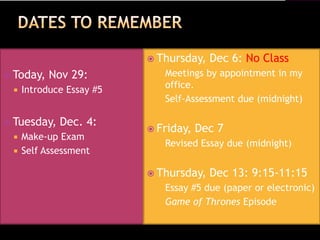
 Thursday,    Dec 6: No Class
 Today,   Nov 29:           Meetings by appointment in my
    Introduce Essay #5       office.
                             Self-Assessment due (midnight)


 Tuesday,   Dec. 4:
                           Friday,   Dec 7
  Make-up Exam
                               Revised Essay due (midnight)
  Self Assessment

                           Thursday,    Dec 13: 9:15-11:15
                             Essay #5 due (paper or electronic)
                             Game of Thrones Episode
 4-6 pages (not including the works cited
  page)
 At least four credible sources
 MLA format
 Due: During class: paper or electronic form
 The topic includes an intersection between
  one or more of the philosophies we read and
  A Game of Thrones. You may choose a topic
  from the list I am passing out, or you may
  use one of your own.
 Takea position for or against a certain
 perspective, opinion, stance, or philosophy.

 You will employ rhetorical strategies as well
 as stylistic devices to persuade your audience
 that your argument is reasoned, responsible,
 and persuasive.
 Defend/Challenge/Qualify:    Describe the
  characteristics or the qualities of something
  or someone. Touch upon the relevance of
  both sides of the claim/argument. Qualify
  your argument by acknowledging exceptions
  or other perspectives.
 Answer based on evidence developed from
  observation, experience and/or reading
 When answering, consider the “road less
  traveled.” Come up with examples that are
  unusual or unique.
 Defineor explain the assertion/claim being
 offered. Or, explain the essence of the
 argument.

 Beaware of any prejudicial attitudes,
 sentiments, or stereotypes you may have.
 (Touch upon ALL possible perspectives you can)

 Produce a clear, arguable thesis statement that
 asserts your opinion.
 As long as you are addressing the prompt and
 appropriately supporting your position, there
 is no danger of your losing points on your
 essay. Your essay is graded for process,
 mastery, and manipulation of language, not
 for how close you come to the viewpoint of
 your reader.
 Use   evidence to support your position:
    be specific and accurate—named and factually
     correct
    avoid using movies and other more informal aspects
     of society as evidence (pop culture)
    Stay away from blogging sites, Wikipedia, and other
     sites that lack authority or credibility.
    reflect a well-educated, widely-read, mature
     individual's thoughtful reaction
    be unified, specific, accurate, adequate, relevant,
     and representative- Do not use an INFORMAL VOICE
    avoid evidence that everybody will cite (To avoid
     this, reject first thoughts and keep digging until you
     find ideas that are complex and interesting.)
 Here is a brief overview of the kinds of
  support/evidence you could include to bolster your
  argument:
— facts/statistics
— details
— quotations
— dialogue
— definitions
— recognition of the opposition
— examples
— anecdotes
— contrast and comparison
— cause and effect
— appeal to authority
1. Begin by writing a meaningful opening
  sentence or two which makes a personal
  observation about the focus of the question
  that reveals your thinking. Do not write
  flowery, general beginnings. Get right to the
  point. Use the first sentence or two to begin
  to define the meaning of the assertion. If you
  need to provide directed summary to provide
  context for your essay, do so here.
2. Qualify your stance if there is a common or strong
argument for a different perspective. Try an “although”
thesis (Example: “Although grass is green, it can also be
other colors.” Then your first page will be about green
grass. Acknowledge that you are familiar with this
stance; In the next pages, you will discuss/argue for
the existence of the other colors. Then will come your
counterargument (rebuttal or concession) and then the
conclusion. Be careful not to contradict yourself.
   If the prompt requires an agree or disagree stance, be sure
    to demonstrate an understanding of argumentation by
    acknowledging both sides of the argument. This is
    usually done by writing a con-pro paragraph immediately
    after the introduction and the remainder of the essay
    becomes different paragraphs which confirm or amplify
    your agreement or disagreement with the assertion.
 Ifthe question requires a defend, challenge, or
  qualify stance on a political or philosophical
  assertion, be sure to address all the issues
  raised by the claim/assertion. Your evidence
  would be specifically named examples that
  support the claim you make in your topic
  sentence. Examples from multiple sources that
  support the same conclusion make your claim
  more valid. Each paragraph then would end
  with an interpretation of the similar conclusion
  that can be reached after examining differing
  types of evidence.
   Agree or disagree with an assertion naturally by
    explaining your stance. Avoid saying “I feel this
    statement/idea/philosophy is correct.” Instead
    state your belief: "Change can be big or small,
    personal or public, but if a person is not
    confident enough or is worried about what
    others think, changes will never happen."

 Avoid    “I believe” statements. (They also
    come in the form of “I think” or “I feel” as
    well.)
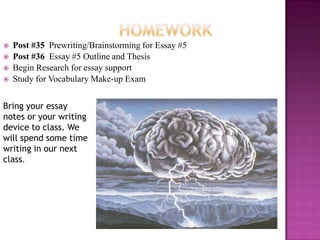
   Post #35 Prewriting/Brainstorming for Essay #5
   Post #36 Essay #5 Outline and Thesis
   Begin Research for essay support
   Study for Vocabulary Make-up Exam


Bring your essay
notes or your writing
device to class. We
will spend some time
writing in our next
class.

Class 19

  • 1.
  • 2.
    Dates to Remember IntroduceEssay #5 Discussion: A Game of Thrones and Philosophy: Choosing your prompt. A Writing Strategy: The Basic Argument
  • 3.
     Thursday, Dec 6: No Class  Today, Nov 29:  Meetings by appointment in my  Introduce Essay #5 office.  Self-Assessment due (midnight)  Tuesday, Dec. 4:  Friday, Dec 7  Make-up Exam  Revised Essay due (midnight)  Self Assessment  Thursday, Dec 13: 9:15-11:15  Essay #5 due (paper or electronic)  Game of Thrones Episode
  • 4.
     4-6 pages(not including the works cited page)  At least four credible sources  MLA format  Due: During class: paper or electronic form  The topic includes an intersection between one or more of the philosophies we read and A Game of Thrones. You may choose a topic from the list I am passing out, or you may use one of your own.
  • 7.
     Takea positionfor or against a certain perspective, opinion, stance, or philosophy.  You will employ rhetorical strategies as well as stylistic devices to persuade your audience that your argument is reasoned, responsible, and persuasive.
  • 8.
     Defend/Challenge/Qualify: Describe the characteristics or the qualities of something or someone. Touch upon the relevance of both sides of the claim/argument. Qualify your argument by acknowledging exceptions or other perspectives.  Answer based on evidence developed from observation, experience and/or reading  When answering, consider the “road less traveled.” Come up with examples that are unusual or unique.
  • 9.
     Defineor explainthe assertion/claim being offered. Or, explain the essence of the argument.  Beaware of any prejudicial attitudes, sentiments, or stereotypes you may have. (Touch upon ALL possible perspectives you can)  Produce a clear, arguable thesis statement that asserts your opinion.
  • 10.
     As longas you are addressing the prompt and appropriately supporting your position, there is no danger of your losing points on your essay. Your essay is graded for process, mastery, and manipulation of language, not for how close you come to the viewpoint of your reader.
  • 11.
     Use evidence to support your position:  be specific and accurate—named and factually correct  avoid using movies and other more informal aspects of society as evidence (pop culture)  Stay away from blogging sites, Wikipedia, and other sites that lack authority or credibility.  reflect a well-educated, widely-read, mature individual's thoughtful reaction  be unified, specific, accurate, adequate, relevant, and representative- Do not use an INFORMAL VOICE  avoid evidence that everybody will cite (To avoid this, reject first thoughts and keep digging until you find ideas that are complex and interesting.)
  • 12.
     Here isa brief overview of the kinds of support/evidence you could include to bolster your argument: — facts/statistics — details — quotations — dialogue — definitions — recognition of the opposition — examples — anecdotes — contrast and comparison — cause and effect — appeal to authority
  • 13.
    1. Begin bywriting a meaningful opening sentence or two which makes a personal observation about the focus of the question that reveals your thinking. Do not write flowery, general beginnings. Get right to the point. Use the first sentence or two to begin to define the meaning of the assertion. If you need to provide directed summary to provide context for your essay, do so here.
  • 14.
    2. Qualify yourstance if there is a common or strong argument for a different perspective. Try an “although” thesis (Example: “Although grass is green, it can also be other colors.” Then your first page will be about green grass. Acknowledge that you are familiar with this stance; In the next pages, you will discuss/argue for the existence of the other colors. Then will come your counterargument (rebuttal or concession) and then the conclusion. Be careful not to contradict yourself.
  • 15.
    If the prompt requires an agree or disagree stance, be sure to demonstrate an understanding of argumentation by acknowledging both sides of the argument. This is usually done by writing a con-pro paragraph immediately after the introduction and the remainder of the essay becomes different paragraphs which confirm or amplify your agreement or disagreement with the assertion.
  • 16.
     Ifthe questionrequires a defend, challenge, or qualify stance on a political or philosophical assertion, be sure to address all the issues raised by the claim/assertion. Your evidence would be specifically named examples that support the claim you make in your topic sentence. Examples from multiple sources that support the same conclusion make your claim more valid. Each paragraph then would end with an interpretation of the similar conclusion that can be reached after examining differing types of evidence.
  • 17.
    Agree or disagree with an assertion naturally by explaining your stance. Avoid saying “I feel this statement/idea/philosophy is correct.” Instead state your belief: "Change can be big or small, personal or public, but if a person is not confident enough or is worried about what others think, changes will never happen."  Avoid “I believe” statements. (They also come in the form of “I think” or “I feel” as well.)
  • 18.
    Post #35 Prewriting/Brainstorming for Essay #5  Post #36 Essay #5 Outline and Thesis  Begin Research for essay support  Study for Vocabulary Make-up Exam Bring your essay notes or your writing device to class. We will spend some time writing in our next class.