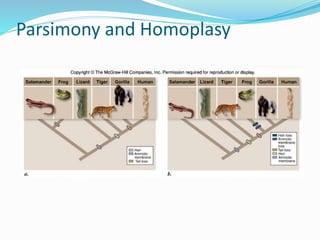
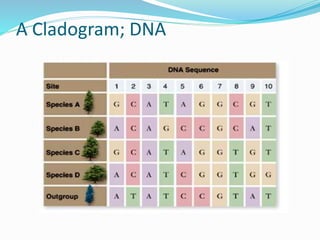
Cladistics is an approach to biological classification that categorizes organisms into groups ("clades") based on their most recent common ancestor. It was developed in the 1950s by the German taxonomist Willi Hennig. Cladistics analyzes morphological, physiological, behavioral, and DNA characters to construct cladograms that illustrate evolutionary relationships. Characters are determined to be ancestral or derived traits, and clades are formed based on shared derived characters called synapomorphies. Conflicts among characters are resolved using parsimony, which favors the hypothesis requiring the fewest evolutionary changes.



![Evolution+and+natural+selection pvms[1]](https://cdn.slidesharecdn.com/ss_thumbnails/evolutionandnaturalselectionpvms1-121017101003-phpapp01-thumbnail.jpg?width=640&height=640&fit=bounds)
![Evolution+and+natural+selection pvms[1]](https://cdn.slidesharecdn.com/ss_thumbnails/evolutionandnaturalselectionpvms1-141015100918-conversion-gate02-thumbnail.jpg?width=640&height=640&fit=bounds)


