Classification of living
things
Dr Caleb Mandikonza
What is displayed in the
picture? How is it displayed?
2
3
What is shown in this picture? What is unique about the
items displayed? Why are they displayed this way? How
else can they be displayed?
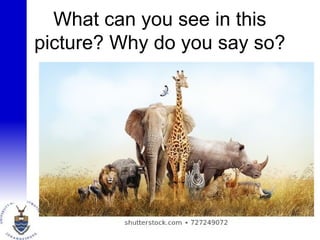
What can you see in this
picture? Why do you say so?
4
Classification
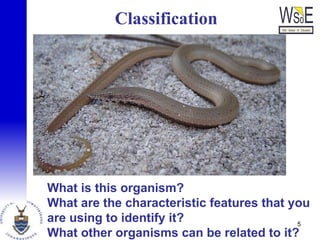
What is this organism?
What are the characteristic features that you
are using to identify it?
What other organisms can be related to it?
5
Classification
• Principles of classification
• Classification of living
organisms
• Diversity of living organisms
6
Principles of classification
Outcomes
• Justify the use of classification in everyday life.
• Explain the basic principles of biological
classification including how to classify.
• Explain in your own words the term biological
diversity, taxonomy, classification, taxon,
domain, kingdom, phyla, binomial
classification, cladistics and distinguishing
characteristics/features.
7
Principles of classification
Outcomes
• Make a simple artificial key of organisms
• Use a simple artificial to identify organisms
8
Introduction to classification
What is classification?
• Is the sorting and grouping of
things/organisms with similar features.
Why do we classify in everyday life?
Activity 1: Discuss the questions below with a
friend/ neighbour
•How are goods classified in a supermarket?
Why?
9
Introduction to classification
(cont.)
• What do you think would happen if the goods
were classified according to alphabetical order
of their names?
• How are words classified in a dictionary?
• How are books classified in the library?
• How is laundry (dirty clothes) classified for
washing?
10
Why do we classify?
Reasons for classifying things in
everyday life:
To find things more easily
To keep track of things
11
Why do we classify living
organisms?
Biologists classify organisms to:
Make sense of the massive number of
organisms in the world by putting them
into groups.
Keep track of information about living
things
Identify unknown organisms
Establish relationships between organisms
12
How do we classify?
Principles of classification
Principle 1: Organisms with similar
characteristics are grouped
together.
Principle 2: Distinguishing characteristics
and not general characteristics of
organisms are used to classify
living organisms.
• E.g. opposable thumb in primates
13
Activity 2
Aim: To find out the difference between
distinguishing and general
characteristics.
14
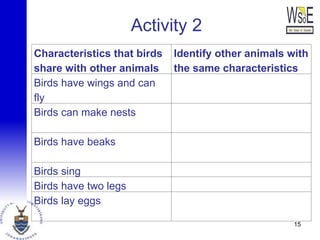
Activity 2
Characteristics that birds
share with other animals
Identify other animals with
the same characteristics
Birds have wings and can
fly
Birds can make nests
Birds have beaks
Birds sing
Birds have two legs
Birds lay eggs
15
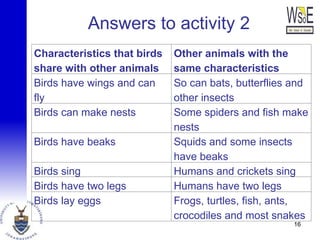
Answers to activity 2
Characteristics that birds
share with other animals
Other animals with the
same characteristics
Birds have wings and can
fly
So can bats, butterflies and
other insects
Birds can make nests Some spiders and fish make
nests
Birds have beaks Squids and some insects
have beaks
Birds sing Humans and crickets sing
Birds have two legs Humans have two legs
Birds lay eggs Frogs, turtles, fish, ants,
crocodiles and most snakes
16
Activity 2 answers cont.
2. General features are features which describe
an animal but the features are also present in
some other animals.
3. General characteristics of a) frogs: two eyes,
four legs, a backbone, toes, etc
General characteristics of b) snakes: scaly
skin, tongue, fangs, a skeleton, etc
Lizards and fish also have a scaly skin, Chameleons,
frogs and many other animals have a tongue.
General characteristics of c) humans: two
eyes, two ears, two arms, two legs, etc
17
Activity 2 answers cont.
4. A distinguishing characteristic is a feature or
features that are only present in a particular group.
5. Distinguishing characteristics of a) mammals:
mammary glands and body covering of hair
Distinguishing characteristics of b) insects: six legs.
Insects are the only living organisms with six legs.
6. General characteristics are characteristics that are
present in more than one group whilst
distinguishing characteristics are present in only
one particular group.
18
Types of classification
• Artificial classification
• Natural classification
• Phylogenetic/ Phyletic (Phylogenetic and
Cladistic)
19
Artificial classification
• Only a few characteristics chosen- usually
morphological
• Organisms may not be related genetically,
e.g. yellow flowers; yellow fruit; presence of
wings
• Provides limited information
• Difficult to identify a particular species or
genus
• Usually has limited information and cannot
add new information to what is present
20
21
What is shown in this picture? What is unique about the
items displayed? Why are they displayed this way? How
else can they be displayed?
Natural classification
• Almost all characteristics are considered
• Members of different groups that are of
similar origin are considered
• May change with advanced information
• Bring together phylogenetically related
individuals and groups
22
Phylogenetic classification
• A form of natural classification that brings
together organisms that are related in
ancestry: using their inherited
characteristics
• Brings together organisms that are related
by their ancestry
• Uses biochemistry, genetics and
palaeontology, in addition to morphology,
anatomy, etc
23
Approaches to natural
classification
Traditional classification, phylogeny
and cladistics.
Traditional classification (Botanist Carl
Linnaeus)
•Uses morphological (external form),
anatomical (structural) and molecular
information to classify organisms.
•Devised a system for assigning
species to a hierarchy of broader
groups. 24
Traditional natural classification
A hierarchical system of taxonomic groups. Until
recently, these levels were:
Kingdom
Phylum
Class
Order
Family
Genus
Species
Addition of Domain overarching the Kingdom
25
A hierarchical system of
taxonomic groups
• Species(specific descriptive) name→
Genus→Family→ Order→
Class→Phylum→ Kingdom→Domain.
• Taxon (pl.taxa) is a formal grouping of
organisms.
26
A hierarchical system of taxonomic groups
According to this traditional system, all living
organisms were divided into five kingdoms.
Name the five kingdoms.
Monera, Protista, fungi, plantae and Animalia.
•Devised a system of naming species, where
each species had two scientific names, the
genus name and the species.
•Eg. Lumbricus terrestris. 27
Binomial nomenclature
The binomial system is used to name living
organisms. The two-part format of the
scientific name was instituted by Carl
Linnaeus.
Two Latin names are used: the generic
name identifies the genus to which the
organism belongs and the specific name/
specific epithet denotes the species name
e.g Homo sapiens for man.
The genus name always spelt with a capital
letter and the species name with a small
letter.
28
Binomial nomenclature
The two names always written in italics or
underlined if handwritten.
Question:
Explain the importance of scientists
adopting the same language and system for
naming living organisms
29
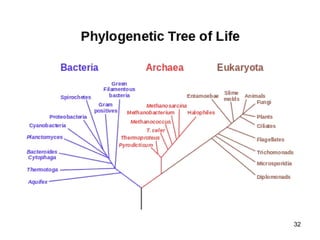
Phylogenetic System of classification.
• The evolutionary relationships are presented
in the form of a tree called a phylogenetic
tree, which is a diagram used to trace their
evolutionary relationships.
• Organisms are classified into clades.
• Clade- a group of organisms that share
characteristics inherited from a common
ancestor.
30
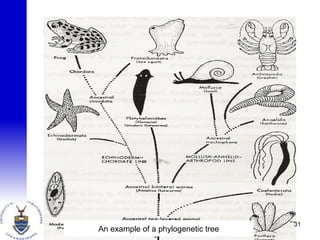
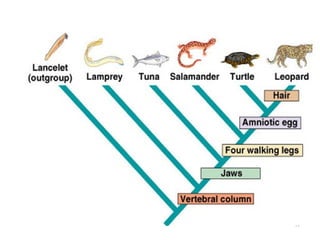
An example of a phylogenetic tree
31
32
33
Phylogenetic tree
• Type of phylogenetic tree we use is a
cladogram.
• It is a tree that depicts the evolutionary
relationships of each group(taxon)through
time.
• Each branch represents a clade, a group
of organisms with a common ancestor.
• Each branching point is referred to as a
node (depicted by a circle),represents a
split of two new groups from a common
ancestor.
• The node represents the most recent
common ancestor of each clade depicted by
the branches.
• Each branch represents one or more
characteristics shared by the clade.
34
• Cladograms are rooted if the most
common ancestor is known.
• The root, or the node at the base,
represents the most recent common
ancestor of all the clades depicted in the
tree.
35
Practical applications of
phylogenies(evolutionary histories)
• Information from phylogenies is used to
identify closely related organisms
• In what way is this information
important?
36
• A phylogenetic tree can help trace a
species back through evolutionary history,
down the branches of the tree, and
• locate their common ancestry along the way.
• ...Trees also identify the origin of certain
traits, or when a certain trait in a group of
organisms first appeared
37
Phylogenetics
• Uses similarities between organisms.
• The more similarities two organisms
have, the more closely related the
organisms are.
• Problem with this approach: Sometimes
organisms which are not related look alike.
38
Cladistics
Uses fossils, anatomical, behavioural and
molecular information of organisms
including DNA to determine common
ancestry and evolutionary history
The evolutionary histories and common
ancestry are then used to classify
organisms.
The evolutionary histories are represented
in the form of a diagram called a
cladogram.
39
Cladistics cont.
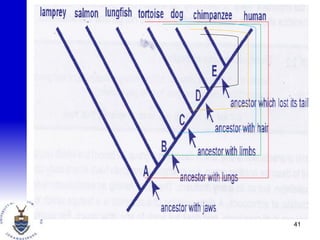
• In a cladogram organisms are put into
groups called clades.
• Each clade is made up of an ancestral
organism and its descendents.
40
41
Interpretation of cladograms
1. Which two organisms are most closely
related?
2. To which animal, the lung fish or the
dog is the tortoise more closely related.
Explain.
3. Name two examples of derived
characteristics.
42
Ancestral/derived characters
• Shared derived characters provide clues
about phylogeny.
• To determine the taxonomic relationships,
we examine the characteristics in the largest
group (such as a phylum or a class)-
indicates the most remote common
ancestry.
• These traits are termed shared ancestral
characters.
43
Shared and derived characters
• A shared character is one that two
lineages have in common,
• a derived character is one that evolved in
the lineage leading up to a clade and that
sets members of that clade apart from
other individuals.
• Shared derived characters can be used
to group organisms into clades.
44
Ancestral/derived characters(cont.)
• When populations become separated and
evolve independently, some of their traits
change as a result of mutations, natural
selection and genetic drift.
• The novel traits that evolve are referred to
as shared derived characters.
• These derived characters originate in a
recent common ancestor.
45
• A shared character is one that two
lineages have in common, and
• a derived character is one that evolved in
the lineage leading up to a clade and that
sets members of that clade apart from
other individuals.
• Shared derived characters can be used
to group organisms into clades.
46
47
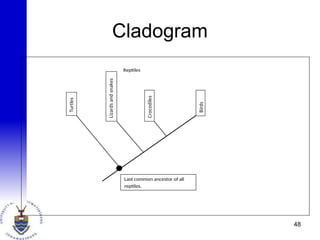
Cladogram
Reptiles
Turtles
Lizards
and
snakes
Crocodiles
Last common ancestor of all
reptiles.
Birds
48
• Before the introduction of domains, all
living organisms were divided into five
kingdoms: monera, protista, plantae,
fungi and animalia.
• Now all living organisms are classified
into three domains namely bacteria,
archaea and eukarya.
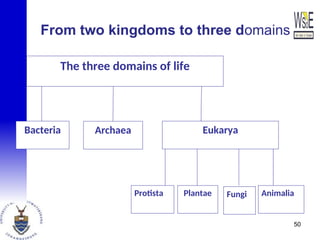
• The domain eukarya is then further
divided into kingdoms: protista,
plantae, fungi and animalia
49
From two kingdoms to three domains
50
The three domains of life
Bacteria Archaea Eukarya
Protista Plantae Fungi Animalia
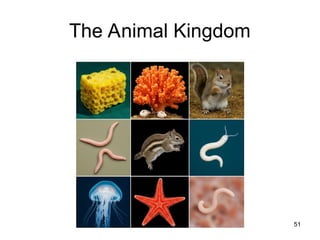
The Animal Kingdom
51
Key features of the Kingdom
Animalia
• Eukaryotic features
• Multicellular
• Heterotrophic nutrition: Intracellular and
extracellular digestion
• Show symmetry (radial; pentameric;
bilateral)
• Some are motile (in search of food)
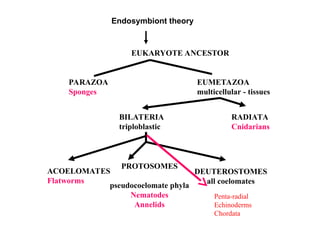
EUKARYOTE ANCESTOR
PARAZOA
Sponges
EUMETAZOA
multicellular - tissues
RADIATA
Cnidarians
BILATERIA
triploblastic
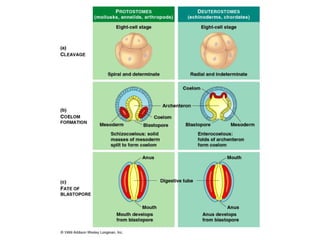
PROTOSOMES
pseudocoelomate phyla
Nematodes
Annelids
DEUTEROSTOMES
all coelomates
ACOELOMATES
Flatworms
Penta-radial
Echinoderms
Chordata
Endosymbiont theory
Levels of cellular organization
Define the following with examples
•Cell
•Tissue
•Organ
•Organ system
•Organism
55
Cellular organization
• Sensory, motor, relay, Nerve cell
• All nerve cells
• Nerve tissue and muscle tissue
• Nerve, muscle, blood, bones
• All such organs together
• Organism
56
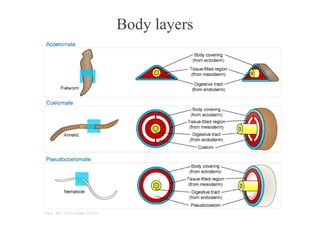
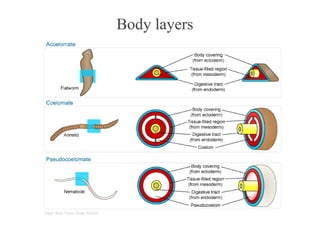
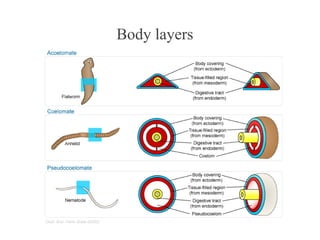
• Ectoderm- most exterior (or distal) layer. It emerges and
originates from the outer layer of germ cells. The
word ectoderm comes from the Greek
ektos meaning "outside", and derma, meaning "skin."
• Endoderm-The innermost of the primary germ layers of an
animal embryo. In vertebrates, the endoderm gives rise to the
respiratory tract, gastrointestinal tract (except mouth and
anus), glands associated with the gastrointestinal tract,
bladder, and urethra.
• Mesoderm-The mesoderm is the middle layer. In the embryo,
it differentiates to gives rise to a number of tissues and
structures including bone, muscle, connective tissue, and the
middle layer of the skin
Three body layers
Body layers
Revision activity
• Look at the diagram of the animal
• How is it adapted for the life it lives?
• What do you understand most?
• What do you understand a bit?
• What do you understand least?
• What do you want to know?
• What are you intending to do so that you
can understand what you do not
understand yet?
59
Subkingdom: Parazoa
• Two phyla: Porifera (sponges) and Placazoa (1 species).
• Mainly marine
• Organisms within the phyla have the following
characteristics:
– No body symmetry.
– No tissues (4 cell types)
– Therefore, no body plan
– Filter feeders.
– Reproduce both sexually and asexually
http://www.mesa.edu.au/porifera/gallery.asp
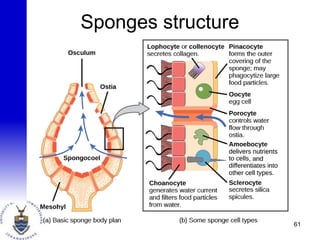
Sponges structure
61
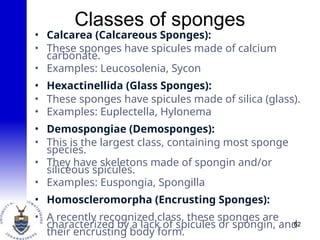
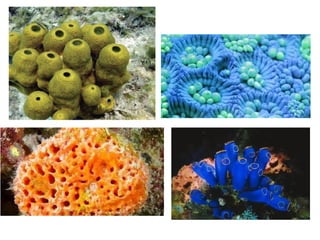
Classes of sponges
• Calcarea (Calcareous Sponges):
• These sponges have spicules made of calcium
carbonate.
• Examples: Leucosolenia, Sycon
• Hexactinellida (Glass Sponges):
• These sponges have spicules made of silica (glass).
• Examples: Euplectella, Hylonema
• Demospongiae (Demosponges):
• This is the largest class, containing most sponge
species.
• They have skeletons made of spongin and/or
siliceous spicules.
• Examples: Euspongia, Spongilla
• Homoscleromorpha (Encrusting Sponges):
• A recently recognized class, these sponges are
characterized by a lack of spicules or spongin, and
their encrusting body form.
62
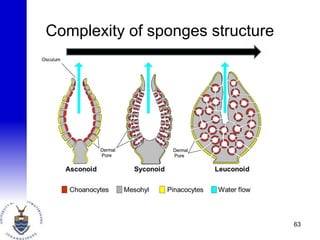
Complexity of sponges structure
63
Video
• https://www.youtube.com/watch?v=pdpKmDZx35I
• https://www.youtube.com/watch?v=q_rt8GzYcgg
65
Body layers
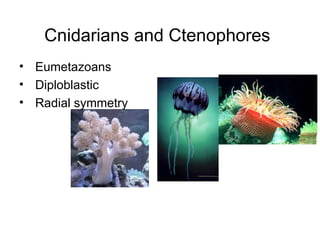
Cnidarians and Ctenophores
• Eumetazoans
• Diploblastic
• Radial symmetry
Key features of the Cnidaria
• Radial symmetry (tentacles surrounding mouth) - The
Radiata
• Gastrovascular cavity (respiration/digestion)
• Diploblastic two body layers (ectoderm and endoderm)
• Cnidocytes (stinging cells)
• Nerve net
• Gas exchange by diffusion
• Two body forms –Polyp and Medusa
• Reproduction
The Cnidarians/Ctenophores
• The Cnidaria and Ctenophora are often referred to as
the coelenterates (Greek means hollow gut).
• Mainly marine but some cnidarians can be found in
fresh-water habitats (e,g, Hydra).
• Some 9000 species have been described
• All are diploblastic - two tissue layers, ectoderm and
endoderm between which is the jelly-like mesoglea
Phylum Cnidaria
(Gr. Knidae - nettle)
• Class: Scyphozoa (jellyfish)
• Class: Cubozoa (sea wasps, box jellyfish)
• Class: Hydrozoa (hydroids e.g. Obelia,
Hydra)
• Class: Anthozoa (sea anemones, corals)
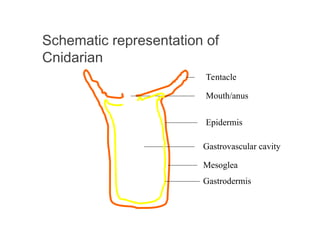
Gastrovascular cavity
Mouth/anus
Schematic representation of
Cnidarian
Epidermis
Mesoglea
Gastrodermis
Tentacle
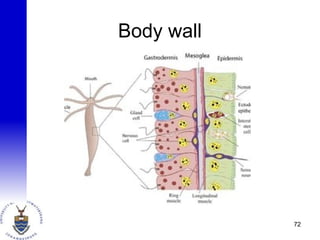
Body wall
72
73
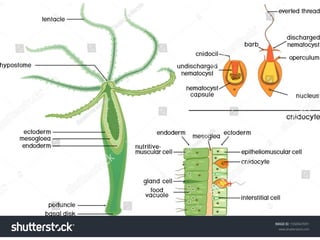
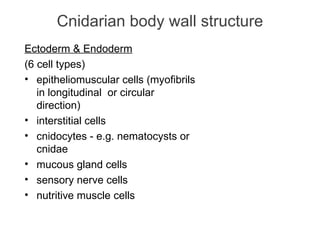
Cnidarian body wall structure
Ectoderm & Endoderm
(6 cell types)
• epitheliomuscular cells (myofibrils
in longitudinal or circular
direction)
• interstitial cells
• cnidocytes - e.g. nematocysts or
cnidae
• mucous gland cells
• sensory nerve cells
• nutritive muscle cells
• Sensory nerve cells
•cells
Cnidarian body wall structure
Cnidocytes
• Nematocysts -
spines that deliver a
proteinaceous toxin
• Spirocysts -
adhesive threads
(Anthozoans)
• Ptycocysts
76
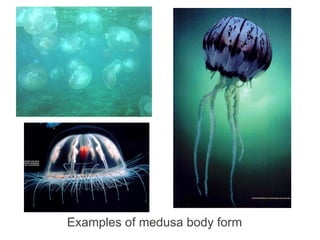
Cnidarians
• Take on one of two morphological forms
– Polyp form (sessile) (corals)
– Medusa form (mobile)
Structurally the two forms are identical, main
difference mesoglea in medusa form greatly
enlarged (i.e. jellyfish)
Examples of
polyp body form
Hydra
Anemones
Examples of medusa body form
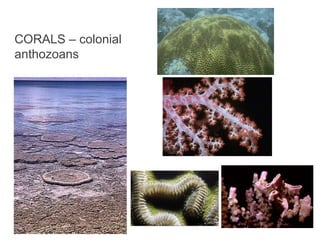
CORALS – colonial
anthozoans
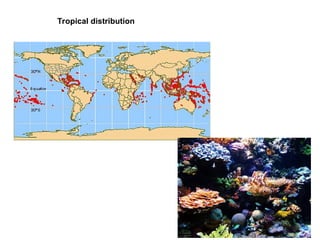
Tropical distribution
Cnidarian/ctenophore reproduction
• Majority of cnidarians/ctenophores are dieocious
(separate sexes).
• Capable of both asexual and sexual reproduction.
• Asexual reproduction usually through budding/fusion
(corals).
• Sexual reproduction involves the formation of gametes.
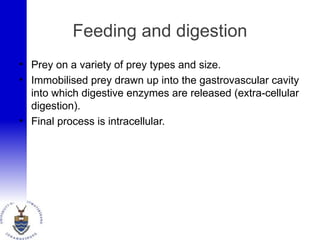
Feeding and digestion
• Prey on a variety of prey types and size.
• Immobilised prey drawn up into the gastrovascular cavity
into which digestive enzymes are released (extra-cellular
digestion).
• Final process is intracellular.
Importance of cnidarians/ctenophores?
Ecological
– Form a significant component of the plankton
biomass in a variety of aquatic ecosystems.
– Important carnivores in plankton food webs.
– Contribute to the complexity of benthic
environments (refuge for both invertebrates
and vertebrates e.g. corals and sea
anemones).
– Employed as a proxy for global change and
biological invasions.
Video
• https://www.youtube.com/watch?v=LjaS-X
Y1gbE
85
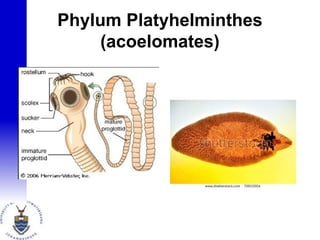
Phylum Platyhelminthes
(acoelomates)
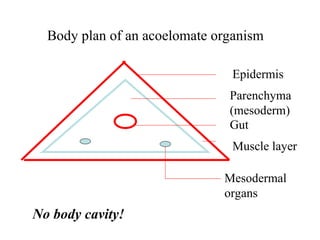
Gut
Body plan of an acoelomate organism
Parenchyma
(mesoderm)
Epidermis
Muscle layer
Mesodermal
organs
No body cavity!
• 4 classes (Turbellaria*, Cestoda, Trematoda,
Monogenea).
• Bilaterally symmetrical organisms,
• Triploblastic- three body layers.
• Acoelomate (no body cavity)*
• Blind ending gut (Cestodes – absence of gut).
• Absence of a circulatory system
• Sexual and asexual reproduction.
• Nerve system (cephalisation).
Phylum: Platyhelminthes
(flatworms)
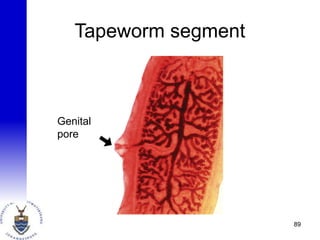
Tapeworm segment
89
Genital
pore
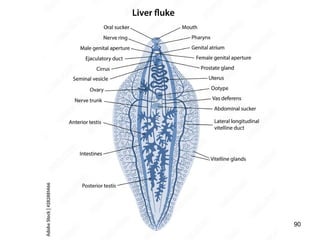
90
Features of the phylum
• Bilaterally symmetrical, dorso-ventrally flattened.
• Triploblastic (ectoderm, mesoderm, endoderm).
• Acoelomate (animals that do not have a true
coelom-body cavity).
• Blind ending gut (absent in Acoela and
Cestodes).
• No blood or respiratory system.
• Simple excretory system - protonephridia
• Simple nervous system - cephalization
• Most are hermaphrodites with complex
reproductive system.
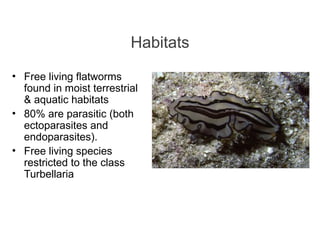
Habitats
• Free living flatworms
found in moist terrestrial
& aquatic habitats
• 80% are parasitic (both
ectoparasites and
endoparasites).
• Free living species
restricted to the class
Turbellaria
Platyhelminth classification
about 25000 species
Class
• Turbellaria
• Monogenea
• Trematoda (flukes)
• Cestoda (tapeworms) Parasitic
Reproduction
• Many flatworms able to reproduce both
sexually and asexually.
• Asexual reproduction is through fission or
through budding (e.g. tapeworms).
• Most flatworms are monoecious (both organs
in one organism=hermaphrodites) - one sexual
organism (opposite of diecious); practice
cross fertilisation). No sexual dimorphism
• Sexual reproduction involves formation of
gametes.
Physiology of Platyhelminthes
• Respiration/excretion of body wastes is
achieved through the process of diffusion.
• Digestive system includes mouth, pharynx
and intestine; intestine produces
proteolytic enzymes for some extracellular
digestion.
• Bulk of digestion takes place at an
intracellular level.
Importance of flat worms?
Ecological
• Flat worms can be extremely abundant in a
variety of ecosystems and thus play an
important role in energy flow within these
systems.
Human health
• Many of the flat worms are parasitic and thus
directly influence human health (e.g. tapeworms;
blood flukes).
Video
• https://www.youtube.com/watch?v=bp86b
0oQlMQ
97
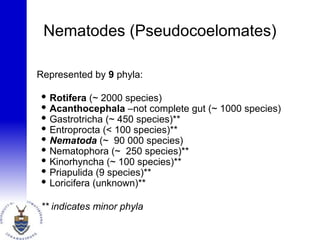
Nematodes (Pseudocoelomates)
 Represented by 9 phyla:
 Rotifera (~ 2000 species)
 Acanthocephala –not complete gut (~ 1000 species)
 Gastrotricha (~ 450 species)**
 Entroprocta (< 100 species)**
 Nematoda (~ 90 000 species)
 Nematophora (~ 250 species)**
 Kinorhyncha (~ 100 species)**
 Priapulida (9 species)**
 Loricifera (unknown)**
** indicates minor phyla
Nematodes
 To date, some 90 000 species have been
described, estimated to be about 500 000 species.
 Nematodes are present in every conceivable
ecological habitat, including sea, freshwater and
soil.
 Attain enormous densities (106
in a m-2
).
 Demonstrate a wide variety of feeding modes
including bactivory, herbivory, carnivory.
 Play an important role in nutrient dynamics of
ecosystems (decomposition).
 Most important parasitic groups (particularly for
humans).
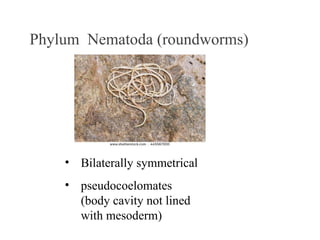
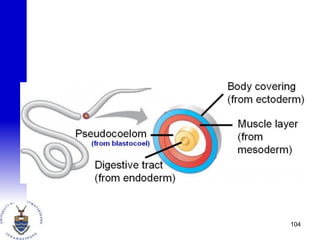
Phylum Nematoda (roundworms)
• Bilaterally symmetrical
• pseudocoelomates
(body cavity not lined
with mesoderm)
Nematodes
Share the following characteristics:
• Bilateral symmetry.
• Pseudocoelomate (fluid filled)
• Body covered with secreted cuticle (comprised
of collagen).
• Motile cilia and flagella lacking.
• Only longitudinal muscle in body wall.
• Hydrostatic skeleton (pseudocoel).
• Nervous system, with no evidence of
cephalisation
• Size range from < 1mm to 1m.
Nematodes
• Complete digestive system consists of a
mouth, muscular pharynx, intestine and
rectum.
• Simple excretory system.-mainly diffusion
and some have Renette cells
• Lack circulatory or respiratory system
(achieved by diffusion in fluid in the body
cavity).
• Respiration is by diffusion across the
cuticle.
Body layers
104
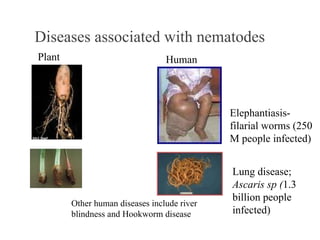
Elephantiasis-
filarial worms (250
M people infected)
Lung disease;
Ascaris sp (1.3
billion people
infected)
Diseases associated with nematodes
Plant Human
Other human diseases include river
blindness and Hookworm disease
Reproduction
• Separate sexes, internal fertilisation.
• Demonstrate sexual dimorphism (males smaller
than females).
• Male reproductive tract opens into the rectum to
form a cloaca; female reproductive open
separate , termed gonopore.
• Internal fertilisation.
• Development is direct to miniature forms of the
adult.
GROUP: COELOMATE INVERTEBRATES
-
These are animals with body cavity (internal space lined with
tissue derived from mesoderm.)
-
-The phyla in this group are:

Mollusca

Nemertea

Annelida

Athropoda

Echinodermata
10
7
STRUCTURE.
-Members secret shells and are soft-bodied.
-Shell is hardened and protective and made of calcium
carbonate.
HABITAT.
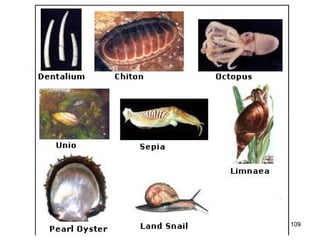
-Marine and freshwater and land animals. Examples are snails,
slugs, oysters, clams, scallops, cuttlefish, octopuses, squids.
-ABOUT 93,000 KNOWN SPECIES.
-Second most diverse animal phylum after arthropoda.
PHYLUM: MOLLUSCA.
10
8
109
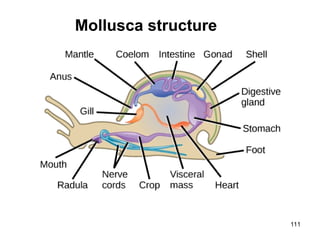
BODY STRUCTURE.
-Size may be 15m long (as in squid which weighs 250kg) or 1.5m long as
in giant clams (weight-270kg).
-Body is divided into 3 parts: muscular foot, visceral mass, and mantle.
-Foot is used for movement; visceral mas contain internal organs;
mantle secrets shell.
MODE OF LIFE.
Giant clam form symbiosis with dinoflagellates.
-Flat foot of snail/slug allows it to crawl (for locomotion).
-Terrestrial mollusk lives in crevices of desert rock which must be moist
or wet.
11
0
111
Mollusca structure
FEEDING.
-Members use strap-like (tongue-like) organ called radula to scrape
up food (algae and grass).
-Can also be used to drill (as in moon snail)
Radula can be transformed into harpoon (which contains venom).
-Harpoon can be used to capture prey like fish or can harm or kill
humans.
REPRODUCTION  REMOVAL OF WASTES.
-Nephridium helps to remove nitrogenous waste.
-Nephridium contains a funnel- nephrostome which is lined with cilia.
-Most molluscs have separate sexes; some are hermaphroditic.
- Fertilization is internal.
11
2
CLASS: POLYPLACOPHORA.
-Example- Chitons.
-Exclusively marine animals with oval-shaped body.
- Body is segmented; foot is broad and flat with which animal
creeps over rock surface.
-They are grazing herbivores and they use radula to scrape algae
of rock surface.
CLASSES OF MOLLUSCA.
11
3
114
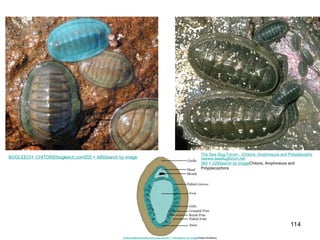
ChitonAnatomyshells.tricity.wsu.edu421 × 444Search by imageChiton Anatomy
The Sea Slug Forum - Chitons, Amphineura and Polyplacopho
rawww.seaslugforum.net
360 × 329Search by imageChitons, Amphineura and
Polyplacophora
BOGLEECH: CHITONS!bogleech.com555 × 485Search by image
CLASS: GASTRODA.
-Example- snails, slugs and limpets.
-Contains majority of Mollusca.
-Marine animals and also freshwater. Some are land animals
(desert and rain forest)
-Foot is modified for creeping/swimming.
-Has tentacles with eyes at the base.
-They usually undergo torsion-twisting of body such that mantle
cavity and anus are moved from a posterior location to front of
body.
-Has spiraled shell (may be conical or flat) into which animal
retreats when threatened.
11
5
116
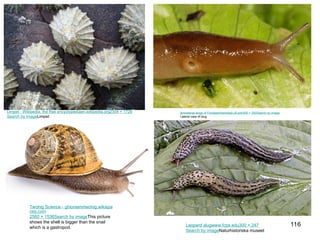
Limpet - Wikipedia, the free encyclopediaen.wikipedia.org2304 × 1728
Search by imageLimpet
terresterial slugs of Floridaentnemdept.ufl.edu500 × 300Search by image
Lateral view of slug
Leopard slugwww.fcps.edu300 × 247
Search by imageNaturhistoriska museet
Twohig Science - ghioniamrtwohig.wikispa
ces.com
2560 × 1536Search by imageThis picture
shows the shell is bigger than the snail
which is a gastropod.
CLASS: BIVALVIA.
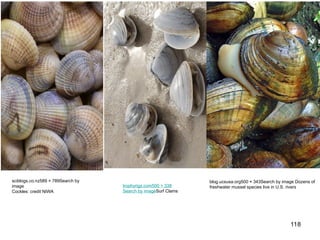
Examples- Clams, mussels, cockles.
-They are marine animals but some live in
freshwater(aquatic).Shell is divided into 2 halves ( no radula or
distinct head)
-Bivalves contain gills for gas exchange.
-Food particles are trapped in mucus present in gills and cilia
transports particles into the mouth.
-Mussels secret threads that attach them to rocks, docks, boats.
Clams can drag themselves into the sand/mud.
11
7
118
sciblogs.co.nz589 × 789Search by
image
Cockles: credit NIWA
trophyrigs.com500 × 338
Search by imageSurf Clams
blog.ucsusa.org500 × 343Search by image Dozens of
freshwater mussel species live in U.S. rivers
CLASS: CEPHALOPODA.
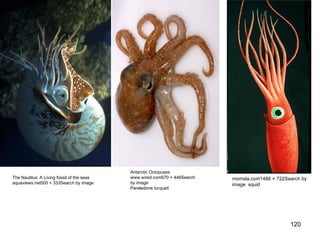
Examples- octopuses, squids, nautiluses.
-Marine swiftly-swimming predators.
-Presence of- tentacles to catch preys.
-Poison in saliva immobilizes prey.
-Beak-like jaw bites prey and pulls it into mouth by radula.
-Foot is equipped with suction cups or hooks to seize prey.
-Octopuses have 8 arms; squids have 8 arms and 2
tentacles; nautilus has 80-90 tentacles(no suckers).
11
9
120
The Nautilus: A Living fossil of the seas
aquaviews.net500 × 333Search by image
Antarctic Octopuses
www.wired.com670 × 446Search
by image
Pareledone turqueti
momsla.com1486 × 722Search by
image squid
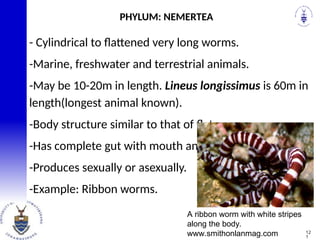
- Cylindrical to flattened very long worms.
-Marine, freshwater and terrestrial animals.
-May be 10-20m in length. Lineus longissimus is 60m in
length(longest animal known).
-Body structure similar to that of flatworms.
-Has complete gut with mouth and anus.
-Produces sexually or asexually.
-Example: Ribbon worms.
PHYLUM: NEMERTEA
12
1
A ribbon worm with white stripes
along the body.
www.smithonlanmag.com
• - Examples of animals in Phylum Annelida include :
earthworms and leeches.
• -They are segmented worms which live in the sea,
freshwater and damp soil.
• -The development and function of each segment differs.
They are used for reproduction, locomotion or excretion.
•
• -Their body is composed ring-like segments.
122
PHYLUM: ANNELIDA
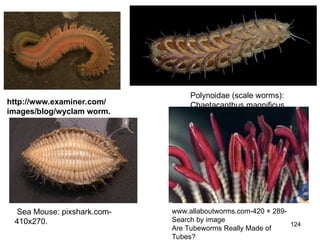
CLASS: POLYCHAETA. Examples- clamworms, scale worms, lugworms, sea mice
and tubeworms.
-Each segment has paddle-like structures (parapodia or feet) used for
locomotion and may function as gills or for swimming, burrowing and crawling.
-Presence of chaetae for attachment during copulation.
-Chaetae may have hooks to help anchor worm to surfaces.
CLASS: OLIGOCHAETA/CLITELLATA. Examples- Earthworm leeches.
-Have fewer chaetae per segment of animal than in polychaetes.
-Presence of clitellum which is a thickened band on the body
CLASSES OF ANNELIDA
12
3
124
http://www.examiner.com/
images/blog/wyclam worm.
Polynoidae (scale worms):
Chaetacanthus magnificus
www.allaboutworms.com-420 × 289-
Search by image
Are Tubeworms Really Made of
Tubes?
Sea Mouse: pixshark.com-
410x270.
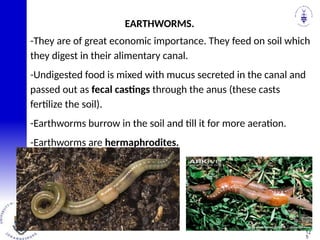
-They are of great economic importance. They feed on soil which
they digest in their alimentary canal.
-Undigested food is mixed with mucus secreted in the canal and
passed out as fecal castings through the anus (these casts
fertilize the soil).
-Earthworms burrow in the soil and till it for more aeration.
-Earthworms are hermaphrodites.
EARTHWORMS.
12
5
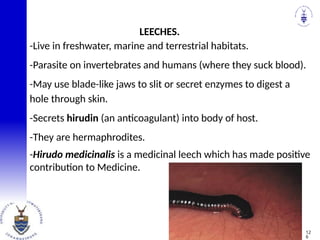
-Live in freshwater, marine and terrestrial habitats.
-Parasite on invertebrates and humans (where they suck blood).
-May use blade-like jaws to slit or secret enzymes to digest a
hole through skin.
-Secrets hirudin (an anticoagulant) into body of host.
-They are hermaphrodites.
-Hirudo medicinalis is a medicinal leech which has made positive
contribution to Medicine.
LEECHES.
12
6
127
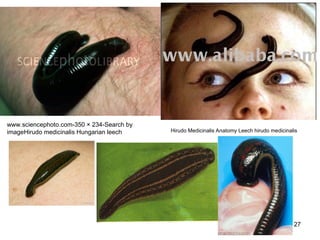
www.sciencephoto.com-350 × 234-Search by
imageHirudo medicinalis Hungarian leech Hirudo Medicinalis Anatomy Leech hirudo medicinalis
-This is the most successful of all animal phyla. Have over
1,000,000 species.
STRUCTURE / KEY FEATURES.
-Members are found in nearly all habitats.
-Body is segmented and has hard exoskeleton and jointed
appendages.
-Appendages used for walking, feeding, sensory reception,
reproduction and defense.
-Segments are divided into groups (tagmata) such as head,
thorax and abdomen ( in insects).
-They have distinct head (e.g. in crustaceans) but head and
thorax are fused to form cephalothorax (or prosoma) in
chelicerates.
PHYLUM: ARTHROPODA.
12
8
129
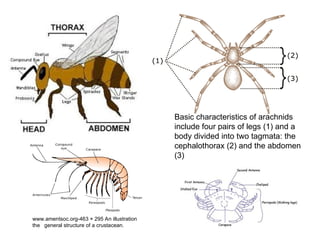
Basic characteristics of arachnids
include four pairs of legs (1) and a
body divided into two tagmata: the
cephalothorax (2) and the abdomen
(3)
www.amentsoc.org-463 × 295 An illustration
the general structure of a crustacean.
-Rigid external exoskeleton is made of chitin and protein.
-They undergo ecdysis/moulting periodically.
-Circulatory system is open.
-Presence of compound eyes in insects, centipedes and crustaceans.
-Marine arthropods have gills while terrestrial ones have tracheae for
respiration.
-Air passes into tracheae through openings in the exoskeleton called
spiracles.
-Spiders use book lungs. They construct webs of silk to catch insects.
-Malpighian tubules are used for excretion in terrestrial insects.
KNOWLEGDE CHECK: In which other phylum do the members undergo
ecdysis/moulting?
13
0
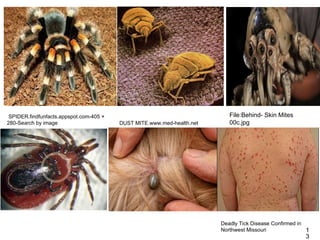
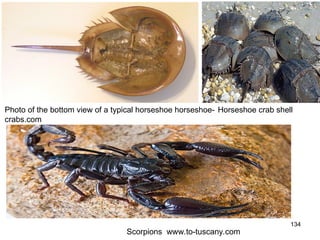
CLASS: CHELICERATA.
Examples: Spider, mites, ticks, horseshoe, scorpions.
-Presence of chelicerae which are pincers or fangs(mouthparts)
used for feeding.
-Body division into 2 parts – anterior prosoma – bears all the
appendages and posterior opisthosoma which bears
reproductive organs.
-They are arachnids and may dwell in freshwater, sea while
some are exclusively marine e.g. sea spider and horseshoe crabs.
CLASSES OF ARTHROPODA.
13
1
-Presence of pedipalps (copulatory organs) in male spiders. They
may be sensory(like antennae). Pincers are present in scorpions.
-Most members are carnivores but mites are herbivorous.
-They can ingest small particles but most ingest liquids and
liquefy solids by injecting digestive enzymes to break them.
-Ticks are blood-sucking and live as parasites on vertebrates,
invertebrates and plants.
13
2
1
3
SPIDER.findfunfacts.appspot.com-405 ×
280-Search by image DUST MITE.www.med-health.net
File:Behind- Skin Mites
00c.jpg
Deadly Tick Disease Confirmed in
Northwest Missouri
134
Photo of the bottom view of a typical horseshoe horseshoe-
crabs.com
Horseshoe crab shell
Scorpions www.to-tuscany.com
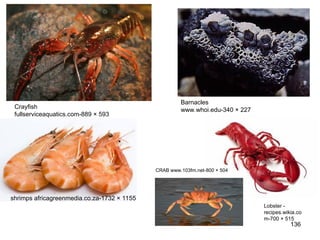
CLASS: CRUSTACEA.
Examples: Crabs, shrimps, lobsters, barnacles, crayfish.
-Members are mostly marine organisms; some live in freshwater
e.g. crayfish. Some are terrestrial e.g. pill bugs).
-Possess specialized appendages e.g. antennae (2 pairs). Some
appendages are modified mouthparts ( for chewing).
-Walking legs on thorax and also appendages on the abdomen
(unlike in insects).
-Gaseous exchange in some is through gills while some do it
across thin areas of cuticle.
13
5
136
Barnacles
www.whoi.edu-340 × 227
Crayfish
fullserviceaquatics.com-889 × 593
Lobster -
recipes.wikia.co
m-700 × 515
shrimps africagreenmedia.co.za-1732 × 1155
CRAB www.103fm.net-800 × 504
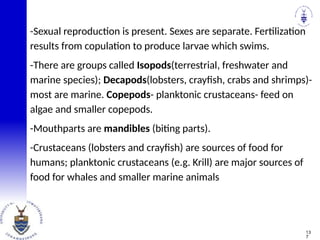
-Sexual reproduction is present. Sexes are separate. Fertilization
results from copulation to produce larvae which swims.
-There are groups called Isopods(terrestrial, freshwater and
marine species); Decapods(lobsters, crayfish, crabs and shrimps)-
most are marine. Copepods- planktonic crustaceans- feed on
algae and smaller copepods.
-Mouthparts are mandibles (biting parts).
-Crustaceans (lobsters and crayfish) are sources of food for
humans; planktonic crustaceans (e.g. Krill) are major sources of
food for whales and smaller marine animals
13
7
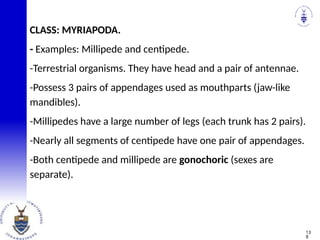
CLASS: MYRIAPODA.
- Examples: Millipede and centipede.
-Terrestrial organisms. They have head and a pair of antennae.
-Possess 3 pairs of appendages used as mouthparts (jaw-like
mandibles).
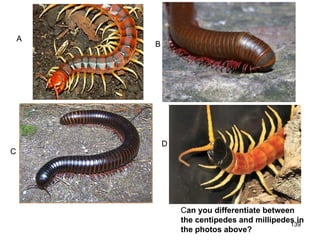
-Millipedes have a large number of legs (each trunk has 2 pairs).
-Nearly all segments of centipede have one pair of appendages.
-Both centipede and millipede are gonochoric (sexes are
separate).
13
8
139
Can you differentiate between
the centipedes and millipedes in
the photos above?
A
B
C
D
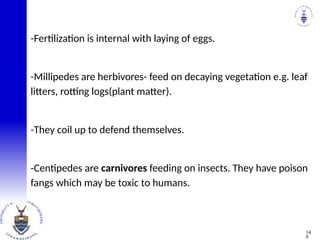
-Fertilization is internal with laying of eggs.
-Millipedes are herbivores- feed on decaying vegetation e.g. leaf
litters, rotting logs(plant matter).
-They coil up to defend themselves.
-Centipedes are carnivores feeding on insects. They have poison
fangs which may be toxic to humans.
14
0
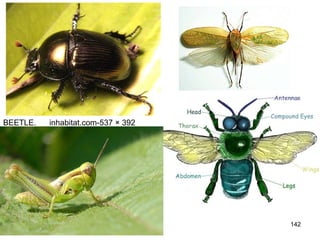
CLASS: HEXAPODA.
-Examples: Insects.
-Largest group of animals on earth occupying almost every
terrestrial habitat, freshwater and air but rare in marine.
-Small body structure ( 0.1mm-30cm in length wingspan).
-Different mouthparts ( biting, chewing, sucking, piercing)
depending on feeding habits.
-Body has 3 regions: Head, thorax and abdomen.
-Thorax has 3 segments each with a pair of legs.
-Presence of 1 or2 pairs of wings ( may be colorful as in
butterfly)attached to thorax for flight, to escape predators, find
food and mates, for dispersal to new habitats.
14
1
142
BEETLE. inhabitat.com-537 × 392
143
-Veins are present in wings for strength.
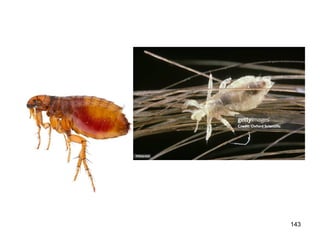
-Fleas and lice are wingless.
-Digestion takes place in stomach or midgut and
excretion takes place through malphighian tubules.
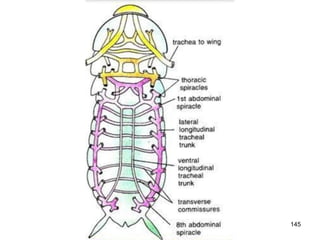
-Air enters tracheal system through the spiracles
located on the segments (thorax and abdomen).
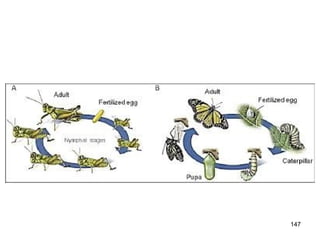
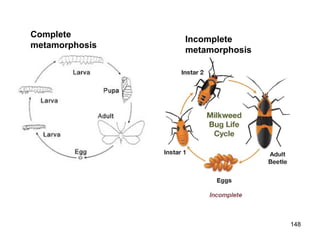
-Life cycle involves metamorphosis which may be
complete (e.g. in mosquito and butterfly) or
incomplete( as in cockroach and grasshoppers).
14
4
145
- In incomplete metamorphosis, egg --------- larva---------
Nymph----------Adult.
-Nymph resembles adults but smaller, lacks wings and moults
several times.
-In complete metamorphosis, egg---------larva---------
pupa-----------Adult.
-Larva or caterpillar or maggot or grub is a voracious(highly
consuming) stage.
-Sexes are separate and reproduction is sexual.
-Fertilization is internal after which eggs are laid.
14
6
147
148
Complete
metamorphosis
Incomplete
metamorphosis
Examples: Star fish, sea stars, sea urchins,
brittle stars, sand dollars, sea cucumbers.
-They are Deuterostomes and are closely
related to Chordates.
-Both of them(Echinoderms and chordates)
belong to the Deuterostomia clade of
bilaterian animals.
PHYLUM: ECHINODERMATA
14
9
STRUCTURE AND KEY FEATURES.
-Members are exclusively marine.
-They have endoskeleton composed of hard calcium carbonate lying
beneath the skin.
-They are slow-moving or sessile and possess water vascular system- canals
branching into extensions called tube foot- for locomotion and feeding.
-They have separate sexes and reproduction is sexual or asexual by splitting.
-They are pentaradially symmetrical- you can draw lines through their body
in five different places that produce mirror images on each side.
-Larvae is bilaterally symmetrical.
-They can regenerate lost parts.
15
0
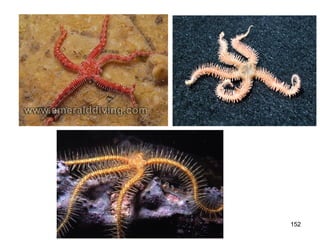
CLASS: OPHIUROIDEA.
- Example: Brittle stars.
-Largest class of echinoderms.
-Resemble asteroids.
-Possess central disk and long flexible arms for
swimming.
-They avoid light and are more active at night.
CLASSES OF ECHINODERMATA.
15
1
152
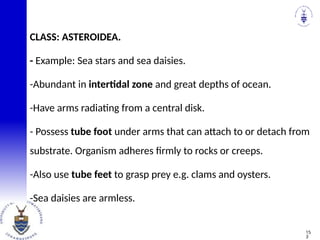
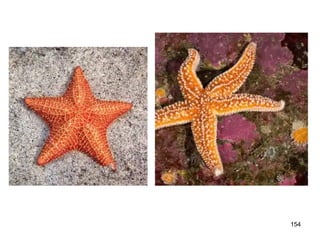
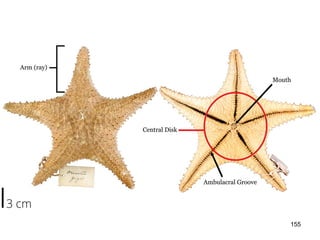
CLASS: ASTEROIDEA.
- Example: Sea stars and sea daisies.
-Abundant in intertidal zone and great depths of ocean.
-Have arms radiating from a central disk.
- Possess tube foot under arms that can attach to or detach from
substrate. Organism adheres firmly to rocks or creeps.
-Also use tube feet to grasp prey e.g. clams and oysters.
-Sea daisies are armless.
15
3
154
155
156
CLASS: ECHINOIDEA.
Examples: Sea urchins and sand dollars.
-They lack arms and possess 5 rows of tube feet used
for slow movement.
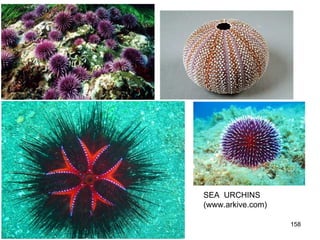
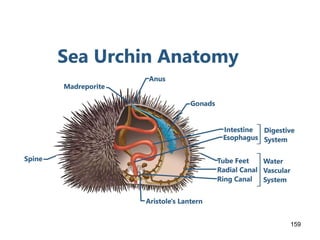
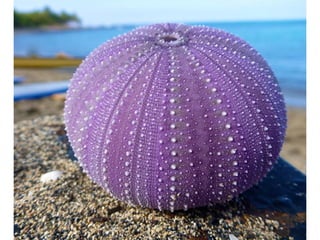
-They have spines that are adapted for eating seaweed.
-Mouth has jaw-like structures.
-Sand dollars are flat disks and sea urchins are spherical.
15
7
158
SEA URCHINS
(www.arkive.com)
159
160
161
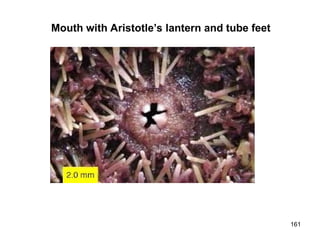
Mouth with Aristotle’s lantern and tube feet
CLASS: CRINOIDEA.
Example: Sea lilies and feather stars.
-Sea lilies are attached to substrate by a stalk.
-Feather stars have long flexible arms for movement.
16
2
163
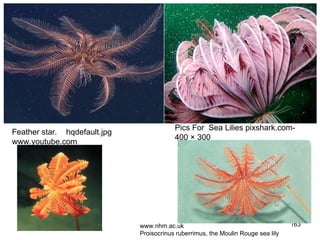
Feather star. hqdefault.jpg
www.youtube.com
Pics For Sea Lilies pixshark.com-
400 × 300
www.nhm.ac.uk
Proisocrinus ruberrimus, the Moulin Rouge sea lily
16
4
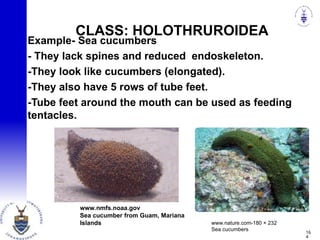
www.nmfs.noaa.gov
Sea cucumber from Guam, Mariana
Islands
Example- Sea cucumbers
- They lack spines and reduced endoskeleton.
-They look like cucumbers (elongated).
-They also have 5 rows of tube feet.
-Tube feet around the mouth can be used as feeding
tentacles.
CLASS: HOLOTHRUROIDEA
www.nature.com-180 × 232
Sea cucumbers
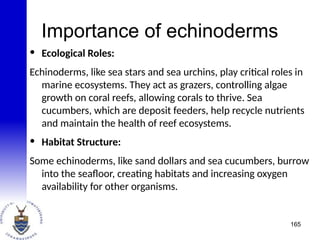
Importance of echinoderms
• Ecological Roles:
Echinoderms, like sea stars and sea urchins, play critical roles in
marine ecosystems. They act as grazers, controlling algae
growth on coral reefs, allowing corals to thrive. Sea
cucumbers, which are deposit feeders, help recycle nutrients
and maintain the health of reef ecosystems.
• Habitat Structure:
Some echinoderms, like sand dollars and sea cucumbers, burrow
into the seafloor, creating habitats and increasing oxygen
availability for other organisms.
165
Importance of echinoderms
• Food Source:
Echinoderms are an important food source for many marine
predators, including sea otters and other fish. Their larvae
also provide sustenance for planktonic organisms.
• Biodiversity Support:
• The diverse range of echinoderm species and their
interactions with other organisms contribute to the overall
biodiversity of marine ecosystems.
• Economic and Medicinal Importance:
• Some echinoderms are harvested for food (sea urchins and
sea cucumbers) or for use in the pharmaceutical industry
(glycosphingolipids from starfish and feather stars).
166
• https://www.youtube.com/watch?
v=haIjK1BFDAc
• https://www.youtube.com/watch?
v=J6Vi2OgKqXk
167
Invertebrate chordates
Key features of Chordates
•Notochord: A flexible, rod-like structure that provides
support. In invertebrate chordates, it's often present in the larval
stage and may be lost in the adult stage.
•Dorsal Hollow Nerve Cord: A neural tube that runs along the
back of the body, developing into the brain and spinal cord in
vertebrates.
•Pharyngeal Slits: Openings in the pharynx (throat) that are
used for feeding in some species and can develop into gills in
aquatic chordates.
•Post-anal Tail: A tail that extends beyond the anus, used for
propulsion in some species.
168
Chordates Classification
• Three main groups
1.Tunicates/ Sea squirts
2.Cephalochordata (lancelets)
3.Vertebrata
169
Classification of invertebrate
chordates
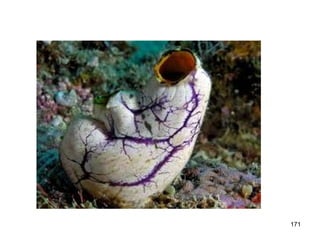
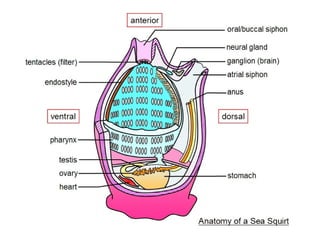
• Subphylum Urochordata: Tunicates (sea squirts):
These are sessile marine animals that filter feed. They
exhibit chordate features, including a notochord,
dorsal nerve cord, and pharyngeal slits, primarily
during their larval stage.
Body is soft, contained in a thick membrane (tunic)
With two siphons that can take in or squirt water (sea
squirts)
Filter feeders (plankton)
170
171
172
Look for a video to watch
tunicates
173
Classification of invertebrate chordates
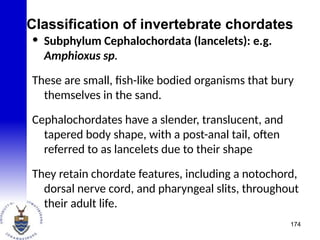
• Subphylum Cephalochordata (lancelets): e.g.
Amphioxus sp.
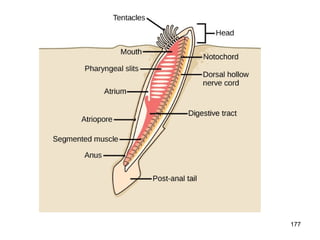
These are small, fish-like bodied organisms that bury
themselves in the sand.
Cephalochordates have a slender, translucent, and
tapered body shape, with a post-anal tail, often
referred to as lancelets due to their shape
They retain chordate features, including a notochord,
dorsal nerve cord, and pharyngeal slits, throughout
their adult life.
174
Classification of invertebrate chordates
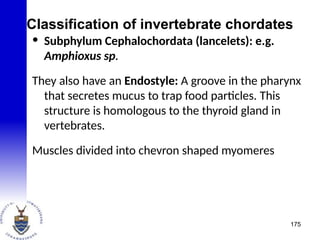
• Subphylum Cephalochordata (lancelets): e.g.
Amphioxus sp.
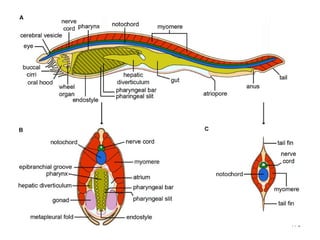
They also have an Endostyle: A groove in the pharynx
that secretes mucus to trap food particles. This
structure is homologous to the thyroid gland in
vertebrates.
Muscles divided into chevron shaped myomeres
175
176
177
Video showing lancelets
• Find a video describing these
178

Introduction to classification notes block 2.ppt

  • 1.
  • 2.
    What is displayedin the picture? How is it displayed? 2
  • 3.
    3 What is shownin this picture? What is unique about the items displayed? Why are they displayed this way? How else can they be displayed?
  • 4.
    What can yousee in this picture? Why do you say so? 4
  • 5.
    Classification What is thisorganism? What are the characteristic features that you are using to identify it? What other organisms can be related to it? 5
  • 6.
    Classification • Principles ofclassification • Classification of living organisms • Diversity of living organisms 6
  • 7.
    Principles of classification Outcomes •Justify the use of classification in everyday life. • Explain the basic principles of biological classification including how to classify. • Explain in your own words the term biological diversity, taxonomy, classification, taxon, domain, kingdom, phyla, binomial classification, cladistics and distinguishing characteristics/features. 7
  • 8.
    Principles of classification Outcomes •Make a simple artificial key of organisms • Use a simple artificial to identify organisms 8
  • 9.
    Introduction to classification Whatis classification? • Is the sorting and grouping of things/organisms with similar features. Why do we classify in everyday life? Activity 1: Discuss the questions below with a friend/ neighbour •How are goods classified in a supermarket? Why? 9
  • 10.
    Introduction to classification (cont.) •What do you think would happen if the goods were classified according to alphabetical order of their names? • How are words classified in a dictionary? • How are books classified in the library? • How is laundry (dirty clothes) classified for washing? 10
  • 11.
    Why do weclassify? Reasons for classifying things in everyday life: To find things more easily To keep track of things 11
  • 12.
    Why do weclassify living organisms? Biologists classify organisms to: Make sense of the massive number of organisms in the world by putting them into groups. Keep track of information about living things Identify unknown organisms Establish relationships between organisms 12
  • 13.
    How do weclassify? Principles of classification Principle 1: Organisms with similar characteristics are grouped together. Principle 2: Distinguishing characteristics and not general characteristics of organisms are used to classify living organisms. • E.g. opposable thumb in primates 13
  • 14.
    Activity 2 Aim: Tofind out the difference between distinguishing and general characteristics. 14
  • 15.
    Activity 2 Characteristics thatbirds share with other animals Identify other animals with the same characteristics Birds have wings and can fly Birds can make nests Birds have beaks Birds sing Birds have two legs Birds lay eggs 15
  • 16.
    Answers to activity2 Characteristics that birds share with other animals Other animals with the same characteristics Birds have wings and can fly So can bats, butterflies and other insects Birds can make nests Some spiders and fish make nests Birds have beaks Squids and some insects have beaks Birds sing Humans and crickets sing Birds have two legs Humans have two legs Birds lay eggs Frogs, turtles, fish, ants, crocodiles and most snakes 16
  • 17.
    Activity 2 answerscont. 2. General features are features which describe an animal but the features are also present in some other animals. 3. General characteristics of a) frogs: two eyes, four legs, a backbone, toes, etc General characteristics of b) snakes: scaly skin, tongue, fangs, a skeleton, etc Lizards and fish also have a scaly skin, Chameleons, frogs and many other animals have a tongue. General characteristics of c) humans: two eyes, two ears, two arms, two legs, etc 17
  • 18.
    Activity 2 answerscont. 4. A distinguishing characteristic is a feature or features that are only present in a particular group. 5. Distinguishing characteristics of a) mammals: mammary glands and body covering of hair Distinguishing characteristics of b) insects: six legs. Insects are the only living organisms with six legs. 6. General characteristics are characteristics that are present in more than one group whilst distinguishing characteristics are present in only one particular group. 18
  • 19.
    Types of classification •Artificial classification • Natural classification • Phylogenetic/ Phyletic (Phylogenetic and Cladistic) 19
  • 20.
    Artificial classification • Onlya few characteristics chosen- usually morphological • Organisms may not be related genetically, e.g. yellow flowers; yellow fruit; presence of wings • Provides limited information • Difficult to identify a particular species or genus • Usually has limited information and cannot add new information to what is present 20
  • 21.
    21 What is shownin this picture? What is unique about the items displayed? Why are they displayed this way? How else can they be displayed?
  • 22.
    Natural classification • Almostall characteristics are considered • Members of different groups that are of similar origin are considered • May change with advanced information • Bring together phylogenetically related individuals and groups 22
  • 23.
    Phylogenetic classification • Aform of natural classification that brings together organisms that are related in ancestry: using their inherited characteristics • Brings together organisms that are related by their ancestry • Uses biochemistry, genetics and palaeontology, in addition to morphology, anatomy, etc 23
  • 24.
    Approaches to natural classification Traditionalclassification, phylogeny and cladistics. Traditional classification (Botanist Carl Linnaeus) •Uses morphological (external form), anatomical (structural) and molecular information to classify organisms. •Devised a system for assigning species to a hierarchy of broader groups. 24
  • 25.
    Traditional natural classification Ahierarchical system of taxonomic groups. Until recently, these levels were: Kingdom Phylum Class Order Family Genus Species Addition of Domain overarching the Kingdom 25
  • 26.
    A hierarchical systemof taxonomic groups • Species(specific descriptive) name→ Genus→Family→ Order→ Class→Phylum→ Kingdom→Domain. • Taxon (pl.taxa) is a formal grouping of organisms. 26
  • 27.
    A hierarchical systemof taxonomic groups According to this traditional system, all living organisms were divided into five kingdoms. Name the five kingdoms. Monera, Protista, fungi, plantae and Animalia. •Devised a system of naming species, where each species had two scientific names, the genus name and the species. •Eg. Lumbricus terrestris. 27
  • 28.
    Binomial nomenclature The binomialsystem is used to name living organisms. The two-part format of the scientific name was instituted by Carl Linnaeus. Two Latin names are used: the generic name identifies the genus to which the organism belongs and the specific name/ specific epithet denotes the species name e.g Homo sapiens for man. The genus name always spelt with a capital letter and the species name with a small letter. 28
  • 29.
    Binomial nomenclature The twonames always written in italics or underlined if handwritten. Question: Explain the importance of scientists adopting the same language and system for naming living organisms 29
  • 30.
    Phylogenetic System ofclassification. • The evolutionary relationships are presented in the form of a tree called a phylogenetic tree, which is a diagram used to trace their evolutionary relationships. • Organisms are classified into clades. • Clade- a group of organisms that share characteristics inherited from a common ancestor. 30
  • 31.
    An example ofa phylogenetic tree 31
  • 32.
  • 33.
    33 Phylogenetic tree • Typeof phylogenetic tree we use is a cladogram. • It is a tree that depicts the evolutionary relationships of each group(taxon)through time. • Each branch represents a clade, a group of organisms with a common ancestor.
  • 34.
    • Each branchingpoint is referred to as a node (depicted by a circle),represents a split of two new groups from a common ancestor. • The node represents the most recent common ancestor of each clade depicted by the branches. • Each branch represents one or more characteristics shared by the clade. 34
  • 35.
    • Cladograms arerooted if the most common ancestor is known. • The root, or the node at the base, represents the most recent common ancestor of all the clades depicted in the tree. 35
  • 36.
    Practical applications of phylogenies(evolutionaryhistories) • Information from phylogenies is used to identify closely related organisms • In what way is this information important? 36
  • 37.
    • A phylogenetictree can help trace a species back through evolutionary history, down the branches of the tree, and • locate their common ancestry along the way. • ...Trees also identify the origin of certain traits, or when a certain trait in a group of organisms first appeared 37
  • 38.
    Phylogenetics • Uses similaritiesbetween organisms. • The more similarities two organisms have, the more closely related the organisms are. • Problem with this approach: Sometimes organisms which are not related look alike. 38
  • 39.
    Cladistics Uses fossils, anatomical,behavioural and molecular information of organisms including DNA to determine common ancestry and evolutionary history The evolutionary histories and common ancestry are then used to classify organisms. The evolutionary histories are represented in the form of a diagram called a cladogram. 39
  • 40.
    Cladistics cont. • Ina cladogram organisms are put into groups called clades. • Each clade is made up of an ancestral organism and its descendents. 40
  • 41.
  • 42.
    Interpretation of cladograms 1.Which two organisms are most closely related? 2. To which animal, the lung fish or the dog is the tortoise more closely related. Explain. 3. Name two examples of derived characteristics. 42
  • 43.
    Ancestral/derived characters • Sharedderived characters provide clues about phylogeny. • To determine the taxonomic relationships, we examine the characteristics in the largest group (such as a phylum or a class)- indicates the most remote common ancestry. • These traits are termed shared ancestral characters. 43
  • 44.
    Shared and derivedcharacters • A shared character is one that two lineages have in common, • a derived character is one that evolved in the lineage leading up to a clade and that sets members of that clade apart from other individuals. • Shared derived characters can be used to group organisms into clades. 44
  • 45.
    Ancestral/derived characters(cont.) • Whenpopulations become separated and evolve independently, some of their traits change as a result of mutations, natural selection and genetic drift. • The novel traits that evolve are referred to as shared derived characters. • These derived characters originate in a recent common ancestor. 45
  • 46.
    • A sharedcharacter is one that two lineages have in common, and • a derived character is one that evolved in the lineage leading up to a clade and that sets members of that clade apart from other individuals. • Shared derived characters can be used to group organisms into clades. 46
  • 47.
  • 48.
  • 49.
    • Before theintroduction of domains, all living organisms were divided into five kingdoms: monera, protista, plantae, fungi and animalia. • Now all living organisms are classified into three domains namely bacteria, archaea and eukarya. • The domain eukarya is then further divided into kingdoms: protista, plantae, fungi and animalia 49
  • 50.
    From two kingdomsto three domains 50 The three domains of life Bacteria Archaea Eukarya Protista Plantae Fungi Animalia
  • 51.
  • 52.
    Key features ofthe Kingdom Animalia • Eukaryotic features • Multicellular • Heterotrophic nutrition: Intracellular and extracellular digestion • Show symmetry (radial; pentameric; bilateral) • Some are motile (in search of food)
  • 53.
    EUKARYOTE ANCESTOR PARAZOA Sponges EUMETAZOA multicellular -tissues RADIATA Cnidarians BILATERIA triploblastic PROTOSOMES pseudocoelomate phyla Nematodes Annelids DEUTEROSTOMES all coelomates ACOELOMATES Flatworms Penta-radial Echinoderms Chordata Endosymbiont theory
  • 55.
    Levels of cellularorganization Define the following with examples •Cell •Tissue •Organ •Organ system •Organism 55
  • 56.
    Cellular organization • Sensory,motor, relay, Nerve cell • All nerve cells • Nerve tissue and muscle tissue • Nerve, muscle, blood, bones • All such organs together • Organism 56
  • 57.
    • Ectoderm- mostexterior (or distal) layer. It emerges and originates from the outer layer of germ cells. The word ectoderm comes from the Greek ektos meaning "outside", and derma, meaning "skin." • Endoderm-The innermost of the primary germ layers of an animal embryo. In vertebrates, the endoderm gives rise to the respiratory tract, gastrointestinal tract (except mouth and anus), glands associated with the gastrointestinal tract, bladder, and urethra. • Mesoderm-The mesoderm is the middle layer. In the embryo, it differentiates to gives rise to a number of tissues and structures including bone, muscle, connective tissue, and the middle layer of the skin Three body layers
  • 58.
  • 59.
    Revision activity • Lookat the diagram of the animal • How is it adapted for the life it lives? • What do you understand most? • What do you understand a bit? • What do you understand least? • What do you want to know? • What are you intending to do so that you can understand what you do not understand yet? 59
  • 60.
    Subkingdom: Parazoa • Twophyla: Porifera (sponges) and Placazoa (1 species). • Mainly marine • Organisms within the phyla have the following characteristics: – No body symmetry. – No tissues (4 cell types) – Therefore, no body plan – Filter feeders. – Reproduce both sexually and asexually http://www.mesa.edu.au/porifera/gallery.asp
  • 61.
  • 62.
    Classes of sponges •Calcarea (Calcareous Sponges): • These sponges have spicules made of calcium carbonate. • Examples: Leucosolenia, Sycon • Hexactinellida (Glass Sponges): • These sponges have spicules made of silica (glass). • Examples: Euplectella, Hylonema • Demospongiae (Demosponges): • This is the largest class, containing most sponge species. • They have skeletons made of spongin and/or siliceous spicules. • Examples: Euspongia, Spongilla • Homoscleromorpha (Encrusting Sponges): • A recently recognized class, these sponges are characterized by a lack of spicules or spongin, and their encrusting body form. 62
  • 63.
  • 65.
  • 66.
  • 67.
    Cnidarians and Ctenophores •Eumetazoans • Diploblastic • Radial symmetry
  • 68.
    Key features ofthe Cnidaria • Radial symmetry (tentacles surrounding mouth) - The Radiata • Gastrovascular cavity (respiration/digestion) • Diploblastic two body layers (ectoderm and endoderm) • Cnidocytes (stinging cells) • Nerve net • Gas exchange by diffusion • Two body forms –Polyp and Medusa • Reproduction
  • 69.
    The Cnidarians/Ctenophores • TheCnidaria and Ctenophora are often referred to as the coelenterates (Greek means hollow gut). • Mainly marine but some cnidarians can be found in fresh-water habitats (e,g, Hydra). • Some 9000 species have been described • All are diploblastic - two tissue layers, ectoderm and endoderm between which is the jelly-like mesoglea
  • 70.
    Phylum Cnidaria (Gr. Knidae- nettle) • Class: Scyphozoa (jellyfish) • Class: Cubozoa (sea wasps, box jellyfish) • Class: Hydrozoa (hydroids e.g. Obelia, Hydra) • Class: Anthozoa (sea anemones, corals)
  • 71.
    Gastrovascular cavity Mouth/anus Schematic representationof Cnidarian Epidermis Mesoglea Gastrodermis Tentacle
  • 72.
  • 73.
  • 74.
    Cnidarian body wallstructure Ectoderm & Endoderm (6 cell types) • epitheliomuscular cells (myofibrils in longitudinal or circular direction) • interstitial cells • cnidocytes - e.g. nematocysts or cnidae • mucous gland cells • sensory nerve cells • nutritive muscle cells • Sensory nerve cells •cells
  • 75.
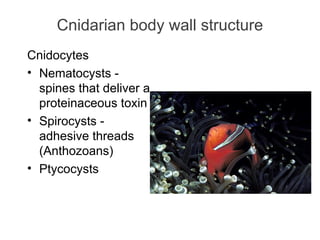
    Cnidarian body wallstructure Cnidocytes • Nematocysts - spines that deliver a proteinaceous toxin • Spirocysts - adhesive threads (Anthozoans) • Ptycocysts
  • 76.
  • 77.
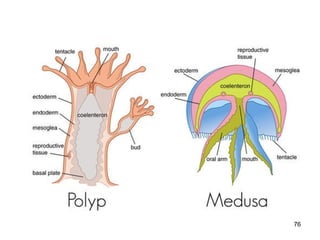
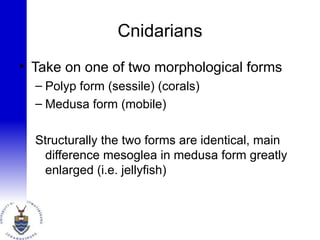
    Cnidarians • Take onone of two morphological forms – Polyp form (sessile) (corals) – Medusa form (mobile) Structurally the two forms are identical, main difference mesoglea in medusa form greatly enlarged (i.e. jellyfish)
  • 78.
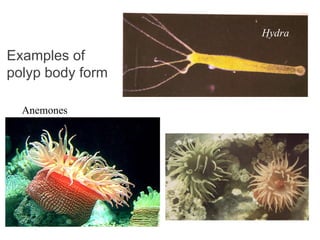
    Examples of polyp bodyform Hydra Anemones
  • 79.
  • 80.
  • 81.
  • 82.
    Cnidarian/ctenophore reproduction • Majorityof cnidarians/ctenophores are dieocious (separate sexes). • Capable of both asexual and sexual reproduction. • Asexual reproduction usually through budding/fusion (corals). • Sexual reproduction involves the formation of gametes.
  • 83.
    Feeding and digestion •Prey on a variety of prey types and size. • Immobilised prey drawn up into the gastrovascular cavity into which digestive enzymes are released (extra-cellular digestion). • Final process is intracellular.
  • 84.
    Importance of cnidarians/ctenophores? Ecological –Form a significant component of the plankton biomass in a variety of aquatic ecosystems. – Important carnivores in plankton food webs. – Contribute to the complexity of benthic environments (refuge for both invertebrates and vertebrates e.g. corals and sea anemones). – Employed as a proxy for global change and biological invasions.
  • 85.
  • 86.
  • 87.
    Gut Body plan ofan acoelomate organism Parenchyma (mesoderm) Epidermis Muscle layer Mesodermal organs No body cavity!
  • 88.
    • 4 classes(Turbellaria*, Cestoda, Trematoda, Monogenea). • Bilaterally symmetrical organisms, • Triploblastic- three body layers. • Acoelomate (no body cavity)* • Blind ending gut (Cestodes – absence of gut). • Absence of a circulatory system • Sexual and asexual reproduction. • Nerve system (cephalisation). Phylum: Platyhelminthes (flatworms)
  • 89.
  • 90.
  • 91.
    Features of thephylum • Bilaterally symmetrical, dorso-ventrally flattened. • Triploblastic (ectoderm, mesoderm, endoderm). • Acoelomate (animals that do not have a true coelom-body cavity). • Blind ending gut (absent in Acoela and Cestodes). • No blood or respiratory system. • Simple excretory system - protonephridia • Simple nervous system - cephalization • Most are hermaphrodites with complex reproductive system.
  • 92.
    Habitats • Free livingflatworms found in moist terrestrial & aquatic habitats • 80% are parasitic (both ectoparasites and endoparasites). • Free living species restricted to the class Turbellaria
  • 93.
    Platyhelminth classification about 25000species Class • Turbellaria • Monogenea • Trematoda (flukes) • Cestoda (tapeworms) Parasitic
  • 94.
    Reproduction • Many flatwormsable to reproduce both sexually and asexually. • Asexual reproduction is through fission or through budding (e.g. tapeworms). • Most flatworms are monoecious (both organs in one organism=hermaphrodites) - one sexual organism (opposite of diecious); practice cross fertilisation). No sexual dimorphism • Sexual reproduction involves formation of gametes.
  • 95.
    Physiology of Platyhelminthes •Respiration/excretion of body wastes is achieved through the process of diffusion. • Digestive system includes mouth, pharynx and intestine; intestine produces proteolytic enzymes for some extracellular digestion. • Bulk of digestion takes place at an intracellular level.
  • 96.
    Importance of flatworms? Ecological • Flat worms can be extremely abundant in a variety of ecosystems and thus play an important role in energy flow within these systems. Human health • Many of the flat worms are parasitic and thus directly influence human health (e.g. tapeworms; blood flukes).
  • 97.
  • 98.
    Nematodes (Pseudocoelomates)  Representedby 9 phyla:  Rotifera (~ 2000 species)  Acanthocephala –not complete gut (~ 1000 species)  Gastrotricha (~ 450 species)**  Entroprocta (< 100 species)**  Nematoda (~ 90 000 species)  Nematophora (~ 250 species)**  Kinorhyncha (~ 100 species)**  Priapulida (9 species)**  Loricifera (unknown)** ** indicates minor phyla
  • 99.
    Nematodes  To date,some 90 000 species have been described, estimated to be about 500 000 species.  Nematodes are present in every conceivable ecological habitat, including sea, freshwater and soil.  Attain enormous densities (106 in a m-2 ).  Demonstrate a wide variety of feeding modes including bactivory, herbivory, carnivory.  Play an important role in nutrient dynamics of ecosystems (decomposition).  Most important parasitic groups (particularly for humans).
  • 100.
    Phylum Nematoda (roundworms) •Bilaterally symmetrical • pseudocoelomates (body cavity not lined with mesoderm)
  • 101.
    Nematodes Share the followingcharacteristics: • Bilateral symmetry. • Pseudocoelomate (fluid filled) • Body covered with secreted cuticle (comprised of collagen). • Motile cilia and flagella lacking. • Only longitudinal muscle in body wall. • Hydrostatic skeleton (pseudocoel). • Nervous system, with no evidence of cephalisation • Size range from < 1mm to 1m.
  • 102.
    Nematodes • Complete digestivesystem consists of a mouth, muscular pharynx, intestine and rectum. • Simple excretory system.-mainly diffusion and some have Renette cells • Lack circulatory or respiratory system (achieved by diffusion in fluid in the body cavity). • Respiration is by diffusion across the cuticle.
  • 103.
  • 104.
  • 105.
    Elephantiasis- filarial worms (250 Mpeople infected) Lung disease; Ascaris sp (1.3 billion people infected) Diseases associated with nematodes Plant Human Other human diseases include river blindness and Hookworm disease
  • 106.
    Reproduction • Separate sexes,internal fertilisation. • Demonstrate sexual dimorphism (males smaller than females). • Male reproductive tract opens into the rectum to form a cloaca; female reproductive open separate , termed gonopore. • Internal fertilisation. • Development is direct to miniature forms of the adult.
  • 107.
    GROUP: COELOMATE INVERTEBRATES - Theseare animals with body cavity (internal space lined with tissue derived from mesoderm.) - -The phyla in this group are:  Mollusca  Nemertea  Annelida  Athropoda  Echinodermata 10 7
  • 108.
    STRUCTURE. -Members secret shellsand are soft-bodied. -Shell is hardened and protective and made of calcium carbonate. HABITAT. -Marine and freshwater and land animals. Examples are snails, slugs, oysters, clams, scallops, cuttlefish, octopuses, squids. -ABOUT 93,000 KNOWN SPECIES. -Second most diverse animal phylum after arthropoda. PHYLUM: MOLLUSCA. 10 8
  • 109.
  • 110.
    BODY STRUCTURE. -Size maybe 15m long (as in squid which weighs 250kg) or 1.5m long as in giant clams (weight-270kg). -Body is divided into 3 parts: muscular foot, visceral mass, and mantle. -Foot is used for movement; visceral mas contain internal organs; mantle secrets shell. MODE OF LIFE. Giant clam form symbiosis with dinoflagellates. -Flat foot of snail/slug allows it to crawl (for locomotion). -Terrestrial mollusk lives in crevices of desert rock which must be moist or wet. 11 0
  • 111.
  • 112.
    FEEDING. -Members use strap-like(tongue-like) organ called radula to scrape up food (algae and grass). -Can also be used to drill (as in moon snail) Radula can be transformed into harpoon (which contains venom). -Harpoon can be used to capture prey like fish or can harm or kill humans. REPRODUCTION REMOVAL OF WASTES. -Nephridium helps to remove nitrogenous waste. -Nephridium contains a funnel- nephrostome which is lined with cilia. -Most molluscs have separate sexes; some are hermaphroditic. - Fertilization is internal. 11 2
  • 113.
    CLASS: POLYPLACOPHORA. -Example- Chitons. -Exclusivelymarine animals with oval-shaped body. - Body is segmented; foot is broad and flat with which animal creeps over rock surface. -They are grazing herbivores and they use radula to scrape algae of rock surface. CLASSES OF MOLLUSCA. 11 3
  • 114.
    114 ChitonAnatomyshells.tricity.wsu.edu421 × 444Searchby imageChiton Anatomy The Sea Slug Forum - Chitons, Amphineura and Polyplacopho rawww.seaslugforum.net 360 × 329Search by imageChitons, Amphineura and Polyplacophora BOGLEECH: CHITONS!bogleech.com555 × 485Search by image
  • 115.
    CLASS: GASTRODA. -Example- snails,slugs and limpets. -Contains majority of Mollusca. -Marine animals and also freshwater. Some are land animals (desert and rain forest) -Foot is modified for creeping/swimming. -Has tentacles with eyes at the base. -They usually undergo torsion-twisting of body such that mantle cavity and anus are moved from a posterior location to front of body. -Has spiraled shell (may be conical or flat) into which animal retreats when threatened. 11 5
  • 116.
    116 Limpet - Wikipedia,the free encyclopediaen.wikipedia.org2304 × 1728 Search by imageLimpet terresterial slugs of Floridaentnemdept.ufl.edu500 × 300Search by image Lateral view of slug Leopard slugwww.fcps.edu300 × 247 Search by imageNaturhistoriska museet Twohig Science - ghioniamrtwohig.wikispa ces.com 2560 × 1536Search by imageThis picture shows the shell is bigger than the snail which is a gastropod.
  • 117.
    CLASS: BIVALVIA. Examples- Clams,mussels, cockles. -They are marine animals but some live in freshwater(aquatic).Shell is divided into 2 halves ( no radula or distinct head) -Bivalves contain gills for gas exchange. -Food particles are trapped in mucus present in gills and cilia transports particles into the mouth. -Mussels secret threads that attach them to rocks, docks, boats. Clams can drag themselves into the sand/mud. 11 7
  • 118.
    118 sciblogs.co.nz589 × 789Searchby image Cockles: credit NIWA trophyrigs.com500 × 338 Search by imageSurf Clams blog.ucsusa.org500 × 343Search by image Dozens of freshwater mussel species live in U.S. rivers
  • 119.
    CLASS: CEPHALOPODA. Examples- octopuses,squids, nautiluses. -Marine swiftly-swimming predators. -Presence of- tentacles to catch preys. -Poison in saliva immobilizes prey. -Beak-like jaw bites prey and pulls it into mouth by radula. -Foot is equipped with suction cups or hooks to seize prey. -Octopuses have 8 arms; squids have 8 arms and 2 tentacles; nautilus has 80-90 tentacles(no suckers). 11 9
  • 120.
    120 The Nautilus: ALiving fossil of the seas aquaviews.net500 × 333Search by image Antarctic Octopuses www.wired.com670 × 446Search by image Pareledone turqueti momsla.com1486 × 722Search by image squid
  • 121.
    - Cylindrical toflattened very long worms. -Marine, freshwater and terrestrial animals. -May be 10-20m in length. Lineus longissimus is 60m in length(longest animal known). -Body structure similar to that of flatworms. -Has complete gut with mouth and anus. -Produces sexually or asexually. -Example: Ribbon worms. PHYLUM: NEMERTEA 12 1 A ribbon worm with white stripes along the body. www.smithonlanmag.com
  • 122.
    • - Examplesof animals in Phylum Annelida include : earthworms and leeches. • -They are segmented worms which live in the sea, freshwater and damp soil. • -The development and function of each segment differs. They are used for reproduction, locomotion or excretion. • • -Their body is composed ring-like segments. 122 PHYLUM: ANNELIDA
  • 123.
    CLASS: POLYCHAETA. Examples-clamworms, scale worms, lugworms, sea mice and tubeworms. -Each segment has paddle-like structures (parapodia or feet) used for locomotion and may function as gills or for swimming, burrowing and crawling. -Presence of chaetae for attachment during copulation. -Chaetae may have hooks to help anchor worm to surfaces. CLASS: OLIGOCHAETA/CLITELLATA. Examples- Earthworm leeches. -Have fewer chaetae per segment of animal than in polychaetes. -Presence of clitellum which is a thickened band on the body CLASSES OF ANNELIDA 12 3
  • 124.
    124 http://www.examiner.com/ images/blog/wyclam worm. Polynoidae (scaleworms): Chaetacanthus magnificus www.allaboutworms.com-420 × 289- Search by image Are Tubeworms Really Made of Tubes? Sea Mouse: pixshark.com- 410x270.
  • 125.
    -They are ofgreat economic importance. They feed on soil which they digest in their alimentary canal. -Undigested food is mixed with mucus secreted in the canal and passed out as fecal castings through the anus (these casts fertilize the soil). -Earthworms burrow in the soil and till it for more aeration. -Earthworms are hermaphrodites. EARTHWORMS. 12 5
  • 126.
    -Live in freshwater,marine and terrestrial habitats. -Parasite on invertebrates and humans (where they suck blood). -May use blade-like jaws to slit or secret enzymes to digest a hole through skin. -Secrets hirudin (an anticoagulant) into body of host. -They are hermaphrodites. -Hirudo medicinalis is a medicinal leech which has made positive contribution to Medicine. LEECHES. 12 6
  • 127.
    127 www.sciencephoto.com-350 × 234-Searchby imageHirudo medicinalis Hungarian leech Hirudo Medicinalis Anatomy Leech hirudo medicinalis
  • 128.
    -This is themost successful of all animal phyla. Have over 1,000,000 species. STRUCTURE / KEY FEATURES. -Members are found in nearly all habitats. -Body is segmented and has hard exoskeleton and jointed appendages. -Appendages used for walking, feeding, sensory reception, reproduction and defense. -Segments are divided into groups (tagmata) such as head, thorax and abdomen ( in insects). -They have distinct head (e.g. in crustaceans) but head and thorax are fused to form cephalothorax (or prosoma) in chelicerates. PHYLUM: ARTHROPODA. 12 8
  • 129.
    129 Basic characteristics ofarachnids include four pairs of legs (1) and a body divided into two tagmata: the cephalothorax (2) and the abdomen (3) www.amentsoc.org-463 × 295 An illustration the general structure of a crustacean.
  • 130.
    -Rigid external exoskeletonis made of chitin and protein. -They undergo ecdysis/moulting periodically. -Circulatory system is open. -Presence of compound eyes in insects, centipedes and crustaceans. -Marine arthropods have gills while terrestrial ones have tracheae for respiration. -Air passes into tracheae through openings in the exoskeleton called spiracles. -Spiders use book lungs. They construct webs of silk to catch insects. -Malpighian tubules are used for excretion in terrestrial insects. KNOWLEGDE CHECK: In which other phylum do the members undergo ecdysis/moulting? 13 0
  • 131.
    CLASS: CHELICERATA. Examples: Spider,mites, ticks, horseshoe, scorpions. -Presence of chelicerae which are pincers or fangs(mouthparts) used for feeding. -Body division into 2 parts – anterior prosoma – bears all the appendages and posterior opisthosoma which bears reproductive organs. -They are arachnids and may dwell in freshwater, sea while some are exclusively marine e.g. sea spider and horseshoe crabs. CLASSES OF ARTHROPODA. 13 1
  • 132.
    -Presence of pedipalps(copulatory organs) in male spiders. They may be sensory(like antennae). Pincers are present in scorpions. -Most members are carnivores but mites are herbivorous. -They can ingest small particles but most ingest liquids and liquefy solids by injecting digestive enzymes to break them. -Ticks are blood-sucking and live as parasites on vertebrates, invertebrates and plants. 13 2
  • 133.
    1 3 SPIDER.findfunfacts.appspot.com-405 × 280-Search byimage DUST MITE.www.med-health.net File:Behind- Skin Mites 00c.jpg Deadly Tick Disease Confirmed in Northwest Missouri
  • 134.
    134 Photo of thebottom view of a typical horseshoe horseshoe- crabs.com Horseshoe crab shell Scorpions www.to-tuscany.com
  • 135.
    CLASS: CRUSTACEA. Examples: Crabs,shrimps, lobsters, barnacles, crayfish. -Members are mostly marine organisms; some live in freshwater e.g. crayfish. Some are terrestrial e.g. pill bugs). -Possess specialized appendages e.g. antennae (2 pairs). Some appendages are modified mouthparts ( for chewing). -Walking legs on thorax and also appendages on the abdomen (unlike in insects). -Gaseous exchange in some is through gills while some do it across thin areas of cuticle. 13 5
  • 136.
    136 Barnacles www.whoi.edu-340 × 227 Crayfish fullserviceaquatics.com-889× 593 Lobster - recipes.wikia.co m-700 × 515 shrimps africagreenmedia.co.za-1732 × 1155 CRAB www.103fm.net-800 × 504
  • 137.
    -Sexual reproduction ispresent. Sexes are separate. Fertilization results from copulation to produce larvae which swims. -There are groups called Isopods(terrestrial, freshwater and marine species); Decapods(lobsters, crayfish, crabs and shrimps)- most are marine. Copepods- planktonic crustaceans- feed on algae and smaller copepods. -Mouthparts are mandibles (biting parts). -Crustaceans (lobsters and crayfish) are sources of food for humans; planktonic crustaceans (e.g. Krill) are major sources of food for whales and smaller marine animals 13 7
  • 138.
    CLASS: MYRIAPODA. - Examples:Millipede and centipede. -Terrestrial organisms. They have head and a pair of antennae. -Possess 3 pairs of appendages used as mouthparts (jaw-like mandibles). -Millipedes have a large number of legs (each trunk has 2 pairs). -Nearly all segments of centipede have one pair of appendages. -Both centipede and millipede are gonochoric (sexes are separate). 13 8
  • 139.
    139 Can you differentiatebetween the centipedes and millipedes in the photos above? A B C D
  • 140.
    -Fertilization is internalwith laying of eggs. -Millipedes are herbivores- feed on decaying vegetation e.g. leaf litters, rotting logs(plant matter). -They coil up to defend themselves. -Centipedes are carnivores feeding on insects. They have poison fangs which may be toxic to humans. 14 0
  • 141.
    CLASS: HEXAPODA. -Examples: Insects. -Largestgroup of animals on earth occupying almost every terrestrial habitat, freshwater and air but rare in marine. -Small body structure ( 0.1mm-30cm in length wingspan). -Different mouthparts ( biting, chewing, sucking, piercing) depending on feeding habits. -Body has 3 regions: Head, thorax and abdomen. -Thorax has 3 segments each with a pair of legs. -Presence of 1 or2 pairs of wings ( may be colorful as in butterfly)attached to thorax for flight, to escape predators, find food and mates, for dispersal to new habitats. 14 1
  • 142.
  • 143.
  • 144.
    -Veins are presentin wings for strength. -Fleas and lice are wingless. -Digestion takes place in stomach or midgut and excretion takes place through malphighian tubules. -Air enters tracheal system through the spiracles located on the segments (thorax and abdomen). -Life cycle involves metamorphosis which may be complete (e.g. in mosquito and butterfly) or incomplete( as in cockroach and grasshoppers). 14 4
  • 145.
  • 146.
    - In incompletemetamorphosis, egg --------- larva--------- Nymph----------Adult. -Nymph resembles adults but smaller, lacks wings and moults several times. -In complete metamorphosis, egg---------larva--------- pupa-----------Adult. -Larva or caterpillar or maggot or grub is a voracious(highly consuming) stage. -Sexes are separate and reproduction is sexual. -Fertilization is internal after which eggs are laid. 14 6
  • 147.
  • 148.
  • 149.
    Examples: Star fish,sea stars, sea urchins, brittle stars, sand dollars, sea cucumbers. -They are Deuterostomes and are closely related to Chordates. -Both of them(Echinoderms and chordates) belong to the Deuterostomia clade of bilaterian animals. PHYLUM: ECHINODERMATA 14 9
  • 150.
    STRUCTURE AND KEYFEATURES. -Members are exclusively marine. -They have endoskeleton composed of hard calcium carbonate lying beneath the skin. -They are slow-moving or sessile and possess water vascular system- canals branching into extensions called tube foot- for locomotion and feeding. -They have separate sexes and reproduction is sexual or asexual by splitting. -They are pentaradially symmetrical- you can draw lines through their body in five different places that produce mirror images on each side. -Larvae is bilaterally symmetrical. -They can regenerate lost parts. 15 0
  • 151.
    CLASS: OPHIUROIDEA. - Example:Brittle stars. -Largest class of echinoderms. -Resemble asteroids. -Possess central disk and long flexible arms for swimming. -They avoid light and are more active at night. CLASSES OF ECHINODERMATA. 15 1
  • 152.
  • 153.
    CLASS: ASTEROIDEA. - Example:Sea stars and sea daisies. -Abundant in intertidal zone and great depths of ocean. -Have arms radiating from a central disk. - Possess tube foot under arms that can attach to or detach from substrate. Organism adheres firmly to rocks or creeps. -Also use tube feet to grasp prey e.g. clams and oysters. -Sea daisies are armless. 15 3
  • 154.
  • 155.
  • 156.
  • 157.
    CLASS: ECHINOIDEA. Examples: Seaurchins and sand dollars. -They lack arms and possess 5 rows of tube feet used for slow movement. -They have spines that are adapted for eating seaweed. -Mouth has jaw-like structures. -Sand dollars are flat disks and sea urchins are spherical. 15 7
  • 158.
  • 159.
  • 160.
  • 161.
    161 Mouth with Aristotle’slantern and tube feet
  • 162.
    CLASS: CRINOIDEA. Example: Sealilies and feather stars. -Sea lilies are attached to substrate by a stalk. -Feather stars have long flexible arms for movement. 16 2
  • 163.
    163 Feather star. hqdefault.jpg www.youtube.com PicsFor Sea Lilies pixshark.com- 400 × 300 www.nhm.ac.uk Proisocrinus ruberrimus, the Moulin Rouge sea lily
  • 164.
    16 4 www.nmfs.noaa.gov Sea cucumber fromGuam, Mariana Islands Example- Sea cucumbers - They lack spines and reduced endoskeleton. -They look like cucumbers (elongated). -They also have 5 rows of tube feet. -Tube feet around the mouth can be used as feeding tentacles. CLASS: HOLOTHRUROIDEA www.nature.com-180 × 232 Sea cucumbers
  • 165.
    Importance of echinoderms •Ecological Roles: Echinoderms, like sea stars and sea urchins, play critical roles in marine ecosystems. They act as grazers, controlling algae growth on coral reefs, allowing corals to thrive. Sea cucumbers, which are deposit feeders, help recycle nutrients and maintain the health of reef ecosystems. • Habitat Structure: Some echinoderms, like sand dollars and sea cucumbers, burrow into the seafloor, creating habitats and increasing oxygen availability for other organisms. 165
  • 166.
    Importance of echinoderms •Food Source: Echinoderms are an important food source for many marine predators, including sea otters and other fish. Their larvae also provide sustenance for planktonic organisms. • Biodiversity Support: • The diverse range of echinoderm species and their interactions with other organisms contribute to the overall biodiversity of marine ecosystems. • Economic and Medicinal Importance: • Some echinoderms are harvested for food (sea urchins and sea cucumbers) or for use in the pharmaceutical industry (glycosphingolipids from starfish and feather stars). 166
  • 167.
  • 168.
    Invertebrate chordates Key featuresof Chordates •Notochord: A flexible, rod-like structure that provides support. In invertebrate chordates, it's often present in the larval stage and may be lost in the adult stage. •Dorsal Hollow Nerve Cord: A neural tube that runs along the back of the body, developing into the brain and spinal cord in vertebrates. •Pharyngeal Slits: Openings in the pharynx (throat) that are used for feeding in some species and can develop into gills in aquatic chordates. •Post-anal Tail: A tail that extends beyond the anus, used for propulsion in some species. 168
  • 169.
    Chordates Classification • Threemain groups 1.Tunicates/ Sea squirts 2.Cephalochordata (lancelets) 3.Vertebrata 169
  • 170.
    Classification of invertebrate chordates •Subphylum Urochordata: Tunicates (sea squirts): These are sessile marine animals that filter feed. They exhibit chordate features, including a notochord, dorsal nerve cord, and pharyngeal slits, primarily during their larval stage. Body is soft, contained in a thick membrane (tunic) With two siphons that can take in or squirt water (sea squirts) Filter feeders (plankton) 170
  • 171.
  • 172.
  • 173.
    Look for avideo to watch tunicates 173
  • 174.
    Classification of invertebratechordates • Subphylum Cephalochordata (lancelets): e.g. Amphioxus sp. These are small, fish-like bodied organisms that bury themselves in the sand. Cephalochordates have a slender, translucent, and tapered body shape, with a post-anal tail, often referred to as lancelets due to their shape They retain chordate features, including a notochord, dorsal nerve cord, and pharyngeal slits, throughout their adult life. 174
  • 175.
    Classification of invertebratechordates • Subphylum Cephalochordata (lancelets): e.g. Amphioxus sp. They also have an Endostyle: A groove in the pharynx that secretes mucus to trap food particles. This structure is homologous to the thyroid gland in vertebrates. Muscles divided into chevron shaped myomeres 175
  • 176.
  • 177.
  • 178.
    Video showing lancelets •Find a video describing these 178