Cosmopolitan Identitites: London and Postcolonial
Diaspora in Fiction and Film
Identidades Cosmopolitas: Londres e a Diáspora Pós-colonial
na Ficção e no Cinema
I Jornadas Nacionais de Professores de Línguas
5, 6 e 7 de setembro de 2016
Margarida Esteves Pereira
(CEHUM | ILCH-UM)
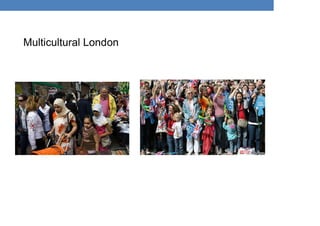
Multicultural London
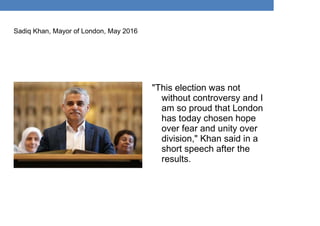
"This election was not
without controversy and I
am so proud that London
has today chosen hope
over fear and unity over
division," Khan said in a
short speech after the
results.
Sadiq Khan, Mayor of London, May 2016
Some data taken from the London Datastore at http://data.london.gov.uk/
COMMUNITIES
The population of London in 2015 was 8,663,300 up 7% from five years ago.
London's population has increased by around 113,000 per year over the past
five years and will surpass 9 million in 2018 and 10 million by 2034. The
release of the 2011 Census results showed London's population had grown
by 12% over the previous decade. It is a diverse city made up of 8.6 million
residents in 2014. The population is made up of many different communities
covering all faiths, ethnicities and nationalities. The city also has some of the
most affluent neighbourhoods in the UK alongside some of the most
deprived.
- Retrieved from http://data.london.gov.uk/
Some data taken from the London Datastore at http://data.london.gov.uk/
Projected population by ethnicity
42% of Londoners (over 3.5 million) are from Black, Asian, and minority ethnic
groups. Data from the GLA 2012 Round Ethnic Group Projections show that in
the future BAME groups will continue to increase at a rapid rate, eventually
overtaking the number of white persons by 2040.
Londoners by country of birth
The top three countries are India, Poland, and Pakistan.
Migrants by country (Top 2014/2015)
In 2014/15, there were over 334,000 new registrations from overseas nationals
in London, which was 38% higher than the year before. In 2014/15, the majority
of registrations were from countries in the European Union (76%). This is up
significantly from 2009/10 when EU countries accounted for 39% of the London
total. The number of registrations in 2014/15 for the EU was 46% higher than the
previous year. The top country of origin to London was Romania with 67,000
registrations – up from 22,000 the year before. Italy was the second highest
country of origin with 35,000 registrations.
Robert Young, in Colonial Desire: Hybridity in Theory, Culture and
Race (1995), pp. 1-2.
With each passing decade London has been
ever more successful in living up to its officially
proclaimed heterogeneous identity, so that now (...)
you could scarcely imagine a more varied mingling of
peoples, whose ancestors hark back to the
Caribbean and Africa, India, Pakistan, Bangladesh,
China, Tibet, Afghanistan, Somalia, the Balkans,
mixed and merged with others whose predecessors
turned up in the British Isles as Angles, Celts,
Danes, Dutch, Irish, Jews, Normans, Norsemen,
Saxon, Vikings... The cleavage of East and West in
that bronze strip on the hill has gradually been
subsumed into a city that, with the potent attraction
of economic power exerting the magnetic field of
force of the North over the South, has drawn the far-
off peripheries into the centre. And with that historic
movement of intussusception, the Prime Meridian,
the Longitude Zero, the centre of the world, has
become inalienably mixed, suffused with the pulse of
difference (Young, 1995: 1-2).
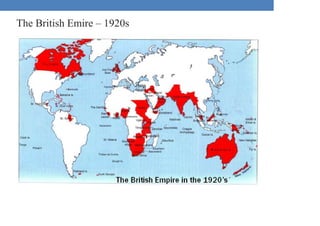
The British Emire – 1920s
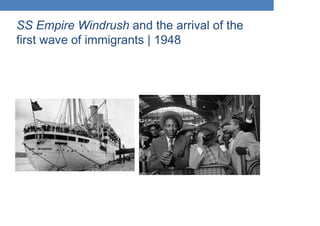
SS Empire Windrush and the arrival of the
first wave of immigrants | 1948
Mike Philips and Trevor Philips, Windrush: The Irresistable Rise of Multi-Racial
Britain, 1998.
Within a decade of its famous voyage of 1948, the
Windrush had become a symbol of post-war immigration
and, for a time, it seemed as if every TV documentary
about race or migration had to begin with the image of a
line of black men and women filling the gangplank (Phillips
e Phillips, 1998, p. 2).
John Clement Ball, Imagining London: Postcolonial
Fiction and the Transnational Metropolis (2004)
• As a result of this so-called ‘New Commonwealth’
migration, the metropolis that once possessed a large
portion of the world now contains a transnational ‘world’
that is increasingly taking possession of it. With over two
million non-white residents in the year 2000 (Ackroyd
715), London has been transformed; demographically it is
becoming more and more global (or transnational) and
less and less traditionally – that is, ethnically, racially, or
even nationally – English or British. (Ball, 2006: 4-5).
Brownyn T. William, “‘A State of Perpetual Wandering’:
Diaspora and Black British Writers”, in The Culture of
Diasporas in the Postcolonial Web.
The postcolonial diaspora is not simply
immigration into Britain from other places, as for
example immigration into the United States or
even Turkish “guest workers” in Germany,” but is
instead a continual reminder that “we are here
because you were there” (7). (Williams, 1999: 2)
Hanif Kureishi, Something to Tell You, 2008, pp.
13-15
• While no one could be happy on the Goldhawk road, the Uxbridge Road, ten
minutes away, is different. At the top of the market I’d buy a falalel and step
into that wide West London street where the shops were Caribbean,
Polish, Kashmiri, Somali. Along from the police station was the mosque
(…). (p 14)
• It was my desire, so far unfulfilled, to live in luxury in the poorest and most
mixed part of town. It always cheered me to walk here. This wasn’t the
ghetto; the ghetto was Belgravia, Knightsbridge and parts of Notting
Hill. This was London as a world city. (p. 15)
• His solution to the fact that few people in the city appeared to speak
understandable English now, was to learn their language. ‘The only way to
survive in this ‘hood is to speak Polish,’ he announced recently. He also
knew enough Bosnian, Czech and Portuguese to get by in the bars and
shops without yelling, as well as enough of several other European
languages to make his way without feeling marginalised in his own city.
(p. 13)
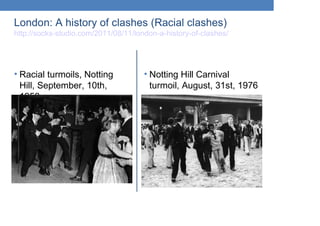
London: A history of clashes (Racial clashes)
http://socks-studio.com/2011/08/11/london-a-history-of-clashes/
• Racial turmoils, Notting
Hill, September, 10th,
1958
• Notting Hill Carnival
turmoil, August, 31st, 1976
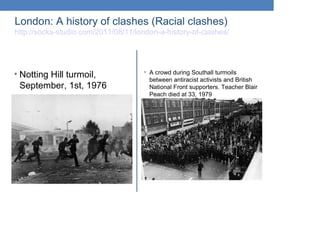
London: A history of clashes (Racial clashes)
http://socks-studio.com/2011/08/11/london-a-history-of-clashes/
• Notting Hill turmoil,
September, 1st, 1976
• A crowd during Southall turmoils
between antiracist activists and British
National Front supporters. Teacher Blair
Peach died at 33, 1979
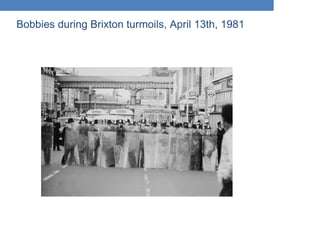
Bobbies during Brixton turmoils, April 13th, 1981
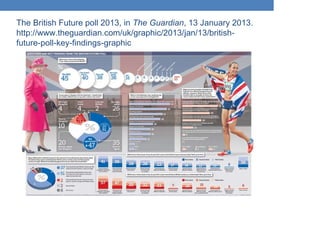
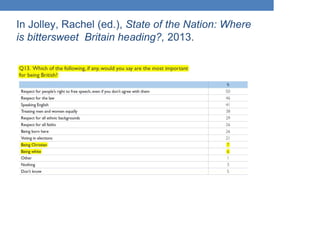
The British Future poll 2013, in The Guardian, 13 January 2013.
http://www.theguardian.com/uk/graphic/2013/jan/13/british-
future-poll-key-findings-graphic
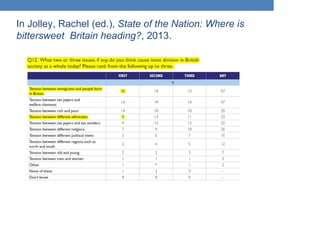
In Jolley, Rachel (ed.), State of the Nation: Where is
bittersweet Britain heading?, 2013.
Hanif Kureishi: The migrant has no
face, status or story, in The Guardian, 30 May,
2014.
Whether he or she – and I will call the immigrant he, while
being aware that he is stripped of colour, gender and
character – the immigrant has been made into something
resembling an alien. He is an example of the undead, who
will invade, colonise and contaminate, a figure we can never
quite digest or vomit. If the 20th century was replete with
uncanny, semi-fictional figures who invaded the lives of the
decent, upright and hard-working – the pure – this character
is rehaunting us in the guise of the immigrant. He is both a
familiar, insidious figure, and a new edition of an old idea
expressed with refreshed and forceful rhetoric.
Hanif Kureishi, “The migrant has no face, status, or
story”, The Guardian, 30th May 2014.
• Nevertheless, the immigrant is easily dismissed and
denigrated since he is now no longer a person. The
recently arrived immigrant, the last through the door, and
now settling down in the new country, can himself be
disgusted by the idea of this newer arrival or interloper,
the one who could take his place, because this
threatening Other does not resemble him in any way. The
migrant has no face, no status, no protection and no story.
His single identity is to be discussed within the limited
rules of the community. (Kureishi, 2014, p. 2)
Zygmunt Bauman, Culture in a Liquid Modern World, 2011.
- phases of mass migration
• 1st
phase: dislocation of millions of Euopeans to what they
called “empty lands”, process of colonization;
• 2nd
phase: inversion of the process of colonization that
follows suit the moment of decolonization;
• 3rd
phase: “an infinite archipelago of ethnic, religious and
linguistic settlements, heedless of the pathways marked
out and paved by the imperial/ colonial episode, and
steered instead by the logic of the global redistribution of
living resources and the chances of survival peculiar to
the current stadium of globalization (35)”.
Louise Bennett, “Colonization in Reverse” (1966)
http://louisebennett.com/colonization-in-reverse/
• Wat a joyful news, miss Mattie,
I feel like me heart gwine burs
Jamaica people colonizin
Englan in Reverse
• By de hundred, by de tousan
From country and from town,
By de ship-load, by de plane load
Jamica is Englan boun.
• Dem a pour out a Jamaica,
Everybody future plan
Is fe get a big-time job
An settle in de mother lan.
• What an islan! What a people!
Man an woman, old an young
Jus a pack dem bag an baggage
An turn history upside dung!
• Some people doan like travel,
But fe show dem loyalty
Dem all a open up cheap-fare-
To-England agency.
• An week by week dem shippin off
Dem countryman like fire,
Fe immigrate an populate
De seat a de Empire.
Oonoo see how life is funny,
Oonoo see da turnabout?
jamaica live fe box bread
Out a English people mout’.
For wen dem ketch a Englan,
An start play dem different role,
Some will settle down to work
An some will settle fe de dole.
Jane says de dole is not too bad
Because dey payin she
Two pounds a week fe seek a job
dat suit her dignity.
Me say Jane will never fine work
At de rate how she dah look,
For all day she stay popn Aunt Fan couch
An read love-story book.
Wat a devilment a Englan!
Dem face war an brave de worse,
But me wonderin how dem gwine stan
Colonizin in reverse
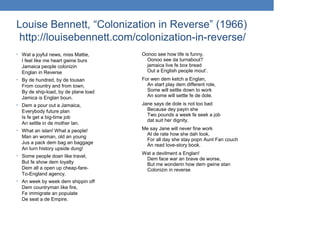
• The Lonely Londoners,
1956
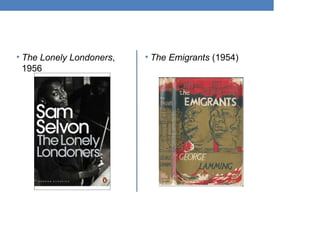
• The Emigrants (1954)
Sam Selvon, The Lonely Londoners, 2006 [1956].
• And this sort of thing was happening at a time when the
English people starting to make rab about how too much
West Indians coming to the country: this was a time, when
any corner you turn, is ten to one you bound to bounce up
a spade. In fact, the boys all over London, it ain’t have a
place where you wouldn’t find them, and big discussion
going on in Parliament about the situation, though the old
Brit’n too deplomatic to clamp down the boys or to do
anything drastic like stop them from coming to the Mother
Country (Selvon, 2006: 2).
Sam Selvon, The Lonely Londoners, 2006 [1956].
• Oh what it is and where it is and why it is, no one knows,
but to have said: ‘I walked on Waterloo Bridge,’ ‘I
rendezvoused at Charing Cross,’ ‘Piccadilly Circus is my
playground,’ to say these things, to have lived these
things, to have lived in the great city of London, centre of
the world (Selvon, 2006: 133-4)
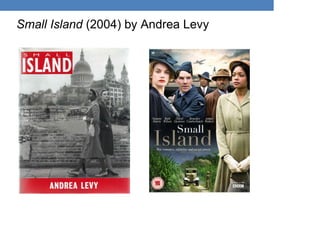
Small Island (2004) by Andrea Levy
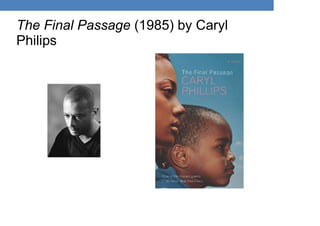
The Final Passage (1985) by Caryl
Philips
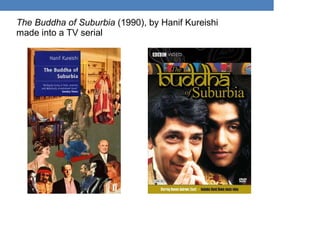
The Buddha of Suburbia (1990), by Hanif Kureishi
made into a TV serial
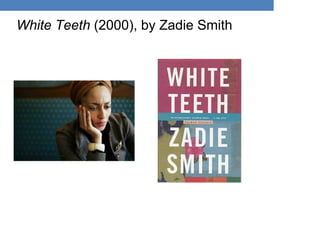
White Teeth (2000), by Zadie Smith
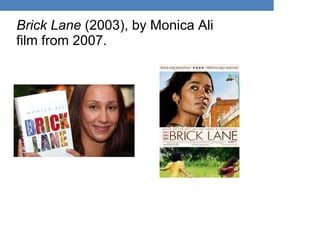
Brick Lane (2003), by Monica Ali
film from 2007.
Hanif Kureishi, The Buddha of Suburbia (1990)
My name is Karim Amir, and I am an Englishman born and
bred, almost. I am often considered to be a funny kind of
Englishman, a new breed as it were, having emerged from two
old histories. But I don’t care – Englishman I am (though not
proud of it), from the South London suburbs and going
somewhere. Perhaps it is the odd mixture of continents and
blood, of here and there, of belonging and not, that makes me
restless and easily bored. Or perhaps it was being brought up in
the suburbs that did it. Anyway, why search the inner room when
it’s enough to say that I was looking for trouble, any kind of
movement, action and sexual interest I could find because things
were so gloomy, so slow and heavy, in our family, I don’t know
why. Quite frankly, it was all getting me down and I was ready for
anything. (Kureishi, 1990: 3)
Hanif Kureishi, “The Rainbow Sign” [1986], 2011.
• It is the British, the white British, who have to learn that
being British is not what it was. Now it is a more complex
thing, involving new elements. So, there must be a fresh
way of seeing Britain and the choices it faces: and a new
way of being British after all this time. (Kureishi, 2011: 34).
In Jolley, Rachel (ed.), State of the Nation: Where
is bittersweet Britain heading?, 2013.
In the Kitchen (2009) by Monica Ali
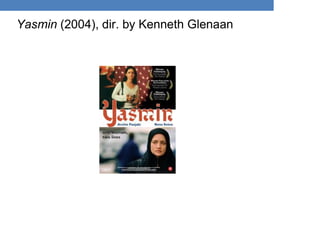
Yasmin (2004), dir. by Kenneth Glenaan
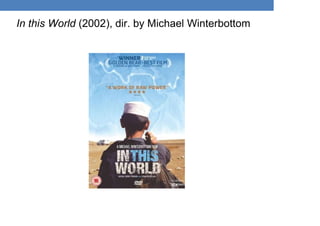
In this World (2002), dir. by Michael Winterbottom

Cosmopolitan identities

  • 1.
    Cosmopolitan Identitites: Londonand Postcolonial Diaspora in Fiction and Film Identidades Cosmopolitas: Londres e a Diáspora Pós-colonial na Ficção e no Cinema I Jornadas Nacionais de Professores de Línguas 5, 6 e 7 de setembro de 2016 Margarida Esteves Pereira (CEHUM | ILCH-UM)
  • 2.
  • 3.
    "This election wasnot without controversy and I am so proud that London has today chosen hope over fear and unity over division," Khan said in a short speech after the results. Sadiq Khan, Mayor of London, May 2016
  • 4.
    Some data takenfrom the London Datastore at http://data.london.gov.uk/ COMMUNITIES The population of London in 2015 was 8,663,300 up 7% from five years ago. London's population has increased by around 113,000 per year over the past five years and will surpass 9 million in 2018 and 10 million by 2034. The release of the 2011 Census results showed London's population had grown by 12% over the previous decade. It is a diverse city made up of 8.6 million residents in 2014. The population is made up of many different communities covering all faiths, ethnicities and nationalities. The city also has some of the most affluent neighbourhoods in the UK alongside some of the most deprived. - Retrieved from http://data.london.gov.uk/
  • 5.
    Some data takenfrom the London Datastore at http://data.london.gov.uk/ Projected population by ethnicity 42% of Londoners (over 3.5 million) are from Black, Asian, and minority ethnic groups. Data from the GLA 2012 Round Ethnic Group Projections show that in the future BAME groups will continue to increase at a rapid rate, eventually overtaking the number of white persons by 2040. Londoners by country of birth The top three countries are India, Poland, and Pakistan. Migrants by country (Top 2014/2015) In 2014/15, there were over 334,000 new registrations from overseas nationals in London, which was 38% higher than the year before. In 2014/15, the majority of registrations were from countries in the European Union (76%). This is up significantly from 2009/10 when EU countries accounted for 39% of the London total. The number of registrations in 2014/15 for the EU was 46% higher than the previous year. The top country of origin to London was Romania with 67,000 registrations – up from 22,000 the year before. Italy was the second highest country of origin with 35,000 registrations.
  • 6.
    Robert Young, inColonial Desire: Hybridity in Theory, Culture and Race (1995), pp. 1-2. With each passing decade London has been ever more successful in living up to its officially proclaimed heterogeneous identity, so that now (...) you could scarcely imagine a more varied mingling of peoples, whose ancestors hark back to the Caribbean and Africa, India, Pakistan, Bangladesh, China, Tibet, Afghanistan, Somalia, the Balkans, mixed and merged with others whose predecessors turned up in the British Isles as Angles, Celts, Danes, Dutch, Irish, Jews, Normans, Norsemen, Saxon, Vikings... The cleavage of East and West in that bronze strip on the hill has gradually been subsumed into a city that, with the potent attraction of economic power exerting the magnetic field of force of the North over the South, has drawn the far- off peripheries into the centre. And with that historic movement of intussusception, the Prime Meridian, the Longitude Zero, the centre of the world, has become inalienably mixed, suffused with the pulse of difference (Young, 1995: 1-2).
  • 7.
  • 8.
    SS Empire Windrushand the arrival of the first wave of immigrants | 1948
  • 9.
    Mike Philips andTrevor Philips, Windrush: The Irresistable Rise of Multi-Racial Britain, 1998. Within a decade of its famous voyage of 1948, the Windrush had become a symbol of post-war immigration and, for a time, it seemed as if every TV documentary about race or migration had to begin with the image of a line of black men and women filling the gangplank (Phillips e Phillips, 1998, p. 2).
  • 10.
    John Clement Ball,Imagining London: Postcolonial Fiction and the Transnational Metropolis (2004) • As a result of this so-called ‘New Commonwealth’ migration, the metropolis that once possessed a large portion of the world now contains a transnational ‘world’ that is increasingly taking possession of it. With over two million non-white residents in the year 2000 (Ackroyd 715), London has been transformed; demographically it is becoming more and more global (or transnational) and less and less traditionally – that is, ethnically, racially, or even nationally – English or British. (Ball, 2006: 4-5).
  • 11.
    Brownyn T. William,“‘A State of Perpetual Wandering’: Diaspora and Black British Writers”, in The Culture of Diasporas in the Postcolonial Web. The postcolonial diaspora is not simply immigration into Britain from other places, as for example immigration into the United States or even Turkish “guest workers” in Germany,” but is instead a continual reminder that “we are here because you were there” (7). (Williams, 1999: 2)
  • 12.
    Hanif Kureishi, Somethingto Tell You, 2008, pp. 13-15 • While no one could be happy on the Goldhawk road, the Uxbridge Road, ten minutes away, is different. At the top of the market I’d buy a falalel and step into that wide West London street where the shops were Caribbean, Polish, Kashmiri, Somali. Along from the police station was the mosque (…). (p 14) • It was my desire, so far unfulfilled, to live in luxury in the poorest and most mixed part of town. It always cheered me to walk here. This wasn’t the ghetto; the ghetto was Belgravia, Knightsbridge and parts of Notting Hill. This was London as a world city. (p. 15) • His solution to the fact that few people in the city appeared to speak understandable English now, was to learn their language. ‘The only way to survive in this ‘hood is to speak Polish,’ he announced recently. He also knew enough Bosnian, Czech and Portuguese to get by in the bars and shops without yelling, as well as enough of several other European languages to make his way without feeling marginalised in his own city. (p. 13)
  • 13.
    London: A historyof clashes (Racial clashes) http://socks-studio.com/2011/08/11/london-a-history-of-clashes/ • Racial turmoils, Notting Hill, September, 10th, 1958 • Notting Hill Carnival turmoil, August, 31st, 1976
  • 14.
    London: A historyof clashes (Racial clashes) http://socks-studio.com/2011/08/11/london-a-history-of-clashes/ • Notting Hill turmoil, September, 1st, 1976 • A crowd during Southall turmoils between antiracist activists and British National Front supporters. Teacher Blair Peach died at 33, 1979
  • 15.
    Bobbies during Brixtonturmoils, April 13th, 1981
  • 16.
    The British Futurepoll 2013, in The Guardian, 13 January 2013. http://www.theguardian.com/uk/graphic/2013/jan/13/british- future-poll-key-findings-graphic
  • 17.
    In Jolley, Rachel(ed.), State of the Nation: Where is bittersweet Britain heading?, 2013.
  • 18.
    Hanif Kureishi: Themigrant has no face, status or story, in The Guardian, 30 May, 2014. Whether he or she – and I will call the immigrant he, while being aware that he is stripped of colour, gender and character – the immigrant has been made into something resembling an alien. He is an example of the undead, who will invade, colonise and contaminate, a figure we can never quite digest or vomit. If the 20th century was replete with uncanny, semi-fictional figures who invaded the lives of the decent, upright and hard-working – the pure – this character is rehaunting us in the guise of the immigrant. He is both a familiar, insidious figure, and a new edition of an old idea expressed with refreshed and forceful rhetoric.
  • 19.
    Hanif Kureishi, “Themigrant has no face, status, or story”, The Guardian, 30th May 2014. • Nevertheless, the immigrant is easily dismissed and denigrated since he is now no longer a person. The recently arrived immigrant, the last through the door, and now settling down in the new country, can himself be disgusted by the idea of this newer arrival or interloper, the one who could take his place, because this threatening Other does not resemble him in any way. The migrant has no face, no status, no protection and no story. His single identity is to be discussed within the limited rules of the community. (Kureishi, 2014, p. 2)
  • 20.
    Zygmunt Bauman, Culturein a Liquid Modern World, 2011. - phases of mass migration • 1st phase: dislocation of millions of Euopeans to what they called “empty lands”, process of colonization; • 2nd phase: inversion of the process of colonization that follows suit the moment of decolonization; • 3rd phase: “an infinite archipelago of ethnic, religious and linguistic settlements, heedless of the pathways marked out and paved by the imperial/ colonial episode, and steered instead by the logic of the global redistribution of living resources and the chances of survival peculiar to the current stadium of globalization (35)”.
  • 21.
    Louise Bennett, “Colonizationin Reverse” (1966) http://louisebennett.com/colonization-in-reverse/ • Wat a joyful news, miss Mattie, I feel like me heart gwine burs Jamaica people colonizin Englan in Reverse • By de hundred, by de tousan From country and from town, By de ship-load, by de plane load Jamica is Englan boun. • Dem a pour out a Jamaica, Everybody future plan Is fe get a big-time job An settle in de mother lan. • What an islan! What a people! Man an woman, old an young Jus a pack dem bag an baggage An turn history upside dung! • Some people doan like travel, But fe show dem loyalty Dem all a open up cheap-fare- To-England agency. • An week by week dem shippin off Dem countryman like fire, Fe immigrate an populate De seat a de Empire. Oonoo see how life is funny, Oonoo see da turnabout? jamaica live fe box bread Out a English people mout’. For wen dem ketch a Englan, An start play dem different role, Some will settle down to work An some will settle fe de dole. Jane says de dole is not too bad Because dey payin she Two pounds a week fe seek a job dat suit her dignity. Me say Jane will never fine work At de rate how she dah look, For all day she stay popn Aunt Fan couch An read love-story book. Wat a devilment a Englan! Dem face war an brave de worse, But me wonderin how dem gwine stan Colonizin in reverse
  • 22.
    • The LonelyLondoners, 1956 • The Emigrants (1954)
  • 23.
    Sam Selvon, TheLonely Londoners, 2006 [1956]. • And this sort of thing was happening at a time when the English people starting to make rab about how too much West Indians coming to the country: this was a time, when any corner you turn, is ten to one you bound to bounce up a spade. In fact, the boys all over London, it ain’t have a place where you wouldn’t find them, and big discussion going on in Parliament about the situation, though the old Brit’n too deplomatic to clamp down the boys or to do anything drastic like stop them from coming to the Mother Country (Selvon, 2006: 2).
  • 24.
    Sam Selvon, TheLonely Londoners, 2006 [1956]. • Oh what it is and where it is and why it is, no one knows, but to have said: ‘I walked on Waterloo Bridge,’ ‘I rendezvoused at Charing Cross,’ ‘Piccadilly Circus is my playground,’ to say these things, to have lived these things, to have lived in the great city of London, centre of the world (Selvon, 2006: 133-4)
  • 25.
    Small Island (2004)by Andrea Levy
  • 26.
    The Final Passage(1985) by Caryl Philips
  • 27.
    The Buddha ofSuburbia (1990), by Hanif Kureishi made into a TV serial
  • 28.
    White Teeth (2000),by Zadie Smith
  • 29.
    Brick Lane (2003),by Monica Ali film from 2007.
  • 30.
    Hanif Kureishi, TheBuddha of Suburbia (1990) My name is Karim Amir, and I am an Englishman born and bred, almost. I am often considered to be a funny kind of Englishman, a new breed as it were, having emerged from two old histories. But I don’t care – Englishman I am (though not proud of it), from the South London suburbs and going somewhere. Perhaps it is the odd mixture of continents and blood, of here and there, of belonging and not, that makes me restless and easily bored. Or perhaps it was being brought up in the suburbs that did it. Anyway, why search the inner room when it’s enough to say that I was looking for trouble, any kind of movement, action and sexual interest I could find because things were so gloomy, so slow and heavy, in our family, I don’t know why. Quite frankly, it was all getting me down and I was ready for anything. (Kureishi, 1990: 3)
  • 31.
    Hanif Kureishi, “TheRainbow Sign” [1986], 2011. • It is the British, the white British, who have to learn that being British is not what it was. Now it is a more complex thing, involving new elements. So, there must be a fresh way of seeing Britain and the choices it faces: and a new way of being British after all this time. (Kureishi, 2011: 34).
  • 32.
    In Jolley, Rachel(ed.), State of the Nation: Where is bittersweet Britain heading?, 2013.
  • 33.
    In the Kitchen(2009) by Monica Ali
  • 34.
    Yasmin (2004), dir.by Kenneth Glenaan
  • 35.
    In this World(2002), dir. by Michael Winterbottom