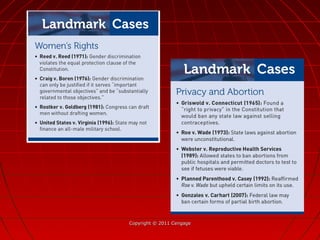
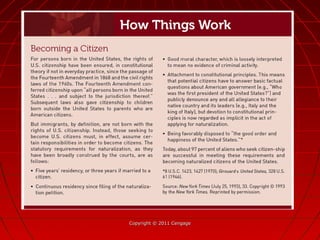
Chapter 6Chapter 6
Civil RightsCivil Rights
Copyright © 2011 CengageCopyright © 2011 Cengage
 WHO GOVERNS?WHO GOVERNS?
1.1. Since Congress enacts our laws, whySince Congress enacts our laws, why
has it not made certain that all groupshas it not made certain that all groups
have the same rights?have the same rights?
2.2. After the Supreme Court ended racialAfter the Supreme Court ended racial
segregation in the schools, what didsegregation in the schools, what did
the president and Congress do?the president and Congress do?
 TO WHAT ENDS?TO WHAT ENDS?
1.1. If the law supports equality ofIf the law supports equality of
opportunity, why has affirmativeopportunity, why has affirmative
action become so important?action become so important?
2.2. Under what circumstances can menUnder what circumstances can men
and women be treated differently?and women be treated differently?
The Black PredicamentThe Black Predicament
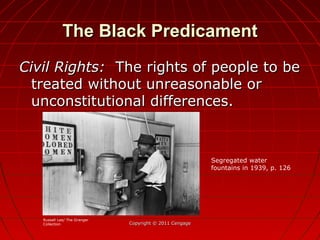
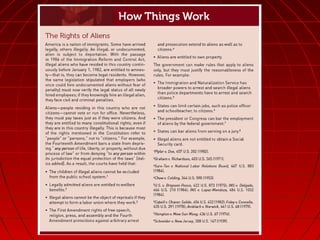
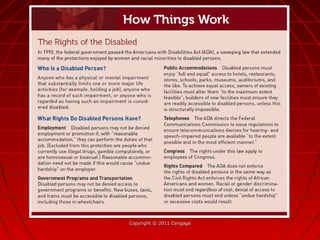
Civil Rights:Civil Rights: The rights of people to beThe rights of people to be
treated without unreasonable ortreated without unreasonable or
unconstitutional differences.unconstitutional differences.
Copyright © 2011 CengageCopyright © 2011 Cengage
Segregated water
fountains in 1939, p. 126
Russell Lee/ The Granger
Collection
The Campaign in the CourtsThe Campaign in the Courts
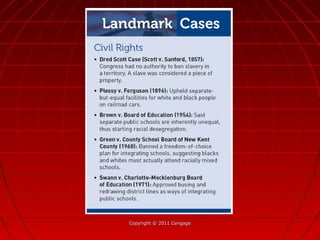
 ““Separate but Equal”Separate but Equal”
 Can Separate Schools be Equal?Can Separate Schools be Equal?
 Brown v Board of EducationBrown v Board of Education
• ImplementationImplementation
• The RationaleThe Rationale
• Desegregation versus IntegrationDesegregation versus Integration
Copyright © 2011 CengageCopyright © 2011 Cengage
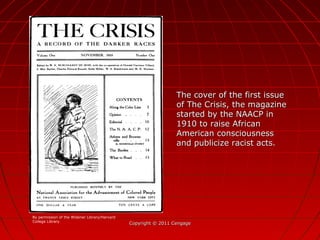
The cover of the first issueThe cover of the first issue
of The Crisis, the magazineof The Crisis, the magazine
started by the NAACP instarted by the NAACP in
1910 to raise African1910 to raise African
American consciousnessAmerican consciousness
and publicize racist acts.and publicize racist acts.
By permission of the Widener Library/Harvard
College Library
MEMORANDUMMEMORANDUM
To:To: Justice Robert GilbertJustice Robert Gilbert
From:From: Ella Fitzgerald, law clerkElla Fitzgerald, law clerk
Until school segregation ended, southern blacks could attendUntil school segregation ended, southern blacks could attend
only all-black colleges. Now they are free to apply toonly all-black colleges. Now they are free to apply to
previously all-white colleges, and these schools arepreviously all-white colleges, and these schools are
integrated. But the traditional black colleges still exist, andintegrated. But the traditional black colleges still exist, and
very few whites apply to them. In 1992, the Supreme Courtvery few whites apply to them. In 1992, the Supreme Court
held that the state could not solve the problem by requiringheld that the state could not solve the problem by requiring
a race-neutral admissions policy.* Now the Court musta race-neutral admissions policy.* Now the Court must
decide whether a predominantly black college can receivedecide whether a predominantly black college can receive
state support.state support.
**United States v. FordiceUnited States v. Fordice, 505 U.S. 717 (1992)., 505 U.S. 717 (1992).
Copyright © 2011 CengageCopyright © 2011 Cengage
WHAT WOULD YOU DO?WHAT WOULD YOU DO?
Arguments for all-black colleges:Arguments for all-black colleges:
1. These schools have a long tradition that ought to be1. These schools have a long tradition that ought to be
preserved.preserved.
2. Many black students will learn better in an all-black2. Many black students will learn better in an all-black
environment.environment.
3. African American organizations, in particular the United3. African American organizations, in particular the United
Negro College Fund, raise money for these schools.Negro College Fund, raise money for these schools.
Copyright © 2011 CengageCopyright © 2011 Cengage
WHAT WOULD YOU DO?WHAT WOULD YOU DO?
Arguments against all-black colleges:Arguments against all-black colleges:
1. If the state once required single-race schools, it now has an1. If the state once required single-race schools, it now has an
obligation to dismantle them.obligation to dismantle them.
2. Race is a suspect classification, and no state program that2. Race is a suspect classification, and no state program that
chiefly serves one race can be allowed.chiefly serves one race can be allowed.
Copyright © 2011 CengageCopyright © 2011 Cengage
WHAT WOULD YOU DO?WHAT WOULD YOU DO?
Your decision:Your decision:
Allow all-black colleges?Allow all-black colleges?
Ban all-black colleges?Ban all-black colleges?
Copyright © 2011 CengageCopyright © 2011 Cengage
WHAT WOULD YOU DO?WHAT WOULD YOU DO?
Copyright © 2011 CengageCopyright © 2011 Cengage
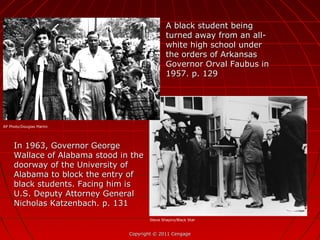
In 1963, Governor GeorgeIn 1963, Governor George
Wallace of Alabama stood in theWallace of Alabama stood in the
doorway of the University ofdoorway of the University of
Alabama to block the entry ofAlabama to block the entry of
black students. Facing him isblack students. Facing him is
U.S. Deputy Attorney GeneralU.S. Deputy Attorney General
Nicholas Katzenbach. p. 131Nicholas Katzenbach. p. 131
A black student beingA black student being
turned away from an all-turned away from an all-
white high school underwhite high school under
the orders of Arkansasthe orders of Arkansas
Governor Orval Faubus inGovernor Orval Faubus in
1957. p. 1291957. p. 129
AP Photo/Douglas Martin
Steve Shapiro/Black Star
MEMORANDUMMEMORANDUM
To:To: Justice Robert GilbertJustice Robert Gilbert
From:From: Ella Fitzgerald, law clerkElla Fitzgerald, law clerk
Until school segregation ended, southern blacks could attendUntil school segregation ended, southern blacks could attend
only all-black colleges. Now they are free to apply toonly all-black colleges. Now they are free to apply to
previously all-white colleges, and these schools arepreviously all-white colleges, and these schools are
integrated. But the traditional black colleges still exist, andintegrated. But the traditional black colleges still exist, and
very few whites apply to them. In 1992, the Supreme Courtvery few whites apply to them. In 1992, the Supreme Court
held that the state could not solve the problem by requiringheld that the state could not solve the problem by requiring
a race-neutral admissions policy.* Now the Court musta race-neutral admissions policy.* Now the Court must
decide whether a predominantly black college can receivedecide whether a predominantly black college can receive
state support.state support.
Copyright © 2011 CengageCopyright © 2011 Cengage
WHAT WOULD YOU DO?WHAT WOULD YOU DO?
Arguments for all-black colleges:Arguments for all-black colleges:
1. These schools have a long tradition that ought to be1. These schools have a long tradition that ought to be
preserved.preserved.
2. Many black students will learn better in an all-black2. Many black students will learn better in an all-black
environment.environment.
3. African American organizations, in particular the United3. African American organizations, in particular the United
Negro College Fund, raise money for these schools.Negro College Fund, raise money for these schools.
Copyright © 2011 CengageCopyright © 2011 Cengage
WHAT WOULD YOU DO?WHAT WOULD YOU DO?
Arguments against all-black colleges:Arguments against all-black colleges:
1. If the state once required single-race schools, it now has an1. If the state once required single-race schools, it now has an
obligation to dismantle them.obligation to dismantle them.
2. Race is a suspect classification, and no state program that2. Race is a suspect classification, and no state program that
chiefly serves one race can be allowed.chiefly serves one race can be allowed.
Copyright © 2011 CengageCopyright © 2011 Cengage
WHAT WOULD YOU DO?WHAT WOULD YOU DO?
Your decision:Your decision:
Allow all-black colleges?Allow all-black colleges?
Ban all-black colleges?Ban all-black colleges?
Copyright © 2011 CengageCopyright © 2011 Cengage
WHAT WOULD YOU DO?WHAT WOULD YOU DO?
Copyright © 2011 CengageCopyright © 2011 Cengage
The Campaign in CongressThe Campaign in Congress
 Civil DisobedienceCivil Disobedience
 Racial ProfilingRacial Profiling
Copyright © 2011 CengageCopyright © 2011 Cengage
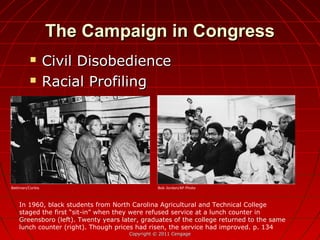
In 1960, black students from North Carolina Agricultural and Technical College
staged the first “sit-in” when they were refused service at a lunch counter in
Greensboro (left). Twenty years later, graduates of the college returned to the same
lunch counter (right). Though prices had risen, the service had improved. p. 134
Bettman/Corbis Bob Jordan/AP Photo
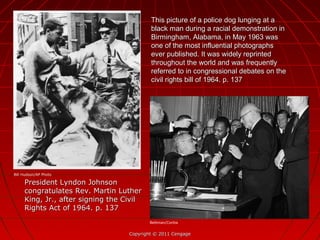
This picture of a police dog lunging at aThis picture of a police dog lunging at a
black man during a racial demonstration inblack man during a racial demonstration in
Birmingham, Alabama, in May 1963 wasBirmingham, Alabama, in May 1963 was
one of the most influential photographsone of the most influential photographs
ever published. It was widely reprintedever published. It was widely reprinted
throughout the world and was frequentlythroughout the world and was frequently
referred to in congressional debates on thereferred to in congressional debates on the
civil rights bill of 1964. p. 137civil rights bill of 1964. p. 137
Copyright © 2011 CengageCopyright © 2011 Cengage
President Lyndon JohnsonPresident Lyndon Johnson
congratulates Rev. Martin Luthercongratulates Rev. Martin Luther
King, Jr., after signing the CivilKing, Jr., after signing the Civil
Rights Act of 1964. p. 137Rights Act of 1964. p. 137
Bill Hudson/AP Photo
Bettman/Corbis
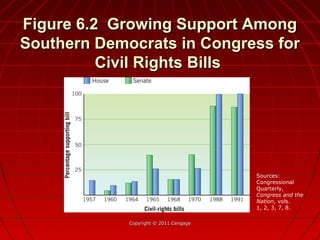
Figure 6.2 Growing Support AmongFigure 6.2 Growing Support Among
Southern Democrats in Congress forSouthern Democrats in Congress for
Civil Rights BillsCivil Rights Bills
Copyright © 2011 CengageCopyright © 2011 Cengage
Sources:
Congressional
Quarterly,
Congress and the
Nation, vols.
1, 2, 3, 7, 8.
Copyright © 2011 CengageCopyright © 2011 Cengage
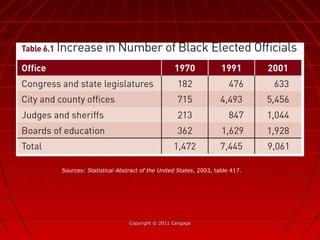
Sources: Statistical Abstract of the United States, 2003, table 417.
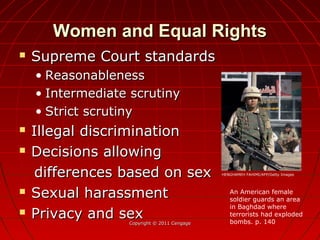
Women and Equal RightsWomen and Equal Rights
 Supreme Court standardsSupreme Court standards
• ReasonablenessReasonableness
• Intermediate scrutinyIntermediate scrutiny
• Strict scrutinyStrict scrutiny
 Illegal discriminationIllegal discrimination
 Decisions allowingDecisions allowing
differences based on sexdifferences based on sex
 Sexual harassmentSexual harassment
 Privacy and sexPrivacy and sexCopyright © 2011 CengageCopyright © 2011 Cengage
An American female
soldier guards an area
in Baghdad where
terrorists had exploded
bombs. p. 140
HENGHAMEH FAHIMI/AFP/Getty Images
Copyright © 2011 CengageCopyright © 2011 Cengage
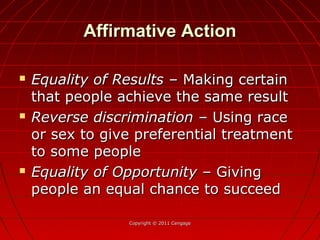
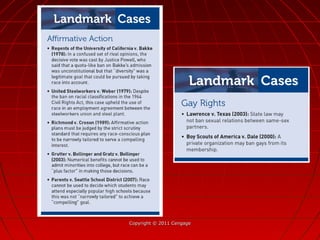
Affirmative ActionAffirmative Action
 Equality of ResultsEquality of Results – Making certain– Making certain
that people achieve the same resultthat people achieve the same result
 Reverse discriminationReverse discrimination – Using race– Using race
or sex to give preferential treatmentor sex to give preferential treatment
to some peopleto some people
 Equality of OpportunityEquality of Opportunity – Giving– Giving
people an equal chance to succeedpeople an equal chance to succeed
Copyright © 2011 CengageCopyright © 2011 Cengage
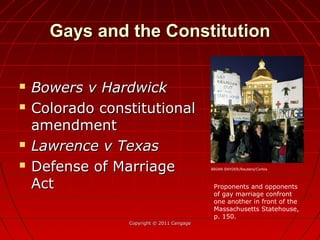
Gays and the ConstitutionGays and the Constitution
 Bowers v HardwickBowers v Hardwick
 Colorado constitutionalColorado constitutional
amendmentamendment
 Lawrence v TexasLawrence v Texas
 Defense of MarriageDefense of Marriage
ActAct
Copyright © 2011 CengageCopyright © 2011 Cengage
Proponents and opponents
of gay marriage confront
one another in front of the
Massachusetts Statehouse,
p. 150.
BRIAN SNYDER/Reuters/Corbis

Civil Rights

  • 1.
    Chapter 6Chapter 6 CivilRightsCivil Rights
  • 2.
    Copyright © 2011CengageCopyright © 2011 Cengage  WHO GOVERNS?WHO GOVERNS? 1.1. Since Congress enacts our laws, whySince Congress enacts our laws, why has it not made certain that all groupshas it not made certain that all groups have the same rights?have the same rights? 2.2. After the Supreme Court ended racialAfter the Supreme Court ended racial segregation in the schools, what didsegregation in the schools, what did the president and Congress do?the president and Congress do?  TO WHAT ENDS?TO WHAT ENDS? 1.1. If the law supports equality ofIf the law supports equality of opportunity, why has affirmativeopportunity, why has affirmative action become so important?action become so important? 2.2. Under what circumstances can menUnder what circumstances can men and women be treated differently?and women be treated differently?
  • 3.
    The Black PredicamentTheBlack Predicament Civil Rights:Civil Rights: The rights of people to beThe rights of people to be treated without unreasonable ortreated without unreasonable or unconstitutional differences.unconstitutional differences. Copyright © 2011 CengageCopyright © 2011 Cengage Segregated water fountains in 1939, p. 126 Russell Lee/ The Granger Collection
  • 4.
    The Campaign inthe CourtsThe Campaign in the Courts  ““Separate but Equal”Separate but Equal”  Can Separate Schools be Equal?Can Separate Schools be Equal?  Brown v Board of EducationBrown v Board of Education • ImplementationImplementation • The RationaleThe Rationale • Desegregation versus IntegrationDesegregation versus Integration Copyright © 2011 CengageCopyright © 2011 Cengage
  • 5.
    Copyright © 2011CengageCopyright © 2011 Cengage The cover of the first issueThe cover of the first issue of The Crisis, the magazineof The Crisis, the magazine started by the NAACP instarted by the NAACP in 1910 to raise African1910 to raise African American consciousnessAmerican consciousness and publicize racist acts.and publicize racist acts. By permission of the Widener Library/Harvard College Library
  • 6.
    MEMORANDUMMEMORANDUM To:To: Justice RobertGilbertJustice Robert Gilbert From:From: Ella Fitzgerald, law clerkElla Fitzgerald, law clerk Until school segregation ended, southern blacks could attendUntil school segregation ended, southern blacks could attend only all-black colleges. Now they are free to apply toonly all-black colleges. Now they are free to apply to previously all-white colleges, and these schools arepreviously all-white colleges, and these schools are integrated. But the traditional black colleges still exist, andintegrated. But the traditional black colleges still exist, and very few whites apply to them. In 1992, the Supreme Courtvery few whites apply to them. In 1992, the Supreme Court held that the state could not solve the problem by requiringheld that the state could not solve the problem by requiring a race-neutral admissions policy.* Now the Court musta race-neutral admissions policy.* Now the Court must decide whether a predominantly black college can receivedecide whether a predominantly black college can receive state support.state support. **United States v. FordiceUnited States v. Fordice, 505 U.S. 717 (1992)., 505 U.S. 717 (1992). Copyright © 2011 CengageCopyright © 2011 Cengage WHAT WOULD YOU DO?WHAT WOULD YOU DO?
  • 7.
    Arguments for all-blackcolleges:Arguments for all-black colleges: 1. These schools have a long tradition that ought to be1. These schools have a long tradition that ought to be preserved.preserved. 2. Many black students will learn better in an all-black2. Many black students will learn better in an all-black environment.environment. 3. African American organizations, in particular the United3. African American organizations, in particular the United Negro College Fund, raise money for these schools.Negro College Fund, raise money for these schools. Copyright © 2011 CengageCopyright © 2011 Cengage WHAT WOULD YOU DO?WHAT WOULD YOU DO?
  • 8.
    Arguments against all-blackcolleges:Arguments against all-black colleges: 1. If the state once required single-race schools, it now has an1. If the state once required single-race schools, it now has an obligation to dismantle them.obligation to dismantle them. 2. Race is a suspect classification, and no state program that2. Race is a suspect classification, and no state program that chiefly serves one race can be allowed.chiefly serves one race can be allowed. Copyright © 2011 CengageCopyright © 2011 Cengage WHAT WOULD YOU DO?WHAT WOULD YOU DO?
  • 9.
    Your decision:Your decision: Allowall-black colleges?Allow all-black colleges? Ban all-black colleges?Ban all-black colleges? Copyright © 2011 CengageCopyright © 2011 Cengage WHAT WOULD YOU DO?WHAT WOULD YOU DO?
  • 10.
    Copyright © 2011CengageCopyright © 2011 Cengage In 1963, Governor GeorgeIn 1963, Governor George Wallace of Alabama stood in theWallace of Alabama stood in the doorway of the University ofdoorway of the University of Alabama to block the entry ofAlabama to block the entry of black students. Facing him isblack students. Facing him is U.S. Deputy Attorney GeneralU.S. Deputy Attorney General Nicholas Katzenbach. p. 131Nicholas Katzenbach. p. 131 A black student beingA black student being turned away from an all-turned away from an all- white high school underwhite high school under the orders of Arkansasthe orders of Arkansas Governor Orval Faubus inGovernor Orval Faubus in 1957. p. 1291957. p. 129 AP Photo/Douglas Martin Steve Shapiro/Black Star
  • 11.
    MEMORANDUMMEMORANDUM To:To: Justice RobertGilbertJustice Robert Gilbert From:From: Ella Fitzgerald, law clerkElla Fitzgerald, law clerk Until school segregation ended, southern blacks could attendUntil school segregation ended, southern blacks could attend only all-black colleges. Now they are free to apply toonly all-black colleges. Now they are free to apply to previously all-white colleges, and these schools arepreviously all-white colleges, and these schools are integrated. But the traditional black colleges still exist, andintegrated. But the traditional black colleges still exist, and very few whites apply to them. In 1992, the Supreme Courtvery few whites apply to them. In 1992, the Supreme Court held that the state could not solve the problem by requiringheld that the state could not solve the problem by requiring a race-neutral admissions policy.* Now the Court musta race-neutral admissions policy.* Now the Court must decide whether a predominantly black college can receivedecide whether a predominantly black college can receive state support.state support. Copyright © 2011 CengageCopyright © 2011 Cengage WHAT WOULD YOU DO?WHAT WOULD YOU DO?
  • 12.
    Arguments for all-blackcolleges:Arguments for all-black colleges: 1. These schools have a long tradition that ought to be1. These schools have a long tradition that ought to be preserved.preserved. 2. Many black students will learn better in an all-black2. Many black students will learn better in an all-black environment.environment. 3. African American organizations, in particular the United3. African American organizations, in particular the United Negro College Fund, raise money for these schools.Negro College Fund, raise money for these schools. Copyright © 2011 CengageCopyright © 2011 Cengage WHAT WOULD YOU DO?WHAT WOULD YOU DO?
  • 13.
    Arguments against all-blackcolleges:Arguments against all-black colleges: 1. If the state once required single-race schools, it now has an1. If the state once required single-race schools, it now has an obligation to dismantle them.obligation to dismantle them. 2. Race is a suspect classification, and no state program that2. Race is a suspect classification, and no state program that chiefly serves one race can be allowed.chiefly serves one race can be allowed. Copyright © 2011 CengageCopyright © 2011 Cengage WHAT WOULD YOU DO?WHAT WOULD YOU DO?
  • 14.
    Your decision:Your decision: Allowall-black colleges?Allow all-black colleges? Ban all-black colleges?Ban all-black colleges? Copyright © 2011 CengageCopyright © 2011 Cengage WHAT WOULD YOU DO?WHAT WOULD YOU DO?
  • 15.
    Copyright © 2011CengageCopyright © 2011 Cengage
  • 16.
    The Campaign inCongressThe Campaign in Congress  Civil DisobedienceCivil Disobedience  Racial ProfilingRacial Profiling Copyright © 2011 CengageCopyright © 2011 Cengage In 1960, black students from North Carolina Agricultural and Technical College staged the first “sit-in” when they were refused service at a lunch counter in Greensboro (left). Twenty years later, graduates of the college returned to the same lunch counter (right). Though prices had risen, the service had improved. p. 134 Bettman/Corbis Bob Jordan/AP Photo
  • 17.
    This picture ofa police dog lunging at aThis picture of a police dog lunging at a black man during a racial demonstration inblack man during a racial demonstration in Birmingham, Alabama, in May 1963 wasBirmingham, Alabama, in May 1963 was one of the most influential photographsone of the most influential photographs ever published. It was widely reprintedever published. It was widely reprinted throughout the world and was frequentlythroughout the world and was frequently referred to in congressional debates on thereferred to in congressional debates on the civil rights bill of 1964. p. 137civil rights bill of 1964. p. 137 Copyright © 2011 CengageCopyright © 2011 Cengage President Lyndon JohnsonPresident Lyndon Johnson congratulates Rev. Martin Luthercongratulates Rev. Martin Luther King, Jr., after signing the CivilKing, Jr., after signing the Civil Rights Act of 1964. p. 137Rights Act of 1964. p. 137 Bill Hudson/AP Photo Bettman/Corbis
  • 18.
    Figure 6.2 GrowingSupport AmongFigure 6.2 Growing Support Among Southern Democrats in Congress forSouthern Democrats in Congress for Civil Rights BillsCivil Rights Bills Copyright © 2011 CengageCopyright © 2011 Cengage Sources: Congressional Quarterly, Congress and the Nation, vols. 1, 2, 3, 7, 8.
  • 19.
    Copyright © 2011CengageCopyright © 2011 Cengage Sources: Statistical Abstract of the United States, 2003, table 417.
  • 20.
    Women and EqualRightsWomen and Equal Rights  Supreme Court standardsSupreme Court standards • ReasonablenessReasonableness • Intermediate scrutinyIntermediate scrutiny • Strict scrutinyStrict scrutiny  Illegal discriminationIllegal discrimination  Decisions allowingDecisions allowing differences based on sexdifferences based on sex  Sexual harassmentSexual harassment  Privacy and sexPrivacy and sexCopyright © 2011 CengageCopyright © 2011 Cengage An American female soldier guards an area in Baghdad where terrorists had exploded bombs. p. 140 HENGHAMEH FAHIMI/AFP/Getty Images
  • 21.
    Copyright © 2011CengageCopyright © 2011 Cengage
  • 22.
    Affirmative ActionAffirmative Action Equality of ResultsEquality of Results – Making certain– Making certain that people achieve the same resultthat people achieve the same result  Reverse discriminationReverse discrimination – Using race– Using race or sex to give preferential treatmentor sex to give preferential treatment to some peopleto some people  Equality of OpportunityEquality of Opportunity – Giving– Giving people an equal chance to succeedpeople an equal chance to succeed Copyright © 2011 CengageCopyright © 2011 Cengage
  • 23.
    Copyright © 2011CengageCopyright © 2011 Cengage
  • 24.
    Copyright © 2011CengageCopyright © 2011 Cengage
  • 25.
    Copyright © 2011CengageCopyright © 2011 Cengage
  • 26.
    Copyright © 2011CengageCopyright © 2011 Cengage
  • 27.
    Gays and theConstitutionGays and the Constitution  Bowers v HardwickBowers v Hardwick  Colorado constitutionalColorado constitutional amendmentamendment  Lawrence v TexasLawrence v Texas  Defense of MarriageDefense of Marriage ActAct Copyright © 2011 CengageCopyright © 2011 Cengage Proponents and opponents of gay marriage confront one another in front of the Massachusetts Statehouse, p. 150. BRIAN SNYDER/Reuters/Corbis

Editor's Notes

  • #19 Replace with jpeg, p. 137
  • #27 Replace with jpeg, p. 149