FINAL EVALUATION
The Rockefeller Foundation’s
Transforming Health Systems Initiative
March 2018
Supported by
THE
RockefellerFoundation
MONITORING&EVALUATIONOFFICE
Cover photo: © Patrick de Noirmont
About Mathematica Policy Research
Mathematica Policy Research is a pioneering nonpartisan research organization dedicated to improving public
well-being. Its 1,200+ experts conduct policy research, data collection, and data analytics that meet the highest
standards of quality and objectivity, working with decision makers across the public and private sectors. For nearly
50 years, Mathematica Policy Research has been at the forefront of assessing the effectiveness of policies and
programs.
About The Rockefeller Foundation
For more than 100 years, The Rockefeller Foundation’s mission has been to promote the well-being of humanity
throughout the world. Together with partners and grantees, The Rockefeller Foundation strives to catalyze and
scale transformative innovations, create unlikely partnerships that span sectors, and take risks others cannot – or
will not. For more information, please visit www.rockefellerfoundation.org.
Monitoring and Evaluation at The Rockefeller Foundation
Committed to supporting learning, accountability, and performance improvements, the Foundation’s Monitoring
and Evaluation team works with staff, grantees, and partners to monitor and evaluate the Foundation’s pathways
to impact in the short- and long-term, and to capture lessons about what works and what doesn’t across the
Foundation’s diverse portfolio.
Supported by
The contents of this report are the views of the authors and do not
necessarily reflect the views or policies of The Rockefeller Foundation.
© 2018, The Rockefeller Foundation
FINAL EVALUATION
The Rockefeller Foundation’s
Transforming Health Systems Initiative
March 2018
THE
RockefellerFoundation
MONITORING&EVALUATIONOFFICE
Kimberly Smith
Swetha Sridharan
Samina Sattar
©NikitaJapra,2018
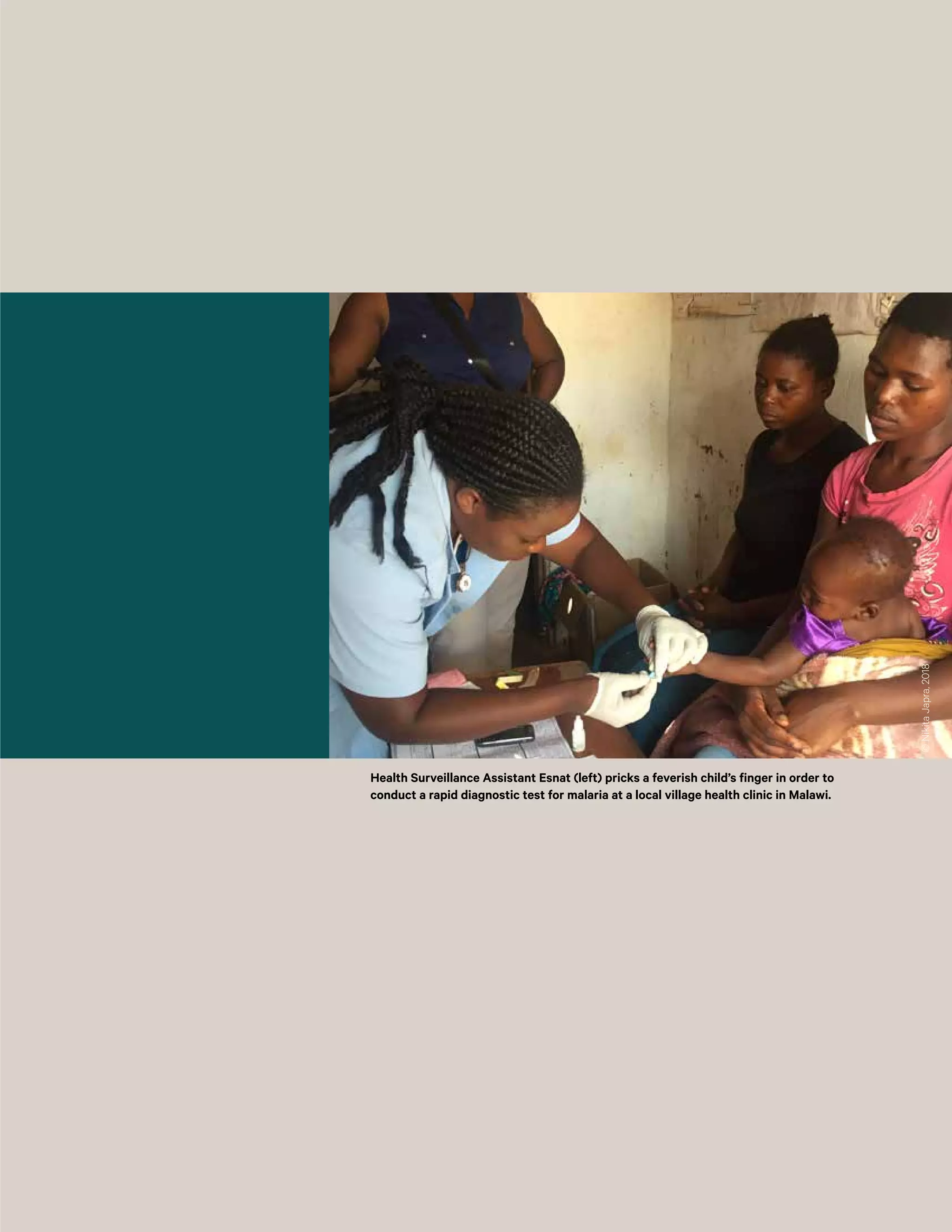
A Health Surveillance Assistant records the results of a feverish child's rapid diagnostic test for malaria in a patient register.
Table of Contents
Acronyms	 v
Preface	 vii
Executive Summary	 ix
1.	Introduction	 1
2. Description of the initiative	 3
Conceptualization and rationale	 3
Search and development	 4
Theory of change	 5
Strategic approach	 7
3. Evaluation approach	 11
Evaluation objectives and scope	 11
Evaluation approach	 12
4. Global UHC advocacy	 15
Overview of global advocacy strategy	 16
Notable achievements	 18
Key learnings	 21
5. Regional (Global South) networks	 25
Overview of networks supported by THS	26
Notable achievements	 28
Key challenges	 32
Key learnings	 33
6. Focus country investments	 37
Background on THS’s country-level grantmaking	 39
Notable achievements	 39
Key challenges	 44
Key learnings	 45
7. Summative findings	 47
Achievements	47
Challenges	49
Key learnings	 50
References	51
THE RO CKEFELLER FOUNDATION’S TRANSFORMING HEALTH SYSTEMS INITIATIVEiv
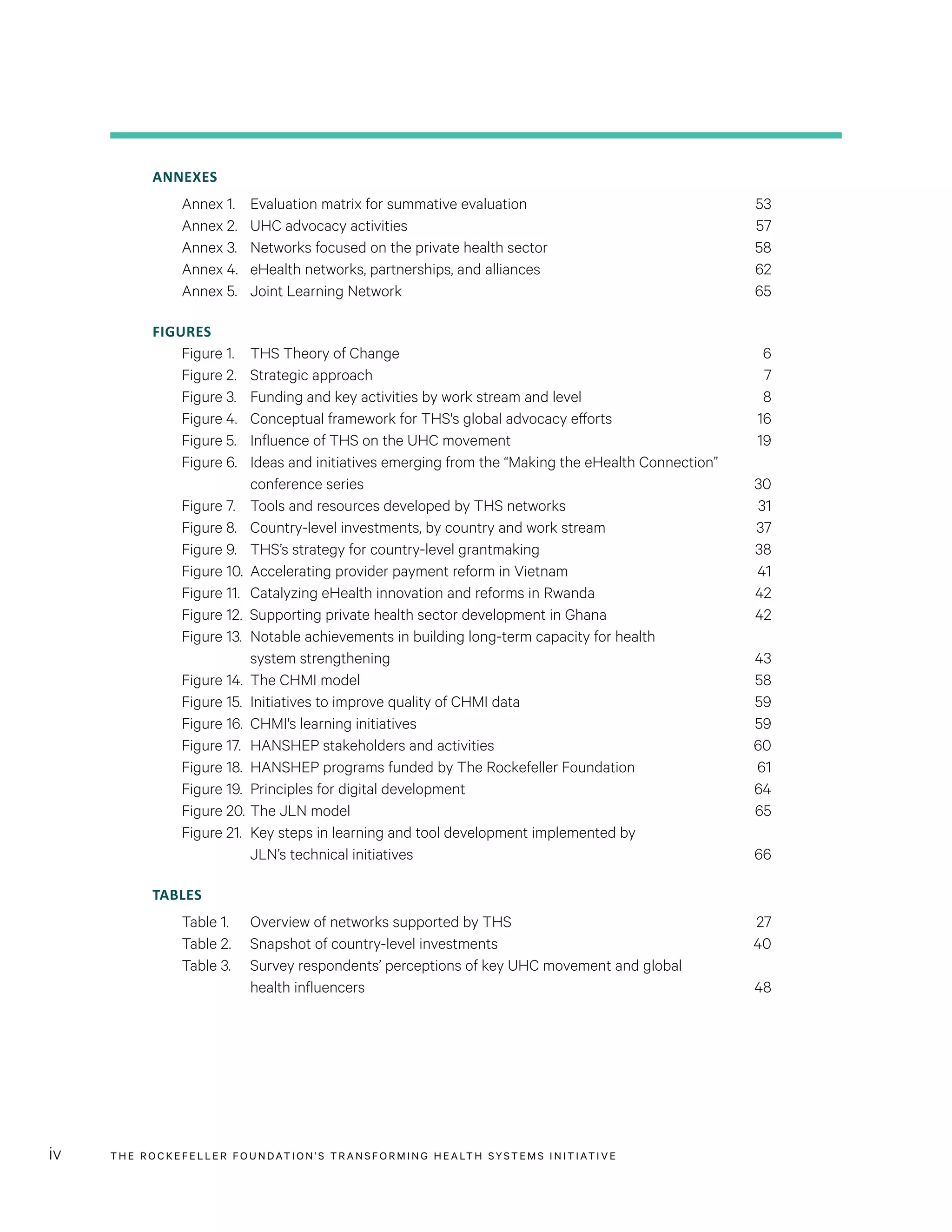
ANNEXES
Annex 1. 	 Evaluation matrix for summative evaluation	 53
Annex 2. 	 UHC advocacy activities	 57
Annex 3. 	 Networks focused on the private health sector	 58
Annex 4. 	 eHealth networks, partnerships, and alliances	 62
Annex 5. 	 Joint Learning Network	 65
FIGURES
Figure 1. 	 THS Theory of Change	 6	
Figure 2. 	 Strategic approach	 7
Figure 3. 	 Funding and key activities by work stream and level	 8
Figure 4. 	 Conceptual framework for THS's global advocacy efforts	 16
Figure 5. 	 Influence of THS on the UHC movement	 19
Figure 6. 	 Ideas and initiatives emerging from the “Making the eHealth Connection”
	 conference series	 30	
Figure 7. 	 Tools and resources developed by THS networks	 31
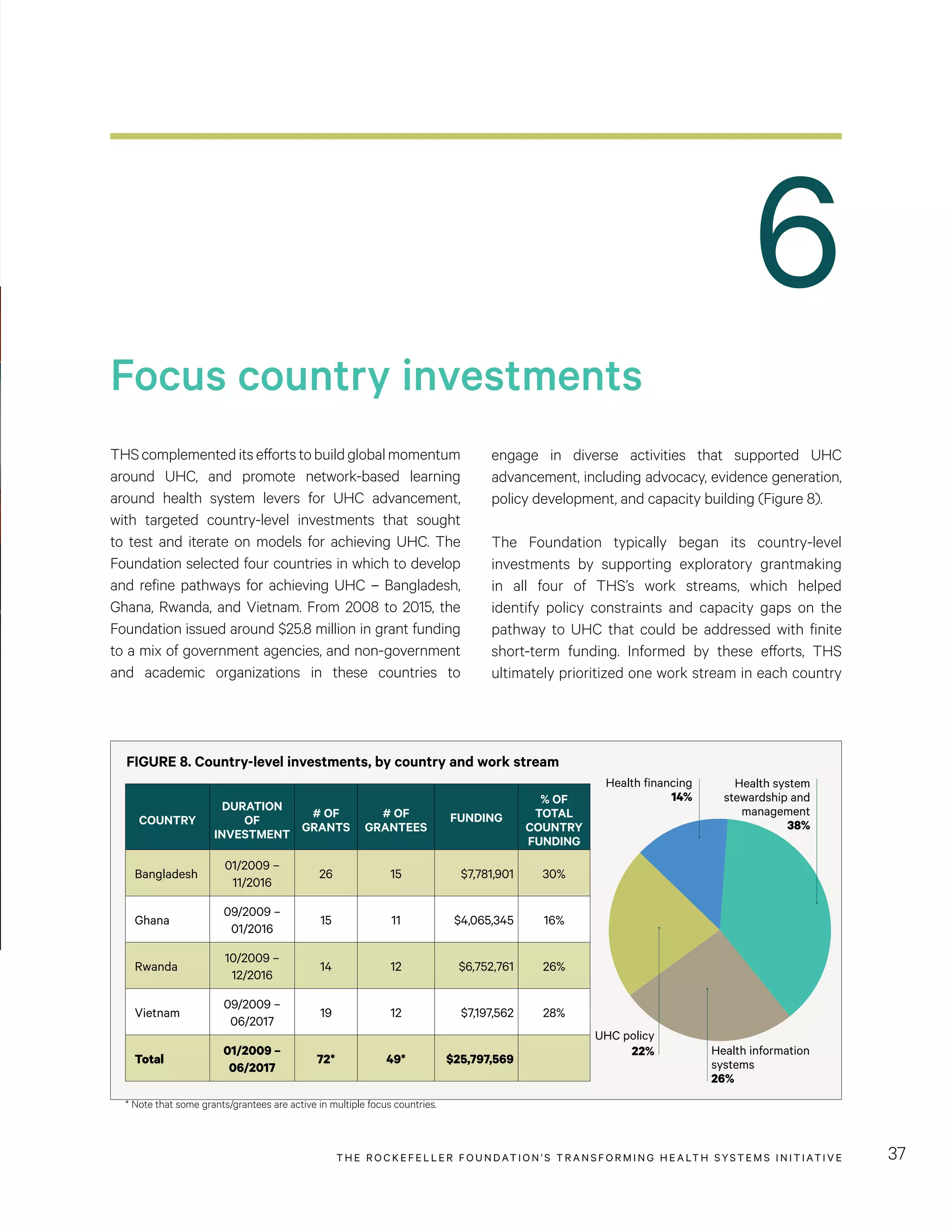
Figure 8. 	 Country-level investments, by country and work stream	 37
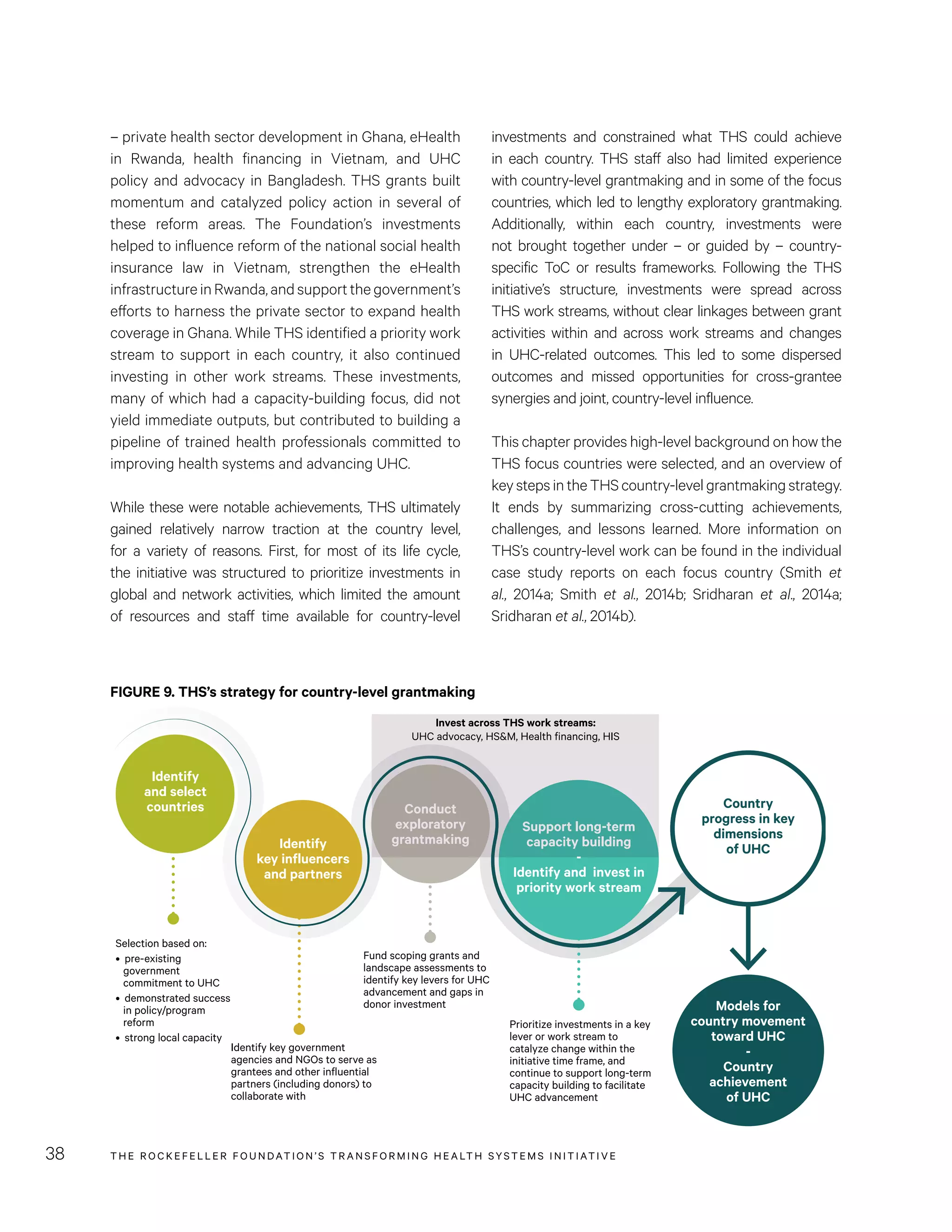
Figure 9. 	 THS’s strategy for country-level grantmaking	 38
Figure 10. 	Accelerating provider payment reform in Vietnam	 41
Figure 11. 	Catalyzing eHealth innovation and reforms in Rwanda	 42
Figure 12. Supporting private health sector development in Ghana	 42
Figure 13. 	Notable achievements in building long-term capacity for health
	 system strengthening	 43
Figure 14. 	The CHMI model	 58
Figure 15. 	Initiatives to improve quality of CHMI data	 59
Figure 16. 	CHMI's learning initiatives	 59
Figure 17. 	HANSHEP stakeholders and activities	 60
Figure 18. 	HANSHEP programs funded by The Rockefeller Foundation	 61
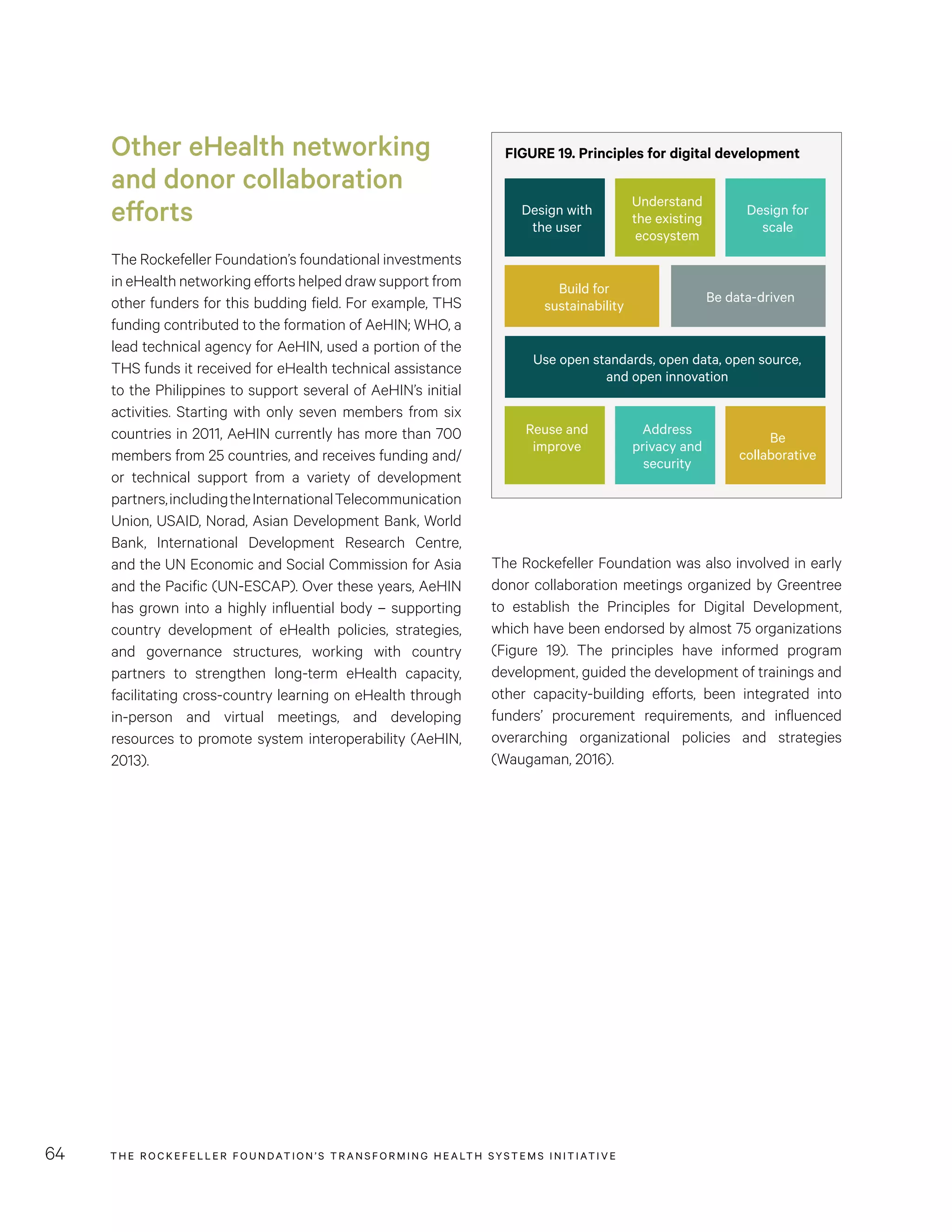
Figure 19. 	Principles for digital development	 64
Figure 20.	The JLN model	 65
Figure 21. 	Key steps in learning and tool development implemented by
	JLN’s technical initiatives	 66	
TABLES
Table 1. 	 Overview of networks supported by THS	27
Table 2. 	 Snapshot of country-level investments	 40
Table 3. 	 Survey respondents’ perceptions of key UHC movement and global
health influencers	 48
THE RO CKEFELLER FOUNDATION’S TRANSFORMING HEALTH SYSTEMS INITIATIVE v
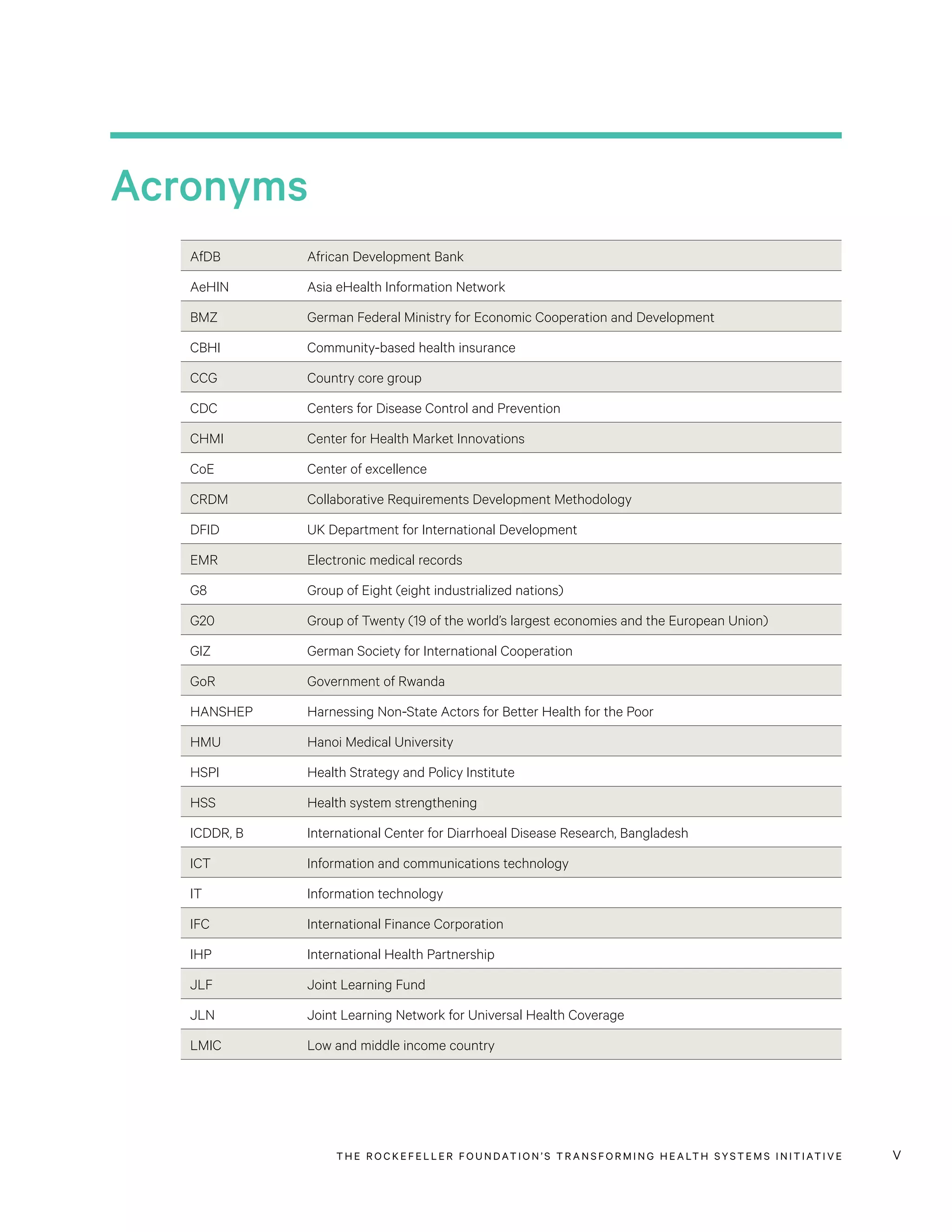
Acronyms
AfDB African Development Bank
AeHIN Asia eHealth Information Network
BMZ German Federal Ministry for Economic Cooperation and Development
CBHI Community-based health insurance
CCG Country core group
CDC Centers for Disease Control and Prevention
CHMI Center for Health Market Innovations
CoE Center of excellence
CRDM Collaborative Requirements Development Methodology
DFID UK Department for International Development
EMR Electronic medical records
G8 Group of Eight (eight industrialized nations)
G20 Group of Twenty (19 of the world’s largest economies and the European Union)
GIZ German Society for International Cooperation
GoR Government of Rwanda
HANSHEP Harnessing Non-State Actors for Better Health for the Poor
HMU Hanoi Medical University
HSPI Health Strategy and Policy Institute
HSS Health system strengthening
ICDDR, B International Center for Diarrhoeal Disease Research, Bangladesh
ICT Information and communications technology
IT Information technology
IFC International Finance Corporation
IHP International Health Partnership
JLF Joint Learning Fund
JLN Joint Learning Network for Universal Health Coverage
LMIC Low and middle income country
THE RO CKEFELLER FOUNDATION’S TRANSFORMING HEALTH SYSTEMS INITIATIVEvi
MDG Millennium Development Goal
MEL Monitoring, evaluation, and learning
mHELP mHealth Expert Learning Network
MoH Ministry of Health
MRS Medical record system
NGO Non-governmental organization
Norad Norwegian Agency for Development Cooperation
OpenHIE Open Health Information Exchange
PEPFAR United States President’s Emergency Plan for AIDS Relief
PHC Primary health care
PLoS Public Library of Science
R4D Results for Development
RHEA Rwanda Health Enterprise Architecture
SDG Sustainable Development Goal
TB Tuberculosis
THS Transforming health systems
TI Technical initiative
ToC Theory of change
UHC Universal health coverage
UN United Nations
UN-ESCAP United Nations Economic and Social Commission for Asia and the Pacific
UNGA United Nations General Assembly
UNICEF United Nations Children’s Fund
USAID U.S. Agency for International Development
WHA World Health Assembly
WHO World Health Organization
THE RO CKEFELLER FOUNDATION’S TRANSFORMING HEALTH SYSTEMS INITIATIVE vii
Preface
In the decade leading up to the 2008 economic crisis, health policy experts increasingly questioned
the donor community’s prevailing focus on interventions targeting specific diseases, such as HIV/AIDS,
tuberculosis, and malaria. Though these disease-specific interventions produced major, measureable
results, they did so at the cost of creating coordination, financial, and reporting challenges for recipient
countries which already had overstretched health systems.
When The Rockefeller Foundation launched its Transforming Health Systems (THS) initiative in 2009, it
committeditselftodrivingrenewedattentiontostrengtheninghealthsystemsasawhole.TheFoundation
believed that this was essential for meeting its overall commitment to equity – so that national health
systems could provide quality care to everyone, rich and poor alike.
THS was ambitious and comprehensive in scope – aiming to build global acceptance for universal
health coverage (UHC), create regional networks to promote learning and innovation, and develop
country demonstration models of efficiency and effectiveness. Accomplishing these goals required a
range of grant and non-grant activities focused on policy and advocacy, health financing, health system
stewardship, and health information systems. Between 2008 and 2015, the Foundation made $115 million
in grants to support work strengthening health systems at the global, regional, and national levels.
This final evaluation – conducted by the Foundation’s monitoring and evaluation grantee, Mathematica
Policy Research – assesses and documents the initiative in its entirety. It reviews the outcomes of the
initiative’sglobaladvocacy,regionalnetworks,andcountry-levelinvestments,anditsoveralleffectiveness
and influence, as well as the Foundation’s legacy for advancing UHC. By sharing this evaluation report, it is
the Foundation’s hope that others will join us in celebrating our successes, learning from our challenges,
and building on this knowledge base to continue advancing Sustainable Development Goal 3 – health
and wellbeing for all.
Veronica Olazabal
Director, Measurement, Evaluation and Organizational Performance
The Rockefeller Foundation
PhotoCredit
©NikitaJapra,2018
Mothers wait with their children outside a village health clinic, 30 km from Malawi's capital city, Lilongwe.
THE RO CKEFELLER FOUNDATION’S TRANSFORMING HEALTH SYSTEMS INITIATIVE ix
Executive Summary
The Rockefeller Foundation’s Transforming Health Systems (THS) initiative (2008–2017) sought to
catalyze health system strengthening (HSS) activities in low and middle income countries (LMICs)
that support advancement toward universal health coverage (UHC). Conceptualized at a time of rising
interest in and political will for UHC, the THS initiative was designed to take advantage of what The
Rockefeller Foundation viewed as a “unique opportunity to drive a global movement to support UHC
and to catalyze the strengthening of health systems that promote greater efficiency and effectiveness,
and are more affordable and equitable” (The Rockefeller Foundation, 2009). THS was approved in 2007,
with an initial budget of $100 million for grantmaking from 2008 to 2012. In 2013, the initiative received
another allocation of $15 million for additional grantmaking until December 2015, with work continuing
under THS through 2017.
THS’s work spanned the global, regional, and country levels, and included complementary grant and
non-grant activities. At the global level, the initiative focused on research and agenda-setting to support
adoption of UHC as a policy goal among global and country actors. At the regional (Global South)
level, it focused on creating and supporting networks that promote cross-learning, innovation, and
collaboration to advance health system reform efforts in LMICs. At the country level, THS addressed
key binding constraints to achieving UHC in four focus countries that the Foundation envisioned could
serve as models for change (Bangladesh, Ghana, Rwanda, and Vietnam). In these countries and through
its regional networks, THS’s efforts focused on four key levers for advancing UHC: policy and advocacy,
health financing, health system stewardship, and health information systems (also referred to as eHealth).
This report synthesizes findings from a five-year, multi-component summative evaluation of the THS
initiative conducted by Mathematica Policy Research. The objectives of the evaluation were to assess:
i) the effectiveness of the three core strategies – global advocacy, regional networks, and country-level
investments in four focus countries – that were employed under THS to advance progress toward UHC
in LMICs, ii) the overall effectiveness and influence of the initiative, and iii) the Foundation’s legacy in the
UHC arena. A key component of the evaluation was to document lessons learned from achievements
and challenges to inform the development of future initiatives at the Foundation. The evaluation, which
began in April 2013 and culminates in this summary report, included six in-depth case studies of THS’s
work at the global, regional, and country levels, as well as prospective data collection to monitor grantee
progress under THS’s consolidation grantmaking phase (2013–2015).
Overall, the evaluation found the THS initiative to be successful in its efforts to activate a global
movement to accelerate progress toward UHC. The Foundation catalyzed and shaped the global UHC
movement and, ultimately, influenced the inclusion of UHC in the Sustainable Development Goals
(SDGs) of the post-2015 agenda. It also created enduring cross-learning platforms and tools to support
country progress toward the SDGs’ UHC targets. Although THS gained less traction in advancing UHC
through its focus country investments, its success in making UHC a global development target and
creating networks and coalitions to support UHC reform efforts in LMICs will likely have country-level
impacts for years to come. Below we provide a summary of key achievements and learnings under THS.
THE RO CKEFELLER FOUNDATION’S TRANSFORMING HEALTH SYSTEMS INITIATIVEx
Notable achievements
Global UHC advocacy
Global advocacy was central to THS’s efforts to catalyze the UHC movement and, in turn, progress
toward UHC at the global and country levels. A key objective of the THS advocacy strategy was to bring
UHC to the forefront of the global health agenda in order to promote widespread adoption of UHC as
a mechanism for improving health outcomes and a policy goal. To do so, The Rockefeller Foundation
leveraged its legacy and convening power in the global health arena, and used a range of advocacy tools,
to expand understanding, use, and operationalization of the UHC term among key global and country
actors. Today, the Foundation is widely recognized as the thought leader behind the UHC movement
among key actors in the UHC space. Its key contributions to the UHC movement are summarized below.
Championed a new policy concept and agenda to support health system strengthening in LMICs.
Although policymakers had started to recognize the importance of well-functioning health systems by
the early 2000s, “health system strengthening” was not gaining sufficient traction to influence policy.
By providing a language and basis for dialogue on HSS that had broad appeal, THS paved the way
for widespread adoption of the UHC term. In its efforts to disseminate and promote the UHC concept,
THS helped to create a new policy space and agenda that brought together a broad range of partners
working to improve health systems in LMICs. It also connected diverse members of the global health
community under a common umbrella and goal.
Influenced the post-2015 agenda process and inclusion of UHC in the SDGs. By using a highly
adaptive approach, and multiple vehicles and tools for policy influence and agenda-setting at the global
and country levels, the Foundation was able to strengthen and shape the UHC movement and ultimately
influence the post-2015 agenda process, culminating in the inclusion of UHC in the SDGs. Through
strategic reflection and pivots at key junctures in the UHC movement, THS effectively responded to and
leveraged changes in the UHC landscape and consolidated gains under the strategy. At the global and
country levels, THS both created and harnessed momentum in support of UHC among key actors and
institutions, and invested in strategic communications and coalition building to strengthen and sustain
the UHC movement and commitment to UHC.
Played a defining role in key milestones that advanced the UHC movement. Several well-recog-
nized milestones in the history of the UHC movement reflect the influence of THS’s advocacy efforts.
These include: i) the THS-supported World Health Report 2010, Health Systems Financing: The Path to
Universal Health Coverage, recognized as the single most influential milestone in the UHC movement
to date; ii) the United Nations General Assembly Resolution A/RES/67/81 (2012), which recommended
inclusion of UHC in the post-2015 development agenda; and iii) public endorsements of UHC by WHO
Director-General Margaret Chan, World Bank President Jim Kim, and prominent economists (via the
Economists’ Declaration on UHC). THS also organized and supported several strategic UHC-themed
convenings around important global meetings and conferences which, in turn, helped to frame, inform,
and increase UHC dialogue at pivotal points in the post-2015 agenda process.
THE RO CKEFELLER FOUNDATION’S TRANSFORMING HEALTH SYSTEMS INITIATIVE xi
Fostered new platforms, coalitions, and partnerships to build sustained momentum around UHC.
THS established and supported multiple global platforms to promote dialogue and evidence generation
around UHC and HSS. These include i) the Global Symposium on Health Systems Research, an annual
meeting of researchers, experts, policymakers, donors, and practitioners, and ii) the People’s Health
Assembly, a meeting held every five years by the People’s Health Movement, a large global network of
health activists, civil society organizations (CSOs), and academics. It also supported the formation of
several new coalitions and partnerships that, in turn, support its advocacy efforts and advance UHC.
These include the UHC Day coalition, a global coalition of 700 organizations that organize UHC Day,
an annual rallying point for the UHC movement. One of the highest profile partnerships to emerge
from THS is the International Health Partnership (IHP) for UHC 2030 (formerly IHP+), a partnership
of governments, development agencies, and CSOs committed to supporting progress toward the SDG
UHC target.
Gained a strong legacy in the UHC arena. The Rockefeller Foundation is widely recognized as the
thought leader behind the UHC movement. Many experts and UHC actors hold the Foundation in high
esteem for its influential role in catalyzing
and advancing the UHC movement, and
its visionary thought leadership in support
of the UHC concept from its early days.
Many noted that the Foundation’s legacy
in the global health arena, combined with
the strong reputation of THS leaders,
was critical for influencing leaders and
decision-makers within the UN and other
institutions, such as the World Health
Organization (WHO), World Bank, and
United Nations Children’s Fund (UNICEF),
to engage in the UHC movement. The
Foundation’s unique convening power
was also cited as a critical factor in the
UHC movement’s success. However,
many are not aware of the Foundation’s
specific contributions to pivotal events in
the history of the UHC movement. This is in part because the Foundation has not publicized its role or
successes in the UHC arena extensively, but instead has empowered global and country actors to be
UHC champions and advance the UHC movement.
Regional networks for cross-learning and collaboration
A key cross-cutting strategy under the THS initiative was to establish networks that would catalyze
learning, collaboration, and innovation around strategies for achieving UHC, and bring other donors on
board to invest in critical HSS efforts. The Rockefeller Foundation has established several successful
networks that bring diverse constellations of health sector stakeholders together to explore and
“Having a strong reputation
changes the receptivity
[of key leaders] and changes the
legitimacy [of the issue].
[The Foundation’s] reputation
was formative for their credibility
in this space.”
– Interviewee
THE RO CKEFELLER FOUNDATION’S TRANSFORMING HEALTH SYSTEMS INITIATIVExii
collaborate on new ideas and approaches. With the Foundation’s strategic and technical guidance,
financial support, and convening power, these networks have generated critical momentum around
“orphan” issues in the HSS space, developed practical tools and resources, and used their learning to
improve health policies, programs, and systems.
Formation of highly valued networks to address critical gaps in global knowledge generation
and collaboration. As the Foundation engaged in efforts to build global momentum around UHC, it
recognized early on that there were limited opportunities for policymakers, practitioners, donors, and
others to learn about and collaborate around approaches to achieving UHC. To address this gap, the
Foundation provided catalytic funding and support to grantee partners to launch networks that shared
experiences and ideas, established knowledge platforms, and developed resources for policy and
program development – thereby creating a strong enabling environment for movement toward UHC.
These networks focused on strategies for overcoming critical constraints to achieving UHC, drawing in
particular on HSS tools and vehicles used in the Global North. For instance, an early priority for THS was
to advance thinking on how to strengthen health systems by leveraging the private sector. To further
knowledge and learning in this area, THS helped launch the Center for Health Market Innovations
(CHMI), which has developed a web platform to catalog and disseminate information on innovative
private health sector programs, and used this information to facilitate replication of effective practices
and generate greater dialogue between public and private sector actors. At around the same time,
the Foundation joined forces with other global health funders to form a donor collaborative focused
on improving the performance of private sector actors in meeting the health care needs of the poor.
Donors in the collaborative, known as the Harnessing Non-State Actors for Better Health for the Poor
(HANSHEP) network, share knowledge and learning around the private health sector and co-finance
promising initiatives.
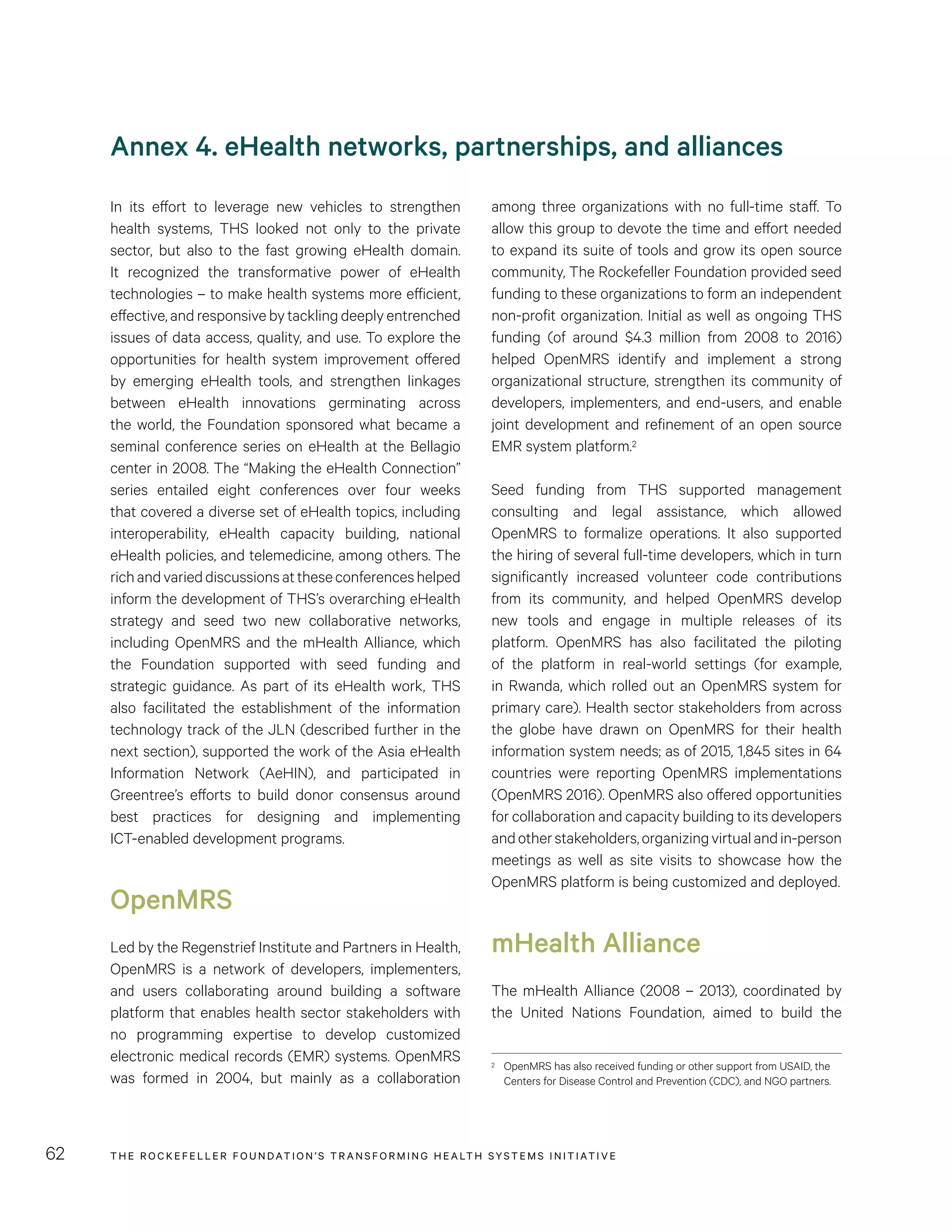
The Foundation also looked to the fast growing eHealth domain to explore opportunities for health
system improvement and identify and support promising solutions. One such strategy was the
development of an open source electronic medical record (EMR) system platform that stakeholders
in LMICs can use to develop their own customized systems. The Foundation provided seed funding
to a loose collaboration of organizations working towards this goal, known as OpenMRS, to form
a strong, sustainable institution and build out their community of practice. The Foundation also
provided funding and support to grantee partners to establish the mHealth Alliance, which aimed to
build the mHealth field through convenings, evidence generation, capacity-building support to NGOs,
and more. The private sector and eHealth network efforts informed the creation of THS’s flagship
network – the Joint Learning Network (JLN) for Universal Health Coverage – that cuts across all work
streams. The JLN connects practitioners from LMICs working towards UHC to facilitate knowledge
sharing and tool development to advance UHC-oriented reforms.
Created greater attention to and consensus around the role of the private sector in health.
HANSHEPgavedonorrepresentativesaplatformtodiscussthisdivisivetopic–opinionshadtraditionally
diverged on the extent to which the private sector should be leveraged in efforts to improve health
THE RO CKEFELLER FOUNDATION’S TRANSFORMING HEALTH SYSTEMS INITIATIVE xiii
coverage. Key informants report that frequent discussion and cross-learning through HANSHEP helped
destigmatize the issue, shined a light on unexplored opportunities and, ultimately, contributed to several
donor representatives mainstreaming private sector engagement into their organizations’ HSS efforts.
CHMI’s web platform of innovative private sector health programs supported this shift, acting as a useful
resource for donors looking to work in this area and for service providers looking to learn from others.
Overall, the platform has increased attention to and understanding of what the private sector has to
offer – profiling over 1,300 innovative programs from 150 countries and receiving between 20,000 and
25,000 visitors each month.
Built lasting momentum around eHealth approaches to strengthening health systems. The
Foundation’s seminal conference – Making the eHealth Connection – held at its Bellagio Center in 2008,
brought together representatives from 34 countries, 32 donor organizations, and 10 high-profile news and
media outlets. The conference was a “tipping point” in the use of eHealth as a key HSS tool – generating
transformative ideas and building a broad, cross-sectoral commitment to testing new approaches,
building evidence, and changing policy. The mHealth Alliance was seeded at the conference and has
continued this work, focusing in particular on the use of mobile phones and technology to strengthen
health service delivery. The Alliance’s mHealth summits, technical working groups, and other informal
networking activities strengthened linkages among mHealth actors and, overall, gave greater shape and
a larger profile to a relatively fragmented field.
Developed useful, practical tools and resources. Networks formed through THS have developed a
rangeoftoolsandresourcestohelppolicymakersandpractitionersembarkonthoughtful,evidence-based
reform of programs, policies, systems, and processes. These “global public goods” are grounded in an
understanding of the context and designed to address practical challenges faced day to day in the
health systems of LMICs. They include, for example, knowledge products summarizing prior experiences
with reform, guidelines for assessments to inform reform efforts, open source tools for strengthening
health information systems, and more.
Strengthened policies and programs through cross-learning and collaboration. Some networks
have been successful in translating the momentum and learning they have generated, and the tools and
resources they have developed, into tangible change in programs, policies, and systems. For example,
policymakers and practitioners have drawn on JLN tools, to conduct costing studies and use results
to inform the development of a national health protection scheme in India, and the reform of provider
payment systems in Vietnam. The OpenMRS platform was piloted in Rwanda, which has since engaged
in a national rollout of the OpenMRS EMR system for primary care. More broadly, as of 2015, 1,845 sites
in 64 countries were reporting OpenMRS implementations.
Positioned networks for sustainability. The progress made by THS-supported networks – in fostering
strong partnerships, generating useful resources, and motivating policy and programmatic action – has
attracted support from other donors. CHMI, JLN, and the mHealth Alliance all eventually expanded their
sources of funding, and CHMI and JLN have strong sustainability planning efforts underway to ensure
their work continues beyond the life of the THS initiative.
THE RO CKEFELLER FOUNDATION’S TRANSFORMING HEALTH SYSTEMS INITIATIVExiv
Supporting country models for change
The Foundation selected four countries – Bangladesh, Ghana, Rwanda, and Vietnam – in which to
develop, refine, and support pathways for achieving UHC, with the goal of developing models for change.
In these countries, it invested in advocacy, evidence generation, policy development, and capacity-
building activities. These activities increased understanding of UHC in these countries, contributed to
building local capacity, and helped advance critical reform efforts.
Catalyzed and advanced nascent or slow-moving reform efforts. THS identified and tackled
well-defined constraints to UHC reforms to facilitate achievement of concrete results within the
initiative’s lifespan. In Vietnam, THS propelled provider payment reforms forward by identifying and
addressing a need for rigorous costing data collection and analysis. In Rwanda, the Foundation supported
implementation of the country’s new eHealth strategy, supporting the establishment of an eHealth
secretariat within the Ministry of Health (MoH), the development of eHealth tools, and the roll-out
of an OpenMRS EMR system for primary care. In Ghana, it supported government efforts to leverage
the private sector to expand access to health services and enrollment in its national health insurance
scheme. THS grants helped to strengthen the MoH’s Private Sector Unit, develop a new private health
sector policy, and improve accreditation processes for private providers.
Positioned countries for long-term progress on health system priorities through institutional
capacity-building grants. THS contributed to building a strong pipeline of health sector officials
committed to health system strengthening by establishing degree programs and founding centers
of excellence at local academic institutions. However, these efforts were not designed to and did not
produce immediate impacts on reform processes.
Increased understanding of UHC concept in focus countries. Through meetings, convenings, and
production of a variety of reports and publications, THS strengthened awareness and understanding of
UHC both within and beyond the health sector, and seeded nuanced dialogue around its core objectives
and elements.
Challenges
Broad scope and siloed grantmaking. The THS initiative emerged out of The Rockefeller Foundation’s
efforts to develop four separate Advance Health initiatives focused on i) research and agenda-setting on
UHC and HSS, ii) enhancing health system stewardship capacity, iii) harnessing the private sector, and
iv) leveraging eHealth technology. In 2008, the Foundation decided to combine these four initiatives into
one large initiative aimed at transforming health systems toward UHC. As a result, THS was expansive in
scope, encompassing four largely independent work streams operating at multiple levels, all organized
around a very broad and ambitious long-term goal. Ultimately, THS’s four work streams were not brought
together under an initiative-level theory of change or results framework that articulated how they would
work together to strengthen health systems in support of UHC. In turn, grantmaking tended to be siloed
and synergies across work streams and levels of intervention were difficult to identify and leverage,
leading to some missed opportunities.
THE RO CKEFELLER FOUNDATION’S TRANSFORMING HEALTH SYSTEMS INITIATIVE xv
Abrupt shifts in strategy. Key informants felt that THS’s private sector and eHealth investments, which
were gaining traction at both the regional and country levels, were called to a halt too soon, which
compromised opportunities for effecting long-term change. For example, THS’s investments in Ghana
were helping to develop capacity to expand the private sector’s role in advancing UHC, but the decision
to wind down private sector-focused grantmaking in 2011 led to some loss of momentum and persisting
gaps in donor support for private sector efforts. A similar narrative emerged in the eHealth space. For
example, once THS funding for eHealth came to a close, the mHealth Alliance found it difficult to raise
funds for its thought leadership, evidence generation, and partnership-building activities – which were
a critical part of its scope of work. The mHealth Alliance eventually wound down in 2013, for this reason
as well as others – including its overly broad scope of work and the growing presence of other actors
stepping into the role that the mHealth Alliance was created to fill.
Reliance on exploratory grantmaking in focus countries. The Foundation threw a wide net to identify
promising short-term investment opportunities as it began grantmaking in its focus countries. However,
at times, this exploratory approach was continued into the “execution” phase of country-level strategies,
leading to disproportionate spending on scoping investments.
Limited traction at the country level. The Foundation had more limited success at the country level
than at the global and regional levels – for several reasons. First, the Foundation had limited resources
to invest at the country level, and these were spread relatively thin across THS’s multiple work streams,
which in turn diluted the Foundation’s influence in focus countries. The Foundation was also constrained
by its limited experience with country-level grantmaking and its lack of a local presence. Without country
offices, THS staff found it challenging to establish relationships with all relevant government actors and
to build collaborative partnerships with other donors in the country. Despite these constraints, THS
did make significant contributions to reform efforts in some countries, helping to propel these efforts
forward to advance UHC. However, this typically happened when a number of enabling factors aligned
organically – such as when synergies emerged between the JLN’s work and policy priorities in Vietnam
and grew into a targeted country-level effort to guide provider payment reform.
Key learnings
Identifyawell-respectedleadertotakethehelmandasubjectmatterexperttoguidetheinitiative.
THS directors responsible for leading the initiative’s global advocacy work and making it a success
were well-known and respected in the global health arena, and possessed an historical perspective that
enabled them to identify strategies and actors that could catalyze the UHC movement. Subject matter
experts managing initiative components played a critical role in shaping the discourse in emerging fields
such as eHealth, and providing needed technical guidance to grantees entering these fields.
Make big bets and bold moves, but ensure objectives are right-sized and aligned with
comparative advantage. Initiative goals should be ambitious, but also feasible, and be closely aligned
with Foundation strengths. For example, the Foundation had the legacy, leadership, and convening
power to move the needle at the global and regional levels – bringing diverse actors together around
THE RO CKEFELLER FOUNDATION’S TRANSFORMING HEALTH SYSTEMS INITIATIVExvi
the policy goal of UHC and facilitating widespread collaboration around strategies for achieving that
goal. By contrast, at the country level, the Foundation had limited experience and relatively sparse
networks, which resulted in portfolios that did not always cohere to achieve common objectives and
ultimately had uneven influence.
Invest in areas where finite funding can have outsized and enduring impacts, such as in global
advocacy and network-based learning. Adoption of a multi-level, multi-pronged advocacy strategy
was critical to THS’s success in elevating UHC’s status on the global agenda, and catalyzing action
among global leaders, donors, and policymakers to propel long-term HSS efforts in LMICs. Learning
networks are also a powerful vehicle for effecting change in the long term. The Foundation helped form
five networks over the course of THS, four of which continue today to facilitate learning, collaboration,
and innovation around approaches for strengthening health systems and advancing UHC.
Use theories of change to inform approach, and monitoring, evaluation, and learning (MEL)
activities to guide strategy refinements. Initiative-wide theories of change, as well as results
frameworks for specific initiative components, can help ensure the development of a cohesive portfolio
of investments that are tied to well-defined, achievable goals. Theories of change and results frameworks
can minimize the type of portfolio fragmentation the THS initiative experienced, and ensure that
linkages across different grants and levels are identified and leveraged. They also provide an underlying
framework for MEL activities, which are critical for tracking initiative progress and making timely and
evidence-based refinements to strategy. Integrating MEL activities early on – and building decision
points into the initiative strategic plan – can be particularly helpful in reining in lengthy exploratory
grantmaking and expediting the process of identifying focus areas.
1
THE RO CKEFELLER FOUNDATION’S TRANSFORMING HEALTH SYSTEMS INITIATIVE 1
The Transforming Health Systems (THS) initiative
was one of The Rockefeller Foundation’s largest global
health initiatives. Aligned with the Foundation’s mission
to promote the well-being of humanity, THS aimed to
improvethehealthstatusandfinancialresilienceofpoor
and otherwise vulnerable populations through activities
promoting improved health systems performance and
the expansion of universal health coverage (UHC).
THS was approved by the Foundation’s Board of
Trustees in 2007, with an initial budget of $100 million
for grantmaking from 2008 to 2012. In 2013, the
initiative received another allocation of $15 million for
additional grantmaking until December 2015, with work
continuing under THS through 2017.
The THS investment strategy focused on health
system strengthening levers that have received less
attention from the international community and
contribute to the initiative’s ultimate goal of UHC. The
initiative defined UHC as “access for all to appropriate
health services at an affordable cost,” and aimed to
increase the percentage of the global population
benefiting from health coverage from 40 percent
in 2009 to 60 percent in 2017 through increased
health coverage in low and middle income countries
(LMICs). To achieve this goal, THS’s work spanned
the global, regional, and country levels, and included
complementary grant and non-grant activities.
At the global level, THS focused on research and
Introduction
agenda-setting to support adoption of UHC as a
policy goal among global and country actors. At the
regional (Global South) level, it focused on catalyzing
and supporting networks that promote cross-
learning, innovation, and collaboration to advance
health system reform efforts in LMICs. At the country
level, the initiative addressed key binding constraints
to achieving UHC in four focus countries that the
Foundation envisioned could serve as models for
change – Bangladesh, Ghana, Rwanda, and Vietnam.
In these countries and through its regional networks,
THS’s efforts focused on four key levers for advancing
UHC: policy and advocacy, health financing, health
system stewardship, and health information systems
(also referred to as eHealth).
This report synthesizes findings from a five-year, multi-
component evaluation of the THS initiative conducted
by Mathematica Policy Research. The objectives of
the evaluation were to assess i) the effectiveness of
the three core strategies – global advocacy, regional
networks, and country-level investments – employed
under THS to advance progress toward UHC in LMICs
in four focus countries, ii) the overall effectiveness and
influenceoftheinitiative,andiii)theFoundation’slegacy
in the UHC arena. A key component of the evaluation
was to document lessons learned from achievements
and challenges to inform the development of future
initiatives at the Foundation.
THE RO CKEFELLER FOUNDATION’S TRANSFORMING HEALTH SYSTEMS INITIATIVE2
THS initiative. In Chapter 3, we provide an overview of
the evaluation. Chapters 4–6 summarize findings from
ourassessmentofeachofTHS’sthreecoreintervention
strategies at the global, regional, and country levels,
respectively. Chapter 7 presents concluding findings on
the overall effectiveness and influence of the initiative.
The evaluation, which began in April 2013 and
culminates in this summary report, included six
in-depth case studies of THS’s work at the global,
regional, and country levels, as well as prospective data
collection to monitor grantee progress under THS’s
consolidation phase (2013–2015). The report is divided
into 7 chapters. In the next chapter, we describe the
THE RO CKEFELLER FOUNDATION’S TRANSFORMING HEALTH SYSTEMS INITIATIVE 3
2
Description of the initiative
Conceptualization and
rationale
The THS initiative was conceptualized in the context
of a broader Foundation-wide effort to refine the
Foundation’s investment strategy to strengthen its
impact. This effort, spearheaded by a new Foundation
president in 2005, included a critical examination
of the Foundation’s role in the global health arena,
an area in which the Foundation had a long history
dating back to its first grants in the early 1900s.
Public health and medical research were among the
Foundation’s first focus areas and included pioneering
initiatives to eradicate preventable diseases such as
malaria and yellow fever on an international scale,
and to establish public health schools in a number
of countries (including the first public health school
in the U.S., at Johns Hopkins University, in 1918).
The Foundation’s robust public health programming
continued into the twenty-first century, with an
ongoing focus on important diseases of the day,
later including HIV/AIDS and childhood diseases.
However, by the early 2000s, a number of new and
large foundations and donor initiatives had entered
the global health landscape, with an overlapping
focus on prevention, treatment, and/or elimination
of specific diseases. These new actors included the
Bill & Melinda Gates Foundation, the Global Fund to
Prevent AIDS, Malaria, and Tuberculosis (TB), and
the United States President’s Emergency Plan for
AIDS Relief (PEPFAR), among others. In recognition
of the important role these large actors were playing,
The Rockefeller Foundation launched a strategic
reflection process in the mid-2000s to reassess its
comparative advantage and value-added within this
new donor landscape.
The idea for the THS initiative emerged from this
strategic reflection process. The Foundation sought
to identify a strategic niche in global health that
would leverage its legacy in public health, historic
convening power, and heritage of building networks
and institutions to address global problems, and also
stand separate from the multitude of efforts being
pursued by other foundations and global actors. In
addition, the Foundation’s refined health investment
strategy needed to be aligned with a new strategic
model adopted by the Foundation at this time,
which focused on innovation and achieving impact
within time-bound initiatives organized around four
outcome areas: i) Revalue Ecosystems, ii) Advance
Health, iii) Secure Livelihoods, and iv) Transform
Cities. Global health work fell under the “Advance
Health” outcome area. Under this new initiative
approach, each new initiative was to be developed
THE RO CKEFELLER FOUNDATION’S TRANSFORMING HEALTH SYSTEMS INITIATIVE4
LMICs had taken significant steps to move their
financing systems toward UHC, using various forms
of prepayment and risk-pooling to improve access
to health services and financial protection against
illness.
Againstthisbackdropofrisinginterestinandpoliticalwill
forUHC,theTHSinitiativewasconceivedin2008totake
advantage of what the Foundation viewed as a “unique
opportunity to drive a global movement to support UHC
and to catalyze the strengthening of health systems
that promote greater efficiency and effectiveness and
are more affordable and equitable” (The Rockefeller
Foundation, 2009). To do so, it sought to reframe health
system strengthening as a mechanism for achieving
UHC, a term that was easier for non-health sector actors
to understand, and was starting to gain support globally
as a key mechanism for achieving progress toward the
health-related Millennium Development Goals (MDGs).
UHC implies full coverage of essential health services,
and involves health system strengthening efforts to
improve the quality, availability, and affordability of
serviceslinkedtotheMDGs,includingessentialmaternal
and child health services.
Search and development
Following the Foundation’s new initiative model, THS
was developed out of a series of “searches” to identify
strategic opportunities and levers to advance the UHC
agenda at the global and country levels. Drawing on
the findings of the 2000 World Health Report, the
search phase focused on exploring possible initiatives
in five areas.
1.	 Enhancing professional capacity for health
system stewardship. This search focused
on identifying required competencies for and
capacity gaps around health system planning
and management in LMICs, an area aligned with
the Foundation’s history of building institutional
pipelines of trained public health and medical
professionals on an international scale.
based on targeted “searches” to identify emerging
opportunities and innovative solutions.1
To inform searches in the Advance Health area, the
Foundation first identified what it perceived to be a
key gap in the global health landscape at that time:
investment in health systems. Starting in the 1990s,
donor support had shifted away from the “horizontal”
systems-wide efforts to achieve universal access
to primary care that followed the 1978 Alma Alta
declaration, and became increasingly focused on
“vertical” efforts focused on select diseases, including
HIV/AIDS, TB, and malaria, among others. Although
these vertical efforts had produced major results and
measureable improvements in health status, by the
late 1990s there was emerging evidence that their
narrow focus on specific diseases had resulted in the
neglect, and arguably the exacerbation, of fundamental
weaknesses in health systems, thereby compromising
access to basic primary care services (Hafner and
Shiffman, 2012).
Highlighting this issue, the World Health Report 2000
focused on health systems performance, arguing
that a well-functioning health financing system was
critical to improving population health and health
equity. In particular, the report underscored the
importance of reducing the burden of out-of-pocket
payments for health services, harnessing the private
sector to improve health systems performance, and
strengthening country stewardship of the health
system (WHO, 2000). Following this report, the need
for UHC-oriented health system reforms became
increasingly integrated into global and country
discourse and agendas, leading to the landmark
2005 World Health Assembly (WHA) resolution on
sustainable health financing, UHC, and social health
insurance. In addition, by the mid-2000s, several
1	 Initiatives typically followed an “initiative pipeline” that included several
distinct phases: i) a scan phase, in which a wide range of problem areas
and opportunities were identified for consideration, using the criteria of
dynamism, feasibility, and potential impact; ii) a search phase, in which
a smaller set of problem areas were weighed against other potential
options and the most promising were selected; iii) a development phase,
in which the selected problem and solution is planned, tested, and
modified as needed; and iv) an execution phase.
THE RO CKEFELLER FOUNDATION’S TRANSFORMING HEALTH SYSTEMS INITIATIVE 5
To further inform its thinking, in September 2007,
The Rockefeller Foundation organized a two-day
consultation meeting with key global health leaders,
including the Secretary General of the United Nations
(UN), and former U.S. President Jimmy Carter, at the
Pocantico Center in New York. The objectives of the
meeting, entitled “Meeting the Challenge of Health
Systems,” were to discuss and examine the role that
The Rockefeller Foundation could play in these search
areas, and to gain buy-in among global influencers for
making health system strengthening and UHC central
components of the global policy agenda.
Following the Pocantico meeting, the Foundation
began to develop initiatives in four of the five search
areas: i) enhancing health system stewardship
capacity, ii) harnessing the private health sector, iii)
leveraging eHealth technology, and iv) strengthening
disease surveillance systems. In 2008, the Foundation
decided to combine the first three initiatives into one,
larger initiative, and to pursue disease surveillance
separately, as it was found to be more aligned with a
“vertical” disease-focused approach than a “horizontal”
health system strengthening approach. In addition,
recognizing the need for strategic advocacy to build
global momentum around UHC, the Foundation added
a “research and agenda-setting” work stream to the
THS initiative.
Recognizing the ambitious scope of THS, the
Foundation’s board initially agreed to provide a budget
of $150 million for the execution phase of the initiative.
However, following the financial crisis, the board
ended up approving an initial budget of $100 million
for five years of grantmaking (2008–2012), which was
increased to $115 million in 2013, to fund grantmaking
through 2015.
Theory of change
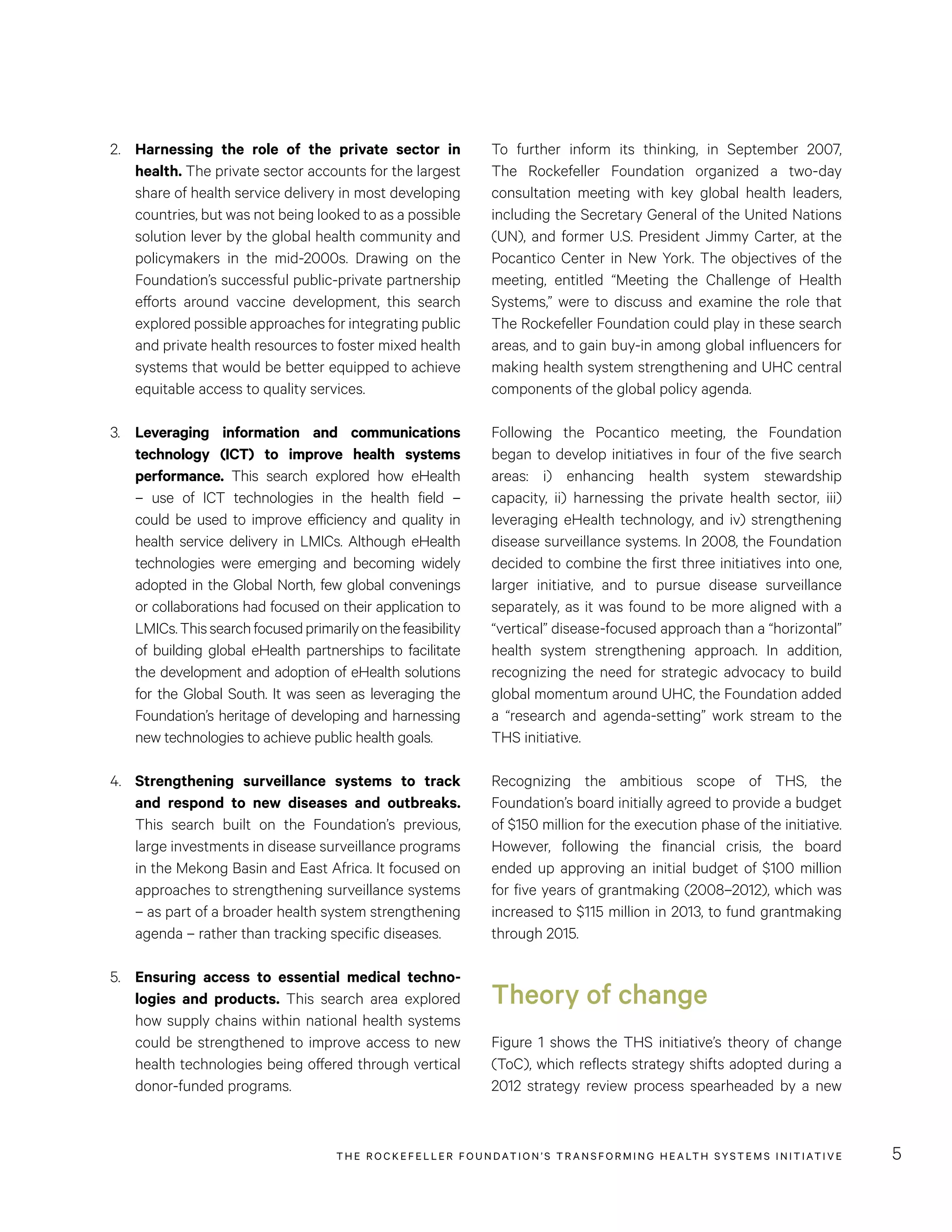
Figure 1 shows the THS initiative’s theory of change
(ToC), which reflects strategy shifts adopted during a
2012 strategy review process spearheaded by a new
2.	 Harnessing the role of the private sector in
health. The private sector accounts for the largest
share of health service delivery in most developing
countries, but was not being looked to as a possible
solution lever by the global health community and
policymakers in the mid-2000s. Drawing on the
Foundation’s successful public-private partnership
efforts around vaccine development, this search
explored possible approaches for integrating public
and private health resources to foster mixed health
systems that would be better equipped to achieve
equitable access to quality services.
3.	 Leveraging information and communications
technology (ICT) to improve health systems
performance. This search explored how eHealth
– use of ICT technologies in the health field –
could be used to improve efficiency and quality in
health service delivery in LMICs. Although eHealth
technologies were emerging and becoming widely
adopted in the Global North, few global convenings
or collaborations had focused on their application to
LMICs.Thissearchfocusedprimarilyonthefeasibility
of building global eHealth partnerships to facilitate
the development and adoption of eHealth solutions
for the Global South. It was seen as leveraging the
Foundation’s heritage of developing and harnessing
new technologies to achieve public health goals.
4.	 Strengthening surveillance systems to track
and respond to new diseases and outbreaks.
This search built on the Foundation’s previous,
large investments in disease surveillance programs
in the Mekong Basin and East Africa. It focused on
approaches to strengthening surveillance systems
– as part of a broader health system strengthening
agenda – rather than tracking specific diseases.
5.	 Ensuring access to essential medical techno-
logies and products. This search area explored
how supply chains within national health systems
could be strengthened to improve access to new
health technologies being offered through vertical
donor-funded programs.
THE RO CKEFELLER FOUNDATION’S TRANSFORMING HEALTH SYSTEMS INITIATIVE6
to wind down and eventually end THS’s private health
sector and eHealth work, which was seen as more
distally related to UHC, except in the few cases where
THS investments were having a direct impact on UHC
reform processes in focus countries.
Figure1 showsthefouroutcomeareas,orworkstreams,
around which THS investments were organized
following the 2012 strategy review.
1.	 UHC embraced as a global and country policy
goal. The Foundation’s activities in this outcome
area focus on adoption of UHC as a health policy
goal at the global and country levels.
2.	 Improved stewardship and management of
mixed (public-private) systems that increase
access to quality care and resilience.
	 Investments in this outcome area focus on improving
government capacity to steward the overall health
system, including its public and private components,
and to use data to develop, plan, and manage
implementation of policy reform efforts. This work
stream includes efforts aimed at leveraging the
private sector to improve health care financing and
access (which formerly fell under an independent
outcome area and were scaled back starting in 2012).
THS managing director. THS’s ultimate goal, as shown
in the highest-level outcome in the ToC diagram, was
to improve health status and the distribution of health
services among people worldwide. The Foundation
believed that UHC was a necessary policy goal to that
end, and that working to transform health systems
in LMICs was a critical piece of the work needed to
achieve UHC at a global level. Under the ToC, the two
core outcomes for individuals within a transformed
health system were: i) equitable access to quality care,
and ii) improved resilience from financial shocks arising
from health care needs.
At the beginning of the initiative, THS’s intervention
areas were organized around four strategic levers for
transforming health systems toward UHC: i) fostering
health systems research and agenda-setting at the
global level, ii) harnessing the private sector as an
important component of health systems, iii) enhancing
health system capabilities in developing countries,
and iv) promoting design and implementation of
interoperable eHealth systems. During a 2012 strategy-
refresh process, the initiative’s strategy was revised
and narrowed to align THS’s work more directly with
achievement of both dimensions of UHC – access to
quality health care and financial protection against
illness. This narrowing of THS’s focus led to the decision
FIGURE 1. THS Theory of change
UNIVERSAL HEALTH COVERAGE
Equitable access to quality care Improved financial resilience to health-related shocks
UHC
embraced as a
global and
country policy
goal
Improved STEWARDSHIP
and management of
mixed health systems that
increase access to quality
care and resilience
Improved HEALTH
FINANCING
policy that
increases access
and resilience
Improved HEALTH
INFORMATION SYSTEMS
that leverage reusable
eHealth platforms and
standards for UHC access
and resilience
Momentum
carries the
work forward
Rockefeller
Foundation
intervention is
essential to
catalyze and
accelerate
change
Social determinants of health Improved health status and distribution of health
FIGURE 2. Strategic approach*
THE RO CKEFELLER FOUNDATION’S TRANSFORMING HEALTH SYSTEMS INITIATIVE 7
and convenings, and a range of advocacy efforts to
elevate awareness, understanding, and use of the UHC
concept. To promote adoption of UHC as a measurable
policy goal, it also supported the development of
a measurement framework and indicators to track
progress toward the various dimensions of UHC at the
country level.
THS’s work at the regional level focused on creating
and contributing to collaborative networks that would
be sustainable beyond the life of the initiative and
propel health system reform efforts at the country
level. Over the course of the initiative, THS developed
networks to catalyze global support, innovation, and
country action around the three technical health
system levers on which the initiative focuses: i) health
3.	 Improved health financing policy that increases
access and resilience.
	 Thisareafocusesonstrengtheninghealthfinancing
policy, including provider payment systems and
mechanisms to reduce direct out-of-pocket
payments for health services, including national
health insurance and health service prepayment
schemes. This has been a focus of THS’s work
since the initiative went into execution in 2009
(health financing activities fell under other work
streams before the 2012 strategy refresh process).
4.	 Improved health information systems that
leverage reusable e-health platforms and
standards for UHC.
	 Activities in this work stream promote the design
and implementation of interoperable eHealth
systems by supporting the development of
eHealth tools and models that can be shared
among countries, contributing to national eHealth
policy and planning efforts, and strengthening
government capacity to implement, use, and
maintain eHealth systems.
Strategic approach
To influence change toward the four health system
outcomes shown in Figure 1, THS’s strategy involved
mutually reinforcing activities at the global, regional
(Global South), and country levels. A key assumption
underlying THS’s approach is that momentum,
collaboration, and action is needed at all levels to
support and advance health reform efforts in LMICs.
Figure 2 summarizes the focus of THS activities at
each intervention level, and Figure 3 describes key
activities at each level, by outcome area. At the global
level, THS focused on bringing UHC to the forefront of
the global health and development agenda, as a means
of promoting widespread adoption of UHC as a policy
goal and gaining support for UHC-oriented health
reforms in LMICs. To do so, the Foundation invested
in evidence generation and dissemination, meetings
REGIONAL LEVEL (GLOBAL SOUTH)
($31.1 million)
Create networks to facilitate cross-learning,
innovation and collaboration around health
systems levers to achieve UHC
COUNTRY LEVEL
($25.8 million)
Advance country reform efforts in
four countries that could serve as
models for change
*Roughly $24 million of THS’s $115 million grantmaking
budget was allocated to activities that fell outside of its
global, regional, and focus country portfolios (see text for
more detail).
GLOBAL LEVEL
($34.0 million)
Leverage The Rockefeller Foundation’s
legacy, influence, and convening power to
elevate UHC on the global agenda
THE RO CKEFELLER FOUNDATION’S TRANSFORMING HEALTH SYSTEMS INITIATIVE8
UHC POLICY AND
ADVOCACY
HEALTH SYSTEM
STEWARDSHIP AND
MANAGEMENT HEALTH FINANCING EHEALTH
Global
activities
•	Dissemination of
information on the UHC
concept
•	Building awareness
of health systems
transformations toward
UHC in LMICs
•	UHC agenda-setting
meetings and exercises
around key global
meetings
•	Development and use
of UHC performance
metrics
•	Advocacy for inclusion
of UHC in regional and
global resolutions
Regional/
Network
activities
•	Momentum building
around UHC through
networks and
partnerships (see right)
•	Development of
regional community-
of-practice networks to
facilitate joint learning
among policymakers,
practitioners, and
donors on different
aspects of health
system strengthening
(including
strengthening the
private sector,
expanding health
coverage, primary
health care, health
financing, and eHealth)
•	Development of
tools to strengthen
health financing
mechanisms,
including prepayment
and health insurance
schemes, supporting
provider payment
reforms, costing
expansions of health
coverage
•	Research and
evidence generation
on health financing
•	Technical support
to facilitate provider
payment reforms
Country-
level
activities
•	Trainings, dialogues,
and study tours to
increase awareness and
understanding of UHC
concept
•	Development of
strategic plans for
achieving UHC
•	Trainings at the
ministerial, academic,
and professional levels
on data-driven health
system management
and planning
•	Creation of centers
of excellence and
academic programs
to build a pipeline of
health policy experts
and practitioners
•	Private sector-focused
evidence generation
and policy development
•	Research and
evidence generation
on health financing
•	Technical support
to facilitate provider
payment reforms
•	Technical support to
strengthen eHealth
institutions and
develop eHealth
policy frameworks
•	Development
of enterprise
architectures and
customized EMR
systems
•	eHealth capacity
building through
creation of academic
programs
FIGURE 3. Funding and key activities by work stream and level
THE RO CKEFELLER FOUNDATION’S TRANSFORMING HEALTH SYSTEMS INITIATIVE 9
advocacy, health system stewardship, health financing,
and eHealth). Its investments focused on addressing
key binding constraints within the national health
system that are most important to overcome in order to
advance toward UHC. Across all four focus countries,
THS helped support health ministries and other actors
in policy development, implementation, and regulation,
and also invested in long-term capacity building
efforts – establishing academic programs and centers
of excellence – to strengthen the pipeline of health
system experts and managers. However, within each
country, THS focused on a specific “change lever” to
catalyze health systems improvement. These strategic
focus areas included:
•	 leveraging the private sector to support
improvements in access to services and expand
enrollment under Ghana’s national health insurance
program
•	 strengthening the stewardship, management, and
implementation of eHealth systems and tools
in Rwanda to increase efficiency and quality of
health services and strengthen the national health
pre-payment scheme
•	 facilitating evidence-based provider payment
reforms under Vietnam’s national health insurance
program
•	 supporting advocacy for UHC and strengthening
stewardship of mixed health systems in
Bangladesh.
As shown in Figure 2, THS investments in its three
primary intervention levels ranged from roughly $26
million at the country level to $34 million at the global
level, and accounted for approximately 80  percent
of THS’s total grant expenditures. The remaining
20 percent, or $23 million, was used for a number of
cross-level or discrete activities that fell outside of
its core global, regional, and focus country portfolios,
including select exploratory grantmaking and research
efforts, monitoring and evaluation of THS, targeted
activities in a small number of non-focus countries, and
some conference activities.
system stewardship, ii) the private sector in health,
and iii) eHealth. These networks brought together
a constellation of actors, including donors, technical
experts, policymakers, and practitioners, to share
learning, capture knowledge, and develop solutions
and practical tools to advance country reform efforts.
Key networks created and supported under the THS
initiative include:
•	 Center for Health Market Innovations (CHMI),
which catalogs and shares information on
innovative private sector approaches to improving
health outcomes and fosters knowledge sharing
among service providers
•	 Harnessing Non-State Actors for Better Health
for the Poor (HANSHEP) network, a collaborative
of donors who co-finance promising initiatives
focused on the private health sector
•	 OpenMRS, a group of organizations developing an
open source platform for electronic medical record
(EMR) systems
•	 mHealth Alliance, which sought to strengthen
the mHealth field through convenings, evidence
generation, and technical assistance to
policymakers and practitioners
•	 Joint Learning Network (JLN) for Universal Health
Coverage, which connects country practitioners
(mainly mid-level government technocrats) working
toward UHC to facilitate knowledge sharing and tool
development to advance UHC-oriented reforms.
These networks endured beyond the scope of their
THS grants and most continue to be active today in
bringing health sector stakeholders together, fostering
idea- and experience sharing, and creating practical
tools and resources.
At the country level, THS investments focused on
advancing implementation of UHC-oriented reforms
in four countries: Bangladesh, Ghana, Rwanda, and
Vietnam. Based on the health systems context in
these countries, the Foundation worked more or less
intensively in each THS outcome area (policy and
©NikitaJapra,2018
Health Surveillance Assistant Esnat (far left) sits alongside volunteers from the local village health team.
THE RO CKEFELLER FOUNDATION’S TRANSFORMING HEALTH SYSTEMS INITIATIVE 11
Evaluation approach
Evaluation objectives and
scope
The summative evaluation of the THS initiative was
a multi-component, multi-year evaluation effort
conducted by Mathematica Policy Research from
April 2013 to September 2017. The evaluation was
conducted in consultation with the THS team and
the Evaluation Office of The Rockefeller Foundation.
The purpose of the evaluation was to assess i) the
effectiveness of the three core strategies employed
under THS to advance progress toward UHC in
LMICs (global advocacy, regional networks, and
country-level investments in four focus countries), ii)
the overall effectiveness and influence of the initiative,
and iii) the Foundation’s legacy in the UHC arena. A
key component of the evaluation was to document
lessons learned from achievements and challenges
under THS to inform the development of future
initiatives at the Foundation.
The summative evaluation effort included several
distinct evaluation activities that allowed for in-depth
examination of THS’s work at the global, regional, and
country levels, as well as cross-cutting analysis of the
initiative’s overall effectiveness and influence. These
activities included:
•	 retrospective case studies of THS’s country-level
investments in each of its four focus countries
– Bangladesh, Ghana, Rwanda and Vietnam –
conducted in 2014 (Sridharan et al., 2014, Smith et al.,
2014a, Smith et al., 2014b, and Sridharan et al., 2015)
•	 retrospective case study of the JLN, conducted in
2016 (Sridharan and Smith, 2016)
•	 retrospective case study of THS’s global UHC
advocacy efforts, conducted in 2016–2017 (Sattar
and Smith, 2017)
•	 collection and analysis of grantee monitoring data
to inform and track THS grant investments during
the initiative’s consolidation grantmaking phase
(2013–2015), which resulted in five semiannual
monitoring reports
•	 collection and analysis of additional data to
support cross-cutting and summative analyses of
the initiative
•	 identification of lessons learned and promising
practices under THS.
Together, these evaluation components cover, to
varying extents, THS activities from 2008 to 2017,
which span over 300 grants and include a range of
non-grant activities. However, the evaluation focuses
on the THS’s global advocacy, regional networking,
and focus country efforts, which account for roughly
80 percent of the THS initiative’s grant investments.
3
THE RO CKEFELLER FOUNDATION’S TRANSFORMING HEALTH SYSTEMS INITIATIVE12
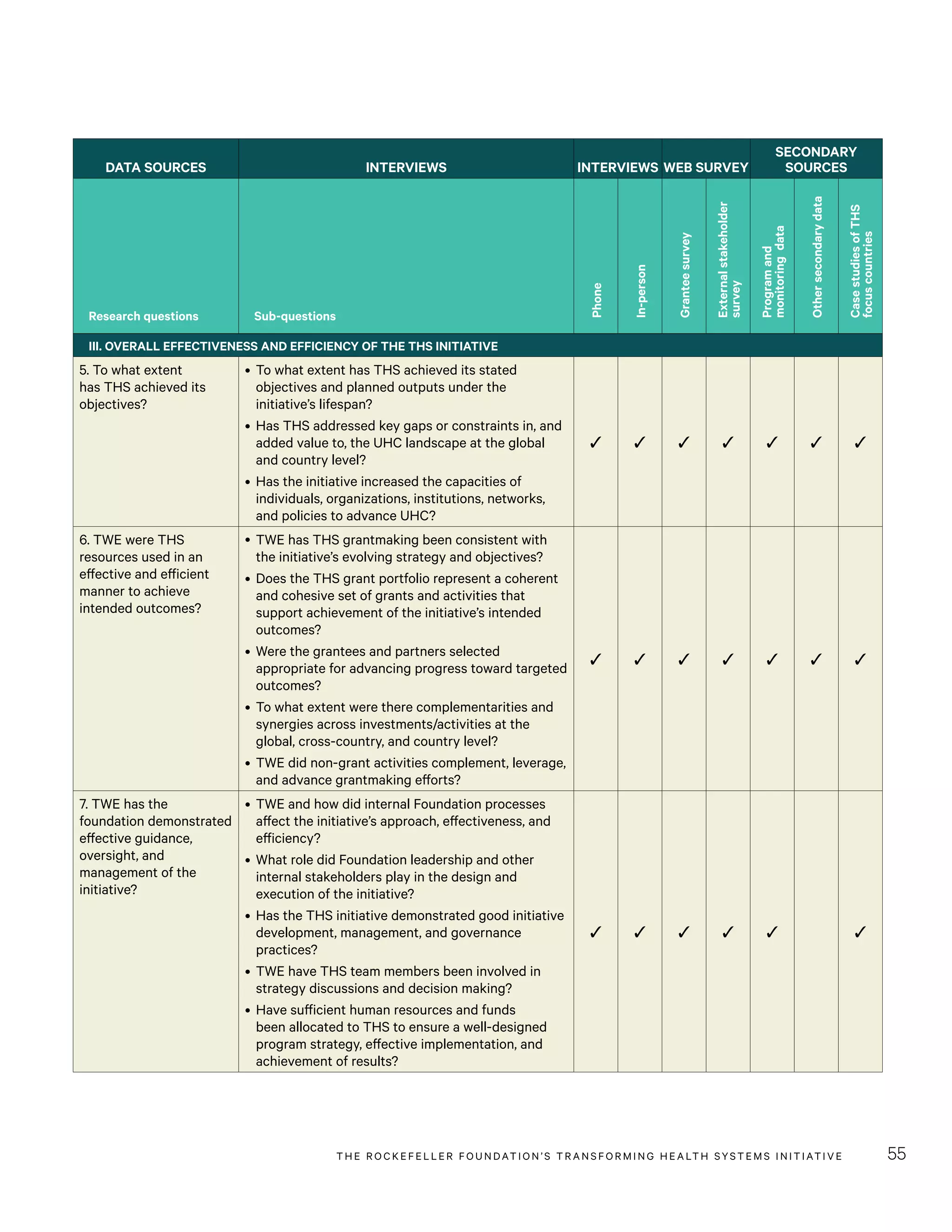
Key informant interviews. We conducted in-person
and phone interviews with a total of 180 key informants,
including current and former Foundation staff, THS
grantees, representatives of donor or partner agencies,
global health experts, and country-level policymakers
and practitioners. In-person interviews were conducted
at the Foundation’s headquarters office in New York
City, during country site visits to THS’s four focus
countries in 2014, and during the 2016 JLN global
meeting in Kuala Lumpur, Malaysia.
Online survey. A web-based survey was developed
using the SurveyMonkey platform to gather
perspectives from a wide range of stakeholders on
the UHC movement and the Foundation’s role in it.
These included THS grantees, external advisors to
the Foundation, and other non-grantee informants
with knowledge of the UHC landscape at the global
and country levels. Of the 159 individuals who received
the survey invitation, 58 responded for an overall
response rate of 36 percent. Roughly one-half of all
respondents had never received funding from the
Foundation, and approximately one-third were current
or former grantees. Other survey respondents included
individuals from partner organizations (10 percent),
external advisors to the Foundation (7 percent), and
others (8 percent).
Data analysis
We used the following methods to analyze the
information generated through the data sources
described above to answer the research questions
for the summative evaluation and its individual
components.
Thematic framing. To identify cross-cutting trends
and themes, we reviewed and assessed data from
different sources together under key topics and
subtopics aligned with the research questions and
logic models developed for each study component. To
support this review, we coded primary qualitative data
using a coding scheme that mapped to the research
questions and logic model. Once the data was coded,
we examined it for key themes. As themes emerged,
The findings presented in this final evaluation report
draw on and synthesize findings from all components
of the summative evaluation.
Evaluation approach
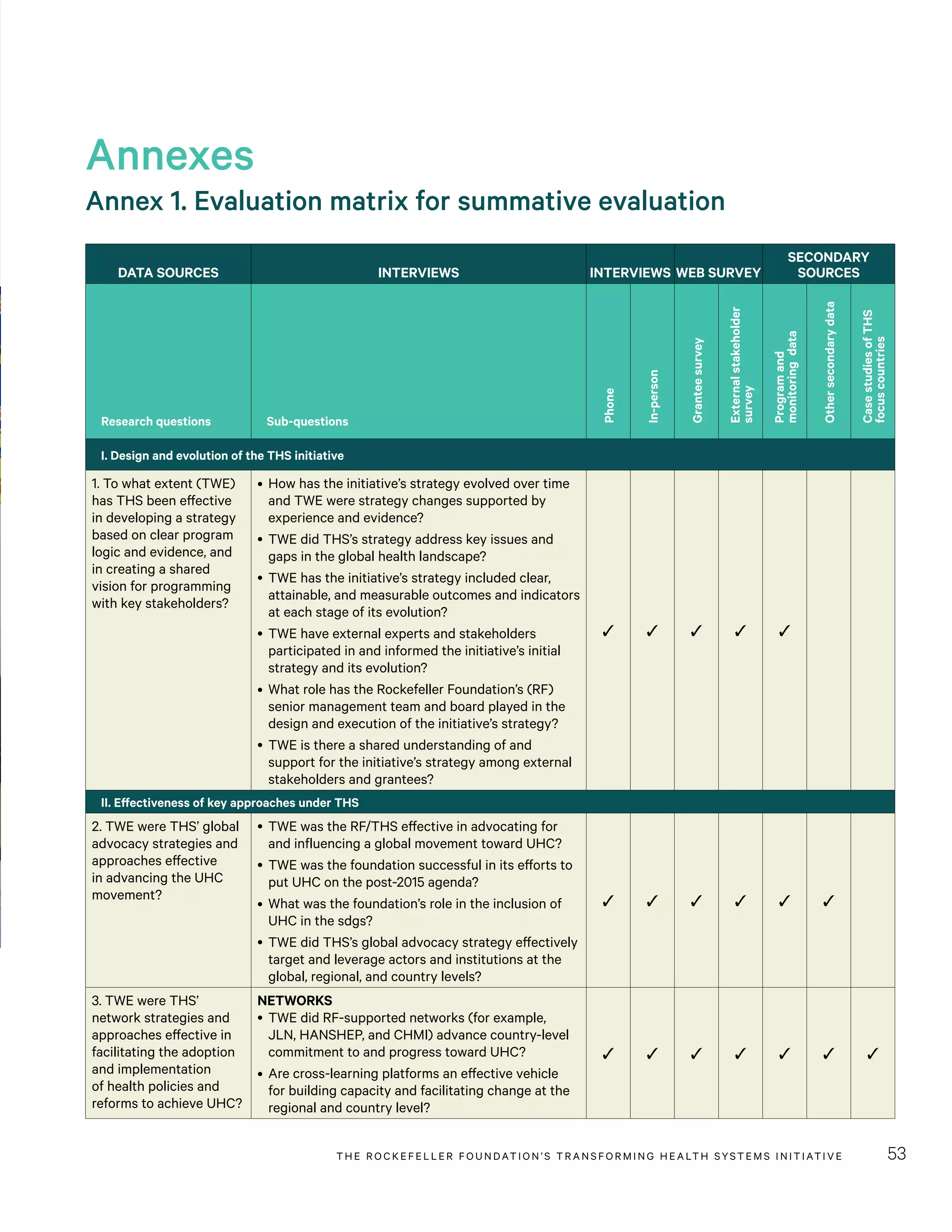
We used a mixed methods approach to conduct the
summative evaluation, including each of its individual
components. Our approach was guided by the
evaluation matrix for the overall summative evaluation
(see Annex 1). As shown in the evaluation matrix, our
mixed-methods approach to answering the research
questions for the evaluation involved the use of a
combination of data sources and methods to improve
the rigor, depth, and generalizability of the findings.
For some questions, we relied primarily on qualitative
information obtained through document review, key
informant interviews, and country site visits, whereas
for others, we used quantitative data obtained from
the Foundation’s grants management database, an
online survey, and/or grantee monitoring data. In
most cases, the two types of data complemented
each other such that the evaluation results benefited
from the specificity and broad grantee/stakeholder
base associated with quantitative methods, and
the explanatory richness and contextual value of
qualitative work. We used a variety of techniques to
analyze the data collected, including tabulations of
survey data, qualitative data coding and triangulation,
and contribution analysis.
Data sources
The evaluation team collected data from three main
sources to inform the case study.
Review of secondary data. The evaluation team
reviewedandabstracteddatafromarangeofsecondary
data sources, including The Rockefeller Foundation’s
documents and reports, grantee proposals and
reports, financial data from the Foundation’s grants
management database, published and gray literature,
country policy and program documents, and relevant
websites, including the JLN website.
THE RO CKEFELLER FOUNDATION’S TRANSFORMING HEALTH SYSTEMS INITIATIVE 13
shown in the logic model. The first step in contribution
analysis involves compiling evidence on activities
implemented, outputs and outcomes, and assumptions
underlying the results chain shown in the logic model.
The next step focuses on critically examining the
strengthoftheevidencesupportingtheachievementof
outputsandoutcomesandlinkages,givingconsiderable
weight to stakeholder perspectives on the program’s
contribution or influence, as well as evidence of the
influence of other factors on outcomes (Mayne, 2008).
Contribution analysis complements triangulation by
looking at activities and results in a broader context
to identify where attribution is appropriate and robust,
as well as any major shortcomings in initiative design,
implementation, and achieved outcomes.
Identification of lessons learned and promising
practices. Drawing on the findings from the above
analyses, we highlighted lessons learned and best
practices related to initiative design, grantmaking
strategy and practices, and increasing overall
effectiveness and influence.
the coding allowed us to organize data in different ways
and compile both affirming and contradictory evidence.
Triangulation. Triangulation involves testing for
consistency in results or findings across several data
sources and methods of inquiry (Patton, 2002). It
facilitates confirmation of themes or findings and
the identification of important discrepancies across
qualitative data, program monitoring data, and
secondary data sources. It also reduces the potential
for inaccuracies that arise from a largely retrospective
review. By triangulating among the evaluation’s data
sources, we tested for the strength of and inconsisten-
cies in findings identified through thematic framing.
The availability of coded data allowed us to triangulate
efficiently across all data sources and types.
Contribution analysis. Building on the triangulation
process, contribution analysis aims to determine
the strength of the evidence on the THS initiative’s
implementation and effects, focusing on the extent to
which the project contributed to targeted outcomes
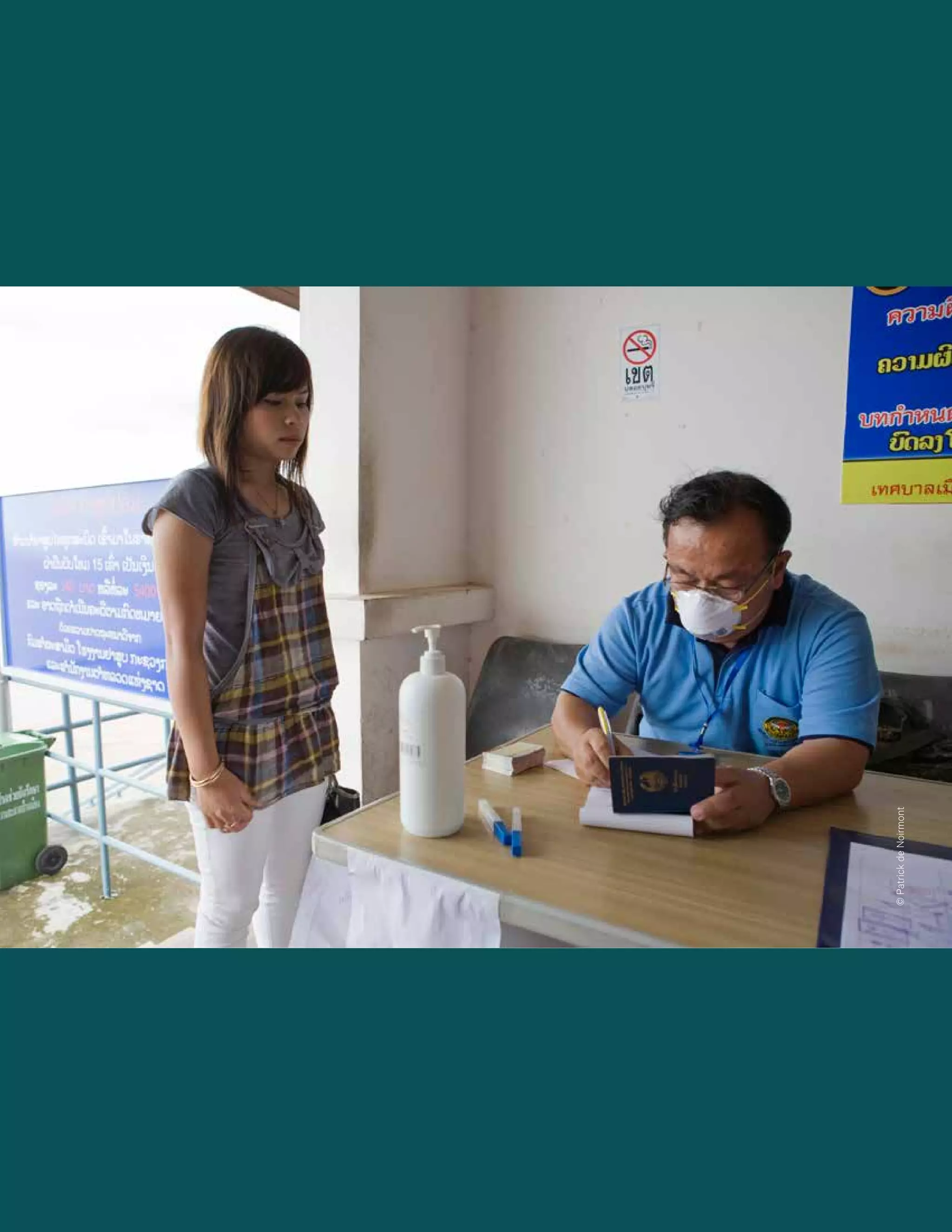
©PatrickdeNoirmont
THE RO CKEFELLER FOUNDATION’S TRANSFORMING HEALTH SYSTEMS INITIATIVE 15
Global UHC advocacy
Global advocacy was central to the THS initiative’s
efforts to catalyze and shape the UHC movement and
advance progress toward UHC at the global and
country level. A key objective of THS’s global advocacy
strategy was to bring UHC to the forefront of the global
health agenda, to promote widespread adoption of
UHC as a mechanism for improving health outcomes
and as a policy goal. To do so, The Rockefeller
Foundationsoughttoleverageitslegacyandconvening
power in the global health arena to elevate
understanding, use, and operationalization of the UHC
term among key global and country actors.
Since THS was launched in 2008, UHC has risen to
prominence as a measureable policy goal, culminating
in the 2016 adoption of UHC as a health target in the
Sustainable Development Goals (SDGs) of the 2030
Agenda for Sustainable Development. As this chapter
documents, The Rockefeller Foundation played a
catalytic and well-recognized role in UHC’s path to
prominence on the global health agenda, supporting
and shaping a number of key milestones in the UHC
movement. It also invested in building coalitions and
partnerships, as well as a measurement framework, to
support and track country progress toward the SDGs’
UHC target.
Over the course of its nine years of grantmaking, THS
invested more than $32 million across 109 grants in
4
global advocacy activities, accounting for roughly
one-third of all grant expenditures under THS. In
addition to these grant investments, Foundation
leadership and staff engaged in a range of non-grant
activities to promote adoption of UHC as a policy
framework and goal.
In this chapter, we begin by describing the key
components and evolution of THS’s advocacy strategy.
We then provide a summary of key achievements
and learnings emerging from its advocacy efforts.
At the time THS was launched,
the UHC term was used only
sparingly by a few international
organizations, in part because of
concern that the term would be
interpreted as endorsing single-
payer health insurance systems,
but also because the term seemed
vague to many health actors.
THE RO CKEFELLER FOUNDATION’S TRANSFORMING HEALTH SYSTEMS INITIATIVE16
these objectives was considered critical for generating
widespread commitment to and progress toward UHC at
thecountrylevel.However,atthetimeTHSwaslaunched,
the UHC term was used only sparingly by international
organizations, in part because of concern that the term
would be interpreted as endorsing single-payer health
insurance systems, but also because the term seemed
vague to many health actors. Therefore, to achieve these
longer-term advocacy objectives, THS initially focused
on increasing understanding and use of the UHC term
among key global actors through strategic generation
and dissemination of information and evidence on UHC
(Box A) and promotion of dialogue around UHC (Box B).
As the UHC concept became more widely understood
and adopted, the focus of THS’s advocacy efforts shifted
More information on THS’s global advocacy work,
achievements, and learnings can be found in Sattar
and Smith (2017).
Overview of global
advocacy strategy
Figure 4 presents the conceptual framework underlying
THS’sglobaladvocacystrategy.Asshowninthefigure,the
specific long-term objectives of THS’s advocacy efforts
were to i) build increased and sustainable momentum
toward advancement of UHC at the global level and ii)
ensure inclusion of UHC in the post-2015 development
agenda (later known as the SDGs). Achievement of
Definition and dissemination
of the UHC concept
Initial focus on adoption among key global
influencers. UN system identified as key
vehicle to expand adoption at global and
country levels.
Post-2015 development agenda
Identifying/supporting UHC
champions within UN system who
could influence post-2015 process and
passage of UN resolution on UHC.
Strategic communications & coalition building
Focus on post-2015 agenda. Strategic
communications to maintain constant “drumbeat” of
focus on UHC. Convenings around key global
meetings. Coalitions to support country progress
toward UHC SDG target.
PHASE 1
2009–11
PHASE 2
2012–14
PHASE 3
2014–16
KEY ACTORS IN THE UHC LANDSCAPE
STRATEGY/ACTIVITIES INTERMEDIATE
OUTCOMES
LONG-TERM AND
ULTIMATE OUTCOMES
Generation and dissemination of
information/evidence on UHC and
country progress toward UHC
Increased coverage of UHC and
progress toward UHC in the literature
and mass media
Increased
momentum toward
advancement of
UHC at the global
level
UHC adopted
as a Sustainable
Development
Goal (SDG)
Countries
implement
UHC-oriented
reforms
UHC increasingly featured in global
and regional policy discussions and
conferences
Endorsement of UHC as a policy goal
by high-level international bodies and
heads of state
Adoption of UHC as an actionable
policy framework and goal by global,
regional, and country actors
Civil society organizations allocate
resources to dedicated UHC advocacy
Promotion of UHC dialogue to
increase awareness, understanding,
and use of the UHC concept
Identification of key global and
regional actors to become
champions for UHC
Mobilization of organizations and
individuals to advocate for UHC
at the country level
Multinational and donor agencies • Thought leaders and influencers • Governments
International NGOs • Research and academic institutions • Civil society organizations
A
B
C
D
FIGURE 4. Conceptual framework for THS's global advocacy efforts
THE RO CKEFELLER FOUNDATION’S TRANSFORMING HEALTH SYSTEMS INITIATIVE 17
UN provided to its member states to support their
participation in the post-2015 process. During this
period, THS sought to identify and support UHC
champions who could influence the post-2015
process, and support passage of a UN resolution on
inclusion of UHC in the SDGs (which were agreed
to in 2015 and adopted on January 1, 2016). Initially,
it focused on gaining endorsements and support
from major industrial countries, such as those in
the G8, as well as influential global institutions,
such as the World Bank.
to gaining endorsements of UHC from key political and
health institutions, and ensuring UHC’s inclusion in the
global development agenda (Box C). THS also invested
in coalitions and local advocacy efforts to promote
commitment to and progress toward UHC at the country
level (Box D).
Below we decribe the evolution of THS’s advocacy
efforts, which reflects how the strategy adapted to
changes in the UHC landscape. Additional detail on
specific advocacy activities and outputs can be found
in Annex 2.
•	 Phase 1 (2009–2011): Definition and dissemi-
nation of the UHC concept. For the first few years
of the initiative, THS focused largely on generating
evidence and disseminating information on UHC
to increase awareness and understanding of the
concept and its adoption by global influencers.
To foster adoption, THS developed an economic
argument for UHC, which it presented to global
leaders, including The Elders, an independent
group of highly influential global leaders working
together to promote human rights. During this
period, THS also identified the UN system as a key
vehicle to advance adoption of UHC as a policy
goal at the global and country levels. THS initially
focused its UN advocacy efforts on achieving a
UN resolution on UHC. To gain enough support
to pass a UHC resolution, THS sought to shape
and align UN delegates’ messages on UHC. At
this time, the Foundation also launched the JLN,
which supported THS’s global advocacy efforts
by engaging global and country actors in dialogue
around UHC policy reforms.
•	 Phase 2 (2012–2014): Post-2015 development
agenda. In 2012, as the MDGs were nearing their
expiration, the Foundation began to focus its
advocacy efforts on ensuring that UHC would be
included in the post-2015 development agenda.
This meant ensuring that UHC was part of global
conversations being facilitated by the UN on the
post-2015 agenda, and featured in the inputs the
“The Rockefeller Foundation
hosted many different dialogues,
invited member states to come in
and participate, and laid out the
rationale and evidence for why
UHC is critical and should be an
SDG target. They were useful for
bringing in other stakeholders,
civil society, and other voices.”
– Interviewee
Once the UN resolution on UHC was passed,
THS focused its advocacy efforts on UN member
countries negotiating the SDGs’ text on health,
which included gaining the support of NGOs and
thought leaders who could influence member
states. To support its advocacy work during this
phase, THS enlisted a communications firm to
develop a multipronged communications strategy
aimed at elevating UHC’s prominence on the global
stage. THS also invested in the development of a
THE RO CKEFELLER FOUNDATION’S TRANSFORMING HEALTH SYSTEMS INITIATIVE18
framework for measuring progress towards UHC
at the country level, an effort designed to make
UHC a more concrete, actionable policy goal, and
to increase its legitimacy as a policy goal within the
SDG framework.
•	 Phase 3 (2014–2016): Strategic communications
and coalition building. During Phase 3, THS
intensified its strategic communications and coali-
tion-building efforts to support its advocacy goals.
It expanded its support of country UHC champions
within the UN system through engagements
with and technical support to mission offices,
with a focus on countries that were members
of influential coalitions such as the G8 and G20.
It also secured formal endorsements of UHC
by groups of influencers, including prominent
economists and The Elders. To maintain a constant
focus on UHC during SDG deliberations, THS
facilitated the placement of op-eds and articles
on UHC in prominent news outlets, supported the
development and dissemination of policy briefs
and research on UHC and country progress toward
UHC, and organized or co-sponsored UHC-themed
convenings around related global meetings.
During this phase, THS increasingly focused on civil
society as an agenda-setting vehicle at the global
and country levels. In 2014, THS supported a civil
society meeting on UHC which brought together
actors from over 23 countries and resulted in a
civil society declaration on UHC. It also supported
the formation of a coalition of 1,000 organizations
from across the globe to campaign for and support
UHC Day, an annual day (inaugurated in December
2014) commemorating the UN resolution on UHC.
As it became clear in early 2015 that UHC would
be included in the SDGs, THS looked toward the
post-2015 period, devoting more resources to
securing UHC commitments from collaboratives
that could support country progress toward the
SDG UHC target, such as the International Health
Partnership(IHP+),acoalitionofdevelopingcountry
governments and civil society organizations.
Notable achievements
The Foundation succeeded in championing a
concept that was controversial at the time the
THS initiative was launched, but responded to an
unmet need for a unifying health sector objective.
Although policymakers had begun to recognize the
importance of well-functioning health systems in the
early 2000s, “health system strengthening” was not
gaining sufficient traction to influence global health
policy. By providing a language and basis for dialogue
on health system strengthening that had broad appeal,
THS paved the way for widespread adoption of the
UHC term. In its efforts to disseminate and promote
the UHC concept, THS helped to create a policy space
and agenda that brought together a broad range of
partners working to improve health systems in LMICs.
It also connected diverse members of the global health
community under a common umbrella and goal.
Through its highly adaptive multi-component
and multi-level advocacy strategy, THS was
able to influence the post-2015 agenda process,
culminating in the inclusion of UHC in the SDGs.
By maintaining an adaptive and flexible approach to
grantmaking, and using multiple vehicles for policy
influence and agenda-setting at the global, regional,
and country levels, The Rockefeller Foundation was
able to strengthen and shape the UHC movement,
and ultimately influence the SDG process. Through
strategic reflection and pivots at key junctures in
the UHC movement, THS effectively responded to
and leveraged changes in the UHC landscape and
consolidated gains under the strategy. At the global
and country levels, THS both created and harnessed
momentum in support of UHC among related
actors and institutions, and invested in strategic
communications and coalition building to strengthen
and sustain the UHC movement and commitment to
UHC. In addition, the Foundation worked to develop
strong synergies between THS’s advocacy efforts and
other elements of the initiative’s broader strategy to
increase adoption of UHC as a policy framework, most
notably, the JLN.
THE RO CKEFELLER FOUNDATION’S TRANSFORMING HEALTH SYSTEMS INITIATIVE 19
FIGURE 5. Influence of THS on the UHC movement
2015
2014
2013
2012
2011
2010
2009
2008
• UN adopts 2015 Sustainable Development Agenda,
including Goal 3 target: “Achieve universal health
coverage, including financial risk protection, access to
quality essential health-care services and access to safe,
effective, quality and affordable essential medicines and
vaccines for all.”
• UHC is included in the post-2015 development targets
proposed by the Open Working Group
• PLOS publishes special collection, Monitoring Universal
Health Coverage, with 13 country case studies conducted
by WHO and World Bank
• WHO/World Bank Ministerial Meeting on UHC
in Geneva with ministers of health and finance from
27 countries to discuss progress on UHC
• World Bank President announces targets for UHC
• UNGA Resolution A/RES/67/81 recommends inclusion
of UHC in the post-2015 development agenda
• Civil Society Call to Action on UHC released
• Tunis Declaration on Value for Money, Sustainability and
Accountability in the Health Sector
• Mexico City Political Declaration on UHC
• Bangkok Statement on UHC
• The Lancet publishes special issue on UHC
• World Health Assembly approves resolution 64.9
on sustainable health financing structures and universal
coverage
• G8 and G20 countries endorse UHC at summits in
Deauville and Cannes, France
• Affordable Care Act signed into legislation in the
United States
• World Health Report 2010 on Health systems financing:
The path to universal coverage published
• The Lancet publishes “All for UHC”
• G8 commitment to strengthening health systems
in Toyako, Japan
Key milestones in the UHC movementSelect THS influence activities
THS organizes release of Economists’
Declaration on UHC led by former Treasury
Secretary Larry Summers in lead up to UNGA
meeting on final SDGs.
THS inaugurates first annual UHC Day, which is
supported by growing coalition of over 700 NGOs.
THS supports strategic UHC-themed
convenings around key global meetings and
conferences, including at the sidelines of
the 2014 UNGA, which launched key SDG
deliberations
WHO and World Bank receive support from
THS to create a framework for measuring
and monitoring UHC and release the first
report on tracking UHC.
THS influences leaders of key global
institutions to be vocal supporters of UHC. In
high-profile speeches, WHO Director-
General Margaret Chan and World Bank
President Jim Kim publicly endorsed UHC.
THS staff and grantees guide and support the
work of country champions for UHC within the
UN system to assist passage of UNGA
Resolution A/RES/67/81.
THS supports First Global Symposium on
Health Systems Research in Montreaux,
Switzerland, the only event of its kind at the time.
UHC Forward website launched to house
evidence generated by THS grantees and staff
and other actors in UHC landscape.
THS supports the World Health Report 2010,
widely recognized as the single most influential
milestone in the UHC movement to date.
THS staff and grantees submit article to
The Lancet, “All for Universal Health Coverage”,
which provides economic case for UHC.
THE RO CKEFELLER FOUNDATION’S TRANSFORMING HEALTH SYSTEMS INITIATIVE20
outside of the health arena, including the highly
visible Economists’ Declaration on UHC which was
led by well-known economist Larry Summers.
•	 UHC-themed convenings. THS organized
and supported several strategic UHC-themed
convenings around important global meetings and
conferences which, in turn, helped to frame, inform,
and increase UHC dialogue at pivotal points in
the post-2015 agenda process. For example, at
the sidelines of the 2014 UN General Assembly
(UNGA) meeting, which launched deliberations
over the final language of the SDGs, THS organized
a high-level panel discussion on the importance
of UHC and how to achieve it, which served to
influence and inform subsequent discussions
around 2030 development goals.
Support for global platforms promoting dialogue
around UHC and health system strengthening
helped to bring UHC to the forefront of policy
discussions. THS has created or supported multiple
platforms that have brought together large groups of
stakeholders to discuss health system strengthening
issues and approaches. These have included: i) the
People’s Health Assembly, a global meeting held
every five years by the People’s Health Movement, a
large global network of health activists, civil society
organizations, and academic institutions, and ii) the
Global Symposium on Health Systems Research, an
annual meeting of researchers, experts, policymakers,
donors, and practitioners.
Strategic use of media around UHC events helped
amplify the UHC message in the post-2015 agenda
process. THS grantees organized a number of
successfulsocialmediacampaignsaroundUHC-related
global events and announcements leading up to the
2015 UN Sustainable Development Summit, including:
i) the release of the June 2015 World Bank and WHO
report, Tracking Universal Health Coverage, the first
report to make a systematic assessment of countries’
progress toward UHC using specific health coverage
and financial protection indicators, ii) the release of the
THS-initiated Economists’ Declaration on UHC, which
THS played a defining role in key milestones and
events that catalyzed and advanced the UHC
movement. Several well-recognized milestones in the
history of the UHC movement reflect the influence of
THS’s advocacy efforts, as illustrated in Figure 5. These
include the following.
•	 World Health Report 2010. The THS-supported
World Health Report 2010, Health Systems
Financing: The Path to Universal Health Coverage,
is recognized as the single most influential
milestone in the UHC movement to date. Shortly
after the World Health Organization (WHO)
released the report, political leaders in Japan and
Mexico, among other countries, and leaders of
global institutions such as the World Bank, began
using the term “UHC” and its WHO definition, which
propelled acceptance and adoption of the term as
a measureable policy goal.
•	 UN resolution on UHC. THS staff and grantees
guided and supported the work of country
champions for UHC within the UN system to
support passage of UNGA Resolution A/RES/67/81
(2012), which recommended inclusion of UHC
in the post-2015 development agenda, another
prominent goal in the UHC movement. THS built
relationships with well-placed country leaders
willing to champion UHC within the UN arena,
and provided strategic technical assistance to UN
country missions, which key informants regarded
as critical for facilitating the UN resolution process.
•	 Public UHC endorsements. Through the
Foundation’s grantmaking and direct outreach
by staff, THS was able to enlist leaders of key
global institutions and other public figures as
vocal supporters of UHC, which helped legitimize
and promote action around UHC as a policy goal.
In several high-profile speeches, WHO Director-
General Margaret Chan and World Bank President
Jim Kim publicly endorsed UHC and the need for
health system reform to advance country progress
toward UHC. To increase the legitimacy of UHC as a
policy goal, THS staff and grantees also generated
endorsements for UHC from prominent figures
THE RO CKEFELLER FOUNDATION’S TRANSFORMING HEALTH SYSTEMS INITIATIVE 21
Adoption of a multi-level, multi-pronged advocacy
strategy was key to THS’s success in elevating
UHC’s status on the global agenda. The THS global
advocacy strategy targeted key influencers while also
striving to gain broad-based support from a range
of stakeholders. It used multiple advocacy vehicles
and tools, including research and dissemination,
conferences and convenings, identification and support
of UHC champions, and grassroots advocacy. Strategic
use of these complementary advocacy approaches was
critical in advancing the UHC movement – particularly
in influencing the UN post-2015 deliberations – with
each approach supporting the other. For example, THS
investments in evidence generation and publications
provided inputs for THS-supported convenings and
for efforts to promote UHC dialogue and support UHC
champions.
Certain components of the THS advocacy strategy
were shown to be particularly effective. These included:
i) securing and publicizing endorsements from groups
of influential stakeholders, such as the Economists’
Declaration on UHC, the Parliamentary Bellagio
Statement, and the Civil Society Call to Action on UHC,
and ii) undertaking non-grant activities, especially
engagement of Foundation staff in one-on-one
conversations with global health leaders and experts,
which helped to both shape the THS initiative and
further its goals.
Although an important milestone, the UNGA
resolution may have missed an opportunity to
generate stronger support for inclusion of UHC
as a more prominent goal in the SDGs. The 2012
elevated the profile of UHC and has been mentioned in
speeches by several global leaders, including the WHO
Director-General and World Bank President, and iii)
the THS-supported UHC Day campaign, which is in its
third year and has become the largest coalition working
in the health sector, encompassing 739 organizations
across 117 countries.
New partnerships to advance UHC have emerged
out of THS-supported efforts led by countries
and civil society organizations. One of the highest
profile partnerships to emerge has been IHP for UHC
2030, announced in 2016 by WHO Director-General
Margaret Chan. Formerly called IHP+, this partnership
of governments, development agencies, and civil
society organizations is committed to facilitating and
supporting progress toward the SDG UHC target. THS
helped guide the evolution of the IHP+ partnership into
IHP for UHC 2030, in order to strengthen accountability
for UHC at the country level.
Key learnings
Sustainedinvestmentinglobaladvocacyovernearly
adecadewascriticaltoachievingTHS’slonger-term
goals. THS global advocacy efforts spanned nine years,
during which time THS achieved many of its targeted
outputs and outcomes. Many key informants noted
that movement-building and agenda-setting around a
new policy concept are long-term endeavors, and that
The Rockefeller Foundation’s sustained support for the
UHC movement was likely a factor in the movement’s
successes.
“It is the combination of different [advocacy] strategies that has been
most effective ... and their success is in that variety even if all strategies
were not equally impactful.”
- Interviewee
THE RO CKEFELLER FOUNDATION’S TRANSFORMING HEALTH SYSTEMS INITIATIVE22
goal. THS also took steps to ground UHC dialogue in
research and evidence, which helped to identify and
document evidence-based policy alternatives and
country success stories that could be used as inputs
for advocacy activities.
A global advocacy strategy should account for
and address multiple channels of policy influence.
In addition to efforts to gain buy-in and support
from leaders of governmental and intergovernmen-
tal agencies, THS devoted significant resources
to strengthening the capacity of organizations to
advocate for the UHC movement and to generate
policy analysis to support it. THS used the political
connections of Foundation staff, a constant drumbeat
of research and policy analysis on UHC, and support
for influential organizations at the country and global
levels to influence the SDG process. The combination of
various approaches, rather than one singular effective
approach, was the key to generating a critical mass of
support for UHC.
Advocacy goals are more likely to be achieved when
a strategy is flexible and responsive to changes in
the global landscape and policy environment. The
THS global advocacy strategy was responsive to
changes in the UHC landscape, as well as achievements
and learnings emerging from THS investments along
the way. The Foundation’s approach to grantmaking
offered the flexibility needed to pivot THS’s advocacy
strategy, as well as to adjust grantmaking, including
the number and size of grants awarded, to support
achievement of targeted outcomes.
A policy movement requires institutionalization
of its mission and vision in order to achieve
sustainability. The UHC movement has been driven by
many organizations and individuals working behind the
scenes – without one unifying voice or leader. However,
the Foundation is recognized by many as embodying the
movement and for stewarding its progress when needed.
To ensure that the end of the THS initiative does not
result in stalled momentum, the Foundation influenced
the evolution of the IHP for UHC 2030 coalition, as a
UNGA resolution on UHC, which endorsed UHC as a
key policy goal and recommended its inclusion in the
SDGs, has been hailed as a key milestone in the UHC
movement. UHC champions involved in the UNGA
resolution process continued to advocate for UHC
after the resolution was passed, and engaged in tough
negotiations around inclusion of UHC in the SDGs.
Although these negotiations eventually led to the
inclusion of UHC as a target under a broader health
goal, some noted that the resolution could have done
more to ease the negotiation process and pave the
way for UHC to be included as an overall health goal. In
particular, the resolution did not include language for
setting up a task force or other type of body that could
help institutionalize UHC as a key policy goal within the
UN.
The limited engagement of champions from
developing countries may have hindered promotion
of UHC in the SDG negotiation process. THS
engaged several countries to champion its efforts to
secure a UNGA resolution on UHC and to include UHC
in the SDGs. However, these were mainly wealthy and
highly industrialized countries, with the exception of
Thailand. Greater engagement of developing countries
as UHC champions could have strengthened efforts
to influence SDG deliberations. For example, the UN
Group of 77, the largest intergovernmental organization
of developing countries in the UN, had an influential
role in the negotiation process leading to the SDGs, but
was not a champion for UHC.
THS’s global advocacy efforts offer several key
learnings for future Foundation initiatives seeking to
influence global and policy agendas.
A policy concept and, in turn, a policy goal
need evidence, academic validation, and public
endorsement by political and field leaders to gain
wide acceptance. The publication of multiple articles
on UHC in The Lancet and public endorsements of
UHC by influential political and health actors provided
legitimacy to the UHC concept, which was critical for
increasing acceptance and adoption of UHC as a policy
THE RO CKEFELLER FOUNDATION’S TRANSFORMING HEALTH SYSTEMS INITIATIVE 23
means of institutionalizing the global UHC movement
and ensuring continued progress toward UHC at the
country level. The JLN, a learning network to support
countries’ UHC-oriented reform efforts, was created
and supported under THS and will likely also play a key
role in sustaining momentum and advancing progress
toward UHC in JLN member countries.
Learnings from THS’s global advocacy efforts also offer
insights into how the design of an initiative can affect
achievement of policy influence.
Choose a leader who is well-known and respected
in the field to take the helm. In order to influence
discourse and agenda-setting at the highest levels, an
initiative needs to have a leader with the experience,
reputation, and connections necessary to: i) determine
the Foundation’s strategic positioning, ii) obtain the
support of key influencers in the field, and iii) respond
effectively to changes in the policy landscape.
Invest in exploratory grants to identify effective
partners and build a broad base of support.
Spreadinggrantsacrossalargenumberoforganizations
can help mobilize a broad-based and diverse set
of stakeholders around a policy issue, and facilitate
identification of organizations that can effectively
support achievement of the initiative’s global influence
goals. These organizations should represent different
levels of influence and sectors in society, and include
donors and global policymakers as well as country-level
government agencies and civil society.
Invest in knowledge management and dissemi-
nation platforms to promote broader and deeper
understandingofpolicyissues.Foundationinitiatives,
such as THS, often generate large volumes of research,
evidence, and information on an issue area. These
resources can and should be leveraged to support
attainment of the initiative’s goals. By creating a widely
accessible clearinghouse or repository of information
around a particular issue area, the initiative can reach
a wider audience and provide important background
and technical information to support policymakers and
advocates. Such an effort may also help strengthen the
Foundation’s legacy in that issue area.
©NikitaJapra,2018
A Village Health Team, comprised of village elders and volunteer residents, works to ensure the needs of the village are met by locally-
administered community health programs.
THE RO CKEFELLER FOUNDATION’S TRANSFORMING HEALTH SYSTEMS INITIATIVE 25
Regional (Global South) networks
A key cross-cutting strategy under the THS initiative
was to establish networks that would catalyze learning,
innovation, and collaboration around strategies for
overcoming critical constraints to achieving UHC. As
The Rockefeller Foundation was working to secure
widespread global commitments to UHC, it recognized
early on that policymakers and practitioners needed
support with achieving this goal. To address this gap,
the Foundation worked with grantee partners to design
and launch networks of diverse health sector actors to
share knowledge and ideas, and develop tools for policy
and program development. The focus areas of these
networks were aligned with priority work streams within
THS, including the private sector, eHealth, and health
system stewardship and management. The Foundation
helped launch a knowledge-sharing platform around
the private sector (CHMI), a collaborative of donors
who co-finance promising private sector initiatives
(HANSHEP), a group to strengthen EMR systems
(OpenMRS), a network to strengthen the mHealth
field (mHealth Alliance), and a flagship network cutting
across all work streams that facilitates collaboration
among government practitioners working on UHC
reforms (JLN). It has also facilitated a variety of other
informal networking activities.
The Foundation was a founding funder of these
partnerships, providing catalytic funding to design
and launch the networks and strategic guidance to
formulate and refine network models. It also provided
ongoing technical guidance on network learning
activities and support with convening influential
stakeholders to guide the network. A key goal for the
Foundation was to ensure the sustainability of the
networks – so that its short-term investments in these
learning and innovation efforts could have long-term
influence on health system reforms in LMICs. It built
partnerships with other donors early on, sometimes
even jointly launching the networks with them, and
also provided significant funding for sustainability
planning and conducted ongoing outreach to other
funders.
Mathematica’s assessment indicates that, overall, these
networks were a successful vehicle for creating a strong
enabling environment for health system strengthening
and UHC achievement. They increased attention to
and momentum around private sector and eHealth
approaches in LMICs – two key levers for improving
health system performance. They facilitated knowledge
exchange and development of practical tools and
resources – which, in turn, helped policymakers and
practitioners improve programs, strengthen systems,
and reform policies to advance UHC. Some felt these
advancements were cut short to some extent in
the eHealth space, which the Foundation stopped
investing in around 2012. Progress also was hindered in
some cases by the absence of a clear mission – some
5
THE RO CKEFELLER FOUNDATION’S TRANSFORMING HEALTH SYSTEMS INITIATIVE26
CHMI, which has developed a web platform to catalog
and disseminate information on innovative private
health sector programs, and facilitated knowledge
sharing among service providers and greater dialogue
between public and private sector actors. At around
the same time, the Foundation joined forces with other
global health funders to form a donor collaborative that
focused on improving the performance of the private
or non-state sector in providing health care to the poor.
Donors in the collaborative, known as HANSHEP, share
knowledge and learning around the private health
sector and co-finance promising initiatives (Table 1).
THS also helped form several networks focused on
eHealth, a growing field in the Global North that the
Foundation felt LMICs could leverage for health
system strengthening. It funded OpenMRS, a group of
organizations developing an open source platform for
EMR systems, and helped form the mHealth Alliance,
which sought to strengthen the mHealth field through
convenings, evidence generation, and technical
assistance to policymakers and practitioners (Table
1). In the eHealth space, the Foundation sought to
leverage public-private partnerships to support the
development and integration of innovations and tools
for health systems in LMICs. The mHealth Alliance,
for example, received funding and support from
bilateral agencies such as Norad and PEPFAR, private
foundations such as The Rockefeller Foundation and
Vodafone Foundation, and private partners such as
Hewlett Packard and Johnson & Johnson.
The private sector and eHealth network efforts
informed the creation of the JLN, THS’s flagship
network that cuts across all work streams. The JLN is
a key innovation and central part of the Foundation’s
efforts to advance UHC under the THS initiative.
Launched in 2010, it connects practitioners around the
globe – mainly mid-level government technocrats – to
share ideas and develop tools to support health system
reforms and achievement of UHC (Table 1).
These networks are generally coordinated by one or
more grantees and are also supported by a variety of
other technical organizations and thought/strategic
networks adopted an overly broad scope of work, which
led to uneven progress and lost momentum.
Most networks launched under THS have been able to
sustain their work past their THS grants. For the most
part, they have been successful in building a diversified
pool of funding to support sustainability, though
sourcing funds remains an ongoing challenge. Other
funders that support THS networks include the Bill &
Melinda Gates Foundation, the Vodafone Foundation,
the UK Department for International Development
(DFID), the U.S. Agency for International Development
(USAID), PEPFAR, the Norwegian Agency for
Development Cooperation (Norad), German Society
for International Cooperation (GIZ), and private sector
partners, such as Hewlett Packard and Johnson &
Johnson. One network supported by THS, the mHealth
Alliance, has been wound down – given lack of mission
clarity and an enduring misalignment between the
expectations of its members and what it received
funding to do.
In this chapter, we provide a high-level overview of
the networks launched under THS, and summarize
key cross-cutting achievements, challenges, and
learnings. Details on how each network was formed,
and its current structure and activities, are provided in
Annex 3 (private sector networks), Annex 4 (eHealth
networks), and Annex 5 (JLN). More detail on the JLN
is also available in Mathematica’s in-depth case study
report on the network (Sridharan and Smith, 2016).
Overview of networks
supported by THS
THS’snetworkssoughttobringfocustounder-explored
or neglected health system approaches to accelerate
progress toward UHC. For instance, an early priority
for THS was to advance thinking on how to strengthen
health systems by leveraging the private sector, a
controversialissuethattheFoundationfeltcouldbenefit
from a practical, evidence-based approach. To further
knowledge and learning in this area, THS helped launch
THE RO CKEFELLER FOUNDATION’S TRANSFORMING HEALTH SYSTEMS INITIATIVE 27
TABLE 1. Overview of networks supported by THS
NETWORK GOAL KEY ACTIVITIES/STRATEGIES KEY PARTNERS
Private sector
CHMI
$3,829,694
(2007-2014)
Provide information,
analysis, and connections
to service providers,
researchers, donors, and
policymakers with the goal
of facilitating improvement
and scale-up of innovative
private health sector
approaches
•	 Establish and run web platform to capture and share
information and analysis on innovative private sector
programs
•	 Conduct research and analysis of cross-cutting
themes in database
•	 Create learning collaboratives for service providers
•	 Link programs to funding opportunities
•	 Conduct outreach to policymakers and foster public-
private collaboration
•	 Coordinated by Results for
Development (R4D) and multiple in-
country partners
•	 Funded by The Rockefeller
Foundation, the Bill & Melinda Gates
Foundation, and DFID
•	 CHMI also partners with investors,
innovation networks, and research/
technical organizations
HANSHEP
$926,424
(2007-2014)
Bring donors together to
improve the performance
of the private or non-state
sector in providing health
care to the poor
•	 Convene donors on quarterly basis to exchange
ideas, make funding decisions, and learn more about
private sector space
•	 Co-fund promising initiatives, including knowledge-
sharing platforms (e.g. CHMI), networks of non-
state actors, efforts to promote public-private
collaboration, market-shaping interventions, and
scale-up of innovative service delivery approaches
•	 Coordinated by Secretariat run by
MDY Legal
•	 Donor members include The
Rockefeller Foundation, African
Development Bank (AfDB), Bill &
Melinda Gates Foundation, IFC, DFID,
USAID, and the World Bank
•	 Country/non-funding members (who
inform grantmaking) include the
governments of Nigeria and Rwanda
and Public Health Foundation of India
eHealth *
OpenMRS
$4,284,100
(2008-2016)
Improve health information
systems in LMICs
•	 Work with network of developers, implementers, and
users to develop an open source software platform
that enables health sector stakeholders with no
programming expertise to develop customized EMR
systems
•	 Build capacity of developers and other stakeholders
through virtual and in-person meetings and site
visits
•	 Coordinated by Regenstrief Institute
and Partners in Health
•	 Funded by The Rockefeller
Foundation, with additional funding
or other support provided by USAID,
CDC, and NGO partners
mHealth Alliance
$1,620,000
(2009-2012)
Facilitate innovation
and collaboration in the
mHealth sector and the
widespread adoption of
scalable mHealth solutions
•	 Organize annual summits for members, including
multilateral agencies, governments, NGOs, academic
institutions, and corporate members
•	 Establish/run technical working groups focused on
policy influence and capacity building
•	 Generate evidence and develop tools
•	 Create online research repository and networking
platform (Health UnBound or “HUB”)
•	 Provide technical assistance to governments and
implementing partners by establishing a mHealth
Expert Learning Network (mHELP)
•	 Implement innovative mHealth programs
•	 Coordinated by the UN Foundation
•	 Funded by The Rockefeller
Foundation, Hewlett Packard,
PEPFAR, Johnson & Johnson, Norad,
and Vodafone Foundation
Cross-cutting
JLN
$20,367,140
(2008-2017)
Connect practitioners
around the globe to
advance knowledge and
learning about approaches
to accelerate country
progress toward UHC
•	 Establish technical initiatives that are facilitated by
technical experts and include country practitioners,
to facilitate knowledge exchange and development
of tools to inform UHC-oriented reforms
•	 (A new technical initiative on mixed health systems
is being formed with CHMI’s support)
•	 Create flexible funding pool (Joint Learning Fund)
for members to draw on for trainings, study tours,
and other activities designed to address country-
specific learning needs
•	 Managed by Network Coordinating
Team, which includes R4D, ACCESS
Health, and the World Bank
•	 Funded by The Rockefeller
Foundation, the Bill & Melinda Gates
Foundation, and GIZ (with some
funding for specific events from
USAID)
•	 (JLN also works with expert partner
organizations that facilitate technical
initiatives)
* As part of its eHealth work, THS also facilitated the establishment of the information technology (IT) track of the JLN and participated in Greentree’s efforts to build donor
consensus around best practices for designing and implementing ICT-enabled development programs. THS funding also contributed to the formation of the Asia eHealth
Information Network (AeHIN), which supports eHealth-related policy development, capacity building, and learning. THS provided an $80,000 grant to WHO, a lead technical
agency for AeHIN, for eHealth technical assistance to the Philippines. WHO drew on these funds to support several of AeHIN’s initial activities.
THE RO CKEFELLER FOUNDATION’S TRANSFORMING HEALTH SYSTEMS INITIATIVE28
HANSHEP has contributed to donors becoming
more open to investing in the private sector space.
By frequently convening a core group of donors to
discuss opportunities in the private health sector,
and holding high-profile external meetings and
symposia, HANSHEP has helped increase interest in
and commitment to leveraging the private sector to
improve health outcomes. First, donors appreciated
the platform HANSHEP offered to discuss and explore
a controversial issue – at the time the collaborative was
formed, there was widespread disagreement about the
extent to which the private sector should be leveraged
to achieve universal and equitable health care. Key
informants report that frequent discussions and
cross-learning through HANSHEP helped destigmatize
the issue, shined a light on unexplored opportunities,
and, ultimately, contributed to several donor repre-
sentatives mainstreaming private sector engagement
into their organizations’ health system strengthening
efforts. HANSHEP also hosted high-profile convenings
on the private health sector, such as the 2013 Private
Sector in Health Symposium in Sydney, Australia, and
the 2015 Advancing Partnerships for UHC workshop
in Nairobi, Kenya, which helped raise the profile of the
issue area and draw the attention of influential public
and private sector stakeholders.
The Foundation increased momentum and
collaboration around leveraging eHealth
approaches for health system strengthening.
partners (see Table 1: Key Partners). Over the course of
their work, networks have developed varying structures
for coordinating across these partners, and organizing
and conducting their work (Annexes 3, 4, and 5 include
figures describing how each network is structured).
Notable achievements
CHMI and HANSHEP have helped increase
attention to and momentum around approaches for
harnessing the private sector to improve health and
health equity.
CHMI has helped increase availability of and access to
information on innovations in the private health sector.
CHMI’s web platform catalogs over 1,300 innovative
programs from 150 countries that have adopted a
variety of strategies to expand delivery of high-quality,
equitable care, including social franchising, licensing
and accreditation, micro-health insurance, supply chain
improvement, and mobile clinics and telemedicine. This
information is used by a diverse set of stakeholders,
including service providers and innovators, donors,
governmentofficials,researchers,andotheractorsinthe
private sector space. A 2015 internal assessment found
that the website had been visited by almost 600,000
unique users, and that visits to the platform had grown
over time and were averaging between 20,000 and
25,000 each month (Results for Development, 2015).
“When the group was convened at Bellagio, it was one of the first times
someone had said global eHealth was a thing. The conference
brought together people from across the world who hadn’t worked
together before to say we have common challenges and we have
common solutions we want to work on.”
– Interviewee
THE RO CKEFELLER FOUNDATION’S TRANSFORMING HEALTH SYSTEMS INITIATIVE 29
to improve health care. It had almost 300 members
by the time it was wound down in 2013, and its annual
mHealth summits, which started with 500 attendees in
2009, grew to 4,500 attending in 2013.
Networks formed through THS have facilitated
joint problem-solving and informed decision-
making. HANSHEP donors have drawn on the input
of non-funding country members to ensure their
investments respond to country needs. For example,
the government of Rwanda reported difficulties in
engaging the private sector given its fragmented
nature, which led HANSHEP to provide support to the
nascent Rwanda Health Care Federation, an umbrella
body that organized all private sector providers in the
country. The JLN was also successful in promoting
productive knowledge sharing. Participating
practitioners frequently reach out to each other for
input on changes they are considering to policies and
processes. They also regularly exchange models or
templates for programs, standards, and tools, which
prevents them from having to “start from scratch”
when developing new initiatives (Sridharan and
Smith, 2016).
The Making the eHealth Connection conference series
organized by the Foundation enabled networking
among eHealth actors, sparked ideas for new
initiatives, and built global momentum around eHealth.
The series was large and high profile. It included eight
conferences on diverse eHealth topics and lasted over
four weeks, with representatives attending from 34
countries, 32 donor organizations, and 10 prominent
media outlets. It helped draw critical attention to
opportunities in this emerging field and build a broad
consensus on priorities and next steps. Conference
participants signed a joint call to action, which called
for engaging in evidence-based policy- and agenda-
setting, forming collaborative networks, building
capacity, developing reusable metrics and tools, and
supporting country-level strategy development and
implementation (The Rockefeller Foundation, 2010).
The conference also enabled eHealth stakeholders
to take critical first steps toward achieving these
commitments – generating transformative ideas that
have since grown into self-standing initiatives (Figure
6). The mHealth Alliance continued to facilitate
networking and collaboration in this field – among
eHealth actors focused on using mobile technologies
“That’s how we built out the strategy. Based on our understanding of
the challenges, we thought – How can we help governments have the
organizational strengths to manage a more mature digital health strategy?
How can we make sure there are people in the country who know about
digital health and can help drive it forward? How can we help create products
that they can take off the shelf and help deploy at low cost? (That’s why we
went with open source approaches.) How can we build up networks to allow
information sharing in this space?”
– THS staff
THE RO CKEFELLER FOUNDATION’S TRANSFORMING HEALTH SYSTEMS INITIATIVE30
CHMI has fostered program improvement by enabling
collaboration and joint problem-solving among service
providers. CHMI identifies organizations implementing
similarservicedeliverymodelsthroughitsdatabaseand
brings them together through learning collaboratives
and exchanges to share information on common
challenges and solutions that have worked on the
ground. Participating service providers have replicated
solutions that other organizations have tested and
refined. For example, following their participation in
CHMI’s Primary Care Learning Collaborative, service
providers adopted each other’s practices, such as
expanding patient follow-up to improve quality of
care, offering discounts to increase patient in-flow, and
integrating dental care as a key service (Brad Herbert
Associates, 2015).
TheOpenMRSplatformhasseenwidespreaduseacross
the globe. The platform was piloted in Rwanda, which
has since engaged in a national rollout of the OpenMRS
EMR system for primary care (see Chapter 6: Focus
country investments for more detail). More broadly,
as of 2016, 1,845 sites in 64 countries were reporting
OpenMRS implementations (OpenMRS, 2016).
THS networks have produced a variety of practical
tools and resources. Networks formed under THS
have developed a range of tools and resources,
or “global public goods,” to help policymakers and
practitioners embark on thoughtful, evidence-based
reform of programs, policies, systems, and processes.
These include knowledge products summarizing
country experiences with reform, guidelines for
assessments and studies to inform reform efforts,
open source platforms, and databases of innovative
programs and research repositories (Figure 7). Many
networks have sought to ensure that these tools are
practical, grounded in an understanding of country
context, and designed to address challenges faced day
to day in the health systems of LMICs. The JLN, which
pairs technical experts with country practitioners
to engage in a knowledge “co-creation” process, has
been particularly successful in creating user-friendly
resources.
Policymakers and practitioners have leveraged
tools and resources generated by THS networks
to strengthen programs and systems and reform
policies to advance UHC.
FIGURE 6. Ideas and initiatives emerging from the “Making the eHealth Connection” conference series
•	 Developing the Collaborative Requirements
Development Methodology (CRDM), a process for
health sector stakeholders to map public health
workflows and define functional requirements for
common business processes
•	 Creating an open-access space for eHealth
stakeholders to develop and exchange methods
and technologies, which led to the expansion and
institutionalization of OpenMRS (described in
Table 1)
•	 Using enterprise architecture to support
integration and interoperability across a country’s
various health information systems, which led
to the establishment of a new health enterprise
architecture laboratory at the University of KawZulu
Natal, which in turn helped to create a customized
Rwanda Health Enterprise Architecture (RHEA)
(the development and piloting of the RHEA was
supported by THS’s country-level grantmaking);
this work was eventually supported by PEPFAR and
USAID and grew into the Open Health Information
Exchange (OpenHIE), a community of practice
that offers open platforms, standards, and tools to
facilitate health information exchange
•	 Establishing a mobile-health network to leverage
and contribute to rapid progress in the mHealth
sector, which led to the formation of the mHealth
Alliance (described in Table 1)
•	 Prioritizing capacity building, which led The
Rockefeller Foundation to fund academic programs
in health informatics in six countries
FIGURE 7. Tools and resources developed by THS networks
THE RO CKEFELLER FOUNDATION’S TRANSFORMING HEALTH SYSTEMS INITIATIVE 31
Several JLN tools and resources have been used
to inform UHC-oriented reforms. Tools developed
by the JLN’s provider payment mechanisms, health
information technology (IT), and primary health care
technical initiatives have been used to inform policy
reform,guidepolicyimplementationefforts,anddevelop
needed IT infrastructure. For example, policymakers
and practitioners have drawn on JLN tools to conduct
costing studies and use results to develop a national
health protection scheme (in India) and reform provider
payment systems (in Vietnam). They have also drawn
on tools developed by the JLN’s IT technical initiative
The mHealth Alliance helped advance country-level
policy and programming around mHealth. The alliance
engaged in advocacy and technical assistance at the
country level, which contributed to Nigeria, Rwanda,
South Africa, and others developing and implementing
mHealth strategies (Seven Hills Advisors, 2014). This
work was particularly successful in Nigeria, where
the alliance helped the federal government develop a
framework for leveraging ICT approaches to increase
access to primary health care for women and children.
ThisframeworkwasadoptedbytheNigerianparliament
and is now policy.
Web platform that includes profiles of innovative private
sector programs, tools to help service providers adopt
and adapt elements of successful programs, and research
products exploring themes and trends across profiled
programs
HANSHEP funded CHMI and managed
the Health Systems Hub, an online
platform that synthesizes learnings from
HANSHEP-funded programs
Open source software platform
and reference application to help
health sector stakeholders build
and strengthen EMR systems (with
several add-on modules to facilitate
customization)
Library of resources, including policy papers, analytical
frameworks, and landscape assessments produced by the
mHealth Alliance, as well as links to mHealth applications,
capacity-building workshops and courses, multimedia tools for
health promotion, mHealth project inventories, and toolkits for
leveraging mHealth technologies
•	 Provider payment mechanisms. Guide for assessing strengths and weaknesses of provider payment
systems, manual for costing health services, and simulation model to assess various provider payment
scenarios
•	 Heath information technology. Sample functional requirements for key business processes, open source
tool for developing health data dictionaries, reference guide for developing eHealth standards frameworks
•	 Primary health care. Tool to assess alignment between health financing and primary health care (PHC)
strategies, manual on engaging the private sector in PHC to achieve UHC
CHMI HANSHEP
mHealth AllianceOpenMRS
JLN (selected resources)
THE RO CKEFELLER FOUNDATION’S TRANSFORMING HEALTH SYSTEMS INITIATIVE32
Lack of mission clarity and reputational challenges
muted the influence of the mHealth Alliance, and
ultimately led to the decision to wind down the
network. The alliance faced significant leadership
and reputational challenges in its first three years.
As a result, by 2010, few of its ambitious goals were
achieved and perceptions of the alliance were poor.
A change in structure and leadership in 2011 helped
retrieve some lost ground, but the alliance continued
to spread itself too thin across multiple activities. It
also faced an enduring misalignment between what
the mHealth community hoped it would do and what
it received funding to do. Specifically, the mHealth
community hoped it would play a convening and
thought leadership role, but once The Rockefeller
Foundation wound down its funding for eHealth, the
alliance received funding mainly for implementing
programs. These initiatives were quite successful,
but most members felt the alliance should focus
instead on knowledge sharing and coalition building
to strengthen the overall mHealth sector. Due to this
misalignment and the enduring negative impact of
early reputational issues, and recognizing that other
organizations were stepping into the role the mHealth
Alliance was created to fill, the board and leadership
of the alliance made the decision to wind down the
network in 2013.
Some felt the Foundation wound down its
investments in eHealth too early and may have
missed opportunities for further influence. While the
Foundation helped put eHealth on global and country
agendas and build critical tools and capacity, some felt
it withdrew too early from investments in the eHealth
space. The Foundation’s commitment to building
communities of practice and facilitating the generation
of global goods have been particularly missed. The
mHealth Alliance, for example, was constrained in its
ability to play the role of broker and convener once
THS funding came to a close, and thereby missed the
opportunity to sustain the momentum that came out
of the 2008 Bellagio conference for building a strong
mHealth sector.
to develop or rebuild the IT infrastructure for health
insurance schemes (in Bangladesh and the Philippines)
(Sridharan and Smith, 2016).
Most networks have attracted support from other
donors and are positioned for sustainability. The
Foundation was successful in leveraging partnerships
with other donors to ensure that THS networks were
sustainable ventures that would have a life beyond
the initiative. Some networks, such as CHMI and the
mHealth Alliance, were launched together with other
funders. The Foundation also engaged in intensive
outreach once THS networks were up and running to
showcase the value of these collaborative partnerships
to other donors and enlist their support (see Table 1 for
a list of other donors funding THS networks).
Key challenges
Some networks lacked clear, well-defined goals and
strategies, which diluted their overall influence.
HANSHEP lacked a strong strategic framework,
which led to highly dispersed grantmaking and put
limits on the collaborative’s influence. At the root of
this fragmentation were HANSHEP’s broad objectives
– when the group was launched, members opted
for a loosely defined scope of work to allow time
for exploring the field and identifying the group’s
comparative advantage. Unfortunately, a more
concrete strategy did not emerge over time, likely due
to the limited overlap between donors’ institutional
priorities, which ranged from leveraging the private
sector for improved service delivery, to regulation
and stewardship, to organizing the private sector for
improved government engagement. Without a clear
mission and strategy, the portfolio’s influence was
scattered, and at times duplicative. To concretize
its approach, the group has recently devised a new
“HANSHEP 2.0” construct with three distinct work
streams: i) knowledge and learning, ii) an innovation
challenge fund, and iii) agenda-setting.
THE RO CKEFELLER FOUNDATION’S TRANSFORMING HEALTH SYSTEMS INITIATIVE 33
health financing and eHealth, collaborate to advance
their shared goals of strengthening health systems
and advancing UHC. In contrast, HANSHEP has not
been able to develop a strong unifying vision or focus.
Therefore, although it has supported important and
useful programs, these have not cohered to move
the needle meaningfully on strengthening the private
health sector.
Building a strong coordination function requires
substantial time and resource investments; while
it does not yield immediate, tangible outputs, it is
critical to ensuring effective network operations in
the long term. Grantees report that The Rockefeller
Foundation is unique in its willingness to support the
administration and coordination of learning networks.
THS has recognized that networks need a strong
governance function in order to be able to produce
useful global goods, and facilitate meaningful action by
network members with busy professional lives. It was
with seed funding from THS that OpenMRS – until then
a loose collaboration of organizations – was able to form
anindependentnon-profitorganizationandhirefull-time
developers to oversee the design of its open source
EMR platform. The Rockefeller Foundation also provided
funding for the JLN’s Network Coordinating Team, which
has been critical to recruiting a strong membership,
fostering country ownership, and coordinating across
network units to get countries the support they need
for UHC-oriented policy action. The Rockefeller
Foundation’s willingness to devote funds to network
governance – which does not have tangible results – has
also encouraged other donors to recognize the value
of such investments. Once the Foundation provided
initial funding for the JLN’s Network Coordinating Team
and HANSHEP’s Secretariat, other donors eventually
contributed funds as well.
Networks can ensure that collaborative learning
efforts yield useful knowledge and tools by having
a skilled technical facilitator work closely with a
team of committed, insightful practitioners. The
experiences of THS-supported learning networks show
Key learnings
Learning networks are a powerful vehicle for
advancing a field and motivating action by
policymakers and practitioners, especially with
limited resources and time. In catalyzing and
supporting learning networks, The Rockefeller
Foundation has identified a strong niche for itself in
the global health sector. The networks space receives
relatively limited financial support – countries are not
positioned to fund efforts that do not have tangible
results for their population and donor funding for
learningeffortsisinrelativelyshortsupply.Thenetworks
space is also a strong match for the Foundation’s
strengths. In the case of THS, the Foundation’s
tolerance for risk has enabled investment in untested
– but promising – learning models, and its in-house
technical expertise and strategic insights have been
critical in helping refine and strengthen these models.
Finally, the Foundation’s convening power has brought
other donors on board once its networks have a clear
structure and value proposition, and thereby ensured
network sustainability. In this way, the Foundation has
leveraged its finite funding to catalyze sustainable
networks that are positioned to facilitate learning
and build an enabling environment for country-level
reforms in the long term.
A clear mission statement and well-defined goals
can help networks build a closely knit, action-
oriented membership that is focused on steadily
moving the needle in its area of focus. Networks
need a clear value proposition that members can align
around to ensure they are moving steadily towards a
common goal. Without a clear ToC, network activities
can also become dispersed and disconnected from
one another, thereby diffusing the network’s overall
influence. The JLN has a clear North Star – advancing
UHC at the country level – that endows members with
a sense of shared purpose and keeps bringing them
back to network activities and initiatives. The clarity
of its overarching mission has also helped ensure that
individuals working in diverse technical areas, such as
THE RO CKEFELLER FOUNDATION’S TRANSFORMING HEALTH SYSTEMS INITIATIVE34
relevant tools and resources, and coalesce groups
around useful initiatives, when there is a high level
of ownership among members and other local
stakeholders. For example, in recognition of the need
for greater member ownership, the JLN has formed
country core groups (CCGs), which are comprised of
staff at key government agencies working towards
UHC and are responsible for organizing and facilitating
country participation in the JLN. These groups have
played a critical role in ensuring that countries are
identifying and taking advantage of opportunities for
learning through JLN’s technical initiatives.
Networks need time and space to iteratively
develop their models, but their work needs to be
tied to at least a few benchmarks and milestones
to ensure they identify their objectives and
approach as soon as possible. Network stakeholders
appreciated the flexible scope of work allowed by
The Rockefeller Foundation, which enabled them to
identify needs, and develop and iterate on strategies
to address those needs. The JLN’s CCGs, for instance,
have become more effective over time, as the network
has understood the factors limiting their effectiveness
in overseeing country participation in the network,
and installed strategies to address those obstacles
(Sridharan and Smith, 2016). While it is important to
ensure that networks have the creative space they
need to refine their models, there is some risk to an
unstructured design process. The mHealth Alliance
spent the majority of its core funding in its first two
years, but in that time had not clearly charted its path
and, overall, had accomplished less than planned. Key
informants feel that the alliance could have benefited
from establishing and working towards some measures
of success, such as membership size, establishment of
working groups, level of activity among members, and
member satisfaction.
Sourcing long-term funding is a critical challenge
for networks focused on producing global public
goods, and requires early planning and action. There
is limited funding available for efforts to develop global
public goods, especially those that prioritize iterative
that collaborative learning does not happen unless it
is carefully facilitated. Bringing bright minds together
around issues of shared interest can build critical
momentum, but if the collaborative process is not
structured to develop and achieve common objectives,
this momentum can quickly subside, or not lead to
tangible change. For instance, the mHealth Alliance’s
working groups may have lost traction because the
alliance missed the opportunity early on to play a
“neutral broker” role and build a shared vision across
group members (Seven Hills Advisors, 2014). Some of
JLN’s technical initiatives, by contrast, have been able
to lead practitioners to identify challenges faced on
the ground, share tested solutions, and jointly develop
tools for policy reform that address common contextual
constraints in LMICs. Their success is grounded in
effective facilitation by technical experts who have
both in-depth subject matter knowledge and the ability
to listen to and learn from practitioners’ experiences,
elicit and synthesize lessons, and co-create useful
knowledge products.
Networks need well-conceived strategies for
building local ownership and participation; only
this can ensure that network learning and tools
are leveraged to effect real change in policies,
programs, and systems. Networks can only produce
“Networks don’t self-form
and self-maintain. You need
a secretariat that wakes up
every morning and continues to
promote and engage
the network.”
– Interviewee
THE RO CKEFELLER FOUNDATION’S TRANSFORMING HEALTH SYSTEMS INITIATIVE 35
are not too closely tied to its brand. This approach has
enabled prominent donors with pre-existing priorities
and agendas to come on board, thereby strengthening
long-term network sustainability. Almost all THS
networks have gone on to receive often substantial
support from other donors.
learning without preset outputs and deliverables. To
ensure adequate and long-term funding, networks
must engage in relationship-building early on and
recruit the support of diverse donor partners. The
Rockefeller Foundation has been successful in building
broad-based support for its networks by ensuring they
JointLearningNetworkforUniversalHealthCoverage
THE RO CKEFELLER FOUNDATION’S TRANSFORMING HEALTH SYSTEMS INITIATIVE 37
Focus country investments
THScomplementeditseffortstobuildglobalmomentum
around UHC, and promote network-based learning
around health system levers for UHC advancement,
with targeted country-level investments that sought
to test and iterate on models for achieving UHC. The
Foundation selected four countries in which to develop
and refine pathways for achieving UHC – Bangladesh,
Ghana, Rwanda, and Vietnam. From 2008 to 2015, the
Foundation issued around $25.8 million in grant funding
to a mix of government agencies, and non-government
and academic organizations in these countries to
engage in diverse activities that supported UHC
advancement, including advocacy, evidence generation,
policy development, and capacity building (Figure 8).
The Foundation typically began its country-level
investments by supporting exploratory grantmaking
in all four of THS’s work streams, which helped
identify policy constraints and capacity gaps on the
pathway to UHC that could be addressed with finite
short-term funding. Informed by these efforts, THS
ultimately prioritized one work stream in each country
6
COUNTRY
DURATION
OF
INVESTMENT
# OF
GRANTS
# OF
GRANTEES
FUNDING
% OF
TOTAL
COUNTRY
FUNDING
Bangladesh
01/2009 –
11/2016
26 15 $7,781,901 30%
Ghana
09/2009 –
01/2016
15 11 $4,065,345 16%
Rwanda
10/2009 –
12/2016
14 12 $6,752,761 26%
Vietnam
09/2009 –
06/2017
19 12 $7,197,562 28%
Total
01/2009 –
06/2017
72* 49* $25,797,569
* Note that some grants/grantees are active in multiple focus countries.
FIGURE 8. Country-level investments, by country and work stream
Health
financing
14%
Health
system
stew
ardship
and
m
anagem
ent38%
Health
inform
ation
system
s26%
UHC
policy22%
D
C
B
A
Health financing
14%
Health system
stewardship and
management
38%
Health information
systems
26%
UHC policy
22%
THE RO CKEFELLER FOUNDATION’S TRANSFORMING HEALTH SYSTEMS INITIATIVE38
investments and constrained what THS could achieve
in each country. THS staff also had limited experience
with country-level grantmaking and in some of the focus
countries, which led to lengthy exploratory grantmaking.
Additionally, within each country, investments were
not brought together under – or guided by – country-
specific ToC or results frameworks. Following the THS
initiative’s structure, investments were spread across
THS work streams, without clear linkages between grant
activities within and across work streams and changes
in UHC-related outcomes. This led to some dispersed
outcomes and missed opportunities for cross-grantee
synergies and joint, country-level influence.
This chapter provides high-level background on how the
THS focus countries were selected, and an overview of
keystepsintheTHScountry-levelgrantmakingstrategy.
It ends by summarizing cross-cutting achievements,
challenges, and lessons learned. More information on
THS’s country-level work can be found in the individual
case study reports on each focus country (Smith et
al., 2014a; Smith et al., 2014b; Sridharan et al., 2014a;
Sridharan et al., 2014b).
– private health sector development in Ghana, eHealth
in Rwanda, health financing in Vietnam, and UHC
policy and advocacy in Bangladesh. THS grants built
momentum and catalyzed policy action in several of
these reform areas. The Foundation’s investments
helped to influence reform of the national social health
insurance law in Vietnam, strengthen the eHealth
infrastructureinRwanda,andsupportthegovernment’s
efforts to harness the private sector to expand health
coverage in Ghana. While THS identified a priority work
stream to support in each country, it also continued
investing in other work streams. These investments,
many of which had a capacity-building focus, did not
yield immediate outputs, but contributed to building a
pipeline of trained health professionals committed to
improving health systems and advancing UHC.
While these were notable achievements, THS ultimately
gained relatively narrow traction at the country level,
for a variety of reasons. First, for most of its life cycle,
the initiative was structured to prioritize investments in
global and network activities, which limited the amount
of resources and staff time available for country-level
FIGURE 9. THS’s strategy for country-level grantmaking
Support long-term
capacity building
-
Identify and invest in
priority work stream
Models for
country movement
toward UHC
-
Country
achievement
of UHC
Identify key government
agencies and NGOs to serve as
grantees and other influential
partners (including donors) to
collaborate with
Fund scoping grants and
landscape assessments to
identify key levers for UHC
advancement and gaps in
donor investment
Prioritize investments in a key
lever or work stream to
catalyze change within the
initiative time frame, and
continue to support long-term
capacity building to facilitate
UHC advancement
Country
progress in key
dimensions
of UHC
Identify
and select
countries
Identify
key influencers
and partners
Conduct
exploratory
grantmaking
Selection based on:
• pre-existing
government
commitment to UHC
• demonstrated success
in policy/program
reform
• strong local capacity
Invest across THS work streams:
UHC advocacy, HS&M, Health financing, HIS
THE RO CKEFELLER FOUNDATION’S TRANSFORMING HEALTH SYSTEMS INITIATIVE 39
UHC landscape, hone in on high-impact opportunities,
and identify critical gaps in donor funding. This initial
grantmaking was conducted across all work streams,
and investments were made in diverse activities,
including advocacy, evidence generation, and trainings
and technical assistance.
Through the work of these grantees, the Foundation
grew its understanding of country needs and identified
a priority work stream in which it could catalyze change
within the initiative time frame. It also continued to
fund activities in other work streams, with a view to
building the long-term health system capacity needed
to support advancement of UHC. Together, these
investments were intended to facilitate meaningful
progress on key aspects of UHC in the focus countries
and propel them toward the ultimate goal of achieving
UHC. It was hoped this process would yield tested,
replicable models for advancing UHC. Table 2 provides
a snapshot of THS investments in each country.
Notable achievements
THS’s exploratory grantmaking approach was
effective in uncovering short-term investment
opportunities with potential for outsized impact.
THSsurmountedpotentiallylargestumblingblocks–its
limited health sector experience in the focus countries,
and its finite budget and short timeframe for effecting
change – by taking an investigative approach in its
initial phase of grantmaking. Its landscaping studies
and investments in multiple work streams allowed
for the identification of critical policy constraints and
capacity gaps on the pathway to UHC. These initial
investments also shed light on which of these issues
could be addressed with small, concentrated injections
of short-term funding – a critical factor for a time-
and resource-bound initiative. In Ghana, for example,
investment in a World Bank-led private health sector
assessment solidified THS’s early focus on the private
sector. It directly informed the main activities of the
Foundation’s first grant to the Ministry of Health (MoH),
which sought to strengthen the ministry’s capacity to
Background on THS’s
country-level grantmaking
Country selection
THS selected focus countries that had a strong,
pre-existing commitment to UHC, seeking to leverage
existing momentum, and fill gaps in the donor
landscape, to catalyze focused UHC-oriented reform
efforts. The governments of Ghana, Rwanda, and
Vietnam had adopted UHC as a national policy goal,
with key UHC objectives (access, financial protection,
and equity) underpinning many health sector policy
frameworks and planning efforts. These countries had
also taken tangible steps to make this policy goal a
reality, creating national health insurance schemes and
engaging in reforms of key programs and systems to
increase health system efficiency, expand coverage,
and extend financial protection. THS was also guided
in its selection by the presence of strong potential
partners, including government agencies and NGOs
that might serve as grantees, as well as other donors
that could leverage and build on the Foundation’s
catalytic investments (Figure 9).
Bangladesh was selected as the fourth focus country
to test a model for achieving UHC in an alternative
context – one where government commitment to UHC
was still uncertain and policy action relatively nascent.
The Foundation felt that Bangladesh’s strong NGO
sector might compensate for these limitations, and
could potentially be leveraged in efforts to expand
coverage and improve equity. It also hoped to take
advantage of THS staff’s extensive network in the
country to build momentum around UHC and promote
focused action.
Country-level strategy
Figure 9 details the key steps in the THS country-level
strategy.Ineachfocuscountry,THSbeganbyidentifying
partnerorganizationsthroughtheFoundation’sexisting
networks and informal introductions at health sector
conferences and meetings. It then issued exploratory
grants to these organizations to better understand the
THE RO CKEFELLER FOUNDATION’S TRANSFORMING HEALTH SYSTEMS INITIATIVE40
TABLE 2. Snapshot of country-level investments
GHANA RWANDA VIETNAM BANGLADESH
INVESTMENTS IN PRIORITY WORK STREAMS
Lever Private sector eHealth Health financing UHC policy and advocacy
Main
activities
•	 Support for World Bank
private health sector
assessment
•	 Development of
a private sector
regulatory framework
& institutional
establishment manual
•	 Technical support to
strengthen the Private
Sector Unit of the
Ministry of Health
(MoH)
•	 Support for
development of 2013
Private Health Sector
Development Policy
•	 Establishment of an
eHealth Secretariat
within the MoH
•	 Design and deployment
of Rwanda Health
Information Exchange
architecture
•	 Scale-up of OpenMRS
EMR platform used in
PIH facilities
•	 Development & roll-
out of District Health
System Strengthening
Tool
•	 Assessment of provider
payments in Vietnam
•	 Costing study to
inform development of
capitation formula
•	 Simulation analysis to
understand feasibility
of different provider
payment reform options
•	 Support for designing
capitation pilot and using
results to inform policy
reform
•	 Study tours to other
countries to learn
about their UHC/health
insurance schemes
•	 Trainings/dialogues on
UHC for national and
local government officials,
medical professionals,
NGOs, press, insurance
firms, religious leaders,
and others
•	 Research on UHC and
health financing
INVESTMENTS IN CAPACITY- AND MOMENTUM-BUILDING TO ADVANCE UHC
Advocacy •	 Meetings with
government on public-
private collaboration
•	 National and regional
conferences on UHC
•	 N/A •	 Seminars on UHC for
goverenment staff &
others
•	 Development of national
UHC “master plan”
•	 See “main activities”
above
Evidence
generation
•	 UHC landscape
assessment and study
on UHC reform impacts
•	 Research on
community-based
health insurance (CBHI)
•	 Evidence generation on
health financing (see
“main activities” above)
•	 The Lancet issue on
Bangladesh health sector
Trainings/
Technical
assistance
•	 Policy analysis trainings
for MoH & partners
•	 TA on priority-
setting and quality
improvement
•	 Trainings and study
tours for policymakers
and practitioners at
centers of excellence
(see”CoEs” below)
•	 Trainings on health
system change for
policymakers
•	 TA on priority-setting
and quality improvement
•	 Trainings on global health
diplomacy
•	 Trainings on specific
health conditions for
providers
Centers of
excellence
(CoEs)
•	N/A •	 Establishment of CoEs
for eHealth and health
system strengthening
•	 Formation of a center for
health systems research
at a local university
•	 Establishment of a
UHC CoE at BRAC and
ICDDR,B
Degree
programs
•	 Development of a
doctorate in public
health program in
health leadership in
Africa
•	 Development of a
curriculum for a masters
program in health
informatics
•	 Establishment of
degrees/specializations
in health economics and
public health informatics
•	 Establishment of masters
programs in public health
and health informatics at
local universities
OTHER INVESTMENTS (SELECTED ACTIVITIES)
Other •	 Implementation of HSS
tool in facilities, creation
of health informatics
society, policy dialogues
on human resources for
health & maternity care
•	 Development of
financing planning tool
for CBHI schemes, and
a plan for private health
sector assessment
•	 Formation of civil society
advocacy network,
media/phone campaigns
on insurance, family
planning, tobacco use,
WHA participation
•	 Micro-health insurance
pilots, telemedicine
program for community
health workers,
development of hospital
accreditation standards
THE RO CKEFELLER FOUNDATION’S TRANSFORMING HEALTH SYSTEMS INITIATIVE 41
EMR system and the Rwandan Health Enterprise
Architecture. It also tackled largely unaddressed gaps
in the government’s capacity to manage eHealth
processes (Figure 11). In Ghana, THS focused on the
private sector, a country priority, and in doing so, it
identified and addressed a previously overlooked need
– for improved government stewardship of the private
sector. THS grants helped strengthen the MoH’s
Private Sector Unit, develop a new private sector
health policy, and improve accreditation processes
(Figure 12). THS was not able to gain traction in any
key reform areas in Bangladesh, with funding spread
evenly across different work streams for the duration of
the Foundation’s investment in the country (discussed
further in Section 10).
Investments in trainings and technical assistance
helped build government support for the initiative,
overcome short-term capacity constraints, and
make some contributions to reform. In response
to needs identified during its exploratory phase, THS
supported a variety of short-term capacity-building
integrate private providers into the country’s national
health insurance scheme. Unfortunately, at times this
exploratory grantmaking approach was continued
into the “execution” phase of country-level strategies,
which led to disproportionate spending on relatively
scattered investments.
THS helped priority reform efforts gain traction by
addressing key constraints to reform. THS focused
investments in high-return gap areas to achieve
concrete, sustainable results quickly. In Vietnam, THS
identified data limitations that were impeding provider
payment reform, which was a government priority,
and, in turn, provided resources for rigorous data
collection and analysis. These efforts strengthened
awareness of the need for reform, increased technical
knowledge about reform models, and shaped the
design of a capitation pilot, which will influence reform
of the national social health insurance law (Figure 10).
In Rwanda, THS prioritized eHealth, with its grants
developing critical new additions to the eHealth
infrastructure, including a customized OpenMRS
FIGURE 10. Accelerating provider payment reform in Vietnam
The Vietnamese government has demonstrated a
sustained commitment to improving its provider
payment system, supporting several capitation pilots
over the past decade, and incorporating numerical
targets for scale-up of capitation reforms in the
implementation plan for its 2009 Social Health
Insurance (SHI) Law. Despite these efforts, there are
persisting gaps in the design of payment systems in
Vietnam, including the development of a capitation rate
formula based on reliable cost data and health care
need across sub-populations.
THS began helping the Vietnamese government
address gaps in its payment system design in 2010,
when the JLN and World Bank provided funding and
technical support for three critical studies, to be
conducted by the Health Strategy and Policy Institute
(HSPI) with support from Hanoi Medical University
(HMU). First, HSPI and HMU adapted JLN’s assessment
guide for Vietnam, using it to analyze the strengths and
weaknesses of provider payment systems in Vietnam.
Second, they conducted a rigorous costing study to
collect the facility-level data needed to develop a
cost-based capitation formula to use at a national level.
Third, they engaged in a simulation exercise to better
understand the feasibility of various payment reform
options.
Drawing on these studies, and with THS country-
level funding, HSPI developed a road map for
amending the capitation system, designed alternative,
evidence-based capitation models, and piloted these
approaches in four provinces. The results of the pilot
will inform adjustments to the capitation model in the
implementation plan for the SHI Law, which will be
rolled out nationally and impact every public primary
care facility in Vietnam.
THE RO CKEFELLER FOUNDATION’S TRANSFORMING HEALTH SYSTEMS INITIATIVE42
FIGURE 11. Catalyzing eHealth innovation and reforms in Rwanda
Rwandan President Paul Kagame’s attendance at
the Rockefeller Foundation’s “Making the eHealth
Connection” conference series at the Bellagio Center
in 2008 signaled the commitment of the Government
of Rwanda (GoR) to building the country’s eHealth
infrastructure. Several of the ideas and initiatives that
came out of the conference series have helped to
inform and support THS’s eHealth strategy in Rwanda,
which focuses on supporting the GoR’s strong eHealth
vision and implementation of its nationwide eHealth
strategic plan (2009-2014).
To help refine and execute GoR’s ehealth vision, THS’s
eHealth investments in Rwanda concentrated on
“support[ing] both the technology architecture and
the talent needed to support it.” The Foundation’s
first THS grant in Rwanda was awarded to the MoH
in 2009 to establish an eHealth unit (with a full-time
eHealth coordinator and multiple other staff) to build
out its eHealth strategy. THS grant funding has also
been used to establish an eHealth Center of Excellence
to provide degree and certificate programs in health
informatics and train eHealth professionals.
THS also supported efforts to pilot in Rwanda two key
approaches that were conceived or gained traction
at the Bellagio conference – the use of an open
source software platform for developing customized
EMR systems (OpenMRS) and the use of enterprise
architecture to facilitate interoperability across
different health information systems and improve
continuity of care. THS grants supported the national
roll-out of an OpenMRS EMR system for primary
care and the implementation of the Rwanda Health
Enterprise Architecture (RHEA) in one Rwandan
district. Partners in Health continued to support
roll-out and expansion of the OpenMRS EMR system
after THS, and RHEA (now Rwanda Health Information
Exchange) is being scaled up nationally with support
from PEPFAR and USAID,
FIGURE 12. Supporting private health sector development in Ghana
Ghana is one of the first countries in sub-Saharan
Africa to successfully establish and implement a
national health insurance scheme (NHIS). Despite
significant increases in insurance coverage under the
NHIS, ensuring equitable access to health services is
a persistent problem in Ghana, and has discouraged
enrollment in the scheme. MoH action to address this
issue has included efforts to increase the participation
of private providers in the NHIS. Under the scheme,
accredited providers are reimbursed for services
delivered to NHIS members. However, whereas
accreditation is automatic for public sector facilities,
private providers have to undergo an accreditation
process to participate in the program. Many private
providers are not accredited due to capacity and
resource constraints within the MoH and NHIS. To
guide its efforts to harness the private sector, the
MoH developed its first Private Health Sector Policy in
2003, and the International Finance Corporation’s (IFC)
Health in Africa Initiative (HAI) began working in Ghana
to support integration of the public and private health
sector.
The Rockefeller Foundation saw the HAI work as
an excellent opportunity to partner with IFC and
leverage its work in the private sector to support UHC
advancement in Ghana. In 2009, THS awarded a grant
to IFC to support a comprehensive assessment of the
private health sector. Published in 2011, the assessment
identified several areas of action to support public-
private collaboration in the health sector. Through a
grant to the MoH, THS went on to fund three of these
action items: i) building the capacity of the MoH Private
Sector Unit; ii) developing a new private health sector
development policy; and iii) establishing a platform for
private sector actors to collaborate and interact with
key players in the health system (the Private Health
Sector Alliance of Ghana). In addition, the Foundation
supported two grants to help strengthen accreditation
of private facilities.
THE RO CKEFELLER FOUNDATION’S TRANSFORMING HEALTH SYSTEMS INITIATIVE 43
activities for health sector stakeholders, including
high-level trainings on health system strengthening
for senior policymakers, courses on planning and
managementformid-levelpractitioners,theuseoftools
and assessments to guide planning efforts, and the
development of broad health sector work plans. These
investments often served as an indication of support
for the country’s overall health system strengthening
efforts and a strong conduit for relationship building
with the government. In some cases, however, they
yielded useful contributions to reform. For instance,
in Vietnam, the government has adopted a detailed
framework for provincial health planning that was
developed through a THS grant. In addition, a “road
map” to UHC, developed as part of an MoH grant, is
now the official plan for the roll-out of national health
insurance. In another example, THS funds were used to
develop a tool to strengthen financial management of
Rwanda’s community-based health insurance (CBHI)
schemes. The tool has been used in each of Rwanda’s
30 districts, and has facilitated documentation of
CBHI funding sources and financial flows (which has
strengthened the evidence base for CBHI decision-
making and policies).
Institutional capacity-building grants laid the
groundwork for long-term progress on health
system priorities, but did not always yield
immediate dividends. THS contributed to building
a strong pipeline of health sector staff committed to
health system strengthening by establishing degree
programs and improving curricula in relevant fields, and
founding centers of excellence (CoEs) at respected
academic institutions (see Figure 6.6 for examples).
Formed through institutions with powerful spheres of
influence, these entities are strongly positioned to build
local health system capacity in the long run. However,
they were not designed to and did not produce
immediate impacts on reform processes.
THS’s research and agenda-setting activities
amplified understanding of the UHC concept in the
focus countries. UHC-focused awareness-building
activities, particularly intensive in Bangladesh, included
FIGURE 13. Notable achievements in building
long-term capacity for health system
strengthening
THS contributed to building long-term health
systems capacity by establishing and improving
degree programs. THS funds have been used in
all four focus countries to create new academic
programs or specializations – in public health,
health economics, and health informatics – which
are intended to train future government officials
and medical professionals. Some grantees
have also been successful in improving and
standardizing training at medical education
institutions. For example, in Bangladesh, the
Bangabandhu Sheikh Mujib Medical University
developed a curriculum for its Master of Public
Health degree that “emphasizes self-education
and global vision” and aims to build core, need-
based competencies. The curriculum was
adopted by six other academic institutions and
is now a requirement for anyone seeking to join a
government institute as a public health specialist.
THS facilitated policy dialogue, evidence
generation, and health system capacity building
by establishing centers of excellence. For
example, in Rwanda, a Center of Excellence in
Health Systems Strengthening was established
with THS funding at the National University of
Rwanda School of Public Health. The Center
develops original research and conducts meetings,
trainings, and study tours for policymakers,
practitioners, and researchers to debate and
share best practices. It also collaborates closely
with the MoH, thereby ensuring that its research
and knowledge-building activities are linked with
policies and practices in Rwanda. In Vietnam,
the THS-funded Center for Health Systems
Research at Hanoi Medical University has focused
on capacity building. It conducts trainings on
health research and evaluation methods, health
economics, and costing analysis for academics,
government officials, and NGO representatives.
THS grantees in Vietnam have noted that these
and other THS-funded education and training
opportunities have helped their staff engage more
meaningfully in policy dialogue and research
on health systems, health financing, and health
information systems.
THE RO CKEFELLER FOUNDATION’S TRANSFORMING HEALTH SYSTEMS INITIATIVE44
activities constrained and diluted the influence of
THS’s country-level portfolios.
Lack of a country presence constrained the
Foundation’s ability to build local partnerships
and put limits on its overall in-country influence.
Without a local presence, the Foundation found it
challenging to move quickly in building out a portfolio
and establishing relationships with critical health sector
actors, which limited grantmaking effectiveness and
sustainability. The absence of a local representative,
combined with its relatively limited country experience,
meant that the Foundation had to engage in extensive
exploratory grantmaking. Lack of a country presence
also meant the Foundation could not make inroads at
some influential government institutions, particularly
within the scope of a time-bound initiative. For
example, in Vietnam, grantees felt the Foundation
could have magnified its influence on the revision
and operationalization of the social health insurance
law (Figure 10) had it engaged more closely with the
National Assembly, Ministry of Finance, and Ministry
of Planning and Investment. However, this would
likely have required intensive country-based outreach,
which was difficult to do with no local office and a
limited travel budget. Finally, the absence of a country
presence hindered regular participation in dialogues
and meetings among development partners. This
constrained the Foundation’s ability to build additional
donor support for its country projects and ensure the
sustainability of its gains.
The Foundation’s decision to cease private health
sector-related grantmaking, an area where THS was
gaining traction in Ghana, may have limited THS’s
influence in the country. Following a 2012 review
of the overall THS strategy, the decision was made
to narrow the initiative’s focus during its remaining
years. As a result, grantmaking focused on the private
sector ceased, with no further private health sector
development grantmaking after 2011. This relatively
abrupt change in strategy created some loss of
momentum in grantmaking in Ghana (as THS officers
had to quickly identify new areas for investment), and
a variety of conferences, meetings, and dialogues,
and the production of reports, concept notes, and
policy briefs. Through these activities, awareness
of UHC stretched beyond health financing experts
and other such “usual suspects” to other prominent
health sector officials as well as non-health sector
and non-government stakeholders. In some countries,
understanding of UHC also grew deeper, with many
recognizing that the concept encompassed more than
the provision of universal health insurance coverage,
and that equity in access to care was an integral
component of UHC achievement.
Key challenges
THS country grant portfolios were spread across
the initiative’s four broad outcome areas and a
wide range of activities, which ultimately limited
the influence of country-level grantmaking.
Country grant investments were spread across
multiple work streams and activities and not well-
positioned to achieve common UHC objectives – for
several reasons. Exploratory grantmaking was often
opportunistic, due to THS staff’s limited experience
with country-level grantmaking and in some of the
focus countries. It was also lengthy, with some early
grants lasting several years beyond the identification
or emergence of a priority reform area. For example
in Vietnam, even though a provider payment reform
focus emerged in 2012, investments continued to be
spread across other work streams and focus areas,
including UHC advocacy and policy development,
eHealth capacity building, and quality of care. In some
cases, there was also fragmentation within focus
areas. For instance, in Bangladesh, eHealth grants
supported a government initiative to build a systems
architecture to integrate its data collection systems,
a dengue surveillance effort, and an ICT application
for an NGO’s community health workers to collect
and analyze data on pregnant women and newborns.
In light of THS’s limited resources for country-level
grantmaking, this fragmentation of grant investments
across work streams and sometimes disparate
THE RO CKEFELLER FOUNDATION’S TRANSFORMING HEALTH SYSTEMS INITIATIVE 45
THS gained the most traction in focus countries,
such as Vietnam and Rwanda, where the government
had a meaningful pre-existing commitment to UHC
and had engaged in ambitious health system reform
efforts to achieve that goal. With existing momentum
and capacity, these contexts are ideal for a strategic
donor with finite funding such as The Rockefeller
Foundation. In Vietnam and Rwanda, the Foundation
identified well-defined constraints to reform that could
be addressed through short-term grantmaking, and
channeled funds to those gaps to catapult reform to
the next phase.
Country portfolios require clear theories of change
to maintain their focus, ensure a realistic scope,
and achieve impact. The Foundation ensured that its
grantmaking strategy in each country was aligned with
THS’s overall strategic framework. However, it did not
develop country-specific strategic plans. Developing
country-based results frameworks early on could have
helped THS define clear, achievable target outcomes
and build cohesive grant portfolios to achieve those
goals.
Gauging organizational capacity and identifying
strong local champions early on can help the
Foundation drive country-level change. THS
leveraged its exploratory grantmaking to understand
which local partners had the needed influence,
commitment, and capacity to undertake ambitious
reform efforts. In Vietnam, for instance, the initiative
had originally targeted a local research organization
as a potential lead on evidence generation to support
provider payment reform and quality improvement.
However, it discovered ultimately that this institution’s
strengths lay in advocacy and networking, and
therefore began working more closely with a local think
tank that had more substantial manpower and research
capacity. In Bangladesh, by contrast, a clear country
champion did not emerge. THS had established a joint
center of excellence across two prominent NGOs to
conduct research and generate dialogue around UHC,
but leadership gaps and interorganizational tensions
prevented this center from playing the envisioned role.
resulted in missed opportunities for the Foundation to
consolidate its influence in this outcome area. Case
study respondents noted that traction around the role
of the private sector had grown over the last five years
in Ghana – culminating in the country’s first private
sector health summit – and that significant donor gaps
remained.
THS was not able to significantly move the needle
on UHC in Bangladesh. Given limited government
commitment to UHC, disagreements among donors on
health financing strategy, and the lack of a clear results
frameworkacrossTHSactivities,theFoundationhasnot
been able to effect meaningful change in UHC-related
policies in Bangladesh. As mentioned, the Foundation
selected Bangladesh as a focus country despite the
absence of a strong national commitment to UHC,
calculating that the strong NGO sector and THS staff’s
expansive in-country network would compensate for
this limitation. Unfortunately, the NGOs selected as
local champions were less effective than expected in
promoting focused action on UHC. They were hindered
by internal leadership and capacity constraints as well
as a challenging policy environment, with frequent
turnover among key government officials, limited
collaboration between the health department and other
relevant agencies, and uneven support from prominent
donors for a nationwide health insurance scheme.
These factors, combined with the fragmentation in
THS’s grant portfolio, limited the extent to which THS’s
country-level grantmaking was able to advance UHC
in Bangladesh. However, over time, global momentum
around UHC, combined with THS’s global advocacy
and regional networking efforts, may have influenced
and strengthened Bangladesh’s commitment to UHC.
For example, Bangladesh is now a member of the JLN.
Key learnings
Time-bound initiatives can ensure tangible
country-level impacts by working in countries with
a strong national commitment to a policy goal,
and supporting efforts to advance policy reform.
THE RO CKEFELLER FOUNDATION’S TRANSFORMING HEALTH SYSTEMS INITIATIVE46
were not linked, which may have led to opportunities
for change being missed.
Grantees need consistent oversight and support
during the entire grant lifecycle to strengthen
project results and ensure the sustainability of
gains. Grantees reported that the Foundation tends to
provide detailed and regular input during the proposal,
planning, and start-up phases. They particularly
appreciated the Foundation’s deep subject matter
expertise in eHealth, and noted that the technical
guidance they received helped ensure the feasibility of
their project plans. However, they felt they could have
benefited from more feedback and technical assistance
from the Foundation in subsequent project phases, and
were particularly eager to receive more support with
sustainability planning. The Foundation’s small staff and
lack of country offices put limits on how much donor
outreach it could do to support sustainability efforts.
However, it could likely have leveraged its reputation
and convening power to a greater extent. For example,
manygranteesindicatedthattheywouldhavebenefited
from additional opportunities to showcase their work
to other development partners, which, in turn, could
have helped them secure resources to sustain grant
activities. Many grantees also felt that the influence and
sustainability of their work could have benefitted from
more purposeful linkages with other THS grantees to
foster cross-learning and collaboration.
Leveraging synergies between regional and
country grantmaking can multiply the influence
of a large, multi-level initiative. Some of THS’s most
concrete and promising achievements emerged when
the initiative identified and capitalized on synergies
between its regional and country-level investments.
For example, the provider payment work in Vietnam
was the outcome of the timely and organic alignment
of several complementary trends. The MoH was
displaying a strong interest in increasing the efficiency
of its payment mechanisms, the JLN was working
on supporting country partners on costing of health
services and provider payment reform, and the
Foundation had developed a relationship with Health
Strategy and Policy Institute [HSPI]), a strong local
partner that could contribute to policy reform. The
Foundation capitalized on these synergies to advance
reform efforts, pairing a technical expert from the JLN
with HSPI to provide in-country technical assistance
and help design a pilot to field test possible reform
models. It is important that initiatives like THS play an
activeroleinlinkingparallelstreamsofworkincasesuch
specific opportunities for collaboration do not emerge
organically. For example, Ghana was a key leader in
the JLN and drew extensively on network resources to
strengthen the National Health Insurance Scheme. At
the same time, the Foundation was investing through
country-level grantmaking in public sector capacity-
building activities. However, these highly related efforts
THE RO CKEFELLER FOUNDATION’S TRANSFORMING HEALTH SYSTEMS INITIATIVE 47
Summative findings
Overall, the summative evaluation found the THS
initiative to be successful in its efforts to build an
enduring global movement to catalyze progress
toward UHC at the global and country levels. Below,
we summarize key cross-cutting achievements,
challenges, and leanings under the initiative.
Achievements
The Rockefeller Foundation played a catalytic and
influential role in the global UHC movement and
adoption of UHC as an SDG health target. The
Foundation is widely recognized as the thought leader
behind the UHC movement. It successfully championed
theonce-controversialUHCconcepttorallywidespread
support for health system strengthening, ensure UHC
was a focal area in the post-2015 agenda deliberations
and eventually an SDG target, and galvanize country
commitment to UHC in LMICs. Although THS gained
limited traction in advancing UHC through its focus
country investments, its success in making UHC a
global development goal will likely have country-level
impacts for years to come.
THS generated global public goods and enduring
platforms to support country progress toward the
SDG UHC target. Under THS, the Foundation created
and supported successful and enduring networks that
brought global attention to health systems issues and
solutions and fostered joint problem solving. These
networks have brought diverse constellations of health
sector stakeholders together to explore and collaborate
on new ideas and approaches. With the Foundation’s
strategic and technical guidance, financial support,
and convening power, these networks have generated
critical momentum around “orphan” issues in the
HSS space, developed practical tools and resources,
and used their learning to improve health policies,
programs, and systems. THS also created research
platforms, advocacy coalitions, and partnerships that
helped build momentum around the UHC SDG target
and will support progress toward the target moving
forward.
The Foundation’s legacy in the global health arena,
combined with the strong reputation of THS
leaders, helped influence leaders and decision-
makers in the UHC arena. The Foundation’s legacy in
the global health arena, combined with the reputation
and connections of individual THS leaders, was critical
to THS’s success in influencing key institutions – such
asWHO,theWorldBank,UNICEF,andtheUNSecretary-
General’s office – to engage actively in the UHC
movement. The Foundation’s reputation also facilitated
its efforts to gain support and endorsements for UHC
from key political leaders. One of the most effective
elements of THS’s movement-building strategy was its
7
THE RO CKEFELLER FOUNDATION’S TRANSFORMING HEALTH SYSTEMS INITIATIVE48
AlthoughTheRockefellerFoundationisperceivedtobe
a catalytic and influential player in the UHC movement,
manyUHCactorsoutsideofthemovement’sinnercircle
are not aware of the Foundation’s specific contributions
or its role in pivotal events in the movement’s history.
For example, only 47 percent of survey respondents
believed that the Foundation played an influential role
in the 2012 UN resolution on UHC, and only 57 percent
believed that the Foundation had an initial role in the
inclusion of UHC in the SDGs. This is likely because
the Foundation has not publicized its role or successes,
but instead empowered global and country actors to
be UHC champions.
While the Foundation’s reputation in the global health
arena was a key factor facilitating its global advocacy
successes under THS, the Foundation has not invested
in communications efforts to protect and potentially
strengthen its reputation. In fact, some respondents
leveraging of various intergovernmental platforms to
promote UHC, including the G8, the Global Health and
Foreign Policy group, and the African Union. By making
connections with government officials participating in
these platforms, THS was able to influence the health
agenda and put UHC on the map.
“Having a strong reputation
changes the receptivity [of
key leaders] and changes the
legitimacy [of the issue].
[The Foundation’s] reputation
was formative for their credibility
in this space.”
- Interviewee TABLE 3. Survey respondents’ perceptions of key
UHC movement and global health influencers
ORGANIZATION
TOP 5
INFLUENCER
IN UHC
MOVEMENT
(%)
TOP 5
INFLUENCER
IN GLOBAL
HEALTH
(%)
WHO 84 93
The Rockefeller
Foundation
77 50
World Bank 74 65
Bill & Melinda
Gates Foundation
46 73
Global Fund
to Fight AIDS,
Tuberculosis and
Malaria
28 44
USAID 21 44
UNICEF 17 29
Source: Mathematica online survey
The Foundation is widely recognized as the
thought leader behind the UHC movement among
key actors in the UHC space. Many experts hold
the Foundation in high esteem for its influential role
in advancing the UHC movement, and its visionary
thought leadership supporting the UHC concept from
its early days. Online survey data suggest that many
perceive the Foundation’s role in the UHC movement
as its most notable contribution to global health (see
Table 3). Almost 80 percent of survey respondents
reported that The Rockefeller Foundation was one
of the top-five influencers in the UHC movement. In
contrast, only 50  percent of respondents selected
the Foundation as a top-five influencer in the global
health arena. The Foundation’s unique and powerful
convening power was highlighted by many experts as
critical to the movement’s success.
THE RO CKEFELLER FOUNDATION’S TRANSFORMING HEALTH SYSTEMS INITIATIVE 49
Abrupt shifts in strategy. Key informants felt that
THS’s private sector and eHealth investments,
which were gaining traction at both the regional and
country levels, were called to a halt too soon, which
compromised opportunities for effecting long-term
change. For example, THS’s early investments in Ghana
were helping to develop momentum and capacity to
expand the private sector’s role in advancing UHC, but
the decision to wind down grantmaking in the private
sector space in 2011 led to some loss of momentum
and persisting gaps in donor support for private sector
efforts. A similar narrative emerged in the eHealth
space. For example, while the mHealth Alliance was
able to attract support from other donors once THS
funding for eHealth came to a close, these new
resources were mainly for designing and implementing
programs. Without THS funding, the mHealth Alliance
was not able to focus on its main goals of building a
community and providing thought leadership and
global public goods. (The mHealth Alliance was
eventually wound down in 2013, for this reason as well
as others – including an overly broad scope of work
and the growing presence of other actors stepping into
the role the mHealth Alliance was created to fill.)
Reliance on exploratory grantmaking in focus
countries. The Foundation threw a wide net to identify
promising short-term investment opportunities as it
began grantmaking in its focus countries. However, at
times, this exploratory approach was continued into the
“execution” phase of country-level strategies, leading
to disproportionate spending on relatively scattered
investments.
Limited traction at the country level. The Foundation
had more limited success at the country level than at
the global and regional levels, for several reasons. First,
the Foundation had only limited resources to invest
at the country level, and these were spread relatively
thinly across THS’s four work streams and multiple
activities. The high degree of fragmentation in country
grant portfolios diluted the Foundation’s overall
influence in focus countries. The Foundation was also
indicated that the Foundation’s presence in the global
healtharenahasdiminishedovertimeduetoareduction
in the number of Foundation staff representing its
health area. Moreover, the Foundation’s website does
not provide extensive information about UHC or the
THS initiative, or access to the many research products
and publications that have been generated under the
THS initiative. A few blog posts by THS staff have
focused on the Foundation’s contributions, but the
posts are not easily found when searching online for
UHC information.
Challenges
Broad scope and siloed grantmaking. The THS
initiative emerged out of the Foundation’s efforts
to develop four separate Advance Health initiatives
focused on: i) research and agenda-setting on UHC
and health system strengthening, ii) enhancing health
system stewardship capacity, iii) harnessing the
private sector, and iv) leveraging eHealth technology.
In 2008, the Foundation decided to combine these
four initiatives into one large initiative aimed at
transforming health systems toward UHC. As a
result, THS was very broad in scope, encompassing
four largely independent work streams operating at
multiple levels, all organized around a very broad and
ambitious long-term goal. Ultimately, THS’s four work
streams were not brought together under an initia-
tive-level ToC or results framework that articulated
how they would work together to strengthen health
systems in support of UHC. In turn, grantmaking was
largely siloed by work stream, and synergies across
work streams and levels of intervention were difficult
to identify and leverage, which led to some missed
opportunities. For example, Ghana, a leader in the
JLN, drew extensively on network resources and
learning to strengthen its National Health Insurance
Scheme. However, this work was not linked closely
to the public sector capacity-building activities
supported by country-level grantmaking – leading to
opportunities for change being missed.
THE RO CKEFELLER FOUNDATION’S TRANSFORMING HEALTH SYSTEMS INITIATIVE50
limited experience and relatively sparse networks at
the country level, which contributed to portfolios that
did not always cohere to achieve common objectives
and ultimately had uneven influence.
Invest in areas where finite funding can have
outsized and enduring impacts, such as in global
advocacy and network-based learning. Adoption
of a multi-level, multi-pronged advocacy strategy was
critical to THS’s success in elevating UHC’s status on
the global agenda, and catalyzing support and action
among global leaders, donors, and policymakers to
propel long-term HSS efforts in LMICs. Learning
networks are also a powerful vehicle for effecting
change in the long term. The Foundation helped form
five networks over the course of THS, four of which
continue today to facilitate learning, collaboration,
and innovation around approaches for strengthening
health systems and advancing UHC.
Use theories of change to inform approach
and monitoring, evaluation, and learning (MEL)
activities to guide strategy refinements. Initiative-
wide theories of change, as well as results frameworks
for specific initiative components, can help ensure the
development of a cohesive portfolio of investments
that are tied to well-defined, achievable goals. Theories
of change and results frameworks can minimize the
type of portfolio fragmentation the THS initiative
experienced, and ensure that linkages across different
grantsandlevelsareidentifiedandleveraged.Theyalso
provide an underlying framework for MEL activities,
which are critical for tracking initiative progress and
making timely and evidence-based refinements to
strategy. Integrating MEL activities early on – and
building decision points into the initiative strategic
plan – can be particularly helpful in reining in lengthy
exploratory grantmaking and expediting the process of
identifying focus areas.
constrained by its limited experience with country-level
grantmaking and its lack of a local presence. Without
country offices, THS staff found it challenging to
establish relationships with all relevant government
actors and engage in collaborative partnerships with
other donors. Despite these constraints, THS did make
significant contributions to reform efforts in some
countries, helping to propel efforts forward to advance
UHC. However, this typically happened when a number
of enabling factors aligned organically, such as when
synergies emerged between the JLN’s work and
policy priorities in Vietnam and grew into a targeted
country-level effort to guide provider payment reform.
Key learnings
Identify a well-respected leader to take the helm
and subject matter experts to guide the initiative.
THS directors responsible for leading the initiative’s
global advocacy work and making it a success were
well-known and respected in the global health arena,
and possessed a historical perspective that enabled
them to identify strategies and actors that could
catalyze and advance the UHC movement. Subject
matter experts managing initiative components played
a critical role in shaping the discourse in emerging
fields such as eHealth, and providing needed technical
guidance to grantees entering these fields.
Makebigbetsandboldmoves,butensureobjectives
are right-sized and aligned with comparative
advantage. Initiative goals should be ambitious, but
also feasible and closely aligned with Foundation
strengths. For example, the Foundation had the legacy,
leadership, and convening power to move the needle
at the global and regional levels – bringing diverse
actors together around the policy goal of UHC and
facilitating widespread collaboration around strategies
for achieving that goal. By contrast, the Foundation had
THE RO CKEFELLER FOUNDATION’S TRANSFORMING HEALTH SYSTEMS INITIATIVE 51
Smith, K., Thomas, C. & McCarthy, M. 2014b. “The
Transforming Health Systems Initiative: Case Study of
the Ghana Grant Portfolio.” Princeton, NJ: Mathematica
Policy Research.
Sridharan, S. & Smith K. 2016. “Case Study: Joint Learning
Network for Universal Health Coverage.” Princeton, NJ:
Mathematica Policy Research.
Sridharan, S., Tran, M. & Smith K. 2014a. “The Transforming
Health Systems Initiative: Case Study of the Vietnam
Grant Portfolio.” Princeton, NJ: Mathematica Policy
Research.
Sridharan, S., Hussain, A.M.Z. & Smith, K. 2014b. “The
Transforming Health Systems Initiative: Case Study
of the Bangladesh Grant Portfolio.” Princeton, NJ:
Mathematica Policy Research.
The Rockefeller Foundation. 2010. “From Silos to Systems:
An Overview of eHealth’s Transformative Power.” New
York, NY.
Waugaman, A. 2016. “From Principle to Practice:
Implementing the Principles for Digital Development.”
Washington, DC: The Principles for Digital Development
Working Group.
World Health Organization. 2000. “The World Health Report
2000: Health Systems: Improving Performance.” Geneva,
Switzerland: WHO.
References
AeHIN. 2013. “Asia eHealth Information Network: Regional
eHealth Strategic Plan – 2012-2017 Implementation
Plan.” Manila, Philippines: AeHIN.
Brad Herbert Associates. 2015. “Strategic Review: Center for
Health Market Innovations.”
Hafner, T. & Shiffman J. 2012. “The Emergence of Global
Attention to Health Systems Strengthening.” Health
Policy and Planning, pp. 1–10.
Lagomarsino, G., Nachuk, S. & Kundra, S.S. 2009. “Public
Stewardship of Private Providers in Mixed Health
Systems.” Synthesis Report from the Rockefeller
Foundation–Sponsored Initiative on the Role of the
Private Sector in Health Systems in Developing
Countries. Washington, DC: Results for Development.
OpenMRS. 2016. “2016 Annual Report.”
Results for Development. 2015. “The Center for Health
Market Innovations (CHMI): How it Began, What it Has
Done, and Where it Could Go Next.” Washington, DC.
Rockefeller Foundation. 2009. Transforming Health
Systems: unpublished internal strategy document.
Seven Hills Advisors. 2014. “Independent Evaluation of the
mHealth Alliance: Findings and Recommendations.”
London, United Kingdom.
Sattar, S. & Smith, K. 2016. “Case Study: Global Advocacy for
Universal Health Coverage.” Princeton, NJ: Mathematica
Policy Research.
Smith, K., Thomas, C., Sekabaraga C. & Nyirazinyoye L.
2014a. “The Transforming Health Systems Initiative:
Case Study of the Rwanda Grant Portfolio.” Princeton,
NJ: Mathematica Policy Research.
©PatrickdeNoirmont
THE RO CKEFELLER FOUNDATION’S TRANSFORMING HEALTH SYSTEMS INITIATIVE 53
DATA SOURCES INTERVIEWS INTERVIEWS WEB SURVEY
SECONDARY
SOURCES
Research questions Sub-questions
Phone
In-person
Granteesurvey
Externalstakeholder
survey
Programand
monitoringdata
Othersecondarydata
CasestudiesofTHS
focuscountries
I. Design and evolution of the THS initiative
1. To what extent (TWE)
has THS been effective
in developing a strategy
based on clear program
logic and evidence, and
in creating a shared
vision for programming
with key stakeholders?
•	How has the initiative’s strategy evolved over time
and TWE were strategy changes supported by
experience and evidence?
•	TWE did THS’s strategy address key issues and
gaps in the global health landscape?
•	TWE has the initiative’s strategy included clear,
attainable, and measurable outcomes and indicators
at each stage of its evolution?
•	TWE have external experts and stakeholders
participated in and informed the initiative’s initial
strategy and its evolution?
•	What role has the Rockefeller Foundation’s (RF)
senior management team and board played in the
design and execution of the initiative’s strategy?
•	TWE is there a shared understanding of and
support for the initiative’s strategy among external
stakeholders and grantees?
✓ ✓ ✓ ✓ ✓
II. Effectiveness of key approaches under THS
2. TWE were THS’ global
advocacy strategies and
approaches effective
in advancing the UHC
movement?
•	TWE was the RF/THS effective in advocating for
and influencing a global movement toward UHC?
•	TWE was the foundation successful in its efforts to
put UHC on the post-2015 agenda?
•	What was the foundation’s role in the inclusion of
UHC in the sdgs?
•	TWE did THS’s global advocacy strategy effectively
target and leverage actors and institutions at the
global, regional, and country levels?
✓ ✓ ✓ ✓ ✓ ✓
3. TWE were THS’
network strategies and
approaches effective in
facilitating the adoption
and implementation
of health policies and
reforms to achieve UHC?
NETWORKS
•	TWE did RF-supported networks (for example,
JLN, HANSHEP, and CHMI) advance country-level
commitment to and progress toward UHC?
•	Are cross-learning platforms an effective vehicle
for building capacity and facilitating change at the
regional and country level?
✓ ✓ ✓ ✓ ✓ ✓ ✓
Annexes
Annex 1. Evaluation matrix for summative evaluation
THE RO CKEFELLER FOUNDATION’S TRANSFORMING HEALTH SYSTEMS INITIATIVE54
TOOLS
•	To what extent are THS-supported technical
tools and approaches being adopted and used by
countries, and referenced by experts and in the
literature?
•	Specific tools to be examined include:
•	 JLN costing manual
•	 Guidebook for designing benefits packages
•	 IDSI guide to priority-setting
•	 Health technology assessment (HTA) guides
•	 WHO/World Bank UHC measurement framework
•	 eHealth/mHealth interoperability and enterprise
architecture
✓ ✓ ✓ ✓ ✓ ✓
RESEARCH AND TECHNICAL ASSISTANCE
•	TWE did RF-supported research and technical
assistance efforts aid countries’ HSS and UHC
efforts?
•	TWE has RF generated knowledge and technical
thinking that has contributed to country-level
health system strengthening in support of UHC
achievement?
✓ ✓ ✓ ✓ ✓ ✓ ✓
4. TWE has the RF
influenced UHC progress
in its four focus countries
and leveraged its
country-level work to
catalyze broader UHC
advancement?
•	TWE did THS advance country-level progress
toward UHC in its four focus countries?
•	TWE did the initiative help to develop models for
change?
•	 TWE is Ghana seen as a model for progress in
expanding enrollment toward UHC?
•	 TWE is Rwanda seen as a model for advancing
effective models of eHealth?
•	 TWE is Vietnam seen as a model for efficient
provider payment systems that support UHC?
•	 In Bangladesh, TWE did UHC momentum
develop into concrete policy outcomes and
implementation?
•	To what extent did THS leverage its country-level
work to influence broader UHC advancement at the
global and regional level?
✓ ✓ ✓ ✓ ✓ ✓ ✓
DATA SOURCES INTERVIEWS INTERVIEWS WEB SURVEY
SECONDARY
SOURCES
Research questions Sub-questions
Phone
In-person
Granteesurvey
Externalstakeholder
survey
Programand
monitoringdata
Othersecondarydata
CasestudiesofTHS
focuscountries
THE RO CKEFELLER FOUNDATION’S TRANSFORMING HEALTH SYSTEMS INITIATIVE 55
III. OVERALL EFFECTIVENESS AND EFFICIENCY OF THE THS INITIATIVE
5. To what extent
has THS achieved its
objectives?
•	To what extent has THS achieved its stated
objectives and planned outputs under the
initiative’s lifespan?
•	Has THS addressed key gaps or constraints in, and
added value to, the UHC landscape at the global
and country level?
•	Has the initiative increased the capacities of
individuals, organizations, institutions, networks,
and policies to advance UHC?
✓ ✓ ✓ ✓ ✓ ✓ ✓
6. TWE were THS
resources used in an
effective and efficient
manner to achieve
intended outcomes?
•	TWE has THS grantmaking been consistent with
the initiative’s evolving strategy and objectives?
•	Does the THS grant portfolio represent a coherent
and cohesive set of grants and activities that
support achievement of the initiative’s intended
outcomes?
•	Were the grantees and partners selected
appropriate for advancing progress toward targeted
outcomes?
•	To what extent were there complementarities and
synergies across investments/activities at the
global, cross-country, and country level?
•	TWE did non-grant activities complement, leverage,
and advance grantmaking efforts?
✓ ✓ ✓ ✓ ✓ ✓ ✓
7. TWE has the
foundation demonstrated
effective guidance,
oversight, and
management of the
initiative?
•	TWE and how did internal Foundation processes
affect the initiative’s approach, effectiveness, and
efficiency?
•	What role did Foundation leadership and other
internal stakeholders play in the design and
execution of the initiative?
•	Has the THS initiative demonstrated good initiative
development, management, and governance
practices?
•	TWE have THS team members been involved in
strategy discussions and decision making?
•	Have sufficient human resources and funds
been allocated to THS to ensure a well-designed
program strategy, effective implementation, and
achievement of results?
✓ ✓ ✓ ✓ ✓ ✓
DATA SOURCES INTERVIEWS INTERVIEWS WEB SURVEY
SECONDARY
SOURCES
Research questions Sub-questions
Phone
In-person
Granteesurvey
Externalstakeholder
survey
Programand
monitoringdata
Othersecondarydata
CasestudiesofTHS
focuscountries
THE RO CKEFELLER FOUNDATION’S TRANSFORMING HEALTH SYSTEMS INITIATIVE56
IV. Influence of the THS initiative on UHC achievement
•	8. TWE did THS shape
and advance the
UHC movement and
progress toward UHC?
•	TWE has the initiative influenced (intended
or unintended) changes that support the
advancement of UHC at the global, regional, and
country levels?
•	TWE has THS influenced external partners and
other resources to advance the UHC agenda and
health systems change?
✓ ✓ ✓ ✓ ✓ ✓ ✓
9. TWE are the
achievements of THS
likely to be sustained?
•	What are the major factors influencing the
sustainability of THS achievements?
•	TWE has the initiative developed sustainable
institutional and financial support for health
systems change in support of UHC?
•	TWE have grantees been able to continue work in
the UHC arena after their THS grant has ended?
•	Which THS approaches show the most promise for
sustainability?
✓ ✓ ✓ ✓ ✓ ✓ ✓
V. Rockefeller Foundation legacy
10. TWE is RF
recognized for its
contributions to UHC
advancement and hss?
•	TWE do grantees and external stakeholders
perceive RF to be an influential and catalytic
partner in global and country efforts to achieve
UHC?
•	TWE is RF credited for UHC progress in its four
focus countries?
•	TWE is RF seen as a resource for innovative
thinking and effective initiatives around global
health issues?
✓ ✓ ✓ ✓ ✓
Vi. Recommendations and lessons learned
11. What lessons and
recommendations does
THS provide for other
foundation initiatives and
the broader field?
•	What learnings emerging from THS’s work
have implications for future RF initiatives and
approaches?
•	What lessons have been learned about strategies
that can enhance grantmaking effectiveness?
•	What recommendations emerge from THS that can
inform future RF work at the global, regional, and
country levels?
✓ ✓ ✓ ✓
DATA SOURCES INTERVIEWS INTERVIEWS WEB SURVEY
SECONDARY
SOURCES
Research questions Sub-questions
Phone
In-person
Granteesurvey
Externalstakeholder
survey
Programand
monitoringdata
Othersecondarydata
CasestudiesofTHS
focuscountries
THE RO CKEFELLER FOUNDATION’S TRANSFORMING HEALTH SYSTEMS INITIATIVE 57
GLOBAL ADVOCACY ACTIVITIES, BY STRATEGY COMPONENT
COMPONENT ACTIVITIES SELECTED OUTPUTS
Evidence
generation and
information
dissemination
on UHC
•	Generating evidence, information, and
stories on UHC that could be used for
broad-based and targeted advocacy efforts
•	Broad-based efforts included dissemination
in academic journals and traditional and
social media outlets
•	Targeted efforts include securing
endorsements of UHC and influencing
dialogue at key global forums
•	“All for UHC” article in The Lancet (2009)
•	WHO Report 2010: “Health Systems Financing, the Path
to Universal Coverage”
•	The Lancet special series on i) UHC, ii) Southeast Asia
and UHC, iii) Bangladesh and UHC, iv) Implementing
UHC in Latin America and the Caribbean, and v)
progress toward UHC in BRICS countries (2011-14)
•	Lancet article on “UHC in post-2015 framework” (2013)
•	WHO/World Bank Report on tracking UHC (2015)
Promotion of
UHC dialogue
•	Supporting convenings that brought
together global leaders, policymakers,
health ministers, researchers, and civil
society to engage in dialogue around UHC
•	Hosting UHC-themed events around key
global meetings, such as the UNGA and
World Health Assembly (WHA)
•	Supporting conference attendance by key
stakeholders, and documenting meeting
proceedings and outcomes
•	Sponsoring regional convenings to deepen
country-level support for UHC
•	Bellagio global health expert meeting (2008)
•	Global Health Forum (2009)
•	Symposiums on Health Systems Research (2010-13)
•	UHC side event at 2010 WHA (2010)
•	Panel on progress toward UHC at UNGA (2011)
•	Prince Mahidol Award Conference in Bangkok (2012)
•	Third People’s Health Assembly in Cape Town (2013)
•	Panel on UHC as post-2015 priority at UNGA week
(2014)
•	UHC sessions at the WHA, the Roadmap Summit, and
the Financing for Development Conference (2015)
Identification
of and support
for UHC
champions
•	Identifying champions who could influence
dialogue and debate on UHC, and generate
country support for UHC through the UN
and other channels
•	Formally engaging champions through
grants, direct outreach by the Foundation
to leaders at key institutions such as the
World Bank, and efforts to generate formal
endorsements for UHC by groups of
influencers
•	Gaining buy-in and enabling more vocal
support for UHC from country leaders and
country support for inclusion of UHC in the
post-2015 agenda
•	Development of global roster of UHC advocates (2010)
•	Establish and provide secretariat support for the Global
Task Force for UHC (2010)
•	Advocacy and support for UNGA UHC resolution (2012)
•	Advocacy and support for embedding UHC within the
post-2015 agenda (2013)
•	Joint NGO statement from the UN post-2015 health
thematic consultation (2013)
•	The Bellagio Declaration on parliamentarians and UHC
•	Economists’ Declaration on UHC (2015)
•	The Elders publicly endorse UHC (2016)
Country-level
UHC advocacy
•	Supporting institutions that influence and
shape health policy at the country level,
including civil society networks that could
advocate for UHC
•	Supporting local advocacy campaigns
in several Asian and African countries
aimed at elevating UHC on the political
agenda and gaining greater support for
implementation of UHC-oriented reforms
•	Facilitating the formation of global civil
society networks and coalitions, resulting
in a civil society declaration on UHC and
global UHC Day Campaign
•	Creation of Vietnam Alliance for Health Equity (2009)
•	Creation of secretariat to assist India in developing a
framework for UHC (2010)
•	Local support for UHC advocacy in five African
countries, India, Indonesia, Myanmar, and Egypt
(2011-13)
•	Development of regional UHC agenda for Americas
(2013)
•	Civil society declaration on UHC (2014)
•	Inaugural UHC Day held to commemorate UNGA
resolution on UHC (2014)
Annex 2. UHC advocacy activities
THE RO CKEFELLER FOUNDATION’S TRANSFORMING HEALTH SYSTEMS INITIATIVE58
Foundation.Earlyinthedevelopmentofitsprivatesector
strategy, around 2008, the Foundation commissioned
14 papers on different aspects of the private sector
to inform its vision for this component of THS. The
papers revealed that the Foundation’s original plan for
its private sector investments – to identify innovative
private sector programs and support their work – was
very similar to what other donors were already doing.
The Foundation perceived a need, instead, for an apex
function or vehicle to facilitate learning across these
programs – a realization that led to the formation
of CHMI. This multi-component initiative facilitates
knowledge sharing around health market innovations
with the goal of i) enhancing private sector capacity to
launch and scale innovative programs, and ii) improving
government stewardship of private sector actors.
Coordinated by Results for Development (R4D), it was
launched in 2010 with joint funding from both The
Rockefeller and Bill and Melinda Gates Foundations,
with The Rockefeller Foundation providing around $3.8
million from 2007 to 2014. CHMI is now also funded by
DFID, through the HANSHEP donor network.
THS helped form two key networks to facilitate
learning and collaboration around private health sector
approaches – the Center for Health Market Innovations
(CHMI) and the Harnessing Non-State Actors for
Better Health for the Poor (HANSHEP) network. CHMI
catalogs and shares information on innovative private
health sector programs through a web platform,
facilitates knowledge sharing on effective practices,
and promotes public-private dialogue. HANSHEP
is a collaborative of donors who share knowledge
and learning around the private health sector and
co-finance promising initiatives. Below, we describe
how these networks were formed, how they evolved,
and how they are structured today.
Center for Health Market
Innovations
CHMI was formed to address critical gaps in the private
health sector landscape perceived by The Rockefeller
Annex 3. Networks focused on the private health sector
FIGURE 14. The CHMI model
Results for Development Coordinate
Funders:
RockefellerFoundation,GatesFoundation,DFID
Establish, populate,
and maintain global
online platform
that identifies and
catalogs innovative
private sector
programs
Link programs
with each other
through learning
collaboratives to
facilitate
knowledge
exchange and
mutual adoption of
promising
practices
Conduct outreach
to policymakers to
showcase promising
programs, provide
guidance on
stewardship of the
private sector,
and promote
public-private
dialogue
Link programs to funding opportunities
Host in-country
innovation
awards and
connect service
providers with
potential funders
Provide profiled
programs access
to fundraising
platforms,
innovation
competitions, and
mentorship
networks
Conduct
research and
analysis of
cross-cutting
themes in
database and
other private
sector issues
Global
collaborators
Foundations, impact
investors, innovation
networks
In-country partners
Organizations in India, Kenya, Nigeria, Pakistan, and South Africa focused
on operational research, technical assistance, and capacity building for
health system strengthening
Expert research
and technical
partners
THE RO CKEFELLER FOUNDATION’S TRANSFORMING HEALTH SYSTEMS INITIATIVE 59
Figure 14 describes the structure and key elements of
CHMI. The first component of CHMI to be established
was a global online platform that provides profiles
of innovative private sector initiatives (this is still
CHMI’s central component). Profiled private sector
programs adopt a variety of strategies to expand
delivery of high-quality, equitable care, including social
franchising, licensing and accreditation, micro-health
insurance, supply chain improvement, and mobile
clinics and telemedicine. Data on these programs
is collected and summarized by both R4D and its
in-country partners, which are prominent organizations
in India, Kenya, Nigeria, Pakistan, and South Africa
focused on operational research, technical assistance,
and capacity building for health system strengthening.
CHMI has two efforts underway to ensure the quality
and completeness of this information (see Figure 15).
These initiatives sought to encourage programs to
move beyond reporting descriptive data and provide
information on program effectiveness and lessons
learned (which are critical for scale-up, replication, and
funding decisions).
Over the years, CHMI has grown its scope of work
to ensure that the knowledge cataloged by the web
platform is influencing key programs and policies. For
FIGURE 15. Initiatives to improve quality
of CHMI data
FIGURE 16. CHMI's learning initiatives
This initiative requests and collects data on
program outcomes (e.g. availability and quality of
services) from profiled service providers.
This incentive program offers ratings of “profile
completeness”, with corresponding benefits
such as greater visibility on the website and
nominations for innovation competitions, to
encourage organizations to provide more
comprehensive data on their work.
CHMI Learning exchange
This initiative, launched in 2014, allows profiled
organizations to apply for learning exchange
grants. Grants are coordinated by a “lead partner”
and include one or more “knowledge partners”,
who engage in peer learning exchange, conduct
site visits to successful programs, and co-create
solutions to common challenges. Thus far, five
grants have been issued to 12 organizations,
which have drawn on the each other’s insights
and experiences to improve drug supply models,
strengthen operational processes, and enhance
financial sustainability.
CHMI brought together five organizations in
Kenya, Burundi, and India that are using franchise
models to provide primary health care. Drawing
on the JLN’s knowledge co-creation approach
(described further below), R4D and in-country
partners facilitated discussion and information
exchange among these service providers on
challenges of quality, sustainability, efficiency,
and scale in delivering primary care in developing
country contexts. Member organizations compiled
their shared learnings in a knowledge product –
The Primary Care Innovator’s Handbook: Voices
from Leaders in the Field. They also adopted
each other’s practices, such as expanding
patient follow-up to improve quality of care,
offering discounts to increase patient in-flow, and
integrating dental care as a key service.
instance, R4D and the in-country partners now form
learning collaboratives of like-minded service providers
that facilitate knowledge exchange, joint problem
solving, and eventually, adoption of promising solutions
(see Figure 16 for details on two recent learning
collaboratives/exchanges). In-country partners have
also started to engage in more intensive outreach
CHMI Plus
Reported Results
Primary care learning collaborative
CHMI learning exchange
THE RO CKEFELLER FOUNDATION’S TRANSFORMING HEALTH SYSTEMS INITIATIVE60
to government decision-makers. They showcase
promising programs to policymakers, and in general,
have assumed a “brokering” function, whereby they
facilitate dialogue between public and private actors,
and advise and guide government officials on how to
respond to key trends in the private sector.
A key benefit that CHMI provides to service providers
is access to funding opportunities. In-country partners
host innovation awards and connect service providers
with potential funders. CHMI also partners with
foundations, impact investors, and innovation networks
(“global collaborators”), which give programs access
to fundraising platforms, innovation competitions,
and mentorship opportunities. In addition to working
with service providers to advance the field, CHMI
also takes the “30,000 foot view” – identifying and
addressing critical gaps in the broader literature on
the private sector. CHMI’s expert partners, which
are research, technical, and learning organizations,
conduct cross-cutting thematic analyses of programs
in the database, and engage in independent research
around critical but overlooked aspects of the private
sector (Figure 14).
HANSHEP network
HANSHEP also grew out of the Foundation’s early
efforts to understand and identify the gaps or pressure
points in the private sector landscape. The review
the Foundation commissioned to inform its private
sector strategy gave the Foundation an out-of-the-box
perspective on the long-brewing controversy around
the role of the private sector in health. This debate,
which was of long standing, had reached particular
levels of intensity around the time the Foundation was
developing its private sector strategy. In particular,
while some organizations made the case that private
sector solutions had a critical role to play in achieving
universal and equitable health care, others argued this
approach was not grounded in the evidence, and called
instead for the scale-up and strengthening of public
provision of health care. The Rockefeller Foundation, in
FIGURE 17. HANSHEP stakeholders and activities
Country Members
• Government
of Nigeria
• Government
of Rwanda
• Public Health
Foundation of India
Develop and refine network strategy
Engage in learning activities around private sector
Secretariat
• MDY Legal
Co-finance promising programs and initiatives
Programs leveraging market-based
approaches to improve service
delivery
Efforts to scale service delivery (e.g.
through franchising)
Support for and formation of investment
and enterprise funds
Capacity building for and formation of
private provider networks and a health
care quality self-regulating body
Initiatives to facilitate public-private collaboration
Efforts to enhance learning around non-state actors (e.g.
Private Sector Health Symposium, CHMI, Health Systems
Hub [HANSHEP’s online platform that synthesizes learnings
from funded programs])
Donor Members
• African Development Bank
• German Federal Ministry for Economic
Cooperation and Development
• UK Department for International Development
• Gates Foundation
• Rockefeller Foundation
• U.S. Agency for International Development
• World Bank
• International Finance Corporation
Provide vital
information on
country needs
and inform
donors’ funding
and strategy
decisions
Inform
development of
and implement
network strategy
Coordinate across
members and
manage network
THE RO CKEFELLER FOUNDATION’S TRANSFORMING HEALTH SYSTEMS INITIATIVE 61
sharing and learning around promising approaches
and practices.
Figure 17 provides an overview of HANSHEP’s structure
and activities. The collaborative currently includes 11
members, including bilateral and multilateral agencies,
private foundations, and government agencies or other
organizations representing countries. Members meet
on a quarterly basis to exchange ideas and information,
make funding decisions, and jointly learn more about
the private sector space. During the meetings, funders
bring promising initiatives to each other’s attention,
and decide to co-fund programs that show potential
(a HANSHEP program is one that is funded by at
least two donors in the collaborative). Investment
decisions are informed by local needs highlighted
by the three country members (India, Nigeria, and
Rwanda), and have yielded a diverse set of programs
that support innovative service delivery mechanisms,
foster public-private dialogue, and generate needed
evidence. Quarterly meetings also serve as a platform
for broader learning around mixed health systems –
they frequently feature guest speakers and may entail
visits to project sites. Management of the network is
the responsibility of the Secretariat, run by MDY Legal,
which coordinates across members to help develop and
refine HANSHEP’s strategy and priorities, implements
the network strategy in consultation with the members,
captures and disseminates learning from the funded
programs, and is responsible for overall management
of the network.
The Rockefeller Foundation was the first HANSHEP
chair, playing a critical role in bringing donors together
initially to commit to a joint plan of action. Overall the
Foundation provided just under $1 million to HANSHEP,
funding the formation and initial operations of the
Secretariat and co-financing four out of HANSHEP’s 15
initiatives (Figure 18).
exploring the private sector space, developed a more
practical view of this controversial topic. It recognized
the reality that private health markets were already
large and enduring in many developing countries,
and focused, therefore, on exploring strategies to
improve their stewardship by the government. This
sentiment drew the attention of DFID, which was
hoping to bring a group of donors together to address
a key recommendation of the 2009 innovative health
financing task force chaired by UK Prime Minister
Gordon Brown – to increase government capacity to
“secure better performance and investment” from
non-state actors in the health sector. The Rockefeller
Foundation’s focus on improving integration of the
private sector into the overarching health system
stronglyresonatedwithkeyplayersatDFID,andthetwo
organizations, together with the Bill and Melinda Gates
Foundation, joined forces to launch the HANSHEP
network. HANSHEP facilitates multi-donor financing
of programs that seek to harness the private sector
to improve health outcomes, and enables information
FIGURE 18. HANSHEP programs funded by
The Rockefeller Foundation
Center for Health Market Innovations (see above)
HANSHEP Health Enterprise Fund, which has
supported several health enterprises to develop
low-cost, grassroots solutions to service delivery
challenges
Private Sector in Health Symposium, which
facilitates dialogue on health market performance
in LMICs among researchers, implementers,
donors, and policymakers
Mining Health Initiative, which developed
comprehensive guidelines for facilitating improved
service delivery through the mining industry
THE RO CKEFELLER FOUNDATION’S TRANSFORMING HEALTH SYSTEMS INITIATIVE62
among three organizations with no full-time staff. To
allow this group to devote the time and effort needed
to expand its suite of tools and grow its open source
community, The Rockefeller Foundation provided seed
funding to these organizations to form an independent
non-profit organization. Initial as well as ongoing THS
funding (of around $4.3 million from 2008 to 2016)
helped OpenMRS identify and implement a strong
organizational structure, strengthen its community of
developers, implementers, and end-users, and enable
joint development and refinement of an open source
EMR system platform.2
Seed funding from THS supported management
consulting and legal assistance, which allowed
OpenMRS to formalize operations. It also supported
the hiring of several full-time developers, which in turn
significantly increased volunteer code contributions
from its community, and helped OpenMRS develop
new tools and engage in multiple releases of its
platform. OpenMRS has also facilitated the piloting
of the platform in real-world settings (for example,
in Rwanda, which rolled out an OpenMRS system for
primary care). Health sector stakeholders from across
the globe have drawn on OpenMRS for their health
information system needs; as of 2015, 1,845 sites in 64
countries were reporting OpenMRS implementations
(OpenMRS 2016). OpenMRS also offered opportunities
for collaboration and capacity building to its developers
andotherstakeholders,organizingvirtualandin-person
meetings as well as site visits to showcase how the
OpenMRS platform is being customized and deployed.
mHealth Alliance
The mHealth Alliance (2008 – 2013), coordinated by
the United Nations Foundation, aimed to build the
2	 OpenMRS has also received funding or other support from USAID, the
Centers for Disease Control and Prevention (CDC), and NGO partners.
Annex 4. eHealth networks, partnerships, and alliances
In its effort to leverage new vehicles to strengthen
health systems, THS looked not only to the private
sector, but also to the fast growing eHealth domain.
It recognized the transformative power of eHealth
technologies – to make health systems more efficient,
effective, and responsive by tackling deeply entrenched
issues of data access, quality, and use. To explore the
opportunities for health system improvement offered
by emerging eHealth tools, and strengthen linkages
between eHealth innovations germinating across
the world, the Foundation sponsored what became a
seminal conference series on eHealth at the Bellagio
center in 2008. The “Making the eHealth Connection”
series entailed eight conferences over four weeks
that covered a diverse set of eHealth topics, including
interoperability, eHealth capacity building, national
eHealth policies, and telemedicine, among others. The
richandvarieddiscussionsattheseconferenceshelped
inform the development of THS’s overarching eHealth
strategy and seed two new collaborative networks,
including OpenMRS and the mHealth Alliance, which
the Foundation supported with seed funding and
strategic guidance. As part of its eHealth work, THS
also facilitated the establishment of the information
technology track of the JLN (described further in the
next section), supported the work of the Asia eHealth
Information Network (AeHIN), and participated in
Greentree’s efforts to build donor consensus around
best practices for designing and implementing
ICT-enabled development programs.
OpenMRS
Led by the Regenstrief Institute and Partners in Health,
OpenMRS is a network of developers, implementers,
and users collaborating around building a software
platform that enables health sector stakeholders with
no programming expertise to develop customized
electronic medical records (EMR) systems. OpenMRS
was formed in 2004, but mainly as a collaboration
THE RO CKEFELLER FOUNDATION’S TRANSFORMING HEALTH SYSTEMS INITIATIVE 63
toolkits for leveraging mHealth technologies.
mHealth capacity building: To build capacity in
this field, the alliance formed the mHealth Expert
Learning Network (mHELP), which provided technical
assistance to governments and implementing partners
as they developed and implemented mHealth solutions
(mHELP was eventually spun off into an independent
organization,knownasHealthEnabled,inSouthAfrica).
Another vehicle the alliance created for knowledge
sharing and capacity building was Health UnBound or
“HUB”, an online research repository and networking
platform.
mHealth policy development: The alliance engaged
in advocacy and technical assistance at the country
level, which contributed to Nigeria, Rwanda, South
Africa, and others developing and implementing
mHealth strategies.
mHealth program implementation: The alliance
implemented several on-the-ground mHealth
programs – developing, testing, and refining promising
mHealth intervention models. For example, the
Foundation incubated the Mobile Alliance for Maternal
Action, a global public-private partnership that tested
the mobile phone-based delivery of MNCH information
to pregnant women and new mothers.
The mHealth Alliance was wound down in 2013. This
was partly a result of a misalignment between its goals
and activities (while its membership hoped it would
play a strong convening and thought leadership role,
it received funding mainly for implementing programs
once THS funding came to a close). Due to this
misalignment and the enduring negative impact of
early reputational issues, and recognizing that other
organizations were stepping into the role the mHealth
Alliance was created to fill, the board and leadership
of the alliance made the decision to wind down the
network in 2013.
mHealth field through evidence generation, diverse
convenings and events, technical assistance to
countries on policy development, capacity-building
support to NGOs, and implementation of mHealth
programs. The idea for the mHealth Alliance came out
of the 2008 conference series at the Bellagio Center,
where stakeholders expressed the need for a neutral
platform to facilitate learning and exchange among
organizations with competing interests (such as
mobile phone companies as well as NGOs with varying
interests). To support this goal, and mobilize collective
action on mHealth, The Rockefeller Foundation joined
forces with the Vodafone Foundation to support the
formation of the mHealth Alliance (The Rockefeller
Foundation provided around $1.6 million to the alliance
from 2009 to 2012). The alliance eventually received
funding from several other donors, including Hewlett
Packard, Johnson & Johnson, the Norwegian Agency
for Development Cooperation (Norad), and the United
States President’s Emergency Plan for AIDS Relief
(PEPFAR). Key activities of the alliance included:
Bringing mHealth stakeholders together through
conveningsandevents:ThemHealthAlliancebrought
together around 300 members, including multilateral
agencies, governments, NGOs, academic institutions,
and corporate members. These organizations came
together in technical working groups to work on
advancing country-level mHealth policy, building
organizational capacity in mHealth, and advancing
country-level policy on integrating mHealth into health
services. The alliance also convened annual mHealth
summits, which started with 500 attendees in 2008
and ended with about 4,500 people in 2013.
Development of tools and resources: The alliance
developed an expansive library of resources, which
included policy papers, analytical frameworks, and
landscape assessments produced by the mHealth
Alliance, and links to mHealth applications, capacity-
building workshops and courses, multimedia tools for
health promotion, mHealth project inventories, and
THE RO CKEFELLER FOUNDATION’S TRANSFORMING HEALTH SYSTEMS INITIATIVE64
The Rockefeller Foundation was also involved in early
donor collaboration meetings organized by Greentree
to establish the Principles for Digital Development,
which have been endorsed by almost 75 organizations
(Figure 19). The principles have informed program
development, guided the development of trainings and
other capacity-building efforts, been integrated into
funders’ procurement requirements, and influenced
overarching organizational policies and strategies
(Waugaman, 2016).
Other eHealth networking
and donor collaboration
efforts
The Rockefeller Foundation’s foundational investments
in eHealth networking efforts helped draw support from
other funders for this budding field. For example, THS
funding contributed to the formation of AeHIN; WHO, a
lead technical agency for AeHIN, used a portion of the
THS funds it received for eHealth technical assistance
to the Philippines to support several of AeHIN’s initial
activities. Starting with only seven members from six
countries in 2011, AeHIN currently has more than 700
members from 25 countries, and receives funding and/
or technical support from a variety of development
partners,includingtheInternationalTelecommunication
Union, USAID, Norad, Asian Development Bank, World
Bank, International Development Research Centre,
and the UN Economic and Social Commission for Asia
and the Pacific (UN-ESCAP). Over these years, AeHIN
has grown into a highly influential body – supporting
country development of eHealth policies, strategies,
and governance structures, working with country
partners to strengthen long-term eHealth capacity,
facilitating cross-country learning on eHealth through
in-person and virtual meetings, and developing
resources to promote system interoperability (AeHIN,
2013).
FIGURE 19. Principles for digital development
Design with
the user
Build for
sustainability
Use open standards, open data, open source,
and open innovation
Reuse and
improve
Understand
the existing
ecosystem
Address
privacy and
security
Design for
scale
Be data-driven
Be
collaborative
THE RO CKEFELLER FOUNDATION’S TRANSFORMING HEALTH SYSTEMS INITIATIVE 65
share experiences and develop tools to support the
design and implementation of UHC-oriented reforms.
The JLN integrates functions similar to other
THS-supported networks, including the facilitation of
experience- and idea-sharing and the development of
practicaltoolsandresources.However,ithasformalized
several of these processes, developing a structured
model for shared learning among practitioners,
and establishing a strong governance structure to
oversee and support technical efforts (Figure 20. The
core learning vehicles under the JLN are technical
initiatives, which facilitate cross-country knowledge
sharing and resource development around key levers
for reaching UHC objectives (see Figure 21 for details
on this process). Technical initiatives focus on provider
payment mechanisms, primary health care, population
coverage, quality improvement, health financing
innovations, and health information technology (which
Annex 5. Joint Learning Network
The idea for the JLN emerged as THS was honing
in on UHC advancement as its key goal and gaining
early insights from its other recently launched
networking efforts on how to foster meaningful
collaboration between health sector actors. Around
2009, key discussions with global and country leaders
revealed to the Foundation that countries engaged
in UHC reforms had few platforms available to share
experiences and exchange ideas and best practices.
The Rockefeller Foundation set out to address this gap
in 2010 by partnering with Results for Development
(R4D) and ACCESS Health to launch the JLN, a
country-led, global learning network that connects
practitioners around the globe to advance knowledge
and learning about approaches to accelerate country
progress toward UHC. The JLN currently includes 27
member countries across Africa, Asia, Europe, and
Latin America, which engage in multilateral workshops,
country learning exchanges, and virtual dialogues to
FIGURE 20. The JLN model
Rockefeller Foundation, Bill & Melinda Gates Foundation, and GIZ
Financial support, strategic guidance, and thought leadership
Steering Group
• Country
representatives
• Network funders
• Technical and
coordinating
partners
Sets strategic
direction
Selects
new members
Funds country
learning activities
Facilitate
cross-country
exchange of
knowledge
Co-develop resources
based on practical
experiences
Guides & executes
strategy
On-boards members, helps
form & support CCGs, leads
knowledge management
NETWORK
COMPONENTS
FUNDERS
MEMBER
COUNTRIES
Network
Coordinating Team
• ACCESS Health
• R4D
• World Bank
Joint Learning Fund
(JLF)
• Managed
by ACCESS Health
Technical Initiatives (TIs)
• Health Information Technology
• Innovations in Health Financing
• Population Coverage
• Primary Health Care
• Provider Payment Mechanisms
• Quality
Countries join the
JLN as members
Countries form CCGs,
which identify technical
needs, facilitate country
participation in TIs, and
disseminate JLN learning
Countries draw on JLF
funds to engage in
targeted learning
activities
Countries learn from
one another’s
practical
experiences
Countries use tools
to inform policy
reform and systems
change
THE RO CKEFELLER FOUNDATION’S TRANSFORMING HEALTH SYSTEMS INITIATIVE66
also falls under THS’s eHealth portfolio). JLN is also
in the process of developing a new technical initiative
focused on mixed health systems with support from the
Center for Health Market Innovations (CHMI), another
learning platform supported by the Foundation (see
Annex 3). To address more targeted technical needs,
the JLN has also established technical collaboratives,
which fall within or cut across technical initiatives.
To address country-specific learning needs, the JLN
has established a flexible funding pool, known as the
“Joint Learning Fund” (JLF). Countries can draw on
the JLF for study tours, trainings, and targeted support
from technical initiatives. The JLN is managed by a
Network Coordinating Team of technical partners,
which implement the strategic direction set by a
global Steering Group of member countries, technical
partners, and network funders. At the country level,
country core groups (CCGs) comprised of staff at
government agencies organize and facilitate country
participation in the JLN.
Since 2010, The Rockefeller Foundation has provided
over $20 million in grant funding to JLN partner
organizations, which has supported the design,
launch, and coordination of the network, as well as
the facilitation of cross-country and country-spe-
cific learning activities. As a founding funder, the
Foundation has also worked to strengthen the JLN’s
sustainability by building support for the network
among other donors, including the Bill & Melinda Gates
Foundation, the World Bank, and the German Society
for International Cooperation (GIZ).
FIGURE 21. Key steps in learning and tool development implemented by JLN’s technical initiatives
Technical facilitators convene an
in-person meeting for countries
to identify common challenges
and priorities within the given
area of work
Facilitators help draw out
essons from country experiences,
identify gaps in knowledge,
and review the literature in
these areas
Countries use knowledge
products and tools (which they
may adapt to their context) to
inform changes to policies and
programs
Through meetings and virtual
exchanges, facilitators help “frame”
the problem and countries share
strategies used to address the
given challenge
Facilitators help
country participants to document
country experiences
using a standardized
method
Facilitators develop first drafts
of knowledge products and tools
(which countries may choose to
pilot), obtain country feedback, and
revise to align with country needs
5
2
4
1
6
3
THE RO CKEFELLER FOUNDATION’S TRANSFORMING HEALTH SYSTEMS INITIATIVE 67
THE RO CKEFELLER FOUNDATION’S TRANSFORMING HEALTH SYSTEMS INITIATIVE68
©NikitaJapra,2018
Health Surveillance Assistant Esnat (left) pricks a feverish child’s finger in order to
conduct a rapid diagnostic test for malaria at a local village health clinic in Malawi.
www.rockefellerfoundation.org
Supported by

Transforming Health Systems Final Evaluation

  • 1.
    FINAL EVALUATION The RockefellerFoundation’s Transforming Health Systems Initiative March 2018 Supported by THE RockefellerFoundation MONITORING&EVALUATIONOFFICE
  • 2.
    Cover photo: ©Patrick de Noirmont About Mathematica Policy Research Mathematica Policy Research is a pioneering nonpartisan research organization dedicated to improving public well-being. Its 1,200+ experts conduct policy research, data collection, and data analytics that meet the highest standards of quality and objectivity, working with decision makers across the public and private sectors. For nearly 50 years, Mathematica Policy Research has been at the forefront of assessing the effectiveness of policies and programs. About The Rockefeller Foundation For more than 100 years, The Rockefeller Foundation’s mission has been to promote the well-being of humanity throughout the world. Together with partners and grantees, The Rockefeller Foundation strives to catalyze and scale transformative innovations, create unlikely partnerships that span sectors, and take risks others cannot – or will not. For more information, please visit www.rockefellerfoundation.org. Monitoring and Evaluation at The Rockefeller Foundation Committed to supporting learning, accountability, and performance improvements, the Foundation’s Monitoring and Evaluation team works with staff, grantees, and partners to monitor and evaluate the Foundation’s pathways to impact in the short- and long-term, and to capture lessons about what works and what doesn’t across the Foundation’s diverse portfolio.
  • 3.
    Supported by The contentsof this report are the views of the authors and do not necessarily reflect the views or policies of The Rockefeller Foundation. © 2018, The Rockefeller Foundation FINAL EVALUATION The Rockefeller Foundation’s Transforming Health Systems Initiative March 2018 THE RockefellerFoundation MONITORING&EVALUATIONOFFICE Kimberly Smith Swetha Sridharan Samina Sattar
  • 4.
    ©NikitaJapra,2018 A Health SurveillanceAssistant records the results of a feverish child's rapid diagnostic test for malaria in a patient register.
  • 5.
    Table of Contents Acronyms v Preface vii Executive Summary ix 1. Introduction 1 2. Description of the initiative 3 Conceptualization and rationale 3 Search and development 4 Theory of change 5 Strategic approach 7 3. Evaluation approach 11 Evaluation objectives and scope 11 Evaluation approach 12 4. Global UHC advocacy 15 Overview of global advocacy strategy 16 Notable achievements 18 Key learnings 21 5. Regional (Global South) networks 25 Overview of networks supported by THS 26 Notable achievements 28 Key challenges 32 Key learnings 33 6. Focus country investments 37 Background on THS’s country-level grantmaking 39 Notable achievements 39 Key challenges 44 Key learnings 45 7. Summative findings 47 Achievements 47 Challenges 49 Key learnings 50 References 51
  • 6.
    THE RO CKEFELLERFOUNDATION’S TRANSFORMING HEALTH SYSTEMS INITIATIVEiv ANNEXES Annex 1. Evaluation matrix for summative evaluation 53 Annex 2. UHC advocacy activities 57 Annex 3. Networks focused on the private health sector 58 Annex 4. eHealth networks, partnerships, and alliances 62 Annex 5. Joint Learning Network 65 FIGURES Figure 1. THS Theory of Change 6 Figure 2. Strategic approach 7 Figure 3. Funding and key activities by work stream and level 8 Figure 4. Conceptual framework for THS's global advocacy efforts 16 Figure 5. Influence of THS on the UHC movement 19 Figure 6. Ideas and initiatives emerging from the “Making the eHealth Connection” conference series 30 Figure 7. Tools and resources developed by THS networks 31 Figure 8. Country-level investments, by country and work stream 37 Figure 9. THS’s strategy for country-level grantmaking 38 Figure 10. Accelerating provider payment reform in Vietnam 41 Figure 11. Catalyzing eHealth innovation and reforms in Rwanda 42 Figure 12. Supporting private health sector development in Ghana 42 Figure 13. Notable achievements in building long-term capacity for health system strengthening 43 Figure 14. The CHMI model 58 Figure 15. Initiatives to improve quality of CHMI data 59 Figure 16. CHMI's learning initiatives 59 Figure 17. HANSHEP stakeholders and activities 60 Figure 18. HANSHEP programs funded by The Rockefeller Foundation 61 Figure 19. Principles for digital development 64 Figure 20. The JLN model 65 Figure 21. Key steps in learning and tool development implemented by JLN’s technical initiatives 66 TABLES Table 1. Overview of networks supported by THS 27 Table 2. Snapshot of country-level investments 40 Table 3. Survey respondents’ perceptions of key UHC movement and global health influencers 48
  • 7.
    THE RO CKEFELLERFOUNDATION’S TRANSFORMING HEALTH SYSTEMS INITIATIVE v Acronyms AfDB African Development Bank AeHIN Asia eHealth Information Network BMZ German Federal Ministry for Economic Cooperation and Development CBHI Community-based health insurance CCG Country core group CDC Centers for Disease Control and Prevention CHMI Center for Health Market Innovations CoE Center of excellence CRDM Collaborative Requirements Development Methodology DFID UK Department for International Development EMR Electronic medical records G8 Group of Eight (eight industrialized nations) G20 Group of Twenty (19 of the world’s largest economies and the European Union) GIZ German Society for International Cooperation GoR Government of Rwanda HANSHEP Harnessing Non-State Actors for Better Health for the Poor HMU Hanoi Medical University HSPI Health Strategy and Policy Institute HSS Health system strengthening ICDDR, B International Center for Diarrhoeal Disease Research, Bangladesh ICT Information and communications technology IT Information technology IFC International Finance Corporation IHP International Health Partnership JLF Joint Learning Fund JLN Joint Learning Network for Universal Health Coverage LMIC Low and middle income country
  • 8.
    THE RO CKEFELLERFOUNDATION’S TRANSFORMING HEALTH SYSTEMS INITIATIVEvi MDG Millennium Development Goal MEL Monitoring, evaluation, and learning mHELP mHealth Expert Learning Network MoH Ministry of Health MRS Medical record system NGO Non-governmental organization Norad Norwegian Agency for Development Cooperation OpenHIE Open Health Information Exchange PEPFAR United States President’s Emergency Plan for AIDS Relief PHC Primary health care PLoS Public Library of Science R4D Results for Development RHEA Rwanda Health Enterprise Architecture SDG Sustainable Development Goal TB Tuberculosis THS Transforming health systems TI Technical initiative ToC Theory of change UHC Universal health coverage UN United Nations UN-ESCAP United Nations Economic and Social Commission for Asia and the Pacific UNGA United Nations General Assembly UNICEF United Nations Children’s Fund USAID U.S. Agency for International Development WHA World Health Assembly WHO World Health Organization
  • 9.
    THE RO CKEFELLERFOUNDATION’S TRANSFORMING HEALTH SYSTEMS INITIATIVE vii Preface In the decade leading up to the 2008 economic crisis, health policy experts increasingly questioned the donor community’s prevailing focus on interventions targeting specific diseases, such as HIV/AIDS, tuberculosis, and malaria. Though these disease-specific interventions produced major, measureable results, they did so at the cost of creating coordination, financial, and reporting challenges for recipient countries which already had overstretched health systems. When The Rockefeller Foundation launched its Transforming Health Systems (THS) initiative in 2009, it committeditselftodrivingrenewedattentiontostrengtheninghealthsystemsasawhole.TheFoundation believed that this was essential for meeting its overall commitment to equity – so that national health systems could provide quality care to everyone, rich and poor alike. THS was ambitious and comprehensive in scope – aiming to build global acceptance for universal health coverage (UHC), create regional networks to promote learning and innovation, and develop country demonstration models of efficiency and effectiveness. Accomplishing these goals required a range of grant and non-grant activities focused on policy and advocacy, health financing, health system stewardship, and health information systems. Between 2008 and 2015, the Foundation made $115 million in grants to support work strengthening health systems at the global, regional, and national levels. This final evaluation – conducted by the Foundation’s monitoring and evaluation grantee, Mathematica Policy Research – assesses and documents the initiative in its entirety. It reviews the outcomes of the initiative’sglobaladvocacy,regionalnetworks,andcountry-levelinvestments,anditsoveralleffectiveness and influence, as well as the Foundation’s legacy for advancing UHC. By sharing this evaluation report, it is the Foundation’s hope that others will join us in celebrating our successes, learning from our challenges, and building on this knowledge base to continue advancing Sustainable Development Goal 3 – health and wellbeing for all. Veronica Olazabal Director, Measurement, Evaluation and Organizational Performance The Rockefeller Foundation
  • 10.
    PhotoCredit ©NikitaJapra,2018 Mothers wait withtheir children outside a village health clinic, 30 km from Malawi's capital city, Lilongwe.
  • 11.
    THE RO CKEFELLERFOUNDATION’S TRANSFORMING HEALTH SYSTEMS INITIATIVE ix Executive Summary The Rockefeller Foundation’s Transforming Health Systems (THS) initiative (2008–2017) sought to catalyze health system strengthening (HSS) activities in low and middle income countries (LMICs) that support advancement toward universal health coverage (UHC). Conceptualized at a time of rising interest in and political will for UHC, the THS initiative was designed to take advantage of what The Rockefeller Foundation viewed as a “unique opportunity to drive a global movement to support UHC and to catalyze the strengthening of health systems that promote greater efficiency and effectiveness, and are more affordable and equitable” (The Rockefeller Foundation, 2009). THS was approved in 2007, with an initial budget of $100 million for grantmaking from 2008 to 2012. In 2013, the initiative received another allocation of $15 million for additional grantmaking until December 2015, with work continuing under THS through 2017. THS’s work spanned the global, regional, and country levels, and included complementary grant and non-grant activities. At the global level, the initiative focused on research and agenda-setting to support adoption of UHC as a policy goal among global and country actors. At the regional (Global South) level, it focused on creating and supporting networks that promote cross-learning, innovation, and collaboration to advance health system reform efforts in LMICs. At the country level, THS addressed key binding constraints to achieving UHC in four focus countries that the Foundation envisioned could serve as models for change (Bangladesh, Ghana, Rwanda, and Vietnam). In these countries and through its regional networks, THS’s efforts focused on four key levers for advancing UHC: policy and advocacy, health financing, health system stewardship, and health information systems (also referred to as eHealth). This report synthesizes findings from a five-year, multi-component summative evaluation of the THS initiative conducted by Mathematica Policy Research. The objectives of the evaluation were to assess: i) the effectiveness of the three core strategies – global advocacy, regional networks, and country-level investments in four focus countries – that were employed under THS to advance progress toward UHC in LMICs, ii) the overall effectiveness and influence of the initiative, and iii) the Foundation’s legacy in the UHC arena. A key component of the evaluation was to document lessons learned from achievements and challenges to inform the development of future initiatives at the Foundation. The evaluation, which began in April 2013 and culminates in this summary report, included six in-depth case studies of THS’s work at the global, regional, and country levels, as well as prospective data collection to monitor grantee progress under THS’s consolidation grantmaking phase (2013–2015). Overall, the evaluation found the THS initiative to be successful in its efforts to activate a global movement to accelerate progress toward UHC. The Foundation catalyzed and shaped the global UHC movement and, ultimately, influenced the inclusion of UHC in the Sustainable Development Goals (SDGs) of the post-2015 agenda. It also created enduring cross-learning platforms and tools to support country progress toward the SDGs’ UHC targets. Although THS gained less traction in advancing UHC through its focus country investments, its success in making UHC a global development target and creating networks and coalitions to support UHC reform efforts in LMICs will likely have country-level impacts for years to come. Below we provide a summary of key achievements and learnings under THS.
  • 12.
    THE RO CKEFELLERFOUNDATION’S TRANSFORMING HEALTH SYSTEMS INITIATIVEx Notable achievements Global UHC advocacy Global advocacy was central to THS’s efforts to catalyze the UHC movement and, in turn, progress toward UHC at the global and country levels. A key objective of the THS advocacy strategy was to bring UHC to the forefront of the global health agenda in order to promote widespread adoption of UHC as a mechanism for improving health outcomes and a policy goal. To do so, The Rockefeller Foundation leveraged its legacy and convening power in the global health arena, and used a range of advocacy tools, to expand understanding, use, and operationalization of the UHC term among key global and country actors. Today, the Foundation is widely recognized as the thought leader behind the UHC movement among key actors in the UHC space. Its key contributions to the UHC movement are summarized below. Championed a new policy concept and agenda to support health system strengthening in LMICs. Although policymakers had started to recognize the importance of well-functioning health systems by the early 2000s, “health system strengthening” was not gaining sufficient traction to influence policy. By providing a language and basis for dialogue on HSS that had broad appeal, THS paved the way for widespread adoption of the UHC term. In its efforts to disseminate and promote the UHC concept, THS helped to create a new policy space and agenda that brought together a broad range of partners working to improve health systems in LMICs. It also connected diverse members of the global health community under a common umbrella and goal. Influenced the post-2015 agenda process and inclusion of UHC in the SDGs. By using a highly adaptive approach, and multiple vehicles and tools for policy influence and agenda-setting at the global and country levels, the Foundation was able to strengthen and shape the UHC movement and ultimately influence the post-2015 agenda process, culminating in the inclusion of UHC in the SDGs. Through strategic reflection and pivots at key junctures in the UHC movement, THS effectively responded to and leveraged changes in the UHC landscape and consolidated gains under the strategy. At the global and country levels, THS both created and harnessed momentum in support of UHC among key actors and institutions, and invested in strategic communications and coalition building to strengthen and sustain the UHC movement and commitment to UHC. Played a defining role in key milestones that advanced the UHC movement. Several well-recog- nized milestones in the history of the UHC movement reflect the influence of THS’s advocacy efforts. These include: i) the THS-supported World Health Report 2010, Health Systems Financing: The Path to Universal Health Coverage, recognized as the single most influential milestone in the UHC movement to date; ii) the United Nations General Assembly Resolution A/RES/67/81 (2012), which recommended inclusion of UHC in the post-2015 development agenda; and iii) public endorsements of UHC by WHO Director-General Margaret Chan, World Bank President Jim Kim, and prominent economists (via the Economists’ Declaration on UHC). THS also organized and supported several strategic UHC-themed convenings around important global meetings and conferences which, in turn, helped to frame, inform, and increase UHC dialogue at pivotal points in the post-2015 agenda process.
  • 13.
    THE RO CKEFELLERFOUNDATION’S TRANSFORMING HEALTH SYSTEMS INITIATIVE xi Fostered new platforms, coalitions, and partnerships to build sustained momentum around UHC. THS established and supported multiple global platforms to promote dialogue and evidence generation around UHC and HSS. These include i) the Global Symposium on Health Systems Research, an annual meeting of researchers, experts, policymakers, donors, and practitioners, and ii) the People’s Health Assembly, a meeting held every five years by the People’s Health Movement, a large global network of health activists, civil society organizations (CSOs), and academics. It also supported the formation of several new coalitions and partnerships that, in turn, support its advocacy efforts and advance UHC. These include the UHC Day coalition, a global coalition of 700 organizations that organize UHC Day, an annual rallying point for the UHC movement. One of the highest profile partnerships to emerge from THS is the International Health Partnership (IHP) for UHC 2030 (formerly IHP+), a partnership of governments, development agencies, and CSOs committed to supporting progress toward the SDG UHC target. Gained a strong legacy in the UHC arena. The Rockefeller Foundation is widely recognized as the thought leader behind the UHC movement. Many experts and UHC actors hold the Foundation in high esteem for its influential role in catalyzing and advancing the UHC movement, and its visionary thought leadership in support of the UHC concept from its early days. Many noted that the Foundation’s legacy in the global health arena, combined with the strong reputation of THS leaders, was critical for influencing leaders and decision-makers within the UN and other institutions, such as the World Health Organization (WHO), World Bank, and United Nations Children’s Fund (UNICEF), to engage in the UHC movement. The Foundation’s unique convening power was also cited as a critical factor in the UHC movement’s success. However, many are not aware of the Foundation’s specific contributions to pivotal events in the history of the UHC movement. This is in part because the Foundation has not publicized its role or successes in the UHC arena extensively, but instead has empowered global and country actors to be UHC champions and advance the UHC movement. Regional networks for cross-learning and collaboration A key cross-cutting strategy under the THS initiative was to establish networks that would catalyze learning, collaboration, and innovation around strategies for achieving UHC, and bring other donors on board to invest in critical HSS efforts. The Rockefeller Foundation has established several successful networks that bring diverse constellations of health sector stakeholders together to explore and “Having a strong reputation changes the receptivity [of key leaders] and changes the legitimacy [of the issue]. [The Foundation’s] reputation was formative for their credibility in this space.” – Interviewee
  • 14.
    THE RO CKEFELLERFOUNDATION’S TRANSFORMING HEALTH SYSTEMS INITIATIVExii collaborate on new ideas and approaches. With the Foundation’s strategic and technical guidance, financial support, and convening power, these networks have generated critical momentum around “orphan” issues in the HSS space, developed practical tools and resources, and used their learning to improve health policies, programs, and systems. Formation of highly valued networks to address critical gaps in global knowledge generation and collaboration. As the Foundation engaged in efforts to build global momentum around UHC, it recognized early on that there were limited opportunities for policymakers, practitioners, donors, and others to learn about and collaborate around approaches to achieving UHC. To address this gap, the Foundation provided catalytic funding and support to grantee partners to launch networks that shared experiences and ideas, established knowledge platforms, and developed resources for policy and program development – thereby creating a strong enabling environment for movement toward UHC. These networks focused on strategies for overcoming critical constraints to achieving UHC, drawing in particular on HSS tools and vehicles used in the Global North. For instance, an early priority for THS was to advance thinking on how to strengthen health systems by leveraging the private sector. To further knowledge and learning in this area, THS helped launch the Center for Health Market Innovations (CHMI), which has developed a web platform to catalog and disseminate information on innovative private health sector programs, and used this information to facilitate replication of effective practices and generate greater dialogue between public and private sector actors. At around the same time, the Foundation joined forces with other global health funders to form a donor collaborative focused on improving the performance of private sector actors in meeting the health care needs of the poor. Donors in the collaborative, known as the Harnessing Non-State Actors for Better Health for the Poor (HANSHEP) network, share knowledge and learning around the private health sector and co-finance promising initiatives. The Foundation also looked to the fast growing eHealth domain to explore opportunities for health system improvement and identify and support promising solutions. One such strategy was the development of an open source electronic medical record (EMR) system platform that stakeholders in LMICs can use to develop their own customized systems. The Foundation provided seed funding to a loose collaboration of organizations working towards this goal, known as OpenMRS, to form a strong, sustainable institution and build out their community of practice. The Foundation also provided funding and support to grantee partners to establish the mHealth Alliance, which aimed to build the mHealth field through convenings, evidence generation, capacity-building support to NGOs, and more. The private sector and eHealth network efforts informed the creation of THS’s flagship network – the Joint Learning Network (JLN) for Universal Health Coverage – that cuts across all work streams. The JLN connects practitioners from LMICs working towards UHC to facilitate knowledge sharing and tool development to advance UHC-oriented reforms. Created greater attention to and consensus around the role of the private sector in health. HANSHEPgavedonorrepresentativesaplatformtodiscussthisdivisivetopic–opinionshadtraditionally diverged on the extent to which the private sector should be leveraged in efforts to improve health
  • 15.
    THE RO CKEFELLERFOUNDATION’S TRANSFORMING HEALTH SYSTEMS INITIATIVE xiii coverage. Key informants report that frequent discussion and cross-learning through HANSHEP helped destigmatize the issue, shined a light on unexplored opportunities and, ultimately, contributed to several donor representatives mainstreaming private sector engagement into their organizations’ HSS efforts. CHMI’s web platform of innovative private sector health programs supported this shift, acting as a useful resource for donors looking to work in this area and for service providers looking to learn from others. Overall, the platform has increased attention to and understanding of what the private sector has to offer – profiling over 1,300 innovative programs from 150 countries and receiving between 20,000 and 25,000 visitors each month. Built lasting momentum around eHealth approaches to strengthening health systems. The Foundation’s seminal conference – Making the eHealth Connection – held at its Bellagio Center in 2008, brought together representatives from 34 countries, 32 donor organizations, and 10 high-profile news and media outlets. The conference was a “tipping point” in the use of eHealth as a key HSS tool – generating transformative ideas and building a broad, cross-sectoral commitment to testing new approaches, building evidence, and changing policy. The mHealth Alliance was seeded at the conference and has continued this work, focusing in particular on the use of mobile phones and technology to strengthen health service delivery. The Alliance’s mHealth summits, technical working groups, and other informal networking activities strengthened linkages among mHealth actors and, overall, gave greater shape and a larger profile to a relatively fragmented field. Developed useful, practical tools and resources. Networks formed through THS have developed a rangeoftoolsandresourcestohelppolicymakersandpractitionersembarkonthoughtful,evidence-based reform of programs, policies, systems, and processes. These “global public goods” are grounded in an understanding of the context and designed to address practical challenges faced day to day in the health systems of LMICs. They include, for example, knowledge products summarizing prior experiences with reform, guidelines for assessments to inform reform efforts, open source tools for strengthening health information systems, and more. Strengthened policies and programs through cross-learning and collaboration. Some networks have been successful in translating the momentum and learning they have generated, and the tools and resources they have developed, into tangible change in programs, policies, and systems. For example, policymakers and practitioners have drawn on JLN tools, to conduct costing studies and use results to inform the development of a national health protection scheme in India, and the reform of provider payment systems in Vietnam. The OpenMRS platform was piloted in Rwanda, which has since engaged in a national rollout of the OpenMRS EMR system for primary care. More broadly, as of 2015, 1,845 sites in 64 countries were reporting OpenMRS implementations. Positioned networks for sustainability. The progress made by THS-supported networks – in fostering strong partnerships, generating useful resources, and motivating policy and programmatic action – has attracted support from other donors. CHMI, JLN, and the mHealth Alliance all eventually expanded their sources of funding, and CHMI and JLN have strong sustainability planning efforts underway to ensure their work continues beyond the life of the THS initiative.
  • 16.
    THE RO CKEFELLERFOUNDATION’S TRANSFORMING HEALTH SYSTEMS INITIATIVExiv Supporting country models for change The Foundation selected four countries – Bangladesh, Ghana, Rwanda, and Vietnam – in which to develop, refine, and support pathways for achieving UHC, with the goal of developing models for change. In these countries, it invested in advocacy, evidence generation, policy development, and capacity- building activities. These activities increased understanding of UHC in these countries, contributed to building local capacity, and helped advance critical reform efforts. Catalyzed and advanced nascent or slow-moving reform efforts. THS identified and tackled well-defined constraints to UHC reforms to facilitate achievement of concrete results within the initiative’s lifespan. In Vietnam, THS propelled provider payment reforms forward by identifying and addressing a need for rigorous costing data collection and analysis. In Rwanda, the Foundation supported implementation of the country’s new eHealth strategy, supporting the establishment of an eHealth secretariat within the Ministry of Health (MoH), the development of eHealth tools, and the roll-out of an OpenMRS EMR system for primary care. In Ghana, it supported government efforts to leverage the private sector to expand access to health services and enrollment in its national health insurance scheme. THS grants helped to strengthen the MoH’s Private Sector Unit, develop a new private health sector policy, and improve accreditation processes for private providers. Positioned countries for long-term progress on health system priorities through institutional capacity-building grants. THS contributed to building a strong pipeline of health sector officials committed to health system strengthening by establishing degree programs and founding centers of excellence at local academic institutions. However, these efforts were not designed to and did not produce immediate impacts on reform processes. Increased understanding of UHC concept in focus countries. Through meetings, convenings, and production of a variety of reports and publications, THS strengthened awareness and understanding of UHC both within and beyond the health sector, and seeded nuanced dialogue around its core objectives and elements. Challenges Broad scope and siloed grantmaking. The THS initiative emerged out of The Rockefeller Foundation’s efforts to develop four separate Advance Health initiatives focused on i) research and agenda-setting on UHC and HSS, ii) enhancing health system stewardship capacity, iii) harnessing the private sector, and iv) leveraging eHealth technology. In 2008, the Foundation decided to combine these four initiatives into one large initiative aimed at transforming health systems toward UHC. As a result, THS was expansive in scope, encompassing four largely independent work streams operating at multiple levels, all organized around a very broad and ambitious long-term goal. Ultimately, THS’s four work streams were not brought together under an initiative-level theory of change or results framework that articulated how they would work together to strengthen health systems in support of UHC. In turn, grantmaking tended to be siloed and synergies across work streams and levels of intervention were difficult to identify and leverage, leading to some missed opportunities.
  • 17.
    THE RO CKEFELLERFOUNDATION’S TRANSFORMING HEALTH SYSTEMS INITIATIVE xv Abrupt shifts in strategy. Key informants felt that THS’s private sector and eHealth investments, which were gaining traction at both the regional and country levels, were called to a halt too soon, which compromised opportunities for effecting long-term change. For example, THS’s investments in Ghana were helping to develop capacity to expand the private sector’s role in advancing UHC, but the decision to wind down private sector-focused grantmaking in 2011 led to some loss of momentum and persisting gaps in donor support for private sector efforts. A similar narrative emerged in the eHealth space. For example, once THS funding for eHealth came to a close, the mHealth Alliance found it difficult to raise funds for its thought leadership, evidence generation, and partnership-building activities – which were a critical part of its scope of work. The mHealth Alliance eventually wound down in 2013, for this reason as well as others – including its overly broad scope of work and the growing presence of other actors stepping into the role that the mHealth Alliance was created to fill. Reliance on exploratory grantmaking in focus countries. The Foundation threw a wide net to identify promising short-term investment opportunities as it began grantmaking in its focus countries. However, at times, this exploratory approach was continued into the “execution” phase of country-level strategies, leading to disproportionate spending on scoping investments. Limited traction at the country level. The Foundation had more limited success at the country level than at the global and regional levels – for several reasons. First, the Foundation had limited resources to invest at the country level, and these were spread relatively thin across THS’s multiple work streams, which in turn diluted the Foundation’s influence in focus countries. The Foundation was also constrained by its limited experience with country-level grantmaking and its lack of a local presence. Without country offices, THS staff found it challenging to establish relationships with all relevant government actors and to build collaborative partnerships with other donors in the country. Despite these constraints, THS did make significant contributions to reform efforts in some countries, helping to propel these efforts forward to advance UHC. However, this typically happened when a number of enabling factors aligned organically – such as when synergies emerged between the JLN’s work and policy priorities in Vietnam and grew into a targeted country-level effort to guide provider payment reform. Key learnings Identifyawell-respectedleadertotakethehelmandasubjectmatterexperttoguidetheinitiative. THS directors responsible for leading the initiative’s global advocacy work and making it a success were well-known and respected in the global health arena, and possessed an historical perspective that enabled them to identify strategies and actors that could catalyze the UHC movement. Subject matter experts managing initiative components played a critical role in shaping the discourse in emerging fields such as eHealth, and providing needed technical guidance to grantees entering these fields. Make big bets and bold moves, but ensure objectives are right-sized and aligned with comparative advantage. Initiative goals should be ambitious, but also feasible, and be closely aligned with Foundation strengths. For example, the Foundation had the legacy, leadership, and convening power to move the needle at the global and regional levels – bringing diverse actors together around
  • 18.
    THE RO CKEFELLERFOUNDATION’S TRANSFORMING HEALTH SYSTEMS INITIATIVExvi the policy goal of UHC and facilitating widespread collaboration around strategies for achieving that goal. By contrast, at the country level, the Foundation had limited experience and relatively sparse networks, which resulted in portfolios that did not always cohere to achieve common objectives and ultimately had uneven influence. Invest in areas where finite funding can have outsized and enduring impacts, such as in global advocacy and network-based learning. Adoption of a multi-level, multi-pronged advocacy strategy was critical to THS’s success in elevating UHC’s status on the global agenda, and catalyzing action among global leaders, donors, and policymakers to propel long-term HSS efforts in LMICs. Learning networks are also a powerful vehicle for effecting change in the long term. The Foundation helped form five networks over the course of THS, four of which continue today to facilitate learning, collaboration, and innovation around approaches for strengthening health systems and advancing UHC. Use theories of change to inform approach, and monitoring, evaluation, and learning (MEL) activities to guide strategy refinements. Initiative-wide theories of change, as well as results frameworks for specific initiative components, can help ensure the development of a cohesive portfolio of investments that are tied to well-defined, achievable goals. Theories of change and results frameworks can minimize the type of portfolio fragmentation the THS initiative experienced, and ensure that linkages across different grants and levels are identified and leveraged. They also provide an underlying framework for MEL activities, which are critical for tracking initiative progress and making timely and evidence-based refinements to strategy. Integrating MEL activities early on – and building decision points into the initiative strategic plan – can be particularly helpful in reining in lengthy exploratory grantmaking and expediting the process of identifying focus areas.
  • 19.
    1 THE RO CKEFELLERFOUNDATION’S TRANSFORMING HEALTH SYSTEMS INITIATIVE 1 The Transforming Health Systems (THS) initiative was one of The Rockefeller Foundation’s largest global health initiatives. Aligned with the Foundation’s mission to promote the well-being of humanity, THS aimed to improvethehealthstatusandfinancialresilienceofpoor and otherwise vulnerable populations through activities promoting improved health systems performance and the expansion of universal health coverage (UHC). THS was approved by the Foundation’s Board of Trustees in 2007, with an initial budget of $100 million for grantmaking from 2008 to 2012. In 2013, the initiative received another allocation of $15 million for additional grantmaking until December 2015, with work continuing under THS through 2017. The THS investment strategy focused on health system strengthening levers that have received less attention from the international community and contribute to the initiative’s ultimate goal of UHC. The initiative defined UHC as “access for all to appropriate health services at an affordable cost,” and aimed to increase the percentage of the global population benefiting from health coverage from 40 percent in 2009 to 60 percent in 2017 through increased health coverage in low and middle income countries (LMICs). To achieve this goal, THS’s work spanned the global, regional, and country levels, and included complementary grant and non-grant activities. At the global level, THS focused on research and Introduction agenda-setting to support adoption of UHC as a policy goal among global and country actors. At the regional (Global South) level, it focused on catalyzing and supporting networks that promote cross- learning, innovation, and collaboration to advance health system reform efforts in LMICs. At the country level, the initiative addressed key binding constraints to achieving UHC in four focus countries that the Foundation envisioned could serve as models for change – Bangladesh, Ghana, Rwanda, and Vietnam. In these countries and through its regional networks, THS’s efforts focused on four key levers for advancing UHC: policy and advocacy, health financing, health system stewardship, and health information systems (also referred to as eHealth). This report synthesizes findings from a five-year, multi- component evaluation of the THS initiative conducted by Mathematica Policy Research. The objectives of the evaluation were to assess i) the effectiveness of the three core strategies – global advocacy, regional networks, and country-level investments – employed under THS to advance progress toward UHC in LMICs in four focus countries, ii) the overall effectiveness and influenceoftheinitiative,andiii)theFoundation’slegacy in the UHC arena. A key component of the evaluation was to document lessons learned from achievements and challenges to inform the development of future initiatives at the Foundation.
  • 20.
    THE RO CKEFELLERFOUNDATION’S TRANSFORMING HEALTH SYSTEMS INITIATIVE2 THS initiative. In Chapter 3, we provide an overview of the evaluation. Chapters 4–6 summarize findings from ourassessmentofeachofTHS’sthreecoreintervention strategies at the global, regional, and country levels, respectively. Chapter 7 presents concluding findings on the overall effectiveness and influence of the initiative. The evaluation, which began in April 2013 and culminates in this summary report, included six in-depth case studies of THS’s work at the global, regional, and country levels, as well as prospective data collection to monitor grantee progress under THS’s consolidation phase (2013–2015). The report is divided into 7 chapters. In the next chapter, we describe the
  • 21.
    THE RO CKEFELLERFOUNDATION’S TRANSFORMING HEALTH SYSTEMS INITIATIVE 3 2 Description of the initiative Conceptualization and rationale The THS initiative was conceptualized in the context of a broader Foundation-wide effort to refine the Foundation’s investment strategy to strengthen its impact. This effort, spearheaded by a new Foundation president in 2005, included a critical examination of the Foundation’s role in the global health arena, an area in which the Foundation had a long history dating back to its first grants in the early 1900s. Public health and medical research were among the Foundation’s first focus areas and included pioneering initiatives to eradicate preventable diseases such as malaria and yellow fever on an international scale, and to establish public health schools in a number of countries (including the first public health school in the U.S., at Johns Hopkins University, in 1918). The Foundation’s robust public health programming continued into the twenty-first century, with an ongoing focus on important diseases of the day, later including HIV/AIDS and childhood diseases. However, by the early 2000s, a number of new and large foundations and donor initiatives had entered the global health landscape, with an overlapping focus on prevention, treatment, and/or elimination of specific diseases. These new actors included the Bill & Melinda Gates Foundation, the Global Fund to Prevent AIDS, Malaria, and Tuberculosis (TB), and the United States President’s Emergency Plan for AIDS Relief (PEPFAR), among others. In recognition of the important role these large actors were playing, The Rockefeller Foundation launched a strategic reflection process in the mid-2000s to reassess its comparative advantage and value-added within this new donor landscape. The idea for the THS initiative emerged from this strategic reflection process. The Foundation sought to identify a strategic niche in global health that would leverage its legacy in public health, historic convening power, and heritage of building networks and institutions to address global problems, and also stand separate from the multitude of efforts being pursued by other foundations and global actors. In addition, the Foundation’s refined health investment strategy needed to be aligned with a new strategic model adopted by the Foundation at this time, which focused on innovation and achieving impact within time-bound initiatives organized around four outcome areas: i) Revalue Ecosystems, ii) Advance Health, iii) Secure Livelihoods, and iv) Transform Cities. Global health work fell under the “Advance Health” outcome area. Under this new initiative approach, each new initiative was to be developed
  • 22.
    THE RO CKEFELLERFOUNDATION’S TRANSFORMING HEALTH SYSTEMS INITIATIVE4 LMICs had taken significant steps to move their financing systems toward UHC, using various forms of prepayment and risk-pooling to improve access to health services and financial protection against illness. Againstthisbackdropofrisinginterestinandpoliticalwill forUHC,theTHSinitiativewasconceivedin2008totake advantage of what the Foundation viewed as a “unique opportunity to drive a global movement to support UHC and to catalyze the strengthening of health systems that promote greater efficiency and effectiveness and are more affordable and equitable” (The Rockefeller Foundation, 2009). To do so, it sought to reframe health system strengthening as a mechanism for achieving UHC, a term that was easier for non-health sector actors to understand, and was starting to gain support globally as a key mechanism for achieving progress toward the health-related Millennium Development Goals (MDGs). UHC implies full coverage of essential health services, and involves health system strengthening efforts to improve the quality, availability, and affordability of serviceslinkedtotheMDGs,includingessentialmaternal and child health services. Search and development Following the Foundation’s new initiative model, THS was developed out of a series of “searches” to identify strategic opportunities and levers to advance the UHC agenda at the global and country levels. Drawing on the findings of the 2000 World Health Report, the search phase focused on exploring possible initiatives in five areas. 1. Enhancing professional capacity for health system stewardship. This search focused on identifying required competencies for and capacity gaps around health system planning and management in LMICs, an area aligned with the Foundation’s history of building institutional pipelines of trained public health and medical professionals on an international scale. based on targeted “searches” to identify emerging opportunities and innovative solutions.1 To inform searches in the Advance Health area, the Foundation first identified what it perceived to be a key gap in the global health landscape at that time: investment in health systems. Starting in the 1990s, donor support had shifted away from the “horizontal” systems-wide efforts to achieve universal access to primary care that followed the 1978 Alma Alta declaration, and became increasingly focused on “vertical” efforts focused on select diseases, including HIV/AIDS, TB, and malaria, among others. Although these vertical efforts had produced major results and measureable improvements in health status, by the late 1990s there was emerging evidence that their narrow focus on specific diseases had resulted in the neglect, and arguably the exacerbation, of fundamental weaknesses in health systems, thereby compromising access to basic primary care services (Hafner and Shiffman, 2012). Highlighting this issue, the World Health Report 2000 focused on health systems performance, arguing that a well-functioning health financing system was critical to improving population health and health equity. In particular, the report underscored the importance of reducing the burden of out-of-pocket payments for health services, harnessing the private sector to improve health systems performance, and strengthening country stewardship of the health system (WHO, 2000). Following this report, the need for UHC-oriented health system reforms became increasingly integrated into global and country discourse and agendas, leading to the landmark 2005 World Health Assembly (WHA) resolution on sustainable health financing, UHC, and social health insurance. In addition, by the mid-2000s, several 1 Initiatives typically followed an “initiative pipeline” that included several distinct phases: i) a scan phase, in which a wide range of problem areas and opportunities were identified for consideration, using the criteria of dynamism, feasibility, and potential impact; ii) a search phase, in which a smaller set of problem areas were weighed against other potential options and the most promising were selected; iii) a development phase, in which the selected problem and solution is planned, tested, and modified as needed; and iv) an execution phase.
  • 23.
    THE RO CKEFELLERFOUNDATION’S TRANSFORMING HEALTH SYSTEMS INITIATIVE 5 To further inform its thinking, in September 2007, The Rockefeller Foundation organized a two-day consultation meeting with key global health leaders, including the Secretary General of the United Nations (UN), and former U.S. President Jimmy Carter, at the Pocantico Center in New York. The objectives of the meeting, entitled “Meeting the Challenge of Health Systems,” were to discuss and examine the role that The Rockefeller Foundation could play in these search areas, and to gain buy-in among global influencers for making health system strengthening and UHC central components of the global policy agenda. Following the Pocantico meeting, the Foundation began to develop initiatives in four of the five search areas: i) enhancing health system stewardship capacity, ii) harnessing the private health sector, iii) leveraging eHealth technology, and iv) strengthening disease surveillance systems. In 2008, the Foundation decided to combine the first three initiatives into one, larger initiative, and to pursue disease surveillance separately, as it was found to be more aligned with a “vertical” disease-focused approach than a “horizontal” health system strengthening approach. In addition, recognizing the need for strategic advocacy to build global momentum around UHC, the Foundation added a “research and agenda-setting” work stream to the THS initiative. Recognizing the ambitious scope of THS, the Foundation’s board initially agreed to provide a budget of $150 million for the execution phase of the initiative. However, following the financial crisis, the board ended up approving an initial budget of $100 million for five years of grantmaking (2008–2012), which was increased to $115 million in 2013, to fund grantmaking through 2015. Theory of change Figure 1 shows the THS initiative’s theory of change (ToC), which reflects strategy shifts adopted during a 2012 strategy review process spearheaded by a new 2. Harnessing the role of the private sector in health. The private sector accounts for the largest share of health service delivery in most developing countries, but was not being looked to as a possible solution lever by the global health community and policymakers in the mid-2000s. Drawing on the Foundation’s successful public-private partnership efforts around vaccine development, this search explored possible approaches for integrating public and private health resources to foster mixed health systems that would be better equipped to achieve equitable access to quality services. 3. Leveraging information and communications technology (ICT) to improve health systems performance. This search explored how eHealth – use of ICT technologies in the health field – could be used to improve efficiency and quality in health service delivery in LMICs. Although eHealth technologies were emerging and becoming widely adopted in the Global North, few global convenings or collaborations had focused on their application to LMICs.Thissearchfocusedprimarilyonthefeasibility of building global eHealth partnerships to facilitate the development and adoption of eHealth solutions for the Global South. It was seen as leveraging the Foundation’s heritage of developing and harnessing new technologies to achieve public health goals. 4. Strengthening surveillance systems to track and respond to new diseases and outbreaks. This search built on the Foundation’s previous, large investments in disease surveillance programs in the Mekong Basin and East Africa. It focused on approaches to strengthening surveillance systems – as part of a broader health system strengthening agenda – rather than tracking specific diseases. 5. Ensuring access to essential medical techno- logies and products. This search area explored how supply chains within national health systems could be strengthened to improve access to new health technologies being offered through vertical donor-funded programs.
  • 24.
    THE RO CKEFELLERFOUNDATION’S TRANSFORMING HEALTH SYSTEMS INITIATIVE6 to wind down and eventually end THS’s private health sector and eHealth work, which was seen as more distally related to UHC, except in the few cases where THS investments were having a direct impact on UHC reform processes in focus countries. Figure1 showsthefouroutcomeareas,orworkstreams, around which THS investments were organized following the 2012 strategy review. 1. UHC embraced as a global and country policy goal. The Foundation’s activities in this outcome area focus on adoption of UHC as a health policy goal at the global and country levels. 2. Improved stewardship and management of mixed (public-private) systems that increase access to quality care and resilience. Investments in this outcome area focus on improving government capacity to steward the overall health system, including its public and private components, and to use data to develop, plan, and manage implementation of policy reform efforts. This work stream includes efforts aimed at leveraging the private sector to improve health care financing and access (which formerly fell under an independent outcome area and were scaled back starting in 2012). THS managing director. THS’s ultimate goal, as shown in the highest-level outcome in the ToC diagram, was to improve health status and the distribution of health services among people worldwide. The Foundation believed that UHC was a necessary policy goal to that end, and that working to transform health systems in LMICs was a critical piece of the work needed to achieve UHC at a global level. Under the ToC, the two core outcomes for individuals within a transformed health system were: i) equitable access to quality care, and ii) improved resilience from financial shocks arising from health care needs. At the beginning of the initiative, THS’s intervention areas were organized around four strategic levers for transforming health systems toward UHC: i) fostering health systems research and agenda-setting at the global level, ii) harnessing the private sector as an important component of health systems, iii) enhancing health system capabilities in developing countries, and iv) promoting design and implementation of interoperable eHealth systems. During a 2012 strategy- refresh process, the initiative’s strategy was revised and narrowed to align THS’s work more directly with achievement of both dimensions of UHC – access to quality health care and financial protection against illness. This narrowing of THS’s focus led to the decision FIGURE 1. THS Theory of change UNIVERSAL HEALTH COVERAGE Equitable access to quality care Improved financial resilience to health-related shocks UHC embraced as a global and country policy goal Improved STEWARDSHIP and management of mixed health systems that increase access to quality care and resilience Improved HEALTH FINANCING policy that increases access and resilience Improved HEALTH INFORMATION SYSTEMS that leverage reusable eHealth platforms and standards for UHC access and resilience Momentum carries the work forward Rockefeller Foundation intervention is essential to catalyze and accelerate change Social determinants of health Improved health status and distribution of health
  • 25.
    FIGURE 2. Strategicapproach* THE RO CKEFELLER FOUNDATION’S TRANSFORMING HEALTH SYSTEMS INITIATIVE 7 and convenings, and a range of advocacy efforts to elevate awareness, understanding, and use of the UHC concept. To promote adoption of UHC as a measurable policy goal, it also supported the development of a measurement framework and indicators to track progress toward the various dimensions of UHC at the country level. THS’s work at the regional level focused on creating and contributing to collaborative networks that would be sustainable beyond the life of the initiative and propel health system reform efforts at the country level. Over the course of the initiative, THS developed networks to catalyze global support, innovation, and country action around the three technical health system levers on which the initiative focuses: i) health 3. Improved health financing policy that increases access and resilience. Thisareafocusesonstrengtheninghealthfinancing policy, including provider payment systems and mechanisms to reduce direct out-of-pocket payments for health services, including national health insurance and health service prepayment schemes. This has been a focus of THS’s work since the initiative went into execution in 2009 (health financing activities fell under other work streams before the 2012 strategy refresh process). 4. Improved health information systems that leverage reusable e-health platforms and standards for UHC. Activities in this work stream promote the design and implementation of interoperable eHealth systems by supporting the development of eHealth tools and models that can be shared among countries, contributing to national eHealth policy and planning efforts, and strengthening government capacity to implement, use, and maintain eHealth systems. Strategic approach To influence change toward the four health system outcomes shown in Figure 1, THS’s strategy involved mutually reinforcing activities at the global, regional (Global South), and country levels. A key assumption underlying THS’s approach is that momentum, collaboration, and action is needed at all levels to support and advance health reform efforts in LMICs. Figure 2 summarizes the focus of THS activities at each intervention level, and Figure 3 describes key activities at each level, by outcome area. At the global level, THS focused on bringing UHC to the forefront of the global health and development agenda, as a means of promoting widespread adoption of UHC as a policy goal and gaining support for UHC-oriented health reforms in LMICs. To do so, the Foundation invested in evidence generation and dissemination, meetings REGIONAL LEVEL (GLOBAL SOUTH) ($31.1 million) Create networks to facilitate cross-learning, innovation and collaboration around health systems levers to achieve UHC COUNTRY LEVEL ($25.8 million) Advance country reform efforts in four countries that could serve as models for change *Roughly $24 million of THS’s $115 million grantmaking budget was allocated to activities that fell outside of its global, regional, and focus country portfolios (see text for more detail). GLOBAL LEVEL ($34.0 million) Leverage The Rockefeller Foundation’s legacy, influence, and convening power to elevate UHC on the global agenda
  • 26.
    THE RO CKEFELLERFOUNDATION’S TRANSFORMING HEALTH SYSTEMS INITIATIVE8 UHC POLICY AND ADVOCACY HEALTH SYSTEM STEWARDSHIP AND MANAGEMENT HEALTH FINANCING EHEALTH Global activities • Dissemination of information on the UHC concept • Building awareness of health systems transformations toward UHC in LMICs • UHC agenda-setting meetings and exercises around key global meetings • Development and use of UHC performance metrics • Advocacy for inclusion of UHC in regional and global resolutions Regional/ Network activities • Momentum building around UHC through networks and partnerships (see right) • Development of regional community- of-practice networks to facilitate joint learning among policymakers, practitioners, and donors on different aspects of health system strengthening (including strengthening the private sector, expanding health coverage, primary health care, health financing, and eHealth) • Development of tools to strengthen health financing mechanisms, including prepayment and health insurance schemes, supporting provider payment reforms, costing expansions of health coverage • Research and evidence generation on health financing • Technical support to facilitate provider payment reforms Country- level activities • Trainings, dialogues, and study tours to increase awareness and understanding of UHC concept • Development of strategic plans for achieving UHC • Trainings at the ministerial, academic, and professional levels on data-driven health system management and planning • Creation of centers of excellence and academic programs to build a pipeline of health policy experts and practitioners • Private sector-focused evidence generation and policy development • Research and evidence generation on health financing • Technical support to facilitate provider payment reforms • Technical support to strengthen eHealth institutions and develop eHealth policy frameworks • Development of enterprise architectures and customized EMR systems • eHealth capacity building through creation of academic programs FIGURE 3. Funding and key activities by work stream and level
  • 27.
    THE RO CKEFELLERFOUNDATION’S TRANSFORMING HEALTH SYSTEMS INITIATIVE 9 advocacy, health system stewardship, health financing, and eHealth). Its investments focused on addressing key binding constraints within the national health system that are most important to overcome in order to advance toward UHC. Across all four focus countries, THS helped support health ministries and other actors in policy development, implementation, and regulation, and also invested in long-term capacity building efforts – establishing academic programs and centers of excellence – to strengthen the pipeline of health system experts and managers. However, within each country, THS focused on a specific “change lever” to catalyze health systems improvement. These strategic focus areas included: • leveraging the private sector to support improvements in access to services and expand enrollment under Ghana’s national health insurance program • strengthening the stewardship, management, and implementation of eHealth systems and tools in Rwanda to increase efficiency and quality of health services and strengthen the national health pre-payment scheme • facilitating evidence-based provider payment reforms under Vietnam’s national health insurance program • supporting advocacy for UHC and strengthening stewardship of mixed health systems in Bangladesh. As shown in Figure 2, THS investments in its three primary intervention levels ranged from roughly $26 million at the country level to $34 million at the global level, and accounted for approximately 80  percent of THS’s total grant expenditures. The remaining 20 percent, or $23 million, was used for a number of cross-level or discrete activities that fell outside of its core global, regional, and focus country portfolios, including select exploratory grantmaking and research efforts, monitoring and evaluation of THS, targeted activities in a small number of non-focus countries, and some conference activities. system stewardship, ii) the private sector in health, and iii) eHealth. These networks brought together a constellation of actors, including donors, technical experts, policymakers, and practitioners, to share learning, capture knowledge, and develop solutions and practical tools to advance country reform efforts. Key networks created and supported under the THS initiative include: • Center for Health Market Innovations (CHMI), which catalogs and shares information on innovative private sector approaches to improving health outcomes and fosters knowledge sharing among service providers • Harnessing Non-State Actors for Better Health for the Poor (HANSHEP) network, a collaborative of donors who co-finance promising initiatives focused on the private health sector • OpenMRS, a group of organizations developing an open source platform for electronic medical record (EMR) systems • mHealth Alliance, which sought to strengthen the mHealth field through convenings, evidence generation, and technical assistance to policymakers and practitioners • Joint Learning Network (JLN) for Universal Health Coverage, which connects country practitioners (mainly mid-level government technocrats) working toward UHC to facilitate knowledge sharing and tool development to advance UHC-oriented reforms. These networks endured beyond the scope of their THS grants and most continue to be active today in bringing health sector stakeholders together, fostering idea- and experience sharing, and creating practical tools and resources. At the country level, THS investments focused on advancing implementation of UHC-oriented reforms in four countries: Bangladesh, Ghana, Rwanda, and Vietnam. Based on the health systems context in these countries, the Foundation worked more or less intensively in each THS outcome area (policy and
  • 28.
    ©NikitaJapra,2018 Health Surveillance AssistantEsnat (far left) sits alongside volunteers from the local village health team.
  • 29.
    THE RO CKEFELLERFOUNDATION’S TRANSFORMING HEALTH SYSTEMS INITIATIVE 11 Evaluation approach Evaluation objectives and scope The summative evaluation of the THS initiative was a multi-component, multi-year evaluation effort conducted by Mathematica Policy Research from April 2013 to September 2017. The evaluation was conducted in consultation with the THS team and the Evaluation Office of The Rockefeller Foundation. The purpose of the evaluation was to assess i) the effectiveness of the three core strategies employed under THS to advance progress toward UHC in LMICs (global advocacy, regional networks, and country-level investments in four focus countries), ii) the overall effectiveness and influence of the initiative, and iii) the Foundation’s legacy in the UHC arena. A key component of the evaluation was to document lessons learned from achievements and challenges under THS to inform the development of future initiatives at the Foundation. The summative evaluation effort included several distinct evaluation activities that allowed for in-depth examination of THS’s work at the global, regional, and country levels, as well as cross-cutting analysis of the initiative’s overall effectiveness and influence. These activities included: • retrospective case studies of THS’s country-level investments in each of its four focus countries – Bangladesh, Ghana, Rwanda and Vietnam – conducted in 2014 (Sridharan et al., 2014, Smith et al., 2014a, Smith et al., 2014b, and Sridharan et al., 2015) • retrospective case study of the JLN, conducted in 2016 (Sridharan and Smith, 2016) • retrospective case study of THS’s global UHC advocacy efforts, conducted in 2016–2017 (Sattar and Smith, 2017) • collection and analysis of grantee monitoring data to inform and track THS grant investments during the initiative’s consolidation grantmaking phase (2013–2015), which resulted in five semiannual monitoring reports • collection and analysis of additional data to support cross-cutting and summative analyses of the initiative • identification of lessons learned and promising practices under THS. Together, these evaluation components cover, to varying extents, THS activities from 2008 to 2017, which span over 300 grants and include a range of non-grant activities. However, the evaluation focuses on the THS’s global advocacy, regional networking, and focus country efforts, which account for roughly 80 percent of the THS initiative’s grant investments. 3
  • 30.
    THE RO CKEFELLERFOUNDATION’S TRANSFORMING HEALTH SYSTEMS INITIATIVE12 Key informant interviews. We conducted in-person and phone interviews with a total of 180 key informants, including current and former Foundation staff, THS grantees, representatives of donor or partner agencies, global health experts, and country-level policymakers and practitioners. In-person interviews were conducted at the Foundation’s headquarters office in New York City, during country site visits to THS’s four focus countries in 2014, and during the 2016 JLN global meeting in Kuala Lumpur, Malaysia. Online survey. A web-based survey was developed using the SurveyMonkey platform to gather perspectives from a wide range of stakeholders on the UHC movement and the Foundation’s role in it. These included THS grantees, external advisors to the Foundation, and other non-grantee informants with knowledge of the UHC landscape at the global and country levels. Of the 159 individuals who received the survey invitation, 58 responded for an overall response rate of 36 percent. Roughly one-half of all respondents had never received funding from the Foundation, and approximately one-third were current or former grantees. Other survey respondents included individuals from partner organizations (10 percent), external advisors to the Foundation (7 percent), and others (8 percent). Data analysis We used the following methods to analyze the information generated through the data sources described above to answer the research questions for the summative evaluation and its individual components. Thematic framing. To identify cross-cutting trends and themes, we reviewed and assessed data from different sources together under key topics and subtopics aligned with the research questions and logic models developed for each study component. To support this review, we coded primary qualitative data using a coding scheme that mapped to the research questions and logic model. Once the data was coded, we examined it for key themes. As themes emerged, The findings presented in this final evaluation report draw on and synthesize findings from all components of the summative evaluation. Evaluation approach We used a mixed methods approach to conduct the summative evaluation, including each of its individual components. Our approach was guided by the evaluation matrix for the overall summative evaluation (see Annex 1). As shown in the evaluation matrix, our mixed-methods approach to answering the research questions for the evaluation involved the use of a combination of data sources and methods to improve the rigor, depth, and generalizability of the findings. For some questions, we relied primarily on qualitative information obtained through document review, key informant interviews, and country site visits, whereas for others, we used quantitative data obtained from the Foundation’s grants management database, an online survey, and/or grantee monitoring data. In most cases, the two types of data complemented each other such that the evaluation results benefited from the specificity and broad grantee/stakeholder base associated with quantitative methods, and the explanatory richness and contextual value of qualitative work. We used a variety of techniques to analyze the data collected, including tabulations of survey data, qualitative data coding and triangulation, and contribution analysis. Data sources The evaluation team collected data from three main sources to inform the case study. Review of secondary data. The evaluation team reviewedandabstracteddatafromarangeofsecondary data sources, including The Rockefeller Foundation’s documents and reports, grantee proposals and reports, financial data from the Foundation’s grants management database, published and gray literature, country policy and program documents, and relevant websites, including the JLN website.
  • 31.
    THE RO CKEFELLERFOUNDATION’S TRANSFORMING HEALTH SYSTEMS INITIATIVE 13 shown in the logic model. The first step in contribution analysis involves compiling evidence on activities implemented, outputs and outcomes, and assumptions underlying the results chain shown in the logic model. The next step focuses on critically examining the strengthoftheevidencesupportingtheachievementof outputsandoutcomesandlinkages,givingconsiderable weight to stakeholder perspectives on the program’s contribution or influence, as well as evidence of the influence of other factors on outcomes (Mayne, 2008). Contribution analysis complements triangulation by looking at activities and results in a broader context to identify where attribution is appropriate and robust, as well as any major shortcomings in initiative design, implementation, and achieved outcomes. Identification of lessons learned and promising practices. Drawing on the findings from the above analyses, we highlighted lessons learned and best practices related to initiative design, grantmaking strategy and practices, and increasing overall effectiveness and influence. the coding allowed us to organize data in different ways and compile both affirming and contradictory evidence. Triangulation. Triangulation involves testing for consistency in results or findings across several data sources and methods of inquiry (Patton, 2002). It facilitates confirmation of themes or findings and the identification of important discrepancies across qualitative data, program monitoring data, and secondary data sources. It also reduces the potential for inaccuracies that arise from a largely retrospective review. By triangulating among the evaluation’s data sources, we tested for the strength of and inconsisten- cies in findings identified through thematic framing. The availability of coded data allowed us to triangulate efficiently across all data sources and types. Contribution analysis. Building on the triangulation process, contribution analysis aims to determine the strength of the evidence on the THS initiative’s implementation and effects, focusing on the extent to which the project contributed to targeted outcomes
  • 32.
  • 33.
    THE RO CKEFELLERFOUNDATION’S TRANSFORMING HEALTH SYSTEMS INITIATIVE 15 Global UHC advocacy Global advocacy was central to the THS initiative’s efforts to catalyze and shape the UHC movement and advance progress toward UHC at the global and country level. A key objective of THS’s global advocacy strategy was to bring UHC to the forefront of the global health agenda, to promote widespread adoption of UHC as a mechanism for improving health outcomes and as a policy goal. To do so, The Rockefeller Foundationsoughttoleverageitslegacyandconvening power in the global health arena to elevate understanding, use, and operationalization of the UHC term among key global and country actors. Since THS was launched in 2008, UHC has risen to prominence as a measureable policy goal, culminating in the 2016 adoption of UHC as a health target in the Sustainable Development Goals (SDGs) of the 2030 Agenda for Sustainable Development. As this chapter documents, The Rockefeller Foundation played a catalytic and well-recognized role in UHC’s path to prominence on the global health agenda, supporting and shaping a number of key milestones in the UHC movement. It also invested in building coalitions and partnerships, as well as a measurement framework, to support and track country progress toward the SDGs’ UHC target. Over the course of its nine years of grantmaking, THS invested more than $32 million across 109 grants in 4 global advocacy activities, accounting for roughly one-third of all grant expenditures under THS. In addition to these grant investments, Foundation leadership and staff engaged in a range of non-grant activities to promote adoption of UHC as a policy framework and goal. In this chapter, we begin by describing the key components and evolution of THS’s advocacy strategy. We then provide a summary of key achievements and learnings emerging from its advocacy efforts. At the time THS was launched, the UHC term was used only sparingly by a few international organizations, in part because of concern that the term would be interpreted as endorsing single- payer health insurance systems, but also because the term seemed vague to many health actors.
  • 34.
    THE RO CKEFELLERFOUNDATION’S TRANSFORMING HEALTH SYSTEMS INITIATIVE16 these objectives was considered critical for generating widespread commitment to and progress toward UHC at thecountrylevel.However,atthetimeTHSwaslaunched, the UHC term was used only sparingly by international organizations, in part because of concern that the term would be interpreted as endorsing single-payer health insurance systems, but also because the term seemed vague to many health actors. Therefore, to achieve these longer-term advocacy objectives, THS initially focused on increasing understanding and use of the UHC term among key global actors through strategic generation and dissemination of information and evidence on UHC (Box A) and promotion of dialogue around UHC (Box B). As the UHC concept became more widely understood and adopted, the focus of THS’s advocacy efforts shifted More information on THS’s global advocacy work, achievements, and learnings can be found in Sattar and Smith (2017). Overview of global advocacy strategy Figure 4 presents the conceptual framework underlying THS’sglobaladvocacystrategy.Asshowninthefigure,the specific long-term objectives of THS’s advocacy efforts were to i) build increased and sustainable momentum toward advancement of UHC at the global level and ii) ensure inclusion of UHC in the post-2015 development agenda (later known as the SDGs). Achievement of Definition and dissemination of the UHC concept Initial focus on adoption among key global influencers. UN system identified as key vehicle to expand adoption at global and country levels. Post-2015 development agenda Identifying/supporting UHC champions within UN system who could influence post-2015 process and passage of UN resolution on UHC. Strategic communications & coalition building Focus on post-2015 agenda. Strategic communications to maintain constant “drumbeat” of focus on UHC. Convenings around key global meetings. Coalitions to support country progress toward UHC SDG target. PHASE 1 2009–11 PHASE 2 2012–14 PHASE 3 2014–16 KEY ACTORS IN THE UHC LANDSCAPE STRATEGY/ACTIVITIES INTERMEDIATE OUTCOMES LONG-TERM AND ULTIMATE OUTCOMES Generation and dissemination of information/evidence on UHC and country progress toward UHC Increased coverage of UHC and progress toward UHC in the literature and mass media Increased momentum toward advancement of UHC at the global level UHC adopted as a Sustainable Development Goal (SDG) Countries implement UHC-oriented reforms UHC increasingly featured in global and regional policy discussions and conferences Endorsement of UHC as a policy goal by high-level international bodies and heads of state Adoption of UHC as an actionable policy framework and goal by global, regional, and country actors Civil society organizations allocate resources to dedicated UHC advocacy Promotion of UHC dialogue to increase awareness, understanding, and use of the UHC concept Identification of key global and regional actors to become champions for UHC Mobilization of organizations and individuals to advocate for UHC at the country level Multinational and donor agencies • Thought leaders and influencers • Governments International NGOs • Research and academic institutions • Civil society organizations A B C D FIGURE 4. Conceptual framework for THS's global advocacy efforts
  • 35.
    THE RO CKEFELLERFOUNDATION’S TRANSFORMING HEALTH SYSTEMS INITIATIVE 17 UN provided to its member states to support their participation in the post-2015 process. During this period, THS sought to identify and support UHC champions who could influence the post-2015 process, and support passage of a UN resolution on inclusion of UHC in the SDGs (which were agreed to in 2015 and adopted on January 1, 2016). Initially, it focused on gaining endorsements and support from major industrial countries, such as those in the G8, as well as influential global institutions, such as the World Bank. to gaining endorsements of UHC from key political and health institutions, and ensuring UHC’s inclusion in the global development agenda (Box C). THS also invested in coalitions and local advocacy efforts to promote commitment to and progress toward UHC at the country level (Box D). Below we decribe the evolution of THS’s advocacy efforts, which reflects how the strategy adapted to changes in the UHC landscape. Additional detail on specific advocacy activities and outputs can be found in Annex 2. • Phase 1 (2009–2011): Definition and dissemi- nation of the UHC concept. For the first few years of the initiative, THS focused largely on generating evidence and disseminating information on UHC to increase awareness and understanding of the concept and its adoption by global influencers. To foster adoption, THS developed an economic argument for UHC, which it presented to global leaders, including The Elders, an independent group of highly influential global leaders working together to promote human rights. During this period, THS also identified the UN system as a key vehicle to advance adoption of UHC as a policy goal at the global and country levels. THS initially focused its UN advocacy efforts on achieving a UN resolution on UHC. To gain enough support to pass a UHC resolution, THS sought to shape and align UN delegates’ messages on UHC. At this time, the Foundation also launched the JLN, which supported THS’s global advocacy efforts by engaging global and country actors in dialogue around UHC policy reforms. • Phase 2 (2012–2014): Post-2015 development agenda. In 2012, as the MDGs were nearing their expiration, the Foundation began to focus its advocacy efforts on ensuring that UHC would be included in the post-2015 development agenda. This meant ensuring that UHC was part of global conversations being facilitated by the UN on the post-2015 agenda, and featured in the inputs the “The Rockefeller Foundation hosted many different dialogues, invited member states to come in and participate, and laid out the rationale and evidence for why UHC is critical and should be an SDG target. They were useful for bringing in other stakeholders, civil society, and other voices.” – Interviewee Once the UN resolution on UHC was passed, THS focused its advocacy efforts on UN member countries negotiating the SDGs’ text on health, which included gaining the support of NGOs and thought leaders who could influence member states. To support its advocacy work during this phase, THS enlisted a communications firm to develop a multipronged communications strategy aimed at elevating UHC’s prominence on the global stage. THS also invested in the development of a
  • 36.
    THE RO CKEFELLERFOUNDATION’S TRANSFORMING HEALTH SYSTEMS INITIATIVE18 framework for measuring progress towards UHC at the country level, an effort designed to make UHC a more concrete, actionable policy goal, and to increase its legitimacy as a policy goal within the SDG framework. • Phase 3 (2014–2016): Strategic communications and coalition building. During Phase 3, THS intensified its strategic communications and coali- tion-building efforts to support its advocacy goals. It expanded its support of country UHC champions within the UN system through engagements with and technical support to mission offices, with a focus on countries that were members of influential coalitions such as the G8 and G20. It also secured formal endorsements of UHC by groups of influencers, including prominent economists and The Elders. To maintain a constant focus on UHC during SDG deliberations, THS facilitated the placement of op-eds and articles on UHC in prominent news outlets, supported the development and dissemination of policy briefs and research on UHC and country progress toward UHC, and organized or co-sponsored UHC-themed convenings around related global meetings. During this phase, THS increasingly focused on civil society as an agenda-setting vehicle at the global and country levels. In 2014, THS supported a civil society meeting on UHC which brought together actors from over 23 countries and resulted in a civil society declaration on UHC. It also supported the formation of a coalition of 1,000 organizations from across the globe to campaign for and support UHC Day, an annual day (inaugurated in December 2014) commemorating the UN resolution on UHC. As it became clear in early 2015 that UHC would be included in the SDGs, THS looked toward the post-2015 period, devoting more resources to securing UHC commitments from collaboratives that could support country progress toward the SDG UHC target, such as the International Health Partnership(IHP+),acoalitionofdevelopingcountry governments and civil society organizations. Notable achievements The Foundation succeeded in championing a concept that was controversial at the time the THS initiative was launched, but responded to an unmet need for a unifying health sector objective. Although policymakers had begun to recognize the importance of well-functioning health systems in the early 2000s, “health system strengthening” was not gaining sufficient traction to influence global health policy. By providing a language and basis for dialogue on health system strengthening that had broad appeal, THS paved the way for widespread adoption of the UHC term. In its efforts to disseminate and promote the UHC concept, THS helped to create a policy space and agenda that brought together a broad range of partners working to improve health systems in LMICs. It also connected diverse members of the global health community under a common umbrella and goal. Through its highly adaptive multi-component and multi-level advocacy strategy, THS was able to influence the post-2015 agenda process, culminating in the inclusion of UHC in the SDGs. By maintaining an adaptive and flexible approach to grantmaking, and using multiple vehicles for policy influence and agenda-setting at the global, regional, and country levels, The Rockefeller Foundation was able to strengthen and shape the UHC movement, and ultimately influence the SDG process. Through strategic reflection and pivots at key junctures in the UHC movement, THS effectively responded to and leveraged changes in the UHC landscape and consolidated gains under the strategy. At the global and country levels, THS both created and harnessed momentum in support of UHC among related actors and institutions, and invested in strategic communications and coalition building to strengthen and sustain the UHC movement and commitment to UHC. In addition, the Foundation worked to develop strong synergies between THS’s advocacy efforts and other elements of the initiative’s broader strategy to increase adoption of UHC as a policy framework, most notably, the JLN.
  • 37.
    THE RO CKEFELLERFOUNDATION’S TRANSFORMING HEALTH SYSTEMS INITIATIVE 19 FIGURE 5. Influence of THS on the UHC movement 2015 2014 2013 2012 2011 2010 2009 2008 • UN adopts 2015 Sustainable Development Agenda, including Goal 3 target: “Achieve universal health coverage, including financial risk protection, access to quality essential health-care services and access to safe, effective, quality and affordable essential medicines and vaccines for all.” • UHC is included in the post-2015 development targets proposed by the Open Working Group • PLOS publishes special collection, Monitoring Universal Health Coverage, with 13 country case studies conducted by WHO and World Bank • WHO/World Bank Ministerial Meeting on UHC in Geneva with ministers of health and finance from 27 countries to discuss progress on UHC • World Bank President announces targets for UHC • UNGA Resolution A/RES/67/81 recommends inclusion of UHC in the post-2015 development agenda • Civil Society Call to Action on UHC released • Tunis Declaration on Value for Money, Sustainability and Accountability in the Health Sector • Mexico City Political Declaration on UHC • Bangkok Statement on UHC • The Lancet publishes special issue on UHC • World Health Assembly approves resolution 64.9 on sustainable health financing structures and universal coverage • G8 and G20 countries endorse UHC at summits in Deauville and Cannes, France • Affordable Care Act signed into legislation in the United States • World Health Report 2010 on Health systems financing: The path to universal coverage published • The Lancet publishes “All for UHC” • G8 commitment to strengthening health systems in Toyako, Japan Key milestones in the UHC movementSelect THS influence activities THS organizes release of Economists’ Declaration on UHC led by former Treasury Secretary Larry Summers in lead up to UNGA meeting on final SDGs. THS inaugurates first annual UHC Day, which is supported by growing coalition of over 700 NGOs. THS supports strategic UHC-themed convenings around key global meetings and conferences, including at the sidelines of the 2014 UNGA, which launched key SDG deliberations WHO and World Bank receive support from THS to create a framework for measuring and monitoring UHC and release the first report on tracking UHC. THS influences leaders of key global institutions to be vocal supporters of UHC. In high-profile speeches, WHO Director- General Margaret Chan and World Bank President Jim Kim publicly endorsed UHC. THS staff and grantees guide and support the work of country champions for UHC within the UN system to assist passage of UNGA Resolution A/RES/67/81. THS supports First Global Symposium on Health Systems Research in Montreaux, Switzerland, the only event of its kind at the time. UHC Forward website launched to house evidence generated by THS grantees and staff and other actors in UHC landscape. THS supports the World Health Report 2010, widely recognized as the single most influential milestone in the UHC movement to date. THS staff and grantees submit article to The Lancet, “All for Universal Health Coverage”, which provides economic case for UHC.
  • 38.
    THE RO CKEFELLERFOUNDATION’S TRANSFORMING HEALTH SYSTEMS INITIATIVE20 outside of the health arena, including the highly visible Economists’ Declaration on UHC which was led by well-known economist Larry Summers. • UHC-themed convenings. THS organized and supported several strategic UHC-themed convenings around important global meetings and conferences which, in turn, helped to frame, inform, and increase UHC dialogue at pivotal points in the post-2015 agenda process. For example, at the sidelines of the 2014 UN General Assembly (UNGA) meeting, which launched deliberations over the final language of the SDGs, THS organized a high-level panel discussion on the importance of UHC and how to achieve it, which served to influence and inform subsequent discussions around 2030 development goals. Support for global platforms promoting dialogue around UHC and health system strengthening helped to bring UHC to the forefront of policy discussions. THS has created or supported multiple platforms that have brought together large groups of stakeholders to discuss health system strengthening issues and approaches. These have included: i) the People’s Health Assembly, a global meeting held every five years by the People’s Health Movement, a large global network of health activists, civil society organizations, and academic institutions, and ii) the Global Symposium on Health Systems Research, an annual meeting of researchers, experts, policymakers, donors, and practitioners. Strategic use of media around UHC events helped amplify the UHC message in the post-2015 agenda process. THS grantees organized a number of successfulsocialmediacampaignsaroundUHC-related global events and announcements leading up to the 2015 UN Sustainable Development Summit, including: i) the release of the June 2015 World Bank and WHO report, Tracking Universal Health Coverage, the first report to make a systematic assessment of countries’ progress toward UHC using specific health coverage and financial protection indicators, ii) the release of the THS-initiated Economists’ Declaration on UHC, which THS played a defining role in key milestones and events that catalyzed and advanced the UHC movement. Several well-recognized milestones in the history of the UHC movement reflect the influence of THS’s advocacy efforts, as illustrated in Figure 5. These include the following. • World Health Report 2010. The THS-supported World Health Report 2010, Health Systems Financing: The Path to Universal Health Coverage, is recognized as the single most influential milestone in the UHC movement to date. Shortly after the World Health Organization (WHO) released the report, political leaders in Japan and Mexico, among other countries, and leaders of global institutions such as the World Bank, began using the term “UHC” and its WHO definition, which propelled acceptance and adoption of the term as a measureable policy goal. • UN resolution on UHC. THS staff and grantees guided and supported the work of country champions for UHC within the UN system to support passage of UNGA Resolution A/RES/67/81 (2012), which recommended inclusion of UHC in the post-2015 development agenda, another prominent goal in the UHC movement. THS built relationships with well-placed country leaders willing to champion UHC within the UN arena, and provided strategic technical assistance to UN country missions, which key informants regarded as critical for facilitating the UN resolution process. • Public UHC endorsements. Through the Foundation’s grantmaking and direct outreach by staff, THS was able to enlist leaders of key global institutions and other public figures as vocal supporters of UHC, which helped legitimize and promote action around UHC as a policy goal. In several high-profile speeches, WHO Director- General Margaret Chan and World Bank President Jim Kim publicly endorsed UHC and the need for health system reform to advance country progress toward UHC. To increase the legitimacy of UHC as a policy goal, THS staff and grantees also generated endorsements for UHC from prominent figures
  • 39.
    THE RO CKEFELLERFOUNDATION’S TRANSFORMING HEALTH SYSTEMS INITIATIVE 21 Adoption of a multi-level, multi-pronged advocacy strategy was key to THS’s success in elevating UHC’s status on the global agenda. The THS global advocacy strategy targeted key influencers while also striving to gain broad-based support from a range of stakeholders. It used multiple advocacy vehicles and tools, including research and dissemination, conferences and convenings, identification and support of UHC champions, and grassroots advocacy. Strategic use of these complementary advocacy approaches was critical in advancing the UHC movement – particularly in influencing the UN post-2015 deliberations – with each approach supporting the other. For example, THS investments in evidence generation and publications provided inputs for THS-supported convenings and for efforts to promote UHC dialogue and support UHC champions. Certain components of the THS advocacy strategy were shown to be particularly effective. These included: i) securing and publicizing endorsements from groups of influential stakeholders, such as the Economists’ Declaration on UHC, the Parliamentary Bellagio Statement, and the Civil Society Call to Action on UHC, and ii) undertaking non-grant activities, especially engagement of Foundation staff in one-on-one conversations with global health leaders and experts, which helped to both shape the THS initiative and further its goals. Although an important milestone, the UNGA resolution may have missed an opportunity to generate stronger support for inclusion of UHC as a more prominent goal in the SDGs. The 2012 elevated the profile of UHC and has been mentioned in speeches by several global leaders, including the WHO Director-General and World Bank President, and iii) the THS-supported UHC Day campaign, which is in its third year and has become the largest coalition working in the health sector, encompassing 739 organizations across 117 countries. New partnerships to advance UHC have emerged out of THS-supported efforts led by countries and civil society organizations. One of the highest profile partnerships to emerge has been IHP for UHC 2030, announced in 2016 by WHO Director-General Margaret Chan. Formerly called IHP+, this partnership of governments, development agencies, and civil society organizations is committed to facilitating and supporting progress toward the SDG UHC target. THS helped guide the evolution of the IHP+ partnership into IHP for UHC 2030, in order to strengthen accountability for UHC at the country level. Key learnings Sustainedinvestmentinglobaladvocacyovernearly adecadewascriticaltoachievingTHS’slonger-term goals. THS global advocacy efforts spanned nine years, during which time THS achieved many of its targeted outputs and outcomes. Many key informants noted that movement-building and agenda-setting around a new policy concept are long-term endeavors, and that The Rockefeller Foundation’s sustained support for the UHC movement was likely a factor in the movement’s successes. “It is the combination of different [advocacy] strategies that has been most effective ... and their success is in that variety even if all strategies were not equally impactful.” - Interviewee
  • 40.
    THE RO CKEFELLERFOUNDATION’S TRANSFORMING HEALTH SYSTEMS INITIATIVE22 goal. THS also took steps to ground UHC dialogue in research and evidence, which helped to identify and document evidence-based policy alternatives and country success stories that could be used as inputs for advocacy activities. A global advocacy strategy should account for and address multiple channels of policy influence. In addition to efforts to gain buy-in and support from leaders of governmental and intergovernmen- tal agencies, THS devoted significant resources to strengthening the capacity of organizations to advocate for the UHC movement and to generate policy analysis to support it. THS used the political connections of Foundation staff, a constant drumbeat of research and policy analysis on UHC, and support for influential organizations at the country and global levels to influence the SDG process. The combination of various approaches, rather than one singular effective approach, was the key to generating a critical mass of support for UHC. Advocacy goals are more likely to be achieved when a strategy is flexible and responsive to changes in the global landscape and policy environment. The THS global advocacy strategy was responsive to changes in the UHC landscape, as well as achievements and learnings emerging from THS investments along the way. The Foundation’s approach to grantmaking offered the flexibility needed to pivot THS’s advocacy strategy, as well as to adjust grantmaking, including the number and size of grants awarded, to support achievement of targeted outcomes. A policy movement requires institutionalization of its mission and vision in order to achieve sustainability. The UHC movement has been driven by many organizations and individuals working behind the scenes – without one unifying voice or leader. However, the Foundation is recognized by many as embodying the movement and for stewarding its progress when needed. To ensure that the end of the THS initiative does not result in stalled momentum, the Foundation influenced the evolution of the IHP for UHC 2030 coalition, as a UNGA resolution on UHC, which endorsed UHC as a key policy goal and recommended its inclusion in the SDGs, has been hailed as a key milestone in the UHC movement. UHC champions involved in the UNGA resolution process continued to advocate for UHC after the resolution was passed, and engaged in tough negotiations around inclusion of UHC in the SDGs. Although these negotiations eventually led to the inclusion of UHC as a target under a broader health goal, some noted that the resolution could have done more to ease the negotiation process and pave the way for UHC to be included as an overall health goal. In particular, the resolution did not include language for setting up a task force or other type of body that could help institutionalize UHC as a key policy goal within the UN. The limited engagement of champions from developing countries may have hindered promotion of UHC in the SDG negotiation process. THS engaged several countries to champion its efforts to secure a UNGA resolution on UHC and to include UHC in the SDGs. However, these were mainly wealthy and highly industrialized countries, with the exception of Thailand. Greater engagement of developing countries as UHC champions could have strengthened efforts to influence SDG deliberations. For example, the UN Group of 77, the largest intergovernmental organization of developing countries in the UN, had an influential role in the negotiation process leading to the SDGs, but was not a champion for UHC. THS’s global advocacy efforts offer several key learnings for future Foundation initiatives seeking to influence global and policy agendas. A policy concept and, in turn, a policy goal need evidence, academic validation, and public endorsement by political and field leaders to gain wide acceptance. The publication of multiple articles on UHC in The Lancet and public endorsements of UHC by influential political and health actors provided legitimacy to the UHC concept, which was critical for increasing acceptance and adoption of UHC as a policy
  • 41.
    THE RO CKEFELLERFOUNDATION’S TRANSFORMING HEALTH SYSTEMS INITIATIVE 23 means of institutionalizing the global UHC movement and ensuring continued progress toward UHC at the country level. The JLN, a learning network to support countries’ UHC-oriented reform efforts, was created and supported under THS and will likely also play a key role in sustaining momentum and advancing progress toward UHC in JLN member countries. Learnings from THS’s global advocacy efforts also offer insights into how the design of an initiative can affect achievement of policy influence. Choose a leader who is well-known and respected in the field to take the helm. In order to influence discourse and agenda-setting at the highest levels, an initiative needs to have a leader with the experience, reputation, and connections necessary to: i) determine the Foundation’s strategic positioning, ii) obtain the support of key influencers in the field, and iii) respond effectively to changes in the policy landscape. Invest in exploratory grants to identify effective partners and build a broad base of support. Spreadinggrantsacrossalargenumberoforganizations can help mobilize a broad-based and diverse set of stakeholders around a policy issue, and facilitate identification of organizations that can effectively support achievement of the initiative’s global influence goals. These organizations should represent different levels of influence and sectors in society, and include donors and global policymakers as well as country-level government agencies and civil society. Invest in knowledge management and dissemi- nation platforms to promote broader and deeper understandingofpolicyissues.Foundationinitiatives, such as THS, often generate large volumes of research, evidence, and information on an issue area. These resources can and should be leveraged to support attainment of the initiative’s goals. By creating a widely accessible clearinghouse or repository of information around a particular issue area, the initiative can reach a wider audience and provide important background and technical information to support policymakers and advocates. Such an effort may also help strengthen the Foundation’s legacy in that issue area.
  • 42.
    ©NikitaJapra,2018 A Village HealthTeam, comprised of village elders and volunteer residents, works to ensure the needs of the village are met by locally- administered community health programs.
  • 43.
    THE RO CKEFELLERFOUNDATION’S TRANSFORMING HEALTH SYSTEMS INITIATIVE 25 Regional (Global South) networks A key cross-cutting strategy under the THS initiative was to establish networks that would catalyze learning, innovation, and collaboration around strategies for overcoming critical constraints to achieving UHC. As The Rockefeller Foundation was working to secure widespread global commitments to UHC, it recognized early on that policymakers and practitioners needed support with achieving this goal. To address this gap, the Foundation worked with grantee partners to design and launch networks of diverse health sector actors to share knowledge and ideas, and develop tools for policy and program development. The focus areas of these networks were aligned with priority work streams within THS, including the private sector, eHealth, and health system stewardship and management. The Foundation helped launch a knowledge-sharing platform around the private sector (CHMI), a collaborative of donors who co-finance promising private sector initiatives (HANSHEP), a group to strengthen EMR systems (OpenMRS), a network to strengthen the mHealth field (mHealth Alliance), and a flagship network cutting across all work streams that facilitates collaboration among government practitioners working on UHC reforms (JLN). It has also facilitated a variety of other informal networking activities. The Foundation was a founding funder of these partnerships, providing catalytic funding to design and launch the networks and strategic guidance to formulate and refine network models. It also provided ongoing technical guidance on network learning activities and support with convening influential stakeholders to guide the network. A key goal for the Foundation was to ensure the sustainability of the networks – so that its short-term investments in these learning and innovation efforts could have long-term influence on health system reforms in LMICs. It built partnerships with other donors early on, sometimes even jointly launching the networks with them, and also provided significant funding for sustainability planning and conducted ongoing outreach to other funders. Mathematica’s assessment indicates that, overall, these networks were a successful vehicle for creating a strong enabling environment for health system strengthening and UHC achievement. They increased attention to and momentum around private sector and eHealth approaches in LMICs – two key levers for improving health system performance. They facilitated knowledge exchange and development of practical tools and resources – which, in turn, helped policymakers and practitioners improve programs, strengthen systems, and reform policies to advance UHC. Some felt these advancements were cut short to some extent in the eHealth space, which the Foundation stopped investing in around 2012. Progress also was hindered in some cases by the absence of a clear mission – some 5
  • 44.
    THE RO CKEFELLERFOUNDATION’S TRANSFORMING HEALTH SYSTEMS INITIATIVE26 CHMI, which has developed a web platform to catalog and disseminate information on innovative private health sector programs, and facilitated knowledge sharing among service providers and greater dialogue between public and private sector actors. At around the same time, the Foundation joined forces with other global health funders to form a donor collaborative that focused on improving the performance of the private or non-state sector in providing health care to the poor. Donors in the collaborative, known as HANSHEP, share knowledge and learning around the private health sector and co-finance promising initiatives (Table 1). THS also helped form several networks focused on eHealth, a growing field in the Global North that the Foundation felt LMICs could leverage for health system strengthening. It funded OpenMRS, a group of organizations developing an open source platform for EMR systems, and helped form the mHealth Alliance, which sought to strengthen the mHealth field through convenings, evidence generation, and technical assistance to policymakers and practitioners (Table 1). In the eHealth space, the Foundation sought to leverage public-private partnerships to support the development and integration of innovations and tools for health systems in LMICs. The mHealth Alliance, for example, received funding and support from bilateral agencies such as Norad and PEPFAR, private foundations such as The Rockefeller Foundation and Vodafone Foundation, and private partners such as Hewlett Packard and Johnson & Johnson. The private sector and eHealth network efforts informed the creation of the JLN, THS’s flagship network that cuts across all work streams. The JLN is a key innovation and central part of the Foundation’s efforts to advance UHC under the THS initiative. Launched in 2010, it connects practitioners around the globe – mainly mid-level government technocrats – to share ideas and develop tools to support health system reforms and achievement of UHC (Table 1). These networks are generally coordinated by one or more grantees and are also supported by a variety of other technical organizations and thought/strategic networks adopted an overly broad scope of work, which led to uneven progress and lost momentum. Most networks launched under THS have been able to sustain their work past their THS grants. For the most part, they have been successful in building a diversified pool of funding to support sustainability, though sourcing funds remains an ongoing challenge. Other funders that support THS networks include the Bill & Melinda Gates Foundation, the Vodafone Foundation, the UK Department for International Development (DFID), the U.S. Agency for International Development (USAID), PEPFAR, the Norwegian Agency for Development Cooperation (Norad), German Society for International Cooperation (GIZ), and private sector partners, such as Hewlett Packard and Johnson & Johnson. One network supported by THS, the mHealth Alliance, has been wound down – given lack of mission clarity and an enduring misalignment between the expectations of its members and what it received funding to do. In this chapter, we provide a high-level overview of the networks launched under THS, and summarize key cross-cutting achievements, challenges, and learnings. Details on how each network was formed, and its current structure and activities, are provided in Annex 3 (private sector networks), Annex 4 (eHealth networks), and Annex 5 (JLN). More detail on the JLN is also available in Mathematica’s in-depth case study report on the network (Sridharan and Smith, 2016). Overview of networks supported by THS THS’snetworkssoughttobringfocustounder-explored or neglected health system approaches to accelerate progress toward UHC. For instance, an early priority for THS was to advance thinking on how to strengthen health systems by leveraging the private sector, a controversialissuethattheFoundationfeltcouldbenefit from a practical, evidence-based approach. To further knowledge and learning in this area, THS helped launch
  • 45.
    THE RO CKEFELLERFOUNDATION’S TRANSFORMING HEALTH SYSTEMS INITIATIVE 27 TABLE 1. Overview of networks supported by THS NETWORK GOAL KEY ACTIVITIES/STRATEGIES KEY PARTNERS Private sector CHMI $3,829,694 (2007-2014) Provide information, analysis, and connections to service providers, researchers, donors, and policymakers with the goal of facilitating improvement and scale-up of innovative private health sector approaches • Establish and run web platform to capture and share information and analysis on innovative private sector programs • Conduct research and analysis of cross-cutting themes in database • Create learning collaboratives for service providers • Link programs to funding opportunities • Conduct outreach to policymakers and foster public- private collaboration • Coordinated by Results for Development (R4D) and multiple in- country partners • Funded by The Rockefeller Foundation, the Bill & Melinda Gates Foundation, and DFID • CHMI also partners with investors, innovation networks, and research/ technical organizations HANSHEP $926,424 (2007-2014) Bring donors together to improve the performance of the private or non-state sector in providing health care to the poor • Convene donors on quarterly basis to exchange ideas, make funding decisions, and learn more about private sector space • Co-fund promising initiatives, including knowledge- sharing platforms (e.g. CHMI), networks of non- state actors, efforts to promote public-private collaboration, market-shaping interventions, and scale-up of innovative service delivery approaches • Coordinated by Secretariat run by MDY Legal • Donor members include The Rockefeller Foundation, African Development Bank (AfDB), Bill & Melinda Gates Foundation, IFC, DFID, USAID, and the World Bank • Country/non-funding members (who inform grantmaking) include the governments of Nigeria and Rwanda and Public Health Foundation of India eHealth * OpenMRS $4,284,100 (2008-2016) Improve health information systems in LMICs • Work with network of developers, implementers, and users to develop an open source software platform that enables health sector stakeholders with no programming expertise to develop customized EMR systems • Build capacity of developers and other stakeholders through virtual and in-person meetings and site visits • Coordinated by Regenstrief Institute and Partners in Health • Funded by The Rockefeller Foundation, with additional funding or other support provided by USAID, CDC, and NGO partners mHealth Alliance $1,620,000 (2009-2012) Facilitate innovation and collaboration in the mHealth sector and the widespread adoption of scalable mHealth solutions • Organize annual summits for members, including multilateral agencies, governments, NGOs, academic institutions, and corporate members • Establish/run technical working groups focused on policy influence and capacity building • Generate evidence and develop tools • Create online research repository and networking platform (Health UnBound or “HUB”) • Provide technical assistance to governments and implementing partners by establishing a mHealth Expert Learning Network (mHELP) • Implement innovative mHealth programs • Coordinated by the UN Foundation • Funded by The Rockefeller Foundation, Hewlett Packard, PEPFAR, Johnson & Johnson, Norad, and Vodafone Foundation Cross-cutting JLN $20,367,140 (2008-2017) Connect practitioners around the globe to advance knowledge and learning about approaches to accelerate country progress toward UHC • Establish technical initiatives that are facilitated by technical experts and include country practitioners, to facilitate knowledge exchange and development of tools to inform UHC-oriented reforms • (A new technical initiative on mixed health systems is being formed with CHMI’s support) • Create flexible funding pool (Joint Learning Fund) for members to draw on for trainings, study tours, and other activities designed to address country- specific learning needs • Managed by Network Coordinating Team, which includes R4D, ACCESS Health, and the World Bank • Funded by The Rockefeller Foundation, the Bill & Melinda Gates Foundation, and GIZ (with some funding for specific events from USAID) • (JLN also works with expert partner organizations that facilitate technical initiatives) * As part of its eHealth work, THS also facilitated the establishment of the information technology (IT) track of the JLN and participated in Greentree’s efforts to build donor consensus around best practices for designing and implementing ICT-enabled development programs. THS funding also contributed to the formation of the Asia eHealth Information Network (AeHIN), which supports eHealth-related policy development, capacity building, and learning. THS provided an $80,000 grant to WHO, a lead technical agency for AeHIN, for eHealth technical assistance to the Philippines. WHO drew on these funds to support several of AeHIN’s initial activities.
  • 46.
    THE RO CKEFELLERFOUNDATION’S TRANSFORMING HEALTH SYSTEMS INITIATIVE28 HANSHEP has contributed to donors becoming more open to investing in the private sector space. By frequently convening a core group of donors to discuss opportunities in the private health sector, and holding high-profile external meetings and symposia, HANSHEP has helped increase interest in and commitment to leveraging the private sector to improve health outcomes. First, donors appreciated the platform HANSHEP offered to discuss and explore a controversial issue – at the time the collaborative was formed, there was widespread disagreement about the extent to which the private sector should be leveraged to achieve universal and equitable health care. Key informants report that frequent discussions and cross-learning through HANSHEP helped destigmatize the issue, shined a light on unexplored opportunities, and, ultimately, contributed to several donor repre- sentatives mainstreaming private sector engagement into their organizations’ health system strengthening efforts. HANSHEP also hosted high-profile convenings on the private health sector, such as the 2013 Private Sector in Health Symposium in Sydney, Australia, and the 2015 Advancing Partnerships for UHC workshop in Nairobi, Kenya, which helped raise the profile of the issue area and draw the attention of influential public and private sector stakeholders. The Foundation increased momentum and collaboration around leveraging eHealth approaches for health system strengthening. partners (see Table 1: Key Partners). Over the course of their work, networks have developed varying structures for coordinating across these partners, and organizing and conducting their work (Annexes 3, 4, and 5 include figures describing how each network is structured). Notable achievements CHMI and HANSHEP have helped increase attention to and momentum around approaches for harnessing the private sector to improve health and health equity. CHMI has helped increase availability of and access to information on innovations in the private health sector. CHMI’s web platform catalogs over 1,300 innovative programs from 150 countries that have adopted a variety of strategies to expand delivery of high-quality, equitable care, including social franchising, licensing and accreditation, micro-health insurance, supply chain improvement, and mobile clinics and telemedicine. This information is used by a diverse set of stakeholders, including service providers and innovators, donors, governmentofficials,researchers,andotheractorsinthe private sector space. A 2015 internal assessment found that the website had been visited by almost 600,000 unique users, and that visits to the platform had grown over time and were averaging between 20,000 and 25,000 each month (Results for Development, 2015). “When the group was convened at Bellagio, it was one of the first times someone had said global eHealth was a thing. The conference brought together people from across the world who hadn’t worked together before to say we have common challenges and we have common solutions we want to work on.” – Interviewee
  • 47.
    THE RO CKEFELLERFOUNDATION’S TRANSFORMING HEALTH SYSTEMS INITIATIVE 29 to improve health care. It had almost 300 members by the time it was wound down in 2013, and its annual mHealth summits, which started with 500 attendees in 2009, grew to 4,500 attending in 2013. Networks formed through THS have facilitated joint problem-solving and informed decision- making. HANSHEP donors have drawn on the input of non-funding country members to ensure their investments respond to country needs. For example, the government of Rwanda reported difficulties in engaging the private sector given its fragmented nature, which led HANSHEP to provide support to the nascent Rwanda Health Care Federation, an umbrella body that organized all private sector providers in the country. The JLN was also successful in promoting productive knowledge sharing. Participating practitioners frequently reach out to each other for input on changes they are considering to policies and processes. They also regularly exchange models or templates for programs, standards, and tools, which prevents them from having to “start from scratch” when developing new initiatives (Sridharan and Smith, 2016). The Making the eHealth Connection conference series organized by the Foundation enabled networking among eHealth actors, sparked ideas for new initiatives, and built global momentum around eHealth. The series was large and high profile. It included eight conferences on diverse eHealth topics and lasted over four weeks, with representatives attending from 34 countries, 32 donor organizations, and 10 prominent media outlets. It helped draw critical attention to opportunities in this emerging field and build a broad consensus on priorities and next steps. Conference participants signed a joint call to action, which called for engaging in evidence-based policy- and agenda- setting, forming collaborative networks, building capacity, developing reusable metrics and tools, and supporting country-level strategy development and implementation (The Rockefeller Foundation, 2010). The conference also enabled eHealth stakeholders to take critical first steps toward achieving these commitments – generating transformative ideas that have since grown into self-standing initiatives (Figure 6). The mHealth Alliance continued to facilitate networking and collaboration in this field – among eHealth actors focused on using mobile technologies “That’s how we built out the strategy. Based on our understanding of the challenges, we thought – How can we help governments have the organizational strengths to manage a more mature digital health strategy? How can we make sure there are people in the country who know about digital health and can help drive it forward? How can we help create products that they can take off the shelf and help deploy at low cost? (That’s why we went with open source approaches.) How can we build up networks to allow information sharing in this space?” – THS staff
  • 48.
    THE RO CKEFELLERFOUNDATION’S TRANSFORMING HEALTH SYSTEMS INITIATIVE30 CHMI has fostered program improvement by enabling collaboration and joint problem-solving among service providers. CHMI identifies organizations implementing similarservicedeliverymodelsthroughitsdatabaseand brings them together through learning collaboratives and exchanges to share information on common challenges and solutions that have worked on the ground. Participating service providers have replicated solutions that other organizations have tested and refined. For example, following their participation in CHMI’s Primary Care Learning Collaborative, service providers adopted each other’s practices, such as expanding patient follow-up to improve quality of care, offering discounts to increase patient in-flow, and integrating dental care as a key service (Brad Herbert Associates, 2015). TheOpenMRSplatformhasseenwidespreaduseacross the globe. The platform was piloted in Rwanda, which has since engaged in a national rollout of the OpenMRS EMR system for primary care (see Chapter 6: Focus country investments for more detail). More broadly, as of 2016, 1,845 sites in 64 countries were reporting OpenMRS implementations (OpenMRS, 2016). THS networks have produced a variety of practical tools and resources. Networks formed under THS have developed a range of tools and resources, or “global public goods,” to help policymakers and practitioners embark on thoughtful, evidence-based reform of programs, policies, systems, and processes. These include knowledge products summarizing country experiences with reform, guidelines for assessments and studies to inform reform efforts, open source platforms, and databases of innovative programs and research repositories (Figure 7). Many networks have sought to ensure that these tools are practical, grounded in an understanding of country context, and designed to address challenges faced day to day in the health systems of LMICs. The JLN, which pairs technical experts with country practitioners to engage in a knowledge “co-creation” process, has been particularly successful in creating user-friendly resources. Policymakers and practitioners have leveraged tools and resources generated by THS networks to strengthen programs and systems and reform policies to advance UHC. FIGURE 6. Ideas and initiatives emerging from the “Making the eHealth Connection” conference series • Developing the Collaborative Requirements Development Methodology (CRDM), a process for health sector stakeholders to map public health workflows and define functional requirements for common business processes • Creating an open-access space for eHealth stakeholders to develop and exchange methods and technologies, which led to the expansion and institutionalization of OpenMRS (described in Table 1) • Using enterprise architecture to support integration and interoperability across a country’s various health information systems, which led to the establishment of a new health enterprise architecture laboratory at the University of KawZulu Natal, which in turn helped to create a customized Rwanda Health Enterprise Architecture (RHEA) (the development and piloting of the RHEA was supported by THS’s country-level grantmaking); this work was eventually supported by PEPFAR and USAID and grew into the Open Health Information Exchange (OpenHIE), a community of practice that offers open platforms, standards, and tools to facilitate health information exchange • Establishing a mobile-health network to leverage and contribute to rapid progress in the mHealth sector, which led to the formation of the mHealth Alliance (described in Table 1) • Prioritizing capacity building, which led The Rockefeller Foundation to fund academic programs in health informatics in six countries
  • 49.
    FIGURE 7. Toolsand resources developed by THS networks THE RO CKEFELLER FOUNDATION’S TRANSFORMING HEALTH SYSTEMS INITIATIVE 31 Several JLN tools and resources have been used to inform UHC-oriented reforms. Tools developed by the JLN’s provider payment mechanisms, health information technology (IT), and primary health care technical initiatives have been used to inform policy reform,guidepolicyimplementationefforts,anddevelop needed IT infrastructure. For example, policymakers and practitioners have drawn on JLN tools to conduct costing studies and use results to develop a national health protection scheme (in India) and reform provider payment systems (in Vietnam). They have also drawn on tools developed by the JLN’s IT technical initiative The mHealth Alliance helped advance country-level policy and programming around mHealth. The alliance engaged in advocacy and technical assistance at the country level, which contributed to Nigeria, Rwanda, South Africa, and others developing and implementing mHealth strategies (Seven Hills Advisors, 2014). This work was particularly successful in Nigeria, where the alliance helped the federal government develop a framework for leveraging ICT approaches to increase access to primary health care for women and children. ThisframeworkwasadoptedbytheNigerianparliament and is now policy. Web platform that includes profiles of innovative private sector programs, tools to help service providers adopt and adapt elements of successful programs, and research products exploring themes and trends across profiled programs HANSHEP funded CHMI and managed the Health Systems Hub, an online platform that synthesizes learnings from HANSHEP-funded programs Open source software platform and reference application to help health sector stakeholders build and strengthen EMR systems (with several add-on modules to facilitate customization) Library of resources, including policy papers, analytical frameworks, and landscape assessments produced by the mHealth Alliance, as well as links to mHealth applications, capacity-building workshops and courses, multimedia tools for health promotion, mHealth project inventories, and toolkits for leveraging mHealth technologies • Provider payment mechanisms. Guide for assessing strengths and weaknesses of provider payment systems, manual for costing health services, and simulation model to assess various provider payment scenarios • Heath information technology. Sample functional requirements for key business processes, open source tool for developing health data dictionaries, reference guide for developing eHealth standards frameworks • Primary health care. Tool to assess alignment between health financing and primary health care (PHC) strategies, manual on engaging the private sector in PHC to achieve UHC CHMI HANSHEP mHealth AllianceOpenMRS JLN (selected resources)
  • 50.
    THE RO CKEFELLERFOUNDATION’S TRANSFORMING HEALTH SYSTEMS INITIATIVE32 Lack of mission clarity and reputational challenges muted the influence of the mHealth Alliance, and ultimately led to the decision to wind down the network. The alliance faced significant leadership and reputational challenges in its first three years. As a result, by 2010, few of its ambitious goals were achieved and perceptions of the alliance were poor. A change in structure and leadership in 2011 helped retrieve some lost ground, but the alliance continued to spread itself too thin across multiple activities. It also faced an enduring misalignment between what the mHealth community hoped it would do and what it received funding to do. Specifically, the mHealth community hoped it would play a convening and thought leadership role, but once The Rockefeller Foundation wound down its funding for eHealth, the alliance received funding mainly for implementing programs. These initiatives were quite successful, but most members felt the alliance should focus instead on knowledge sharing and coalition building to strengthen the overall mHealth sector. Due to this misalignment and the enduring negative impact of early reputational issues, and recognizing that other organizations were stepping into the role the mHealth Alliance was created to fill, the board and leadership of the alliance made the decision to wind down the network in 2013. Some felt the Foundation wound down its investments in eHealth too early and may have missed opportunities for further influence. While the Foundation helped put eHealth on global and country agendas and build critical tools and capacity, some felt it withdrew too early from investments in the eHealth space. The Foundation’s commitment to building communities of practice and facilitating the generation of global goods have been particularly missed. The mHealth Alliance, for example, was constrained in its ability to play the role of broker and convener once THS funding came to a close, and thereby missed the opportunity to sustain the momentum that came out of the 2008 Bellagio conference for building a strong mHealth sector. to develop or rebuild the IT infrastructure for health insurance schemes (in Bangladesh and the Philippines) (Sridharan and Smith, 2016). Most networks have attracted support from other donors and are positioned for sustainability. The Foundation was successful in leveraging partnerships with other donors to ensure that THS networks were sustainable ventures that would have a life beyond the initiative. Some networks, such as CHMI and the mHealth Alliance, were launched together with other funders. The Foundation also engaged in intensive outreach once THS networks were up and running to showcase the value of these collaborative partnerships to other donors and enlist their support (see Table 1 for a list of other donors funding THS networks). Key challenges Some networks lacked clear, well-defined goals and strategies, which diluted their overall influence. HANSHEP lacked a strong strategic framework, which led to highly dispersed grantmaking and put limits on the collaborative’s influence. At the root of this fragmentation were HANSHEP’s broad objectives – when the group was launched, members opted for a loosely defined scope of work to allow time for exploring the field and identifying the group’s comparative advantage. Unfortunately, a more concrete strategy did not emerge over time, likely due to the limited overlap between donors’ institutional priorities, which ranged from leveraging the private sector for improved service delivery, to regulation and stewardship, to organizing the private sector for improved government engagement. Without a clear mission and strategy, the portfolio’s influence was scattered, and at times duplicative. To concretize its approach, the group has recently devised a new “HANSHEP 2.0” construct with three distinct work streams: i) knowledge and learning, ii) an innovation challenge fund, and iii) agenda-setting.
  • 51.
    THE RO CKEFELLERFOUNDATION’S TRANSFORMING HEALTH SYSTEMS INITIATIVE 33 health financing and eHealth, collaborate to advance their shared goals of strengthening health systems and advancing UHC. In contrast, HANSHEP has not been able to develop a strong unifying vision or focus. Therefore, although it has supported important and useful programs, these have not cohered to move the needle meaningfully on strengthening the private health sector. Building a strong coordination function requires substantial time and resource investments; while it does not yield immediate, tangible outputs, it is critical to ensuring effective network operations in the long term. Grantees report that The Rockefeller Foundation is unique in its willingness to support the administration and coordination of learning networks. THS has recognized that networks need a strong governance function in order to be able to produce useful global goods, and facilitate meaningful action by network members with busy professional lives. It was with seed funding from THS that OpenMRS – until then a loose collaboration of organizations – was able to form anindependentnon-profitorganizationandhirefull-time developers to oversee the design of its open source EMR platform. The Rockefeller Foundation also provided funding for the JLN’s Network Coordinating Team, which has been critical to recruiting a strong membership, fostering country ownership, and coordinating across network units to get countries the support they need for UHC-oriented policy action. The Rockefeller Foundation’s willingness to devote funds to network governance – which does not have tangible results – has also encouraged other donors to recognize the value of such investments. Once the Foundation provided initial funding for the JLN’s Network Coordinating Team and HANSHEP’s Secretariat, other donors eventually contributed funds as well. Networks can ensure that collaborative learning efforts yield useful knowledge and tools by having a skilled technical facilitator work closely with a team of committed, insightful practitioners. The experiences of THS-supported learning networks show Key learnings Learning networks are a powerful vehicle for advancing a field and motivating action by policymakers and practitioners, especially with limited resources and time. In catalyzing and supporting learning networks, The Rockefeller Foundation has identified a strong niche for itself in the global health sector. The networks space receives relatively limited financial support – countries are not positioned to fund efforts that do not have tangible results for their population and donor funding for learningeffortsisinrelativelyshortsupply.Thenetworks space is also a strong match for the Foundation’s strengths. In the case of THS, the Foundation’s tolerance for risk has enabled investment in untested – but promising – learning models, and its in-house technical expertise and strategic insights have been critical in helping refine and strengthen these models. Finally, the Foundation’s convening power has brought other donors on board once its networks have a clear structure and value proposition, and thereby ensured network sustainability. In this way, the Foundation has leveraged its finite funding to catalyze sustainable networks that are positioned to facilitate learning and build an enabling environment for country-level reforms in the long term. A clear mission statement and well-defined goals can help networks build a closely knit, action- oriented membership that is focused on steadily moving the needle in its area of focus. Networks need a clear value proposition that members can align around to ensure they are moving steadily towards a common goal. Without a clear ToC, network activities can also become dispersed and disconnected from one another, thereby diffusing the network’s overall influence. The JLN has a clear North Star – advancing UHC at the country level – that endows members with a sense of shared purpose and keeps bringing them back to network activities and initiatives. The clarity of its overarching mission has also helped ensure that individuals working in diverse technical areas, such as
  • 52.
    THE RO CKEFELLERFOUNDATION’S TRANSFORMING HEALTH SYSTEMS INITIATIVE34 relevant tools and resources, and coalesce groups around useful initiatives, when there is a high level of ownership among members and other local stakeholders. For example, in recognition of the need for greater member ownership, the JLN has formed country core groups (CCGs), which are comprised of staff at key government agencies working towards UHC and are responsible for organizing and facilitating country participation in the JLN. These groups have played a critical role in ensuring that countries are identifying and taking advantage of opportunities for learning through JLN’s technical initiatives. Networks need time and space to iteratively develop their models, but their work needs to be tied to at least a few benchmarks and milestones to ensure they identify their objectives and approach as soon as possible. Network stakeholders appreciated the flexible scope of work allowed by The Rockefeller Foundation, which enabled them to identify needs, and develop and iterate on strategies to address those needs. The JLN’s CCGs, for instance, have become more effective over time, as the network has understood the factors limiting their effectiveness in overseeing country participation in the network, and installed strategies to address those obstacles (Sridharan and Smith, 2016). While it is important to ensure that networks have the creative space they need to refine their models, there is some risk to an unstructured design process. The mHealth Alliance spent the majority of its core funding in its first two years, but in that time had not clearly charted its path and, overall, had accomplished less than planned. Key informants feel that the alliance could have benefited from establishing and working towards some measures of success, such as membership size, establishment of working groups, level of activity among members, and member satisfaction. Sourcing long-term funding is a critical challenge for networks focused on producing global public goods, and requires early planning and action. There is limited funding available for efforts to develop global public goods, especially those that prioritize iterative that collaborative learning does not happen unless it is carefully facilitated. Bringing bright minds together around issues of shared interest can build critical momentum, but if the collaborative process is not structured to develop and achieve common objectives, this momentum can quickly subside, or not lead to tangible change. For instance, the mHealth Alliance’s working groups may have lost traction because the alliance missed the opportunity early on to play a “neutral broker” role and build a shared vision across group members (Seven Hills Advisors, 2014). Some of JLN’s technical initiatives, by contrast, have been able to lead practitioners to identify challenges faced on the ground, share tested solutions, and jointly develop tools for policy reform that address common contextual constraints in LMICs. Their success is grounded in effective facilitation by technical experts who have both in-depth subject matter knowledge and the ability to listen to and learn from practitioners’ experiences, elicit and synthesize lessons, and co-create useful knowledge products. Networks need well-conceived strategies for building local ownership and participation; only this can ensure that network learning and tools are leveraged to effect real change in policies, programs, and systems. Networks can only produce “Networks don’t self-form and self-maintain. You need a secretariat that wakes up every morning and continues to promote and engage the network.” – Interviewee
  • 53.
    THE RO CKEFELLERFOUNDATION’S TRANSFORMING HEALTH SYSTEMS INITIATIVE 35 are not too closely tied to its brand. This approach has enabled prominent donors with pre-existing priorities and agendas to come on board, thereby strengthening long-term network sustainability. Almost all THS networks have gone on to receive often substantial support from other donors. learning without preset outputs and deliverables. To ensure adequate and long-term funding, networks must engage in relationship-building early on and recruit the support of diverse donor partners. The Rockefeller Foundation has been successful in building broad-based support for its networks by ensuring they
  • 54.
  • 55.
    THE RO CKEFELLERFOUNDATION’S TRANSFORMING HEALTH SYSTEMS INITIATIVE 37 Focus country investments THScomplementeditseffortstobuildglobalmomentum around UHC, and promote network-based learning around health system levers for UHC advancement, with targeted country-level investments that sought to test and iterate on models for achieving UHC. The Foundation selected four countries in which to develop and refine pathways for achieving UHC – Bangladesh, Ghana, Rwanda, and Vietnam. From 2008 to 2015, the Foundation issued around $25.8 million in grant funding to a mix of government agencies, and non-government and academic organizations in these countries to engage in diverse activities that supported UHC advancement, including advocacy, evidence generation, policy development, and capacity building (Figure 8). The Foundation typically began its country-level investments by supporting exploratory grantmaking in all four of THS’s work streams, which helped identify policy constraints and capacity gaps on the pathway to UHC that could be addressed with finite short-term funding. Informed by these efforts, THS ultimately prioritized one work stream in each country 6 COUNTRY DURATION OF INVESTMENT # OF GRANTS # OF GRANTEES FUNDING % OF TOTAL COUNTRY FUNDING Bangladesh 01/2009 – 11/2016 26 15 $7,781,901 30% Ghana 09/2009 – 01/2016 15 11 $4,065,345 16% Rwanda 10/2009 – 12/2016 14 12 $6,752,761 26% Vietnam 09/2009 – 06/2017 19 12 $7,197,562 28% Total 01/2009 – 06/2017 72* 49* $25,797,569 * Note that some grants/grantees are active in multiple focus countries. FIGURE 8. Country-level investments, by country and work stream Health financing 14% Health system stew ardship and m anagem ent38% Health inform ation system s26% UHC policy22% D C B A Health financing 14% Health system stewardship and management 38% Health information systems 26% UHC policy 22%
  • 56.
    THE RO CKEFELLERFOUNDATION’S TRANSFORMING HEALTH SYSTEMS INITIATIVE38 investments and constrained what THS could achieve in each country. THS staff also had limited experience with country-level grantmaking and in some of the focus countries, which led to lengthy exploratory grantmaking. Additionally, within each country, investments were not brought together under – or guided by – country- specific ToC or results frameworks. Following the THS initiative’s structure, investments were spread across THS work streams, without clear linkages between grant activities within and across work streams and changes in UHC-related outcomes. This led to some dispersed outcomes and missed opportunities for cross-grantee synergies and joint, country-level influence. This chapter provides high-level background on how the THS focus countries were selected, and an overview of keystepsintheTHScountry-levelgrantmakingstrategy. It ends by summarizing cross-cutting achievements, challenges, and lessons learned. More information on THS’s country-level work can be found in the individual case study reports on each focus country (Smith et al., 2014a; Smith et al., 2014b; Sridharan et al., 2014a; Sridharan et al., 2014b). – private health sector development in Ghana, eHealth in Rwanda, health financing in Vietnam, and UHC policy and advocacy in Bangladesh. THS grants built momentum and catalyzed policy action in several of these reform areas. The Foundation’s investments helped to influence reform of the national social health insurance law in Vietnam, strengthen the eHealth infrastructureinRwanda,andsupportthegovernment’s efforts to harness the private sector to expand health coverage in Ghana. While THS identified a priority work stream to support in each country, it also continued investing in other work streams. These investments, many of which had a capacity-building focus, did not yield immediate outputs, but contributed to building a pipeline of trained health professionals committed to improving health systems and advancing UHC. While these were notable achievements, THS ultimately gained relatively narrow traction at the country level, for a variety of reasons. First, for most of its life cycle, the initiative was structured to prioritize investments in global and network activities, which limited the amount of resources and staff time available for country-level FIGURE 9. THS’s strategy for country-level grantmaking Support long-term capacity building - Identify and invest in priority work stream Models for country movement toward UHC - Country achievement of UHC Identify key government agencies and NGOs to serve as grantees and other influential partners (including donors) to collaborate with Fund scoping grants and landscape assessments to identify key levers for UHC advancement and gaps in donor investment Prioritize investments in a key lever or work stream to catalyze change within the initiative time frame, and continue to support long-term capacity building to facilitate UHC advancement Country progress in key dimensions of UHC Identify and select countries Identify key influencers and partners Conduct exploratory grantmaking Selection based on: • pre-existing government commitment to UHC • demonstrated success in policy/program reform • strong local capacity Invest across THS work streams: UHC advocacy, HS&M, Health financing, HIS
  • 57.
    THE RO CKEFELLERFOUNDATION’S TRANSFORMING HEALTH SYSTEMS INITIATIVE 39 UHC landscape, hone in on high-impact opportunities, and identify critical gaps in donor funding. This initial grantmaking was conducted across all work streams, and investments were made in diverse activities, including advocacy, evidence generation, and trainings and technical assistance. Through the work of these grantees, the Foundation grew its understanding of country needs and identified a priority work stream in which it could catalyze change within the initiative time frame. It also continued to fund activities in other work streams, with a view to building the long-term health system capacity needed to support advancement of UHC. Together, these investments were intended to facilitate meaningful progress on key aspects of UHC in the focus countries and propel them toward the ultimate goal of achieving UHC. It was hoped this process would yield tested, replicable models for advancing UHC. Table 2 provides a snapshot of THS investments in each country. Notable achievements THS’s exploratory grantmaking approach was effective in uncovering short-term investment opportunities with potential for outsized impact. THSsurmountedpotentiallylargestumblingblocks–its limited health sector experience in the focus countries, and its finite budget and short timeframe for effecting change – by taking an investigative approach in its initial phase of grantmaking. Its landscaping studies and investments in multiple work streams allowed for the identification of critical policy constraints and capacity gaps on the pathway to UHC. These initial investments also shed light on which of these issues could be addressed with small, concentrated injections of short-term funding – a critical factor for a time- and resource-bound initiative. In Ghana, for example, investment in a World Bank-led private health sector assessment solidified THS’s early focus on the private sector. It directly informed the main activities of the Foundation’s first grant to the Ministry of Health (MoH), which sought to strengthen the ministry’s capacity to Background on THS’s country-level grantmaking Country selection THS selected focus countries that had a strong, pre-existing commitment to UHC, seeking to leverage existing momentum, and fill gaps in the donor landscape, to catalyze focused UHC-oriented reform efforts. The governments of Ghana, Rwanda, and Vietnam had adopted UHC as a national policy goal, with key UHC objectives (access, financial protection, and equity) underpinning many health sector policy frameworks and planning efforts. These countries had also taken tangible steps to make this policy goal a reality, creating national health insurance schemes and engaging in reforms of key programs and systems to increase health system efficiency, expand coverage, and extend financial protection. THS was also guided in its selection by the presence of strong potential partners, including government agencies and NGOs that might serve as grantees, as well as other donors that could leverage and build on the Foundation’s catalytic investments (Figure 9). Bangladesh was selected as the fourth focus country to test a model for achieving UHC in an alternative context – one where government commitment to UHC was still uncertain and policy action relatively nascent. The Foundation felt that Bangladesh’s strong NGO sector might compensate for these limitations, and could potentially be leveraged in efforts to expand coverage and improve equity. It also hoped to take advantage of THS staff’s extensive network in the country to build momentum around UHC and promote focused action. Country-level strategy Figure 9 details the key steps in the THS country-level strategy.Ineachfocuscountry,THSbeganbyidentifying partnerorganizationsthroughtheFoundation’sexisting networks and informal introductions at health sector conferences and meetings. It then issued exploratory grants to these organizations to better understand the
  • 58.
    THE RO CKEFELLERFOUNDATION’S TRANSFORMING HEALTH SYSTEMS INITIATIVE40 TABLE 2. Snapshot of country-level investments GHANA RWANDA VIETNAM BANGLADESH INVESTMENTS IN PRIORITY WORK STREAMS Lever Private sector eHealth Health financing UHC policy and advocacy Main activities • Support for World Bank private health sector assessment • Development of a private sector regulatory framework & institutional establishment manual • Technical support to strengthen the Private Sector Unit of the Ministry of Health (MoH) • Support for development of 2013 Private Health Sector Development Policy • Establishment of an eHealth Secretariat within the MoH • Design and deployment of Rwanda Health Information Exchange architecture • Scale-up of OpenMRS EMR platform used in PIH facilities • Development & roll- out of District Health System Strengthening Tool • Assessment of provider payments in Vietnam • Costing study to inform development of capitation formula • Simulation analysis to understand feasibility of different provider payment reform options • Support for designing capitation pilot and using results to inform policy reform • Study tours to other countries to learn about their UHC/health insurance schemes • Trainings/dialogues on UHC for national and local government officials, medical professionals, NGOs, press, insurance firms, religious leaders, and others • Research on UHC and health financing INVESTMENTS IN CAPACITY- AND MOMENTUM-BUILDING TO ADVANCE UHC Advocacy • Meetings with government on public- private collaboration • National and regional conferences on UHC • N/A • Seminars on UHC for goverenment staff & others • Development of national UHC “master plan” • See “main activities” above Evidence generation • UHC landscape assessment and study on UHC reform impacts • Research on community-based health insurance (CBHI) • Evidence generation on health financing (see “main activities” above) • The Lancet issue on Bangladesh health sector Trainings/ Technical assistance • Policy analysis trainings for MoH & partners • TA on priority- setting and quality improvement • Trainings and study tours for policymakers and practitioners at centers of excellence (see”CoEs” below) • Trainings on health system change for policymakers • TA on priority-setting and quality improvement • Trainings on global health diplomacy • Trainings on specific health conditions for providers Centers of excellence (CoEs) • N/A • Establishment of CoEs for eHealth and health system strengthening • Formation of a center for health systems research at a local university • Establishment of a UHC CoE at BRAC and ICDDR,B Degree programs • Development of a doctorate in public health program in health leadership in Africa • Development of a curriculum for a masters program in health informatics • Establishment of degrees/specializations in health economics and public health informatics • Establishment of masters programs in public health and health informatics at local universities OTHER INVESTMENTS (SELECTED ACTIVITIES) Other • Implementation of HSS tool in facilities, creation of health informatics society, policy dialogues on human resources for health & maternity care • Development of financing planning tool for CBHI schemes, and a plan for private health sector assessment • Formation of civil society advocacy network, media/phone campaigns on insurance, family planning, tobacco use, WHA participation • Micro-health insurance pilots, telemedicine program for community health workers, development of hospital accreditation standards
  • 59.
    THE RO CKEFELLERFOUNDATION’S TRANSFORMING HEALTH SYSTEMS INITIATIVE 41 EMR system and the Rwandan Health Enterprise Architecture. It also tackled largely unaddressed gaps in the government’s capacity to manage eHealth processes (Figure 11). In Ghana, THS focused on the private sector, a country priority, and in doing so, it identified and addressed a previously overlooked need – for improved government stewardship of the private sector. THS grants helped strengthen the MoH’s Private Sector Unit, develop a new private sector health policy, and improve accreditation processes (Figure 12). THS was not able to gain traction in any key reform areas in Bangladesh, with funding spread evenly across different work streams for the duration of the Foundation’s investment in the country (discussed further in Section 10). Investments in trainings and technical assistance helped build government support for the initiative, overcome short-term capacity constraints, and make some contributions to reform. In response to needs identified during its exploratory phase, THS supported a variety of short-term capacity-building integrate private providers into the country’s national health insurance scheme. Unfortunately, at times this exploratory grantmaking approach was continued into the “execution” phase of country-level strategies, which led to disproportionate spending on relatively scattered investments. THS helped priority reform efforts gain traction by addressing key constraints to reform. THS focused investments in high-return gap areas to achieve concrete, sustainable results quickly. In Vietnam, THS identified data limitations that were impeding provider payment reform, which was a government priority, and, in turn, provided resources for rigorous data collection and analysis. These efforts strengthened awareness of the need for reform, increased technical knowledge about reform models, and shaped the design of a capitation pilot, which will influence reform of the national social health insurance law (Figure 10). In Rwanda, THS prioritized eHealth, with its grants developing critical new additions to the eHealth infrastructure, including a customized OpenMRS FIGURE 10. Accelerating provider payment reform in Vietnam The Vietnamese government has demonstrated a sustained commitment to improving its provider payment system, supporting several capitation pilots over the past decade, and incorporating numerical targets for scale-up of capitation reforms in the implementation plan for its 2009 Social Health Insurance (SHI) Law. Despite these efforts, there are persisting gaps in the design of payment systems in Vietnam, including the development of a capitation rate formula based on reliable cost data and health care need across sub-populations. THS began helping the Vietnamese government address gaps in its payment system design in 2010, when the JLN and World Bank provided funding and technical support for three critical studies, to be conducted by the Health Strategy and Policy Institute (HSPI) with support from Hanoi Medical University (HMU). First, HSPI and HMU adapted JLN’s assessment guide for Vietnam, using it to analyze the strengths and weaknesses of provider payment systems in Vietnam. Second, they conducted a rigorous costing study to collect the facility-level data needed to develop a cost-based capitation formula to use at a national level. Third, they engaged in a simulation exercise to better understand the feasibility of various payment reform options. Drawing on these studies, and with THS country- level funding, HSPI developed a road map for amending the capitation system, designed alternative, evidence-based capitation models, and piloted these approaches in four provinces. The results of the pilot will inform adjustments to the capitation model in the implementation plan for the SHI Law, which will be rolled out nationally and impact every public primary care facility in Vietnam.
  • 60.
    THE RO CKEFELLERFOUNDATION’S TRANSFORMING HEALTH SYSTEMS INITIATIVE42 FIGURE 11. Catalyzing eHealth innovation and reforms in Rwanda Rwandan President Paul Kagame’s attendance at the Rockefeller Foundation’s “Making the eHealth Connection” conference series at the Bellagio Center in 2008 signaled the commitment of the Government of Rwanda (GoR) to building the country’s eHealth infrastructure. Several of the ideas and initiatives that came out of the conference series have helped to inform and support THS’s eHealth strategy in Rwanda, which focuses on supporting the GoR’s strong eHealth vision and implementation of its nationwide eHealth strategic plan (2009-2014). To help refine and execute GoR’s ehealth vision, THS’s eHealth investments in Rwanda concentrated on “support[ing] both the technology architecture and the talent needed to support it.” The Foundation’s first THS grant in Rwanda was awarded to the MoH in 2009 to establish an eHealth unit (with a full-time eHealth coordinator and multiple other staff) to build out its eHealth strategy. THS grant funding has also been used to establish an eHealth Center of Excellence to provide degree and certificate programs in health informatics and train eHealth professionals. THS also supported efforts to pilot in Rwanda two key approaches that were conceived or gained traction at the Bellagio conference – the use of an open source software platform for developing customized EMR systems (OpenMRS) and the use of enterprise architecture to facilitate interoperability across different health information systems and improve continuity of care. THS grants supported the national roll-out of an OpenMRS EMR system for primary care and the implementation of the Rwanda Health Enterprise Architecture (RHEA) in one Rwandan district. Partners in Health continued to support roll-out and expansion of the OpenMRS EMR system after THS, and RHEA (now Rwanda Health Information Exchange) is being scaled up nationally with support from PEPFAR and USAID, FIGURE 12. Supporting private health sector development in Ghana Ghana is one of the first countries in sub-Saharan Africa to successfully establish and implement a national health insurance scheme (NHIS). Despite significant increases in insurance coverage under the NHIS, ensuring equitable access to health services is a persistent problem in Ghana, and has discouraged enrollment in the scheme. MoH action to address this issue has included efforts to increase the participation of private providers in the NHIS. Under the scheme, accredited providers are reimbursed for services delivered to NHIS members. However, whereas accreditation is automatic for public sector facilities, private providers have to undergo an accreditation process to participate in the program. Many private providers are not accredited due to capacity and resource constraints within the MoH and NHIS. To guide its efforts to harness the private sector, the MoH developed its first Private Health Sector Policy in 2003, and the International Finance Corporation’s (IFC) Health in Africa Initiative (HAI) began working in Ghana to support integration of the public and private health sector. The Rockefeller Foundation saw the HAI work as an excellent opportunity to partner with IFC and leverage its work in the private sector to support UHC advancement in Ghana. In 2009, THS awarded a grant to IFC to support a comprehensive assessment of the private health sector. Published in 2011, the assessment identified several areas of action to support public- private collaboration in the health sector. Through a grant to the MoH, THS went on to fund three of these action items: i) building the capacity of the MoH Private Sector Unit; ii) developing a new private health sector development policy; and iii) establishing a platform for private sector actors to collaborate and interact with key players in the health system (the Private Health Sector Alliance of Ghana). In addition, the Foundation supported two grants to help strengthen accreditation of private facilities.
  • 61.
    THE RO CKEFELLERFOUNDATION’S TRANSFORMING HEALTH SYSTEMS INITIATIVE 43 activities for health sector stakeholders, including high-level trainings on health system strengthening for senior policymakers, courses on planning and managementformid-levelpractitioners,theuseoftools and assessments to guide planning efforts, and the development of broad health sector work plans. These investments often served as an indication of support for the country’s overall health system strengthening efforts and a strong conduit for relationship building with the government. In some cases, however, they yielded useful contributions to reform. For instance, in Vietnam, the government has adopted a detailed framework for provincial health planning that was developed through a THS grant. In addition, a “road map” to UHC, developed as part of an MoH grant, is now the official plan for the roll-out of national health insurance. In another example, THS funds were used to develop a tool to strengthen financial management of Rwanda’s community-based health insurance (CBHI) schemes. The tool has been used in each of Rwanda’s 30 districts, and has facilitated documentation of CBHI funding sources and financial flows (which has strengthened the evidence base for CBHI decision- making and policies). Institutional capacity-building grants laid the groundwork for long-term progress on health system priorities, but did not always yield immediate dividends. THS contributed to building a strong pipeline of health sector staff committed to health system strengthening by establishing degree programs and improving curricula in relevant fields, and founding centers of excellence (CoEs) at respected academic institutions (see Figure 6.6 for examples). Formed through institutions with powerful spheres of influence, these entities are strongly positioned to build local health system capacity in the long run. However, they were not designed to and did not produce immediate impacts on reform processes. THS’s research and agenda-setting activities amplified understanding of the UHC concept in the focus countries. UHC-focused awareness-building activities, particularly intensive in Bangladesh, included FIGURE 13. Notable achievements in building long-term capacity for health system strengthening THS contributed to building long-term health systems capacity by establishing and improving degree programs. THS funds have been used in all four focus countries to create new academic programs or specializations – in public health, health economics, and health informatics – which are intended to train future government officials and medical professionals. Some grantees have also been successful in improving and standardizing training at medical education institutions. For example, in Bangladesh, the Bangabandhu Sheikh Mujib Medical University developed a curriculum for its Master of Public Health degree that “emphasizes self-education and global vision” and aims to build core, need- based competencies. The curriculum was adopted by six other academic institutions and is now a requirement for anyone seeking to join a government institute as a public health specialist. THS facilitated policy dialogue, evidence generation, and health system capacity building by establishing centers of excellence. For example, in Rwanda, a Center of Excellence in Health Systems Strengthening was established with THS funding at the National University of Rwanda School of Public Health. The Center develops original research and conducts meetings, trainings, and study tours for policymakers, practitioners, and researchers to debate and share best practices. It also collaborates closely with the MoH, thereby ensuring that its research and knowledge-building activities are linked with policies and practices in Rwanda. In Vietnam, the THS-funded Center for Health Systems Research at Hanoi Medical University has focused on capacity building. It conducts trainings on health research and evaluation methods, health economics, and costing analysis for academics, government officials, and NGO representatives. THS grantees in Vietnam have noted that these and other THS-funded education and training opportunities have helped their staff engage more meaningfully in policy dialogue and research on health systems, health financing, and health information systems.
  • 62.
    THE RO CKEFELLERFOUNDATION’S TRANSFORMING HEALTH SYSTEMS INITIATIVE44 activities constrained and diluted the influence of THS’s country-level portfolios. Lack of a country presence constrained the Foundation’s ability to build local partnerships and put limits on its overall in-country influence. Without a local presence, the Foundation found it challenging to move quickly in building out a portfolio and establishing relationships with critical health sector actors, which limited grantmaking effectiveness and sustainability. The absence of a local representative, combined with its relatively limited country experience, meant that the Foundation had to engage in extensive exploratory grantmaking. Lack of a country presence also meant the Foundation could not make inroads at some influential government institutions, particularly within the scope of a time-bound initiative. For example, in Vietnam, grantees felt the Foundation could have magnified its influence on the revision and operationalization of the social health insurance law (Figure 10) had it engaged more closely with the National Assembly, Ministry of Finance, and Ministry of Planning and Investment. However, this would likely have required intensive country-based outreach, which was difficult to do with no local office and a limited travel budget. Finally, the absence of a country presence hindered regular participation in dialogues and meetings among development partners. This constrained the Foundation’s ability to build additional donor support for its country projects and ensure the sustainability of its gains. The Foundation’s decision to cease private health sector-related grantmaking, an area where THS was gaining traction in Ghana, may have limited THS’s influence in the country. Following a 2012 review of the overall THS strategy, the decision was made to narrow the initiative’s focus during its remaining years. As a result, grantmaking focused on the private sector ceased, with no further private health sector development grantmaking after 2011. This relatively abrupt change in strategy created some loss of momentum in grantmaking in Ghana (as THS officers had to quickly identify new areas for investment), and a variety of conferences, meetings, and dialogues, and the production of reports, concept notes, and policy briefs. Through these activities, awareness of UHC stretched beyond health financing experts and other such “usual suspects” to other prominent health sector officials as well as non-health sector and non-government stakeholders. In some countries, understanding of UHC also grew deeper, with many recognizing that the concept encompassed more than the provision of universal health insurance coverage, and that equity in access to care was an integral component of UHC achievement. Key challenges THS country grant portfolios were spread across the initiative’s four broad outcome areas and a wide range of activities, which ultimately limited the influence of country-level grantmaking. Country grant investments were spread across multiple work streams and activities and not well- positioned to achieve common UHC objectives – for several reasons. Exploratory grantmaking was often opportunistic, due to THS staff’s limited experience with country-level grantmaking and in some of the focus countries. It was also lengthy, with some early grants lasting several years beyond the identification or emergence of a priority reform area. For example in Vietnam, even though a provider payment reform focus emerged in 2012, investments continued to be spread across other work streams and focus areas, including UHC advocacy and policy development, eHealth capacity building, and quality of care. In some cases, there was also fragmentation within focus areas. For instance, in Bangladesh, eHealth grants supported a government initiative to build a systems architecture to integrate its data collection systems, a dengue surveillance effort, and an ICT application for an NGO’s community health workers to collect and analyze data on pregnant women and newborns. In light of THS’s limited resources for country-level grantmaking, this fragmentation of grant investments across work streams and sometimes disparate
  • 63.
    THE RO CKEFELLERFOUNDATION’S TRANSFORMING HEALTH SYSTEMS INITIATIVE 45 THS gained the most traction in focus countries, such as Vietnam and Rwanda, where the government had a meaningful pre-existing commitment to UHC and had engaged in ambitious health system reform efforts to achieve that goal. With existing momentum and capacity, these contexts are ideal for a strategic donor with finite funding such as The Rockefeller Foundation. In Vietnam and Rwanda, the Foundation identified well-defined constraints to reform that could be addressed through short-term grantmaking, and channeled funds to those gaps to catapult reform to the next phase. Country portfolios require clear theories of change to maintain their focus, ensure a realistic scope, and achieve impact. The Foundation ensured that its grantmaking strategy in each country was aligned with THS’s overall strategic framework. However, it did not develop country-specific strategic plans. Developing country-based results frameworks early on could have helped THS define clear, achievable target outcomes and build cohesive grant portfolios to achieve those goals. Gauging organizational capacity and identifying strong local champions early on can help the Foundation drive country-level change. THS leveraged its exploratory grantmaking to understand which local partners had the needed influence, commitment, and capacity to undertake ambitious reform efforts. In Vietnam, for instance, the initiative had originally targeted a local research organization as a potential lead on evidence generation to support provider payment reform and quality improvement. However, it discovered ultimately that this institution’s strengths lay in advocacy and networking, and therefore began working more closely with a local think tank that had more substantial manpower and research capacity. In Bangladesh, by contrast, a clear country champion did not emerge. THS had established a joint center of excellence across two prominent NGOs to conduct research and generate dialogue around UHC, but leadership gaps and interorganizational tensions prevented this center from playing the envisioned role. resulted in missed opportunities for the Foundation to consolidate its influence in this outcome area. Case study respondents noted that traction around the role of the private sector had grown over the last five years in Ghana – culminating in the country’s first private sector health summit – and that significant donor gaps remained. THS was not able to significantly move the needle on UHC in Bangladesh. Given limited government commitment to UHC, disagreements among donors on health financing strategy, and the lack of a clear results frameworkacrossTHSactivities,theFoundationhasnot been able to effect meaningful change in UHC-related policies in Bangladesh. As mentioned, the Foundation selected Bangladesh as a focus country despite the absence of a strong national commitment to UHC, calculating that the strong NGO sector and THS staff’s expansive in-country network would compensate for this limitation. Unfortunately, the NGOs selected as local champions were less effective than expected in promoting focused action on UHC. They were hindered by internal leadership and capacity constraints as well as a challenging policy environment, with frequent turnover among key government officials, limited collaboration between the health department and other relevant agencies, and uneven support from prominent donors for a nationwide health insurance scheme. These factors, combined with the fragmentation in THS’s grant portfolio, limited the extent to which THS’s country-level grantmaking was able to advance UHC in Bangladesh. However, over time, global momentum around UHC, combined with THS’s global advocacy and regional networking efforts, may have influenced and strengthened Bangladesh’s commitment to UHC. For example, Bangladesh is now a member of the JLN. Key learnings Time-bound initiatives can ensure tangible country-level impacts by working in countries with a strong national commitment to a policy goal, and supporting efforts to advance policy reform.
  • 64.
    THE RO CKEFELLERFOUNDATION’S TRANSFORMING HEALTH SYSTEMS INITIATIVE46 were not linked, which may have led to opportunities for change being missed. Grantees need consistent oversight and support during the entire grant lifecycle to strengthen project results and ensure the sustainability of gains. Grantees reported that the Foundation tends to provide detailed and regular input during the proposal, planning, and start-up phases. They particularly appreciated the Foundation’s deep subject matter expertise in eHealth, and noted that the technical guidance they received helped ensure the feasibility of their project plans. However, they felt they could have benefited from more feedback and technical assistance from the Foundation in subsequent project phases, and were particularly eager to receive more support with sustainability planning. The Foundation’s small staff and lack of country offices put limits on how much donor outreach it could do to support sustainability efforts. However, it could likely have leveraged its reputation and convening power to a greater extent. For example, manygranteesindicatedthattheywouldhavebenefited from additional opportunities to showcase their work to other development partners, which, in turn, could have helped them secure resources to sustain grant activities. Many grantees also felt that the influence and sustainability of their work could have benefitted from more purposeful linkages with other THS grantees to foster cross-learning and collaboration. Leveraging synergies between regional and country grantmaking can multiply the influence of a large, multi-level initiative. Some of THS’s most concrete and promising achievements emerged when the initiative identified and capitalized on synergies between its regional and country-level investments. For example, the provider payment work in Vietnam was the outcome of the timely and organic alignment of several complementary trends. The MoH was displaying a strong interest in increasing the efficiency of its payment mechanisms, the JLN was working on supporting country partners on costing of health services and provider payment reform, and the Foundation had developed a relationship with Health Strategy and Policy Institute [HSPI]), a strong local partner that could contribute to policy reform. The Foundation capitalized on these synergies to advance reform efforts, pairing a technical expert from the JLN with HSPI to provide in-country technical assistance and help design a pilot to field test possible reform models. It is important that initiatives like THS play an activeroleinlinkingparallelstreamsofworkincasesuch specific opportunities for collaboration do not emerge organically. For example, Ghana was a key leader in the JLN and drew extensively on network resources to strengthen the National Health Insurance Scheme. At the same time, the Foundation was investing through country-level grantmaking in public sector capacity- building activities. However, these highly related efforts
  • 65.
    THE RO CKEFELLERFOUNDATION’S TRANSFORMING HEALTH SYSTEMS INITIATIVE 47 Summative findings Overall, the summative evaluation found the THS initiative to be successful in its efforts to build an enduring global movement to catalyze progress toward UHC at the global and country levels. Below, we summarize key cross-cutting achievements, challenges, and leanings under the initiative. Achievements The Rockefeller Foundation played a catalytic and influential role in the global UHC movement and adoption of UHC as an SDG health target. The Foundation is widely recognized as the thought leader behind the UHC movement. It successfully championed theonce-controversialUHCconcepttorallywidespread support for health system strengthening, ensure UHC was a focal area in the post-2015 agenda deliberations and eventually an SDG target, and galvanize country commitment to UHC in LMICs. Although THS gained limited traction in advancing UHC through its focus country investments, its success in making UHC a global development goal will likely have country-level impacts for years to come. THS generated global public goods and enduring platforms to support country progress toward the SDG UHC target. Under THS, the Foundation created and supported successful and enduring networks that brought global attention to health systems issues and solutions and fostered joint problem solving. These networks have brought diverse constellations of health sector stakeholders together to explore and collaborate on new ideas and approaches. With the Foundation’s strategic and technical guidance, financial support, and convening power, these networks have generated critical momentum around “orphan” issues in the HSS space, developed practical tools and resources, and used their learning to improve health policies, programs, and systems. THS also created research platforms, advocacy coalitions, and partnerships that helped build momentum around the UHC SDG target and will support progress toward the target moving forward. The Foundation’s legacy in the global health arena, combined with the strong reputation of THS leaders, helped influence leaders and decision- makers in the UHC arena. The Foundation’s legacy in the global health arena, combined with the reputation and connections of individual THS leaders, was critical to THS’s success in influencing key institutions – such asWHO,theWorldBank,UNICEF,andtheUNSecretary- General’s office – to engage actively in the UHC movement. The Foundation’s reputation also facilitated its efforts to gain support and endorsements for UHC from key political leaders. One of the most effective elements of THS’s movement-building strategy was its 7
  • 66.
    THE RO CKEFELLERFOUNDATION’S TRANSFORMING HEALTH SYSTEMS INITIATIVE48 AlthoughTheRockefellerFoundationisperceivedtobe a catalytic and influential player in the UHC movement, manyUHCactorsoutsideofthemovement’sinnercircle are not aware of the Foundation’s specific contributions or its role in pivotal events in the movement’s history. For example, only 47 percent of survey respondents believed that the Foundation played an influential role in the 2012 UN resolution on UHC, and only 57 percent believed that the Foundation had an initial role in the inclusion of UHC in the SDGs. This is likely because the Foundation has not publicized its role or successes, but instead empowered global and country actors to be UHC champions. While the Foundation’s reputation in the global health arena was a key factor facilitating its global advocacy successes under THS, the Foundation has not invested in communications efforts to protect and potentially strengthen its reputation. In fact, some respondents leveraging of various intergovernmental platforms to promote UHC, including the G8, the Global Health and Foreign Policy group, and the African Union. By making connections with government officials participating in these platforms, THS was able to influence the health agenda and put UHC on the map. “Having a strong reputation changes the receptivity [of key leaders] and changes the legitimacy [of the issue]. [The Foundation’s] reputation was formative for their credibility in this space.” - Interviewee TABLE 3. Survey respondents’ perceptions of key UHC movement and global health influencers ORGANIZATION TOP 5 INFLUENCER IN UHC MOVEMENT (%) TOP 5 INFLUENCER IN GLOBAL HEALTH (%) WHO 84 93 The Rockefeller Foundation 77 50 World Bank 74 65 Bill & Melinda Gates Foundation 46 73 Global Fund to Fight AIDS, Tuberculosis and Malaria 28 44 USAID 21 44 UNICEF 17 29 Source: Mathematica online survey The Foundation is widely recognized as the thought leader behind the UHC movement among key actors in the UHC space. Many experts hold the Foundation in high esteem for its influential role in advancing the UHC movement, and its visionary thought leadership supporting the UHC concept from its early days. Online survey data suggest that many perceive the Foundation’s role in the UHC movement as its most notable contribution to global health (see Table 3). Almost 80 percent of survey respondents reported that The Rockefeller Foundation was one of the top-five influencers in the UHC movement. In contrast, only 50  percent of respondents selected the Foundation as a top-five influencer in the global health arena. The Foundation’s unique and powerful convening power was highlighted by many experts as critical to the movement’s success.
  • 67.
    THE RO CKEFELLERFOUNDATION’S TRANSFORMING HEALTH SYSTEMS INITIATIVE 49 Abrupt shifts in strategy. Key informants felt that THS’s private sector and eHealth investments, which were gaining traction at both the regional and country levels, were called to a halt too soon, which compromised opportunities for effecting long-term change. For example, THS’s early investments in Ghana were helping to develop momentum and capacity to expand the private sector’s role in advancing UHC, but the decision to wind down grantmaking in the private sector space in 2011 led to some loss of momentum and persisting gaps in donor support for private sector efforts. A similar narrative emerged in the eHealth space. For example, while the mHealth Alliance was able to attract support from other donors once THS funding for eHealth came to a close, these new resources were mainly for designing and implementing programs. Without THS funding, the mHealth Alliance was not able to focus on its main goals of building a community and providing thought leadership and global public goods. (The mHealth Alliance was eventually wound down in 2013, for this reason as well as others – including an overly broad scope of work and the growing presence of other actors stepping into the role the mHealth Alliance was created to fill.) Reliance on exploratory grantmaking in focus countries. The Foundation threw a wide net to identify promising short-term investment opportunities as it began grantmaking in its focus countries. However, at times, this exploratory approach was continued into the “execution” phase of country-level strategies, leading to disproportionate spending on relatively scattered investments. Limited traction at the country level. The Foundation had more limited success at the country level than at the global and regional levels, for several reasons. First, the Foundation had only limited resources to invest at the country level, and these were spread relatively thinly across THS’s four work streams and multiple activities. The high degree of fragmentation in country grant portfolios diluted the Foundation’s overall influence in focus countries. The Foundation was also indicated that the Foundation’s presence in the global healtharenahasdiminishedovertimeduetoareduction in the number of Foundation staff representing its health area. Moreover, the Foundation’s website does not provide extensive information about UHC or the THS initiative, or access to the many research products and publications that have been generated under the THS initiative. A few blog posts by THS staff have focused on the Foundation’s contributions, but the posts are not easily found when searching online for UHC information. Challenges Broad scope and siloed grantmaking. The THS initiative emerged out of the Foundation’s efforts to develop four separate Advance Health initiatives focused on: i) research and agenda-setting on UHC and health system strengthening, ii) enhancing health system stewardship capacity, iii) harnessing the private sector, and iv) leveraging eHealth technology. In 2008, the Foundation decided to combine these four initiatives into one large initiative aimed at transforming health systems toward UHC. As a result, THS was very broad in scope, encompassing four largely independent work streams operating at multiple levels, all organized around a very broad and ambitious long-term goal. Ultimately, THS’s four work streams were not brought together under an initia- tive-level ToC or results framework that articulated how they would work together to strengthen health systems in support of UHC. In turn, grantmaking was largely siloed by work stream, and synergies across work streams and levels of intervention were difficult to identify and leverage, which led to some missed opportunities. For example, Ghana, a leader in the JLN, drew extensively on network resources and learning to strengthen its National Health Insurance Scheme. However, this work was not linked closely to the public sector capacity-building activities supported by country-level grantmaking – leading to opportunities for change being missed.
  • 68.
    THE RO CKEFELLERFOUNDATION’S TRANSFORMING HEALTH SYSTEMS INITIATIVE50 limited experience and relatively sparse networks at the country level, which contributed to portfolios that did not always cohere to achieve common objectives and ultimately had uneven influence. Invest in areas where finite funding can have outsized and enduring impacts, such as in global advocacy and network-based learning. Adoption of a multi-level, multi-pronged advocacy strategy was critical to THS’s success in elevating UHC’s status on the global agenda, and catalyzing support and action among global leaders, donors, and policymakers to propel long-term HSS efforts in LMICs. Learning networks are also a powerful vehicle for effecting change in the long term. The Foundation helped form five networks over the course of THS, four of which continue today to facilitate learning, collaboration, and innovation around approaches for strengthening health systems and advancing UHC. Use theories of change to inform approach and monitoring, evaluation, and learning (MEL) activities to guide strategy refinements. Initiative- wide theories of change, as well as results frameworks for specific initiative components, can help ensure the development of a cohesive portfolio of investments that are tied to well-defined, achievable goals. Theories of change and results frameworks can minimize the type of portfolio fragmentation the THS initiative experienced, and ensure that linkages across different grantsandlevelsareidentifiedandleveraged.Theyalso provide an underlying framework for MEL activities, which are critical for tracking initiative progress and making timely and evidence-based refinements to strategy. Integrating MEL activities early on – and building decision points into the initiative strategic plan – can be particularly helpful in reining in lengthy exploratory grantmaking and expediting the process of identifying focus areas. constrained by its limited experience with country-level grantmaking and its lack of a local presence. Without country offices, THS staff found it challenging to establish relationships with all relevant government actors and engage in collaborative partnerships with other donors. Despite these constraints, THS did make significant contributions to reform efforts in some countries, helping to propel efforts forward to advance UHC. However, this typically happened when a number of enabling factors aligned organically, such as when synergies emerged between the JLN’s work and policy priorities in Vietnam and grew into a targeted country-level effort to guide provider payment reform. Key learnings Identify a well-respected leader to take the helm and subject matter experts to guide the initiative. THS directors responsible for leading the initiative’s global advocacy work and making it a success were well-known and respected in the global health arena, and possessed a historical perspective that enabled them to identify strategies and actors that could catalyze and advance the UHC movement. Subject matter experts managing initiative components played a critical role in shaping the discourse in emerging fields such as eHealth, and providing needed technical guidance to grantees entering these fields. Makebigbetsandboldmoves,butensureobjectives are right-sized and aligned with comparative advantage. Initiative goals should be ambitious, but also feasible and closely aligned with Foundation strengths. For example, the Foundation had the legacy, leadership, and convening power to move the needle at the global and regional levels – bringing diverse actors together around the policy goal of UHC and facilitating widespread collaboration around strategies for achieving that goal. By contrast, the Foundation had
  • 69.
    THE RO CKEFELLERFOUNDATION’S TRANSFORMING HEALTH SYSTEMS INITIATIVE 51 Smith, K., Thomas, C. & McCarthy, M. 2014b. “The Transforming Health Systems Initiative: Case Study of the Ghana Grant Portfolio.” Princeton, NJ: Mathematica Policy Research. Sridharan, S. & Smith K. 2016. “Case Study: Joint Learning Network for Universal Health Coverage.” Princeton, NJ: Mathematica Policy Research. Sridharan, S., Tran, M. & Smith K. 2014a. “The Transforming Health Systems Initiative: Case Study of the Vietnam Grant Portfolio.” Princeton, NJ: Mathematica Policy Research. Sridharan, S., Hussain, A.M.Z. & Smith, K. 2014b. “The Transforming Health Systems Initiative: Case Study of the Bangladesh Grant Portfolio.” Princeton, NJ: Mathematica Policy Research. The Rockefeller Foundation. 2010. “From Silos to Systems: An Overview of eHealth’s Transformative Power.” New York, NY. Waugaman, A. 2016. “From Principle to Practice: Implementing the Principles for Digital Development.” Washington, DC: The Principles for Digital Development Working Group. World Health Organization. 2000. “The World Health Report 2000: Health Systems: Improving Performance.” Geneva, Switzerland: WHO. References AeHIN. 2013. “Asia eHealth Information Network: Regional eHealth Strategic Plan – 2012-2017 Implementation Plan.” Manila, Philippines: AeHIN. Brad Herbert Associates. 2015. “Strategic Review: Center for Health Market Innovations.” Hafner, T. & Shiffman J. 2012. “The Emergence of Global Attention to Health Systems Strengthening.” Health Policy and Planning, pp. 1–10. Lagomarsino, G., Nachuk, S. & Kundra, S.S. 2009. “Public Stewardship of Private Providers in Mixed Health Systems.” Synthesis Report from the Rockefeller Foundation–Sponsored Initiative on the Role of the Private Sector in Health Systems in Developing Countries. Washington, DC: Results for Development. OpenMRS. 2016. “2016 Annual Report.” Results for Development. 2015. “The Center for Health Market Innovations (CHMI): How it Began, What it Has Done, and Where it Could Go Next.” Washington, DC. Rockefeller Foundation. 2009. Transforming Health Systems: unpublished internal strategy document. Seven Hills Advisors. 2014. “Independent Evaluation of the mHealth Alliance: Findings and Recommendations.” London, United Kingdom. Sattar, S. & Smith, K. 2016. “Case Study: Global Advocacy for Universal Health Coverage.” Princeton, NJ: Mathematica Policy Research. Smith, K., Thomas, C., Sekabaraga C. & Nyirazinyoye L. 2014a. “The Transforming Health Systems Initiative: Case Study of the Rwanda Grant Portfolio.” Princeton, NJ: Mathematica Policy Research.
  • 70.
  • 71.
    THE RO CKEFELLERFOUNDATION’S TRANSFORMING HEALTH SYSTEMS INITIATIVE 53 DATA SOURCES INTERVIEWS INTERVIEWS WEB SURVEY SECONDARY SOURCES Research questions Sub-questions Phone In-person Granteesurvey Externalstakeholder survey Programand monitoringdata Othersecondarydata CasestudiesofTHS focuscountries I. Design and evolution of the THS initiative 1. To what extent (TWE) has THS been effective in developing a strategy based on clear program logic and evidence, and in creating a shared vision for programming with key stakeholders? • How has the initiative’s strategy evolved over time and TWE were strategy changes supported by experience and evidence? • TWE did THS’s strategy address key issues and gaps in the global health landscape? • TWE has the initiative’s strategy included clear, attainable, and measurable outcomes and indicators at each stage of its evolution? • TWE have external experts and stakeholders participated in and informed the initiative’s initial strategy and its evolution? • What role has the Rockefeller Foundation’s (RF) senior management team and board played in the design and execution of the initiative’s strategy? • TWE is there a shared understanding of and support for the initiative’s strategy among external stakeholders and grantees? ✓ ✓ ✓ ✓ ✓ II. Effectiveness of key approaches under THS 2. TWE were THS’ global advocacy strategies and approaches effective in advancing the UHC movement? • TWE was the RF/THS effective in advocating for and influencing a global movement toward UHC? • TWE was the foundation successful in its efforts to put UHC on the post-2015 agenda? • What was the foundation’s role in the inclusion of UHC in the sdgs? • TWE did THS’s global advocacy strategy effectively target and leverage actors and institutions at the global, regional, and country levels? ✓ ✓ ✓ ✓ ✓ ✓ 3. TWE were THS’ network strategies and approaches effective in facilitating the adoption and implementation of health policies and reforms to achieve UHC? NETWORKS • TWE did RF-supported networks (for example, JLN, HANSHEP, and CHMI) advance country-level commitment to and progress toward UHC? • Are cross-learning platforms an effective vehicle for building capacity and facilitating change at the regional and country level? ✓ ✓ ✓ ✓ ✓ ✓ ✓ Annexes Annex 1. Evaluation matrix for summative evaluation
  • 72.
    THE RO CKEFELLERFOUNDATION’S TRANSFORMING HEALTH SYSTEMS INITIATIVE54 TOOLS • To what extent are THS-supported technical tools and approaches being adopted and used by countries, and referenced by experts and in the literature? • Specific tools to be examined include: • JLN costing manual • Guidebook for designing benefits packages • IDSI guide to priority-setting • Health technology assessment (HTA) guides • WHO/World Bank UHC measurement framework • eHealth/mHealth interoperability and enterprise architecture ✓ ✓ ✓ ✓ ✓ ✓ RESEARCH AND TECHNICAL ASSISTANCE • TWE did RF-supported research and technical assistance efforts aid countries’ HSS and UHC efforts? • TWE has RF generated knowledge and technical thinking that has contributed to country-level health system strengthening in support of UHC achievement? ✓ ✓ ✓ ✓ ✓ ✓ ✓ 4. TWE has the RF influenced UHC progress in its four focus countries and leveraged its country-level work to catalyze broader UHC advancement? • TWE did THS advance country-level progress toward UHC in its four focus countries? • TWE did the initiative help to develop models for change? • TWE is Ghana seen as a model for progress in expanding enrollment toward UHC? • TWE is Rwanda seen as a model for advancing effective models of eHealth? • TWE is Vietnam seen as a model for efficient provider payment systems that support UHC? • In Bangladesh, TWE did UHC momentum develop into concrete policy outcomes and implementation? • To what extent did THS leverage its country-level work to influence broader UHC advancement at the global and regional level? ✓ ✓ ✓ ✓ ✓ ✓ ✓ DATA SOURCES INTERVIEWS INTERVIEWS WEB SURVEY SECONDARY SOURCES Research questions Sub-questions Phone In-person Granteesurvey Externalstakeholder survey Programand monitoringdata Othersecondarydata CasestudiesofTHS focuscountries
  • 73.
    THE RO CKEFELLERFOUNDATION’S TRANSFORMING HEALTH SYSTEMS INITIATIVE 55 III. OVERALL EFFECTIVENESS AND EFFICIENCY OF THE THS INITIATIVE 5. To what extent has THS achieved its objectives? • To what extent has THS achieved its stated objectives and planned outputs under the initiative’s lifespan? • Has THS addressed key gaps or constraints in, and added value to, the UHC landscape at the global and country level? • Has the initiative increased the capacities of individuals, organizations, institutions, networks, and policies to advance UHC? ✓ ✓ ✓ ✓ ✓ ✓ ✓ 6. TWE were THS resources used in an effective and efficient manner to achieve intended outcomes? • TWE has THS grantmaking been consistent with the initiative’s evolving strategy and objectives? • Does the THS grant portfolio represent a coherent and cohesive set of grants and activities that support achievement of the initiative’s intended outcomes? • Were the grantees and partners selected appropriate for advancing progress toward targeted outcomes? • To what extent were there complementarities and synergies across investments/activities at the global, cross-country, and country level? • TWE did non-grant activities complement, leverage, and advance grantmaking efforts? ✓ ✓ ✓ ✓ ✓ ✓ ✓ 7. TWE has the foundation demonstrated effective guidance, oversight, and management of the initiative? • TWE and how did internal Foundation processes affect the initiative’s approach, effectiveness, and efficiency? • What role did Foundation leadership and other internal stakeholders play in the design and execution of the initiative? • Has the THS initiative demonstrated good initiative development, management, and governance practices? • TWE have THS team members been involved in strategy discussions and decision making? • Have sufficient human resources and funds been allocated to THS to ensure a well-designed program strategy, effective implementation, and achievement of results? ✓ ✓ ✓ ✓ ✓ ✓ DATA SOURCES INTERVIEWS INTERVIEWS WEB SURVEY SECONDARY SOURCES Research questions Sub-questions Phone In-person Granteesurvey Externalstakeholder survey Programand monitoringdata Othersecondarydata CasestudiesofTHS focuscountries
  • 74.
    THE RO CKEFELLERFOUNDATION’S TRANSFORMING HEALTH SYSTEMS INITIATIVE56 IV. Influence of the THS initiative on UHC achievement • 8. TWE did THS shape and advance the UHC movement and progress toward UHC? • TWE has the initiative influenced (intended or unintended) changes that support the advancement of UHC at the global, regional, and country levels? • TWE has THS influenced external partners and other resources to advance the UHC agenda and health systems change? ✓ ✓ ✓ ✓ ✓ ✓ ✓ 9. TWE are the achievements of THS likely to be sustained? • What are the major factors influencing the sustainability of THS achievements? • TWE has the initiative developed sustainable institutional and financial support for health systems change in support of UHC? • TWE have grantees been able to continue work in the UHC arena after their THS grant has ended? • Which THS approaches show the most promise for sustainability? ✓ ✓ ✓ ✓ ✓ ✓ ✓ V. Rockefeller Foundation legacy 10. TWE is RF recognized for its contributions to UHC advancement and hss? • TWE do grantees and external stakeholders perceive RF to be an influential and catalytic partner in global and country efforts to achieve UHC? • TWE is RF credited for UHC progress in its four focus countries? • TWE is RF seen as a resource for innovative thinking and effective initiatives around global health issues? ✓ ✓ ✓ ✓ ✓ Vi. Recommendations and lessons learned 11. What lessons and recommendations does THS provide for other foundation initiatives and the broader field? • What learnings emerging from THS’s work have implications for future RF initiatives and approaches? • What lessons have been learned about strategies that can enhance grantmaking effectiveness? • What recommendations emerge from THS that can inform future RF work at the global, regional, and country levels? ✓ ✓ ✓ ✓ DATA SOURCES INTERVIEWS INTERVIEWS WEB SURVEY SECONDARY SOURCES Research questions Sub-questions Phone In-person Granteesurvey Externalstakeholder survey Programand monitoringdata Othersecondarydata CasestudiesofTHS focuscountries
  • 75.
    THE RO CKEFELLERFOUNDATION’S TRANSFORMING HEALTH SYSTEMS INITIATIVE 57 GLOBAL ADVOCACY ACTIVITIES, BY STRATEGY COMPONENT COMPONENT ACTIVITIES SELECTED OUTPUTS Evidence generation and information dissemination on UHC • Generating evidence, information, and stories on UHC that could be used for broad-based and targeted advocacy efforts • Broad-based efforts included dissemination in academic journals and traditional and social media outlets • Targeted efforts include securing endorsements of UHC and influencing dialogue at key global forums • “All for UHC” article in The Lancet (2009) • WHO Report 2010: “Health Systems Financing, the Path to Universal Coverage” • The Lancet special series on i) UHC, ii) Southeast Asia and UHC, iii) Bangladesh and UHC, iv) Implementing UHC in Latin America and the Caribbean, and v) progress toward UHC in BRICS countries (2011-14) • Lancet article on “UHC in post-2015 framework” (2013) • WHO/World Bank Report on tracking UHC (2015) Promotion of UHC dialogue • Supporting convenings that brought together global leaders, policymakers, health ministers, researchers, and civil society to engage in dialogue around UHC • Hosting UHC-themed events around key global meetings, such as the UNGA and World Health Assembly (WHA) • Supporting conference attendance by key stakeholders, and documenting meeting proceedings and outcomes • Sponsoring regional convenings to deepen country-level support for UHC • Bellagio global health expert meeting (2008) • Global Health Forum (2009) • Symposiums on Health Systems Research (2010-13) • UHC side event at 2010 WHA (2010) • Panel on progress toward UHC at UNGA (2011) • Prince Mahidol Award Conference in Bangkok (2012) • Third People’s Health Assembly in Cape Town (2013) • Panel on UHC as post-2015 priority at UNGA week (2014) • UHC sessions at the WHA, the Roadmap Summit, and the Financing for Development Conference (2015) Identification of and support for UHC champions • Identifying champions who could influence dialogue and debate on UHC, and generate country support for UHC through the UN and other channels • Formally engaging champions through grants, direct outreach by the Foundation to leaders at key institutions such as the World Bank, and efforts to generate formal endorsements for UHC by groups of influencers • Gaining buy-in and enabling more vocal support for UHC from country leaders and country support for inclusion of UHC in the post-2015 agenda • Development of global roster of UHC advocates (2010) • Establish and provide secretariat support for the Global Task Force for UHC (2010) • Advocacy and support for UNGA UHC resolution (2012) • Advocacy and support for embedding UHC within the post-2015 agenda (2013) • Joint NGO statement from the UN post-2015 health thematic consultation (2013) • The Bellagio Declaration on parliamentarians and UHC • Economists’ Declaration on UHC (2015) • The Elders publicly endorse UHC (2016) Country-level UHC advocacy • Supporting institutions that influence and shape health policy at the country level, including civil society networks that could advocate for UHC • Supporting local advocacy campaigns in several Asian and African countries aimed at elevating UHC on the political agenda and gaining greater support for implementation of UHC-oriented reforms • Facilitating the formation of global civil society networks and coalitions, resulting in a civil society declaration on UHC and global UHC Day Campaign • Creation of Vietnam Alliance for Health Equity (2009) • Creation of secretariat to assist India in developing a framework for UHC (2010) • Local support for UHC advocacy in five African countries, India, Indonesia, Myanmar, and Egypt (2011-13) • Development of regional UHC agenda for Americas (2013) • Civil society declaration on UHC (2014) • Inaugural UHC Day held to commemorate UNGA resolution on UHC (2014) Annex 2. UHC advocacy activities
  • 76.
    THE RO CKEFELLERFOUNDATION’S TRANSFORMING HEALTH SYSTEMS INITIATIVE58 Foundation.Earlyinthedevelopmentofitsprivatesector strategy, around 2008, the Foundation commissioned 14 papers on different aspects of the private sector to inform its vision for this component of THS. The papers revealed that the Foundation’s original plan for its private sector investments – to identify innovative private sector programs and support their work – was very similar to what other donors were already doing. The Foundation perceived a need, instead, for an apex function or vehicle to facilitate learning across these programs – a realization that led to the formation of CHMI. This multi-component initiative facilitates knowledge sharing around health market innovations with the goal of i) enhancing private sector capacity to launch and scale innovative programs, and ii) improving government stewardship of private sector actors. Coordinated by Results for Development (R4D), it was launched in 2010 with joint funding from both The Rockefeller and Bill and Melinda Gates Foundations, with The Rockefeller Foundation providing around $3.8 million from 2007 to 2014. CHMI is now also funded by DFID, through the HANSHEP donor network. THS helped form two key networks to facilitate learning and collaboration around private health sector approaches – the Center for Health Market Innovations (CHMI) and the Harnessing Non-State Actors for Better Health for the Poor (HANSHEP) network. CHMI catalogs and shares information on innovative private health sector programs through a web platform, facilitates knowledge sharing on effective practices, and promotes public-private dialogue. HANSHEP is a collaborative of donors who share knowledge and learning around the private health sector and co-finance promising initiatives. Below, we describe how these networks were formed, how they evolved, and how they are structured today. Center for Health Market Innovations CHMI was formed to address critical gaps in the private health sector landscape perceived by The Rockefeller Annex 3. Networks focused on the private health sector FIGURE 14. The CHMI model Results for Development Coordinate Funders: RockefellerFoundation,GatesFoundation,DFID Establish, populate, and maintain global online platform that identifies and catalogs innovative private sector programs Link programs with each other through learning collaboratives to facilitate knowledge exchange and mutual adoption of promising practices Conduct outreach to policymakers to showcase promising programs, provide guidance on stewardship of the private sector, and promote public-private dialogue Link programs to funding opportunities Host in-country innovation awards and connect service providers with potential funders Provide profiled programs access to fundraising platforms, innovation competitions, and mentorship networks Conduct research and analysis of cross-cutting themes in database and other private sector issues Global collaborators Foundations, impact investors, innovation networks In-country partners Organizations in India, Kenya, Nigeria, Pakistan, and South Africa focused on operational research, technical assistance, and capacity building for health system strengthening Expert research and technical partners
  • 77.
    THE RO CKEFELLERFOUNDATION’S TRANSFORMING HEALTH SYSTEMS INITIATIVE 59 Figure 14 describes the structure and key elements of CHMI. The first component of CHMI to be established was a global online platform that provides profiles of innovative private sector initiatives (this is still CHMI’s central component). Profiled private sector programs adopt a variety of strategies to expand delivery of high-quality, equitable care, including social franchising, licensing and accreditation, micro-health insurance, supply chain improvement, and mobile clinics and telemedicine. Data on these programs is collected and summarized by both R4D and its in-country partners, which are prominent organizations in India, Kenya, Nigeria, Pakistan, and South Africa focused on operational research, technical assistance, and capacity building for health system strengthening. CHMI has two efforts underway to ensure the quality and completeness of this information (see Figure 15). These initiatives sought to encourage programs to move beyond reporting descriptive data and provide information on program effectiveness and lessons learned (which are critical for scale-up, replication, and funding decisions). Over the years, CHMI has grown its scope of work to ensure that the knowledge cataloged by the web platform is influencing key programs and policies. For FIGURE 15. Initiatives to improve quality of CHMI data FIGURE 16. CHMI's learning initiatives This initiative requests and collects data on program outcomes (e.g. availability and quality of services) from profiled service providers. This incentive program offers ratings of “profile completeness”, with corresponding benefits such as greater visibility on the website and nominations for innovation competitions, to encourage organizations to provide more comprehensive data on their work. CHMI Learning exchange This initiative, launched in 2014, allows profiled organizations to apply for learning exchange grants. Grants are coordinated by a “lead partner” and include one or more “knowledge partners”, who engage in peer learning exchange, conduct site visits to successful programs, and co-create solutions to common challenges. Thus far, five grants have been issued to 12 organizations, which have drawn on the each other’s insights and experiences to improve drug supply models, strengthen operational processes, and enhance financial sustainability. CHMI brought together five organizations in Kenya, Burundi, and India that are using franchise models to provide primary health care. Drawing on the JLN’s knowledge co-creation approach (described further below), R4D and in-country partners facilitated discussion and information exchange among these service providers on challenges of quality, sustainability, efficiency, and scale in delivering primary care in developing country contexts. Member organizations compiled their shared learnings in a knowledge product – The Primary Care Innovator’s Handbook: Voices from Leaders in the Field. They also adopted each other’s practices, such as expanding patient follow-up to improve quality of care, offering discounts to increase patient in-flow, and integrating dental care as a key service. instance, R4D and the in-country partners now form learning collaboratives of like-minded service providers that facilitate knowledge exchange, joint problem solving, and eventually, adoption of promising solutions (see Figure 16 for details on two recent learning collaboratives/exchanges). In-country partners have also started to engage in more intensive outreach CHMI Plus Reported Results Primary care learning collaborative CHMI learning exchange
  • 78.
    THE RO CKEFELLERFOUNDATION’S TRANSFORMING HEALTH SYSTEMS INITIATIVE60 to government decision-makers. They showcase promising programs to policymakers, and in general, have assumed a “brokering” function, whereby they facilitate dialogue between public and private actors, and advise and guide government officials on how to respond to key trends in the private sector. A key benefit that CHMI provides to service providers is access to funding opportunities. In-country partners host innovation awards and connect service providers with potential funders. CHMI also partners with foundations, impact investors, and innovation networks (“global collaborators”), which give programs access to fundraising platforms, innovation competitions, and mentorship opportunities. In addition to working with service providers to advance the field, CHMI also takes the “30,000 foot view” – identifying and addressing critical gaps in the broader literature on the private sector. CHMI’s expert partners, which are research, technical, and learning organizations, conduct cross-cutting thematic analyses of programs in the database, and engage in independent research around critical but overlooked aspects of the private sector (Figure 14). HANSHEP network HANSHEP also grew out of the Foundation’s early efforts to understand and identify the gaps or pressure points in the private sector landscape. The review the Foundation commissioned to inform its private sector strategy gave the Foundation an out-of-the-box perspective on the long-brewing controversy around the role of the private sector in health. This debate, which was of long standing, had reached particular levels of intensity around the time the Foundation was developing its private sector strategy. In particular, while some organizations made the case that private sector solutions had a critical role to play in achieving universal and equitable health care, others argued this approach was not grounded in the evidence, and called instead for the scale-up and strengthening of public provision of health care. The Rockefeller Foundation, in FIGURE 17. HANSHEP stakeholders and activities Country Members • Government of Nigeria • Government of Rwanda • Public Health Foundation of India Develop and refine network strategy Engage in learning activities around private sector Secretariat • MDY Legal Co-finance promising programs and initiatives Programs leveraging market-based approaches to improve service delivery Efforts to scale service delivery (e.g. through franchising) Support for and formation of investment and enterprise funds Capacity building for and formation of private provider networks and a health care quality self-regulating body Initiatives to facilitate public-private collaboration Efforts to enhance learning around non-state actors (e.g. Private Sector Health Symposium, CHMI, Health Systems Hub [HANSHEP’s online platform that synthesizes learnings from funded programs]) Donor Members • African Development Bank • German Federal Ministry for Economic Cooperation and Development • UK Department for International Development • Gates Foundation • Rockefeller Foundation • U.S. Agency for International Development • World Bank • International Finance Corporation Provide vital information on country needs and inform donors’ funding and strategy decisions Inform development of and implement network strategy Coordinate across members and manage network
  • 79.
    THE RO CKEFELLERFOUNDATION’S TRANSFORMING HEALTH SYSTEMS INITIATIVE 61 sharing and learning around promising approaches and practices. Figure 17 provides an overview of HANSHEP’s structure and activities. The collaborative currently includes 11 members, including bilateral and multilateral agencies, private foundations, and government agencies or other organizations representing countries. Members meet on a quarterly basis to exchange ideas and information, make funding decisions, and jointly learn more about the private sector space. During the meetings, funders bring promising initiatives to each other’s attention, and decide to co-fund programs that show potential (a HANSHEP program is one that is funded by at least two donors in the collaborative). Investment decisions are informed by local needs highlighted by the three country members (India, Nigeria, and Rwanda), and have yielded a diverse set of programs that support innovative service delivery mechanisms, foster public-private dialogue, and generate needed evidence. Quarterly meetings also serve as a platform for broader learning around mixed health systems – they frequently feature guest speakers and may entail visits to project sites. Management of the network is the responsibility of the Secretariat, run by MDY Legal, which coordinates across members to help develop and refine HANSHEP’s strategy and priorities, implements the network strategy in consultation with the members, captures and disseminates learning from the funded programs, and is responsible for overall management of the network. The Rockefeller Foundation was the first HANSHEP chair, playing a critical role in bringing donors together initially to commit to a joint plan of action. Overall the Foundation provided just under $1 million to HANSHEP, funding the formation and initial operations of the Secretariat and co-financing four out of HANSHEP’s 15 initiatives (Figure 18). exploring the private sector space, developed a more practical view of this controversial topic. It recognized the reality that private health markets were already large and enduring in many developing countries, and focused, therefore, on exploring strategies to improve their stewardship by the government. This sentiment drew the attention of DFID, which was hoping to bring a group of donors together to address a key recommendation of the 2009 innovative health financing task force chaired by UK Prime Minister Gordon Brown – to increase government capacity to “secure better performance and investment” from non-state actors in the health sector. The Rockefeller Foundation’s focus on improving integration of the private sector into the overarching health system stronglyresonatedwithkeyplayersatDFID,andthetwo organizations, together with the Bill and Melinda Gates Foundation, joined forces to launch the HANSHEP network. HANSHEP facilitates multi-donor financing of programs that seek to harness the private sector to improve health outcomes, and enables information FIGURE 18. HANSHEP programs funded by The Rockefeller Foundation Center for Health Market Innovations (see above) HANSHEP Health Enterprise Fund, which has supported several health enterprises to develop low-cost, grassroots solutions to service delivery challenges Private Sector in Health Symposium, which facilitates dialogue on health market performance in LMICs among researchers, implementers, donors, and policymakers Mining Health Initiative, which developed comprehensive guidelines for facilitating improved service delivery through the mining industry
  • 80.
    THE RO CKEFELLERFOUNDATION’S TRANSFORMING HEALTH SYSTEMS INITIATIVE62 among three organizations with no full-time staff. To allow this group to devote the time and effort needed to expand its suite of tools and grow its open source community, The Rockefeller Foundation provided seed funding to these organizations to form an independent non-profit organization. Initial as well as ongoing THS funding (of around $4.3 million from 2008 to 2016) helped OpenMRS identify and implement a strong organizational structure, strengthen its community of developers, implementers, and end-users, and enable joint development and refinement of an open source EMR system platform.2 Seed funding from THS supported management consulting and legal assistance, which allowed OpenMRS to formalize operations. It also supported the hiring of several full-time developers, which in turn significantly increased volunteer code contributions from its community, and helped OpenMRS develop new tools and engage in multiple releases of its platform. OpenMRS has also facilitated the piloting of the platform in real-world settings (for example, in Rwanda, which rolled out an OpenMRS system for primary care). Health sector stakeholders from across the globe have drawn on OpenMRS for their health information system needs; as of 2015, 1,845 sites in 64 countries were reporting OpenMRS implementations (OpenMRS 2016). OpenMRS also offered opportunities for collaboration and capacity building to its developers andotherstakeholders,organizingvirtualandin-person meetings as well as site visits to showcase how the OpenMRS platform is being customized and deployed. mHealth Alliance The mHealth Alliance (2008 – 2013), coordinated by the United Nations Foundation, aimed to build the 2 OpenMRS has also received funding or other support from USAID, the Centers for Disease Control and Prevention (CDC), and NGO partners. Annex 4. eHealth networks, partnerships, and alliances In its effort to leverage new vehicles to strengthen health systems, THS looked not only to the private sector, but also to the fast growing eHealth domain. It recognized the transformative power of eHealth technologies – to make health systems more efficient, effective, and responsive by tackling deeply entrenched issues of data access, quality, and use. To explore the opportunities for health system improvement offered by emerging eHealth tools, and strengthen linkages between eHealth innovations germinating across the world, the Foundation sponsored what became a seminal conference series on eHealth at the Bellagio center in 2008. The “Making the eHealth Connection” series entailed eight conferences over four weeks that covered a diverse set of eHealth topics, including interoperability, eHealth capacity building, national eHealth policies, and telemedicine, among others. The richandvarieddiscussionsattheseconferenceshelped inform the development of THS’s overarching eHealth strategy and seed two new collaborative networks, including OpenMRS and the mHealth Alliance, which the Foundation supported with seed funding and strategic guidance. As part of its eHealth work, THS also facilitated the establishment of the information technology track of the JLN (described further in the next section), supported the work of the Asia eHealth Information Network (AeHIN), and participated in Greentree’s efforts to build donor consensus around best practices for designing and implementing ICT-enabled development programs. OpenMRS Led by the Regenstrief Institute and Partners in Health, OpenMRS is a network of developers, implementers, and users collaborating around building a software platform that enables health sector stakeholders with no programming expertise to develop customized electronic medical records (EMR) systems. OpenMRS was formed in 2004, but mainly as a collaboration
  • 81.
    THE RO CKEFELLERFOUNDATION’S TRANSFORMING HEALTH SYSTEMS INITIATIVE 63 toolkits for leveraging mHealth technologies. mHealth capacity building: To build capacity in this field, the alliance formed the mHealth Expert Learning Network (mHELP), which provided technical assistance to governments and implementing partners as they developed and implemented mHealth solutions (mHELP was eventually spun off into an independent organization,knownasHealthEnabled,inSouthAfrica). Another vehicle the alliance created for knowledge sharing and capacity building was Health UnBound or “HUB”, an online research repository and networking platform. mHealth policy development: The alliance engaged in advocacy and technical assistance at the country level, which contributed to Nigeria, Rwanda, South Africa, and others developing and implementing mHealth strategies. mHealth program implementation: The alliance implemented several on-the-ground mHealth programs – developing, testing, and refining promising mHealth intervention models. For example, the Foundation incubated the Mobile Alliance for Maternal Action, a global public-private partnership that tested the mobile phone-based delivery of MNCH information to pregnant women and new mothers. The mHealth Alliance was wound down in 2013. This was partly a result of a misalignment between its goals and activities (while its membership hoped it would play a strong convening and thought leadership role, it received funding mainly for implementing programs once THS funding came to a close). Due to this misalignment and the enduring negative impact of early reputational issues, and recognizing that other organizations were stepping into the role the mHealth Alliance was created to fill, the board and leadership of the alliance made the decision to wind down the network in 2013. mHealth field through evidence generation, diverse convenings and events, technical assistance to countries on policy development, capacity-building support to NGOs, and implementation of mHealth programs. The idea for the mHealth Alliance came out of the 2008 conference series at the Bellagio Center, where stakeholders expressed the need for a neutral platform to facilitate learning and exchange among organizations with competing interests (such as mobile phone companies as well as NGOs with varying interests). To support this goal, and mobilize collective action on mHealth, The Rockefeller Foundation joined forces with the Vodafone Foundation to support the formation of the mHealth Alliance (The Rockefeller Foundation provided around $1.6 million to the alliance from 2009 to 2012). The alliance eventually received funding from several other donors, including Hewlett Packard, Johnson & Johnson, the Norwegian Agency for Development Cooperation (Norad), and the United States President’s Emergency Plan for AIDS Relief (PEPFAR). Key activities of the alliance included: Bringing mHealth stakeholders together through conveningsandevents:ThemHealthAlliancebrought together around 300 members, including multilateral agencies, governments, NGOs, academic institutions, and corporate members. These organizations came together in technical working groups to work on advancing country-level mHealth policy, building organizational capacity in mHealth, and advancing country-level policy on integrating mHealth into health services. The alliance also convened annual mHealth summits, which started with 500 attendees in 2008 and ended with about 4,500 people in 2013. Development of tools and resources: The alliance developed an expansive library of resources, which included policy papers, analytical frameworks, and landscape assessments produced by the mHealth Alliance, and links to mHealth applications, capacity- building workshops and courses, multimedia tools for health promotion, mHealth project inventories, and
  • 82.
    THE RO CKEFELLERFOUNDATION’S TRANSFORMING HEALTH SYSTEMS INITIATIVE64 The Rockefeller Foundation was also involved in early donor collaboration meetings organized by Greentree to establish the Principles for Digital Development, which have been endorsed by almost 75 organizations (Figure 19). The principles have informed program development, guided the development of trainings and other capacity-building efforts, been integrated into funders’ procurement requirements, and influenced overarching organizational policies and strategies (Waugaman, 2016). Other eHealth networking and donor collaboration efforts The Rockefeller Foundation’s foundational investments in eHealth networking efforts helped draw support from other funders for this budding field. For example, THS funding contributed to the formation of AeHIN; WHO, a lead technical agency for AeHIN, used a portion of the THS funds it received for eHealth technical assistance to the Philippines to support several of AeHIN’s initial activities. Starting with only seven members from six countries in 2011, AeHIN currently has more than 700 members from 25 countries, and receives funding and/ or technical support from a variety of development partners,includingtheInternationalTelecommunication Union, USAID, Norad, Asian Development Bank, World Bank, International Development Research Centre, and the UN Economic and Social Commission for Asia and the Pacific (UN-ESCAP). Over these years, AeHIN has grown into a highly influential body – supporting country development of eHealth policies, strategies, and governance structures, working with country partners to strengthen long-term eHealth capacity, facilitating cross-country learning on eHealth through in-person and virtual meetings, and developing resources to promote system interoperability (AeHIN, 2013). FIGURE 19. Principles for digital development Design with the user Build for sustainability Use open standards, open data, open source, and open innovation Reuse and improve Understand the existing ecosystem Address privacy and security Design for scale Be data-driven Be collaborative
  • 83.
    THE RO CKEFELLERFOUNDATION’S TRANSFORMING HEALTH SYSTEMS INITIATIVE 65 share experiences and develop tools to support the design and implementation of UHC-oriented reforms. The JLN integrates functions similar to other THS-supported networks, including the facilitation of experience- and idea-sharing and the development of practicaltoolsandresources.However,ithasformalized several of these processes, developing a structured model for shared learning among practitioners, and establishing a strong governance structure to oversee and support technical efforts (Figure 20. The core learning vehicles under the JLN are technical initiatives, which facilitate cross-country knowledge sharing and resource development around key levers for reaching UHC objectives (see Figure 21 for details on this process). Technical initiatives focus on provider payment mechanisms, primary health care, population coverage, quality improvement, health financing innovations, and health information technology (which Annex 5. Joint Learning Network The idea for the JLN emerged as THS was honing in on UHC advancement as its key goal and gaining early insights from its other recently launched networking efforts on how to foster meaningful collaboration between health sector actors. Around 2009, key discussions with global and country leaders revealed to the Foundation that countries engaged in UHC reforms had few platforms available to share experiences and exchange ideas and best practices. The Rockefeller Foundation set out to address this gap in 2010 by partnering with Results for Development (R4D) and ACCESS Health to launch the JLN, a country-led, global learning network that connects practitioners around the globe to advance knowledge and learning about approaches to accelerate country progress toward UHC. The JLN currently includes 27 member countries across Africa, Asia, Europe, and Latin America, which engage in multilateral workshops, country learning exchanges, and virtual dialogues to FIGURE 20. The JLN model Rockefeller Foundation, Bill & Melinda Gates Foundation, and GIZ Financial support, strategic guidance, and thought leadership Steering Group • Country representatives • Network funders • Technical and coordinating partners Sets strategic direction Selects new members Funds country learning activities Facilitate cross-country exchange of knowledge Co-develop resources based on practical experiences Guides & executes strategy On-boards members, helps form & support CCGs, leads knowledge management NETWORK COMPONENTS FUNDERS MEMBER COUNTRIES Network Coordinating Team • ACCESS Health • R4D • World Bank Joint Learning Fund (JLF) • Managed by ACCESS Health Technical Initiatives (TIs) • Health Information Technology • Innovations in Health Financing • Population Coverage • Primary Health Care • Provider Payment Mechanisms • Quality Countries join the JLN as members Countries form CCGs, which identify technical needs, facilitate country participation in TIs, and disseminate JLN learning Countries draw on JLF funds to engage in targeted learning activities Countries learn from one another’s practical experiences Countries use tools to inform policy reform and systems change
  • 84.
    THE RO CKEFELLERFOUNDATION’S TRANSFORMING HEALTH SYSTEMS INITIATIVE66 also falls under THS’s eHealth portfolio). JLN is also in the process of developing a new technical initiative focused on mixed health systems with support from the Center for Health Market Innovations (CHMI), another learning platform supported by the Foundation (see Annex 3). To address more targeted technical needs, the JLN has also established technical collaboratives, which fall within or cut across technical initiatives. To address country-specific learning needs, the JLN has established a flexible funding pool, known as the “Joint Learning Fund” (JLF). Countries can draw on the JLF for study tours, trainings, and targeted support from technical initiatives. The JLN is managed by a Network Coordinating Team of technical partners, which implement the strategic direction set by a global Steering Group of member countries, technical partners, and network funders. At the country level, country core groups (CCGs) comprised of staff at government agencies organize and facilitate country participation in the JLN. Since 2010, The Rockefeller Foundation has provided over $20 million in grant funding to JLN partner organizations, which has supported the design, launch, and coordination of the network, as well as the facilitation of cross-country and country-spe- cific learning activities. As a founding funder, the Foundation has also worked to strengthen the JLN’s sustainability by building support for the network among other donors, including the Bill & Melinda Gates Foundation, the World Bank, and the German Society for International Cooperation (GIZ). FIGURE 21. Key steps in learning and tool development implemented by JLN’s technical initiatives Technical facilitators convene an in-person meeting for countries to identify common challenges and priorities within the given area of work Facilitators help draw out essons from country experiences, identify gaps in knowledge, and review the literature in these areas Countries use knowledge products and tools (which they may adapt to their context) to inform changes to policies and programs Through meetings and virtual exchanges, facilitators help “frame” the problem and countries share strategies used to address the given challenge Facilitators help country participants to document country experiences using a standardized method Facilitators develop first drafts of knowledge products and tools (which countries may choose to pilot), obtain country feedback, and revise to align with country needs 5 2 4 1 6 3
  • 85.
    THE RO CKEFELLERFOUNDATION’S TRANSFORMING HEALTH SYSTEMS INITIATIVE 67
  • 86.
    THE RO CKEFELLERFOUNDATION’S TRANSFORMING HEALTH SYSTEMS INITIATIVE68
  • 87.
    ©NikitaJapra,2018 Health Surveillance AssistantEsnat (left) pricks a feverish child’s finger in order to conduct a rapid diagnostic test for malaria at a local village health clinic in Malawi.
  • 88.