RESILIENT CITIES
Setsuko Saya
Head of Division
Regional Policies for Sustainable Development
Public Governance and Territorial Development
OECD
May 2016
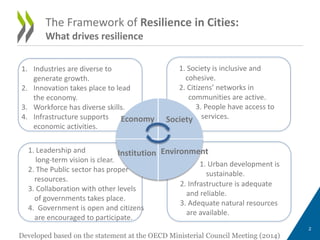
1. Industries are diverse to
generate growth.
2. Innovation takes place to lead
the economy.
3. Workforce has diverse skills.
4. Infrastructure supports
economic activities.
1. Society is inclusive and
cohesive.
2. Citizens’ networks in
communities are active.
3. People have access to
services.
1. Leadership and
long-term vision is clear.
2. The Public sector has proper
resources.
3. Collaboration with other levels
of governments takes place.
4. Government is open and citizens
are encouraged to participate.
2. Infrastructure is adequate
and reliable.
3. Adequate natural resources
are available.
1. Urban development is
sustainable.
Economy
Institution Environment
Society
The Framework of Resilience in Cities:
What drives resilience
2
Developed based on the statement at the OECD Ministerial Council Meeting (2014)
3
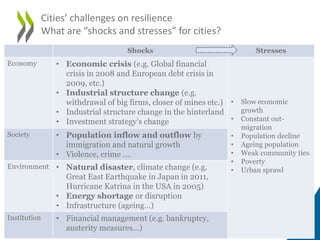
Cities’ challenges on resilience
What are “shocks and stresses” for cities?
Shocks Stresses
Economy • Economic crisis (e.g. Global financial
crisis in 2008 and European debt crisis in
2009, etc.)
• Industrial structure change (e.g.
withdrawal of big firms, closer of mines etc.)
• Industrial structure change in the hinterland
• Investment strategy’s change
• Slow economic
growth
• Constant out-
migration
• Population decline
• Ageing population
• Weak community ties
• Poverty
• Urban sprawl
Society • Population inflow and outflow by
immigration and natural growth
• Violence, crime ….
Environment • Natural disaster, climate change (e.g.
Great East Earthquake in Japan in 2011,
Hurricane Katrina in the USA in 2005)
• Energy shortage or disruption
• Infrastructure (ageing…)
Institution • Financial management (e.g. bankruptcy,
austerity measures…)
4
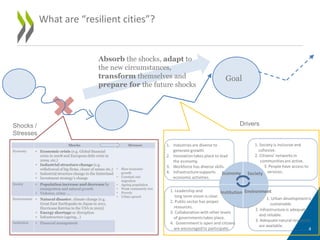
Absorb the shocks, adapt to
the new circumstances,
transform themselves and
prepare for the future shocks
What are “resilient cities”?
Goal
DriversShocks /
Stresses
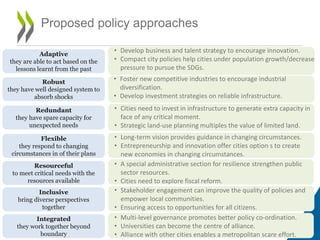
Proposed policy approaches
5
Adaptive
they are able to act based on the
lessons learnt from the past
Resourceful
to meet critical needs with the
resources available
• Develop business and talent strategy to encourage innovation.
• Compact city policies help cities under population growth/decrease
pressure to pursue the SDGs.
Robust
they have well designed system to
absorb shocks
Redundant
they have spare capacity for
unexpected needs
Flexible
they respond to changing
circumstances in of their plans
Integrated
they work together beyond
boundary
Inclusive
bring diverse perspectives
together
• Foster new competitive industries to encourage industrial
diversification.
• Develop investment strategies on reliable infrastructure.
• Cities need to invest in infrastructure to generate extra capacity in
face of any critical moment.
• Strategic land-use planning multiples the value of limited land.
• Long-term vision provides guidance in changing circumstances.
• Entrepreneurship and innovation offer cities option s to create
new economies in changing circumstances.
• A special administrative section for resilience strengthen public
sector resources.
• Cities need to explore fiscal reform.
• Stakeholder engagement can improve the quality of policies and
empower local communities.
• Ensuring access to opportunities for all citizens.
• Multi-level governance promotes better policy co-ordination.
• Universities can become the centre of alliance.
• Alliance with other cities enables a metropolitan scare effort.
6
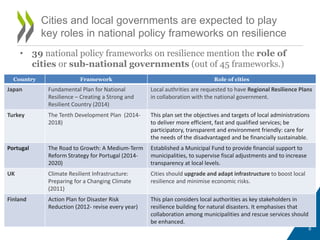
Cities and local governments are expected to play
key roles in national policy frameworks on resilience
• 39 national policy frameworks on resilience mention the role of
cities or sub-national governments (out of 45 frameworks.)
Country Framework Role of cities
Japan Fundamental Plan for National
Resilience – Creating a Strong and
Resilient Country (2014)
Local authrities are requested to have Regional Resilience Plans
in collaboration with the national government.
Turkey The Tenth Development Plan (2014-
2018)
This plan set the objectives and targets of local administrations
to deliver more efficient, fast and qualified services; be
participatory, transparent and environment friendly: care for
the needs of the disadvantaged and be financially sustainable.
Portugal The Road to Growth: A Medium-Term
Reform Strategy for Portugal (2014-
2020)
Established a Municipal Fund to provide financial support to
municipalities, to supervise fiscal adjustments and to increase
transparency at local levels.
UK Climate Resilient Infrastructure:
Preparing for a Changing Climate
(2011)
Cities should upgrade and adapt infrastructure to boost local
resilience and minimise economic risks.
Finland Action Plan for Disaster Risk
Reduction (2012- revise every year)
This plan considers local authorities as key stakeholders in
resilience building for natural disasters. It emphasises that
collaboration among municipalities and rescue services should
be enhanced.

Resilient Cities - OECD

  • 1.
    RESILIENT CITIES Setsuko Saya Headof Division Regional Policies for Sustainable Development Public Governance and Territorial Development OECD May 2016
  • 2.
    1. Industries arediverse to generate growth. 2. Innovation takes place to lead the economy. 3. Workforce has diverse skills. 4. Infrastructure supports economic activities. 1. Society is inclusive and cohesive. 2. Citizens’ networks in communities are active. 3. People have access to services. 1. Leadership and long-term vision is clear. 2. The Public sector has proper resources. 3. Collaboration with other levels of governments takes place. 4. Government is open and citizens are encouraged to participate. 2. Infrastructure is adequate and reliable. 3. Adequate natural resources are available. 1. Urban development is sustainable. Economy Institution Environment Society The Framework of Resilience in Cities: What drives resilience 2 Developed based on the statement at the OECD Ministerial Council Meeting (2014)
  • 3.
    3 Cities’ challenges onresilience What are “shocks and stresses” for cities? Shocks Stresses Economy • Economic crisis (e.g. Global financial crisis in 2008 and European debt crisis in 2009, etc.) • Industrial structure change (e.g. withdrawal of big firms, closer of mines etc.) • Industrial structure change in the hinterland • Investment strategy’s change • Slow economic growth • Constant out- migration • Population decline • Ageing population • Weak community ties • Poverty • Urban sprawl Society • Population inflow and outflow by immigration and natural growth • Violence, crime …. Environment • Natural disaster, climate change (e.g. Great East Earthquake in Japan in 2011, Hurricane Katrina in the USA in 2005) • Energy shortage or disruption • Infrastructure (ageing…) Institution • Financial management (e.g. bankruptcy, austerity measures…)
  • 4.
    4 Absorb the shocks,adapt to the new circumstances, transform themselves and prepare for the future shocks What are “resilient cities”? Goal DriversShocks / Stresses
  • 5.
    Proposed policy approaches 5 Adaptive theyare able to act based on the lessons learnt from the past Resourceful to meet critical needs with the resources available • Develop business and talent strategy to encourage innovation. • Compact city policies help cities under population growth/decrease pressure to pursue the SDGs. Robust they have well designed system to absorb shocks Redundant they have spare capacity for unexpected needs Flexible they respond to changing circumstances in of their plans Integrated they work together beyond boundary Inclusive bring diverse perspectives together • Foster new competitive industries to encourage industrial diversification. • Develop investment strategies on reliable infrastructure. • Cities need to invest in infrastructure to generate extra capacity in face of any critical moment. • Strategic land-use planning multiples the value of limited land. • Long-term vision provides guidance in changing circumstances. • Entrepreneurship and innovation offer cities option s to create new economies in changing circumstances. • A special administrative section for resilience strengthen public sector resources. • Cities need to explore fiscal reform. • Stakeholder engagement can improve the quality of policies and empower local communities. • Ensuring access to opportunities for all citizens. • Multi-level governance promotes better policy co-ordination. • Universities can become the centre of alliance. • Alliance with other cities enables a metropolitan scare effort.
  • 6.
    6 Cities and localgovernments are expected to play key roles in national policy frameworks on resilience • 39 national policy frameworks on resilience mention the role of cities or sub-national governments (out of 45 frameworks.) Country Framework Role of cities Japan Fundamental Plan for National Resilience – Creating a Strong and Resilient Country (2014) Local authrities are requested to have Regional Resilience Plans in collaboration with the national government. Turkey The Tenth Development Plan (2014- 2018) This plan set the objectives and targets of local administrations to deliver more efficient, fast and qualified services; be participatory, transparent and environment friendly: care for the needs of the disadvantaged and be financially sustainable. Portugal The Road to Growth: A Medium-Term Reform Strategy for Portugal (2014- 2020) Established a Municipal Fund to provide financial support to municipalities, to supervise fiscal adjustments and to increase transparency at local levels. UK Climate Resilient Infrastructure: Preparing for a Changing Climate (2011) Cities should upgrade and adapt infrastructure to boost local resilience and minimise economic risks. Finland Action Plan for Disaster Risk Reduction (2012- revise every year) This plan considers local authorities as key stakeholders in resilience building for natural disasters. It emphasises that collaboration among municipalities and rescue services should be enhanced.