Sustainable regeneration
in urban areas
urbact ii capitalisation, april 2015
urbact
ii
Sustainableregenerationinurbanareas,URBACTIIcapitalisation,April2015
Published by URBACT
5,Rue Pleyel,93283 Saint Denis,France
http://urbact.eu
Editorial advisory board:
Melody Houk
Jenny Koutsomarkou
Emmanuel Moulin
Maria Scantamburlo
Ivan Tosics
Graphic design and layout:
Christos Tsoleridis (Oxhouse design studio),
Thessaloniki,Greece
Printing:
bialec,Nancy (France)
©2015 URBACT II programme
urbact ii capitalisation, april 2015
Sustainable
regeneration
inurbanareas
This publication is part of a bigger
capitalisation initiative set by the URBACT
programme for 2014–2015 with the objective
to present to Europe’ s cities existing urban
knowledge and good practices about:
	
New urban economies
	
Jobs for young people in cities
	
Social innovation in cities
	
Sustainable regeneration in urban areas
These topics have been explored by four
URBACT working groups (workstreams),
composed of multidisciplinary
stakeholders across Europe such as urban
practitioners and experts from URBACT,
representatives from European universities,
European programmes and international
organisations working on these fields.
04	.....................navigator	What is this publication about?
06	..........................article	Setting the scene: raising the game in environmentally sustainable
urban regeneration
ByDarinkaCzischke,ConorMoloneyandCatalinaTurcu
15	 ..........................article	Why‘Think Global,Act Local’is no longer enough.
Arealitycheckfromtheemergingintelligenceonenvironmentallimits.
ByConorMoloney
22	.................... case study	Cities tackling climate change: the case of the International Building
Exhibition (IBA) Hamburg
ByNilsScheffler
28	..................... interview	 Energy-efficient housing renovation
and sustainable urban regeneration: looking for synergies
InterviewwithSorchaEdwards,byDarinkaCzischke
30	..................... interview	Connecting‘new urban economies’to sustainable urban regeneration
InterviewwithLuísCarvalho,byDarinkaCzischke
32	..........................article	Governing the sustainable city
ByNilsSchefflerandCatalinaTurcu
37	..................... interview	Keepingresidents’involvementgoinginsustainableurbanregeneration
InterviewwithManuelHumburg,byNilsScheffler
39	..................... interview	Calling for socially innovative local authorities
for sustainable urban regeneration
InterviewwithFrançoisJégou,byDarinkaCzischke
41	.................... case study	The path towards sustainable urban regeneration in Vilnius
ByTadasJonauskis,JustinaMuliuolytėandDarinkaCzischke
50	..................... interview	Working with the private sector in sustainable urban regeneration:
towards win-win solutions
InterviewwithRutaMatoniene,byIvanTosics
52	..........................article	Towards pro-environmental behaviour
ByCatalinaTurcuandConorMoloney
58	..........................article	Policy responses: the way forward
ByDarinkaCzischke,ConorMoloneyandCatalinaTurcu
61	........................... annex	The URBACT workstream‘Sustainable regeneration in urban areas’:
how did we get here
66	........................... annex	 Where to find out more
contents
04 urbact ii capitalisation
sustainable regeneration in urban areas
Welcometothepublication
oftheURBACTworkstream
‘Sustainableregenerationinurbanareas’!
Agroupofexperts,urbanpolicy-makers
andpractitionersfromacrossEuropehave
workedtogethersinceJune2014toanswer
theoverarchingquestion:howcancities
developlong-termstrategiesthatintegrate
thegoalsofmoresustainableresource
use,reducedcarbonemissionsandmore
equitablesocialdevelopment?Tothisend,
wehaveexaminedkeychallengesthatcities
faceinthesefieldsanddocumentedsomeof
thesolutionsthattheyhaveappliedtotackle
themthroughenvironmentallyfocusedurban
actionsacrossEurope.Whileouremphasis
isonphysicalinterventionsatlocallevel
intownsandcities,wehavealsolookedat
thewiderrelationshipstothesocialand
institutionaldimensionsofsustainability.
This publication presents a selection of the
evidence,analysis and concrete solutions that
we have brought together over the course of
this workstream.A first article sets the scene by
providing an overview of the main challenges and
types of approaches applied across Europe.The
following article,“Why‘Think Global,Act Local’is
no longer enough”,frames our discussion about
local solutions in the wider context of pressing
global challenges by introducing the notion and
evidence on‘environmental limits’,calling for a
move beyond the well-known‘Think Globally,Act
Locally’motto of sustainable urban development.
Following our conceptual framing,we move on to
innovative approaches and concrete solutions.We
begin by looking at the physical environmental
dimension: our first in-depth case study,on the
IBA Hamburg (International Building Exhibition),
discusses in detail the implementation of the
innovative‘Cities and Climate Change’strategy and
actions towards a climate neutral urban district.
An interview with the co-ordinator of the Power
House Europe project tells us about the challenges
and solutions that housing providers are facing
in their quest to retrofit Europe’s housing stock,
as well as on the importance of linking energy-
efficient housing renovation to sustainable urban
regeneration.Lastly,in an interview with Luís
Carvalho from the URBACT workstream‘New
What is
this publication
about?
05
navigator
urbact ii capitalisation
urban economies’,we reflect on connections of the
latter with sustainable urban regeneration and
the possibilities and limits of current policy trends
such as the‘smart city’or the‘green economy’.
A second set of articles investigates the importance
of institutional and social aspects in achieving
sustainable urban regeneration.In‘Governing the
sustainable city’,we reflect on the importance of
cross-sector integration in sustainable regeneration
projects and propose a set of recommendations
for cities to become better at that.We then look
at the residents’perspective on these processes,
particularly at what happens next following
completion of a given sustainable regeneration
project,through an interview with one of the
leaders of the residents’movement that gave rise
to the IBA Hamburg in Wilhemsburg.Following
this,Francois Jégou,co-ordinator of the URBACT
workstream‘Social innovation in cities’,gives us
his views on the importance of social innovation
not only from the grassroots when it comes to
sustainable urban regeneration initiatives,but also
from local authorities leading these projects.
In our second in-depth case study,in the city of
Vilnius,we look at the specific problems that post-
communist cities face in this field and adopt a
process-perspective to understand the root causes
of problems and the way forward.In addition,we
asked the Head of the Urban Planning Department
of Vilnius to give us her view on how to best work
with the private sector to achieve win-win solutions
in sustainable urban regeneration projects.
But none of the above can be achieved and
sustained over time without the adoption of new,
pro-environmental behaviours by individuals
and institutions.Our last article explores this
issue and sheds light on concrete actions that
cities can take to encourage their citizens to
change their behaviour in that direction.
We conclude with a set of policy recommendations
in our last article,followed by a word on our working
methods to carry out this work and by a list of useful
literature and online resources for the curious reader.
Enjoythereading!
Darinka Czischke
AssistantProfessor,FacultyofArchitecture
andtheBuiltEnvironment,
DelftUniversityofTechnology(TheNetherlands)
andco-ordinatoroftheURBACTworkstream
‘Sustainableregenerationinurbanareas’
Source: Freepik
06 urbact ii capitalisation
sustainable regeneration in urban areas
The big green challenge for cities
WitharoundthreequartersofEurope’s
population–approximately359million
people–livingincitiesandurbanareasof
morethan5,000inhabitants,Europeisthe
world’smosturbanisedcontinent.Urban
livinghasmanyadvantages,includingmore
andbetterjobopportunities,thediversity
andvibrancyofurbanlife,andothersocial
andeconomicbenefits.Townsandcitiesare
alsoenginesofregionalandnationalgrowth.
However,theveryattributesthatmakethem
suchdesirableplacestoliveandinvestbring
aseriesofchallengestotheirsustainability.
Overcrowding,noise,poor air quality,traffic
congestion,waste production and industrial
emissions are just a few of the many externalities
of contemporary urban production and
consumption patterns.Cities are currently facing
major challenges to their quality of life and to the
range of opportunities that urban environments
can offer their residents.One can speak about
three main families of challenges for sustainable
urban regeneration: environmental (climate
change,carbon emissions and resource use),social
(inequality,cohesion and health),and institutional
(governance and geographical disparities).
The reality of climate change presents particular
challenges for cities.Flooding,heat waves,droughts
and other extreme whether events impact physically
on urban neighbourhoods and infrastructures,
and consequently on the health and mortality of
urban populations.They can also impact indirectly
on urban communities and economies through
damage to key assets and creation of uncertainty
about the future,which together erode confidence
in investment both in social and financial capital.
Socio-economic inequalities should also be seen as a
major challenge to sustainable urban regeneration.
In a global context,the increasing competition
*	 Darinka Czischke is Assistant Professor at the Faculty of Architecture and the Built Environment,Delft University of
Technology (The Netherlands) and co-ordinator of the URBACT workstream‘Sustainable regeneration in urban areas’
Conor Moloney is Head of Sustainable Places at BioRegional,UK
Catalina Turcu is lecturer in Sustainable Urban Development at Bartlett School of Planning,University College London,UK
Raising the game
in environmentally
sustainable urban regeneration
✍  ByDarinkaCzischke,ConorMoloneyandCatalinaTurcu*
07
article
urbact ii capitalisation
for energy and resources is
likely to combine with the
effects of climate change to
impact disproportionally
on the poorest and most
vulnerable.This is no less true
in Europe and in particular in
its cities,where inequalities
are intensifying due to a
number of demographic and economic phenomena,
notably ageing (with many elderly people being
less able to cope with environmental impacts),
increasing ethnic diversity and rising numbers
of people experiencing poverty and/or social
exclusion.These developments are inter-related
and combine to produce different configurations
of environmental vulnerability in a given city.
Institutional challenges to urban sustainability are
linked to tensions between top-down technical
and managerial approaches to urban regeneration
and bottom-up or grassroots
environmental needs,expectations
and initiatives.It is widely accepted
that in democratic societies urban
regeneration processes should
adopt governance approaches
that involve multiple stakeholders
including residents and other civil
communities-of-interest.However,
too often we see unresolved clashes
between what local communities
want for their neighbourhoods
on the one hand,and the plans of
city administrations on the other.
In addition,corporate interests
of commercial developers add
to the mix,which can create
long-term blockages in decision-
making,or win-lose situations.
The URBACT workstream
‘Sustainable regeneration in
urban areas’has examined these challenges and
documented some of the solutions that cities
across Europe have applied to tackle them through
environmentally focused actions.We have put a
particular emphasis on physical interventions at local
level in towns and cities,and consider innovative
low-carbon and energy-efficiency actions whilst
also looking at the wider relationships to the social
and institutional dimensions of sustainability.
What are we talking about
when we talk about
‘sustainable urban regeneration’ here?
Before we proceed,it is useful to clarify what we
understand by‘sustainable regeneration’.While
a consistent definition of‘urban sustainability’or
‘sustainable urban development’has proved to be
elusive,in most policy and academic circles it is
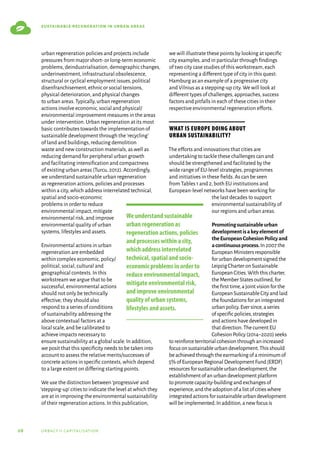
agreed that they can be defined as an aggregate of
four basic pillars: economic,environmental,social
and institutional (see Figure 1).On the same vein,
the URBACT programme uses the term‘integrated
sustainable approach’to describe the integration
of these different dimensions of sustainable local
development.Taking this quadruple bottom-
line as an overall framework,this workstream
understands urban sustainability from the direction
of the environmental pillar; hence environmental
urban sustainability,while considering links with
the social,institutional and economic pillars.
Urban regeneration is a way to reorganise and
upgrade existing places rather than planning new
urbanisation (Puppim de Oliveira and Balaban,
2013).Urban regeneration is primarily concerned
with regenerating city centres,former industrial
areas,early / inner ring suburbs and also post
war (post 1945) housing areas facing periods of
decline due to compounding and intersecting
pressures.Factors underlying the adoption of
Urban ENVIRONMENT
(protection / safeguarding)
Urban ECONOMY
(development / growth)
Urban SOCIAL CONTEXT
(cohesion / justice / equality)
Urban GOVERNANCE
(empowerment / integration)
SUSTAINABLE
URBAN DEVELOPMENT
Figure 1. The Prism of urban sustainability
Source:Turcu, C., 2010, on the basis ofValentin  Spangenberg, 1999
Source: Dreamstime.com
08 urbact ii capitalisation
sustainable regeneration in urban areas
urban regeneration policies and projects include
pressures from major short-or long-term economic
problems,deindustrialisation,demographic changes,
underinvestment,infrastructural obsolescence,
structural or cyclical employment issues,political
disenfranchisement,ethnic or social tensions,
physical deterioration,and physical changes
to urban areas.Typically,urban regeneration
actions involve economic,social and physical/
environmental improvement measures in the areas
under intervention.Urban regeneration at its most
basic contributes towards the implementation of
sustainable development through the‘recycling’
of land and buildings,reducing demolition
waste and new construction materials,as well as
reducing demand for peripheral urban growth
and facilitating intensification and compactness
of existing urban areas (Turcu,2012).Accordingly,
we understand sustainable urban regeneration
as regeneration actions,policies and processes
within a city,which address interrelated technical,
spatial and socio-economic
problems in order to reduce
environmental impact,mitigate
environmental risk,and improve
environmental quality of urban
systems,lifestyles and assets.
Environmental actions in urban
regeneration are embedded
within complex economic,policy/
political,social,cultural and
geographical contexts.In this
workstream we argue that to be
successful,environmental actions
should not only be technically
effective; they should also
respond to a series of conditions
of sustainability addressing the
above contextual factors at a
local scale,and be calibrated to
achieve impacts necessary to
ensure sustainability at a global scale.In addition,
we posit that this specificity needs to be taken into
account to assess the relative merits/successes of
concrete actions in specific contexts,which depend
to a large extent on differing starting points.
We use the distinction between‘progressive’and
‘stepping-up’cities to indicate the level at which they
are at in improving the environmental sustainability
of their regeneration actions.In this publication,
we will illustrate these points by looking at specific
city examples,and in particular through findings
of two city case studies of this workstream,each
representing a different type of city in this quest:
Hamburg as an example of a progressive city
and Vilnius as a stepping-up city.We will look at
different types of challenges,approaches,success
factors and pitfalls in each of these cities in their
respective environmental regeneration efforts.
What is Europe doing about
urban sustainability?
The efforts and innovations that cities are
undertaking to tackle these challenges can and
should be strengthened and facilitated by the
wide range of EU-level strategies,programmes
and initiatives in these fields.As can be seen
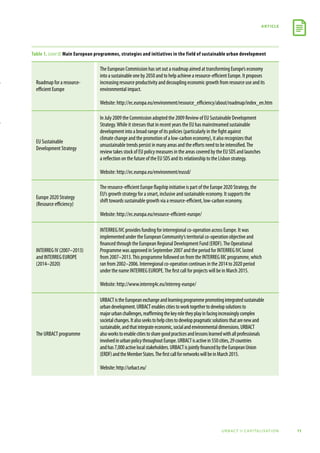
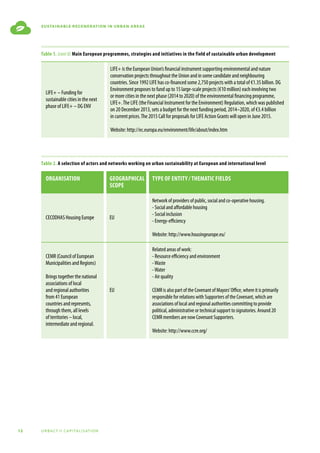
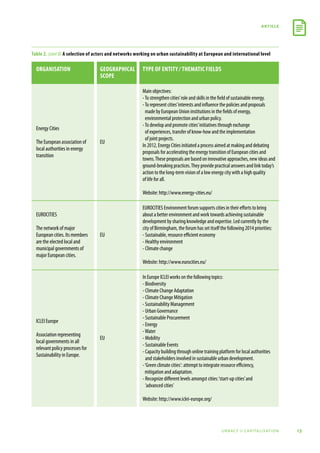
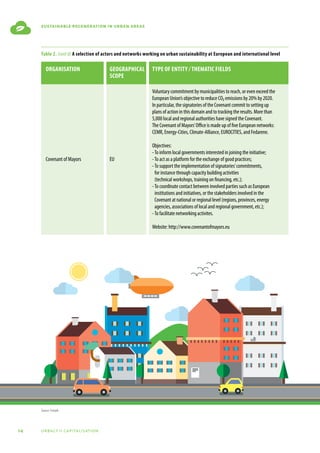
from Tables 1 and 2,both EU institutions and
European-level networks have been working for
the last decades to support
environmental sustainability of
our regions and urban areas.
Promotingsustainableurban
developmentisakeyelementof
theEuropeanCohesionPolicyand
acontinuousprocess.In2007the
EuropeanMinistersresponsible
forurbandevelopmentsignedthe
LeipzigCharteronSustainable
EuropeanCities.Withthischarter,
theMemberStatesoutlined,for
thefirsttime,ajointvisionforthe
EuropeanSustainableCityandlaid
thefoundationsforanintegrated
urbanpolicy.Eversince,aseries
ofspecificpolicies,strategies
andactionshavedevelopedin
thatdirection.ThecurrentEU
CohesionPolicy(2014–2020)seeks
toreinforceterritorialcohesionthroughanincreased
focusonsustainableurbandevelopment.Thisshould
beachievedthroughtheearmarkingofaminimumof
5%ofEuropeanRegionalDevelopmentFund(ERDF)
resourcesforsustainableurbandevelopment,the
establishmentofanurbandevelopmentplatform
topromotecapacity-buildingandexchangesof
experience,andtheadoptionofalistofcitieswhere
integratedactionsforsustainableurbandevelopment
willbeimplemented.Inaddition,anewfocusis
We understand sustainable
urban regeneration as
regeneration actions, policies
and processes within a city,
which address interrelated
technical, spatial and socio-
economic problems in order to
reduce environmental impact,
mitigate environmental risk,
and improve environmental
quality of urban systems,
lifestyles and assets.
09
article
urbact ii capitalisation
proposedonconnectingruralandurbanprogrammes,
notablythroughbuildingrural-urbanpartnerships.
The European Commission provides a general
understanding of what they consider an‘integrated
approach’to sustainable urban development:“The
various dimensions of urban life–environmental,
economic,social and cultural–are interwoven
and success in urban development can only
be achieved through an integrated approach.
Measures concerning physical urban renewal
must be combined with measures promoting
education,economic development,social inclusion
and environmental protection.In addition,the
development of strong partnerships between
local citizens,civil society,the local economy
and the various levels of government is a pre-
requisite.”(European Commission,2014).
Europe 2020 is the European Union’s ten-year
growth and jobs strategy that was launched in
2010.In addition to the core goal
of overcoming the crisis from
which European economies are
gradually recovering,the strategy
aims to address the shortcomings
of Europe’s growth model and
create the conditions for smart,
sustainable and inclusive growth.
Five headline targets have been
set for the EU,to be achieved
by the end of 2020.These cover
employment; research and
development; climate/energy;
education; social inclusion
and poverty reduction.Within
this framework,another key
initiative for sustainable development is Horizon
2020,the financial instrument implementing the
‘Innovation Union’,a Europe 2020 flagship initiative
aimed at securing Europe’s global competitiveness.
Horizon 2020 is the biggest EU Research and
Innovation programme ever with nearly €80 billion
of funding available over seven years (2014–2020),
in addition to the private investment that this
money is due to attract.Sustainable development
in general,and more specifically,environmental
sustainability,feature amongst the key priorities
to obtain research funding from Horizon 2020.
What’s in for cities in this Publication?
Thearticlesinthispublicationprovideavarietyof
perspectivesonkeyapproachesappliedbycitiesto
addresstheabovechallenges.Fromaphysicalperspective,
differentparadigmsonhowcitiesshouldbespatially
organisedrepresentcontrastingviewsonenvironmental
problemsandsolutions.Forexample,somearguethata
shifttodenserurbanlivingwouldprovideanoutletfor
socialinteractionandconditionsunderwhichhumans
canprosper.Followingthisview,‘compactcity’advocates
positthaturbansystemscanbemoreenvironmentally
sustainablethanruralorsuburbanliving.However,the
‘compactcity’approachtourbandevelopmentisnot
uncontested.Therearethresholdsinurbandensity,for
example,beyondwhichnegativeimpactscanundermine
thepositiveaspectsoflivingincloseproximity.Themore
compactcitiesbecome,thegreatertheircomplexityand
hencethebetterconfigured,designedandgoverned
theymustbeinordertomitigatethepotentialimpacts
ofdensity.Alternativeapproachesincludemore
expansivelower-densitysolutions
thatprovidegreaterscopeforhigh
qualitylandscapesandhabitats,
localenergygeneration,food
growing,andgeneralopenspace
leisureactivities.Again,thisposes
significantchallengestoEuropean
citiesintermsofplanning,urban
designandgovernancesystems.
Inthispublication,wewilllook
atplanningchoicesthatdifferent
citieshavemadewhenitcomes
todecideonwheretoprioritise
regeneration(strategiclocation),
howtodeliverit(e.g.densities,
provisionoftransportlinksand
greenareas,etc.),andwhatcontributionregeneration
canmaketotheenvironmentalsustainability
oftheareainquestionandofthecityasawhole.
Throughcasestudiesandcityexamples,wealso
lookattheinnovativeuseoftechnologyinurban
environmentaldesignandregeneration,including
energymappingandmasterplanning,useofsmart
technologiesandurbangreening–allofwhichaim
tostepupresponsestotheabovechallenges.
However,technical solutions are not enough to
achieve sustainable urban regeneration.This goal
requires bringing together a variety of often clashing
agendas at different levels and across sectors in order
to achieve coherence and long-term solutions.To
Technical solutions are not
enough to achieve sustainable
urban regeneration.This goal
requires bringing together
a variety of often clashing
agendas at different levels
and across sectors in order
to achieve coherence and
long-term solutions.
10 urbact ii capitalisation
sustainable regeneration in urban areas
this end,urban governance arrangements,including
cross-sector co-operation and citizen participation
channels,need to be up-to-date with the new reality
of social innovation and co-production of the built
environment.Furthermore,on a societal and cultural
level,people’s behaviour towards the environment
needs to change accordingly,which means changing
mind-sets.We will reflect on concrete actions and
processes that different cities have adopted and/
or could adopt to make this change effective.
It is time to raise the game in environmentally
sustainable urban regeneration.We hope that the
examples and ideas presented in this publication
inspire you and your city to be up to the challenge!  g
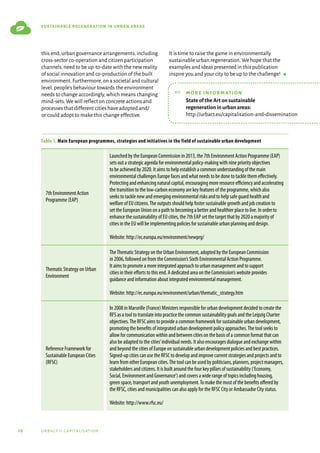
Table 1. Main European programmes, strategies and initiatives in the field of sustainable urban development
7th Environment Action
Programme (EAP)
Launched by the European Commission in 2013, the 7th Environment Action Programme (EAP)
sets out a strategic agenda for environmental policy-making with nine priority objectives
to be achieved by 2020. It aims to help establish a common understanding of the main
environmental challenges Europe faces and what needs to be done to tackle them effectively.
Protecting and enhancing natural capital, encouraging more resource efficiency and accelerating
the transition to the low-carbon economy are key features of the programme, which also
seeks to tackle new and emerging environmental risks and to help safe guard health and
welfare of EU citizens.The outputs should help foster sustainable growth and job creation to
set the European Union on a path to becoming a better and healthier place to live. In order to
enhance the sustainability of EU cities, the 7th EAP set the target that by 2020 a majority of
cities in the EU will be implementing policies for sustainable urban planning and design.
Website: http://ec.europa.eu/environment/newprg/
Thematic Strategy on Urban
Environment
TheThematic Strategy on the Urban Environment, adopted by the European Commission
in 2006, followed on from the Commission’s Sixth Environmental Action Programme.
It aims to promote a more integrated approach to urban management and to support
cities in their efforts to this end. A dedicated area on the Commission’s website provides
guidance and information about integrated environmental management.
Website: http://ec.europa.eu/environment/urban/thematic_strategy.htm
Reference Framework for
Sustainable European Cities
(RFSC)
In 2008 in Marseille (France) Ministers responsible for urban development decided to create the
RFS as a tool to translate into practice the common sustainability goals and the Leipzig Charter
objectives.The RFSC aims to provide a common framework for sustainable urban development,
promoting the benefits of integrated urban development policy approaches.The tool seeks to
allow for communication within and between cities on the basis of a common format that can
also be adapted to the cities’individual needs. It also encourages dialogue and exchange within
and beyond the cities of Europe on sustainable urban development policies and best practices.
Signed-up cities can use the RFSC to develop and improve current strategies and projects and to
learn from other European cities.The tool can be used by politicians, planners, project managers,
stakeholders and citizens. It is built around the four key pillars of sustainability (‘Economy,
Social, Environment and Governance’) and covers a wide range of topics including housing,
green space, transport and youth unemployment.To make the most of the benefits offered by
the RFSC, cities and municipalities can also apply for the RFSC City or Ambassador City status.
Website: http://www.rfsc.eu/
☞	more information
	
State of the Art on sustainable
regeneration in urban areas:
http://urbact.eu/capitalisation-and-dissemination
11
article
urbact ii capitalisation
Table 1. (cont’d) Main European programmes, strategies and initiatives in the field of sustainable urban development
Roadmap for a resource-
efficient Europe
The European Commission has set out a roadmap aimed at transforming Europe’s economy
into a sustainable one by 2050 and to help achieve a resource-efficient Europe. It proposes
increasing resource productivity and decoupling economic growth from resource use and its
environmental impact.
Website: http://ec.europa.eu/environment/resource_efficiency/about/roadmap/index_en.htm
EU Sustainable
Development Strategy
In July 2009 the Commission adopted the 2009 Review of EU Sustainable Development
Strategy.While it stresses that in recent years the EU has mainstreamed sustainable
development into a broad range of its policies (particularly in the fight against
climate change and the promotion of a low-carbon economy), it also recognizes that
unsustainable trends persist in many areas and the efforts need to be intensified.The
review takes stock of EU policy measures in the areas covered by the EU SDS and launches
a reflection on the future of the EU SDS and its relationship to the Lisbon strategy.
Website: http://ec.europa.eu/environment/eussd/
Europe 2020 Strategy
(Resource efficiency)
The resource-efficient Europe flagship initiative is part of the Europe 2020 Strategy, the
EU’s growth strategy for a smart, inclusive and sustainable economy. It supports the
shift towards sustainable growth via a resource-efficient, low-carbon economy.
Website: http://ec.europa.eu/resource-efficient-europe/
INTERREG IV (2007–2013)
and INTERREG EUROPE
(2014–2020)
INTERREG IVC provides funding for interregional co-operation across Europe. It was
implemented under the European Community’s territorial co-operation objective and
financed through the European Regional Development Fund (ERDF).The Operational
Programme was approved in September 2007 and the period for INTERREG IVC lasted
from 2007–2013.This programme followed on from the INTERREG IIIC programme, which
ran from 2002–2006. Interregional co-operation continues in the 2014 to 2020 period
under the name INTERREG EUROPE.The first call for projects will be in March 2015.
Website: http://www.interreg4c.eu/interreg-europe/
The URBACT programme
URBACTistheEuropeanexchangeandlearningprogrammepromotingintegratedsustainable
urbandevelopment.URBACTenablescitiestoworktogethertodevelopsolutionsto
majorurbanchallenges,reaffirmingthekeyroletheyplayinfacingincreasinglycomplex
societalchanges.Italsoseekstohelpcitestodeveloppragmaticsolutionsthatarenewand
sustainable,andthatintegrateeconomic,socialandenvironmentaldimensions.URBACT
alsoworkstoenablecitiestosharegoodpracticesandlessonslearnedwithallprofessionals
involvedinurbanpolicythroughoutEurope.URBACTisactivein550cities,29countries
andhas7,000activelocalstakeholders.URBACTisjointlyfinancedbytheEuropeanUnion
(ERDF)andtheMemberStates.ThefirstcallfornetworkswillbeinMarch2015.
Website:http://urbact.eu/
12 urbact ii capitalisation
sustainable regeneration in urban areas
Table 1. (cont’d) Main European programmes, strategies and initiatives in the field of sustainable urban development
LIFE+ – Funding for
sustainable cities in the next
phase of LIFE+ – DG ENV
LIFE+ is the European Union’s financial instrument supporting environmental and nature
conservation projects throughout the Union and in some candidate and neighbouring
countries. Since 1992 LIFE has co-financed some 2,750 projects with a total of €1.35 billion. DG
Environment proposes to fund up to 15 large-scale projects (€10 million) each involving two
or more cities in the next phase (2014 to 2020) of the environmental financing programme,
LIFE+.The LIFE (the Financial Instrument for the Environment) Regulation, which was published
on 20 December 2013, sets a budget for the next funding period, 2014–2020, of €3.4 billion
in current prices.The 2015 Call for proposals for LIFE Action Grants will open in June 2015.
Website: http://ec.europa.eu/environment/life/about/index.htm
Table 2. A selection of actors and networks working on urban sustainability at European and international level
Organisation Geographical
scope
Type of entity / thematic fields
CECODHAS Housing Europe EU
Network of providers of public, social and co-operative housing.
- Social and affordable housing
- Social inclusion
- Energy-efficiency
Website: http://www.housingeurope.eu/
CEMR (Council of European
Municipalities and Regions)
Brings together the national
associations of local
and regional authorities
from 41 European
countries and represents,
through them, all levels
of territories – local,
intermediate and regional.
EU
Related areas of work:
- Resource efficiency and environment
-Waste
-Water
- Air quality
CEMR is also part of the Covenant of Mayors’Office, where it is primarily
responsible for relations with Supporters of the Covenant, which are
associations of local and regional authorities committing to provide
political, administrative or technical support to signatories. Around 20
CEMR members are now Covenant Supporters.
Website: http://www.ccre.org/
13
article
urbact ii capitalisation
Table 2. (cont’d) A selection of actors and networks working on urban sustainability at European and international level
Organisation Geographical
scope
Type of entity / thematic fields
Energy Cities
The European association of
local authorities in energy
transition
EU
Main objectives:
-To strengthen cities’role and skills in the field of sustainable energy.
-To represent cities’interests and influence the policies and proposals
made by European Union institutions in the fields of energy,
environmental protection and urban policy.
-To develop and promote cities’initiatives through exchange
of experiences, transfer of know-how and the implementation
of joint projects.
In 2012, Energy Cities initiated a process aimed at making and debating
proposals for accelerating the energy transition of European cities and
towns.These proposals are based on innovative approaches, new ideas and
ground-breaking practices.They provide practical answers and link today’s
action to the long-term vision of a low energy city with a high quality
of life for all.
Website: http://www.energy-cities.eu/
EUROCITIES
The network of major
European cities. Its members
are the elected local and
municipal governments of
major European cities.
EU
EUROCITIES Environment forum supports cities in their efforts to bring
about a better environment and work towards achieving sustainable
development by sharing knowledge and expertise. Led currently by the
city of Birmingham, the forum has set itself the following 2014 priorities:
- Sustainable, resource efficient economy
- Healthy environment
- Climate change
Website: http://www.eurocities.eu/
ICLEI Europe
Association representing
local governments in all
relevant policy processes for
Sustainability in Europe.
EU
In Europe ICLEI works on the following topics:
- Biodiversity
- Climate Change Adaptation
- Climate Change Mitigation
- Sustainability Management
- Urban Governance
- Sustainable Procurement
- Energy
-Water
- Mobility
- Sustainable Events
- Capacity building through online training platform for local authorities
and stakeholders involved in sustainable urban development.
-‘Green climate cities’: attempt to integrate resource efficiency,
mitigation and adaptation.
- Recognize different levels amongst cities:‘start-up cities’and
‘advanced cities’
Website: http://www.iclei-europe.org/
14 urbact ii capitalisation
sustainable regeneration in urban areas
Table 2. (cont’d) A selection of actors and networks working on urban sustainability at European and international level
Organisation Geographical
scope
Type of entity / thematic fields
Covenant of Mayors EU
Voluntary commitment by municipalities to reach, or even exceed the
European Union’s objective to reduce CO₂ emissions by 20% by 2020.
In particular, the signatories of the Covenant commit to setting up
plans of action in this domain and to tracking the results. More than
5,000 local and regional authorities have signed the Covenant.
The Covenant of Mayors’Office is made up of five European networks:
CEMR, Energy-Cities, Climate-Alliance, EUROCITIES, and Fedarene.
Objectives:
-To inform local governments interested in joining the initiative;
-To act as a platform for the exchange of good practices;
-To support the implementation of signatories’commitments,
for instance through capacity building activities
(technical workshops, training on financing, etc.);
-To coordinate contact between involved parties such as European
institutions and initiatives, or the stakeholders involved in the
Covenant at national or regional level (regions, provinces, energy
agencies, associations of local and regional government, etc.);
-To facilitate networking activites.
Website: http://www.covenantofmayors.eu
Source: Freepik
15
article
urbact ii capitalisation
‘Thinkglobal,actlocal’hasbeenacore
messageinsustainabledevelopment
policysinceLocalAgenda21.
In the 20 years since the Rio Earth Summit from
which it emerged,the evidence for climate change
has become ever more robust and the case for
action ever more urgent.Whilst the rate of resource
consumption has increased exponentially,there is
increasingly limited capacity for continued emissions
and other environmental impacts before tipping
points are reached,beyond which there is a high
risk of catastrophic consequences.With mounting
evidence of escalating environmental damage,it is
essential that cities deepen their understanding of
these environmental limits at all levels and devise
better ways of accounting for pressures and impacts
that are taking them up to and beyond these limits.
Cities need to use this knowledge to inform the
actions in neighbourhoods,cities and regions,as
well as nationally and globally.Critically,climate
change is only one of numerous environmental
limits identified in the latest research,in addition
to biodiversity loss and land-use change for
example.It’s clear that the‘think global,act local’
message does not quite capture the gravity of the
situation cities now face; it is commonly used to
support localised and incremental improvements
on current practice in environmental sustainability,
rather than unlocking the systemic change required
at neighbourhood,city,regional and national
level to meet the scale of the challenge as it is now
understood.So the question is this: how can cities
refresh the message and build common purpose
amongst stakeholders–citizens,communities,
elected representatives,businesses,civil servants
–to achieve the impacts that are needed in towns
andcitiesacrossEuropeandacrosstheworld? Below
we introduce the latest thinking on environmental
limits,and then consider what this might mean for
European urban regeneration in the coming years.
Over the past decade,a number of scientific
approaches to the calibration of environmental
limits have emerged.Foremost amongst these
is the Stockholm Resilience Centre’s1‘Planetary
Why‘Think Global, Act Local’
is no longer enough
A reality check from the emerging
intelligence on environmental limits
✍  ByConorMoloney*
*	 Conor Moloney is Head of Sustainable Places at BioRegional,UK
1	
http://www.stockholmresilience.org/
Source: Freepik
16 urbact ii capitalisation
sustainable regeneration in urban areas
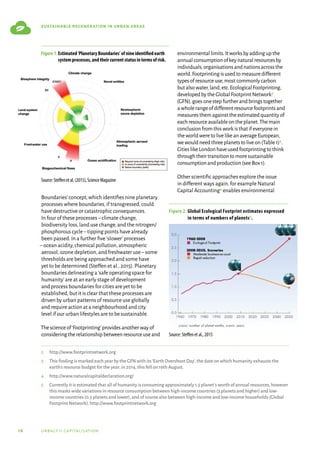
Boundaries’concept,which identifies nine planetary
processes where boundaries,if transgressed,could
have destructive or catastrophic consequences.
In four of these processes–climate change,
biodiversity loss,land use change,and the nitrogen/
phosphorous cycle–tipping points have already
been passed.In a further five‘slower’processes
–ocean acidity,chemical pollution,atmospheric
aerosol,ozone depletion,and freshwater use–some
thresholds are being approached and some have
yet to be determined (Steffen et al.,2015).Planetary
boundaries delineating a‘safe operating space for
humanity’are at an early stage of development
and process boundaries for cities are yet to be
established,but it is clear that these processes are
driven by urban patterns of resource use globally
and require action at a neighbourhood and city
level if our urban lifestyles are to be sustainable.
Thescienceof‘Footprinting’providesanotherwayof
consideringtherelationshipbetweenresourceuseand
environmentallimits.Itworksbyaddingupthe
annualconsumptionofkeynaturalresourcesby
individuals,organisationsandnationsacrossthe
world.Footprintingisusedtomeasuredifferent
typesofresourceuse,mostcommonlycarbon
butalsowater,land,etc.EcologicalFootprinting,
developedbytheGlobalFootprintNetwork2
(GFN),goesonestepfurtherandbringstogether
awholerangeofdifferentresourcefootprintsand
measuresthemagainsttheestimatedquantityof
eachresourceavailableontheplanet.Themain
conclusionfromthisworkisthatifeveryonein
theworldweretolivelikeanaverageEuropean,
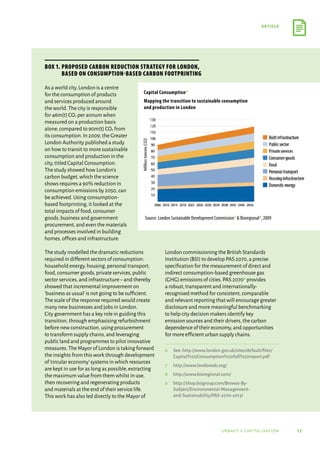
wewouldneedthreeplanetstoliveon(Table 1)3.
CitieslikeLondonhaveusedfootprintingtothink
throughtheirtransitiontomoresustainable
consumptionandproduction(seeBox1).
Other scientific approaches explore the issue
in different ways again,for example Natural
Capital Accounting4 enables environmental
Figure1.Estimated‘PlanetaryBoundaries’ofnineidentifiedearth
systemprocesses,andtheircurrentstatusintermsofrisk.
Source:Steffenetal.(2015),ScienceMagazine
Figure 2. Global Ecological Footprint estimates expressed
in terms of numbers of planets5.
Source: Steffen et al., 2015
2	 http://www.footprintnetwork.org
3	 This finding is marked each year by the GFN with its‘Earth Overshoot Day’,the date on which humanity exhausts the
earth’s resource budget for the year; in 2014,this fell on 19th August.
4	 http://www.naturalcapitaldeclaration.org/
5	 Currently it is estimated that all of humanity is consuming approximately 1.5 planet’s worth of annual resources,however
this masks wide variations in resource consumption between high-income countries (3 planets and higher) and low-
income countries (0.5 planets and lower),and of course also between high-income and low-income households (Global
Footprint Network).http://www.footprintnetwork.org
17
article
urbact ii capitalisation
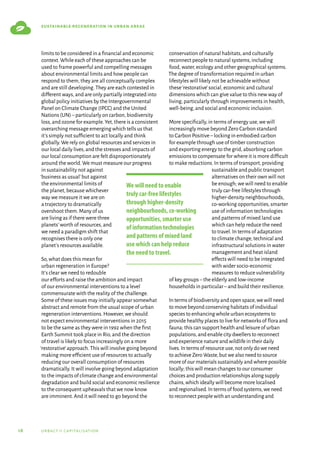
As a world city,London is a centre
for the consumption of products
and services produced around
the world.The city is responsible
for 46m(t) CO2 per annum when
measured on a production basis
alone,compared to 90m(t) CO2 from
its consumption.In 2009,the Greater
London Authority published a study
on how to transit to more sustainable
consumption and production in the
city,titled Capital Consumption.
The study showed how London’s
carbon budget,which the science
shows requires a 90% reduction in
consumption emissions by 2050,can
be achieved.Using consumption-
based footprinting,it looked at the
total impacts of food,consumer
goods,business and government
procurement,and even the materials
and processes involved in building
homes,offices and infrastructure.
The study modelled the dramatic reductions
required in different sectors of consumption:
household energy,housing,personal transport,
food,consumer goods,private services,public
sector services,and infrastructure–and thereby
showed that incremental improvement on
‘business as usual’is not going to be sufficient.
The scale of the response required would create
many new businesses and jobs in London.
City government has a key role in guiding this
transition,through emphasising refurbishment
before new construction,using procurement
to transform supply chains,and leveraging
public land and programmes to pilot innovative
measures.The Mayor of London is taking forward
the insights from this work through development
of‘circular economy’systems in which resources
are kept in use for as long as possible,extracting
the maximum value from them whilst in use,
then recovering and regenerating products
and materials at the end of their service life.
This work has also led directly to the Mayor of
London commissioning the British Standards
Institution (BSI) to develop PAS 2070,a precise
specification for the measurement of direct and
indirect consumption-based greenhouse gas
(GHG) emissions of cities.PAS 20709 provides
a robust,transparent and internationally-
recognised method for consistent,comparable
and relevant reporting that will encourage greater
disclosure and more meaningful benchmarking
to help city decision makers identify key
emission sources and their drivers,the carbon
dependence of their economy,and opportunities
for more efficient urban supply chains.
6	 See: http://www.london.gov.uk/sites/default/files/
Capital%20Consumption%20full%20report.pdf
7	 http://www.londonsdc.org/
8	 http://www.bioregional.com/
9	 http://shop.bsigroup.com/Browse-By-
Subject/Environmental-Management-
and-Sustainability/PAS-2070-2013/
Box 1. Proposed carbon reduction strategy for London,
based on consumption-based carbon footprinting
Source: London Sustainable Development Commission7 Bioregional8, 2009
Capital Consumption6
Mapping the transition to sustainable consumption
and production in London
18 urbact ii capitalisation
sustainable regeneration in urban areas
limits to be considered in a financial and economic
context.While each of these approaches can be
used to frame powerful and compelling messages
about environmental limits and how people can
respond to them,they are all conceptually complex
and are still developing.They are each contested in
different ways,and are only partially integrated into
global policy initiatives by the Intergovernmental
Panel on Climate Change (IPCC) and the United
Nations (UN)–particularly on carbon,biodiversity
loss,and ozone for example.Yet,there is a consistent
overarching message emerging which tells us that
it’s simply not sufficient to act locally and think
globally.We rely on global resources and services in
our local daily lives,and the stresses and impacts of
our local consumption are felt disproportionately
around the world.We must measure our progress
in sustainability not against
‘business as usual’but against
the environmental limits of
the planet,because whichever
way we measure it we are on
a trajectory to dramatically
overshoot them.Many of us
are living as if there were three
planets’worth of resources,and
we need a paradigm shift that
recognises there is only one
planet’s resources available.
So,what does this mean for
urban regeneration in Europe?
It’s clear we need to redouble
our efforts and raise the ambition and impact
of our environmental interventions to a level
commensurate with the reality of the challenge.
Some of these issues may initially appear somewhat
abstract and remote from the usual scope of urban
regeneration interventions.However,we should
not expect environmental interventions in 2015
to be the same as they were in 1992 when the first
Earth Summit took place in Rio,and the direction
of travel is likely to focus increasingly on a more
‘restorative’approach.This will involve going beyond
making more efficient use of resources to actually
reducing our overall consumption of resources
dramatically.It will involve going beyond adaptation
to the impacts of climate change and environmental
degradation and build social and economic resilience
to the consequent upheavals that we now know
are imminent.And it will need to go beyond the
conservation of natural habitats,and culturally
reconnect people to natural systems,including
food,water,ecology and other geographical systems.
The degree of transformation required in urban
lifestyles will likely not be achievable without
these‘restorative’social,economic and cultural
dimensions which can give value to this new way of
living,particularly through improvements in health,
well-being,and social and economic inclusion.
More specifically,in terms of energy use,we will
increasingly move beyond Zero Carbon standard
to Carbon Positive–locking in embodied carbon
for example through use of timber construction
and exporting energy to the grid,absorbing carbon
emissions to compensate for where it is more difficult
to make reductions.In terms of transport,providing
sustainable and public transport
alternatives on their own will not
be enough; we will need to enable
truly car-free lifestyles through
higher-density neighbourhoods,
co-working opportunities,smarter
use of information technologies
and patterns of mixed land use
which can help reduce the need
to travel.In terms of adaptation
to climate change,technical and
infrastructural solutions in water
management and heat island
effects will need to be integrated
with wider socio-economic
measures to reduce vulnerability
of key groups–the elderly and low-income
households in particular–and build their resilience.
In terms of biodiversity and open space,we will need
to move beyond conserving habitats of individual
species to enhancing whole urban ecosystems to
provide healthy places to live for networks of flora and
fauna; this can support health and leisure of urban
populations,and enable city dwellers to reconnect
and experience nature and wildlife in their daily
lives.In terms of resource use,not only do we need
to achieve Zero Waste,but we also need to source
more of our materials sustainably and where possible
locally; this will mean changes to our consumer
choices and production relationships along supply
chains,which ideally will become more localised
and regionalised.In terms of food systems,we need
to reconnect people with an understanding and
We will need to enable
truly car-free lifestyles
through higher-density
neighbourhoods, co-working
opportunities, smarter use
of information technologies
and patterns of mixed land
use which can help reduce
the need to travel.
19
article
urbact ii capitalisation
direct experience of food growing and food systems,
explore opportunities for low-impact and Zero Carbon
food,and develop food cultures based on a more
balanced plant-based diet.In terms of measuring
impact,we will be moving beyond monitoring of
technical data streams to monitoring a fuller range
of outcomes including health,well-being,social
inclusion and environmental quality.And so on…
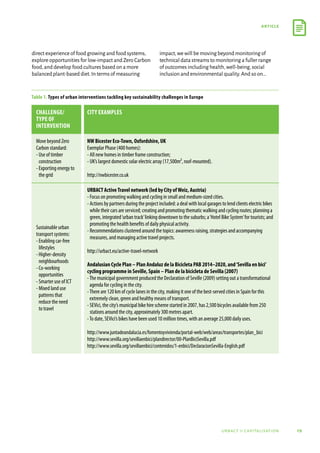
Table 1. Types of urban interventions tackling key sustainability challenges in Europe
Challenge/
Type of
intervention
City examples
Move beyond Zero
Carbon standard:
- Use of timber
construction
- Exporting energy to
the grid
NW Bicester Eco-Town, Oxfordshire, UK
Exemplar Phase (400 homes):
- All new homes in timber frame construction;
- UK’s largest domestic solar electric array (17,500m², roof-mounted).
http://nwbicester.co.uk
Sustainable urban
transport systems:
- Enabling car-free
lifestyles
- Higher-density
neighbourhoods
- Co-working
opportunities
- Smarter use of ICT
- Mixed land use
patterns that
reduce the need
to travel
URBACT ActiveTravel network (led by City ofWeiz, Austria)
- Focus on promoting walking and cycling in small and medium-sized cities.
- Actions by partners during the project included: a deal with local garages to lend clients electric bikes
while their cars are serviced; creating and promoting thematic walking and cycling routes; planning a
green, integrated‘urban track’linking downtown to the suburbs; a‘Hotel Bike System’for tourists; and
promoting the health benefits of daily physical activity.
- Recommendations clustered around the topics: awareness raising, strategies and accompanying
measures, and managing active travel projects.
http://urbact.eu/active-travel-network
Andalusian Cycle Plan – Plan Andaluz de la Bicicleta PAB 2014–2020, and‘Sevilla en bici’
cycling programme in Seville, Spain – Plan de la bicicleta de Sevilla (2007)
-The municipal government produced the Declaration of Seville (2009) setting out a transformational
agenda for cycling in the city.
-There are 120 km of cycle lanes in the city, making it one of the best-served cities in Spain for this
extremely clean, green and healthy means of transport.
- SEVici, the city’s municipal bike hire scheme started in 2007, has 2,500 bicycles available from 250
stations around the city, approximately 300 metres apart.
-To date, SEVici’s bikes have been used 10 million times, with an average 25,000 daily uses.
http://www.juntadeandalucia.es/fomentoyvivienda/portal-web/web/areas/transportes/plan_bici
http://www.sevilla.org/sevillaenbici/plandirector/00-PlanBiciSevilla.pdf
http://www.sevilla.org/sevillaenbici/contenidos/1-enbici/DeclaracionSevilla-English.pdf
20 urbact ii capitalisation
sustainable regeneration in urban areas
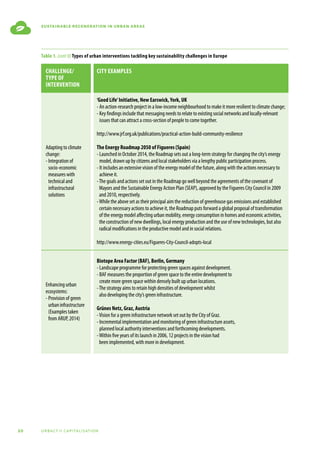
Table 1. (cont’d) Types of urban interventions tackling key sustainability challenges in Europe
Challenge/
Type of
intervention
City examples
Adapting to climate
change:
- Integration of
socio-economic
measures with
technical and
infrastructural
solutions
‘Good Life’Initiative, New Earswick,York, UK
- An action-research project in a low-income neighbourhood to make it more resilient to climate change;
- Key findings include that messaging needs to relate to existing social networks and locally-relevant
issues that can attract a cross-section of people to come together.
http://www.jrf.org.uk/publications/practical-action-build-community-resilience
The Energy Roadmap 2050 of Figueres (Spain)
- Launched in October 2014, the Roadmap sets out a long-term strategy for changing the city’s energy
model, drawn up by citizens and local stakeholders via a lengthy public participation process.
- It includes an extensive vision of the energy model of the future, along with the actions necessary to
achieve it.
-The goals and actions set out in the Roadmap go well beyond the agreements of the covenant of
Mayors and the Sustainable Energy Action Plan (SEAP), approved by the Figueres City Council in 2009
and 2010, respectively.
-While the above set as their principal aim the reduction of greenhouse gas emissions and established
certain necessary actions to achieve it, the Roadmap puts forward a global proposal of transformation
of the energy model affecting urban mobility, energy consumption in homes and economic activities,
the construction of new dwellings, local energy production and the use of new technologies, but also
radical modifications in the productive model and in social relations.
http://www.energy-cities.eu/Figueres-City-Council-adopts-local
Enhancing urban
ecosystems:
- Provision of green
urbaninfrastructure
(Examples taken
from ARUP, 2014)
Biotope Area Factor (BAF), Berlin, Germany
- Landscape programme for protecting green spaces against development.
- BAF measures the proportion of green space to the entire development to
create more green space within densely built up urban locations.
-The strategy aims to retain high densities of development whilst
also developing the city’s green infrastructure.
Grünes Netz, Graz, Austria
-Vision for a green infrastructure network set out by the City of Graz.
- Incremental implementation and monitoring of green infrastructure assets,
planned local authority interventions and forthcoming developments.
-Within five years of its launch in 2006, 12 projects in the vision had
been implemented, with more in development.
21
article
urbact ii capitalisation
With Europe the most urbanised continent on
the planet,the environmental decisions we make
in cities over the coming years will be crucial to
meeting the global sustainability challenge.If we
can integrate concepts of environmental limits
into urban programmes we have a chance of
safeguarding the environment for future generations,
and setting a benchmark for other urbanised
nations to emulate.The benefits for cities include
increased resilience to the impacts of climate
change,but also a better quality of life for residents
–healthier and more active urban lifestyles,more
localised urban economies with new economic
opportunities and more inclusive urban societies
in terms of age,income,mobility,etc.Because
these potential benefits will be more tangible
than the risks associated with climate change and
other environmental limits,it will be important
to use them to communicate with residents and
stakeholders.However,while continuing to‘think
globally and act locally’we do need to raise our
game.It’s time for a new catchphrase for sustainable
development that can communicate the true urgency
of the challenge: to borrow from Bill Clinton’s
campaign slogan,“it’s the planet,stupid!”.  g
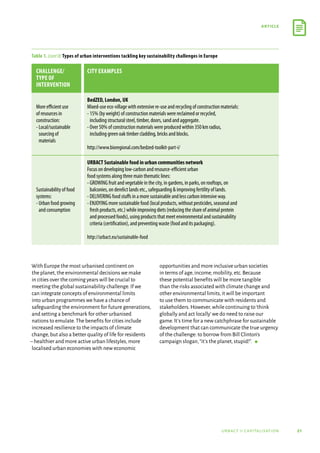
Table 1. (cont’d) Types of urban interventions tackling key sustainability challenges in Europe
Challenge/
Type of
intervention
City examples
More efficient use
of resources in
construction:
- Local/sustainable
sourcing of
materials
BedZED, London, UK
Mixed-use eco-village with extensive re-use and recycling of construction materials:
- 15% (by weight) of construction materials were reclaimed or recycled,
including structural steel, timber, doors, sand and aggregate.
- Over 50% of construction materials were produced within 350 km radius,
including green oak timber cladding, bricks and blocks.
http://www.bioregional.com/bedzed-toolkit-part-i/
Sustainability of food
systems:
- Urban food growing
and consumption
URBACT Sustainable food in urban communities network
Focus on developing low-carbon and resource-efficient urban
food systems along three main thematic lines:
- GROWING fruit and vegetable in the city, in gardens, in parks, on rooftops, on
balconies, on derelict lands etc., safeguarding  improving fertility of lands.
- DELIVERING food stuffs in a more sustainable and less carbon intensive way.
- ENJOYING more sustainable food (local products, without pesticides, seasonal and
fresh products, etc.) while improving diets (reducing the share of animal protein
and processed foods), using products that meet environmental and sustainability
criteria (certification), and preventing waste (food and its packaging).
http://urbact.eu/sustainable-food
22 urbact ii capitalisation
sustainable regeneration in urban areas
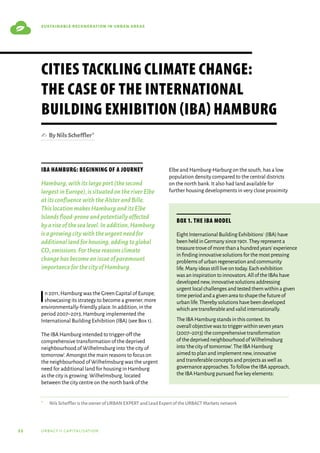
IBA Hamburg: beginning of a journey
Hamburg,withitslargeport(thesecond
largestinEurope),issituatedontheriverElbe
atitsconfluencewiththeAlsterandBille.
ThislocationmakesHamburganditsElbe
Islandsflood-proneandpotentiallyaffected
byariseofthesealevel.Inaddition,Hamburg
isagrowingcitywiththeurgentneedfor
additionallandforhousing,addingtoglobal
CO2 emissions.Forthesereasonsclimate
changehasbecomeanissueofparamount
importanceforthecityofHamburg.
In 2011,Hamburg was the Green Capital of Europe,
showcasing its strategy to become a greener,more
environmentally-friendly place.In addition,in the
period 2007–2013,Hamburg implemented the
International Building Exhibition (IBA) (see Box 1).
The IBA Hamburg intended to trigger-off the
comprehensive transformation of the deprived
neighbourhood of Wilhelmsburg into‘the city of
tomorrow’.Amongst the main reasons to focus on
the neighbourhood of Wilhelmsburg was the urgent
need for additional land for housing in Hamburg
as the city is growing.Wilhelmsburg,located
between the city centre on the north bank of the
Elbe and Hamburg-Harburg on the south,has a low
population density compared to the central districts
on the north bank.It also had land available for
further housing developments in very close proximity
Cities tackling Climate Change:
The case of the International
Building Exhibition (IBA) Hamburg
✍  ByNilsScheffler*
*	
Nils Scheffler is the owner of URBAN EXPERT and Lead Expert of the URBACT Markets network
Box 1. The IBA Model
EightInternationalBuildingExhibitions1(IBA)have
beenheldinGermanysince1901.Theyrepresenta
treasuretroveofmorethanahundredyears’experience
infindinginnovativesolutionsforthemostpressing
problemsofurbanregenerationandcommunity
life.Manyideasstillliveontoday.Eachexhibition
wasaninspirationtoinnovators.AlloftheIBAshave
developednew,innovativesolutionsaddressing
urgentlocalchallengesandtestedthemwithinagiven
timeperiodandagivenareatoshapethefutureof
urbanlife.Therebysolutionshavebeendeveloped
whicharetransferableandvalidinternationally.
TheIBAHamburgstandsinthiscontext.Its
overallobjectivewastotriggerwithinsevenyears
(2007–2013)thecomprehensivetransformation
ofthedeprivedneighbourhoodofWilhelmsburg
into‘thecityoftomorrow’.TheIBAHamburg
aimedtoplanandimplementnew,innovative
andtransferableconceptsandprojectsaswellas
governanceapproaches.TofollowtheIBAapproach,
theIBAHamburgpursuedfivekeyelements:
23
case study
urbact ii capitalisation
to the city centre.The low population density is
rooted in the departure of residents from the area
after the great flood of 1962.Afterwards,people
did not move back to Wilhelmsburg and it turned
into a deprived,multi-ethnic neighbourhood with
an urgent need to improve the living conditions of
the residents and to uplift the image of the area.
Among the causes of this negative perception of
Wilhelmsburg was the nearby waste dump,where
dioxin was detected in 1984.As a result,people from
Hamburg did not want to live there and investors
refused to invest in the construction of new dwellings.
AfurtherreasontofocusonregeneratingWilhelmsburg
wasHamburg’sbidfortheOlympicgames,inwhich
theneighbourhoodwouldhavehadanimportant
role.Hence,Wilhelmsburghasbeenaproblemand
offeredgreatpotentialforthecityofHamburg.
A series of citizen protests added to the pressures.
In 2001,about 100 committed Wilhelmsburg
residents became vocal about the problems facing
their area and received funding from the Hamburg
authorities to organise the‘Wilhelmsburg Future
Conference’.The citizens worked in conjunction with
the authorities on creating a vision for Wilhelmsburg.
In 2002,they produced a White Paper that called
for better schools and prospects for children and
young people,high quality and family-friendly
new residential buildings,the relocation of the
Reichsstraße,the elimination of brownfield sites
and improved transport connections.As a result,
in 2004 the City of Hamburg outlined its‘Leap
across the Elbe’campaign,and in 2005 it drafted
the Memorandum for the International Building
Exhibition Hamburg 2013 (IBA Hamburg).
The intention of the IBA Hamburg was to plan and
implement new,innovative and transferable concepts
and projects to address the issues raised in the White
Paper and other pressing issues the growing city of
Hamburg was facing.The latter included different
cultures living together,providing space for growth,
offering short distances between residential and
working areas and growing in a climate-friendly
way.These issues were assembled under the
three main themes of‘Cosmopolis’,‘Metrozones’
and‘Cities and Climate Change’,respectively.
Under the key theme of‘Cosmopolis’,the IBA
Hamburg demonstrated what living together in a
multi-ethnic community could look like and which
forms of co-operation might be nurtured in the
future.The theme‘Metrozones’showed how to
provide space for growth within the city and how to
better connect living and working places.Under the
theme ‘Cities and Climate Change’ the IBA Hamburg
aimed to demonstrate how to combine growth and
sustainability for a climate-compatible future.The
vision it offered was for a climate-neutral district
as a model for the future of the metropolis.To this
end a strategy and a set of concrete projects for the
deprived neighbourhood of Wilhelmsburg were
developed and tested.The main goal was to change
energy supply,moving away from fossil fuels to
renewable energy sources sited within and around
the neighbourhood for a self-sufficient supply.
1	Planning and design of a holistic and strategic
development framework dealing with the
main social,economic and environmental
challenges and opportunities of Wilhelmsburg
from a local and citywide perspective.
2	Development and implementation of transferable,
integrated model,pilot and demonstration projects,
meeting the seven IBA Excellence Criteria2.
3	Implementation of governance structures
allowing new ways of thinking,planning
and implementing projects.
4	Involvement of residents in the
transformation process.
5	Public relation to inform and present projects
to the (international) public and make citizens
aware about the changes in Wilhelmsburg.
1	
http://www.iba-hamburg.de/fileadmin/
Mediathek/00_allgemein/IBAmeetsIBA_en.pdf
2	
http://www.iba-hamburg.de/fileadmin/Die_IBA-
Story_post2013/IBA-Exzellenzkriterien.pdf
24 urbact ii capitalisation
sustainable regeneration in urban areas
Strategy for a climate-neutral
district Wilhelmsburg
Atthebeginningoftheclimate-friendly
transformationoftheneighbourhoodof
Wihelmsburg,theIBAHamburgelaboratedfor
itsfirstyearsacomprehensiveclimateprotection
concept;‘EnergyAtlas:FutureConceptRenewable
Wilhelmsburg’.Theconceptpresentsspatial-
strategicapproachesforfutureenergyrequirements
oftheneighbourhood.Futureenergyscenariosfor
Wihelmsburgweredescribed;costsandbenefitsof
thefutureconceptcalculated;sociologicalaspects
ofclimatechangeanalysedandaroadmapanda
spatialenergyactionplanwaselaboratedforthe
neighbourhood.Theanalyticalmethodusedformed
thebasisforurbanactionanddemonstratedhowthe
neighbourhoodcouldbecomeapioneerofclimate
protectionandresourceconservationforthewidercity.
As a result of this comprehensive analysis,
the chosen objectives for Wilhelmsburg’s
climate change strategy were:
•	to change energy sources,moving away from
fossil fuels to 100% renewable energies in the
long term (100%renewableWilhelmsburg);
•	to change from centralised energy systems to
decentralised systems,in which the required
energy is generated directly by consumers
or nearby in the area (localenergysupply);
•	to implement high standards of
energy-efficiency in existing and future
buildings (climate-friendlybuildings);
•	to encourage residents to share and to
commit to these policy-related measures
(climatechangeasacommontask).
Implementation and testing
of projects
Based on this strategy model,pilot and
demonstration projects for new energy efficient
buildings,renovation of existing buildings and
renewable energy generation were developed and
implemented.
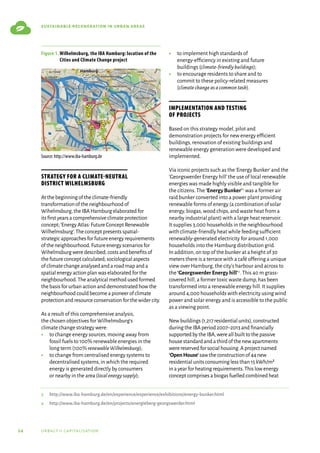
Via iconic projects such as the‘Energy Bunker’and the
‘Georgswerder Energy hill’the use of local renewable
energies was made highly visible and tangible for
the citizens.The ‘Energy Bunker’3 was a former air
raid bunker converted into a power plant providing
renewable forms of energy (a combination of solar
energy,biogas,wood chips,and waste heat from a
nearby industrial plant) with a large heat reservoir.
It supplies 3,000 households in the neighbourhood
with climate-friendly heat while feeding sufficient
renewably-generated electricity for around 1,000
households into the Hamburg distribution grid.
In addition,on top of the bunker at a height of 30
meters there is a terrace with a café offering a unique
view over Hamburg,the city’s harbour and across to
the ‘Georgswerder Energy hill’4.This 40 m grass-
covered hill,a former toxic waste dump,has been
transformed into a renewable energy hill.It supplies
around 4,000 households with electricity using wind
power and solar energy and is accessible to the public
as a viewing point.
Newbuildings(1,217residentialunits),constructed
duringtheIBAperiod2007–2013andfinancially
supportedbytheIBA,wereallbuilttothepassive
housestandardandathirdofthenewapartments
werereservedforsocialhousing.Aprojectnamed
‘OpenHouse’sawtheconstructionof44new
residentialunitsconsuminglessthan15kWh/m²
inayearforheatingrequirements.Thislowenergy
conceptcomprisesabiogasfuelledcombinedheat
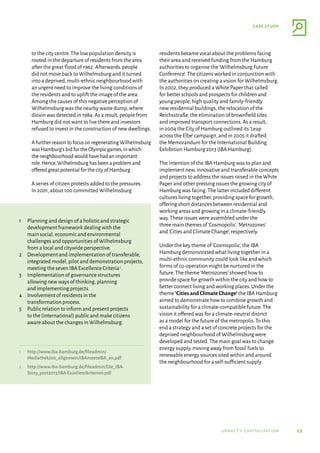
Figure 1. Wilhelmsburg, the IBA Hamburg: location of the
Cities and Climate Change project
Source: http://www.iba-hamburg.de
3	 http://www.iba-hamburg.de/en/experience/experience/exhibitions/energy-bunker.html
4	 http://www.iba-hamburg.de/en/projects/energieberg-georgswerder.html
25
case study
urbact ii capitalisation
andpowerplantservingaresidentialblock.Theheat
providesspaceheatingandhotwater.Theelectricity
generatedisinpartusedbytheresidentsandinpart
fedintothelocalpowergrid.Thus,the64tonnes
perannumofCO2 emissionfromtheheatsupplyfor
aconventionalblockofthissizecanbereducedto
maximumof10t/y.Furthermore,aphotovoltaicsystem
withaperformanceof70kilowatt-peakisinstalled
ontheflatroof.The56megawatthoursperannum
ofelectricitythisgeneratesispartiallyusedinthe
apartmentsandpartiallyfedintothelocalpowergrid,
savingabout29tonnesofCO2 emissionsperannum.
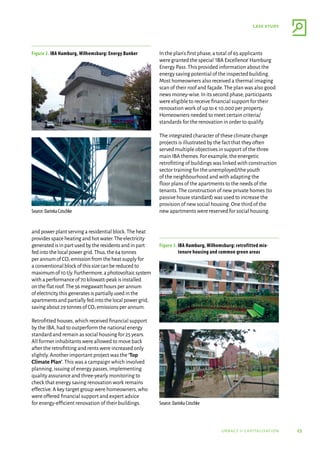
Retrofitted houses,which received financial support
by the IBA,had to outperform the national energy
standard and remain as social housing for 25 years.
All former inhabitants were allowed to move back
after the retrofitting and rents were increased only
slightly.Another important project was the ‘Top
Climate Plan’.This was a campaign which involved
planning,issuing of energy passes,implementing
quality assurance and three-yearly monitoring to
check that energy saving renovation work remains
effective.A key target group were homeowners,who
were offered financial support and expert advice
for energy-efficient renovation of their buildings.
In the plan’s first phase,a total of 65 applicants
were granted the special‘IBA Excellence’Hamburg
Energy Pass.This provided information about the
energy saving potential of the inspected building.
Most homeowners also received a thermal imaging
scan of their roof and façade.The plan was also good
news money-wise.In its second phase,participants
were eligible to receive financial support for their
renovation work of up to € 10,000 per property.
Homeowners needed to meet certain criteria/
standards for the renovation in order to qualify.
The integrated character of these climate change
projects is illustrated by the fact that they often
served multiple objectives in support of the three
main IBA themes.For example,the energetic
retrofitting of buildings was linked with construction
sector training for the unemployed/the youth
of the neighbourhood and with adapting the
floor plans of the apartments to the needs of the
tenants.The construction of new private homes (to
passive house standard) was used to increase the
provision of new social housing.One third of the
new apartments were reserved for social housing.
Figure 2. IBA Hamburg, Wilhemsburg: Energy Bunker
Figure 3. IBA Hamburg, Wilhemsburg: retrofitted mix-
tenure housing and common green areas
Source: Darinka Czischke
26 urbact ii capitalisation
sustainable regeneration in urban areas
Butnotonlyphysicalactionswereimplemented
toreduceCO2emisions.The‘HamburgEnergy
Partnerships’involvedresidentsinreducingtheir
householdenergyconsumptionbyexplainingand
clarifyingopportunitiesforenergysavingsand
concreteactionstorealisethem.Tothisend,an
inventoryoftheenergyandwaterconsumptionper
householdwasdrawnup.Inco-operationwiththe
residents,studentsthendevelopedappropriateaction
planstoreduceenergyconsumptionincludingenergy
consciousbehaviour.So-calledsmartmetersforenergy
consumptionhavebeeninstalledasaidsforenergy
consultationandsuccessmonitoring.Theresultsof
theprojectwerepublishedintheprojectnewspaper
‘DieWilhelmsburgerEnergiefreunde’todisseminate
theresultsandexperiencetootherresidents.
Achievements and critical issues
It could be said that the city of Hamburg started
to think about and deal with climate change with
the IBA Hamburg.In parallel to the development
of the Energy Atlas for Wilhelmsburg,policy
guidelines on climate change and climate adaptation
at the citywide level were developed in 2009.
This was followed in 2013 by the master plan for
climate protection of the city of Hamburg.
TheIBAHamburghasbeenaninstrumentofvisionary
urbandevelopment,an‘urbanlaboratory’foraseven-
yearperiod.Thelabsituationmadeitpossibleto
thinkoutofthebox,todevelop,testandimplement
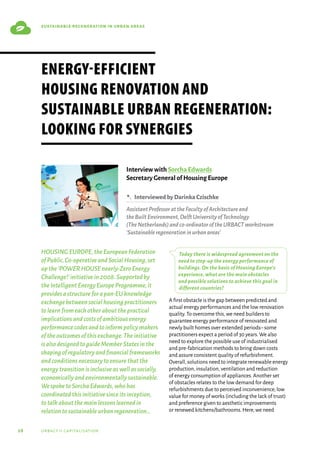
newwaysofsustainableurbanregenerationand
toinvolveamultitudeofstakeholdersindifferent
ways.Whenitofficiallyendedin2013,theIBA
Hamburghadimplemented23projectsunder
thethemeofCosmopolis,33projectsunderthe
themeofMetrozonesand14projectswithinthe
themeof‘CitiesandClimateChange’.FurtherIBA
Hamburgprojectscoveringenergyissuesandaction
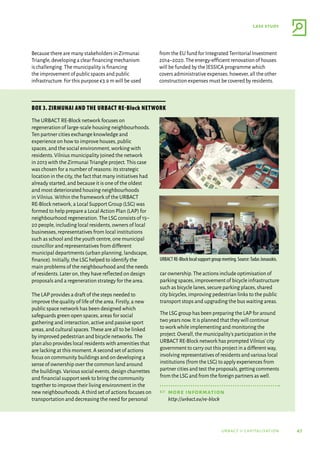
groupssuchasthe‘RenewableWilhelmsburg’
climateprotectionconceptcontinuetheirwork.
The‘Cities and Climate Change’strategy has shown
the importance of linking energy modernisation
of buildings with neighbourhood energy strategy.
Spheres of action such as the use of local renewable
energy,the energy modernisation of buildings,the
construction of new buildings to passive (plus) house
standard,energy-efficient households and CO2-
low mobility have been linked with each other.The
Energy Atlas has demonstrated that it is possible to
use renewable and locally produced energy to meet
the demand for electricity of buildings by 2015 as well
as almost the entire thermal energy requirement by
2050.Legal national energy standards in housing
projects have been outperformed.More cycling
tracks were installed and the connection with public
transport to the northern city centre improved.
The IBA has also significantly improved social and
technical infrastructure and housing conditions in
many areas of Wilhelmsburg.Furthermore,the range
of support and advisory/guidance opportunities
for inhabitants has been improved as have youth
education and training opportunities.Social
monitoring for the west part of Wilhelmsburg,a focal
area for the projects,indicates a positive dynamic.
The IBA has changed the perception of Wilhelmsburg
significantly.People are now choosing to live in
Wilhelmsburg and investors have started to build
new apartments there.The IBA Hamburg pushed
the residential construction that is urgently
required by the city.In addition,it has provided
100,000 m² of commercial space,eight educational
establishments,two senior citizens’homes (one of
them being the first intercultural senior citizens’
home in Hamburg),three day-nurseries,four
sports facilities,a commercial park,a centre for
artists and creative workers,an extension of the
Assmannkanal and over 70 hectares of green space.
Officially,the IBA Hamburg ended in 2013,but the
process of urban redevelopment that it initiated is
still ongoing and is expected to continue.The IBA’s
seven-year timeframe is considered too short to be
able to deal with all relevant issues and solve all
problems that have been identified.Some projects
are still being realised and have yet to be completed.
Figure 4. Neighbourhood infrastructure provided by the
IBA in Wilhemsburg
Source: Martin Kunze and Darinka Czischke
27
case study
urbact ii capitalisation
Nonetheless,whilethetechnicalmerits
ofthe‘CitiesandClimateChange’
strategyhavebeenwidelyacknowledged
bothinHamburgandbeyond,critical
considerationsremainregardingthe
continuityandimpactoftheseprojects
andapproachestoawiderurbanscope.
Somecriticsremarkthatthecityseemsto
have‘runoutofsteam’inextendingthese
pioneeringmodelstothewidercitylevel.
Moregenerally,thereisasenseamongst
communityleadersthattheoriginal
‘impulse’oftheIBAhasbeenlostordiffusedoncethe
exhibitionperiodwasoverin2014(see,forexample,
interviewwithManuelHumburginthispublication).
Thishighlightstheneedfortechnicallyinnovative
solutionstobeaccompaniedbysoundinstitutional
arrangementsandpermanentdialoguewithlocal
stakeholderstoensuretheircontinuityandsustained
positiveimpactoncetheinceptionphaseisover.
Transferring the IBA approach
to other contexts
TheIBAHamburgapproachtocommencingthe
sustainableregenerationofurbanneighbourhoods
canbetransferredtootherareasandcontextsin
Europe.UnlikeWorldExhibitionsorCulturalCapitals,
forexample,theIBAapproachdoesnothaveanyfixed
scheduleandcanbedevelopedwithoutanyprefixed
regulations,particularlaws,legislationorpolicies.The
experiencewithIBAsinGermanyhasproventhatthis
approachcanbereplicatedindifferenturbancontexts,
whilethemesandstandardsareadaptedtothespecific
localcontext.Nevertheless,IBAsarecharacterised
bythehighqualitystandardsofitsprojectsand
governancesystem.WhenreplicatingtheIBAapproach
thisaspecthastobekeptup,ensuringhighstandards
andtheessentialelementsoftheIBAapproach
asmentionedinBox1toguaranteeitsquality.
As the IBA is an‘informal’approach based on
agreements between the main stakeholders,it
requires the will and creativity by all concerned to
transform an area in an innovative and sustainable
way,together with the residents.It is crucial to
provide a governance structure that allows for
creativity and for thinking and acting‘outside the
box’,to get the multitude of stakeholders with their
different resources together and gain their support
for the sustainable urban regeneration process.
TherealisationoftheIBAHamburganditsprojects
didnotrequirethecitytoraiseanyadditionalfunds
beyondthoseobtainedfromtheregularcitybudget.
Thedistinctivefeaturewasthat
eachcitydepartmenthadto
provideacertainamountofits
regularbudgetfortheIBAand
itsprojects.Thus,thecityfunds
couldbebroughttogetherfrom
variouscitydepartmentsand
channelledtoWilhelmsburg.
Thisconcentrationoffundsfor
Wilhelmsburgalsoattracted
politicians’attentionandmade
themawareofthesituationin
Wilhelmsburg.Furthermore,the
publicfundshelpedtoactivate
privatefundsandinvestments.
To conclude,a city that wants
to adopt this approach should
meet the following conditions:
✔	 
The area and the topics for the urban
regeneration have to be of high interest for
decision makers engaged in city development.
Wilhelmsburg did not only present local
problems but also provided an opportunity for
the development of the entire city.
✔	 
Active residents that want a change for the better
campaign for this and develop project ideas from
the bottom-up.The development of the future
concept by the inhabitants of Wilhelmsburg was
the starting point and a crucial milestone for the
regeneration of Wilhelmsburg.
✔	 
Engagement of the city administration in
improving the situation of the area and
recognition of a local need for action,also from a
citywide perspective.
✔	 
The city council giving freedom of action
and allocating financial resources to the
city administration to set up an exceptional
framework that allows the development of
exemplary and innovative solutions.
✔	 
People keen on experimenting being allowed to
fail with a project!  g
☞	more information
	
AnalyticaltemplateonIBAHamburg:
http://urbact.eu/capitalisation-and-
dissemination
Technically innovative
solutions need to
be accompanied by
sound institutional
arrangements and
permanent dialogue
with local stakeholders
to ensure their
continuityandsustained
positive impact once the
inception phase is over.
28 urbact ii capitalisation
sustainable regeneration in urban areas
HOUSINGEUROPE,theEuropeanFederation
ofPublic,Co-operativeandSocialHousing,set
upthe‘POWERHOUSEnearly-ZeroEnergy
Challenge!’initiativein2008.Supportedby
theIntelligentEnergyEuropeProgramme,it
providesastructureforapan-EUknowledge
exchangebetweensocialhousingpractitioners
tolearnfromeachotheraboutthepractical
implicationsandcostsofambitiousenergy
performancecodesandtoinformpolicymakers
oftheoutcomesofthisexchange.Theinitiative
isalsodesignedtoguideMemberStatesinthe
shapingofregulatoryandfinancialframeworks
andconditionsnecessarytoensurethatthe
energytransitionisinclusiveaswellassocially,
economicallyandenvironmentallysustainable.
WespoketoSorchaEdwards,whohas
coordinatedthisinitiativesinceitsinception,
totalkaboutthemainlessonslearnedin
relationtosustainableurbanregeneration…
Today there is widespread agreement on the
need to step-up the energy performance of
buildings. On the basis of Housing Europe’s
experience, what are the main obstacles
and possible solutions to achieve this goal in
different countries?
A first obstacle is the gap between predicted and
actual energy performances and the low renovation
quality.To overcome this,we need builders to
guarantee energy performance of renovated and
newly built homes over extended periods–some
practitioners expect a period of 30 years.We also
need to explore the possible use of industrialised
and pre-fabrication methods to bring down costs
and assure consistent quality of refurbishment.
Overall,solutions need to integrate renewable energy
production,insulation,ventilation and reduction
of energy consumption of appliances.Another set
of obstacles relates to the low demand for deep
refurbishments due to perceived inconvenience,low
value for money of works (including the lack of trust)
and preference given to aesthetic improvements
or renewed kitchens/bathrooms.Here,we need
Energy-efficient
housing renovation and
sustainable urban regeneration:
looking for synergies
Interview with Sorcha Edwards
Secretary General of Housing Europe
B  InterviewedbyDarinkaCzischke
AssistantProfessorattheFacultyofArchitectureand
theBuiltEnvironment,DelftUniversityofTechnology
(TheNetherlands)andco-ordinatoroftheURBACTworkstream
‘Sustainableregenerationinurbanareas’
29
interview
urbact ii capitalisation
refurbishments to be carried out
in shorter time with residents
remaining in their houses.
Community outreach before
and after renovation helps to
build trust among residents.
Evidence shows that aesthetic
finish leads to high interest
among neighbourhoods where
pilots have been completed.One
last obstacle I would mention
is the long payback time on
investment,reducing interest of private investors or
energy service contractors and resulting in a tendency
to implement only superficial measures offering
short-term returns.We need to be able to guarantee
that energy savings over the lifetime of a given
housing project will compensate for the up-front
costs.A key success factor would be to guarantee
affordability for residents in spite of retrofitting costs.
What is the importance of linking
the retrofitting of buildings to wider
neighbourhood regeneration efforts?
It is vital to not place housing renovation in
a silo! Housing renovation to reduce energy
consumption and bills is an integrated part of
effective neighbourhood city or regional-wide
energy transition planning.This must be seen in
the context of job creation,therefore reducing the
social and economic costs related
to unemployment,the burden
of which is felt by the whole
neighbourhood,city,region,and
country…Also,this links directly
into reducing fuel poverty and its
health impacts,the cost of which
is transferred to health services,
empowering citizens financially
by increasing purchasing
power…and could go on!
What is needed to achieve these synergies?
There is more and more recognition of this need to
integrate sustainable housing renovation and urban
regeneration and we will be working more on this.
The URBACT programme,for example,is one of the
best instruments with which to raise awareness of
an integrated planning approach.Overall,we know
of some interesting examples where this approach
is planned in collaboration with cities and with
housing providers.Take the case of the‘Regeneration
Dialogue’1 initiative in Malmö (Sweden),where the
municipality is working with co-operative housing
providers on housing environments that create values
supporting sustainable regeneration.Their goal is to
create a smart fund for green growth,social change
and innovation to support these integrated processes.
This is a road worth following for other cities!  g
1	 For more information about the‘Regeneration Dialogue’project,contact Mr Bjarne Stenquist,Environment
department,City of Malmö
❝	
Housingrenovationtoreduce
energyconsumptionandbillsis
anintegratedpartofeffective
neighbourhoodcityorregional-
wideenergytransitionplanning.
❞
Source: Freepik
30 urbact ii capitalisation
sustainable regeneration in urban areas
During2014–2015,theURBACTIIprogramme
setupfourworkinggroups(workstreams)with
theobjectivetocapitaliseonurbanknowledge
andgoodpractices.Theworkstream‘Newurban
economies’isoneofthem.
In your workstream, you describe different
types of ‘new urban economies’ that are
taking shape across Europe. Have you found
examples where these economies are linked
to environmentally sustainable urban
regeneration processes?
The most obvious example has to do with the so-
called‘green economy’,more concretely with activities
linked with energy-efficiency and building renovation.
A large number of services and activities are necessary
to renovate a building,ranging from insulation
materials,solar panels and boilers to all of the
associated services including architecture and design
services but also a lot of specialised manual work.
And what is interesting is that while the former can
come from overseas,the latter are most often locally
sourced.So there can be a lot of economic leverage
linked with urban regeneration.
A bit less obvious but also interesting is the
link between the‘digital economy’and urban
regeneration.For example,digital artefacts such
as smart meters often underpin renewable energy
production and distribution.But we also see citizen-
driven solutions.For example,in Berlin there are
so-called consumer collectives sharing information
about energy savings in newly refurnished buildings
through new digital apps,and the same goes for
groups of citizens sharing solar panels.All this is
driving digital innovation considerably.
In your view, are there any links between
green economies and more environmental
regeneration actions in cities?
Absolutely,but we won’t see some of it in the short
run.There are‘carrots’and‘sticks’that cities give
to stimulate urban regeneration and building
Connecting
‘New urban economies’
to sustainable
urban regeneration
Interview with Luís Carvalho
University of Porto and UrbanIQ,core group member
of the URBACT workstream‘New urban economies’
B  InterviewedbyDarinkaCzischke
AssistantProfessorattheFacultyofArchitectureandtheBuiltEnvironment,
DelftUniversityofTechnology(TheNetherlands)andco-ordinatoroftheURBACT
workstream‘Sustainableregenerationinurbanareas’
Source: Freepik
31
interview
urbact ii capitalisation
retrofitting,which
may produce effects
relatively fast,such as
tax breaks and new
energy-efficiency
laws.The city of
Turin,for example,is
the Italian champion
in this field with
several energy-
efficiency supportive
regulations;
moreover,the city has
been through large
urban regeneration
efforts over the last
decades,linking
old and new buildings to a district heating network.
We see the impacts of that in the local economy,
with higher percentages of associated services (e.g.
insulation,boiler installations).But then there are
other types of initiatives that take much more time
to produce tangible economic effects,because they
require a lot of experimentation,technology learning
and societal embedding,such as
the development of state-of-the-
art eco-districts.We see a good
example in Stockholm,where
the city,the electric utility and
several other players are teaming
up to redevelop a former port area
around new promising‘green’
concepts.These developments are
promising in many ways,but it will
take time before newly developed
solutions can be scaled up and reach
the market.
At the moment the ‘smart city’ features as
a very popular or fashionable concept in
policy-making circles. To what extent do you
think that the smart city approach is also an
environmentally sustainable approach?
Just like‘sustainability’can have many meanings,so
can‘smart cities’.Most of what we listen to is linked
with techno-centred notions of sustainability,in
which new technology is believed to solve most
of the environmental problems of cities.A serious
limitation of those views comes with the fact that new
technology often leads to substitution in consumption
(e.g.of energy) and not necessarily to overall
reduction and behavioural change; moreover,users
are seen as‘takers’of solutions developed by others
elsewhere.For these reasons we see a gradual change
in the smart city discourse,at least in Europe,towards
placing citizens at the core of smart city strategies.But
we still have to see whether the changing discourse
will be reflected in concrete actions and policy
priorities,for example under the auspices of the
European funding frameworks.
Overall, what are the missing links between
‘new urban economies’ and environmental
regeneration actions? What could cities do to
improve synergies between these fields?
The economic spill overs of environmental
regeneration in cities tend to be rather spontaneous;
there is often little action from the side of local
governments to make it happen.However,I believe
that more strategic action could enhance the links.
For this to happen,city staff needs to be able to
work across departments (e.g.environment,social,
planning,economic),but also
interact with other external-to-the-
council stakeholders.Here,we see
for example that utility companies
with a lot of technical and business
expertise (but with limited
understanding of how a city works
on the ground),but also knowledge
institutes and communities of
consumers,are increasingly
relevant.And it is important that
different stakeholders are able to
understand each other’s points
of view and‘language’.City staff
could be important mediators
here,bridging the interests of
different players.Moreover,many cities have a lot of
uncoordinated actions in these fields (e.g.smart city
strategies,environmental and energy plans,green
economy‘deals’,regeneration policies) that could
certainly benefit from more integration.  g
❝	
Citystaffneedstobeableto
workacrossdepartments
(e.g.environment,social,
planning,economic),
butalsointeractwithother
external-to-the-council
stakeholders.
❞
☞	
more information
	
New urban economies,URBACT II
capitalisation,April 2015:
http://urbact.eu/capitalisation-and-dissemination
32 urbact ii capitalisation
sustainable regeneration in urban areas
The problem:
clashing agendas at the city level
Inurbanregenerationinterestsandagendas
ofawidevarietyofurbanstakeholderseither
cometogetheror,moreoften,clashwith
eachother.Inparticular,environmental
issuestendtodividethepopulationbetween
thosepromotingacertainpolicyorproject
andthosewhofeelaffectedbyit–usually
groupsofresidents.Inrecentdecades,the
conceptofgovernancehasbeenappliedin
localandurbanpolicy-makingasawayof
bringingtogetheravarietyofactorswith
theirdifferentinterestsandagendas.There
hasbeenanefforttoovercometheseconflicts
andmovetowardswin-winsolutions,thus
movingawayfromtop-downdecision-making
logicstoamorehorizontal,multi-stakeholder
coordinationandco-operationapproach.
Cities all over Europe have had to deal increasingly
with new governance challenges,including
environmental movements and citizen protests in
relation to,for example,environmental degradation,
development pressures on green areas and natural
habitat,resource consumption and waste in urban
environments.Such challenges contest traditional
models of city governance and highlight the need
for innovative city governance modes.Some of
these new modes seem to have emerged across
European cities,built on citizen empowerment,
participation of all relevant stakeholders and
innovative use of social and institutional capital.
European cities have showcased a range of
solutions to the governance of urban regeneration
processes.Two examples are provided in Boxes
1 and 2,respectively.The City of Hamburg has
opted for a city-owned enterprise to spearhead the
regeneration of Wilhelmsburg,while Vilnius has
focused on partnerships between the municipality
and either relevant stakeholders in the case of the
Park of Architecture (a post-industrial brownfield
regeneration),or community and resident
organisations in the case of Zirmunai Triangle (an
existing large housing estate regeneration).
Thecreativeandculturalindustrycanbeused
asatoolwithinthegovernancemodeltopush
urbanregeneration(seeasexamplestheURBACT
network‘CreativeClusters’),particularlyinhistoric
neighbourhoodsandcities.TheCityofBerlin
*	 Nils Scheffler is owner of URBAN EXPERT and Lead Expert of the URBACT Markets network
Catalina Turcu is lecturer in Sustainable Urban Development at Bartlett School of Planning,University College London,UK
Governing
the Sustainable City
✍  ByNilsSchefflerandCatalinaTurcu*
33
article
urbact ii capitalisation
introducedagovernancemodelwithinthe‘Socially
integrativecity’programmebyinvolvingcross-
policyactorsandstakeholdersofallkindsinorder
toimprovelivingandhousingconditionsinsocially
deprivedneighbourhoods.Thestrategyinvolves
cross-departmentalmunicipalco-operationandan
integratedactionplan,settingupnewstructuresfor
directingneighbourhoodmanagementoperations.
Thenewneighbourhoodmanagementenables
co-operationbetweenallrelevantactorsand
stakeholders,thusextendingthescopeoflocalpolicies.
Box 1. City of Hamburg:
City-owned enterprise
A city-owned enterprise was established in
Hamburg for the sustainable urban regeneration of
the deprived urban neighbourhood of Wilhemsburg
during the time of the International Building
Exhibition,IBA Hamburg,from 2007 to 2013.It
functioned as an external‘Think-Do-Tank’outside
the official city administration structure and was
responsible for stakeholder involvement.To ensure
a certain level of public control and support an
IBA supervisory board,a coordinating committee
and an IBA board of trustees made up of experts
from around the world was introduced,overseeing
the processes of the IBA.Local inhabitants have
been involved primarily via a committee for civic
participation of active citizens and politicians
in the IBA presentation area.It is worth noting,
nonetheless,that this governance structure has
been underlined by and factored in an active
citizen movement that rallied for the improvement
of living conditions in the neighbourhood.
ThebudgetoftheIBAHamburgLtd.overthe7-year
periodhadbeen€190mofpublicfundsfromthe
regularcitybudgetofHamburg(€90mfortheIBA,
€100mforpublicinfrastructureinWilhelmsburg).
Thefundsmobilisedprivateandotherpublic
investments.Theprivate
investmentthattheIBA
finallyattractedamounted
to€700m.Inaddition,ithad
receivedatotalof€300 m
ofpublicinvestment.
Publicfundsmobilised
fortheimplementation
ofindividualprojects
camealsofromESFand
ERDFfundsviathefederal
stateofHamburgandthe
climatefundfromtheEU.
Box 2. City of Vilnius: Partnerships
The city government of Vilnius is seeking new
ways of involving residents and private apartment
owners in the regeneration of the‘Zirmunai
Triangle’neighbourhood.Being a partner in the
URBACT RE-Block network1,the city established
a Local Support Group (LSG) consisting of
representatives of municipal departments,
politicians,residents,social associations and
entrepreneurs from the neighbourhood.A core
group of 25 people is actively involved in the
preparation of the Local Action Plan (LAP) for the
regeneration of Zirmunai Triangle.One important
goal is to encourage residents to upgrade
and maintain land around their buildings.
Activities to engage and involve residents and
private apartment owners include,for example,
the possibility that residents could claim the
land around the apartment buildings for their
collective use.The municipality has also launched
an on-line map displaying the energy-efficiency
of the buildings.This has helped residents to
monitor their building’s performance and to
obtain information prior to buying a property.
For the design of the public spaces residents
will be involved in defining design standards
and articulating the community’s needs.For a
later phase more active
community involvement
is planned,such as
competitions between the
smaller neighbourhoods on
who takes better care of the
plot around the building,
or on which building is
most energy-efficient.
1	
http://urbact.eu/re-block
Hamburg.
Source: Darinka Czischke
Vilnius. Source: Darinka Czischke
34 urbact ii capitalisation
sustainable regeneration in urban areas
Good’urban governance is seen as a prerequisite
of sustainable urban development (Evans et al.,
2005; Healey et al.,2002) and,by extension,of
sustainable urban regeneration.The Governance
and Sustainable Human Development Programme
(1997) of the United Nations Development
Programme (UNDP) and European Governance
White Paper (2001) enunciate five principles of
‘good governance’that,with slight variations,
appears in much of the literature.These can be
grouped under five broad themes (see Box 3).
From a multi-level governance perspective,tensions
can sometimes be recognised between‘vertical’and
‘horizontal’integration of urban governance in relation
to the five principles above.Vertical governance
integration refers to the integration between different
(spatial and administrative) levels of government,
institutions,politics and power i.e.local,city,regional,
national.The cities of the URBACT ESIMeC network
concluded that governance,particularly in terms of
leadership and stakeholder engagement,makes a
huge difference to potential impacts when delivering
actions and solutions2.However,evidence suggests
that achieving horizontal governance integration
across municipal departments in practice is not easy.
Horizontal governance integration can be understood
from two different perspectives.One refers to the
involvement of civil society (NGOs,business,and
urban dwellers in general) in decision-making
and in implementing these decisions alongside
the public administration.The second refers to
the coordination and integration between various
municipal departments in order to provide coherence
and direction for sustainable urban regeneration.
However,the joint working of different municipal
departments often brings about challenges in terms
of overcoming
sectoral and/or
disciplinary divides.
While this aspect
of horizontal
governance
integration has been
relatively neglected
in policy discussions,
the ways in which
effective cross-sector
collaboration (i.e.
across municipal
departments) may
or may not help
environmentally
sustainable urban
regeneration featured as a particularly relevant issue
in our case study on the IBA Hamburg.Furthermore,
the ability of civil servants to be able to work across
disciplinary boundaries has been recognised as a
key enabler for greater synergies between a series of
new urban economies that are taking shape across
European cities and environmental regeneration
processes (see interview with Luís Carvalho in
this publication).Thus,we believe it is of strategic
relevance to give special attention to this aspect of
horizontal integration in the remainder of this article.
Municipal administrators and decision-makers are
often trained in a sectoral and specialised way.As
a result,they are used to thinking in sectoral‘silos’.
Hence,multidisciplinary approaches are rather
rare.Administrative bodies tend to work in an
independent and fragmented way with relatively
Box 3. The five principles of
‘good governance’ (UNDP)
✔	 
Openness or Fairness
All should have equal opportunities and the
rule of law should be fairly applied.
✔	 
Participation or Legitimacy  Voice
All should have a voice in decision-making and
differences in interests should be mediated.
✔	 
Accountability
Decisions should be accountable to the public
and transparent.
✔	 
Effectiveness or Performance
Outcomes should meet needs and make best
use of resources.
✔	 
Coherence or Direction
Decisionsshouldtakealong-termand
holisticview.
2	 ESIMeC II transnational event 1,Sabadell,19 and 20 March 2014.http://urbact.eu/esimec-ii
The ability of civil servants
to be able to work across
disciplinary boundaries has
been recognised as a key
enabler for greater synergies
between a series of‘new
urban economies’that are
taking shape across European
cities and environmental
regeneration processes.
35
article
urbact ii capitalisation
clear tasks and closed
decision processes.They
normally function in
a rather hierarchical
way,aimed at
simplifying internal
administrative
processes and control.
Environmental issues
are mainly dealt with
in the department of
the environment (if it
exists at all) or in the urban
planning department.Other
departments tend to neglect
environmental aspects and do not
consider the impacts of their policies
on the latter.Procedures and structures that
enforce the consideration of environmental impacts
in sectoral policy making are most often missing.
Breaking silos
What can be done to overcome the above-described
barriers? There are at least four approaches that
can be applied in practice to lead municipalities
towards greater horizontal governance integration
(Metropolis,2011).They are: organisational
arrangements,mergingdepartments,jobrotation
andincentivesforintegratedthinkingandaction.
In what follows,we will
refer to each of these
principles in relation to
environmental urban
regeneration practices.
Organisational
arrangements are
represented by
cross-departmental
structures such as
inter-departmental
committees,commissions,
steering groups and
supervisory bodies (Box 4).
These structures are intended to
improve communication,coordination
and co-operation (the‘3 Cs’) within the
urban regeneration process at the municipal level
and bring the relevant administrative bodies,
decision-makers and stakeholders together.
In some European cities even stronger structural
action has been taken in order to ensure integrated
urban intervention and whole departments have
been merged.Specific departments such as,for
example,housing,environment,planning,etc.have
merged under one head department (i.e.Department
for Housing,Environment and Planning) or a new
department has even been created at the city level
(Department for Sustainable Urban Development).
The aim of this approach is to enable a
platform for constant exchanges and co-
operation between different policy sectors
and also provide strategic direction or
coherence at the municipal level.
Job rotation provides another approach
to promote working relationships
between different departments at the
municipal level i.e.municipal staff are
incentivised via career development goals
to rotate between different departments.
This facilitates working relations
between departments,improves and
develops the staff knowledge base and
understanding of various urban aspects
and,last but not least,eases professional
co-operation i.e.staff have a more holistic
understanding of sustainable urban
regeneration from different perspectives.
Source: Freepik
Box 4. Operational structures for
cross-departmental integration
The area of Wilhelmsburg in Hamburg set up an inter-
institutional and-authority coordinating committee,which
brought together the main decision-makers to discuss
projects and speed up decision-making processes.This
helped to overcome the‘silo’approach and departmental
barriers resulting from technical jargon,different
professional knowledge and departmental priorities.It also
aided cross-departmental fertilisation in policy formulation,
communication and delivery.Another example can be a
steering group,directly responsible to the Mayor,which
can coordinate institutional arrangements and support
coordination of policies from different departments.It
is essential,however,that such arrangements/bodies do
not dominate the process but rather act as‘mediators’.
36 urbact ii capitalisation
sustainable regeneration in urban areas
Incentives for integrated thinking and action can
also be provided,which promote inter-departmental
co-operation within urban regeneration projects.
Examples include earmarked budgets for joint
policy making for sustainable urban regeneration
action or implementation of urban regeneration
projects within deprived neighbourhoods (Box 5).
What can cities do?
On the basis of the approaches and examples
described above we can conclude that,in order to
achieve better horizontal integration of governance
processes in sustainable urban regeneration,there
are at least four key actions that cities can take:
Canvassing political support
Alongside the‘willingness’of heads of municipal
departments,a crucial prerequisite for structural
change at the city level is overall political support as
well as Mayor’s/city leadership’s support.Support can
be strengthened via‘pilot projects’in smaller areas
of urban regeneration followed by dissemination
of lessons and good practice to larger scales.For
example,the city of Växjö in Sweden started in
the 1970s with smaller municipal environmental
projects such as restoration of lakes and renewable
energy generation for district heating.Building
on the success of this,political support started to
grow slowly.Today,the city heralds a strong cross-
party environmental policy extending to 2030.
Working with multi-stakeholder partnerships
Successful strategies for sustainable urban
regeneration rely on long-term visions brought
about by strong partnerships between politicians,
administrators,market actors and members of the
public.These partnerships should be arbitrated
by independent bodies and be accountable and
transparent to residents.For example,for the IBA
Project (2007–2013) in Hamburg a partnership
between financial providers,the state and
district administration,and a solar company
worked together with private homeowners to
campaign for energy retrofit of their homes.
Building local capacity
Sustainable urban regeneration processes are
complex and involve a wide range of knowledge
and professionals.Cities should invest in facilitating
knowledge transfer between departments and
improving the‘know-how’of their staff.This can be
done via field visits to other cities,municipal peer
reviews and municipal networking.Cities should also
work with and‘educate’all the stakeholders involved
in sustainable urban regeneration processes.This
was the case for Växjö in Sweden where,in parallel
to the development of city’s environmental policy to
2030,extensive training in sustainable development
was provided to 6,000 municipal employees.
Vertical governance integration
Finally,urban governance processes take place at
many levels so it is important for cities to strive
towards governance integration not only at the
horizontal but also at the vertical level i.e.between
neighbourhood,area,city and regional levels.One
area’s sustainable urban regeneration strategy
may stand little chances of success if it jeopardises
the city’s wider urban strategy.For example,cities
in Germany receive financial support to develop
integrated and city-wide climate change and
energy retrofit strategies.These are then fed and
operationalised into strategies for smaller areas.  g
Box 5. Earmarked budgets
and municipal ‘field trips’
The‘Social City’initiative in Berlin has an
earmarked budget for‘joint’policy making areas.
The earmarked budgets could only be accessed
when the different departments involved have
developed a common strategy and action plan
or have coordinated and agreed on actions to be
financed from the earmarked budget.Another
example can include municipal networking and
‘field visits’.For example,the city of Vilnius has
had much to learn about integrated thinking
and sustainable urban regeneration delivery at
its Park of Architecture when visiting the IBA
Emscher Park in the Ruhr region of Germany.
Also,‘municipal touring’of Freiburg in Germany,
Amsterdam’s Nieuw West,Barcelona’s Ciutat
Vella,Royal Seaport in Stockholm,Rotterdam
or Turin is a well established practice in Europe
by which municipalities master and learn from
sustainable urban regeneration best practice.
URBACT city networks and wider city networks
such as C40,EUROCITIES and ICLEI have also
fostered integrated thinking and action.
37
interview
urbact ii capitalisation
TheinhabitantsoftheWilhelmsburgdistrict
inHamburgsettheideaofregenerating
theirareainmotion;in2000theylaunched
aparticipatoryprocesstodebatethe
problemsaffectingtheirareaanddeveloped
acommonvisionforthispartofHamburg.
Thisprocessculminatedwiththepublication
ofa‘WhiteBook’withconcreteregeneration
proposalsfortheirarea,andinvitedawide-
rangeoflocalstakeholderstodebatethese
proposalsinthe‘FutureConference’,alsoat
theirowninitiative.15yearson,weasked
ManuelHumburg,oneofthemainleaders
ofthisresidents’movement,toreflecton
thelonger-termoutcomesofthisprocess.
What do you think about the achievement
of the IBA?
It is true that much has been achieved; the majority
of the demands from the White Book were
implemented,but not the key ones.Wilhelmsburg
is still considered as a place where infrastructures
can be located which are not wanted in other inner
city neighbourhoods.In this sense,I would say that
the IBA did not really change this mindset amongst
most politicians and the city administration.
In your view, to what extent were citizens’
needs and aspirations described in the White
Book taken into account?
This is judged very differently by different people.
In my opinion,while many basic ideas were
incorporated and the IBA had many positive
effects for Wilhelmsburg as a good place to live,
Keeping residents’involvement
in urban regeneration going
in the longer term
Interview with Manuel Humburg
who has lived and worked for 40 years in Wilhelmsburg,Hamburg.
He has participated in various neighbourhood initiatives,such as
in the 2001/02 Wilhelmsburg Future Conference.He campaigns for
a liveable Wilhelmsburg in the‘Future Elbinsel’club that resulted
from the conference.
B  InterviewedbyNilsScheffler
OwnerofURBANEXPERTandLeadExpertoftheURBACTMarketsnetwork
38 urbact ii capitalisation
sustainable regeneration in urban areas
the real key messages of the White Book were
not entirely implemented.The administration
still sees Wilhelmsburg as the best location for
industry,harbour,logistics and their traffic needs.
How important have environmental issues
been for the engagement of the inhabitants in
the urban regeneration in Wilhelmsburg?
A catalyst for civic engagement was the motorway
plans of the city.The first plans became public
prior to the IBA.During the IBA these plans were
further developed by the economic and transport
department of the city.The IBA pursued a more
neighborhood-friendly traffic planning,but it
was unable to prevail against the interests of the
economic and transport department.You can
even say that the IBA had its mandate to think
about city transport matters for Wilhelmsburg
withdrawn.Other environmental issues were
noise and fine dust with its health hazards for
the inhabitants.Also the plans to build a new
coal-fired power plant west of Wilhelmsburg,
which was actually done,brought inhabitants in
the street.Another issue is the deepening of the
Elbe,demanded by the harbor authority,which
increases the risk of flooding for Wihelmsburg.
You have referred to participation as an
important ‘detail’ in the process of sustainable
urban regeneration – what advantages and
opportunities are generated for the city
administration in that process from your
point of view?
Thereareclassicreasonswhyacityshouldinvolve
itsresidents.ButtheexperienceinWihelmsburgis
quitedifferent,asthecitycouncilandsomeofthecity
administrationhaveadifferentvisionforWilhelmsburg
thantheresidents.Inthe60stheywantedtotransform
mostofWihelmsburgintoanindustrialarea.
Participationwouldhavetendedmoretoinformand
winacceptanceforthatratherthantodisputewith
theresidentsandreallytaketheirneedsintoaccount.
Buttheresidentshavefoughtandtheirengagement
hasshownthattheinhabitantsaremoreforward-
lookingandthinkingthanthecitycouncilandthecity
administration.Theresidentscanbetheenginesfor
theneighborhooddevelopment,butthisisdifficult
whenthecityhasopposinginterests.Wilhelmsburg
demonstratesthat:sometimessaying‘no’and
showingresistanceisthebestwayof‘participation’.
Finally, what lessons or messages would you
give residents in other cities to be effectively
involved in environmentally sustainable
urban regeneration processes?
Theimplementationofafutureconferenceisavery
goodandimportantstartingpoint.TheWilhelmsburg
futureconference,organisedbytheresidents,has
shownthattheyhavegoodideasandarewillingand
abletodialoguewiththecityadministration.The
resultsoftheFutureConferencewereaverygood
preparationforthedesignoftheIBA.Withthat,
residentsshowedthattheycanbegoodco-operation
partners.Toensurethelongterminvolvementof
residents,itisimportanttoanchortheparticipation
anddialoguestructurallyandensurethatthey
havearealsay.Butresidentsmustfightforthat!
Andthattakestimeandenergy;soitishelpfulto
startacluboralobbygrouptogetorganised.When
thethreadofdialoguebreakswiththecity,youmust
demandaresumptionofthedialoguewithastrong
voice.Iwishthatmunicipalitieswouldcampaignby
themselvesforcivicengagementofresidentsintheir
neighbourhoodsandtakecaretoensurethatresidents
becomedialoguepartners.Theyshouldsupport
residentstoexpressandorganisethemselves.  g
Source: Freepik
39
interview
urbact ii capitalisation
During2014–2015,theURBACTIIprogramme
setupfourworkinggroups(workstreams)
withtheobjectivetocapitaliseonurban
knowledgeandgoodpractices.Theworkstream
‘Socialinnovationincities’isoneofthem.
Often we see a great deal of social innovation
happening at grassroots level when it comes
to urban environmental issues, but very
rarely do we see local authorities behaving
in the same way. Have you come across
any examples of socially innovative local
authorities that could be applied to the
field of environmentally sustainable urban
regeneration?
The URBACT workstream on‘Social innovation in
cities’focused on how cities can better collaborate with
citizens,stimulate grassroots sustainable initiatives
and encourage participation in the design and delivery
of public services.It pays particular attention to cities’
administration and how some of them radically change
their governance practices from top-down command
and control to adopt the stance of a facilitator
between the different stakeholders active in the city.
Calling for
socially innovative
local authorities
for sustainable
urban regeneration
Interview with François Jégou
Strategic Design Scenarios and co-ordinator
of the URBACT workstream‘Social innovation in cities’
B  InterviewedbyDarinkaCzischke
AssistantProfessorattheFacultyofArchitectureandtheBuiltEnvironment,
DelftUniversityofTechnology(TheNetherlands)
andco-ordinatoroftheURBACTworkstream
‘Sustainableregenerationinurbanareas’
40 urbact ii capitalisation
sustainable regeneration in urban areas
Take the case of
Amersfoort in the
Netherlands: this city
is experimenting
with advanced
modes of
collaboration
with citizens,
trusting their
capacities and
letting them take
actionontheirown.
The transformation
of the old Elisabeth
hospital area into a
park in the urban centre
is a good example.The
urban development plan has
been entirely made by a group of
citizens.Civil servants took part but the
municipality lets citizens lead the process,respecting
their own approach and recognising at the end that
the result was more efficient,quicker and cheaper
than the traditional administrative process.
Administrations are exploring how they can
catalyse citizens’dynamics and benefit from their
participation in the delivery of public services.
They also innovate in their own administrative
practices,improving their capacity to listen to the
population,starting every project systematically
with a stakeholder process and inventing new forms
of co-responsibility between citizens and public
services.This innovation in city administration
processes is an important form of social innovation.
On the basis of your experience, what are
the main obstacles for local authorities
to become more responsive to grassroots
social innovation in the field of urban
sustainability?
Today,cities’administrationsareexperiencing
hugetensionsbetweenincreasingbudgetcuts,
morecomplexproblemsandresponsibilitiesand
thedutytostilldeliverpublicservicesinafairand
balancedway.Itisdifficultthereforetoleavespace
forcitizens’initiatives,tocoproducepublicservices
withthemwithoutgivingtheimpressionofstepping
backandoff-loadingpublicresponsibilitiesonto
citizens’shoulders.
Keychallengesare
torefrainfrom
monopolising
problemsandto
activelylistento
citizens’ideasand
innovations;to
actwithcomplete
transparency
recognising
bothsuccesses
andfailures;to
feelcomfortable
inabrokerrole
facilitatingother
financingstakeholders;etc.
In your opinion, what could local authorities
do to become more socially innovative
and engage with local or grassroots
environmental movements?
Beyond letting go and building trust with citizens,
the social innovation workstream collected a rich
range of innovative practices of cities’administrations
in liaising with grassroots’innovations which were
promising in terms of sustainability.In particular,
wesawtheemergenceofwhatwecallsustainable
collaborativepublicservices:publicservicesthat
are‘formulated’andproducedincollaborationwith
thecitizensthatwillbenefitfromthem.These new
collaborative services are based on local exchanges,
sharing infrastructures and equipment,mutual help,
new forms of partnerships between citizens and cities’
administrations; etc.For instance,creative citizens’
initiatives such as‘community gardens’,‘solidarity
food purchase groups’,‘car sharing’,‘neighbourhood
tool libraries’,‘local exchange trading systems’,
‘collaborative housing’have a great potential to
refurbish the social fabric in urban areas and to
generate new and more sustainable ways of living.  g
Source: Freepik
☞	more information
	
Socialinnovationincities,URBACTII
capitalisation,April2015:
http://urbact.eu/capitalisation-and-dissemination
41
case study
urbact ii capitalisation
Likemostpost-communistcitiesinEurope,
Vilniusfacesanumberofpressingurban
developmentandregenerationchallenges
–uncontrolledurbansprawl,alargestock
ofout-datedmulti-familybuildings,vast
brownfieldsitesawaitingredevelopment…
Howtodealwiththecomplexrequirements
thatthesechallengespose?Incountries
whereurbanregenerationstartedonlyafter
communism,tryingtoachievesustainable
urbanregenerationistobeunderstoodasa
gradualprocessofimprovementor‘steppingup’
efforts,wherelearningfrompastexperiencesis
crucial.Inthisarticle,wediscusstheexperience
ofVilniusbydrawingonconcreteandongoing
examplesofurbanregeneration,eachofwhich
include,todifferentdegrees,elementsof
environmentalsustainability.
Urban regeneration in Vilnius and Lithuania has
a very short history by comparison with other
parts to (Western) Europe as such efforts could
only start after the fall of communism.With only
1,340 inhabitants per km2
,Vilnius is one of the most
sparsely populated and least-urbanised capitals of
Europe–compared,for example,to Paris with 21,060
inhabitants per km2
and with Barcelona with 16,055
inhabitants per km2
.
Three zones reflect the development of the city
through the centuries (see Figure 1): the central zone
built in the XII–XIX centuries,the middle zone built
in the XX century,and the peripheral zone built
from the end of the XX century onwards.During the
Soviet times,huge residential multi-dwelling districts
were built in the middle zone (see Box 2).Over this
period,there was a mass rural-urban migration into
the capital.Families who lived in these districts used
to have garden plots,where more recently the state
has permitted construction of private houses.Soviet
ideology did not allow private property; therefore
after regaining independence,many families,
especially young ones,moved to the suburbs and
built their own houses.Furthermore,during the
*	 Tadas Jonauskis is owner of PUPA (Public Urbanism Personal Architecture) and local expert in Vilnius for the URBACT
RE-Block network
Justina Muliuolytė is owner of PUPA (Public Urbanism Personal Architecture)
Darinka Czischke is Assistant Professor at the Faculty of Architecture and the Built Environment,Delft University
of Technology (The Netherlands) and co-ordinator of the URBACT workstream‘Sustainable regeneration in urban areas’
The Path towards
Sustainable Urban Regeneration
in Vilnius
✍  ByTadasJonauskis,JustinaMuliuolytėandDarinkaCzischke*
42 urbact ii capitalisation
sustainable regeneration in urban areas
economic peak pre-dating the 2008 global financial
and economic crisis,Vilnius experienced rapid and
uncoordinated residential construction across the
city.No comprehensive territorial planning was
required at that time; new development took place
very spontaneously and rather chaotically producing
what is today called the peripheral zone,where urban
sprawl dominates.This area is characterised by very
low densities,ranging from 13–39 inhabitants/ha,the
latter only in the more compact areas.The central city
has been steadily losing its young population who live
in suburbs and commute to their workplaces every
morning.This pattern of urban development carries
a significant number of disadvantages such as severe
traffic congestion,limited social life and the need for
expensive physical infrastructure.Thus a key question
for the city administration today is to identify,test and
implement initiatives which can attract more people
to the central zone and generate the critical mass
necessary to drive local economic development and
urban sustainability.
Another key challenge for Vilnius is the renovation
and retrofitting of its multi-family housing stock.In
Vilnius,up to 60% of households’income is spent
on heating costs in the peak winter season.66% of
Lithuanian population lives in multi-family buildings
built before 1993,97% of which are now privately
owned.The main obstacles for renovation are related
to this,since the majority of owners are elderly
people who live in the city centre and are reluctant to
make any upgrades.Another obstacle for renovation
is the significant level of emigration from the country
of people with specialised technical skills,including
energy-efficient construction and renovation.
More than 6,000 multi-family buildings need
renovation but in the last ten years only 92 have been
renovated.Consequently,a key challenge in achieving
comprehensive retrofit of the existing buildings is the
adoption and implementation of stable,integrated
policies and legislation at all levels.
b
a
l
t
i
c
s
e
a
Minsk
Riga
Klaipeda
Kaliningrad
Warsaw
lithuania
latvia
poland belarus
estonia russia
russia Vilnius
Tallin
Figure 1. Vilnius urban development zones
Source: City ofVilnius
Box 1. Vilnius: key urban facts
and figures
Vilnius is the major economic administrative and
political centre and the only city with a growing
population in Lithuania.
Numberofinhabitants:..................................540,000
Area:................................................................400 km2
Density:....................................... 1,340 inhab.per km2
Urbanisedarea:......................................................39%
Dailypopulation:................................673,000 people
Populationinmetropolitanarea:.......800,000 people
43
case study
urbact ii capitalisation
Planning and policy responses on track
To address the problem of urban sprawl the Vilnius
City Plan1 focuses on consolidating development
in the city centre,intensifying district centres to
create a polycentric city,and stopping further
outward expansion.The key to this strategy is the
regeneration of industrial and brownfield lands
within the existing city limits.The city recognises
that one of the main tasks is to relocate industrial
uses away from the central city and redevelop the
remediated sites.Vilnius has great potential for such
regeneration; approximately 500 ha in the whole
city and 120 ha in the central area.However,there
are a number of obstacles to the regeneration of
brownfield lands.There is a general lack of planning
policy for the identified areas.In addition,the land
mostly belongs to private developers making it
difficult for the municipality to take a leading role in
its redevelopment.Communication with developers
is difficult for the municipality,for other stakeholders
and for the local community.Furthermore,former
industrial areas are contaminated and thus the
remediation of soil and buildings imposes a heavy
financial burden on developers.
Regarding renovation,the 2007–2015 Vilnius City
Plan gives priority to the comprehensive renovation
of housing in the middle zone districts built in the
Soviet times.In addition,there are a number of
replicable renovation projects in development.
The Environment and Energy department of the
Vilnius municipality is co-operating with the
municipal company‘Vilnius plan’in the preparation
of 35 replicable projects for renovation of target
areas including multi-family buildings.The
public institution‘Renew the City’,established by
the municipality of Vilnius,is coordinating the
implementation of energy-efficiency measures in
the renovation of blocks of flats.In addition,as part
of the‘Smart Vilnius’project,an interactive map2
of the city allows residents to find out data on the
administration of multi-family buildings,covering
issues such as their energy status and consumption.
While the above-described planning and policy
framework seems to be moving in the right direction,
it is at the level of project delivery where obstacles and
challenges–but also solutions–for environmentally
sustainable urban regeneration are more visible.Let’s
have a look at these in what follows…
1	 For more information visit: http://www.vilnius.lt/index.php?1635831436
2	 http://www.vilnius.lt/vmap/t1.php?layershow=siluma
Box 2. The legacy of Vilnius’
Soviet ‘microdistricts’
More than 50% of Vilnius’population lives in
large-scale housing estates constructed in the
Soviet era.These so-called‘microdistricts’were
built after the central USSR government decided to
deal with urban overcrowding.A replicable urban
development model was devised to achieve the
desired number of apartments in a cheap and fast
way.The microdistrict became the smallest unit of
soviet city structure,where people lived in multi-
storey apartment blocks grouped around a common
centre.Apartment blocks were built from prefab
concrete panels,using plain inexpensive designs,
mass production techniques,and typical layouts,all
extensively replicated with little variation.Today,the
majority of the buildings in these estates in Vilnius
and Lithuania are outdated,badly maintained
and losing popularity among citizens and thus
driving suburbanisation.The regeneration of
microdistricts is therefore a national issue as well as
a primary task for every municipality.However,97%
of apartments are privately owned which makes
regeneration a challenging task (see article‘Towards
pro-environmental behaviour’in this publication).
Multi-family housing estates inVilnius. Source:Tadas Jonauskis.
44 urbact ii capitalisation
sustainable regeneration in urban areas
Stepping-up the efforts towards
sustainable urban regeneration
A number of urban regeneration projects carried out
since the advent of democracy and capitalism in the
country in the early 1990s,help to illustrate the path
towards sustainable urban regeneration taken by the
city of Vilnius.Here we will focus on three of them:
one has already been realised and two are ongoing.
While all three projects differ in scale,design ambition,
management structure and even political context,a
comparison will help us develop a good understanding
of the reality of sustainable regeneration in Vilnius.
The beginning:
‘North Town’
The redevelopment of industrial and/or military
sites has been a topic in Lithuania since gaining
independence.In the 1990s,there was a major
housing shortage: while the municipality was
financially unable to play any role in the housing
market,the market economy quickly offered residents
a new range of housing choices.In this context,the
municipality offered the 53 ha North Town military
camp to private developers as a large central site with
public infrastructure for development.A company
owned by Vilnius municipality managed and
supervised from 1998 to 2008 the transformation of
this former military camp into what has become a
very popular residential,business and commercial
neighbourhood.The importance of North Town
for Vilnius is that it was the first such large-scale
regeneration project in the country–and one
considered highly successful in terms of its popularity
as a living and shopping destination,its high
quality infrastructure and public space design,and
the fact that it was realised without any recourse
to public funds.Furthermore,this regeneration
project increased the value of the surrounding
neighbourhoods.However,there is recognition that
despite this success,North Town was not conceived
as a sustainable regeneration project in general and,
in particular,no specific environmental aspects were
considered in the project.Hence,Vilnius municipality
sought to step up the‘green’dimension of new urban
regeneration projects,as we explain below.
Raising the ‘green’ bar:
‘Park of Architecture’
While North Town was considered successful in the
conventional terms of a free market economy,‘Park of
Architecture’represents a considerable step forward
in terms of integrating more complex ambitions and
requirements,notably in terms of environmental
specification.In 2008,the city started the regeneration
project‘Park of Architecture’,a 78 ha brownfield site in a
historical location as part of its efforts to counteract the
trend towards sprawl and suburbanisation described
earlier.This project is part of the city’s attempt to
re-focus development in central city areas.The
municipality initiated the‘Park of Architecture’project
with the overall ambition for an exceptional and
innovative brownfield regeneration project,unique in
Location map of the three urban regeneration projects. Source:Tadas Jonauskis.
NorthTown. Source: Darinka Czischke.
45
case study
urbact ii capitalisation
terms of process and design results.An open invitation
was issued to investors willing to develop such a
project.The site in the historical Uzupis neighbourhood
fitted best with the
ambition of the city
and investors and
landowners strongly
backed the proposal.
A partnership
agreement to
redevelop the site
was signed between
the developers and
the city in 2008.
The co-operation
contract described the desired development scenario
for the whole site and the responsibilities of the
respective partners.In 2009,a project management
group was established,consisting of representatives
of every developer and representatives of different city
departments.Between 2008 and 2011 the masterplan
was prepared and various workshops and events took
place in order to involve a larger professional audience.
A public relations campaign provided a degree of
project transparency and built public support.In 2014,
construction of the first new residential district started.
Park of Architecture is financed partly by the
municipality and partly by developers.The
municipality is financing decontamination of sites,
construction of green spaces,streets and engineering
infrastructure,all supported by EU funding.Investors
are financing development of buildings,courtyards
and approach roads.They are responsible for
developing the site based on the conditions stated
in the contract and masterplan.It is estimated that
private investment in the first phase development
area will amount to €100 m.
The greatest challenge of the project has been to
balance the new development with the historic and
natural characteristics of the site.After working with
the various experts and improving the plan,UNESCO
evaluated the project as appropriately designed
for such a historic location.Various solutions were
adopted to improve the environmental performance
of the new neighbourhood.First,the plan forms‘green
fingers’through which streets lead to the river and
green pockets are designed in between the blocks;
second,several urban parks are planned in the vicinity
of the neighbourhood–along the banks of the river
Vilnele and at the Missionary’s Gardens.Pedestrian
and bicycle paths will lead to the parks and to the
protected landscapes in Pavilniai Regional Park.
Amongst the positive aspects of the Park of
Architecture project is the fact that the city has
found developers and project partners with the
same ambition,with architectural and urban
design quality requirements set at a very early
stage.In environmental terms,this regeneration
project represents a big step up from North Town.
Environmental issues have been explicitly taken
into account,such as moving polluting factories
from the vulnerable part of the city and cleaning up
contaminated soil.The new neighbourhoods will
be linked with the surrounding landscapes and the
river; new green connections and public spaces will
add value not only to the district but to the wider
city; and there will be more facilities for bike parking
spaces and bike lanes than in other development
projects in Vilnius.Last but not least,the involvement
of various stakeholders in the preparation of the plan
has secured high quality standards for the project
and good communication to the wider audience and
the architecture and planning communities who
have given strong support for the city to continue this
Park of Architecture. Source: Darinka Czischke.
Park of Architecture plan. Source:Tadas Jonauskis.
‘Park of Architecture’represents
a considerable step forward
in terms of integrating more
complex ambitions and
requirements, notably in terms
of environmental specification.
46 urbact ii capitalisation
sustainable regeneration in urban areas
project.In 2014,the first demolition and soil cleaning
procedures began with the ambition of starting
construction works by the end of 2015.
However,some critical considerations remain.
The project is mainly aimed at middle-income
households and doesn’t include any provision for
social and/or affordable housing.This may lead
to the gentrification of this part of the city and to
higher levels of income-based urban segregation.
In addition,although the project is very much in the
spirit of the compact-city and includes a series of pro-
environmental measures,one could argue that its
environmental specifications correspond to‘business
as usual’in other EU states,and are not really pushing
the bar high enough e.g.in terms of energy-efficiency
building requirements,recycling systems and
infrastructure,etc.
The future:
‘Zirmunai Triangle’
ZirmunaiTriangleisa52haneighbourhoodwith
12,000residents,oneoftheoldestmicrodistricts
builtinSoviettimesinVilnius.TheZirmunaiTriangle
projectaimstofindwaystoregeneratesuchareas
wherethereislittlespaceleftfornewconstructionand
thethousandsofapartmentownersarenotableor
willingtoinvestintheirrapidlydeterioratinghomes.
TheZirmunaiTriangleredevelopmentstartedwitha
landuseplanpreparedin1996whichpermittedsome
newconstruction.Thatwasfollowedbyrapidand
uncoordinateddevelopmentofthenewbuildings
inthefewavailableprivatelyownedorprivatised
landlotsbetweentheexistingbuildings.However,
theseandmanyotherinterventionshadverylittle
ambitionandnooverallvision.Privatedevelopers
didnotcreateanypublicspacesandfocusedonlyon
theprivateplots.Thecitywasunabletosavesome
importantgreenopenspacesthatwereprivatised
anddeveloped,someimportantpublicpathswere
blockedorreroutedandverylittleeffortwasmadeto
solveincreasingcarparkingproblems.Variousstudies
werepreparedforparkingpossibilities,landzoning
andpartitioninginordertoimprovetheenvironment
oftheneighbourhood–butthesedidnotstimulate
anyaction.In2003,thefirsttwosocialistapartment
blockswererenovatedbutthisfocusedonlyonthe
energy-efficiencyandwasmostlyfundedbythe
apartmentowners.In2013,themunicipalityjoinedthe
URBACTRE-Blocknetwork(seeBox3),whichprovided
anopportunitytostartregenerationoftheZirmunai
Triangleinamorecomprehensiveway.Themunicipality
declaredtheareaasthemaintestsiteforinnovative
regenerationproposals.Toensurethereplicabilityand
viabilityoftheproject,theneighbourhoodwasincluded
intoadesignatedstrategicterritoryforintegratedurban
developmentthatsecuredpartialfinancialsupport
tostartfirstactions.Theoverallvisionfortherenewal
oftheterritorywasthendraftedasajointendeavour
involvingthemunicipality,residents,representatives
oflocalbusinessesandinstitutions.TheresultingLocal
ActionPlan(seeBox3)servesasaworkingguidelinefor
futureprojectmanaginggroups.Thenextstepsinclude
thepreparationofmoredetailedprojectsforthemain
publicspacesandpilotprojectsforcomprehensive
renovationofindividualblocks.
ZirmunaiTriangle. Source:Tadas Jonauskis. ZirmunaiTriangle plan. Source:Tadas Jonauskis.
47
case study
urbact ii capitalisation
The URBACT RE-Block network focuses on
regeneration of large-scale housing neighbourhoods.
Ten partner cities exchange knowledge and
experience on how to improve houses,public
spaces,and the social environment,working with
residents.Vilnius municipality joined the network
in 2013 with the Zirmunai Triangle project.This case
was chosen for a number of reasons: its strategic
location in the city,the fact that many initiatives had
already started,and because it is one of the oldest
and most deteriorated housing neighbourhoods
in Vilnius.Within the framework of the URBACT
RE-Block network,a Local Support Group (LSG) was
formed to help prepare a Local Action Plan (LAP) for
neighbourhood regeneration.The LSG consists of 15–
20 people,including local residents,owners of local
businesses,representatives from local institutions
such as school and the youth centre,one municipal
councillor and representatives from different
municipal departments (urban planning,landscape,
finance).Initially,the LSG helped to identify the
main problems of the neighbourhood and the needs
of residents.Later on,they have reflected on design
proposals and a regeneration strategy for the area.
The LAP provides a draft of the steps needed to
improve the quality of life of the area.Firstly,a new
public space network has been designed which
safeguards green open spaces,areas for social
gathering and interaction,active and passive sport
areas,and cultural spaces.These are all to be linked
by improved pedestrian and bicycle networks.The
plan also provides local residents with amenities that
are lacking at this moment.A second set of actions
focus on community buildings and on developing a
sense of ownership over the common land around
the buildings.Various social events,design charrettes
and financial support seek to bring the community
together to improve their living environment in the
new neighbourhoods.A third set of actions focuses on
transportation and decreasing the need for personal
car ownership.The actions include optimisation of
parking spaces,improvement of bicycle infrastructure
such as bicycle lanes,secure parking places,shared
city bicycles,improving pedestrian links to the public
transport stops and upgrading the bus waiting areas.
The LSG group has been preparing the LAP for around
two years now.It is planned that they will continue
to work while implementing and monitoring the
project.Overall,the municipality’s participation in the
URBACT RE-Block network has prompted Vilnius’city
government to carry out this project in a different way,
involving representatives of residents and various local
institutions (from the LSG) to apply experiences from
partner cities and test the proposals,getting comments
from the LSG and from the foreign partners as well.
☞	more information
http://urbact.eu/re-block
Box 3. Zirmunai and the URBACT RE-Block network
URBACT RE-Block local support group meeting. Source:Tadas Jonauskis.
Because there are many stakeholders in Zirmunai
Triangle,developing a clear financing mechanism
is challenging.The municipality is financing
the improvement of public spaces and public
infrastructure.For this purpose €3.9 m will be used
from the EU fund for Integrated Territorial Investment
2014–2020.The energy-efficient renovation of houses
will be funded by the JESSICA programme which
covers administrative expenses; however,all the other
construction expenses must be covered by residents.
48 urbact ii capitalisation
sustainable regeneration in urban areas
The project has recently started and the major
problems and success factors are already apparent.
The city has to find ways to convince residents to
participate in the renewal of their apartments and
to find ways to attract investors to take part in the
renewal.Offering tax incentives or win-win public-
private partnerships could attract potential investors.
An additional challenge is to ensure continuation and
implementation of the Local Action Plan once the
project management group steers the regeneration.
Nevertheless,some steps have already been taken
to ensure project continuation.Firstly,the project
site was designated as one of the strategic sites for
city development and included in an Integrated
Territorial Investment (ITI) programme.That secured
political and financial support for the initial phase.
Secondly,very intense and detailed preparation of
future steps allows forward planning to secure the
desired outcomes.And finally,the municipality has
an ambition to develop Zirmunai Triangle as a pilot
neighbourhood regeneration project.The process
methodology would be applied in the renewal of
many other housing estates in Vilnius and throughout
Lithuania.Declaring the project as a pilot gives more
opportunities for experimentation and innovation.
Conclusions and lessons learnt
All three projects differ in scale,design ambition,
management structure,and even political
context.However,only the comparison of these
different projects over time can provide us with a
comprehensive picture of the progressive‘greening’
of urban regeneration
practices in Vilnius
(see Figure 2).We
believe that such
experience can also
be transferred to
other European cities,
especially those where
the private sector has a
strong involvement in
developing large parts
of the city and where
the city administration
lacks financial and political powers to adequately
react and guide such development towards more
sustainable development (see interview with Ruta
Matoniene in this publication).
North Town,a case from the past,describes the
development process in the years immediately after
gaining independence and during the economic peak
before the 2008.While rated as highly successful at
the time of its completion,particularly in terms of
its popularity and good quality infrastructure and
public spaces,North Town did not include any specific
environmental measures.Park of Architecture,an
ongoing project,describes the case of development
during and after the global economic crisis,when
the project started
slowly,defining
process and results at
the very early stage.
While environmental
aspects have
significantly
been stepped-up
compared to those
of North Town,the
lack of social and/or
affordable housing in
the project makes it
less of an integrated
approach to sustainable urban regeneration.Zirmunai
Triangle,a project that has started very recently,relates
to a significant and growing challenge for the future:
how to regenerate declining large-scale housing
estates,taking environmental and social aspects
into account? If the project is successfully realised
it is expected to become a pilot for the same type of
neighbourhoods across the country–and perhaps also
in other European cities facing similar challenges.
Otheraspectstoconsiderincludetheissueofland
ownership.Withoutownershipofanylandandwithout
themeanstocontributefinanciallytothedevelopment,
thecitycanonlyuseitsrelativelyweakpowersof
regulationandincentivisationtoachievehigher
environmentalstandardsandsecurecontributionsto
publicobjectivesinprivatedevelopments.
The example of Vilnius should also be regarded as
a context-specific innovation; in other words,these
projects can be deemed innovative when we consider
the constrained circumstances under which they have
been accomplished.Thus,transferability of this type
of innovation is mostly relevant for countries and
cities that are in similarly constrained situations.
Only the comparison
of these different projects
over time can provide us with
a comprehensive picture of
the progressive‘greening’
of urban regeneration
practices inVilnius.
Without ownership of any
land and without the means
to contribute financially to
the development, the city
can only use its relatively
weak powers of regulation
and incentivisation.
49
case study
urbact ii capitalisation
Thisalsohelpstoexplaintherelativelackofsocial
aimsinsomecases.Forexample,theaimofcreatinga
mixedneighbourhoodinParkofArchitecturehadto
begivenup,mostlyduetothelackofpublicsubsidies
tofacilitatesocialand/ortenuremix.Ontheother
hand,wehaveseenthattherearesomeenvironmental
aimsinindirectform,notablyattractingbacktothe
citycentrefamiliesfromtheirsuburbanlocationsand
offeringgoodopportunitiestoyoungfamilieswho
otherwisewouldmoveouttothesuburbs.
To conclude, reflecting on the three above urban
regeneration cases in Vilnius, we can draw some
lessons that could be transferred to other cities, both
in Lithuania and in other parts of Europe, facing
similar challenges:
•	
Gaining political support for the project
from the very early stage ensures easier
communication between city departments, faster
decision-making and continuation of the process,
securing public funding, and, last but not least,
greater integration of environmental concerns in
urban regeneration practice.
•	
Appointing one body responsible for
implementation and management of the
project is crucial to ensure success and coherent
development. Some examples of such bodies are
given in the article ‘Governing the Sustainable
City’in this publication.
•	
Developinglarge-scaleurbanareasasone
projectwithacommonvision is a very important
lesson for cities in Lithuania and other transition
countries. Having one vision/plan ensures quality
of spaces, right densities, integration of the site
into the city and finally it makes possible win-win
situations between private developers and the city.
•	
Havingambitionforarchitectural,environmental
andurbandesignqualityatanearlystageand
settingoutthisambitioninpublicandprivate
tenderingandcontractshelpstoachievebetter
urbandevelopmentandqualityurbanspace.
•	
Embeddingproject-specificenvironmental
measures(e.g.recyclingsystems,energychoices,
cyclinglanes,etc.)intowiderurbansystemsrequires
alonger-termcitywideenvironmentalvision.
•	
Changing behaviours and involving residents
and other key stakeholders is crucial to ensure
the effective design and implementation of
environmental goals, especially when dealing
with home-owners who are key players in making
decisions about the housing stock and common
areas (see article ‘Towards pro-environmental
behaviour’in this publication).  g
ZIRMUNAI TRIANGLE
2013 ONWARDS
+ integrated approach
+ central location/
combat urban sprawl
+ energy-efficient renovation
+ upgrading of public spaces
+ improving public transport
use and expanding bicycle
and pedestrian infrastructures
NORTH TOWN 1990s
+ brownfield converstion
+ quality of buildings
and public spaces
– lack of environmetnal specs
– lack of social dimension
PARK OF ARCHITECTURE
2008 ONWARDS
+ brownfield conversion
+ central location/
combat sprawl
+ some environmental specs
– weak social dimension
Figure 2. Learning curve towards environmentally sustainable urban regeneration: the case of Vilnius
☞	more information
	
AnalyticaltemplateonVilnius:
http://urbact.eu/capitalisation-and-dissemination
50 urbact ii capitalisation
sustainable regeneration in urban areas
ThecityofVilniushasbeeninvolvingprivate
developersinurbanregenerationsincethe
early1990s,whereinthefirstmajorprojects
tartedfollowingthefallofcommunism.
Sincethenthecityhaslearnedahugedeal
onhowtoworkwiththeprivatesector.
WeaskedRutaMatonienetotellusabout
howthecityisinvolvingtheprivatesector
inacontextofchangingregulations.
What is the current approach of the city of
Vilnius to work with the private sector in
urban regeneration?
Today,the main approach is through concessions,
in the form of public-private sector collaboration in
the implementation of infrastructure projects and
in the provision of public services.One example of
this is an Italian company winning the tender for
renovation,operation and management of street
lighting system for an 18-year period.Another
involves a French company which won the concession
to run and improve the district heating system in
the city,with the municipality retaining ownership
of the heat pipe network while the company runs
the system and invests in renovation of the heating
plant,creating co-generation and wood fuel-heating
options.Since the early 2000s,however,a new law
regulates PPP projects.In this new law,the rights of
the municipalities are specified,excluding them from
any‘market activity’.This means that the municipality
can neither buy nor sell properties; it can thus only
have control over an area through planning.
How are you planning to work with
the private sector in sustainable urban
regeneration projects within this new, more
constraining framework?
The‘Park of Architecture’is a good example of
an ongoing sustainable regeneration project in
this respect.The city signed a funding agreement
with a developer.The city did planning and
decontamination of the land (with the help of
EU funds),and provides the necessary main
infrastructure without becoming owner of the land
or doing any development activity.The developer
Interview with Ruta Matoniene
Urban Planning Department,
Municipality of Vilnius
B  InterviewedbyIvanTosics
URBACTThematicPoleManager
Working with the private sector
in sustainable urban regeneration:
towards win-win solutions
51
interview
urbact ii capitalisation
bought from the state a 8 ha area with a closed and
deteriorated factory and signed a detailed agreement
with the city,according to which
the developer has to fulfil a series
of‘public’obligations as well as
developing the site.These include,
for example,creating bicycle
parking plots,building a day
care centre,allocating space for
community activities,fulfilling
tight UNESCO requirements on
protection of urban heritage,
diminishing individual transport
access and increasing the use of
public transport,and creating
multifunctional areas with
high quality public spaces.
How can the city make private developers
interested in the huge task of renovating and
modernising in a sustainable way old multi-
storey residential areas, which is one of the
key problems your city faces?
As a basic rule,private developers are only interested
in investing in the renovation of existing buildings
if they get the opportunity (land) to develop new
buildings,i.e.if the area is not too dense.Otherwise,
the sustainable improvement of residential areas has
to be based mainly on the resources of the residents.
Due to the availability of long-term loans from the
JESSICA holding fund,managed by the EIB,and from
the national Urban Development Fund,managed by
local banks,renovation activities are going on in some
areas of the city.In Vilnius,92 multifamily buildings
have been renovated in 2004–2013.To take a decision
about renovation is easier in buildings in which the
residents establish a homeowners association.
How can you achieve the modernisation
and improvement of public spaces
between buildings?
An example that could be applied to a wider variety
of public spaces is the case of parking.One of the
main problems on the housing
estates in Vilnius is parking.
Additional parking spaces
are required.However,this is
only possible if parking was
constrained,i.e.one household
would only be entitled to one
parking space for free and would
have to pay for additional ones.
From these parking payments
a fund would be created,which
could initiate the construction of
new parking places.Surprisingly
enough,the URBACT RE-Block
network raised the interest of the
residents of the Zirmunai housing
estate: people have approached the municipality
asking to work together on additional,paid parking
places.The project will start very shortly.Ten years
ago paying for parking was unimaginable.Today,
it is the reality in central areas and this might be
accepted step-by-step in other parts of the city.g
❝	
Totakeadecision
aboutrenovation
iseasierinbuildings
inwhichtheresidents
establishahomeowners
association.
❞
Source: Freepik
52 urbact ii capitalisation
sustainable regeneration in urban areas
Why behaviour?
TheinfluentialecologistGarrettHardinargued
thatpeopleactindependentlyandrationallyin
theirownself-interest,andsotheyhabitually
yetunintentionallydepleteexisting(and
limited)resources(Hardin,1968).Hecalled
thisthe‘TragedyoftheCommons’.Inother
words,individualbehaviourcontributestothe
consumptionofresourcesandthegeneration
ofwasteonadailybasis,andcontinuoushabits
ofconsumptiondamagetheenvironmentand
areinherentlyunsustainable.Environmental
quality–bothinthenaturalandbuilt
environment–isthussignificantlydependent
onanddeeplyrootedinpatternsofhuman
behaviour(Stern,2002;SternandVlek,2009).
Pro-environmental or‘green’behaviour is that
which minimises harm to the environment as
much as possible,or even benefits it (Steg and
Vlek,2009).In terms of the built environment,this
includes minimising energy use,reducing waste
and using public transportation,as well as personal
buying behaviour and active participation in pro-
environmental organisations.More simply,it has
been described as“doing good and avoiding bad”
to the environment (Cushman-Roisin,2012).
Over the last few decades,in many parts of the
world,people have shown a willingness to act
environmentally and engage in green consumption:
they recycle more and buy organic food (Hines et al.,
1987; Davies et al.,1995; Schultz at al.,1995; Dickman
and Franzen,1997; Bentley,2000; DEFRA,2007);
they also are better informed and display stronger
environmental concerns and environmental values
(Arcury and Christianson,1990) against a background
of increasing political and societal concern and
action.Nonetheless,even if environmental concerns,
values and awareness are acknowledged at societal
level,those often do not translate into individual
pro-environmental behaviour.For example,the
overall cumulative impact of lifestyles of people in
high-income countries is significantly larger than
that of people in low-income countries,and they
consistently display higher energy footprints (Hurth
and Wells,2007).In addition,Europeans increasingly
rely on imports involving intensive resource use in
the country of production,and so the environmental
burden is shifted to other continents (UNDP,2013).
✍  ByCatalinaTurcuandConorMoloney*
*	
Catalina Turcu is lecturer in Sustainable Urban Development at Bartlett School of Planning,University College London,UK
Conor Moloney is Head of Sustainable Places at BioRegional,UK
Towards
Pro-environmental Behaviour
Source: Freepik
53
article
urbact ii capitalisation
Linking behaviour
to environmentally sustainable
regeneration
Pro-environmental behaviour can be understood from
different perspectives.At the level of the individual,
it refers to the behaviour of ordinary people as
opposed to‘collective behaviour’which is defined as
the behaviour of groups of people,civil society,social
movements etc.This is also different from institutional
behaviour’or so-called‘organisational cultures’.While
these different types of behaviour are interlinked,
we focus in this article on how cities can support
peopletoovercomebarrierstotheirindividual
pro-environmentalbehaviourandtherebydeliver
moresustainableurbanregenerationoutcomes.
What motivates people to behave in a pro-
environmental way? Pro-environmental behaviour is
conditioned by individual values,attitudes and norms.
Much of the time these translate into action,but not
always; this can be explained by the value-action gap.
A gap opens up between one’s values (i.e.attitudes
and norms) and actions (i.e.behaviour) when one
does not do as one says or believes that one should do.
The challenge is to close this gap and foster sustained
pro-environmental behaviour,which means new
‘good’(i.e.pro-environmental) behaviour that does
not revert back to old‘bad’(i.e.non-environmental)
behaviour once the incentives for pro-environmental
behaviour have changed or ceased (see Box 1).
Pro-environmental behaviour is a key outcome for any
successful environmentally sustainable regeneration
practice.Urban design and urban intervention in our
cities can encourage or discourage people to take
environmentally friendly decisions.For example,
municipal provision of public transportation,
well-lit public footpaths,bike lanes and bike-hire
schemes in cities like Paris,Stockholm,London,
Milan or Brussels are proven to encourage urban
residents to adopt sustainable modes of transport.
Cities across Europe have made significant efforts
over the last decade to change the behaviour of their
residents in relation to waste.Regular collections
and deposit schemes are provided,awareness is
rising and,in some cities (e.g.Sassari in Italy and
London in the UK) fines have been introduced to
penalise inappropriate or non-recycling behaviour.
Moreover,deposit schemes are used in many cities
to encourage people to return empty packaging
from products purchased‘on the go’such as soft
drinks containers and sandwich wrappings,and
there is evidence that this reduces urban littering.In
the town of Exeter (England),recycling has become
‘the norm’through programmes that increase the
social visibility of“putting the bin out”(Barr,2003).
In Danish cities a combination of a bottle deposit
scheme with a network of Reverse Vending Machines
(RVMs) has seen return rates of 84% for cans,93%
for plastic bottles and 91% for glass bottles,while
in British cities the IrnBru soft drinks company
has taken similar steps (Eunomia,2010).However,
research also shows that if residential recycling bins
are misplaced,residents in the UK stop recycling,
whereas in Sweden they continue recycling on an
ad hoc basis whilst investigating what has gone
wrong.This demonstrates that the Swedes generally
exhibit more sustained pro-environmental behaviour
in relation to waste recycling,whilst some of the
Brits still have to make that step,despite perhaps
displaying pro-environmental attitudes and values.
Box 1. Pro-environmental behaviour: waste recycling in cities
Reverse vending machine (RVM). Source: User:Mattes
54 urbact ii capitalisation
sustainable regeneration in urban areas
Providing alternatives that are easy,attractive
and affordable can also foster sustained pro-
environmental behaviour.By‘designing-in’cues for
pro-environmental behaviour in our cities,such as the
visibility of waste recycling,or energy visualisation
and monitoring‘meters’,city planners and designers
can foster pro-environmental behaviour towards
recycling and energy saving in the built environment.
Understanding barriers
Whatarethebarrierstopro-environmentalbehaviour
incities?Residents’lackofknowledgeandinformation
canresultinscepticismaboutthecausesandseverityof
environmentalproblemsandthenecessityforindividual
action.Thisinturncaninhibitpro-environmental
behaviour.Manycitieshaveundertakensignificant
actiontoraiseawarenessandconveyenvironmental
knowledgetotheirresidents.However,weknownow
thatknowledgeoreducationisnotonitsownsufficient
forpro-environmentalbehaviourforarangeofreasons
beyondtheaforementionedvalue-actiongap.
Personalcharacteristics(suchasage,income,
occupation,etc.),attitudesandvaluesheldbyresidents
playanimportantroleinshapingbehaviour.People
oftenfocusonself-gratificationandmanybelieve
thatscientificdevelopmentscansolveenvironmental
problemswithoutrequiringanychangeinbehaviour.
WhencomparingcitiesinEngland,itwasfound
that‘committedenvironmentalists’weremorelikely
tobefromhigher-incomegroups,andthataccess
toprivategardenscanpromptgreenconsumption
andchangesinshoppinghabitstowardsmore
environmentally-awarepurchasing(Barr,2005).
Social norms are established and reinforced through
social practices.For example,some residents will
save energy or retrofit their home only because they
know that their neighbour does so and perceive that
as‘the norm’.Overall,people tend to be reluctant to
change if others do not follow suit,and might feel
that their actions would not make much difference
if other people,government or large polluters do
not take the initiative (Eurobarometer,2005).
People tend to believe that engaging in pro-
environmental behaviour does not make good
economic sense.A case in point is the emphasis some
local governments often put on highly globalised
forms of economic development,which can result
in even greater levels of resource consumption.This
can contradict and hinder residents’green behaviour.
Cities like Stockholm and Copenhagen,by contrast,
have shifted the emphasis to green local economic
development that seeks to achieve a low-carbon,
resource efficient,and more socially inclusive urban
economy.Finally,institutional barriers can be created
through lack of urban services and infrastructure
necessary for pro-environmental behaviour,such
as recycling schemes or public transportation.
Energy visualisation – energy
meters. Example of a smart meter
based on Open smart grid proto-
col (OSGP) in use in Europe that
has the ability to reduce load,
disconnect-reconnect remotely,
and interface to gas and water
meters. Source: EVB Energy Ltd by
Wikimedia Commons
Electricity usage markings on the road inTidy Street.
Source: FlemmichWebb, http://www.theguardian.com/environment/
blog/2011/apr/12/energy-use-households-monitor-electricity
Bike-hire schemes in Paris (Vélib) and Milan (BikeMi).
Source: Coyau (left) and jcrakow (right)
55
article
urbact ii capitalisation
What can cities do?
Cities have sought solutions to overcome barriers
to their residents’pro-environmental behaviour.
These solutions can be classified as pull-and
push-based approaches (Box 3).The most effective
solutions have proved to be those that combine both
approaches and take into consideration specific
contexts and city goals,but also economic,cultural
and institutional determinants and the prevailing
social norms of their residents.Thus,achieving
resident pro-environmental behaviour is likely
to require different approaches across different
cities–and different parts of cities–in Europe.
Local government has a key role to play in
unlocking pro-environmental behaviour
amongst all stakeholders at all scales from the
household to the neighbourhood,to business,
and to different communities-of-interest.
In one of our case studies,the Zirmunai Triangle
in Vilnius,we identified a number of barriers
to pro-environmental behaviour.At the same
time,however,some important opportunities
for pro-environmental behaviour have also
emerged.The majority of residents in the
Zirmunai Triangle live in low-income households
and many are pensioners.Their opportunities to
act as committed environmentalists and display
high levels of pro-environmental behaviour
are somewhat different from those of higher
income households.On the one hand,older
residents may find it difficult to engage with
retrofit programmes due to their limited financial
means and their expectation that the state takes
charge of the matter.This can in turn establish a
social norm against retrofitting,i.e.residents are
reluctant to display pro-environmental behaviour
or retrofit their home if their neighbours do not
do so.On the other hand,we also found clear
evidence for pro-environmental behaviour,such as
in reuse and recycling practices,whereby people
enhance the formal recycling facilities provided
for glass and plastic with informal recycling
arrangements for building materials,tyres and
household appliances.Similarly,informal fruit
and vegetable vendors provide convenient and
affordable access to high-quality fresh produce
in parallel to formal supermarket facilities.Both
these examples pose a number of interesting
questions.Can resource-efficient behaviour not
also be considered pro-environmental,even when
it is not primarily motivated by environmental
concerns? Are these informal responses to need
and opportunity not a demonstration of social
and economic resilience,which other European
cities could learn from in facing the future direct
and indirect impacts of climate change? Is there
an opportunity to use these‘inadvertent’pro-
environmental behaviours to help reframe the
difficult challenges of energy-efficiency and
communicate them in a more constructive way?
Box 2. Barriers and motivations for pro-environmental behaviour
in sustainable urban regeneration: the Zirmunai Triangle in Vilnius, Lithuania
ZirmunaiTriangle’s, adhoc recycling inVilnius.
Source: Conor Moloney
ZirmunaiTriangle’s,‘greengrocers’inVilnius.
Source: Conor Moloney
56 urbact ii capitalisation
sustainable regeneration in urban areas
This will require three types of measures:
1	
Walkingthewalk: local government needs
to demonstrate that it has embedded pro-
environmental behaviour in its own operational
activities including procurement,estates
management and other service delivery,etc.
2	
Enablingapproach: local government
needs to use its various legal,regulatory,
planning and other powers to support pro-
environmental behaviour in residents.
3	
Communicativeaction: local government needs
to embed pro-environmental messaging in
its communications messaging and corporate
profile,e.g.Bloomberg Mayors,European Green
Capital,One Planet Brighton  Hove,etc.(Box 4).
Only cities have the supporting competencies,
services and social structures to implement these
measures.European cities can rise to the challenge
and drive behavioural change in environmentally
sustainable urban regeneration practice and
our built environment.It can be done! g
✍  ByIvanTosics
Memberofthe12personSelection
andURBACTThematicPoleManager
In the 2014 Bloomberg Mayors Challenge,European
cities were asked for ideas that address major social
or economic problems or make government more
effective.The response exceeded all expectations:
155 cities applied from 28 European countries.21
cities were shortlisted and four-member teams
(including three city officials) from each city
participated in a two-day‘Ideas Camp’in Berlin.
After the‘Ideas Camp’the 21 cities re-submitted
their improved applications and the Selection
Committee decided on the five city-winners:
Barcelona,with a €5 m prize,and Athens,Kirklees
(UK),Stockholm and Warsaw with €1 m prize
each.Participating cities generated many ideas
that sought to improve city life and solve major
urban challenges such as unemployment and
workforce development,energy,obesity and the
food supply,ageing and fostering social inclusion.
The high profile and media attention around the
Bloomberg competition means that many city
ideas have a good chance of being realised.
Many of the Bloomberg city projects addressed the
idea of changing the behaviour of the residents.
For example,Bristol (UK) proposes to change food
behaviour and fight social isolation by supporting
socially responsible food outlets in deprived
neighbourhoods that promote and/or expand urban
food production.It focused on celebrating good
food and healthy eating through food growing
initiatives,food tasting sessions,cookery classes
and recipe sharing,and training on local food
production.Another example is Kraków in Poland,
which intends to challenge residents’preference
for car driving and encourage more sustainable
ways of transport.The city plans to introduce a
fully integrated package of city-wide mobility
services by which residents receive customised
real-time travel and payment information,including
options such as commuter trains and city biking.
Box 3. The Bloomberg Mayors
Challenge: innovative ideas
and residents’ behaviour
Source: Freepik
57
article
urbact ii capitalisation
Box 4. Overcoming barriers to pro-environmental behaviour
in cities: push- and pull-approaches
Pull-based approaches Push-based approaches
Information-based: provide residents with data
and feedback on the impacts of their behaviour,
for example through real time energy monitoring
in refurbished buildings and, calculation of savings
in money or carbon terms (e.g. energy monitors,
electricity meters, power display); information
and raising awareness campaigns1, etc.;
Peer-based: bring residents together to
support, affirm and validate new behaviours
into accepted norms, for example through
pledges2, group discussions3, community-led
activities and neighbourhood forums4;
Incentive-based: reward residents for their pro-
environmental behaviour by means of financial
or other rewards, for example through discounts,
credit, prizes (e.g. London’s Congestion Charge
exemption for low emissions vehicles5; Cherwell
District Council’s Bicester Green Deal, free energy
savings assessments AND chance to win a free
installation of energy-saving measures6)
Affect-based: develop a pro-environmental sensibility
through direct experience of the value of natural
systems and the global consequences of unsustainable
lifestyles, for example through initiatives for food-
growing, wildlife and ecosystem conservation,
and partnerships with places and people severely
impacted by climate change, habitat destruction, etc.
Default-based: change the defaults in existing
technologies, infrastructures and systems to
‘environmental defaults’in order to‘nudge’pro-
environmental behaviour; for example through motion
activated city lighting (e.g. twilight systems in the
Netherlands, Ireland and Germany);‘environmentally
biased’route planning (e.g. city route planners where
public transport, bike and walking take priority);
underground automated waste conveying systems (e.g.
ENVACsystemsinHammarby,StockholmandHelsinki),etc.
Regulation-based: internalise environmental costs
and encourage behaviour changes by regulating urban
development via taxes (e.g. congestion charges in London,
Stockholm); trading schemes (e.g. renewables obligation
in UK); subsidies (e.g. feed-in tariffs in UK and Germany,
100,000 roofs programme in Germany; 1,000,000 homes
programme in Sweden); planning regulations (e.g. Merton
Rule in UK); building regulations and codes; sustainability
certification schemes (i.e. BREEAM, DGNB, LEEDS) etc.
Legislation-based: such as implications of the EU’s
EEB and EPBD Directives at the city level (e.g. Energy
Performance Certificates and Nearly Zero Carbon
development legislation); Barcelona SolarThermal
Ordinance (e.g. compulsory to use solar energy to
supply 60% of running hot water in all new buildings,
renovated buildings, or buildings changing their
use; it applies to both private and public buildings
and it has been implemented since 2000).
1	 For example: One Planet Living,WWF,Greenpeace,20:20:20
2	 See http://www.thedonation.org.uk/
3	 See http://carbonconversations.org/
4	 See http://www.transitiontowntotnes.org/; http://www.incredible-edible-todmorden.co.uk/
5	 See https://www.tfl.gov.uk/modes/driving/congestion-charge/discounts-and-exemptions
6	 See http://www.ecobicester.org.uk/cms/content/bicester-green-deal-update#.VLOsCCusUgw
58 urbact ii capitalisation
sustainable regeneration in urban areas
Businessasusualisnolongerenoughifweare
tosustainthequalityoflifeandcompetitiveness
ofourcitiesintheXXIcentury.Citiesall
overEuropeneedtoraisetheirgameiftheir
urbanpoliciesandactionsaretomanage
thestaggeringrisksimposedonthemby
environmentaldegradationwithinandbeyond
theirboundaries.Inthispublicationwehave
advocatedforarestorativeapproachtobe
takenbycitieswhentacklingthesechallenges.
Thismeansgoingbeyondmoreefficient
useofresourcesandactuallysignificantly
reducingoverallconsumption.Howdoes
thistranslateintourbanregeneration?
Through articles,case studies and interviews,
we have presented a range of approaches and
concrete solutions that cities in different parts
of Europe are applying in key urban fields,such
as: energy (e.g.moving beyond Zero Carbon
standard),transport (e.g.adopting sustainable
transport systems,car-free lifestyles and working
patterns),enhancing urban eco-systems (e.g.
increasing and optimising the provision of
green infrastructure as part of regeneration
projects),making more efficient use of resources
in construction (e.g.sourcing materials locally
and sustainably),and adopting and promoting
sustainable food systems (e.g.promoting and
facilitating urban food growing and consumption).
However,we also argued that to effect real change,
environmental actions should not only be technically
effective; they should also respond to a series
of non-technicalconditionsforenvironmental
sustainability,in particular,social and institutional
ones.For example,as the interview with Housing
Europe showed,the effective implementation
of energy-efficient renovation relies on the right
incentives both for users and producers (building
companies,housing providers,contractors,etc.).We
*	 Darinka Czischke is Assistant Professor at the Faculty of Architecture and the Built Environment,Delft University of
Technology (The Netherlands) and co-ordinator of the URBACT workstream‘Sustainable regeneration in urban areas’
Conor Moloney is Head of Sustainable Places at BioRegional,UK
Catalina Turcu is lecturer in Sustainable Urban Development at Bartlett School of Planning,University College London,UK
The way forward:
What local authorities can do
to raise their game in environmentally
sustainable urban regeneration
✍  ByDarinkaCzischke,ConorMoloneyandCatalinaTurcu*
59
article
urbact ii capitalisation
have also highlighted the benefits for cities from
working with citizens,not only as a way to build
support and facilitate delivery of their regeneration
plans (see Hamburg and Vilnius case studies),but also
as a source of creativity and (social) innovation (see
interview with François Jégou in this publication).
We have also shown the need for cities to facilitate
the adoption of pro-environmental behaviours
amongst their citizens (see article‘Towards pro-
environmental behaviour’) as a key condition for
the sustainability of environmental regeneration
interventions.But behaviour change should also
take place within city administrations.As shown
in our article on‘Governing the sustainable city’,
increasingly complex and multi-disciplinary
environmental challenges require policy makers
at city level (and on other levels as well) to learn
more effective ways of working across sectoral
divisions and administrative boundaries.We
recommended a series of concrete actions to make
this happen.Lastly,all these social and institutional
measures can be hugely facilitated by the adoption
of pilot-style projects or urban labs,such as in the
case of the IBA Hamburg or the RE-Block project
in Vilnius,where both policy-makers and local
stakeholders (notably residents) are empowered
and emboldened to think outside the box and test
new approaches and solutions to‘wicked’problems.
Through the examples presented in this publication,
we have learned about the challenges of financing
environmentally sustainable urban regeneration,
which requires bringing together a variety of public
and private resources while keeping core‘green’
objectives in place.In the IBA Hamburg for instance,
public sector investment has played a key role
in leveraging private investment in projects that
initially may seem too risky for market actors.In
Vilnius,on the other hand,the limited availability
of public money to invest in regeneration–let alone
in higher environmental standards–makes it even
more important to involve the private sector to
obtain the necessary financing.As seen in the case
study on Vilnius and in the interview with Ruta
Matoniene,the municipality has secured progress
towards a series of environmental objectives
through the signing of a detailed agreement with
the developer,as well by funding decontamination
of the land and core infrastructure from public
funds–including EU funds and EIB loans.The latter
also feature as key levers in the field of energy-
efficient modernisation of the housing stock.
Last but not least,to account for geographical/
historical,economic and political differences across
Europe,we have distinguished between ‘progressive’
and ‘stepping up’ cities.This means that cities
can be at different points on their path towards
improving the environmental sustainability of their
regeneration actions.We have provided evidence
from two in-depth city case studies that highlight the
specific types of challenges and responses that each
of these types of cities face: Hamburg as a‘progressive
Source: Freepik
60 urbact ii capitalisation
sustainable regeneration in urban areas
city’–through the IBA approach and its‘Cities and
Climate Change’theme–and Vilnius as a‘stepping
up’city–applying a process-approach to understand
the progressive incorporation of environmental
elements in their urban regeneration projects.
What can cities do?
Building on the above,we would like to conclude
with a set of seven key recommendations for
cities to raise their game in environmentally
sustainable urban regeneration:
1	
Favourarestorativeapproach to sustainable
urban regeneration projects,in order to (re)
connect urban lifestyles with environmental issues.
2	
Integratetechnicalandinfrastructuresolutions
withsocio-economicmeasures,in order to
address vulnerabilities and inequalities effectively.
3	
Implementsystemsforcross-disciplinary
andcross-departmentalthinkingand
action within city administrations,in
order to develop holistic solutions.
4	
Proactivelyseekandencourageresident
involvement (rather than solely consultation),
not only for validation and acceptance of urban
policies,but as a source of creativity,social
innovation and community-led delivery.
5	
Adoptpilotorurbanlab-stylepolicyco-
productionenvironments,in order to enable
creative and innovative thinking and testing
of new approaches and replicable solutions to
complex challenges through implementation.
6	
For‘progressive’cities: Keep raising their
game by engaging residents and stakeholders
in the consideration of future risk scenarios.
Take the time to share their lessons (including
successes and pitfalls) with stepping up cities.
7	
For‘stepping-up’cities: Seek context-specific
solutions,while integrating useful lessons from
other contexts.Deepen the understanding
of all actors about the scale of the challenges
ahead.Actively seek opportunities to learn
from progressive cities but also from other
stepping-up cities that face similar challenges.
8	
Treatenvironmentalsustainabilityasa
long-termprocess,which requires continued
commitment from all concerned stakeholders,
notably politicians,civil servants,and citizens.
The above are general principles that local authorities
can follow–the specific action points and policy
recommendations on each of these principles can be
found in the different articles of this publication.
Wewishyoueverysuccessinthisexcitingendeavour!  g
Source: Freepik
61
annex
urbact ii capitalisation
Withintheframeworkofitscapitalisation
activitiesfor2014–2015,theURBACT
IIprogrammehassetupfourworking
groups(workstreams)on‘Newurban
economies’,‘Jobgenerationforajobless
generation’,‘Socialinnovationincities’,
and‘Sustainableregenerationinurban
areas’togiveanswersonwhatcancities
dotoaddressspecificurbanchallenges.
Stepping-up the efforts towards
sustainable urban regeneration
Since June 2014,we,the co-ordinator and
the core group members of the workstream
‘Sustainable regeneration in urban areas’,have
been working to answer the core question of this
workstream,namely: how can cities develop
long-term strategies that integrate the goals of
more sustainable resource use,reduced carbon
emissions and more equitable social development?
To this end,we examined key challenges that cities
face in these fields and documented some of the
solutions that they have applied to tackle them
through environmentally-focused urban actions
across Europe.While our emphasis was on physical
interventions at local level in towns and cities,we
have also looked at the wider relationships to the
social and institutional dimensions of sustainability.
The core group brings together‘doers/practitioners’
and‘thinkers/strategists’(see Table 1).Core group
members gathered evidence through a variety of
methods,including desk research and case study
visits,and discussed and jointly drafted the outputs
of this workstream.In addition,the workstream
invited‘expert witnesses’to two‘hearings’held
in the framework of the core group meetings.
Expert witnesses are individuals with particular
insights into the workstream’s topic,who have
contributed their knowledge and experience to
the discussions held at workstream meetings.
In addition,Ivan Tosics,URBACT Thematic
Pole Manger,accompanied the activities of the
workstream and took part in every meeting.
Kick-off meeting and hearing:
Brussels, 25 June 2014
Thewitnesshearing
broughttogether
aselectedgroup
ofexpertsand
representatives
oforganisations
workingatEuropean
levelinthisfield,who
providedevidenceon
threecorequestions
(seeTable2).
Kick-off core group meeting and witness
hearing, Brussels, 25 June 2014
THE URBACT WORKSTREAM
‘SUSTAINABLE REGENERATION
IN URBAN AREAS’:
HOW DID WE GET HERE
62 urbact ii capitalisation
sustainable regeneration in urban areas
Table 1. Core group members of the workstream
Name Position / Organisation Type of
participant
Dr Darinka Czischke
Assistant Professor, Faculty of Architecture and the Built Environment,
Delft University ofTechnology
Expert
Nils Scheffler Independent consultant Expert
Conor Moloney Head of Sustainable Places, Bioregional
Expert and
practitioner
Nuria Costa Galobart City of Barcelona, Lead Partner of URBACT Markets network Practitioner
Brigitte Grandt
City of Duisburg, Lead Partner of URBACT
Reg-Gov network
Practitioner
Dr CatalinaTurcu
Lecturer in Sustainable Urban Development,
Bartlett School of Planning, UCL
Expert
Table 2. Overview of kick-off core group meeting and witness hearing in Brussels, 25 June 2014
Activity Objectives and Topics People / Organisations
Core group
meeting
- Setting up core group
- Narrowing down workstream focus
- Scoping case studies
- Fine-tuning work plan and deliveries’schedule
-WS core group: Darinka Czischke (co-
ordinator), Conor Moloney, Nils Scheffler,
Brigitte Grandt, Nuria Costa-Galobart.
- Jenny Koutsomarkou, URBACT
Capitalisation Officer
- IvanTosics, URBACTThematic Pole Manager
Witness
hearing
Witnesses provided evidence on three key questions:
1.What are the key issues and approaches that should
be considered to enhance the environmental
sustainability of urban areas in Europe, from
your/your organisation’s perspective?
2. Following the above, which case studies would you
recommend us to look at? (i.e. cities or specific urban areas)
3. How do you think your organisation could
collaborate with our workstream in the future?
(i.e. creating synergies and cross-learning)
Representatives of Brussels-based
organisations working on related topics:
- Peter Schinkel, Energy-Cities
- Francesca Froy, OECD
- Axelle Griffon, CEMR and Reference
Framework for Sustainable Cities
- Sorcha Edwards, CECODHAS Housing
Europe  Power House Europe project
- Sander Scheurwater, RICS Europe
- Giorgia Rambelli, ICLEI Europe
- Stephanie Mantell, SustFood
 Brussels Environment
63
annex
urbact ii capitalisation
Core group meeting and hearing:
Hamburg, 1–2 October 2014
The second core group meeting and witness hearing
in Hamburg focused mainly in gathering evidence
on the case study IBA Hamburg,as well as on a
recent project carried out in a different part of the
city,the energy-efficient co-operative housing
project‘Gojensbergweg’.To this end,the core group
members carried out site visits and group discussions
with local witnesses to understand and assess the
process and outcomes of these projects.In addition,
two external or international witnesses were invited
to join the group in these site visits and discussions,
in order to add an international perspective to the
work done in Hamburg,considering commonalities
and differences on sustainable urban regeneration
in different parts of Europe (see Table 3).
Second core group meeting and witness hearing,
Hamburg, 1–2 October 2014. Source: Darinka Czischke
Table 3. Overview of second core group meeting and witness hearing, Hamburg, 1–2 October 2014
Activity Objectives and Topics People / Organisations
Core group
meeting
- Refining focus and key questions
of the workstream
- In-depth case study of the IBA Hamburg
- Deciding on the second case study city
- Core group members: Darinka Czischke (co-
ordinator), Conor Moloney, Nils Scheffler
- IvanTosics, URBACTThematic Pole Manager
- Alberto Merolla, Fondazione Giacomo Brodolini
Witness
hearing
- In-depth case study of the IBA Hamburg
- Contrasting different approaches/
models in different parts of Europe
Local witnesses:
- Kai Michael Dietrich, Assistant of the Managing Director, IBA
Hamburg
- René Reckschwardt, project co-ordinator, IBA Hamburg
- Chiara Derenbach, representative of‘Sprung über die Elbe’, project
group of the Ministry of Urban Development and Environment,
Hamburg
- Manuel Humburg, resident ofWilhelmsburg
- Ellen Bruns-Hernandez, representative from the housing co-operative
‘Gojensbergweg’
External (international) witnesses:
- Bjarne Stenquist, RD and social sustainability unit, Malmö (Sweden)
- Aušra Sičiūnienė,Vilnius City Municipal Government, Urban
Development Department (Lithuania)
Site visits
- IBA Hamburg
- Energy-efficient co-operative housing
project‘Gojensbergweg’
64 urbact ii capitalisation
sustainable regeneration in urban areas
Core group meeting and hearing:
Vilnius, 11–12 November 2014
The third core group meeting and witness hearing
in Vilnius focused mainly on gathering evidence
on the city,through visits to the three different
projects that were chosen to show Vilnius’path
towards sustainable urban regeneration.To this
end,the core group members carried out site visits
and group discussions with local witnesses to
understand and assess the process and outcomes
of these projects (see Table 4).In addition,this
meeting focused on the overall workstream’s core
messages and on deciding on the content and
shape of the workstream’s final publication.g
Third core group meeting and hearing:Vilnius, 11–12 November 2014.
Source: Darinka Czischke
Table 4. Overview of third core group meeting and witness hearing, Vilnius, 11–12 November 2014
Activity Objectives and Topics People / Organisations
Core group
meeting
- In-depth case study ofVilnius
- Focus on structure and
content of workstream
final publication
- Core group members: Darinka Czischke (co-ordinator), Conor Moloney, Nils
Scheffler, Brigitte Grandt, CatalinaTurcu.
- IvanTosics, URBACTThematic Pole Manager
Witness
hearing
- In-depth case study ofVilnius
regeneration projects, focusing
on environmental aspects.
- Contrasting different
approaches/models in
different parts of Europe.
- Aušra Sičiūnienė,Vilnius City Municipal Government,
Urban Development Department
- Ruta Matoniene, RE-Block co-ordinator, KA, Deputy
director, Urban Development Department
- Jonas Juodka, RE-Block KA, Councillor, residents
community manager in the ZirmunaiTriangle
-Tadas Jonauskis, RE-Block external expert, urbanist
- Prof. Dr. Dovilė Krupickaitė, Department of Geography and Land
Management, Faculty of Natural Sciences,Vilnius University
- Ona Suncoviene, District manager, Žirmūnai triangle territory, ULSG member
- Simas Ramutis Petrikis, director of StartVilnius company,
key person on North town development
- Jūratė Raugalienė, Old city renewal agency, expert on the Unesco
issues/where the brownfield-Park of Architecture is located
- Laura Kovarskyte, EU projects co-ordinator, expert
on first stage of Park of Architecture
Site visits
- LoftTown (post-industrial
housing conversion)
- NorthTown urban
regeneration project
- Park of Architecture
regeneration project
- Zirmunai triangle
urban renewal and
regeneration project
65
annex
urbact ii capitalisation
ABOUT THE MAIN AUTHORS:
DarinkaCzischke(PhD)
isassistantprofessorattheFacultyof
ArchitectureandtheBuiltEnvironment,
DelftUniversityofTechnology(the
Netherlands)andhonoraryfellow
attheHousingandCommunities
ResearchGroup,Universityof
Birmingham(UK).Herworkfocuseson
socialhousinginacomparativeinternationalperspective,
socialinnovationinhousing,newcollaborativehousing
approachesandsocio-spatialintegrationincities.Darinka
hasworkedasexpertwiththeURBACTprogrammesince
2009.Sheregularlyadviseslocalauthorities,housing
practitionersandinternationalandgovernmentalbodies
suchastheEuropeanCommission,UnitedNationsEconomic
CommissionforEurope(UNECE),EuropeanInvestment
Bank(EIB)andHabitatforHumanity.Darinkahaspublished
widelyinbooksandinternationalpeer-reviewedjournals.
Email:	 d.k.czischke@tudelft.nl
Linkedin:	https://www.linkedin.com/in/darinkaczischke
Twitter:	 @DarinkaCzischke
Website:	 http://staff.tudelft.nl/en/D.K.Czischke/
ConorMoloney
isheadofSustainablePlacesat
Bioregional,aUK-basedsocial
enterprisewhichchampionsabetter,
moresustainablewaytolive.Setup
in1994,Bioregionaldevelopedthe
‘OnePlanetLiving’frameworkwith
WWFandhasshapedanumberof
innovativesustainabledevelopmentandregeneration
projectsincludingBedZEDeco-village(2001),OneBrighton
(2009)andtheNWBicesterEco-Town(currentlyonsite).
Conorisaplannerandurbandesignerwithabackground
inarchitectureandurbangeography.Heisamemberof
theUKDesignCouncil’sBuiltEnvironmentPanelandisa
formerpresidentoftheArchitecturalAssociationofIreland.
Email:	 conor.moloney@bioregional.com
Linkedin:	http://uk.linkedin.com/pub/
conor-moloney/15/863/a1b
Twitter:	 @Conor_Moloney_Bioregional
Website:	 www.bioregional.com
NilsScheffler
is owner of Urban Expert and
a registered town planner,
DGNB Auditor for sustainable
neighborhoods and trained
in environmental and quality
management.Since 2003 he
has worked at both the local
and international levels in the field of integrated,
sustainable urban development and participatory
planning and implementation processes.Since
2007 Nils works as expert for the URBACT
programme,being the lead expert of the networks
‘HerO’: Cultural heritage as driver of sustainable
urban development and‘URBACT Markets’: Drivers
for the neighbourhood development.He also assists
the URBACT programme in the implementation
of workshops and the preparation of case studies.
Email:	 scheffler@urbanexpert.net
Linkedin:	http://de.linkedin.com/in/nilsscheffler
Websites:	www.urbanexpert.de/en
CatalinaTurcu(PhD)
is lecturer in Sustainable Urban
Development and Director for
MSc Sustainable Urbanism at
the Bartlett School of Planning,
University College London (UK).
She has 19 years of professional
experience in both academia
and practice where she has worked as an architect,
planner and environmental consultant.Her current
research interests are energy-efficiency,housing
retrofit and sustainable urban regeneration.
Catalina has been commissioned research by,
among others,local and national government,
ESRC,EPSRC and CABE.She has published in both
peer-reviewed journals and professional magazines.
Catalina sits on research evaluation boards for
FORMAS (Sweden),ESRC (UK) and JPI (EU).
Email:	 catalina.turcu@ucl.ac.uk
Website:	http://www.bartlett.ucl.ac.uk/people/
?school=planningupi=CTURC04
66 urbact ii capitalisation
sustainable regeneration in urban areas
Literature
Allen,J.(2006),‘Welfareregimes,welfaresystems
andhousinginSouthernEurope’,in:International
JournalofHousingPolicy,6 (3),251–277.
Arcury,TA.,Christianson,EH.(1990),‘Environmental
worldviewinresponsetoenvironmental
problems:Kentucky1984and1988compared’
in: EnvironmentBehavior22: 387–407.
ARUP (2014),CitiesAlive. Report.London.
Barr,S.,Gilg,A.,W.,Ford,N.(2005),‘Thehousehold
energygap:examiningthedividebetweenhabitual
andpurchase-basedconservationbehaviours’
in: EnergyPolicy.Vol.33, pp.1425–1444
Barr,S (2003),‘Strategiesforsustainability:
citizensandresponsibleenvironmental
behaviour’, in: Area, Vol.35,pp.227–240.
Bentley,M.(2000),Consumertrendsand
expectations:aninternationalsurveyfocusing
onenvironmentalimpacts. UNEP Industry
and Environment Review 23: 9–11.
BPIE (2011),Europe’sbuildingsunderthe
microscope.Acountry-by-countryreviewof
theenergyperformanceinbuildings. Brussels:
Building Performance Institute Europe.
Burdett,R.,Travers,T.,Czischke,D.,Rode,P.,
and Moser,B.(2005),Densityandurban
neighbourhoodsinLondon:detailedreport
(No.13970). London School of Economics
and Political Science,LSE Library.
Cushman-Roisin,B.(2012),Greenbehaviour(homo
ecologicus). [Presentation] Available at: http://
engineering.dartmouth.edu/~cushman/
courses/engs44/GreenBehavior.pdf
Davies A.,Titterington AJ.,and Cochrane,C.
(1995),‘Whobuysorganicfood?Aprofileof
thepurchasersoforganicfoodinNorthern
Ireland’, in: BritishFoodJournal97: 17–23.
DEFRA (2007),QuestionnaireandDataTablesFollowing
SurveyofPublicAttitudesandBehaviourstoward
theEnvironment:2007. DEFRA: London.
Diekman A.,Franzen,A.(1999),‘Thewealth
ofnationsandenvironmentalconcern’, in:
EnvironmentandBehavior31: 540–549.
Evans,B.,Joas,M.,Sundback,S.,and Theobald,K.(2005),
GoverningSustainableCities.London: Earthscan.
Eunomia(2010),–CampaigntoProtectRuralEngland
(CPRE),availableat:http://www.eunomia.
co.uk/reports-tools/have-we-got-the-bottle-
implementing-a-deposit-refund-scheme-in-the-uk/
Eurobarometer (2005),Eurobarometer63:Public
OpinionintheEuropeanUnion, European
Commission,Directorate-General Press
and Communication,Opinion Polls.
European Commission (2014) IntegratedSustainable
UrbanDevelopmentFactsheet,EuropeanCommission,
available at: http://ec.europa.eu/regional_policy/
sources/docgener/informat/2014/urban_en.pdf
EuropeanCommission(2011),Citiesoftomorrow:
Challenges,visions,waysforward.EURegionalPolicy.
Greater London Authority–GLA (2011),The
LondonPlan. London.Available at https://
www.london.gov.uk/priorities/planning/
publications/the-london-plan
Hardin,G.(1968),TheTragedyoftheCommons.
Science,Vol.162 no.3859 pp.1243–1248
Healey,P.(1999),‘Institutionalistanalysis,communicative
planning,andshapingplaces’, in: Journalof
planningeducationandresearch,19, 111–121.
Healey,P.,Cars,G.,Madanipour,A.and De Magalhaes,
C.(2002),‘Transforminggovernance,institutionalist
analysisandinstitutionalcapital’, in: Cars,G.,
Healey,P.,Madanipour,A.and De Magalhaes,
C.(eds.) UrbanGovernance,InstitutionalCapacity
andSocialMilieux.Aldershot: Ashgates.
WHERE TO FIND OUT MORE
67
annex
urbact ii capitalisation
Hegedüs,J.and Tosics,I.(1992),‘Conclusion:Past
TendenciesandRecentProblemsoftheEastEuropean
HousingModel’ in: TheReformofHousinginEastern
EuropeandtheSovietUnion, Edited by B.Turner,
J.Hegedüs and I.Tosics,Routledge,1992.
Hines JM.,Hungerford HR.,Tomera,AN.(1987),
‘Analysisandsynthesisofresearchonresponsible
environmentalbehavior:ameta-analysis’,in:
JournalofEnvironmentalEducation18: 1–18.
Hurth  Wells (2007),Avertingcatastrophicclimate
change:confrontingwealth,InternationalJournalof
InnovationandSustainableDevelopment,2(1),63–78.
London Sustainable Development Commission
 Bioregional (2009),CapitalConsumption,
thetransitiontosustainableconsumption
andproductioninLondon. Greater London
Authority,September 2009.
LSE Cities (2013),Stockholm:GreenEconomyLeader
Report, A report by the Economics of Green
Cities Programme at the London School of
Economics and Political Science.London
Metropolis,World Association of the Major
Metropolises (2011),IntegratedUrbangovernance.
OECD (2014),GoverningtheMetropolitanCityof
Venice.OECD Working Party on Territorial
Policies in Urban Areas GOV/TDPC/
URB(2014)6,September 2014 available at:
http://www.oecd.org/officialdocuments/pu
blicdisplaydocumentpdf/?cote=GOV/TDPC/
URB%282014%296docLanguage=En ;p.29–31
Patacchini,E.and Zenou,Y.(2009),Urban
SprawlinEurope, Brookings-Wharton
Papers on Urban Affairs.
PuppimdeOliveiraJ.A.andBalaban,O.(2013),Climate-
friendlyUrbanRegeneration:LessonsfromJapan.
DevelopmentSociety:Asia,ClimateChange,Urban
Development.2013/08/28.UnitedNationsUniversity.
Availableat:http://ourworld.unu.edu/en/climate-
friendly-urban-regeneration-lessons-from-japan.
Seixas,J. Albet i Mas,A.(2010),‘Urban
governanceintheSouthofEurope:cultural
identitiesandglobaldilemmas’ in: Análise
Social,vol.XLV(197),2010,771–787
Schultz,PW.,Oskamp,S,Mainieri,T.(1995),
‘Whorecyclesandwhen–areviewofpersonal
andsituationalfactors’, in: Journalof
EnvironmentalPsychology15(2): 105–121.
Steffen,W.,Richardson,K.,Rockström,J.,Cornell,
S.E.,Fetzer,I.,E.M.Bennett,Biggs,R.,S.R.
Carpenter,de Vries,W.,de Wit,C.A.,Folke,C.,
Gerten,D.,Heinke,J.,Mace,G.M.,Persson,L.M.,
Veerabhadran,R.,Reyers,B.and S.Sörlin (2015),
‘Planetaryboundaries:Guidinghumandevelopment
onachangingplanet’ in: Science, 1259855.
Steg,L.,and Vlek,C.(2009),‘Encouragingpro-
environmentalbehaviour:Anintegrative
reviewandresearchagenda’, in: Journalof
EnvironmentalPsycology,29, 309–317.
Stern,P.C.(2000),‘Towardacoherenttheoryof
environmentallysignificantbehaviour’, in:
JournalofSocialIssues,56(3),407–424.
Tosics,I.(2004),‘EuropeanUrbanDevelopment:
SustainabilityandtheRoleofHousing’ in: Journal
ofHousingandtheBuiltEnvironment,19: 67–90
Turcu,C.(forthcoming),‘Dividedwetrust,united
weRETROFIT:unpackingtheinstitutional
framingofapartmentbuildingrenovationin
CentralandEasternEurope’ in: EnergyPolicy.
Turcu,C. Persson,A.(forthcoming),TheNorthand
SouthofEnergy-EfficiencyCityPlanninginCentraland
EasternEurope:thetaleoffourcities. ECEEE Paper.
Turcu,C.and Chaytor,S.(2015),Theimpactoftheglobal
financialcrisisonEuropeancities, UCL Public Policy
Briefing.University College London,London
Turcu,C.(2012),‘Localexperiencesofurban
sustainability:ResearchingHousingMarketRenewal
interventioninthreeEnglishneighbourhoods’
in: ProgressinPlanning,78 (3),101–150
68 urbact ii capitalisation
sustainable regeneration in urban areas
Turcu,C.(2010),Examiningtheimpactofhousing
refurbishment-ledregenerationoncommunity
sustainability:AstudyofthreeHousingMarket
RenewalareasinEngland (Doctoral dissertation).
London School of Economics and Political
Sciences.Available at http://etheses.lse.ac.uk/635/
UN Habitat (2010),StateoftheWorld‘scities
2010/2011:BridgingtheUrbanDivide.
UNDP (2013),ResourceEfficiency:Economicsand
OutlookforEurope,CaucasusandCentralAsia.
Valentin,A.,and Spangenberg,J.(1999),Indicators
forsustainablecommunities. Paper presented
at the International COST C8 Workshop
on Assessment Methodologies for Urban
Infrastructure,Stockholm.19–21 September.
Websites
IBA Hamburg: www.iba-hamburg.
de/en/iba-in-english.html
CECODHAS Housing Europe: www.housingeurope.eu
Power House Europe: www.powerhouseeurope.eu
CEMR (Council of European Municipalities
and Regions): www.ccre.org
Energy Cities: www.energy-cities.eu/
EUROCITIES: www.eurocities.eu
ICLEI Europe: www.iclei-europe.org
Covenant of Mayors: www.covenantofmayors.eu
URBACT RE-Block network: http://urbact.eu/re-block
United Nations Statistics Division: http://unstats.
un.org/unsd/methods/m49/m49regin.htm
URBACT is a European exchange and learning programme promoting
integratedsustainableurbandevelopment.
It enables cities to work together to develop solutions to major urban challenges,
re-a�firming the key role they play in facing increasingly complex societal changes.
URBACT helps cities to develop pragmatic solutions that are new and sustainable,
and that integrate economic, social and environmental dimensions. It enables cities
to share good practices and lessons learned with all professionals involved in urban
policy throughout Europe. URBACT II comprises 550 di�ferent sized cities and their
Local Support Groups, 61 projects, 29 countries, and 7,000 active local stakeholders.
URBACT is jointly financed by the ERDF and the Member States.
URBACT Secretariat
5, rue Pleyel
93283 Saint Denis cedex
France
www.urbact.eu

04_sustreg-web

  • 1.
    Sustainable regeneration in urbanareas urbact ii capitalisation, april 2015 urbact ii
  • 2.
    Sustainableregenerationinurbanareas,URBACTIIcapitalisation,April2015 Published by URBACT 5,RuePleyel,93283 Saint Denis,France http://urbact.eu Editorial advisory board: Melody Houk Jenny Koutsomarkou Emmanuel Moulin Maria Scantamburlo Ivan Tosics Graphic design and layout: Christos Tsoleridis (Oxhouse design studio), Thessaloniki,Greece Printing: bialec,Nancy (France) ©2015 URBACT II programme
  • 3.
    urbact ii capitalisation,april 2015 Sustainable regeneration inurbanareas
  • 4.
    This publication ispart of a bigger capitalisation initiative set by the URBACT programme for 2014–2015 with the objective to present to Europe’ s cities existing urban knowledge and good practices about: New urban economies Jobs for young people in cities Social innovation in cities Sustainable regeneration in urban areas These topics have been explored by four URBACT working groups (workstreams), composed of multidisciplinary stakeholders across Europe such as urban practitioners and experts from URBACT, representatives from European universities, European programmes and international organisations working on these fields.
  • 5.
    04 .....................navigator What is thispublication about? 06 ..........................article Setting the scene: raising the game in environmentally sustainable urban regeneration ByDarinkaCzischke,ConorMoloneyandCatalinaTurcu 15 ..........................article Why‘Think Global,Act Local’is no longer enough. Arealitycheckfromtheemergingintelligenceonenvironmentallimits. ByConorMoloney 22 .................... case study Cities tackling climate change: the case of the International Building Exhibition (IBA) Hamburg ByNilsScheffler 28 ..................... interview Energy-efficient housing renovation and sustainable urban regeneration: looking for synergies InterviewwithSorchaEdwards,byDarinkaCzischke 30 ..................... interview Connecting‘new urban economies’to sustainable urban regeneration InterviewwithLuísCarvalho,byDarinkaCzischke 32 ..........................article Governing the sustainable city ByNilsSchefflerandCatalinaTurcu 37 ..................... interview Keepingresidents’involvementgoinginsustainableurbanregeneration InterviewwithManuelHumburg,byNilsScheffler 39 ..................... interview Calling for socially innovative local authorities for sustainable urban regeneration InterviewwithFrançoisJégou,byDarinkaCzischke 41 .................... case study The path towards sustainable urban regeneration in Vilnius ByTadasJonauskis,JustinaMuliuolytėandDarinkaCzischke 50 ..................... interview Working with the private sector in sustainable urban regeneration: towards win-win solutions InterviewwithRutaMatoniene,byIvanTosics 52 ..........................article Towards pro-environmental behaviour ByCatalinaTurcuandConorMoloney 58 ..........................article Policy responses: the way forward ByDarinkaCzischke,ConorMoloneyandCatalinaTurcu 61 ........................... annex The URBACT workstream‘Sustainable regeneration in urban areas’: how did we get here 66 ........................... annex Where to find out more contents
  • 6.
    04 urbact iicapitalisation sustainable regeneration in urban areas Welcometothepublication oftheURBACTworkstream ‘Sustainableregenerationinurbanareas’! Agroupofexperts,urbanpolicy-makers andpractitionersfromacrossEuropehave workedtogethersinceJune2014toanswer theoverarchingquestion:howcancities developlong-termstrategiesthatintegrate thegoalsofmoresustainableresource use,reducedcarbonemissionsandmore equitablesocialdevelopment?Tothisend, wehaveexaminedkeychallengesthatcities faceinthesefieldsanddocumentedsomeof thesolutionsthattheyhaveappliedtotackle themthroughenvironmentallyfocusedurban actionsacrossEurope.Whileouremphasis isonphysicalinterventionsatlocallevel intownsandcities,wehavealsolookedat thewiderrelationshipstothesocialand institutionaldimensionsofsustainability. This publication presents a selection of the evidence,analysis and concrete solutions that we have brought together over the course of this workstream.A first article sets the scene by providing an overview of the main challenges and types of approaches applied across Europe.The following article,“Why‘Think Global,Act Local’is no longer enough”,frames our discussion about local solutions in the wider context of pressing global challenges by introducing the notion and evidence on‘environmental limits’,calling for a move beyond the well-known‘Think Globally,Act Locally’motto of sustainable urban development. Following our conceptual framing,we move on to innovative approaches and concrete solutions.We begin by looking at the physical environmental dimension: our first in-depth case study,on the IBA Hamburg (International Building Exhibition), discusses in detail the implementation of the innovative‘Cities and Climate Change’strategy and actions towards a climate neutral urban district. An interview with the co-ordinator of the Power House Europe project tells us about the challenges and solutions that housing providers are facing in their quest to retrofit Europe’s housing stock, as well as on the importance of linking energy- efficient housing renovation to sustainable urban regeneration.Lastly,in an interview with Luís Carvalho from the URBACT workstream‘New What is this publication about?
  • 7.
    05 navigator urbact ii capitalisation urbaneconomies’,we reflect on connections of the latter with sustainable urban regeneration and the possibilities and limits of current policy trends such as the‘smart city’or the‘green economy’. A second set of articles investigates the importance of institutional and social aspects in achieving sustainable urban regeneration.In‘Governing the sustainable city’,we reflect on the importance of cross-sector integration in sustainable regeneration projects and propose a set of recommendations for cities to become better at that.We then look at the residents’perspective on these processes, particularly at what happens next following completion of a given sustainable regeneration project,through an interview with one of the leaders of the residents’movement that gave rise to the IBA Hamburg in Wilhemsburg.Following this,Francois Jégou,co-ordinator of the URBACT workstream‘Social innovation in cities’,gives us his views on the importance of social innovation not only from the grassroots when it comes to sustainable urban regeneration initiatives,but also from local authorities leading these projects. In our second in-depth case study,in the city of Vilnius,we look at the specific problems that post- communist cities face in this field and adopt a process-perspective to understand the root causes of problems and the way forward.In addition,we asked the Head of the Urban Planning Department of Vilnius to give us her view on how to best work with the private sector to achieve win-win solutions in sustainable urban regeneration projects. But none of the above can be achieved and sustained over time without the adoption of new, pro-environmental behaviours by individuals and institutions.Our last article explores this issue and sheds light on concrete actions that cities can take to encourage their citizens to change their behaviour in that direction. We conclude with a set of policy recommendations in our last article,followed by a word on our working methods to carry out this work and by a list of useful literature and online resources for the curious reader. Enjoythereading! Darinka Czischke AssistantProfessor,FacultyofArchitecture andtheBuiltEnvironment, DelftUniversityofTechnology(TheNetherlands) andco-ordinatoroftheURBACTworkstream ‘Sustainableregenerationinurbanareas’ Source: Freepik
  • 8.
    06 urbact iicapitalisation sustainable regeneration in urban areas The big green challenge for cities WitharoundthreequartersofEurope’s population–approximately359million people–livingincitiesandurbanareasof morethan5,000inhabitants,Europeisthe world’smosturbanisedcontinent.Urban livinghasmanyadvantages,includingmore andbetterjobopportunities,thediversity andvibrancyofurbanlife,andothersocial andeconomicbenefits.Townsandcitiesare alsoenginesofregionalandnationalgrowth. However,theveryattributesthatmakethem suchdesirableplacestoliveandinvestbring aseriesofchallengestotheirsustainability. Overcrowding,noise,poor air quality,traffic congestion,waste production and industrial emissions are just a few of the many externalities of contemporary urban production and consumption patterns.Cities are currently facing major challenges to their quality of life and to the range of opportunities that urban environments can offer their residents.One can speak about three main families of challenges for sustainable urban regeneration: environmental (climate change,carbon emissions and resource use),social (inequality,cohesion and health),and institutional (governance and geographical disparities). The reality of climate change presents particular challenges for cities.Flooding,heat waves,droughts and other extreme whether events impact physically on urban neighbourhoods and infrastructures, and consequently on the health and mortality of urban populations.They can also impact indirectly on urban communities and economies through damage to key assets and creation of uncertainty about the future,which together erode confidence in investment both in social and financial capital. Socio-economic inequalities should also be seen as a major challenge to sustainable urban regeneration. In a global context,the increasing competition * Darinka Czischke is Assistant Professor at the Faculty of Architecture and the Built Environment,Delft University of Technology (The Netherlands) and co-ordinator of the URBACT workstream‘Sustainable regeneration in urban areas’ Conor Moloney is Head of Sustainable Places at BioRegional,UK Catalina Turcu is lecturer in Sustainable Urban Development at Bartlett School of Planning,University College London,UK Raising the game in environmentally sustainable urban regeneration ✍  ByDarinkaCzischke,ConorMoloneyandCatalinaTurcu*
  • 9.
    07 article urbact ii capitalisation forenergy and resources is likely to combine with the effects of climate change to impact disproportionally on the poorest and most vulnerable.This is no less true in Europe and in particular in its cities,where inequalities are intensifying due to a number of demographic and economic phenomena, notably ageing (with many elderly people being less able to cope with environmental impacts), increasing ethnic diversity and rising numbers of people experiencing poverty and/or social exclusion.These developments are inter-related and combine to produce different configurations of environmental vulnerability in a given city. Institutional challenges to urban sustainability are linked to tensions between top-down technical and managerial approaches to urban regeneration and bottom-up or grassroots environmental needs,expectations and initiatives.It is widely accepted that in democratic societies urban regeneration processes should adopt governance approaches that involve multiple stakeholders including residents and other civil communities-of-interest.However, too often we see unresolved clashes between what local communities want for their neighbourhoods on the one hand,and the plans of city administrations on the other. In addition,corporate interests of commercial developers add to the mix,which can create long-term blockages in decision- making,or win-lose situations. The URBACT workstream ‘Sustainable regeneration in urban areas’has examined these challenges and documented some of the solutions that cities across Europe have applied to tackle them through environmentally focused actions.We have put a particular emphasis on physical interventions at local level in towns and cities,and consider innovative low-carbon and energy-efficiency actions whilst also looking at the wider relationships to the social and institutional dimensions of sustainability. What are we talking about when we talk about ‘sustainable urban regeneration’ here? Before we proceed,it is useful to clarify what we understand by‘sustainable regeneration’.While a consistent definition of‘urban sustainability’or ‘sustainable urban development’has proved to be elusive,in most policy and academic circles it is agreed that they can be defined as an aggregate of four basic pillars: economic,environmental,social and institutional (see Figure 1).On the same vein, the URBACT programme uses the term‘integrated sustainable approach’to describe the integration of these different dimensions of sustainable local development.Taking this quadruple bottom- line as an overall framework,this workstream understands urban sustainability from the direction of the environmental pillar; hence environmental urban sustainability,while considering links with the social,institutional and economic pillars. Urban regeneration is a way to reorganise and upgrade existing places rather than planning new urbanisation (Puppim de Oliveira and Balaban, 2013).Urban regeneration is primarily concerned with regenerating city centres,former industrial areas,early / inner ring suburbs and also post war (post 1945) housing areas facing periods of decline due to compounding and intersecting pressures.Factors underlying the adoption of Urban ENVIRONMENT (protection / safeguarding) Urban ECONOMY (development / growth) Urban SOCIAL CONTEXT (cohesion / justice / equality) Urban GOVERNANCE (empowerment / integration) SUSTAINABLE URBAN DEVELOPMENT Figure 1. The Prism of urban sustainability Source:Turcu, C., 2010, on the basis ofValentin Spangenberg, 1999 Source: Dreamstime.com
  • 10.
    08 urbact iicapitalisation sustainable regeneration in urban areas urban regeneration policies and projects include pressures from major short-or long-term economic problems,deindustrialisation,demographic changes, underinvestment,infrastructural obsolescence, structural or cyclical employment issues,political disenfranchisement,ethnic or social tensions, physical deterioration,and physical changes to urban areas.Typically,urban regeneration actions involve economic,social and physical/ environmental improvement measures in the areas under intervention.Urban regeneration at its most basic contributes towards the implementation of sustainable development through the‘recycling’ of land and buildings,reducing demolition waste and new construction materials,as well as reducing demand for peripheral urban growth and facilitating intensification and compactness of existing urban areas (Turcu,2012).Accordingly, we understand sustainable urban regeneration as regeneration actions,policies and processes within a city,which address interrelated technical, spatial and socio-economic problems in order to reduce environmental impact,mitigate environmental risk,and improve environmental quality of urban systems,lifestyles and assets. Environmental actions in urban regeneration are embedded within complex economic,policy/ political,social,cultural and geographical contexts.In this workstream we argue that to be successful,environmental actions should not only be technically effective; they should also respond to a series of conditions of sustainability addressing the above contextual factors at a local scale,and be calibrated to achieve impacts necessary to ensure sustainability at a global scale.In addition, we posit that this specificity needs to be taken into account to assess the relative merits/successes of concrete actions in specific contexts,which depend to a large extent on differing starting points. We use the distinction between‘progressive’and ‘stepping-up’cities to indicate the level at which they are at in improving the environmental sustainability of their regeneration actions.In this publication, we will illustrate these points by looking at specific city examples,and in particular through findings of two city case studies of this workstream,each representing a different type of city in this quest: Hamburg as an example of a progressive city and Vilnius as a stepping-up city.We will look at different types of challenges,approaches,success factors and pitfalls in each of these cities in their respective environmental regeneration efforts. What is Europe doing about urban sustainability? The efforts and innovations that cities are undertaking to tackle these challenges can and should be strengthened and facilitated by the wide range of EU-level strategies,programmes and initiatives in these fields.As can be seen from Tables 1 and 2,both EU institutions and European-level networks have been working for the last decades to support environmental sustainability of our regions and urban areas. Promotingsustainableurban developmentisakeyelementof theEuropeanCohesionPolicyand acontinuousprocess.In2007the EuropeanMinistersresponsible forurbandevelopmentsignedthe LeipzigCharteronSustainable EuropeanCities.Withthischarter, theMemberStatesoutlined,for thefirsttime,ajointvisionforthe EuropeanSustainableCityandlaid thefoundationsforanintegrated urbanpolicy.Eversince,aseries ofspecificpolicies,strategies andactionshavedevelopedin thatdirection.ThecurrentEU CohesionPolicy(2014–2020)seeks toreinforceterritorialcohesionthroughanincreased focusonsustainableurbandevelopment.Thisshould beachievedthroughtheearmarkingofaminimumof 5%ofEuropeanRegionalDevelopmentFund(ERDF) resourcesforsustainableurbandevelopment,the establishmentofanurbandevelopmentplatform topromotecapacity-buildingandexchangesof experience,andtheadoptionofalistofcitieswhere integratedactionsforsustainableurbandevelopment willbeimplemented.Inaddition,anewfocusis We understand sustainable urban regeneration as regeneration actions, policies and processes within a city, which address interrelated technical, spatial and socio- economic problems in order to reduce environmental impact, mitigate environmental risk, and improve environmental quality of urban systems, lifestyles and assets.
  • 11.
    09 article urbact ii capitalisation proposedonconnectingruralandurbanprogrammes, notablythroughbuildingrural-urbanpartnerships. TheEuropean Commission provides a general understanding of what they consider an‘integrated approach’to sustainable urban development:“The various dimensions of urban life–environmental, economic,social and cultural–are interwoven and success in urban development can only be achieved through an integrated approach. Measures concerning physical urban renewal must be combined with measures promoting education,economic development,social inclusion and environmental protection.In addition,the development of strong partnerships between local citizens,civil society,the local economy and the various levels of government is a pre- requisite.”(European Commission,2014). Europe 2020 is the European Union’s ten-year growth and jobs strategy that was launched in 2010.In addition to the core goal of overcoming the crisis from which European economies are gradually recovering,the strategy aims to address the shortcomings of Europe’s growth model and create the conditions for smart, sustainable and inclusive growth. Five headline targets have been set for the EU,to be achieved by the end of 2020.These cover employment; research and development; climate/energy; education; social inclusion and poverty reduction.Within this framework,another key initiative for sustainable development is Horizon 2020,the financial instrument implementing the ‘Innovation Union’,a Europe 2020 flagship initiative aimed at securing Europe’s global competitiveness. Horizon 2020 is the biggest EU Research and Innovation programme ever with nearly €80 billion of funding available over seven years (2014–2020), in addition to the private investment that this money is due to attract.Sustainable development in general,and more specifically,environmental sustainability,feature amongst the key priorities to obtain research funding from Horizon 2020. What’s in for cities in this Publication? Thearticlesinthispublicationprovideavarietyof perspectivesonkeyapproachesappliedbycitiesto addresstheabovechallenges.Fromaphysicalperspective, differentparadigmsonhowcitiesshouldbespatially organisedrepresentcontrastingviewsonenvironmental problemsandsolutions.Forexample,somearguethata shifttodenserurbanlivingwouldprovideanoutletfor socialinteractionandconditionsunderwhichhumans canprosper.Followingthisview,‘compactcity’advocates positthaturbansystemscanbemoreenvironmentally sustainablethanruralorsuburbanliving.However,the ‘compactcity’approachtourbandevelopmentisnot uncontested.Therearethresholdsinurbandensity,for example,beyondwhichnegativeimpactscanundermine thepositiveaspectsoflivingincloseproximity.Themore compactcitiesbecome,thegreatertheircomplexityand hencethebetterconfigured,designedandgoverned theymustbeinordertomitigatethepotentialimpacts ofdensity.Alternativeapproachesincludemore expansivelower-densitysolutions thatprovidegreaterscopeforhigh qualitylandscapesandhabitats, localenergygeneration,food growing,andgeneralopenspace leisureactivities.Again,thisposes significantchallengestoEuropean citiesintermsofplanning,urban designandgovernancesystems. Inthispublication,wewilllook atplanningchoicesthatdifferent citieshavemadewhenitcomes todecideonwheretoprioritise regeneration(strategiclocation), howtodeliverit(e.g.densities, provisionoftransportlinksand greenareas,etc.),andwhatcontributionregeneration canmaketotheenvironmentalsustainability oftheareainquestionandofthecityasawhole. Throughcasestudiesandcityexamples,wealso lookattheinnovativeuseoftechnologyinurban environmentaldesignandregeneration,including energymappingandmasterplanning,useofsmart technologiesandurbangreening–allofwhichaim tostepupresponsestotheabovechallenges. However,technical solutions are not enough to achieve sustainable urban regeneration.This goal requires bringing together a variety of often clashing agendas at different levels and across sectors in order to achieve coherence and long-term solutions.To Technical solutions are not enough to achieve sustainable urban regeneration.This goal requires bringing together a variety of often clashing agendas at different levels and across sectors in order to achieve coherence and long-term solutions.
  • 12.
    10 urbact iicapitalisation sustainable regeneration in urban areas this end,urban governance arrangements,including cross-sector co-operation and citizen participation channels,need to be up-to-date with the new reality of social innovation and co-production of the built environment.Furthermore,on a societal and cultural level,people’s behaviour towards the environment needs to change accordingly,which means changing mind-sets.We will reflect on concrete actions and processes that different cities have adopted and/ or could adopt to make this change effective. It is time to raise the game in environmentally sustainable urban regeneration.We hope that the examples and ideas presented in this publication inspire you and your city to be up to the challenge!  g Table 1. Main European programmes, strategies and initiatives in the field of sustainable urban development 7th Environment Action Programme (EAP) Launched by the European Commission in 2013, the 7th Environment Action Programme (EAP) sets out a strategic agenda for environmental policy-making with nine priority objectives to be achieved by 2020. It aims to help establish a common understanding of the main environmental challenges Europe faces and what needs to be done to tackle them effectively. Protecting and enhancing natural capital, encouraging more resource efficiency and accelerating the transition to the low-carbon economy are key features of the programme, which also seeks to tackle new and emerging environmental risks and to help safe guard health and welfare of EU citizens.The outputs should help foster sustainable growth and job creation to set the European Union on a path to becoming a better and healthier place to live. In order to enhance the sustainability of EU cities, the 7th EAP set the target that by 2020 a majority of cities in the EU will be implementing policies for sustainable urban planning and design. Website: http://ec.europa.eu/environment/newprg/ Thematic Strategy on Urban Environment TheThematic Strategy on the Urban Environment, adopted by the European Commission in 2006, followed on from the Commission’s Sixth Environmental Action Programme. It aims to promote a more integrated approach to urban management and to support cities in their efforts to this end. A dedicated area on the Commission’s website provides guidance and information about integrated environmental management. Website: http://ec.europa.eu/environment/urban/thematic_strategy.htm Reference Framework for Sustainable European Cities (RFSC) In 2008 in Marseille (France) Ministers responsible for urban development decided to create the RFS as a tool to translate into practice the common sustainability goals and the Leipzig Charter objectives.The RFSC aims to provide a common framework for sustainable urban development, promoting the benefits of integrated urban development policy approaches.The tool seeks to allow for communication within and between cities on the basis of a common format that can also be adapted to the cities’individual needs. It also encourages dialogue and exchange within and beyond the cities of Europe on sustainable urban development policies and best practices. Signed-up cities can use the RFSC to develop and improve current strategies and projects and to learn from other European cities.The tool can be used by politicians, planners, project managers, stakeholders and citizens. It is built around the four key pillars of sustainability (‘Economy, Social, Environment and Governance’) and covers a wide range of topics including housing, green space, transport and youth unemployment.To make the most of the benefits offered by the RFSC, cities and municipalities can also apply for the RFSC City or Ambassador City status. Website: http://www.rfsc.eu/ ☞ more information State of the Art on sustainable regeneration in urban areas: http://urbact.eu/capitalisation-and-dissemination
  • 13.
    11 article urbact ii capitalisation Table1. (cont’d) Main European programmes, strategies and initiatives in the field of sustainable urban development Roadmap for a resource- efficient Europe The European Commission has set out a roadmap aimed at transforming Europe’s economy into a sustainable one by 2050 and to help achieve a resource-efficient Europe. It proposes increasing resource productivity and decoupling economic growth from resource use and its environmental impact. Website: http://ec.europa.eu/environment/resource_efficiency/about/roadmap/index_en.htm EU Sustainable Development Strategy In July 2009 the Commission adopted the 2009 Review of EU Sustainable Development Strategy.While it stresses that in recent years the EU has mainstreamed sustainable development into a broad range of its policies (particularly in the fight against climate change and the promotion of a low-carbon economy), it also recognizes that unsustainable trends persist in many areas and the efforts need to be intensified.The review takes stock of EU policy measures in the areas covered by the EU SDS and launches a reflection on the future of the EU SDS and its relationship to the Lisbon strategy. Website: http://ec.europa.eu/environment/eussd/ Europe 2020 Strategy (Resource efficiency) The resource-efficient Europe flagship initiative is part of the Europe 2020 Strategy, the EU’s growth strategy for a smart, inclusive and sustainable economy. It supports the shift towards sustainable growth via a resource-efficient, low-carbon economy. Website: http://ec.europa.eu/resource-efficient-europe/ INTERREG IV (2007–2013) and INTERREG EUROPE (2014–2020) INTERREG IVC provides funding for interregional co-operation across Europe. It was implemented under the European Community’s territorial co-operation objective and financed through the European Regional Development Fund (ERDF).The Operational Programme was approved in September 2007 and the period for INTERREG IVC lasted from 2007–2013.This programme followed on from the INTERREG IIIC programme, which ran from 2002–2006. Interregional co-operation continues in the 2014 to 2020 period under the name INTERREG EUROPE.The first call for projects will be in March 2015. Website: http://www.interreg4c.eu/interreg-europe/ The URBACT programme URBACTistheEuropeanexchangeandlearningprogrammepromotingintegratedsustainable urbandevelopment.URBACTenablescitiestoworktogethertodevelopsolutionsto majorurbanchallenges,reaffirmingthekeyroletheyplayinfacingincreasinglycomplex societalchanges.Italsoseekstohelpcitestodeveloppragmaticsolutionsthatarenewand sustainable,andthatintegrateeconomic,socialandenvironmentaldimensions.URBACT alsoworkstoenablecitiestosharegoodpracticesandlessonslearnedwithallprofessionals involvedinurbanpolicythroughoutEurope.URBACTisactivein550cities,29countries andhas7,000activelocalstakeholders.URBACTisjointlyfinancedbytheEuropeanUnion (ERDF)andtheMemberStates.ThefirstcallfornetworkswillbeinMarch2015. Website:http://urbact.eu/
  • 14.
    12 urbact iicapitalisation sustainable regeneration in urban areas Table 1. (cont’d) Main European programmes, strategies and initiatives in the field of sustainable urban development LIFE+ – Funding for sustainable cities in the next phase of LIFE+ – DG ENV LIFE+ is the European Union’s financial instrument supporting environmental and nature conservation projects throughout the Union and in some candidate and neighbouring countries. Since 1992 LIFE has co-financed some 2,750 projects with a total of €1.35 billion. DG Environment proposes to fund up to 15 large-scale projects (€10 million) each involving two or more cities in the next phase (2014 to 2020) of the environmental financing programme, LIFE+.The LIFE (the Financial Instrument for the Environment) Regulation, which was published on 20 December 2013, sets a budget for the next funding period, 2014–2020, of €3.4 billion in current prices.The 2015 Call for proposals for LIFE Action Grants will open in June 2015. Website: http://ec.europa.eu/environment/life/about/index.htm Table 2. A selection of actors and networks working on urban sustainability at European and international level Organisation Geographical scope Type of entity / thematic fields CECODHAS Housing Europe EU Network of providers of public, social and co-operative housing. - Social and affordable housing - Social inclusion - Energy-efficiency Website: http://www.housingeurope.eu/ CEMR (Council of European Municipalities and Regions) Brings together the national associations of local and regional authorities from 41 European countries and represents, through them, all levels of territories – local, intermediate and regional. EU Related areas of work: - Resource efficiency and environment -Waste -Water - Air quality CEMR is also part of the Covenant of Mayors’Office, where it is primarily responsible for relations with Supporters of the Covenant, which are associations of local and regional authorities committing to provide political, administrative or technical support to signatories. Around 20 CEMR members are now Covenant Supporters. Website: http://www.ccre.org/
  • 15.
    13 article urbact ii capitalisation Table2. (cont’d) A selection of actors and networks working on urban sustainability at European and international level Organisation Geographical scope Type of entity / thematic fields Energy Cities The European association of local authorities in energy transition EU Main objectives: -To strengthen cities’role and skills in the field of sustainable energy. -To represent cities’interests and influence the policies and proposals made by European Union institutions in the fields of energy, environmental protection and urban policy. -To develop and promote cities’initiatives through exchange of experiences, transfer of know-how and the implementation of joint projects. In 2012, Energy Cities initiated a process aimed at making and debating proposals for accelerating the energy transition of European cities and towns.These proposals are based on innovative approaches, new ideas and ground-breaking practices.They provide practical answers and link today’s action to the long-term vision of a low energy city with a high quality of life for all. Website: http://www.energy-cities.eu/ EUROCITIES The network of major European cities. Its members are the elected local and municipal governments of major European cities. EU EUROCITIES Environment forum supports cities in their efforts to bring about a better environment and work towards achieving sustainable development by sharing knowledge and expertise. Led currently by the city of Birmingham, the forum has set itself the following 2014 priorities: - Sustainable, resource efficient economy - Healthy environment - Climate change Website: http://www.eurocities.eu/ ICLEI Europe Association representing local governments in all relevant policy processes for Sustainability in Europe. EU In Europe ICLEI works on the following topics: - Biodiversity - Climate Change Adaptation - Climate Change Mitigation - Sustainability Management - Urban Governance - Sustainable Procurement - Energy -Water - Mobility - Sustainable Events - Capacity building through online training platform for local authorities and stakeholders involved in sustainable urban development. -‘Green climate cities’: attempt to integrate resource efficiency, mitigation and adaptation. - Recognize different levels amongst cities:‘start-up cities’and ‘advanced cities’ Website: http://www.iclei-europe.org/
  • 16.
    14 urbact iicapitalisation sustainable regeneration in urban areas Table 2. (cont’d) A selection of actors and networks working on urban sustainability at European and international level Organisation Geographical scope Type of entity / thematic fields Covenant of Mayors EU Voluntary commitment by municipalities to reach, or even exceed the European Union’s objective to reduce CO₂ emissions by 20% by 2020. In particular, the signatories of the Covenant commit to setting up plans of action in this domain and to tracking the results. More than 5,000 local and regional authorities have signed the Covenant. The Covenant of Mayors’Office is made up of five European networks: CEMR, Energy-Cities, Climate-Alliance, EUROCITIES, and Fedarene. Objectives: -To inform local governments interested in joining the initiative; -To act as a platform for the exchange of good practices; -To support the implementation of signatories’commitments, for instance through capacity building activities (technical workshops, training on financing, etc.); -To coordinate contact between involved parties such as European institutions and initiatives, or the stakeholders involved in the Covenant at national or regional level (regions, provinces, energy agencies, associations of local and regional government, etc.); -To facilitate networking activites. Website: http://www.covenantofmayors.eu Source: Freepik
  • 17.
    15 article urbact ii capitalisation ‘Thinkglobal,actlocal’hasbeenacore messageinsustainabledevelopment policysinceLocalAgenda21. Inthe 20 years since the Rio Earth Summit from which it emerged,the evidence for climate change has become ever more robust and the case for action ever more urgent.Whilst the rate of resource consumption has increased exponentially,there is increasingly limited capacity for continued emissions and other environmental impacts before tipping points are reached,beyond which there is a high risk of catastrophic consequences.With mounting evidence of escalating environmental damage,it is essential that cities deepen their understanding of these environmental limits at all levels and devise better ways of accounting for pressures and impacts that are taking them up to and beyond these limits. Cities need to use this knowledge to inform the actions in neighbourhoods,cities and regions,as well as nationally and globally.Critically,climate change is only one of numerous environmental limits identified in the latest research,in addition to biodiversity loss and land-use change for example.It’s clear that the‘think global,act local’ message does not quite capture the gravity of the situation cities now face; it is commonly used to support localised and incremental improvements on current practice in environmental sustainability, rather than unlocking the systemic change required at neighbourhood,city,regional and national level to meet the scale of the challenge as it is now understood.So the question is this: how can cities refresh the message and build common purpose amongst stakeholders–citizens,communities, elected representatives,businesses,civil servants –to achieve the impacts that are needed in towns andcitiesacrossEuropeandacrosstheworld? Below we introduce the latest thinking on environmental limits,and then consider what this might mean for European urban regeneration in the coming years. Over the past decade,a number of scientific approaches to the calibration of environmental limits have emerged.Foremost amongst these is the Stockholm Resilience Centre’s1‘Planetary Why‘Think Global, Act Local’ is no longer enough A reality check from the emerging intelligence on environmental limits ✍  ByConorMoloney* * Conor Moloney is Head of Sustainable Places at BioRegional,UK 1 http://www.stockholmresilience.org/ Source: Freepik
  • 18.
    16 urbact iicapitalisation sustainable regeneration in urban areas Boundaries’concept,which identifies nine planetary processes where boundaries,if transgressed,could have destructive or catastrophic consequences. In four of these processes–climate change, biodiversity loss,land use change,and the nitrogen/ phosphorous cycle–tipping points have already been passed.In a further five‘slower’processes –ocean acidity,chemical pollution,atmospheric aerosol,ozone depletion,and freshwater use–some thresholds are being approached and some have yet to be determined (Steffen et al.,2015).Planetary boundaries delineating a‘safe operating space for humanity’are at an early stage of development and process boundaries for cities are yet to be established,but it is clear that these processes are driven by urban patterns of resource use globally and require action at a neighbourhood and city level if our urban lifestyles are to be sustainable. Thescienceof‘Footprinting’providesanotherwayof consideringtherelationshipbetweenresourceuseand environmentallimits.Itworksbyaddingupthe annualconsumptionofkeynaturalresourcesby individuals,organisationsandnationsacrossthe world.Footprintingisusedtomeasuredifferent typesofresourceuse,mostcommonlycarbon butalsowater,land,etc.EcologicalFootprinting, developedbytheGlobalFootprintNetwork2 (GFN),goesonestepfurtherandbringstogether awholerangeofdifferentresourcefootprintsand measuresthemagainsttheestimatedquantityof eachresourceavailableontheplanet.Themain conclusionfromthisworkisthatifeveryonein theworldweretolivelikeanaverageEuropean, wewouldneedthreeplanetstoliveon(Table 1)3. CitieslikeLondonhaveusedfootprintingtothink throughtheirtransitiontomoresustainable consumptionandproduction(seeBox1). Other scientific approaches explore the issue in different ways again,for example Natural Capital Accounting4 enables environmental Figure1.Estimated‘PlanetaryBoundaries’ofnineidentifiedearth systemprocesses,andtheircurrentstatusintermsofrisk. Source:Steffenetal.(2015),ScienceMagazine Figure 2. Global Ecological Footprint estimates expressed in terms of numbers of planets5. Source: Steffen et al., 2015 2 http://www.footprintnetwork.org 3 This finding is marked each year by the GFN with its‘Earth Overshoot Day’,the date on which humanity exhausts the earth’s resource budget for the year; in 2014,this fell on 19th August. 4 http://www.naturalcapitaldeclaration.org/ 5 Currently it is estimated that all of humanity is consuming approximately 1.5 planet’s worth of annual resources,however this masks wide variations in resource consumption between high-income countries (3 planets and higher) and low- income countries (0.5 planets and lower),and of course also between high-income and low-income households (Global Footprint Network).http://www.footprintnetwork.org
  • 19.
    17 article urbact ii capitalisation Asa world city,London is a centre for the consumption of products and services produced around the world.The city is responsible for 46m(t) CO2 per annum when measured on a production basis alone,compared to 90m(t) CO2 from its consumption.In 2009,the Greater London Authority published a study on how to transit to more sustainable consumption and production in the city,titled Capital Consumption. The study showed how London’s carbon budget,which the science shows requires a 90% reduction in consumption emissions by 2050,can be achieved.Using consumption- based footprinting,it looked at the total impacts of food,consumer goods,business and government procurement,and even the materials and processes involved in building homes,offices and infrastructure. The study modelled the dramatic reductions required in different sectors of consumption: household energy,housing,personal transport, food,consumer goods,private services,public sector services,and infrastructure–and thereby showed that incremental improvement on ‘business as usual’is not going to be sufficient. The scale of the response required would create many new businesses and jobs in London. City government has a key role in guiding this transition,through emphasising refurbishment before new construction,using procurement to transform supply chains,and leveraging public land and programmes to pilot innovative measures.The Mayor of London is taking forward the insights from this work through development of‘circular economy’systems in which resources are kept in use for as long as possible,extracting the maximum value from them whilst in use, then recovering and regenerating products and materials at the end of their service life. This work has also led directly to the Mayor of London commissioning the British Standards Institution (BSI) to develop PAS 2070,a precise specification for the measurement of direct and indirect consumption-based greenhouse gas (GHG) emissions of cities.PAS 20709 provides a robust,transparent and internationally- recognised method for consistent,comparable and relevant reporting that will encourage greater disclosure and more meaningful benchmarking to help city decision makers identify key emission sources and their drivers,the carbon dependence of their economy,and opportunities for more efficient urban supply chains. 6 See: http://www.london.gov.uk/sites/default/files/ Capital%20Consumption%20full%20report.pdf 7 http://www.londonsdc.org/ 8 http://www.bioregional.com/ 9 http://shop.bsigroup.com/Browse-By- Subject/Environmental-Management- and-Sustainability/PAS-2070-2013/ Box 1. Proposed carbon reduction strategy for London, based on consumption-based carbon footprinting Source: London Sustainable Development Commission7 Bioregional8, 2009 Capital Consumption6 Mapping the transition to sustainable consumption and production in London
  • 20.
    18 urbact iicapitalisation sustainable regeneration in urban areas limits to be considered in a financial and economic context.While each of these approaches can be used to frame powerful and compelling messages about environmental limits and how people can respond to them,they are all conceptually complex and are still developing.They are each contested in different ways,and are only partially integrated into global policy initiatives by the Intergovernmental Panel on Climate Change (IPCC) and the United Nations (UN)–particularly on carbon,biodiversity loss,and ozone for example.Yet,there is a consistent overarching message emerging which tells us that it’s simply not sufficient to act locally and think globally.We rely on global resources and services in our local daily lives,and the stresses and impacts of our local consumption are felt disproportionately around the world.We must measure our progress in sustainability not against ‘business as usual’but against the environmental limits of the planet,because whichever way we measure it we are on a trajectory to dramatically overshoot them.Many of us are living as if there were three planets’worth of resources,and we need a paradigm shift that recognises there is only one planet’s resources available. So,what does this mean for urban regeneration in Europe? It’s clear we need to redouble our efforts and raise the ambition and impact of our environmental interventions to a level commensurate with the reality of the challenge. Some of these issues may initially appear somewhat abstract and remote from the usual scope of urban regeneration interventions.However,we should not expect environmental interventions in 2015 to be the same as they were in 1992 when the first Earth Summit took place in Rio,and the direction of travel is likely to focus increasingly on a more ‘restorative’approach.This will involve going beyond making more efficient use of resources to actually reducing our overall consumption of resources dramatically.It will involve going beyond adaptation to the impacts of climate change and environmental degradation and build social and economic resilience to the consequent upheavals that we now know are imminent.And it will need to go beyond the conservation of natural habitats,and culturally reconnect people to natural systems,including food,water,ecology and other geographical systems. The degree of transformation required in urban lifestyles will likely not be achievable without these‘restorative’social,economic and cultural dimensions which can give value to this new way of living,particularly through improvements in health, well-being,and social and economic inclusion. More specifically,in terms of energy use,we will increasingly move beyond Zero Carbon standard to Carbon Positive–locking in embodied carbon for example through use of timber construction and exporting energy to the grid,absorbing carbon emissions to compensate for where it is more difficult to make reductions.In terms of transport,providing sustainable and public transport alternatives on their own will not be enough; we will need to enable truly car-free lifestyles through higher-density neighbourhoods, co-working opportunities,smarter use of information technologies and patterns of mixed land use which can help reduce the need to travel.In terms of adaptation to climate change,technical and infrastructural solutions in water management and heat island effects will need to be integrated with wider socio-economic measures to reduce vulnerability of key groups–the elderly and low-income households in particular–and build their resilience. In terms of biodiversity and open space,we will need to move beyond conserving habitats of individual species to enhancing whole urban ecosystems to provide healthy places to live for networks of flora and fauna; this can support health and leisure of urban populations,and enable city dwellers to reconnect and experience nature and wildlife in their daily lives.In terms of resource use,not only do we need to achieve Zero Waste,but we also need to source more of our materials sustainably and where possible locally; this will mean changes to our consumer choices and production relationships along supply chains,which ideally will become more localised and regionalised.In terms of food systems,we need to reconnect people with an understanding and We will need to enable truly car-free lifestyles through higher-density neighbourhoods, co-working opportunities, smarter use of information technologies and patterns of mixed land use which can help reduce the need to travel.
  • 21.
    19 article urbact ii capitalisation directexperience of food growing and food systems, explore opportunities for low-impact and Zero Carbon food,and develop food cultures based on a more balanced plant-based diet.In terms of measuring impact,we will be moving beyond monitoring of technical data streams to monitoring a fuller range of outcomes including health,well-being,social inclusion and environmental quality.And so on… Table 1. Types of urban interventions tackling key sustainability challenges in Europe Challenge/ Type of intervention City examples Move beyond Zero Carbon standard: - Use of timber construction - Exporting energy to the grid NW Bicester Eco-Town, Oxfordshire, UK Exemplar Phase (400 homes): - All new homes in timber frame construction; - UK’s largest domestic solar electric array (17,500m², roof-mounted). http://nwbicester.co.uk Sustainable urban transport systems: - Enabling car-free lifestyles - Higher-density neighbourhoods - Co-working opportunities - Smarter use of ICT - Mixed land use patterns that reduce the need to travel URBACT ActiveTravel network (led by City ofWeiz, Austria) - Focus on promoting walking and cycling in small and medium-sized cities. - Actions by partners during the project included: a deal with local garages to lend clients electric bikes while their cars are serviced; creating and promoting thematic walking and cycling routes; planning a green, integrated‘urban track’linking downtown to the suburbs; a‘Hotel Bike System’for tourists; and promoting the health benefits of daily physical activity. - Recommendations clustered around the topics: awareness raising, strategies and accompanying measures, and managing active travel projects. http://urbact.eu/active-travel-network Andalusian Cycle Plan – Plan Andaluz de la Bicicleta PAB 2014–2020, and‘Sevilla en bici’ cycling programme in Seville, Spain – Plan de la bicicleta de Sevilla (2007) -The municipal government produced the Declaration of Seville (2009) setting out a transformational agenda for cycling in the city. -There are 120 km of cycle lanes in the city, making it one of the best-served cities in Spain for this extremely clean, green and healthy means of transport. - SEVici, the city’s municipal bike hire scheme started in 2007, has 2,500 bicycles available from 250 stations around the city, approximately 300 metres apart. -To date, SEVici’s bikes have been used 10 million times, with an average 25,000 daily uses. http://www.juntadeandalucia.es/fomentoyvivienda/portal-web/web/areas/transportes/plan_bici http://www.sevilla.org/sevillaenbici/plandirector/00-PlanBiciSevilla.pdf http://www.sevilla.org/sevillaenbici/contenidos/1-enbici/DeclaracionSevilla-English.pdf
  • 22.
    20 urbact iicapitalisation sustainable regeneration in urban areas Table 1. (cont’d) Types of urban interventions tackling key sustainability challenges in Europe Challenge/ Type of intervention City examples Adapting to climate change: - Integration of socio-economic measures with technical and infrastructural solutions ‘Good Life’Initiative, New Earswick,York, UK - An action-research project in a low-income neighbourhood to make it more resilient to climate change; - Key findings include that messaging needs to relate to existing social networks and locally-relevant issues that can attract a cross-section of people to come together. http://www.jrf.org.uk/publications/practical-action-build-community-resilience The Energy Roadmap 2050 of Figueres (Spain) - Launched in October 2014, the Roadmap sets out a long-term strategy for changing the city’s energy model, drawn up by citizens and local stakeholders via a lengthy public participation process. - It includes an extensive vision of the energy model of the future, along with the actions necessary to achieve it. -The goals and actions set out in the Roadmap go well beyond the agreements of the covenant of Mayors and the Sustainable Energy Action Plan (SEAP), approved by the Figueres City Council in 2009 and 2010, respectively. -While the above set as their principal aim the reduction of greenhouse gas emissions and established certain necessary actions to achieve it, the Roadmap puts forward a global proposal of transformation of the energy model affecting urban mobility, energy consumption in homes and economic activities, the construction of new dwellings, local energy production and the use of new technologies, but also radical modifications in the productive model and in social relations. http://www.energy-cities.eu/Figueres-City-Council-adopts-local Enhancing urban ecosystems: - Provision of green urbaninfrastructure (Examples taken from ARUP, 2014) Biotope Area Factor (BAF), Berlin, Germany - Landscape programme for protecting green spaces against development. - BAF measures the proportion of green space to the entire development to create more green space within densely built up urban locations. -The strategy aims to retain high densities of development whilst also developing the city’s green infrastructure. Grünes Netz, Graz, Austria -Vision for a green infrastructure network set out by the City of Graz. - Incremental implementation and monitoring of green infrastructure assets, planned local authority interventions and forthcoming developments. -Within five years of its launch in 2006, 12 projects in the vision had been implemented, with more in development.
  • 23.
    21 article urbact ii capitalisation WithEurope the most urbanised continent on the planet,the environmental decisions we make in cities over the coming years will be crucial to meeting the global sustainability challenge.If we can integrate concepts of environmental limits into urban programmes we have a chance of safeguarding the environment for future generations, and setting a benchmark for other urbanised nations to emulate.The benefits for cities include increased resilience to the impacts of climate change,but also a better quality of life for residents –healthier and more active urban lifestyles,more localised urban economies with new economic opportunities and more inclusive urban societies in terms of age,income,mobility,etc.Because these potential benefits will be more tangible than the risks associated with climate change and other environmental limits,it will be important to use them to communicate with residents and stakeholders.However,while continuing to‘think globally and act locally’we do need to raise our game.It’s time for a new catchphrase for sustainable development that can communicate the true urgency of the challenge: to borrow from Bill Clinton’s campaign slogan,“it’s the planet,stupid!”.  g Table 1. (cont’d) Types of urban interventions tackling key sustainability challenges in Europe Challenge/ Type of intervention City examples More efficient use of resources in construction: - Local/sustainable sourcing of materials BedZED, London, UK Mixed-use eco-village with extensive re-use and recycling of construction materials: - 15% (by weight) of construction materials were reclaimed or recycled, including structural steel, timber, doors, sand and aggregate. - Over 50% of construction materials were produced within 350 km radius, including green oak timber cladding, bricks and blocks. http://www.bioregional.com/bedzed-toolkit-part-i/ Sustainability of food systems: - Urban food growing and consumption URBACT Sustainable food in urban communities network Focus on developing low-carbon and resource-efficient urban food systems along three main thematic lines: - GROWING fruit and vegetable in the city, in gardens, in parks, on rooftops, on balconies, on derelict lands etc., safeguarding improving fertility of lands. - DELIVERING food stuffs in a more sustainable and less carbon intensive way. - ENJOYING more sustainable food (local products, without pesticides, seasonal and fresh products, etc.) while improving diets (reducing the share of animal protein and processed foods), using products that meet environmental and sustainability criteria (certification), and preventing waste (food and its packaging). http://urbact.eu/sustainable-food
  • 24.
    22 urbact iicapitalisation sustainable regeneration in urban areas IBA Hamburg: beginning of a journey Hamburg,withitslargeport(thesecond largestinEurope),issituatedontheriverElbe atitsconfluencewiththeAlsterandBille. ThislocationmakesHamburganditsElbe Islandsflood-proneandpotentiallyaffected byariseofthesealevel.Inaddition,Hamburg isagrowingcitywiththeurgentneedfor additionallandforhousing,addingtoglobal CO2 emissions.Forthesereasonsclimate changehasbecomeanissueofparamount importanceforthecityofHamburg. In 2011,Hamburg was the Green Capital of Europe, showcasing its strategy to become a greener,more environmentally-friendly place.In addition,in the period 2007–2013,Hamburg implemented the International Building Exhibition (IBA) (see Box 1). The IBA Hamburg intended to trigger-off the comprehensive transformation of the deprived neighbourhood of Wilhelmsburg into‘the city of tomorrow’.Amongst the main reasons to focus on the neighbourhood of Wilhelmsburg was the urgent need for additional land for housing in Hamburg as the city is growing.Wilhelmsburg,located between the city centre on the north bank of the Elbe and Hamburg-Harburg on the south,has a low population density compared to the central districts on the north bank.It also had land available for further housing developments in very close proximity Cities tackling Climate Change: The case of the International Building Exhibition (IBA) Hamburg ✍  ByNilsScheffler* * Nils Scheffler is the owner of URBAN EXPERT and Lead Expert of the URBACT Markets network Box 1. The IBA Model EightInternationalBuildingExhibitions1(IBA)have beenheldinGermanysince1901.Theyrepresenta treasuretroveofmorethanahundredyears’experience infindinginnovativesolutionsforthemostpressing problemsofurbanregenerationandcommunity life.Manyideasstillliveontoday.Eachexhibition wasaninspirationtoinnovators.AlloftheIBAshave developednew,innovativesolutionsaddressing urgentlocalchallengesandtestedthemwithinagiven timeperiodandagivenareatoshapethefutureof urbanlife.Therebysolutionshavebeendeveloped whicharetransferableandvalidinternationally. TheIBAHamburgstandsinthiscontext.Its overallobjectivewastotriggerwithinsevenyears (2007–2013)thecomprehensivetransformation ofthedeprivedneighbourhoodofWilhelmsburg into‘thecityoftomorrow’.TheIBAHamburg aimedtoplanandimplementnew,innovative andtransferableconceptsandprojectsaswellas governanceapproaches.TofollowtheIBAapproach, theIBAHamburgpursuedfivekeyelements:
  • 25.
    23 case study urbact iicapitalisation to the city centre.The low population density is rooted in the departure of residents from the area after the great flood of 1962.Afterwards,people did not move back to Wilhelmsburg and it turned into a deprived,multi-ethnic neighbourhood with an urgent need to improve the living conditions of the residents and to uplift the image of the area. Among the causes of this negative perception of Wilhelmsburg was the nearby waste dump,where dioxin was detected in 1984.As a result,people from Hamburg did not want to live there and investors refused to invest in the construction of new dwellings. AfurtherreasontofocusonregeneratingWilhelmsburg wasHamburg’sbidfortheOlympicgames,inwhich theneighbourhoodwouldhavehadanimportant role.Hence,Wilhelmsburghasbeenaproblemand offeredgreatpotentialforthecityofHamburg. A series of citizen protests added to the pressures. In 2001,about 100 committed Wilhelmsburg residents became vocal about the problems facing their area and received funding from the Hamburg authorities to organise the‘Wilhelmsburg Future Conference’.The citizens worked in conjunction with the authorities on creating a vision for Wilhelmsburg. In 2002,they produced a White Paper that called for better schools and prospects for children and young people,high quality and family-friendly new residential buildings,the relocation of the Reichsstraße,the elimination of brownfield sites and improved transport connections.As a result, in 2004 the City of Hamburg outlined its‘Leap across the Elbe’campaign,and in 2005 it drafted the Memorandum for the International Building Exhibition Hamburg 2013 (IBA Hamburg). The intention of the IBA Hamburg was to plan and implement new,innovative and transferable concepts and projects to address the issues raised in the White Paper and other pressing issues the growing city of Hamburg was facing.The latter included different cultures living together,providing space for growth, offering short distances between residential and working areas and growing in a climate-friendly way.These issues were assembled under the three main themes of‘Cosmopolis’,‘Metrozones’ and‘Cities and Climate Change’,respectively. Under the key theme of‘Cosmopolis’,the IBA Hamburg demonstrated what living together in a multi-ethnic community could look like and which forms of co-operation might be nurtured in the future.The theme‘Metrozones’showed how to provide space for growth within the city and how to better connect living and working places.Under the theme ‘Cities and Climate Change’ the IBA Hamburg aimed to demonstrate how to combine growth and sustainability for a climate-compatible future.The vision it offered was for a climate-neutral district as a model for the future of the metropolis.To this end a strategy and a set of concrete projects for the deprived neighbourhood of Wilhelmsburg were developed and tested.The main goal was to change energy supply,moving away from fossil fuels to renewable energy sources sited within and around the neighbourhood for a self-sufficient supply. 1 Planning and design of a holistic and strategic development framework dealing with the main social,economic and environmental challenges and opportunities of Wilhelmsburg from a local and citywide perspective. 2 Development and implementation of transferable, integrated model,pilot and demonstration projects, meeting the seven IBA Excellence Criteria2. 3 Implementation of governance structures allowing new ways of thinking,planning and implementing projects. 4 Involvement of residents in the transformation process. 5 Public relation to inform and present projects to the (international) public and make citizens aware about the changes in Wilhelmsburg. 1 http://www.iba-hamburg.de/fileadmin/ Mediathek/00_allgemein/IBAmeetsIBA_en.pdf 2 http://www.iba-hamburg.de/fileadmin/Die_IBA- Story_post2013/IBA-Exzellenzkriterien.pdf
  • 26.
    24 urbact iicapitalisation sustainable regeneration in urban areas Strategy for a climate-neutral district Wilhelmsburg Atthebeginningoftheclimate-friendly transformationoftheneighbourhoodof Wihelmsburg,theIBAHamburgelaboratedfor itsfirstyearsacomprehensiveclimateprotection concept;‘EnergyAtlas:FutureConceptRenewable Wilhelmsburg’.Theconceptpresentsspatial- strategicapproachesforfutureenergyrequirements oftheneighbourhood.Futureenergyscenariosfor Wihelmsburgweredescribed;costsandbenefitsof thefutureconceptcalculated;sociologicalaspects ofclimatechangeanalysedandaroadmapanda spatialenergyactionplanwaselaboratedforthe neighbourhood.Theanalyticalmethodusedformed thebasisforurbanactionanddemonstratedhowthe neighbourhoodcouldbecomeapioneerofclimate protectionandresourceconservationforthewidercity. As a result of this comprehensive analysis, the chosen objectives for Wilhelmsburg’s climate change strategy were: • to change energy sources,moving away from fossil fuels to 100% renewable energies in the long term (100%renewableWilhelmsburg); • to change from centralised energy systems to decentralised systems,in which the required energy is generated directly by consumers or nearby in the area (localenergysupply); • to implement high standards of energy-efficiency in existing and future buildings (climate-friendlybuildings); • to encourage residents to share and to commit to these policy-related measures (climatechangeasacommontask). Implementation and testing of projects Based on this strategy model,pilot and demonstration projects for new energy efficient buildings,renovation of existing buildings and renewable energy generation were developed and implemented. Via iconic projects such as the‘Energy Bunker’and the ‘Georgswerder Energy hill’the use of local renewable energies was made highly visible and tangible for the citizens.The ‘Energy Bunker’3 was a former air raid bunker converted into a power plant providing renewable forms of energy (a combination of solar energy,biogas,wood chips,and waste heat from a nearby industrial plant) with a large heat reservoir. It supplies 3,000 households in the neighbourhood with climate-friendly heat while feeding sufficient renewably-generated electricity for around 1,000 households into the Hamburg distribution grid. In addition,on top of the bunker at a height of 30 meters there is a terrace with a café offering a unique view over Hamburg,the city’s harbour and across to the ‘Georgswerder Energy hill’4.This 40 m grass- covered hill,a former toxic waste dump,has been transformed into a renewable energy hill.It supplies around 4,000 households with electricity using wind power and solar energy and is accessible to the public as a viewing point. Newbuildings(1,217residentialunits),constructed duringtheIBAperiod2007–2013andfinancially supportedbytheIBA,wereallbuilttothepassive housestandardandathirdofthenewapartments werereservedforsocialhousing.Aprojectnamed ‘OpenHouse’sawtheconstructionof44new residentialunitsconsuminglessthan15kWh/m² inayearforheatingrequirements.Thislowenergy conceptcomprisesabiogasfuelledcombinedheat Figure 1. Wilhelmsburg, the IBA Hamburg: location of the Cities and Climate Change project Source: http://www.iba-hamburg.de 3 http://www.iba-hamburg.de/en/experience/experience/exhibitions/energy-bunker.html 4 http://www.iba-hamburg.de/en/projects/energieberg-georgswerder.html
  • 27.
    25 case study urbact iicapitalisation andpowerplantservingaresidentialblock.Theheat providesspaceheatingandhotwater.Theelectricity generatedisinpartusedbytheresidentsandinpart fedintothelocalpowergrid.Thus,the64tonnes perannumofCO2 emissionfromtheheatsupplyfor aconventionalblockofthissizecanbereducedto maximumof10t/y.Furthermore,aphotovoltaicsystem withaperformanceof70kilowatt-peakisinstalled ontheflatroof.The56megawatthoursperannum ofelectricitythisgeneratesispartiallyusedinthe apartmentsandpartiallyfedintothelocalpowergrid, savingabout29tonnesofCO2 emissionsperannum. Retrofitted houses,which received financial support by the IBA,had to outperform the national energy standard and remain as social housing for 25 years. All former inhabitants were allowed to move back after the retrofitting and rents were increased only slightly.Another important project was the ‘Top Climate Plan’.This was a campaign which involved planning,issuing of energy passes,implementing quality assurance and three-yearly monitoring to check that energy saving renovation work remains effective.A key target group were homeowners,who were offered financial support and expert advice for energy-efficient renovation of their buildings. In the plan’s first phase,a total of 65 applicants were granted the special‘IBA Excellence’Hamburg Energy Pass.This provided information about the energy saving potential of the inspected building. Most homeowners also received a thermal imaging scan of their roof and façade.The plan was also good news money-wise.In its second phase,participants were eligible to receive financial support for their renovation work of up to € 10,000 per property. Homeowners needed to meet certain criteria/ standards for the renovation in order to qualify. The integrated character of these climate change projects is illustrated by the fact that they often served multiple objectives in support of the three main IBA themes.For example,the energetic retrofitting of buildings was linked with construction sector training for the unemployed/the youth of the neighbourhood and with adapting the floor plans of the apartments to the needs of the tenants.The construction of new private homes (to passive house standard) was used to increase the provision of new social housing.One third of the new apartments were reserved for social housing. Figure 2. IBA Hamburg, Wilhemsburg: Energy Bunker Figure 3. IBA Hamburg, Wilhemsburg: retrofitted mix- tenure housing and common green areas Source: Darinka Czischke Source: Darinka Czischke
  • 28.
    26 urbact iicapitalisation sustainable regeneration in urban areas Butnotonlyphysicalactionswereimplemented toreduceCO2emisions.The‘HamburgEnergy Partnerships’involvedresidentsinreducingtheir householdenergyconsumptionbyexplainingand clarifyingopportunitiesforenergysavingsand concreteactionstorealisethem.Tothisend,an inventoryoftheenergyandwaterconsumptionper householdwasdrawnup.Inco-operationwiththe residents,studentsthendevelopedappropriateaction planstoreduceenergyconsumptionincludingenergy consciousbehaviour.So-calledsmartmetersforenergy consumptionhavebeeninstalledasaidsforenergy consultationandsuccessmonitoring.Theresultsof theprojectwerepublishedintheprojectnewspaper ‘DieWilhelmsburgerEnergiefreunde’todisseminate theresultsandexperiencetootherresidents. Achievements and critical issues It could be said that the city of Hamburg started to think about and deal with climate change with the IBA Hamburg.In parallel to the development of the Energy Atlas for Wilhelmsburg,policy guidelines on climate change and climate adaptation at the citywide level were developed in 2009. This was followed in 2013 by the master plan for climate protection of the city of Hamburg. TheIBAHamburghasbeenaninstrumentofvisionary urbandevelopment,an‘urbanlaboratory’foraseven- yearperiod.Thelabsituationmadeitpossibleto thinkoutofthebox,todevelop,testandimplement newwaysofsustainableurbanregenerationand toinvolveamultitudeofstakeholdersindifferent ways.Whenitofficiallyendedin2013,theIBA Hamburghadimplemented23projectsunder thethemeofCosmopolis,33projectsunderthe themeofMetrozonesand14projectswithinthe themeof‘CitiesandClimateChange’.FurtherIBA Hamburgprojectscoveringenergyissuesandaction groupssuchasthe‘RenewableWilhelmsburg’ climateprotectionconceptcontinuetheirwork. The‘Cities and Climate Change’strategy has shown the importance of linking energy modernisation of buildings with neighbourhood energy strategy. Spheres of action such as the use of local renewable energy,the energy modernisation of buildings,the construction of new buildings to passive (plus) house standard,energy-efficient households and CO2- low mobility have been linked with each other.The Energy Atlas has demonstrated that it is possible to use renewable and locally produced energy to meet the demand for electricity of buildings by 2015 as well as almost the entire thermal energy requirement by 2050.Legal national energy standards in housing projects have been outperformed.More cycling tracks were installed and the connection with public transport to the northern city centre improved. The IBA has also significantly improved social and technical infrastructure and housing conditions in many areas of Wilhelmsburg.Furthermore,the range of support and advisory/guidance opportunities for inhabitants has been improved as have youth education and training opportunities.Social monitoring for the west part of Wilhelmsburg,a focal area for the projects,indicates a positive dynamic. The IBA has changed the perception of Wilhelmsburg significantly.People are now choosing to live in Wilhelmsburg and investors have started to build new apartments there.The IBA Hamburg pushed the residential construction that is urgently required by the city.In addition,it has provided 100,000 m² of commercial space,eight educational establishments,two senior citizens’homes (one of them being the first intercultural senior citizens’ home in Hamburg),three day-nurseries,four sports facilities,a commercial park,a centre for artists and creative workers,an extension of the Assmannkanal and over 70 hectares of green space. Officially,the IBA Hamburg ended in 2013,but the process of urban redevelopment that it initiated is still ongoing and is expected to continue.The IBA’s seven-year timeframe is considered too short to be able to deal with all relevant issues and solve all problems that have been identified.Some projects are still being realised and have yet to be completed. Figure 4. Neighbourhood infrastructure provided by the IBA in Wilhemsburg Source: Martin Kunze and Darinka Czischke
  • 29.
    27 case study urbact iicapitalisation Nonetheless,whilethetechnicalmerits ofthe‘CitiesandClimateChange’ strategyhavebeenwidelyacknowledged bothinHamburgandbeyond,critical considerationsremainregardingthe continuityandimpactoftheseprojects andapproachestoawiderurbanscope. Somecriticsremarkthatthecityseemsto have‘runoutofsteam’inextendingthese pioneeringmodelstothewidercitylevel. Moregenerally,thereisasenseamongst communityleadersthattheoriginal ‘impulse’oftheIBAhasbeenlostordiffusedoncethe exhibitionperiodwasoverin2014(see,forexample, interviewwithManuelHumburginthispublication). Thishighlightstheneedfortechnicallyinnovative solutionstobeaccompaniedbysoundinstitutional arrangementsandpermanentdialoguewithlocal stakeholderstoensuretheircontinuityandsustained positiveimpactoncetheinceptionphaseisover. Transferring the IBA approach to other contexts TheIBAHamburgapproachtocommencingthe sustainableregenerationofurbanneighbourhoods canbetransferredtootherareasandcontextsin Europe.UnlikeWorldExhibitionsorCulturalCapitals, forexample,theIBAapproachdoesnothaveanyfixed scheduleandcanbedevelopedwithoutanyprefixed regulations,particularlaws,legislationorpolicies.The experiencewithIBAsinGermanyhasproventhatthis approachcanbereplicatedindifferenturbancontexts, whilethemesandstandardsareadaptedtothespecific localcontext.Nevertheless,IBAsarecharacterised bythehighqualitystandardsofitsprojectsand governancesystem.WhenreplicatingtheIBAapproach thisaspecthastobekeptup,ensuringhighstandards andtheessentialelementsoftheIBAapproach asmentionedinBox1toguaranteeitsquality. As the IBA is an‘informal’approach based on agreements between the main stakeholders,it requires the will and creativity by all concerned to transform an area in an innovative and sustainable way,together with the residents.It is crucial to provide a governance structure that allows for creativity and for thinking and acting‘outside the box’,to get the multitude of stakeholders with their different resources together and gain their support for the sustainable urban regeneration process. TherealisationoftheIBAHamburganditsprojects didnotrequirethecitytoraiseanyadditionalfunds beyondthoseobtainedfromtheregularcitybudget. Thedistinctivefeaturewasthat eachcitydepartmenthadto provideacertainamountofits regularbudgetfortheIBAand itsprojects.Thus,thecityfunds couldbebroughttogetherfrom variouscitydepartmentsand channelledtoWilhelmsburg. Thisconcentrationoffundsfor Wilhelmsburgalsoattracted politicians’attentionandmade themawareofthesituationin Wilhelmsburg.Furthermore,the publicfundshelpedtoactivate privatefundsandinvestments. To conclude,a city that wants to adopt this approach should meet the following conditions: ✔ The area and the topics for the urban regeneration have to be of high interest for decision makers engaged in city development. Wilhelmsburg did not only present local problems but also provided an opportunity for the development of the entire city. ✔ Active residents that want a change for the better campaign for this and develop project ideas from the bottom-up.The development of the future concept by the inhabitants of Wilhelmsburg was the starting point and a crucial milestone for the regeneration of Wilhelmsburg. ✔ Engagement of the city administration in improving the situation of the area and recognition of a local need for action,also from a citywide perspective. ✔ The city council giving freedom of action and allocating financial resources to the city administration to set up an exceptional framework that allows the development of exemplary and innovative solutions. ✔ People keen on experimenting being allowed to fail with a project!  g ☞ more information AnalyticaltemplateonIBAHamburg: http://urbact.eu/capitalisation-and- dissemination Technically innovative solutions need to be accompanied by sound institutional arrangements and permanent dialogue with local stakeholders to ensure their continuityandsustained positive impact once the inception phase is over.
  • 30.
    28 urbact iicapitalisation sustainable regeneration in urban areas HOUSINGEUROPE,theEuropeanFederation ofPublic,Co-operativeandSocialHousing,set upthe‘POWERHOUSEnearly-ZeroEnergy Challenge!’initiativein2008.Supportedby theIntelligentEnergyEuropeProgramme,it providesastructureforapan-EUknowledge exchangebetweensocialhousingpractitioners tolearnfromeachotheraboutthepractical implicationsandcostsofambitiousenergy performancecodesandtoinformpolicymakers oftheoutcomesofthisexchange.Theinitiative isalsodesignedtoguideMemberStatesinthe shapingofregulatoryandfinancialframeworks andconditionsnecessarytoensurethatthe energytransitionisinclusiveaswellassocially, economicallyandenvironmentallysustainable. WespoketoSorchaEdwards,whohas coordinatedthisinitiativesinceitsinception, totalkaboutthemainlessonslearnedin relationtosustainableurbanregeneration… Today there is widespread agreement on the need to step-up the energy performance of buildings. On the basis of Housing Europe’s experience, what are the main obstacles and possible solutions to achieve this goal in different countries? A first obstacle is the gap between predicted and actual energy performances and the low renovation quality.To overcome this,we need builders to guarantee energy performance of renovated and newly built homes over extended periods–some practitioners expect a period of 30 years.We also need to explore the possible use of industrialised and pre-fabrication methods to bring down costs and assure consistent quality of refurbishment. Overall,solutions need to integrate renewable energy production,insulation,ventilation and reduction of energy consumption of appliances.Another set of obstacles relates to the low demand for deep refurbishments due to perceived inconvenience,low value for money of works (including the lack of trust) and preference given to aesthetic improvements or renewed kitchens/bathrooms.Here,we need Energy-efficient housing renovation and sustainable urban regeneration: looking for synergies Interview with Sorcha Edwards Secretary General of Housing Europe B  InterviewedbyDarinkaCzischke AssistantProfessorattheFacultyofArchitectureand theBuiltEnvironment,DelftUniversityofTechnology (TheNetherlands)andco-ordinatoroftheURBACTworkstream ‘Sustainableregenerationinurbanareas’
  • 31.
    29 interview urbact ii capitalisation refurbishmentsto be carried out in shorter time with residents remaining in their houses. Community outreach before and after renovation helps to build trust among residents. Evidence shows that aesthetic finish leads to high interest among neighbourhoods where pilots have been completed.One last obstacle I would mention is the long payback time on investment,reducing interest of private investors or energy service contractors and resulting in a tendency to implement only superficial measures offering short-term returns.We need to be able to guarantee that energy savings over the lifetime of a given housing project will compensate for the up-front costs.A key success factor would be to guarantee affordability for residents in spite of retrofitting costs. What is the importance of linking the retrofitting of buildings to wider neighbourhood regeneration efforts? It is vital to not place housing renovation in a silo! Housing renovation to reduce energy consumption and bills is an integrated part of effective neighbourhood city or regional-wide energy transition planning.This must be seen in the context of job creation,therefore reducing the social and economic costs related to unemployment,the burden of which is felt by the whole neighbourhood,city,region,and country…Also,this links directly into reducing fuel poverty and its health impacts,the cost of which is transferred to health services, empowering citizens financially by increasing purchasing power…and could go on! What is needed to achieve these synergies? There is more and more recognition of this need to integrate sustainable housing renovation and urban regeneration and we will be working more on this. The URBACT programme,for example,is one of the best instruments with which to raise awareness of an integrated planning approach.Overall,we know of some interesting examples where this approach is planned in collaboration with cities and with housing providers.Take the case of the‘Regeneration Dialogue’1 initiative in Malmö (Sweden),where the municipality is working with co-operative housing providers on housing environments that create values supporting sustainable regeneration.Their goal is to create a smart fund for green growth,social change and innovation to support these integrated processes. This is a road worth following for other cities!  g 1 For more information about the‘Regeneration Dialogue’project,contact Mr Bjarne Stenquist,Environment department,City of Malmö ❝ Housingrenovationtoreduce energyconsumptionandbillsis anintegratedpartofeffective neighbourhoodcityorregional- wideenergytransitionplanning. ❞ Source: Freepik
  • 32.
    30 urbact iicapitalisation sustainable regeneration in urban areas During2014–2015,theURBACTIIprogramme setupfourworkinggroups(workstreams)with theobjectivetocapitaliseonurbanknowledge andgoodpractices.Theworkstream‘Newurban economies’isoneofthem. In your workstream, you describe different types of ‘new urban economies’ that are taking shape across Europe. Have you found examples where these economies are linked to environmentally sustainable urban regeneration processes? The most obvious example has to do with the so- called‘green economy’,more concretely with activities linked with energy-efficiency and building renovation. A large number of services and activities are necessary to renovate a building,ranging from insulation materials,solar panels and boilers to all of the associated services including architecture and design services but also a lot of specialised manual work. And what is interesting is that while the former can come from overseas,the latter are most often locally sourced.So there can be a lot of economic leverage linked with urban regeneration. A bit less obvious but also interesting is the link between the‘digital economy’and urban regeneration.For example,digital artefacts such as smart meters often underpin renewable energy production and distribution.But we also see citizen- driven solutions.For example,in Berlin there are so-called consumer collectives sharing information about energy savings in newly refurnished buildings through new digital apps,and the same goes for groups of citizens sharing solar panels.All this is driving digital innovation considerably. In your view, are there any links between green economies and more environmental regeneration actions in cities? Absolutely,but we won’t see some of it in the short run.There are‘carrots’and‘sticks’that cities give to stimulate urban regeneration and building Connecting ‘New urban economies’ to sustainable urban regeneration Interview with Luís Carvalho University of Porto and UrbanIQ,core group member of the URBACT workstream‘New urban economies’ B  InterviewedbyDarinkaCzischke AssistantProfessorattheFacultyofArchitectureandtheBuiltEnvironment, DelftUniversityofTechnology(TheNetherlands)andco-ordinatoroftheURBACT workstream‘Sustainableregenerationinurbanareas’ Source: Freepik
  • 33.
    31 interview urbact ii capitalisation retrofitting,which mayproduce effects relatively fast,such as tax breaks and new energy-efficiency laws.The city of Turin,for example,is the Italian champion in this field with several energy- efficiency supportive regulations; moreover,the city has been through large urban regeneration efforts over the last decades,linking old and new buildings to a district heating network. We see the impacts of that in the local economy, with higher percentages of associated services (e.g. insulation,boiler installations).But then there are other types of initiatives that take much more time to produce tangible economic effects,because they require a lot of experimentation,technology learning and societal embedding,such as the development of state-of-the- art eco-districts.We see a good example in Stockholm,where the city,the electric utility and several other players are teaming up to redevelop a former port area around new promising‘green’ concepts.These developments are promising in many ways,but it will take time before newly developed solutions can be scaled up and reach the market. At the moment the ‘smart city’ features as a very popular or fashionable concept in policy-making circles. To what extent do you think that the smart city approach is also an environmentally sustainable approach? Just like‘sustainability’can have many meanings,so can‘smart cities’.Most of what we listen to is linked with techno-centred notions of sustainability,in which new technology is believed to solve most of the environmental problems of cities.A serious limitation of those views comes with the fact that new technology often leads to substitution in consumption (e.g.of energy) and not necessarily to overall reduction and behavioural change; moreover,users are seen as‘takers’of solutions developed by others elsewhere.For these reasons we see a gradual change in the smart city discourse,at least in Europe,towards placing citizens at the core of smart city strategies.But we still have to see whether the changing discourse will be reflected in concrete actions and policy priorities,for example under the auspices of the European funding frameworks. Overall, what are the missing links between ‘new urban economies’ and environmental regeneration actions? What could cities do to improve synergies between these fields? The economic spill overs of environmental regeneration in cities tend to be rather spontaneous; there is often little action from the side of local governments to make it happen.However,I believe that more strategic action could enhance the links. For this to happen,city staff needs to be able to work across departments (e.g.environment,social, planning,economic),but also interact with other external-to-the- council stakeholders.Here,we see for example that utility companies with a lot of technical and business expertise (but with limited understanding of how a city works on the ground),but also knowledge institutes and communities of consumers,are increasingly relevant.And it is important that different stakeholders are able to understand each other’s points of view and‘language’.City staff could be important mediators here,bridging the interests of different players.Moreover,many cities have a lot of uncoordinated actions in these fields (e.g.smart city strategies,environmental and energy plans,green economy‘deals’,regeneration policies) that could certainly benefit from more integration.  g ❝ Citystaffneedstobeableto workacrossdepartments (e.g.environment,social, planning,economic), butalsointeractwithother external-to-the-council stakeholders. ❞ ☞ more information New urban economies,URBACT II capitalisation,April 2015: http://urbact.eu/capitalisation-and-dissemination
  • 34.
    32 urbact iicapitalisation sustainable regeneration in urban areas The problem: clashing agendas at the city level Inurbanregenerationinterestsandagendas ofawidevarietyofurbanstakeholderseither cometogetheror,moreoften,clashwith eachother.Inparticular,environmental issuestendtodividethepopulationbetween thosepromotingacertainpolicyorproject andthosewhofeelaffectedbyit–usually groupsofresidents.Inrecentdecades,the conceptofgovernancehasbeenappliedin localandurbanpolicy-makingasawayof bringingtogetheravarietyofactorswith theirdifferentinterestsandagendas.There hasbeenanefforttoovercometheseconflicts andmovetowardswin-winsolutions,thus movingawayfromtop-downdecision-making logicstoamorehorizontal,multi-stakeholder coordinationandco-operationapproach. Cities all over Europe have had to deal increasingly with new governance challenges,including environmental movements and citizen protests in relation to,for example,environmental degradation, development pressures on green areas and natural habitat,resource consumption and waste in urban environments.Such challenges contest traditional models of city governance and highlight the need for innovative city governance modes.Some of these new modes seem to have emerged across European cities,built on citizen empowerment, participation of all relevant stakeholders and innovative use of social and institutional capital. European cities have showcased a range of solutions to the governance of urban regeneration processes.Two examples are provided in Boxes 1 and 2,respectively.The City of Hamburg has opted for a city-owned enterprise to spearhead the regeneration of Wilhelmsburg,while Vilnius has focused on partnerships between the municipality and either relevant stakeholders in the case of the Park of Architecture (a post-industrial brownfield regeneration),or community and resident organisations in the case of Zirmunai Triangle (an existing large housing estate regeneration). Thecreativeandculturalindustrycanbeused asatoolwithinthegovernancemodeltopush urbanregeneration(seeasexamplestheURBACT network‘CreativeClusters’),particularlyinhistoric neighbourhoodsandcities.TheCityofBerlin * Nils Scheffler is owner of URBAN EXPERT and Lead Expert of the URBACT Markets network Catalina Turcu is lecturer in Sustainable Urban Development at Bartlett School of Planning,University College London,UK Governing the Sustainable City ✍  ByNilsSchefflerandCatalinaTurcu*
  • 35.
    33 article urbact ii capitalisation introducedagovernancemodelwithinthe‘Socially integrativecity’programmebyinvolvingcross- policyactorsandstakeholdersofallkindsinorder toimprovelivingandhousingconditionsinsocially deprivedneighbourhoods.Thestrategyinvolves cross-departmentalmunicipalco-operationandan integratedactionplan,settingupnewstructuresfor directingneighbourhoodmanagementoperations. Thenewneighbourhoodmanagementenables co-operationbetweenallrelevantactorsand stakeholders,thusextendingthescopeoflocalpolicies. Box1. City of Hamburg: City-owned enterprise A city-owned enterprise was established in Hamburg for the sustainable urban regeneration of the deprived urban neighbourhood of Wilhemsburg during the time of the International Building Exhibition,IBA Hamburg,from 2007 to 2013.It functioned as an external‘Think-Do-Tank’outside the official city administration structure and was responsible for stakeholder involvement.To ensure a certain level of public control and support an IBA supervisory board,a coordinating committee and an IBA board of trustees made up of experts from around the world was introduced,overseeing the processes of the IBA.Local inhabitants have been involved primarily via a committee for civic participation of active citizens and politicians in the IBA presentation area.It is worth noting, nonetheless,that this governance structure has been underlined by and factored in an active citizen movement that rallied for the improvement of living conditions in the neighbourhood. ThebudgetoftheIBAHamburgLtd.overthe7-year periodhadbeen€190mofpublicfundsfromthe regularcitybudgetofHamburg(€90mfortheIBA, €100mforpublicinfrastructureinWilhelmsburg). Thefundsmobilisedprivateandotherpublic investments.Theprivate investmentthattheIBA finallyattractedamounted to€700m.Inaddition,ithad receivedatotalof€300 m ofpublicinvestment. Publicfundsmobilised fortheimplementation ofindividualprojects camealsofromESFand ERDFfundsviathefederal stateofHamburgandthe climatefundfromtheEU. Box 2. City of Vilnius: Partnerships The city government of Vilnius is seeking new ways of involving residents and private apartment owners in the regeneration of the‘Zirmunai Triangle’neighbourhood.Being a partner in the URBACT RE-Block network1,the city established a Local Support Group (LSG) consisting of representatives of municipal departments, politicians,residents,social associations and entrepreneurs from the neighbourhood.A core group of 25 people is actively involved in the preparation of the Local Action Plan (LAP) for the regeneration of Zirmunai Triangle.One important goal is to encourage residents to upgrade and maintain land around their buildings. Activities to engage and involve residents and private apartment owners include,for example, the possibility that residents could claim the land around the apartment buildings for their collective use.The municipality has also launched an on-line map displaying the energy-efficiency of the buildings.This has helped residents to monitor their building’s performance and to obtain information prior to buying a property. For the design of the public spaces residents will be involved in defining design standards and articulating the community’s needs.For a later phase more active community involvement is planned,such as competitions between the smaller neighbourhoods on who takes better care of the plot around the building, or on which building is most energy-efficient. 1 http://urbact.eu/re-block Hamburg. Source: Darinka Czischke Vilnius. Source: Darinka Czischke
  • 36.
    34 urbact iicapitalisation sustainable regeneration in urban areas Good’urban governance is seen as a prerequisite of sustainable urban development (Evans et al., 2005; Healey et al.,2002) and,by extension,of sustainable urban regeneration.The Governance and Sustainable Human Development Programme (1997) of the United Nations Development Programme (UNDP) and European Governance White Paper (2001) enunciate five principles of ‘good governance’that,with slight variations, appears in much of the literature.These can be grouped under five broad themes (see Box 3). From a multi-level governance perspective,tensions can sometimes be recognised between‘vertical’and ‘horizontal’integration of urban governance in relation to the five principles above.Vertical governance integration refers to the integration between different (spatial and administrative) levels of government, institutions,politics and power i.e.local,city,regional, national.The cities of the URBACT ESIMeC network concluded that governance,particularly in terms of leadership and stakeholder engagement,makes a huge difference to potential impacts when delivering actions and solutions2.However,evidence suggests that achieving horizontal governance integration across municipal departments in practice is not easy. Horizontal governance integration can be understood from two different perspectives.One refers to the involvement of civil society (NGOs,business,and urban dwellers in general) in decision-making and in implementing these decisions alongside the public administration.The second refers to the coordination and integration between various municipal departments in order to provide coherence and direction for sustainable urban regeneration. However,the joint working of different municipal departments often brings about challenges in terms of overcoming sectoral and/or disciplinary divides. While this aspect of horizontal governance integration has been relatively neglected in policy discussions, the ways in which effective cross-sector collaboration (i.e. across municipal departments) may or may not help environmentally sustainable urban regeneration featured as a particularly relevant issue in our case study on the IBA Hamburg.Furthermore, the ability of civil servants to be able to work across disciplinary boundaries has been recognised as a key enabler for greater synergies between a series of new urban economies that are taking shape across European cities and environmental regeneration processes (see interview with Luís Carvalho in this publication).Thus,we believe it is of strategic relevance to give special attention to this aspect of horizontal integration in the remainder of this article. Municipal administrators and decision-makers are often trained in a sectoral and specialised way.As a result,they are used to thinking in sectoral‘silos’. Hence,multidisciplinary approaches are rather rare.Administrative bodies tend to work in an independent and fragmented way with relatively Box 3. The five principles of ‘good governance’ (UNDP) ✔ Openness or Fairness All should have equal opportunities and the rule of law should be fairly applied. ✔ Participation or Legitimacy Voice All should have a voice in decision-making and differences in interests should be mediated. ✔ Accountability Decisions should be accountable to the public and transparent. ✔ Effectiveness or Performance Outcomes should meet needs and make best use of resources. ✔ Coherence or Direction Decisionsshouldtakealong-termand holisticview. 2 ESIMeC II transnational event 1,Sabadell,19 and 20 March 2014.http://urbact.eu/esimec-ii The ability of civil servants to be able to work across disciplinary boundaries has been recognised as a key enabler for greater synergies between a series of‘new urban economies’that are taking shape across European cities and environmental regeneration processes.
  • 37.
    35 article urbact ii capitalisation cleartasks and closed decision processes.They normally function in a rather hierarchical way,aimed at simplifying internal administrative processes and control. Environmental issues are mainly dealt with in the department of the environment (if it exists at all) or in the urban planning department.Other departments tend to neglect environmental aspects and do not consider the impacts of their policies on the latter.Procedures and structures that enforce the consideration of environmental impacts in sectoral policy making are most often missing. Breaking silos What can be done to overcome the above-described barriers? There are at least four approaches that can be applied in practice to lead municipalities towards greater horizontal governance integration (Metropolis,2011).They are: organisational arrangements,mergingdepartments,jobrotation andincentivesforintegratedthinkingandaction. In what follows,we will refer to each of these principles in relation to environmental urban regeneration practices. Organisational arrangements are represented by cross-departmental structures such as inter-departmental committees,commissions, steering groups and supervisory bodies (Box 4). These structures are intended to improve communication,coordination and co-operation (the‘3 Cs’) within the urban regeneration process at the municipal level and bring the relevant administrative bodies, decision-makers and stakeholders together. In some European cities even stronger structural action has been taken in order to ensure integrated urban intervention and whole departments have been merged.Specific departments such as,for example,housing,environment,planning,etc.have merged under one head department (i.e.Department for Housing,Environment and Planning) or a new department has even been created at the city level (Department for Sustainable Urban Development). The aim of this approach is to enable a platform for constant exchanges and co- operation between different policy sectors and also provide strategic direction or coherence at the municipal level. Job rotation provides another approach to promote working relationships between different departments at the municipal level i.e.municipal staff are incentivised via career development goals to rotate between different departments. This facilitates working relations between departments,improves and develops the staff knowledge base and understanding of various urban aspects and,last but not least,eases professional co-operation i.e.staff have a more holistic understanding of sustainable urban regeneration from different perspectives. Source: Freepik Box 4. Operational structures for cross-departmental integration The area of Wilhelmsburg in Hamburg set up an inter- institutional and-authority coordinating committee,which brought together the main decision-makers to discuss projects and speed up decision-making processes.This helped to overcome the‘silo’approach and departmental barriers resulting from technical jargon,different professional knowledge and departmental priorities.It also aided cross-departmental fertilisation in policy formulation, communication and delivery.Another example can be a steering group,directly responsible to the Mayor,which can coordinate institutional arrangements and support coordination of policies from different departments.It is essential,however,that such arrangements/bodies do not dominate the process but rather act as‘mediators’.
  • 38.
    36 urbact iicapitalisation sustainable regeneration in urban areas Incentives for integrated thinking and action can also be provided,which promote inter-departmental co-operation within urban regeneration projects. Examples include earmarked budgets for joint policy making for sustainable urban regeneration action or implementation of urban regeneration projects within deprived neighbourhoods (Box 5). What can cities do? On the basis of the approaches and examples described above we can conclude that,in order to achieve better horizontal integration of governance processes in sustainable urban regeneration,there are at least four key actions that cities can take: Canvassing political support Alongside the‘willingness’of heads of municipal departments,a crucial prerequisite for structural change at the city level is overall political support as well as Mayor’s/city leadership’s support.Support can be strengthened via‘pilot projects’in smaller areas of urban regeneration followed by dissemination of lessons and good practice to larger scales.For example,the city of Växjö in Sweden started in the 1970s with smaller municipal environmental projects such as restoration of lakes and renewable energy generation for district heating.Building on the success of this,political support started to grow slowly.Today,the city heralds a strong cross- party environmental policy extending to 2030. Working with multi-stakeholder partnerships Successful strategies for sustainable urban regeneration rely on long-term visions brought about by strong partnerships between politicians, administrators,market actors and members of the public.These partnerships should be arbitrated by independent bodies and be accountable and transparent to residents.For example,for the IBA Project (2007–2013) in Hamburg a partnership between financial providers,the state and district administration,and a solar company worked together with private homeowners to campaign for energy retrofit of their homes. Building local capacity Sustainable urban regeneration processes are complex and involve a wide range of knowledge and professionals.Cities should invest in facilitating knowledge transfer between departments and improving the‘know-how’of their staff.This can be done via field visits to other cities,municipal peer reviews and municipal networking.Cities should also work with and‘educate’all the stakeholders involved in sustainable urban regeneration processes.This was the case for Växjö in Sweden where,in parallel to the development of city’s environmental policy to 2030,extensive training in sustainable development was provided to 6,000 municipal employees. Vertical governance integration Finally,urban governance processes take place at many levels so it is important for cities to strive towards governance integration not only at the horizontal but also at the vertical level i.e.between neighbourhood,area,city and regional levels.One area’s sustainable urban regeneration strategy may stand little chances of success if it jeopardises the city’s wider urban strategy.For example,cities in Germany receive financial support to develop integrated and city-wide climate change and energy retrofit strategies.These are then fed and operationalised into strategies for smaller areas.  g Box 5. Earmarked budgets and municipal ‘field trips’ The‘Social City’initiative in Berlin has an earmarked budget for‘joint’policy making areas. The earmarked budgets could only be accessed when the different departments involved have developed a common strategy and action plan or have coordinated and agreed on actions to be financed from the earmarked budget.Another example can include municipal networking and ‘field visits’.For example,the city of Vilnius has had much to learn about integrated thinking and sustainable urban regeneration delivery at its Park of Architecture when visiting the IBA Emscher Park in the Ruhr region of Germany. Also,‘municipal touring’of Freiburg in Germany, Amsterdam’s Nieuw West,Barcelona’s Ciutat Vella,Royal Seaport in Stockholm,Rotterdam or Turin is a well established practice in Europe by which municipalities master and learn from sustainable urban regeneration best practice. URBACT city networks and wider city networks such as C40,EUROCITIES and ICLEI have also fostered integrated thinking and action.
  • 39.
    37 interview urbact ii capitalisation TheinhabitantsoftheWilhelmsburgdistrict inHamburgsettheideaofregenerating theirareainmotion;in2000theylaunched aparticipatoryprocesstodebatethe problemsaffectingtheirareaanddeveloped acommonvisionforthispartofHamburg. Thisprocessculminatedwiththepublication ofa‘WhiteBook’withconcreteregeneration proposalsfortheirarea,andinvitedawide- rangeoflocalstakeholderstodebatethese proposalsinthe‘FutureConference’,alsoat theirowninitiative.15yearson,weasked ManuelHumburg,oneofthemainleaders ofthisresidents’movement,toreflecton thelonger-termoutcomesofthisprocess. Whatdo you think about the achievement of the IBA? It is true that much has been achieved; the majority of the demands from the White Book were implemented,but not the key ones.Wilhelmsburg is still considered as a place where infrastructures can be located which are not wanted in other inner city neighbourhoods.In this sense,I would say that the IBA did not really change this mindset amongst most politicians and the city administration. In your view, to what extent were citizens’ needs and aspirations described in the White Book taken into account? This is judged very differently by different people. In my opinion,while many basic ideas were incorporated and the IBA had many positive effects for Wilhelmsburg as a good place to live, Keeping residents’involvement in urban regeneration going in the longer term Interview with Manuel Humburg who has lived and worked for 40 years in Wilhelmsburg,Hamburg. He has participated in various neighbourhood initiatives,such as in the 2001/02 Wilhelmsburg Future Conference.He campaigns for a liveable Wilhelmsburg in the‘Future Elbinsel’club that resulted from the conference. B  InterviewedbyNilsScheffler OwnerofURBANEXPERTandLeadExpertoftheURBACTMarketsnetwork
  • 40.
    38 urbact iicapitalisation sustainable regeneration in urban areas the real key messages of the White Book were not entirely implemented.The administration still sees Wilhelmsburg as the best location for industry,harbour,logistics and their traffic needs. How important have environmental issues been for the engagement of the inhabitants in the urban regeneration in Wilhelmsburg? A catalyst for civic engagement was the motorway plans of the city.The first plans became public prior to the IBA.During the IBA these plans were further developed by the economic and transport department of the city.The IBA pursued a more neighborhood-friendly traffic planning,but it was unable to prevail against the interests of the economic and transport department.You can even say that the IBA had its mandate to think about city transport matters for Wilhelmsburg withdrawn.Other environmental issues were noise and fine dust with its health hazards for the inhabitants.Also the plans to build a new coal-fired power plant west of Wilhelmsburg, which was actually done,brought inhabitants in the street.Another issue is the deepening of the Elbe,demanded by the harbor authority,which increases the risk of flooding for Wihelmsburg. You have referred to participation as an important ‘detail’ in the process of sustainable urban regeneration – what advantages and opportunities are generated for the city administration in that process from your point of view? Thereareclassicreasonswhyacityshouldinvolve itsresidents.ButtheexperienceinWihelmsburgis quitedifferent,asthecitycouncilandsomeofthecity administrationhaveadifferentvisionforWilhelmsburg thantheresidents.Inthe60stheywantedtotransform mostofWihelmsburgintoanindustrialarea. Participationwouldhavetendedmoretoinformand winacceptanceforthatratherthantodisputewith theresidentsandreallytaketheirneedsintoaccount. Buttheresidentshavefoughtandtheirengagement hasshownthattheinhabitantsaremoreforward- lookingandthinkingthanthecitycouncilandthecity administration.Theresidentscanbetheenginesfor theneighborhooddevelopment,butthisisdifficult whenthecityhasopposinginterests.Wilhelmsburg demonstratesthat:sometimessaying‘no’and showingresistanceisthebestwayof‘participation’. Finally, what lessons or messages would you give residents in other cities to be effectively involved in environmentally sustainable urban regeneration processes? Theimplementationofafutureconferenceisavery goodandimportantstartingpoint.TheWilhelmsburg futureconference,organisedbytheresidents,has shownthattheyhavegoodideasandarewillingand abletodialoguewiththecityadministration.The resultsoftheFutureConferencewereaverygood preparationforthedesignoftheIBA.Withthat, residentsshowedthattheycanbegoodco-operation partners.Toensurethelongterminvolvementof residents,itisimportanttoanchortheparticipation anddialoguestructurallyandensurethatthey havearealsay.Butresidentsmustfightforthat! Andthattakestimeandenergy;soitishelpfulto startacluboralobbygrouptogetorganised.When thethreadofdialoguebreakswiththecity,youmust demandaresumptionofthedialoguewithastrong voice.Iwishthatmunicipalitieswouldcampaignby themselvesforcivicengagementofresidentsintheir neighbourhoodsandtakecaretoensurethatresidents becomedialoguepartners.Theyshouldsupport residentstoexpressandorganisethemselves.  g Source: Freepik
  • 41.
    39 interview urbact ii capitalisation During2014–2015,theURBACTIIprogramme setupfourworkinggroups(workstreams) withtheobjectivetocapitaliseonurban knowledgeandgoodpractices.Theworkstream ‘Socialinnovationincities’isoneofthem. Oftenwe see a great deal of social innovation happening at grassroots level when it comes to urban environmental issues, but very rarely do we see local authorities behaving in the same way. Have you come across any examples of socially innovative local authorities that could be applied to the field of environmentally sustainable urban regeneration? The URBACT workstream on‘Social innovation in cities’focused on how cities can better collaborate with citizens,stimulate grassroots sustainable initiatives and encourage participation in the design and delivery of public services.It pays particular attention to cities’ administration and how some of them radically change their governance practices from top-down command and control to adopt the stance of a facilitator between the different stakeholders active in the city. Calling for socially innovative local authorities for sustainable urban regeneration Interview with François Jégou Strategic Design Scenarios and co-ordinator of the URBACT workstream‘Social innovation in cities’ B  InterviewedbyDarinkaCzischke AssistantProfessorattheFacultyofArchitectureandtheBuiltEnvironment, DelftUniversityofTechnology(TheNetherlands) andco-ordinatoroftheURBACTworkstream ‘Sustainableregenerationinurbanareas’
  • 42.
    40 urbact iicapitalisation sustainable regeneration in urban areas Take the case of Amersfoort in the Netherlands: this city is experimenting with advanced modes of collaboration with citizens, trusting their capacities and letting them take actionontheirown. The transformation of the old Elisabeth hospital area into a park in the urban centre is a good example.The urban development plan has been entirely made by a group of citizens.Civil servants took part but the municipality lets citizens lead the process,respecting their own approach and recognising at the end that the result was more efficient,quicker and cheaper than the traditional administrative process. Administrations are exploring how they can catalyse citizens’dynamics and benefit from their participation in the delivery of public services. They also innovate in their own administrative practices,improving their capacity to listen to the population,starting every project systematically with a stakeholder process and inventing new forms of co-responsibility between citizens and public services.This innovation in city administration processes is an important form of social innovation. On the basis of your experience, what are the main obstacles for local authorities to become more responsive to grassroots social innovation in the field of urban sustainability? Today,cities’administrationsareexperiencing hugetensionsbetweenincreasingbudgetcuts, morecomplexproblemsandresponsibilitiesand thedutytostilldeliverpublicservicesinafairand balancedway.Itisdifficultthereforetoleavespace forcitizens’initiatives,tocoproducepublicservices withthemwithoutgivingtheimpressionofstepping backandoff-loadingpublicresponsibilitiesonto citizens’shoulders. Keychallengesare torefrainfrom monopolising problemsandto activelylistento citizens’ideasand innovations;to actwithcomplete transparency recognising bothsuccesses andfailures;to feelcomfortable inabrokerrole facilitatingother financingstakeholders;etc. In your opinion, what could local authorities do to become more socially innovative and engage with local or grassroots environmental movements? Beyond letting go and building trust with citizens, the social innovation workstream collected a rich range of innovative practices of cities’administrations in liaising with grassroots’innovations which were promising in terms of sustainability.In particular, wesawtheemergenceofwhatwecallsustainable collaborativepublicservices:publicservicesthat are‘formulated’andproducedincollaborationwith thecitizensthatwillbenefitfromthem.These new collaborative services are based on local exchanges, sharing infrastructures and equipment,mutual help, new forms of partnerships between citizens and cities’ administrations; etc.For instance,creative citizens’ initiatives such as‘community gardens’,‘solidarity food purchase groups’,‘car sharing’,‘neighbourhood tool libraries’,‘local exchange trading systems’, ‘collaborative housing’have a great potential to refurbish the social fabric in urban areas and to generate new and more sustainable ways of living.  g Source: Freepik ☞ more information Socialinnovationincities,URBACTII capitalisation,April2015: http://urbact.eu/capitalisation-and-dissemination
  • 43.
    41 case study urbact iicapitalisation Likemostpost-communistcitiesinEurope, Vilniusfacesanumberofpressingurban developmentandregenerationchallenges –uncontrolledurbansprawl,alargestock ofout-datedmulti-familybuildings,vast brownfieldsitesawaitingredevelopment… Howtodealwiththecomplexrequirements thatthesechallengespose?Incountries whereurbanregenerationstartedonlyafter communism,tryingtoachievesustainable urbanregenerationistobeunderstoodasa gradualprocessofimprovementor‘steppingup’ efforts,wherelearningfrompastexperiencesis crucial.Inthisarticle,wediscusstheexperience ofVilniusbydrawingonconcreteandongoing examplesofurbanregeneration,eachofwhich include,todifferentdegrees,elementsof environmentalsustainability. Urban regeneration in Vilnius and Lithuania has a very short history by comparison with other parts to (Western) Europe as such efforts could only start after the fall of communism.With only 1,340 inhabitants per km2 ,Vilnius is one of the most sparsely populated and least-urbanised capitals of Europe–compared,for example,to Paris with 21,060 inhabitants per km2 and with Barcelona with 16,055 inhabitants per km2 . Three zones reflect the development of the city through the centuries (see Figure 1): the central zone built in the XII–XIX centuries,the middle zone built in the XX century,and the peripheral zone built from the end of the XX century onwards.During the Soviet times,huge residential multi-dwelling districts were built in the middle zone (see Box 2).Over this period,there was a mass rural-urban migration into the capital.Families who lived in these districts used to have garden plots,where more recently the state has permitted construction of private houses.Soviet ideology did not allow private property; therefore after regaining independence,many families, especially young ones,moved to the suburbs and built their own houses.Furthermore,during the * Tadas Jonauskis is owner of PUPA (Public Urbanism Personal Architecture) and local expert in Vilnius for the URBACT RE-Block network Justina Muliuolytė is owner of PUPA (Public Urbanism Personal Architecture) Darinka Czischke is Assistant Professor at the Faculty of Architecture and the Built Environment,Delft University of Technology (The Netherlands) and co-ordinator of the URBACT workstream‘Sustainable regeneration in urban areas’ The Path towards Sustainable Urban Regeneration in Vilnius ✍  ByTadasJonauskis,JustinaMuliuolytėandDarinkaCzischke*
  • 44.
    42 urbact iicapitalisation sustainable regeneration in urban areas economic peak pre-dating the 2008 global financial and economic crisis,Vilnius experienced rapid and uncoordinated residential construction across the city.No comprehensive territorial planning was required at that time; new development took place very spontaneously and rather chaotically producing what is today called the peripheral zone,where urban sprawl dominates.This area is characterised by very low densities,ranging from 13–39 inhabitants/ha,the latter only in the more compact areas.The central city has been steadily losing its young population who live in suburbs and commute to their workplaces every morning.This pattern of urban development carries a significant number of disadvantages such as severe traffic congestion,limited social life and the need for expensive physical infrastructure.Thus a key question for the city administration today is to identify,test and implement initiatives which can attract more people to the central zone and generate the critical mass necessary to drive local economic development and urban sustainability. Another key challenge for Vilnius is the renovation and retrofitting of its multi-family housing stock.In Vilnius,up to 60% of households’income is spent on heating costs in the peak winter season.66% of Lithuanian population lives in multi-family buildings built before 1993,97% of which are now privately owned.The main obstacles for renovation are related to this,since the majority of owners are elderly people who live in the city centre and are reluctant to make any upgrades.Another obstacle for renovation is the significant level of emigration from the country of people with specialised technical skills,including energy-efficient construction and renovation. More than 6,000 multi-family buildings need renovation but in the last ten years only 92 have been renovated.Consequently,a key challenge in achieving comprehensive retrofit of the existing buildings is the adoption and implementation of stable,integrated policies and legislation at all levels. b a l t i c s e a Minsk Riga Klaipeda Kaliningrad Warsaw lithuania latvia poland belarus estonia russia russia Vilnius Tallin Figure 1. Vilnius urban development zones Source: City ofVilnius Box 1. Vilnius: key urban facts and figures Vilnius is the major economic administrative and political centre and the only city with a growing population in Lithuania. Numberofinhabitants:..................................540,000 Area:................................................................400 km2 Density:....................................... 1,340 inhab.per km2 Urbanisedarea:......................................................39% Dailypopulation:................................673,000 people Populationinmetropolitanarea:.......800,000 people
  • 45.
    43 case study urbact iicapitalisation Planning and policy responses on track To address the problem of urban sprawl the Vilnius City Plan1 focuses on consolidating development in the city centre,intensifying district centres to create a polycentric city,and stopping further outward expansion.The key to this strategy is the regeneration of industrial and brownfield lands within the existing city limits.The city recognises that one of the main tasks is to relocate industrial uses away from the central city and redevelop the remediated sites.Vilnius has great potential for such regeneration; approximately 500 ha in the whole city and 120 ha in the central area.However,there are a number of obstacles to the regeneration of brownfield lands.There is a general lack of planning policy for the identified areas.In addition,the land mostly belongs to private developers making it difficult for the municipality to take a leading role in its redevelopment.Communication with developers is difficult for the municipality,for other stakeholders and for the local community.Furthermore,former industrial areas are contaminated and thus the remediation of soil and buildings imposes a heavy financial burden on developers. Regarding renovation,the 2007–2015 Vilnius City Plan gives priority to the comprehensive renovation of housing in the middle zone districts built in the Soviet times.In addition,there are a number of replicable renovation projects in development. The Environment and Energy department of the Vilnius municipality is co-operating with the municipal company‘Vilnius plan’in the preparation of 35 replicable projects for renovation of target areas including multi-family buildings.The public institution‘Renew the City’,established by the municipality of Vilnius,is coordinating the implementation of energy-efficiency measures in the renovation of blocks of flats.In addition,as part of the‘Smart Vilnius’project,an interactive map2 of the city allows residents to find out data on the administration of multi-family buildings,covering issues such as their energy status and consumption. While the above-described planning and policy framework seems to be moving in the right direction, it is at the level of project delivery where obstacles and challenges–but also solutions–for environmentally sustainable urban regeneration are more visible.Let’s have a look at these in what follows… 1 For more information visit: http://www.vilnius.lt/index.php?1635831436 2 http://www.vilnius.lt/vmap/t1.php?layershow=siluma Box 2. The legacy of Vilnius’ Soviet ‘microdistricts’ More than 50% of Vilnius’population lives in large-scale housing estates constructed in the Soviet era.These so-called‘microdistricts’were built after the central USSR government decided to deal with urban overcrowding.A replicable urban development model was devised to achieve the desired number of apartments in a cheap and fast way.The microdistrict became the smallest unit of soviet city structure,where people lived in multi- storey apartment blocks grouped around a common centre.Apartment blocks were built from prefab concrete panels,using plain inexpensive designs, mass production techniques,and typical layouts,all extensively replicated with little variation.Today,the majority of the buildings in these estates in Vilnius and Lithuania are outdated,badly maintained and losing popularity among citizens and thus driving suburbanisation.The regeneration of microdistricts is therefore a national issue as well as a primary task for every municipality.However,97% of apartments are privately owned which makes regeneration a challenging task (see article‘Towards pro-environmental behaviour’in this publication). Multi-family housing estates inVilnius. Source:Tadas Jonauskis.
  • 46.
    44 urbact iicapitalisation sustainable regeneration in urban areas Stepping-up the efforts towards sustainable urban regeneration A number of urban regeneration projects carried out since the advent of democracy and capitalism in the country in the early 1990s,help to illustrate the path towards sustainable urban regeneration taken by the city of Vilnius.Here we will focus on three of them: one has already been realised and two are ongoing. While all three projects differ in scale,design ambition, management structure and even political context,a comparison will help us develop a good understanding of the reality of sustainable regeneration in Vilnius. The beginning: ‘North Town’ The redevelopment of industrial and/or military sites has been a topic in Lithuania since gaining independence.In the 1990s,there was a major housing shortage: while the municipality was financially unable to play any role in the housing market,the market economy quickly offered residents a new range of housing choices.In this context,the municipality offered the 53 ha North Town military camp to private developers as a large central site with public infrastructure for development.A company owned by Vilnius municipality managed and supervised from 1998 to 2008 the transformation of this former military camp into what has become a very popular residential,business and commercial neighbourhood.The importance of North Town for Vilnius is that it was the first such large-scale regeneration project in the country–and one considered highly successful in terms of its popularity as a living and shopping destination,its high quality infrastructure and public space design,and the fact that it was realised without any recourse to public funds.Furthermore,this regeneration project increased the value of the surrounding neighbourhoods.However,there is recognition that despite this success,North Town was not conceived as a sustainable regeneration project in general and, in particular,no specific environmental aspects were considered in the project.Hence,Vilnius municipality sought to step up the‘green’dimension of new urban regeneration projects,as we explain below. Raising the ‘green’ bar: ‘Park of Architecture’ While North Town was considered successful in the conventional terms of a free market economy,‘Park of Architecture’represents a considerable step forward in terms of integrating more complex ambitions and requirements,notably in terms of environmental specification.In 2008,the city started the regeneration project‘Park of Architecture’,a 78 ha brownfield site in a historical location as part of its efforts to counteract the trend towards sprawl and suburbanisation described earlier.This project is part of the city’s attempt to re-focus development in central city areas.The municipality initiated the‘Park of Architecture’project with the overall ambition for an exceptional and innovative brownfield regeneration project,unique in Location map of the three urban regeneration projects. Source:Tadas Jonauskis. NorthTown. Source: Darinka Czischke.
  • 47.
    45 case study urbact iicapitalisation terms of process and design results.An open invitation was issued to investors willing to develop such a project.The site in the historical Uzupis neighbourhood fitted best with the ambition of the city and investors and landowners strongly backed the proposal. A partnership agreement to redevelop the site was signed between the developers and the city in 2008. The co-operation contract described the desired development scenario for the whole site and the responsibilities of the respective partners.In 2009,a project management group was established,consisting of representatives of every developer and representatives of different city departments.Between 2008 and 2011 the masterplan was prepared and various workshops and events took place in order to involve a larger professional audience. A public relations campaign provided a degree of project transparency and built public support.In 2014, construction of the first new residential district started. Park of Architecture is financed partly by the municipality and partly by developers.The municipality is financing decontamination of sites, construction of green spaces,streets and engineering infrastructure,all supported by EU funding.Investors are financing development of buildings,courtyards and approach roads.They are responsible for developing the site based on the conditions stated in the contract and masterplan.It is estimated that private investment in the first phase development area will amount to €100 m. The greatest challenge of the project has been to balance the new development with the historic and natural characteristics of the site.After working with the various experts and improving the plan,UNESCO evaluated the project as appropriately designed for such a historic location.Various solutions were adopted to improve the environmental performance of the new neighbourhood.First,the plan forms‘green fingers’through which streets lead to the river and green pockets are designed in between the blocks; second,several urban parks are planned in the vicinity of the neighbourhood–along the banks of the river Vilnele and at the Missionary’s Gardens.Pedestrian and bicycle paths will lead to the parks and to the protected landscapes in Pavilniai Regional Park. Amongst the positive aspects of the Park of Architecture project is the fact that the city has found developers and project partners with the same ambition,with architectural and urban design quality requirements set at a very early stage.In environmental terms,this regeneration project represents a big step up from North Town. Environmental issues have been explicitly taken into account,such as moving polluting factories from the vulnerable part of the city and cleaning up contaminated soil.The new neighbourhoods will be linked with the surrounding landscapes and the river; new green connections and public spaces will add value not only to the district but to the wider city; and there will be more facilities for bike parking spaces and bike lanes than in other development projects in Vilnius.Last but not least,the involvement of various stakeholders in the preparation of the plan has secured high quality standards for the project and good communication to the wider audience and the architecture and planning communities who have given strong support for the city to continue this Park of Architecture. Source: Darinka Czischke. Park of Architecture plan. Source:Tadas Jonauskis. ‘Park of Architecture’represents a considerable step forward in terms of integrating more complex ambitions and requirements, notably in terms of environmental specification.
  • 48.
    46 urbact iicapitalisation sustainable regeneration in urban areas project.In 2014,the first demolition and soil cleaning procedures began with the ambition of starting construction works by the end of 2015. However,some critical considerations remain. The project is mainly aimed at middle-income households and doesn’t include any provision for social and/or affordable housing.This may lead to the gentrification of this part of the city and to higher levels of income-based urban segregation. In addition,although the project is very much in the spirit of the compact-city and includes a series of pro- environmental measures,one could argue that its environmental specifications correspond to‘business as usual’in other EU states,and are not really pushing the bar high enough e.g.in terms of energy-efficiency building requirements,recycling systems and infrastructure,etc. The future: ‘Zirmunai Triangle’ ZirmunaiTriangleisa52haneighbourhoodwith 12,000residents,oneoftheoldestmicrodistricts builtinSoviettimesinVilnius.TheZirmunaiTriangle projectaimstofindwaystoregeneratesuchareas wherethereislittlespaceleftfornewconstructionand thethousandsofapartmentownersarenotableor willingtoinvestintheirrapidlydeterioratinghomes. TheZirmunaiTriangleredevelopmentstartedwitha landuseplanpreparedin1996whichpermittedsome newconstruction.Thatwasfollowedbyrapidand uncoordinateddevelopmentofthenewbuildings inthefewavailableprivatelyownedorprivatised landlotsbetweentheexistingbuildings.However, theseandmanyotherinterventionshadverylittle ambitionandnooverallvision.Privatedevelopers didnotcreateanypublicspacesandfocusedonlyon theprivateplots.Thecitywasunabletosavesome importantgreenopenspacesthatwereprivatised anddeveloped,someimportantpublicpathswere blockedorreroutedandverylittleeffortwasmadeto solveincreasingcarparkingproblems.Variousstudies werepreparedforparkingpossibilities,landzoning andpartitioninginordertoimprovetheenvironment oftheneighbourhood–butthesedidnotstimulate anyaction.In2003,thefirsttwosocialistapartment blockswererenovatedbutthisfocusedonlyonthe energy-efficiencyandwasmostlyfundedbythe apartmentowners.In2013,themunicipalityjoinedthe URBACTRE-Blocknetwork(seeBox3),whichprovided anopportunitytostartregenerationoftheZirmunai Triangleinamorecomprehensiveway.Themunicipality declaredtheareaasthemaintestsiteforinnovative regenerationproposals.Toensurethereplicabilityand viabilityoftheproject,theneighbourhoodwasincluded intoadesignatedstrategicterritoryforintegratedurban developmentthatsecuredpartialfinancialsupport tostartfirstactions.Theoverallvisionfortherenewal oftheterritorywasthendraftedasajointendeavour involvingthemunicipality,residents,representatives oflocalbusinessesandinstitutions.TheresultingLocal ActionPlan(seeBox3)servesasaworkingguidelinefor futureprojectmanaginggroups.Thenextstepsinclude thepreparationofmoredetailedprojectsforthemain publicspacesandpilotprojectsforcomprehensive renovationofindividualblocks. ZirmunaiTriangle. Source:Tadas Jonauskis. ZirmunaiTriangle plan. Source:Tadas Jonauskis.
  • 49.
    47 case study urbact iicapitalisation The URBACT RE-Block network focuses on regeneration of large-scale housing neighbourhoods. Ten partner cities exchange knowledge and experience on how to improve houses,public spaces,and the social environment,working with residents.Vilnius municipality joined the network in 2013 with the Zirmunai Triangle project.This case was chosen for a number of reasons: its strategic location in the city,the fact that many initiatives had already started,and because it is one of the oldest and most deteriorated housing neighbourhoods in Vilnius.Within the framework of the URBACT RE-Block network,a Local Support Group (LSG) was formed to help prepare a Local Action Plan (LAP) for neighbourhood regeneration.The LSG consists of 15– 20 people,including local residents,owners of local businesses,representatives from local institutions such as school and the youth centre,one municipal councillor and representatives from different municipal departments (urban planning,landscape, finance).Initially,the LSG helped to identify the main problems of the neighbourhood and the needs of residents.Later on,they have reflected on design proposals and a regeneration strategy for the area. The LAP provides a draft of the steps needed to improve the quality of life of the area.Firstly,a new public space network has been designed which safeguards green open spaces,areas for social gathering and interaction,active and passive sport areas,and cultural spaces.These are all to be linked by improved pedestrian and bicycle networks.The plan also provides local residents with amenities that are lacking at this moment.A second set of actions focus on community buildings and on developing a sense of ownership over the common land around the buildings.Various social events,design charrettes and financial support seek to bring the community together to improve their living environment in the new neighbourhoods.A third set of actions focuses on transportation and decreasing the need for personal car ownership.The actions include optimisation of parking spaces,improvement of bicycle infrastructure such as bicycle lanes,secure parking places,shared city bicycles,improving pedestrian links to the public transport stops and upgrading the bus waiting areas. The LSG group has been preparing the LAP for around two years now.It is planned that they will continue to work while implementing and monitoring the project.Overall,the municipality’s participation in the URBACT RE-Block network has prompted Vilnius’city government to carry out this project in a different way, involving representatives of residents and various local institutions (from the LSG) to apply experiences from partner cities and test the proposals,getting comments from the LSG and from the foreign partners as well. ☞ more information http://urbact.eu/re-block Box 3. Zirmunai and the URBACT RE-Block network URBACT RE-Block local support group meeting. Source:Tadas Jonauskis. Because there are many stakeholders in Zirmunai Triangle,developing a clear financing mechanism is challenging.The municipality is financing the improvement of public spaces and public infrastructure.For this purpose €3.9 m will be used from the EU fund for Integrated Territorial Investment 2014–2020.The energy-efficient renovation of houses will be funded by the JESSICA programme which covers administrative expenses; however,all the other construction expenses must be covered by residents.
  • 50.
    48 urbact iicapitalisation sustainable regeneration in urban areas The project has recently started and the major problems and success factors are already apparent. The city has to find ways to convince residents to participate in the renewal of their apartments and to find ways to attract investors to take part in the renewal.Offering tax incentives or win-win public- private partnerships could attract potential investors. An additional challenge is to ensure continuation and implementation of the Local Action Plan once the project management group steers the regeneration. Nevertheless,some steps have already been taken to ensure project continuation.Firstly,the project site was designated as one of the strategic sites for city development and included in an Integrated Territorial Investment (ITI) programme.That secured political and financial support for the initial phase. Secondly,very intense and detailed preparation of future steps allows forward planning to secure the desired outcomes.And finally,the municipality has an ambition to develop Zirmunai Triangle as a pilot neighbourhood regeneration project.The process methodology would be applied in the renewal of many other housing estates in Vilnius and throughout Lithuania.Declaring the project as a pilot gives more opportunities for experimentation and innovation. Conclusions and lessons learnt All three projects differ in scale,design ambition, management structure,and even political context.However,only the comparison of these different projects over time can provide us with a comprehensive picture of the progressive‘greening’ of urban regeneration practices in Vilnius (see Figure 2).We believe that such experience can also be transferred to other European cities, especially those where the private sector has a strong involvement in developing large parts of the city and where the city administration lacks financial and political powers to adequately react and guide such development towards more sustainable development (see interview with Ruta Matoniene in this publication). North Town,a case from the past,describes the development process in the years immediately after gaining independence and during the economic peak before the 2008.While rated as highly successful at the time of its completion,particularly in terms of its popularity and good quality infrastructure and public spaces,North Town did not include any specific environmental measures.Park of Architecture,an ongoing project,describes the case of development during and after the global economic crisis,when the project started slowly,defining process and results at the very early stage. While environmental aspects have significantly been stepped-up compared to those of North Town,the lack of social and/or affordable housing in the project makes it less of an integrated approach to sustainable urban regeneration.Zirmunai Triangle,a project that has started very recently,relates to a significant and growing challenge for the future: how to regenerate declining large-scale housing estates,taking environmental and social aspects into account? If the project is successfully realised it is expected to become a pilot for the same type of neighbourhoods across the country–and perhaps also in other European cities facing similar challenges. Otheraspectstoconsiderincludetheissueofland ownership.Withoutownershipofanylandandwithout themeanstocontributefinanciallytothedevelopment, thecitycanonlyuseitsrelativelyweakpowersof regulationandincentivisationtoachievehigher environmentalstandardsandsecurecontributionsto publicobjectivesinprivatedevelopments. The example of Vilnius should also be regarded as a context-specific innovation; in other words,these projects can be deemed innovative when we consider the constrained circumstances under which they have been accomplished.Thus,transferability of this type of innovation is mostly relevant for countries and cities that are in similarly constrained situations. Only the comparison of these different projects over time can provide us with a comprehensive picture of the progressive‘greening’ of urban regeneration practices inVilnius. Without ownership of any land and without the means to contribute financially to the development, the city can only use its relatively weak powers of regulation and incentivisation.
  • 51.
    49 case study urbact iicapitalisation Thisalsohelpstoexplaintherelativelackofsocial aimsinsomecases.Forexample,theaimofcreatinga mixedneighbourhoodinParkofArchitecturehadto begivenup,mostlyduetothelackofpublicsubsidies tofacilitatesocialand/ortenuremix.Ontheother hand,wehaveseenthattherearesomeenvironmental aimsinindirectform,notablyattractingbacktothe citycentrefamiliesfromtheirsuburbanlocationsand offeringgoodopportunitiestoyoungfamilieswho otherwisewouldmoveouttothesuburbs. To conclude, reflecting on the three above urban regeneration cases in Vilnius, we can draw some lessons that could be transferred to other cities, both in Lithuania and in other parts of Europe, facing similar challenges: • Gaining political support for the project from the very early stage ensures easier communication between city departments, faster decision-making and continuation of the process, securing public funding, and, last but not least, greater integration of environmental concerns in urban regeneration practice. • Appointing one body responsible for implementation and management of the project is crucial to ensure success and coherent development. Some examples of such bodies are given in the article ‘Governing the Sustainable City’in this publication. • Developinglarge-scaleurbanareasasone projectwithacommonvision is a very important lesson for cities in Lithuania and other transition countries. Having one vision/plan ensures quality of spaces, right densities, integration of the site into the city and finally it makes possible win-win situations between private developers and the city. • Havingambitionforarchitectural,environmental andurbandesignqualityatanearlystageand settingoutthisambitioninpublicandprivate tenderingandcontractshelpstoachievebetter urbandevelopmentandqualityurbanspace. • Embeddingproject-specificenvironmental measures(e.g.recyclingsystems,energychoices, cyclinglanes,etc.)intowiderurbansystemsrequires alonger-termcitywideenvironmentalvision. • Changing behaviours and involving residents and other key stakeholders is crucial to ensure the effective design and implementation of environmental goals, especially when dealing with home-owners who are key players in making decisions about the housing stock and common areas (see article ‘Towards pro-environmental behaviour’in this publication).  g ZIRMUNAI TRIANGLE 2013 ONWARDS + integrated approach + central location/ combat urban sprawl + energy-efficient renovation + upgrading of public spaces + improving public transport use and expanding bicycle and pedestrian infrastructures NORTH TOWN 1990s + brownfield converstion + quality of buildings and public spaces – lack of environmetnal specs – lack of social dimension PARK OF ARCHITECTURE 2008 ONWARDS + brownfield conversion + central location/ combat sprawl + some environmental specs – weak social dimension Figure 2. Learning curve towards environmentally sustainable urban regeneration: the case of Vilnius ☞ more information AnalyticaltemplateonVilnius: http://urbact.eu/capitalisation-and-dissemination
  • 52.
    50 urbact iicapitalisation sustainable regeneration in urban areas ThecityofVilniushasbeeninvolvingprivate developersinurbanregenerationsincethe early1990s,whereinthefirstmajorprojects tartedfollowingthefallofcommunism. Sincethenthecityhaslearnedahugedeal onhowtoworkwiththeprivatesector. WeaskedRutaMatonienetotellusabout howthecityisinvolvingtheprivatesector inacontextofchangingregulations. What is the current approach of the city of Vilnius to work with the private sector in urban regeneration? Today,the main approach is through concessions, in the form of public-private sector collaboration in the implementation of infrastructure projects and in the provision of public services.One example of this is an Italian company winning the tender for renovation,operation and management of street lighting system for an 18-year period.Another involves a French company which won the concession to run and improve the district heating system in the city,with the municipality retaining ownership of the heat pipe network while the company runs the system and invests in renovation of the heating plant,creating co-generation and wood fuel-heating options.Since the early 2000s,however,a new law regulates PPP projects.In this new law,the rights of the municipalities are specified,excluding them from any‘market activity’.This means that the municipality can neither buy nor sell properties; it can thus only have control over an area through planning. How are you planning to work with the private sector in sustainable urban regeneration projects within this new, more constraining framework? The‘Park of Architecture’is a good example of an ongoing sustainable regeneration project in this respect.The city signed a funding agreement with a developer.The city did planning and decontamination of the land (with the help of EU funds),and provides the necessary main infrastructure without becoming owner of the land or doing any development activity.The developer Interview with Ruta Matoniene Urban Planning Department, Municipality of Vilnius B  InterviewedbyIvanTosics URBACTThematicPoleManager Working with the private sector in sustainable urban regeneration: towards win-win solutions
  • 53.
    51 interview urbact ii capitalisation boughtfrom the state a 8 ha area with a closed and deteriorated factory and signed a detailed agreement with the city,according to which the developer has to fulfil a series of‘public’obligations as well as developing the site.These include, for example,creating bicycle parking plots,building a day care centre,allocating space for community activities,fulfilling tight UNESCO requirements on protection of urban heritage, diminishing individual transport access and increasing the use of public transport,and creating multifunctional areas with high quality public spaces. How can the city make private developers interested in the huge task of renovating and modernising in a sustainable way old multi- storey residential areas, which is one of the key problems your city faces? As a basic rule,private developers are only interested in investing in the renovation of existing buildings if they get the opportunity (land) to develop new buildings,i.e.if the area is not too dense.Otherwise, the sustainable improvement of residential areas has to be based mainly on the resources of the residents. Due to the availability of long-term loans from the JESSICA holding fund,managed by the EIB,and from the national Urban Development Fund,managed by local banks,renovation activities are going on in some areas of the city.In Vilnius,92 multifamily buildings have been renovated in 2004–2013.To take a decision about renovation is easier in buildings in which the residents establish a homeowners association. How can you achieve the modernisation and improvement of public spaces between buildings? An example that could be applied to a wider variety of public spaces is the case of parking.One of the main problems on the housing estates in Vilnius is parking. Additional parking spaces are required.However,this is only possible if parking was constrained,i.e.one household would only be entitled to one parking space for free and would have to pay for additional ones. From these parking payments a fund would be created,which could initiate the construction of new parking places.Surprisingly enough,the URBACT RE-Block network raised the interest of the residents of the Zirmunai housing estate: people have approached the municipality asking to work together on additional,paid parking places.The project will start very shortly.Ten years ago paying for parking was unimaginable.Today, it is the reality in central areas and this might be accepted step-by-step in other parts of the city.g ❝ Totakeadecision aboutrenovation iseasierinbuildings inwhichtheresidents establishahomeowners association. ❞ Source: Freepik
  • 54.
    52 urbact iicapitalisation sustainable regeneration in urban areas Why behaviour? TheinfluentialecologistGarrettHardinargued thatpeopleactindependentlyandrationallyin theirownself-interest,andsotheyhabitually yetunintentionallydepleteexisting(and limited)resources(Hardin,1968).Hecalled thisthe‘TragedyoftheCommons’.Inother words,individualbehaviourcontributestothe consumptionofresourcesandthegeneration ofwasteonadailybasis,andcontinuoushabits ofconsumptiondamagetheenvironmentand areinherentlyunsustainable.Environmental quality–bothinthenaturalandbuilt environment–isthussignificantlydependent onanddeeplyrootedinpatternsofhuman behaviour(Stern,2002;SternandVlek,2009). Pro-environmental or‘green’behaviour is that which minimises harm to the environment as much as possible,or even benefits it (Steg and Vlek,2009).In terms of the built environment,this includes minimising energy use,reducing waste and using public transportation,as well as personal buying behaviour and active participation in pro- environmental organisations.More simply,it has been described as“doing good and avoiding bad” to the environment (Cushman-Roisin,2012). Over the last few decades,in many parts of the world,people have shown a willingness to act environmentally and engage in green consumption: they recycle more and buy organic food (Hines et al., 1987; Davies et al.,1995; Schultz at al.,1995; Dickman and Franzen,1997; Bentley,2000; DEFRA,2007); they also are better informed and display stronger environmental concerns and environmental values (Arcury and Christianson,1990) against a background of increasing political and societal concern and action.Nonetheless,even if environmental concerns, values and awareness are acknowledged at societal level,those often do not translate into individual pro-environmental behaviour.For example,the overall cumulative impact of lifestyles of people in high-income countries is significantly larger than that of people in low-income countries,and they consistently display higher energy footprints (Hurth and Wells,2007).In addition,Europeans increasingly rely on imports involving intensive resource use in the country of production,and so the environmental burden is shifted to other continents (UNDP,2013). ✍  ByCatalinaTurcuandConorMoloney* * Catalina Turcu is lecturer in Sustainable Urban Development at Bartlett School of Planning,University College London,UK Conor Moloney is Head of Sustainable Places at BioRegional,UK Towards Pro-environmental Behaviour Source: Freepik
  • 55.
    53 article urbact ii capitalisation Linkingbehaviour to environmentally sustainable regeneration Pro-environmental behaviour can be understood from different perspectives.At the level of the individual, it refers to the behaviour of ordinary people as opposed to‘collective behaviour’which is defined as the behaviour of groups of people,civil society,social movements etc.This is also different from institutional behaviour’or so-called‘organisational cultures’.While these different types of behaviour are interlinked, we focus in this article on how cities can support peopletoovercomebarrierstotheirindividual pro-environmentalbehaviourandtherebydeliver moresustainableurbanregenerationoutcomes. What motivates people to behave in a pro- environmental way? Pro-environmental behaviour is conditioned by individual values,attitudes and norms. Much of the time these translate into action,but not always; this can be explained by the value-action gap. A gap opens up between one’s values (i.e.attitudes and norms) and actions (i.e.behaviour) when one does not do as one says or believes that one should do. The challenge is to close this gap and foster sustained pro-environmental behaviour,which means new ‘good’(i.e.pro-environmental) behaviour that does not revert back to old‘bad’(i.e.non-environmental) behaviour once the incentives for pro-environmental behaviour have changed or ceased (see Box 1). Pro-environmental behaviour is a key outcome for any successful environmentally sustainable regeneration practice.Urban design and urban intervention in our cities can encourage or discourage people to take environmentally friendly decisions.For example, municipal provision of public transportation, well-lit public footpaths,bike lanes and bike-hire schemes in cities like Paris,Stockholm,London, Milan or Brussels are proven to encourage urban residents to adopt sustainable modes of transport. Cities across Europe have made significant efforts over the last decade to change the behaviour of their residents in relation to waste.Regular collections and deposit schemes are provided,awareness is rising and,in some cities (e.g.Sassari in Italy and London in the UK) fines have been introduced to penalise inappropriate or non-recycling behaviour. Moreover,deposit schemes are used in many cities to encourage people to return empty packaging from products purchased‘on the go’such as soft drinks containers and sandwich wrappings,and there is evidence that this reduces urban littering.In the town of Exeter (England),recycling has become ‘the norm’through programmes that increase the social visibility of“putting the bin out”(Barr,2003). In Danish cities a combination of a bottle deposit scheme with a network of Reverse Vending Machines (RVMs) has seen return rates of 84% for cans,93% for plastic bottles and 91% for glass bottles,while in British cities the IrnBru soft drinks company has taken similar steps (Eunomia,2010).However, research also shows that if residential recycling bins are misplaced,residents in the UK stop recycling, whereas in Sweden they continue recycling on an ad hoc basis whilst investigating what has gone wrong.This demonstrates that the Swedes generally exhibit more sustained pro-environmental behaviour in relation to waste recycling,whilst some of the Brits still have to make that step,despite perhaps displaying pro-environmental attitudes and values. Box 1. Pro-environmental behaviour: waste recycling in cities Reverse vending machine (RVM). Source: User:Mattes
  • 56.
    54 urbact iicapitalisation sustainable regeneration in urban areas Providing alternatives that are easy,attractive and affordable can also foster sustained pro- environmental behaviour.By‘designing-in’cues for pro-environmental behaviour in our cities,such as the visibility of waste recycling,or energy visualisation and monitoring‘meters’,city planners and designers can foster pro-environmental behaviour towards recycling and energy saving in the built environment. Understanding barriers Whatarethebarrierstopro-environmentalbehaviour incities?Residents’lackofknowledgeandinformation canresultinscepticismaboutthecausesandseverityof environmentalproblemsandthenecessityforindividual action.Thisinturncaninhibitpro-environmental behaviour.Manycitieshaveundertakensignificant actiontoraiseawarenessandconveyenvironmental knowledgetotheirresidents.However,weknownow thatknowledgeoreducationisnotonitsownsufficient forpro-environmentalbehaviourforarangeofreasons beyondtheaforementionedvalue-actiongap. Personalcharacteristics(suchasage,income, occupation,etc.),attitudesandvaluesheldbyresidents playanimportantroleinshapingbehaviour.People oftenfocusonself-gratificationandmanybelieve thatscientificdevelopmentscansolveenvironmental problemswithoutrequiringanychangeinbehaviour. WhencomparingcitiesinEngland,itwasfound that‘committedenvironmentalists’weremorelikely tobefromhigher-incomegroups,andthataccess toprivategardenscanpromptgreenconsumption andchangesinshoppinghabitstowardsmore environmentally-awarepurchasing(Barr,2005). Social norms are established and reinforced through social practices.For example,some residents will save energy or retrofit their home only because they know that their neighbour does so and perceive that as‘the norm’.Overall,people tend to be reluctant to change if others do not follow suit,and might feel that their actions would not make much difference if other people,government or large polluters do not take the initiative (Eurobarometer,2005). People tend to believe that engaging in pro- environmental behaviour does not make good economic sense.A case in point is the emphasis some local governments often put on highly globalised forms of economic development,which can result in even greater levels of resource consumption.This can contradict and hinder residents’green behaviour. Cities like Stockholm and Copenhagen,by contrast, have shifted the emphasis to green local economic development that seeks to achieve a low-carbon, resource efficient,and more socially inclusive urban economy.Finally,institutional barriers can be created through lack of urban services and infrastructure necessary for pro-environmental behaviour,such as recycling schemes or public transportation. Energy visualisation – energy meters. Example of a smart meter based on Open smart grid proto- col (OSGP) in use in Europe that has the ability to reduce load, disconnect-reconnect remotely, and interface to gas and water meters. Source: EVB Energy Ltd by Wikimedia Commons Electricity usage markings on the road inTidy Street. Source: FlemmichWebb, http://www.theguardian.com/environment/ blog/2011/apr/12/energy-use-households-monitor-electricity Bike-hire schemes in Paris (Vélib) and Milan (BikeMi). Source: Coyau (left) and jcrakow (right)
  • 57.
    55 article urbact ii capitalisation Whatcan cities do? Cities have sought solutions to overcome barriers to their residents’pro-environmental behaviour. These solutions can be classified as pull-and push-based approaches (Box 3).The most effective solutions have proved to be those that combine both approaches and take into consideration specific contexts and city goals,but also economic,cultural and institutional determinants and the prevailing social norms of their residents.Thus,achieving resident pro-environmental behaviour is likely to require different approaches across different cities–and different parts of cities–in Europe. Local government has a key role to play in unlocking pro-environmental behaviour amongst all stakeholders at all scales from the household to the neighbourhood,to business, and to different communities-of-interest. In one of our case studies,the Zirmunai Triangle in Vilnius,we identified a number of barriers to pro-environmental behaviour.At the same time,however,some important opportunities for pro-environmental behaviour have also emerged.The majority of residents in the Zirmunai Triangle live in low-income households and many are pensioners.Their opportunities to act as committed environmentalists and display high levels of pro-environmental behaviour are somewhat different from those of higher income households.On the one hand,older residents may find it difficult to engage with retrofit programmes due to their limited financial means and their expectation that the state takes charge of the matter.This can in turn establish a social norm against retrofitting,i.e.residents are reluctant to display pro-environmental behaviour or retrofit their home if their neighbours do not do so.On the other hand,we also found clear evidence for pro-environmental behaviour,such as in reuse and recycling practices,whereby people enhance the formal recycling facilities provided for glass and plastic with informal recycling arrangements for building materials,tyres and household appliances.Similarly,informal fruit and vegetable vendors provide convenient and affordable access to high-quality fresh produce in parallel to formal supermarket facilities.Both these examples pose a number of interesting questions.Can resource-efficient behaviour not also be considered pro-environmental,even when it is not primarily motivated by environmental concerns? Are these informal responses to need and opportunity not a demonstration of social and economic resilience,which other European cities could learn from in facing the future direct and indirect impacts of climate change? Is there an opportunity to use these‘inadvertent’pro- environmental behaviours to help reframe the difficult challenges of energy-efficiency and communicate them in a more constructive way? Box 2. Barriers and motivations for pro-environmental behaviour in sustainable urban regeneration: the Zirmunai Triangle in Vilnius, Lithuania ZirmunaiTriangle’s, adhoc recycling inVilnius. Source: Conor Moloney ZirmunaiTriangle’s,‘greengrocers’inVilnius. Source: Conor Moloney
  • 58.
    56 urbact iicapitalisation sustainable regeneration in urban areas This will require three types of measures: 1 Walkingthewalk: local government needs to demonstrate that it has embedded pro- environmental behaviour in its own operational activities including procurement,estates management and other service delivery,etc. 2 Enablingapproach: local government needs to use its various legal,regulatory, planning and other powers to support pro- environmental behaviour in residents. 3 Communicativeaction: local government needs to embed pro-environmental messaging in its communications messaging and corporate profile,e.g.Bloomberg Mayors,European Green Capital,One Planet Brighton Hove,etc.(Box 4). Only cities have the supporting competencies, services and social structures to implement these measures.European cities can rise to the challenge and drive behavioural change in environmentally sustainable urban regeneration practice and our built environment.It can be done! g ✍  ByIvanTosics Memberofthe12personSelection andURBACTThematicPoleManager In the 2014 Bloomberg Mayors Challenge,European cities were asked for ideas that address major social or economic problems or make government more effective.The response exceeded all expectations: 155 cities applied from 28 European countries.21 cities were shortlisted and four-member teams (including three city officials) from each city participated in a two-day‘Ideas Camp’in Berlin. After the‘Ideas Camp’the 21 cities re-submitted their improved applications and the Selection Committee decided on the five city-winners: Barcelona,with a €5 m prize,and Athens,Kirklees (UK),Stockholm and Warsaw with €1 m prize each.Participating cities generated many ideas that sought to improve city life and solve major urban challenges such as unemployment and workforce development,energy,obesity and the food supply,ageing and fostering social inclusion. The high profile and media attention around the Bloomberg competition means that many city ideas have a good chance of being realised. Many of the Bloomberg city projects addressed the idea of changing the behaviour of the residents. For example,Bristol (UK) proposes to change food behaviour and fight social isolation by supporting socially responsible food outlets in deprived neighbourhoods that promote and/or expand urban food production.It focused on celebrating good food and healthy eating through food growing initiatives,food tasting sessions,cookery classes and recipe sharing,and training on local food production.Another example is Kraków in Poland, which intends to challenge residents’preference for car driving and encourage more sustainable ways of transport.The city plans to introduce a fully integrated package of city-wide mobility services by which residents receive customised real-time travel and payment information,including options such as commuter trains and city biking. Box 3. The Bloomberg Mayors Challenge: innovative ideas and residents’ behaviour Source: Freepik
  • 59.
    57 article urbact ii capitalisation Box4. Overcoming barriers to pro-environmental behaviour in cities: push- and pull-approaches Pull-based approaches Push-based approaches Information-based: provide residents with data and feedback on the impacts of their behaviour, for example through real time energy monitoring in refurbished buildings and, calculation of savings in money or carbon terms (e.g. energy monitors, electricity meters, power display); information and raising awareness campaigns1, etc.; Peer-based: bring residents together to support, affirm and validate new behaviours into accepted norms, for example through pledges2, group discussions3, community-led activities and neighbourhood forums4; Incentive-based: reward residents for their pro- environmental behaviour by means of financial or other rewards, for example through discounts, credit, prizes (e.g. London’s Congestion Charge exemption for low emissions vehicles5; Cherwell District Council’s Bicester Green Deal, free energy savings assessments AND chance to win a free installation of energy-saving measures6) Affect-based: develop a pro-environmental sensibility through direct experience of the value of natural systems and the global consequences of unsustainable lifestyles, for example through initiatives for food- growing, wildlife and ecosystem conservation, and partnerships with places and people severely impacted by climate change, habitat destruction, etc. Default-based: change the defaults in existing technologies, infrastructures and systems to ‘environmental defaults’in order to‘nudge’pro- environmental behaviour; for example through motion activated city lighting (e.g. twilight systems in the Netherlands, Ireland and Germany);‘environmentally biased’route planning (e.g. city route planners where public transport, bike and walking take priority); underground automated waste conveying systems (e.g. ENVACsystemsinHammarby,StockholmandHelsinki),etc. Regulation-based: internalise environmental costs and encourage behaviour changes by regulating urban development via taxes (e.g. congestion charges in London, Stockholm); trading schemes (e.g. renewables obligation in UK); subsidies (e.g. feed-in tariffs in UK and Germany, 100,000 roofs programme in Germany; 1,000,000 homes programme in Sweden); planning regulations (e.g. Merton Rule in UK); building regulations and codes; sustainability certification schemes (i.e. BREEAM, DGNB, LEEDS) etc. Legislation-based: such as implications of the EU’s EEB and EPBD Directives at the city level (e.g. Energy Performance Certificates and Nearly Zero Carbon development legislation); Barcelona SolarThermal Ordinance (e.g. compulsory to use solar energy to supply 60% of running hot water in all new buildings, renovated buildings, or buildings changing their use; it applies to both private and public buildings and it has been implemented since 2000). 1 For example: One Planet Living,WWF,Greenpeace,20:20:20 2 See http://www.thedonation.org.uk/ 3 See http://carbonconversations.org/ 4 See http://www.transitiontowntotnes.org/; http://www.incredible-edible-todmorden.co.uk/ 5 See https://www.tfl.gov.uk/modes/driving/congestion-charge/discounts-and-exemptions 6 See http://www.ecobicester.org.uk/cms/content/bicester-green-deal-update#.VLOsCCusUgw
  • 60.
    58 urbact iicapitalisation sustainable regeneration in urban areas Businessasusualisnolongerenoughifweare tosustainthequalityoflifeandcompetitiveness ofourcitiesintheXXIcentury.Citiesall overEuropeneedtoraisetheirgameiftheir urbanpoliciesandactionsaretomanage thestaggeringrisksimposedonthemby environmentaldegradationwithinandbeyond theirboundaries.Inthispublicationwehave advocatedforarestorativeapproachtobe takenbycitieswhentacklingthesechallenges. Thismeansgoingbeyondmoreefficient useofresourcesandactuallysignificantly reducingoverallconsumption.Howdoes thistranslateintourbanregeneration? Through articles,case studies and interviews, we have presented a range of approaches and concrete solutions that cities in different parts of Europe are applying in key urban fields,such as: energy (e.g.moving beyond Zero Carbon standard),transport (e.g.adopting sustainable transport systems,car-free lifestyles and working patterns),enhancing urban eco-systems (e.g. increasing and optimising the provision of green infrastructure as part of regeneration projects),making more efficient use of resources in construction (e.g.sourcing materials locally and sustainably),and adopting and promoting sustainable food systems (e.g.promoting and facilitating urban food growing and consumption). However,we also argued that to effect real change, environmental actions should not only be technically effective; they should also respond to a series of non-technicalconditionsforenvironmental sustainability,in particular,social and institutional ones.For example,as the interview with Housing Europe showed,the effective implementation of energy-efficient renovation relies on the right incentives both for users and producers (building companies,housing providers,contractors,etc.).We * Darinka Czischke is Assistant Professor at the Faculty of Architecture and the Built Environment,Delft University of Technology (The Netherlands) and co-ordinator of the URBACT workstream‘Sustainable regeneration in urban areas’ Conor Moloney is Head of Sustainable Places at BioRegional,UK Catalina Turcu is lecturer in Sustainable Urban Development at Bartlett School of Planning,University College London,UK The way forward: What local authorities can do to raise their game in environmentally sustainable urban regeneration ✍  ByDarinkaCzischke,ConorMoloneyandCatalinaTurcu*
  • 61.
    59 article urbact ii capitalisation havealso highlighted the benefits for cities from working with citizens,not only as a way to build support and facilitate delivery of their regeneration plans (see Hamburg and Vilnius case studies),but also as a source of creativity and (social) innovation (see interview with François Jégou in this publication). We have also shown the need for cities to facilitate the adoption of pro-environmental behaviours amongst their citizens (see article‘Towards pro- environmental behaviour’) as a key condition for the sustainability of environmental regeneration interventions.But behaviour change should also take place within city administrations.As shown in our article on‘Governing the sustainable city’, increasingly complex and multi-disciplinary environmental challenges require policy makers at city level (and on other levels as well) to learn more effective ways of working across sectoral divisions and administrative boundaries.We recommended a series of concrete actions to make this happen.Lastly,all these social and institutional measures can be hugely facilitated by the adoption of pilot-style projects or urban labs,such as in the case of the IBA Hamburg or the RE-Block project in Vilnius,where both policy-makers and local stakeholders (notably residents) are empowered and emboldened to think outside the box and test new approaches and solutions to‘wicked’problems. Through the examples presented in this publication, we have learned about the challenges of financing environmentally sustainable urban regeneration, which requires bringing together a variety of public and private resources while keeping core‘green’ objectives in place.In the IBA Hamburg for instance, public sector investment has played a key role in leveraging private investment in projects that initially may seem too risky for market actors.In Vilnius,on the other hand,the limited availability of public money to invest in regeneration–let alone in higher environmental standards–makes it even more important to involve the private sector to obtain the necessary financing.As seen in the case study on Vilnius and in the interview with Ruta Matoniene,the municipality has secured progress towards a series of environmental objectives through the signing of a detailed agreement with the developer,as well by funding decontamination of the land and core infrastructure from public funds–including EU funds and EIB loans.The latter also feature as key levers in the field of energy- efficient modernisation of the housing stock. Last but not least,to account for geographical/ historical,economic and political differences across Europe,we have distinguished between ‘progressive’ and ‘stepping up’ cities.This means that cities can be at different points on their path towards improving the environmental sustainability of their regeneration actions.We have provided evidence from two in-depth city case studies that highlight the specific types of challenges and responses that each of these types of cities face: Hamburg as a‘progressive Source: Freepik
  • 62.
    60 urbact iicapitalisation sustainable regeneration in urban areas city’–through the IBA approach and its‘Cities and Climate Change’theme–and Vilnius as a‘stepping up’city–applying a process-approach to understand the progressive incorporation of environmental elements in their urban regeneration projects. What can cities do? Building on the above,we would like to conclude with a set of seven key recommendations for cities to raise their game in environmentally sustainable urban regeneration: 1 Favourarestorativeapproach to sustainable urban regeneration projects,in order to (re) connect urban lifestyles with environmental issues. 2 Integratetechnicalandinfrastructuresolutions withsocio-economicmeasures,in order to address vulnerabilities and inequalities effectively. 3 Implementsystemsforcross-disciplinary andcross-departmentalthinkingand action within city administrations,in order to develop holistic solutions. 4 Proactivelyseekandencourageresident involvement (rather than solely consultation), not only for validation and acceptance of urban policies,but as a source of creativity,social innovation and community-led delivery. 5 Adoptpilotorurbanlab-stylepolicyco- productionenvironments,in order to enable creative and innovative thinking and testing of new approaches and replicable solutions to complex challenges through implementation. 6 For‘progressive’cities: Keep raising their game by engaging residents and stakeholders in the consideration of future risk scenarios. Take the time to share their lessons (including successes and pitfalls) with stepping up cities. 7 For‘stepping-up’cities: Seek context-specific solutions,while integrating useful lessons from other contexts.Deepen the understanding of all actors about the scale of the challenges ahead.Actively seek opportunities to learn from progressive cities but also from other stepping-up cities that face similar challenges. 8 Treatenvironmentalsustainabilityasa long-termprocess,which requires continued commitment from all concerned stakeholders, notably politicians,civil servants,and citizens. The above are general principles that local authorities can follow–the specific action points and policy recommendations on each of these principles can be found in the different articles of this publication. Wewishyoueverysuccessinthisexcitingendeavour!  g Source: Freepik
  • 63.
    61 annex urbact ii capitalisation Withintheframeworkofitscapitalisation activitiesfor2014–2015,theURBACT IIprogrammehassetupfourworking groups(workstreams)on‘Newurban economies’,‘Jobgenerationforajobless generation’,‘Socialinnovationincities’, and‘Sustainableregenerationinurban areas’togiveanswersonwhatcancities dotoaddressspecificurbanchallenges. Stepping-upthe efforts towards sustainable urban regeneration Since June 2014,we,the co-ordinator and the core group members of the workstream ‘Sustainable regeneration in urban areas’,have been working to answer the core question of this workstream,namely: how can cities develop long-term strategies that integrate the goals of more sustainable resource use,reduced carbon emissions and more equitable social development? To this end,we examined key challenges that cities face in these fields and documented some of the solutions that they have applied to tackle them through environmentally-focused urban actions across Europe.While our emphasis was on physical interventions at local level in towns and cities,we have also looked at the wider relationships to the social and institutional dimensions of sustainability. The core group brings together‘doers/practitioners’ and‘thinkers/strategists’(see Table 1).Core group members gathered evidence through a variety of methods,including desk research and case study visits,and discussed and jointly drafted the outputs of this workstream.In addition,the workstream invited‘expert witnesses’to two‘hearings’held in the framework of the core group meetings. Expert witnesses are individuals with particular insights into the workstream’s topic,who have contributed their knowledge and experience to the discussions held at workstream meetings. In addition,Ivan Tosics,URBACT Thematic Pole Manger,accompanied the activities of the workstream and took part in every meeting. Kick-off meeting and hearing: Brussels, 25 June 2014 Thewitnesshearing broughttogether aselectedgroup ofexpertsand representatives oforganisations workingatEuropean levelinthisfield,who providedevidenceon threecorequestions (seeTable2). Kick-off core group meeting and witness hearing, Brussels, 25 June 2014 THE URBACT WORKSTREAM ‘SUSTAINABLE REGENERATION IN URBAN AREAS’: HOW DID WE GET HERE
  • 64.
    62 urbact iicapitalisation sustainable regeneration in urban areas Table 1. Core group members of the workstream Name Position / Organisation Type of participant Dr Darinka Czischke Assistant Professor, Faculty of Architecture and the Built Environment, Delft University ofTechnology Expert Nils Scheffler Independent consultant Expert Conor Moloney Head of Sustainable Places, Bioregional Expert and practitioner Nuria Costa Galobart City of Barcelona, Lead Partner of URBACT Markets network Practitioner Brigitte Grandt City of Duisburg, Lead Partner of URBACT Reg-Gov network Practitioner Dr CatalinaTurcu Lecturer in Sustainable Urban Development, Bartlett School of Planning, UCL Expert Table 2. Overview of kick-off core group meeting and witness hearing in Brussels, 25 June 2014 Activity Objectives and Topics People / Organisations Core group meeting - Setting up core group - Narrowing down workstream focus - Scoping case studies - Fine-tuning work plan and deliveries’schedule -WS core group: Darinka Czischke (co- ordinator), Conor Moloney, Nils Scheffler, Brigitte Grandt, Nuria Costa-Galobart. - Jenny Koutsomarkou, URBACT Capitalisation Officer - IvanTosics, URBACTThematic Pole Manager Witness hearing Witnesses provided evidence on three key questions: 1.What are the key issues and approaches that should be considered to enhance the environmental sustainability of urban areas in Europe, from your/your organisation’s perspective? 2. Following the above, which case studies would you recommend us to look at? (i.e. cities or specific urban areas) 3. How do you think your organisation could collaborate with our workstream in the future? (i.e. creating synergies and cross-learning) Representatives of Brussels-based organisations working on related topics: - Peter Schinkel, Energy-Cities - Francesca Froy, OECD - Axelle Griffon, CEMR and Reference Framework for Sustainable Cities - Sorcha Edwards, CECODHAS Housing Europe Power House Europe project - Sander Scheurwater, RICS Europe - Giorgia Rambelli, ICLEI Europe - Stephanie Mantell, SustFood Brussels Environment
  • 65.
    63 annex urbact ii capitalisation Coregroup meeting and hearing: Hamburg, 1–2 October 2014 The second core group meeting and witness hearing in Hamburg focused mainly in gathering evidence on the case study IBA Hamburg,as well as on a recent project carried out in a different part of the city,the energy-efficient co-operative housing project‘Gojensbergweg’.To this end,the core group members carried out site visits and group discussions with local witnesses to understand and assess the process and outcomes of these projects.In addition, two external or international witnesses were invited to join the group in these site visits and discussions, in order to add an international perspective to the work done in Hamburg,considering commonalities and differences on sustainable urban regeneration in different parts of Europe (see Table 3). Second core group meeting and witness hearing, Hamburg, 1–2 October 2014. Source: Darinka Czischke Table 3. Overview of second core group meeting and witness hearing, Hamburg, 1–2 October 2014 Activity Objectives and Topics People / Organisations Core group meeting - Refining focus and key questions of the workstream - In-depth case study of the IBA Hamburg - Deciding on the second case study city - Core group members: Darinka Czischke (co- ordinator), Conor Moloney, Nils Scheffler - IvanTosics, URBACTThematic Pole Manager - Alberto Merolla, Fondazione Giacomo Brodolini Witness hearing - In-depth case study of the IBA Hamburg - Contrasting different approaches/ models in different parts of Europe Local witnesses: - Kai Michael Dietrich, Assistant of the Managing Director, IBA Hamburg - René Reckschwardt, project co-ordinator, IBA Hamburg - Chiara Derenbach, representative of‘Sprung über die Elbe’, project group of the Ministry of Urban Development and Environment, Hamburg - Manuel Humburg, resident ofWilhelmsburg - Ellen Bruns-Hernandez, representative from the housing co-operative ‘Gojensbergweg’ External (international) witnesses: - Bjarne Stenquist, RD and social sustainability unit, Malmö (Sweden) - Aušra Sičiūnienė,Vilnius City Municipal Government, Urban Development Department (Lithuania) Site visits - IBA Hamburg - Energy-efficient co-operative housing project‘Gojensbergweg’
  • 66.
    64 urbact iicapitalisation sustainable regeneration in urban areas Core group meeting and hearing: Vilnius, 11–12 November 2014 The third core group meeting and witness hearing in Vilnius focused mainly on gathering evidence on the city,through visits to the three different projects that were chosen to show Vilnius’path towards sustainable urban regeneration.To this end,the core group members carried out site visits and group discussions with local witnesses to understand and assess the process and outcomes of these projects (see Table 4).In addition,this meeting focused on the overall workstream’s core messages and on deciding on the content and shape of the workstream’s final publication.g Third core group meeting and hearing:Vilnius, 11–12 November 2014. Source: Darinka Czischke Table 4. Overview of third core group meeting and witness hearing, Vilnius, 11–12 November 2014 Activity Objectives and Topics People / Organisations Core group meeting - In-depth case study ofVilnius - Focus on structure and content of workstream final publication - Core group members: Darinka Czischke (co-ordinator), Conor Moloney, Nils Scheffler, Brigitte Grandt, CatalinaTurcu. - IvanTosics, URBACTThematic Pole Manager Witness hearing - In-depth case study ofVilnius regeneration projects, focusing on environmental aspects. - Contrasting different approaches/models in different parts of Europe. - Aušra Sičiūnienė,Vilnius City Municipal Government, Urban Development Department - Ruta Matoniene, RE-Block co-ordinator, KA, Deputy director, Urban Development Department - Jonas Juodka, RE-Block KA, Councillor, residents community manager in the ZirmunaiTriangle -Tadas Jonauskis, RE-Block external expert, urbanist - Prof. Dr. Dovilė Krupickaitė, Department of Geography and Land Management, Faculty of Natural Sciences,Vilnius University - Ona Suncoviene, District manager, Žirmūnai triangle territory, ULSG member - Simas Ramutis Petrikis, director of StartVilnius company, key person on North town development - Jūratė Raugalienė, Old city renewal agency, expert on the Unesco issues/where the brownfield-Park of Architecture is located - Laura Kovarskyte, EU projects co-ordinator, expert on first stage of Park of Architecture Site visits - LoftTown (post-industrial housing conversion) - NorthTown urban regeneration project - Park of Architecture regeneration project - Zirmunai triangle urban renewal and regeneration project
  • 67.
    65 annex urbact ii capitalisation ABOUTTHE MAIN AUTHORS: DarinkaCzischke(PhD) isassistantprofessorattheFacultyof ArchitectureandtheBuiltEnvironment, DelftUniversityofTechnology(the Netherlands)andhonoraryfellow attheHousingandCommunities ResearchGroup,Universityof Birmingham(UK).Herworkfocuseson socialhousinginacomparativeinternationalperspective, socialinnovationinhousing,newcollaborativehousing approachesandsocio-spatialintegrationincities.Darinka hasworkedasexpertwiththeURBACTprogrammesince 2009.Sheregularlyadviseslocalauthorities,housing practitionersandinternationalandgovernmentalbodies suchastheEuropeanCommission,UnitedNationsEconomic CommissionforEurope(UNECE),EuropeanInvestment Bank(EIB)andHabitatforHumanity.Darinkahaspublished widelyinbooksandinternationalpeer-reviewedjournals. Email: d.k.czischke@tudelft.nl Linkedin: https://www.linkedin.com/in/darinkaczischke Twitter: @DarinkaCzischke Website: http://staff.tudelft.nl/en/D.K.Czischke/ ConorMoloney isheadofSustainablePlacesat Bioregional,aUK-basedsocial enterprisewhichchampionsabetter, moresustainablewaytolive.Setup in1994,Bioregionaldevelopedthe ‘OnePlanetLiving’frameworkwith WWFandhasshapedanumberof innovativesustainabledevelopmentandregeneration projectsincludingBedZEDeco-village(2001),OneBrighton (2009)andtheNWBicesterEco-Town(currentlyonsite). Conorisaplannerandurbandesignerwithabackground inarchitectureandurbangeography.Heisamemberof theUKDesignCouncil’sBuiltEnvironmentPanelandisa formerpresidentoftheArchitecturalAssociationofIreland. Email: conor.moloney@bioregional.com Linkedin: http://uk.linkedin.com/pub/ conor-moloney/15/863/a1b Twitter: @Conor_Moloney_Bioregional Website: www.bioregional.com NilsScheffler is owner of Urban Expert and a registered town planner, DGNB Auditor for sustainable neighborhoods and trained in environmental and quality management.Since 2003 he has worked at both the local and international levels in the field of integrated, sustainable urban development and participatory planning and implementation processes.Since 2007 Nils works as expert for the URBACT programme,being the lead expert of the networks ‘HerO’: Cultural heritage as driver of sustainable urban development and‘URBACT Markets’: Drivers for the neighbourhood development.He also assists the URBACT programme in the implementation of workshops and the preparation of case studies. Email: scheffler@urbanexpert.net Linkedin: http://de.linkedin.com/in/nilsscheffler Websites: www.urbanexpert.de/en CatalinaTurcu(PhD) is lecturer in Sustainable Urban Development and Director for MSc Sustainable Urbanism at the Bartlett School of Planning, University College London (UK). She has 19 years of professional experience in both academia and practice where she has worked as an architect, planner and environmental consultant.Her current research interests are energy-efficiency,housing retrofit and sustainable urban regeneration. Catalina has been commissioned research by, among others,local and national government, ESRC,EPSRC and CABE.She has published in both peer-reviewed journals and professional magazines. Catalina sits on research evaluation boards for FORMAS (Sweden),ESRC (UK) and JPI (EU). Email: catalina.turcu@ucl.ac.uk Website: http://www.bartlett.ucl.ac.uk/people/ ?school=planningupi=CTURC04
  • 68.
    66 urbact iicapitalisation sustainable regeneration in urban areas Literature Allen,J.(2006),‘Welfareregimes,welfaresystems andhousinginSouthernEurope’,in:International JournalofHousingPolicy,6 (3),251–277. Arcury,TA.,Christianson,EH.(1990),‘Environmental worldviewinresponsetoenvironmental problems:Kentucky1984and1988compared’ in: EnvironmentBehavior22: 387–407. ARUP (2014),CitiesAlive. Report.London. Barr,S.,Gilg,A.,W.,Ford,N.(2005),‘Thehousehold energygap:examiningthedividebetweenhabitual andpurchase-basedconservationbehaviours’ in: EnergyPolicy.Vol.33, pp.1425–1444 Barr,S (2003),‘Strategiesforsustainability: citizensandresponsibleenvironmental behaviour’, in: Area, Vol.35,pp.227–240. Bentley,M.(2000),Consumertrendsand expectations:aninternationalsurveyfocusing onenvironmentalimpacts. UNEP Industry and Environment Review 23: 9–11. BPIE (2011),Europe’sbuildingsunderthe microscope.Acountry-by-countryreviewof theenergyperformanceinbuildings. Brussels: Building Performance Institute Europe. Burdett,R.,Travers,T.,Czischke,D.,Rode,P., and Moser,B.(2005),Densityandurban neighbourhoodsinLondon:detailedreport (No.13970). London School of Economics and Political Science,LSE Library. Cushman-Roisin,B.(2012),Greenbehaviour(homo ecologicus). [Presentation] Available at: http:// engineering.dartmouth.edu/~cushman/ courses/engs44/GreenBehavior.pdf Davies A.,Titterington AJ.,and Cochrane,C. (1995),‘Whobuysorganicfood?Aprofileof thepurchasersoforganicfoodinNorthern Ireland’, in: BritishFoodJournal97: 17–23. DEFRA (2007),QuestionnaireandDataTablesFollowing SurveyofPublicAttitudesandBehaviourstoward theEnvironment:2007. DEFRA: London. Diekman A.,Franzen,A.(1999),‘Thewealth ofnationsandenvironmentalconcern’, in: EnvironmentandBehavior31: 540–549. Evans,B.,Joas,M.,Sundback,S.,and Theobald,K.(2005), GoverningSustainableCities.London: Earthscan. Eunomia(2010),–CampaigntoProtectRuralEngland (CPRE),availableat:http://www.eunomia. co.uk/reports-tools/have-we-got-the-bottle- implementing-a-deposit-refund-scheme-in-the-uk/ Eurobarometer (2005),Eurobarometer63:Public OpinionintheEuropeanUnion, European Commission,Directorate-General Press and Communication,Opinion Polls. European Commission (2014) IntegratedSustainable UrbanDevelopmentFactsheet,EuropeanCommission, available at: http://ec.europa.eu/regional_policy/ sources/docgener/informat/2014/urban_en.pdf EuropeanCommission(2011),Citiesoftomorrow: Challenges,visions,waysforward.EURegionalPolicy. Greater London Authority–GLA (2011),The LondonPlan. London.Available at https:// www.london.gov.uk/priorities/planning/ publications/the-london-plan Hardin,G.(1968),TheTragedyoftheCommons. Science,Vol.162 no.3859 pp.1243–1248 Healey,P.(1999),‘Institutionalistanalysis,communicative planning,andshapingplaces’, in: Journalof planningeducationandresearch,19, 111–121. Healey,P.,Cars,G.,Madanipour,A.and De Magalhaes, C.(2002),‘Transforminggovernance,institutionalist analysisandinstitutionalcapital’, in: Cars,G., Healey,P.,Madanipour,A.and De Magalhaes, C.(eds.) UrbanGovernance,InstitutionalCapacity andSocialMilieux.Aldershot: Ashgates. WHERE TO FIND OUT MORE
  • 69.
    67 annex urbact ii capitalisation Hegedüs,J.andTosics,I.(1992),‘Conclusion:Past TendenciesandRecentProblemsoftheEastEuropean HousingModel’ in: TheReformofHousinginEastern EuropeandtheSovietUnion, Edited by B.Turner, J.Hegedüs and I.Tosics,Routledge,1992. Hines JM.,Hungerford HR.,Tomera,AN.(1987), ‘Analysisandsynthesisofresearchonresponsible environmentalbehavior:ameta-analysis’,in: JournalofEnvironmentalEducation18: 1–18. Hurth Wells (2007),Avertingcatastrophicclimate change:confrontingwealth,InternationalJournalof InnovationandSustainableDevelopment,2(1),63–78. London Sustainable Development Commission Bioregional (2009),CapitalConsumption, thetransitiontosustainableconsumption andproductioninLondon. Greater London Authority,September 2009. LSE Cities (2013),Stockholm:GreenEconomyLeader Report, A report by the Economics of Green Cities Programme at the London School of Economics and Political Science.London Metropolis,World Association of the Major Metropolises (2011),IntegratedUrbangovernance. OECD (2014),GoverningtheMetropolitanCityof Venice.OECD Working Party on Territorial Policies in Urban Areas GOV/TDPC/ URB(2014)6,September 2014 available at: http://www.oecd.org/officialdocuments/pu blicdisplaydocumentpdf/?cote=GOV/TDPC/ URB%282014%296docLanguage=En ;p.29–31 Patacchini,E.and Zenou,Y.(2009),Urban SprawlinEurope, Brookings-Wharton Papers on Urban Affairs. PuppimdeOliveiraJ.A.andBalaban,O.(2013),Climate- friendlyUrbanRegeneration:LessonsfromJapan. DevelopmentSociety:Asia,ClimateChange,Urban Development.2013/08/28.UnitedNationsUniversity. Availableat:http://ourworld.unu.edu/en/climate- friendly-urban-regeneration-lessons-from-japan. Seixas,J. Albet i Mas,A.(2010),‘Urban governanceintheSouthofEurope:cultural identitiesandglobaldilemmas’ in: Análise Social,vol.XLV(197),2010,771–787 Schultz,PW.,Oskamp,S,Mainieri,T.(1995), ‘Whorecyclesandwhen–areviewofpersonal andsituationalfactors’, in: Journalof EnvironmentalPsychology15(2): 105–121. Steffen,W.,Richardson,K.,Rockström,J.,Cornell, S.E.,Fetzer,I.,E.M.Bennett,Biggs,R.,S.R. Carpenter,de Vries,W.,de Wit,C.A.,Folke,C., Gerten,D.,Heinke,J.,Mace,G.M.,Persson,L.M., Veerabhadran,R.,Reyers,B.and S.Sörlin (2015), ‘Planetaryboundaries:Guidinghumandevelopment onachangingplanet’ in: Science, 1259855. Steg,L.,and Vlek,C.(2009),‘Encouragingpro- environmentalbehaviour:Anintegrative reviewandresearchagenda’, in: Journalof EnvironmentalPsycology,29, 309–317. Stern,P.C.(2000),‘Towardacoherenttheoryof environmentallysignificantbehaviour’, in: JournalofSocialIssues,56(3),407–424. Tosics,I.(2004),‘EuropeanUrbanDevelopment: SustainabilityandtheRoleofHousing’ in: Journal ofHousingandtheBuiltEnvironment,19: 67–90 Turcu,C.(forthcoming),‘Dividedwetrust,united weRETROFIT:unpackingtheinstitutional framingofapartmentbuildingrenovationin CentralandEasternEurope’ in: EnergyPolicy. Turcu,C. Persson,A.(forthcoming),TheNorthand SouthofEnergy-EfficiencyCityPlanninginCentraland EasternEurope:thetaleoffourcities. ECEEE Paper. Turcu,C.and Chaytor,S.(2015),Theimpactoftheglobal financialcrisisonEuropeancities, UCL Public Policy Briefing.University College London,London Turcu,C.(2012),‘Localexperiencesofurban sustainability:ResearchingHousingMarketRenewal interventioninthreeEnglishneighbourhoods’ in: ProgressinPlanning,78 (3),101–150
  • 70.
    68 urbact iicapitalisation sustainable regeneration in urban areas Turcu,C.(2010),Examiningtheimpactofhousing refurbishment-ledregenerationoncommunity sustainability:AstudyofthreeHousingMarket RenewalareasinEngland (Doctoral dissertation). London School of Economics and Political Sciences.Available at http://etheses.lse.ac.uk/635/ UN Habitat (2010),StateoftheWorld‘scities 2010/2011:BridgingtheUrbanDivide. UNDP (2013),ResourceEfficiency:Economicsand OutlookforEurope,CaucasusandCentralAsia. Valentin,A.,and Spangenberg,J.(1999),Indicators forsustainablecommunities. Paper presented at the International COST C8 Workshop on Assessment Methodologies for Urban Infrastructure,Stockholm.19–21 September. Websites IBA Hamburg: www.iba-hamburg. de/en/iba-in-english.html CECODHAS Housing Europe: www.housingeurope.eu Power House Europe: www.powerhouseeurope.eu CEMR (Council of European Municipalities and Regions): www.ccre.org Energy Cities: www.energy-cities.eu/ EUROCITIES: www.eurocities.eu ICLEI Europe: www.iclei-europe.org Covenant of Mayors: www.covenantofmayors.eu URBACT RE-Block network: http://urbact.eu/re-block United Nations Statistics Division: http://unstats. un.org/unsd/methods/m49/m49regin.htm
  • 72.
    URBACT is aEuropean exchange and learning programme promoting integratedsustainableurbandevelopment. It enables cities to work together to develop solutions to major urban challenges, re-a�firming the key role they play in facing increasingly complex societal changes. URBACT helps cities to develop pragmatic solutions that are new and sustainable, and that integrate economic, social and environmental dimensions. It enables cities to share good practices and lessons learned with all professionals involved in urban policy throughout Europe. URBACT II comprises 550 di�ferent sized cities and their Local Support Groups, 61 projects, 29 countries, and 7,000 active local stakeholders. URBACT is jointly financed by the ERDF and the Member States. URBACT Secretariat 5, rue Pleyel 93283 Saint Denis cedex France www.urbact.eu