© 2008 Cisco Systems, Inc. All rights reserved. Cisco ConfidentialPresentation_ID 1
Point-to-Point
Connections
Connecting Networks
Presentation_ID 2© 2008 Cisco Systems, Inc. All rights reserved. Cisco Confidential
Objectives
 Explain the fundamentals of point-to-point serial communication
across a WAN.
 Configure HDLC encapsulation on a point-to-point serial link.
 Describe the benefits of using PPP over HDLC in a WAN.
 Describe the PPP layered architecture and the functions of LCP and
NCP.
 Explain how a PPP session is established.
 Configure PPP encapsulation on a point-to-point serial link.
 Configure PPP authentication protocols.
 Use show and debug commands to troubleshoot PPP.
© 2008 Cisco Systems, Inc. All rights reserved. Cisco ConfidentialPresentation_ID 3
Serial Point-to-Point
Overview
Presentation_ID 4© 2008 Cisco Systems, Inc. All rights reserved. Cisco Confidential
Serial Communications
Serial and Parallel Ports
 Point-to-point connections are used to connect LANs to service provider
WANs.
• Also referred to as a serial connection or leased-line connection.
 Communications across a serial connection is a method of data
transmissions in which the bits are transmitted sequentially over a single
channel.
 In parallel communications, bits can be transmitted simultaneously over
multiple wires.
Presentation_ID 5© 2008 Cisco Systems, Inc. All rights reserved. Cisco Confidential
Serial Communications
Serial Communication
 On the WAN link, data is
encapsulated by the protocol
used by the sending router.
 Encapsulated frame is sent on a
physical medium to the WAN.
 Receiving router uses the same
communications protocol to de-
encapsulate the frame when it
arrives.
Three serial communication
standards for LAN-to-WAN
connections: RS-232, V.35, HSSI
Presentation_ID 6© 2008 Cisco Systems, Inc. All rights reserved. Cisco Confidential
Serial Communications
Point-to-Point Communication Links
 Point-to-point links can connect two geographically distant sites.
 Carrier dedicates specific resources for a line leased by the customer
(leased-line).
 Point-to-point links are usually more expensive than shared services.
Presentation_ID 7© 2008 Cisco Systems, Inc. All rights reserved. Cisco Confidential
Serial Communications
Time-Division Multiplexing
Multiplexing – A scheme that allows multiple logical signals to share a
single physical channel.
Presentation_ID 8© 2008 Cisco Systems, Inc. All rights reserved. Cisco Confidential
Serial Communications
DTE-DCE
 DTE – Commonly CPE, generally a router, could also be a terminal,
computer, printer, or fax machine if they connect directly to the service
provider network.
 DCE – Commonly a modem or CSU/DSU, it is a device used to
convert the user data from the DTE into a form acceptable to the WAN
service provider transmission link. The signal is received at the remote
DCE, which decodes the signal back into a sequence of bits; the
remote DCE then signals this sequence to the remote DTE.
Presentation_ID 9© 2008 Cisco Systems, Inc. All rights reserved. Cisco Confidential
Serial Communications
Serial Cables
Presentation_ID 10© 2008 Cisco Systems, Inc. All rights reserved. Cisco Confidential
HDLC Encapsulation
WAN Encapsulation Protocols
Data is encapsulated into frames before crossing the WAN link; an
appropriate Layer 2 encapsulation type must be configured.
Presentation_ID 11© 2008 Cisco Systems, Inc. All rights reserved. Cisco Confidential
HDLC Encapsulation
HDLC Encapsulation
 Bit-oriented, synchronous data link layer protocol developed by the
International Organization for Standardization (ISO).
 Uses synchronous serial transmission to provide error-free
communication between two points.
 Defines a Layer 2 framing structure that allows for flow control and
error control through the use of acknowledgments.
 Cisco has developed an extension to the HLDC protocol to solve the
inability to provide multiprotocol support (Cisco HLDC also referred to
as cHDLC).
Presentation_ID 12© 2008 Cisco Systems, Inc. All rights reserved. Cisco Confidential
HDLC Encapsulation
Configuring HDLC Encapsulation
 Default encapsulation method used by Cisco devices on synchronous
serial lines
 Point-to-point protocol on leased lines between two Cisco devices
 Connecting to a non-Cisco device, use synchronous PPP
Presentation_ID 13© 2008 Cisco Systems, Inc. All rights reserved. Cisco Confidential
HDLC Encapsulation
Troubleshooting a Serial Interface
© 2008 Cisco Systems, Inc. All rights reserved. Cisco ConfidentialPresentation_ID 14
PPP Operation
Presentation_ID 15© 2008 Cisco Systems, Inc. All rights reserved. Cisco Confidential
Benefits of PPP
Introducing PPP
PPP contains three main
components:
 HDLC protocol for
encapsulating datagrams
over point-to-point links
 Extensible Link Control
Protocol (LCP) to establish,
configure, and test the data
link connection
 Family of Network Control
Protocols (NCPs) to
establish and configure
different network layer
protocols (IPv4, IPv6,
AppleTalk, Novell IPX, and
SNA Control Protocol)
Presentation_ID 16© 2008 Cisco Systems, Inc. All rights reserved. Cisco Confidential
Benefits of PPP
Advantages of PPP
 PPP not proprietary
 PPP includes many features not available in HDLC
 Link quality management feature monitors the quality of the link.
If too many errors are detected, PPP takes down the link
 Supports PAP and CHAP authentication
Presentation_ID 17© 2008 Cisco Systems, Inc. All rights reserved. Cisco Confidential
LCP and NCP
PPP Layered Architecture
 LCP sets up the
PPP connection
and its
parameters
 NCPs handle
higher layer
protocol
configurations
 LCP terminates
the PPP
connection
Presentation_ID 18© 2008 Cisco Systems, Inc. All rights reserved. Cisco Confidential
LCP and NCP
PPP Control Protocol (LCP)
LCP provides
automatic
configuration of the
interfaces at each end,
including:
 Handling varying
limits on packet
size.
 Detecting common
misconfiguration
errors.
 Terminating the link.
 Determining when a
link is functioning
properly or when it
is failing.
Presentation_ID 19© 2008 Cisco Systems, Inc. All rights reserved. Cisco Confidential
LCP and NCP
PPP Network Control Protocol (NCP)
 PPP permits
multiple network
layer protocols to
operate on the
same
communications
link.
 For every
network layer
protocol used,
PPP uses a
separate NCP.
Presentation_ID 20© 2008 Cisco Systems, Inc. All rights reserved. Cisco Confidential
PPP Sessions
Establishing a PPP Session
Phase 1 – LCP must first open the connection and
negotiate configuration options; it completes when the
receiving router sends a configuration-acknowledgment
frame back to the router initiating the connection.
Presentation_ID 21© 2008 Cisco Systems, Inc. All rights reserved. Cisco Confidential
PPP Sessions
Establishing a PPP Session (cont.)
Phase 2 – LCP tests the link to determine whether the
link quality is sufficient to bring up network layer
protocols.
Presentation_ID 22© 2008 Cisco Systems, Inc. All rights reserved. Cisco Confidential
PPP Sessions
Establishing a PPP Session (cont.)
Phase 3 – After the LCP has finished the link quality
determination phase, the appropriate NCP can separately
configure the network layer protocols, and bring them up
and take them down at any time.
Presentation_ID 23© 2008 Cisco Systems, Inc. All rights reserved. Cisco Confidential
PPP Sessions
PPP Configuration Options
Optional functions
include:
 Authentication
using either
PAP or CHAP
 Compression
using either
Stacker or
Predictor
 Multilink that
combines two
or more
channels to
increase the
WAN bandwidth
© 2008 Cisco Systems, Inc. All rights reserved. Cisco ConfidentialPresentation_ID 24
Configuring PPP
Presentation_ID 25© 2008 Cisco Systems, Inc. All rights reserved. Cisco Confidential
Configure PPP
PPP Basic Configuration Command
Presentation_ID 26© 2008 Cisco Systems, Inc. All rights reserved. Cisco Confidential
Configure PPP
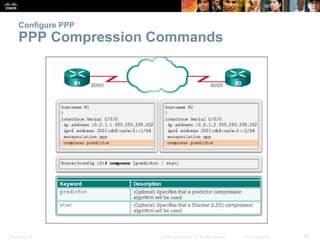
PPP Compression Commands
Presentation_ID 27© 2008 Cisco Systems, Inc. All rights reserved. Cisco Confidential
Configure PPP
PPP Link Quality Monitoring Command
The ppp quality percentage command ensures that
the link meets the quality requirement set; otherwise, the link
closes down.
Presentation_ID 28© 2008 Cisco Systems, Inc. All rights reserved. Cisco Confidential
Configure PPP
PPP Multilink Commands
Presentation_ID 29© 2008 Cisco Systems, Inc. All rights reserved. Cisco Confidential
Configure PPP
Verifying PPP Configuration
Presentation_ID 30© 2008 Cisco Systems, Inc. All rights reserved. Cisco Confidential
PPP Authentication
PPP Authentication Protocols
Presentation_ID 31© 2008 Cisco Systems, Inc. All rights reserved. Cisco Confidential
PPP Authentication
Password Authentication Protocol (PAP)
Initiating PAP
Completing PAP
Presentation_ID 32© 2008 Cisco Systems, Inc. All rights reserved. Cisco Confidential
PPP Authentication
Challenge Handshake Authentication Protocol
Initiating CHAP
Responding CHAP
Presentation_ID 33© 2008 Cisco Systems, Inc. All rights reserved. Cisco Confidential
PPP Authentication
CHAP (cont.)
Completing CHAP
Presentation_ID 34© 2008 Cisco Systems, Inc. All rights reserved. Cisco Confidential
PPP Authentication
PPP Encapsulation and Authentication Process
Presentation_ID 35© 2008 Cisco Systems, Inc. All rights reserved. Cisco Confidential
PPP Authentication
Configuring PPP Authentication
Presentation_ID 36© 2008 Cisco Systems, Inc. All rights reserved. Cisco Confidential
PPP Authentication
Configuring PPP Authentication (cont.)
Presentation_ID 37© 2008 Cisco Systems, Inc. All rights reserved. Cisco Confidential
PPP Authentication
Configuring PPP Authentication (cont.)
© 2008 Cisco Systems, Inc. All rights reserved. Cisco ConfidentialPresentation_ID 38
Troubleshooting WAN
Connectivity
Presentation_ID 39© 2008 Cisco Systems, Inc. All rights reserved. Cisco Confidential
Troubleshoot PPP
Troubleshooting PPP Serial Encapsulation
Presentation_ID 40© 2008 Cisco Systems, Inc. All rights reserved. Cisco Confidential
Troubleshoot PPP
Troubleshooting a PPP Configuration with Authentication
Presentation_ID 41© 2008 Cisco Systems, Inc. All rights reserved. Cisco Confidential

cisco-nti-Day18

  • 1.
    © 2008 CiscoSystems, Inc. All rights reserved. Cisco ConfidentialPresentation_ID 1 Point-to-Point Connections Connecting Networks
  • 2.
    Presentation_ID 2© 2008Cisco Systems, Inc. All rights reserved. Cisco Confidential Objectives  Explain the fundamentals of point-to-point serial communication across a WAN.  Configure HDLC encapsulation on a point-to-point serial link.  Describe the benefits of using PPP over HDLC in a WAN.  Describe the PPP layered architecture and the functions of LCP and NCP.  Explain how a PPP session is established.  Configure PPP encapsulation on a point-to-point serial link.  Configure PPP authentication protocols.  Use show and debug commands to troubleshoot PPP.
  • 3.
    © 2008 CiscoSystems, Inc. All rights reserved. Cisco ConfidentialPresentation_ID 3 Serial Point-to-Point Overview
  • 4.
    Presentation_ID 4© 2008Cisco Systems, Inc. All rights reserved. Cisco Confidential Serial Communications Serial and Parallel Ports  Point-to-point connections are used to connect LANs to service provider WANs. • Also referred to as a serial connection or leased-line connection.  Communications across a serial connection is a method of data transmissions in which the bits are transmitted sequentially over a single channel.  In parallel communications, bits can be transmitted simultaneously over multiple wires.
  • 5.
    Presentation_ID 5© 2008Cisco Systems, Inc. All rights reserved. Cisco Confidential Serial Communications Serial Communication  On the WAN link, data is encapsulated by the protocol used by the sending router.  Encapsulated frame is sent on a physical medium to the WAN.  Receiving router uses the same communications protocol to de- encapsulate the frame when it arrives. Three serial communication standards for LAN-to-WAN connections: RS-232, V.35, HSSI
  • 6.
    Presentation_ID 6© 2008Cisco Systems, Inc. All rights reserved. Cisco Confidential Serial Communications Point-to-Point Communication Links  Point-to-point links can connect two geographically distant sites.  Carrier dedicates specific resources for a line leased by the customer (leased-line).  Point-to-point links are usually more expensive than shared services.
  • 7.
    Presentation_ID 7© 2008Cisco Systems, Inc. All rights reserved. Cisco Confidential Serial Communications Time-Division Multiplexing Multiplexing – A scheme that allows multiple logical signals to share a single physical channel.
  • 8.
    Presentation_ID 8© 2008Cisco Systems, Inc. All rights reserved. Cisco Confidential Serial Communications DTE-DCE  DTE – Commonly CPE, generally a router, could also be a terminal, computer, printer, or fax machine if they connect directly to the service provider network.  DCE – Commonly a modem or CSU/DSU, it is a device used to convert the user data from the DTE into a form acceptable to the WAN service provider transmission link. The signal is received at the remote DCE, which decodes the signal back into a sequence of bits; the remote DCE then signals this sequence to the remote DTE.
  • 9.
    Presentation_ID 9© 2008Cisco Systems, Inc. All rights reserved. Cisco Confidential Serial Communications Serial Cables
  • 10.
    Presentation_ID 10© 2008Cisco Systems, Inc. All rights reserved. Cisco Confidential HDLC Encapsulation WAN Encapsulation Protocols Data is encapsulated into frames before crossing the WAN link; an appropriate Layer 2 encapsulation type must be configured.
  • 11.
    Presentation_ID 11© 2008Cisco Systems, Inc. All rights reserved. Cisco Confidential HDLC Encapsulation HDLC Encapsulation  Bit-oriented, synchronous data link layer protocol developed by the International Organization for Standardization (ISO).  Uses synchronous serial transmission to provide error-free communication between two points.  Defines a Layer 2 framing structure that allows for flow control and error control through the use of acknowledgments.  Cisco has developed an extension to the HLDC protocol to solve the inability to provide multiprotocol support (Cisco HLDC also referred to as cHDLC).
  • 12.
    Presentation_ID 12© 2008Cisco Systems, Inc. All rights reserved. Cisco Confidential HDLC Encapsulation Configuring HDLC Encapsulation  Default encapsulation method used by Cisco devices on synchronous serial lines  Point-to-point protocol on leased lines between two Cisco devices  Connecting to a non-Cisco device, use synchronous PPP
  • 13.
    Presentation_ID 13© 2008Cisco Systems, Inc. All rights reserved. Cisco Confidential HDLC Encapsulation Troubleshooting a Serial Interface
  • 14.
    © 2008 CiscoSystems, Inc. All rights reserved. Cisco ConfidentialPresentation_ID 14 PPP Operation
  • 15.
    Presentation_ID 15© 2008Cisco Systems, Inc. All rights reserved. Cisco Confidential Benefits of PPP Introducing PPP PPP contains three main components:  HDLC protocol for encapsulating datagrams over point-to-point links  Extensible Link Control Protocol (LCP) to establish, configure, and test the data link connection  Family of Network Control Protocols (NCPs) to establish and configure different network layer protocols (IPv4, IPv6, AppleTalk, Novell IPX, and SNA Control Protocol)
  • 16.
    Presentation_ID 16© 2008Cisco Systems, Inc. All rights reserved. Cisco Confidential Benefits of PPP Advantages of PPP  PPP not proprietary  PPP includes many features not available in HDLC  Link quality management feature monitors the quality of the link. If too many errors are detected, PPP takes down the link  Supports PAP and CHAP authentication
  • 17.
    Presentation_ID 17© 2008Cisco Systems, Inc. All rights reserved. Cisco Confidential LCP and NCP PPP Layered Architecture  LCP sets up the PPP connection and its parameters  NCPs handle higher layer protocol configurations  LCP terminates the PPP connection
  • 18.
    Presentation_ID 18© 2008Cisco Systems, Inc. All rights reserved. Cisco Confidential LCP and NCP PPP Control Protocol (LCP) LCP provides automatic configuration of the interfaces at each end, including:  Handling varying limits on packet size.  Detecting common misconfiguration errors.  Terminating the link.  Determining when a link is functioning properly or when it is failing.
  • 19.
    Presentation_ID 19© 2008Cisco Systems, Inc. All rights reserved. Cisco Confidential LCP and NCP PPP Network Control Protocol (NCP)  PPP permits multiple network layer protocols to operate on the same communications link.  For every network layer protocol used, PPP uses a separate NCP.
  • 20.
    Presentation_ID 20© 2008Cisco Systems, Inc. All rights reserved. Cisco Confidential PPP Sessions Establishing a PPP Session Phase 1 – LCP must first open the connection and negotiate configuration options; it completes when the receiving router sends a configuration-acknowledgment frame back to the router initiating the connection.
  • 21.
    Presentation_ID 21© 2008Cisco Systems, Inc. All rights reserved. Cisco Confidential PPP Sessions Establishing a PPP Session (cont.) Phase 2 – LCP tests the link to determine whether the link quality is sufficient to bring up network layer protocols.
  • 22.
    Presentation_ID 22© 2008Cisco Systems, Inc. All rights reserved. Cisco Confidential PPP Sessions Establishing a PPP Session (cont.) Phase 3 – After the LCP has finished the link quality determination phase, the appropriate NCP can separately configure the network layer protocols, and bring them up and take them down at any time.
  • 23.
    Presentation_ID 23© 2008Cisco Systems, Inc. All rights reserved. Cisco Confidential PPP Sessions PPP Configuration Options Optional functions include:  Authentication using either PAP or CHAP  Compression using either Stacker or Predictor  Multilink that combines two or more channels to increase the WAN bandwidth
  • 24.
    © 2008 CiscoSystems, Inc. All rights reserved. Cisco ConfidentialPresentation_ID 24 Configuring PPP
  • 25.
    Presentation_ID 25© 2008Cisco Systems, Inc. All rights reserved. Cisco Confidential Configure PPP PPP Basic Configuration Command
  • 26.
    Presentation_ID 26© 2008Cisco Systems, Inc. All rights reserved. Cisco Confidential Configure PPP PPP Compression Commands
  • 27.
    Presentation_ID 27© 2008Cisco Systems, Inc. All rights reserved. Cisco Confidential Configure PPP PPP Link Quality Monitoring Command The ppp quality percentage command ensures that the link meets the quality requirement set; otherwise, the link closes down.
  • 28.
    Presentation_ID 28© 2008Cisco Systems, Inc. All rights reserved. Cisco Confidential Configure PPP PPP Multilink Commands
  • 29.
    Presentation_ID 29© 2008Cisco Systems, Inc. All rights reserved. Cisco Confidential Configure PPP Verifying PPP Configuration
  • 30.
    Presentation_ID 30© 2008Cisco Systems, Inc. All rights reserved. Cisco Confidential PPP Authentication PPP Authentication Protocols
  • 31.
    Presentation_ID 31© 2008Cisco Systems, Inc. All rights reserved. Cisco Confidential PPP Authentication Password Authentication Protocol (PAP) Initiating PAP Completing PAP
  • 32.
    Presentation_ID 32© 2008Cisco Systems, Inc. All rights reserved. Cisco Confidential PPP Authentication Challenge Handshake Authentication Protocol Initiating CHAP Responding CHAP
  • 33.
    Presentation_ID 33© 2008Cisco Systems, Inc. All rights reserved. Cisco Confidential PPP Authentication CHAP (cont.) Completing CHAP
  • 34.
    Presentation_ID 34© 2008Cisco Systems, Inc. All rights reserved. Cisco Confidential PPP Authentication PPP Encapsulation and Authentication Process
  • 35.
    Presentation_ID 35© 2008Cisco Systems, Inc. All rights reserved. Cisco Confidential PPP Authentication Configuring PPP Authentication
  • 36.
    Presentation_ID 36© 2008Cisco Systems, Inc. All rights reserved. Cisco Confidential PPP Authentication Configuring PPP Authentication (cont.)
  • 37.
    Presentation_ID 37© 2008Cisco Systems, Inc. All rights reserved. Cisco Confidential PPP Authentication Configuring PPP Authentication (cont.)
  • 38.
    © 2008 CiscoSystems, Inc. All rights reserved. Cisco ConfidentialPresentation_ID 38 Troubleshooting WAN Connectivity
  • 39.
    Presentation_ID 39© 2008Cisco Systems, Inc. All rights reserved. Cisco Confidential Troubleshoot PPP Troubleshooting PPP Serial Encapsulation
  • 40.
    Presentation_ID 40© 2008Cisco Systems, Inc. All rights reserved. Cisco Confidential Troubleshoot PPP Troubleshooting a PPP Configuration with Authentication
  • 41.
    Presentation_ID 41© 2008Cisco Systems, Inc. All rights reserved. Cisco Confidential