


the name of God
cirrhosis
    saeed
Renderer:               •


adinehvand
      Dr.
Respective Professor:


Eshratkhah
What is Cirrhosis?
• A chronic, progressive disease of the liver
• Extensive parenchymal cell degeneration &
  Destruction of parenchymal cells
• Normal lobular structure distorted by fibrotic
  connective tissue
• Lobules are irregular in size and shape with impaired
  vascular flow
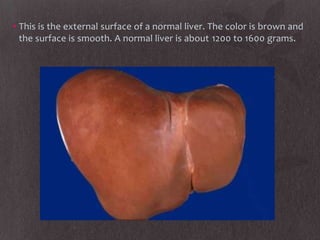
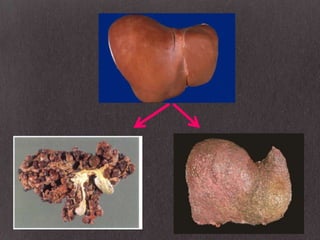
• This is the external surface of a normal liver. The color is brown and
  the surface is smooth. A normal liver is about 1200 to 1600 grams.
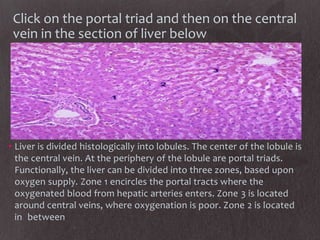
Click on the portal triad and then on the central
 vein in the section of liver below


• Liver is divided histologically into lobules. The center of the lobule is
  the central vein. At the periphery of the lobule are portal triads.
  Functionally, the liver can be divided into three zones, based upon
  oxygen supply. Zone 1 encircles the portal tracts where the
  oxygenated blood from hepatic arteries enters. Zone 3 is located
  around central veins, where oxygenation is poor. Zone 2 is located
  in between
What is the Function of the Liver?

• The liver extracts nutrients from the blood and
  processes them for later use.
• The liver makes bile, which is used by the digestive
  system to help absorb fat and certain vitamins.
• The liver also removes medications and toxic waste-
  products from the blood and excretes them into bile.
• The liver is the body’s main factory for blood
  proteins, including the proteins involved in normal
  blood clotting function.
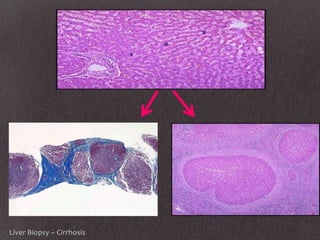
• Liver Biopsy – Cirrhosis
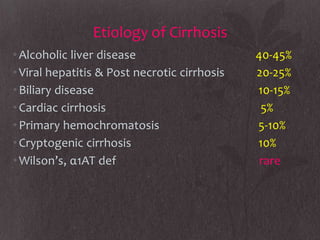
Etiology of Cirrhosis
• Alcoholic liver disease                     40-45%
• Viral hepatitis & Post necrotic cirrhosis   20-25%
• Biliary disease                             10-15%
• Cardiac cirrhosis                            5%
• Primary hemochromatosis                     5-10%
• Cryptogenic cirrhosis                       10%
• Wilson’s, α1AT def                           rare
What are the Symptoms of Cirrhosis?
 Fatigue
 Itching
 Edema
 Ascites
 Digestive Tract Bleeding
 Jaundice
 hepatic encephalopathy
Etiology of Cirrhosis
• Alcoholic liver disease                     40-45%
• Viral hepatitis & Post necrotic cirrhosis   20-25%
• Biliary disease                             10-15%
• Cardiac cirrhosis                            5%
• Primary hemochromatosis                     5-10%
• Cryptogenic cirrhosis                       10%
• Wilson’s, α1AT def                           rare
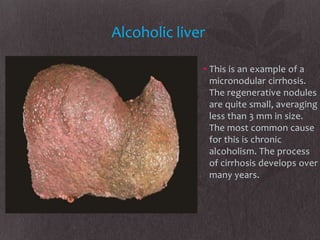
Alcoholic liver

              • This is an example of a
                micronodular cirrhosis.
                The regenerative nodules
                are quite small, averaging
                less than 3 mm in size.
                The most common cause
                for this is chronic
                alcoholism. The process
                of cirrhosis develops over
                many years.
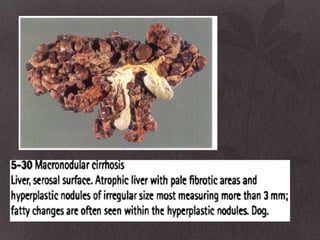
Viral hepatitis
• Here is another example of macronodular cirrhosis.
  Viral hepatitis (B or C) is the most common cause for
  macronodular cirrhosis. Wilson's disease and alpha-1-
  antitrypsin deficiency also can produce a
  macronodular cirrhosis.
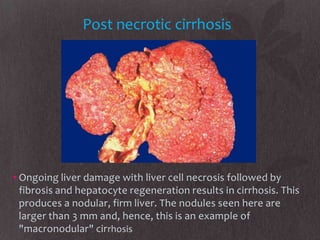
Post necrotic cirrhosis


• Ongoing liver damage with liver cell necrosis followed by
  fibrosis and hepatocyte regeneration results in cirrhosis. This
  produces a nodular, firm liver. The nodules seen here are
  larger than 3 mm and, hence, this is an example of
  "macronodular" cirrhosis
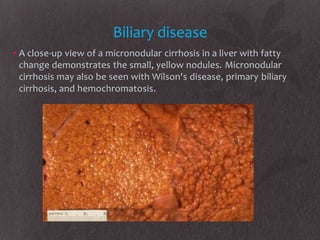
Biliary disease
• A close-up view of a micronodular cirrhosis in a liver with fatty
  change demonstrates the small, yellow nodules. Micronodular
  cirrhosis may also be seen with Wilson's disease, primary biliary
  cirrhosis, and hemochromatosis.
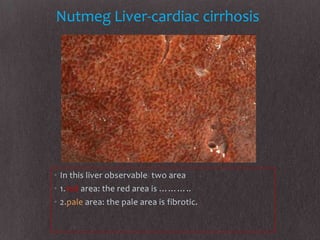
Nutmeg Liver-cardiac cirrhosis


• In this liver observable two area
• 1.red area: the red area is ………..
• 2.pale area: the pale area is fibrotic.
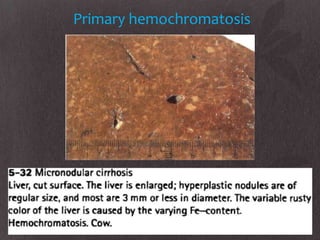
Primary hemochromatosis
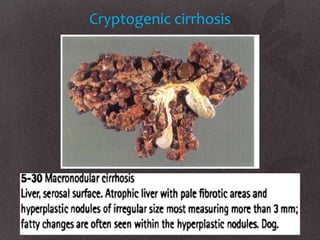
Cryptogenic cirrhosis
What are the Complications of Cirrhosis

•Ascites
•Varices
•Hepatic Encephalopathy
•Liver Cancer (Hepatocellular Carcinoma)
•spontaneous bacterial peritonitis
What Treatments for Cirrhosis are Available
•total avoidance of alcohol
•updating vaccinations
•Dietary salt restriction and diuretic
 medications
•blood-pressure reducing medications
•TIPS shunt
•liver transplantation
References
                                                                  •

• LIVER CIRRHOSIS, William Sanchez, M.D. & Jayant A. Talwalkar,
  Miles and Shirley Fiterman, The American College of
  Gastroenterology
• 6400 Goldsboro Rd., Suite 450, Bethesda, MD 20817
• P: 301-263-9000 F: 301-263-9025
cirrhosis

cirrhosis

  • 1.
  • 2.
    cirrhosis saeed Renderer: • adinehvand Dr. Respective Professor: Eshratkhah
  • 3.
    What is Cirrhosis? •A chronic, progressive disease of the liver • Extensive parenchymal cell degeneration & Destruction of parenchymal cells • Normal lobular structure distorted by fibrotic connective tissue • Lobules are irregular in size and shape with impaired vascular flow
  • 4.
    • This isthe external surface of a normal liver. The color is brown and the surface is smooth. A normal liver is about 1200 to 1600 grams.
  • 5.
    Click on theportal triad and then on the central vein in the section of liver below • Liver is divided histologically into lobules. The center of the lobule is the central vein. At the periphery of the lobule are portal triads. Functionally, the liver can be divided into three zones, based upon oxygen supply. Zone 1 encircles the portal tracts where the oxygenated blood from hepatic arteries enters. Zone 3 is located around central veins, where oxygenation is poor. Zone 2 is located in between
  • 6.
    What is theFunction of the Liver? • The liver extracts nutrients from the blood and processes them for later use. • The liver makes bile, which is used by the digestive system to help absorb fat and certain vitamins. • The liver also removes medications and toxic waste- products from the blood and excretes them into bile. • The liver is the body’s main factory for blood proteins, including the proteins involved in normal blood clotting function.
  • 7.
    • Liver Biopsy– Cirrhosis
  • 9.
    Etiology of Cirrhosis •Alcoholic liver disease 40-45% • Viral hepatitis & Post necrotic cirrhosis 20-25% • Biliary disease 10-15% • Cardiac cirrhosis 5% • Primary hemochromatosis 5-10% • Cryptogenic cirrhosis 10% • Wilson’s, α1AT def rare
  • 10.
    What are theSymptoms of Cirrhosis?  Fatigue  Itching  Edema  Ascites  Digestive Tract Bleeding  Jaundice  hepatic encephalopathy
  • 11.
    Etiology of Cirrhosis •Alcoholic liver disease 40-45% • Viral hepatitis & Post necrotic cirrhosis 20-25% • Biliary disease 10-15% • Cardiac cirrhosis 5% • Primary hemochromatosis 5-10% • Cryptogenic cirrhosis 10% • Wilson’s, α1AT def rare
  • 12.
    Alcoholic liver • This is an example of a micronodular cirrhosis. The regenerative nodules are quite small, averaging less than 3 mm in size. The most common cause for this is chronic alcoholism. The process of cirrhosis develops over many years.
  • 13.
    Viral hepatitis • Hereis another example of macronodular cirrhosis. Viral hepatitis (B or C) is the most common cause for macronodular cirrhosis. Wilson's disease and alpha-1- antitrypsin deficiency also can produce a macronodular cirrhosis.
  • 14.
    Post necrotic cirrhosis •Ongoing liver damage with liver cell necrosis followed by fibrosis and hepatocyte regeneration results in cirrhosis. This produces a nodular, firm liver. The nodules seen here are larger than 3 mm and, hence, this is an example of "macronodular" cirrhosis
  • 16.
    Biliary disease • Aclose-up view of a micronodular cirrhosis in a liver with fatty change demonstrates the small, yellow nodules. Micronodular cirrhosis may also be seen with Wilson's disease, primary biliary cirrhosis, and hemochromatosis.
  • 17.
    Nutmeg Liver-cardiac cirrhosis •In this liver observable two area • 1.red area: the red area is ……….. • 2.pale area: the pale area is fibrotic.
  • 18.
  • 19.
  • 20.
    What are theComplications of Cirrhosis •Ascites •Varices •Hepatic Encephalopathy •Liver Cancer (Hepatocellular Carcinoma) •spontaneous bacterial peritonitis
  • 21.
    What Treatments forCirrhosis are Available •total avoidance of alcohol •updating vaccinations •Dietary salt restriction and diuretic medications •blood-pressure reducing medications •TIPS shunt •liver transplantation
  • 22.
    References • • LIVER CIRRHOSIS, William Sanchez, M.D. & Jayant A. Talwalkar, Miles and Shirley Fiterman, The American College of Gastroenterology • 6400 Goldsboro Rd., Suite 450, Bethesda, MD 20817 • P: 301-263-9000 F: 301-263-9025

Editor's Notes