
Blood &
circulation
Circulation
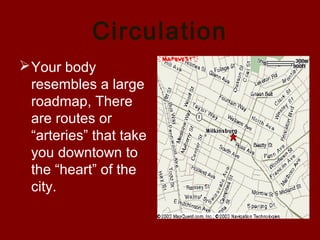
Your body
resembles a large
roadmap, There
are routes or
“arteries” that take
you downtown to
the “heart” of the
city.
3 Major Parts of the Circulatory
system
• Blood Vessels - routes blood travels
• Heart – pumps or pushes blood through body
• Blood – carries important “ *stuff ” through
body
* Stuff – includes oxygen, food, & waste
# 1 Blood Vessels : One Way
Streets
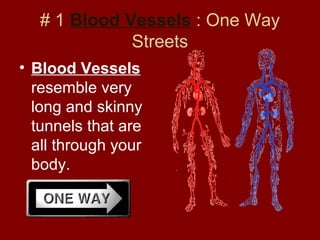
• Blood Vessels
resemble very
long and skinny
tunnels that are
all through your
body.
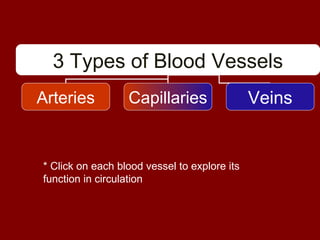
3 Types of Blood Vessels
Arteries Capillaries Veins
* Click on each blood vessel to explore its
function in circulation
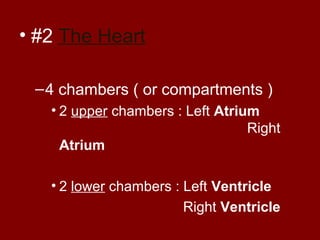
• #2 The Heart
–4 chambers ( or compartments )
• 2 upper chambers : Left Atrium
Right
Atrium
• 2 lower chambers : Left Ventricle
Right Ventricle
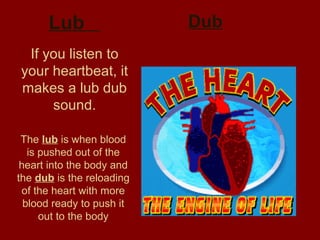
Lub
If you listen to
your heartbeat, it
makes a lub dub
sound.
The lub is when blood
is pushed out of the
heart into the body and
the dub is the reloading
of the heart with more
blood ready to push it
out to the body
Dub
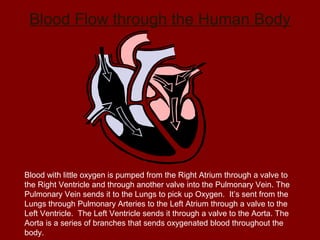
Blood Flow through the Human Body
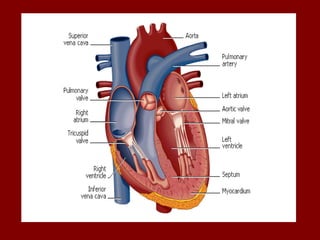
Blood with little oxygen is pumped from the Right Atrium through a valve to
the Right Ventricle and through another valve into the Pulmonary Vein. The
Pulmonary Vein sends it to the Lungs to pick up Oxygen. It’s sent from the
Lungs through Pulmonary Arteries to the Left Atrium through a valve to the
Left Ventricle. The Left Ventricle sends it through a valve to the Aorta. The
Aorta is a series of branches that sends oxygenated blood throughout the
body.
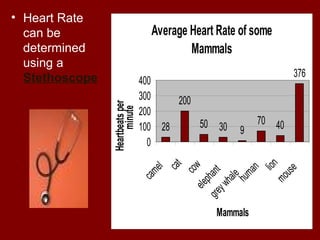
• Heart Rate
can be
determined
using a
Stethoscope
Average Heart Rate of some
Mammals
28
200
50 30 9
70 40
376
0
100
200
300
400
camel
cat
cowelephantgreywhale
human
lion
mouse
Mammals
Heartbeatsper
minute
Heart Facts
• Hold out your hand and make a fist. If you're a kid, your
heart is about the same size as your fist, and if you're an
adult, it's about the same size as two fists.
• Your heart beats about 100,000 times in one day and
about 35 million times in a year. During an average
lifetime, the human heart will beat more than 2.5 billion
times.
• Give a tennis ball a good, hard squeeze. You're using
about the same amount of force your heart uses to
pump blood out to the body. Even at rest, the muscles
of the heart work hard--twice as hard as the leg muscles
of a person sprinting.
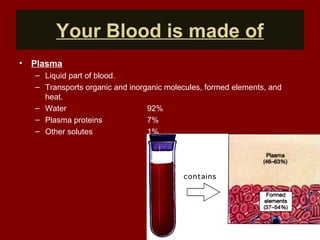
Your Blood is made of
• Plasma
– Liquid part of blood.
– Transports organic and inorganic molecules, formed elements, and
heat.
– Water 92%
– Plasma proteins 7%
– Other solutes 1%
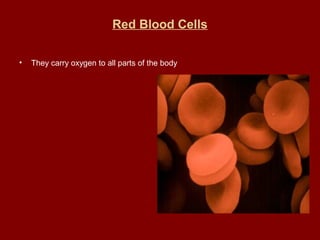
Red Blood Cells
• They carry oxygen to all parts of the body
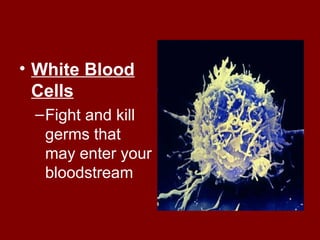
• White Blood
Cells
–Fight and kill
germs that
may enter your
bloodstream
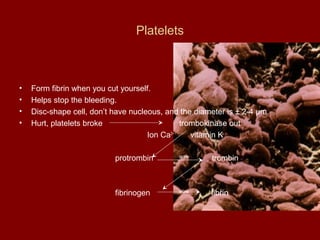
Platelets
• Form fibrin when you cut yourself.
• Helps stop the bleeding.
• Disc-shape cell, don’t have nucleous, and the diameter is ± 2-4 µm.
• Hurt, platelets broke trombokinase out
Ion Ca2+
vitamin K
protrombin become
trombin
fibrinogen become
fibrin
 Normal count is 250,000.
 Normal life span 7-10 days.
 About 1/3 are trapped in the spleen.
Blood Types
There are 4 main Blood
Types:
Type A, Type B, Type AB, and
Type O
This powerpoint was kindly donated to
www.worldofteaching.com
http://www.worldofteaching.com is home to over a
thousand powerpoints submitted by teachers. This is a
completely free site and requires no registration. Please
visit and I hope it will help in your teaching.

Blood & circulation

  • 1.
  • 2.
    Circulation Your body resembles alarge roadmap, There are routes or “arteries” that take you downtown to the “heart” of the city.
  • 3.
    3 Major Partsof the Circulatory system • Blood Vessels - routes blood travels • Heart – pumps or pushes blood through body • Blood – carries important “ *stuff ” through body * Stuff – includes oxygen, food, & waste
  • 4.
    # 1 BloodVessels : One Way Streets • Blood Vessels resemble very long and skinny tunnels that are all through your body.
  • 5.
    3 Types ofBlood Vessels Arteries Capillaries Veins * Click on each blood vessel to explore its function in circulation
  • 6.
    • #2 TheHeart –4 chambers ( or compartments ) • 2 upper chambers : Left Atrium Right Atrium • 2 lower chambers : Left Ventricle Right Ventricle
  • 8.
    Lub If you listento your heartbeat, it makes a lub dub sound. The lub is when blood is pushed out of the heart into the body and the dub is the reloading of the heart with more blood ready to push it out to the body Dub
  • 9.
    Blood Flow throughthe Human Body Blood with little oxygen is pumped from the Right Atrium through a valve to the Right Ventricle and through another valve into the Pulmonary Vein. The Pulmonary Vein sends it to the Lungs to pick up Oxygen. It’s sent from the Lungs through Pulmonary Arteries to the Left Atrium through a valve to the Left Ventricle. The Left Ventricle sends it through a valve to the Aorta. The Aorta is a series of branches that sends oxygenated blood throughout the body.
  • 10.
    • Heart Rate canbe determined using a Stethoscope Average Heart Rate of some Mammals 28 200 50 30 9 70 40 376 0 100 200 300 400 camel cat cowelephantgreywhale human lion mouse Mammals Heartbeatsper minute
  • 11.
    Heart Facts • Holdout your hand and make a fist. If you're a kid, your heart is about the same size as your fist, and if you're an adult, it's about the same size as two fists. • Your heart beats about 100,000 times in one day and about 35 million times in a year. During an average lifetime, the human heart will beat more than 2.5 billion times. • Give a tennis ball a good, hard squeeze. You're using about the same amount of force your heart uses to pump blood out to the body. Even at rest, the muscles of the heart work hard--twice as hard as the leg muscles of a person sprinting.
  • 12.
    Your Blood ismade of • Plasma – Liquid part of blood. – Transports organic and inorganic molecules, formed elements, and heat. – Water 92% – Plasma proteins 7% – Other solutes 1%
  • 13.
    Red Blood Cells •They carry oxygen to all parts of the body
  • 14.
    • White Blood Cells –Fightand kill germs that may enter your bloodstream
  • 15.
    Platelets • Form fibrinwhen you cut yourself. • Helps stop the bleeding. • Disc-shape cell, don’t have nucleous, and the diameter is ± 2-4 µm. • Hurt, platelets broke trombokinase out Ion Ca2+ vitamin K protrombin become trombin fibrinogen become fibrin
  • 16.
     Normal countis 250,000.  Normal life span 7-10 days.  About 1/3 are trapped in the spleen.
  • 17.
    Blood Types There are4 main Blood Types: Type A, Type B, Type AB, and Type O
  • 18.
    This powerpoint waskindly donated to www.worldofteaching.com http://www.worldofteaching.com is home to over a thousand powerpoints submitted by teachers. This is a completely free site and requires no registration. Please visit and I hope it will help in your teaching.