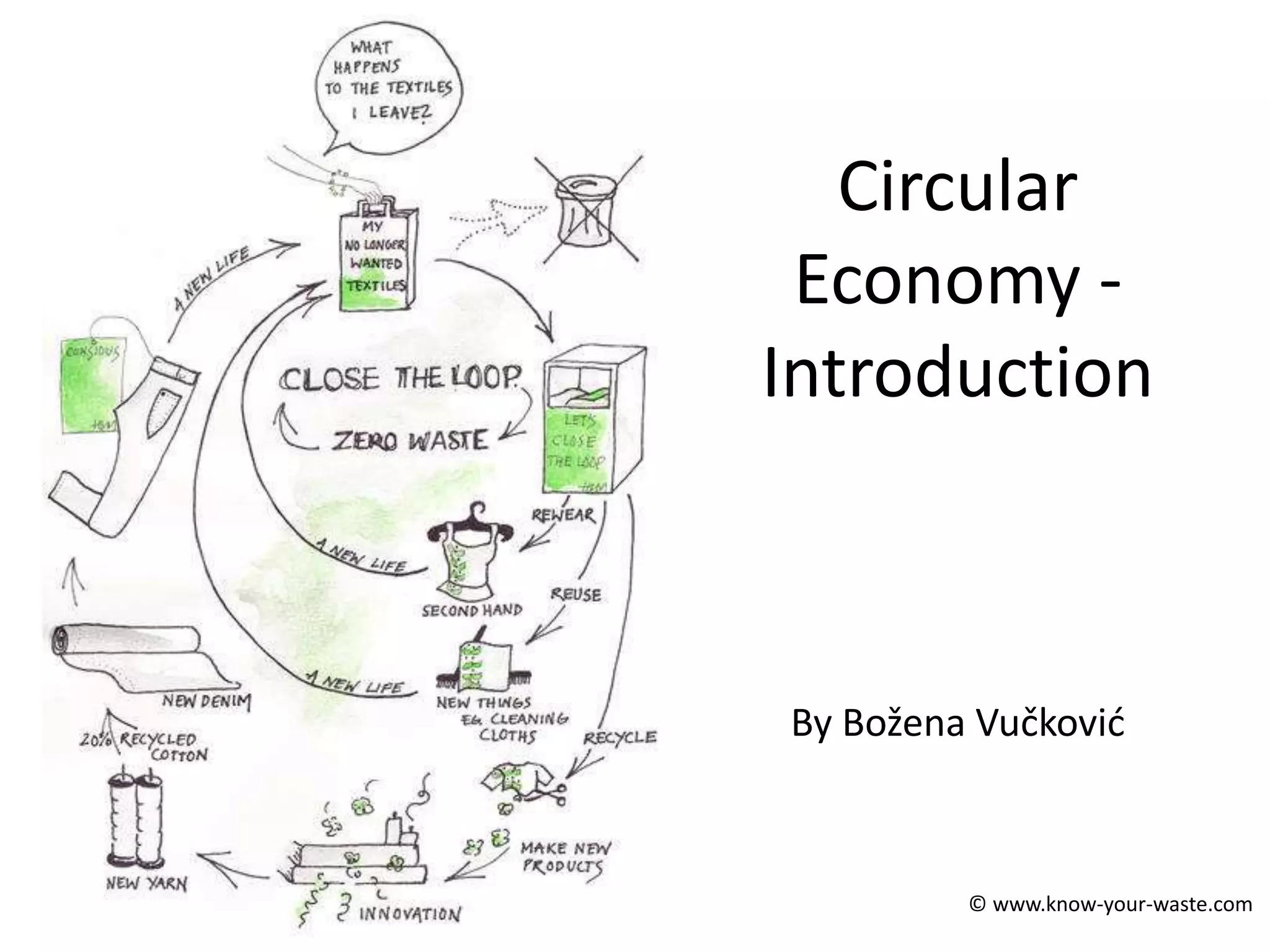
Circular
Economy -
Introduction
By Božena Vučković
© www.know-your-waste.com
What is Circular Economy?
• Remember how in the 80’s everything was repaired?
• If your TV broke, you took it to a repair shop.
• If your shoes wore out you took them to a shoemaker to see if they
can be fixed somehow.
• The same was with clothes, furniture, washing machine, fridge…
• Some things were repaired using parts from other broken items.
© www.know-your-waste.com
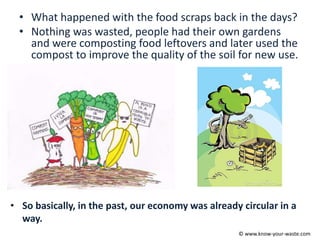
• What happened with the food scraps back in the days?
• Nothing was wasted, people had their own gardens
and were composting food leftovers and later used the
compost to improve the quality of the soil for new use.
• So basically, in the past, our economy was already circular in a
way.
© www.know-your-waste.com
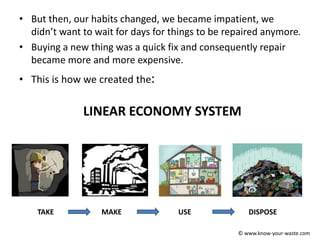
• But then, our habits changed, we became impatient, we
didn’t want to wait for days for things to be repaired anymore.
• Buying a new thing was a quick fix and consequently repair
became more and more expensive.
• This is how we created the:
LINEAR ECONOMY SYSTEM
TAKE MAKE USE DISPOSE
© www.know-your-waste.com
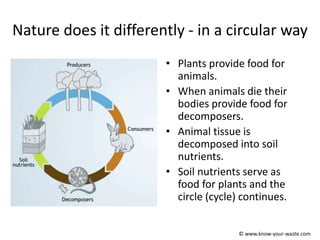
Nature does it differently - in a circular way
• Plants provide food for
animals.
• When animals die their
bodies provide food for
decomposers.
• Animal tissue is
decomposed into soil
nutrients.
• Soil nutrients serve as
food for plants and the
circle (cycle) continues.
© www.know-your-waste.com
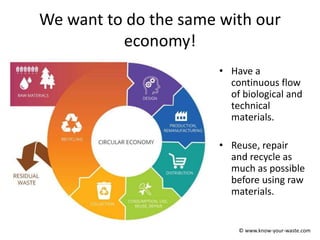
We want to do the same with our
economy!
• Have a
continuous flow
of biological and
technical
materials.
• Reuse, repair
and recycle as
much as possible
before using raw
materials.
© www.know-your-waste.com
Waste is not waste, it is a resource!
• Did you know that in 1 ton of old cell phones there is 324
times more gold than in 1 ton of ore from Yanacocha, one
of the biggest gold mines in the world. [12]
• All that gold is goint to waste instead of being reused.
1t ore = 0.85 g (0.03 oz.) of gold 1t phones = 275 g (9.72 oz.) of gold
© www.know-your-waste.com
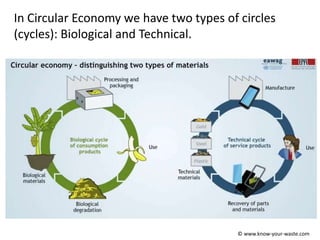
In Circular Economy we have two types of circles
(cycles): Biological and Technical.
© www.know-your-waste.com
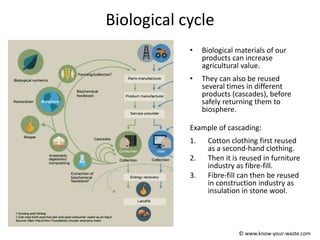
Biological cycle
• Biological materials of our
products can increase
agricultural value.
• They can also be reused
several times in different
products (cascades), before
safely returning them to
biosphere.
Example of cascading:
1. Cotton clothing first reused
as a second-hand clothing.
2. Then it is reused in furniture
industry as fibre-fill.
3. Fibre-fill can then be reused
in construction industry as
insulation in stone wool.
© www.know-your-waste.com
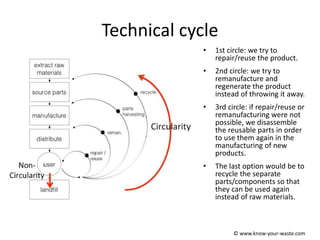
Technical cycle
• 1st circle: we try to
repair/reuse the product.
• 2nd circle: we try to
remanufacture and
regenerate the product
instead of throwing it away.
• 3rd circle: if repair/reuse or
remanufacturing were not
possible, we disassemble
the reusable parts in order
to use them again in the
manufacturing of new
products.
• The last option would be to
recycle the separate
parts/components so that
they can be used again
instead of raw materials.
© www.know-your-waste.com
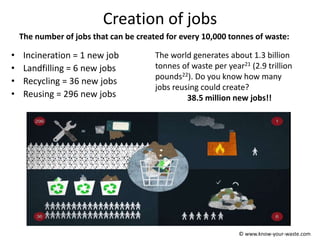
Creation of jobs
• Incineration = 1 new job
• Landfilling = 6 new jobs
• Recycling = 36 new jobs
• Reusing = 296 new jobs
© www.know-your-waste.com
The number of jobs that can be created for every 10,000 tonnes of waste:
The world generates about 1.3 billion
tonnes of waste per year21 (2.9 trillion
pounds22). Do you know how many
jobs reusing could create?
38.5 million new jobs!!
What do we need?
• Innovation in design - less components,
products designed to be easily disassembled,
regenerated and recycled.
• Innovation in business approach - buying
service instead of buying the product.
• Technological improvements in recycling.
• Collaboration between public and private
sectors.
© www.know-your-waste.com
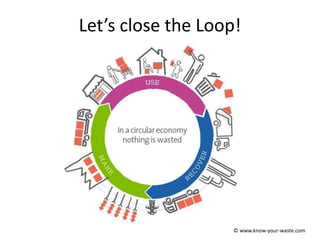
Let’s close the Loop!
© www.know-your-waste.com

Circular Economy Introduction

  • 1.
    Circular Economy - Introduction By BoženaVučković © www.know-your-waste.com
  • 2.
    What is CircularEconomy? • Remember how in the 80’s everything was repaired? • If your TV broke, you took it to a repair shop. • If your shoes wore out you took them to a shoemaker to see if they can be fixed somehow. • The same was with clothes, furniture, washing machine, fridge… • Some things were repaired using parts from other broken items. © www.know-your-waste.com
  • 3.
    • What happenedwith the food scraps back in the days? • Nothing was wasted, people had their own gardens and were composting food leftovers and later used the compost to improve the quality of the soil for new use. • So basically, in the past, our economy was already circular in a way. © www.know-your-waste.com
  • 4.
    • But then,our habits changed, we became impatient, we didn’t want to wait for days for things to be repaired anymore. • Buying a new thing was a quick fix and consequently repair became more and more expensive. • This is how we created the: LINEAR ECONOMY SYSTEM TAKE MAKE USE DISPOSE © www.know-your-waste.com
  • 5.
    Nature does itdifferently - in a circular way • Plants provide food for animals. • When animals die their bodies provide food for decomposers. • Animal tissue is decomposed into soil nutrients. • Soil nutrients serve as food for plants and the circle (cycle) continues. © www.know-your-waste.com
  • 6.
    We want todo the same with our economy! • Have a continuous flow of biological and technical materials. • Reuse, repair and recycle as much as possible before using raw materials. © www.know-your-waste.com
  • 7.
    Waste is notwaste, it is a resource! • Did you know that in 1 ton of old cell phones there is 324 times more gold than in 1 ton of ore from Yanacocha, one of the biggest gold mines in the world. [12] • All that gold is goint to waste instead of being reused. 1t ore = 0.85 g (0.03 oz.) of gold 1t phones = 275 g (9.72 oz.) of gold © www.know-your-waste.com
  • 8.
    In Circular Economywe have two types of circles (cycles): Biological and Technical. © www.know-your-waste.com
  • 9.
    Biological cycle • Biologicalmaterials of our products can increase agricultural value. • They can also be reused several times in different products (cascades), before safely returning them to biosphere. Example of cascading: 1. Cotton clothing first reused as a second-hand clothing. 2. Then it is reused in furniture industry as fibre-fill. 3. Fibre-fill can then be reused in construction industry as insulation in stone wool. © www.know-your-waste.com
  • 10.
    Technical cycle • 1stcircle: we try to repair/reuse the product. • 2nd circle: we try to remanufacture and regenerate the product instead of throwing it away. • 3rd circle: if repair/reuse or remanufacturing were not possible, we disassemble the reusable parts in order to use them again in the manufacturing of new products. • The last option would be to recycle the separate parts/components so that they can be used again instead of raw materials. © www.know-your-waste.com
  • 11.
    Creation of jobs •Incineration = 1 new job • Landfilling = 6 new jobs • Recycling = 36 new jobs • Reusing = 296 new jobs © www.know-your-waste.com The number of jobs that can be created for every 10,000 tonnes of waste: The world generates about 1.3 billion tonnes of waste per year21 (2.9 trillion pounds22). Do you know how many jobs reusing could create? 38.5 million new jobs!!
  • 12.
    What do weneed? • Innovation in design - less components, products designed to be easily disassembled, regenerated and recycled. • Innovation in business approach - buying service instead of buying the product. • Technological improvements in recycling. • Collaboration between public and private sectors. © www.know-your-waste.com
  • 13.
    Let’s close theLoop! © www.know-your-waste.com

Editor's Notes

  • #2 1. Image Close the Loop, <http://2.bp.blogspot.com/-9EGr97v6hi8/Vd0uc_gXeeI/AAAAAAAAKTc/h5jUAnG47yU/s1600/thumbnail%2B%25281%2529.jpg>
  • #3 2. Image Washing machine, <http://worldartsme.com/images/washing-machine-repair-clipart-1.jpg> 3. Image Shoemaker, <http://i.istockimg.com/file_thumbview_approve/17953976/6/stock-illustration-17953976-shoemaker.jpg>
  • #4 4. Image Composting 1, <http://2.bp.blogspot.com/-f70xxb9oDLk/T08fTk9-DXI/AAAAAAAAAFo/rI2b_IIXin4/s1600/CompostJJNielsenColor_0001.jpg> 5. Image Composting 2, <http://thumbs.dreamstime.com/x/happy-tree-enjoying-compost-lunch-19061664.jpg>
  • #5 6. Image Mining, <http://www.clker.com/cliparts/O/M/w/q/c/8/coal-miner-md.png> 7. Image Factory, <http://2.bp.blogspot.com/-0UFfTiJCGyY/VnwZudvxF6I/AAAAAAAAAmw/dYly7MpP6K4/s1600/s.gif> 8. Image Use, <http://www.progettoautismo.it/images/materiale_utile/ambienti/disegno-casa.jpg> 9. Image Garbage, <http://previews.123rf.com/images/danomyte/danomyte1301/danomyte130100001/17114870-Garbage-Dump--Stock-Vector-garbage-waste-landfill.jpg>
  • #6 10. Image Natural Cycle, Coursera, SWM in Developing countries, <https://www.coursera.org/learn/solid-waste-management/lecture/uLmy2/5-4-circular-economy-and-solid-waste-management>
  • #7 11. Image Circular Economy, <http://www.europarl.europa.eu/resources/library/images/20150703PHT73954/20150703PHT73954_original.jpg>
  • #8 12. Electronic Products, How much precious metal is in your iPhone?, <http://www.electronicproducts.com/Computer_Systems/Standalone_Mobile/How_much_precious_metal_is_in_your_iPhone.aspx> 13. Image Mine, <http://image.desiringgod.org/your-bible-is-a-gold-mine-en/legacy_landscape/large_your-bible-is-a-gold-mine.jpg?1452019711> 14. Image Cell Phones, <https://image-store.slidesharecdn.com/9e6fd802-5215-435e-b996-2a0de7b0ce29-large.png>
  • #9 15. Image Two Cycles, Coursera, SWM in Developing countries, <https://www.coursera.org/learn/solid-waste-management/lecture/uLmy2/5-4-circular-economy-and-solid-waste-management>
  • #10 16. Ellen MacArthur Foundation, Towards The Circular Economy vol. 1. <http://www.ellenmacarthurfoundation.org/assets/downloads/publications/Ellen-MacArthur-Foundation-Towards-the-Circular-Economy-vol.1.pdf> 17. Ellen MacArthur Foundation, Re-thinking Progress: The Circular Economy, <https://youtu.be/zCRKvDyyHmI>
  • #11 18. Environmental Leader, The Role of Manufacturing in the Circular Economy, <http://www.environmentalleader.com/2015/11/18/the-role-of-manufacturing-in-the-circular-economy/> 19. Image Technical Cycle, <http://1.bp.blogspot.com/--zzjnBFx0xU/VkwAoS4NUmI/AAAAAAAAAYU/kbY6IXqsy14/s1600/right-half-schematic.jpg>
  • #12 20. Image Creation of Jobs: Greens EFA, The circular economy - a transformation for all?, <https://youtu.be/euWkYMlJyY8> 21. World Bank, What a Waste: A Global Review of Solid Waste Management (2012), <http://siteresources.worldbank.org/INTURBANDEVELOPMENT/Resources/336387-1334852610766/What_a_Waste2012_Final.pdf> 22. The Atlantic, 2.6 Trillion Pounds of Garbage: Where Does the World's Trash Go?, <http://www.theatlantic.com/business/archive/2012/06/26-trillion-pounds-of-garbage-where-does-the-worlds-trash-go/258234/>
  • #14 23. Image Close The Loop, <http://www.flagship.cz/wp-content/uploads/2015/04/circular-economy-2.jpg>