 What is line graph?
 What are the pointers in constructing line graph?
Circle Graph
or
Circle Graph
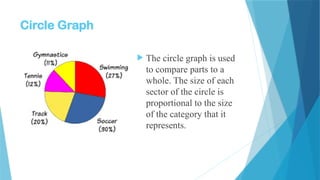
 The circle graph is used
to compare parts to a
whole. The size of each
sector of the circle is
proportional to the size
of the category that it
represents.
Pointers in constructing circle graph
1. Organize the data on the table by providing columns to:
a. The fractional parts or percent each quantity is of the whole.
b. The number of degrees representing each fractional part, obtained by
multiplying 360˚ by the fractional part.
2. On a circle, construct successive central angles using the number
of degrees representing each part.
3. Label each part and write an appropriate title for the graph.
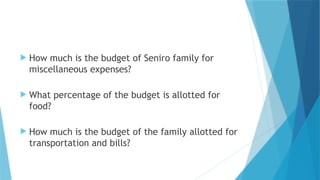
 How much is the budget of Seniro family for
miscellaneous expenses?
 What percentage of the budget is allotted for
food?
 How much is the budget of the family allotted for
transportation and bills?
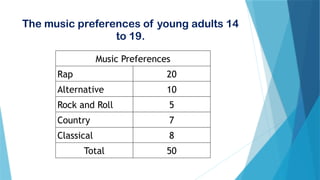
The music preferences of young adults 14
to 19.
Music Preferences
Rap 20
Alternative 10
Rock and Roll 5
Country 7
Classical 8
Total 50
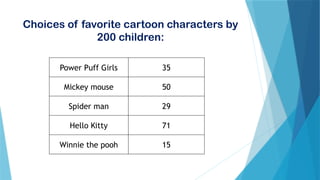
Choices of favorite cartoon characters by
200 children:
Power Puff Girls 35
Mickey mouse 50
Spider man 29
Hello Kitty 71
Winnie the pooh 15
 What is Circle Graph?
 What are the things to do in constructing a
circle graph?
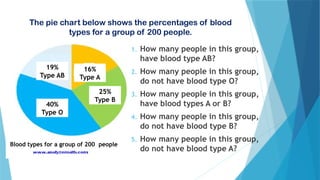
The pie chart below shows the percentages of blood
types for a group of 200 people.
1. How many people in this group,
have blood type AB?
2. How many people in this group,
do not have blood type O?
3. How many people in this group,
have blood types A or B?
4. How many people in this group,
do not have blood type B?
5. How many people in this group,
do not have blood type A?
19%
Type AB
40%
Type O
25%
Type B
16%
Type A
Blood types for a group of 200 people
Circle Graph Circle Graph Circle Graph Circle Graph

Circle Graph Circle Graph Circle Graph Circle Graph

  • 2.
     What isline graph?  What are the pointers in constructing line graph?
  • 3.
  • 4.
    Circle Graph  Thecircle graph is used to compare parts to a whole. The size of each sector of the circle is proportional to the size of the category that it represents.
  • 5.
    Pointers in constructingcircle graph 1. Organize the data on the table by providing columns to: a. The fractional parts or percent each quantity is of the whole. b. The number of degrees representing each fractional part, obtained by multiplying 360˚ by the fractional part. 2. On a circle, construct successive central angles using the number of degrees representing each part. 3. Label each part and write an appropriate title for the graph.
  • 6.
     How muchis the budget of Seniro family for miscellaneous expenses?  What percentage of the budget is allotted for food?  How much is the budget of the family allotted for transportation and bills?
  • 7.
    The music preferencesof young adults 14 to 19. Music Preferences Rap 20 Alternative 10 Rock and Roll 5 Country 7 Classical 8 Total 50
  • 8.
    Choices of favoritecartoon characters by 200 children: Power Puff Girls 35 Mickey mouse 50 Spider man 29 Hello Kitty 71 Winnie the pooh 15
  • 10.
     What isCircle Graph?  What are the things to do in constructing a circle graph?
  • 11.
    The pie chartbelow shows the percentages of blood types for a group of 200 people. 1. How many people in this group, have blood type AB? 2. How many people in this group, do not have blood type O? 3. How many people in this group, have blood types A or B? 4. How many people in this group, do not have blood type B? 5. How many people in this group, do not have blood type A? 19% Type AB 40% Type O 25% Type B 16% Type A Blood types for a group of 200 people

Editor's Notes

  • #4 : It is in the form of circle. : It is used to compare parts to a whole. : The size of each sector of the circle is proportional to the size of the category that it represents.
  • #5 (10,000/20,000)x 100% = 50 % ( 50, 10, 15, 5,20) 360˚ x 50% = 180˚ (180, 36, 54, 18, 72, )
  • #7 : FP (40, 20, 10, 14, 16) : ND (144˚, 72˚, 36˚, 50.4˚, 57.6˚)
  • #8 : FP (17.5, 25, 14.5, 35.5, 7.5) : ND (63, 90, 52.2, 127.8, 27)
  • #11 : 38 people  : 120 people  : 82 people  : 150  : 168