Cindies
Christian Bisson
Tudor Carstoiu
Umberto Di Capua
Stefano Gulmini
Gabriele Mambrini
Valeria Torelli
Developing your company
Table of Contents
Executive summary..................................................................................................3
Team..........................................................................................................................4
Business model..........................................................................................................6
MVP...........................................................................................................................8
Customer needs ......................................................................................................11
Segmentation ..........................................................................................................11
Market size..............................................................................................................13
Milestones................................................................................................................13
Industry Analysis ...................................................................................................14
Actual Competitors................................................................................................15
Activity Analysis.....................................................................................................22
Financial Analysis ..................................................................................................24
Corporate governance ...........................................................................................34
2
Developing your company
Executive summary
Cindies is seeking a funding of €310.681 in order to set up a business which offers house
cleaning services through an innovative and user-friendly website and mobile-app.
Our team includes a variety of postgraduates willing to utilize their knowledge of the market,
together with their personal experience in order to achieve a successful and growth-capable firm.
We represent the ideal market segment that our business wishes to address: students in need of a
cheap, reliable and easy to use service for house cleaning. We are well aware of the various
obstacles and possible opportunities in developing such a business because we have personally
experienced the problem that it aims to resolve. This, coupled with our knowledge in business
and entrepreneurial acumen, makes us the ideal team to develop this innovative idea.
Our service is accessible through an extremely user-friendly website, which clearly and
concisely gives information regarding availability of our staff as well as precious user feedback,
which will ensure consumers a truthful description of quality. Each service can be easily booked
online, avoiding bothersome phone calls or lengthy contractual obligations.
The market will initially be defined as, but not limited to, students of at least 18 years of age in
Milan. Additional targets include single professionals, working mothers or even the elderly.
Cindies' business model is extremely flexible in that it can be applied to many different student
cities such as Rome, Bologna or Napoli.
Our strategy consists in obtaining a foothold in the housecleaning market in Milan, which is
currently dominated by freelancers and independent professional companies. Both of these
competitors fail in providing a simple and efficient service available to the individual who
simply needs his or her house or office to be cleaned by reliable professionals. Furthermore, we
avoid the lengthy and costly contractual processes by providing a simple and modern ‘click and
eat’ type of service.
Amongst the initial investment of €310.681 of equity, we need to spend €50.000 for the initial
advertising activities to create brand awareness, crucial for a start-up. In terms of infrastructure,
we plan to spend €12.000 for the first year office rent and €4.050 for the initial PCs dotation.
Finally, a part is going to be spent for unpredicted expenses and cash flow financing.
3
Developing your company
Team
Born in Rome on 15/11/1990, Christian a MSc student in
“Economics and Management of Innovation and Technology” at
Bocconi University and graduate of the London School of
Economics in the Business Economics BSc. He has lived in Italy, Canada and England; thanks to
these experiences, he speaks a professional level of English, French and Italian. He also retains a
high level of expertise in computer operations and Web design. These set of capabilities make
him the perfect spokesperson for the company and the coordinator of “issues” associated with
core operations.
Mobile-phone: +39 3273903484
E-mail: chrbisson@gmail.com
Born in Arad (Romania) on 12/03/89, Tudor is a MSc student in
“Economics and Management of Innovation and Technology”. He
is proficient in three languages: English, Italian and Romanian.
Tudor has extensive competences in management and, amongst
other features that characterize him are situation control and team spirit. His qualities have also
placed him as the Vice President on campus of the Bocconi Alumni Association, which is
instrumental in developing an efficient network.
Mobile-phone: +39 3383417447
E-mail: tudor.ca@gmail.com
Born in Asti on 27/09/91, Umberto is a MSc student in
“Economics and Management of Innovation and Technology”. He
is proficient in both English and Italian and also speaks French and
Spanish. He has grown up learning from his father, who is a
manager in a multinational company, and consequently Umberto has developed a strong
knowledge about the company’s features and situations. Some of his most valuable qualities
include his problem solving attitude and his precision in coordinating works that derive from his
passion in military strategies applied in business contexts. All this, added to his leadership
qualities, make him a perfect CEO.
Mobile-phone: +39 3356025525
E-mail: umberto.dicapua@gmail.com
Born in Casale Monferrato (AL) on 5/09/1991, Stefano has is a
MSc student in “Economics and Management of Innovation and
Technology”. Many of the male members of his family are
entrepreneurs and, since he was very young, he has observed and learned the fundamentals in
managing and developing a company. Stefano is a member of ESN Bocconi, an association that
deals with exchange students and facilitating their involvement in University life. This has
provided him with an interesting skill set which can be instrumental in dealing with various
foreign companies in future dealings.
Mobile-phone: +39 3398962688
E-mail: s.gulmini@gmail.com
Christian
Bisson
Tudor
Carstoiu
Umberto
Di Capua
Stefano
Gulmini
4
Developing your company
Born in Palermo on 16/07/92, Gabriele is a MSc student in
“Economics and Management of Innovation and Technology”.
Before University, he attended the Scuola Militare Nunziatella,
where he has learned the importance of rigor and precision.
Gabriele is characterized by a task-oriented mentality, an impeccable focus and a very flexible
mindset; all qualities that perfectly fit with the aim of valuating and selecting the best workers
for Cindies. Gabriele has also functioned as a referee in professional kickboxing tournaments and
competitions, which has provided him with a relatively useful set of skills in judgment and
human relations.
Mobile-phone: +39 3403664668
E-mail: mambrini.gabriele@gmail.com
Born in Milan on 27/09/91, Valeria has graduated from Bocconi
University in Economics and Management for Arts, Culture and
Communication and is currently a MSc student in “Economics and
Management of Innovation and Technology”. She has attended the
American School of Milan for 11 years, where she immersed herself in an international
atmosphere, opened her mind to many different cultures and developed her creativity. This
background will be very helpful for our company, as it will facilitate her involvement in
marketing functions, taking decisions about promotion and advertising for better positions.
Valeria is currently responsible for the marketing decisions of the Bocconi Students for Fashion
association, where she has accumulated further experience in the field.
Mobile-phone: +39 3334427164
E-mail: valetorelli1991@gmail.com
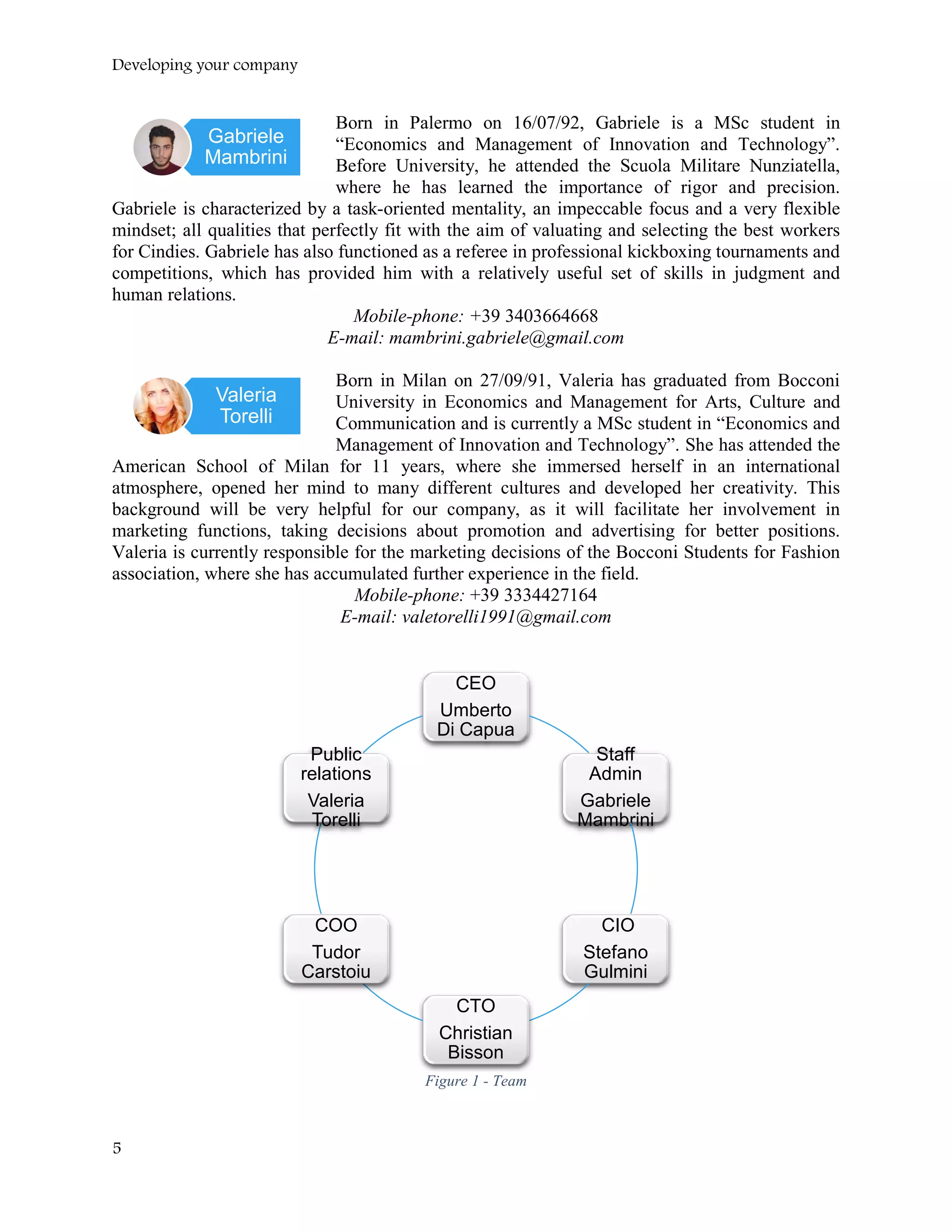
Figure 1 - Team
CEO
Umberto
Di Capua
Staff
Admin
Gabriele
Mambrini
CIO
Stefano
Gulmini
CTO
Christian
Bisson
COO
Tudor
Carstoiu
Public
relations
Valeria
Torelli
Valeria
Torelli
Gabriele
Mambrini
5
Developing your company
Business model
Have you ever come home from work feeling exhausted? You look around and you notice that
you have a dirty or messy house, but you do not have the energy or the time to clean? You try to
call your housekeeper, but he/she is busy? Well, from now on you won’t have to worry anymore,
because Cindies will do the work for you!
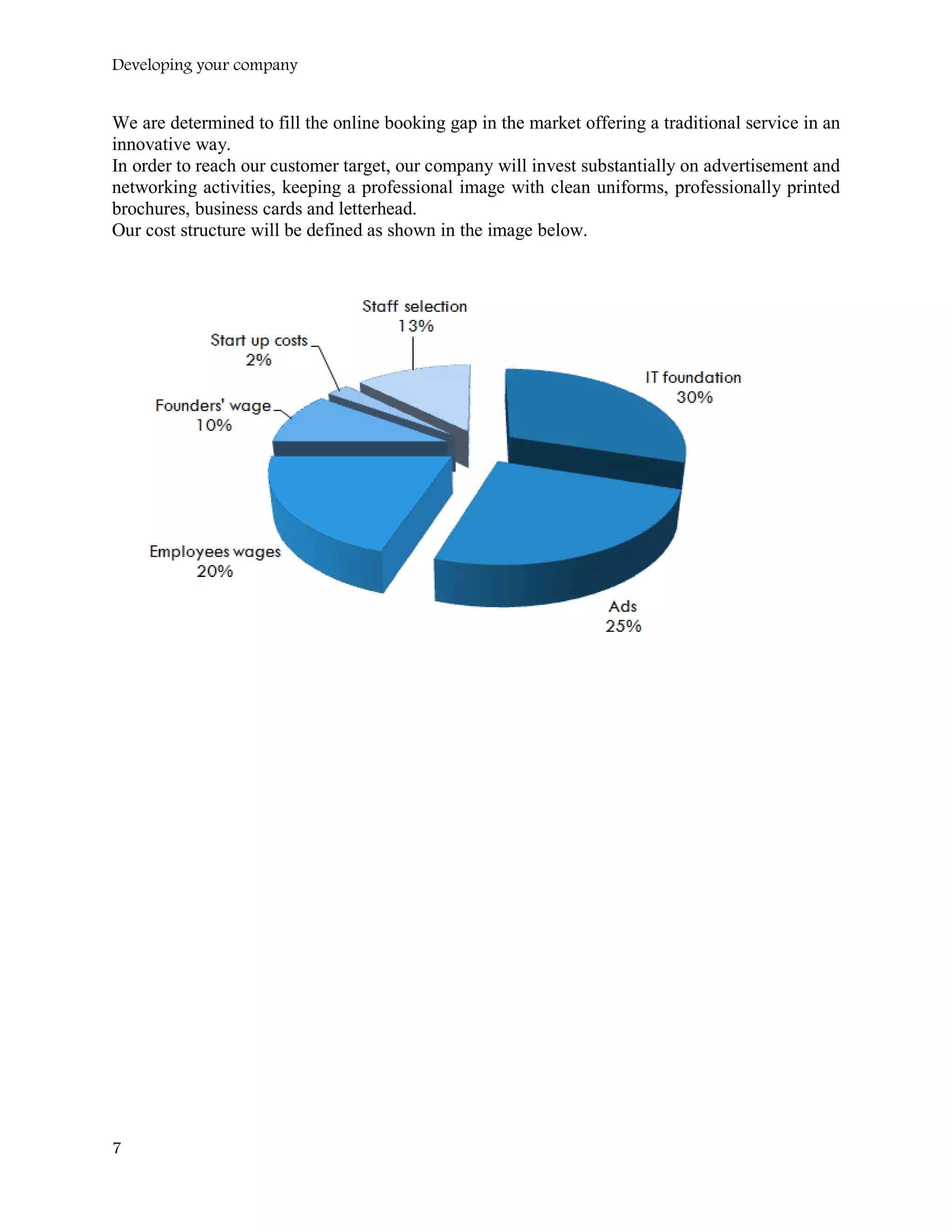
Figure 2 - Business model
Our idea is to found a web-based company named Cindies in the house-cleaning sector.
Cindies offers individuals an innovative and customized solution for the maintenance of their
home through housekeepers specially trained to effectively meet their needs.
A dedicated website, along with the mobile app, will allow customers to book cleaning
performances. Customers will be able to choose the duration, the time, the type of service
(ironing, cleaning or both) and the employee they prefer. The feedback given by other customers
regarding previous performances by employees will help the customer through the decisional
process. An external call-center will be responsible for assigning the selected house cleaners to
the appropriate customers. These features, easily accessible through our website with the click of
a button, best represent our value proposition.
The business will guarantee performance and reliability of the house cleaners through a
meticulous recruiting process that includes competence and trustworthiness analysis.
Furthermore, there will be a mandatory eight-hour training guaranteed by our company for all
employees, in order to properly train them to carry out their duties at best in our customers’
homes.
Each housekeeper will be paid €6 per hour, defining a very clear and simple revenue stream
model.
6
Developing your company
We are determined to fill the online booking gap in the market offering a traditional service in an
innovative way.
In order to reach our customer target, our company will invest substantially on advertisement and
networking activities, keeping a professional image with clean uniforms, professionally printed
brochures, business cards and letterhead.
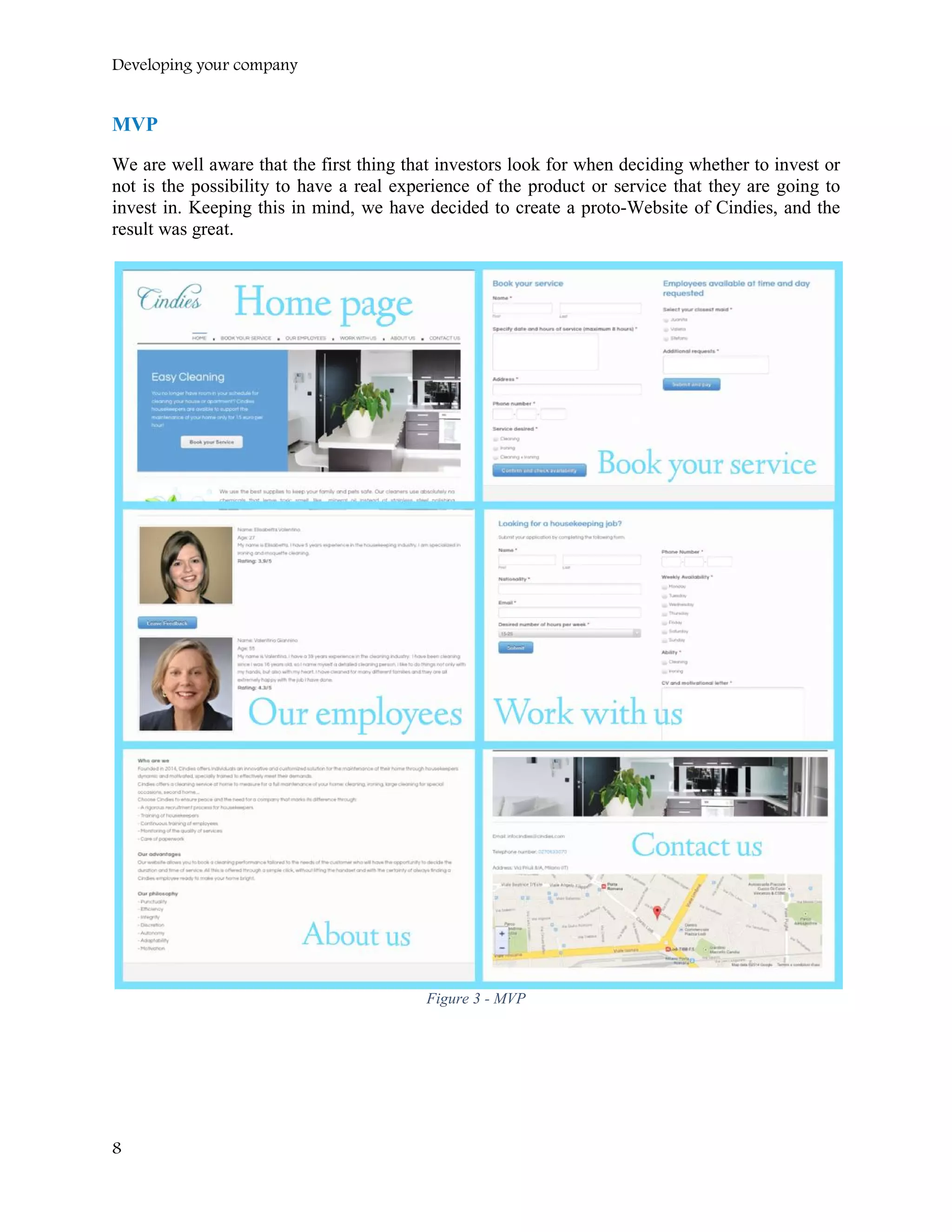
Our cost structure will be defined as shown in the image below.
7
Developing your company
MVP
We are well aware that the first thing that investors look for when deciding whether to invest or
not is the possibility to have a real experience of the product or service that they are going to
invest in. Keeping this in mind, we have decided to create a proto-Website of Cindies, and the
result was great.
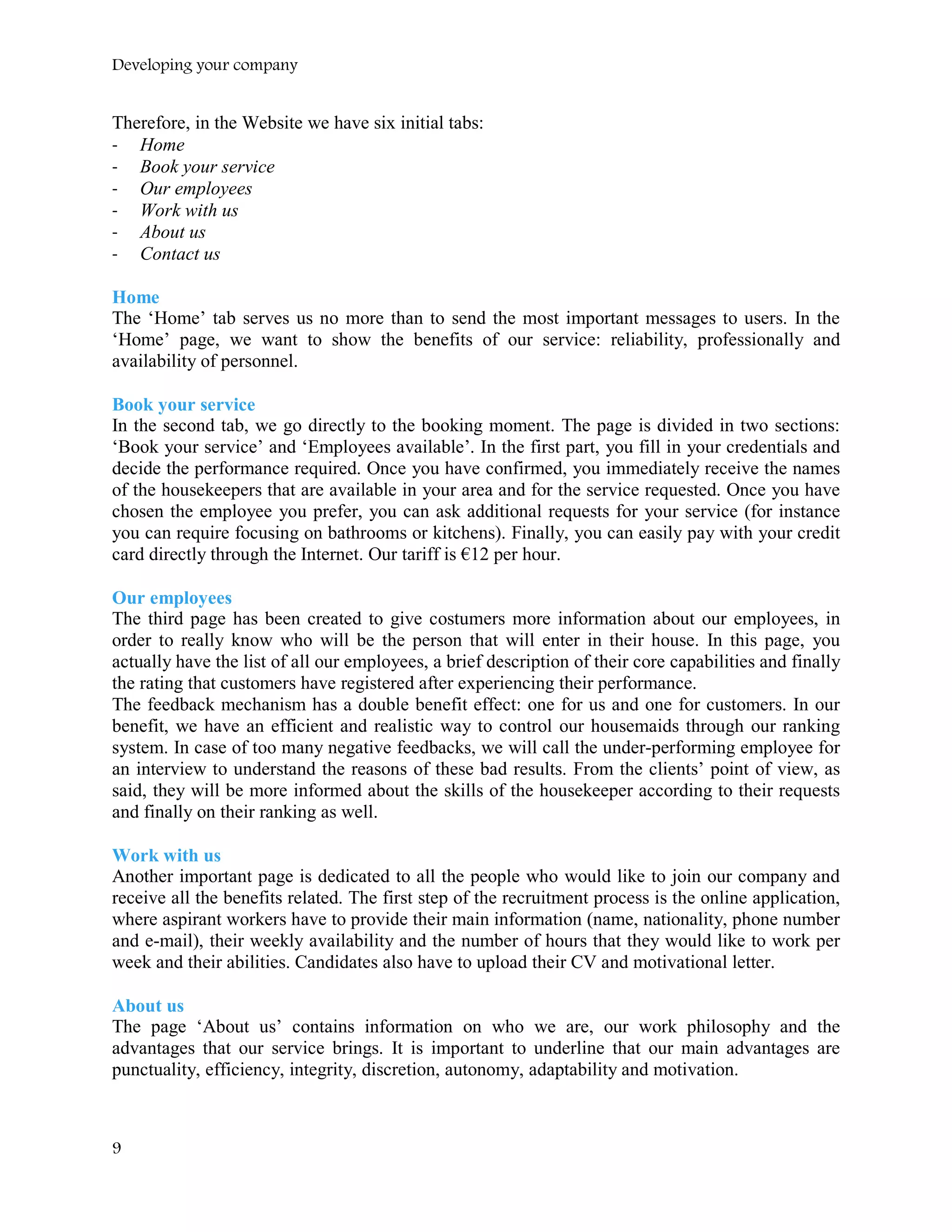
Figure 3 - MVP
8
Developing your company
Therefore, in the Website we have six initial tabs:
- Home
- Book your service
- Our employees
- Work with us
- About us
- Contact us
Home
The ‘Home’ tab serves us no more than to send the most important messages to users. In the
‘Home’ page, we want to show the benefits of our service: reliability, professionally and
availability of personnel.
Book your service
In the second tab, we go directly to the booking moment. The page is divided in two sections:
‘Book your service’ and ‘Employees available’. In the first part, you fill in your credentials and
decide the performance required. Once you have confirmed, you immediately receive the names
of the housekeepers that are available in your area and for the service requested. Once you have
chosen the employee you prefer, you can ask additional requests for your service (for instance
you can require focusing on bathrooms or kitchens). Finally, you can easily pay with your credit
card directly through the Internet. Our tariff is €12 per hour.
Our employees
The third page has been created to give costumers more information about our employees, in
order to really know who will be the person that will enter in their house. In this page, you
actually have the list of all our employees, a brief description of their core capabilities and finally
the rating that customers have registered after experiencing their performance.
The feedback mechanism has a double benefit effect: one for us and one for customers. In our
benefit, we have an efficient and realistic way to control our housemaids through our ranking
system. In case of too many negative feedbacks, we will call the under-performing employee for
an interview to understand the reasons of these bad results. From the clients’ point of view, as
said, they will be more informed about the skills of the housekeeper according to their requests
and finally on their ranking as well.
Work with us
Another important page is dedicated to all the people who would like to join our company and
receive all the benefits related. The first step of the recruitment process is the online application,
where aspirant workers have to provide their main information (name, nationality, phone number
and e-mail), their weekly availability and the number of hours that they would like to work per
week and their abilities. Candidates also have to upload their CV and motivational letter.
About us
The page ‘About us’ contains information on who we are, our work philosophy and the
advantages that our service brings. It is important to underline that our main advantages are
punctuality, efficiency, integrity, discretion, autonomy, adaptability and motivation.
9
Developing your company
Contact us
The page ‘Contact us’ contains our main contact information: e-mail, telephone number, address
and a map to find us. Customers are free to contact us and we are pleased to help them in any
way we can.
10
Developing your company
Customer needs
Our idea started from observing the housekeepers market and realizing there is room for more
flexibility. Traditional clients mostly use agencies and word-of-mouth to find maids and, once
they found a person, they usually stick with that person. By watching our own needs and talking
with different people, we realized that there is a latent need that is not fully satisfied: the need of
occasional customers for cleaning services. Most people do their cleaning on their own, but there
are moments in which they would like to ask professional help and they wish that this was easily
available and at a fair price. The average customer can be a student or a young professional that
does not want to take any commitment with a particular house cleaner and that will use this
service on an occasional basis.
Segmentation
We have defined two major segments: a broader and heterogeneous one based on a top-down
approach starting with Milan’s population and a more homogenous and focused one defined by
Milan’s student population that have their residences outside Milan and are in this city for study
and work purposes.
First segment
Considered variables:
- Geographical location: city of Milan
As our core business implies that our staff performs cleaning service, we find it vital for
logistical reasons, at least in the first development phase, to restrict our operational area
within the boundaries of the city of Milan.
- Age: 20-45
We consider this age group the one that will show most interest in an easily accessible
cleaning service that can be used occasionally if an urgent need occurs. Starting from 20
because of the possibility that individuals below this age might still not be living outside their
parents’ house. Also, limited to 45 because at this age we consider the possibility that
individuals tend to hire a full-time maid instead of hiring for individual jobs or might find
themselves with more time to take care of these chores themselves.
- Internet access
As our service can be booked only online, we restrict our focus to the population having
access to Internet (both land and mobile)
- Income: €15.000-50.000 per year
We assumed that individuals having an annual income in the range written above are the
ones most likely to be interested in our service, as they probably do not afford or need a
permanent housekeeper but still they might access a cleaning service occasionally.
Now going to numbers, we know that total Milan population is 1.262.000. The population
between 20-45 is 450.0451
. Of this population, 295.5292
have Internet connection. Further,
178.442 have an income between 15-50k3
.
Source:
1 Atlante Statistico dei Comuni
2 ISTAT
11
Developing your company
Knowing that in Milan there are 1.262.100 individuals in 633.000 habitations, we can assume
that in each house live on average two people.
Considering that our target population is 178.442 but in average, they share the house with a
person, we may assume that 89.221 potential customers compose the market size in Milan.
Second segment
Since foreign students are not included in the first target because they have no income and they
are not residents in Milan, we have decided to create a second segment to include them. We
therefore do not comprise Milan resident students, because we assume that they live with their
families.
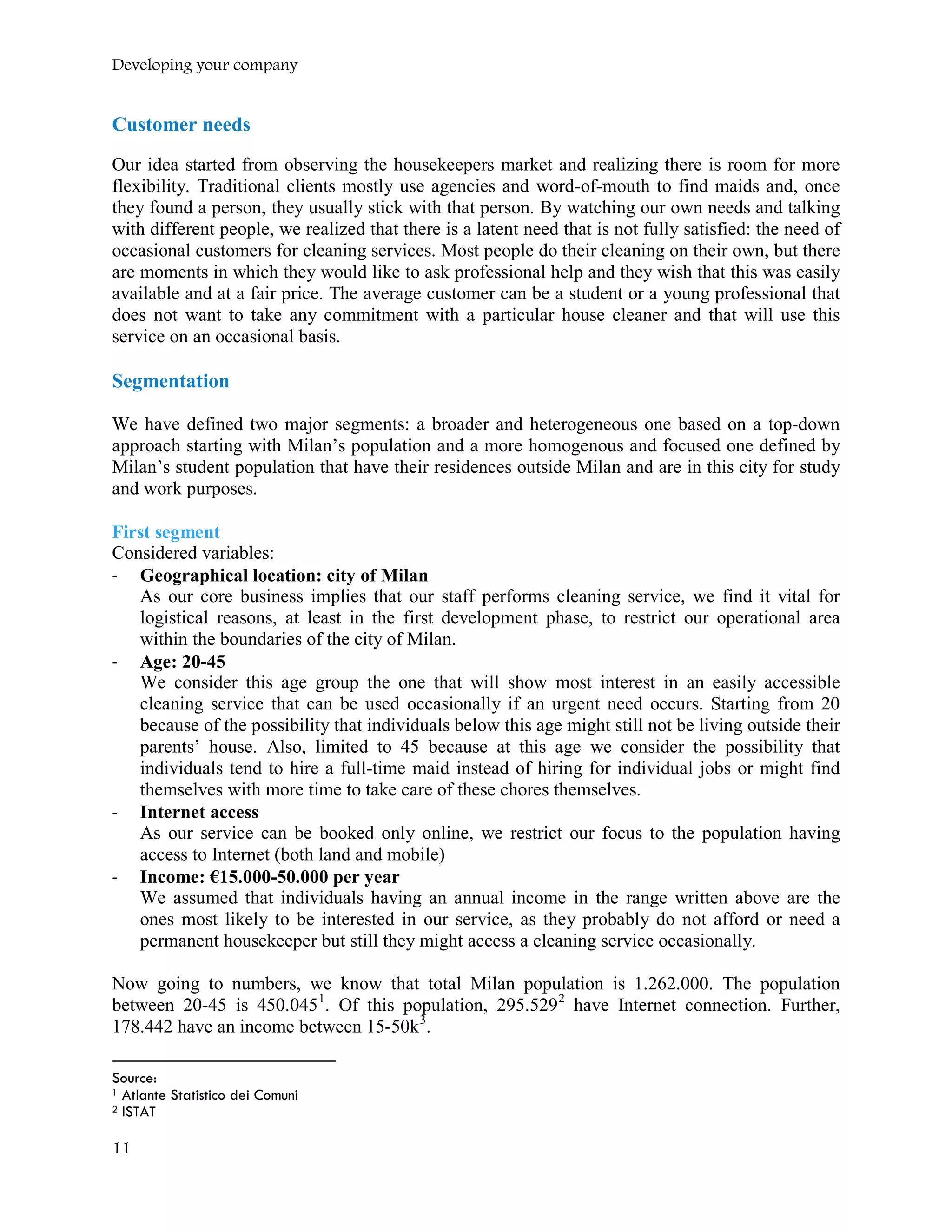
22% of the students (52.957) of all Milan’s universities come from different regions of Italy or
different countries. As we can see from the table below4
, Bocconi university has by far the
highest proportion of students (70%) coming from outside Lombardy region, although in
absolute terms Politecnico, Cattolica or Statale University have even higher numbers due to a
larger pool of students.
Figure 4 - Segmentation
Around 5.000 of these students live in different student residences, which have their own
cleaning staff, therefore we remain with 48.000. We can assume that all have access to Internet
(personal mobile or land connection, university computer rooms or Wi-Fi). We again use the fact
that on average in Milan habitations are composed by two individuals thus we obtain a target
market of 24.000 customers.
3 www.comuniitaliani.it
Source:
4 www.universi-mi.it
0
10000
20000
30000
40000
50000
60000
70000
Tot. Students
Tot. Students away from
home
12
Developing your company
Market size
As our cleaning service is designed to be used occasionally and it is quantified by hour, we
assume that our clients will use on average 24 hours per year (2 per month). Having a price of
€12/hour, our value extraction per client per year will be €288. Thus, the value of our initial
target market will be 24.000*288 = €6.912.000.
Extending the demand also to both our segments, we get a total value of our potential market
equal with (89.221*228) + 6.912.000 = €32.607.648/year.
Milestones
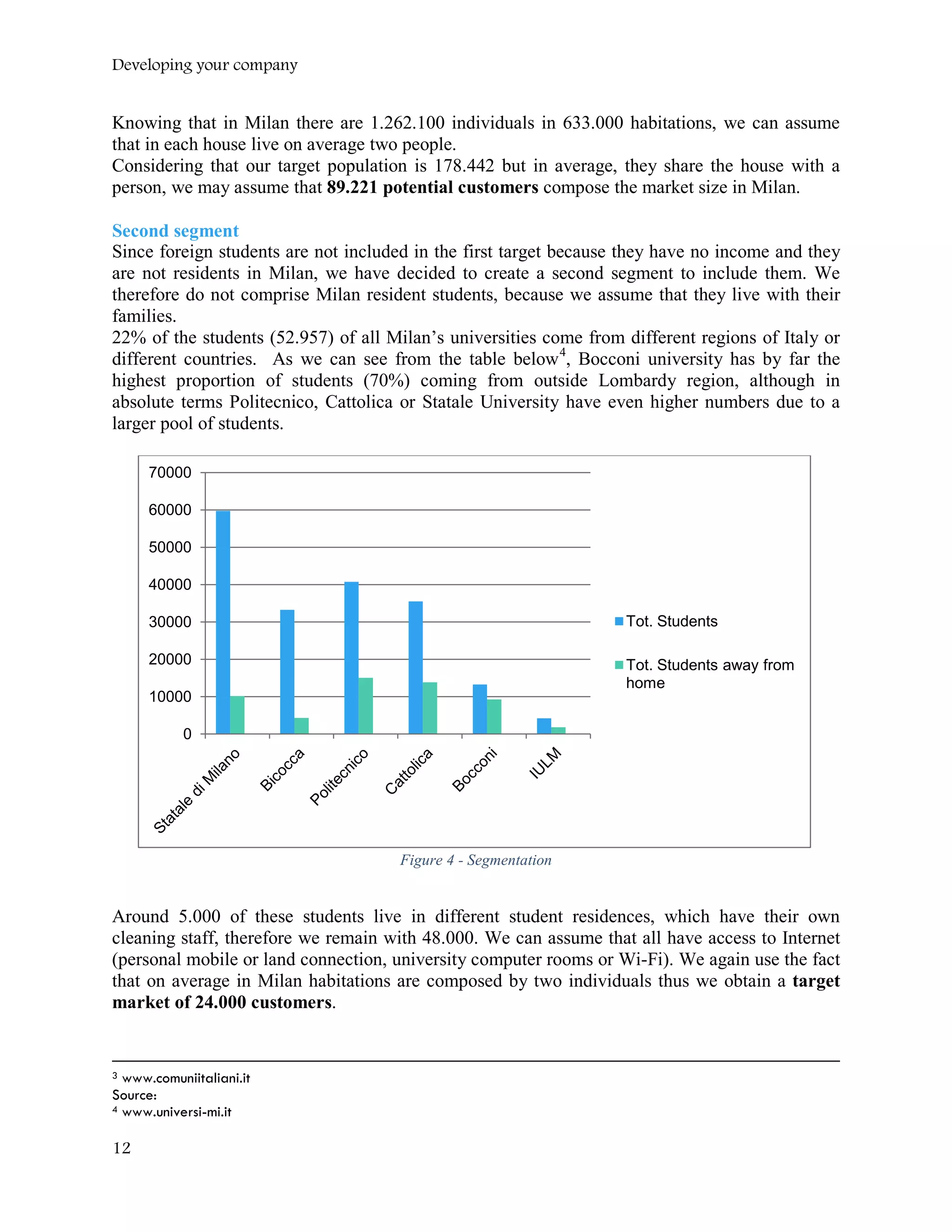
After creating solid brand recognition in Milan, our aim is to expand to other large and medium
size cities initially around Italy and in later stages abroad. We will target cities that have relevant
student communities like Rome, Bologna, Torino, Napoli, Padova, Verona, Venice and Pisa.
In Milan, our target market is roughly 10% of the total population of the city, so we can use the
same estimates for the cities mentioned above5
.
Figure 5 - Segmentation
Thus, the potential total market revenue for Italy may be €86.916.384/year serving a total of
565677 potential clients.
Source:
5 http://www.tuttitalia.it/citta/popolazione/
City (total population) Potential clients Potential market value (Potential clients*€288year)
Rome (2.638.842) 263.88 €75.998.592
Napoli (959.052) 95.91 €27.620.640
Torino (872.091) 87.21 €25.116.192
Bologna (380.635) 38.06 €10.962.144
Venice (259.263) 25.93 €7.466.688
Verona (253.409) 25.34 €7.297.920
Padua (207.245) 20.72 €5.968.512
Pisa (86.263) 8.63 €2.484.288
13
Developing your company
Industry Analysis
Through the online database Orbis.com, we were able to identify 9851 firms under code 97
“activities of households as employers of domestic personnel” on a global level.
Unfortunately, none of these firms seem to have gone public and therefore this renders any kind
of analysis with fundamental indices impossible such as: Ent Value/Sales, Ent. Value /EBITDA,
Ent. Value / EBIT, Ent. Value /CF, P/E, P/Cash, P/BV.
We therefore decided to proceed with an analysis of the sector based on extrapolations of Orbis'
data. In addition, for geographical reasons, we decided to take in consideration only European
companies.
After applying the mentioned filter, the number of observations decreased to 8962. The
observations we are going to consider, however, are a lot fewer, as we decided to include only
firms with an annual turnover of at least $100,000; reducing observations to 1023.
The lack of public indices induced the necessity to synthesize firm organizational structure and
financials through other available data.
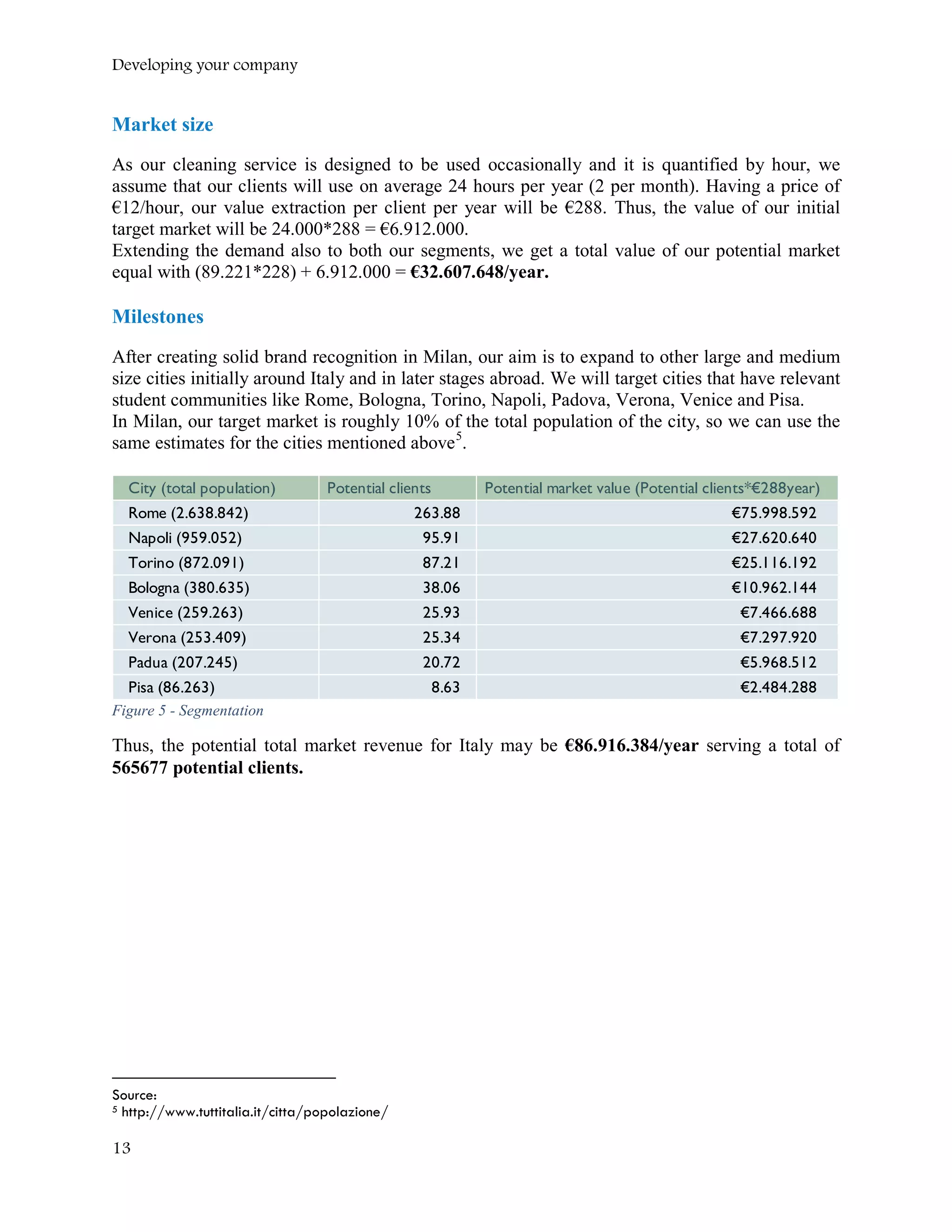
Considered indices include: 1) Profit margin 2) Cash flow 3) EBIT margin 4) Profit per
employee 5) ROE using P/L before tax 6) Operating revenues.
We calculated an average for each value:
Table 1 - Industry analysis ($ thousand)
Upon comparing revenue average $1,376.00 with the median value of $246,000, we observed
that the sector is characterized by few large firms (the largest reaching $548 million) and a subset
of extremely reduced firms. In fact, the highest concentration of firms is situated along the left
side of the median and is characterized by low revenues.
ROE values are particularly high, while EBIT margin is consistently average with other sectors.
In terms of location, we notice that the countries with the highest number of firms in this sector
are France and UK.
Mean
Operating revenue (Turnover) th USD 1,376.00$
Last avail. yr
Number of employees 20
Last avail. yr
Profit margin % 9%
Last avail. yr
ROE using P/L before tax % 52%
Last avail. yr
Cash flow th USD 331.00$
Last avail. yr
EBIT margin % 12%
Last avail. yr
Profit per employee th USD 46.00$
Last avail. yr
14
Developing your company
Additional aspects include the significant lack of presence of IPR regimes amongst these firms,
in fact we did not find any trademark registrations. In our case in particular, the use of
trademarks is extremely important to protect our most important asset: Cindies brand.
This represents a relative advantage as none of these firms in fact seem to care about their image
or the level of recognition associated with any type of logo.
Consequent analysis is based in the Italian territory as it represents our initial focus target.
Codes pertaining to our research through Orbis.com include: 1) Pulizia (cleaning) 2) Attività di
pulizia specializzata di edifici e di impianti e macchinari (specialized cleaning activity for
buildings, installations and industrial machines) 3) Attività di pulizia NCA (NCA cleaning
activity): codice ISTAT 74.70.1 (codici attività Ateco 2007 81.20.00-81.22.02-81.29.99).
Through this analysis, we observed that in Italy, firms or agencies listed in the Ministry of
Commerce (2001) that fall under the category of cleaning services and other related services
amount to 36,726. There are also twenty types of variations in juridical societies, obviously
included in our analysis are individual freelancers, which result in the following structure:
- Individual Freelancer: 62,71%
- Cooperatives: 12 %
- S.n.c.: 8,32%
- S.r.l.: 7,51%
- S.a.s.: 5,86%
The remaining 3,67% retains no explanatory value. It is evident that the majority of cleaning
companies have a nature of the firm and structure limited by economies of scale.
Firm to employee proportions result in 2.4, meaning that there are two employees per agency.
This data concludes that there is an extremely low density of employees in regards to activities
and that most of these firms employ a very reduced number of staff members.
Actual Competitors
Establishing an analysis of our competitors required analyzing the market for house related
services in Italy; additionally we decided to consider some foreign-based firms in order to have a
better understanding of various business models as well as possible knowledge for future
expansion in foreign territory. Overall, our competitors can be subdivided into three categories:
agencies, web-based companies and freelancers. Agency-oriented companies tend to offer
very specific services such as specialized cleaning, disinfestations, moving services or even
emergency services (electrical or pluming), while simple house cleaning services are not
provided. Their employees are specialized in their respective field and are not available for
simple and quick cleaning services. Furthermore these companies are not to be relied upon for
first time services, they require a contract to be stipulated in order for their services to be
utilized, additionally an initial estimate must be created which can take from a couple of hours to
a day or more. Last but not least, these companies tend to rely on newspaper ads or poorly
written websites to convey their services to the public. This inefficient means of advertisement
consequentially only allows exposure to a very limited portion of the population.
A prominent example of a company defined by agency-like characteristics in Italy is the CNS
(Consorzio Nazionale Servizi). CNS is an Italian based modern entrepreneurial cooperative,
which is headquartered in Bologna. CNS specializes in innovative techniques to improve certain
aspects of any company or associations’ operations and infrastructure. Service varies from
specialized cleaning for large office spaces to eco-friendly implants and energy sustainability
15
Developing your company
projects. For the purposes of this business plan, we will focus on the services relevant for our
comparison. In terms of cleaning services, CNS provides hygiene specialized cleaning for
industrial size structures, disinfestations and hospital cleansing which includes sterilization of
equipment. In terms of private household services CNS is extremely limited: individuals can
submit a request via phone call and obtain an estimate on the possible costs of receiving cleaning
services, however CNS seems to employ over-qualified personnel for mundane cleaning services
and consequentially inefficient as a provider of said service.
CNS’s value proposition lies in the highly specialized workforce they employ, quality is not an
issue when receiving their services. They employ the latest technologies in maintain high levels
of hygiene and eco-friendly standards in every infrastructure they service.
CNS’s customer segment includes schools, office buildings, factories, villas, hotels and private
households. On a more individual level the firm tends to attract eco-conscious individuals with
higher than average incomes, individuals tend to own one or more large properties such as villas
which require additional services such as gardening, pool maintenance and possible
environmental conscious services.
CNS’s cost structure consists in personnel salaries, public administration costs (indirect
&direct) and capital maintenance (considering the vastness of their services and high scope of
technology this amounts to a significant value).
This company maintains different types of customer relationships, in terms of individual
customers, relations begin and end strictly upon delivery of service after estimates are drawn and
contractual obligations are maintained. CNS’s core capabilities lie in the vastness of their
services, maintaining a foothold in various markets and allowing specialization to occur on many
different levels. Consequentially CNS is able to diverge from a normal cooperative and access
additional areas of interests. Professional and high quality services maintain CNS as an exclusive
service and generate a sort of loyalty among large and prestigious institutions such as museums.
CNS’s partner network can be divided as direct partners who are involved in general,
operations such as ACOS Ambiente, Consorzio Formula Ambiente and Cooperafactor SPA all
involved in waste disposal to some degree. Additionally secondary partners include CCFS an
investment agency and Kined Energy Facility SRL with whom cooperate in the facility
operations sector.
The revenue model relies on consumers submitting orders, receiving estimates and processing
the order. Out of a total revenue of €621.677.540, cleaning service specific revenue amounts to
46.5% of total revenue (290,014,627). CNS’s critical success factors are based on the
additional value they bring to the service industry, their ability to play in multiple markets and
offer innovative solutions in evolving communities allows them to become protagonists in a
creative way.
16
Developing your company
Table 2 - Competitors
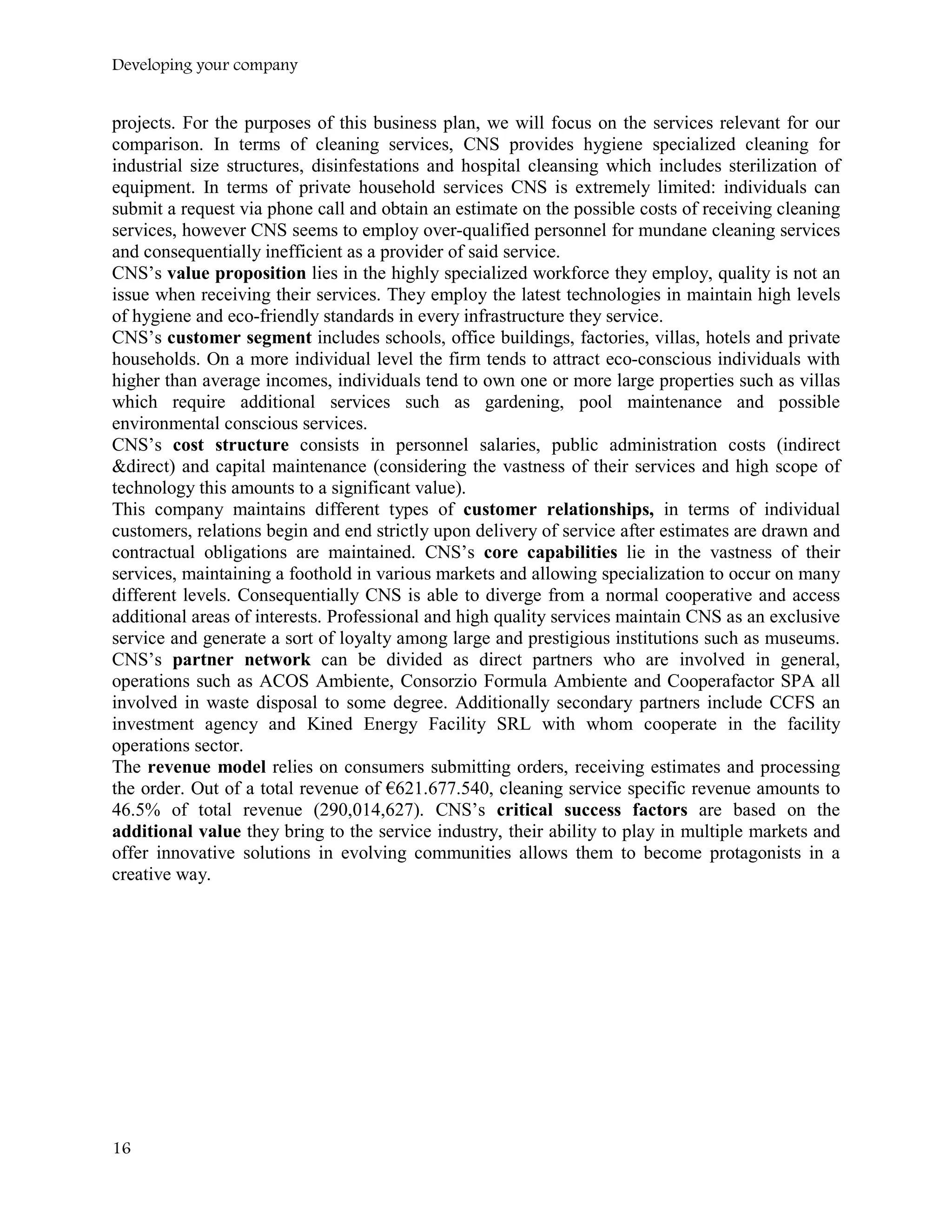
The above CNS SWOT analysis shows how many of the problems the company faces can be
attributed to any firm who enters several markets and involves multiple services. High costs due
to technical proficiency are extremely common and expected. Interesting developments occur
due to the sustainability and eco-friendly features which could result in long run benefits due to
government involvements as well as specialized workforce advantages.
Our second category of competitors are web-based companies, these include companies who
provide cleaning or similar services and convey their services mainly through a website. It is
important to specify that while agencies might possess websites as well; they do not intend it to
be a means to interact with consumers wishing to purchase their services, but more of a tool to
inform and possibly a tool for employees to operate upon. What we mean by website-based
companies are companies who require signing up or registering on their website, selecting
possible services, applying for a position as an employee or even simply to contact the company.
Given the importance that lies upon their website, we have found that most web-based
companies do not own an extremely user-friendly website: for example some websites are not
available in any other language than that spoken in the relevant country, rendering the site hard
to access if foreign. More importantly, most websites do not possess an online booking feature,
even after filling out all the details to register for the services and perusing the lists of possible
services it is still necessary to call a respective call centre or office in order to place an order.
This creates a situation where first time users are not able to immediately gain access to their
desired service, are provided with a disincentive to utilize the service in the future and have to
pay additional transaction costs.
A prominent example of the currently most efficient web-based company in the cleaning service
industry is Shiva.fr, which is a French-based company who specializes in providing private
household cleaning services as well as babysitting, gardening, catering and laundry services.
Established in 2002 in Paris, Shiva has grown to cover all of France and certain neighboring
cities. Shiva operates directly through their website Shiva.fr and is composed of over 85 agencies
and a total of 1,600,000 hours of service a year. Shiva’s value proposition is determined by their
ability to bring the professionalism of quality-trained personnel to everyday consumers,
essentially taking the qualities of big event preparations and skilled staff to the ordinary
household. By doing so they have managed to allow middle-income consumers to access a
service which has until now been dominated by freelancers.
Helpful Harmful
Strengths Weaknesses
1. Monetary assistance provided 1. Costs
2. Skilled workforce 2. Investments in research and development
3. High value provided 3. Lack of penetration in private household markets
Opportunities Threats
1. Growth in environmental consciousness 1. External business risks
2. New markets 2. Increase in labour costs
3. Obligatory investment in sustainable energy 3. Rising cost of raw materials
4. Unexpected problems
Internal Origin
External Origin
17
Developing your company
Shiva’s customer segment is composed of middle to high-income individuals or families who
require cleaning or other said related services on a regular basis on one or more households.
Scope of customers includes the elderly, families, single parents or students. Shiva’s main
channel is of course their website but especially for initial growth, mediums such as advertising
campaigns and agencies are utilized to diffuse their service. The cost structure is dominated by
server maintenance costs, staff salaries and advertisement costs. Consumer relationships are
dictated by the type of contract, which is stipulated initially. Most consumers regardless of their
particular financial situation enter a contract which offers regular housecleaning services, annual
fees are due to maintain the contract as well as hourly costs of service. Most consumers enter a
minimum 1-year contract but multiple house owners often engage in longer contracts in order to
avoid hustle and further transactions costs. Shiva’s core capabilities are dominated by the high
quality staff pool maintained by strict training programs and continuous evaluation processes.
By doing so Shiva is able to maintain the highest standard of professionalism in their service and
provide an exceptional user experience. Their website can be considered essential as it requires
all the necessary information and registration tools to initiate utilizing the service as well as
relevant phone numbers and availability details.
Shiva has succeeded in taking a service which is usually reserved to high end consumers and
shrunk it down to the necessary dimensions for ordinary individuals without reducing quality and
cutting costs. The company also employs tax refunds on total income spent on their service
when surpassing a total a certain value. This enables further incentive available to new
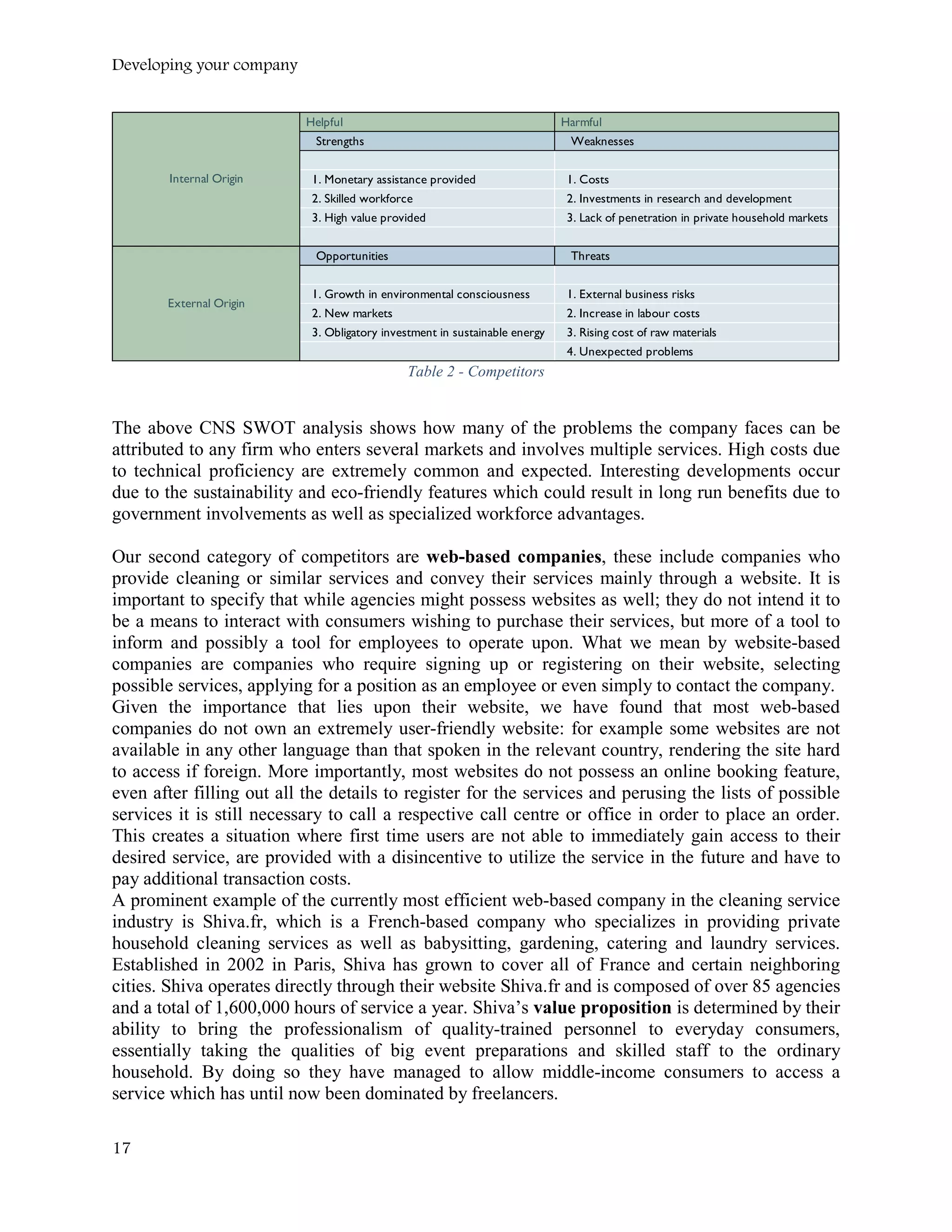
consumers when selecting which service to employ. Looking now at SWOT analysis:
Table 3 - Competitors
Shiva.fr is without a doubt our most similar competitor in terms of organization and business
model. The main features we are interested in comparing or modifying are the highly selective
pool of employees in order to guarantee a high standard of service, customer feedback to further
secure our market position and incentivize new customers to use the service. However, Shiva
does show some negative qualities we wish to overcome, like the difficulty of access: booking is
only available by telephone and only after the company ascertains a considerable contract. In
addition, services are never available within 12-hour periods.
Lastly, we consider freelancer, defined as any individual who is self-employed and provides
cleaning or maid related services.
Helpful Harmful
Strengths Weaknesses
1. High quality employee pool 1. No-online booking
2. Customer feedback 2. Only in French
3. Reasonable prices 3. Not much interaction with employees
Opportunities Threats
1. Expand in similar markets 1. Increase in labor costs
2. Expand in other locations 2. Employees decide to avoid freelance
3. Obtain tax-refunds for ulterior situations 3. Easily adaptable
Internal Origin
External Origin
18
Developing your company
Freelancers represent potential personnel for us, in fact many of them will realize benefits and a
stable structure which are essential to maintain a higher quality of life. Freelancer’s value
proposition lies in their relatively low costs compared to most agencies that obviously have to
incur additional costs. Their customer segments include low/medium income families, students,
young professionals, low/medium income and retirees. They rely on word of mouth as their
principal channel.
Freelancers cost structure is relatively simplistic in that it mainly revolves around transportation
costs and possibly equipment maintenance (even though many freelancers simply use the
households equipment). They often maintain extremely informal customer relationships;
transactions are brief and informal as well. Their core capabilities include basic cleaning skills
unqualified and un-certified as well as possible enthusiasm, which can in some occasions prove
to be extremely useful. Also possible partner networks might emerge through cooperatives and
other such associations.
Freelancers rely on a very simplistic revenue model, which consists in simple hourly wages, in
many unfortunate cases such transactions are undergone without declaring income receipts to
government bodies and constitute a ‘grey area’ of the law.
Freelancer critical success factors are also simplistic; their main critical success factor is to
increase their customer base daily. The housemaid would exploit the word of mouth effect and
some sort of association to find employers; in some cases they start working constantly with a
family, under a contract.
Table 4 - Competitors
Freelancers obviously provide more problems than solutions; we consider them as possible staff
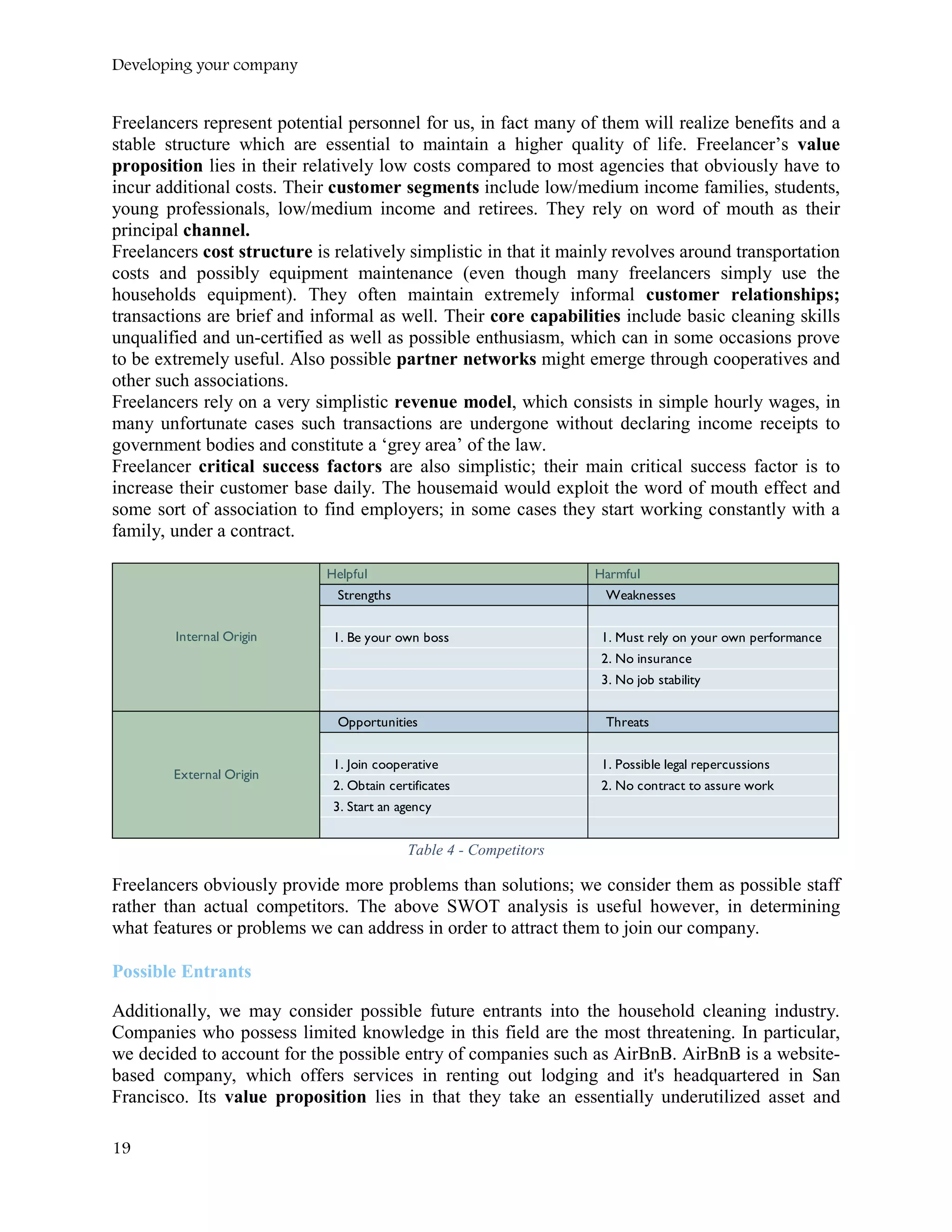
rather than actual competitors. The above SWOT analysis is useful however, in determining
what features or problems we can address in order to attract them to join our company.
Possible Entrants
Additionally, we may consider possible future entrants into the household cleaning industry.
Companies who possess limited knowledge in this field are the most threatening. In particular,
we decided to account for the possible entry of companies such as AirBnB. AirBnB is a website-
based company, which offers services in renting out lodging and it's headquartered in San
Francisco. Its value proposition lies in that they take an essentially underutilized asset and
Helpful Harmful
Strengths Weaknesses
1. Be your own boss 1. Must rely on your own performance
2. No insurance
3. No job stability
Opportunities Threats
1. Join cooperative 1. Possible legal repercussions
2. Obtain certificates 2. No contract to assure work
3. Start an agency
Internal Origin
External Origin
19
Developing your company
create a mechanism through which owners are able to earn money off it. AirBnB, in fact,
provides an international platform for foreigners looking for places to stay during travels as
opposed to the previous smaller websites who would focus on smaller territories. We can define
its customer segment as personal and business travelers.
AirBnB uses several channels to acquire customers: online advertising constitutes the most
aggressive of these channels that leads it to be ranked as the top 5 paid advertisers in the world.
It's cost structure can be categorized as follows: technology costs such as top programmers and
server space, marketing costs which include the paid advertisements and finally sales costs,
including country managers and their teams located in all of their large markets.
In terms of customer relationships, this company has two types of customers:
1) home/apartment owners that provide the assets that are rented out and represent the face of the
company and 2) renters which are the consumers generating the most revenue.
The core capabilities of AirBnB include marketing, product development and community
management of their homeowners’ network. Given the vastness of their market, they specialize
in understanding key affiliate partners and various key features in foreign markets.
The revenue model consists in commissions from renters and from homeowners. The key of this
system is the maintaining of low commissions in order to avoid the possible transaction between
the two parties independently from the AirBnB website.
The critical success factors can be listed as liquidity or critical mass: AirBnB listings find
transactions sooner than listings on a buy-and-sell real estate marketplace; this increases the
metric intrinsically with numbers of customers and home/apartment owners signing up to the
platform. Secondly, matching efficiency regards how well the search algorithm is able to match
searches to listing profiles. A user visiting the site experiences the quality of a search engine and
intuitiveness of navigation intent, which conjunctively produce value. Trust is in AirBnB’s case
central to its success, this is due to the high risk characteristic of this particular market; in fact
allows home/apartment owners and travelers to review each other and takes additional steps to
increase trust such as photos and document verifications.
Table 5 - Competitors
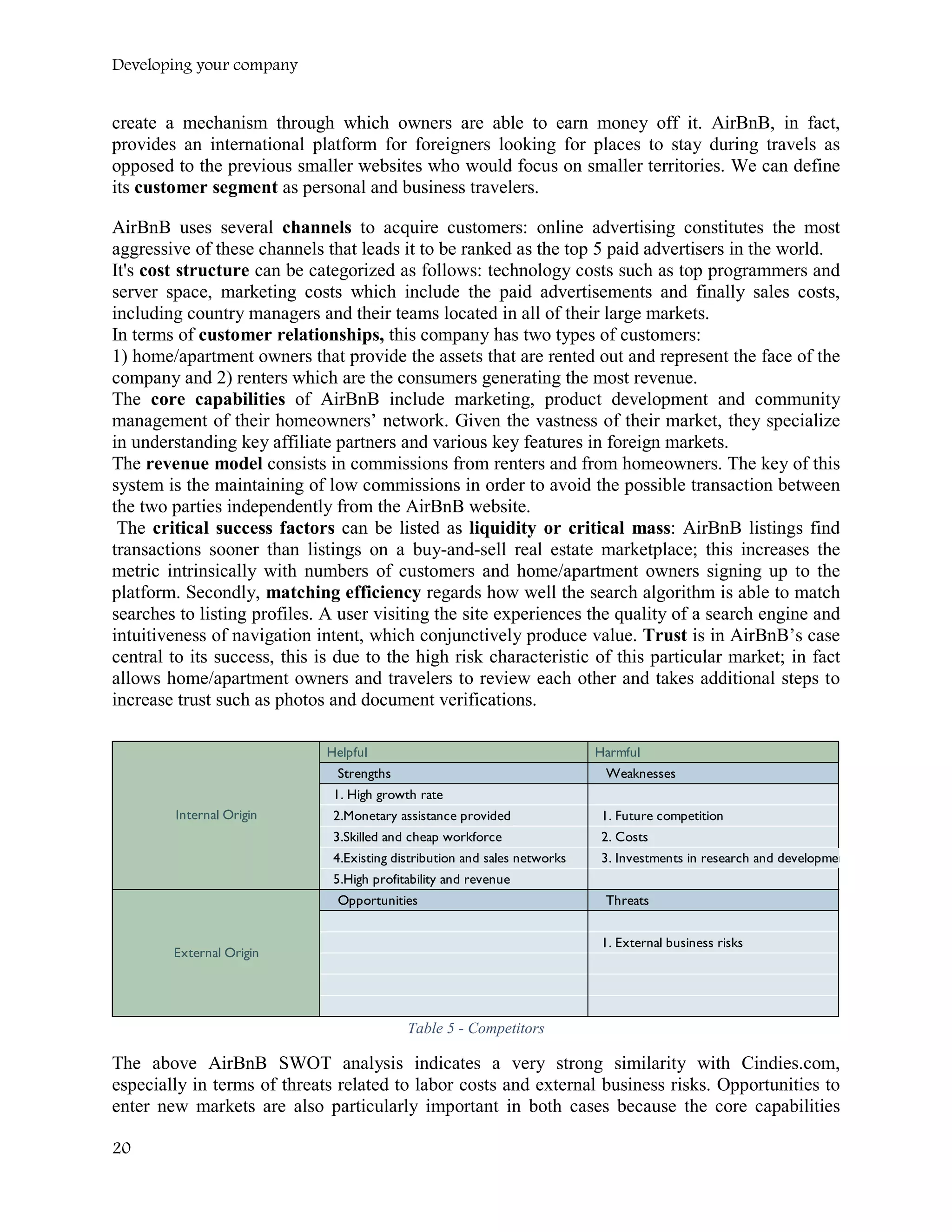
The above AirBnB SWOT analysis indicates a very strong similarity with Cindies.com,
especially in terms of threats related to labor costs and external business risks. Opportunities to
enter new markets are also particularly important in both cases because the core capabilities
Helpful Harmful
Strengths Weaknesses
1. High growth rate
2.Monetary assistance provided 1. Future competition
3.Skilled and cheap workforce 2. Costs
4.Existing distribution and sales networks 3. Investments in research and developmen
5.High profitability and revenue
Opportunities Threats
1. External business risks
Internal Origin
External Origin
20
Developing your company
shared are intrinsic in succeeding in respective markets. This puts AirBnB in a very prominent
position in terms of entering the house cleaners’ market coupled with the similarity in expertise
necessary to function in each industry. Of course, if it decides to enter in this industry it should
apply a strategy of brand differentiation, adding a new brand specialized only for the online
house cleaning service (for example 'AirMaid').
21
Developing your company
Activity Analysis
The functionality of our organization is based on five main units:
- Employee selection & training
- Marketing
- Core operations
- Employee communication
Employee selection & training
This unit is composed of two activities: personnel selection and training.
Personnel selection is orchestrated through strict recruitment standards. An ideal candidate can
be described as holding three or more years of experience, possess strong integrity and social
values. Furthermore our maximum transparency policy requires foreign employees to possess
regular work visas.
We opted to outsource most of our personnel selection process to Assindatcolf (Associazione
Sindacale Nazionale dei Datori di Lavoro Domestico), this association provides efficient labor
force organization and covers management of paperwork, refining selection criteria, and
ultimately provides greater visibility and assurance with potential employees.
The selection process will consist in three simple steps. First, the potential housemaids will fill in
an online questionnaire which will function as a way to cut out aspirants without working
experiences or without the right requirements. Potential employees will be called in for an
interview and if successful will be asked to undergo a compulsory one month trial period. This
process all be it long, is essential in order to guarantee high standards of quality with every
booking. The final trail period also serves as initiation for our second activity ‘Personnel
Training’. In this case, employees will undergo an 8 hour training seminar through Scuola
Italiana Domestici, an institution which performs courses on how to professionally and
efficiently service a household.
The courses we will offer to our employees trough Scuola Italiana Domestici will cover four
fundamental areas:
- Household care
- Laundry Service
- Clothing Maintenance
- Deep Cleansing and Hygiene Techniques
Marketing
In order to reach a relevant percentage of the market as soon as possible, our company will invest
substantially on advertisement and networking activities. Considering the potential market and
our consumer target, we can exploit many channels to reach them.
First, considering that we are a Web-based company, the Internet will be our main marketing
channel. We will promote Cindies through free advertising websites, a Facebook business page
and a Google+ business page. We will also use Google AdWords to find new customers that
look for our services.
However, being that Italy still relies on paper transactions; the online route cannot be the only
way to advertise. We address this problem by issuing article adds on local newspapers like
Corriere della Sera Lomabardia section, referring to papers and magazines distributed outside
Universities for free (such as Free Futool). We will use local community notice boards (for
22
Developing your company
example, university notice boards) and the most traditional way of advertising like flyers and
vinyl letterings detailing our services.
In addition, to spur the word of mouth potential, we will offer referral programs.
Core Operations
Our website represents the face of the company and the essential tool through which our service
is available. Core operations include activities like website logistics and server maintenance.
These aspects are deemed essential and represent the core of our capabilities; it is therefore
necessary to maintain it internally. This strategy could be interpreted as causing lower flexibility
and specialization, however the benefits from maintain internal consistency in this area will be
reflected in the overall functionality of our service.
Employee communication
This activity is characterized as an outbound logistic because it encompasses order fulfillment,
distribution management and transferring the service to our customers.
Our employee communications system is governed by an external call-center responsible for
assigning the selected maids to the appropriate customers and for responding to any complaints
by our clients.
The main objective of this function is to facilitate the connection between employee and
objective through a specialized contact system. A possible Instrumental to maintain this
efficiency is the provision of a Smartphone or tablet device to all employees in order to create
exclusive channels with Cindies call center and provide time and location information, but that's
just an option to consider for the future due to the high implementation costs. The system will
work with a timed accept/reject feature so as to efficiently deal with situations in which
employees might not be able to fulfill their booking on time. In this case a similar employee will
be located and quickly assigned to the current task.
This activity will be externalized as to benefit from an already existing and implemented
structure. Furthermore internalizing such an activity would be extremely costly and inefficient
due to continuous expansion and growth proportionate to its use.
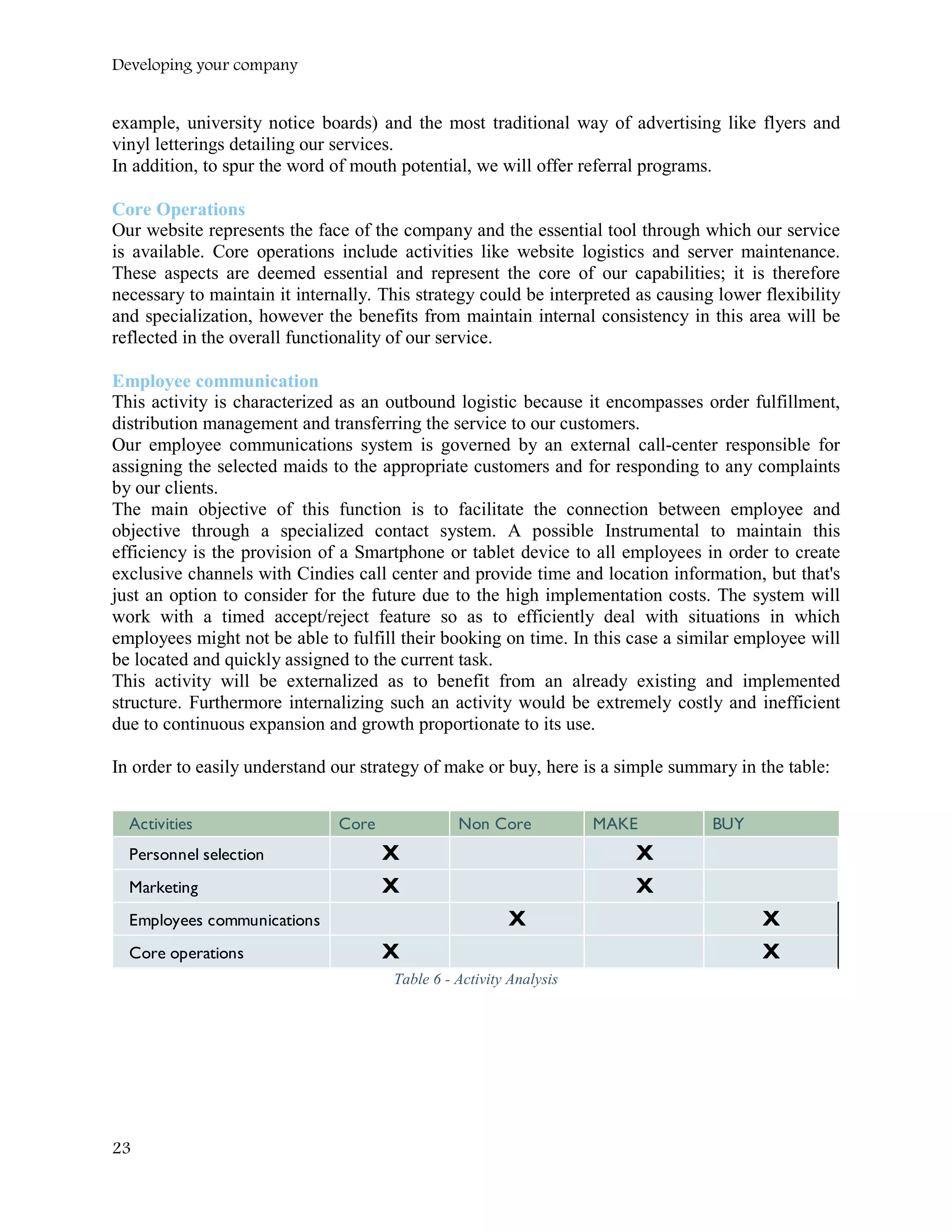
In order to easily understand our strategy of make or buy, here is a simple summary in the table:
Table 6 - Activity Analysis
Activities Core Non Core MAKE BUY
Personnel selection X X
Marketing X X
Employees communications X X
Core operations X X
23
Developing your company
Financial Analysis
Investments plan
Investments in personnel selection
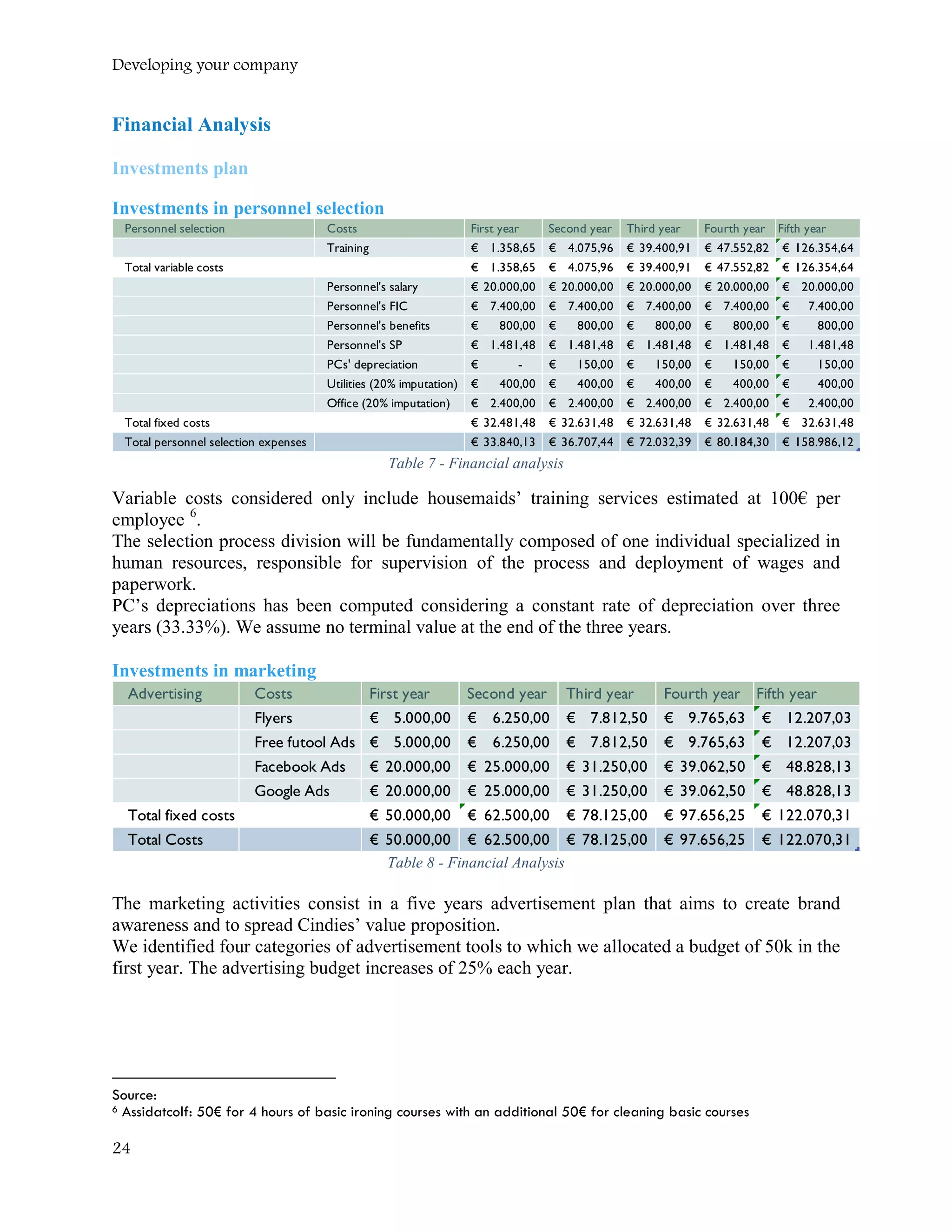
Table 7 - Financial analysis
Variable costs considered only include housemaids’ training services estimated at 100€ per
employee 6
.
The selection process division will be fundamentally composed of one individual specialized in
human resources, responsible for supervision of the process and deployment of wages and
paperwork.
PC’s depreciations has been computed considering a constant rate of depreciation over three
years (33.33%). We assume no terminal value at the end of the three years.
Investments in marketing
Table 8 - Financial Analysis
The marketing activities consist in a five years advertisement plan that aims to create brand
awareness and to spread Cindies’ value proposition.
We identified four categories of advertisement tools to which we allocated a budget of 50k in the
first year. The advertising budget increases of 25% each year.
Source:
6 Assidatcolf: 50€ for 4 hours of basic ironing courses with an additional 50€ for cleaning basic courses
Personnel selection Costs First year Second year Third year Fourth year Fifth year
Training 1.358,65€ 4.075,96€ 39.400,91€ 47.552,82€ 126.354,64€
Total variable costs 1.358,65€ 4.075,96€ 39.400,91€ 47.552,82€ 126.354,64€
Personnel's salary 20.000,00€ 20.000,00€ 20.000,00€ 20.000,00€ 20.000,00€
Personnel's FIC 7.400,00€ 7.400,00€ 7.400,00€ 7.400,00€ 7.400,00€
Personnel's benefits 800,00€ 800,00€ 800,00€ 800,00€ 800,00€
Personnel's SP 1.481,48€ 1.481,48€ 1.481,48€ 1.481,48€ 1.481,48€
PCs' depreciation -€ 150,00€ 150,00€ 150,00€ 150,00€
Utilities (20% imputation) 400,00€ 400,00€ 400,00€ 400,00€ 400,00€
Office (20% imputation) 2.400,00€ 2.400,00€ 2.400,00€ 2.400,00€ 2.400,00€
Total fixed costs 32.481,48€ 32.631,48€ 32.631,48€ 32.631,48€ 32.631,48€
Total personnel selection expenses 33.840,13€ 36.707,44€ 72.032,39€ 80.184,30€ 158.986,12€
Advertising Costs First year Second year Third year Fourth year Fifth year
Flyers 5.000,00€ 6.250,00€ 7.812,50€ 9.765,63€ 12.207,03€
Free futool Ads 5.000,00€ 6.250,00€ 7.812,50€ 9.765,63€ 12.207,03€
Facebook Ads 20.000,00€ 25.000,00€ 31.250,00€ 39.062,50€ 48.828,13€
Google Ads 20.000,00€ 25.000,00€ 31.250,00€ 39.062,50€ 48.828,13€
Total fixed costs 50.000,00€ 62.500,00€ 78.125,00€ 97.656,25€ 122.070,31€
Total Costs 50.000,00€ 62.500,00€ 78.125,00€ 97.656,25€ 122.070,31€
24
Developing your company
Investments in Employees communication
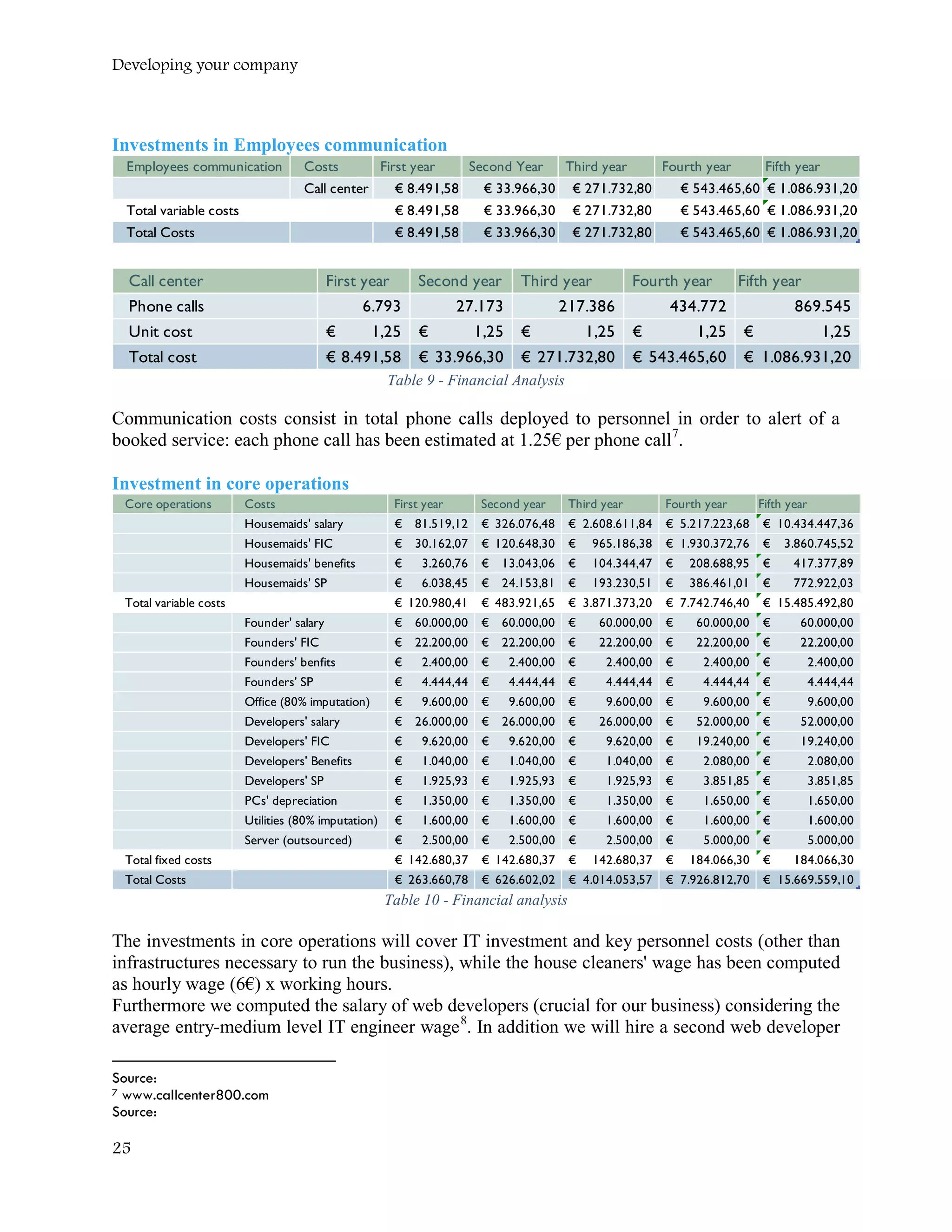
Table 9 - Financial Analysis
Communication costs consist in total phone calls deployed to personnel in order to alert of a
booked service: each phone call has been estimated at 1.25€ per phone call7
.
Investment in core operations
Table 10 - Financial analysis
The investments in core operations will cover IT investment and key personnel costs (other than
infrastructures necessary to run the business), while the house cleaners' wage has been computed
as hourly wage (6€) x working hours.
Furthermore we computed the salary of web developers (crucial for our business) considering the
average entry-medium level IT engineer wage8
. In addition we will hire a second web developer
Source:
7 www.callcenter800.com
Source:
Employees communication Costs First year Second Year Third year Fourth year Fifth year
Call center € 8.491,58 € 33.966,30 € 271.732,80 € 543.465,60 € 1.086.931,20
Total variable costs € 8.491,58 € 33.966,30 € 271.732,80 € 543.465,60 € 1.086.931,20
Total Costs € 8.491,58 € 33.966,30 € 271.732,80 € 543.465,60 € 1.086.931,20
Call center First year Second year Third year Fourth year Fifth year
Phone calls 6.793 27.173 217.386 434.772 869.545
Unit cost 1,25€ 1,25€ 1,25€ 1,25€ 1,25€
Total cost 8.491,58€ 33.966,30€ 271.732,80€ 543.465,60€ 1.086.931,20€
Core operations Costs First year Second year Third year Fourth year Fifth year
Housemaids' salary 81.519,12€ 326.076,48€ 2.608.611,84€ 5.217.223,68€ 10.434.447,36€
Housemaids' FIC 30.162,07€ 120.648,30€ 965.186,38€ 1.930.372,76€ 3.860.745,52€
Housemaids' benefits 3.260,76€ 13.043,06€ 104.344,47€ 208.688,95€ 417.377,89€
Housemaids' SP 6.038,45€ 24.153,81€ 193.230,51€ 386.461,01€ 772.922,03€
Total variable costs 120.980,41€ 483.921,65€ 3.871.373,20€ 7.742.746,40€ 15.485.492,80€
Founder' salary 60.000,00€ 60.000,00€ 60.000,00€ 60.000,00€ 60.000,00€
Founders' FIC 22.200,00€ 22.200,00€ 22.200,00€ 22.200,00€ 22.200,00€
Founders' benfits 2.400,00€ 2.400,00€ 2.400,00€ 2.400,00€ 2.400,00€
Founders' SP 4.444,44€ 4.444,44€ 4.444,44€ 4.444,44€ 4.444,44€
Office (80% imputation) 9.600,00€ 9.600,00€ 9.600,00€ 9.600,00€ 9.600,00€
Developers' salary 26.000,00€ 26.000,00€ 26.000,00€ 52.000,00€ 52.000,00€
Developers' FIC 9.620,00€ 9.620,00€ 9.620,00€ 19.240,00€ 19.240,00€
Developers' Benefits 1.040,00€ 1.040,00€ 1.040,00€ 2.080,00€ 2.080,00€
Developers' SP 1.925,93€ 1.925,93€ 1.925,93€ 3.851,85€ 3.851,85€
PCs' depreciation 1.350,00€ 1.350,00€ 1.350,00€ 1.650,00€ 1.650,00€
Utilities (80% imputation) 1.600,00€ 1.600,00€ 1.600,00€ 1.600,00€ 1.600,00€
Server (outsourced) 2.500,00€ 2.500,00€ 2.500,00€ 5.000,00€ 5.000,00€
Total fixed costs 142.680,37€ 142.680,37€ 142.680,37€ 184.066,30€ 184.066,30€
Total Costs 263.660,78€ 626.602,02€ 4.014.053,57€ 7.926.812,70€ 15.669.559,10€
25
Developing your company
in the fourth year, expecting a greater complexity in operation management. The Federal Insural
Contributions (FIC9
) are in general the 37% of the gross salary, and 4% the benefits. The
severance package (SP10
) is the 13,5% of the total salary. The server support will be outsourced.
Provisional P&L statement
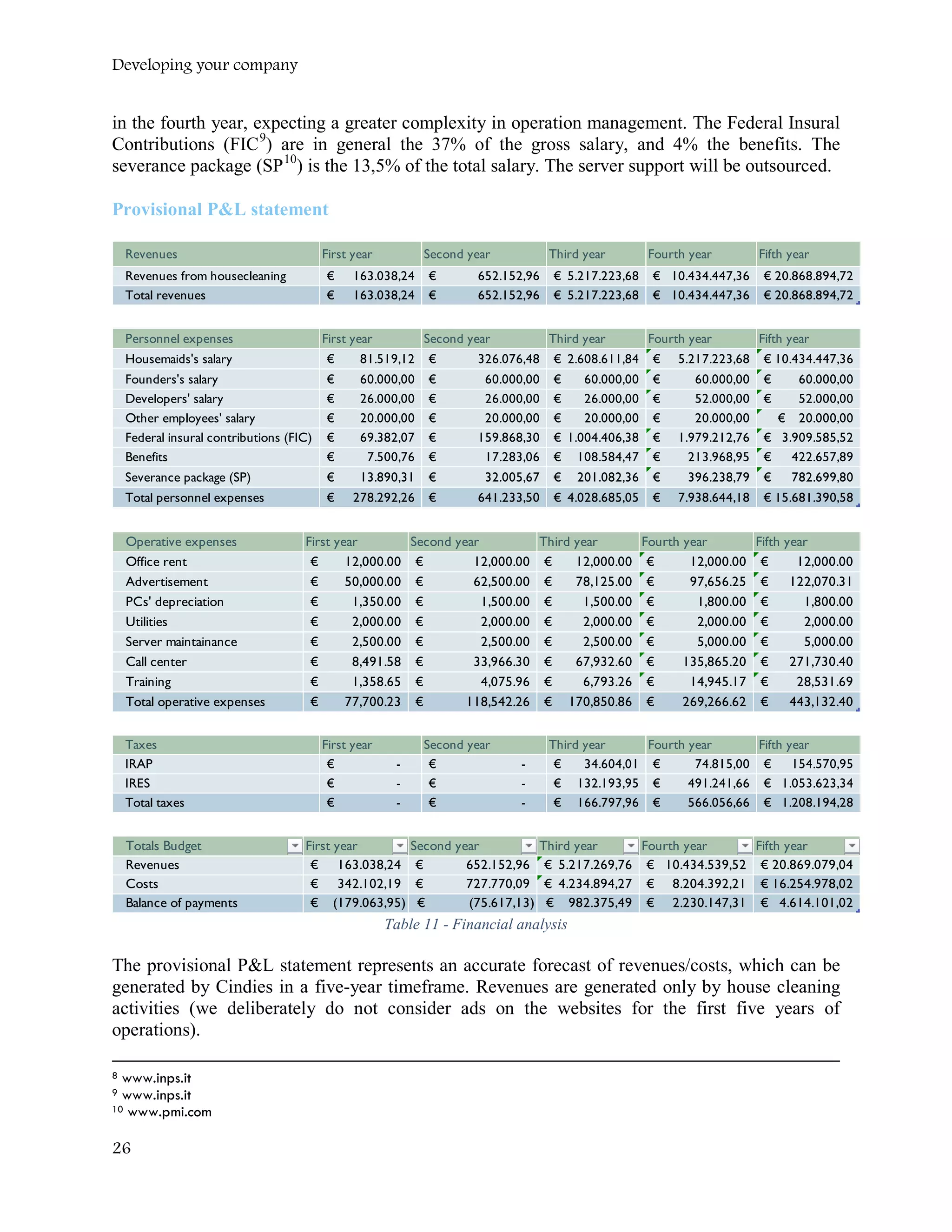
Table 11 - Financial analysis
The provisional P&L statement represents an accurate forecast of revenues/costs, which can be
generated by Cindies in a five-year timeframe. Revenues are generated only by house cleaning
activities (we deliberately do not consider ads on the websites for the first five years of
operations).
8 www.inps.it
9 www.inps.it
10 www.pmi.com
Revenues First year Second year Third year Fourth year Fifth year
Revenues from housecleaning 163.038,24€ 652.152,96€ 5.217.223,68€ 10.434.447,36€ 20.868.894,72€
Total revenues 163.038,24€ 652.152,96€ 5.217.223,68€ 10.434.447,36€ 20.868.894,72€
Personnel expenses First year Second year Third year Fourth year Fifth year
Housemaids's salary 81.519,12€ 326.076,48€ 2.608.611,84€ 5.217.223,68€ 10.434.447,36€
Founders's salary 60.000,00€ 60.000,00€ 60.000,00€ 60.000,00€ 60.000,00€
Developers' salary 26.000,00€ 26.000,00€ 26.000,00€ 52.000,00€ 52.000,00€
Other employees' salary 20.000,00€ 20.000,00€ 20.000,00€ 20.000,00€ 20.000,00€
Federal insural contributions (FIC) 69.382,07€ 159.868,30€ 1.004.406,38€ 1.979.212,76€ 3.909.585,52€
Benefits 7.500,76€ 17.283,06€ 108.584,47€ 213.968,95€ 422.657,89€
Severance package (SP) 13.890,31€ 32.005,67€ 201.082,36€ 396.238,79€ 782.699,80€
Total personnel expenses 278.292,26€ 641.233,50€ 4.028.685,05€ 7.938.644,18€ 15.681.390,58€
Operative expenses First year Second year Third year Fourth year Fifth year
Office rent 12,000.00€ 12,000.00€ 12,000.00€ 12,000.00€ 12,000.00€
Advertisement 50,000.00€ 62,500.00€ 78,125.00€ 97,656.25€ 122,070.31€
PCs' depreciation 1,350.00€ 1,500.00€ 1,500.00€ 1,800.00€ 1,800.00€
Utilities 2,000.00€ 2,000.00€ 2,000.00€ 2,000.00€ 2,000.00€
Server maintainance 2,500.00€ 2,500.00€ 2,500.00€ 5,000.00€ 5,000.00€
Call center 8,491.58€ 33,966.30€ 67,932.60€ 135,865.20€ 271,730.40€
Training 1,358.65€ 4,075.96€ 6,793.26€ 14,945.17€ 28,531.69€
Total operative expenses 77,700.23€ 118,542.26€ 170,850.86€ 269,266.62€ 443,132.40€
Taxes First year Second year Third year Fourth year Fifth year
IRAP -€ -€ 34.604,01€ 74.815,00€ 154.570,95€
IRES -€ -€ 132.193,95€ 491.241,66€ 1.053.623,34€
Total taxes -€ -€ 166.797,96€ 566.056,66€ 1.208.194,28€
Totals Budget First year Second year Third year Fourth year Fifth year
Revenues 163.038,24€ 652.152,96€ 5.217.269,76€ 10.434.539,52€ 20.869.079,04€
Costs 342.102,19€ 727.770,09€ 4.234.894,27€ 8.204.392,21€ 16.254.978,02€
Balance of payments (179.063,95)€ (75.617,13)€ 982.375,49€ 2.230.147,31€ 4.614.101,02€
26
Developing your company
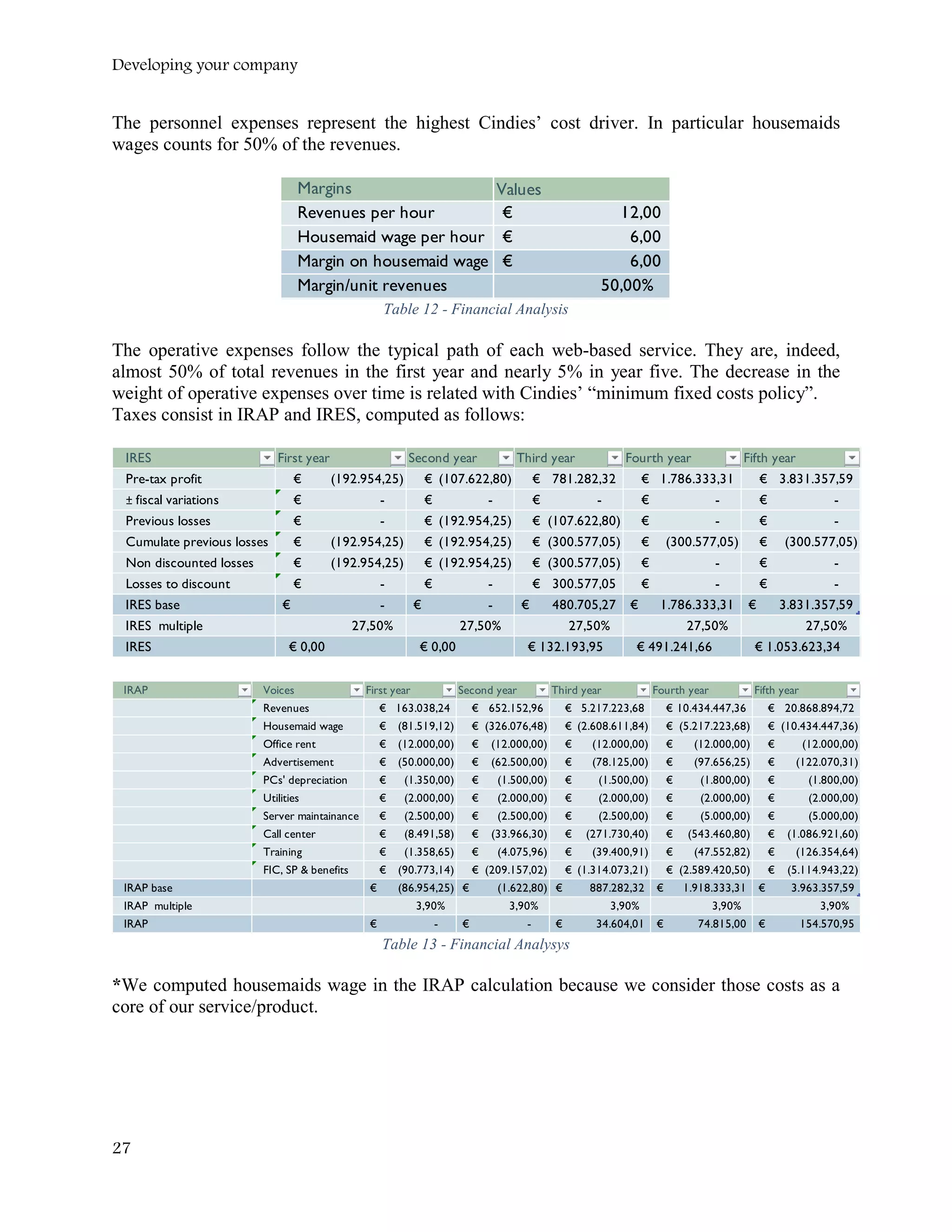
The personnel expenses represent the highest Cindies’ cost driver. In particular housemaids
wages counts for 50% of the revenues.
Table 12 - Financial Analysis
The operative expenses follow the typical path of each web-based service. They are, indeed,
almost 50% of total revenues in the first year and nearly 5% in year five. The decrease in the
weight of operative expenses over time is related with Cindies’ “minimum fixed costs policy”.
Taxes consist in IRAP and IRES, computed as follows:
Table 13 - Financial Analysys
*We computed housemaids wage in the IRAP calculation because we consider those costs as a
core of our service/product.
Margins Values
Revenues per hour 12,00€
Housemaid wage per hour 6,00€
Margin on housemaid wage 6,00€
Margin/unit revenues 50,00%
IRES First year Second year Third year Fourth year Fifth year
Pre-tax profit (192.954,25)€ (107.622,80)€ 781.282,32€ 1.786.333,31€ 3.831.357,59€
± fiscal variations -€ -€ -€ -€ -€
Previous losses -€ (192.954,25)€ (107.622,80)€ -€ -€
Cumulate previous losses (192.954,25)€ (192.954,25)€ (300.577,05)€ (300.577,05)€ (300.577,05)€
Non discounted losses (192.954,25)€ (192.954,25)€ (300.577,05)€ -€ -€
Losses to discount -€ -€ 300.577,05€ -€ -€
IRES base -€ -€ 480.705,27€ 1.786.333,31€ 3.831.357,59€
IRES multiple 27,50% 27,50% 27,50% 27,50% 27,50%
IRES € 0,00 € 0,00 € 132.193,95 € 491.241,66 € 1.053.623,34
IRAP Voices First year Second year Third year Fourth year Fifth year
Revenues 163.038,24€ 652.152,96€ 5.217.223,68€ 10.434.447,36€ 20.868.894,72€
Housemaid wage (81.519,12)€ (326.076,48)€ (2.608.611,84)€ (5.217.223,68)€ (10.434.447,36)€
Office rent (12.000,00)€ (12.000,00)€ (12.000,00)€ (12.000,00)€ (12.000,00)€
Advertisement (50.000,00)€ (62.500,00)€ (78.125,00)€ (97.656,25)€ (122.070,31)€
PCs' depreciation (1.350,00)€ (1.500,00)€ (1.500,00)€ (1.800,00)€ (1.800,00)€
Utilities (2.000,00)€ (2.000,00)€ (2.000,00)€ (2.000,00)€ (2.000,00)€
Server maintainance (2.500,00)€ (2.500,00)€ (2.500,00)€ (5.000,00)€ (5.000,00)€
Call center (8.491,58)€ (33.966,30)€ (271.730,40)€ (543.460,80)€ (1.086.921,60)€
Training (1.358,65)€ (4.075,96)€ (39.400,91)€ (47.552,82)€ (126.354,64)€
FIC, SP & benefits (90.773,14)€ (209.157,02)€ (1.314.073,21)€ (2.589.420,50)€ (5.114.943,22)€
IRAP base (86.954,25)€ (1.622,80)€ 887.282,32€ 1.918.333,31€ 3.963.357,59€
IRAP multiple 3,90% 3,90% 3,90% 3,90% 3,90%
IRAP -€ -€ 34.604,01€ 74.815,00€ 154.570,95€
27
Developing your company
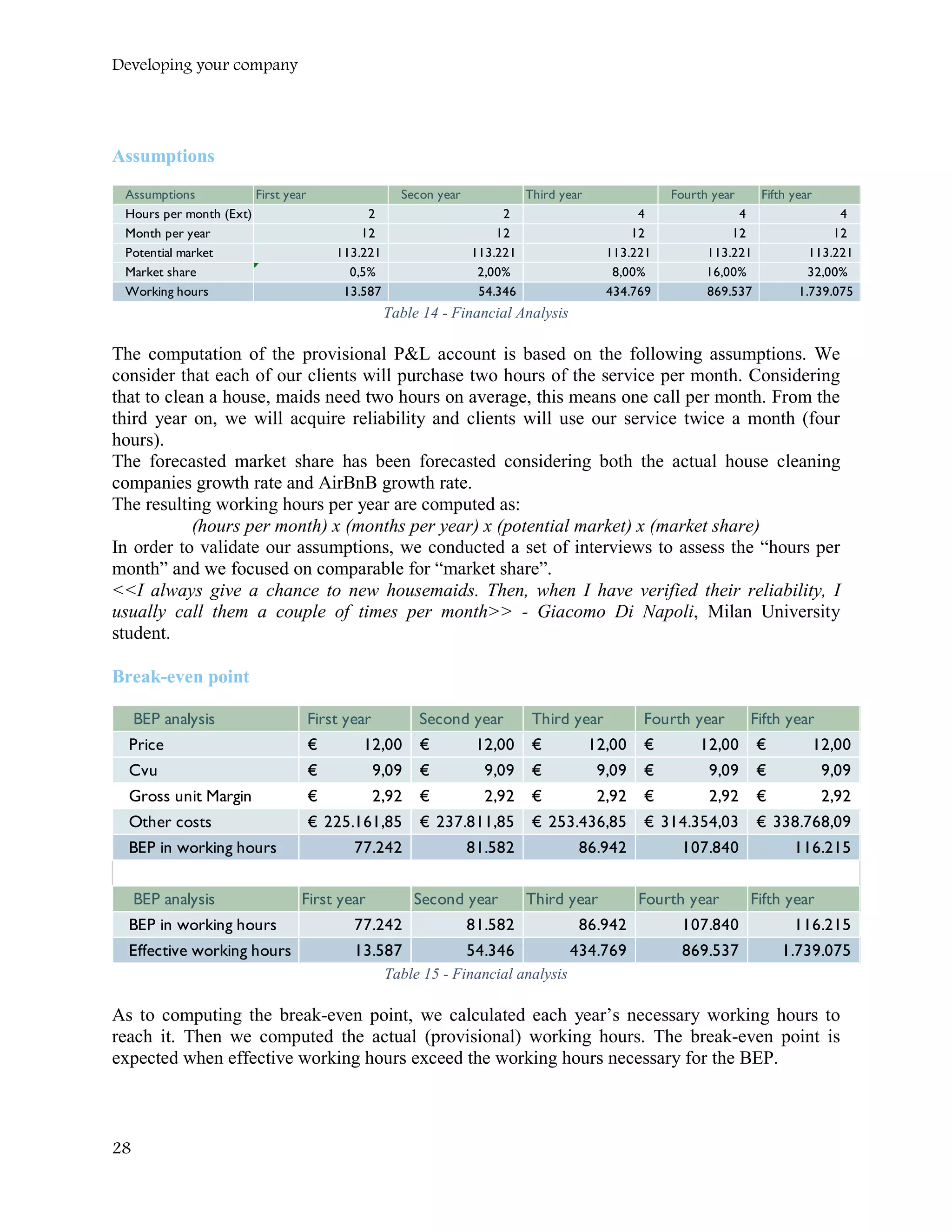
Assumptions
Table 14 - Financial Analysis
The computation of the provisional P&L account is based on the following assumptions. We
consider that each of our clients will purchase two hours of the service per month. Considering
that to clean a house, maids need two hours on average, this means one call per month. From the
third year on, we will acquire reliability and clients will use our service twice a month (four
hours).
The forecasted market share has been forecasted considering both the actual house cleaning
companies growth rate and AirBnB growth rate.
The resulting working hours per year are computed as:
(hours per month) x (months per year) x (potential market) x (market share)
In order to validate our assumptions, we conducted a set of interviews to assess the “hours per
month” and we focused on comparable for “market share”.
<<I always give a chance to new housemaids. Then, when I have verified their reliability, I
usually call them a couple of times per month>> - Giacomo Di Napoli, Milan University
student.
Break-even point
Table 15 - Financial analysis
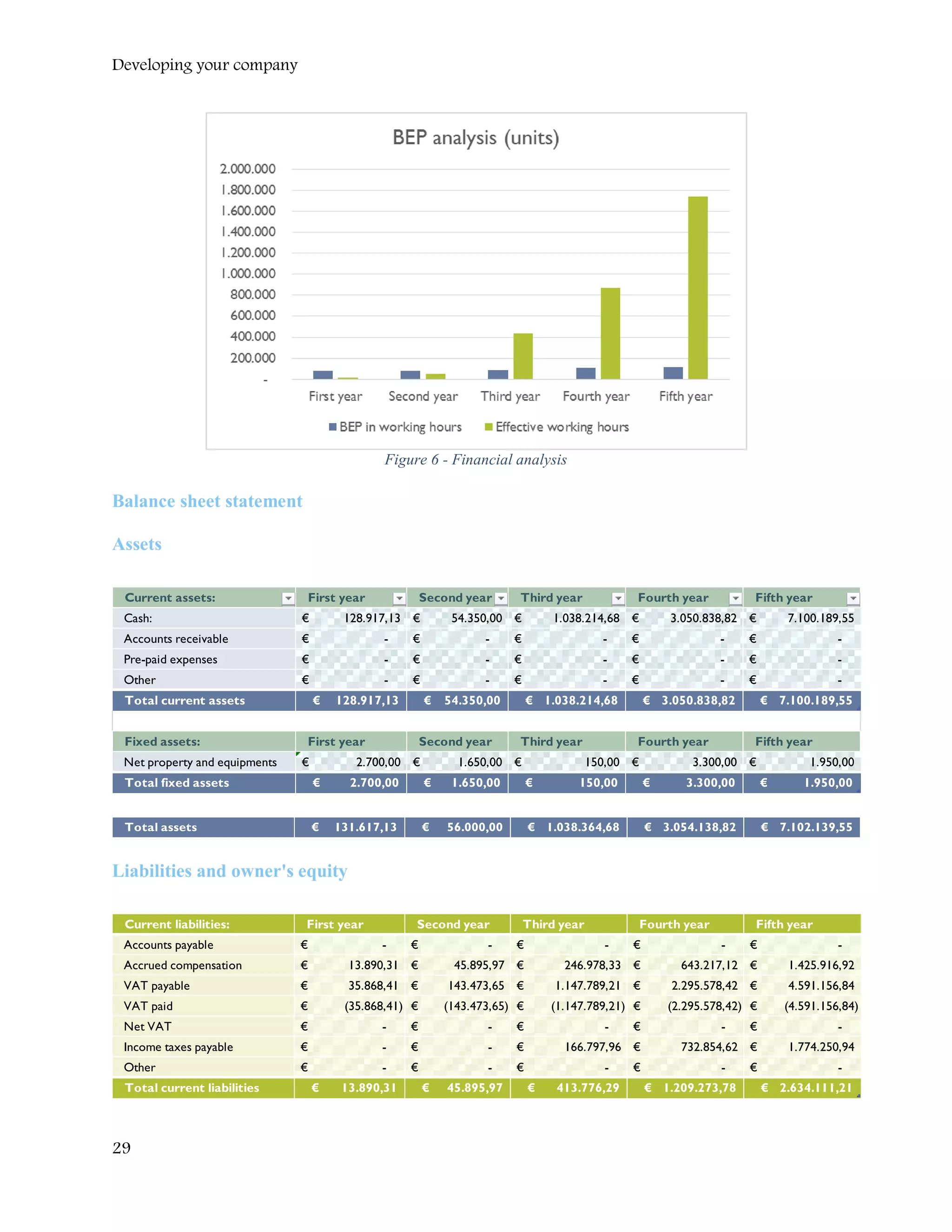
As to computing the break-even point, we calculated each year’s necessary working hours to
reach it. Then we computed the actual (provisional) working hours. The break-even point is
expected when effective working hours exceed the working hours necessary for the BEP.
Assumptions First year Secon year Third year Fourth year Fifth year
Hours per month (Ext) 2 2 4 4 4
Month per year 12 12 12 12 12
Potential market 113.221 113.221 113.221 113.221 113.221
Market share 0,5% 2,00% 8,00% 16,00% 32,00%
Working hours 13.587 54.346 434.769 869.537 1.739.075
BEP analysis First year Second year Third year Fourth year Fifth year
Price 12,00€ 12,00€ 12,00€ 12,00€ 12,00€
Cvu 9,09€ 9,09€ 9,09€ 9,09€ 9,09€
Gross unit Margin 2,92€ 2,92€ 2,92€ 2,92€ 2,92€
Other costs 225.161,85€ 237.811,85€ 253.436,85€ 314.354,03€ 338.768,09€
BEP in working hours 77.242 81.582 86.942 107.840 116.215
BEP analysis First year Second year Third year Fourth year Fifth year
BEP in working hours 77.242 81.582 86.942 107.840 116.215
Effective working hours 13.587 54.346 434.769 869.537 1.739.075
28
Developing your company
Figure 6 - Financial analysis
Balance sheet statement
Assets
Liabilities and owner's equity
Current assets: First year Second year Third year Fourth year Fifth year
Cash: 128.917,13€ 54.350,00€ 1.038.214,68€ 3.050.838,82€ 7.100.189,55€
Accounts receivable -€ -€ -€ -€ -€
Pre-paid expenses -€ -€ -€ -€ -€
Other -€ -€ -€ -€ -€
Total current assets 128.917,13€ 54.350,00€ 1.038.214,68€ 3.050.838,82€ 7.100.189,55€
Fixed assets: First year Second year Third year Fourth year Fifth year
Net property and equipments 2.700,00€ 1.650,00€ 150,00€ 3.300,00€ 1.950,00€
Total fixed assets 2.700,00€ 1.650,00€ 150,00€ 3.300,00€ 1.950,00€
Total assets 131.617,13€ 56.000,00€ 1.038.364,68€ 3.054.138,82€ 7.102.139,55€
Current liabilities: First year Second year Third year Fourth year Fifth year
Accounts payable -€ -€ -€ -€ -€
Accrued compensation 13.890,31€ 45.895,97€ 246.978,33€ 643.217,12€ 1.425.916,92€
VAT payable 35.868,41€ 143.473,65€ 1.147.789,21€ 2.295.578,42€ 4.591.156,84€
VAT paid (35.868,41)€ (143.473,65)€ (1.147.789,21)€ (2.295.578,42)€ (4.591.156,84)€
Net VAT -€ -€ -€ -€ -€
Income taxes payable -€ -€ 166.797,96€ 732.854,62€ 1.774.250,94€
Other -€ -€ -€ -€ -€
Total current liabilities 13.890,31€ 45.895,97€ 413.776,29€ 1.209.273,78€ 2.634.111,21€
29
Developing your company
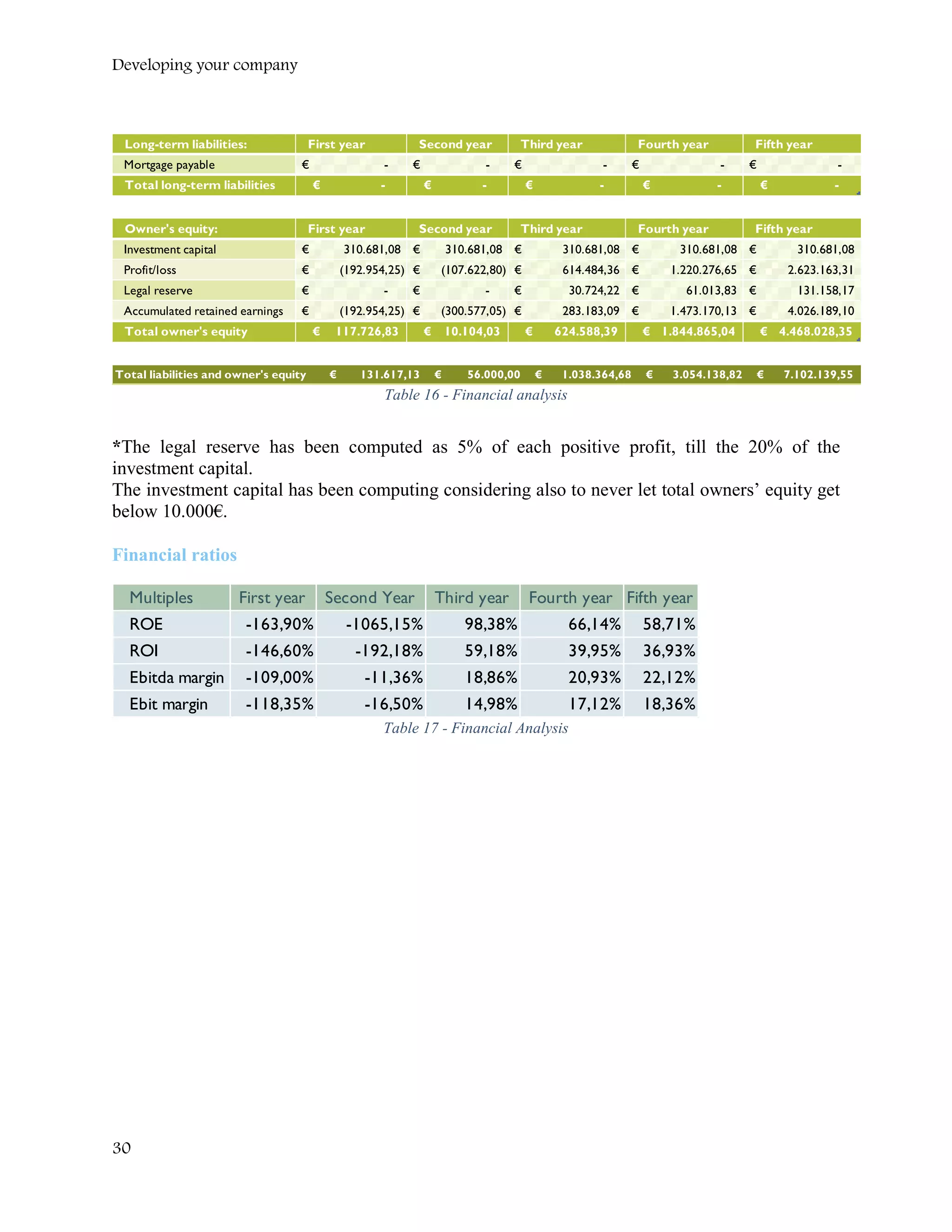
Table 16 - Financial analysis
*The legal reserve has been computed as 5% of each positive profit, till the 20% of the
investment capital.
The investment capital has been computing considering also to never let total owners’ equity get
below 10.000€.
Financial ratios
Table 17 - Financial Analysis
Long-term liabilities: First year Second year Third year Fourth year Fifth year
Mortgage payable -€ -€ -€ -€ -€
Total long-term liabilities -€ -€ -€ -€ -€
Owner's equity: First year Second year Third year Fourth year Fifth year
Investment capital 310.681,08€ 310.681,08€ 310.681,08€ 310.681,08€ 310.681,08€
Profit/loss (192.954,25)€ (107.622,80)€ 614.484,36€ 1.220.276,65€ 2.623.163,31€
Legal reserve -€ -€ 30.724,22€ 61.013,83€ 131.158,17€
Accumulated retained earnings (192.954,25)€ (300.577,05)€ 283.183,09€ 1.473.170,13€ 4.026.189,10€
Total owner's equity 117.726,83€ 10.104,03€ 624.588,39€ 1.844.865,04€ 4.468.028,35€
Total liabilities and owner's equity 131.617,13€ 56.000,00€ 1.038.364,68€ 3.054.138,82€ 7.102.139,55€
Multiples First year Second Year Third year Fourth year Fifth year
ROE -163,90% -1065,15% 98,38% 66,14% 58,71%
ROI -146,60% -192,18% 59,18% 39,95% 36,93%
Ebitda margin -109,00% -11,36% 18,86% 20,93% 22,12%
Ebit margin -118,35% -16,50% 14,98% 17,12% 18,36%
30
Developing your company
Valuation
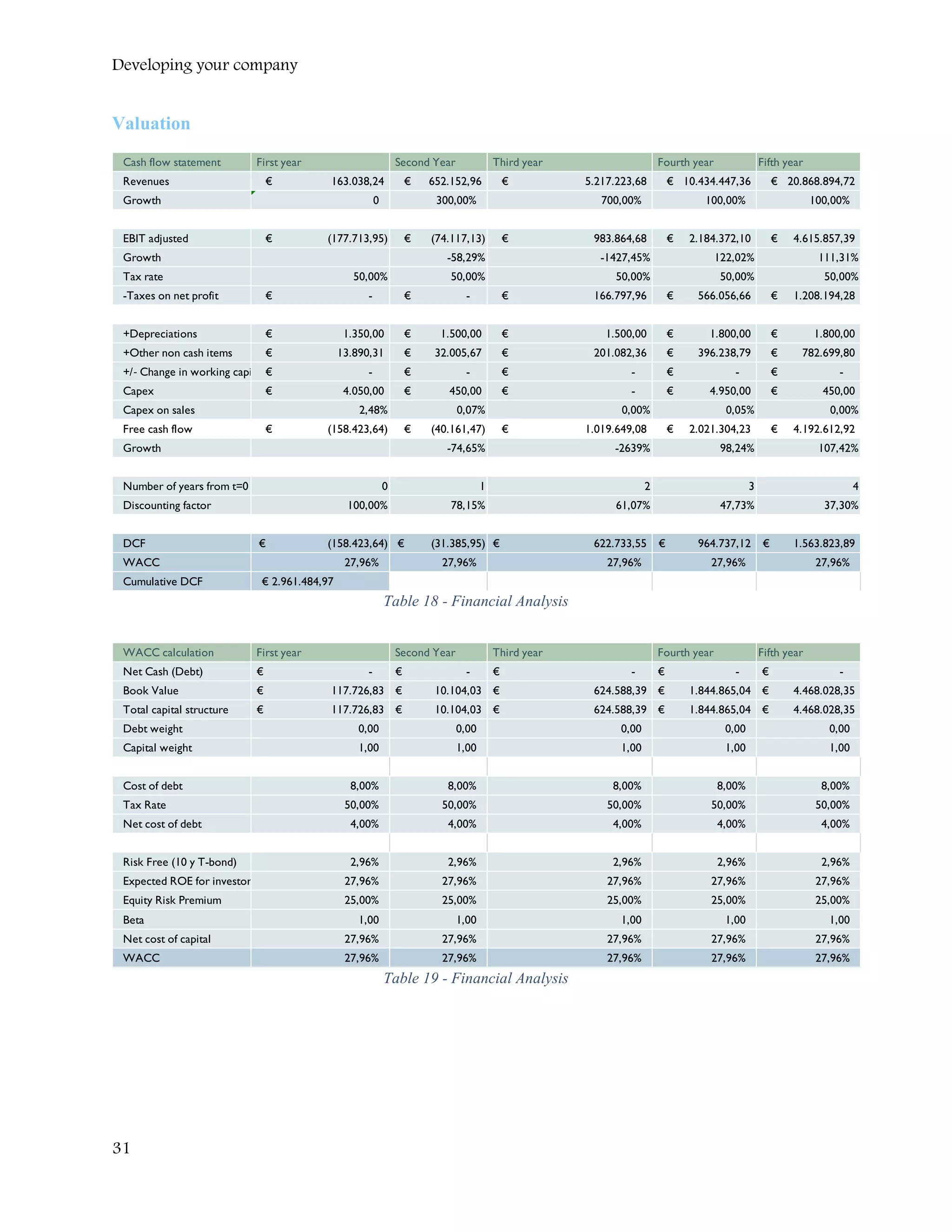
Table 18 - Financial Analysis
Table 19 - Financial Analysis
Cash flow statement First year Second Year Third year Fourth year Fifth year
Revenues 163.038,24€ 652.152,96€ 5.217.223,68€ 10.434.447,36€ 20.868.894,72€
Growth 0 300,00% 700,00% 100,00% 100,00%
EBIT adjusted (177.713,95)€ (74.117,13)€ 983.864,68€ 2.184.372,10€ 4.615.857,39€
Growth -58,29% -1427,45% 122,02% 111,31%
Tax rate 50,00% 50,00% 50,00% 50,00% 50,00%
-Taxes on net profit -€ -€ 166.797,96€ 566.056,66€ 1.208.194,28€
+Depreciations 1.350,00€ 1.500,00€ 1.500,00€ 1.800,00€ 1.800,00€
+Other non cash items 13.890,31€ 32.005,67€ 201.082,36€ 396.238,79€ 782.699,80€
+/‐ Change in working capi -€ -€ -€ -€ -€
Capex 4.050,00€ 450,00€ -€ 4.950,00€ 450,00€
Capex on sales 2,48% 0,07% 0,00% 0,05% 0,00%
Free cash flow (158.423,64)€ (40.161,47)€ 1.019.649,08€ 2.021.304,23€ 4.192.612,92€
Growth -74,65% -2639% 98,24% 107,42%
Number of years from t=0 0 1 2 3 4
Discounting factor 100,00% 78,15% 61,07% 47,73% 37,30%
DCF (158.423,64)€ (31.385,95)€ 622.733,55€ 964.737,12€ 1.563.823,89€
WACC 27,96% 27,96% 27,96% 27,96% 27,96%
Cumulative DCF € 2.961.484,97
WACC calculation First year Second Year Third year Fourth year Fifth year
Net Cash (Debt) -€ -€ -€ -€ -€
Book Value 117.726,83€ 10.104,03€ 624.588,39€ 1.844.865,04€ 4.468.028,35€
Total capital structure 117.726,83€ 10.104,03€ 624.588,39€ 1.844.865,04€ 4.468.028,35€
Debt weight 0,00 0,00 0,00 0,00 0,00
Capital weight 1,00 1,00 1,00 1,00 1,00
Cost of debt 8,00% 8,00% 8,00% 8,00% 8,00%
Tax Rate 50,00% 50,00% 50,00% 50,00% 50,00%
Net cost of debt 4,00% 4,00% 4,00% 4,00% 4,00%
Risk Free (10 y T-bond) 2,96% 2,96% 2,96% 2,96% 2,96%
Expected ROE for investor 27,96% 27,96% 27,96% 27,96% 27,96%
Equity Risk Premium 25,00% 25,00% 25,00% 25,00% 25,00%
Beta 1,00 1,00 1,00 1,00 1,00
Net cost of capital 27,96% 27,96% 27,96% 27,96% 27,96%
WACC 27,96% 27,96% 27,96% 27,96% 27,96%
31
Developing your company
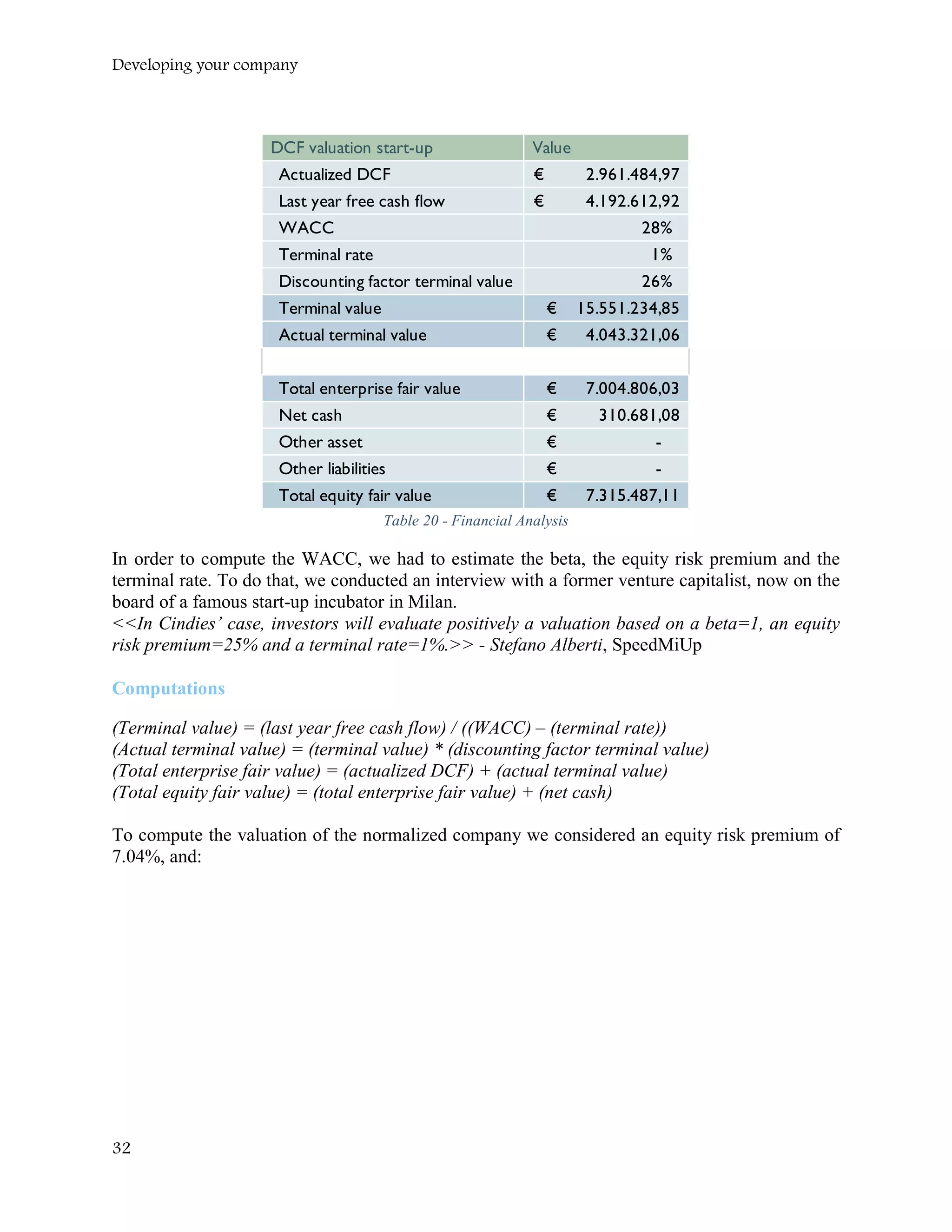
Table 20 - Financial Analysis
In order to compute the WACC, we had to estimate the beta, the equity risk premium and the
terminal rate. To do that, we conducted an interview with a former venture capitalist, now on the
board of a famous start-up incubator in Milan.
<<In Cindies’ case, investors will evaluate positively a valuation based on a beta=1, an equity
risk premium=25% and a terminal rate=1%.>> - Stefano Alberti, SpeedMiUp
Computations
(Terminal value) = (last year free cash flow) / ((WACC) – (terminal rate))
(Actual terminal value) = (terminal value) * (discounting factor terminal value)
(Total enterprise fair value) = (actualized DCF) + (actual terminal value)
(Total equity fair value) = (total enterprise fair value) + (net cash)
To compute the valuation of the normalized company we considered an equity risk premium of
7.04%, and:
DCF valuation start-up Value
Actualized DCF 2.961.484,97€
Last year free cash flow 4.192.612,92€
WACC 28%
Terminal rate 1%
Discounting factor terminal value 26%
Terminal value 15.551.234,85€
Actual terminal value 4.043.321,06€
Total enterprise fair value 7.004.806,03€
Net cash 310.681,08€
Other asset -€
Other liabilities -€
Total equity fair value 7.315.487,11€
32
Developing your company
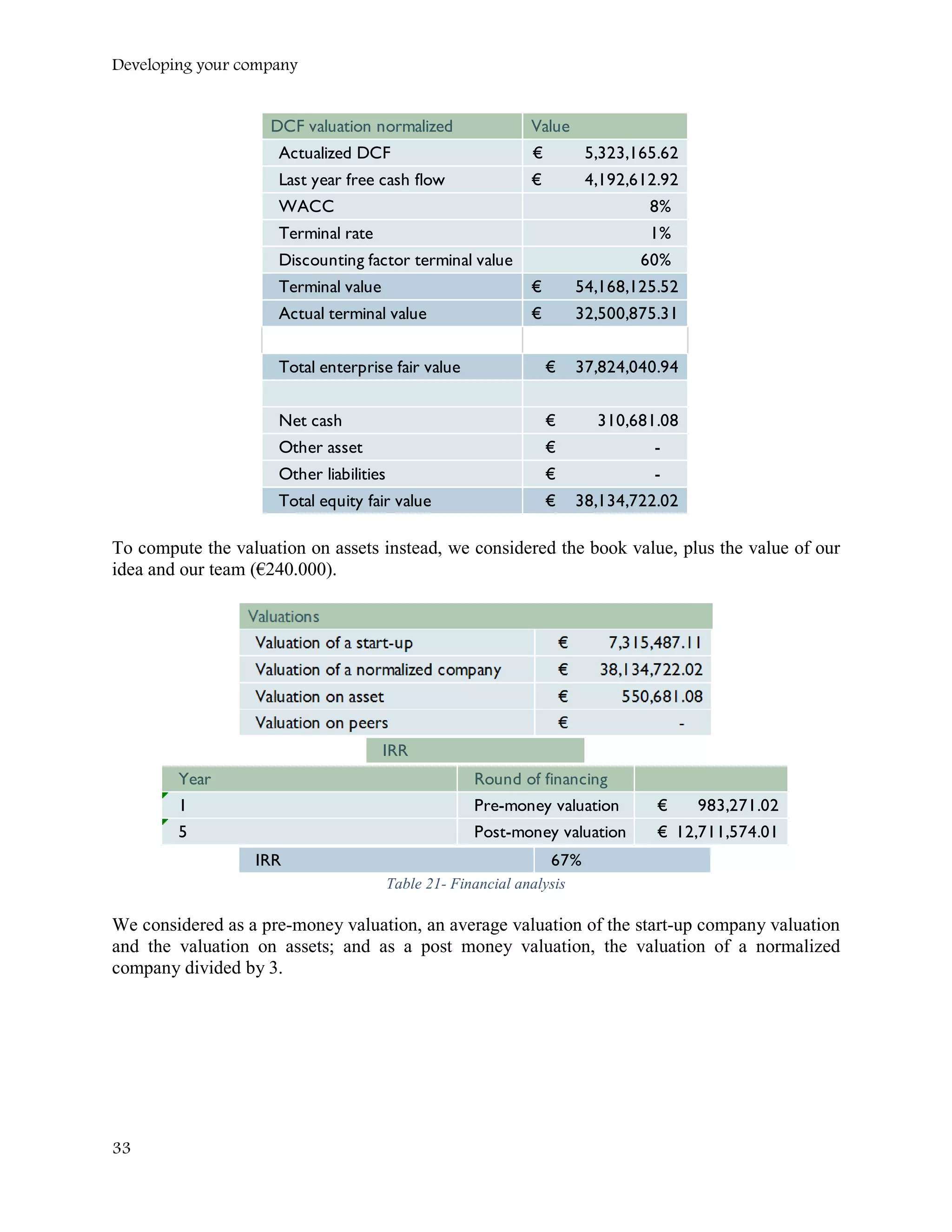
To compute the valuation on assets instead, we considered the book value, plus the value of our
idea and our team (€240.000).
Table 21- Financial analysis
We considered as a pre-money valuation, an average valuation of the start-up company valuation
and the valuation on assets; and as a post money valuation, the valuation of a normalized
company divided by 3.
DCF valuation normalized Value
Actualized DCF 5,323,165.62€
Last year free cash flow 4,192,612.92€
WACC 8%
Terminal rate 1%
Discounting factor terminal value 60%
Terminal value 54,168,125.52€
Actual terminal value 32,500,875.31€
Total enterprise fair value 37,824,040.94€
Net cash 310,681.08€
Other asset -€
Other liabilities -€
Total equity fair value 38,134,722.02€
IRR
Year Round of financing
1 Pre-money valuation 983,271.02€
5 Post-money valuation 12,711,574.01€
IRR 67%
33
Developing your company
Corporate governance
The Cindies board of directors will be composed of five people, of which three are founders and
two are financial investors.
In order to facilitate the investment in the company, we introduced the veto power for all
financial investors (only for strategic decisions).
Absolute majority (50%+1) will be the rule only for ordinary topics, while qualified majority
(2/3) will be the rule for strategic decisions such as diversification of the business, M&A,
changes in the business name and in the form of the corporate vehicle.
Another important instrument that will allow an easier financing of the company when the
members' contributions are not enough, are the rights to information for financial investors:
reports of financial results every four months, reports of bank statements every three months and
meeting with financial investors every two months.
Like every good corporate governance, we adopted benefits and obligations for founders:
benefits related to behavior (if the revenues annual growth rate is double digit, less rigor in
right to information) and obligations like non-competitive agreement (founders can't stay in
competitors board but they can invest in them) and a lock-up provision of five years only for
founders board members.
For what concerns the liquidity mechanisms, we planned many methods for managing different
situations. In case of selling of a minority stake, the managing methods we came up with are:
- Participating rights for founders (preemption right and first refusal right);
- Liquidation preference on financial investors' stake.
Instead, for the majority of founders’ stakes, we planned exit provisions like tag-along, co-sale
right and drag-along (which requires qualified majority).
The maximum stake in the company for financial investors will be 40%.
These percentages restrict the entry of foreign investors in the company to maintain a high
enough internal control.
In case one founder withdraws from the board, he/she will be replaced by the oldest one that is
not in the board.
An incentive to maintain a high level of investment in the company will be the constraint that
every year a minimum of 50% of profits must be reinvested for the first five years.
For what concerns the type of corporation, initially Cindies will be an S.R.L., but, in order to
facilitate the growth in other Italian cities, the company will then become an S.P.A. when it is
ready to expand.
Finally, we have not neglected even the exit strategy, of which the main points are:
- Golden-hand cuffs of three years for investors and founders not in the board, while five years
for investors and founders in the board;
- Mandatory redemption right: in case of not redemption, the penalty is the increase of seats in
the board for financial investors;
- Obligation to announce to the board four months in advance the intention to sell more than 10%
of the total stake.
34

cindies bp

  • 1.
    Cindies Christian Bisson Tudor Carstoiu UmbertoDi Capua Stefano Gulmini Gabriele Mambrini Valeria Torelli
  • 2.
    Developing your company Tableof Contents Executive summary..................................................................................................3 Team..........................................................................................................................4 Business model..........................................................................................................6 MVP...........................................................................................................................8 Customer needs ......................................................................................................11 Segmentation ..........................................................................................................11 Market size..............................................................................................................13 Milestones................................................................................................................13 Industry Analysis ...................................................................................................14 Actual Competitors................................................................................................15 Activity Analysis.....................................................................................................22 Financial Analysis ..................................................................................................24 Corporate governance ...........................................................................................34 2
  • 3.
    Developing your company Executivesummary Cindies is seeking a funding of €310.681 in order to set up a business which offers house cleaning services through an innovative and user-friendly website and mobile-app. Our team includes a variety of postgraduates willing to utilize their knowledge of the market, together with their personal experience in order to achieve a successful and growth-capable firm. We represent the ideal market segment that our business wishes to address: students in need of a cheap, reliable and easy to use service for house cleaning. We are well aware of the various obstacles and possible opportunities in developing such a business because we have personally experienced the problem that it aims to resolve. This, coupled with our knowledge in business and entrepreneurial acumen, makes us the ideal team to develop this innovative idea. Our service is accessible through an extremely user-friendly website, which clearly and concisely gives information regarding availability of our staff as well as precious user feedback, which will ensure consumers a truthful description of quality. Each service can be easily booked online, avoiding bothersome phone calls or lengthy contractual obligations. The market will initially be defined as, but not limited to, students of at least 18 years of age in Milan. Additional targets include single professionals, working mothers or even the elderly. Cindies' business model is extremely flexible in that it can be applied to many different student cities such as Rome, Bologna or Napoli. Our strategy consists in obtaining a foothold in the housecleaning market in Milan, which is currently dominated by freelancers and independent professional companies. Both of these competitors fail in providing a simple and efficient service available to the individual who simply needs his or her house or office to be cleaned by reliable professionals. Furthermore, we avoid the lengthy and costly contractual processes by providing a simple and modern ‘click and eat’ type of service. Amongst the initial investment of €310.681 of equity, we need to spend €50.000 for the initial advertising activities to create brand awareness, crucial for a start-up. In terms of infrastructure, we plan to spend €12.000 for the first year office rent and €4.050 for the initial PCs dotation. Finally, a part is going to be spent for unpredicted expenses and cash flow financing. 3
  • 4.
    Developing your company Team Bornin Rome on 15/11/1990, Christian a MSc student in “Economics and Management of Innovation and Technology” at Bocconi University and graduate of the London School of Economics in the Business Economics BSc. He has lived in Italy, Canada and England; thanks to these experiences, he speaks a professional level of English, French and Italian. He also retains a high level of expertise in computer operations and Web design. These set of capabilities make him the perfect spokesperson for the company and the coordinator of “issues” associated with core operations. Mobile-phone: +39 3273903484 E-mail: chrbisson@gmail.com Born in Arad (Romania) on 12/03/89, Tudor is a MSc student in “Economics and Management of Innovation and Technology”. He is proficient in three languages: English, Italian and Romanian. Tudor has extensive competences in management and, amongst other features that characterize him are situation control and team spirit. His qualities have also placed him as the Vice President on campus of the Bocconi Alumni Association, which is instrumental in developing an efficient network. Mobile-phone: +39 3383417447 E-mail: tudor.ca@gmail.com Born in Asti on 27/09/91, Umberto is a MSc student in “Economics and Management of Innovation and Technology”. He is proficient in both English and Italian and also speaks French and Spanish. He has grown up learning from his father, who is a manager in a multinational company, and consequently Umberto has developed a strong knowledge about the company’s features and situations. Some of his most valuable qualities include his problem solving attitude and his precision in coordinating works that derive from his passion in military strategies applied in business contexts. All this, added to his leadership qualities, make him a perfect CEO. Mobile-phone: +39 3356025525 E-mail: umberto.dicapua@gmail.com Born in Casale Monferrato (AL) on 5/09/1991, Stefano has is a MSc student in “Economics and Management of Innovation and Technology”. Many of the male members of his family are entrepreneurs and, since he was very young, he has observed and learned the fundamentals in managing and developing a company. Stefano is a member of ESN Bocconi, an association that deals with exchange students and facilitating their involvement in University life. This has provided him with an interesting skill set which can be instrumental in dealing with various foreign companies in future dealings. Mobile-phone: +39 3398962688 E-mail: s.gulmini@gmail.com Christian Bisson Tudor Carstoiu Umberto Di Capua Stefano Gulmini 4
  • 5.
    Developing your company Bornin Palermo on 16/07/92, Gabriele is a MSc student in “Economics and Management of Innovation and Technology”. Before University, he attended the Scuola Militare Nunziatella, where he has learned the importance of rigor and precision. Gabriele is characterized by a task-oriented mentality, an impeccable focus and a very flexible mindset; all qualities that perfectly fit with the aim of valuating and selecting the best workers for Cindies. Gabriele has also functioned as a referee in professional kickboxing tournaments and competitions, which has provided him with a relatively useful set of skills in judgment and human relations. Mobile-phone: +39 3403664668 E-mail: mambrini.gabriele@gmail.com Born in Milan on 27/09/91, Valeria has graduated from Bocconi University in Economics and Management for Arts, Culture and Communication and is currently a MSc student in “Economics and Management of Innovation and Technology”. She has attended the American School of Milan for 11 years, where she immersed herself in an international atmosphere, opened her mind to many different cultures and developed her creativity. This background will be very helpful for our company, as it will facilitate her involvement in marketing functions, taking decisions about promotion and advertising for better positions. Valeria is currently responsible for the marketing decisions of the Bocconi Students for Fashion association, where she has accumulated further experience in the field. Mobile-phone: +39 3334427164 E-mail: valetorelli1991@gmail.com Figure 1 - Team CEO Umberto Di Capua Staff Admin Gabriele Mambrini CIO Stefano Gulmini CTO Christian Bisson COO Tudor Carstoiu Public relations Valeria Torelli Valeria Torelli Gabriele Mambrini 5
  • 6.
    Developing your company Businessmodel Have you ever come home from work feeling exhausted? You look around and you notice that you have a dirty or messy house, but you do not have the energy or the time to clean? You try to call your housekeeper, but he/she is busy? Well, from now on you won’t have to worry anymore, because Cindies will do the work for you! Figure 2 - Business model Our idea is to found a web-based company named Cindies in the house-cleaning sector. Cindies offers individuals an innovative and customized solution for the maintenance of their home through housekeepers specially trained to effectively meet their needs. A dedicated website, along with the mobile app, will allow customers to book cleaning performances. Customers will be able to choose the duration, the time, the type of service (ironing, cleaning or both) and the employee they prefer. The feedback given by other customers regarding previous performances by employees will help the customer through the decisional process. An external call-center will be responsible for assigning the selected house cleaners to the appropriate customers. These features, easily accessible through our website with the click of a button, best represent our value proposition. The business will guarantee performance and reliability of the house cleaners through a meticulous recruiting process that includes competence and trustworthiness analysis. Furthermore, there will be a mandatory eight-hour training guaranteed by our company for all employees, in order to properly train them to carry out their duties at best in our customers’ homes. Each housekeeper will be paid €6 per hour, defining a very clear and simple revenue stream model. 6
  • 7.
    Developing your company Weare determined to fill the online booking gap in the market offering a traditional service in an innovative way. In order to reach our customer target, our company will invest substantially on advertisement and networking activities, keeping a professional image with clean uniforms, professionally printed brochures, business cards and letterhead. Our cost structure will be defined as shown in the image below. 7
  • 8.
    Developing your company MVP Weare well aware that the first thing that investors look for when deciding whether to invest or not is the possibility to have a real experience of the product or service that they are going to invest in. Keeping this in mind, we have decided to create a proto-Website of Cindies, and the result was great. Figure 3 - MVP 8
  • 9.
    Developing your company Therefore,in the Website we have six initial tabs: - Home - Book your service - Our employees - Work with us - About us - Contact us Home The ‘Home’ tab serves us no more than to send the most important messages to users. In the ‘Home’ page, we want to show the benefits of our service: reliability, professionally and availability of personnel. Book your service In the second tab, we go directly to the booking moment. The page is divided in two sections: ‘Book your service’ and ‘Employees available’. In the first part, you fill in your credentials and decide the performance required. Once you have confirmed, you immediately receive the names of the housekeepers that are available in your area and for the service requested. Once you have chosen the employee you prefer, you can ask additional requests for your service (for instance you can require focusing on bathrooms or kitchens). Finally, you can easily pay with your credit card directly through the Internet. Our tariff is €12 per hour. Our employees The third page has been created to give costumers more information about our employees, in order to really know who will be the person that will enter in their house. In this page, you actually have the list of all our employees, a brief description of their core capabilities and finally the rating that customers have registered after experiencing their performance. The feedback mechanism has a double benefit effect: one for us and one for customers. In our benefit, we have an efficient and realistic way to control our housemaids through our ranking system. In case of too many negative feedbacks, we will call the under-performing employee for an interview to understand the reasons of these bad results. From the clients’ point of view, as said, they will be more informed about the skills of the housekeeper according to their requests and finally on their ranking as well. Work with us Another important page is dedicated to all the people who would like to join our company and receive all the benefits related. The first step of the recruitment process is the online application, where aspirant workers have to provide their main information (name, nationality, phone number and e-mail), their weekly availability and the number of hours that they would like to work per week and their abilities. Candidates also have to upload their CV and motivational letter. About us The page ‘About us’ contains information on who we are, our work philosophy and the advantages that our service brings. It is important to underline that our main advantages are punctuality, efficiency, integrity, discretion, autonomy, adaptability and motivation. 9
  • 10.
    Developing your company Contactus The page ‘Contact us’ contains our main contact information: e-mail, telephone number, address and a map to find us. Customers are free to contact us and we are pleased to help them in any way we can. 10
  • 11.
    Developing your company Customerneeds Our idea started from observing the housekeepers market and realizing there is room for more flexibility. Traditional clients mostly use agencies and word-of-mouth to find maids and, once they found a person, they usually stick with that person. By watching our own needs and talking with different people, we realized that there is a latent need that is not fully satisfied: the need of occasional customers for cleaning services. Most people do their cleaning on their own, but there are moments in which they would like to ask professional help and they wish that this was easily available and at a fair price. The average customer can be a student or a young professional that does not want to take any commitment with a particular house cleaner and that will use this service on an occasional basis. Segmentation We have defined two major segments: a broader and heterogeneous one based on a top-down approach starting with Milan’s population and a more homogenous and focused one defined by Milan’s student population that have their residences outside Milan and are in this city for study and work purposes. First segment Considered variables: - Geographical location: city of Milan As our core business implies that our staff performs cleaning service, we find it vital for logistical reasons, at least in the first development phase, to restrict our operational area within the boundaries of the city of Milan. - Age: 20-45 We consider this age group the one that will show most interest in an easily accessible cleaning service that can be used occasionally if an urgent need occurs. Starting from 20 because of the possibility that individuals below this age might still not be living outside their parents’ house. Also, limited to 45 because at this age we consider the possibility that individuals tend to hire a full-time maid instead of hiring for individual jobs or might find themselves with more time to take care of these chores themselves. - Internet access As our service can be booked only online, we restrict our focus to the population having access to Internet (both land and mobile) - Income: €15.000-50.000 per year We assumed that individuals having an annual income in the range written above are the ones most likely to be interested in our service, as they probably do not afford or need a permanent housekeeper but still they might access a cleaning service occasionally. Now going to numbers, we know that total Milan population is 1.262.000. The population between 20-45 is 450.0451 . Of this population, 295.5292 have Internet connection. Further, 178.442 have an income between 15-50k3 . Source: 1 Atlante Statistico dei Comuni 2 ISTAT 11
  • 12.
    Developing your company Knowingthat in Milan there are 1.262.100 individuals in 633.000 habitations, we can assume that in each house live on average two people. Considering that our target population is 178.442 but in average, they share the house with a person, we may assume that 89.221 potential customers compose the market size in Milan. Second segment Since foreign students are not included in the first target because they have no income and they are not residents in Milan, we have decided to create a second segment to include them. We therefore do not comprise Milan resident students, because we assume that they live with their families. 22% of the students (52.957) of all Milan’s universities come from different regions of Italy or different countries. As we can see from the table below4 , Bocconi university has by far the highest proportion of students (70%) coming from outside Lombardy region, although in absolute terms Politecnico, Cattolica or Statale University have even higher numbers due to a larger pool of students. Figure 4 - Segmentation Around 5.000 of these students live in different student residences, which have their own cleaning staff, therefore we remain with 48.000. We can assume that all have access to Internet (personal mobile or land connection, university computer rooms or Wi-Fi). We again use the fact that on average in Milan habitations are composed by two individuals thus we obtain a target market of 24.000 customers. 3 www.comuniitaliani.it Source: 4 www.universi-mi.it 0 10000 20000 30000 40000 50000 60000 70000 Tot. Students Tot. Students away from home 12
  • 13.
    Developing your company Marketsize As our cleaning service is designed to be used occasionally and it is quantified by hour, we assume that our clients will use on average 24 hours per year (2 per month). Having a price of €12/hour, our value extraction per client per year will be €288. Thus, the value of our initial target market will be 24.000*288 = €6.912.000. Extending the demand also to both our segments, we get a total value of our potential market equal with (89.221*228) + 6.912.000 = €32.607.648/year. Milestones After creating solid brand recognition in Milan, our aim is to expand to other large and medium size cities initially around Italy and in later stages abroad. We will target cities that have relevant student communities like Rome, Bologna, Torino, Napoli, Padova, Verona, Venice and Pisa. In Milan, our target market is roughly 10% of the total population of the city, so we can use the same estimates for the cities mentioned above5 . Figure 5 - Segmentation Thus, the potential total market revenue for Italy may be €86.916.384/year serving a total of 565677 potential clients. Source: 5 http://www.tuttitalia.it/citta/popolazione/ City (total population) Potential clients Potential market value (Potential clients*€288year) Rome (2.638.842) 263.88 €75.998.592 Napoli (959.052) 95.91 €27.620.640 Torino (872.091) 87.21 €25.116.192 Bologna (380.635) 38.06 €10.962.144 Venice (259.263) 25.93 €7.466.688 Verona (253.409) 25.34 €7.297.920 Padua (207.245) 20.72 €5.968.512 Pisa (86.263) 8.63 €2.484.288 13
  • 14.
    Developing your company IndustryAnalysis Through the online database Orbis.com, we were able to identify 9851 firms under code 97 “activities of households as employers of domestic personnel” on a global level. Unfortunately, none of these firms seem to have gone public and therefore this renders any kind of analysis with fundamental indices impossible such as: Ent Value/Sales, Ent. Value /EBITDA, Ent. Value / EBIT, Ent. Value /CF, P/E, P/Cash, P/BV. We therefore decided to proceed with an analysis of the sector based on extrapolations of Orbis' data. In addition, for geographical reasons, we decided to take in consideration only European companies. After applying the mentioned filter, the number of observations decreased to 8962. The observations we are going to consider, however, are a lot fewer, as we decided to include only firms with an annual turnover of at least $100,000; reducing observations to 1023. The lack of public indices induced the necessity to synthesize firm organizational structure and financials through other available data. Considered indices include: 1) Profit margin 2) Cash flow 3) EBIT margin 4) Profit per employee 5) ROE using P/L before tax 6) Operating revenues. We calculated an average for each value: Table 1 - Industry analysis ($ thousand) Upon comparing revenue average $1,376.00 with the median value of $246,000, we observed that the sector is characterized by few large firms (the largest reaching $548 million) and a subset of extremely reduced firms. In fact, the highest concentration of firms is situated along the left side of the median and is characterized by low revenues. ROE values are particularly high, while EBIT margin is consistently average with other sectors. In terms of location, we notice that the countries with the highest number of firms in this sector are France and UK. Mean Operating revenue (Turnover) th USD 1,376.00$ Last avail. yr Number of employees 20 Last avail. yr Profit margin % 9% Last avail. yr ROE using P/L before tax % 52% Last avail. yr Cash flow th USD 331.00$ Last avail. yr EBIT margin % 12% Last avail. yr Profit per employee th USD 46.00$ Last avail. yr 14
  • 15.
    Developing your company Additionalaspects include the significant lack of presence of IPR regimes amongst these firms, in fact we did not find any trademark registrations. In our case in particular, the use of trademarks is extremely important to protect our most important asset: Cindies brand. This represents a relative advantage as none of these firms in fact seem to care about their image or the level of recognition associated with any type of logo. Consequent analysis is based in the Italian territory as it represents our initial focus target. Codes pertaining to our research through Orbis.com include: 1) Pulizia (cleaning) 2) Attività di pulizia specializzata di edifici e di impianti e macchinari (specialized cleaning activity for buildings, installations and industrial machines) 3) Attività di pulizia NCA (NCA cleaning activity): codice ISTAT 74.70.1 (codici attività Ateco 2007 81.20.00-81.22.02-81.29.99). Through this analysis, we observed that in Italy, firms or agencies listed in the Ministry of Commerce (2001) that fall under the category of cleaning services and other related services amount to 36,726. There are also twenty types of variations in juridical societies, obviously included in our analysis are individual freelancers, which result in the following structure: - Individual Freelancer: 62,71% - Cooperatives: 12 % - S.n.c.: 8,32% - S.r.l.: 7,51% - S.a.s.: 5,86% The remaining 3,67% retains no explanatory value. It is evident that the majority of cleaning companies have a nature of the firm and structure limited by economies of scale. Firm to employee proportions result in 2.4, meaning that there are two employees per agency. This data concludes that there is an extremely low density of employees in regards to activities and that most of these firms employ a very reduced number of staff members. Actual Competitors Establishing an analysis of our competitors required analyzing the market for house related services in Italy; additionally we decided to consider some foreign-based firms in order to have a better understanding of various business models as well as possible knowledge for future expansion in foreign territory. Overall, our competitors can be subdivided into three categories: agencies, web-based companies and freelancers. Agency-oriented companies tend to offer very specific services such as specialized cleaning, disinfestations, moving services or even emergency services (electrical or pluming), while simple house cleaning services are not provided. Their employees are specialized in their respective field and are not available for simple and quick cleaning services. Furthermore these companies are not to be relied upon for first time services, they require a contract to be stipulated in order for their services to be utilized, additionally an initial estimate must be created which can take from a couple of hours to a day or more. Last but not least, these companies tend to rely on newspaper ads or poorly written websites to convey their services to the public. This inefficient means of advertisement consequentially only allows exposure to a very limited portion of the population. A prominent example of a company defined by agency-like characteristics in Italy is the CNS (Consorzio Nazionale Servizi). CNS is an Italian based modern entrepreneurial cooperative, which is headquartered in Bologna. CNS specializes in innovative techniques to improve certain aspects of any company or associations’ operations and infrastructure. Service varies from specialized cleaning for large office spaces to eco-friendly implants and energy sustainability 15
  • 16.
    Developing your company projects.For the purposes of this business plan, we will focus on the services relevant for our comparison. In terms of cleaning services, CNS provides hygiene specialized cleaning for industrial size structures, disinfestations and hospital cleansing which includes sterilization of equipment. In terms of private household services CNS is extremely limited: individuals can submit a request via phone call and obtain an estimate on the possible costs of receiving cleaning services, however CNS seems to employ over-qualified personnel for mundane cleaning services and consequentially inefficient as a provider of said service. CNS’s value proposition lies in the highly specialized workforce they employ, quality is not an issue when receiving their services. They employ the latest technologies in maintain high levels of hygiene and eco-friendly standards in every infrastructure they service. CNS’s customer segment includes schools, office buildings, factories, villas, hotels and private households. On a more individual level the firm tends to attract eco-conscious individuals with higher than average incomes, individuals tend to own one or more large properties such as villas which require additional services such as gardening, pool maintenance and possible environmental conscious services. CNS’s cost structure consists in personnel salaries, public administration costs (indirect &direct) and capital maintenance (considering the vastness of their services and high scope of technology this amounts to a significant value). This company maintains different types of customer relationships, in terms of individual customers, relations begin and end strictly upon delivery of service after estimates are drawn and contractual obligations are maintained. CNS’s core capabilities lie in the vastness of their services, maintaining a foothold in various markets and allowing specialization to occur on many different levels. Consequentially CNS is able to diverge from a normal cooperative and access additional areas of interests. Professional and high quality services maintain CNS as an exclusive service and generate a sort of loyalty among large and prestigious institutions such as museums. CNS’s partner network can be divided as direct partners who are involved in general, operations such as ACOS Ambiente, Consorzio Formula Ambiente and Cooperafactor SPA all involved in waste disposal to some degree. Additionally secondary partners include CCFS an investment agency and Kined Energy Facility SRL with whom cooperate in the facility operations sector. The revenue model relies on consumers submitting orders, receiving estimates and processing the order. Out of a total revenue of €621.677.540, cleaning service specific revenue amounts to 46.5% of total revenue (290,014,627). CNS’s critical success factors are based on the additional value they bring to the service industry, their ability to play in multiple markets and offer innovative solutions in evolving communities allows them to become protagonists in a creative way. 16
  • 17.
    Developing your company Table2 - Competitors The above CNS SWOT analysis shows how many of the problems the company faces can be attributed to any firm who enters several markets and involves multiple services. High costs due to technical proficiency are extremely common and expected. Interesting developments occur due to the sustainability and eco-friendly features which could result in long run benefits due to government involvements as well as specialized workforce advantages. Our second category of competitors are web-based companies, these include companies who provide cleaning or similar services and convey their services mainly through a website. It is important to specify that while agencies might possess websites as well; they do not intend it to be a means to interact with consumers wishing to purchase their services, but more of a tool to inform and possibly a tool for employees to operate upon. What we mean by website-based companies are companies who require signing up or registering on their website, selecting possible services, applying for a position as an employee or even simply to contact the company. Given the importance that lies upon their website, we have found that most web-based companies do not own an extremely user-friendly website: for example some websites are not available in any other language than that spoken in the relevant country, rendering the site hard to access if foreign. More importantly, most websites do not possess an online booking feature, even after filling out all the details to register for the services and perusing the lists of possible services it is still necessary to call a respective call centre or office in order to place an order. This creates a situation where first time users are not able to immediately gain access to their desired service, are provided with a disincentive to utilize the service in the future and have to pay additional transaction costs. A prominent example of the currently most efficient web-based company in the cleaning service industry is Shiva.fr, which is a French-based company who specializes in providing private household cleaning services as well as babysitting, gardening, catering and laundry services. Established in 2002 in Paris, Shiva has grown to cover all of France and certain neighboring cities. Shiva operates directly through their website Shiva.fr and is composed of over 85 agencies and a total of 1,600,000 hours of service a year. Shiva’s value proposition is determined by their ability to bring the professionalism of quality-trained personnel to everyday consumers, essentially taking the qualities of big event preparations and skilled staff to the ordinary household. By doing so they have managed to allow middle-income consumers to access a service which has until now been dominated by freelancers. Helpful Harmful Strengths Weaknesses 1. Monetary assistance provided 1. Costs 2. Skilled workforce 2. Investments in research and development 3. High value provided 3. Lack of penetration in private household markets Opportunities Threats 1. Growth in environmental consciousness 1. External business risks 2. New markets 2. Increase in labour costs 3. Obligatory investment in sustainable energy 3. Rising cost of raw materials 4. Unexpected problems Internal Origin External Origin 17
  • 18.
    Developing your company Shiva’scustomer segment is composed of middle to high-income individuals or families who require cleaning or other said related services on a regular basis on one or more households. Scope of customers includes the elderly, families, single parents or students. Shiva’s main channel is of course their website but especially for initial growth, mediums such as advertising campaigns and agencies are utilized to diffuse their service. The cost structure is dominated by server maintenance costs, staff salaries and advertisement costs. Consumer relationships are dictated by the type of contract, which is stipulated initially. Most consumers regardless of their particular financial situation enter a contract which offers regular housecleaning services, annual fees are due to maintain the contract as well as hourly costs of service. Most consumers enter a minimum 1-year contract but multiple house owners often engage in longer contracts in order to avoid hustle and further transactions costs. Shiva’s core capabilities are dominated by the high quality staff pool maintained by strict training programs and continuous evaluation processes. By doing so Shiva is able to maintain the highest standard of professionalism in their service and provide an exceptional user experience. Their website can be considered essential as it requires all the necessary information and registration tools to initiate utilizing the service as well as relevant phone numbers and availability details. Shiva has succeeded in taking a service which is usually reserved to high end consumers and shrunk it down to the necessary dimensions for ordinary individuals without reducing quality and cutting costs. The company also employs tax refunds on total income spent on their service when surpassing a total a certain value. This enables further incentive available to new consumers when selecting which service to employ. Looking now at SWOT analysis: Table 3 - Competitors Shiva.fr is without a doubt our most similar competitor in terms of organization and business model. The main features we are interested in comparing or modifying are the highly selective pool of employees in order to guarantee a high standard of service, customer feedback to further secure our market position and incentivize new customers to use the service. However, Shiva does show some negative qualities we wish to overcome, like the difficulty of access: booking is only available by telephone and only after the company ascertains a considerable contract. In addition, services are never available within 12-hour periods. Lastly, we consider freelancer, defined as any individual who is self-employed and provides cleaning or maid related services. Helpful Harmful Strengths Weaknesses 1. High quality employee pool 1. No-online booking 2. Customer feedback 2. Only in French 3. Reasonable prices 3. Not much interaction with employees Opportunities Threats 1. Expand in similar markets 1. Increase in labor costs 2. Expand in other locations 2. Employees decide to avoid freelance 3. Obtain tax-refunds for ulterior situations 3. Easily adaptable Internal Origin External Origin 18
  • 19.
    Developing your company Freelancersrepresent potential personnel for us, in fact many of them will realize benefits and a stable structure which are essential to maintain a higher quality of life. Freelancer’s value proposition lies in their relatively low costs compared to most agencies that obviously have to incur additional costs. Their customer segments include low/medium income families, students, young professionals, low/medium income and retirees. They rely on word of mouth as their principal channel. Freelancers cost structure is relatively simplistic in that it mainly revolves around transportation costs and possibly equipment maintenance (even though many freelancers simply use the households equipment). They often maintain extremely informal customer relationships; transactions are brief and informal as well. Their core capabilities include basic cleaning skills unqualified and un-certified as well as possible enthusiasm, which can in some occasions prove to be extremely useful. Also possible partner networks might emerge through cooperatives and other such associations. Freelancers rely on a very simplistic revenue model, which consists in simple hourly wages, in many unfortunate cases such transactions are undergone without declaring income receipts to government bodies and constitute a ‘grey area’ of the law. Freelancer critical success factors are also simplistic; their main critical success factor is to increase their customer base daily. The housemaid would exploit the word of mouth effect and some sort of association to find employers; in some cases they start working constantly with a family, under a contract. Table 4 - Competitors Freelancers obviously provide more problems than solutions; we consider them as possible staff rather than actual competitors. The above SWOT analysis is useful however, in determining what features or problems we can address in order to attract them to join our company. Possible Entrants Additionally, we may consider possible future entrants into the household cleaning industry. Companies who possess limited knowledge in this field are the most threatening. In particular, we decided to account for the possible entry of companies such as AirBnB. AirBnB is a website- based company, which offers services in renting out lodging and it's headquartered in San Francisco. Its value proposition lies in that they take an essentially underutilized asset and Helpful Harmful Strengths Weaknesses 1. Be your own boss 1. Must rely on your own performance 2. No insurance 3. No job stability Opportunities Threats 1. Join cooperative 1. Possible legal repercussions 2. Obtain certificates 2. No contract to assure work 3. Start an agency Internal Origin External Origin 19
  • 20.
    Developing your company createa mechanism through which owners are able to earn money off it. AirBnB, in fact, provides an international platform for foreigners looking for places to stay during travels as opposed to the previous smaller websites who would focus on smaller territories. We can define its customer segment as personal and business travelers. AirBnB uses several channels to acquire customers: online advertising constitutes the most aggressive of these channels that leads it to be ranked as the top 5 paid advertisers in the world. It's cost structure can be categorized as follows: technology costs such as top programmers and server space, marketing costs which include the paid advertisements and finally sales costs, including country managers and their teams located in all of their large markets. In terms of customer relationships, this company has two types of customers: 1) home/apartment owners that provide the assets that are rented out and represent the face of the company and 2) renters which are the consumers generating the most revenue. The core capabilities of AirBnB include marketing, product development and community management of their homeowners’ network. Given the vastness of their market, they specialize in understanding key affiliate partners and various key features in foreign markets. The revenue model consists in commissions from renters and from homeowners. The key of this system is the maintaining of low commissions in order to avoid the possible transaction between the two parties independently from the AirBnB website. The critical success factors can be listed as liquidity or critical mass: AirBnB listings find transactions sooner than listings on a buy-and-sell real estate marketplace; this increases the metric intrinsically with numbers of customers and home/apartment owners signing up to the platform. Secondly, matching efficiency regards how well the search algorithm is able to match searches to listing profiles. A user visiting the site experiences the quality of a search engine and intuitiveness of navigation intent, which conjunctively produce value. Trust is in AirBnB’s case central to its success, this is due to the high risk characteristic of this particular market; in fact allows home/apartment owners and travelers to review each other and takes additional steps to increase trust such as photos and document verifications. Table 5 - Competitors The above AirBnB SWOT analysis indicates a very strong similarity with Cindies.com, especially in terms of threats related to labor costs and external business risks. Opportunities to enter new markets are also particularly important in both cases because the core capabilities Helpful Harmful Strengths Weaknesses 1. High growth rate 2.Monetary assistance provided 1. Future competition 3.Skilled and cheap workforce 2. Costs 4.Existing distribution and sales networks 3. Investments in research and developmen 5.High profitability and revenue Opportunities Threats 1. External business risks Internal Origin External Origin 20
  • 21.
    Developing your company sharedare intrinsic in succeeding in respective markets. This puts AirBnB in a very prominent position in terms of entering the house cleaners’ market coupled with the similarity in expertise necessary to function in each industry. Of course, if it decides to enter in this industry it should apply a strategy of brand differentiation, adding a new brand specialized only for the online house cleaning service (for example 'AirMaid'). 21
  • 22.
    Developing your company ActivityAnalysis The functionality of our organization is based on five main units: - Employee selection & training - Marketing - Core operations - Employee communication Employee selection & training This unit is composed of two activities: personnel selection and training. Personnel selection is orchestrated through strict recruitment standards. An ideal candidate can be described as holding three or more years of experience, possess strong integrity and social values. Furthermore our maximum transparency policy requires foreign employees to possess regular work visas. We opted to outsource most of our personnel selection process to Assindatcolf (Associazione Sindacale Nazionale dei Datori di Lavoro Domestico), this association provides efficient labor force organization and covers management of paperwork, refining selection criteria, and ultimately provides greater visibility and assurance with potential employees. The selection process will consist in three simple steps. First, the potential housemaids will fill in an online questionnaire which will function as a way to cut out aspirants without working experiences or without the right requirements. Potential employees will be called in for an interview and if successful will be asked to undergo a compulsory one month trial period. This process all be it long, is essential in order to guarantee high standards of quality with every booking. The final trail period also serves as initiation for our second activity ‘Personnel Training’. In this case, employees will undergo an 8 hour training seminar through Scuola Italiana Domestici, an institution which performs courses on how to professionally and efficiently service a household. The courses we will offer to our employees trough Scuola Italiana Domestici will cover four fundamental areas: - Household care - Laundry Service - Clothing Maintenance - Deep Cleansing and Hygiene Techniques Marketing In order to reach a relevant percentage of the market as soon as possible, our company will invest substantially on advertisement and networking activities. Considering the potential market and our consumer target, we can exploit many channels to reach them. First, considering that we are a Web-based company, the Internet will be our main marketing channel. We will promote Cindies through free advertising websites, a Facebook business page and a Google+ business page. We will also use Google AdWords to find new customers that look for our services. However, being that Italy still relies on paper transactions; the online route cannot be the only way to advertise. We address this problem by issuing article adds on local newspapers like Corriere della Sera Lomabardia section, referring to papers and magazines distributed outside Universities for free (such as Free Futool). We will use local community notice boards (for 22
  • 23.
    Developing your company example,university notice boards) and the most traditional way of advertising like flyers and vinyl letterings detailing our services. In addition, to spur the word of mouth potential, we will offer referral programs. Core Operations Our website represents the face of the company and the essential tool through which our service is available. Core operations include activities like website logistics and server maintenance. These aspects are deemed essential and represent the core of our capabilities; it is therefore necessary to maintain it internally. This strategy could be interpreted as causing lower flexibility and specialization, however the benefits from maintain internal consistency in this area will be reflected in the overall functionality of our service. Employee communication This activity is characterized as an outbound logistic because it encompasses order fulfillment, distribution management and transferring the service to our customers. Our employee communications system is governed by an external call-center responsible for assigning the selected maids to the appropriate customers and for responding to any complaints by our clients. The main objective of this function is to facilitate the connection between employee and objective through a specialized contact system. A possible Instrumental to maintain this efficiency is the provision of a Smartphone or tablet device to all employees in order to create exclusive channels with Cindies call center and provide time and location information, but that's just an option to consider for the future due to the high implementation costs. The system will work with a timed accept/reject feature so as to efficiently deal with situations in which employees might not be able to fulfill their booking on time. In this case a similar employee will be located and quickly assigned to the current task. This activity will be externalized as to benefit from an already existing and implemented structure. Furthermore internalizing such an activity would be extremely costly and inefficient due to continuous expansion and growth proportionate to its use. In order to easily understand our strategy of make or buy, here is a simple summary in the table: Table 6 - Activity Analysis Activities Core Non Core MAKE BUY Personnel selection X X Marketing X X Employees communications X X Core operations X X 23
  • 24.
    Developing your company FinancialAnalysis Investments plan Investments in personnel selection Table 7 - Financial analysis Variable costs considered only include housemaids’ training services estimated at 100€ per employee 6 . The selection process division will be fundamentally composed of one individual specialized in human resources, responsible for supervision of the process and deployment of wages and paperwork. PC’s depreciations has been computed considering a constant rate of depreciation over three years (33.33%). We assume no terminal value at the end of the three years. Investments in marketing Table 8 - Financial Analysis The marketing activities consist in a five years advertisement plan that aims to create brand awareness and to spread Cindies’ value proposition. We identified four categories of advertisement tools to which we allocated a budget of 50k in the first year. The advertising budget increases of 25% each year. Source: 6 Assidatcolf: 50€ for 4 hours of basic ironing courses with an additional 50€ for cleaning basic courses Personnel selection Costs First year Second year Third year Fourth year Fifth year Training 1.358,65€ 4.075,96€ 39.400,91€ 47.552,82€ 126.354,64€ Total variable costs 1.358,65€ 4.075,96€ 39.400,91€ 47.552,82€ 126.354,64€ Personnel's salary 20.000,00€ 20.000,00€ 20.000,00€ 20.000,00€ 20.000,00€ Personnel's FIC 7.400,00€ 7.400,00€ 7.400,00€ 7.400,00€ 7.400,00€ Personnel's benefits 800,00€ 800,00€ 800,00€ 800,00€ 800,00€ Personnel's SP 1.481,48€ 1.481,48€ 1.481,48€ 1.481,48€ 1.481,48€ PCs' depreciation -€ 150,00€ 150,00€ 150,00€ 150,00€ Utilities (20% imputation) 400,00€ 400,00€ 400,00€ 400,00€ 400,00€ Office (20% imputation) 2.400,00€ 2.400,00€ 2.400,00€ 2.400,00€ 2.400,00€ Total fixed costs 32.481,48€ 32.631,48€ 32.631,48€ 32.631,48€ 32.631,48€ Total personnel selection expenses 33.840,13€ 36.707,44€ 72.032,39€ 80.184,30€ 158.986,12€ Advertising Costs First year Second year Third year Fourth year Fifth year Flyers 5.000,00€ 6.250,00€ 7.812,50€ 9.765,63€ 12.207,03€ Free futool Ads 5.000,00€ 6.250,00€ 7.812,50€ 9.765,63€ 12.207,03€ Facebook Ads 20.000,00€ 25.000,00€ 31.250,00€ 39.062,50€ 48.828,13€ Google Ads 20.000,00€ 25.000,00€ 31.250,00€ 39.062,50€ 48.828,13€ Total fixed costs 50.000,00€ 62.500,00€ 78.125,00€ 97.656,25€ 122.070,31€ Total Costs 50.000,00€ 62.500,00€ 78.125,00€ 97.656,25€ 122.070,31€ 24
  • 25.
    Developing your company Investmentsin Employees communication Table 9 - Financial Analysis Communication costs consist in total phone calls deployed to personnel in order to alert of a booked service: each phone call has been estimated at 1.25€ per phone call7 . Investment in core operations Table 10 - Financial analysis The investments in core operations will cover IT investment and key personnel costs (other than infrastructures necessary to run the business), while the house cleaners' wage has been computed as hourly wage (6€) x working hours. Furthermore we computed the salary of web developers (crucial for our business) considering the average entry-medium level IT engineer wage8 . In addition we will hire a second web developer Source: 7 www.callcenter800.com Source: Employees communication Costs First year Second Year Third year Fourth year Fifth year Call center € 8.491,58 € 33.966,30 € 271.732,80 € 543.465,60 € 1.086.931,20 Total variable costs € 8.491,58 € 33.966,30 € 271.732,80 € 543.465,60 € 1.086.931,20 Total Costs € 8.491,58 € 33.966,30 € 271.732,80 € 543.465,60 € 1.086.931,20 Call center First year Second year Third year Fourth year Fifth year Phone calls 6.793 27.173 217.386 434.772 869.545 Unit cost 1,25€ 1,25€ 1,25€ 1,25€ 1,25€ Total cost 8.491,58€ 33.966,30€ 271.732,80€ 543.465,60€ 1.086.931,20€ Core operations Costs First year Second year Third year Fourth year Fifth year Housemaids' salary 81.519,12€ 326.076,48€ 2.608.611,84€ 5.217.223,68€ 10.434.447,36€ Housemaids' FIC 30.162,07€ 120.648,30€ 965.186,38€ 1.930.372,76€ 3.860.745,52€ Housemaids' benefits 3.260,76€ 13.043,06€ 104.344,47€ 208.688,95€ 417.377,89€ Housemaids' SP 6.038,45€ 24.153,81€ 193.230,51€ 386.461,01€ 772.922,03€ Total variable costs 120.980,41€ 483.921,65€ 3.871.373,20€ 7.742.746,40€ 15.485.492,80€ Founder' salary 60.000,00€ 60.000,00€ 60.000,00€ 60.000,00€ 60.000,00€ Founders' FIC 22.200,00€ 22.200,00€ 22.200,00€ 22.200,00€ 22.200,00€ Founders' benfits 2.400,00€ 2.400,00€ 2.400,00€ 2.400,00€ 2.400,00€ Founders' SP 4.444,44€ 4.444,44€ 4.444,44€ 4.444,44€ 4.444,44€ Office (80% imputation) 9.600,00€ 9.600,00€ 9.600,00€ 9.600,00€ 9.600,00€ Developers' salary 26.000,00€ 26.000,00€ 26.000,00€ 52.000,00€ 52.000,00€ Developers' FIC 9.620,00€ 9.620,00€ 9.620,00€ 19.240,00€ 19.240,00€ Developers' Benefits 1.040,00€ 1.040,00€ 1.040,00€ 2.080,00€ 2.080,00€ Developers' SP 1.925,93€ 1.925,93€ 1.925,93€ 3.851,85€ 3.851,85€ PCs' depreciation 1.350,00€ 1.350,00€ 1.350,00€ 1.650,00€ 1.650,00€ Utilities (80% imputation) 1.600,00€ 1.600,00€ 1.600,00€ 1.600,00€ 1.600,00€ Server (outsourced) 2.500,00€ 2.500,00€ 2.500,00€ 5.000,00€ 5.000,00€ Total fixed costs 142.680,37€ 142.680,37€ 142.680,37€ 184.066,30€ 184.066,30€ Total Costs 263.660,78€ 626.602,02€ 4.014.053,57€ 7.926.812,70€ 15.669.559,10€ 25
  • 26.
    Developing your company inthe fourth year, expecting a greater complexity in operation management. The Federal Insural Contributions (FIC9 ) are in general the 37% of the gross salary, and 4% the benefits. The severance package (SP10 ) is the 13,5% of the total salary. The server support will be outsourced. Provisional P&L statement Table 11 - Financial analysis The provisional P&L statement represents an accurate forecast of revenues/costs, which can be generated by Cindies in a five-year timeframe. Revenues are generated only by house cleaning activities (we deliberately do not consider ads on the websites for the first five years of operations). 8 www.inps.it 9 www.inps.it 10 www.pmi.com Revenues First year Second year Third year Fourth year Fifth year Revenues from housecleaning 163.038,24€ 652.152,96€ 5.217.223,68€ 10.434.447,36€ 20.868.894,72€ Total revenues 163.038,24€ 652.152,96€ 5.217.223,68€ 10.434.447,36€ 20.868.894,72€ Personnel expenses First year Second year Third year Fourth year Fifth year Housemaids's salary 81.519,12€ 326.076,48€ 2.608.611,84€ 5.217.223,68€ 10.434.447,36€ Founders's salary 60.000,00€ 60.000,00€ 60.000,00€ 60.000,00€ 60.000,00€ Developers' salary 26.000,00€ 26.000,00€ 26.000,00€ 52.000,00€ 52.000,00€ Other employees' salary 20.000,00€ 20.000,00€ 20.000,00€ 20.000,00€ 20.000,00€ Federal insural contributions (FIC) 69.382,07€ 159.868,30€ 1.004.406,38€ 1.979.212,76€ 3.909.585,52€ Benefits 7.500,76€ 17.283,06€ 108.584,47€ 213.968,95€ 422.657,89€ Severance package (SP) 13.890,31€ 32.005,67€ 201.082,36€ 396.238,79€ 782.699,80€ Total personnel expenses 278.292,26€ 641.233,50€ 4.028.685,05€ 7.938.644,18€ 15.681.390,58€ Operative expenses First year Second year Third year Fourth year Fifth year Office rent 12,000.00€ 12,000.00€ 12,000.00€ 12,000.00€ 12,000.00€ Advertisement 50,000.00€ 62,500.00€ 78,125.00€ 97,656.25€ 122,070.31€ PCs' depreciation 1,350.00€ 1,500.00€ 1,500.00€ 1,800.00€ 1,800.00€ Utilities 2,000.00€ 2,000.00€ 2,000.00€ 2,000.00€ 2,000.00€ Server maintainance 2,500.00€ 2,500.00€ 2,500.00€ 5,000.00€ 5,000.00€ Call center 8,491.58€ 33,966.30€ 67,932.60€ 135,865.20€ 271,730.40€ Training 1,358.65€ 4,075.96€ 6,793.26€ 14,945.17€ 28,531.69€ Total operative expenses 77,700.23€ 118,542.26€ 170,850.86€ 269,266.62€ 443,132.40€ Taxes First year Second year Third year Fourth year Fifth year IRAP -€ -€ 34.604,01€ 74.815,00€ 154.570,95€ IRES -€ -€ 132.193,95€ 491.241,66€ 1.053.623,34€ Total taxes -€ -€ 166.797,96€ 566.056,66€ 1.208.194,28€ Totals Budget First year Second year Third year Fourth year Fifth year Revenues 163.038,24€ 652.152,96€ 5.217.269,76€ 10.434.539,52€ 20.869.079,04€ Costs 342.102,19€ 727.770,09€ 4.234.894,27€ 8.204.392,21€ 16.254.978,02€ Balance of payments (179.063,95)€ (75.617,13)€ 982.375,49€ 2.230.147,31€ 4.614.101,02€ 26
  • 27.
    Developing your company Thepersonnel expenses represent the highest Cindies’ cost driver. In particular housemaids wages counts for 50% of the revenues. Table 12 - Financial Analysis The operative expenses follow the typical path of each web-based service. They are, indeed, almost 50% of total revenues in the first year and nearly 5% in year five. The decrease in the weight of operative expenses over time is related with Cindies’ “minimum fixed costs policy”. Taxes consist in IRAP and IRES, computed as follows: Table 13 - Financial Analysys *We computed housemaids wage in the IRAP calculation because we consider those costs as a core of our service/product. Margins Values Revenues per hour 12,00€ Housemaid wage per hour 6,00€ Margin on housemaid wage 6,00€ Margin/unit revenues 50,00% IRES First year Second year Third year Fourth year Fifth year Pre-tax profit (192.954,25)€ (107.622,80)€ 781.282,32€ 1.786.333,31€ 3.831.357,59€ ± fiscal variations -€ -€ -€ -€ -€ Previous losses -€ (192.954,25)€ (107.622,80)€ -€ -€ Cumulate previous losses (192.954,25)€ (192.954,25)€ (300.577,05)€ (300.577,05)€ (300.577,05)€ Non discounted losses (192.954,25)€ (192.954,25)€ (300.577,05)€ -€ -€ Losses to discount -€ -€ 300.577,05€ -€ -€ IRES base -€ -€ 480.705,27€ 1.786.333,31€ 3.831.357,59€ IRES multiple 27,50% 27,50% 27,50% 27,50% 27,50% IRES € 0,00 € 0,00 € 132.193,95 € 491.241,66 € 1.053.623,34 IRAP Voices First year Second year Third year Fourth year Fifth year Revenues 163.038,24€ 652.152,96€ 5.217.223,68€ 10.434.447,36€ 20.868.894,72€ Housemaid wage (81.519,12)€ (326.076,48)€ (2.608.611,84)€ (5.217.223,68)€ (10.434.447,36)€ Office rent (12.000,00)€ (12.000,00)€ (12.000,00)€ (12.000,00)€ (12.000,00)€ Advertisement (50.000,00)€ (62.500,00)€ (78.125,00)€ (97.656,25)€ (122.070,31)€ PCs' depreciation (1.350,00)€ (1.500,00)€ (1.500,00)€ (1.800,00)€ (1.800,00)€ Utilities (2.000,00)€ (2.000,00)€ (2.000,00)€ (2.000,00)€ (2.000,00)€ Server maintainance (2.500,00)€ (2.500,00)€ (2.500,00)€ (5.000,00)€ (5.000,00)€ Call center (8.491,58)€ (33.966,30)€ (271.730,40)€ (543.460,80)€ (1.086.921,60)€ Training (1.358,65)€ (4.075,96)€ (39.400,91)€ (47.552,82)€ (126.354,64)€ FIC, SP & benefits (90.773,14)€ (209.157,02)€ (1.314.073,21)€ (2.589.420,50)€ (5.114.943,22)€ IRAP base (86.954,25)€ (1.622,80)€ 887.282,32€ 1.918.333,31€ 3.963.357,59€ IRAP multiple 3,90% 3,90% 3,90% 3,90% 3,90% IRAP -€ -€ 34.604,01€ 74.815,00€ 154.570,95€ 27
  • 28.
    Developing your company Assumptions Table14 - Financial Analysis The computation of the provisional P&L account is based on the following assumptions. We consider that each of our clients will purchase two hours of the service per month. Considering that to clean a house, maids need two hours on average, this means one call per month. From the third year on, we will acquire reliability and clients will use our service twice a month (four hours). The forecasted market share has been forecasted considering both the actual house cleaning companies growth rate and AirBnB growth rate. The resulting working hours per year are computed as: (hours per month) x (months per year) x (potential market) x (market share) In order to validate our assumptions, we conducted a set of interviews to assess the “hours per month” and we focused on comparable for “market share”. <<I always give a chance to new housemaids. Then, when I have verified their reliability, I usually call them a couple of times per month>> - Giacomo Di Napoli, Milan University student. Break-even point Table 15 - Financial analysis As to computing the break-even point, we calculated each year’s necessary working hours to reach it. Then we computed the actual (provisional) working hours. The break-even point is expected when effective working hours exceed the working hours necessary for the BEP. Assumptions First year Secon year Third year Fourth year Fifth year Hours per month (Ext) 2 2 4 4 4 Month per year 12 12 12 12 12 Potential market 113.221 113.221 113.221 113.221 113.221 Market share 0,5% 2,00% 8,00% 16,00% 32,00% Working hours 13.587 54.346 434.769 869.537 1.739.075 BEP analysis First year Second year Third year Fourth year Fifth year Price 12,00€ 12,00€ 12,00€ 12,00€ 12,00€ Cvu 9,09€ 9,09€ 9,09€ 9,09€ 9,09€ Gross unit Margin 2,92€ 2,92€ 2,92€ 2,92€ 2,92€ Other costs 225.161,85€ 237.811,85€ 253.436,85€ 314.354,03€ 338.768,09€ BEP in working hours 77.242 81.582 86.942 107.840 116.215 BEP analysis First year Second year Third year Fourth year Fifth year BEP in working hours 77.242 81.582 86.942 107.840 116.215 Effective working hours 13.587 54.346 434.769 869.537 1.739.075 28
  • 29.
    Developing your company Figure6 - Financial analysis Balance sheet statement Assets Liabilities and owner's equity Current assets: First year Second year Third year Fourth year Fifth year Cash: 128.917,13€ 54.350,00€ 1.038.214,68€ 3.050.838,82€ 7.100.189,55€ Accounts receivable -€ -€ -€ -€ -€ Pre-paid expenses -€ -€ -€ -€ -€ Other -€ -€ -€ -€ -€ Total current assets 128.917,13€ 54.350,00€ 1.038.214,68€ 3.050.838,82€ 7.100.189,55€ Fixed assets: First year Second year Third year Fourth year Fifth year Net property and equipments 2.700,00€ 1.650,00€ 150,00€ 3.300,00€ 1.950,00€ Total fixed assets 2.700,00€ 1.650,00€ 150,00€ 3.300,00€ 1.950,00€ Total assets 131.617,13€ 56.000,00€ 1.038.364,68€ 3.054.138,82€ 7.102.139,55€ Current liabilities: First year Second year Third year Fourth year Fifth year Accounts payable -€ -€ -€ -€ -€ Accrued compensation 13.890,31€ 45.895,97€ 246.978,33€ 643.217,12€ 1.425.916,92€ VAT payable 35.868,41€ 143.473,65€ 1.147.789,21€ 2.295.578,42€ 4.591.156,84€ VAT paid (35.868,41)€ (143.473,65)€ (1.147.789,21)€ (2.295.578,42)€ (4.591.156,84)€ Net VAT -€ -€ -€ -€ -€ Income taxes payable -€ -€ 166.797,96€ 732.854,62€ 1.774.250,94€ Other -€ -€ -€ -€ -€ Total current liabilities 13.890,31€ 45.895,97€ 413.776,29€ 1.209.273,78€ 2.634.111,21€ 29
  • 30.
    Developing your company Table16 - Financial analysis *The legal reserve has been computed as 5% of each positive profit, till the 20% of the investment capital. The investment capital has been computing considering also to never let total owners’ equity get below 10.000€. Financial ratios Table 17 - Financial Analysis Long-term liabilities: First year Second year Third year Fourth year Fifth year Mortgage payable -€ -€ -€ -€ -€ Total long-term liabilities -€ -€ -€ -€ -€ Owner's equity: First year Second year Third year Fourth year Fifth year Investment capital 310.681,08€ 310.681,08€ 310.681,08€ 310.681,08€ 310.681,08€ Profit/loss (192.954,25)€ (107.622,80)€ 614.484,36€ 1.220.276,65€ 2.623.163,31€ Legal reserve -€ -€ 30.724,22€ 61.013,83€ 131.158,17€ Accumulated retained earnings (192.954,25)€ (300.577,05)€ 283.183,09€ 1.473.170,13€ 4.026.189,10€ Total owner's equity 117.726,83€ 10.104,03€ 624.588,39€ 1.844.865,04€ 4.468.028,35€ Total liabilities and owner's equity 131.617,13€ 56.000,00€ 1.038.364,68€ 3.054.138,82€ 7.102.139,55€ Multiples First year Second Year Third year Fourth year Fifth year ROE -163,90% -1065,15% 98,38% 66,14% 58,71% ROI -146,60% -192,18% 59,18% 39,95% 36,93% Ebitda margin -109,00% -11,36% 18,86% 20,93% 22,12% Ebit margin -118,35% -16,50% 14,98% 17,12% 18,36% 30
  • 31.
    Developing your company Valuation Table18 - Financial Analysis Table 19 - Financial Analysis Cash flow statement First year Second Year Third year Fourth year Fifth year Revenues 163.038,24€ 652.152,96€ 5.217.223,68€ 10.434.447,36€ 20.868.894,72€ Growth 0 300,00% 700,00% 100,00% 100,00% EBIT adjusted (177.713,95)€ (74.117,13)€ 983.864,68€ 2.184.372,10€ 4.615.857,39€ Growth -58,29% -1427,45% 122,02% 111,31% Tax rate 50,00% 50,00% 50,00% 50,00% 50,00% -Taxes on net profit -€ -€ 166.797,96€ 566.056,66€ 1.208.194,28€ +Depreciations 1.350,00€ 1.500,00€ 1.500,00€ 1.800,00€ 1.800,00€ +Other non cash items 13.890,31€ 32.005,67€ 201.082,36€ 396.238,79€ 782.699,80€ +/‐ Change in working capi -€ -€ -€ -€ -€ Capex 4.050,00€ 450,00€ -€ 4.950,00€ 450,00€ Capex on sales 2,48% 0,07% 0,00% 0,05% 0,00% Free cash flow (158.423,64)€ (40.161,47)€ 1.019.649,08€ 2.021.304,23€ 4.192.612,92€ Growth -74,65% -2639% 98,24% 107,42% Number of years from t=0 0 1 2 3 4 Discounting factor 100,00% 78,15% 61,07% 47,73% 37,30% DCF (158.423,64)€ (31.385,95)€ 622.733,55€ 964.737,12€ 1.563.823,89€ WACC 27,96% 27,96% 27,96% 27,96% 27,96% Cumulative DCF € 2.961.484,97 WACC calculation First year Second Year Third year Fourth year Fifth year Net Cash (Debt) -€ -€ -€ -€ -€ Book Value 117.726,83€ 10.104,03€ 624.588,39€ 1.844.865,04€ 4.468.028,35€ Total capital structure 117.726,83€ 10.104,03€ 624.588,39€ 1.844.865,04€ 4.468.028,35€ Debt weight 0,00 0,00 0,00 0,00 0,00 Capital weight 1,00 1,00 1,00 1,00 1,00 Cost of debt 8,00% 8,00% 8,00% 8,00% 8,00% Tax Rate 50,00% 50,00% 50,00% 50,00% 50,00% Net cost of debt 4,00% 4,00% 4,00% 4,00% 4,00% Risk Free (10 y T-bond) 2,96% 2,96% 2,96% 2,96% 2,96% Expected ROE for investor 27,96% 27,96% 27,96% 27,96% 27,96% Equity Risk Premium 25,00% 25,00% 25,00% 25,00% 25,00% Beta 1,00 1,00 1,00 1,00 1,00 Net cost of capital 27,96% 27,96% 27,96% 27,96% 27,96% WACC 27,96% 27,96% 27,96% 27,96% 27,96% 31
  • 32.
    Developing your company Table20 - Financial Analysis In order to compute the WACC, we had to estimate the beta, the equity risk premium and the terminal rate. To do that, we conducted an interview with a former venture capitalist, now on the board of a famous start-up incubator in Milan. <<In Cindies’ case, investors will evaluate positively a valuation based on a beta=1, an equity risk premium=25% and a terminal rate=1%.>> - Stefano Alberti, SpeedMiUp Computations (Terminal value) = (last year free cash flow) / ((WACC) – (terminal rate)) (Actual terminal value) = (terminal value) * (discounting factor terminal value) (Total enterprise fair value) = (actualized DCF) + (actual terminal value) (Total equity fair value) = (total enterprise fair value) + (net cash) To compute the valuation of the normalized company we considered an equity risk premium of 7.04%, and: DCF valuation start-up Value Actualized DCF 2.961.484,97€ Last year free cash flow 4.192.612,92€ WACC 28% Terminal rate 1% Discounting factor terminal value 26% Terminal value 15.551.234,85€ Actual terminal value 4.043.321,06€ Total enterprise fair value 7.004.806,03€ Net cash 310.681,08€ Other asset -€ Other liabilities -€ Total equity fair value 7.315.487,11€ 32
  • 33.
    Developing your company Tocompute the valuation on assets instead, we considered the book value, plus the value of our idea and our team (€240.000). Table 21- Financial analysis We considered as a pre-money valuation, an average valuation of the start-up company valuation and the valuation on assets; and as a post money valuation, the valuation of a normalized company divided by 3. DCF valuation normalized Value Actualized DCF 5,323,165.62€ Last year free cash flow 4,192,612.92€ WACC 8% Terminal rate 1% Discounting factor terminal value 60% Terminal value 54,168,125.52€ Actual terminal value 32,500,875.31€ Total enterprise fair value 37,824,040.94€ Net cash 310,681.08€ Other asset -€ Other liabilities -€ Total equity fair value 38,134,722.02€ IRR Year Round of financing 1 Pre-money valuation 983,271.02€ 5 Post-money valuation 12,711,574.01€ IRR 67% 33
  • 34.
    Developing your company Corporategovernance The Cindies board of directors will be composed of five people, of which three are founders and two are financial investors. In order to facilitate the investment in the company, we introduced the veto power for all financial investors (only for strategic decisions). Absolute majority (50%+1) will be the rule only for ordinary topics, while qualified majority (2/3) will be the rule for strategic decisions such as diversification of the business, M&A, changes in the business name and in the form of the corporate vehicle. Another important instrument that will allow an easier financing of the company when the members' contributions are not enough, are the rights to information for financial investors: reports of financial results every four months, reports of bank statements every three months and meeting with financial investors every two months. Like every good corporate governance, we adopted benefits and obligations for founders: benefits related to behavior (if the revenues annual growth rate is double digit, less rigor in right to information) and obligations like non-competitive agreement (founders can't stay in competitors board but they can invest in them) and a lock-up provision of five years only for founders board members. For what concerns the liquidity mechanisms, we planned many methods for managing different situations. In case of selling of a minority stake, the managing methods we came up with are: - Participating rights for founders (preemption right and first refusal right); - Liquidation preference on financial investors' stake. Instead, for the majority of founders’ stakes, we planned exit provisions like tag-along, co-sale right and drag-along (which requires qualified majority). The maximum stake in the company for financial investors will be 40%. These percentages restrict the entry of foreign investors in the company to maintain a high enough internal control. In case one founder withdraws from the board, he/she will be replaced by the oldest one that is not in the board. An incentive to maintain a high level of investment in the company will be the constraint that every year a minimum of 50% of profits must be reinvested for the first five years. For what concerns the type of corporation, initially Cindies will be an S.R.L., but, in order to facilitate the growth in other Italian cities, the company will then become an S.P.A. when it is ready to expand. Finally, we have not neglected even the exit strategy, of which the main points are: - Golden-hand cuffs of three years for investors and founders not in the board, while five years for investors and founders in the board; - Mandatory redemption right: in case of not redemption, the penalty is the increase of seats in the board for financial investors; - Obligation to announce to the board four months in advance the intention to sell more than 10% of the total stake. 34