Energetic Willow in
Romania
2014/15
IMPACTS ONTHE TRIPLEBOTTOMLINE
ANNA FUERTBAUER AND TUDOR CARSTOIU
20413 - GLOBALIZATION, SUSTAINABILITY AND TECHNOLOGY
Carstoiu Tudor Globalization, Sustainability and Technology Page I
FuertbauerAnna 20413 09.05.2015
Table of Contents
1. Introduction.......................................................................................................................... 1
1.1. EU Policies..................................................................................................................... 2
1.2. Preconditions in Romania............................................................................................... 3
2. Impact on the Triple Bottom Line............................................................................................ 6
2.1. Social Factors................................................................................................................. 8
2.2. Environmental Factors.................................................................................................... 9
2.3. Economic Factors..........................................................................................................11
3. Concluding Remarks..............................................................................................................14
4. References ...........................................................................................................................16
Carstoiu Tudor Globalization, Sustainability and Technology Page II
FuertbauerAnna 20413 09.05.2015
Table of Figures
Figure 1: Energy crop premium (Source: Summa, 2008)................................................................... 3
Figure 2: Licensed producers and distributorsin Europe (Source: SalixEnergi)................................... 4
Figure 3: The TBL (Source: Wikipedia)............................................................................................. 6
Figure 4: People, planet, profit (Source: Quality Consultants)........................................................... 7
Figure 5: Carbon neutral cycle of biomass(Source: Clark, 2013) ......................................................10
Figure 6: Carbon dioxideemissionandreabsorptiontimescale forwoodpellets(Source:Clark,2013)
...................................................................................................................................................10
Figure 7: Projected biomass prices CIF Denmark (Source: Ea Energy Analyses, 2013)........................12
Figure 8: Annual gross margin per ha for wheat and barley (Source: Ericssonet al., 2006) ................13
Figure 9: Produced energy unit price (Source: own diagram based on Dezsi and Dozescu)................13
Figure 10: Selectedpositive andnegative aspectsof energeticwillow (Source:owntable basedon
Olejniczaket al., 2011) .................................................................................................................14
Carstoiu Tudor Globalization, Sustainability and Technology Page 1
FuertbauerAnna 20413 09.05.2015
1. Introduction
In recent years, the search for new green energy sources has been intensified due to an increasing
awareness of environmental problems and climate change caused by traditional energy sources.
Therefore,politicshave introducedmeasuresandpoliciestoattaina more sustainable energysupply
by directingresearchtowardsdifferenttypesof unconventionalenergy sources. Great success could
be achieved from solar, wind and heat pump (Murg, Martin, Abraham and Mateoc, 2012).
Anotherpossiblesolutionsdiscussedisbiomass,whichreferstoplants or plant-based materials that
can be usedasan energysource. Thereby, eitherbiomassis burned directly for producing heat, or it
can be utilized indirectly by converting it into different forms of biofuels. Wood is still the most
popular biomass energy source, but also other plants are used, including hemp, corn, willow,
bamboo, palm, and sugarcane (Biomass Energy Centre; Murg et al., 2012).
The bestresultscouldbe obtainedbywillow.Those plantsare quite popularespecially the Northern
Hemisphere, and there are different types according to local climate conditions (Olejniczak,
Cyganiuk, Kucinska and Łukaszewicz, 2011). They form part of short-rotation energy crops that are
specifically grown to maximize the output her hectare with low input and overcome the
disadvantage of a long time scale of conventional forestry. Traditional forest plants can only be
harvestedafter3-5 years,butenergeticwillow canbe harvested each year, thus representing a safe
and secure energysource. All the differentvarietiesof willow are specifically bred to be well suited
for the use as energy sources (Biomass Energy Centre; Murg et al., 2012).
Energeticwillow(Salix viminalis,commonosier,basketwillow) is a plant which belongs to the SRWC
group(ShortRotationWoodyCrops) and it isreferredtoas a “greenfuel”.Salix viminalis is originally
from Sweden, where it already is cultivated on over 50,000 ha, and prefers colder areas and moist
soil. Due to its fast growth of 3-3.5 cm per day and a productivity of about 50 tons per ha, it can be
cut frequently anditisusedfordirectcombustionfor heat and electricity or to obtain solid biomass
like pellets and briquettes. In addition, the high calorific value of about 4900 kcal/kg makes it an
especially efficientenergysource. Furthermore,itisveryrobust,resistanttovariousdiseases, can be
planted on hillsides, and it adapts easily to all types of soil, including wetlands and flood plains.
Therefore,itcanbe cultivatedevenonpermanentor periodic swampy land. (Olejniczak et al., 2011;
Murg et al., 2012).
In general,the life of a Salix viminalis plantation is approximately 25-30 years. Only during the first
year, the plantrequiressome special care,and inthe firstwinteritisusuallycut back to ground level
inorder to fosterthe growthof multiple stems. Beginning from the second year, however, it grows
very fast without any other substantial intervention. This and low investments per hectare (about
2,000€) make the plantveryconvenient.Inaddition,once it is planted, it will yield a profit of 2,800€
perhectare in onlytwoyears,thuspresentingalow-cost, basicallyrisk-free and non-labour-intensive
business opportunity.Hence,energeticwillow can be very profitable even in small areas for energy
independence and consumption (Murg et al., 2012; Biomass Energy Centre).
Usually,harvesttime isin winter after leaf fall, between November and March. Yield, around 40-60
t/ha of dry material, depends not just on the site, but also on water availability, weed control,
plantingdensity,light,andtemperature.Harvestingmaybe as rods, billets or chips. Since crops also
Carstoiu Tudor Globalization, Sustainability and Technology Page 2
FuertbauerAnna 20413 09.05.2015
can be harvestedwith justslightlyadopted traditional agriculture machines, the stock of labour and
machinerycanbe betterexploited.Afterthe harvest,the watercontentof willow chips decreases to
14-16% within months, thus they can be processed without artificial drying. However, chips may
cause some problems regarding storage due to a loss of energy content caused by fast composting
and due to possible mould formation. (Murg et al., 2012; Biomass Energy Centre).
A commonform of using energetic willow chips is converting it to briquettes for heating. This way,
the biomass is mechanically or hydraulically compressed to reduce its size and to get a compact
product with a high calorific value, without losing any material. Theses cylindrical, hexagonal or
rectangularproductsevencontainmore calorificvalue thanbeechwood,whichallowscost saving of
60% compared to gas heating and 40% compared to heating with wood. The combination of low
production costs with a huge demand make it a viable business option. It is obvious that people
wouldprefertobuyone ton of ready-to-use briquettes instead of getting 1.5 to 2 tons of wood that
still needs a lot of work before it can be burned (Murg et al., 2012).
1.1.EU Policies
Shortage of fossil energy sources such as oil, gas and coal, as well as environmental considerations
have made renewable energy sources an interesting alternative for energy production. However,
since those green alternatives still have some inconveniencies for both producers and consumer,
investmentsare not as high as desired. Therefore, states have decided to intervene for the sake of
environmental protection and energy independence.
In 2003, the EU started giving direct subsidies to farmers that cultivate biomass to support
environmental protection measures. The EC Regulation No. 1782/2003 granted a financial aid of 45
€/ha for biomass producers if the crop is covered by a contract between the farmer and the
processingindustryorif the farmer himself processesit.The total amount was limited to 1.5 million
hectares, but it was raised to 2.0 million hectares in 2006. In case there would be too many
applications, the regulation suggested a pro-rata deduction. As it can be seen in Figure 1, Romania
was one of the countriesthatusedmost thissubsidy. However,asthis energy crop bonus was a very
controversial issue,the EUstoppedit.Nowadays,suchfarmersare onlyeligible for the general single
farm payment also according EC Regulation No. 1782/2003, if they follow certain conditions and
rules,suchas a minimumholdingsizeof one hectare usedfor agricultural activity and meeting cross
compliance standards (Ekardt and Bredow, 2011).
In addition,the CAP(CommonAgricultural Policy) includesother mechanisms to support the growth
of energeticwillowincludingtrainingof farmersandinvestmentsupporttoprocessingactivities. The
Rural Development programs also provides the possibility of supporting investments and
infrastructure related to short rotation energy crops, thus providing funding for a broad range of
activities (Summa, 2008). The “health check” of the CAP in 2008 proposed that money should be
shiftedfromdirectaidtoRural Development.All farmersgettingmore than 5,000 € in direct aid only
get90% of this amount since 2012. With this money, the Member States can reinforce programmes
related to renewables, and it is co-financed by the EU in convergence regions with lower GDP
(Agriculture and Rural Development, 2009).
Carstoiu Tudor Globalization, Sustainability and Technology Page 3
FuertbauerAnna 20413 09.05.2015
Figure 1: Energy crop premium (Source: Summa, 2008)
With the European Directive 2009/28/CE, the European Union decided that renewables should
represent20%of energy consumed by2020 and that energyefficiencyhasto increase by 20%, while
alsoreducingCO2 emissions by20%.This is the so-called “20-20-20” strategy (Murg et al., 2012). The
directive required each Member State to submit a national Action Plan by the end of June 2012.
Those set the share of renewable energy in transport, heating, and the production of electricity.
Furthermore, they describe support mechanisms and cooperation with other Member States to
reach the targets (EUR-Lex, 2014).
1.2.Preconditions in Romania
When looking at Romania, it soon becomes evident that the current situation in this country is
strongly favourable for the cultivation of energetic willow.
First,landavailabilityisveryhigh,especiallycomparedtoWesternandCentral Europe. Out of a total
of 9.4 millionhectaresof arable landinRomania,about1 millionhectares remain uncultivated, thus
turningfallow.Eventhoughthisnumberhasdropped lately (fallow stretched across 3 million ha six
years ago) it is still very high.
In addition,beyondthose fallowareas,othertypesof landhave been ignored completely so far and
do not produce anything. Such unproductive land is not part of fallow, thus arable land that is not
cultivated,but it is land on which there is no construction, and nothing is and was cultivated there.
Hence, these half a million hectares of degraded land should also be used in some way, since it
represents 2% of the total area of Romania (about 24 million hectares). If this this land was taken
care of,if it was irrigatedandcultivated,itcouldenterthe agricultural circuitorotherwise mightfind
some other useful purpose for construction etc. The county with the most degraded land is Alba,
where 43,400 hectares of land produce nothing. Second, Cluj has 33,450 hectares of degraded land
(Cristescu, 2012).
Carstoiu Tudor Globalization, Sustainability and Technology Page 4
FuertbauerAnna 20413 09.05.2015
Reasons for the vast land availability are three strong waves of emigration from Romania. In 1989,
after the fall of the Soviet Union, many people left the country and abandoned their land. Also in
2002, afterthe eliminationof visasinSchengencountries,Romaniaexperienced a strong population
outflowsince itbecame more convenienttotravel inEurope.Andlast,the entrance inthe EU further
aggravated the situation in 2007.
What ismore,the countryisexperiencingastructural change inagriculture.Manyfarmers shift from
subsistence agriculture toactivitiesthatare more lucrative, and the sector is modernizing at a quite
fast pace. For instance, agriculture, which has been in turmoil for more than three years and which
contributesto6-7% of the annual GDP,brought 18.5 billionEurosinthe economy in 2013. This is the
best result in history and a plus of 28% compared to 2012 (Ziarul Financiar, 2014). Therefore, it is
clearthat agriculture isdevelopingfast and that farmers look for new investment possibilities. This
context is just perfect for the development of energetic willow, which is not labour intensive and
therefore could be a lucrative activity also in areas where traditional agriculture is not feasible.
Anothercrucial preconditionisthat the know-how about energetic willow already exists. All that is
needed is land and a proper implementation. As demonstrated by Arora, Fosfuri and Gambardella
(2001), the vertical organizationof industriesinthe firstworldmatters not just for the growth of the
first world, but also for the growth of other nations. This implies that for the plantation of Salix
viminalis we donotneedtoreinventthe wheel.We are building on the shoulders of giants because
energetic willow has been tested for many years until the most productive type was discovered.
The leading know-how in this sector is found at the Swedish company SalixEnergi Europa AB. The
company has all the incentives to create win-win solutions. Apart from the obvious environmental
and societal benefits, the expansion of the market for energetic willow and thus the use of this
source of biomassat a larger scale strongly depends on how fast the diffusion takes place. Because
the core complementary asset, namely land, is not that easy to acquire or manage at a very large
scale, we deal with fragmented markets. This implies more division of inventive labour and more
general-purpose technologies (Bresnahan and Gambardella, 1998). Thus, owner of the technology
has a strong interest in convincing as many farmers as possible to invest in energetic willow and
license the technology from him. Therefore, the most profitable option for him is to spread the
know-howtoothernational orregional players.Infact,SalixEnergi EuropaABhas signed license and
distribution agreementsforcertainenergeticwillow varieties with three Romanian companies (S.C.
Rebina Agrar S.R.L., S.C. Agrifarm S.R.L., Kontrastwege S.R.L.) and also with several others around
Europe (see Figure 2).
Figure 2: Licensed producers and distributors in Europe (Source: SalixEnergi)
Carstoiu Tudor Globalization, Sustainability and Technology Page 5
FuertbauerAnna 20413 09.05.2015
The good soil conditionsfurtherfacilitate the growthof energeticwillow. First, water supply heavily
affectsthe growthof the plant.Cultivationin Hungary also showed that willow is growing better on
sandysoilsandin areaswithhighertemperature, yielding approximately 45% more than plantation
inSweden.Therefore,Romaniacanofferfavourable conditionsforthe cultivationof energeticwillow
inriverbedsandunusedfloodplains. Furthermore, the general goodgroundwatersupplysupportsits
plantation there, especially in the Danube Meadow and the Danube Delta, and it allows for cheap
and easy irrigation where needed (Murg et al., 2012).
However,despite of those favourable soilconditions, shortrotationcoppice are still atthe beginning
in Romania. In 2010, only 49 test plantations were realized and it was estimated that about 850
hectaresof energeticwillow existedinRomaniaby 2012 (Borz,Dreczeni,Popa and Nita, 2013). This a
verylownumberconsideringthe total amount of 8 million hectares of agricultural area in Romania,
so there is a long way until saturation and many options are available (Profit360).
Romania,alongwithall EuropeanUnioncountries, alsohastouse 20% renewable energyby 2020. At
the moment,renewable sourcesenergyproductionrate inRomania is insignificant when comparing
it with other countries of the EU, since it only represents 1.14% of the total electric energy
production (Dezsi and Dozescu).
The Romanian parliamentintroducedLaw 220/2008 regardingthe productionof renewable energyin
2008, but it was not applied until recently due to the strong tensions it caused. In addition, some
secondary requirements had to be added in order to solve the technical problems associated with
windandphotovoltaicenergy,caused by discontinuity of natural forces. Finally, a state aid scheme
for green certificates was introduced by this law. Those energy suppliers that use biomass receive
two certificates for every MW/hour produced, and power stations that use energetic plants like
willow get a free certificate. However, even though stimulation of the production of renewable
energy sources started very enthusiastic, the bureaucratic labyrinth soon became a problem.
Investors needs a lot of patience to realize their renewable energy projects (Murg et al., 2012;
Profit360).
The RomanianNational ProgramforRural Development(P.N.D.R.) togetherwith the EuropeanUnion
program PHARE invests around 10 billion euro in Rural Development. Grants for energetic willow
crops are onthe rise throughthe measures112 (installingof youngfarmers) and 121 (modernization
of agricultural tools), with economically underdeveloped areas having priority. Those measures
further help implementing energetic willow as an alternative investment solution in Romania.
In conclusion,energeticwillow byitsdifferent types according to the local climatic conditions is the
right answer to the question related to how to obtain in a short time very good amounts of wood
mass per hectare. Especially in Romania, where heating is still a big problem in many areas, Salix
viminalis couldbe aviable optiontoincrease energyindependence inaneasy and cheap way. With a
productivityupto40 tonnes/hectare woodmassin 2-3 years, energetic willow can ensure the basic
raw material for different applications like direct combustion to produce electricity or heating.
Demanding a not so pretentious technology and being very adaptable to all type of soil, it may
therefore become the basis of a sustainable business in Romania. Supported by programs financed
by the European Union, such investments (in particular on the land not offering good results in
traditional crop cultivation) can be promoted and implemented rapidly by farmers (Rebina Group
Romania).
Carstoiu Tudor Globalization, Sustainability and Technology Page 6
FuertbauerAnna 20413 09.05.2015
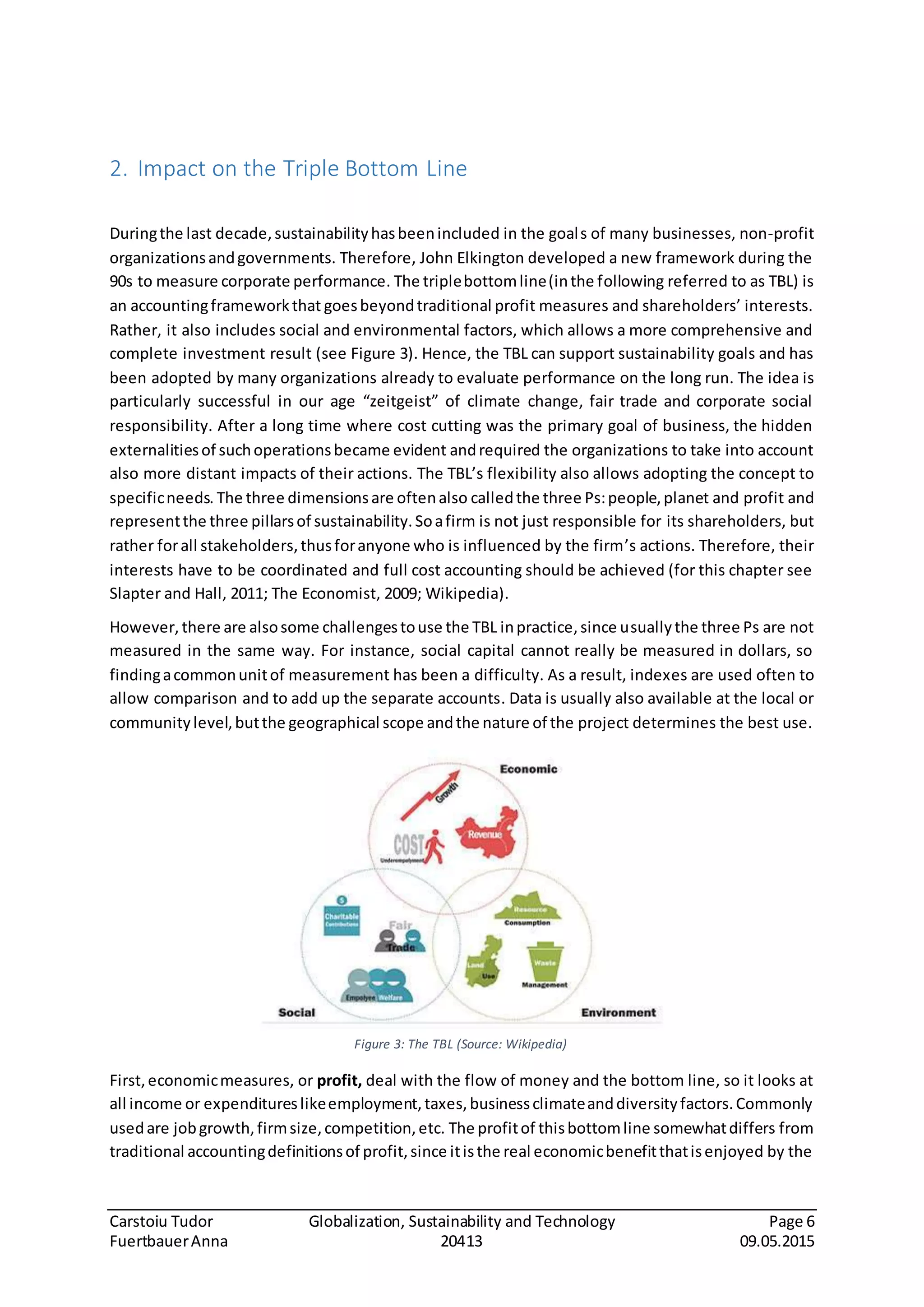
Figure 3: The TBL (Source: Wikipedia)
2. Impact on the Triple Bottom Line
Duringthe last decade,sustainabilityhasbeenincluded in the goals of many businesses, non-profit
organizationsandgovernments. Therefore, John Elkington developed a new framework during the
90s to measure corporate performance. The triplebottomline(inthe following referred to as TBL) is
an accountingframeworkthat goesbeyondtraditional profit measures and shareholders’ interests.
Rather, it also includes social and environmental factors, which allows a more comprehensive and
complete investment result (see Figure 3). Hence, the TBL can support sustainability goals and has
been adopted by many organizations already to evaluate performance on the long run. The idea is
particularly successful in our age “zeitgeist” of climate change, fair trade and corporate social
responsibility. After a long time where cost cutting was the primary goal of business, the hidden
externalitiesof suchoperationsbecame evident andrequired the organizations to take into account
also more distant impacts of their actions. The TBL’s flexibility also allows adopting the concept to
specificneeds. The three dimensionsare oftenalso calledthe three Ps:people,planet and profit and
representthe three pillarsof sustainability.Soafirm is not just responsible for its shareholders, but
rather forall stakeholders,thusforanyone who is influenced by the firm’s actions. Therefore, their
interests have to be coordinated and full cost accounting should be achieved (for this chapter see
Slapter and Hall, 2011; The Economist, 2009; Wikipedia).
However, there are alsosome challengestouse the TBL inpractice,since usuallythe three Ps are not
measured in the same way. For instance, social capital cannot really be measured in dollars, so
findingacommonunitof measurement has been a difficulty. As a result, indexes are used often to
allow comparison and to add up the separate accounts. Data is usually also available at the local or
communitylevel,butthe geographical scope andthe nature of the project determines the best use.
First,economicmeasures, or profit, deal with the flow of money and the bottom line, so it looks at
all income or expenditureslikeemployment,taxes,businessclimateanddiversityfactors.Commonly
usedare jobgrowth,firmsize,competition,etc. The profitof thisbottomline somewhatdiffers from
traditional accountingdefinitionsof profit,since itisthe real economicbenefitthatisenjoyed by the
Carstoiu Tudor Globalization, Sustainability and Technology Page 7
FuertbauerAnna 20413 09.05.2015
hostsociety.Inaddition,the true economicimpact on the environment is included, thus it shall not
be confused with the limited internal profit made by a business.
Second,environmentalmeasures,orplanet, capture the potential impacts on the environment and
itsviability. Businesspracticesshouldbe environmentallysustainable bybenefitingthe natural order.
In case this is not possible, the impact on the environment should be close to zero and at least
minimized. The ecological footprint is crucial here, and this bottom line can include not just air and
water quality but also energy consumption, waste and land cover. It should help the company to
identifythe impactsof aplannedprojectorpolicyandto betteranalyse the long-termtrends.Hence,
some measuresalreadyimplemented include fossil fuel consumption, pollutants, hazardous waste
managementandexcessive nutrients. Thisperspective isalsoconsideringthe complete life cycle of a
product, so from raw material to the disposal of the end user. Therefore, the company may be
required to bear part of the cost of e.g. the ultimate disposal to avoid free riding by society.
Third, social measures, or people, deal with the wellbeing of the community and the region. The
impacton education,equity,healthandaccesstosocial resourcesisimportant,and the organization
should enhance quality of life and social capital. Business practices should be fair and beneficial
toward the workers and inhabitants, so the company should try to give something back. No group
shouldbe exploitedatanypointof the supplychain, anda simple “upstreaming”of negative impacts
is not valid (e.g. outsourcing production to a third country with child labour). Concrete measures
include unemployment rate, poverty, commuting time, crimes and life expectancy which can show
how socially responsible an organization operates.
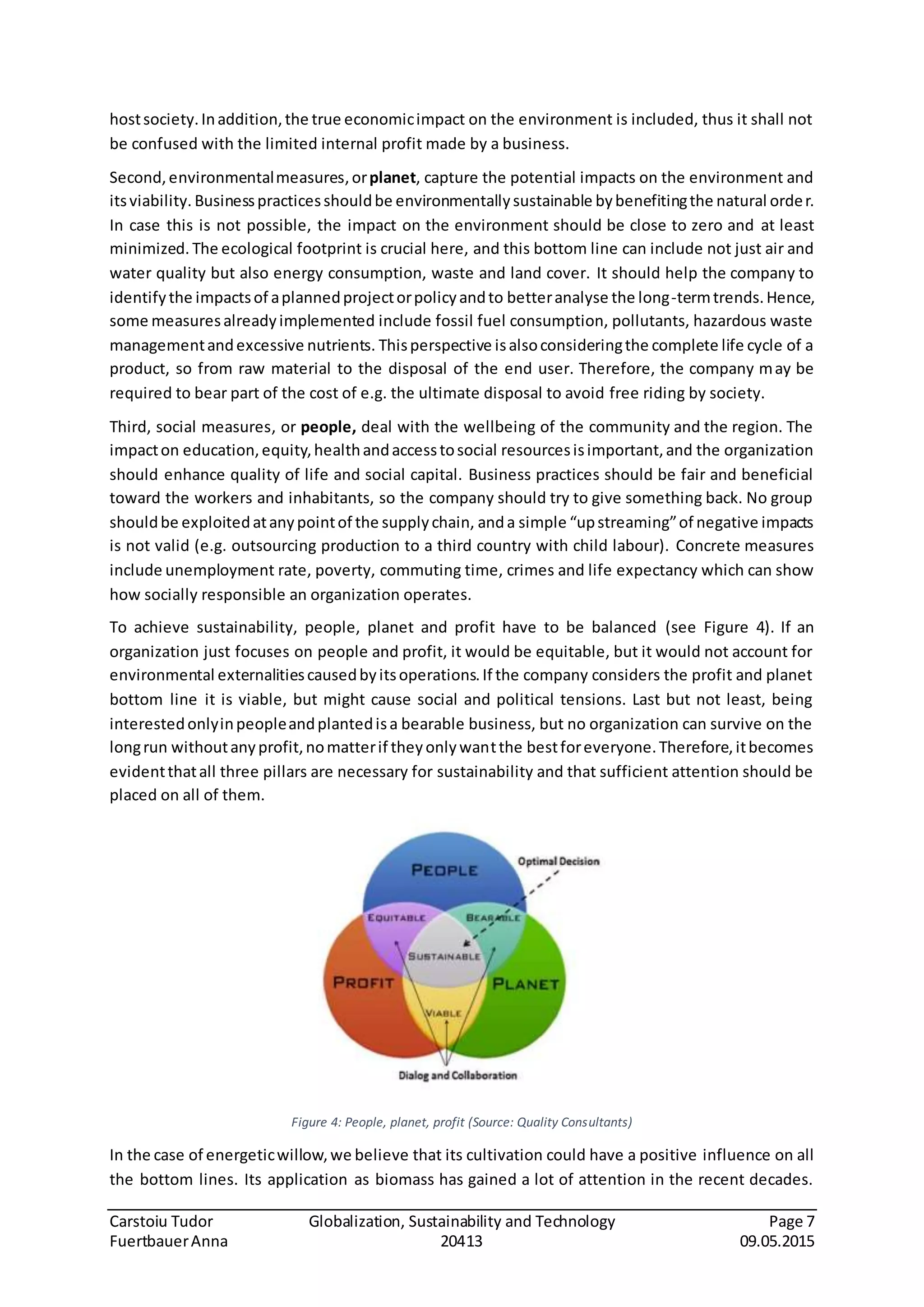
To achieve sustainability, people, planet and profit have to be balanced (see Figure 4). If an
organization just focuses on people and profit, it would be equitable, but it would not account for
environmental externalitiescausedbyitsoperations.If the company considers the profit and planet
bottom line it is viable, but might cause social and political tensions. Last but not least, being
interestedonlyinpeopleandplantedisa bearable business, but no organization can survive on the
longrun withoutanyprofit,nomatterif theyonlywantthe bestforeveryone.Therefore,itbecomes
evidentthatall three pillars are necessary for sustainability and that sufficient attention should be
placed on all of them.
Figure 4: People, planet, profit (Source: Quality Consultants)
In the case of energeticwillow,we believe that its cultivation could have a positive influence on all
the bottom lines. Its application as biomass has gained a lot of attention in the recent decades.
Carstoiu Tudor Globalization, Sustainability and Technology Page 8
FuertbauerAnna 20413 09.05.2015
Variousargumentsfroma social,political andeconomic perspective can be found in the discussion,
mostly pointing out positive aspects (Olejniczak et al., 2011). In order to highlight the benefits, the
following part will analyse the possible impact of cultivating Salix viminalis on Romania’s society,
environment and economic value.
2.1.Social Factors
Energetic willow could have a strong social impact due to multiple factors. Firstly, it could give a
productive use toland that until now didnotserve anypurpose.Asmentionedbefore,the amountof
unproductive land accounts for a total of 2% of Romania, which means that there is a huge social
potential ingivingunderdevelopedareasthe possibilityto exploitbettertheiruntappedresources. It
must be mentioned that especially such areas with unproductive land are the poorest ones, and
manypeople livingonthe countryside struggle economic-wise even though they own large parts of
land. Since energetic willow is very robust and resistant, it allows to exploit those areas that were
untappedbytraditional agriculture.Thisway,the peoplelivinginsuchareaswouldhave anoption to
strengthentheircommunityanditcouldbringabouta revival of the region.People owningsuchland
can earn an additional income by renting it to willow producers or by producing themselves.
Consequently, also other abandoned land will increase in price as land-supply will become scarcer
and demandwill increase. Hence, the economicvalueof the unproductivelandingeneral would rise
by finding a productive use, thus further helping the development of the community. Of course,
energeticwillow isalsoagreatchoice for using the one million hectares of fallow land, which seem
not to be useddue to emigration or too low productivity, and the total impact could be huge. Since
energetic willow can be planted on all types of soil and does not demand such a pretentious
technology, it would be a great choice for Rumanian land that does not yield good returns from
traditional crops of grain. With the help of EU funding programs, farmers could implement such
investments quickly, thus promoting energetic willow as the basis of a sustainable business in
Romania (Murg et al., 2012).
What is more, as energetic willow is not very labour intensive, it can be used just as a convenient
additional source of income foratraditional farmer.Thiswayhe notonlycouldget more moneythan
from some other traditional crops, but he would also be able to diversify risk. Traditional crops
depend strongly on the nature, while willow is quite resistant to external factors. It is a common
problem in agriculture that natural forces can completely destroy the harvest of a whole season,
makingfarminga unsecure andunpredictable business.Hence,energeticwillow can playa bigrole in
securinga minimum annual income and in minimizing exposure to environmental conditions, thus
making farming a more viable alternative to a more secure job in another sector.
This is also strongly related to the next issue, the change from subsistence agriculture to more
lucrative activities. As shown previously, agriculture is transforming a lot lately, and its economic
importance isincreasing.Inthe past,mostpeople inRomaniahadfarmsonlytosupport themselves,
whichmeansthat there were plantingonly enough to have sufficient food throughout the year and
to secure independence. However, those farms are now transforming to either larger-scale
agriculture,ortheyare abandonedcompletely.Planting energeticwillow can be a chance to prevent
such people from moving to cities due to the job situation and in giving them a viable alternative
farming concept that will allow them to transform towards a more productive and profitable
agricultural sector.
Carstoiu Tudor Globalization, Sustainability and Technology Page 9
FuertbauerAnna 20413 09.05.2015
Since harvesting is usually done between November and March, an additional social impact of
energeticwillow isthe creationof more jobs.Normally,people that are employed in agriculture are
confronted with strong seasonality, since the most part of the work has to be done during spring,
summer,andautumn. Consequently,manyare unemployedduringthe lessproductiveseason,which
is a problem that must not be underestimated in a country that has very low wages and that offers
limitedpossibilitiestounskilledpersons.Inaddition, as already available agricultural machinery can
be used, planting Salix viminalis helps people in better using their resources, both labour and
machinery (Murg et al., 2012). Also some new jobs might be created in willow-selling units and in
new energy or heating facilities.
As an example,Romanianvillages can profit by using briquettes, pellets, or just chopped energetic
willow asa safe alternativeenergysource forthe heatingof municipal buildingslike schools etc. This
way,theywill notonlysave money ascomparedto heatingwithotherenergy sources than biomass,
but it will also reduce the hard labour required for transforming wood for heating. Wood was the
most common way of heating so far, thus involving a lot of work and discomfort. Salix viminalis,
however,wouldbe amore convenient way of securing energy independence and hence increasing
qualityof life, especially in remote areas. Installing a district heating plant can be a very cheap and
efficient way to provide heating for houses since the heat created by burning the chips is used
directly and does not have to be converted in a different form of energy before.
In a nutshell,it is clear that the Romanian society would profit a lot from planting energetic willow
and that it can foster regional development. Not only jobs and additional income would be
generated, but also the value of land increases and efficient heating can be secured. In addition, it
can supportthe current transformationsinagriculture andsecure amore effective use of resources.
2.2.Environmental Factors
In general,energeticwillowhasbeendeveloped to serve as a green energy source. Its high calorific
value of 4,900 kcal/kgmakesita real greenalternative tootherfuel sourcessuchasnatural gas, coal,
and oil that have a very strong negative impact on the environment. For instance, the amount of
energy that can be derived from 1,000 kg of dry energetic willow is comparable to 700 kg of high-
quality black coal. However, it is known that black coal causes huge, irreversible environmental
damages, which are an important issue nowadays. Consequently, the use of Salix viminalis for
energetic purposes should be increased (Olejniczak et al., 2011). Of course there are also other
renewable energysourcesavailable,butmanyof themstill include some inconveniencies and trade-
offs.Energeticwillow,however, hasacalorificvalue thatisevenhigher than oak (3,460 kcal/kg), and
so a lowerquantityof woodmaterial hastobe burnedfor the same heating result. Therefore, it can
provide a very efficient alternative solution that minimizes negative connotations associated with
changing energy supply. Using Salix viminalis in Romania is the first step to securing a right
development towards more green energy sources and an independent and sustainable energy
supply. Especially the easy and cheap investment is a big advantage for a country that still has to
struggle withalowereconomicdevelopment. Assuming that 20,000 ha are planted in Romania, one
could get as much as 1,000,000 tonnes of pellets and a heat source of 4,900,000 Gcal energy per
year, providing green heating for more than 145,000 apartments (Murg et al., 2012).
Furthermore, combustion emissions are close to zero. “Salix viminalis cultivation has a positive
influenceonthe environmentsince theirhighmass productivity per hectare is definitely associated
withCO2 absorptionfromthe atmosphere”(Olejniczaketal., 2011, p.206). Consideringthis, itcanbe
Carstoiu Tudor Globalization, Sustainability and Technology Page 10
FuertbauerAnna 20413 09.05.2015
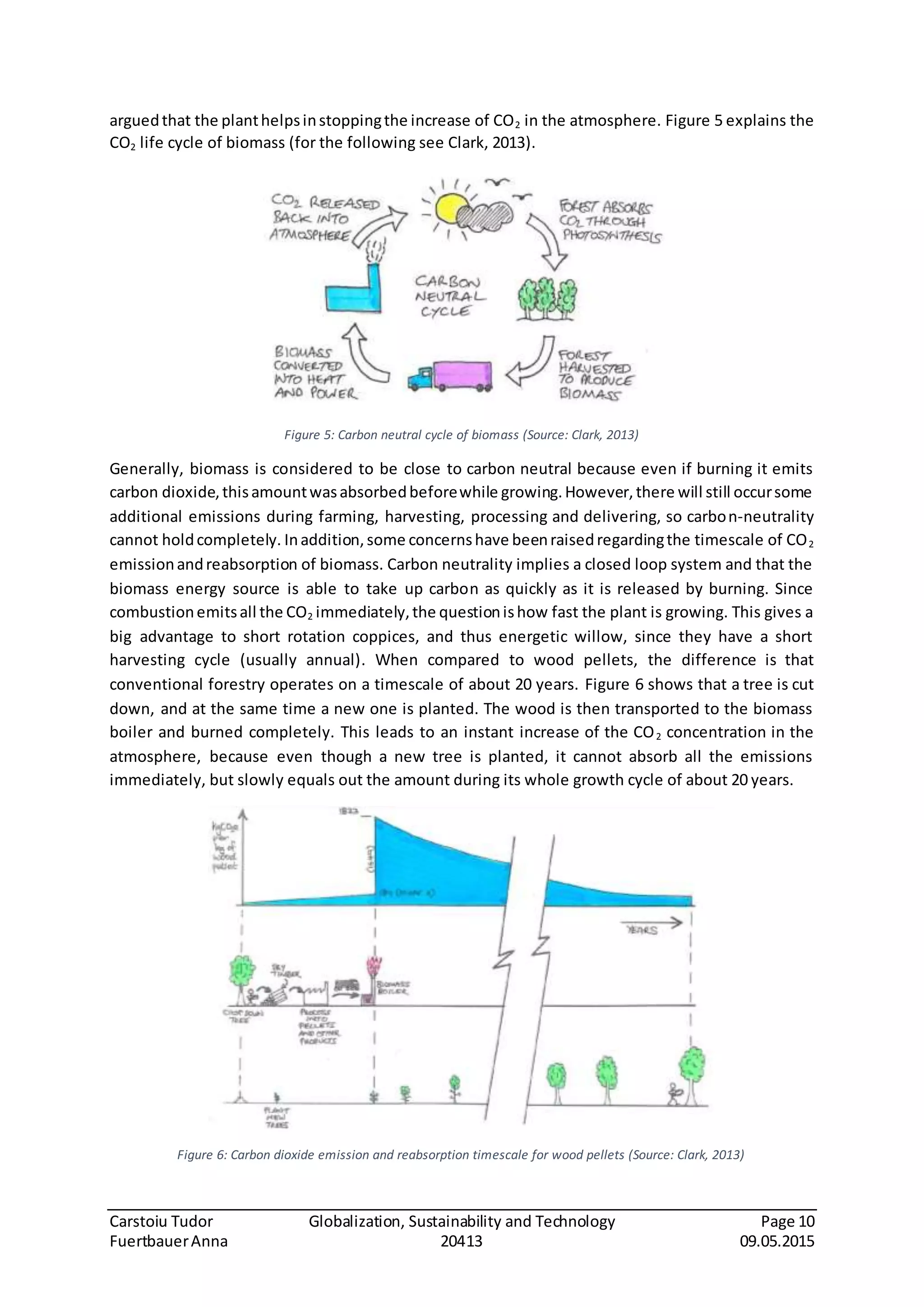
arguedthat the planthelpsinstoppingthe increase of CO2 in the atmosphere. Figure 5 explains the
CO2 life cycle of biomass (for the following see Clark, 2013).
Figure 5: Carbon neutral cycle of biomass (Source: Clark, 2013)
Generally, biomass is considered to be close to carbon neutral because even if burning it emits
carbon dioxide,thisamountwasabsorbedbeforewhile growing.However,there will still occursome
additional emissions during farming, harvesting, processing and delivering, so carbon-neutrality
cannot holdcompletely. Inaddition,some concernshave beenraisedregardingthe timescale of CO2
emissionandreabsorption of biomass. Carbon neutrality implies a closed loop system and that the
biomass energy source is able to take up carbon as quickly as it is released by burning. Since
combustionemitsall the CO2 immediately,the questionishow fast the plant is growing. This gives a
big advantage to short rotation coppices, and thus energetic willow, since they have a short
harvesting cycle (usually annual). When compared to wood pellets, the difference is that
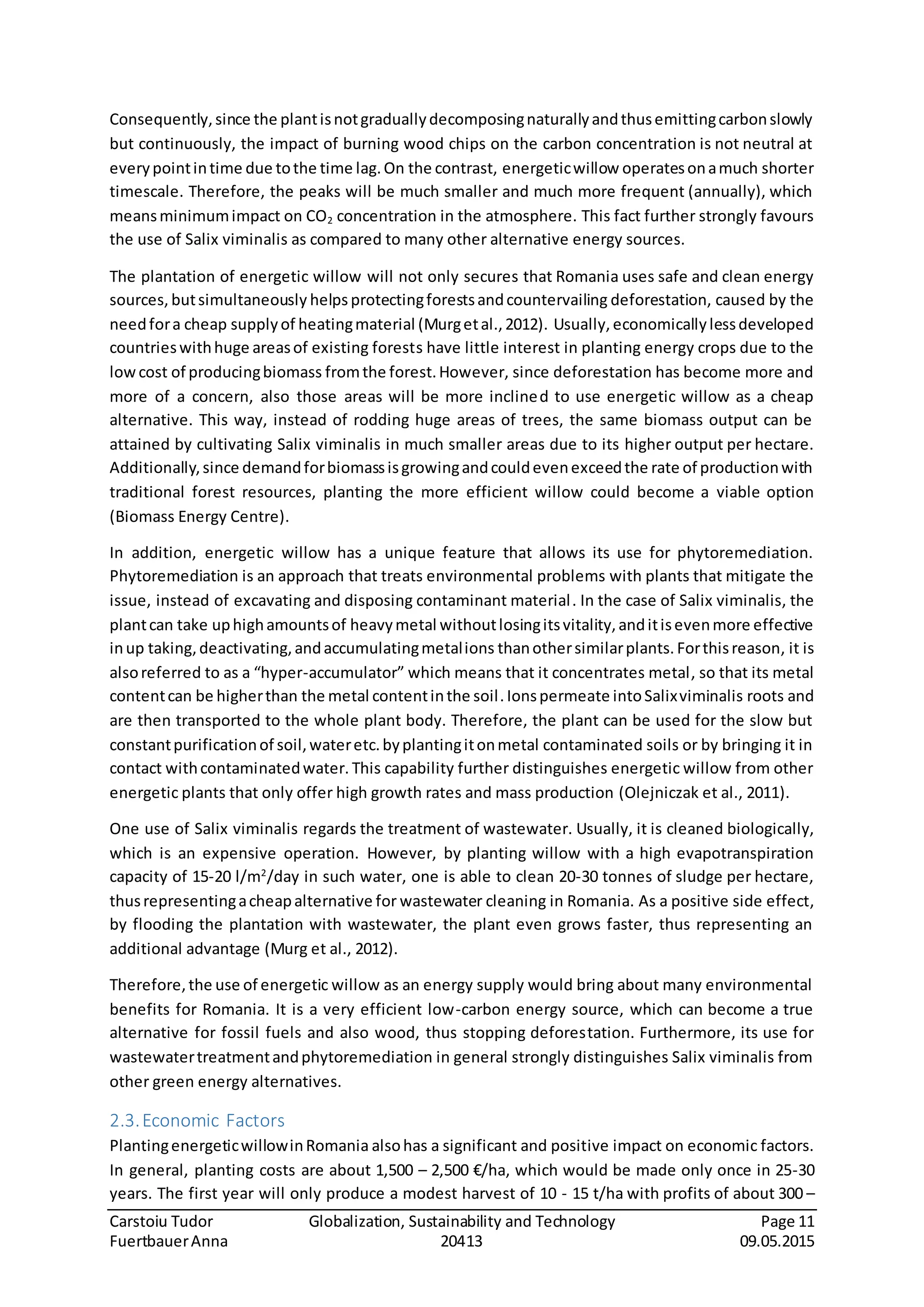
conventional forestry operates on a timescale of about 20 years. Figure 6 shows that a tree is cut
down, and at the same time a new one is planted. The wood is then transported to the biomass
boiler and burned completely. This leads to an instant increase of the CO2 concentration in the
atmosphere, because even though a new tree is planted, it cannot absorb all the emissions
immediately, but slowly equals out the amount during its whole growth cycle of about 20 years.
Figure 6: Carbon dioxide emission and reabsorption timescale for wood pellets (Source: Clark, 2013)
Carstoiu Tudor Globalization, Sustainability and Technology Page 11
FuertbauerAnna 20413 09.05.2015
Consequently,since the plantisnotgraduallydecomposingnaturallyandthusemittingcarbonslowly
but continuously, the impact of burning wood chips on the carbon concentration is not neutral at
everypointintime due tothe time lag.On the contrast, energeticwillow operatesonamuch shorter
timescale. Therefore, the peaks will be much smaller and much more frequent (annually), which
meansminimumimpact on CO2 concentration in the atmosphere. This fact further strongly favours
the use of Salix viminalis as compared to many other alternative energy sources.
The plantation of energetic willow will not only secures that Romania uses safe and clean energy
sources, butsimultaneously helps protectingforestsandcountervailing deforestation, caused by the
needfora cheap supplyof heatingmaterial (Murgetal.,2012). Usually, economicallylessdeveloped
countrieswithhuge areasof existing forests have little interest in planting energy crops due to the
lowcost of producingbiomass fromthe forest.However, since deforestation has become more and
more of a concern, also those areas will be more inclined to use energetic willow as a cheap
alternative. This way, instead of rodding huge areas of trees, the same biomass output can be
attained by cultivating Salix viminalis in much smaller areas due to its higher output per hectare.
Additionally,since demandforbiomassisgrowingandcouldevenexceedthe rate of productionwith
traditional forest resources, planting the more efficient willow could become a viable option
(Biomass Energy Centre).
In addition, energetic willow has a unique feature that allows its use for phytoremediation.
Phytoremediation is an approach that treats environmental problems with plants that mitigate the
issue, instead of excavating and disposing contaminant material. In the case of Salix viminalis, the
plantcan take uphighamountsof heavymetal withoutlosingitsvitality,anditisevenmore effective
inup taking,deactivating,andaccumulatingmetalions thanothersimilarplants. Forthisreason, it is
alsoreferred to as a “hyper-accumulator” which means that it concentrates metal, so that its metal
contentcan be higherthan the metal contentinthe soil.Ionspermeate intoSalixviminalis roots and
are then transported to the whole plant body. Therefore, the plant can be used for the slow but
constantpurificationof soil,wateretc.byplantingitonmetal contaminated soils or by bringing it in
contact withcontaminatedwater. This capability further distinguishes energetic willow from other
energetic plants that only offer high growth rates and mass production (Olejniczak et al., 2011).
One use of Salix viminalis regards the treatment of wastewater. Usually, it is cleaned biologically,
which is an expensive operation. However, by planting willow with a high evapotranspiration
capacity of 15-20 l/m2
/day in such water, one is able to clean 20-30 tonnes of sludge per hectare,
thusrepresentingacheapalternative for wastewater cleaning in Romania. As a positive side effect,
by flooding the plantation with wastewater, the plant even grows faster, thus representing an
additional advantage (Murg et al., 2012).
Therefore,the use of energetic willow as an energy supply would bring about many environmental
benefits for Romania. It is a very efficient low-carbon energy source, which can become a true
alternative for fossil fuels and also wood, thus stopping deforestation. Furthermore, its use for
wastewatertreatmentandphytoremediation in general strongly distinguishes Salix viminalis from
other green energy alternatives.
2.3.Economic Factors
PlantingenergeticwillowinRomania alsohas a significant and positive impact on economic factors.
In general, planting costs are about 1,500 – 2,500 €/ha, which would be made only once in 25-30
years. The first year will only produce a modest harvest of 10 - 15 t/ha with profits of about 300 –
Carstoiu Tudor Globalization, Sustainability and Technology Page 12
FuertbauerAnna 20413 09.05.2015
400 €/ha. However, under the favourable conditions in Romania (meaning intensive water supply)
production can reach up to 60 t/ha starting from the second year. This will lead to annual profits of
1500-1600 €/ha, withonlyminorcosts (200€/ha/year) and care required (Admin, 2012; SalixEnergi).
In addition, despite of the initial investment for the planting, investment is rather low, especially
since traditional agriculturalequipment can be used with just slight adaptations (Murg et al., 2012).
As mentioned, Salix viminalis is very robust and not labour intensive. Therefore, its cultivation
deliversasafe andsecure income withminimumworkandcan provide aviable businessopportunity
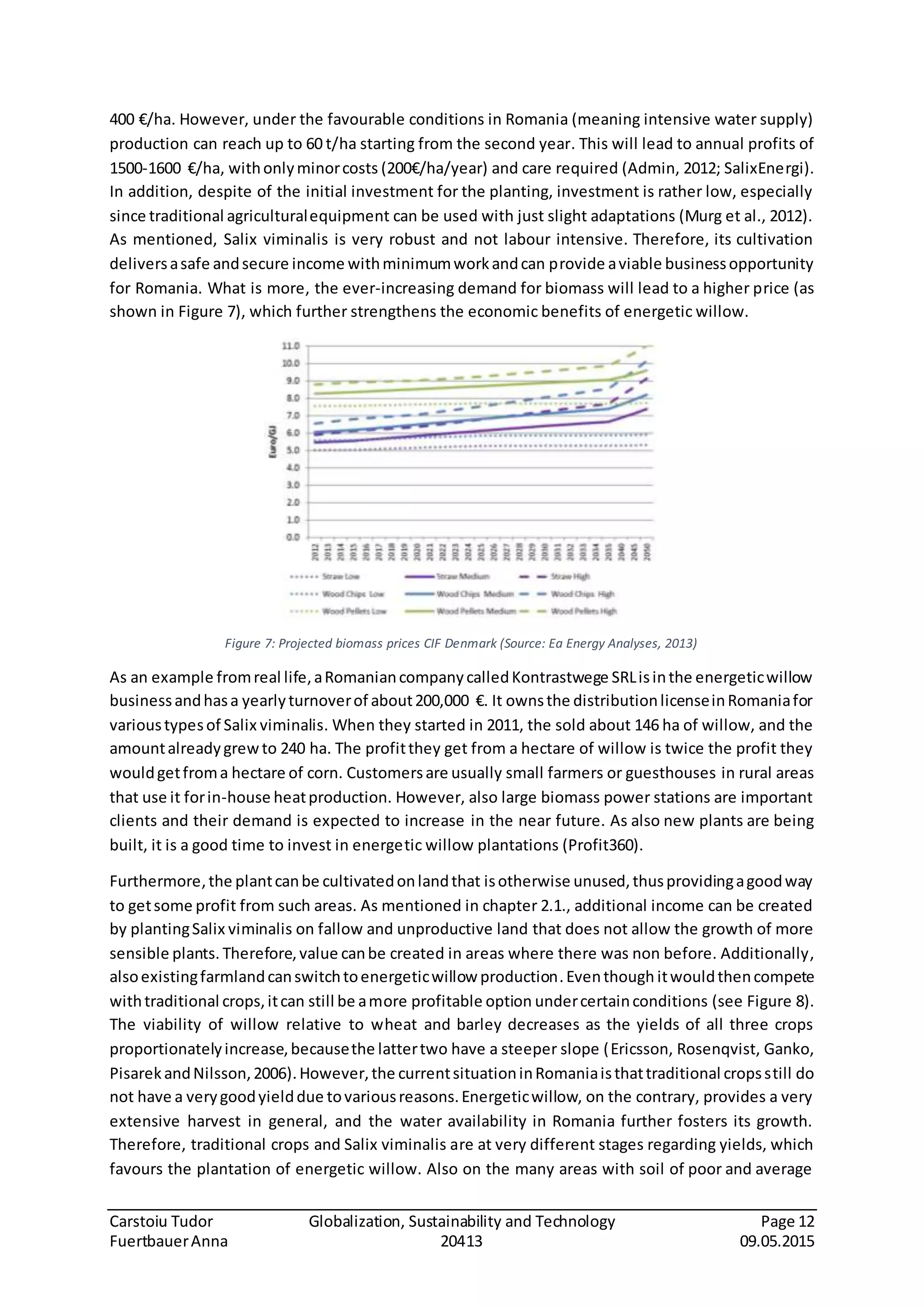
for Romania. What is more, the ever-increasing demand for biomass will lead to a higher price (as
shown in Figure 7), which further strengthens the economic benefits of energetic willow.
Figure 7: Projected biomass prices CIF Denmark (Source: Ea Energy Analyses, 2013)
As an example fromreal life,aRomaniancompanycalledKontrastwege SRLisinthe energeticwillow
businessandhasa yearlyturnoverof about200,000 €. It ownsthe distributionlicenseinRomaniafor
varioustypesof Salix viminalis. When they started in 2011, the sold about 146 ha of willow, and the
amountalreadygrewto 240 ha. The profitthey get from a hectare of willow is twice the profit they
wouldgetfroma hectare of corn. Customersare usually small farmers or guesthouses in rural areas
that use it forin-house heatproduction. However, also large biomass power stations are important
clients and their demand is expected to increase in the near future. As also new plants are being
built, it is a good time to invest in energetic willow plantations (Profit360).
Furthermore,the plantcanbe cultivatedonlandthat isotherwise unused,thusprovidingagoodway
to getsome profit from such areas. As mentioned in chapter 2.1., additional income can be created
by plantingSalix viminalis on fallow and unproductive land that does not allow the growth of more
sensible plants. Therefore,value canbe created in areas where there was non before. Additionally,
alsoexistingfarmlandcanswitchtoenergeticwillow production.Eventhough itwouldthencompete
withtraditional crops,itcan still be amore profitable option undercertainconditions (see Figure 8).
The viability of willow relative to wheat and barley decreases as the yields of all three crops
proportionatelyincrease,becausethe lattertwo have a steeper slope (Ericsson, Rosenqvist, Ganko,
PisarekandNilsson,2006).However,the currentsituationinRomaniaisthattraditional cropsstill do
not have a verygoodyielddue tovariousreasons.Energeticwillow, on the contrary, provides a very
extensive harvest in general, and the water availability in Romania further fosters its growth.
Therefore, traditional crops and Salix viminalis are at very different stages regarding yields, which
favours the plantation of energetic willow. Also on the many areas with soil of poor and average
Carstoiu Tudor Globalization, Sustainability and Technology Page 13
FuertbauerAnna 20413 09.05.2015
quality(fallowandunproductiveland) referred to above, it is the best option to revive such land by
the cultivation of willow instead of other crops.
Another interesting use of energetic willow is its plantation along roads. In the county of Arad in
Romania, about 3000 roadside trees have been cut down three years ago because they were
regardedas a dangerto traffic.Therefore,the countycouncil isnow planningtouse Salix viminalis as
fast-growingplantsnexttoroadsnot onlyto getbriquettesorpelletsforheating,butalsoto prevent
snowdrifts on the road during blizzards, thus making roads more secure and accessible in winter.
What is more, in case of an accident the plant is also less dangerous than trunks of other trees due
the willow’s shape. The first test was on a 20 km long route between Semlac and Nădlac, and now
the county decided to invest about 112,000 € in the expansion of the project to an area of about 67
hectares.Witha price of 50 €/ton,and each hectare producinganaverage of 40 tonnes of wood, the
costs shouldbe recoveredafterthe first harvest in two years and the country is able to generate an
additional income fromroadsidesthathave beenunproductive so far. Additionally, as a by-product,
the project seems to be positively affecting society’s security for no cost (Sinka, 2013).
What is more, if willow is cultivated on sufficiently large areas (1,000 - 1,500 ha) it makes even the
investmentinapelletsplantfeasible. This way, a cheap alternative energy source for cities and the
central heatingof theirhouses canbe installed (Murgetal.,2012). However,if nosuchpellets plants
are available,itismore economictouse justcoppedenergeticwillow. When comparing the costs of
producing one kWh of energy (see Figure 9), it becomes clear that all end-users can save a lot of
money by using energetic willow for heating, and that wood, gas and diesel can be successfully
replaced in Romania (Dezsi and Dozescu).
0.00
0.10
0.20
0.30
0.40
0.50
0.60
Minced energy willow -30%
humidity
Deciduous wood -20%
humidity
Wood briquette -18%
humidity
Pellets Liquid fuel
Produced energy unit price [lei/kWh]
Figure 8: Annual gross margin per ha for wheat and barley (Source: Ericsson et al., 2006)
Figure 9: Produced energy unit price (Source: own diagram based on Dezsi and Dozescu)
Carstoiu Tudor Globalization, Sustainability and Technology Page 14
FuertbauerAnna 20413 09.05.2015
All of thisshowsthat economicadvantagesof energetic willow are numerous. Not only farmers can
get a sustainable income, but also end-users profit from a lower price for heating. In addition, also
the cheap wastewater treatment mentioned in 2.2 and a general economic upswing due to an
increasing price of land can benefit Romania economic-wise
3. Concluding Remarks
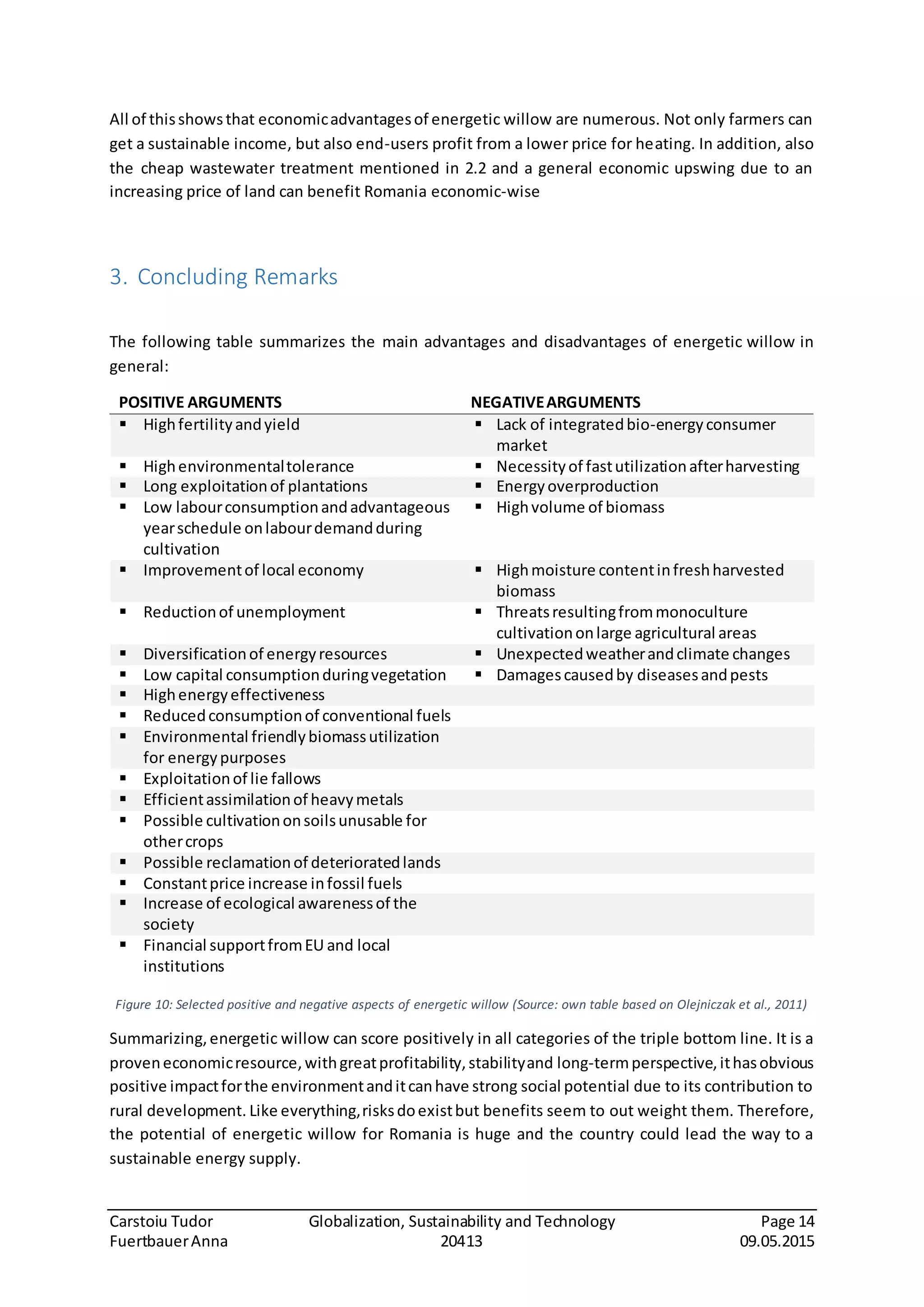
The following table summarizes the main advantages and disadvantages of energetic willow in
general:
POSITIVE ARGUMENTS NEGATIVEARGUMENTS
 Highfertilityandyield  Lack of integratedbio-energyconsumer
market
 Highenvironmentaltolerance  Necessityof fastutilizationafterharvesting
 Long exploitationof plantations  Energyoverproduction
 Low labourconsumptionandadvantageous
yearschedule onlabourdemandduring
cultivation
 Highvolume of biomass
 Improvementof local economy  Highmoisture contentinfreshharvested
biomass
 Reductionof unemployment  Threatsresultingfrommonoculture
cultivationonlarge agricultural areas
 Diversificationof energyresources  Unexpectedweatherandclimate changes
 Low capital consumptionduringvegetation  Damagescausedby diseasesandpests
 Highenergyeffectiveness
 Reducedconsumptionof conventional fuels
 Environmental friendlybiomassutilization
for energypurposes
 Exploitationof lie fallows
 Efficientassimilationof heavymetals
 Possible cultivationonsoilsunusable for
othercrops
 Possible reclamationof deterioratedlands
 Constantprice increase infossil fuels
 Increase of ecological awarenessof the
society
 Financial supportfromEU and local
institutions
Figure 10: Selected positive and negative aspects of energetic willow (Source: own table based on Olejniczak et al., 2011)
Summarizing,energetic willow can score positively in all categories of the triple bottom line. It is a
proveneconomicresource,withgreatprofitability,stabilityand long-termperspective,ithasobvious
positive impactforthe environmentanditcanhave strong social potential due to its contribution to
rural development. Like everything,risksdoexistbut benefits seem to out weight them. Therefore,
the potential of energetic willow for Romania is huge and the country could lead the way to a
sustainable energy supply.
Carstoiu Tudor Globalization, Sustainability and Technology Page 15
FuertbauerAnna 20413 09.05.2015
Thinking also about the geopolitical conditions of Romania and Europe in general, it can be noted
that there is an increased pressure for energetic independence, and energetic willow can support
also this matter. Political tensions and scarcity of resources has intensified, making Europe more
dependentthaneverbefore.Consequently, projects like this are very appreciated by governments
and society in general.
Finallyyetimportantly,underthe trendof continuouslyincreasingcostsof traditional energy sources
like oil,gas, andwood, butalso considering its multiple uses, experts say the demand for energetic
willow demandcanjustincrease. Hence,itwill have averyinterestingfuture asanefficientandclean
energy source, especially in light of climate change policies and the worldwide trend of increasing
sustainability efforts (Murg et al., 2012).
Carstoiu Tudor Globalization, Sustainability and Technology Page 16
FuertbauerAnna 20413 09.05.2015
4. References
Admin,l.(29 January 2012). Growing energeticwillow “Salix viminalis energo”.Retrievedfrom
http://3businessideas.blogspot.it/2012/01/growing-energy-willow-salix-viminalis.html
Arora,A.; Fosfuri,A.; Gambardella,A.(2001). SpecializedTechnologySuppliers,International
SpilloversandInvestments:Evidencefromthe Chemical Industry. Journal of DevelopmentEconomics
65 (1), 31-54.
Agriculture andRural Development(2February2009). "HealthCheck"of the CommonAgricultural
Policy.Retrievedfromhttp://ec.europa.eu/agriculture/healthcheck/index_en.htm
BiomassEnergyCentre.Retrievedfrom
http://www.biomassenergycentre.org.uk/portal/page?_pageid=76,15049&_dad=portal (lastaccess
08.11.2014)
Borz, S.;Dreczeni,R.;Popa,B.; Nita,M. (2013). Regional Profile of the BiomassSectorinRomania.
Retrievedfrom http://www.foropa.eu/files/country_reports/country%20report%20romania.pdf
Bresnahan,T.;Gambardella,A.(1998). The Divisionof Inventive Labor andthe Extentof the Market.
In Helpman,E.(ed.). General Purpose TechnologiesandEconomicGrowth.Cambridge:MITPress,
253-281.
Clark,D. (2013). CO2 emissionsfrombiomassandbiofuels.Retrievedfrom
http://www.cundall.com/Cundall/fckeditor/editor/images/UserFilesUpload/file/WCIYB/IP-4%20-
%20CO2e%20emissions%20from%20biomass%20and%20biofuels.pdf
Cristescu,A.(28 March 2012). Ciulinii Romaniei! Catterendegradateste infiecare judet.TOP
national!Retrievedfrom http://old.econtext.ro/dosar--2/analiza/ciulinii-romaniei-cat-teren-
degradat-este-in-fiecare-judet-top-national.html
Dezsi,A.;Dozescu,S. Energeticwillow–Anadvantageousfuel forbiomasspowerplants.Retrieved
fromhttp://www.energy-cie.ro/archives/2011/3.8-dezsi_2.pdf
Ea EnergyAnalyses(2013).Analysisof biomassprices.Retrievedfrom
http://www.ens.dk/sites/ens.dk/files/undergrund-forsyning/vedvarende-energi/bioenergi/analyse-
bioenergi-danmark/analysis_of_biomass_prices_2013.06.18_-_final_report.pdf
Ekardt, F.;von Bredow,H.(2011). Managingthe ecological andsocial ambivalencesof bioenergy:
Sustainabilitycriteriaversusextendedcarbonmarkets.InLeal Filho,W.(ed.).The economic,social
and political elementsof climate change. Berlin:Springer,455-480.
Ericsson,K.;Rosenqvist,H.;Ganko,E.; Pisarek,M.;Nilsson,L.(2006). Anagro-economicanalysisof
willowcultivationinPoland.BiomassandBioenergy,30 (1),16-27.
EUR-Lex (6 February2014). Promotionof the use of energyfromrenewable sources.Retrieved from
http://eur-lex.europa.eu/legal-content/EN/TXT/?qid=1415638710312&uri=URISERV:en0009
Murg, O.; Martin, S.;Abraham,I.; Mateoc,T. (2012). The energeticwillowsolutionforagriculture,
energyandenvironment. Lucrări Ştiinţifice,Universitateade ŞtiinţeAgricole Şi MedicinăVeterinarăa
Banatului,Timisoara,SeriaI,ManagementAgricol,14(1), 527-540.
Carstoiu Tudor Globalization, Sustainability and Technology Page 17
FuertbauerAnna 20413 09.05.2015
Olejniczak,A.;Cyganiuk,A.;Kucinska,A.;Łukaszewicz,J.(2011). EnergeticWillow (Salixviminalis)–
Unconventional Applications, SustainableGrowthandApplications.InM.Nayeripour(Ed.)
RenewableEnergy Sources,InTech.Available from:http://www.intechopen.com/books/sustainable-
growth-and-applications-in-renewable-energy-sources/energetic-willow-salix-viminalis-
unconventional-applications
Profit360. Retrievedfrom http://www.business-in-romania.com/startup/energetic-willow-business-
worth-200-000-euros-year
QualityConsultants.Triple bottomline approach(TBL).Retrievedfromhttp://www.quality-
consult.com/index.php?site=triplebottom
RebinaGroupRomania.Retrievedfrom http://www.rebina.ro/en/
SalixEnergi.Retrievedfromhttp://www.salixenergi.se/Seedproducers
Sinka,P.(17 December2013). Energeticwillows,plantedtoprotectroadsfrom blizzardsinWestern
Romania.Retrievedfromhttp://www.romania-insider.com/energy-willows-planted-to-protect-
roads-from-blizzards-in-western-romania/111682/
Slaper,T.;Hall,T. (2011). The Triple BottomLine:WhatIs It andHow DoesIt Work? IndianaBusiness
Review,86(1), 4-8.
Summa,H. (28 November2008).Europeanpoliciestopromote energycrops.EUBIONET,Brussel.
Retrievedfrom
http://www.biomassenergycentre.org.uk/portal/page?_pageid=77,15133&_dad=portal&_schema=p
ortal
The Economist(17 November2009).Triple bottomline.Retrievedfrom
http://www.economist.com/node/14301663
Wikipedia.Triple bottomline.Retrievedfromhttp://en.wikipedia.org/wiki/Triple_bottom_line
Ziarul Financiar(10 January2014). ZF: Agriculturaa facut istorie in2013. Ce a produsRomaniacel
mai multanul trecut.Retrievedfromhttp://stirileprotv.ro/stiri/financiar/zf-agricultura-a-facut-
istorie-in-2013-cum-a-ajuns-romania-sa-sperie-tarile-dezvoltate-din-ue.html

Energetic Willow in Romania_Final_V0

  • 1.
    Energetic Willow in Romania 2014/15 IMPACTSONTHE TRIPLEBOTTOMLINE ANNA FUERTBAUER AND TUDOR CARSTOIU 20413 - GLOBALIZATION, SUSTAINABILITY AND TECHNOLOGY
  • 2.
    Carstoiu Tudor Globalization,Sustainability and Technology Page I FuertbauerAnna 20413 09.05.2015 Table of Contents 1. Introduction.......................................................................................................................... 1 1.1. EU Policies..................................................................................................................... 2 1.2. Preconditions in Romania............................................................................................... 3 2. Impact on the Triple Bottom Line............................................................................................ 6 2.1. Social Factors................................................................................................................. 8 2.2. Environmental Factors.................................................................................................... 9 2.3. Economic Factors..........................................................................................................11 3. Concluding Remarks..............................................................................................................14 4. References ...........................................................................................................................16
  • 3.
    Carstoiu Tudor Globalization,Sustainability and Technology Page II FuertbauerAnna 20413 09.05.2015 Table of Figures Figure 1: Energy crop premium (Source: Summa, 2008)................................................................... 3 Figure 2: Licensed producers and distributorsin Europe (Source: SalixEnergi)................................... 4 Figure 3: The TBL (Source: Wikipedia)............................................................................................. 6 Figure 4: People, planet, profit (Source: Quality Consultants)........................................................... 7 Figure 5: Carbon neutral cycle of biomass(Source: Clark, 2013) ......................................................10 Figure 6: Carbon dioxideemissionandreabsorptiontimescale forwoodpellets(Source:Clark,2013) ...................................................................................................................................................10 Figure 7: Projected biomass prices CIF Denmark (Source: Ea Energy Analyses, 2013)........................12 Figure 8: Annual gross margin per ha for wheat and barley (Source: Ericssonet al., 2006) ................13 Figure 9: Produced energy unit price (Source: own diagram based on Dezsi and Dozescu)................13 Figure 10: Selectedpositive andnegative aspectsof energeticwillow (Source:owntable basedon Olejniczaket al., 2011) .................................................................................................................14
  • 4.
    Carstoiu Tudor Globalization,Sustainability and Technology Page 1 FuertbauerAnna 20413 09.05.2015 1. Introduction In recent years, the search for new green energy sources has been intensified due to an increasing awareness of environmental problems and climate change caused by traditional energy sources. Therefore,politicshave introducedmeasuresandpoliciestoattaina more sustainable energysupply by directingresearchtowardsdifferenttypesof unconventionalenergy sources. Great success could be achieved from solar, wind and heat pump (Murg, Martin, Abraham and Mateoc, 2012). Anotherpossiblesolutionsdiscussedisbiomass,whichreferstoplants or plant-based materials that can be usedasan energysource. Thereby, eitherbiomassis burned directly for producing heat, or it can be utilized indirectly by converting it into different forms of biofuels. Wood is still the most popular biomass energy source, but also other plants are used, including hemp, corn, willow, bamboo, palm, and sugarcane (Biomass Energy Centre; Murg et al., 2012). The bestresultscouldbe obtainedbywillow.Those plantsare quite popularespecially the Northern Hemisphere, and there are different types according to local climate conditions (Olejniczak, Cyganiuk, Kucinska and Łukaszewicz, 2011). They form part of short-rotation energy crops that are specifically grown to maximize the output her hectare with low input and overcome the disadvantage of a long time scale of conventional forestry. Traditional forest plants can only be harvestedafter3-5 years,butenergeticwillow canbe harvested each year, thus representing a safe and secure energysource. All the differentvarietiesof willow are specifically bred to be well suited for the use as energy sources (Biomass Energy Centre; Murg et al., 2012). Energeticwillow(Salix viminalis,commonosier,basketwillow) is a plant which belongs to the SRWC group(ShortRotationWoodyCrops) and it isreferredtoas a “greenfuel”.Salix viminalis is originally from Sweden, where it already is cultivated on over 50,000 ha, and prefers colder areas and moist soil. Due to its fast growth of 3-3.5 cm per day and a productivity of about 50 tons per ha, it can be cut frequently anditisusedfordirectcombustionfor heat and electricity or to obtain solid biomass like pellets and briquettes. In addition, the high calorific value of about 4900 kcal/kg makes it an especially efficientenergysource. Furthermore,itisveryrobust,resistanttovariousdiseases, can be planted on hillsides, and it adapts easily to all types of soil, including wetlands and flood plains. Therefore,itcanbe cultivatedevenonpermanentor periodic swampy land. (Olejniczak et al., 2011; Murg et al., 2012). In general,the life of a Salix viminalis plantation is approximately 25-30 years. Only during the first year, the plantrequiressome special care,and inthe firstwinteritisusuallycut back to ground level inorder to fosterthe growthof multiple stems. Beginning from the second year, however, it grows very fast without any other substantial intervention. This and low investments per hectare (about 2,000€) make the plantveryconvenient.Inaddition,once it is planted, it will yield a profit of 2,800€ perhectare in onlytwoyears,thuspresentingalow-cost, basicallyrisk-free and non-labour-intensive business opportunity.Hence,energeticwillow can be very profitable even in small areas for energy independence and consumption (Murg et al., 2012; Biomass Energy Centre). Usually,harvesttime isin winter after leaf fall, between November and March. Yield, around 40-60 t/ha of dry material, depends not just on the site, but also on water availability, weed control, plantingdensity,light,andtemperature.Harvestingmaybe as rods, billets or chips. Since crops also
  • 5.
    Carstoiu Tudor Globalization,Sustainability and Technology Page 2 FuertbauerAnna 20413 09.05.2015 can be harvestedwith justslightlyadopted traditional agriculture machines, the stock of labour and machinerycanbe betterexploited.Afterthe harvest,the watercontentof willow chips decreases to 14-16% within months, thus they can be processed without artificial drying. However, chips may cause some problems regarding storage due to a loss of energy content caused by fast composting and due to possible mould formation. (Murg et al., 2012; Biomass Energy Centre). A commonform of using energetic willow chips is converting it to briquettes for heating. This way, the biomass is mechanically or hydraulically compressed to reduce its size and to get a compact product with a high calorific value, without losing any material. Theses cylindrical, hexagonal or rectangularproductsevencontainmore calorificvalue thanbeechwood,whichallowscost saving of 60% compared to gas heating and 40% compared to heating with wood. The combination of low production costs with a huge demand make it a viable business option. It is obvious that people wouldprefertobuyone ton of ready-to-use briquettes instead of getting 1.5 to 2 tons of wood that still needs a lot of work before it can be burned (Murg et al., 2012). 1.1.EU Policies Shortage of fossil energy sources such as oil, gas and coal, as well as environmental considerations have made renewable energy sources an interesting alternative for energy production. However, since those green alternatives still have some inconveniencies for both producers and consumer, investmentsare not as high as desired. Therefore, states have decided to intervene for the sake of environmental protection and energy independence. In 2003, the EU started giving direct subsidies to farmers that cultivate biomass to support environmental protection measures. The EC Regulation No. 1782/2003 granted a financial aid of 45 €/ha for biomass producers if the crop is covered by a contract between the farmer and the processingindustryorif the farmer himself processesit.The total amount was limited to 1.5 million hectares, but it was raised to 2.0 million hectares in 2006. In case there would be too many applications, the regulation suggested a pro-rata deduction. As it can be seen in Figure 1, Romania was one of the countriesthatusedmost thissubsidy. However,asthis energy crop bonus was a very controversial issue,the EUstoppedit.Nowadays,suchfarmersare onlyeligible for the general single farm payment also according EC Regulation No. 1782/2003, if they follow certain conditions and rules,suchas a minimumholdingsizeof one hectare usedfor agricultural activity and meeting cross compliance standards (Ekardt and Bredow, 2011). In addition,the CAP(CommonAgricultural Policy) includesother mechanisms to support the growth of energeticwillowincludingtrainingof farmersandinvestmentsupporttoprocessingactivities. The Rural Development programs also provides the possibility of supporting investments and infrastructure related to short rotation energy crops, thus providing funding for a broad range of activities (Summa, 2008). The “health check” of the CAP in 2008 proposed that money should be shiftedfromdirectaidtoRural Development.All farmersgettingmore than 5,000 € in direct aid only get90% of this amount since 2012. With this money, the Member States can reinforce programmes related to renewables, and it is co-financed by the EU in convergence regions with lower GDP (Agriculture and Rural Development, 2009).
  • 6.
    Carstoiu Tudor Globalization,Sustainability and Technology Page 3 FuertbauerAnna 20413 09.05.2015 Figure 1: Energy crop premium (Source: Summa, 2008) With the European Directive 2009/28/CE, the European Union decided that renewables should represent20%of energy consumed by2020 and that energyefficiencyhasto increase by 20%, while alsoreducingCO2 emissions by20%.This is the so-called “20-20-20” strategy (Murg et al., 2012). The directive required each Member State to submit a national Action Plan by the end of June 2012. Those set the share of renewable energy in transport, heating, and the production of electricity. Furthermore, they describe support mechanisms and cooperation with other Member States to reach the targets (EUR-Lex, 2014). 1.2.Preconditions in Romania When looking at Romania, it soon becomes evident that the current situation in this country is strongly favourable for the cultivation of energetic willow. First,landavailabilityisveryhigh,especiallycomparedtoWesternandCentral Europe. Out of a total of 9.4 millionhectaresof arable landinRomania,about1 millionhectares remain uncultivated, thus turningfallow.Eventhoughthisnumberhasdropped lately (fallow stretched across 3 million ha six years ago) it is still very high. In addition,beyondthose fallowareas,othertypesof landhave been ignored completely so far and do not produce anything. Such unproductive land is not part of fallow, thus arable land that is not cultivated,but it is land on which there is no construction, and nothing is and was cultivated there. Hence, these half a million hectares of degraded land should also be used in some way, since it represents 2% of the total area of Romania (about 24 million hectares). If this this land was taken care of,if it was irrigatedandcultivated,itcouldenterthe agricultural circuitorotherwise mightfind some other useful purpose for construction etc. The county with the most degraded land is Alba, where 43,400 hectares of land produce nothing. Second, Cluj has 33,450 hectares of degraded land (Cristescu, 2012).
  • 7.
    Carstoiu Tudor Globalization,Sustainability and Technology Page 4 FuertbauerAnna 20413 09.05.2015 Reasons for the vast land availability are three strong waves of emigration from Romania. In 1989, after the fall of the Soviet Union, many people left the country and abandoned their land. Also in 2002, afterthe eliminationof visasinSchengencountries,Romaniaexperienced a strong population outflowsince itbecame more convenienttotravel inEurope.Andlast,the entrance inthe EU further aggravated the situation in 2007. What ismore,the countryisexperiencingastructural change inagriculture.Manyfarmers shift from subsistence agriculture toactivitiesthatare more lucrative, and the sector is modernizing at a quite fast pace. For instance, agriculture, which has been in turmoil for more than three years and which contributesto6-7% of the annual GDP,brought 18.5 billionEurosinthe economy in 2013. This is the best result in history and a plus of 28% compared to 2012 (Ziarul Financiar, 2014). Therefore, it is clearthat agriculture isdevelopingfast and that farmers look for new investment possibilities. This context is just perfect for the development of energetic willow, which is not labour intensive and therefore could be a lucrative activity also in areas where traditional agriculture is not feasible. Anothercrucial preconditionisthat the know-how about energetic willow already exists. All that is needed is land and a proper implementation. As demonstrated by Arora, Fosfuri and Gambardella (2001), the vertical organizationof industriesinthe firstworldmatters not just for the growth of the first world, but also for the growth of other nations. This implies that for the plantation of Salix viminalis we donotneedtoreinventthe wheel.We are building on the shoulders of giants because energetic willow has been tested for many years until the most productive type was discovered. The leading know-how in this sector is found at the Swedish company SalixEnergi Europa AB. The company has all the incentives to create win-win solutions. Apart from the obvious environmental and societal benefits, the expansion of the market for energetic willow and thus the use of this source of biomassat a larger scale strongly depends on how fast the diffusion takes place. Because the core complementary asset, namely land, is not that easy to acquire or manage at a very large scale, we deal with fragmented markets. This implies more division of inventive labour and more general-purpose technologies (Bresnahan and Gambardella, 1998). Thus, owner of the technology has a strong interest in convincing as many farmers as possible to invest in energetic willow and license the technology from him. Therefore, the most profitable option for him is to spread the know-howtoothernational orregional players.Infact,SalixEnergi EuropaABhas signed license and distribution agreementsforcertainenergeticwillow varieties with three Romanian companies (S.C. Rebina Agrar S.R.L., S.C. Agrifarm S.R.L., Kontrastwege S.R.L.) and also with several others around Europe (see Figure 2). Figure 2: Licensed producers and distributors in Europe (Source: SalixEnergi)
  • 8.
    Carstoiu Tudor Globalization,Sustainability and Technology Page 5 FuertbauerAnna 20413 09.05.2015 The good soil conditionsfurtherfacilitate the growthof energeticwillow. First, water supply heavily affectsthe growthof the plant.Cultivationin Hungary also showed that willow is growing better on sandysoilsandin areaswithhighertemperature, yielding approximately 45% more than plantation inSweden.Therefore,Romaniacanofferfavourable conditionsforthe cultivationof energeticwillow inriverbedsandunusedfloodplains. Furthermore, the general goodgroundwatersupplysupportsits plantation there, especially in the Danube Meadow and the Danube Delta, and it allows for cheap and easy irrigation where needed (Murg et al., 2012). However,despite of those favourable soilconditions, shortrotationcoppice are still atthe beginning in Romania. In 2010, only 49 test plantations were realized and it was estimated that about 850 hectaresof energeticwillow existedinRomaniaby 2012 (Borz,Dreczeni,Popa and Nita, 2013). This a verylownumberconsideringthe total amount of 8 million hectares of agricultural area in Romania, so there is a long way until saturation and many options are available (Profit360). Romania,alongwithall EuropeanUnioncountries, alsohastouse 20% renewable energyby 2020. At the moment,renewable sourcesenergyproductionrate inRomania is insignificant when comparing it with other countries of the EU, since it only represents 1.14% of the total electric energy production (Dezsi and Dozescu). The Romanian parliamentintroducedLaw 220/2008 regardingthe productionof renewable energyin 2008, but it was not applied until recently due to the strong tensions it caused. In addition, some secondary requirements had to be added in order to solve the technical problems associated with windandphotovoltaicenergy,caused by discontinuity of natural forces. Finally, a state aid scheme for green certificates was introduced by this law. Those energy suppliers that use biomass receive two certificates for every MW/hour produced, and power stations that use energetic plants like willow get a free certificate. However, even though stimulation of the production of renewable energy sources started very enthusiastic, the bureaucratic labyrinth soon became a problem. Investors needs a lot of patience to realize their renewable energy projects (Murg et al., 2012; Profit360). The RomanianNational ProgramforRural Development(P.N.D.R.) togetherwith the EuropeanUnion program PHARE invests around 10 billion euro in Rural Development. Grants for energetic willow crops are onthe rise throughthe measures112 (installingof youngfarmers) and 121 (modernization of agricultural tools), with economically underdeveloped areas having priority. Those measures further help implementing energetic willow as an alternative investment solution in Romania. In conclusion,energeticwillow byitsdifferent types according to the local climatic conditions is the right answer to the question related to how to obtain in a short time very good amounts of wood mass per hectare. Especially in Romania, where heating is still a big problem in many areas, Salix viminalis couldbe aviable optiontoincrease energyindependence inaneasy and cheap way. With a productivityupto40 tonnes/hectare woodmassin 2-3 years, energetic willow can ensure the basic raw material for different applications like direct combustion to produce electricity or heating. Demanding a not so pretentious technology and being very adaptable to all type of soil, it may therefore become the basis of a sustainable business in Romania. Supported by programs financed by the European Union, such investments (in particular on the land not offering good results in traditional crop cultivation) can be promoted and implemented rapidly by farmers (Rebina Group Romania).
  • 9.
    Carstoiu Tudor Globalization,Sustainability and Technology Page 6 FuertbauerAnna 20413 09.05.2015 Figure 3: The TBL (Source: Wikipedia) 2. Impact on the Triple Bottom Line Duringthe last decade,sustainabilityhasbeenincluded in the goals of many businesses, non-profit organizationsandgovernments. Therefore, John Elkington developed a new framework during the 90s to measure corporate performance. The triplebottomline(inthe following referred to as TBL) is an accountingframeworkthat goesbeyondtraditional profit measures and shareholders’ interests. Rather, it also includes social and environmental factors, which allows a more comprehensive and complete investment result (see Figure 3). Hence, the TBL can support sustainability goals and has been adopted by many organizations already to evaluate performance on the long run. The idea is particularly successful in our age “zeitgeist” of climate change, fair trade and corporate social responsibility. After a long time where cost cutting was the primary goal of business, the hidden externalitiesof suchoperationsbecame evident andrequired the organizations to take into account also more distant impacts of their actions. The TBL’s flexibility also allows adopting the concept to specificneeds. The three dimensionsare oftenalso calledthe three Ps:people,planet and profit and representthe three pillarsof sustainability.Soafirm is not just responsible for its shareholders, but rather forall stakeholders,thusforanyone who is influenced by the firm’s actions. Therefore, their interests have to be coordinated and full cost accounting should be achieved (for this chapter see Slapter and Hall, 2011; The Economist, 2009; Wikipedia). However, there are alsosome challengestouse the TBL inpractice,since usuallythe three Ps are not measured in the same way. For instance, social capital cannot really be measured in dollars, so findingacommonunitof measurement has been a difficulty. As a result, indexes are used often to allow comparison and to add up the separate accounts. Data is usually also available at the local or communitylevel,butthe geographical scope andthe nature of the project determines the best use. First,economicmeasures, or profit, deal with the flow of money and the bottom line, so it looks at all income or expenditureslikeemployment,taxes,businessclimateanddiversityfactors.Commonly usedare jobgrowth,firmsize,competition,etc. The profitof thisbottomline somewhatdiffers from traditional accountingdefinitionsof profit,since itisthe real economicbenefitthatisenjoyed by the
  • 10.
    Carstoiu Tudor Globalization,Sustainability and Technology Page 7 FuertbauerAnna 20413 09.05.2015 hostsociety.Inaddition,the true economicimpact on the environment is included, thus it shall not be confused with the limited internal profit made by a business. Second,environmentalmeasures,orplanet, capture the potential impacts on the environment and itsviability. Businesspracticesshouldbe environmentallysustainable bybenefitingthe natural order. In case this is not possible, the impact on the environment should be close to zero and at least minimized. The ecological footprint is crucial here, and this bottom line can include not just air and water quality but also energy consumption, waste and land cover. It should help the company to identifythe impactsof aplannedprojectorpolicyandto betteranalyse the long-termtrends.Hence, some measuresalreadyimplemented include fossil fuel consumption, pollutants, hazardous waste managementandexcessive nutrients. Thisperspective isalsoconsideringthe complete life cycle of a product, so from raw material to the disposal of the end user. Therefore, the company may be required to bear part of the cost of e.g. the ultimate disposal to avoid free riding by society. Third, social measures, or people, deal with the wellbeing of the community and the region. The impacton education,equity,healthandaccesstosocial resourcesisimportant,and the organization should enhance quality of life and social capital. Business practices should be fair and beneficial toward the workers and inhabitants, so the company should try to give something back. No group shouldbe exploitedatanypointof the supplychain, anda simple “upstreaming”of negative impacts is not valid (e.g. outsourcing production to a third country with child labour). Concrete measures include unemployment rate, poverty, commuting time, crimes and life expectancy which can show how socially responsible an organization operates. To achieve sustainability, people, planet and profit have to be balanced (see Figure 4). If an organization just focuses on people and profit, it would be equitable, but it would not account for environmental externalitiescausedbyitsoperations.If the company considers the profit and planet bottom line it is viable, but might cause social and political tensions. Last but not least, being interestedonlyinpeopleandplantedisa bearable business, but no organization can survive on the longrun withoutanyprofit,nomatterif theyonlywantthe bestforeveryone.Therefore,itbecomes evidentthatall three pillars are necessary for sustainability and that sufficient attention should be placed on all of them. Figure 4: People, planet, profit (Source: Quality Consultants) In the case of energeticwillow,we believe that its cultivation could have a positive influence on all the bottom lines. Its application as biomass has gained a lot of attention in the recent decades.
  • 11.
    Carstoiu Tudor Globalization,Sustainability and Technology Page 8 FuertbauerAnna 20413 09.05.2015 Variousargumentsfroma social,political andeconomic perspective can be found in the discussion, mostly pointing out positive aspects (Olejniczak et al., 2011). In order to highlight the benefits, the following part will analyse the possible impact of cultivating Salix viminalis on Romania’s society, environment and economic value. 2.1.Social Factors Energetic willow could have a strong social impact due to multiple factors. Firstly, it could give a productive use toland that until now didnotserve anypurpose.Asmentionedbefore,the amountof unproductive land accounts for a total of 2% of Romania, which means that there is a huge social potential ingivingunderdevelopedareasthe possibilityto exploitbettertheiruntappedresources. It must be mentioned that especially such areas with unproductive land are the poorest ones, and manypeople livingonthe countryside struggle economic-wise even though they own large parts of land. Since energetic willow is very robust and resistant, it allows to exploit those areas that were untappedbytraditional agriculture.Thisway,the peoplelivinginsuchareaswouldhave anoption to strengthentheircommunityanditcouldbringabouta revival of the region.People owningsuchland can earn an additional income by renting it to willow producers or by producing themselves. Consequently, also other abandoned land will increase in price as land-supply will become scarcer and demandwill increase. Hence, the economicvalueof the unproductivelandingeneral would rise by finding a productive use, thus further helping the development of the community. Of course, energeticwillow isalsoagreatchoice for using the one million hectares of fallow land, which seem not to be useddue to emigration or too low productivity, and the total impact could be huge. Since energetic willow can be planted on all types of soil and does not demand such a pretentious technology, it would be a great choice for Rumanian land that does not yield good returns from traditional crops of grain. With the help of EU funding programs, farmers could implement such investments quickly, thus promoting energetic willow as the basis of a sustainable business in Romania (Murg et al., 2012). What is more, as energetic willow is not very labour intensive, it can be used just as a convenient additional source of income foratraditional farmer.Thiswayhe notonlycouldget more moneythan from some other traditional crops, but he would also be able to diversify risk. Traditional crops depend strongly on the nature, while willow is quite resistant to external factors. It is a common problem in agriculture that natural forces can completely destroy the harvest of a whole season, makingfarminga unsecure andunpredictable business.Hence,energeticwillow can playa bigrole in securinga minimum annual income and in minimizing exposure to environmental conditions, thus making farming a more viable alternative to a more secure job in another sector. This is also strongly related to the next issue, the change from subsistence agriculture to more lucrative activities. As shown previously, agriculture is transforming a lot lately, and its economic importance isincreasing.Inthe past,mostpeople inRomaniahadfarmsonlytosupport themselves, whichmeansthat there were plantingonly enough to have sufficient food throughout the year and to secure independence. However, those farms are now transforming to either larger-scale agriculture,ortheyare abandonedcompletely.Planting energeticwillow can be a chance to prevent such people from moving to cities due to the job situation and in giving them a viable alternative farming concept that will allow them to transform towards a more productive and profitable agricultural sector.
  • 12.
    Carstoiu Tudor Globalization,Sustainability and Technology Page 9 FuertbauerAnna 20413 09.05.2015 Since harvesting is usually done between November and March, an additional social impact of energeticwillow isthe creationof more jobs.Normally,people that are employed in agriculture are confronted with strong seasonality, since the most part of the work has to be done during spring, summer,andautumn. Consequently,manyare unemployedduringthe lessproductiveseason,which is a problem that must not be underestimated in a country that has very low wages and that offers limitedpossibilitiestounskilledpersons.Inaddition, as already available agricultural machinery can be used, planting Salix viminalis helps people in better using their resources, both labour and machinery (Murg et al., 2012). Also some new jobs might be created in willow-selling units and in new energy or heating facilities. As an example,Romanianvillages can profit by using briquettes, pellets, or just chopped energetic willow asa safe alternativeenergysource forthe heatingof municipal buildingslike schools etc. This way,theywill notonlysave money ascomparedto heatingwithotherenergy sources than biomass, but it will also reduce the hard labour required for transforming wood for heating. Wood was the most common way of heating so far, thus involving a lot of work and discomfort. Salix viminalis, however,wouldbe amore convenient way of securing energy independence and hence increasing qualityof life, especially in remote areas. Installing a district heating plant can be a very cheap and efficient way to provide heating for houses since the heat created by burning the chips is used directly and does not have to be converted in a different form of energy before. In a nutshell,it is clear that the Romanian society would profit a lot from planting energetic willow and that it can foster regional development. Not only jobs and additional income would be generated, but also the value of land increases and efficient heating can be secured. In addition, it can supportthe current transformationsinagriculture andsecure amore effective use of resources. 2.2.Environmental Factors In general,energeticwillowhasbeendeveloped to serve as a green energy source. Its high calorific value of 4,900 kcal/kgmakesita real greenalternative tootherfuel sourcessuchasnatural gas, coal, and oil that have a very strong negative impact on the environment. For instance, the amount of energy that can be derived from 1,000 kg of dry energetic willow is comparable to 700 kg of high- quality black coal. However, it is known that black coal causes huge, irreversible environmental damages, which are an important issue nowadays. Consequently, the use of Salix viminalis for energetic purposes should be increased (Olejniczak et al., 2011). Of course there are also other renewable energysourcesavailable,butmanyof themstill include some inconveniencies and trade- offs.Energeticwillow,however, hasacalorificvalue thatisevenhigher than oak (3,460 kcal/kg), and so a lowerquantityof woodmaterial hastobe burnedfor the same heating result. Therefore, it can provide a very efficient alternative solution that minimizes negative connotations associated with changing energy supply. Using Salix viminalis in Romania is the first step to securing a right development towards more green energy sources and an independent and sustainable energy supply. Especially the easy and cheap investment is a big advantage for a country that still has to struggle withalowereconomicdevelopment. Assuming that 20,000 ha are planted in Romania, one could get as much as 1,000,000 tonnes of pellets and a heat source of 4,900,000 Gcal energy per year, providing green heating for more than 145,000 apartments (Murg et al., 2012). Furthermore, combustion emissions are close to zero. “Salix viminalis cultivation has a positive influenceonthe environmentsince theirhighmass productivity per hectare is definitely associated withCO2 absorptionfromthe atmosphere”(Olejniczaketal., 2011, p.206). Consideringthis, itcanbe
  • 13.
    Carstoiu Tudor Globalization,Sustainability and Technology Page 10 FuertbauerAnna 20413 09.05.2015 arguedthat the planthelpsinstoppingthe increase of CO2 in the atmosphere. Figure 5 explains the CO2 life cycle of biomass (for the following see Clark, 2013). Figure 5: Carbon neutral cycle of biomass (Source: Clark, 2013) Generally, biomass is considered to be close to carbon neutral because even if burning it emits carbon dioxide,thisamountwasabsorbedbeforewhile growing.However,there will still occursome additional emissions during farming, harvesting, processing and delivering, so carbon-neutrality cannot holdcompletely. Inaddition,some concernshave beenraisedregardingthe timescale of CO2 emissionandreabsorption of biomass. Carbon neutrality implies a closed loop system and that the biomass energy source is able to take up carbon as quickly as it is released by burning. Since combustionemitsall the CO2 immediately,the questionishow fast the plant is growing. This gives a big advantage to short rotation coppices, and thus energetic willow, since they have a short harvesting cycle (usually annual). When compared to wood pellets, the difference is that conventional forestry operates on a timescale of about 20 years. Figure 6 shows that a tree is cut down, and at the same time a new one is planted. The wood is then transported to the biomass boiler and burned completely. This leads to an instant increase of the CO2 concentration in the atmosphere, because even though a new tree is planted, it cannot absorb all the emissions immediately, but slowly equals out the amount during its whole growth cycle of about 20 years. Figure 6: Carbon dioxide emission and reabsorption timescale for wood pellets (Source: Clark, 2013)
  • 14.
    Carstoiu Tudor Globalization,Sustainability and Technology Page 11 FuertbauerAnna 20413 09.05.2015 Consequently,since the plantisnotgraduallydecomposingnaturallyandthusemittingcarbonslowly but continuously, the impact of burning wood chips on the carbon concentration is not neutral at everypointintime due tothe time lag.On the contrast, energeticwillow operatesonamuch shorter timescale. Therefore, the peaks will be much smaller and much more frequent (annually), which meansminimumimpact on CO2 concentration in the atmosphere. This fact further strongly favours the use of Salix viminalis as compared to many other alternative energy sources. The plantation of energetic willow will not only secures that Romania uses safe and clean energy sources, butsimultaneously helps protectingforestsandcountervailing deforestation, caused by the needfora cheap supplyof heatingmaterial (Murgetal.,2012). Usually, economicallylessdeveloped countrieswithhuge areasof existing forests have little interest in planting energy crops due to the lowcost of producingbiomass fromthe forest.However, since deforestation has become more and more of a concern, also those areas will be more inclined to use energetic willow as a cheap alternative. This way, instead of rodding huge areas of trees, the same biomass output can be attained by cultivating Salix viminalis in much smaller areas due to its higher output per hectare. Additionally,since demandforbiomassisgrowingandcouldevenexceedthe rate of productionwith traditional forest resources, planting the more efficient willow could become a viable option (Biomass Energy Centre). In addition, energetic willow has a unique feature that allows its use for phytoremediation. Phytoremediation is an approach that treats environmental problems with plants that mitigate the issue, instead of excavating and disposing contaminant material. In the case of Salix viminalis, the plantcan take uphighamountsof heavymetal withoutlosingitsvitality,anditisevenmore effective inup taking,deactivating,andaccumulatingmetalions thanothersimilarplants. Forthisreason, it is alsoreferred to as a “hyper-accumulator” which means that it concentrates metal, so that its metal contentcan be higherthan the metal contentinthe soil.Ionspermeate intoSalixviminalis roots and are then transported to the whole plant body. Therefore, the plant can be used for the slow but constantpurificationof soil,wateretc.byplantingitonmetal contaminated soils or by bringing it in contact withcontaminatedwater. This capability further distinguishes energetic willow from other energetic plants that only offer high growth rates and mass production (Olejniczak et al., 2011). One use of Salix viminalis regards the treatment of wastewater. Usually, it is cleaned biologically, which is an expensive operation. However, by planting willow with a high evapotranspiration capacity of 15-20 l/m2 /day in such water, one is able to clean 20-30 tonnes of sludge per hectare, thusrepresentingacheapalternative for wastewater cleaning in Romania. As a positive side effect, by flooding the plantation with wastewater, the plant even grows faster, thus representing an additional advantage (Murg et al., 2012). Therefore,the use of energetic willow as an energy supply would bring about many environmental benefits for Romania. It is a very efficient low-carbon energy source, which can become a true alternative for fossil fuels and also wood, thus stopping deforestation. Furthermore, its use for wastewatertreatmentandphytoremediation in general strongly distinguishes Salix viminalis from other green energy alternatives. 2.3.Economic Factors PlantingenergeticwillowinRomania alsohas a significant and positive impact on economic factors. In general, planting costs are about 1,500 – 2,500 €/ha, which would be made only once in 25-30 years. The first year will only produce a modest harvest of 10 - 15 t/ha with profits of about 300 –
  • 15.
    Carstoiu Tudor Globalization,Sustainability and Technology Page 12 FuertbauerAnna 20413 09.05.2015 400 €/ha. However, under the favourable conditions in Romania (meaning intensive water supply) production can reach up to 60 t/ha starting from the second year. This will lead to annual profits of 1500-1600 €/ha, withonlyminorcosts (200€/ha/year) and care required (Admin, 2012; SalixEnergi). In addition, despite of the initial investment for the planting, investment is rather low, especially since traditional agriculturalequipment can be used with just slight adaptations (Murg et al., 2012). As mentioned, Salix viminalis is very robust and not labour intensive. Therefore, its cultivation deliversasafe andsecure income withminimumworkandcan provide aviable businessopportunity for Romania. What is more, the ever-increasing demand for biomass will lead to a higher price (as shown in Figure 7), which further strengthens the economic benefits of energetic willow. Figure 7: Projected biomass prices CIF Denmark (Source: Ea Energy Analyses, 2013) As an example fromreal life,aRomaniancompanycalledKontrastwege SRLisinthe energeticwillow businessandhasa yearlyturnoverof about200,000 €. It ownsthe distributionlicenseinRomaniafor varioustypesof Salix viminalis. When they started in 2011, the sold about 146 ha of willow, and the amountalreadygrewto 240 ha. The profitthey get from a hectare of willow is twice the profit they wouldgetfroma hectare of corn. Customersare usually small farmers or guesthouses in rural areas that use it forin-house heatproduction. However, also large biomass power stations are important clients and their demand is expected to increase in the near future. As also new plants are being built, it is a good time to invest in energetic willow plantations (Profit360). Furthermore,the plantcanbe cultivatedonlandthat isotherwise unused,thusprovidingagoodway to getsome profit from such areas. As mentioned in chapter 2.1., additional income can be created by plantingSalix viminalis on fallow and unproductive land that does not allow the growth of more sensible plants. Therefore,value canbe created in areas where there was non before. Additionally, alsoexistingfarmlandcanswitchtoenergeticwillow production.Eventhough itwouldthencompete withtraditional crops,itcan still be amore profitable option undercertainconditions (see Figure 8). The viability of willow relative to wheat and barley decreases as the yields of all three crops proportionatelyincrease,becausethe lattertwo have a steeper slope (Ericsson, Rosenqvist, Ganko, PisarekandNilsson,2006).However,the currentsituationinRomaniaisthattraditional cropsstill do not have a verygoodyielddue tovariousreasons.Energeticwillow, on the contrary, provides a very extensive harvest in general, and the water availability in Romania further fosters its growth. Therefore, traditional crops and Salix viminalis are at very different stages regarding yields, which favours the plantation of energetic willow. Also on the many areas with soil of poor and average
  • 16.
    Carstoiu Tudor Globalization,Sustainability and Technology Page 13 FuertbauerAnna 20413 09.05.2015 quality(fallowandunproductiveland) referred to above, it is the best option to revive such land by the cultivation of willow instead of other crops. Another interesting use of energetic willow is its plantation along roads. In the county of Arad in Romania, about 3000 roadside trees have been cut down three years ago because they were regardedas a dangerto traffic.Therefore,the countycouncil isnow planningtouse Salix viminalis as fast-growingplantsnexttoroadsnot onlyto getbriquettesorpelletsforheating,butalsoto prevent snowdrifts on the road during blizzards, thus making roads more secure and accessible in winter. What is more, in case of an accident the plant is also less dangerous than trunks of other trees due the willow’s shape. The first test was on a 20 km long route between Semlac and Nădlac, and now the county decided to invest about 112,000 € in the expansion of the project to an area of about 67 hectares.Witha price of 50 €/ton,and each hectare producinganaverage of 40 tonnes of wood, the costs shouldbe recoveredafterthe first harvest in two years and the country is able to generate an additional income fromroadsidesthathave beenunproductive so far. Additionally, as a by-product, the project seems to be positively affecting society’s security for no cost (Sinka, 2013). What is more, if willow is cultivated on sufficiently large areas (1,000 - 1,500 ha) it makes even the investmentinapelletsplantfeasible. This way, a cheap alternative energy source for cities and the central heatingof theirhouses canbe installed (Murgetal.,2012). However,if nosuchpellets plants are available,itismore economictouse justcoppedenergeticwillow. When comparing the costs of producing one kWh of energy (see Figure 9), it becomes clear that all end-users can save a lot of money by using energetic willow for heating, and that wood, gas and diesel can be successfully replaced in Romania (Dezsi and Dozescu). 0.00 0.10 0.20 0.30 0.40 0.50 0.60 Minced energy willow -30% humidity Deciduous wood -20% humidity Wood briquette -18% humidity Pellets Liquid fuel Produced energy unit price [lei/kWh] Figure 8: Annual gross margin per ha for wheat and barley (Source: Ericsson et al., 2006) Figure 9: Produced energy unit price (Source: own diagram based on Dezsi and Dozescu)
  • 17.
    Carstoiu Tudor Globalization,Sustainability and Technology Page 14 FuertbauerAnna 20413 09.05.2015 All of thisshowsthat economicadvantagesof energetic willow are numerous. Not only farmers can get a sustainable income, but also end-users profit from a lower price for heating. In addition, also the cheap wastewater treatment mentioned in 2.2 and a general economic upswing due to an increasing price of land can benefit Romania economic-wise 3. Concluding Remarks The following table summarizes the main advantages and disadvantages of energetic willow in general: POSITIVE ARGUMENTS NEGATIVEARGUMENTS  Highfertilityandyield  Lack of integratedbio-energyconsumer market  Highenvironmentaltolerance  Necessityof fastutilizationafterharvesting  Long exploitationof plantations  Energyoverproduction  Low labourconsumptionandadvantageous yearschedule onlabourdemandduring cultivation  Highvolume of biomass  Improvementof local economy  Highmoisture contentinfreshharvested biomass  Reductionof unemployment  Threatsresultingfrommonoculture cultivationonlarge agricultural areas  Diversificationof energyresources  Unexpectedweatherandclimate changes  Low capital consumptionduringvegetation  Damagescausedby diseasesandpests  Highenergyeffectiveness  Reducedconsumptionof conventional fuels  Environmental friendlybiomassutilization for energypurposes  Exploitationof lie fallows  Efficientassimilationof heavymetals  Possible cultivationonsoilsunusable for othercrops  Possible reclamationof deterioratedlands  Constantprice increase infossil fuels  Increase of ecological awarenessof the society  Financial supportfromEU and local institutions Figure 10: Selected positive and negative aspects of energetic willow (Source: own table based on Olejniczak et al., 2011) Summarizing,energetic willow can score positively in all categories of the triple bottom line. It is a proveneconomicresource,withgreatprofitability,stabilityand long-termperspective,ithasobvious positive impactforthe environmentanditcanhave strong social potential due to its contribution to rural development. Like everything,risksdoexistbut benefits seem to out weight them. Therefore, the potential of energetic willow for Romania is huge and the country could lead the way to a sustainable energy supply.
  • 18.
    Carstoiu Tudor Globalization,Sustainability and Technology Page 15 FuertbauerAnna 20413 09.05.2015 Thinking also about the geopolitical conditions of Romania and Europe in general, it can be noted that there is an increased pressure for energetic independence, and energetic willow can support also this matter. Political tensions and scarcity of resources has intensified, making Europe more dependentthaneverbefore.Consequently, projects like this are very appreciated by governments and society in general. Finallyyetimportantly,underthe trendof continuouslyincreasingcostsof traditional energy sources like oil,gas, andwood, butalso considering its multiple uses, experts say the demand for energetic willow demandcanjustincrease. Hence,itwill have averyinterestingfuture asanefficientandclean energy source, especially in light of climate change policies and the worldwide trend of increasing sustainability efforts (Murg et al., 2012).
  • 19.
    Carstoiu Tudor Globalization,Sustainability and Technology Page 16 FuertbauerAnna 20413 09.05.2015 4. References Admin,l.(29 January 2012). Growing energeticwillow “Salix viminalis energo”.Retrievedfrom http://3businessideas.blogspot.it/2012/01/growing-energy-willow-salix-viminalis.html Arora,A.; Fosfuri,A.; Gambardella,A.(2001). SpecializedTechnologySuppliers,International SpilloversandInvestments:Evidencefromthe Chemical Industry. Journal of DevelopmentEconomics 65 (1), 31-54. Agriculture andRural Development(2February2009). "HealthCheck"of the CommonAgricultural Policy.Retrievedfromhttp://ec.europa.eu/agriculture/healthcheck/index_en.htm BiomassEnergyCentre.Retrievedfrom http://www.biomassenergycentre.org.uk/portal/page?_pageid=76,15049&_dad=portal (lastaccess 08.11.2014) Borz, S.;Dreczeni,R.;Popa,B.; Nita,M. (2013). Regional Profile of the BiomassSectorinRomania. Retrievedfrom http://www.foropa.eu/files/country_reports/country%20report%20romania.pdf Bresnahan,T.;Gambardella,A.(1998). The Divisionof Inventive Labor andthe Extentof the Market. In Helpman,E.(ed.). General Purpose TechnologiesandEconomicGrowth.Cambridge:MITPress, 253-281. Clark,D. (2013). CO2 emissionsfrombiomassandbiofuels.Retrievedfrom http://www.cundall.com/Cundall/fckeditor/editor/images/UserFilesUpload/file/WCIYB/IP-4%20- %20CO2e%20emissions%20from%20biomass%20and%20biofuels.pdf Cristescu,A.(28 March 2012). Ciulinii Romaniei! Catterendegradateste infiecare judet.TOP national!Retrievedfrom http://old.econtext.ro/dosar--2/analiza/ciulinii-romaniei-cat-teren- degradat-este-in-fiecare-judet-top-national.html Dezsi,A.;Dozescu,S. Energeticwillow–Anadvantageousfuel forbiomasspowerplants.Retrieved fromhttp://www.energy-cie.ro/archives/2011/3.8-dezsi_2.pdf Ea EnergyAnalyses(2013).Analysisof biomassprices.Retrievedfrom http://www.ens.dk/sites/ens.dk/files/undergrund-forsyning/vedvarende-energi/bioenergi/analyse- bioenergi-danmark/analysis_of_biomass_prices_2013.06.18_-_final_report.pdf Ekardt, F.;von Bredow,H.(2011). Managingthe ecological andsocial ambivalencesof bioenergy: Sustainabilitycriteriaversusextendedcarbonmarkets.InLeal Filho,W.(ed.).The economic,social and political elementsof climate change. Berlin:Springer,455-480. Ericsson,K.;Rosenqvist,H.;Ganko,E.; Pisarek,M.;Nilsson,L.(2006). Anagro-economicanalysisof willowcultivationinPoland.BiomassandBioenergy,30 (1),16-27. EUR-Lex (6 February2014). Promotionof the use of energyfromrenewable sources.Retrieved from http://eur-lex.europa.eu/legal-content/EN/TXT/?qid=1415638710312&uri=URISERV:en0009 Murg, O.; Martin, S.;Abraham,I.; Mateoc,T. (2012). The energeticwillowsolutionforagriculture, energyandenvironment. Lucrări Ştiinţifice,Universitateade ŞtiinţeAgricole Şi MedicinăVeterinarăa Banatului,Timisoara,SeriaI,ManagementAgricol,14(1), 527-540.
  • 20.
    Carstoiu Tudor Globalization,Sustainability and Technology Page 17 FuertbauerAnna 20413 09.05.2015 Olejniczak,A.;Cyganiuk,A.;Kucinska,A.;Łukaszewicz,J.(2011). EnergeticWillow (Salixviminalis)– Unconventional Applications, SustainableGrowthandApplications.InM.Nayeripour(Ed.) RenewableEnergy Sources,InTech.Available from:http://www.intechopen.com/books/sustainable- growth-and-applications-in-renewable-energy-sources/energetic-willow-salix-viminalis- unconventional-applications Profit360. Retrievedfrom http://www.business-in-romania.com/startup/energetic-willow-business- worth-200-000-euros-year QualityConsultants.Triple bottomline approach(TBL).Retrievedfromhttp://www.quality- consult.com/index.php?site=triplebottom RebinaGroupRomania.Retrievedfrom http://www.rebina.ro/en/ SalixEnergi.Retrievedfromhttp://www.salixenergi.se/Seedproducers Sinka,P.(17 December2013). Energeticwillows,plantedtoprotectroadsfrom blizzardsinWestern Romania.Retrievedfromhttp://www.romania-insider.com/energy-willows-planted-to-protect- roads-from-blizzards-in-western-romania/111682/ Slaper,T.;Hall,T. (2011). The Triple BottomLine:WhatIs It andHow DoesIt Work? IndianaBusiness Review,86(1), 4-8. Summa,H. (28 November2008).Europeanpoliciestopromote energycrops.EUBIONET,Brussel. Retrievedfrom http://www.biomassenergycentre.org.uk/portal/page?_pageid=77,15133&_dad=portal&_schema=p ortal The Economist(17 November2009).Triple bottomline.Retrievedfrom http://www.economist.com/node/14301663 Wikipedia.Triple bottomline.Retrievedfromhttp://en.wikipedia.org/wiki/Triple_bottom_line Ziarul Financiar(10 January2014). ZF: Agriculturaa facut istorie in2013. Ce a produsRomaniacel mai multanul trecut.Retrievedfromhttp://stirileprotv.ro/stiri/financiar/zf-agricultura-a-facut- istorie-in-2013-cum-a-ajuns-romania-sa-sperie-tarile-dezvoltate-din-ue.html