Balancing bets and losses:
exploration vs. exploitation
in the
Video Game Industry
Federico Bertazzoni
Tudor Carstoiu
Simone Di Carlo
Andrea Muttoni
The 4 Bit
Team 20
Paper Structure
• Exploration vs Exploitation (Tudor)
– General overview
– Application in the video industry
– Specific examples (e.g. Assassin’s Creed)
• Overview Industry (Federico)
– Specific focus on Publishers
• Our value added
• Research motivations
• Methodology
• The Model
• Outcomes
• Conclusions
• References
Behind the Human Mind
Behavioural and Brain Science
Should I stay or should I go? How the human
brain manages the trade-off between
exploitation and exploration.
Cohen, McClure, Yu (2007)
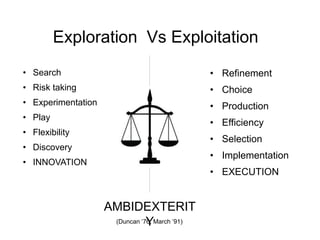
Exploration Vs Exploitation
• Refinement
• Choice
• Production
• Efficiency
• Selection
• Implementation
• EXECUTION
• Search
• Risk taking
• Experimentation
• Play
• Flexibility
• Discovery
• INNOVATION
AMBIDEXTERIT
Y(Duncan ‘76, March ’91)
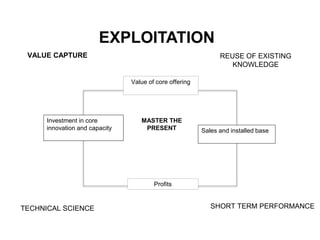
MASTER THE
PRESENT
Profits
Value of core offering
SHORT TERM PERFORMANCE
VALUE CAPTURE
Sales and installed base
Investment in core
innovation and capacity
EXPLOITATION
REUSE OF EXISTING
KNOWLEDGE
TECHNICAL SCIENCE
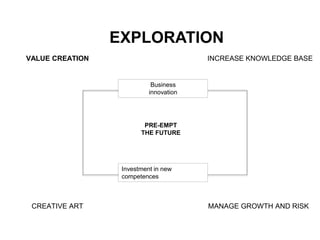
PRE-EMPT
THE FUTURE
Investment in new
competences
Business
innovation
MANAGE GROWTH AND RISK
VALUE CREATION
EXPLORATION
INCREASE KNOWLEDGE BASE
CREATIVE ART
Intertiality of Competences
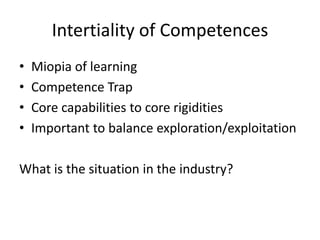
• Miopia of learning
• Competence Trap
• Core capabilities to core rigidities
• Important to balance exploration/exploitation
What is the situation in the industry?
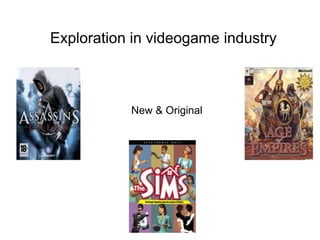
Exploration in videogame industry
New & Original
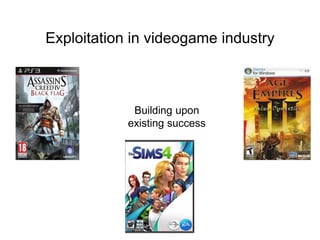
Exploitation in videogame industry
Building upon
existing success
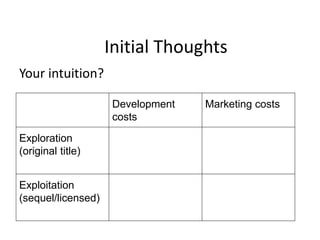
Initial Thoughts
Your intuition?
Development
costs
Marketing costs
Exploration
(original title)
Exploitation
(sequel/licensed)
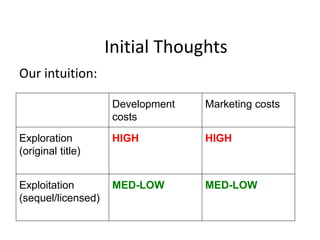
Initial Thoughts
Our intuition:
Development
costs
Marketing costs
Exploration
(original title)
HIGH HIGH
Exploitation
(sequel/licensed)
MED-LOW MED-LOW
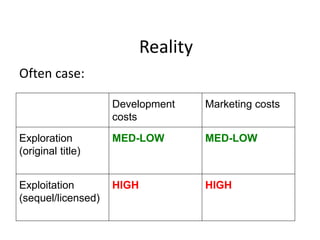
Reality
Often case:
Development
costs
Marketing costs
Exploration
(original title)
MED-LOW MED-LOW
Exploitation
(sequel/licensed)
HIGH HIGH
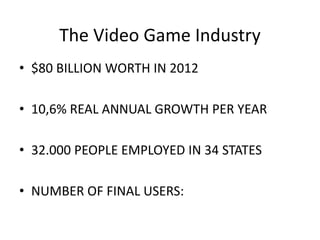
The Video Game Industry
• $80 BILLION WORTH IN 2012
• 10,6% REAL ANNUAL GROWTH PER YEAR
• 32.000 PEOPLE EMPLOYED IN 34 STATES
• NUMBER OF FINAL USERS:
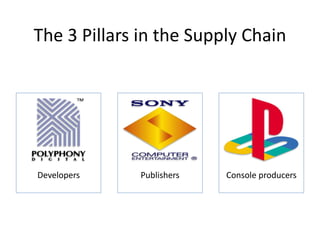
The 3 Pillars in the Supply Chain
Developers Publishers Console producers
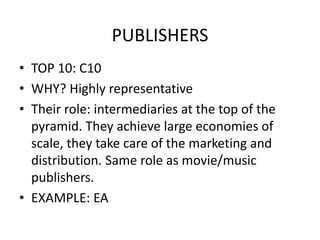
PUBLISHERS
• TOP 10: C10
• WHY? Highly representative
• Their role: intermediaries at the top of the
pyramid. They achieve large economies of
scale, they take care of the marketing and
distribution. Same role as movie/music
publishers.
• EXAMPLE: EA
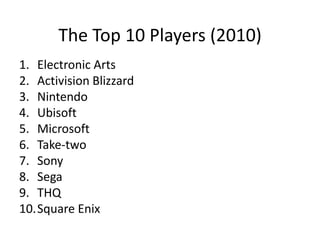
The Top 10 Players (2010)
1. Electronic Arts
2. Activision Blizzard
3. Nintendo
4. Ubisoft
5. Microsoft
6. Take-two
7. Sony
8. Sega
9. THQ
10.Square Enix
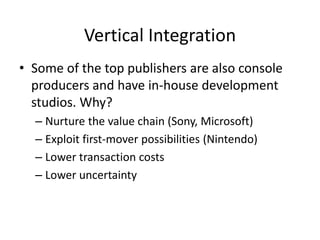
Vertical Integration
• Some of the top publishers are also console
producers and have in-house development
studios. Why?
– Nurture the value chain (Sony, Microsoft)
– Exploit first-mover possibilities (Nintendo)
– Lower transaction costs
– Lower uncertainty
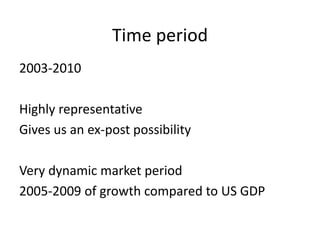
Time period
2003-2010
Highly representative
Gives us an ex-post possibility
Very dynamic market period
2005-2009 of growth compared to US GDP
Research Motivation
• How explorative is the industry?
• How does the industry react to performance?
• How does the industry react to external
events?
Hypothesis Overview
2 Null hypotheses:
• high levels of exploitation over time have no effect on performance.
• an external event (new console launch) has no effect on
exploitation.
Methodology
• Data source: mobygames.com
• Exploration: new original title (Max Payne)
• Exploitation: sequels or licensed titles (FIFA
2012)
• Average of individual game ratings as proxy
for firm performance
• Type of regression: panel data regression
Data Mining
Total titles examined: 3.212
Total titles kept: 1.564
Information considered:
• Reported release date
• Ratings
• Publisher
• Original/Licensed/Sequel -> Lots of Wikipedia
Our very own innovation case
• Started by hand and did over 1000 titles.
• Data was inconsistent and difficult to sort
• We had two options:
– time machine OR
– find a better way
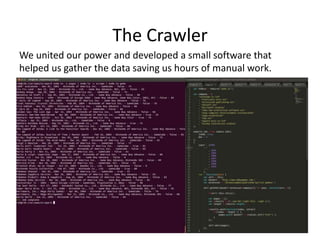
The Crawler
We united our power and developed a small software that
helped us gather the data saving us hours of manual work.
Endogenous changes
Null Hypothesis: high levels of exploitation over time have no effect on performance.
First Alternative: high levels of exploitation have positive effects on performance
because the risk goes down and firms are able to capture all the value
Second Alternative: high levels of exploitation have negative effects on firms’
performance because of excessive path dependence so become harder and more difficult
reach novelty
Exogenous changes
Null Hypothesis: an external event (new console launch) has no effect on exploitation.
First Alternative: increases exploitation to make the same games available for the new platform.
Second Alternative: new console generations may stimulate more exploration.
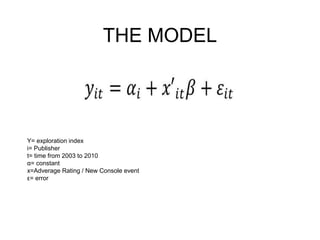
THE MODEL
Y= exploration index
i= Publisher
t= time from 2003 to 2010
α= constant
x=Adverage Rating / New Console event
ε= error
PUBLISHER
AVERAGE
RATING
EXOLORATIVE
INDEX
NEW
CONSOLE
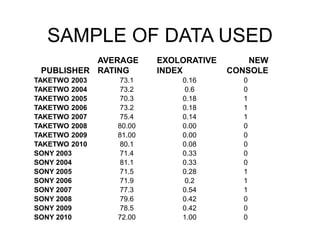
TAKETWO 2003 73.1 0.16 0
TAKETWO 2004 73.2 0.6 0
TAKETWO 2005 70.3 0.18 1
TAKETWO 2006 73.2 0.18 1
TAKETWO 2007 75.4 0.14 1
TAKETWO 2008 80.00 0.00 0
TAKETWO 2009 81.00 0.00 0
TAKETWO 2010 80.1 0.08 0
SONY 2003 71.4 0.33 0
SONY 2004 81.1 0.33 0
SONY 2005 71.5 0.28 1
SONY 2006 71.9 0.2 1
SONY 2007 77.3 0.54 1
SONY 2008 79.6 0.42 0
SONY 2009 78.5 0.42 0
SONY 2010 72.00 1.00 0
SAMPLE OF DATA USED
TABLE N°1
VARIABLES Constant
Average
rating
Exploration
index
1,0064
(0,004)
-0.0106
(0,028)
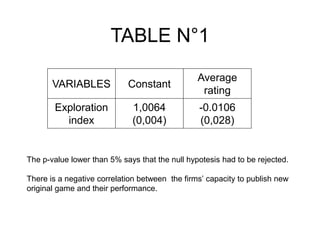
The p-value lower than 5% says that the null hypotesis had to be rejected.
There is a negative correlation between the firms’ capacity to publish new
original game and their performance.
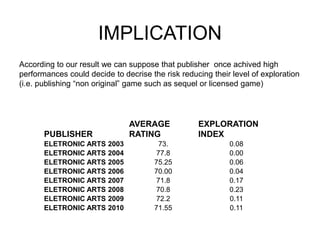
According to our result we can suppose that publisher once achived high
performances could decide to decrise the risk reducing their level of exploration
(i.e. publishing “non original” game such as sequel or licensed game)
PUBLISHER
AVERAGE
RATING
EXPLORATION
INDEX
ELETRONIC ARTS 2003 73. 0.08
ELETRONIC ARTS 2004 77.8 0.00
ELETRONIC ARTS 2005 75.25 0.06
ELETRONIC ARTS 2006 70.00 0.04
ELETRONIC ARTS 2007 71.8 0.17
ELETRONIC ARTS 2008 70.8 0.23
ELETRONIC ARTS 2009 72.2 0.11
ELETRONIC ARTS 2010 71.55 0.11
IMPLICATION
IMPLICATION
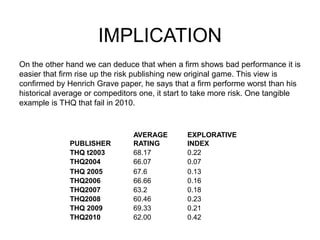
On the other hand we can deduce that when a firm shows bad performance it is
easier that firm rise up the risk publishing new original game. This view is
confirmed by Henrich Grave paper, he says that a firm performe worst than his
historical average or compeditors one, it start to take more risk. One tangible
example is THQ that fail in 2010.
PUBLISHER
AVERAGE
RATING
EXPLORATIVE
INDEX
THQ t2003 68.17 0.22
THQ2004 66.07 0.07
THQ 2005 67.6 0.13
THQ2006 66.66 0.16
THQ2007 63.2 0.18
THQ2008 60.46 0.23
THQ 2009 69.33 0.21
THQ2010 62.00 0.42
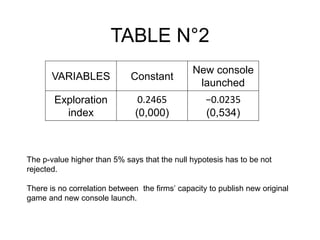
VARIABLES Constant
New console
launched
Exploration
index
0.2465
(0,000)
−0.0235
(0,534)
TABLE N°2
The p-value higher than 5% says that the null hypotesis has to be not
rejected.
There is no correlation between the firms’ capacity to publish new original
game and new console launch.
OUTCOMES
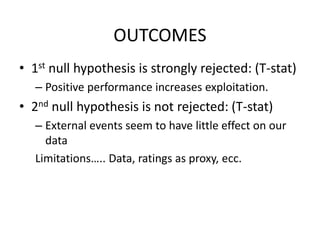
• 1st null hypothesis is strongly rejected: (T-stat)
– Positive performance increases exploitation.
• 2nd null hypothesis is not rejected: (T-stat)
– External events seem to have little effect on our
data
Limitations….. Data, ratings as proxy, ecc.
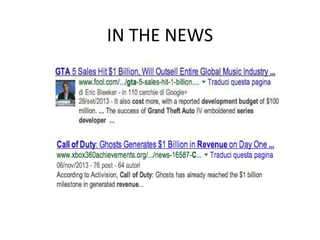
IN THE NEWS
CONCLUSIONS
• Largest bets are on exploitation: cash cows
• Path dependence and Value Network Trap:
good performance drives exploitation.
• Found support for Henrich Greve’s
performance feedback: negative performance
increases exploration.

Video Game Industry

  • 2.
    Balancing bets andlosses: exploration vs. exploitation in the Video Game Industry Federico Bertazzoni Tudor Carstoiu Simone Di Carlo Andrea Muttoni The 4 Bit Team 20
  • 3.
    Paper Structure • Explorationvs Exploitation (Tudor) – General overview – Application in the video industry – Specific examples (e.g. Assassin’s Creed) • Overview Industry (Federico) – Specific focus on Publishers • Our value added • Research motivations • Methodology • The Model • Outcomes • Conclusions • References
  • 4.
    Behind the HumanMind Behavioural and Brain Science Should I stay or should I go? How the human brain manages the trade-off between exploitation and exploration. Cohen, McClure, Yu (2007)
  • 5.
    Exploration Vs Exploitation •Refinement • Choice • Production • Efficiency • Selection • Implementation • EXECUTION • Search • Risk taking • Experimentation • Play • Flexibility • Discovery • INNOVATION AMBIDEXTERIT Y(Duncan ‘76, March ’91)
  • 6.
    MASTER THE PRESENT Profits Value ofcore offering SHORT TERM PERFORMANCE VALUE CAPTURE Sales and installed base Investment in core innovation and capacity EXPLOITATION REUSE OF EXISTING KNOWLEDGE TECHNICAL SCIENCE
  • 7.
    PRE-EMPT THE FUTURE Investment innew competences Business innovation MANAGE GROWTH AND RISK VALUE CREATION EXPLORATION INCREASE KNOWLEDGE BASE CREATIVE ART
  • 8.
    Intertiality of Competences •Miopia of learning • Competence Trap • Core capabilities to core rigidities • Important to balance exploration/exploitation What is the situation in the industry?
  • 9.
    Exploration in videogameindustry New & Original
  • 10.
    Exploitation in videogameindustry Building upon existing success
  • 11.
    Initial Thoughts Your intuition? Development costs Marketingcosts Exploration (original title) Exploitation (sequel/licensed)
  • 12.
    Initial Thoughts Our intuition: Development costs Marketingcosts Exploration (original title) HIGH HIGH Exploitation (sequel/licensed) MED-LOW MED-LOW
  • 13.
    Reality Often case: Development costs Marketing costs Exploration (originaltitle) MED-LOW MED-LOW Exploitation (sequel/licensed) HIGH HIGH
  • 14.
    The Video GameIndustry • $80 BILLION WORTH IN 2012 • 10,6% REAL ANNUAL GROWTH PER YEAR • 32.000 PEOPLE EMPLOYED IN 34 STATES • NUMBER OF FINAL USERS:
  • 15.
    The 3 Pillarsin the Supply Chain Developers Publishers Console producers
  • 16.
    PUBLISHERS • TOP 10:C10 • WHY? Highly representative • Their role: intermediaries at the top of the pyramid. They achieve large economies of scale, they take care of the marketing and distribution. Same role as movie/music publishers. • EXAMPLE: EA
  • 17.
    The Top 10Players (2010) 1. Electronic Arts 2. Activision Blizzard 3. Nintendo 4. Ubisoft 5. Microsoft 6. Take-two 7. Sony 8. Sega 9. THQ 10.Square Enix
  • 18.
    Vertical Integration • Someof the top publishers are also console producers and have in-house development studios. Why? – Nurture the value chain (Sony, Microsoft) – Exploit first-mover possibilities (Nintendo) – Lower transaction costs – Lower uncertainty
  • 19.
    Time period 2003-2010 Highly representative Givesus an ex-post possibility Very dynamic market period 2005-2009 of growth compared to US GDP
  • 20.
    Research Motivation • Howexplorative is the industry? • How does the industry react to performance? • How does the industry react to external events?
  • 21.
    Hypothesis Overview 2 Nullhypotheses: • high levels of exploitation over time have no effect on performance. • an external event (new console launch) has no effect on exploitation.
  • 22.
    Methodology • Data source:mobygames.com • Exploration: new original title (Max Payne) • Exploitation: sequels or licensed titles (FIFA 2012) • Average of individual game ratings as proxy for firm performance • Type of regression: panel data regression
  • 23.
    Data Mining Total titlesexamined: 3.212 Total titles kept: 1.564 Information considered: • Reported release date • Ratings • Publisher • Original/Licensed/Sequel -> Lots of Wikipedia
  • 24.
    Our very owninnovation case • Started by hand and did over 1000 titles. • Data was inconsistent and difficult to sort • We had two options: – time machine OR – find a better way
  • 25.
    The Crawler We unitedour power and developed a small software that helped us gather the data saving us hours of manual work.
  • 26.
    Endogenous changes Null Hypothesis:high levels of exploitation over time have no effect on performance. First Alternative: high levels of exploitation have positive effects on performance because the risk goes down and firms are able to capture all the value Second Alternative: high levels of exploitation have negative effects on firms’ performance because of excessive path dependence so become harder and more difficult reach novelty
  • 27.
    Exogenous changes Null Hypothesis:an external event (new console launch) has no effect on exploitation. First Alternative: increases exploitation to make the same games available for the new platform. Second Alternative: new console generations may stimulate more exploration.
  • 28.
    THE MODEL Y= explorationindex i= Publisher t= time from 2003 to 2010 α= constant x=Adverage Rating / New Console event ε= error
  • 29.
    PUBLISHER AVERAGE RATING EXOLORATIVE INDEX NEW CONSOLE TAKETWO 2003 73.10.16 0 TAKETWO 2004 73.2 0.6 0 TAKETWO 2005 70.3 0.18 1 TAKETWO 2006 73.2 0.18 1 TAKETWO 2007 75.4 0.14 1 TAKETWO 2008 80.00 0.00 0 TAKETWO 2009 81.00 0.00 0 TAKETWO 2010 80.1 0.08 0 SONY 2003 71.4 0.33 0 SONY 2004 81.1 0.33 0 SONY 2005 71.5 0.28 1 SONY 2006 71.9 0.2 1 SONY 2007 77.3 0.54 1 SONY 2008 79.6 0.42 0 SONY 2009 78.5 0.42 0 SONY 2010 72.00 1.00 0 SAMPLE OF DATA USED
  • 30.
    TABLE N°1 VARIABLES Constant Average rating Exploration index 1,0064 (0,004) -0.0106 (0,028) Thep-value lower than 5% says that the null hypotesis had to be rejected. There is a negative correlation between the firms’ capacity to publish new original game and their performance.
  • 31.
    According to ourresult we can suppose that publisher once achived high performances could decide to decrise the risk reducing their level of exploration (i.e. publishing “non original” game such as sequel or licensed game) PUBLISHER AVERAGE RATING EXPLORATION INDEX ELETRONIC ARTS 2003 73. 0.08 ELETRONIC ARTS 2004 77.8 0.00 ELETRONIC ARTS 2005 75.25 0.06 ELETRONIC ARTS 2006 70.00 0.04 ELETRONIC ARTS 2007 71.8 0.17 ELETRONIC ARTS 2008 70.8 0.23 ELETRONIC ARTS 2009 72.2 0.11 ELETRONIC ARTS 2010 71.55 0.11 IMPLICATION
  • 32.
    IMPLICATION On the otherhand we can deduce that when a firm shows bad performance it is easier that firm rise up the risk publishing new original game. This view is confirmed by Henrich Grave paper, he says that a firm performe worst than his historical average or compeditors one, it start to take more risk. One tangible example is THQ that fail in 2010. PUBLISHER AVERAGE RATING EXPLORATIVE INDEX THQ t2003 68.17 0.22 THQ2004 66.07 0.07 THQ 2005 67.6 0.13 THQ2006 66.66 0.16 THQ2007 63.2 0.18 THQ2008 60.46 0.23 THQ 2009 69.33 0.21 THQ2010 62.00 0.42
  • 33.
    VARIABLES Constant New console launched Exploration index 0.2465 (0,000) −0.0235 (0,534) TABLEN°2 The p-value higher than 5% says that the null hypotesis has to be not rejected. There is no correlation between the firms’ capacity to publish new original game and new console launch.
  • 34.
    OUTCOMES • 1st nullhypothesis is strongly rejected: (T-stat) – Positive performance increases exploitation. • 2nd null hypothesis is not rejected: (T-stat) – External events seem to have little effect on our data Limitations….. Data, ratings as proxy, ecc.
  • 35.
  • 36.
    CONCLUSIONS • Largest betsare on exploitation: cash cows • Path dependence and Value Network Trap: good performance drives exploitation. • Found support for Henrich Greve’s performance feedback: negative performance increases exploration.