401(k) ADVISORS
HOW TO USE COLLECTIVE FUNDS TO
WIN AND KEEP MORE BUSINESS
- BY ADAM PONDER -
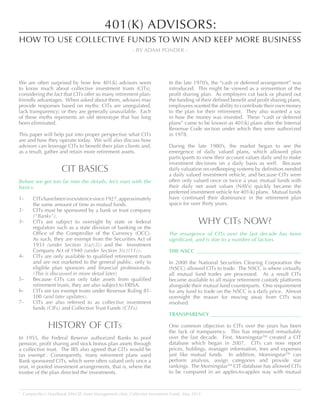
We are often surprised by how few 401(k) advisors seem
to know much about collective investment trusts (CITs),
considering the fact that CITs offer so many retirement plan-
friendly advantages. When asked about them, advisors may
provide responses based on myths: CITs are unregulated,
lack transparency; or they are generally unavailable. Each
of these myths represents an old stereotype that has long
been eliminated.
This paper will help put into proper perspective what CITs
are and how they operate today. We will also discuss how
advisors can leverage CITs to benefit their plan clients and,
as a result, gather and retain more retirement assets.
CIT BASICS
Before we get too far into the details, let’s start with the
basics.
CITshavebeeninexistencesince1927,approximately
the same amount of time as mutual funds.
CITs must be sponsored by a bank or trust company
(“Banks”).
CITs are subject to oversight by state or federal
regulators such as a state division of banking or the
Office of the Comptroller of the Currency (OCC).
As such, they are exempt from the Securities Act of
1933 (under Section 3(a)(2)) and the Investment
Company Act of 1940 (under Section 3(c)(11)).
CITs are only available to qualified retirement trusts
and are not marketed to the general public, only to
eligible plan sponsors and financial professionals.
(This is discussed in more detail later)
Because CITs can only take assets from qualified
retirement trusts, they are also subject to ERISA.
CITs are tax exempt trusts under Revenue Ruling 81-
100 (and later updates).
CITs are also referred to as collective investment
funds (CIFs) and Collective Trust Funds (CTFs).
HISTORY OF CITs
In 1955, the Federal Reserve authorized Banks to pool
pension, profit sharing and stock bonus plan assets through
a collective trust. The IRS also agreed that CITs would be
tax exempt1
. Consequently, many retirement plans used
Bank sponsored CITs, which were often valued only once a
year, in pooled investment arrangements, that is, where the
trustee of the plan directed the investments.
In the late 1970’s, the “cash or deferred arrangement” was
introduced. This might be viewed as a reinvention of the
profit sharing plan. As employers cut back or phased out
the funding of their defined benefit and profit sharing plans,
employees wanted the ability to contribute their own money
to the plan for their retirement. They also wanted a say
in how the money was invested. These “cash or deferred
plans” came to be known as 401(k) plans after the Internal
Revenue Code section under which they were authorized
in 1978.
During the late 1980’s, the market began to see the
emergence of daily valued plans, which allowed plan
participants to view their account values daily and to make
investment decisions on a daily basis as well. Because
daily valuation recordkeeping systems by definition needed
a daily valued investment vehicle, and because CITs were
often only valued once or twice a year, mutual funds with
their daily net asset values (NAVs) quickly became the
preferred investment vehicle for 401(k) plans. Mutual funds
have continued their dominance in the retirement plan
space for over thirty years.
WHY CITs NOW?
The resurgence of CITs over the last decade has been
significant, and is due to a number of factors.
THE NSCC 	
In 2000 the National Securities Clearing Corporation the
(NSCC) allowed CITs to trade. The NSCC is where virtually
all mutual fund trades are processed. As a result CITs
became available to all major retirement custody platforms
alongside their mutual fund counterparts. One requirement
for any fund to trade on the NSCC is a daily price. Almost
overnight the reason for moving away from CITs was
resolved.
TRANSPARENCY 	
One common objection to CITs over the years has been
the lack of transparency. This has improved remarkably
over the last decade. First, MorningstarTM
created a CIT
database which began in 2007. CITs can now report
prices, holdings, manager information, fees and expenses
just like mutual funds. In addition, MorningstarTM
can
perform analysis, assign categories and provide star
rankings. The MorningstarTM
CIT database has allowed CITs
to be compared in an apples-to-apples way with mutual
1
Comptroller’s Handbook AM-CIF, Asset Management (AM), Collective Investment Funds, May 2014
401(K) ADVISORS:
HOW TO USE COLLECTIVE FUNDS TO WIN AND KEEP MORE BUSINESS
- BY ADAM PONDER -
1-
2-
3-
4-
5-
6-
7-
funds. Bank sponsors have also increased the transparency
of the funds on their own by providing fund performance
fact sheets that include current holdings, fees and expenses,
CIT performance and so forth. Another major step towards
transparency and uniformity were the 408(b)2 and 404a-
5 disclosure requirements that CITs are subject to under
ERISA.
FIDUCIARY PROTECTION 	
Retirement plan advisors may not be aware that mutual
funds have a special exemption from ERISA’s fiduciary
and plan asset rules under sections 3(21)(b) and 401(b)(1).
Mutual funds and their investment managers are, therefore,
not required to adhere to the same fiduciary standard as the
plan sponsor or other ERISA fiduciaries that the plan may
have engaged, including in many cases the 401(k) advisor
himself.
In contrast, CITs are specifically subject to ERISA, including
the fiduciary rules. The assets within the CIT are treated as
plan assets. The Bank that establishes the CIT is a fiduciary
to the plan. The investment manager of the CIT’s assets is
also a fiduciary under ERISA. All of this helps to give plan
sponsors and other fiduciaries confidence that they are
engaged with equal partners. To the extent that a CIT has a
sub-adviser, there is in effect a double layer of protection,
as the sub adviser is typically a 3(21) or 3(38) fiduciary with
respect to the CIT.
LOWER FEES 	
The CIT structure goes to the heart of why it is typically
less expensive than a mutual fund. Mutual funds are
registered with the Securities and Exchange Commission
(SEC) and are required to follow certain rules. They must
have a prospectus, which is an expensive document to
prepare. Based on their corporate structure they must
have a Board of Directors to oversee the funds along with
a Chief Compliance Officer, so they have “infrastructure”
costs that are paid for out of the fund. They may also be
required to comply with the securities laws in states in
which they desire to sell the fund. And because they are
offered to the public, they incur substantial advertising and
marketing costs. Finally, mutual fund audits are typically
very expensive. But probably more than any other factor,
mutual funds are required to participate in a very costly
game of “pay to play.”
CITs on the other hand are trusts that are overseen by the
Bank’s Board of Directors and the Bank’s Trust Committee.
Because these groups are already in place, they are not
additional overhead to the Bank. CITs are exempt from
the Securities Act of 1933 and the Investment Company
Act of 1940 and, therefore, do not need to meet the filing
and prospectus requirements like a mutual fund. CIT audits
tend to be very cost effective in comparison to a mutual
fund. Because CITs can only be marketed to retirement
plans, they do not incur the significant advertising and
shareholder service expenses incurred by mutual funds.
Finally, the open architecture movement in retirement plans
over the years has paved the way for making CITs available
on custody platforms with little to no cost.
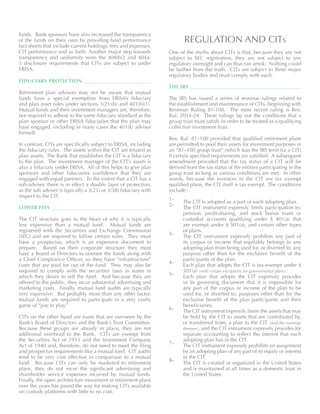
REGULATION AND CITs
One of the myths about CITs is that, because they are not
subject to SEC registration, they are not subject to any
regulatory oversight and can thus run amok. Nothing could
be further from the truth. CITs are subject to three major
regulatory bodies and must comply with each.
THE IRS 	
The IRS has issued a series of revenue rulings related to
the establishment and maintenance of CITs, beginning with
Revenue Ruling 81-100. The most recent ruling is Rev.
Rul. 2014-24. These rulings lay out the conditions that a
group trust must satisfy in order to be treated as a qualifying
collective investment trust.
Rev. Rul. 81–100 provided that qualified retirement plans
are permitted to pool their assets for investment purposes in
an “81–100 group trust” (which was the IRS term for a CIT)
if certain specified requirements are satisfied. A subsequent
amendment provided that the tax status of a CIT will be
derived from the tax status of the entities participating in the
group trust so long as various conditions are met. In other
words, because the investors in the CIT are tax exempt
qualified plans, the CIT itself is tax exempt. The conditions
include:
The CIT is adopted as a part of each adopting plan.
The CIT instrument expressly limits participation to:
pension, profit-sharing, and stock bonus trusts or
custodial accounts qualifying under § 401(a) that
are exempt under § 501(a); and certain other types
of plans.
The CIT instrument expressly prohibits any part of
its corpus or income that equitably belongs to any
adopting plan from being used for, or diverted to, any
purpose other than for the exclusive benefit of the
participants of the plan.
Each plan that adopts the CIT is tax-exempt under §
501(a) (with certain exceptions for governmental plans).
Each plan that adopts the CIT expressly provides
in its governing document that it is impossible for
any part of the corpus or income of the plan to be
used for, or diverted to, purposes other than for the
exclusive benefit of the plan participants and their
beneficiaries.
The CIT instrument expressly limits the assets that may
be held by the CIT to assets that are contributed by,
or transferred from, a plan to the CIT (and the earnings
thereon), and the CIT instrument expressly provides for
separate accounting to reflect the interest that each
adopting plan has in the CIT.
The CIT instrument expressly prohibits an assignment
by an adopting plan of any part of its equity or interest
in the CIT.
The CIT is created or organized in the United States
and is maintained at all times as a domestic trust in
the United States.
1-
2-
3-
4-
5-
6-
7-
8-
While these provisions are conditions to maintaining the
tax exempt status of a CIT, their effect is to impose duties
on the part of the trustee to ensure that the document
and operation of the CIT satisfy these requirements. The
consequence of a failure to do so would be that the CIT
would not be tax exempt, which would create significant
problems for the investing plans.
THE DOL 	
Because CITs are subject to ERISA and the Department
of Labor is the enforcement arm of ERISA, CITs and their
Bank sponsors must be in full compliance with the ERISA
regulatory scheme and guidance issued by the DOL.
Unlike a mutual fund, which has a statutory exemption,
the assets of a CIT are treated as plan assets along with the
interest in the CIT itself. As a result, the Bank that maintains
the CIT is a fiduciary to the plans that invest in it. The
advisory firm that manages those assets is also a fiduciary.
Both the Bank and the advisory firm must comply with the
fiduciary rules of ERISA, including acting in the best interest
of the participants, acting prudently in the management
of the CIT’s investments and avoid engaging in fiduciary
self-dealing prohibited transactions. This adds a layer of
protection for participants and plan fiduciaries that is not
afforded by mutual funds.
Fees are always an issue with almost any investment
vehicle, and fiduciary protection is always better to have
than not from a plan sponsor’s perspective. But one of
the real reasons these two factors have become such hot
button issues in the retirement plan world is because of
the Department of Labor’s (DOL) continued focus on both
issues. In July of 2012 the DOL regulation on disclosure
of service provider compensation under ERISA Section
408(b)(2) went into effect. Covered service providers
(except mutual fund managers) are required to disclose
their services, status as a fiduciary and both their direct
and indirect compensation…that is, what they make for
providing their services, not necessarily what it costs the
plan. This includes, for the first time, the 12b-1 fees the
service provider receives from mutual funds.
At the same time, the participant disclosure rule (Regulation
404a-5) became effective. This requires disclosure to
participants of the costs they incur by participating in the
plan and, more importantly, the costs they incur in the
investments they select for their accounts.
On the fiduciary side, the DOL continues to work on its
proposed re-definition of a fiduciary investment advisor.
Taken together, these regulatory actions have made plan
sponsors more aware of the costs of operating the plan,
the costs of the investments and the fiduciary status of their
advisors, a status they often may have assumed was there
in the past. And this awareness has placed pressure on
advisors to find lower cost options for their clients and to
accept the role of a fiduciary to the plan.
THE OCC OR STATE DIVISION OF BANKING 	
A Bank may organize under either state or federal laws. If
a Bank is organized under state laws, it becomes subject
to that particular state’s jurisdiction and regulator. Bank’s
organized under federal laws are usually subject to the
Office of the Comptroller of the Currency (OCC) or the Office
of Thrift Supervision (OTS). This means they must comply
with very specific and often rigorous rules related to what
they may and may not do in organizing and maintaining a
CIT. The OCC has provided substantial rules and guidance
regarding CITs; in most cases states follow the OCC rules.
It also subjects the Bank and the CITs sponsored by the
Bank to periodic examination, usually once every 12 to
24 months. These examinations are rigorous and thorough
to ensure compliance with both the specific rules and a
requirement to avoid actions that could adversely impact
the Bank’s reputation.
One of the OCC rules for CITs requires an annual audit
to ensure that the financial condition of each of the funds
is fairly presented. The rule states, “At least once during
each 12-month period, a bank administering a collective
investment fund shall arrange for an audit of the collective
investment fund by auditors responsible only to the board
of directors of the bank2
.”
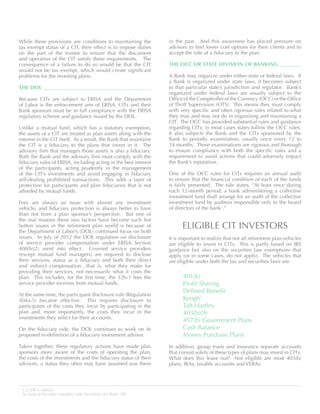
ELIGIBLE CIT INVESTORS
It is important to realize that not all retirement plan vehicles
are eligible to invest in CITs. This is partly based on IRS
guidance but also on the securities law exemptions that
apply (or in some cases, do not apply). The vehicles that
are eligible under both the tax and securities laws are:
401(k)
Profit Sharing
Defined Benefit
Keogh3
Taft-Hartley
403(b)(9)
457(b) Government Plans
Cash Balance
Money Purchase Plans
In addition, group trusts and insurance separate accounts
that consist solely of these types of plans may invest in CITs.
What does this leave out? Not eligible are most 403(b)
plans, IRAs, taxable accounts and VEBAs.
2
12 CFR 9.18(6)(i)
3
So long as the plan complies with Securities Act Rule 180.
MUTUAL FUND AND CIT
SIMILARITIES & DIFFERENCES
participants read the investor disclosure prior to investing in
order to understand the objective of the CIT as well as the
investment strategy, fees, etc. so that they can determine if
the CIT is an appropriate investment for them.
Once the paperwork is out of the way, the process is the
same as an investment in any mutual fund. The plan
custodian and recordkeeper make the CIT available to the
plan, and the participants are able to begin trading.
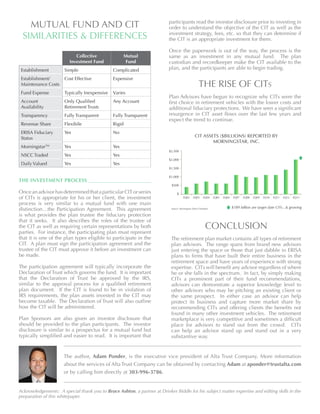
THE RISE OF CITs
Plan Advisors have begun to recognize why CITs were the
first choice in retirement vehicles with the lower costs and
additional fiduciary protections. We have seen a significant
resurgence in CIT asset flows over the last few years and
expect the trend to continue.
Collective
Investment Fund
Mutual
Fund
Establishment Simple Complicated
Establishment/
Maintenance Costs
Cost Effective Expensive
Fund Expense Typically Inexpensive Varies
Account
Availability
Only Qualified
Retirement Trusts
Any Account
Transparency Fully Transparent Fully Transparent
Revenue Share Flexibile Rigid
ERISA Fiduciary
Status
Yes No
MorningstarTM
Yes Yes
NSCC Traded Yes Yes
Daily Valued Yes Yes
THE INVESTMENT PROCESS 	
OnceanadvisorhasdeterminedthataparticularCITorseries
of CITs is appropriate for his or her client, the investment
process is very similar to a mutual fund with one main
distinction…the Participation Agreement. This agreement
is what provides the plan trustee the fiduciary protection
that it seeks. It also describes the roles of the trustee of
the CIT as well as requiring certain representations by both
parties. For instance, the participating plan must represent
that it is one of the plan types eligible to participate in the
CIT. A plan must sign the participation agreement and the
trustee of the CIT must approve it before an investment can
be made.
The participation agreement will typically incorporate the
Declaration of Trust which governs the fund. It is important
that the Declaration of Trust be approved by the IRS,
similar to the approval process for a qualified retirement
plan document. If the CIT is found to be in violation of
IRS requirements, the plan assets invested in the CIT may
become taxable. The Declaration of Trust will also outline
how the CIT will be administered.
Plan Sponsors are also given an investor disclosure that
should be provided to the plan participants. The investor
disclosure is similar to a prospectus for a mutual fund but
typically simplified and easier to read. It is important that
CIT ASSETS ($BILLIONS) REPORTED BY
MORNINGSTAR, INC.
$2,500
$2,000
$1,500
$1,000
$500
$
3Q02 3Q03 3Q04 3Q05 3Q06 3Q07 3Q08 3Q09 3Q10 3Q11 3Q12 4Q13
$189 billion are target date CITs...& growingSource: Morningstar Direct Database
CONCLUSION
The retirement plan market contains all types of retirement
plan advisors. The range spans from brand new advisors
just entering the space or those that just dabble in ERISA
plans to firms that have built their entire business in the
retirement space and have years of experience with strong
expertise. CITs will benefit any advisor regardless of where
he or she falls in the spectrum. In fact, by simply making
CITs a prominent part of their fund recommendations,
advisors can demonstrate a superior knowledge level to
other advisors who may be pitching an existing client or
the same prospect. In either case an advisor can help
protect its business and capture more market share by
recommending CITs and offering clients the benefits not
found in many other investment vehicles. The retirement
marketplace is very competitive and sometimes a difficult
place for advisors to stand out from the crowd. CITs
can help an advisor stand up and stand out in a very
substantive way.
The author, Adam Ponder, is the executive vice president of Alta Trust Company. More information
about the services of Alta Trust Company can be obtained by contacting Adam at aponder@trustalta.com
or by calling him directly at 303-996-3786.
Acknowledgements: A special thank you to Bruce Ashton, a partner at Drinker Biddle for his subject matter expertise and editing skills in the
preparation of this whitepaper.

CIF Opportunity for The 401k Advisor

  • 1.
    401(k) ADVISORS HOW TOUSE COLLECTIVE FUNDS TO WIN AND KEEP MORE BUSINESS - BY ADAM PONDER -
  • 2.
    We are oftensurprised by how few 401(k) advisors seem to know much about collective investment trusts (CITs), considering the fact that CITs offer so many retirement plan- friendly advantages. When asked about them, advisors may provide responses based on myths: CITs are unregulated, lack transparency; or they are generally unavailable. Each of these myths represents an old stereotype that has long been eliminated. This paper will help put into proper perspective what CITs are and how they operate today. We will also discuss how advisors can leverage CITs to benefit their plan clients and, as a result, gather and retain more retirement assets. CIT BASICS Before we get too far into the details, let’s start with the basics. CITshavebeeninexistencesince1927,approximately the same amount of time as mutual funds. CITs must be sponsored by a bank or trust company (“Banks”). CITs are subject to oversight by state or federal regulators such as a state division of banking or the Office of the Comptroller of the Currency (OCC). As such, they are exempt from the Securities Act of 1933 (under Section 3(a)(2)) and the Investment Company Act of 1940 (under Section 3(c)(11)). CITs are only available to qualified retirement trusts and are not marketed to the general public, only to eligible plan sponsors and financial professionals. (This is discussed in more detail later) Because CITs can only take assets from qualified retirement trusts, they are also subject to ERISA. CITs are tax exempt trusts under Revenue Ruling 81- 100 (and later updates). CITs are also referred to as collective investment funds (CIFs) and Collective Trust Funds (CTFs). HISTORY OF CITs In 1955, the Federal Reserve authorized Banks to pool pension, profit sharing and stock bonus plan assets through a collective trust. The IRS also agreed that CITs would be tax exempt1 . Consequently, many retirement plans used Bank sponsored CITs, which were often valued only once a year, in pooled investment arrangements, that is, where the trustee of the plan directed the investments. In the late 1970’s, the “cash or deferred arrangement” was introduced. This might be viewed as a reinvention of the profit sharing plan. As employers cut back or phased out the funding of their defined benefit and profit sharing plans, employees wanted the ability to contribute their own money to the plan for their retirement. They also wanted a say in how the money was invested. These “cash or deferred plans” came to be known as 401(k) plans after the Internal Revenue Code section under which they were authorized in 1978. During the late 1980’s, the market began to see the emergence of daily valued plans, which allowed plan participants to view their account values daily and to make investment decisions on a daily basis as well. Because daily valuation recordkeeping systems by definition needed a daily valued investment vehicle, and because CITs were often only valued once or twice a year, mutual funds with their daily net asset values (NAVs) quickly became the preferred investment vehicle for 401(k) plans. Mutual funds have continued their dominance in the retirement plan space for over thirty years. WHY CITs NOW? The resurgence of CITs over the last decade has been significant, and is due to a number of factors. THE NSCC In 2000 the National Securities Clearing Corporation the (NSCC) allowed CITs to trade. The NSCC is where virtually all mutual fund trades are processed. As a result CITs became available to all major retirement custody platforms alongside their mutual fund counterparts. One requirement for any fund to trade on the NSCC is a daily price. Almost overnight the reason for moving away from CITs was resolved. TRANSPARENCY One common objection to CITs over the years has been the lack of transparency. This has improved remarkably over the last decade. First, MorningstarTM created a CIT database which began in 2007. CITs can now report prices, holdings, manager information, fees and expenses just like mutual funds. In addition, MorningstarTM can perform analysis, assign categories and provide star rankings. The MorningstarTM CIT database has allowed CITs to be compared in an apples-to-apples way with mutual 1 Comptroller’s Handbook AM-CIF, Asset Management (AM), Collective Investment Funds, May 2014 401(K) ADVISORS: HOW TO USE COLLECTIVE FUNDS TO WIN AND KEEP MORE BUSINESS - BY ADAM PONDER - 1- 2- 3- 4- 5- 6- 7-
  • 3.
    funds. Bank sponsorshave also increased the transparency of the funds on their own by providing fund performance fact sheets that include current holdings, fees and expenses, CIT performance and so forth. Another major step towards transparency and uniformity were the 408(b)2 and 404a- 5 disclosure requirements that CITs are subject to under ERISA. FIDUCIARY PROTECTION Retirement plan advisors may not be aware that mutual funds have a special exemption from ERISA’s fiduciary and plan asset rules under sections 3(21)(b) and 401(b)(1). Mutual funds and their investment managers are, therefore, not required to adhere to the same fiduciary standard as the plan sponsor or other ERISA fiduciaries that the plan may have engaged, including in many cases the 401(k) advisor himself. In contrast, CITs are specifically subject to ERISA, including the fiduciary rules. The assets within the CIT are treated as plan assets. The Bank that establishes the CIT is a fiduciary to the plan. The investment manager of the CIT’s assets is also a fiduciary under ERISA. All of this helps to give plan sponsors and other fiduciaries confidence that they are engaged with equal partners. To the extent that a CIT has a sub-adviser, there is in effect a double layer of protection, as the sub adviser is typically a 3(21) or 3(38) fiduciary with respect to the CIT. LOWER FEES The CIT structure goes to the heart of why it is typically less expensive than a mutual fund. Mutual funds are registered with the Securities and Exchange Commission (SEC) and are required to follow certain rules. They must have a prospectus, which is an expensive document to prepare. Based on their corporate structure they must have a Board of Directors to oversee the funds along with a Chief Compliance Officer, so they have “infrastructure” costs that are paid for out of the fund. They may also be required to comply with the securities laws in states in which they desire to sell the fund. And because they are offered to the public, they incur substantial advertising and marketing costs. Finally, mutual fund audits are typically very expensive. But probably more than any other factor, mutual funds are required to participate in a very costly game of “pay to play.” CITs on the other hand are trusts that are overseen by the Bank’s Board of Directors and the Bank’s Trust Committee. Because these groups are already in place, they are not additional overhead to the Bank. CITs are exempt from the Securities Act of 1933 and the Investment Company Act of 1940 and, therefore, do not need to meet the filing and prospectus requirements like a mutual fund. CIT audits tend to be very cost effective in comparison to a mutual fund. Because CITs can only be marketed to retirement plans, they do not incur the significant advertising and shareholder service expenses incurred by mutual funds. Finally, the open architecture movement in retirement plans over the years has paved the way for making CITs available on custody platforms with little to no cost. REGULATION AND CITs One of the myths about CITs is that, because they are not subject to SEC registration, they are not subject to any regulatory oversight and can thus run amok. Nothing could be further from the truth. CITs are subject to three major regulatory bodies and must comply with each. THE IRS The IRS has issued a series of revenue rulings related to the establishment and maintenance of CITs, beginning with Revenue Ruling 81-100. The most recent ruling is Rev. Rul. 2014-24. These rulings lay out the conditions that a group trust must satisfy in order to be treated as a qualifying collective investment trust. Rev. Rul. 81–100 provided that qualified retirement plans are permitted to pool their assets for investment purposes in an “81–100 group trust” (which was the IRS term for a CIT) if certain specified requirements are satisfied. A subsequent amendment provided that the tax status of a CIT will be derived from the tax status of the entities participating in the group trust so long as various conditions are met. In other words, because the investors in the CIT are tax exempt qualified plans, the CIT itself is tax exempt. The conditions include: The CIT is adopted as a part of each adopting plan. The CIT instrument expressly limits participation to: pension, profit-sharing, and stock bonus trusts or custodial accounts qualifying under § 401(a) that are exempt under § 501(a); and certain other types of plans. The CIT instrument expressly prohibits any part of its corpus or income that equitably belongs to any adopting plan from being used for, or diverted to, any purpose other than for the exclusive benefit of the participants of the plan. Each plan that adopts the CIT is tax-exempt under § 501(a) (with certain exceptions for governmental plans). Each plan that adopts the CIT expressly provides in its governing document that it is impossible for any part of the corpus or income of the plan to be used for, or diverted to, purposes other than for the exclusive benefit of the plan participants and their beneficiaries. The CIT instrument expressly limits the assets that may be held by the CIT to assets that are contributed by, or transferred from, a plan to the CIT (and the earnings thereon), and the CIT instrument expressly provides for separate accounting to reflect the interest that each adopting plan has in the CIT. The CIT instrument expressly prohibits an assignment by an adopting plan of any part of its equity or interest in the CIT. The CIT is created or organized in the United States and is maintained at all times as a domestic trust in the United States. 1- 2- 3- 4- 5- 6- 7- 8-
  • 4.
    While these provisionsare conditions to maintaining the tax exempt status of a CIT, their effect is to impose duties on the part of the trustee to ensure that the document and operation of the CIT satisfy these requirements. The consequence of a failure to do so would be that the CIT would not be tax exempt, which would create significant problems for the investing plans. THE DOL Because CITs are subject to ERISA and the Department of Labor is the enforcement arm of ERISA, CITs and their Bank sponsors must be in full compliance with the ERISA regulatory scheme and guidance issued by the DOL. Unlike a mutual fund, which has a statutory exemption, the assets of a CIT are treated as plan assets along with the interest in the CIT itself. As a result, the Bank that maintains the CIT is a fiduciary to the plans that invest in it. The advisory firm that manages those assets is also a fiduciary. Both the Bank and the advisory firm must comply with the fiduciary rules of ERISA, including acting in the best interest of the participants, acting prudently in the management of the CIT’s investments and avoid engaging in fiduciary self-dealing prohibited transactions. This adds a layer of protection for participants and plan fiduciaries that is not afforded by mutual funds. Fees are always an issue with almost any investment vehicle, and fiduciary protection is always better to have than not from a plan sponsor’s perspective. But one of the real reasons these two factors have become such hot button issues in the retirement plan world is because of the Department of Labor’s (DOL) continued focus on both issues. In July of 2012 the DOL regulation on disclosure of service provider compensation under ERISA Section 408(b)(2) went into effect. Covered service providers (except mutual fund managers) are required to disclose their services, status as a fiduciary and both their direct and indirect compensation…that is, what they make for providing their services, not necessarily what it costs the plan. This includes, for the first time, the 12b-1 fees the service provider receives from mutual funds. At the same time, the participant disclosure rule (Regulation 404a-5) became effective. This requires disclosure to participants of the costs they incur by participating in the plan and, more importantly, the costs they incur in the investments they select for their accounts. On the fiduciary side, the DOL continues to work on its proposed re-definition of a fiduciary investment advisor. Taken together, these regulatory actions have made plan sponsors more aware of the costs of operating the plan, the costs of the investments and the fiduciary status of their advisors, a status they often may have assumed was there in the past. And this awareness has placed pressure on advisors to find lower cost options for their clients and to accept the role of a fiduciary to the plan. THE OCC OR STATE DIVISION OF BANKING A Bank may organize under either state or federal laws. If a Bank is organized under state laws, it becomes subject to that particular state’s jurisdiction and regulator. Bank’s organized under federal laws are usually subject to the Office of the Comptroller of the Currency (OCC) or the Office of Thrift Supervision (OTS). This means they must comply with very specific and often rigorous rules related to what they may and may not do in organizing and maintaining a CIT. The OCC has provided substantial rules and guidance regarding CITs; in most cases states follow the OCC rules. It also subjects the Bank and the CITs sponsored by the Bank to periodic examination, usually once every 12 to 24 months. These examinations are rigorous and thorough to ensure compliance with both the specific rules and a requirement to avoid actions that could adversely impact the Bank’s reputation. One of the OCC rules for CITs requires an annual audit to ensure that the financial condition of each of the funds is fairly presented. The rule states, “At least once during each 12-month period, a bank administering a collective investment fund shall arrange for an audit of the collective investment fund by auditors responsible only to the board of directors of the bank2 .” ELIGIBLE CIT INVESTORS It is important to realize that not all retirement plan vehicles are eligible to invest in CITs. This is partly based on IRS guidance but also on the securities law exemptions that apply (or in some cases, do not apply). The vehicles that are eligible under both the tax and securities laws are: 401(k) Profit Sharing Defined Benefit Keogh3 Taft-Hartley 403(b)(9) 457(b) Government Plans Cash Balance Money Purchase Plans In addition, group trusts and insurance separate accounts that consist solely of these types of plans may invest in CITs. What does this leave out? Not eligible are most 403(b) plans, IRAs, taxable accounts and VEBAs. 2 12 CFR 9.18(6)(i) 3 So long as the plan complies with Securities Act Rule 180.
  • 5.
    MUTUAL FUND ANDCIT SIMILARITIES & DIFFERENCES participants read the investor disclosure prior to investing in order to understand the objective of the CIT as well as the investment strategy, fees, etc. so that they can determine if the CIT is an appropriate investment for them. Once the paperwork is out of the way, the process is the same as an investment in any mutual fund. The plan custodian and recordkeeper make the CIT available to the plan, and the participants are able to begin trading. THE RISE OF CITs Plan Advisors have begun to recognize why CITs were the first choice in retirement vehicles with the lower costs and additional fiduciary protections. We have seen a significant resurgence in CIT asset flows over the last few years and expect the trend to continue. Collective Investment Fund Mutual Fund Establishment Simple Complicated Establishment/ Maintenance Costs Cost Effective Expensive Fund Expense Typically Inexpensive Varies Account Availability Only Qualified Retirement Trusts Any Account Transparency Fully Transparent Fully Transparent Revenue Share Flexibile Rigid ERISA Fiduciary Status Yes No MorningstarTM Yes Yes NSCC Traded Yes Yes Daily Valued Yes Yes THE INVESTMENT PROCESS OnceanadvisorhasdeterminedthataparticularCITorseries of CITs is appropriate for his or her client, the investment process is very similar to a mutual fund with one main distinction…the Participation Agreement. This agreement is what provides the plan trustee the fiduciary protection that it seeks. It also describes the roles of the trustee of the CIT as well as requiring certain representations by both parties. For instance, the participating plan must represent that it is one of the plan types eligible to participate in the CIT. A plan must sign the participation agreement and the trustee of the CIT must approve it before an investment can be made. The participation agreement will typically incorporate the Declaration of Trust which governs the fund. It is important that the Declaration of Trust be approved by the IRS, similar to the approval process for a qualified retirement plan document. If the CIT is found to be in violation of IRS requirements, the plan assets invested in the CIT may become taxable. The Declaration of Trust will also outline how the CIT will be administered. Plan Sponsors are also given an investor disclosure that should be provided to the plan participants. The investor disclosure is similar to a prospectus for a mutual fund but typically simplified and easier to read. It is important that CIT ASSETS ($BILLIONS) REPORTED BY MORNINGSTAR, INC. $2,500 $2,000 $1,500 $1,000 $500 $ 3Q02 3Q03 3Q04 3Q05 3Q06 3Q07 3Q08 3Q09 3Q10 3Q11 3Q12 4Q13 $189 billion are target date CITs...& growingSource: Morningstar Direct Database CONCLUSION The retirement plan market contains all types of retirement plan advisors. The range spans from brand new advisors just entering the space or those that just dabble in ERISA plans to firms that have built their entire business in the retirement space and have years of experience with strong expertise. CITs will benefit any advisor regardless of where he or she falls in the spectrum. In fact, by simply making CITs a prominent part of their fund recommendations, advisors can demonstrate a superior knowledge level to other advisors who may be pitching an existing client or the same prospect. In either case an advisor can help protect its business and capture more market share by recommending CITs and offering clients the benefits not found in many other investment vehicles. The retirement marketplace is very competitive and sometimes a difficult place for advisors to stand out from the crowd. CITs can help an advisor stand up and stand out in a very substantive way. The author, Adam Ponder, is the executive vice president of Alta Trust Company. More information about the services of Alta Trust Company can be obtained by contacting Adam at aponder@trustalta.com or by calling him directly at 303-996-3786. Acknowledgements: A special thank you to Bruce Ashton, a partner at Drinker Biddle for his subject matter expertise and editing skills in the preparation of this whitepaper.