Innovation policy for sustainability – a new agenda Fred Steward Professor of Innovation & Sustainability,  Policy Studies Institute, Westminster University, London, UK UK-China Workshop, Beijing, March 2010
A shift in policy discourse A shared acknowledgement that addressing sustainability implies radical change New policy narratives from margin to mainstream in the last  10 years ‘ Green revolution ‘ Ecological transformation’ ‘ Low carbon transition’
 
 
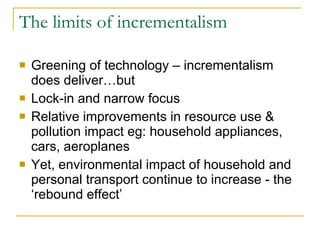
The limits of incrementalism Greening of technology – incrementalism does deliver…but Lock-in and narrow focus Relative improvements in resource use & pollution impact eg: household appliances, cars, aeroplanes Yet, environmental impact of household and personal transport continue to increase - the ‘rebound effect’
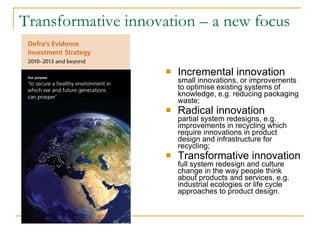
Transformative innovation – a new focus  Incremental innovation  small innovations, or improvements to optimise existing systems of knowledge, e.g. reducing packaging waste; Radical innovation partial system redesigns, e.g. improvements in recycling which require innovations in product design and infrastructure for recycling; Transformative innovation  full system redesign and culture change in the way people think about products and services, e.g. industrial ecologies or life cycle approaches to product design.
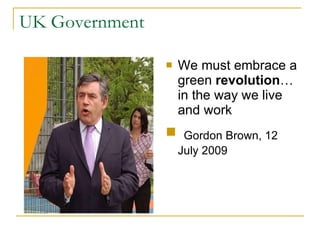
UK Government We must embrace a green  revolution …in the way we live and work Gordon Brown, 12 July 2009
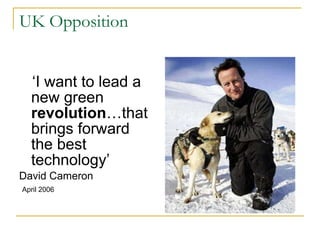
UK Opposition ‘ I want to lead a new green  revolution …that brings forward the best technology’ David Cameron April 2006
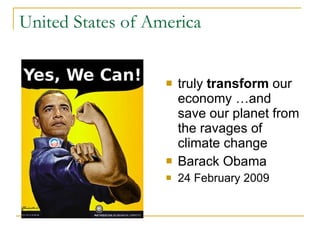
United States of America truly  transform  our economy …and save our planet from the ravages of climate change Barack Obama  24 February 2009
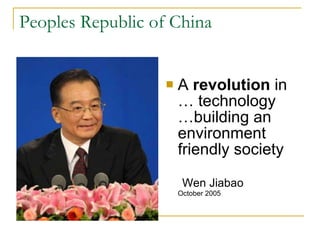
Peoples Republic of China A  revolution  in … technology …building an environment friendly society   Wen Jiabao   October 2005
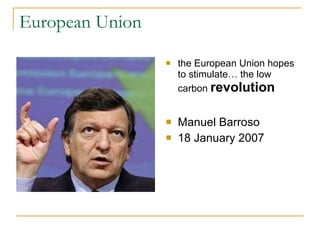
European Union the European Union hopes to stimulate… the low carbon  revolution Manuel Barroso 18 January 2007
Not simply at the rhetorical level  Change in policy landscape from climate change ‘problem’ to low carbon innovation ‘solution’ Incorporation of ambitious targets into national and transnational legal form Driven by mix of global treaty obligations & local informed advocacy  Remains the basic trend of policy despite the new post- Copenhagen context
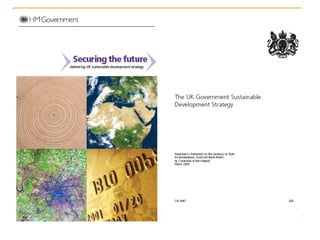
The UK strategy 2009
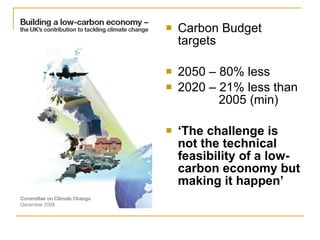
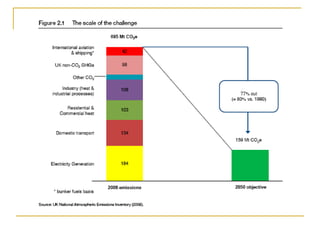
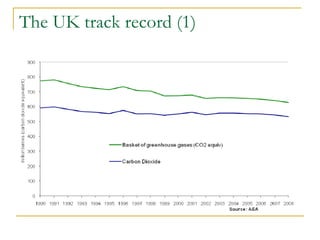
Carbon Budget targets 2050 – 80% less 2020 – 21% less than    2005 (min) ‘ The challenge is not the technical feasibility of a low-carbon economy but making it happen’
 
The UK track record (1)
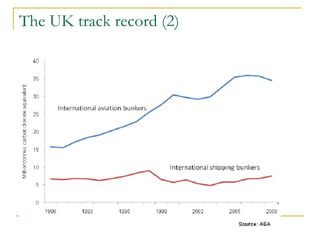
The UK track record (2)
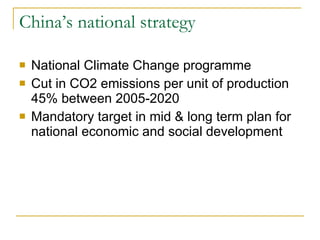
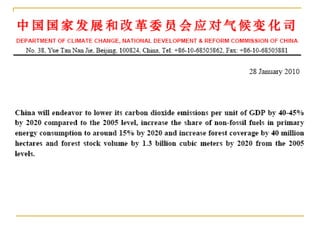
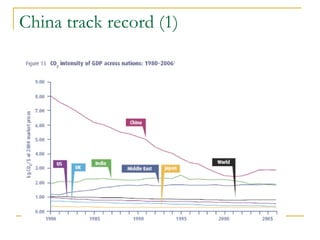
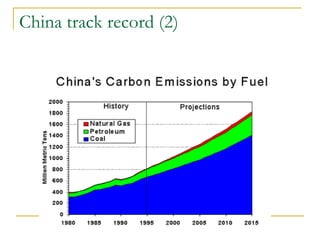
China’s national strategy National Climate Change programme Cut in CO2 emissions per unit of production 45% between 2005-2020 Mandatory target in mid & long term plan for national economic and social development
 
China track record (1)
China track record (2)
 
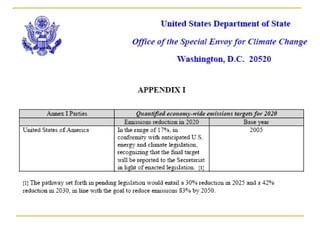
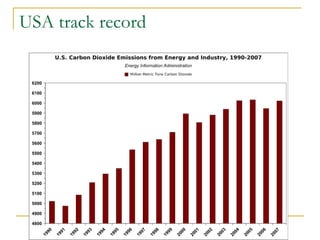
USA track record
In summary A variety of national governments are incorporating carbon targets into their economic and social policies  The targets are highly ambitious given the national track records Despite the setback for a new global treaty this represent a highly significant policy domain  The global challenge remains huge
Policy needs new ideas The new consensus over the need for ‘revolutionary’ change precipitates a search for  relevant ideas One resource is the repertoire of historical analogies of episodes of ‘radical’ change Another resource is the range of academic concepts on the dynamics of innovation and change
Historical analogies Quite pervasive and powerful in contemporary discourse Tend to reflect contrasting views on ‘statism’ and ‘individualism’ Tend to polarise between a focus on either ‘technological’ or ‘social’ innovation  4 narratives are quite common at present
Narrative 1: ‘big science’ Government has made big investments in key areas of science in the past – it should do so again Popular analogies are the research programmes that led to nuclear weapons and human space travel
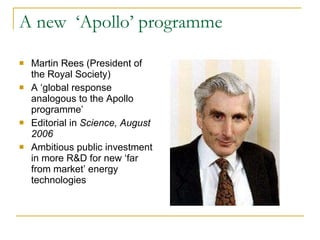
A new  ‘Apollo’ programme Martin Rees (President of the Royal Society) A ‘global response analogous to the Apollo programme’ Editorial in  Science, August 2006  Ambitious public investment in more R&D for new ‘far from market’ energy technologies
Conceptual roots Linear science push model Innovation arises from radical breakthroughs in basic science Largely abandoned by innovation researchers though still a few advocates Still popular with some scientists
Narrative 2: ‘industrial revolution’ Low carbon transition is equivalent  long term revolution in technology & economics Forces driving it are structural in nature – new technologies, natural limits Policy options are to facilitate national receptiveness and entrepreneurial opportunity
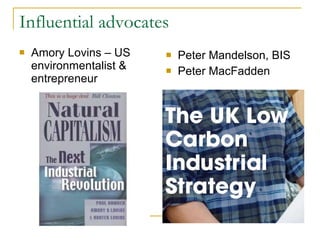
Influential advocates Amory Lovins – US environmentalist & entrepreneur Peter Mandelson, BIS Peter MacFadden
Conceptual roots ‘ Technoeconomic paradigm – Freeman & Perez Schumpeterian evolutionary theory of innovation Ecological modernisation – Huber Influential among economic studies of innovation  Epochs defined by ‘lead technologies’
Narrative 3: ‘social reform’ Analogies with government led programmes of welfare reform from the 20 th  century  eg Rooselvelt’s  New Deal Large scale state investment for societal purposes is possible
Advocates – greens, social democrats
Conceptual roots  Traditional theories of state action for social purposes Retheorised as social innovation and public innovation
Narrative 4: ‘moral crusade’ Analogies with ethical and moral crusades for reform Wilberforce’s campaign for the Abolition of the Slave Trade, and Martin Luther King’s leadership of the Civil Rights movement are exemplars
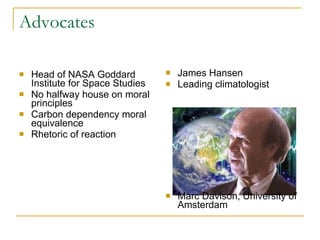
Advocates Head of NASA Goddard Institute for Space Studies  No halfway house on moral principles Carbon dependency moral equivalence Rhetoric of reaction James Hansen Leading climatologist Marc Davison, University of Amsterdam
What do these narratives possess Powerful narratives with influential advocates Recognise past periods of radical change Tend to inscribe established political positions and guidelines  Evocative of actual changes despite problems
What do they lack A model of how social and technological innovation interact with each other New routes for global institutions to effectively interact with established institutions of national governance  Convincing approaches to the urgency of the climate change challenge These are the key challenges for a new transformative discourse and innovation policy
Actually existing innovation policy Turning to the real world of UK innovation policy there are interesting signs of change The persistence of science push has begun to be displaced NESTA played a key role in translating academic concepts about innovation into policy terms
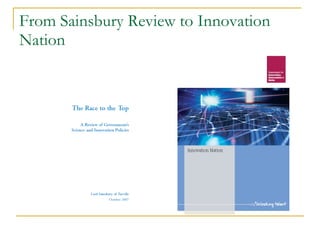
From Sainsbury Review to Innovation Nation
The new innovation policy  Challenge led Demand side Social as well as technological Public and private actors Interactive networks
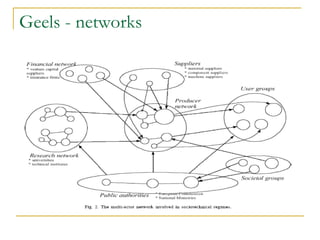
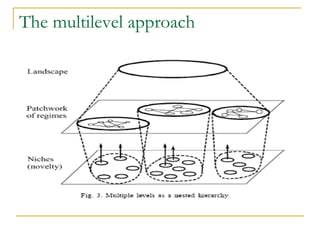
Sources Interactive  - Freeman, Rothwell SPRU User led – von Hippel Open – Chesbrough Actor networks – Callon, Latour Innovation commons – Lessig Sociotechnical transitions – Geels, Schot
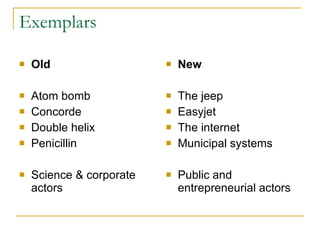
Exemplars Old Atom bomb  Concorde Double helix Penicillin Science & corporate actors New The jeep Easyjet The internet Municipal systems  Public and entrepreneurial actors
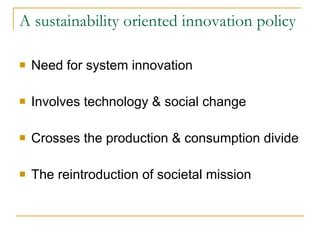
A sustainability oriented innovation policy  Need for system innovation  Involves technology & social change Crosses the production & consumption divide The reintroduction of societal mission
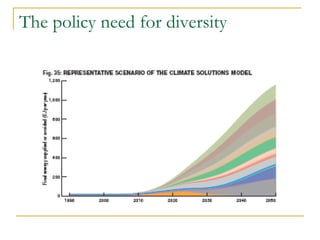
The policy need for diversity
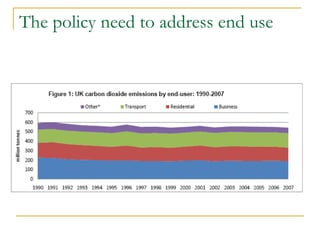
The policy need to address end use
Geels - networks
The multilevel approach
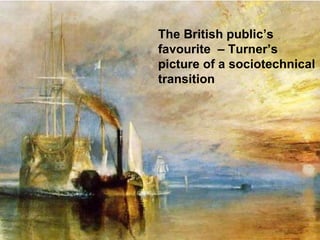
The British public’s favourite  – Turner’s picture of a sociotechnical transition
New thinking Needs a sociology of interactions An understanding of innovation as it is situated in real social networks Policy remains dominated by a society/individual duality expressed through economics and psychology
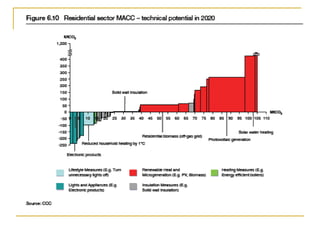
The perspective from economics
 
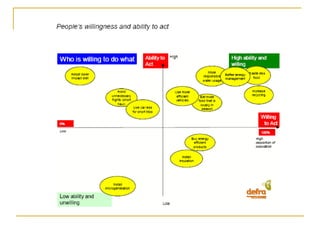
The perspective from psychology
 
Opportunity Policy advice remains dominated by economics (trading/tax) and psychology (behavioural change) Diversity is increasingly recognised and the need for end use engagement Transitions plan recognises different technologies and new initiatives on Community challenges recognises user enagement
Yet Current interpretation of diversity favours the incumbents: Off shore wind Carbon capture and storage Nuclear Electric car ‘silos’ or ‘networks’ ?
New systems need stronger voice Small local waste into biogas Smart grids Micro generation Combined heat and power Multimodal transport – cycles to buses
 
 
The new system innovators More likely to be: municipal and regional actors infrastructural actors green entrepreneurs civil society third sector actors The sources of variety Equal rights with the incumbents (at least)!
New capabilities needed Understanding of systemic (not singular) innovation ‘ Learning by doing’ - sociotechnical experiments Framing goals in terms of societal outcomes rather than technical inputs Promoting ’bottom up’ innovation to complement the ‘top down’ carbon market Need for new interdisciplinary boundary spanning competences
A practice based approach  Is there an alternative to the economic incentive or psychological persuasion? Yes… enactment, enrolment, performance in new social experiments
Conclusion Need for a challenge led broad based innovation policy A shift to practice based social experimentation  A strong new transformative discourse which combines the power of the old with that of the new

Fred Steward: Innovation policy for sustainability - a new agenda

  • 1.
    Innovation policy forsustainability – a new agenda Fred Steward Professor of Innovation & Sustainability, Policy Studies Institute, Westminster University, London, UK UK-China Workshop, Beijing, March 2010
  • 2.
    A shift inpolicy discourse A shared acknowledgement that addressing sustainability implies radical change New policy narratives from margin to mainstream in the last 10 years ‘ Green revolution ‘ Ecological transformation’ ‘ Low carbon transition’
  • 3.
  • 4.
  • 5.
    The limits ofincrementalism Greening of technology – incrementalism does deliver…but Lock-in and narrow focus Relative improvements in resource use & pollution impact eg: household appliances, cars, aeroplanes Yet, environmental impact of household and personal transport continue to increase - the ‘rebound effect’
  • 6.
    Transformative innovation –a new focus Incremental innovation small innovations, or improvements to optimise existing systems of knowledge, e.g. reducing packaging waste; Radical innovation partial system redesigns, e.g. improvements in recycling which require innovations in product design and infrastructure for recycling; Transformative innovation full system redesign and culture change in the way people think about products and services, e.g. industrial ecologies or life cycle approaches to product design.
  • 7.
    UK Government Wemust embrace a green revolution …in the way we live and work Gordon Brown, 12 July 2009
  • 8.
    UK Opposition ‘I want to lead a new green revolution …that brings forward the best technology’ David Cameron April 2006
  • 9.
    United States ofAmerica truly transform our economy …and save our planet from the ravages of climate change Barack Obama 24 February 2009
  • 10.
    Peoples Republic ofChina A revolution in … technology …building an environment friendly society Wen Jiabao October 2005
  • 11.
    European Union theEuropean Union hopes to stimulate… the low carbon revolution Manuel Barroso 18 January 2007
  • 12.
    Not simply atthe rhetorical level Change in policy landscape from climate change ‘problem’ to low carbon innovation ‘solution’ Incorporation of ambitious targets into national and transnational legal form Driven by mix of global treaty obligations & local informed advocacy Remains the basic trend of policy despite the new post- Copenhagen context
  • 13.
  • 14.
    Carbon Budget targets2050 – 80% less 2020 – 21% less than 2005 (min) ‘ The challenge is not the technical feasibility of a low-carbon economy but making it happen’
  • 15.
  • 16.
    The UK trackrecord (1)
  • 17.
    The UK trackrecord (2)
  • 18.
    China’s national strategyNational Climate Change programme Cut in CO2 emissions per unit of production 45% between 2005-2020 Mandatory target in mid & long term plan for national economic and social development
  • 19.
  • 20.
  • 21.
  • 22.
  • 23.
  • 24.
    In summary Avariety of national governments are incorporating carbon targets into their economic and social policies The targets are highly ambitious given the national track records Despite the setback for a new global treaty this represent a highly significant policy domain The global challenge remains huge
  • 25.
    Policy needs newideas The new consensus over the need for ‘revolutionary’ change precipitates a search for relevant ideas One resource is the repertoire of historical analogies of episodes of ‘radical’ change Another resource is the range of academic concepts on the dynamics of innovation and change
  • 26.
    Historical analogies Quitepervasive and powerful in contemporary discourse Tend to reflect contrasting views on ‘statism’ and ‘individualism’ Tend to polarise between a focus on either ‘technological’ or ‘social’ innovation 4 narratives are quite common at present
  • 27.
    Narrative 1: ‘bigscience’ Government has made big investments in key areas of science in the past – it should do so again Popular analogies are the research programmes that led to nuclear weapons and human space travel
  • 28.
    A new ‘Apollo’ programme Martin Rees (President of the Royal Society) A ‘global response analogous to the Apollo programme’ Editorial in Science, August 2006 Ambitious public investment in more R&D for new ‘far from market’ energy technologies
  • 29.
    Conceptual roots Linearscience push model Innovation arises from radical breakthroughs in basic science Largely abandoned by innovation researchers though still a few advocates Still popular with some scientists
  • 30.
    Narrative 2: ‘industrialrevolution’ Low carbon transition is equivalent long term revolution in technology & economics Forces driving it are structural in nature – new technologies, natural limits Policy options are to facilitate national receptiveness and entrepreneurial opportunity
  • 31.
    Influential advocates AmoryLovins – US environmentalist & entrepreneur Peter Mandelson, BIS Peter MacFadden
  • 32.
    Conceptual roots ‘Technoeconomic paradigm – Freeman & Perez Schumpeterian evolutionary theory of innovation Ecological modernisation – Huber Influential among economic studies of innovation Epochs defined by ‘lead technologies’
  • 33.
    Narrative 3: ‘socialreform’ Analogies with government led programmes of welfare reform from the 20 th century eg Rooselvelt’s New Deal Large scale state investment for societal purposes is possible
  • 34.
    Advocates – greens,social democrats
  • 35.
    Conceptual roots Traditional theories of state action for social purposes Retheorised as social innovation and public innovation
  • 36.
    Narrative 4: ‘moralcrusade’ Analogies with ethical and moral crusades for reform Wilberforce’s campaign for the Abolition of the Slave Trade, and Martin Luther King’s leadership of the Civil Rights movement are exemplars
  • 37.
    Advocates Head ofNASA Goddard Institute for Space Studies No halfway house on moral principles Carbon dependency moral equivalence Rhetoric of reaction James Hansen Leading climatologist Marc Davison, University of Amsterdam
  • 38.
    What do thesenarratives possess Powerful narratives with influential advocates Recognise past periods of radical change Tend to inscribe established political positions and guidelines Evocative of actual changes despite problems
  • 39.
    What do theylack A model of how social and technological innovation interact with each other New routes for global institutions to effectively interact with established institutions of national governance Convincing approaches to the urgency of the climate change challenge These are the key challenges for a new transformative discourse and innovation policy
  • 40.
    Actually existing innovationpolicy Turning to the real world of UK innovation policy there are interesting signs of change The persistence of science push has begun to be displaced NESTA played a key role in translating academic concepts about innovation into policy terms
  • 41.
    From Sainsbury Reviewto Innovation Nation
  • 42.
    The new innovationpolicy Challenge led Demand side Social as well as technological Public and private actors Interactive networks
  • 43.
    Sources Interactive - Freeman, Rothwell SPRU User led – von Hippel Open – Chesbrough Actor networks – Callon, Latour Innovation commons – Lessig Sociotechnical transitions – Geels, Schot
  • 44.
    Exemplars Old Atombomb Concorde Double helix Penicillin Science & corporate actors New The jeep Easyjet The internet Municipal systems Public and entrepreneurial actors
  • 45.
    A sustainability orientedinnovation policy Need for system innovation Involves technology & social change Crosses the production & consumption divide The reintroduction of societal mission
  • 46.
    The policy needfor diversity
  • 47.
    The policy needto address end use
  • 48.
  • 49.
  • 50.
    The British public’sfavourite – Turner’s picture of a sociotechnical transition
  • 51.
    New thinking Needsa sociology of interactions An understanding of innovation as it is situated in real social networks Policy remains dominated by a society/individual duality expressed through economics and psychology
  • 52.
  • 53.
  • 54.
  • 55.
  • 56.
    Opportunity Policy adviceremains dominated by economics (trading/tax) and psychology (behavioural change) Diversity is increasingly recognised and the need for end use engagement Transitions plan recognises different technologies and new initiatives on Community challenges recognises user enagement
  • 57.
    Yet Current interpretationof diversity favours the incumbents: Off shore wind Carbon capture and storage Nuclear Electric car ‘silos’ or ‘networks’ ?
  • 58.
    New systems needstronger voice Small local waste into biogas Smart grids Micro generation Combined heat and power Multimodal transport – cycles to buses
  • 59.
  • 60.
  • 61.
    The new systeminnovators More likely to be: municipal and regional actors infrastructural actors green entrepreneurs civil society third sector actors The sources of variety Equal rights with the incumbents (at least)!
  • 62.
    New capabilities neededUnderstanding of systemic (not singular) innovation ‘ Learning by doing’ - sociotechnical experiments Framing goals in terms of societal outcomes rather than technical inputs Promoting ’bottom up’ innovation to complement the ‘top down’ carbon market Need for new interdisciplinary boundary spanning competences
  • 63.
    A practice basedapproach Is there an alternative to the economic incentive or psychological persuasion? Yes… enactment, enrolment, performance in new social experiments
  • 64.
    Conclusion Need fora challenge led broad based innovation policy A shift to practice based social experimentation A strong new transformative discourse which combines the power of the old with that of the new