Asynchronous Method
Invocation through Connectors

        IDL to C++11
Why AMI4CCM?

    LwCCM has no standardized way to perform an
    asynchronous method invocation between two
    components
    Each project and developer solves this challenge
    differently
    Need a standardized solution to align
    implementations and models


2                                                  Copyright © 2013
Requirements AMI4CCM

    Pure client side solution
    Shall not extend the LwCCM specification
    Reuse the Generic Interaction Support (GIS) that
    was introduced by DDS4CCM and which is now part
    of the CCM specification


3                                               Copyright © 2013
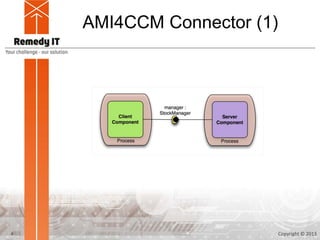
AMI4CCM Connector (1)


4                           Copyright © 2013
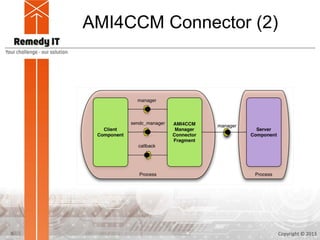
AMI4CCM Connector (2)


5                           Copyright © 2013
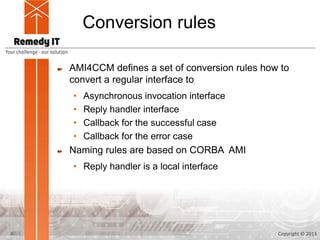
Conversion rules

    AMI4CCM defines a set of conversion rules how to
    convert a regular interface to
     • Asynchronous invocation interface
     • Reply handler interface
     • Callback for the successful case
     • Callback for the error case
    Naming rules are based on CORBA AMI
    • Reply handler is a local interface


6                                                Copyright © 2013
Conclusion

    AMI4CCM introduces asynchronous method
    invocation for CCM
    Doesn’t extend the CCM core
    Reuses GIS from CCM


7                                            Copyright © 2013
IDL to C++11


8                  Copyright © 2013
Why a new language mapping?

    IDL to C++ language mapping is impossible to
    change because
     • Multiple implementations are on the market (open
        source and commercial)
     • A huge amount of applications have been developed
    An updated IDL to C++ language mapping would
    force vendors and users to update their products
    The standardization of a new C++ revision in 2011
    (ISO/IEC 14882:2011, called C++11) gives the
    opportunity to define a new language mapping
    • C++11 features are not backward compatible with
      C++03 or C++99
    • A new C++11 mapping leaves the existing mapping
      intact


9                                                  Copyright © 2013
Goals

     Simplify mapping for C++
     Make use of the new C++11 features to
     •   Reduce amount of application code
     •   Reduce amount of possible errors made
     •   Gain runtime performance
     •   Speedup development and testing
     •   Faster time to market
     •   Reduced costs
     •   Reduced training time


10                                               Copyright © 2013
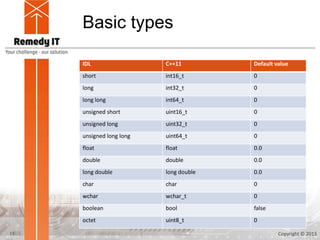
Basic types

     IDL                  C++11         Default value
     short                int16_t       0
     long                 int32_t       0
     long long            int64_t       0
     unsigned short       uint16_t      0
     unsigned long        uint32_t      0
     unsigned long long   uint64_t      0
     float                float         0.0
     double               double        0.0
     long double          long double   0.0
     char                 char          0
     wchar                wchar_t       0
     boolean              bool          false
     octet                uint8_t       0

11                                               Copyright © 2013
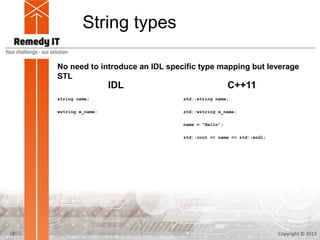
String types

     No need to introduce an IDL specific type mapping but leverage
     STL
                       IDL                             C++11
     string name;                    std::string name;

     wstring w_name;                 std::wstring w_name;

                                     name = “Hello”;

                                     std::cout << name << std::endl;


12                                                                     Copyright © 2013
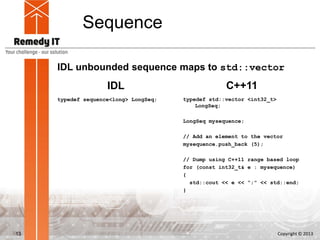
Sequence

     IDL unbounded sequence maps to std::vector
                    IDL                             C++11
     typedef sequence<long> LongSeq;   typedef std::vector <int32_t>
                                           LongSeq;

                                       LongSeq mysequence;

                                       // Add an element to the vector
                                       mysequence.push_back (5);

                                       // Dump using C++11 range based loop
                                       for (const int32_t& e : mysequence)
                                       {
                                         std::cout << e << “;” << std::end;
                                       }


13                                                                     Copyright © 2013
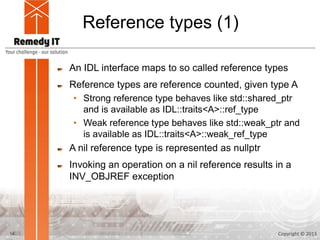
Reference types (1)

     An IDL interface maps to so called reference types
     Reference types are reference counted, given type A
      • Strong reference type behaves like std::shared_ptr
        and is available as IDL::traits<A>::ref_type
      • Weak reference type behaves like std::weak_ptr and
        is available as IDL::traits<A>::weak_ref_type
     A nil reference type is represented as nullptr
     Invoking an operation on a nil reference results in a
     INV_OBJREF exception


14                                                    Copyright © 2013
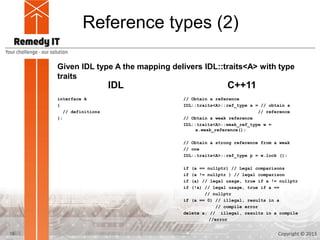
Reference types (2)

     Given IDL type A the mapping delivers IDL::traits<A> with type
     traits
                         IDL                         C++11
     interface A                     // Obtain a reference
     {                               IDL::traits<A>::ref_type a = // obtain a
        // definitions                                           // reference
     };                              // Obtain a weak reference
                                     IDL::traits<A>::weak_ref_type w =
                                          a.weak_reference();

                                     // Obtain a strong reference from a weak
                                     // one
                                     IDL::traits<A>::ref_type p = w.lock ();

                                     if (a == nullptr) // Legal comparisons
                                     if (a != nullptr ) // legal comparison
                                     if (a) // legal usage, true if a != nullptr
                                     if (!a) // legal usage, true if a ==
                                             // nullptr
                                     if (a == 0) // illegal, results in a
                                                  // compile error
                                     delete a; // illegal, results in a compile
                                               //error


15                                                                      Copyright © 2013
Components with C++11

     Component executors are local object
     implementations
     Implemented as C++ classes using standardized
     C++ traits
     Method signatures will be different compared to the
     IDL to C++ mapping
     Implementation can use the new C++11 features


16                                                   Copyright © 2013
Conclusion IDL to C++11

     IDL to C++11 simplifies programming
     The combination of reference counting and C++11
     move semantics make the code much safer and
     secure
     Application code is much smaller and easier to read


17                                                  Copyright © 2013
CCM Implementations


18                         Copyright © 2013
CIAO as implementation

     Open source LwCCM implementation using IDL to
     C++
      • Optional support for CCM navigation
      • Profile to disable CCM event support
     Uses TAO for all of its infrastructure
     Support for DDS4CCM using OpenDDS and RTI
     Connext DDS as underlying DDS implementations
     Support for AMI4CCM
     Available from http://download.dre.vanderbilt.edu


19                                                   Copyright © 2013
CIAOX11 as implementation

     LwCCM implementation using IDL to C++11
     Deviates from LwCCM towards UCM
     Clean separation between CORBA and the user
     component executors
     Current plan is to release CIAOX11 as open source
     LwCCM implementation using a similar license as
     CIAO
     New CIAOX11 high level architecture would also
     work with other programming languages


20                                                 Copyright © 2013
DAnCE

     Open source implementation of the OMG D&C
     standard using the IDL to C++ language mapping
     Uses TAO as CORBA implementation
     Introduces LocalityManager as component server
      • CIAOX11 will deliver its own C++11 LocalityManager
         and will reuse the other services from the C++
         DAnCE version
     Defines a set of plugins to customize its behavior


21                                                  Copyright © 2013

AMI4CCM_IDL2CPP

  • 1.
  • 2.
    Why AMI4CCM? LwCCM has no standardized way to perform an asynchronous method invocation between two components Each project and developer solves this challenge differently Need a standardized solution to align implementations and models 2 Copyright © 2013
  • 3.
    Requirements AMI4CCM Pure client side solution Shall not extend the LwCCM specification Reuse the Generic Interaction Support (GIS) that was introduced by DDS4CCM and which is now part of the CCM specification 3 Copyright © 2013
  • 4.
    AMI4CCM Connector (1) 4 Copyright © 2013
  • 5.
    AMI4CCM Connector (2) 5 Copyright © 2013
  • 6.
    Conversion rules AMI4CCM defines a set of conversion rules how to convert a regular interface to • Asynchronous invocation interface • Reply handler interface • Callback for the successful case • Callback for the error case Naming rules are based on CORBA AMI • Reply handler is a local interface 6 Copyright © 2013
  • 7.
    Conclusion AMI4CCM introduces asynchronous method invocation for CCM Doesn’t extend the CCM core Reuses GIS from CCM 7 Copyright © 2013
  • 8.
    IDL to C++11 8 Copyright © 2013
  • 9.
    Why a newlanguage mapping? IDL to C++ language mapping is impossible to change because • Multiple implementations are on the market (open source and commercial) • A huge amount of applications have been developed An updated IDL to C++ language mapping would force vendors and users to update their products The standardization of a new C++ revision in 2011 (ISO/IEC 14882:2011, called C++11) gives the opportunity to define a new language mapping • C++11 features are not backward compatible with C++03 or C++99 • A new C++11 mapping leaves the existing mapping intact 9 Copyright © 2013
  • 10.
    Goals Simplify mapping for C++ Make use of the new C++11 features to • Reduce amount of application code • Reduce amount of possible errors made • Gain runtime performance • Speedup development and testing • Faster time to market • Reduced costs • Reduced training time 10 Copyright © 2013
  • 11.
    Basic types IDL C++11 Default value short int16_t 0 long int32_t 0 long long int64_t 0 unsigned short uint16_t 0 unsigned long uint32_t 0 unsigned long long uint64_t 0 float float 0.0 double double 0.0 long double long double 0.0 char char 0 wchar wchar_t 0 boolean bool false octet uint8_t 0 11 Copyright © 2013
  • 12.
    String types No need to introduce an IDL specific type mapping but leverage STL IDL C++11 string name; std::string name; wstring w_name; std::wstring w_name; name = “Hello”; std::cout << name << std::endl; 12 Copyright © 2013
  • 13.
    Sequence IDL unbounded sequence maps to std::vector IDL C++11 typedef sequence<long> LongSeq; typedef std::vector <int32_t> LongSeq; LongSeq mysequence; // Add an element to the vector mysequence.push_back (5); // Dump using C++11 range based loop for (const int32_t& e : mysequence) { std::cout << e << “;” << std::end; } 13 Copyright © 2013
  • 14.
    Reference types (1) An IDL interface maps to so called reference types Reference types are reference counted, given type A • Strong reference type behaves like std::shared_ptr and is available as IDL::traits<A>::ref_type • Weak reference type behaves like std::weak_ptr and is available as IDL::traits<A>::weak_ref_type A nil reference type is represented as nullptr Invoking an operation on a nil reference results in a INV_OBJREF exception 14 Copyright © 2013
  • 15.
    Reference types (2) Given IDL type A the mapping delivers IDL::traits<A> with type traits IDL C++11 interface A // Obtain a reference { IDL::traits<A>::ref_type a = // obtain a // definitions // reference }; // Obtain a weak reference IDL::traits<A>::weak_ref_type w = a.weak_reference(); // Obtain a strong reference from a weak // one IDL::traits<A>::ref_type p = w.lock (); if (a == nullptr) // Legal comparisons if (a != nullptr ) // legal comparison if (a) // legal usage, true if a != nullptr if (!a) // legal usage, true if a == // nullptr if (a == 0) // illegal, results in a // compile error delete a; // illegal, results in a compile //error 15 Copyright © 2013
  • 16.
    Components with C++11 Component executors are local object implementations Implemented as C++ classes using standardized C++ traits Method signatures will be different compared to the IDL to C++ mapping Implementation can use the new C++11 features 16 Copyright © 2013
  • 17.
    Conclusion IDL toC++11 IDL to C++11 simplifies programming The combination of reference counting and C++11 move semantics make the code much safer and secure Application code is much smaller and easier to read 17 Copyright © 2013
  • 18.
    CCM Implementations 18 Copyright © 2013
  • 19.
    CIAO as implementation Open source LwCCM implementation using IDL to C++ • Optional support for CCM navigation • Profile to disable CCM event support Uses TAO for all of its infrastructure Support for DDS4CCM using OpenDDS and RTI Connext DDS as underlying DDS implementations Support for AMI4CCM Available from http://download.dre.vanderbilt.edu 19 Copyright © 2013
  • 20.
    CIAOX11 as implementation LwCCM implementation using IDL to C++11 Deviates from LwCCM towards UCM Clean separation between CORBA and the user component executors Current plan is to release CIAOX11 as open source LwCCM implementation using a similar license as CIAO New CIAOX11 high level architecture would also work with other programming languages 20 Copyright © 2013
  • 21.
    DAnCE Open source implementation of the OMG D&C standard using the IDL to C++ language mapping Uses TAO as CORBA implementation Introduces LocalityManager as component server • CIAOX11 will deliver its own C++11 LocalityManager and will reuse the other services from the C++ DAnCE version Defines a set of plugins to customize its behavior 21 Copyright © 2013