

Commission on Information and
 Communications Technology


        Monchito B. Ibrahim
          Commissioner
OVERVIEW
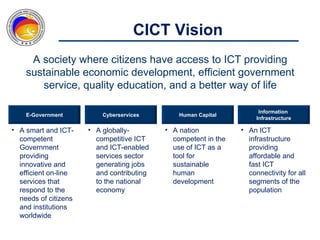
CICT Vision
     A society where citizens have access to ICT providing
    sustainable economic development, efficient government
       service, quality education, and a better way of life

                                                                      Information
    E-Government          Cyberservices        Human Capital
                                                                     Infrastructure

• A smart and ICT-    • A globally-        • A nation           • An ICT
  competent             competitive ICT      competent in the     infrastructure
  Government            and ICT-enabled      use of ICT as a      providing
  providing             services sector      tool for             affordable and
  innovative and        generating jobs      sustainable          fast ICT
  efficient on-line     and contributing     human                connectivity for all
  services that         to the national      development          segments of the
  respond to the        economy                                   population
  needs of citizens
  and institutions
  worldwide
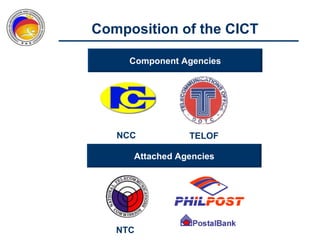
Composition of the CICT

     Component Agencies


   NCC          TELOF

     Attached Agencies


   NTC
Composition

 Headed by a Chairman with Cabinet Rank
 Assisted by four Commissioners
  • Two (2) in concurrent capacity
    • Director-General of the National Computer Center
    • Chief (Assistant Secretary) of the
      Telecommunications Office
  • Two (2) additional Commissioners as may be
    provided in the CICT structure
Cyberservices
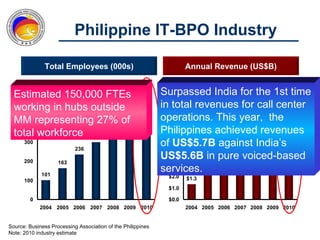
Philippine IT-BPO Industry

              T
              Total Employees (000s)                                  A
                                                                      Annual Revenue (US$B)

      600                                              562    $10.0

  Estimated 150,000 FTEs                                     Surpassed India for the 1st time
                                                               $9.0
                                                                                               $9.1


  working in hubs outside442
    500                                                      in$8.0 revenues for call center
                                                                total                     $7.2
  MM representing 27% of
    400               372
                                                             operations. This year, the
                                                               $7.0
                                                                                     $6.1
  total workforce 300                                        Philippines achieved revenues
                                                               $6.0
                                                                                $4.9
      300
                           236
                                                             of US$5.7B against India’s
                                                               $5.0


      200
                                                             US$5.6B in pure voiced-based
                                                               $4.0
                                                                           $3.3
                    163

             101
                                                             services.$2.2
                                                               $3.0

                                                               $2.0   $1.3
      100
                                                               $1.0

        0                                                      $0.0
            2004 2005 2006 2007 2008 2009 2010                        2004 2005 2006 2007 2008 2009 2010


Source: Business Processing Association of the Philippines
Note: 2010 industry estimate
Awards and Distinctions

   Offshoring Destination of the Year:
   (2007, 2009, 2010)
   Philippines

   Top 10 Outsourcing Cities in Asia Pacific:
   #3 Manila


   31 New Emerging Destinations:
   Davao
   Iloilo
Awards and Distinctions

 2010 Top 100 Cities in the World for
 Outsourcing Report:
 #4 Metro Manila
 #9 Cebu City
 #69 Davao City
 #88 City of Sta. Rosa
 #98 Iloilo City
 #100 Bacolod City
Awards and Distinctions

                           Among the 3 finalist countries in
                           the 2010 Most Preferred BPO
                           Country Destination


                           Global Locations Trends 2010
                           Report: Philippines now world
                           leader in terms of jobs for
Global Business Services   Shared Services and BPO
                           Services
Importance of IT-BPO to Government

 Job creation
 Contribution to national economy
 Supports related industries
 Generates tax revenues
 Lets Filipino workers stay in the Philippines
 Resiliency amid global recession
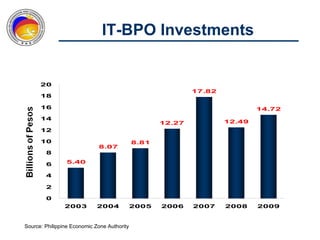
IT-BPO Investments


      20
                                                            17.82
      18

      16                                                                    14.72
      14
                                                    12.27           12.49
      12

      10                                     8.81
                             8.07
        8

        6       5.40

        4

        2

        0
                2003         2004            2005   2006    2007    2008    2009


Source: Philippine Economic Zone Authority
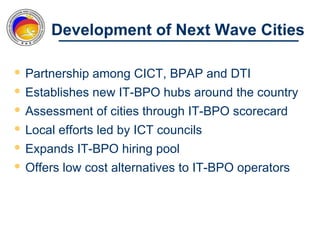
Development of Next Wave Cities

 Partnership among CICT, BPAP and DTI
 Establishes new IT-BPO hubs around the country
 Assessment of cities through IT-BPO scorecard
 Local efforts led by ICT councils
 Expands IT-BPO hiring pool
 Offers low cost alternatives to IT-BPO operators
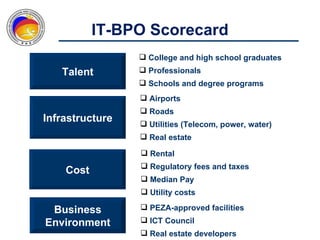
IT-BPO Scorecard
                  College and high school graduates
   Talent         Professionals
                  Schools and degree programs
                  Airports
                  Roads
Infrastructure    Utilities (Telecom, power, water)
                  Real estate

                  Rental
                  Regulatory fees and taxes
    Cost
                  Median Pay
                  Utility costs

 Business         PEZA-approved facilities
Environment       ICT Council
                  Real estate developers
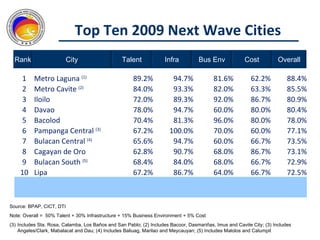
Top Ten 2009 Next Wave Cities
  Rank                    City                   Talent             Infra          Bus Env              Cost           Overall

    1     Metro Laguna (1)                            89.2%            94.7%              81.6%            62.2%           88.4%
    2     Metro Cavite (2)                            84.0%            93.3%              82.0%            63.3%           85.5%
    3     Iloilo                                      72.0%            89.3%              92.0%            86.7%           80.9%
    4     Davao                                       78.0%            94.7%              60.0%            80.0%           80.4%
    5     Bacolod                                     70.4%            81.3%              96.0%            80.0%           78.0%
    6     Pampanga Central (3)                        67.2%           100.0%              70.0%            60.0%           77.1%
    7     Bulacan Central (4)                         65.6%            94.7%              60.0%            66.7%           73.5%
    8     Cagayan de Oro                              62.8%            90.7%              68.0%            86.7%           73.1%
    9     Bulacan South (5)                           68.4%            84.0%              68.0%            66.7%           72.9%
    10    Lipa                                        67.2%            86.7%              64.0%            66.7%           72.5%


Source: BPAP, CICT, DTI
Note: Overall = 50% Talent + 30% Infrastructure + 15% Business Environment + 5% Cost
(3) Includes Sta. Rosa, Calamba, Los Baños and San Pablo; (2) Includes Bacoor, Dasmariñas, Imus and Cavite City; (3) Includes
    Angeles/Clark, Mabalacat and Dau; (4) Includes Baliuag, Marilao and Meycauyan; (5) Includes Malolos and Calumpit
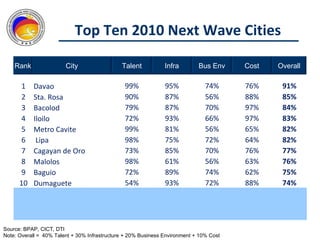
Top Ten 2010 Next Wave Cities

    Rank                City                  Talent           Infra        Bus Env     Cost   Overall

      1    Davao                               99%             95%             74%      76%     91%
      2    Sta. Rosa                           90%             87%             56%      88%     85%
      3    Bacolod                             79%             87%             70%      97%     84%
      4    Iloilo                              72%             93%             66%      97%     83%
      5    Metro Cavite                        99%             81%             56%      65%     82%
      6     Lipa                               98%             75%             72%      64%     82%
      7    Cagayan de Oro                      73%             85%             70%      76%     77%
      8    Malolos                             98%             61%             56%      63%     76%
      9    Baguio                              72%             89%             74%      62%     75%
      10   Dumaguete                           54%             93%             72%      88%     74%


Source: BPAP, CICT, DTI
Note: Overall = 40% Talent + 30% Infrastructure + 20% Business Environment + 10% Cost
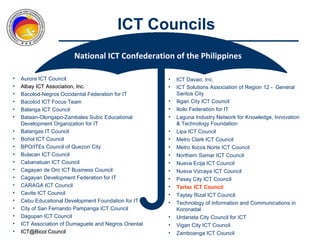
ICT Councils
                         National ICT Confederation of the Philippines

•   Aurora ICT Council                                 •   ICT Davao, Inc.
•   Albay ICT Association, Inc.                        •   ICT Solutions Association of Region 12 - General
•   Bacolod-Negros Occidental Federation for IT            Santos City
•   Bacolod ICT Focus Team                             •   Iligan City ICT Council
•   Balanga ICT Council                                •   Iloilo Federation for IT
•   Bataan-Olongapo-Zambales Subic Educational         •   Laguna Industry Network for Knowledge, Innovation
    Development Organization for IT                        & Technology Foundation
•   Batangas IT Council                                •   Lipa ICT Council
•   Bohol ICT Council                                  •   Metro Clark ICT Council
•   BPO/ITEs Council of Quezon City                    •   Metro Ilocos Norte ICT Council
•   Bulacan ICT Council                                •   Northern Samar ICT Council
•   Cabanatuan ICT Council                             •   Nueva Ecija ICT Council
•   Cagayan de Oro ICT Business Council                •   Nueva Vizcaya ICT Council
•   Cagayan Development Federation for IT              •   Pasay City ICT Council
•   CARAGA ICT Council                                 •   Tarlac ICT Council
•   Cavite ICT Council                                 •   Taytay Rizal ICT Council
•   Cebu Educational Development Foundation for IT     •   Technology of Information and Communications in
•   City of San Fernando Pampanga ICT Council              Koronadal
•   Dagupan ICT Council                                •   Urdaneta City Council for ICT
•   ICT Association of Dumaguete and Negros Oriental   •   Vigan City ICT Council
•   ICT@Bicol Council                                  •   Zamboanga ICT Council
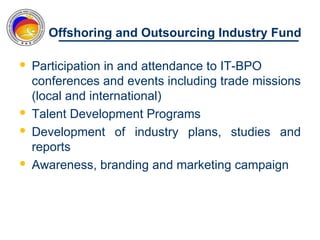
Offshoring and Outsourcing Industry Fund

 Participation in and attendance to IT-BPO
  conferences and events including trade missions
  (local and international)
 Talent Development Programs
 Development of industry plans, studies and
  reports
 Awareness, branding and marketing campaign
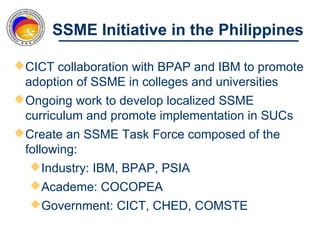
SSME Initiative in the Philippines

 CICT collaboration with BPAP and IBM to promote
  adoption of SSME in colleges and universities
 Ongoing work to develop localized SSME
  curriculum and promote implementation in SUCs
 Create an SSME Task Force composed of the
  following:
    Industry: IBM, BPAP, PSIA
   Academe: COCOPEA
   Government: CICT, CHED, COMSTE
Why we need SSME

 Provide steady supply of qualified
  manpower for the IT-BPO industry
 Expand presence in non-voice services
 Maintain competitiveness in the IT-BPO
  global landscape
 Create new jobs amid the current global
  economic crisis
BPAP IT-BPO Roadmap 2016:
        Driving to Global Leadership

 US$20B to US$25B revenue in 2016
 US$1.3M direct employment
 9% share in GDP
BPAP IT-BPO Roadmap 2016:
                      Driving to Global Leadership

The industry has identified five immediate public-private–partnership initiatives to
drive Road Map 2016:
1. Dramatically increase quality and quantity of talent pool by catalyzing the education
and training sector (Industry-recognized standards, Industry accreditation, Hiring
prioritization)
2. Undertake internal marketing to position IT-BPO as a career of choice
3. Aggressively promote Philippine IT-BPO proposition in new service lines and
geographies (e.g., F&A, Healthcare, IT, UK and APAC)
4. Enable industry growth through legislation and policy changes
    Greater autonomy in curriculum design and other education interventions
    Flexibility in labor markets
    Legislation to create competitive data privacy and anti-cybercrime laws and to
      establish DICT
    Continuation of current incentives
5. Allocate resources for critical talent and marketing initiatives
    Scale-up BPAP National Competency Test (BNCT)
    Continue Training for Work Scholarships
    Domestic and international marketing
BPAP IT-BPO Roadmap 2016:
              Driving to Global Leadership

What the industry needs from government to meet their
targets:
    Education (CHED, DepEd, TESDA)
    Legislation (Congress)
    Investment promotion (DTI and DOF)
    Closely aligned government partner (CICT)
BPAP IT-BPO Roadmap 2016:
                Driving to Global Leadership

What the industry needs from government to meet their
targets:
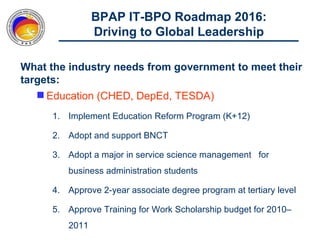
    Education (CHED, DepEd, TESDA)
      1. Implement Education Reform Program (K+12)

      2. Adopt and support BNCT

      3. Adopt a major in service science management for
         business administration students

      4. Approve 2-year associate degree program at tertiary level

      5. Approve Training for Work Scholarship budget for 2010‒
         2011
BPAP IT-BPO Roadmap 2016:
               Driving to Global Leadership

What the industry needs from government to meet their
targets:
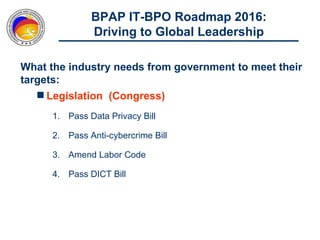
    Legislation (Congress)
      1. Pass Data Privacy Bill

      2. Pass Anti-cybercrime Bill

      3. Amend Labor Code

      4. Pass DICT Bill
BPAP IT-BPO Roadmap 2016:
                Driving to Global Leadership

What the industry needs from government to meet their
targets:
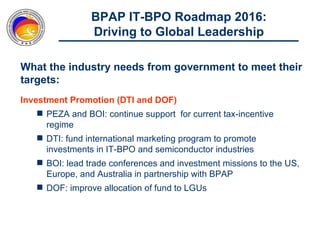
Investment Promotion (DTI and DOF)
    PEZA and BOI: continue support for current tax-incentive
     regime
    DTI: fund international marketing program to promote
     investments in IT-BPO and semiconductor industries
    BOI: lead trade conferences and investment missions to the US,
     Europe, and Australia in partnership with BPAP
    DOF: improve allocation of fund to LGUs
BPAP IT-BPO Roadmap 2016:
                 Driving to Global Leadership

What the industry needs from government to meet their
targets:
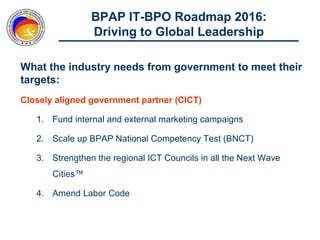
Closely aligned government partner (CICT)

   1. Fund internal and external marketing campaigns

   2. Scale up BPAP National Competency Test (BNCT)

   3. Strengthen the regional ICT Councils in all the Next Wave
       Cities™

   4. Amend Labor Code
The Philippine Digital Strategy: ICT
              Road Map 2011-2016
   Currently drafting the Philippine Digital Strategy
    2011-2016, which shall serve as government’s blueprint
    for the ICT sector

   Technical working groups composed of ICT stakeholders
    from government and industry are organized to work on
    the strategic thrusts of the Digital Strategy

   In the process, the CICT will lead efforts in:
     Conducting periodic assessments and updates to make
        the Digital Strategy resonate with the needs of the
        country and the technological advances that have
        taken place
     Stock-taking and formulating key recommendations
The Philippine Digital Strategy: ICT
              Road Map 2011-2016
Strategic Themes/Thrusts:
    - Digital Inclusion/ Universal Access
    - Cyberservices and ICT Industries
    - eGovernance/ eGovernment
    - Cyberservices and ICT Industries

Cross-Cutting Themes:
   - Digital Inclusion/ Universal Access
   - Gender
   - Environment
   - Cybersecurity
   - Privacy
   - Legislation
   - Leadership
The Philippine Digital Strategy: ICT
                 Road Map 2011-2016
Digital Inclusion/   Skills, Training &       eGovernance/         Cyberservices
Universal Access        Education             eGovernment
• Funding /          • Scarcity of quality   • Leadership/        • Weak or
  Resources to         labor pool and job-   • Communication        undefined brand,
  Ensure Universal     skills mismatch       • Institutional        both internally as
  Access             • ICT in Government       framework            well as externally
                     • Disparate ICT         • Information        • Quantity and
• Spectrum             initiatives             Systems              quality of talent is
  Management         • Limited                 Applications         perceived as
                       opportunities for     • Computerization      lacking
• Sustainability       ICT workers in          in LGUs            • Policy
  and Scalability of   government            • Infrastructure       environment has
  Shared Access      • Leadership and          Facilities           not caught up with
  Points               Governance            • ICT Manpower in      new realities
                     • Equitable Access        Government         • Difficulty of
• Security and       • Infrastructure        • Absence of           starting-up new
  Privacy of Data    • Content                 Interoperability     ventures, local
  in Network         • Delivery                standards/           ventures
                     • Standards/Quality       framework.
                     • Information and
                       Advocacy
Migration to IPv6
 The exponential growth of the Internet, resulting in an
  explosion of digital traffic and possible IPv4 address
  exhaustion, has spurred the need to adopt Internet
  Protocol Version 6, or IPv6, as a response to the
  shortcomings of IPv4
 CICT encourages the migration to IPv6 by telecom
  operators, ISPs and government agencies
 Executive Order to promote and encourage the migration
  to IPV6 already issued, current work on the IRR ongoing,
  including the formation of an Inter-Agency Task Force
  and Inter-Agency Technical Working Group
International Cooperation/Commitments
ASEAN Telecommunications and IT Working Group
APEC Telecommunications and Information Working
Group
APEC eCommerce Steering Group
APEC Human Resources Development Working
Group
International Telecommunication Union
Governmental Advisory Committee (GAC) of the
Internet Corporation for Assigned Names and
Numbers (ICANN)

                         33
Legislative Agenda
 DICT and Data Privacy Bills
These bills already been approved by the House Committees on
 Information and Communications Technology and Government
 Reorganization

 Anti-Cybercrime Bill
    Awaiting deliberation
Thank You!

Cict cavite[1]

  • 1.
    Commission on Informationand Communications Technology Monchito B. Ibrahim Commissioner
  • 2.
  • 3.
    CICT Vision A society where citizens have access to ICT providing sustainable economic development, efficient government service, quality education, and a better way of life Information E-Government Cyberservices Human Capital Infrastructure • A smart and ICT- • A globally- • A nation • An ICT competent competitive ICT competent in the infrastructure Government and ICT-enabled use of ICT as a providing providing services sector tool for affordable and innovative and generating jobs sustainable fast ICT efficient on-line and contributing human connectivity for all services that to the national development segments of the respond to the economy population needs of citizens and institutions worldwide
  • 4.
    Composition of theCICT Component Agencies NCC TELOF Attached Agencies NTC
  • 5.
    Composition  Headed bya Chairman with Cabinet Rank  Assisted by four Commissioners • Two (2) in concurrent capacity • Director-General of the National Computer Center • Chief (Assistant Secretary) of the Telecommunications Office • Two (2) additional Commissioners as may be provided in the CICT structure
  • 6.
  • 7.
    Philippine IT-BPO Industry T Total Employees (000s) A Annual Revenue (US$B) 600 562 $10.0 Estimated 150,000 FTEs Surpassed India for the 1st time $9.0 $9.1 working in hubs outside442 500 in$8.0 revenues for call center total $7.2 MM representing 27% of 400 372 operations. This year, the $7.0 $6.1 total workforce 300 Philippines achieved revenues $6.0 $4.9 300 236 of US$5.7B against India’s $5.0 200 US$5.6B in pure voiced-based $4.0 $3.3 163 101 services.$2.2 $3.0 $2.0 $1.3 100 $1.0 0 $0.0 2004 2005 2006 2007 2008 2009 2010 2004 2005 2006 2007 2008 2009 2010 Source: Business Processing Association of the Philippines Note: 2010 industry estimate
  • 9.
    Awards and Distinctions Offshoring Destination of the Year: (2007, 2009, 2010) Philippines Top 10 Outsourcing Cities in Asia Pacific: #3 Manila 31 New Emerging Destinations: Davao Iloilo
  • 10.
    Awards and Distinctions 2010 Top 100 Cities in the World for Outsourcing Report: #4 Metro Manila #9 Cebu City #69 Davao City #88 City of Sta. Rosa #98 Iloilo City #100 Bacolod City
  • 11.
    Awards and Distinctions Among the 3 finalist countries in the 2010 Most Preferred BPO Country Destination Global Locations Trends 2010 Report: Philippines now world leader in terms of jobs for Global Business Services Shared Services and BPO Services
  • 12.
    Importance of IT-BPOto Government  Job creation  Contribution to national economy  Supports related industries  Generates tax revenues  Lets Filipino workers stay in the Philippines  Resiliency amid global recession
  • 13.
    IT-BPO Investments 20 17.82 18 16 14.72 14 12.27 12.49 12 10 8.81 8.07 8 6 5.40 4 2 0 2003 2004 2005 2006 2007 2008 2009 Source: Philippine Economic Zone Authority
  • 14.
    Development of NextWave Cities  Partnership among CICT, BPAP and DTI  Establishes new IT-BPO hubs around the country  Assessment of cities through IT-BPO scorecard  Local efforts led by ICT councils  Expands IT-BPO hiring pool  Offers low cost alternatives to IT-BPO operators
  • 15.
    IT-BPO Scorecard  College and high school graduates Talent  Professionals  Schools and degree programs  Airports  Roads Infrastructure  Utilities (Telecom, power, water)  Real estate  Rental  Regulatory fees and taxes Cost  Median Pay  Utility costs Business  PEZA-approved facilities Environment  ICT Council  Real estate developers
  • 16.
    Top Ten 2009Next Wave Cities Rank City Talent Infra Bus Env Cost Overall 1 Metro Laguna (1) 89.2% 94.7% 81.6% 62.2% 88.4% 2 Metro Cavite (2) 84.0% 93.3% 82.0% 63.3% 85.5% 3 Iloilo 72.0% 89.3% 92.0% 86.7% 80.9% 4 Davao 78.0% 94.7% 60.0% 80.0% 80.4% 5 Bacolod 70.4% 81.3% 96.0% 80.0% 78.0% 6 Pampanga Central (3) 67.2% 100.0% 70.0% 60.0% 77.1% 7 Bulacan Central (4) 65.6% 94.7% 60.0% 66.7% 73.5% 8 Cagayan de Oro 62.8% 90.7% 68.0% 86.7% 73.1% 9 Bulacan South (5) 68.4% 84.0% 68.0% 66.7% 72.9% 10 Lipa 67.2% 86.7% 64.0% 66.7% 72.5% Source: BPAP, CICT, DTI Note: Overall = 50% Talent + 30% Infrastructure + 15% Business Environment + 5% Cost (3) Includes Sta. Rosa, Calamba, Los Baños and San Pablo; (2) Includes Bacoor, Dasmariñas, Imus and Cavite City; (3) Includes Angeles/Clark, Mabalacat and Dau; (4) Includes Baliuag, Marilao and Meycauyan; (5) Includes Malolos and Calumpit
  • 17.
    Top Ten 2010Next Wave Cities Rank City Talent Infra Bus Env Cost Overall 1 Davao 99% 95% 74% 76% 91% 2 Sta. Rosa 90% 87% 56% 88% 85% 3 Bacolod 79% 87% 70% 97% 84% 4 Iloilo 72% 93% 66% 97% 83% 5 Metro Cavite 99% 81% 56% 65% 82% 6 Lipa 98% 75% 72% 64% 82% 7 Cagayan de Oro 73% 85% 70% 76% 77% 8 Malolos 98% 61% 56% 63% 76% 9 Baguio 72% 89% 74% 62% 75% 10 Dumaguete 54% 93% 72% 88% 74% Source: BPAP, CICT, DTI Note: Overall = 40% Talent + 30% Infrastructure + 20% Business Environment + 10% Cost
  • 18.
    ICT Councils National ICT Confederation of the Philippines • Aurora ICT Council • ICT Davao, Inc. • Albay ICT Association, Inc. • ICT Solutions Association of Region 12 - General • Bacolod-Negros Occidental Federation for IT Santos City • Bacolod ICT Focus Team • Iligan City ICT Council • Balanga ICT Council • Iloilo Federation for IT • Bataan-Olongapo-Zambales Subic Educational • Laguna Industry Network for Knowledge, Innovation Development Organization for IT & Technology Foundation • Batangas IT Council • Lipa ICT Council • Bohol ICT Council • Metro Clark ICT Council • BPO/ITEs Council of Quezon City • Metro Ilocos Norte ICT Council • Bulacan ICT Council • Northern Samar ICT Council • Cabanatuan ICT Council • Nueva Ecija ICT Council • Cagayan de Oro ICT Business Council • Nueva Vizcaya ICT Council • Cagayan Development Federation for IT • Pasay City ICT Council • CARAGA ICT Council • Tarlac ICT Council • Cavite ICT Council • Taytay Rizal ICT Council • Cebu Educational Development Foundation for IT • Technology of Information and Communications in • City of San Fernando Pampanga ICT Council Koronadal • Dagupan ICT Council • Urdaneta City Council for ICT • ICT Association of Dumaguete and Negros Oriental • Vigan City ICT Council • ICT@Bicol Council • Zamboanga ICT Council
  • 19.
    Offshoring and OutsourcingIndustry Fund  Participation in and attendance to IT-BPO conferences and events including trade missions (local and international)  Talent Development Programs  Development of industry plans, studies and reports  Awareness, branding and marketing campaign
  • 20.
    SSME Initiative inthe Philippines  CICT collaboration with BPAP and IBM to promote adoption of SSME in colleges and universities  Ongoing work to develop localized SSME curriculum and promote implementation in SUCs  Create an SSME Task Force composed of the following:  Industry: IBM, BPAP, PSIA  Academe: COCOPEA  Government: CICT, CHED, COMSTE
  • 21.
    Why we needSSME  Provide steady supply of qualified manpower for the IT-BPO industry  Expand presence in non-voice services  Maintain competitiveness in the IT-BPO global landscape  Create new jobs amid the current global economic crisis
  • 22.
    BPAP IT-BPO Roadmap2016: Driving to Global Leadership  US$20B to US$25B revenue in 2016  US$1.3M direct employment  9% share in GDP
  • 23.
    BPAP IT-BPO Roadmap2016: Driving to Global Leadership The industry has identified five immediate public-private–partnership initiatives to drive Road Map 2016: 1. Dramatically increase quality and quantity of talent pool by catalyzing the education and training sector (Industry-recognized standards, Industry accreditation, Hiring prioritization) 2. Undertake internal marketing to position IT-BPO as a career of choice 3. Aggressively promote Philippine IT-BPO proposition in new service lines and geographies (e.g., F&A, Healthcare, IT, UK and APAC) 4. Enable industry growth through legislation and policy changes  Greater autonomy in curriculum design and other education interventions  Flexibility in labor markets  Legislation to create competitive data privacy and anti-cybercrime laws and to establish DICT  Continuation of current incentives 5. Allocate resources for critical talent and marketing initiatives  Scale-up BPAP National Competency Test (BNCT)  Continue Training for Work Scholarships  Domestic and international marketing
  • 24.
    BPAP IT-BPO Roadmap2016: Driving to Global Leadership What the industry needs from government to meet their targets:  Education (CHED, DepEd, TESDA)  Legislation (Congress)  Investment promotion (DTI and DOF)  Closely aligned government partner (CICT)
  • 25.
    BPAP IT-BPO Roadmap2016: Driving to Global Leadership What the industry needs from government to meet their targets:  Education (CHED, DepEd, TESDA) 1. Implement Education Reform Program (K+12) 2. Adopt and support BNCT 3. Adopt a major in service science management for business administration students 4. Approve 2-year associate degree program at tertiary level 5. Approve Training for Work Scholarship budget for 2010‒ 2011
  • 26.
    BPAP IT-BPO Roadmap2016: Driving to Global Leadership What the industry needs from government to meet their targets:  Legislation (Congress) 1. Pass Data Privacy Bill 2. Pass Anti-cybercrime Bill 3. Amend Labor Code 4. Pass DICT Bill
  • 27.
    BPAP IT-BPO Roadmap2016: Driving to Global Leadership What the industry needs from government to meet their targets: Investment Promotion (DTI and DOF)  PEZA and BOI: continue support for current tax-incentive regime  DTI: fund international marketing program to promote investments in IT-BPO and semiconductor industries  BOI: lead trade conferences and investment missions to the US, Europe, and Australia in partnership with BPAP  DOF: improve allocation of fund to LGUs
  • 28.
    BPAP IT-BPO Roadmap2016: Driving to Global Leadership What the industry needs from government to meet their targets: Closely aligned government partner (CICT) 1. Fund internal and external marketing campaigns 2. Scale up BPAP National Competency Test (BNCT) 3. Strengthen the regional ICT Councils in all the Next Wave Cities™ 4. Amend Labor Code
  • 29.
    The Philippine DigitalStrategy: ICT Road Map 2011-2016  Currently drafting the Philippine Digital Strategy 2011-2016, which shall serve as government’s blueprint for the ICT sector  Technical working groups composed of ICT stakeholders from government and industry are organized to work on the strategic thrusts of the Digital Strategy  In the process, the CICT will lead efforts in:  Conducting periodic assessments and updates to make the Digital Strategy resonate with the needs of the country and the technological advances that have taken place  Stock-taking and formulating key recommendations
  • 30.
    The Philippine DigitalStrategy: ICT Road Map 2011-2016 Strategic Themes/Thrusts: - Digital Inclusion/ Universal Access - Cyberservices and ICT Industries - eGovernance/ eGovernment - Cyberservices and ICT Industries Cross-Cutting Themes: - Digital Inclusion/ Universal Access - Gender - Environment - Cybersecurity - Privacy - Legislation - Leadership
  • 31.
    The Philippine DigitalStrategy: ICT Road Map 2011-2016 Digital Inclusion/ Skills, Training & eGovernance/ Cyberservices Universal Access Education eGovernment • Funding / • Scarcity of quality • Leadership/ • Weak or Resources to labor pool and job- • Communication undefined brand, Ensure Universal skills mismatch • Institutional both internally as Access • ICT in Government framework well as externally • Disparate ICT • Information • Quantity and • Spectrum initiatives Systems quality of talent is Management • Limited Applications perceived as opportunities for • Computerization lacking • Sustainability ICT workers in in LGUs • Policy and Scalability of government • Infrastructure environment has Shared Access • Leadership and Facilities not caught up with Points Governance • ICT Manpower in new realities • Equitable Access Government • Difficulty of • Security and • Infrastructure • Absence of starting-up new Privacy of Data • Content Interoperability ventures, local in Network • Delivery standards/ ventures • Standards/Quality framework. • Information and Advocacy
  • 32.
    Migration to IPv6 The exponential growth of the Internet, resulting in an explosion of digital traffic and possible IPv4 address exhaustion, has spurred the need to adopt Internet Protocol Version 6, or IPv6, as a response to the shortcomings of IPv4  CICT encourages the migration to IPv6 by telecom operators, ISPs and government agencies  Executive Order to promote and encourage the migration to IPV6 already issued, current work on the IRR ongoing, including the formation of an Inter-Agency Task Force and Inter-Agency Technical Working Group
  • 33.
    International Cooperation/Commitments ASEAN Telecommunicationsand IT Working Group APEC Telecommunications and Information Working Group APEC eCommerce Steering Group APEC Human Resources Development Working Group International Telecommunication Union Governmental Advisory Committee (GAC) of the Internet Corporation for Assigned Names and Numbers (ICANN) 33
  • 34.
    Legislative Agenda DICTand Data Privacy Bills These bills already been approved by the House Committees on Information and Communications Technology and Government Reorganization Anti-Cybercrime Bill  Awaiting deliberation
  • 35.