CIA exam review course
Prepared by Jack Davidsz
www.mas-online.nl
1
1. Mandatory Guidance
2. Independence, Objectivity and Due Care
3. Control Frameworks and Fraud
4. Control: Types and Techniques
5. Data Gathering and Data Analysis
6. Conducting the Engagement: Sampling
7. Procedures, Analysis, Conclusions and
Documentation.
2
Study Unit 1
3
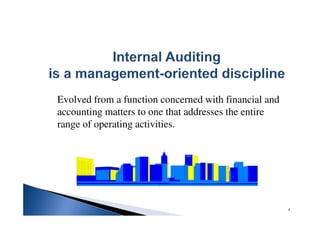
Evolved from a function concerned with financial and
accounting matters to one that addresses the entire
range of operating activities.
4
Internal auditing is an independent, objective
assurance and consulting activity designed to add
value and improve an organization’s operations.
It helps an organization accomplish its objectives by
bringing a systematic and disciplined approach to
evaluate and improve the effectiveness of the
organization’s risk management, control, and
governance processes.
IIA Board of Directors, June 1999.
5
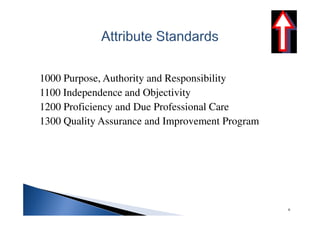
1000 Purpose, Authority and Responsibility
1100 Independence and Objectivity
1200 Proficiency and Due Professional Care
1300 Quality Assurance and Improvement Program
6
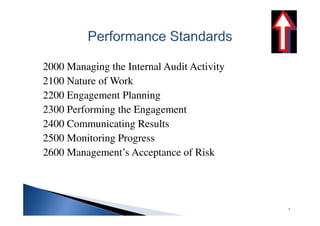
2000 Managing the Internal Audit Activity
2100 Nature of Work
2200 Engagement Planning
2300 Performing the Engagement
2400 Communicating Results
2500 Monitoring Progress
2600 Management’s Acceptance of Risk
7
8
An organization´s code of ethics is the established
general value system the organization wishes to apply
to its members´ activities.
9
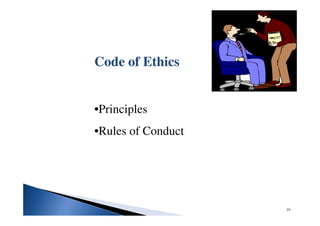
Code of Ethics
•Principles
•Rules of Conduct
10
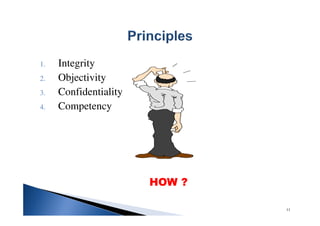
1. Integrity
2. Objectivity
3. Confidentiality
4. Competency
HOW ?
11
Work with honesty, diligence and responsibility
Observe the law and make disclosures
Be not a party to any illegal activity
Respect the ethical objectives of the organization
12
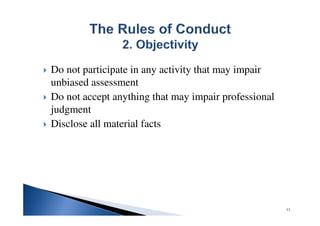
Do not participate in any activity that may impair
unbiased assessment
Do not accept anything that may impair professional
judgment
Disclose all material facts
13
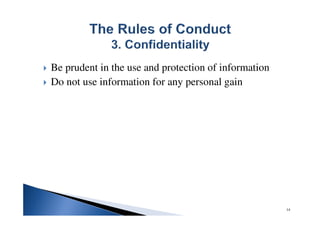
Be prudent in the use and protection of information
Do not use information for any personal gain
14
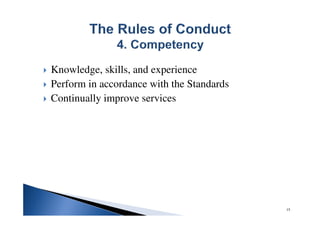
Knowledge, skills, and experience
Perform in accordance with the Standards
Continually improve services
15
16
To enhance and protect organizational value by
providing risk-based and objective assurance,
advice, and insight.
17
1. Demonstrates integrity.
2. Demonstrates competence and due professional care.
3. Is objective and free from undue influence
4. Aligns with the strategies, objectives, and risks of the
organization.
5. Is appropriately positioned and adequately resourced.
6. Demonstrates quality and continuous improvement.
7. Communicates effectively.
8. Provides risk-based assurance.
9. Is insightful, proactive, and future-focused.
10.Promotes organizational improvement
18
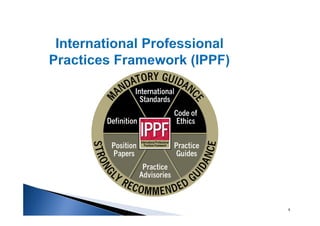
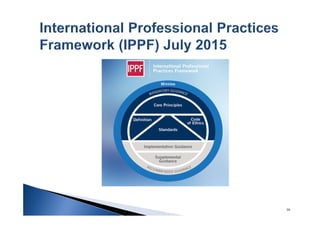
Implementation Guidance/Practice Advisories
Supplemental Guidance/Practice Guides
19
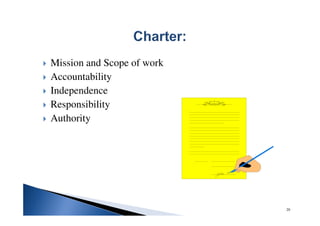
Mission and Scope of work
Accountability
Independence
Responsibility
Authority
20
Study Unit 2
21
Functional,
Directly to the Audit Committee or equivalent to ensure
independence and communication
Administrative,
To the CEO or an other executive to afford support to
accomplish day-to-day activities.
22
Any relationship that is, or appears to be, not in the best
interest of the organization
Internal Auditor’s Objectivity
?
23
Advisory and related client service activities, the nature
and scope of which are agreed upon with the client and
which are intended to add value and improve an
organization’s operations.
24
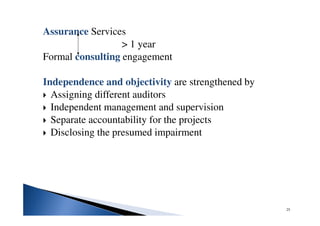
Assurance Services
> 1 year
Formal consulting engagement
Independence and objectivity are strengthened by
Assigning different auditors
Independent management and supervision
Separate accountability for the projects
Disclosing the presumed impairment
25
Due Professional care
Expected of a reasonably prudent and competent
internal auditor, who should be alert to the possibility
of intentional wrongdoing, errors and omissions,
inefficiency, waste, ineffectiveness, and conflicts of
interest
Due care implies
Reasonable care and competence not infallibility or
extraordinary performance.
26
Oversight and responsibility for the IAA must not be
outsourced
Services must be performed in accordance with the
standards and the guidance for obtaining external
service providers should be considered (PA 1210).
27
CAE should assess the competency, independence and
objectivity of the outside service provider.
When the outside service provider performs Internal
Auditing activities the CAE should specify and ensure
that the work complies with the SPPIA.
28
Quality Assurance and Improvement
Program covers all aspects of the IAA and continuously
monitors its effectiveness.
Should help the IAA add value and improve the
organization’s operations and provide assurance that
the IAA is in conformity with the Standards and Code
of Ethics.
29
Ongoing Reviews
Periodic Reviews
30
Should be conducted at least once every five years by a
qualified independent reviewer from outside the
organization
Self assessment with independent, external validation is
an alternative to full external assessment
31
Be a competent certified audit professional, who
possesses current knowledge of the Standards
Be well versed in the best practices of the profession
Have at least three years of recent experience in the
practice of internal auditing
32
Nonconformance with the Definition of IA, Code of
Ethics or Standards should be disclosed by the CAE to
senior management and Board
33
Study Unit 3
34
35
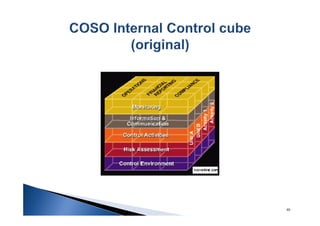
Internal Control (COSO)
A process, effected by an entity’s Board of Directors,
management and other personnel, designed to provide
reasonable assurance regarding the achievement of
objectives in the following categories:
36
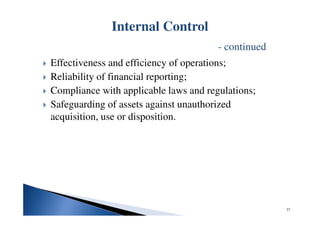
Internal Control
- continued
Effectiveness and efficiency of operations;
Reliability of financial reporting;
Compliance with applicable laws and regulations;
Safeguarding of assets against unauthorized
acquisition, use or disposition.
37
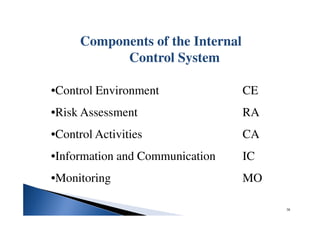
Components of the Internal
Control System
•Control Environment CE
•Risk Assessment RA
•Control Activities CA
•Information and Communication IC
•Monitoring MO
38
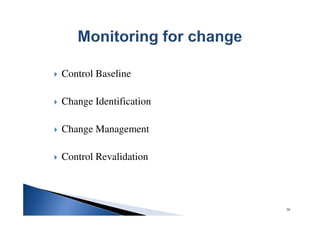
Control Baseline
Change Identification
Change Management
Control Revalidation
39
40
20 criteria grouped into the following 4 components
Purpose
Commitment
Capability
Monitoring and Learning
41
CoCo : ethical values, mutual trust
COSO : part of the control environment
42
43
1. Meeting stakeholders needs
◦ Realization of benefits
◦ Optimization of risk
◦ Optimal use of resources.
44
2. Covering the Enterprise End to End. IT governance
must be integrated with enterprise governance.
45
3. Applying a Single, Integrated Framework.
46
4. Enabling a Holistic Approach
◦ Principles, policies, frameworks
◦ Processes
◦ Organizational structures
◦ Culture, ethics and behavior
◦ Information
◦ Services, infrastructure, and application
◦ People, skills and competencies.
47
5. Separating Governance from Management.
48
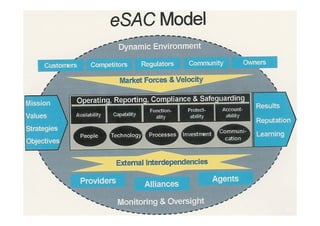
Framework for evaluating the
e-business control environment
49
50
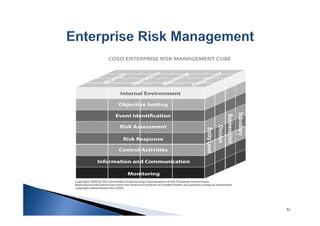
Process ..
Applied in strategy setting and across..
Designed to identify potential events..
Manage risks..
To provide reasonable assurance..
Achievement of entity objectives
51
52
1. Risk Avoidence
2. Risk Retention
3. Risk Reduction
4. Risk Sharing
5. Risk Exploitation
53
A structured, consistent and continuous process across
the whole organization for identifiying, assessing,
deciding on responses to and reporting on opportunities
and threats that affect the achievements of objectives
54
CAE should obtain an understanding of management’s
and board’s expectations of the internal audit activity in
the organization’s risk management process.
55
Objectives support and align with the mission.
Significant risks are identified and assessed.
Appropriate risk responses are selected that align
risks with the organization´s risk appetite
Relevant risk information is captured and
communicated in a timely manner across the
organization, enabling staff, management and board
to carry out their responsibilties.
56
Formal ↔ informal
Quantitative ↔ subjective
Business unit ↔ at corporate level
57
Internal auditors can facilitate or enable risk
management processes, but they should not “own” or
be responsible for the management of the risks
identified.
58
No role
Auditing the risk management process
Active, continuous support and involvement
Managing and coordinating
59
Setting the risk appetite
Imposing risk management processes
Management assurance on risks
Taking decisions on risk responses
Implementing risk responses on management’s behalf
Accountability for risk management.
60
Audit failure
False assurance
Reputation risks
MANAGE YOUR RISKS!
61
62
Any illegal act characterized by deceit, conceilment,
or violation of trust.
These acts are not dependent upon the threat or
violence or physical force.
Perpetrated by parties and organizations to obtain
money, property or services to avoid payment or loss
of services or to secure advantage.
62
63
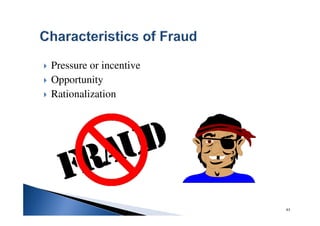
Pressure or incentive
Opportunity
Rationalization
63
Internal auditors are responsible for assisting in the
deterrence of fraud by examining and evaluating the
adequacy and the effectiveness of control,
commensurate with the extent of the potential
exposure/risk in the various segments of the entity’s
operations.
64
Responsibilities of the internal auditor
Have sufficient knowledge of fraud to be able to
identify indicators
Be alert to opportunities, such as control weaknesses
Evaluate the indicators that fraud might have been
committed
Notify the appropriate authorities within the
organization if there are sufficient indicators to
recommend an investigation.
65
6666
Examples:
Lack of employee rotation in sensitive positions
Inappropriate combination of job duties
Unclear lines of responsibility and accountability
Unrealistic sales or production goals
Employee who refuses to take vacations
Study Unit 4
67
Any action taken by management to enhance the
likelihood that established objectives and goals will
be achieved
Preventive
Detective
Directive
Mitigating
68
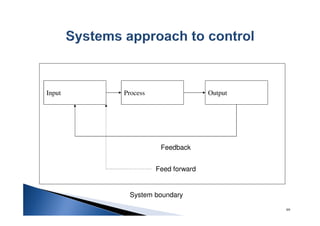
Input Process Output
Feedback
Feed forward
System boundary
69
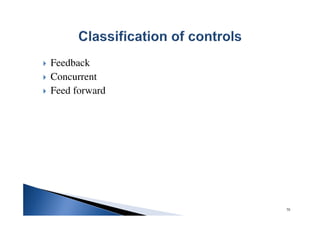
Feedback
Concurrent
Feed forward
70
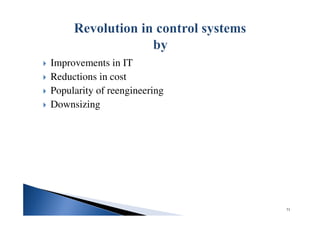
Improvements in IT
Reductions in cost
Popularity of reengineering
Downsizing
71
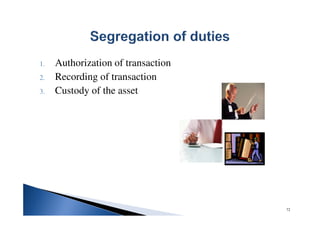
1. Authorization of transaction
2. Recording of transaction
3. Custody of the asset
72
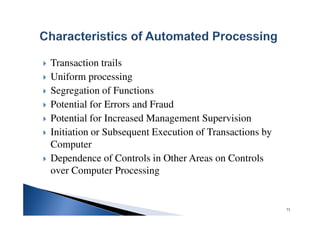
Transaction trails
Uniform processing
Segregation of Functions
Potential for Errors and Fraud
Potential for Increased Management Supervision
Initiation or Subsequent Execution of Transactions by
Computer
Dependence of Controls in Other Areas on Controls
over Computer Processing
73
74
75
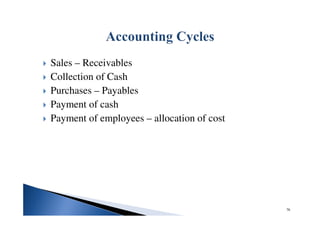
Sales – Receivables
Collection of Cash
Purchases – Payables
Payment of cash
Payment of employees – allocation of cost
76
The employment of all the means devised in an
enterprise to promote, direct, restrain, govern, and
check upon its various activities for the purpose of
seeing that enterprise objectives are met. These means
of control include, but are not limited to, form of
organization, policies, systems, procedures,
instructions, standards, committees, charts of accounts,
forecasts, budgets, schedules, reports, records,
checklists, methods, devices, and internal auditing.
77
Organization
Policies
Procedures
Personnel
Accounting
Budgeting
Reporting
78
Study Unit 5
79
80
1. Physical evidence
2. Testimonial evidence
3. Documentary evidence
- Internal
- External
4. Analytic evidence
81
Sufficient
Reliable
Relevant
Useful
82
Objectivity
Documentation
Externality
Sample size
Sampling method
Corroboration
Timeliness
Authoritativeness
Directness
Adequacy of controls
Input from client
Analytic Procedures
Prior Audit Reports
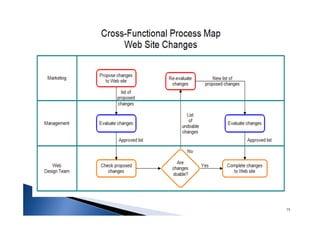
Process Mapping
Checklists
Documentation and Communication of Results
83
Questionnaires
Interviewing
Observation
Checklists
Internal Surveys
External Datasources
84
Study Unit 6
85
86
Learning a great deal by looking at a little.
Tasting a spoonful from the pot.
Taking blood tests.
87
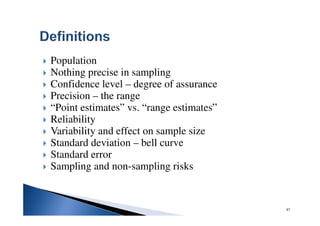
Population
Nothing precise in sampling
Confidence level – degree of assurance
Precision – the range
“Point estimates” vs. “range estimates”
Reliability
Variability and effect on sample size
Standard deviation – bell curve
Standard error
Sampling and non-sampling risks
88
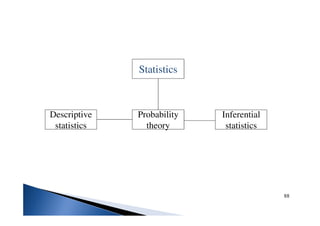
Descriptive
statistics
Statistics
Probability
theory
Inferential
statistics
89
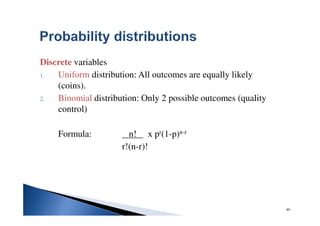
Discrete variables
1. Uniform distribution: All outcomes are equally likely
(coins).
2. Binomial distribution: Only 2 possible outcomes (quality
control)
Formula: n! x pr(1-p)n-r
r!(n-r)!
90
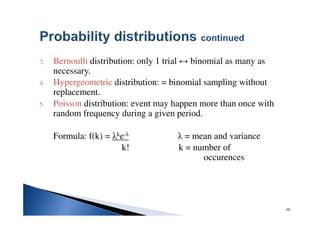
3. Bernoulli distribution: only 1 trial ↔ binomial as many as
necessary.
4. Hypergeometric distribution: = binomial sampling without
replacement.
5. Poisson distribution: event may happen more than once with
random frequency during a given period.
Formula: f(k) = λke-λ λ = mean and variance
k! k = number of
occurences
91
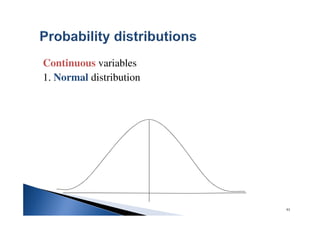
Continuous variables
1. Normal distribution
92
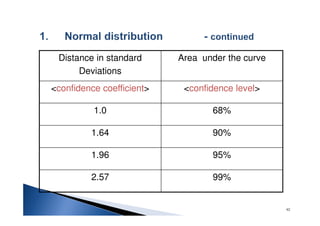
Distance in standard
Deviations
Area under the curve
<confidence coefficient> <confidence level>
1.0 68%
1.64 90%
1.96 95%
2.57 99%
93
Regardless of the distribution of the population from
which random samples are drawn, the shape of the
sampling distribution of the mean approaches the
normal distribution as the sample size is increased.
94
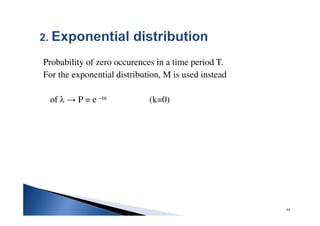
Probability of zero occurences in a time period T.
For the exponential distribution, M is used instead
of λ → P = e –m (k=0)
95
3. T-distribution
Small samples, less than 30 with unknown variance.
4. Chi-square distribution: comparison of sample variance
and population variance. Is the sample likely to be from the
population.
96
1. Judgment (non statistical sampling)
2. Statistical sampling
Test of controls
(attribute sampling)
Substantive testing
(variables sampling)
Sampling risk: probability that a properly
drawn sample may not represent the
population.
97
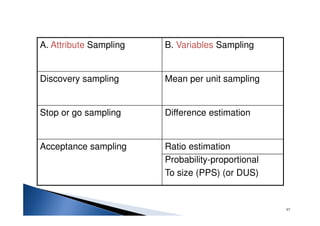
A. Attribute Sampling B. Variables Sampling
Discovery sampling Mean per unit sampling
Stop or go sampling Difference estimation
Acceptance sampling Ratio estimation
Probability-proportional
To size (PPS) (or DUS)
98
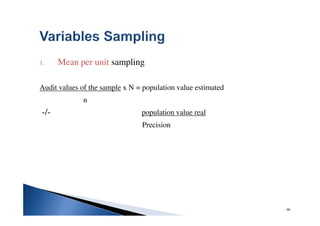
1. Mean per unit sampling
Audit values of the sample x N = population value estimated
n
-/- population value real
Precision
99
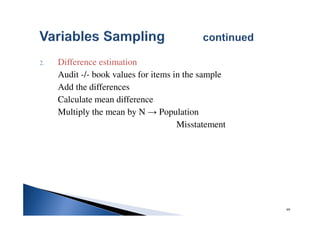
2. Difference estimation
Audit -/- book values for items in the sample
Add the differences
Calculate mean difference
Multiply the mean by N → Population
Misstatement
100
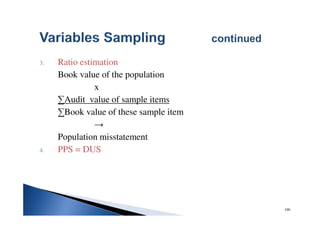
3. Ratio estimation
Book value of the population
x
∑Audit value of sample items
∑Book value of these sample item
→
Population misstatement
4. PPS = DUS
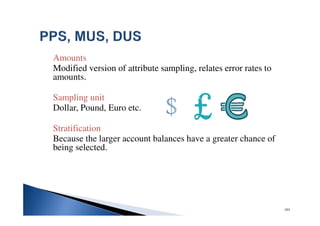
Amounts
Modified version of attribute sampling, relates error rates to
amounts.
Sampling unit
Dollar, Pound, Euro etc.
Stratification
Because the larger account balances have a greater chance of
being selected.
101
102
Overstatements
It is good to test for overstatements, not effective for
estimating understatement errors. Testing of account balances:
inventory, receivables, loans.
Few errors
Useful if few errors are expected
As the number of expected misstatements increases, MUS
requires a larger sample size than classical variables sampling.
103
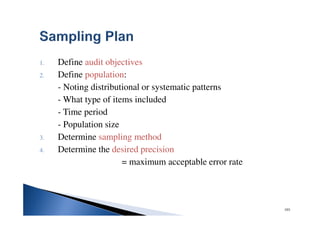
1. Define audit objectives
2. Define population:
- Noting distributional or systematic patterns
- What type of items included
- Time period
- Population size
3. Determine sampling method
4. Determine the desired precision
= maximum acceptable error rate
104
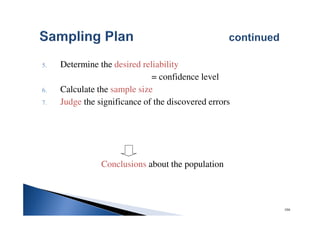
5. Determine the desired reliability
= confidence level
6. Calculate the sample size
7. Judge the significance of the discovered errors
Conclusions about the population
105
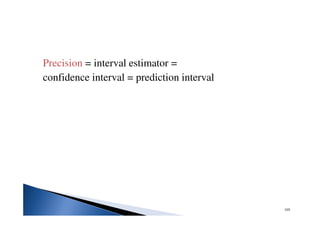
Precision = interval estimator =
confidence interval = prediction interval
106
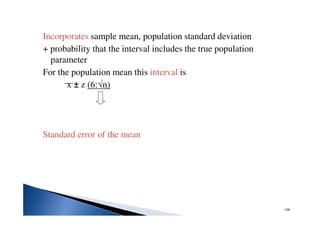
Incorporates sample mean, population standard deviation
+ probability that the interval includes the true population
parameter
For the population mean this interval is
x ± z (6:√n)
Standard error of the mean
107
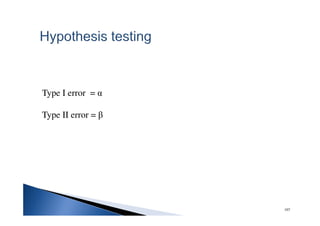
Type I error = α
Type II error = β
108
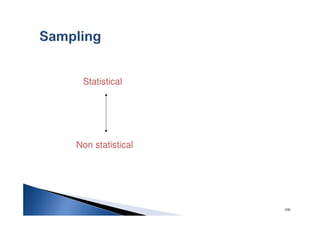
Statistical
Non statistical
109
The end result of sampling
More than just the numbers
Affected by various factors
- Nature of system of control
- Views on administration.
- Views on training and experience of people
- Effect of erroneous transactions
- Effect on other transactions
110
Use scientific sampling when they best fit the audit
objectives
Base audit opinions only on the population sampled
Let every item have an equal chance of being selected
Do not let personal bias affect the sample
Do not permit population patterns affect the
randomness of the sample
111
Do not draw conclusions about the entire population
from a directed sample
Base estimates of maximum error rates on what is
reasonable
Stratify wherever it would appear to reduce
variability in the sample
Do not set needlessly high confidence and precision
levels
Do not stop with statistical results, know why the
variances occurred.
Study Unit 7
11
2
113
Comparing information with
expectations identified or developed by
the internal auditor
These procedures may identify
Unexpected differences
Absence of expected differences
Potential errors, fraud, or illegal acts
Other unusual or nonrecurring transactions or events
114
Entails analysis and measurement of key output against
those of the best organizations.
Own process performance versus performance by the
best in the class.
115
11
6
Inspection of records
Inspection of tangible assets
Observation
Inquiry
Confirmation
Recomputing
Reperformance
Analytical procedure, scanning
Conclusion and opinions are the internal auditor’s
evaluations of the effects of the observations and
recommendations on the activities reviewed.
117
Input from client
Analytic Procedures
Prior Audit Reports
Process Mapping
Checklists
Documentation and Communication of Results
118
119
Probe deeply for the fundamental causes of identified
problems
120
be prepared by the Internal
Auditor and reviewed by
management of the IAA.
record the information obtained
and the analysis made.
support the bases for
observations and
recommendations to be reported.
121
Members of the organization or outside parties may
request access to working papers.
Internal auditors are encouraged to consult legal
counsel in all matters involving legal issues.
122
Property of the organization
Under control of the IAA
Access subject to approval of CAE or senior
management/legal counsel (outside the organization)
123
Properly protected
Locked files
Reviews in the IAA’s office
Passwords
Backup + storage off-site
Retrievability
Maintain at least 7 years (SOX)
124
1. Interviews
2. Questionnaires
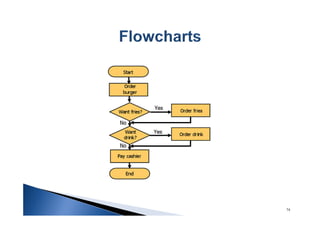
3. Flowcharts
4. Generalized audit software
5. Other audit software
6. Code review
7. Test data
8. Code comparison
9. Concurrent audit techniques
125
Integrated Test Facility (ITF)
Snapshot
Tracing
Embedded Audit Module
System Control Audit Review File (SCARF)
Sample Audit Review File (SARF)
© Management Audit Services 2017 126

CIA Part I review course 2017

  • 1.
    CIA exam reviewcourse Prepared by Jack Davidsz www.mas-online.nl 1
  • 2.
    1. Mandatory Guidance 2.Independence, Objectivity and Due Care 3. Control Frameworks and Fraud 4. Control: Types and Techniques 5. Data Gathering and Data Analysis 6. Conducting the Engagement: Sampling 7. Procedures, Analysis, Conclusions and Documentation. 2
  • 3.
  • 4.
    Evolved from afunction concerned with financial and accounting matters to one that addresses the entire range of operating activities. 4
  • 5.
    Internal auditing isan independent, objective assurance and consulting activity designed to add value and improve an organization’s operations. It helps an organization accomplish its objectives by bringing a systematic and disciplined approach to evaluate and improve the effectiveness of the organization’s risk management, control, and governance processes. IIA Board of Directors, June 1999. 5
  • 6.
    1000 Purpose, Authorityand Responsibility 1100 Independence and Objectivity 1200 Proficiency and Due Professional Care 1300 Quality Assurance and Improvement Program 6
  • 7.
    2000 Managing theInternal Audit Activity 2100 Nature of Work 2200 Engagement Planning 2300 Performing the Engagement 2400 Communicating Results 2500 Monitoring Progress 2600 Management’s Acceptance of Risk 7
  • 8.
  • 9.
    An organization´s codeof ethics is the established general value system the organization wishes to apply to its members´ activities. 9
  • 10.
  • 11.
    1. Integrity 2. Objectivity 3.Confidentiality 4. Competency HOW ? 11
  • 12.
    Work with honesty,diligence and responsibility Observe the law and make disclosures Be not a party to any illegal activity Respect the ethical objectives of the organization 12
  • 13.
    Do not participatein any activity that may impair unbiased assessment Do not accept anything that may impair professional judgment Disclose all material facts 13
  • 14.
    Be prudent inthe use and protection of information Do not use information for any personal gain 14
  • 15.
    Knowledge, skills, andexperience Perform in accordance with the Standards Continually improve services 15
  • 16.
  • 17.
    To enhance andprotect organizational value by providing risk-based and objective assurance, advice, and insight. 17
  • 18.
    1. Demonstrates integrity. 2.Demonstrates competence and due professional care. 3. Is objective and free from undue influence 4. Aligns with the strategies, objectives, and risks of the organization. 5. Is appropriately positioned and adequately resourced. 6. Demonstrates quality and continuous improvement. 7. Communicates effectively. 8. Provides risk-based assurance. 9. Is insightful, proactive, and future-focused. 10.Promotes organizational improvement 18
  • 19.
  • 20.
    Mission and Scopeof work Accountability Independence Responsibility Authority 20
  • 21.
  • 22.
    Functional, Directly to theAudit Committee or equivalent to ensure independence and communication Administrative, To the CEO or an other executive to afford support to accomplish day-to-day activities. 22
  • 23.
    Any relationship thatis, or appears to be, not in the best interest of the organization Internal Auditor’s Objectivity ? 23
  • 24.
    Advisory and relatedclient service activities, the nature and scope of which are agreed upon with the client and which are intended to add value and improve an organization’s operations. 24
  • 25.
    Assurance Services > 1year Formal consulting engagement Independence and objectivity are strengthened by Assigning different auditors Independent management and supervision Separate accountability for the projects Disclosing the presumed impairment 25
  • 26.
    Due Professional care Expectedof a reasonably prudent and competent internal auditor, who should be alert to the possibility of intentional wrongdoing, errors and omissions, inefficiency, waste, ineffectiveness, and conflicts of interest Due care implies Reasonable care and competence not infallibility or extraordinary performance. 26
  • 27.
    Oversight and responsibilityfor the IAA must not be outsourced Services must be performed in accordance with the standards and the guidance for obtaining external service providers should be considered (PA 1210). 27
  • 28.
    CAE should assessthe competency, independence and objectivity of the outside service provider. When the outside service provider performs Internal Auditing activities the CAE should specify and ensure that the work complies with the SPPIA. 28
  • 29.
    Quality Assurance andImprovement Program covers all aspects of the IAA and continuously monitors its effectiveness. Should help the IAA add value and improve the organization’s operations and provide assurance that the IAA is in conformity with the Standards and Code of Ethics. 29
  • 30.
  • 31.
    Should be conductedat least once every five years by a qualified independent reviewer from outside the organization Self assessment with independent, external validation is an alternative to full external assessment 31
  • 32.
    Be a competentcertified audit professional, who possesses current knowledge of the Standards Be well versed in the best practices of the profession Have at least three years of recent experience in the practice of internal auditing 32
  • 33.
    Nonconformance with theDefinition of IA, Code of Ethics or Standards should be disclosed by the CAE to senior management and Board 33
  • 34.
  • 35.
  • 36.
    Internal Control (COSO) Aprocess, effected by an entity’s Board of Directors, management and other personnel, designed to provide reasonable assurance regarding the achievement of objectives in the following categories: 36
  • 37.
    Internal Control - continued Effectivenessand efficiency of operations; Reliability of financial reporting; Compliance with applicable laws and regulations; Safeguarding of assets against unauthorized acquisition, use or disposition. 37
  • 38.
    Components of theInternal Control System •Control Environment CE •Risk Assessment RA •Control Activities CA •Information and Communication IC •Monitoring MO 38
  • 39.
    Control Baseline Change Identification ChangeManagement Control Revalidation 39
  • 40.
  • 41.
    20 criteria groupedinto the following 4 components Purpose Commitment Capability Monitoring and Learning 41
  • 42.
    CoCo : ethicalvalues, mutual trust COSO : part of the control environment 42
  • 43.
  • 44.
    1. Meeting stakeholdersneeds ◦ Realization of benefits ◦ Optimization of risk ◦ Optimal use of resources. 44
  • 45.
    2. Covering theEnterprise End to End. IT governance must be integrated with enterprise governance. 45
  • 46.
    3. Applying aSingle, Integrated Framework. 46
  • 47.
    4. Enabling aHolistic Approach ◦ Principles, policies, frameworks ◦ Processes ◦ Organizational structures ◦ Culture, ethics and behavior ◦ Information ◦ Services, infrastructure, and application ◦ People, skills and competencies. 47
  • 48.
    5. Separating Governancefrom Management. 48
  • 49.
    Framework for evaluatingthe e-business control environment 49
  • 50.
  • 51.
    Process .. Applied instrategy setting and across.. Designed to identify potential events.. Manage risks.. To provide reasonable assurance.. Achievement of entity objectives 51
  • 52.
  • 53.
    1. Risk Avoidence 2.Risk Retention 3. Risk Reduction 4. Risk Sharing 5. Risk Exploitation 53
  • 54.
    A structured, consistentand continuous process across the whole organization for identifiying, assessing, deciding on responses to and reporting on opportunities and threats that affect the achievements of objectives 54
  • 55.
    CAE should obtainan understanding of management’s and board’s expectations of the internal audit activity in the organization’s risk management process. 55
  • 56.
    Objectives support andalign with the mission. Significant risks are identified and assessed. Appropriate risk responses are selected that align risks with the organization´s risk appetite Relevant risk information is captured and communicated in a timely manner across the organization, enabling staff, management and board to carry out their responsibilties. 56
  • 57.
    Formal ↔ informal Quantitative↔ subjective Business unit ↔ at corporate level 57
  • 58.
    Internal auditors canfacilitate or enable risk management processes, but they should not “own” or be responsible for the management of the risks identified. 58
  • 59.
    No role Auditing therisk management process Active, continuous support and involvement Managing and coordinating 59
  • 60.
    Setting the riskappetite Imposing risk management processes Management assurance on risks Taking decisions on risk responses Implementing risk responses on management’s behalf Accountability for risk management. 60
  • 61.
    Audit failure False assurance Reputationrisks MANAGE YOUR RISKS! 61
  • 62.
    62 Any illegal actcharacterized by deceit, conceilment, or violation of trust. These acts are not dependent upon the threat or violence or physical force. Perpetrated by parties and organizations to obtain money, property or services to avoid payment or loss of services or to secure advantage. 62
  • 63.
  • 64.
    Internal auditors areresponsible for assisting in the deterrence of fraud by examining and evaluating the adequacy and the effectiveness of control, commensurate with the extent of the potential exposure/risk in the various segments of the entity’s operations. 64
  • 65.
    Responsibilities of theinternal auditor Have sufficient knowledge of fraud to be able to identify indicators Be alert to opportunities, such as control weaknesses Evaluate the indicators that fraud might have been committed Notify the appropriate authorities within the organization if there are sufficient indicators to recommend an investigation. 65
  • 66.
    6666 Examples: Lack of employeerotation in sensitive positions Inappropriate combination of job duties Unclear lines of responsibility and accountability Unrealistic sales or production goals Employee who refuses to take vacations
  • 67.
  • 68.
    Any action takenby management to enhance the likelihood that established objectives and goals will be achieved Preventive Detective Directive Mitigating 68
  • 69.
    Input Process Output Feedback Feedforward System boundary 69
  • 70.
  • 71.
    Improvements in IT Reductionsin cost Popularity of reengineering Downsizing 71
  • 72.
    1. Authorization oftransaction 2. Recording of transaction 3. Custody of the asset 72
  • 73.
    Transaction trails Uniform processing Segregationof Functions Potential for Errors and Fraud Potential for Increased Management Supervision Initiation or Subsequent Execution of Transactions by Computer Dependence of Controls in Other Areas on Controls over Computer Processing 73
  • 74.
  • 75.
  • 76.
    Sales – Receivables Collectionof Cash Purchases – Payables Payment of cash Payment of employees – allocation of cost 76
  • 77.
    The employment ofall the means devised in an enterprise to promote, direct, restrain, govern, and check upon its various activities for the purpose of seeing that enterprise objectives are met. These means of control include, but are not limited to, form of organization, policies, systems, procedures, instructions, standards, committees, charts of accounts, forecasts, budgets, schedules, reports, records, checklists, methods, devices, and internal auditing. 77
  • 78.
  • 79.
  • 80.
    80 1. Physical evidence 2.Testimonial evidence 3. Documentary evidence - Internal - External 4. Analytic evidence
  • 81.
  • 82.
  • 83.
    Input from client AnalyticProcedures Prior Audit Reports Process Mapping Checklists Documentation and Communication of Results 83
  • 84.
  • 85.
  • 86.
    86 Learning a greatdeal by looking at a little. Tasting a spoonful from the pot. Taking blood tests.
  • 87.
    87 Population Nothing precise insampling Confidence level – degree of assurance Precision – the range “Point estimates” vs. “range estimates” Reliability Variability and effect on sample size Standard deviation – bell curve Standard error Sampling and non-sampling risks
  • 88.
  • 89.
    89 Discrete variables 1. Uniformdistribution: All outcomes are equally likely (coins). 2. Binomial distribution: Only 2 possible outcomes (quality control) Formula: n! x pr(1-p)n-r r!(n-r)!
  • 90.
    90 3. Bernoulli distribution:only 1 trial ↔ binomial as many as necessary. 4. Hypergeometric distribution: = binomial sampling without replacement. 5. Poisson distribution: event may happen more than once with random frequency during a given period. Formula: f(k) = λke-λ λ = mean and variance k! k = number of occurences
  • 91.
  • 92.
    92 Distance in standard Deviations Areaunder the curve <confidence coefficient> <confidence level> 1.0 68% 1.64 90% 1.96 95% 2.57 99%
  • 93.
    93 Regardless of thedistribution of the population from which random samples are drawn, the shape of the sampling distribution of the mean approaches the normal distribution as the sample size is increased.
  • 94.
    94 Probability of zerooccurences in a time period T. For the exponential distribution, M is used instead of λ → P = e –m (k=0)
  • 95.
    95 3. T-distribution Small samples,less than 30 with unknown variance. 4. Chi-square distribution: comparison of sample variance and population variance. Is the sample likely to be from the population.
  • 96.
    96 1. Judgment (nonstatistical sampling) 2. Statistical sampling Test of controls (attribute sampling) Substantive testing (variables sampling) Sampling risk: probability that a properly drawn sample may not represent the population.
  • 97.
    97 A. Attribute SamplingB. Variables Sampling Discovery sampling Mean per unit sampling Stop or go sampling Difference estimation Acceptance sampling Ratio estimation Probability-proportional To size (PPS) (or DUS)
  • 98.
    98 1. Mean perunit sampling Audit values of the sample x N = population value estimated n -/- population value real Precision
  • 99.
    99 2. Difference estimation Audit-/- book values for items in the sample Add the differences Calculate mean difference Multiply the mean by N → Population Misstatement
  • 100.
    100 3. Ratio estimation Bookvalue of the population x ∑Audit value of sample items ∑Book value of these sample item → Population misstatement 4. PPS = DUS
  • 101.
    Amounts Modified version ofattribute sampling, relates error rates to amounts. Sampling unit Dollar, Pound, Euro etc. Stratification Because the larger account balances have a greater chance of being selected. 101
  • 102.
    102 Overstatements It is goodto test for overstatements, not effective for estimating understatement errors. Testing of account balances: inventory, receivables, loans. Few errors Useful if few errors are expected As the number of expected misstatements increases, MUS requires a larger sample size than classical variables sampling.
  • 103.
    103 1. Define auditobjectives 2. Define population: - Noting distributional or systematic patterns - What type of items included - Time period - Population size 3. Determine sampling method 4. Determine the desired precision = maximum acceptable error rate
  • 104.
    104 5. Determine thedesired reliability = confidence level 6. Calculate the sample size 7. Judge the significance of the discovered errors Conclusions about the population
  • 105.
    105 Precision = intervalestimator = confidence interval = prediction interval
  • 106.
    106 Incorporates sample mean,population standard deviation + probability that the interval includes the true population parameter For the population mean this interval is x ± z (6:√n) Standard error of the mean
  • 107.
    107 Type I error= α Type II error = β
  • 108.
  • 109.
    109 The end resultof sampling More than just the numbers Affected by various factors - Nature of system of control - Views on administration. - Views on training and experience of people - Effect of erroneous transactions - Effect on other transactions
  • 110.
    110 Use scientific samplingwhen they best fit the audit objectives Base audit opinions only on the population sampled Let every item have an equal chance of being selected Do not let personal bias affect the sample Do not permit population patterns affect the randomness of the sample
  • 111.
    111 Do not drawconclusions about the entire population from a directed sample Base estimates of maximum error rates on what is reasonable Stratify wherever it would appear to reduce variability in the sample Do not set needlessly high confidence and precision levels Do not stop with statistical results, know why the variances occurred.
  • 112.
  • 113.
    113 Comparing information with expectationsidentified or developed by the internal auditor
  • 114.
    These procedures mayidentify Unexpected differences Absence of expected differences Potential errors, fraud, or illegal acts Other unusual or nonrecurring transactions or events 114
  • 115.
    Entails analysis andmeasurement of key output against those of the best organizations. Own process performance versus performance by the best in the class. 115
  • 116.
    11 6 Inspection of records Inspectionof tangible assets Observation Inquiry Confirmation Recomputing Reperformance Analytical procedure, scanning
  • 117.
    Conclusion and opinionsare the internal auditor’s evaluations of the effects of the observations and recommendations on the activities reviewed. 117
  • 118.
    Input from client AnalyticProcedures Prior Audit Reports Process Mapping Checklists Documentation and Communication of Results 118
  • 119.
    119 Probe deeply forthe fundamental causes of identified problems
  • 120.
    120 be prepared bythe Internal Auditor and reviewed by management of the IAA. record the information obtained and the analysis made. support the bases for observations and recommendations to be reported.
  • 121.
    121 Members of theorganization or outside parties may request access to working papers. Internal auditors are encouraged to consult legal counsel in all matters involving legal issues.
  • 122.
    122 Property of theorganization Under control of the IAA Access subject to approval of CAE or senior management/legal counsel (outside the organization)
  • 123.
    123 Properly protected Locked files Reviewsin the IAA’s office Passwords Backup + storage off-site Retrievability Maintain at least 7 years (SOX)
  • 124.
    124 1. Interviews 2. Questionnaires 3.Flowcharts 4. Generalized audit software 5. Other audit software 6. Code review 7. Test data 8. Code comparison 9. Concurrent audit techniques
  • 125.
    125 Integrated Test Facility(ITF) Snapshot Tracing Embedded Audit Module System Control Audit Review File (SCARF) Sample Audit Review File (SARF)
  • 126.
    © Management AuditServices 2017 126