PERFORMANCE
STANDARDS
The Institute of Internal Auditors
www.theiia.org
describe the nature of internal
audit activities and provide
criteria against which the
performance of these services
can be evaluated.
The chief audit executive must effectively
manage the internal audit activity to ensure it
adds value to the organization.
Considers strategies, objectives, and risks
Strives to offer ways to enhance governance, risk
management, and control processes
Objectively provides relevant assurance
The chief audit executive must establish a risk-based
plan to determine the priorities of the internal audit
activity, consistent with the organization’s goals.
CAE must review and adjust the plan, as necessary
CAE consults with senior management and the board
and obtains an understanding of the organization’s
strategies, key business objectives, associated risks,
and risk management processes
The chief audit executive must communicate
the internal audit activity’s plans and resource
requirements to senior management and the
board for review and approval.
The chief audit executive must ensure that
internal audit resources are appropriate,
sufficient, and effectively deployed to
achieve the approved plan.
Refers to the
mix of
knowledge, skills
and other
competencies
needed to
perform the plan
Refers to the quantity of resources
needed to accomplish the plan
The chief audit executive must establish
policies and procedures to guide the internal
audit activity.
The chief audit executive should share
information, coordinate activities, and consider
relying upon the work of other internal and
external assurance and consulting service
providers to ensure proper coverage and
minimize duplication of efforts.
The chief audit executive must report periodically
to senior management and the board on the
internal audit activity’s purpose, authority,
responsibility, and performance relative to its plan
and on its conformance with the Code of Ethics
and the Standards.
Significant risks
Control issues
When an external service provider serves as the
internal audit activity, the provider must make
the organization aware that the organization
has the responsibility for maintaining an
effective internal audit activity.
The internal audit activity must evaluate and
contribute to the improvement of the
organization’s governance, risk management,
and control processes using a systematic,
disciplined, and risk-based approach.
Auditors are proactive
Offer new insights and consider future impact
The internal audit activity must assess and make
appropriate recommendations to improve the
organization’s governance processes for:
1) Makingstrategicand operationaldecisions
2) Overseeing risk managementand control
3) Promotingappropriateethics and values
4) Ensuring effective organizationalperformance
managementand accountability
5) Communicatingrisk and control information
The internal audit activity must evaluate the
effectiveness and contribute to the improvement
of risk management process.
Determination of the effectiveness of risk
management processes is a judgment resulting
from the internal auditor’s assessment
Provide an understanding of the organization’s risk
management processes and their effectiveness
The internal audit activity must assist the organization in
maintaining effective controls by evaluating their
effectiveness and efficiency and by promoting continuous
improvement.
Must evaluate the adequacy and effectiveness
of controls in responding to risks
Must incorporateknowledge of controls gained
Internal auditors must develop and document a plan for
each engagement, including the engagement’s
objectives, scope, timing, and resource allocations.
Internal auditors must consider:
The strategies and objectives of the activity being reviewed
and the means by which the activity controls its performance.
The significant risks to the activity’s objectives, resources,
and operations and the means by which the potential impact
of risk is kept to an acceptable level.
The adequacy and effectiveness of the activity’s governance,
risk management, and control processes
The opportunities for making significant improvements to the
activity’s governance, risk management, and control process
Internal auditors must:
Conduct a preliminary assessment of the risks relevant to
the activity under review
Consider the probability of significant errors, fraud,
noncompliance, and other exposures when developing the
engagement objectives
Ascertain the extent to which management and/or board
has established adequate criteria to determine whether
objectives and goals have been accomplished
1) Internal
2) External
3) Leading practices
The engagement scope must be sufficient to achieve the
objectives of the engagement.
Must include considerationof relevant systems, records,
personnel, and physical properties
Must ensure that the scope of the engagement is sufficient to
address the agreed-upon objectives
Must address controls consistent with the engagement’s
objectives and be alert to significant control issues
Internal auditors must determine appropriate and sufficient
resources to achieve engagement objectives based on an
evaluation of the nature and complexity of each
engagement, time constraints, and available resources.
Internal auditors must develop and document work
programs that achieve the engagement objectives.
Must include the procedures for identifying, analyzing,
evaluating, and documenting information during the
engagement
Must be approved prior to its implementation
Internal auditors must identify, analyze, evaluate, and
document sufficient information to achieve the
engagement’s objectives.
Internal auditors must identify sufficient, reliable, relevant,
and useful information to achieve the engagement’s
objectives.
Internal auditors must base conclusions and engagement
results on appropriate analyses and evaluations.
Internal auditors must document sufficient, reliable,
relevant, and useful information to support the engagement
results and conclusions.
CAE must control access to engagement records.
CAE must develop retention requirements for engagement
records.
CAE must develop policies governing the custody and
retention of consulting engagement records.
Engagements must be properly supervised to ensure
objectives are achieved, quality is assured, and staff is
developed.
Internal auditors must communicate the results of
engagements.
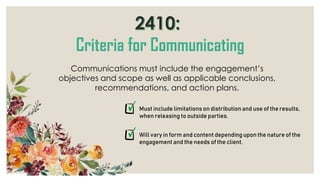
Communications must include the engagement’s
objectives and scope as well as applicable conclusions,
recommendations, and action plans.
Must include limitations on distribution and use of the results,
when releasing to outside parties.
Will vary in form and content depending upon the nature of the
engagement and the needs of the client.
Communications must be accurate, objective, clear,
concise, constructive, complete, and timely.
If a final communication contains a significant error or
omission, the chief audit executive must communicate
corrected information to all parties who received the
original information.
Is appropriate only if supported by the results of the
quality assurance and improvement program
When nonconformance with the Code of Ethics or the
Standards impacts a specific engagement, communication
of results must disclose the:
Principle/s of conduct of the Code of Ethics with which full
conformance was not achieved
Reason/s for nonconformance
Impact of nonconformance on the engagement and the
communicated engagement results
The chief audit executive is responsible for reviewing and
approving the final engagement communication before
issuance and for deciding to whom and how it will be
disseminated.
When an overall opinion is issued, it must take into account
the strategies, objectives, and risks of the organization; and
the expectations of senior management, the board, and
other stakeholders.
The chief audit executive must establish and maintain a
system to monitor the disposition of results communicated
to management.
Must establish a follow-up process to monitor and
ensure that management actions have been
effectively implemented
The chief audit executive must discuss the matter with senior
management. If the CAE determines that the matter has
not been resolved, the CAE must communicate the matter
to the board.
Raffaele Carpi, John Douglas, and Frédéric Gascon
McKinsey & Company
https://www.mckinsey.com/business-functions/operations/our-insights/performance-
management-why-keeping-score-is-so-important-and-so-hard
❖ Effective performance management is essential to business.
❖ Common pitfalls:
1) Poor metrics
2) Poor targets
3) Lack of transparency
4) Lack of relevance
5) Lack of dialogue
6) Lack of consequences
7) Lack of management engagement
❖ Building a strong performance-management system:
1) Metrics: Emphasizing leading indicators
2) Sustainability: Standard work and regular heartbeat
3) Continuous improvement: Standard work is for leaders too

Performance Standards

  • 1.
    PERFORMANCE STANDARDS The Institute ofInternal Auditors www.theiia.org
  • 2.
    describe the natureof internal audit activities and provide criteria against which the performance of these services can be evaluated.
  • 3.
    The chief auditexecutive must effectively manage the internal audit activity to ensure it adds value to the organization. Considers strategies, objectives, and risks Strives to offer ways to enhance governance, risk management, and control processes Objectively provides relevant assurance
  • 4.
    The chief auditexecutive must establish a risk-based plan to determine the priorities of the internal audit activity, consistent with the organization’s goals. CAE must review and adjust the plan, as necessary CAE consults with senior management and the board and obtains an understanding of the organization’s strategies, key business objectives, associated risks, and risk management processes
  • 5.
    The chief auditexecutive must communicate the internal audit activity’s plans and resource requirements to senior management and the board for review and approval.
  • 6.
    The chief auditexecutive must ensure that internal audit resources are appropriate, sufficient, and effectively deployed to achieve the approved plan. Refers to the mix of knowledge, skills and other competencies needed to perform the plan Refers to the quantity of resources needed to accomplish the plan
  • 7.
    The chief auditexecutive must establish policies and procedures to guide the internal audit activity.
  • 8.
    The chief auditexecutive should share information, coordinate activities, and consider relying upon the work of other internal and external assurance and consulting service providers to ensure proper coverage and minimize duplication of efforts.
  • 9.
    The chief auditexecutive must report periodically to senior management and the board on the internal audit activity’s purpose, authority, responsibility, and performance relative to its plan and on its conformance with the Code of Ethics and the Standards. Significant risks Control issues
  • 10.
    When an externalservice provider serves as the internal audit activity, the provider must make the organization aware that the organization has the responsibility for maintaining an effective internal audit activity.
  • 11.
    The internal auditactivity must evaluate and contribute to the improvement of the organization’s governance, risk management, and control processes using a systematic, disciplined, and risk-based approach. Auditors are proactive Offer new insights and consider future impact
  • 12.
    The internal auditactivity must assess and make appropriate recommendations to improve the organization’s governance processes for: 1) Makingstrategicand operationaldecisions 2) Overseeing risk managementand control 3) Promotingappropriateethics and values 4) Ensuring effective organizationalperformance managementand accountability 5) Communicatingrisk and control information
  • 13.
    The internal auditactivity must evaluate the effectiveness and contribute to the improvement of risk management process. Determination of the effectiveness of risk management processes is a judgment resulting from the internal auditor’s assessment Provide an understanding of the organization’s risk management processes and their effectiveness
  • 14.
    The internal auditactivity must assist the organization in maintaining effective controls by evaluating their effectiveness and efficiency and by promoting continuous improvement. Must evaluate the adequacy and effectiveness of controls in responding to risks Must incorporateknowledge of controls gained
  • 15.
    Internal auditors mustdevelop and document a plan for each engagement, including the engagement’s objectives, scope, timing, and resource allocations.
  • 16.
    Internal auditors mustconsider: The strategies and objectives of the activity being reviewed and the means by which the activity controls its performance. The significant risks to the activity’s objectives, resources, and operations and the means by which the potential impact of risk is kept to an acceptable level. The adequacy and effectiveness of the activity’s governance, risk management, and control processes The opportunities for making significant improvements to the activity’s governance, risk management, and control process
  • 17.
    Internal auditors must: Conducta preliminary assessment of the risks relevant to the activity under review Consider the probability of significant errors, fraud, noncompliance, and other exposures when developing the engagement objectives Ascertain the extent to which management and/or board has established adequate criteria to determine whether objectives and goals have been accomplished 1) Internal 2) External 3) Leading practices
  • 18.
    The engagement scopemust be sufficient to achieve the objectives of the engagement. Must include considerationof relevant systems, records, personnel, and physical properties Must ensure that the scope of the engagement is sufficient to address the agreed-upon objectives Must address controls consistent with the engagement’s objectives and be alert to significant control issues
  • 19.
    Internal auditors mustdetermine appropriate and sufficient resources to achieve engagement objectives based on an evaluation of the nature and complexity of each engagement, time constraints, and available resources.
  • 20.
    Internal auditors mustdevelop and document work programs that achieve the engagement objectives. Must include the procedures for identifying, analyzing, evaluating, and documenting information during the engagement Must be approved prior to its implementation
  • 21.
    Internal auditors mustidentify, analyze, evaluate, and document sufficient information to achieve the engagement’s objectives.
  • 22.
    Internal auditors mustidentify sufficient, reliable, relevant, and useful information to achieve the engagement’s objectives.
  • 23.
    Internal auditors mustbase conclusions and engagement results on appropriate analyses and evaluations.
  • 24.
    Internal auditors mustdocument sufficient, reliable, relevant, and useful information to support the engagement results and conclusions. CAE must control access to engagement records. CAE must develop retention requirements for engagement records. CAE must develop policies governing the custody and retention of consulting engagement records.
  • 25.
    Engagements must beproperly supervised to ensure objectives are achieved, quality is assured, and staff is developed.
  • 26.
    Internal auditors mustcommunicate the results of engagements.
  • 27.
    Communications must includethe engagement’s objectives and scope as well as applicable conclusions, recommendations, and action plans. Must include limitations on distribution and use of the results, when releasing to outside parties. Will vary in form and content depending upon the nature of the engagement and the needs of the client.
  • 28.
    Communications must beaccurate, objective, clear, concise, constructive, complete, and timely.
  • 29.
    If a finalcommunication contains a significant error or omission, the chief audit executive must communicate corrected information to all parties who received the original information.
  • 30.
    Is appropriate onlyif supported by the results of the quality assurance and improvement program
  • 31.
    When nonconformance withthe Code of Ethics or the Standards impacts a specific engagement, communication of results must disclose the: Principle/s of conduct of the Code of Ethics with which full conformance was not achieved Reason/s for nonconformance Impact of nonconformance on the engagement and the communicated engagement results
  • 32.
    The chief auditexecutive is responsible for reviewing and approving the final engagement communication before issuance and for deciding to whom and how it will be disseminated.
  • 33.
    When an overallopinion is issued, it must take into account the strategies, objectives, and risks of the organization; and the expectations of senior management, the board, and other stakeholders.
  • 34.
    The chief auditexecutive must establish and maintain a system to monitor the disposition of results communicated to management. Must establish a follow-up process to monitor and ensure that management actions have been effectively implemented
  • 35.
    The chief auditexecutive must discuss the matter with senior management. If the CAE determines that the matter has not been resolved, the CAE must communicate the matter to the board.
  • 36.
    Raffaele Carpi, JohnDouglas, and Frédéric Gascon McKinsey & Company https://www.mckinsey.com/business-functions/operations/our-insights/performance- management-why-keeping-score-is-so-important-and-so-hard
  • 37.
    ❖ Effective performancemanagement is essential to business. ❖ Common pitfalls: 1) Poor metrics 2) Poor targets 3) Lack of transparency 4) Lack of relevance 5) Lack of dialogue 6) Lack of consequences 7) Lack of management engagement ❖ Building a strong performance-management system: 1) Metrics: Emphasizing leading indicators 2) Sustainability: Standard work and regular heartbeat 3) Continuous improvement: Standard work is for leaders too