PROJECT BASED 
LEARNING 
Kateland Smith 
Savanah Starcher 
Brandee Malcomb
DEFINITION 
• Teaching method in which students gain knowledge and skills by 
working for an extended period of time to investigate and respond to 
a complex question, problem, or challenge 
• 21st Century competencies 
• Students acquire critical thinking, problem solving, collaboration, communication skills, 
and induces creativity 
• Students have a “voice and a choice”
CONTINUED 
• They understand the need to gain knowledge and understand 
concepts 
• Ask questions 
• Public audience 
• Students present work further than the classroom
IMPORTANCE 
• Allows a wider perspective when using different types of learning 
methods and materials 
• Students will have developed work habits, collaboration in a group, 
responsibility, communication skills, and be creative innovators - this 
builds confidence 
• They will be better prepared for the workplace 
• Those skills can be applied to all subjects in school throughout a 
student’s entire life in school and civic settings
21ST CENTURY EDUCATION 
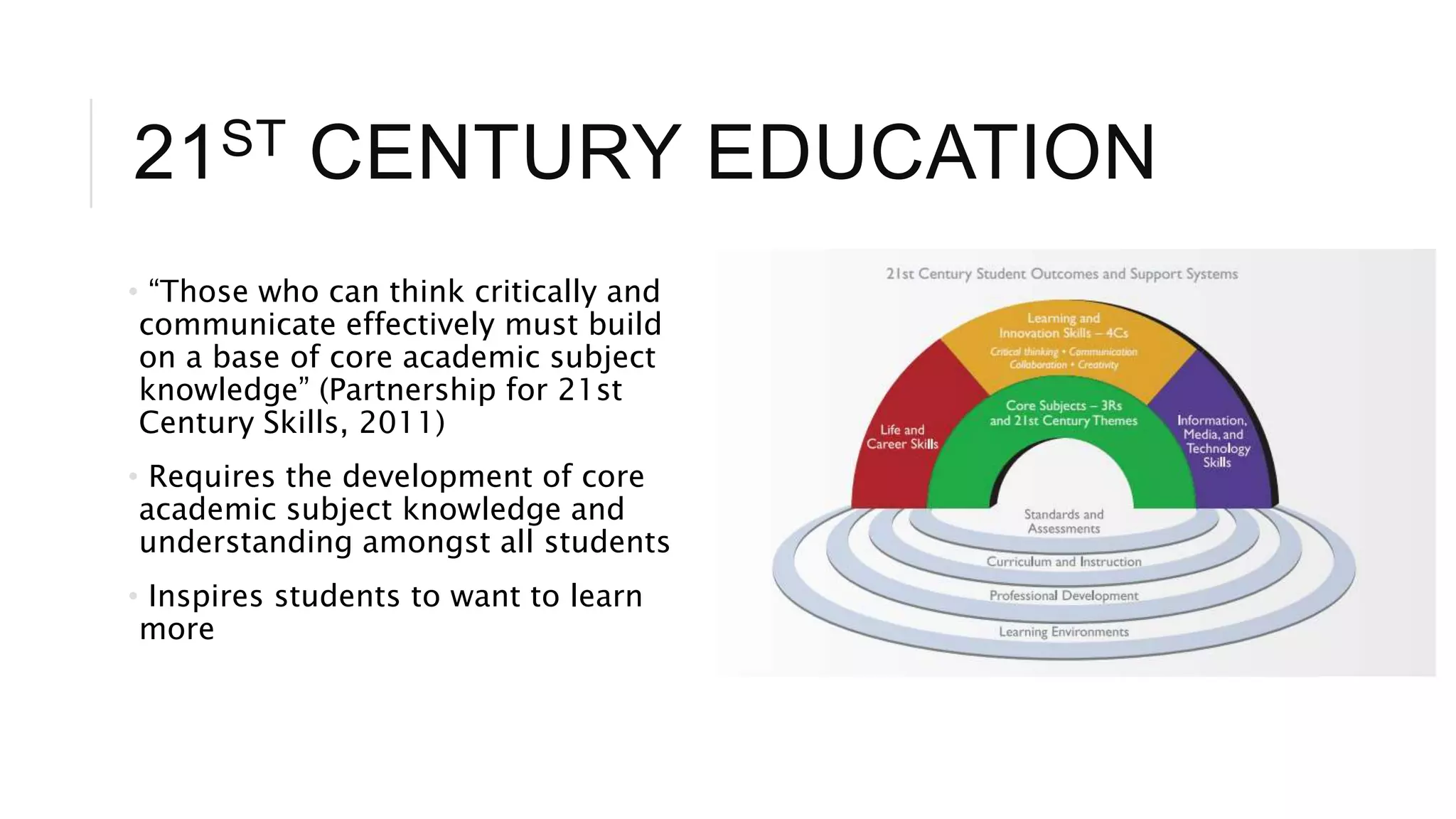
• “Those who can think critically and 
communicate effectively must build 
on a base of core academic subject 
knowledge” (Partnership for 21st 
Century Skills, 2011) 
• Requires the development of core 
academic subject knowledge and 
understanding amongst all students 
• Inspires students to want to learn 
more
EXAMPLE 
• Students can: 
• Compare information before completing an assignment 
• Draw inferences 
• Solve complex problems 
• Provide feedback to other classmates 
• Produce own ideas on the process of solving problems 
• Prove hypotheses 
• Use other multimedia aspects in the classroom (Voki’s, blogs, WebQuests, etc.)
CONTINUED 
• Students can be put into groups of four and will be asked to come 
up with their own ideas for different topics such as: how to recycle, 
how can they be re-used, why it would be useful, and what can 
people in your community do to help; use a survey 
• Clear example of cause and effect 
• Use of critical thinking skills to generate a notion 
• Apply that concept learned in the classroom to everyday life
ROLE OF TECHNOLOGY 
• Effective way to integrate technology into curriculum 
• Engages students to be active in learning because its not dull 
• Use of internet such as blogs, videos, etc. to research ideas or 
present them online 
• Use of Smart Boards to present ideas to classroom 
• Video cameras to show proof of true hypothesis 
• Can post videos or blogs online for more feedback around the world
WORK CITED 
BIE. (2014). What is PBL? Retrieved from BIE (Buck Institute of 
Education): http://bie.org/about/what_pbl 
George Lucas Educational Foundation. (2014). Why Teach with Project 
Based Learning? Retrieved from Edutopia: 
http://www.edutopia.org/project-learning-introduction 
Great Schools Partnership. (2014). 21st Century Skills. Retrieved from The 
Glossary of Education Reform: http://edglossary.org/21st-century-skills/ 
Partnership for 21st Century Skills. (2011). Framework for 21st Century 
Learning. Retrieved from Partnership for 21st Century Skills: 
http://www.p21.org/storage/documents/1.__p21_framework_2- 
pager.pdf

Ci 350 project based learning

  • 1.
    PROJECT BASED LEARNING Kateland Smith Savanah Starcher Brandee Malcomb
  • 2.
    DEFINITION • Teachingmethod in which students gain knowledge and skills by working for an extended period of time to investigate and respond to a complex question, problem, or challenge • 21st Century competencies • Students acquire critical thinking, problem solving, collaboration, communication skills, and induces creativity • Students have a “voice and a choice”
  • 3.
    CONTINUED • Theyunderstand the need to gain knowledge and understand concepts • Ask questions • Public audience • Students present work further than the classroom
  • 4.
    IMPORTANCE • Allowsa wider perspective when using different types of learning methods and materials • Students will have developed work habits, collaboration in a group, responsibility, communication skills, and be creative innovators - this builds confidence • They will be better prepared for the workplace • Those skills can be applied to all subjects in school throughout a student’s entire life in school and civic settings
  • 5.
    21ST CENTURY EDUCATION • “Those who can think critically and communicate effectively must build on a base of core academic subject knowledge” (Partnership for 21st Century Skills, 2011) • Requires the development of core academic subject knowledge and understanding amongst all students • Inspires students to want to learn more
  • 6.
    EXAMPLE • Studentscan: • Compare information before completing an assignment • Draw inferences • Solve complex problems • Provide feedback to other classmates • Produce own ideas on the process of solving problems • Prove hypotheses • Use other multimedia aspects in the classroom (Voki’s, blogs, WebQuests, etc.)
  • 7.
    CONTINUED • Studentscan be put into groups of four and will be asked to come up with their own ideas for different topics such as: how to recycle, how can they be re-used, why it would be useful, and what can people in your community do to help; use a survey • Clear example of cause and effect • Use of critical thinking skills to generate a notion • Apply that concept learned in the classroom to everyday life
  • 8.
    ROLE OF TECHNOLOGY • Effective way to integrate technology into curriculum • Engages students to be active in learning because its not dull • Use of internet such as blogs, videos, etc. to research ideas or present them online • Use of Smart Boards to present ideas to classroom • Video cameras to show proof of true hypothesis • Can post videos or blogs online for more feedback around the world
  • 9.
    WORK CITED BIE.(2014). What is PBL? Retrieved from BIE (Buck Institute of Education): http://bie.org/about/what_pbl George Lucas Educational Foundation. (2014). Why Teach with Project Based Learning? Retrieved from Edutopia: http://www.edutopia.org/project-learning-introduction Great Schools Partnership. (2014). 21st Century Skills. Retrieved from The Glossary of Education Reform: http://edglossary.org/21st-century-skills/ Partnership for 21st Century Skills. (2011). Framework for 21st Century Learning. Retrieved from Partnership for 21st Century Skills: http://www.p21.org/storage/documents/1.__p21_framework_2- pager.pdf