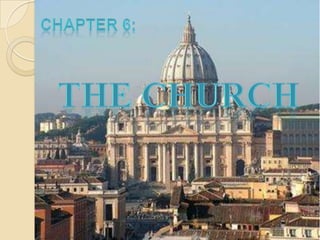
CHAPTER 6:THE CHURCH
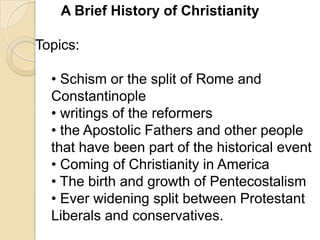
A Brief History of Christianity	Topics: Schism or the split of Rome and Constantinople
writings of the reformers
the Apostolic Fathers and other people that have been part of the historical event
Coming of Christianity in America
The birth and growth of Pentecostalism
Ever widening split between Protestant Liberals and conservatives.THE APOSTOLIC ERA (30 - 476)Apostolic refers to the religious adherence to succession of the Church through the Apostles and the inerrancy of the Bible and doctrine according to the New Testament.The Apostolic Era opened with the first Pentecost, following Jesus death and resurrection and this ended in the fifth century when the Visigoths invaded and sacked Rome. This periods leads to the following events;The formation of the church
collection of Christian writings and agreement included in the New Testament
conversion of Emperor Constantine (312)
establishment of Christianity as the religion of the Roman Empire
The Councils of Nicea (325) and Constantinople (381)
writings of Jerome and Augustine (early 400s)Chronologically Covers the era of leadership in which the Church was led by individuals personally chosen and trained by Jesus Christ. Eusebius ( ca. 260 to ca. 340) claims that the apostle John lived to see the reign of Emperor Trajan (r. 98-117). Experientially Church experiences purest expression, most dramatic influence Direct stamp of Jesus’ personal influence upon leadership Miraculous gifts of Holy Spirit Touchstone of contemporary Church
Authority of the Apostles Jesus Christ absolute authority over Church (Matt 16:18; Eph 1:18-23; Col 1:15-18) Apostles commissioned by Jesus as his authoritative representatives (Matt 16:17-19; Acts 1:1-26; 2 Cor 10-11; Gal 1:11-2:9) Apostles granted miracle working powers to authenticate their authority (Acts 2:43 with Heb 2:3-4; Acts 3:1-16; 5:12; 14:3; Rom 15:18-19; 2 Cor 12:11-12) Apostles are foundation of the Church (Eph 2:19-22) Apostles pass on derivative leadership responsibility to elders over local churches (Acts 1:2, 26; 2:37-43; 4:33ff; 5:12; 6:1ff; 8:1, 14; 9:27; 11:1, 27-30; 14:23; 15:2-6, 22, 33; 16:4 (last ref in Acts to apostles as a group); 20:17, 28-31; Phil 1:1; 1 Tim 3:1ff; 5:17; 1 Thess 5:12; 1 Pet 5:1-5
Roman Witnesses to the Historicity of Jesus of NazarethTacitus (b. 56 or 57 A.D.), the renowned Roman historian and statesman, recounts the burning of Rome in A.D. 64. Tacitus implicates Nero as the primary arsonist and charges the emperor with concocting a ruse to divert public suspicions away from himself: Tacitus writes: “Nero fabricated scapegoats—and punished with every refinement the notoriously depraved Christians (as they were popularly called). Their originator, Christ, had been executed in Tiberius’ reign by the governor of Judea, Pontius Pilatus. But in spite of this temporary setback the deadly superstition had broken out afresh, not only in Judea (where the mischief had started) but even in Rome. All degraded and shameful practices collect and flourish in the capital …” ( Annals , XV, 44).
Jewish Witnesses to the Historicity of Jesus of Nazareth Although some dispute either the authenticity or the precise meaning of the passage, Josephus records another important early reference to Christ. In the context of a discussion concerning the career of Pontus Pilate, Josephus adds this aside: “ Now, there was about this time Jesus, a wise man, if it be lawful to call him a man, for he was a doer of wonderful works—a teacher … He was [the] Christ; and when Pilate, at the suggestion of the principal men among us, had condemned him to the cross, those that loved him at the first did not forsake him, for he appeared to them alive again the third day, as the divine prophets had foretold these and ten thousand other wonderful things concerning him; and the tribe of Christians, so named from him, are not extinct at this day” ( Antiquities , 18.3.3).
Christians, so named from him, are not extinct at this day” ( Antiquities , 18.3.3). Birth of Church Jesus’ ascension prerequisite to the formation of the Church by means of Holy Spirit baptism (Luke 3:16; John 16:5-15; Acts 2:1-11, 33, 38; 11:1-18; Eph 3:1-12) Church born on the Lord’s Day, May 24, 33 AD (Hoehner, Chronological Aspects , 143)
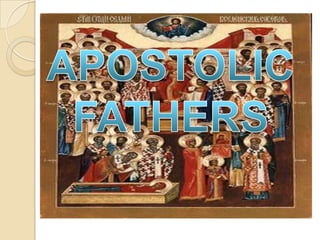
APOSTOLIC FATHERS
	The Apostolic Fathers were the Christian writers of the first and second centuries, who may be considered as the first teachers after the Apostles. Their writings presented to us the faith which these Apostolic Fathers received either through their direct contact with the Apostles or as handed to them by their disciples.	The term ‘Apostolic Fathers’ was entirely unknown in the early Church. It was introduced by scholars of the seventeenth century. The French scholar Jean B Cotelier, a man from the 17th century published his two volumes under the title of “PatresaeviApostolici” in the year 1672.
	At the beginning of the second century, the  leadership of the church passed to the apostolic fathers, so called because it was believed that at least, some, like Polycarp and Clement, had known the apostles. 	The Apostolic Fathers were primarily Gentiles in contrast to the apostles and sub apostles like Silas and Timothy, most of whom are Jews.	Apostolic Fathers carried on with the apostolic mission, established church government and administrative procedures, wrote catechisms (instruction) to new believers, developed the church’s worship and liturgy, and polemical treatises against pagan intellectuals and Jews who were attacking the church.
Characteristics of Apostolic Fathers Men of simple and sincere faith – high morality
Informal, practical letters and sermons
Monotheistic, belief in creation
Promoted humanity and deity of Christ
Promoted the authority of Scripture while struggling with poor hermeneutics (i.e. allegorical interpretation)
Preferred baptism by immersion, some baptismal regeneration
Held to immanency of Christ’s return – Papias and Barnabas were premillennial; no one clearly pre-trib; no one post-trib
NT canon not formally fixed nor universally appreciated
Loss of a homogeneous faith IGNATIUS OF ANTIOCH (c. 35 - 107)
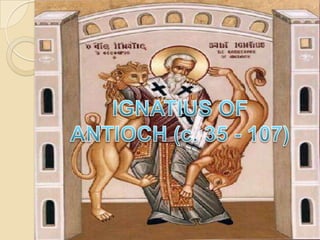
IGNATIUS OF ANTIOCH (c. 35 - 107)	He was martyred in the Colosseum in Rome, argued for both the deity and humanity of Jesus.	He was the third bishop of Antioch, after the Apostle Peter and Euodios, whom Ignatius succeeded around AD 68. Ignatius, who also called himself Theophorus ("God-bearer"), was most likely a disciple of both Apostles Peter and John. 	Several of his letters have survived to this day; he is one of the Apostolic Fathers (the earliest group of the Church Fathers), and a saint in the
He was arrested by the Roman authorities and transported to Rome to die in the arena. They hoped to make an example of him and thus discourage Christianity from spreading. 	Instead, he met with and encouraged Christians all along his route, and wrote letters to the Ephesians, Magnesians, Trallians, Philadelphians, Smyrneans, and Romans, as well as a letter to Polycarp, who was bishop of Smyrna and a disciple of John the Evangelist.
	Ignatius also stresses the value of the Eucharist, calling it "a medicine to immortality." The very strong desire for bloody martyrdom in the arena, which Ignatius expresses rather graphically in places, may seem quite odd to the modern reader, but an examination of his theology of soteriology shows that he regarded salvation as being from the power and fear of death. So, for him, to try to escape his martyrdom would be to fear death and place himself back under its power.
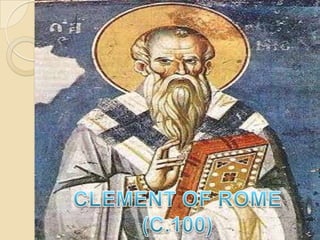
CLEMENT OF ROME (C.100)
CLEMENT OF ROME (c. 100)	He set forth the concept of “apostolic succession”, the Roman Catholic belief in an unbroken line of bishops from the apostles to the present.	 He was the third in succession after the Apostle Peter as bishop of Rome. Clement is known mainly for the letter he wrote to the Corinthians in about AD 96. He is counted among the apostolic fathers. His feast day is November 23 in the west, but in the east he life little is known of Clement’s life.
	What is known is from writers who wrote over a hundred years after his death, often inconsistently, and with great variety. These writers include Tertullian, Jerome, Irenaeus, Epiphanius, and Eusebius. His birth date is not known. He may have met St. Peter and Paul and may have been ordained by St Peter. There are confusing propositions that associate him with the Clement in Paul’s letters (Phil. 4:3 (KJV)) and to consul T. Flavius Clemens associations that now are considered not probable.	Clement is believed to have been named bishop of Rome in about 88 and held the position until about 98, when he died. These dates are also uncertain. Early sources noted that he died a natural death, perhaps in Greece. A tradition dated from the ninth century tells of his martyrdom in Crimea in 102 by drowning when thrown overboard from a boat with a ship’s anchor tied to him.
 Letters	The letter sent in about the year 96 to the Church of Corinth in the name of the Church of Rome has been attributed to Clement. The letter was sent in an attempt to restore peace and unity in the Corinthian church, where apparently a few violent people had revolted against the leadership of the church community. 	A second letter to the Corinthians had also been attributed to Clement based upon its inclusion in a Greek manuscript that included Clement’s first letter, with the title of “Second Epistle of Clement to the Corinthians.” But, when a missing ending to the “letter” was found, it proved to be a homily of unknown authorship. Guard us all through yourintercessions!
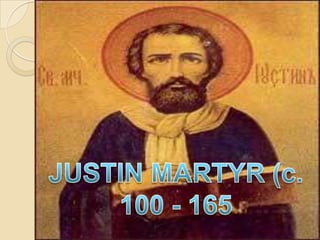
JUSTIN MARTYR (c. 100 - 165
	Justin was born around 100 (both his birth and death dates are approximate) at FlaviaNeapolis (ancient Shechem, modern Nablus) in Samaria (the middle portion of Israel, between Galilee and Judea) of pagan Greek parents. He was brought up with a good education in rhetoric, poetry, and history. He studied various schools of philosophy in Alexandria and Ephesus , joining himself first to Stoicism, then Pythagoreanism, then Platonism, looking for answers to his questions. While at Ephesus, he was impressed by the steadfastness of the Christian martyrs, and by the personality of an aged Christian man whom he met by chance while walking on the seashore. This man spoke to him about Jesus as the fulfilment of the promises made through the Jewish prophets. Justin was overwhelmed. "Straightway a flame was kindled in my soul," he writes, "and a love of the prophets and those who are friends of Christ possessed me."
	Justin became a Christian, but he continued to wear the cloak that was the characteristic uniform of the professional teacher of philosophy. His position was that pagan philosophy, especially Platonism, is not simply wrong, but is a partial grasp of the truth, and serves as "a schoolmaster to bring us to Christ." He engaged in debates and disputations with non-Christians of all varieties, pagans, Jews, and heretics. He opened a school of Christian philosophy and accepted students, first at Ephesus and then later at Rome. There he engaged the Cynic philosopher Crescens in debate, and soon after was arrested on the charge of practicing an anauthorized religion. (It is suggested that Crescens lost the debate and denounced Justin to the authorities out of spite.) He was tried before the Roman prefect Rusticus, refused to renounce Christianity, and was put to death by beheading along with six of his students, one of them a woman. A record of the trial, probably authentic, is preserved, known as The Acts of Justin the Martyr.
Three works of Justin have been preserved. 	His First Apology (in the sense of "defense" or "vindication") was addressed (around 155) to the Emperor Antoninus Pius and his adopted sons. (It is perhaps worth noting that some of the fiercest persecutors of the Christians were precisely the emperors who had a strong sense of duty, who were fighting to maintain the traditional Roman values, including respect for the gods, which they felt had made Rome great and were her only hope of survival.) He defends Christianity as the only rational creed, and he includes an account of current Christian ceremonies of Baptism and the Eucharist (probably to counteract distorted accounts from anti-Christian sources).
	The Second Apology is addressed to the Roman Senate. It is chiefly concerned to rebut specific charges of immorality and the like that had been made against the Christians. He argues that good Christians make good citizens, and that the notion that Christianity undermines the foundations of a good society is based on slander or misunderstanding.
	The Dialog With Trypho the Jew is an account of a dialog between Justin and a Jewish rabbi named Trypho(n) (probably a real conversation with a real rabbi, although it may be suspected that Justin in editing it later gave himself a few good lines that he wished he had thought of at the time), whom he met while promenading at Ephesus shortly after the sack of Jerusalem in 135. Trypho had fled from Israel, and the two men talked about the Jewish people and their place in history, and then about Jesus and whether he was the promised Messiah. A principal question is whether the Christian belief in the deity of Christ can be reconciled with the uncompromising monotheism of the Scriptures. The dialogue is a valuable source of information about early Christian thought concerning Judaism and the relation between Israel and the Church as communities having a covenant relation with God.
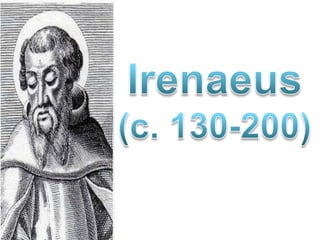
Irenaeus(c. 130-200)
	The bishop of  Lyons, France wrote against those who argued that salvation comes through special or secret knowledge, thus only to a select few.Irenaeus' best-known book, AdversusHaeresess or Against Heresies (c. 180) is a detailed attack on Gnosticism, which was then a serious threat to the Church, and especially on the system of the Gnostic Valentinus.As one of the first great Christian theologians, he emphasized the traditional elements in the Church, especially the episcopate, Scripture, and tradition.Irenaeus wrote that the only way for Christians to retain unity was to humbly accept one doctrinal authority—episcopal councils in union with the bishop of Rome.
	Against the Gnostics, who said that they possessed a secret oral tradition from Jesus himself, Irenaeus maintained that the bishops in different cities are known as far back as the Apostles — and none of them were Gnostics — and that the bishops provided the only safe guide to the interpretation of Scripture.His writings, with those of Clement and Ignatius, are taken to hint at papal primacy. Irenaeus is the earliest witness to recognition of the canonical character of all four gospels.
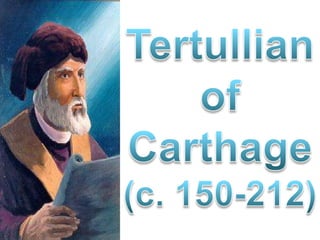
Tertullian of Carthage (c. 150-212)
	The first North African Father, helped developed and formulate the concept of  Trinity.	Tertullian was born in Carthage in what is modern Tunisia and Algeria. He was the son of a highly placed pagan centurion. Some scholars think that he was the son of a commander of the proconsul's guard. This may account for his use of military metaphors such as, for example, his remarks that "the Lord, in disarming Peter, unbelted every soldier." Tertullian considered that it was almost impossible for any Christian to hold public office or accept military service. This may be because he was a military man. One was expected not only to swear an oath of allegiance to the emperor but also to the gods.
	Tertullian sometimes wrote in Latin and is regarded as the first of the Latin fathers. He was a brilliant and outstanding rhetorician, full of enthusiasm and rugged eloquence. He was a born debater with a supreme command of language: "When we are condemned by you, we are acquitted by God (...) I hear that there has been an edict set forth, and a peremptory one too. The Sovereign Pontiff! - the Bishop of Bishops...“His writings may be categorized as:1. Apologetic2. Doctrinal and Polemical3. Moral and Practical.
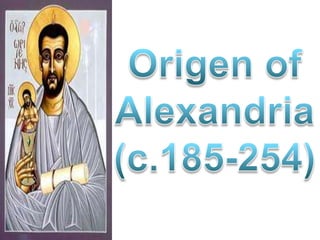
Origen of Alexandria(c.185-254)
	The greatest scholar at the early church, established the intellectual respectability of Christianity.	Origen was a theologian, philosopher, and devoted Christian of the Alexandrian school. He famously castrated himself so he could tutor women without suspicion, and he risked his life countless times in encouraging martyrs. He himself was tortured under Decius as an old man and died a short time later. Origen's controversial views on the pre-existence of souls, the ultimate salvation of all beings and other topics eventually caused him to be labeled a heretic, yet his teachings were highly influential and today he is regarded as one of the most important early church fathers.
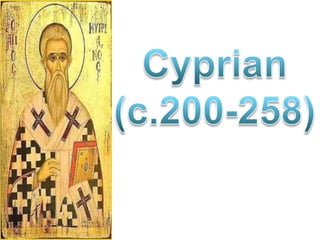
Cyprian (c.200-258)
	The bishop of Carthage, maintained that there was no salvation outside the church.	He was born circa the beginning of the 3rd century in North Africa, perhaps at Carthage, where he received a classical education. After converting to Christianity, he became a bishop (249) and eventually died a martyr at Carthage.
	Cyprian's works were edited in volumes 3 and 4 of the Patrologia Latina. Besides a number of epistles, which are partly collected with the answers of those to whom they were written, Cyprian wrote a number of treatises, some of which have also the character of pastoral letters.	His most important work is his "De unitate ecclesiae." In it, he states: "He can no longer have God for his Father who has not the Church for his mother; . . . he who gathereth elsewhere than in the Church scatters the Church of Christ" (vi.); "nor is there any other home to believers but the one Church" (ix.).
THE APOSTLES’ CREED	The Apostles’ Creed summarizes essential Christian beliefs. The word creeds – from Latin word credo meaning “I Believe”.	The Apostles’ Creed derives its name from a legend that each apostles contributed a clause or an article to the creed. The original form has 12 clauses. The creed itself is believed to be the end product of several priors creeds and confessions, including a Trinitian baptismal formula dating from 200.  During the reign of Charlemagne (9th Century), the Apostles’ Creed became the official creed of the Western  Church.
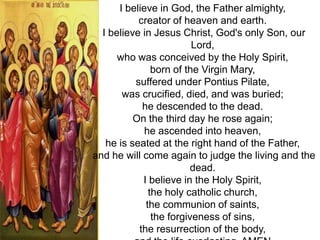
I believe in God, the Father almighty,  creator of heaven and earth.  I believe in Jesus Christ, God's only Son, our Lord,  who was conceived by the Holy Spirit,  born of the Virgin Mary,  suffered under Pontius Pilate,  was crucified, died, and was buried;  he descended to the dead.  On the third day he rose again;  he ascended into heaven,  he is seated at the right hand of the Father,  and he will come again to judge the living and the dead.  I believe in the Holy Spirit,  the holy catholic church,  the communion of saints,  the forgiveness of sins,  the resurrection of the body,  and the life everlasting. AMEN.
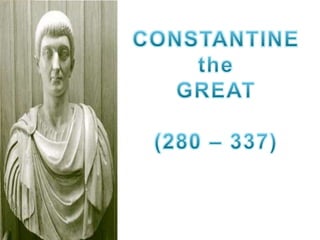
CONSTANTINE the GREAT (280 – 337)
Important details from A Handbook of Christian Faith, page 150	Roman ‘Emperor Cult” was a means of unifying the Roman Empire. Those who would not acknowledge the Emperor as divine were considered disloyal,  the Jews are exempted because of special status.	Rome refused to grant Christianity the same rights and privileges, and Christians were often persecuted and martyred.	October 312 – before entering a battle against Maxentius at Milvian Bridge outside Rome,  it is said that Constantine had a vision of Greek letters chi and rho, the first two letters name for Christ.  Constantine won the battle and thrown Maxentius into Tiber River.	Constantine issued the EDICT OF MILAN which gave Christianity as legal status in the empire
End of 380 – Christianity became the official religion of the 	Roman EmpireA Deeper View On Life Of Constantine The Great- Roman Emperor from 306 – 337- he was born in Naissus in upper Moesia son of ConstantiusChlorus and Helena
 he took the possession of Britain, Gaul and Spain after his fathers death and series of  victorious battle over Maxentius.
 became the sole lord of the Roman world
 he converted to Christianity
 died upon 337 at Nicodemia because of illness.FOUNDING OF NEW ROME Lecinius defeat represented the passing of New Rome. Constantine rebuilt the city Byzantium and renamed it “Nova Roma” New Rome or Constantinople, The City of Constantine.325 – He convened a Council of Bishops at Nicea to 	resolve the 	Arian dispute.Trinitian Nicene Creed – agreement of the council, this 	is the confession par excellence of Christian 	Orthodoxy 381 – Council of Constantinople was formed
Constantine provided the following for Christianity: the exempting of the Christian elegy from certain obligations
 Sunday was declared as a public holiday because it is the day 	of the week when Jesus resurrected.
 the city is provided with a senate and civic offices
 alleged true cross
 rod of Moses
 the city is protected with cameo
 old Gods was replaced by Christian symbolism
 temple of Aphrodite was built as the New Basilica of the 	Apostles
 he generously endowed Christian shrines both in Rome (Saint 	Peter’s Basilica and Saint Paul’s Churches) and in the 	Holy Land (the Church of Nativity and the Church of 	Holy Sepulchre)326 – after Constantine success in his works for Christianity  	he had killed his son Crispus because he believed the 	accusation that his son had an affair with 	Fausta, 	Constantine second wife. He also killed Fausta,  	several of his relatives and some of his most intimate 	friends in some passionable resentment of some 	fancied infringement of his right. Constantine onChristianity	He still kept pagans in highest position and forbade everything which might look like an encroachment of Christianity upon paganism.
	He respected cultivation of Christianity but his court was composed mostly of non – Christian people.	Eusebius reports that Constantine was baptized before his death in 337.
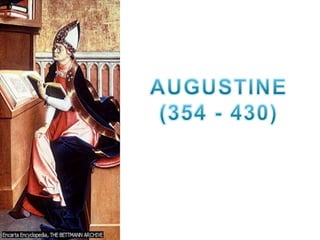
AUGUSTINE(354 - 430)
Important details from A Handbook of Christian Faith, page 151Augustinus Aurelius or better known as Augustine – a hinge figure between the end of the early church and the beginning of Middle Ages. 	He was born in a small city not far from Carthage in North Africa. 	He had a common-law wife for several years who bore him a son,  Adeodatus.	He was convicted by a passage in Paul’s letter to the Romans at the age of 32. 	He was baptized as a Christian  together with his son at the Easter Sunday in 387.
396 – he became a bishop of Hippo(Annaba, Algeria) at  the age 	of 42A DEEPER VIEW OF ST. AUGUSTINES’ LIFE a Bishop of Hippo Regins (Annaba, Algeria)

Church

  • 1.
  • 2.
    A Brief Historyof Christianity Topics: Schism or the split of Rome and Constantinople
  • 3.
    writings of thereformers
  • 4.
    the Apostolic Fathersand other people that have been part of the historical event
  • 5.
  • 6.
    The birth andgrowth of Pentecostalism
  • 7.
    Ever widening splitbetween Protestant Liberals and conservatives.THE APOSTOLIC ERA (30 - 476)Apostolic refers to the religious adherence to succession of the Church through the Apostles and the inerrancy of the Bible and doctrine according to the New Testament.The Apostolic Era opened with the first Pentecost, following Jesus death and resurrection and this ended in the fifth century when the Visigoths invaded and sacked Rome. This periods leads to the following events;The formation of the church
  • 8.
    collection of Christianwritings and agreement included in the New Testament
  • 9.
    conversion of EmperorConstantine (312)
  • 10.
    establishment of Christianityas the religion of the Roman Empire
  • 11.
    The Councils ofNicea (325) and Constantinople (381)
  • 12.
    writings of Jeromeand Augustine (early 400s)Chronologically Covers the era of leadership in which the Church was led by individuals personally chosen and trained by Jesus Christ. Eusebius ( ca. 260 to ca. 340) claims that the apostle John lived to see the reign of Emperor Trajan (r. 98-117). Experientially Church experiences purest expression, most dramatic influence Direct stamp of Jesus’ personal influence upon leadership Miraculous gifts of Holy Spirit Touchstone of contemporary Church
  • 13.
    Authority of theApostles Jesus Christ absolute authority over Church (Matt 16:18; Eph 1:18-23; Col 1:15-18) Apostles commissioned by Jesus as his authoritative representatives (Matt 16:17-19; Acts 1:1-26; 2 Cor 10-11; Gal 1:11-2:9) Apostles granted miracle working powers to authenticate their authority (Acts 2:43 with Heb 2:3-4; Acts 3:1-16; 5:12; 14:3; Rom 15:18-19; 2 Cor 12:11-12) Apostles are foundation of the Church (Eph 2:19-22) Apostles pass on derivative leadership responsibility to elders over local churches (Acts 1:2, 26; 2:37-43; 4:33ff; 5:12; 6:1ff; 8:1, 14; 9:27; 11:1, 27-30; 14:23; 15:2-6, 22, 33; 16:4 (last ref in Acts to apostles as a group); 20:17, 28-31; Phil 1:1; 1 Tim 3:1ff; 5:17; 1 Thess 5:12; 1 Pet 5:1-5
  • 14.
    Roman Witnesses tothe Historicity of Jesus of NazarethTacitus (b. 56 or 57 A.D.), the renowned Roman historian and statesman, recounts the burning of Rome in A.D. 64. Tacitus implicates Nero as the primary arsonist and charges the emperor with concocting a ruse to divert public suspicions away from himself: Tacitus writes: “Nero fabricated scapegoats—and punished with every refinement the notoriously depraved Christians (as they were popularly called). Their originator, Christ, had been executed in Tiberius’ reign by the governor of Judea, Pontius Pilatus. But in spite of this temporary setback the deadly superstition had broken out afresh, not only in Judea (where the mischief had started) but even in Rome. All degraded and shameful practices collect and flourish in the capital …” ( Annals , XV, 44).
  • 15.
    Jewish Witnesses tothe Historicity of Jesus of Nazareth Although some dispute either the authenticity or the precise meaning of the passage, Josephus records another important early reference to Christ. In the context of a discussion concerning the career of Pontus Pilate, Josephus adds this aside: “ Now, there was about this time Jesus, a wise man, if it be lawful to call him a man, for he was a doer of wonderful works—a teacher … He was [the] Christ; and when Pilate, at the suggestion of the principal men among us, had condemned him to the cross, those that loved him at the first did not forsake him, for he appeared to them alive again the third day, as the divine prophets had foretold these and ten thousand other wonderful things concerning him; and the tribe of Christians, so named from him, are not extinct at this day” ( Antiquities , 18.3.3).
  • 16.
    Christians, so namedfrom him, are not extinct at this day” ( Antiquities , 18.3.3). Birth of Church Jesus’ ascension prerequisite to the formation of the Church by means of Holy Spirit baptism (Luke 3:16; John 16:5-15; Acts 2:1-11, 33, 38; 11:1-18; Eph 3:1-12) Church born on the Lord’s Day, May 24, 33 AD (Hoehner, Chronological Aspects , 143)
  • 17.
  • 18.
    The Apostolic Fatherswere the Christian writers of the first and second centuries, who may be considered as the first teachers after the Apostles. Their writings presented to us the faith which these Apostolic Fathers received either through their direct contact with the Apostles or as handed to them by their disciples. The term ‘Apostolic Fathers’ was entirely unknown in the early Church. It was introduced by scholars of the seventeenth century. The French scholar Jean B Cotelier, a man from the 17th century published his two volumes under the title of “PatresaeviApostolici” in the year 1672.
  • 19.
    At the beginningof the second century, the leadership of the church passed to the apostolic fathers, so called because it was believed that at least, some, like Polycarp and Clement, had known the apostles. The Apostolic Fathers were primarily Gentiles in contrast to the apostles and sub apostles like Silas and Timothy, most of whom are Jews. Apostolic Fathers carried on with the apostolic mission, established church government and administrative procedures, wrote catechisms (instruction) to new believers, developed the church’s worship and liturgy, and polemical treatises against pagan intellectuals and Jews who were attacking the church.
  • 20.
    Characteristics of ApostolicFathers Men of simple and sincere faith – high morality
  • 21.
  • 22.
  • 23.
    Promoted humanity anddeity of Christ
  • 24.
    Promoted the authorityof Scripture while struggling with poor hermeneutics (i.e. allegorical interpretation)
  • 25.
    Preferred baptism byimmersion, some baptismal regeneration
  • 26.
    Held to immanencyof Christ’s return – Papias and Barnabas were premillennial; no one clearly pre-trib; no one post-trib
  • 27.
    NT canon notformally fixed nor universally appreciated
  • 28.
    Loss of ahomogeneous faith IGNATIUS OF ANTIOCH (c. 35 - 107)
  • 29.
    IGNATIUS OF ANTIOCH(c. 35 - 107) He was martyred in the Colosseum in Rome, argued for both the deity and humanity of Jesus. He was the third bishop of Antioch, after the Apostle Peter and Euodios, whom Ignatius succeeded around AD 68. Ignatius, who also called himself Theophorus ("God-bearer"), was most likely a disciple of both Apostles Peter and John. Several of his letters have survived to this day; he is one of the Apostolic Fathers (the earliest group of the Church Fathers), and a saint in the
  • 30.
    He was arrestedby the Roman authorities and transported to Rome to die in the arena. They hoped to make an example of him and thus discourage Christianity from spreading. Instead, he met with and encouraged Christians all along his route, and wrote letters to the Ephesians, Magnesians, Trallians, Philadelphians, Smyrneans, and Romans, as well as a letter to Polycarp, who was bishop of Smyrna and a disciple of John the Evangelist.
  • 31.
    Ignatius also stressesthe value of the Eucharist, calling it "a medicine to immortality." The very strong desire for bloody martyrdom in the arena, which Ignatius expresses rather graphically in places, may seem quite odd to the modern reader, but an examination of his theology of soteriology shows that he regarded salvation as being from the power and fear of death. So, for him, to try to escape his martyrdom would be to fear death and place himself back under its power.
  • 32.
  • 33.
    CLEMENT OF ROME(c. 100) He set forth the concept of “apostolic succession”, the Roman Catholic belief in an unbroken line of bishops from the apostles to the present. He was the third in succession after the Apostle Peter as bishop of Rome. Clement is known mainly for the letter he wrote to the Corinthians in about AD 96. He is counted among the apostolic fathers. His feast day is November 23 in the west, but in the east he life little is known of Clement’s life.
  • 34.
    What is knownis from writers who wrote over a hundred years after his death, often inconsistently, and with great variety. These writers include Tertullian, Jerome, Irenaeus, Epiphanius, and Eusebius. His birth date is not known. He may have met St. Peter and Paul and may have been ordained by St Peter. There are confusing propositions that associate him with the Clement in Paul’s letters (Phil. 4:3 (KJV)) and to consul T. Flavius Clemens associations that now are considered not probable. Clement is believed to have been named bishop of Rome in about 88 and held the position until about 98, when he died. These dates are also uncertain. Early sources noted that he died a natural death, perhaps in Greece. A tradition dated from the ninth century tells of his martyrdom in Crimea in 102 by drowning when thrown overboard from a boat with a ship’s anchor tied to him.
  • 35.
     Letters The letter sentin about the year 96 to the Church of Corinth in the name of the Church of Rome has been attributed to Clement. The letter was sent in an attempt to restore peace and unity in the Corinthian church, where apparently a few violent people had revolted against the leadership of the church community. A second letter to the Corinthians had also been attributed to Clement based upon its inclusion in a Greek manuscript that included Clement’s first letter, with the title of “Second Epistle of Clement to the Corinthians.” But, when a missing ending to the “letter” was found, it proved to be a homily of unknown authorship. Guard us all through yourintercessions!
  • 36.
  • 37.
    Justin was bornaround 100 (both his birth and death dates are approximate) at FlaviaNeapolis (ancient Shechem, modern Nablus) in Samaria (the middle portion of Israel, between Galilee and Judea) of pagan Greek parents. He was brought up with a good education in rhetoric, poetry, and history. He studied various schools of philosophy in Alexandria and Ephesus , joining himself first to Stoicism, then Pythagoreanism, then Platonism, looking for answers to his questions. While at Ephesus, he was impressed by the steadfastness of the Christian martyrs, and by the personality of an aged Christian man whom he met by chance while walking on the seashore. This man spoke to him about Jesus as the fulfilment of the promises made through the Jewish prophets. Justin was overwhelmed. "Straightway a flame was kindled in my soul," he writes, "and a love of the prophets and those who are friends of Christ possessed me."
  • 38.
    Justin became aChristian, but he continued to wear the cloak that was the characteristic uniform of the professional teacher of philosophy. His position was that pagan philosophy, especially Platonism, is not simply wrong, but is a partial grasp of the truth, and serves as "a schoolmaster to bring us to Christ." He engaged in debates and disputations with non-Christians of all varieties, pagans, Jews, and heretics. He opened a school of Christian philosophy and accepted students, first at Ephesus and then later at Rome. There he engaged the Cynic philosopher Crescens in debate, and soon after was arrested on the charge of practicing an anauthorized religion. (It is suggested that Crescens lost the debate and denounced Justin to the authorities out of spite.) He was tried before the Roman prefect Rusticus, refused to renounce Christianity, and was put to death by beheading along with six of his students, one of them a woman. A record of the trial, probably authentic, is preserved, known as The Acts of Justin the Martyr.
  • 39.
    Three works ofJustin have been preserved. His First Apology (in the sense of "defense" or "vindication") was addressed (around 155) to the Emperor Antoninus Pius and his adopted sons. (It is perhaps worth noting that some of the fiercest persecutors of the Christians were precisely the emperors who had a strong sense of duty, who were fighting to maintain the traditional Roman values, including respect for the gods, which they felt had made Rome great and were her only hope of survival.) He defends Christianity as the only rational creed, and he includes an account of current Christian ceremonies of Baptism and the Eucharist (probably to counteract distorted accounts from anti-Christian sources).
  • 40.
    The Second Apologyis addressed to the Roman Senate. It is chiefly concerned to rebut specific charges of immorality and the like that had been made against the Christians. He argues that good Christians make good citizens, and that the notion that Christianity undermines the foundations of a good society is based on slander or misunderstanding.
  • 41.
    The Dialog WithTrypho the Jew is an account of a dialog between Justin and a Jewish rabbi named Trypho(n) (probably a real conversation with a real rabbi, although it may be suspected that Justin in editing it later gave himself a few good lines that he wished he had thought of at the time), whom he met while promenading at Ephesus shortly after the sack of Jerusalem in 135. Trypho had fled from Israel, and the two men talked about the Jewish people and their place in history, and then about Jesus and whether he was the promised Messiah. A principal question is whether the Christian belief in the deity of Christ can be reconciled with the uncompromising monotheism of the Scriptures. The dialogue is a valuable source of information about early Christian thought concerning Judaism and the relation between Israel and the Church as communities having a covenant relation with God.
  • 42.
  • 43.
    The bishop of Lyons, France wrote against those who argued that salvation comes through special or secret knowledge, thus only to a select few.Irenaeus' best-known book, AdversusHaeresess or Against Heresies (c. 180) is a detailed attack on Gnosticism, which was then a serious threat to the Church, and especially on the system of the Gnostic Valentinus.As one of the first great Christian theologians, he emphasized the traditional elements in the Church, especially the episcopate, Scripture, and tradition.Irenaeus wrote that the only way for Christians to retain unity was to humbly accept one doctrinal authority—episcopal councils in union with the bishop of Rome.
  • 44.
    Against the Gnostics,who said that they possessed a secret oral tradition from Jesus himself, Irenaeus maintained that the bishops in different cities are known as far back as the Apostles — and none of them were Gnostics — and that the bishops provided the only safe guide to the interpretation of Scripture.His writings, with those of Clement and Ignatius, are taken to hint at papal primacy. Irenaeus is the earliest witness to recognition of the canonical character of all four gospels.
  • 45.
  • 46.
    The first NorthAfrican Father, helped developed and formulate the concept of Trinity. Tertullian was born in Carthage in what is modern Tunisia and Algeria. He was the son of a highly placed pagan centurion. Some scholars think that he was the son of a commander of the proconsul's guard. This may account for his use of military metaphors such as, for example, his remarks that "the Lord, in disarming Peter, unbelted every soldier." Tertullian considered that it was almost impossible for any Christian to hold public office or accept military service. This may be because he was a military man. One was expected not only to swear an oath of allegiance to the emperor but also to the gods.
  • 47.
    Tertullian sometimes wrotein Latin and is regarded as the first of the Latin fathers. He was a brilliant and outstanding rhetorician, full of enthusiasm and rugged eloquence. He was a born debater with a supreme command of language: "When we are condemned by you, we are acquitted by God (...) I hear that there has been an edict set forth, and a peremptory one too. The Sovereign Pontiff! - the Bishop of Bishops...“His writings may be categorized as:1. Apologetic2. Doctrinal and Polemical3. Moral and Practical.
  • 48.
  • 49.
    The greatest scholarat the early church, established the intellectual respectability of Christianity. Origen was a theologian, philosopher, and devoted Christian of the Alexandrian school. He famously castrated himself so he could tutor women without suspicion, and he risked his life countless times in encouraging martyrs. He himself was tortured under Decius as an old man and died a short time later. Origen's controversial views on the pre-existence of souls, the ultimate salvation of all beings and other topics eventually caused him to be labeled a heretic, yet his teachings were highly influential and today he is regarded as one of the most important early church fathers.
  • 50.
  • 51.
    The bishop ofCarthage, maintained that there was no salvation outside the church. He was born circa the beginning of the 3rd century in North Africa, perhaps at Carthage, where he received a classical education. After converting to Christianity, he became a bishop (249) and eventually died a martyr at Carthage.
  • 52.
    Cyprian's works wereedited in volumes 3 and 4 of the Patrologia Latina. Besides a number of epistles, which are partly collected with the answers of those to whom they were written, Cyprian wrote a number of treatises, some of which have also the character of pastoral letters. His most important work is his "De unitate ecclesiae." In it, he states: "He can no longer have God for his Father who has not the Church for his mother; . . . he who gathereth elsewhere than in the Church scatters the Church of Christ" (vi.); "nor is there any other home to believers but the one Church" (ix.).
  • 53.
    THE APOSTLES’ CREED TheApostles’ Creed summarizes essential Christian beliefs. The word creeds – from Latin word credo meaning “I Believe”. The Apostles’ Creed derives its name from a legend that each apostles contributed a clause or an article to the creed. The original form has 12 clauses. The creed itself is believed to be the end product of several priors creeds and confessions, including a Trinitian baptismal formula dating from 200. During the reign of Charlemagne (9th Century), the Apostles’ Creed became the official creed of the Western Church.
  • 54.
    I believe inGod, the Father almighty,  creator of heaven and earth.  I believe in Jesus Christ, God's only Son, our Lord,  who was conceived by the Holy Spirit,  born of the Virgin Mary,  suffered under Pontius Pilate,  was crucified, died, and was buried;  he descended to the dead.  On the third day he rose again;  he ascended into heaven,  he is seated at the right hand of the Father,  and he will come again to judge the living and the dead.  I believe in the Holy Spirit,  the holy catholic church,  the communion of saints,  the forgiveness of sins,  the resurrection of the body,  and the life everlasting. AMEN.
  • 55.
  • 56.
    Important details fromA Handbook of Christian Faith, page 150 Roman ‘Emperor Cult” was a means of unifying the Roman Empire. Those who would not acknowledge the Emperor as divine were considered disloyal, the Jews are exempted because of special status. Rome refused to grant Christianity the same rights and privileges, and Christians were often persecuted and martyred. October 312 – before entering a battle against Maxentius at Milvian Bridge outside Rome, it is said that Constantine had a vision of Greek letters chi and rho, the first two letters name for Christ. Constantine won the battle and thrown Maxentius into Tiber River. Constantine issued the EDICT OF MILAN which gave Christianity as legal status in the empire
  • 57.
    End of 380– Christianity became the official religion of the Roman EmpireA Deeper View On Life Of Constantine The Great- Roman Emperor from 306 – 337- he was born in Naissus in upper Moesia son of ConstantiusChlorus and Helena
  • 58.
    he tookthe possession of Britain, Gaul and Spain after his fathers death and series of victorious battle over Maxentius.
  • 59.
    became thesole lord of the Roman world
  • 60.
    he convertedto Christianity
  • 61.
    died upon337 at Nicodemia because of illness.FOUNDING OF NEW ROME Lecinius defeat represented the passing of New Rome. Constantine rebuilt the city Byzantium and renamed it “Nova Roma” New Rome or Constantinople, The City of Constantine.325 – He convened a Council of Bishops at Nicea to resolve the Arian dispute.Trinitian Nicene Creed – agreement of the council, this is the confession par excellence of Christian Orthodoxy 381 – Council of Constantinople was formed
  • 62.
    Constantine provided thefollowing for Christianity: the exempting of the Christian elegy from certain obligations
  • 63.
    Sunday wasdeclared as a public holiday because it is the day of the week when Jesus resurrected.
  • 64.
    the cityis provided with a senate and civic offices
  • 65.
  • 66.
    rod ofMoses
  • 67.
    the cityis protected with cameo
  • 68.
    old Godswas replaced by Christian symbolism
  • 69.
    temple ofAphrodite was built as the New Basilica of the Apostles
  • 70.
    he generouslyendowed Christian shrines both in Rome (Saint Peter’s Basilica and Saint Paul’s Churches) and in the Holy Land (the Church of Nativity and the Church of Holy Sepulchre)326 – after Constantine success in his works for Christianity he had killed his son Crispus because he believed the accusation that his son had an affair with Fausta, Constantine second wife. He also killed Fausta, several of his relatives and some of his most intimate friends in some passionable resentment of some fancied infringement of his right. Constantine onChristianity He still kept pagans in highest position and forbade everything which might look like an encroachment of Christianity upon paganism.
  • 71.
    He respected cultivationof Christianity but his court was composed mostly of non – Christian people. Eusebius reports that Constantine was baptized before his death in 337.
  • 72.
  • 73.
    Important details fromA Handbook of Christian Faith, page 151Augustinus Aurelius or better known as Augustine – a hinge figure between the end of the early church and the beginning of Middle Ages. He was born in a small city not far from Carthage in North Africa. He had a common-law wife for several years who bore him a son, Adeodatus. He was convicted by a passage in Paul’s letter to the Romans at the age of 32. He was baptized as a Christian together with his son at the Easter Sunday in 387.
  • 74.
    396 – hebecame a bishop of Hippo(Annaba, Algeria) at the age of 42A DEEPER VIEW OF ST. AUGUSTINES’ LIFE a Bishop of Hippo Regins (Annaba, Algeria)