Christianity after Christ
Historical Sources
• We have quite detailed historical sources for the
early years of Christianity after Christ…
• The Acts of the Apostles was a second book
written by the Greek physician Luke
• Many of the epistles (letters) refer to incidents,
heresies, issues, people and churches
• As Christianity became a growing force other
writers and commentators started to make
reference to it… not always in a complimentary
way!
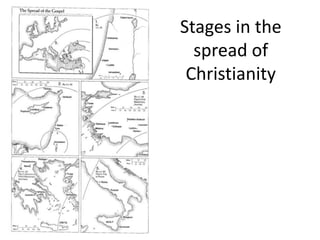
Stages in the
spread of
Christianity
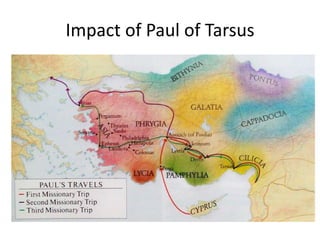
Impact of Paul of Tarsus
Context for early Christianity
• Pax Romana (the Peace of Roam) meant all of
Europe and the middle east were relatively
stable
• Roman obsession for communication meant
linking roads were built
• Romans allowed freedom of religion (in
general) though strongly suppressed any
religion thought to attack their power
Religion
• Romans: polytheist… the official religion
• Greek: wide spread due to earlier Greek
empire… polytheist
• Romans blended or identified Greek gods as
Roman gods
• Other cults and local religions were plentiful
• Practices included idol worship, talismans,
witchcraft, necromancy, temple prosititution,
sacrifice, superstition
Opposition
• Jewish synagogues and leaders were hostile to what was
seen as a false messiah cult
• Local religions were hostile to the idea of losing revenue
and adherents
• Some people saw Christianity as a interesting new way for
them to seek power (or extort money) and claimed to be
Christian exorcists, healers or teachers
• All of this can be read about in Acts 19
• Romans, while initially without interest, became concerned
as numbers grew, despite the emphasis in Christianity on
peace and personal holiness
• Nero persecuted Christians in Rome after the great fire of
64 CE
Roman Empire
• The roman empire reached its maximum
coverage in the rule of Trajan (to 117 AD)
• There were various crises in the 3rd C
• Christianity became the official religion in 4th C
under Constantine
• Western part collapsed in 5th C

Christianity after christ

  • 1.
  • 2.
    Historical Sources • Wehave quite detailed historical sources for the early years of Christianity after Christ… • The Acts of the Apostles was a second book written by the Greek physician Luke • Many of the epistles (letters) refer to incidents, heresies, issues, people and churches • As Christianity became a growing force other writers and commentators started to make reference to it… not always in a complimentary way!
  • 3.
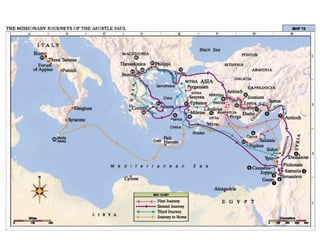
    Stages in the spreadof Christianity
  • 4.
    Impact of Paulof Tarsus
  • 6.
    Context for earlyChristianity • Pax Romana (the Peace of Roam) meant all of Europe and the middle east were relatively stable • Roman obsession for communication meant linking roads were built • Romans allowed freedom of religion (in general) though strongly suppressed any religion thought to attack their power
  • 7.
    Religion • Romans: polytheist…the official religion • Greek: wide spread due to earlier Greek empire… polytheist • Romans blended or identified Greek gods as Roman gods • Other cults and local religions were plentiful • Practices included idol worship, talismans, witchcraft, necromancy, temple prosititution, sacrifice, superstition
  • 8.
    Opposition • Jewish synagoguesand leaders were hostile to what was seen as a false messiah cult • Local religions were hostile to the idea of losing revenue and adherents • Some people saw Christianity as a interesting new way for them to seek power (or extort money) and claimed to be Christian exorcists, healers or teachers • All of this can be read about in Acts 19 • Romans, while initially without interest, became concerned as numbers grew, despite the emphasis in Christianity on peace and personal holiness • Nero persecuted Christians in Rome after the great fire of 64 CE
  • 9.
    Roman Empire • Theroman empire reached its maximum coverage in the rule of Trajan (to 117 AD) • There were various crises in the 3rd C • Christianity became the official religion in 4th C under Constantine • Western part collapsed in 5th C