CHROMOSOMAL
ABNORMALITIES
Nsikak-Abasi David
Trisomy 13
• Referred to as Patau syndrome
• All cells in the body contain an extra genetic material from
chromosome 13
• Incidence is 1/20000
• 90% are dead in the 1st year
• Common signs includes: severe developmental retardation, midline
brain defect, malformed ear, micropthalmos, and coloboma, scalp
defect
Trisomy 18
• Referred to as Edwards Syndrome
• Overlaps with Trisomy 13 and the incidence rate is 1/8000
• >90% dead in the 1st year
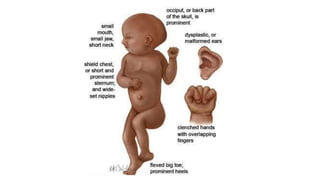
• Common presentations include: small face with prominent occiput,
small sternum and pelvis, flexion deformity of the finger, VSD and
horseshoe kidney, severe mental retardation.
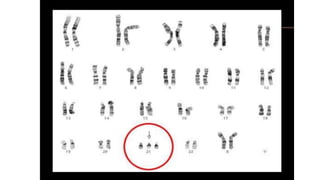
Trisomy 21
• Referred to as Down Syndrome
• Incidence is 1 in 700
• 95% have trisomy 21 , chromosome no 47
• 1% cases are mosaics, mitotic nondisjunction
• 4% cases- extra chromosomal material derives from presence of
robertsonian translocation of long arm of chromosome 21 to
acrocentric chromosome
• 10*20 fold increased risk of developing leukemia
Disorders affecting Sex Chromosomes
• More common than autosomal aberrations
• Lyon Hypothesis plays a big role here:
“doseage compensation in mammals is by inactivation of all but one X
chromosome in cells with more than one X chromosome”
Turner Syndrome
• Complete or partial monosomy of X chromosome
• Referred to as 45,X. or monosomy X or TS
• Occurs in 1/2000 live born females
• 57% missing an entire X chromosome – 45,X Karyotype
• 14% have structural abnormalities of X chromosomes
• 29% are mosaics. Mosaic patterns includes:
- 45,X/46.XX
- 45,X/46.XY
- 45,X/47.XXX
Klinefelter Syndrome
• Referred to as 47,XXY or XXY,
• is the set of symptoms that result from two or more X chromosomes
in males
• Occurs in 1/660 live male births
• 15% cases are mosaic
• Treating adolescents with implants of controlled-release testosterone
has shown good results when appropriately monitored
Chromosomal abnormalities

Chromosomal abnormalities

  • 1.
  • 2.
    Trisomy 13 • Referredto as Patau syndrome • All cells in the body contain an extra genetic material from chromosome 13 • Incidence is 1/20000 • 90% are dead in the 1st year • Common signs includes: severe developmental retardation, midline brain defect, malformed ear, micropthalmos, and coloboma, scalp defect
  • 5.
    Trisomy 18 • Referredto as Edwards Syndrome • Overlaps with Trisomy 13 and the incidence rate is 1/8000 • >90% dead in the 1st year • Common presentations include: small face with prominent occiput, small sternum and pelvis, flexion deformity of the finger, VSD and horseshoe kidney, severe mental retardation.
  • 8.
    Trisomy 21 • Referredto as Down Syndrome • Incidence is 1 in 700 • 95% have trisomy 21 , chromosome no 47 • 1% cases are mosaics, mitotic nondisjunction • 4% cases- extra chromosomal material derives from presence of robertsonian translocation of long arm of chromosome 21 to acrocentric chromosome • 10*20 fold increased risk of developing leukemia
  • 12.
    Disorders affecting SexChromosomes • More common than autosomal aberrations • Lyon Hypothesis plays a big role here: “doseage compensation in mammals is by inactivation of all but one X chromosome in cells with more than one X chromosome”
  • 13.
    Turner Syndrome • Completeor partial monosomy of X chromosome • Referred to as 45,X. or monosomy X or TS • Occurs in 1/2000 live born females • 57% missing an entire X chromosome – 45,X Karyotype • 14% have structural abnormalities of X chromosomes • 29% are mosaics. Mosaic patterns includes: - 45,X/46.XX - 45,X/46.XY - 45,X/47.XXX
  • 16.
    Klinefelter Syndrome • Referredto as 47,XXY or XXY, • is the set of symptoms that result from two or more X chromosomes in males • Occurs in 1/660 live male births • 15% cases are mosaic • Treating adolescents with implants of controlled-release testosterone has shown good results when appropriately monitored