Chromosomal disorder
The disorder in the body of human being due to
increase or decrease in the number of chromosomes is
called chromosomal disorder.
Condition of disorder(type)
 Due to increase or decrease in one or more number of
chromosomes.( change in number)
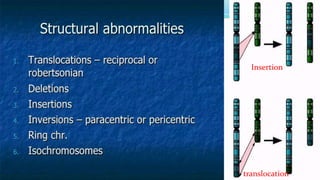
 Due to combination or translocation or duplication of
chromosomes.( change in structure)
Insertion
translocation
Aneuploidy
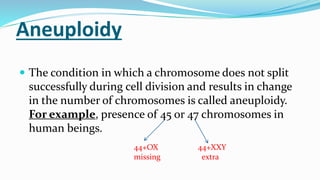
 The condition in which a chromosome does not split
successfully during cell division and results in change
in the number of chromosomes is called aneuploidy.
For example, presence of 45 or 47 chromosomes in
human beings.
44+OX
missing
44+XXY
extra
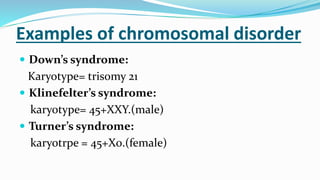
Examples of chromosomal disorder
 Down’s syndrome:
Karyotype= trisomy 21
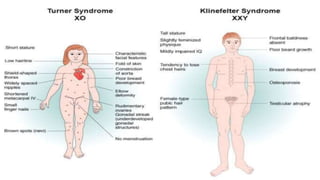
 Klinefelter’s syndrome:
karyotype= 45+XXY.(male)
 Turner’s syndrome:
karyotrpe = 45+X0.(female)
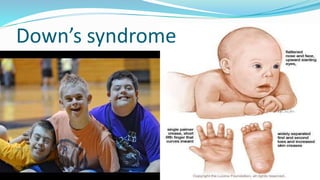
Down’s syndrome
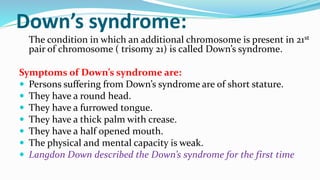
Down’s syndrome:
The condition in which an additional chromosome is present in 21st
pair of chromosome ( trisomy 21) is called Down’s syndrome.
Symptoms of Down’s syndrome are:
 Persons suffering from Down’s syndrome are of short stature.
 They have a round head.
 They have a furrowed tongue.
 They have a thick palm with crease.
 They have a half opened mouth.
 The physical and mental capacity is weak.
 Langdon Down described the Down’s syndrome for the first time
Klinfelter’s syndrome
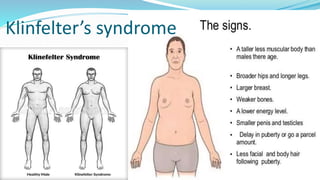
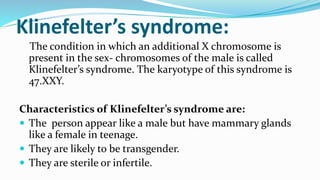
Klinefelter’s syndrome:
The condition in which an additional X chromosome is
present in the sex- chromosomes of the male is called
Klinefelter’s syndrome. The karyotype of this syndrome is
47.XXY.
Characteristics of Klinefelter’s syndrome are:
 The person appear like a male but have mammary glands
like a female in teenage.
 They are likely to be transgender.
 They are sterile or infertile.
Turner’s syndrome
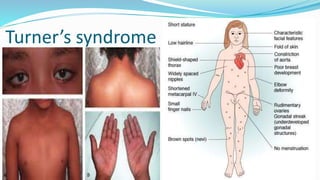
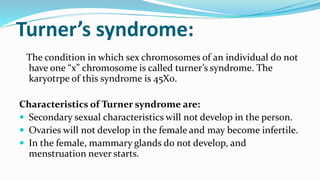
Turner’s syndrome:
The condition in which sex chromosomes of an individual do not
have one “x” chromosome is called turner’s syndrome. The
karyotrpe of this syndrome is 45X0.
Characteristics of Turner syndrome are:
 Secondary sexual characteristics will not develop in the person.
 Ovaries will not develop in the female and may become infertile.
 In the female, mammary glands do not develop, and
menstruation never starts.
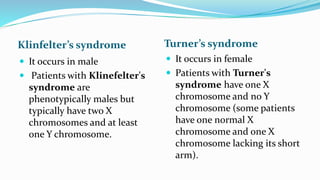
Klinfelter’s syndrome Turner’s syndrome
 It occurs in male
 Patients with Klinefelter's
syndrome are
phenotypically males but
typically have two X
chromosomes and at least
one Y chromosome.
 It occurs in female
 Patients with Turner's
syndrome have one X
chromosome and no Y
chromosome (some patients
have one normal X
chromosome and one X
chromosome lacking its short
arm).
Few questions
1)What do you mean by gene? Write it major functions.
2)Differentiate between autosome and sex chromosome.
3)Write the number of chromosome in human, frog,
onion and pine.
4) How is gender determined? Explain with a diagram.
Prepared by,
Chandan K. Chaudhary

Chrosomal disorder

  • 1.
    Chromosomal disorder The disorderin the body of human being due to increase or decrease in the number of chromosomes is called chromosomal disorder. Condition of disorder(type)  Due to increase or decrease in one or more number of chromosomes.( change in number)  Due to combination or translocation or duplication of chromosomes.( change in structure)
  • 3.
  • 4.
    Aneuploidy  The conditionin which a chromosome does not split successfully during cell division and results in change in the number of chromosomes is called aneuploidy. For example, presence of 45 or 47 chromosomes in human beings. 44+OX missing 44+XXY extra
  • 5.
    Examples of chromosomaldisorder  Down’s syndrome: Karyotype= trisomy 21  Klinefelter’s syndrome: karyotype= 45+XXY.(male)  Turner’s syndrome: karyotrpe = 45+X0.(female)
  • 6.
  • 7.
    Down’s syndrome: The conditionin which an additional chromosome is present in 21st pair of chromosome ( trisomy 21) is called Down’s syndrome. Symptoms of Down’s syndrome are:  Persons suffering from Down’s syndrome are of short stature.  They have a round head.  They have a furrowed tongue.  They have a thick palm with crease.  They have a half opened mouth.  The physical and mental capacity is weak.  Langdon Down described the Down’s syndrome for the first time
  • 8.
  • 9.
    Klinefelter’s syndrome: The conditionin which an additional X chromosome is present in the sex- chromosomes of the male is called Klinefelter’s syndrome. The karyotype of this syndrome is 47.XXY. Characteristics of Klinefelter’s syndrome are:  The person appear like a male but have mammary glands like a female in teenage.  They are likely to be transgender.  They are sterile or infertile.
  • 10.
  • 11.
    Turner’s syndrome: The conditionin which sex chromosomes of an individual do not have one “x” chromosome is called turner’s syndrome. The karyotrpe of this syndrome is 45X0. Characteristics of Turner syndrome are:  Secondary sexual characteristics will not develop in the person.  Ovaries will not develop in the female and may become infertile.  In the female, mammary glands do not develop, and menstruation never starts.
  • 13.
    Klinfelter’s syndrome Turner’ssyndrome  It occurs in male  Patients with Klinefelter's syndrome are phenotypically males but typically have two X chromosomes and at least one Y chromosome.  It occurs in female  Patients with Turner's syndrome have one X chromosome and no Y chromosome (some patients have one normal X chromosome and one X chromosome lacking its short arm).
  • 14.
    Few questions 1)What doyou mean by gene? Write it major functions. 2)Differentiate between autosome and sex chromosome. 3)Write the number of chromosome in human, frog, onion and pine. 4) How is gender determined? Explain with a diagram.
  • 15.