ORGANIZATIONAL BEHAVIOUR
                               MMS I (SEM I)


          Introduction to
Organizational Behaviour


                                Ms. Sonali Murzello

                                         LOGO
Organizational Behavior


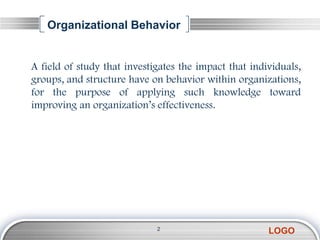
A field of study that investigates the impact that individuals,
groups, and structure have on behavior within organizations,
for the purpose of applying such knowledge toward
improving an organization’s effectiveness.


                             2
                                                       LOGO
Origin
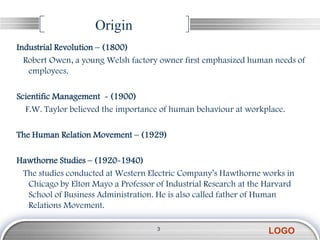
Industrial Revolution – (1800)
  Robert Owen, a young Welsh factory owner first emphasized human needs of
   employees.

Scientific Management - (1900)
  F.W. Taylor believed the importance of human behaviour at workplace.

The Human Relation Movement – (1929)

Hawthorne Studies – (1920-1940)
 The studies conducted at Western Electric Company’s Hawthorne works in
  Chicago by Elton Mayo a Professor of Industrial Research at the Harvard
  School of Business Administration. He is also called father of Human
  Relations Movement.

                                    3
                                                                  LOGO
Nature of O.B.
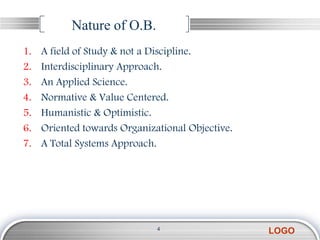
1.   A field of Study & not a Discipline.
2.   Interdisciplinary Approach.
3.   An Applied Science.
4.   Normative & Value Centered.
5.   Humanistic & Optimistic.
6.   Oriented towards Organizational Objective.
7.   A Total Systems Approach.


                              4
                                                  LOGO
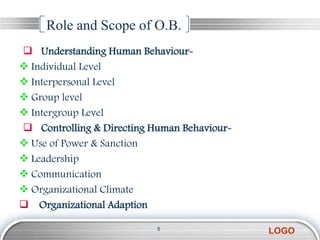
Role and Scope of O.B.
 Understanding Human Behaviour-
 Individual Level
 Interpersonal Level
 Group level
 Intergroup Level
 Controlling & Directing Human Behaviour-
 Use of Power & Sanction
 Leadership
 Communication
 Organizational Climate
 Organizational Adaption

                           5
                                             LOGO
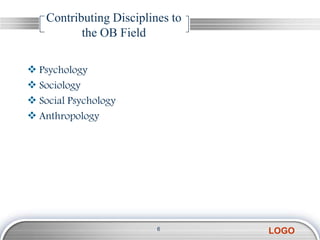
Contributing Disciplines to
           the OB Field

 Psychology
 Sociology
 Social Psychology
 Anthropology


                          6
                                  LOGO
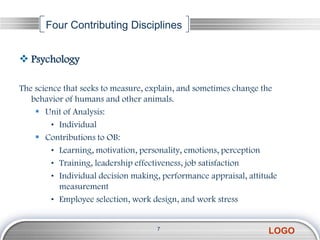
Four Contributing Disciplines


 Psychology

The science that seeks to measure, explain, and sometimes change the
   behavior of humans and other animals.
     Unit of Analysis:
         • Individual
     Contributions to OB:
         • Learning, motivation, personality, emotions, perception
         • Training, leadership effectiveness, job satisfaction
         • Individual decision making, performance appraisal, attitude
           measurement
         • Employee selection, work design, and work stress


                                     7
                                                                   LOGO
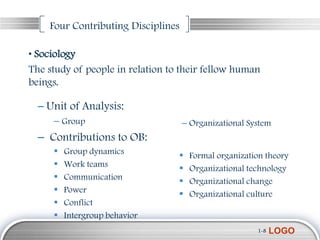
Four Contributing Disciplines

• Sociology
The study of people in relation to their fellow human
beings.

  – Unit of Analysis:
     – Group                        – Organizational System
  – Contributions to OB:
        Group dynamics              Formal organization theory
        Work teams                  Organizational technology
        Communication               Organizational change
        Power                       Organizational culture
        Conflict
        Intergroup behavior
                                                       1-8   LOGO
Four Contributing Disciplines

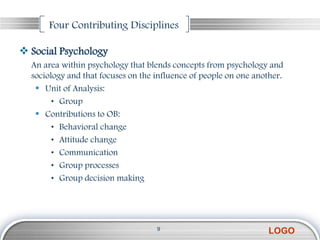
 Social Psychology
  An area within psychology that blends concepts from psychology and
  sociology and that focuses on the influence of people on one another.
    Unit of Analysis:
        • Group
    Contributions to OB:
        • Behavioral change
        • Attitude change
        • Communication
        • Group processes
        • Group decision making


                                    9
                                                                  LOGO
Four Contributing Disciplines

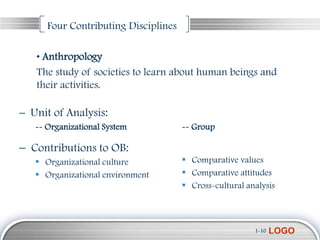
   • Anthropology
   The study of societies to learn about human beings and
   their activities.

– Unit of Analysis:
   -- Organizational System           -- Group

– Contributions to OB:
    Organizational culture            Comparative values
    Organizational environment        Comparative attitudes
                                       Cross-cultural analysis


                                                         1-10   LOGO

Chp 1 intro to ob[1]

  • 1.
    ORGANIZATIONAL BEHAVIOUR MMS I (SEM I) Introduction to Organizational Behaviour Ms. Sonali Murzello LOGO
  • 2.
    Organizational Behavior A fieldof study that investigates the impact that individuals, groups, and structure have on behavior within organizations, for the purpose of applying such knowledge toward improving an organization’s effectiveness. 2 LOGO
  • 3.
    Origin Industrial Revolution –(1800) Robert Owen, a young Welsh factory owner first emphasized human needs of employees. Scientific Management - (1900) F.W. Taylor believed the importance of human behaviour at workplace. The Human Relation Movement – (1929) Hawthorne Studies – (1920-1940) The studies conducted at Western Electric Company’s Hawthorne works in Chicago by Elton Mayo a Professor of Industrial Research at the Harvard School of Business Administration. He is also called father of Human Relations Movement. 3 LOGO
  • 4.
    Nature of O.B. 1. A field of Study & not a Discipline. 2. Interdisciplinary Approach. 3. An Applied Science. 4. Normative & Value Centered. 5. Humanistic & Optimistic. 6. Oriented towards Organizational Objective. 7. A Total Systems Approach. 4 LOGO
  • 5.
    Role and Scopeof O.B.  Understanding Human Behaviour-  Individual Level  Interpersonal Level  Group level  Intergroup Level  Controlling & Directing Human Behaviour-  Use of Power & Sanction  Leadership  Communication  Organizational Climate  Organizational Adaption 5 LOGO
  • 6.
    Contributing Disciplines to the OB Field  Psychology  Sociology  Social Psychology  Anthropology 6 LOGO
  • 7.
    Four Contributing Disciplines Psychology The science that seeks to measure, explain, and sometimes change the behavior of humans and other animals.  Unit of Analysis: • Individual  Contributions to OB: • Learning, motivation, personality, emotions, perception • Training, leadership effectiveness, job satisfaction • Individual decision making, performance appraisal, attitude measurement • Employee selection, work design, and work stress 7 LOGO
  • 8.
    Four Contributing Disciplines •Sociology The study of people in relation to their fellow human beings. – Unit of Analysis: – Group – Organizational System – Contributions to OB:  Group dynamics  Formal organization theory  Work teams  Organizational technology  Communication  Organizational change  Power  Organizational culture  Conflict  Intergroup behavior 1-8 LOGO
  • 9.
    Four Contributing Disciplines Social Psychology An area within psychology that blends concepts from psychology and sociology and that focuses on the influence of people on one another.  Unit of Analysis: • Group  Contributions to OB: • Behavioral change • Attitude change • Communication • Group processes • Group decision making 9 LOGO
  • 10.
    Four Contributing Disciplines • Anthropology The study of societies to learn about human beings and their activities. – Unit of Analysis: -- Organizational System -- Group – Contributions to OB:  Organizational culture  Comparative values  Organizational environment  Comparative attitudes  Cross-cultural analysis 1-10 LOGO