•The science which treats of the laws of distribution of living
organisms over the earth's surface as to latitude, altitude,
locality, etc.
•The science of describing localities; chorography.
•The science of the geographical distribution of plants and
animals; zoögeography and phytogeography.
The rain fed
highlands of the
western and
southwestern
regions (Sarawat
Mountains)
The vast arid and
extra arid lands of
the interior (Najd)
Draw a map to illustrate the
phytogeographical regions of KSA
Five min.
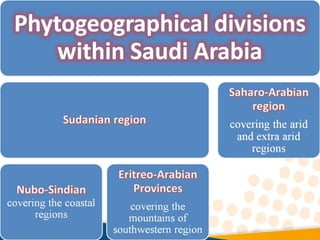
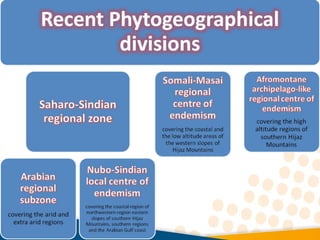
1. Arabian Regional sub zone. 2. Nubo-Sindian local centre of endemism. 3. Somali-
Masai regional centre of endemism. 4.Afromontane Archipelago-like regional centre
of endemism.
The Arabian Regional subzone is the largest
phytogeographical reigon in Saudi Arabia,
covering central, northern and eastern regions.
This area is generally arid with an average
annual rainfall of 120 mm and an average
maximum temperature of 480
C. during July-
September and an average minimum
temperature of 80
C. during December-
February.
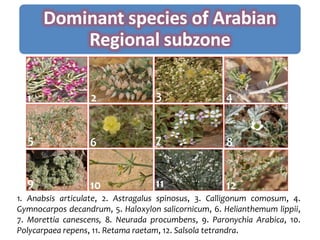
1. Anabsis articulate, 2. Astragalus spinosus, 3. Calligonum comosum, 4.
Gymnocarpos decandrum, 5. Haloxylon salicornicum, 6. Helianthemum lippii,
7. Morettia canescens, 8. Neurada procumbens, 9. Paronychia Arabica, 10.
Polycarpaea repens, 11. Retama raetam, 12. Salsola tetrandra.
1 2 3 4
5 6 7 8
9 10 11 12
This is a narrow strip of land bordering the
coastal regions of the Arabian Peninsula, often
difficult to differentiate from the neighbouring
phytogeographical divisions. Phytogeographers
are of the view that the area covered by the
Nubo-Sindian zone, particularly in the southern
regions of the Arabian Peninsula should be
extended further towards the interior parts of
the Peninsula.
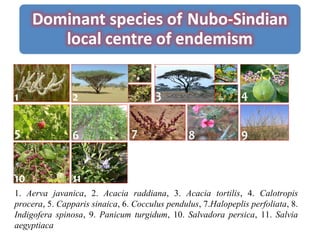
1. Aerva javanica, 2. Acacia raddiana, 3. Acacia tortilis, 4. Calotropis
procera, 5. Capparis sinaica, 6. Cocculus pendulus, 7.Halopeplis perfoliata, 8.
Indigofera spinosa, 9. Panicum turgidum, 10. Salvadora persica, 11. Salvia
aegyptiaca
1 2 3 4
5 6 7 8 9
10 11
This region covers the low altitude areas of
southwestern region. These areas are
influenced by the subtropical climate and
dominated by vegetation similar to that of north
east Africa.
1. Acacia hamulosa, 2. Acacia mellifera, 3. Breonadia salicina, 4. Cadaba
longifolia, 5. Carissa edulis, 6. Celtis Africana, 7. Commiphora spp., 8.
Dodonaea angustifolia, 9. Euclea schimperi, 10. Ficus cordata ssp. Salicifolia,
11. Ficus palmata, 12. Forsskaolea viridis,
1 2 3 4
5 6 7 8
9 10 11 12
13. Maytenus parviflorus, 14. Ochna inermis, 15. Premna resinosa, 16. Psiadia
puntulata, 17. Pterolobium stellatum, 18. Sarcostemma viminale, 19. Trichilia
emetica
13 14 1615
17 1918
The areas belonging to this phytochorion is
the most important part of Saudi Arabia
and the Arabian Peninsula in general in
terms of vegetation and speciation. These
areas are situated between 1000 to 3000 m
above sea level and are similar to the high
altitude mountains of north-eastern and eastern
parts of Africa, both floristically and
ecologically.
1. Acacia origena, 2. Buddleja polystachya, 3. Cadia purpurea, 4. Campanula
edulis, 5. Dombeya torrida, 6. Erica arborea, 7. Hypericum revolutum, 8. Juniperus
procera
1 2 3 4
5 6 7 8
9. Lavandula dentate, 10. Maesa lanceolata, 11. Myrsine Africana, 12. Rhamnus
staddo, 13. Rumex nervosus, 14. Salvia merjamie, 15. Senecio hadiensis, 16.
Solanum schimperianum, 17. Teclea nobilis
9 10 11 12 13
14 1615 17
Chorology

Chorology

  • 1.
    •The science whichtreats of the laws of distribution of living organisms over the earth's surface as to latitude, altitude, locality, etc. •The science of describing localities; chorography. •The science of the geographical distribution of plants and animals; zoögeography and phytogeography.
  • 2.
    The rain fed highlandsof the western and southwestern regions (Sarawat Mountains) The vast arid and extra arid lands of the interior (Najd)
  • 5.
    Draw a mapto illustrate the phytogeographical regions of KSA Five min.
  • 6.
    1. Arabian Regionalsub zone. 2. Nubo-Sindian local centre of endemism. 3. Somali- Masai regional centre of endemism. 4.Afromontane Archipelago-like regional centre of endemism.
  • 7.
    The Arabian Regionalsubzone is the largest phytogeographical reigon in Saudi Arabia, covering central, northern and eastern regions. This area is generally arid with an average annual rainfall of 120 mm and an average maximum temperature of 480 C. during July- September and an average minimum temperature of 80 C. during December- February.
  • 8.
    1. Anabsis articulate,2. Astragalus spinosus, 3. Calligonum comosum, 4. Gymnocarpos decandrum, 5. Haloxylon salicornicum, 6. Helianthemum lippii, 7. Morettia canescens, 8. Neurada procumbens, 9. Paronychia Arabica, 10. Polycarpaea repens, 11. Retama raetam, 12. Salsola tetrandra. 1 2 3 4 5 6 7 8 9 10 11 12
  • 9.
    This is anarrow strip of land bordering the coastal regions of the Arabian Peninsula, often difficult to differentiate from the neighbouring phytogeographical divisions. Phytogeographers are of the view that the area covered by the Nubo-Sindian zone, particularly in the southern regions of the Arabian Peninsula should be extended further towards the interior parts of the Peninsula.
  • 10.
    1. Aerva javanica,2. Acacia raddiana, 3. Acacia tortilis, 4. Calotropis procera, 5. Capparis sinaica, 6. Cocculus pendulus, 7.Halopeplis perfoliata, 8. Indigofera spinosa, 9. Panicum turgidum, 10. Salvadora persica, 11. Salvia aegyptiaca 1 2 3 4 5 6 7 8 9 10 11
  • 11.
    This region coversthe low altitude areas of southwestern region. These areas are influenced by the subtropical climate and dominated by vegetation similar to that of north east Africa.
  • 12.
    1. Acacia hamulosa,2. Acacia mellifera, 3. Breonadia salicina, 4. Cadaba longifolia, 5. Carissa edulis, 6. Celtis Africana, 7. Commiphora spp., 8. Dodonaea angustifolia, 9. Euclea schimperi, 10. Ficus cordata ssp. Salicifolia, 11. Ficus palmata, 12. Forsskaolea viridis, 1 2 3 4 5 6 7 8 9 10 11 12
  • 13.
    13. Maytenus parviflorus,14. Ochna inermis, 15. Premna resinosa, 16. Psiadia puntulata, 17. Pterolobium stellatum, 18. Sarcostemma viminale, 19. Trichilia emetica 13 14 1615 17 1918
  • 14.
    The areas belongingto this phytochorion is the most important part of Saudi Arabia and the Arabian Peninsula in general in terms of vegetation and speciation. These areas are situated between 1000 to 3000 m above sea level and are similar to the high altitude mountains of north-eastern and eastern parts of Africa, both floristically and ecologically.
  • 15.
    1. Acacia origena,2. Buddleja polystachya, 3. Cadia purpurea, 4. Campanula edulis, 5. Dombeya torrida, 6. Erica arborea, 7. Hypericum revolutum, 8. Juniperus procera 1 2 3 4 5 6 7 8
  • 16.
    9. Lavandula dentate,10. Maesa lanceolata, 11. Myrsine Africana, 12. Rhamnus staddo, 13. Rumex nervosus, 14. Salvia merjamie, 15. Senecio hadiensis, 16. Solanum schimperianum, 17. Teclea nobilis 9 10 11 12 13 14 1615 17