CHOLESTEROLAND
ATHEROSCLEROSIS
PRESENTED BY:
SMRITI AULAKH
SUKHLEEN KAUR
SUKHMANI
SUPREET KAUR
TARANVIR KAUR
YAISHWAR SRAN
Cholesterol
– The word cholesterol is derived from greek word “chole”
=Bile, “steros”= solid, “ol” =alcohol.
– Choleterol is widely distributed in animal tissues but is
absent in plants.
– It is soluble in chloroform and fat soluble vitamins
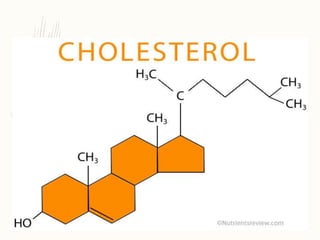
Structure of Cholesterol
– Cholesterol has cyclopentanoperhydrophenanthrene ring
system
– Total 27 carbon, one OH group at third position double
bond between C-5 &C-6.
– An eight carbon β-oriented side chain is attached to 17th
carbon.
– Two methyl groups attached at position 10 & 13.
Functions of Cholesterol
– It is a component of cell membrane.
– It is used to insulate nerve fibers.
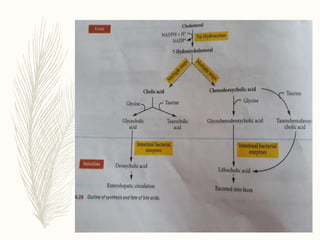
– Bile acids and bile salts are derived from cholesterol.
– It is a precursor for steroid hormones & Vitamin D3.
BIOSYNTHESIS OF
CHOLESTEROL
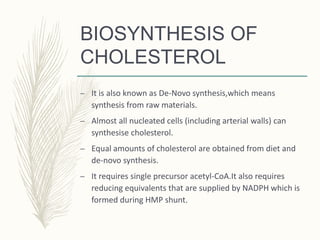
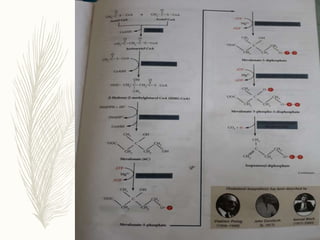
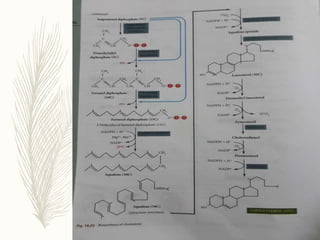
– It is also known as De-Novo synthesis,which means
synthesis from raw materials.
– Almost all nucleated cells (including arterial walls) can
synthesise cholesterol.
– Equal amounts of cholesterol are obtained from diet and
de-novo synthesis.
– It requires single precursor acetyl-CoA.It also requires
reducing equivalents that are supplied by NADPH which is
formed during HMP shunt.
REGULATION
– It mainly regulated at the level of HMG-CoA
reductase,which is a rate limiting enzyme.
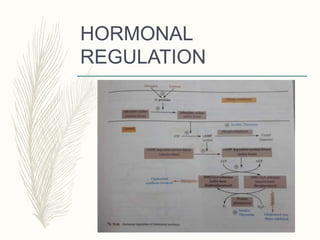
– Regulation occurs by two means:Feedback and Hormonal
regulation.
– FEEDBACK REGULATION: The end product of the
pathway,cholesterol,and already stored cholesterol esters
inside the cell, controls the de novo synthesis by feedback
mechanism at the level of transcription of gene HMG CoA
reductase.
HORMONAL
REGULATION
DEGRADATION OF
CHOLESTEROL
Cholesterol does not degrade to release energy unlike most
of the other biomolecules. It has a different fate
alltogether.
1. Synthesis of bile acids
2. Synthesis of steroid hormone
3. Synthesis of vitamin D
ATHEROSCLEROSIS
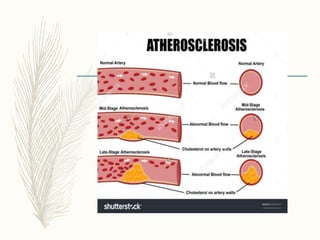
– ‘Athero’ means artery, ‘sclerosis’ means hardening.
– Atherosclerosis is a result of hypercholesterolemia.
– Coronary artery disease and myocardial infarction due to
atherosclerosis top the list of killer diseases of the world.
– In india,20% deaths are due to CAD. It is estimated that it
will increase to 33% by 2020.
CAUSES OF
HYPERCHOLESTROLEMIA
– Obesity
– Diet rich in cholesterol
– Diabetes mellitus
– Hypothyroidism
– Obstructive jaundice
FORMATION OF
PLAQUE
– STAGE 1- The increased level of cholesterol causes
overloading of macrophages with cholesterol in arterial
wall, known as foam cells.
– STAGE 2- PROGRESSION OF ATHEROSCLEROSIS: In this,
smooth muscle cells containing lipid droplets are seen in
the lesion.
– STAGE 3- FIBROUS PROLIFERATION: Due to liberation of
various growth factors by macrophages, collagen is
accumulated. Thus, their is definite component of
inflammation in atherosclerosis.
– STAGE 4- ADVANCING FIBROUS PLAQUE: This leads to the
narrowing of vessel walls when proliferative changes
occur. The blood floe through the narrow lumen is more
turbulent and their is tendency of clot formation.
RISK FACTORS
– Low HDL level
– High LDL level
– Lipoprotein a
– Smoking
– Diabetes mellitus
– Hypertension
– Obesity and sedentary lifestyle
MYOCARDIAL
INFARCTION
This is the ultimate risk of atherosclerosis. A clot is formed,
which occludes major vessels. Thrombosis in coronary
artery leads to ischemia of cardiac tissue due to hindrance
in O2 supply. Eventually, infarction(death of tissue) occurs
resulting in inefficient blood supply to the body ,leading to
death of the individual.
PREVENTION OF
ATHEROSCLEROSIS
– Reduce dietary cholesterol
– Intake of vegetable oils and PUFA
– Intake of green leafy vegetables
– Avoid sucrose and cigarette
– Regular exercise
– Avoid trans fatty acids
– Hypolipidemic drugs
QUESTIONS??
Q. Which ring system is present in
cholesterol structure?
Q. Which is the rate limiting step of
cholesterol synthesis?
Q. At what level of gene expression does
feedback inhibition of HMG reductase
enzyme is regulated?
Q. In which form HMG CoA reductase is
active?
Q. Which is the only way of excretion of
cholesterol form?

Cholesterol & atherosclerosis

  • 1.
  • 2.
    PRESENTED BY: SMRITI AULAKH SUKHLEENKAUR SUKHMANI SUPREET KAUR TARANVIR KAUR YAISHWAR SRAN
  • 3.
    Cholesterol – The wordcholesterol is derived from greek word “chole” =Bile, “steros”= solid, “ol” =alcohol. – Choleterol is widely distributed in animal tissues but is absent in plants. – It is soluble in chloroform and fat soluble vitamins
  • 4.
    Structure of Cholesterol –Cholesterol has cyclopentanoperhydrophenanthrene ring system – Total 27 carbon, one OH group at third position double bond between C-5 &C-6. – An eight carbon β-oriented side chain is attached to 17th carbon. – Two methyl groups attached at position 10 & 13.
  • 6.
    Functions of Cholesterol –It is a component of cell membrane. – It is used to insulate nerve fibers. – Bile acids and bile salts are derived from cholesterol. – It is a precursor for steroid hormones & Vitamin D3.
  • 7.
    BIOSYNTHESIS OF CHOLESTEROL – Itis also known as De-Novo synthesis,which means synthesis from raw materials. – Almost all nucleated cells (including arterial walls) can synthesise cholesterol. – Equal amounts of cholesterol are obtained from diet and de-novo synthesis. – It requires single precursor acetyl-CoA.It also requires reducing equivalents that are supplied by NADPH which is formed during HMP shunt.
  • 10.
    REGULATION – It mainlyregulated at the level of HMG-CoA reductase,which is a rate limiting enzyme. – Regulation occurs by two means:Feedback and Hormonal regulation. – FEEDBACK REGULATION: The end product of the pathway,cholesterol,and already stored cholesterol esters inside the cell, controls the de novo synthesis by feedback mechanism at the level of transcription of gene HMG CoA reductase.
  • 11.
  • 12.
    DEGRADATION OF CHOLESTEROL Cholesterol doesnot degrade to release energy unlike most of the other biomolecules. It has a different fate alltogether. 1. Synthesis of bile acids 2. Synthesis of steroid hormone 3. Synthesis of vitamin D
  • 14.
    ATHEROSCLEROSIS – ‘Athero’ meansartery, ‘sclerosis’ means hardening. – Atherosclerosis is a result of hypercholesterolemia. – Coronary artery disease and myocardial infarction due to atherosclerosis top the list of killer diseases of the world. – In india,20% deaths are due to CAD. It is estimated that it will increase to 33% by 2020.
  • 16.
    CAUSES OF HYPERCHOLESTROLEMIA – Obesity –Diet rich in cholesterol – Diabetes mellitus – Hypothyroidism – Obstructive jaundice
  • 17.
    FORMATION OF PLAQUE – STAGE1- The increased level of cholesterol causes overloading of macrophages with cholesterol in arterial wall, known as foam cells. – STAGE 2- PROGRESSION OF ATHEROSCLEROSIS: In this, smooth muscle cells containing lipid droplets are seen in the lesion. – STAGE 3- FIBROUS PROLIFERATION: Due to liberation of various growth factors by macrophages, collagen is accumulated. Thus, their is definite component of inflammation in atherosclerosis.
  • 18.
    – STAGE 4-ADVANCING FIBROUS PLAQUE: This leads to the narrowing of vessel walls when proliferative changes occur. The blood floe through the narrow lumen is more turbulent and their is tendency of clot formation.
  • 19.
    RISK FACTORS – LowHDL level – High LDL level – Lipoprotein a – Smoking – Diabetes mellitus – Hypertension – Obesity and sedentary lifestyle
  • 20.
    MYOCARDIAL INFARCTION This is theultimate risk of atherosclerosis. A clot is formed, which occludes major vessels. Thrombosis in coronary artery leads to ischemia of cardiac tissue due to hindrance in O2 supply. Eventually, infarction(death of tissue) occurs resulting in inefficient blood supply to the body ,leading to death of the individual.
  • 21.
    PREVENTION OF ATHEROSCLEROSIS – Reducedietary cholesterol – Intake of vegetable oils and PUFA – Intake of green leafy vegetables – Avoid sucrose and cigarette – Regular exercise – Avoid trans fatty acids – Hypolipidemic drugs
  • 23.
    QUESTIONS?? Q. Which ringsystem is present in cholesterol structure? Q. Which is the rate limiting step of cholesterol synthesis? Q. At what level of gene expression does feedback inhibition of HMG reductase enzyme is regulated?
  • 24.
    Q. In whichform HMG CoA reductase is active? Q. Which is the only way of excretion of cholesterol form?