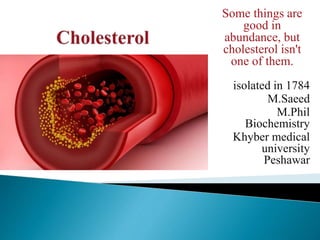
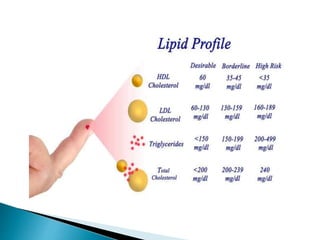
Some things are
good in
abundance, but
cholesterol isn't
one of them.
isolated in 1784
M.Saeed
M.Phil
Biochemistry
Khyber medical
university
Peshawar
 Cholesterol is a waxy, fat-like substance
made by the liver that's found in all the
cells in your body.
 Your body needs some cholesterol to
make hormones, vitamin D, and
substances that help you digest foods
 Cholesterol, exclusively found in animal.
 . lt is widely distributed in all cells and is a
major component of cell membranes and
lipoprotein.
 . Cholesterol (Creek: chole-bile) was first
isolated from bile.
 Cholesterol literally means 'solid alcohol
from bile.'
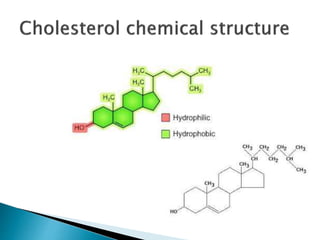
 The structure of cholesterol (C27H46OH).
 . lt has one hydroxyl group at C3 and a
double bond between C5 and C6.
 Cholesterol contains a total of 5 methyl
group.
 As a structural component of plasma
membranes, cholesterol is an important
determinant of membrane permeability
 There are two basic types of cholesterol: LDL (low-
density lipoprotein, or "bad cholesterol,") and HDL
(high-density lipoprotein, or "good cholesterol“
 Lipoproteins are made of fat and proteins.
Cholesterol moves through your body while inside
lipoproteins.
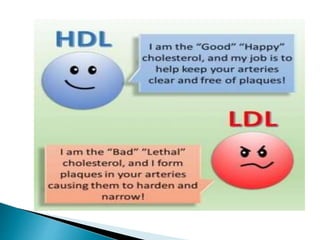
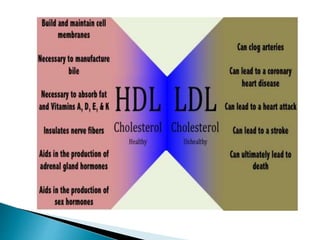
 HDL is known as “good cholesterol” because it
transports cholesterol to your liver to be expelled from
your body. HDL helps rid your body of excess
cholesterol so it’s less likely to end up in your arteries
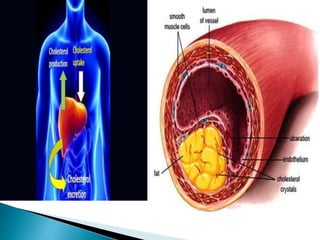
 LDL is called “bad cholesterol” because it takes
cholesterol to your arteries, where it may collect in
artery walls. Too much cholesterol in your arteries may
lead to a buildup of plaque known as atherosclerosis.
This can increase the risk of blood clots in your
arteries. If a blood clot breaks away and blocks an
artery in your heart or brain, you may have
a stroke or heart attack.
 Cholesterol is found in association with fatty
acids to- form cholestervl esters (esterification
occurs at the OH group of C3.
 Several reactions given by cholesterol are
useful for its qualitative identification and
quantitative estimation. These include
Salkowski's test, Liebermann-Burchard
reaction and Zak's test.
 Cholesterol is an yellowish crystalline solid.
 The crystals, under the microscope, show a
notched (E) appearance.
 Cholesterol is insoluble in water
 soluble in organic solvents such as
chloroform, benzene, ether etc.
 . lt is present in abundance in nervous tissues.
 lt appears that cholesterol functions as an
insulating cover for the transmission of
electrical impulses in the nervous tissue.
 Cholesterol performs several other
biochemical functions which include its role in
membrane structure and function, in the
synthesis of bile acids, hormones (sex and
cortical) and vitamin D.
 Two cholesterol disorders are
hyperlipidemia, and hypolipidemia.
 Hyperlipidemia
 means you have an unusually high level
of fat (lipids) in your blood. This puts
you at risk for many health problems,
including heart attack and stroke. It is
sometimes called high blood cholesterol
 Hypolipidemia
 Means you have an unusually low level of fat
in your blood. It is sometimes called low
blood cholesterol.
 Being overweight
 Not exercising regularly
 Overuse of alcohol
 Family history. High blood cholesterol can be an
inherited condition.
 Age and sex. As you age, your LDL ("bad
cholesterol") level rises. After age 55, women have
higher LDL levels than men.
 Diseases like diabetes, hypothyroidism, Cushing's
syndrome, and kidney failure
 Medications like birth control pills, beta-blockers,
estrogen, corticosteroids, and certain diuretics
 Hypolipidemia can be caused by several
things:
 Hypothyroidism
 Anemia (a low amount of red blood cells)
 Malnutrition, or a lack of food
 Liver disease
 The body being unable to absorb food
(malabsorption)
 Rare genetic conditions,
 Tangier disease
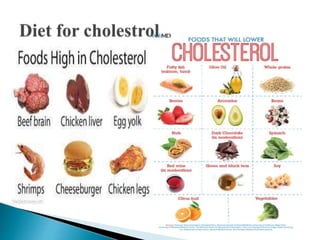
 To reduce cholesterol in your blood:
 Follow a healthful diet, eating foods low in
total fat and saturated fat
 Maintain a healthful weight
 Exercise at least three times a week, for 30
minutes at a stretch
 Have your total cholesterol rechecked in one
to two years if:
 Statins lower LDL ("bad cholesterol") levels
 Bile Acid are sometimes prescribed with statins, and
help lower LDL cholesterol levels
 Nicotinic Acid lowers LDL cholesterol and
triglycerides, and raises HDL ("good" cholesterol)
levels
 Fibrates lower triglyceride levels, and may increase
HDL levels
Cholestrol
Cholestrol

Cholestrol

  • 2.
    Some things are goodin abundance, but cholesterol isn't one of them. isolated in 1784 M.Saeed M.Phil Biochemistry Khyber medical university Peshawar
  • 3.
     Cholesterol isa waxy, fat-like substance made by the liver that's found in all the cells in your body.  Your body needs some cholesterol to make hormones, vitamin D, and substances that help you digest foods
  • 4.
     Cholesterol, exclusivelyfound in animal.  . lt is widely distributed in all cells and is a major component of cell membranes and lipoprotein.  . Cholesterol (Creek: chole-bile) was first isolated from bile.  Cholesterol literally means 'solid alcohol from bile.'
  • 5.
     The structureof cholesterol (C27H46OH).  . lt has one hydroxyl group at C3 and a double bond between C5 and C6.  Cholesterol contains a total of 5 methyl group.  As a structural component of plasma membranes, cholesterol is an important determinant of membrane permeability
  • 8.
     There aretwo basic types of cholesterol: LDL (low- density lipoprotein, or "bad cholesterol,") and HDL (high-density lipoprotein, or "good cholesterol“  Lipoproteins are made of fat and proteins. Cholesterol moves through your body while inside lipoproteins.
  • 9.
     HDL isknown as “good cholesterol” because it transports cholesterol to your liver to be expelled from your body. HDL helps rid your body of excess cholesterol so it’s less likely to end up in your arteries  LDL is called “bad cholesterol” because it takes cholesterol to your arteries, where it may collect in artery walls. Too much cholesterol in your arteries may lead to a buildup of plaque known as atherosclerosis. This can increase the risk of blood clots in your arteries. If a blood clot breaks away and blocks an artery in your heart or brain, you may have a stroke or heart attack.
  • 12.
     Cholesterol isfound in association with fatty acids to- form cholestervl esters (esterification occurs at the OH group of C3.  Several reactions given by cholesterol are useful for its qualitative identification and quantitative estimation. These include Salkowski's test, Liebermann-Burchard reaction and Zak's test.
  • 13.
     Cholesterol isan yellowish crystalline solid.  The crystals, under the microscope, show a notched (E) appearance.  Cholesterol is insoluble in water  soluble in organic solvents such as chloroform, benzene, ether etc.
  • 14.
     . ltis present in abundance in nervous tissues.  lt appears that cholesterol functions as an insulating cover for the transmission of electrical impulses in the nervous tissue.  Cholesterol performs several other biochemical functions which include its role in membrane structure and function, in the synthesis of bile acids, hormones (sex and cortical) and vitamin D.
  • 15.
     Two cholesteroldisorders are hyperlipidemia, and hypolipidemia.  Hyperlipidemia  means you have an unusually high level of fat (lipids) in your blood. This puts you at risk for many health problems, including heart attack and stroke. It is sometimes called high blood cholesterol
  • 16.
     Hypolipidemia  Meansyou have an unusually low level of fat in your blood. It is sometimes called low blood cholesterol.
  • 17.
     Being overweight Not exercising regularly  Overuse of alcohol  Family history. High blood cholesterol can be an inherited condition.  Age and sex. As you age, your LDL ("bad cholesterol") level rises. After age 55, women have higher LDL levels than men.  Diseases like diabetes, hypothyroidism, Cushing's syndrome, and kidney failure  Medications like birth control pills, beta-blockers, estrogen, corticosteroids, and certain diuretics
  • 18.
     Hypolipidemia canbe caused by several things:  Hypothyroidism  Anemia (a low amount of red blood cells)  Malnutrition, or a lack of food  Liver disease  The body being unable to absorb food (malabsorption)  Rare genetic conditions,  Tangier disease
  • 20.
     To reducecholesterol in your blood:  Follow a healthful diet, eating foods low in total fat and saturated fat  Maintain a healthful weight  Exercise at least three times a week, for 30 minutes at a stretch  Have your total cholesterol rechecked in one to two years if:
  • 21.
     Statins lowerLDL ("bad cholesterol") levels  Bile Acid are sometimes prescribed with statins, and help lower LDL cholesterol levels  Nicotinic Acid lowers LDL cholesterol and triglycerides, and raises HDL ("good" cholesterol) levels  Fibrates lower triglyceride levels, and may increase HDL levels