Greg Armento, Asian & Asian American Studies Librarian
 Susan C. Luévano, Chican@ & Latin@ Studies Librarian
Research Support
                
   Librarians
    Nuts and bolts of the research
     process
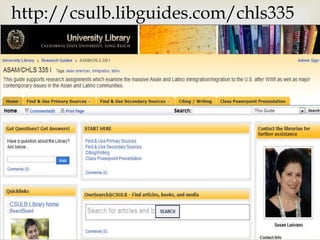
ASAM/ CHLS 335 I Research Guide
http://csulb.libguides.com/chls335


                
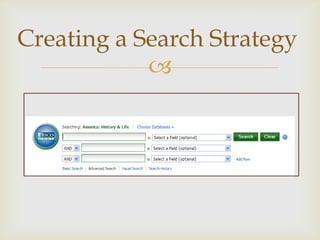
Creating a Search Strategy
            
 Create a thesis statement
 Break down your thesis statement by concept
 Create research questions
 Techie Tools
   Boolean operators
   Truncation
 Select databases & other resources
     America: History and Life
     Academic Search Complete
     Historical New York Times
     Historical Los Angeles Times
Creating a Search Strategy
              
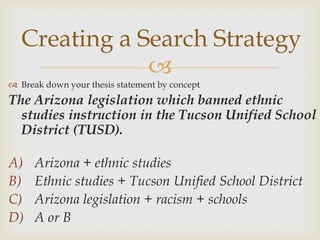
 Break down your thesis statement by concept
The Arizona legislation which banned ethnic
  studies instruction in the Tucson Unified School
  District (TUSD).

A)    Arizona + ethnic studies
B)    Ethnic studies + Tucson Unified School District
C)    Arizona legislation + racism + schools
D)    A or B
Creating a Search Strategy
            
I-Clickers
                   
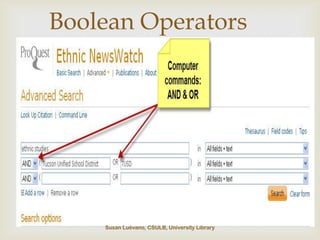
What are Boolean Operators?
 A. Computer commands used to organize research
  databases
 B. Computer commands used to search multiple
  databases at once.
 C. Computer commands used to create a research
  strategy.
 D. Computer commands used in selected databases
  to find full-text articles.
Boolean Operators
                   


    Susan Luévano, CSULB, University Library
Creating a Search
                 Strategy
                    
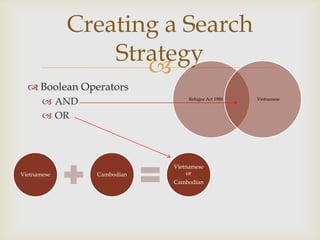
   Boolean Operators
        AND                    Refugee Act 1980   Vietnamese


        OR


                           Vietnamese
Vietnamese     Cambodian        or
                           Cambodian
I-Clickers
                    
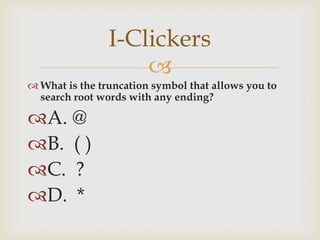
 What is the truncation symbol that allows you to
  search root words with any ending?

A. @
B. ( )
C. ?
D. *
Creating a Search Strategy
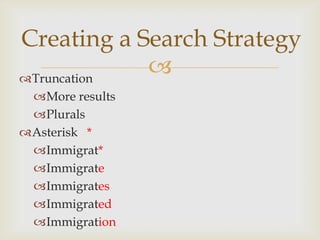
Truncation
            
 More results
 Plurals
Asterisk *
 Immigrat*
 Immigrate
 Immigrates
 Immigrated
 Immigration
I-Clickers
                          
What is a primary source?
 A. A document which describes an event by a witnesses (diaries,
  speeches, letters, interviews, autobiographies, etc)
 B. A fundamental or original document relating to a particular
  subject (government publications, legislation, court reports, etc)
 C. A source from the time of an event (newspaper articles, news
  footage, songs, cartoons, etc)
 D. A & C
 E. All of the above
I-Clickers
                          
What is a secondary source?
 A. Information written by an authority who reports on an
  event, person, place or thing (ie, a biography, etc)
 B. An accounting of events or experiences (ie, a news story, etc)
  not personally observed or experienced by the writer.
 C. A scholar's description or analysis of primary sources. (ie, a
  journal article, etc.)
 D. B & C
 E. All of the above
I-Clickers
                    
• What is a peer reviewed journal article?
• A. A research article that has been vetted
  by a team of peer scholars.
• B. An research article written by a team of
  peer scholars.
• C. A research article that has been
  presented at a professional conference
  before publication.
Peer-Reviewed Journals
                           
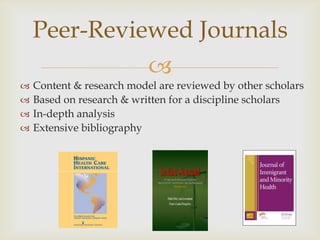
   Content & research model are reviewed by other scholars
   Based on research & written for a discipline scholars
   In-depth analysis
   Extensive bibliography
Finding Sources
               
What library resource can you search to
 find a scan of both journals and books ?
A. BeachReach
B. Link+
C. OneSearch@CSULB
Finding Peer-Reviewed Articles
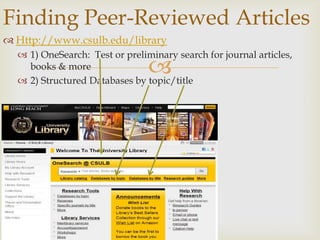
 Http://www.csulb.edu/library
   1) OneSearch: Test or preliminary search for journal articles,
    books & more                
   2) Structured Databases by topic/title
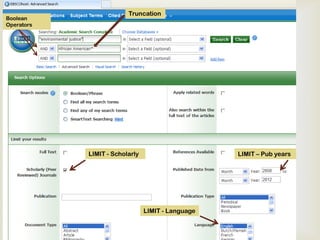
Truncation
Boolean
Operators

            Search Strategies
                     


               LIMIT - Scholarly                               LIMIT – Pub years


                                   LIMIT - Language

                    Susan Luévano, CSULB, University Library
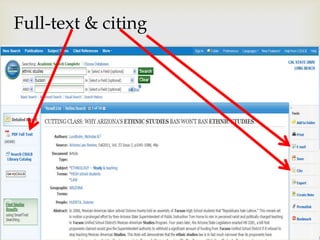
Full-text & citing

                     

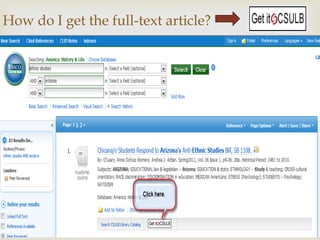
How do I get the full-text article?


                        


                                      21
Need full-text articles NOT available?:
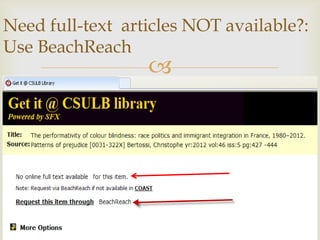
Use BeachReach
                  
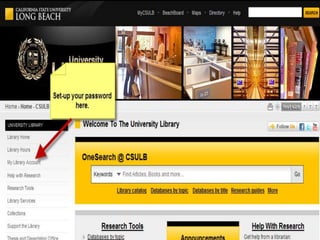
Library Pin

                           
Allows off-campus access to research databases
Library Home page
   My library account
   Type in your name, CSULB I.D. #, click submit
Type in a password of your choice and confirm
 by typing it again

Using databases off campus


  Susan Luévano, CSULB, University
              Library
Research Strategies
                             
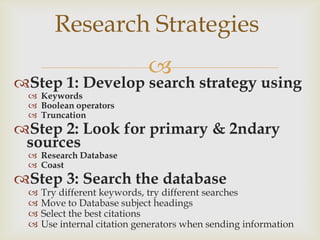
Step 1: Develop search strategy using
  Keywords
  Boolean operators
  Truncation
Step 2: Look for primary & 2ndary
 sources
  Research Database
  Coast
Step 3: Search the database
    Try different keywords, try different searches
    Move to Database subject headings
    Select the best citations
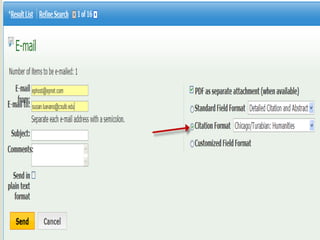
    Use internal citation generators when sending information
Research strategies
             
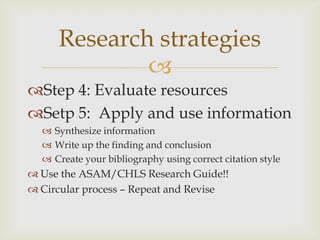
Step 4: Evaluate resources
Setp 5: Apply and use information
   Synthesize information
   Write up the finding and conclusion
   Create your bibliography using correct citation style
 Use the ASAM/CHLS Research Guide!!
 Circular process – Repeat and Revise
Where to get more
             assistance?
                               
 Research Subject Guide
 Individual appointment w/ discipline librarian
   Greg Armento – ASAM
   Susan Luévano – CHLS
   Evening Consultations:
       Wednesday, April 10th
       5:00 pm – 6:30 pm
       University Library, Spidell classroom, room 116
 Reference Desk, 1st floor, University Library

Chls 335 i_13

  • 1.
    Greg Armento, Asian& Asian American Studies Librarian Susan C. Luévano, Chican@ & Latin@ Studies Librarian
  • 2.
    Research Support   Librarians Nuts and bolts of the research process ASAM/ CHLS 335 I Research Guide
  • 3.
  • 4.
    Creating a SearchStrategy   Create a thesis statement  Break down your thesis statement by concept  Create research questions  Techie Tools  Boolean operators  Truncation  Select databases & other resources  America: History and Life  Academic Search Complete  Historical New York Times  Historical Los Angeles Times
  • 5.
    Creating a SearchStrategy   Break down your thesis statement by concept The Arizona legislation which banned ethnic studies instruction in the Tucson Unified School District (TUSD). A) Arizona + ethnic studies B) Ethnic studies + Tucson Unified School District C) Arizona legislation + racism + schools D) A or B
  • 6.
    Creating a SearchStrategy 
  • 7.
    I-Clickers  What are Boolean Operators?  A. Computer commands used to organize research databases  B. Computer commands used to search multiple databases at once.  C. Computer commands used to create a research strategy.  D. Computer commands used in selected databases to find full-text articles.
  • 8.
    Boolean Operators  Susan Luévano, CSULB, University Library
  • 9.
    Creating a Search Strategy   Boolean Operators  AND Refugee Act 1980 Vietnamese  OR Vietnamese Vietnamese Cambodian or Cambodian
  • 10.
    I-Clickers   What is the truncation symbol that allows you to search root words with any ending? A. @ B. ( ) C. ? D. *
  • 11.
    Creating a SearchStrategy Truncation  More results Plurals Asterisk * Immigrat* Immigrate Immigrates Immigrated Immigration
  • 12.
    I-Clickers  What is a primary source?  A. A document which describes an event by a witnesses (diaries, speeches, letters, interviews, autobiographies, etc)  B. A fundamental or original document relating to a particular subject (government publications, legislation, court reports, etc)  C. A source from the time of an event (newspaper articles, news footage, songs, cartoons, etc)  D. A & C  E. All of the above
  • 13.
    I-Clickers  What is a secondary source?  A. Information written by an authority who reports on an event, person, place or thing (ie, a biography, etc)  B. An accounting of events or experiences (ie, a news story, etc) not personally observed or experienced by the writer.  C. A scholar's description or analysis of primary sources. (ie, a journal article, etc.)  D. B & C  E. All of the above
  • 14.
    I-Clickers  • What is a peer reviewed journal article? • A. A research article that has been vetted by a team of peer scholars. • B. An research article written by a team of peer scholars. • C. A research article that has been presented at a professional conference before publication.
  • 15.
    Peer-Reviewed Journals   Content & research model are reviewed by other scholars  Based on research & written for a discipline scholars  In-depth analysis  Extensive bibliography
  • 16.
    Finding Sources  What library resource can you search to find a scan of both journals and books ? A. BeachReach B. Link+ C. OneSearch@CSULB
  • 17.
    Finding Peer-Reviewed Articles Http://www.csulb.edu/library  1) OneSearch: Test or preliminary search for journal articles, books & more   2) Structured Databases by topic/title
  • 18.
    Truncation Boolean Operators Search Strategies  LIMIT - Scholarly LIMIT – Pub years LIMIT - Language Susan Luévano, CSULB, University Library
  • 19.
  • 20.
  • 21.
    How do Iget the full-text article?  21
  • 22.
    Need full-text articlesNOT available?: Use BeachReach 
  • 23.
    Library Pin  Allows off-campus access to research databases Library Home page  My library account  Type in your name, CSULB I.D. #, click submit Type in a password of your choice and confirm by typing it again
  • 24.
     Using databases offcampus Susan Luévano, CSULB, University Library
  • 25.
    Research Strategies  Step 1: Develop search strategy using  Keywords  Boolean operators  Truncation Step 2: Look for primary & 2ndary sources  Research Database  Coast Step 3: Search the database  Try different keywords, try different searches  Move to Database subject headings  Select the best citations  Use internal citation generators when sending information
  • 26.
    Research strategies  Step 4: Evaluate resources Setp 5: Apply and use information  Synthesize information  Write up the finding and conclusion  Create your bibliography using correct citation style  Use the ASAM/CHLS Research Guide!!  Circular process – Repeat and Revise
  • 27.
    Where to getmore assistance?   Research Subject Guide  Individual appointment w/ discipline librarian  Greg Armento – ASAM  Susan Luévano – CHLS  Evening Consultations:  Wednesday, April 10th  5:00 pm – 6:30 pm  University Library, Spidell classroom, room 116  Reference Desk, 1st floor, University Library

Editor's Notes

  • #3 The Research Guide was created specifically for this class. This researchroad map is designed to bring all the resources you need to successfully completed the assignment for this class.The URL is on your handout. I highly recommend that when viewing this site you you Firefox web browser. As Greg & I have found that the display on Explorer is really bad.The get to this page:
  • #13 Let’s just get a sense of everybody’s knowledge of primary sources.OK.Let’s look at the class Research Roadmap for a more detailed review of primary sources.