Nano-confined Fluids:Nano-confined Fluids:
A New StateA New State
Alokmay Datta
Saha Institute of Nuclear Physics
1/AF Bidhannagar, Kolkata 700 064,
INDIA
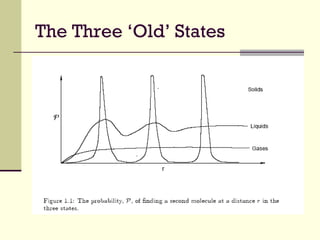
The Three ‘Old’ States
Fluids: Simple and Complex
Simple Fluid
Intermolecular potential
1. Spherically symmetric
2. Short range
Isotropic and Viscous
Complex Fluid
Intermolecular potential
1. Anisotropic
2. Long/short range
Anisotropic and Visco-elastic
X-ray Diffractometer for
Reflectivity Studies
Rotating-Anode Generator,
Cu kα1 , λ=1.540562Å
•Angle of Incidence used: from 0° - 3.5°
•Scan-step: 2 mdeg for films > 800 Å, 5 mdeg for films ≤ 800 Å
•3.8 kW of X-ray Power used
Grazing Incidence X-ray
Diffractometer, FR591, Enraf-
Nonius
X-ray Reflectivity: Principles
•In x-ray region, refractive index n < 1, i.e.,
phase velocity of x-rays in material > phase
velocity in vacuum.
total external reflection (specular reflection)
Incident and scattered wave-vectors in same plane normal to surface
Incident angle (α) = scattered angle (β)
δ∼10-6
, ρ → electron density, r0 → classical electron radius ~ 2.8×10⁻⁵
Å
•n = (1-δ) =1-(ρr0 λ2
/2π )
•qz = normal momentum transfer = kf - ki= 4π/λ(sinα)
∀αc = critical angle for sample film = (2 δ)½
z
x
At α > αc, x-rays penetrate into sample, are scattered for each change in
ρ, and these scattered x-rays interfere  interference (Kiessig) fringes in
reflectivity profile with periodicity 2π/d, d = thickness of a layer with a
constant ρ, while amplitude of fringes ∝ change in ρ
kt
ki kf
α α
β
n = 1-δ
n=1
∆qz = 2π/d
d
Air
Film
Substrate
Interference (Kiessig) fringes with periodicity 2Interference (Kiessig) fringes with periodicity 2ππ/d, d = thickness of/d, d = thickness of
a layer with a constanta layer with a constant ρρ, while amplitude of fringes, while amplitude of fringes ∝∝ change inchange in ρρ
M. K Sanyal, A. Datta, S. Hazra, Pure Appl. Chem. 74, 1553 (2002).
Layering in Simple Fluids: TEHOS
C.-J. Yu, A. G. Richter, A. Datta, M. K. Durbin, and P. Dutta, Phys. Rev.
Lett. 82 , 2326 (1999).
This work used the National Synchrotron Light Source, USA as the X-ray source
Layering in Complex Fluids:
Polystyrene
Sample preparation: Spin Coating
Spin Coating Unit, EC101, Headway Research
Thin films are prepared by putting a drop of solution in toluene on
acid-washed quartz mounted on rotating vacuum chuck.
Film thickness can be varied by adjusting the rotation speed and
concentration of the solution
Mirror
Laser
Diode
Focusing Lens
Piezo Scanner
Sample
Holder
Integrator
Divider /
Multiplier
Differential
amplifier
4-quadrant PSPD
X-Y Translator
X Y
Tip
SampleCantilever
Force
attractive force
distance
(tip-to-sample
)
repulsive force
non-contact
contact
Intermittent-
contact
Multimode Nanoscope IV
(Digital Instruments)
Intermittent-Contact (tapping) mode; Etched Si tip; Phosphorus-
doped Si cantilever; Force constant 40N/m; Characteristic frequency
344kHz
Atomic Force Microscope
Surface Energy Variation from
Phase Measurement
000
sin
kAA
QE
A
A D
πω
ω
φ +





=
SiPS
Sic
D A
z
r
E ∆=∆ 2
0
3
2 α
2/12
2/12/1
4















 ∆
−
∆
=∆
Si
SiPS
PS
Si
SiPS
H
A
A
A
A
A
A
Tip Parameters:  = phase,  (0) = working
(resonant) frequency, A (A0) = set-point (free)
amplitude, k = spring constant, Q = quality factor,
ED = energy dissipated per cycle, rc = radius of
curvature, Si = Si atomic radius, ASi = Si Hamaker
constant
z0 = Tip-sample separation,
ASiPS = Si-PS Hamaker
constant, APS = Bulk PS
Hamaker constant, AH = PS
Hamaker constant in film
J. Tamayo and R. Garcia, Appl. Phys. Lett. 73, 2926 (1998).
First Indication of Layering
0.00 0.05 0.10 0.15 0.20 0.25 0.30 0.35
10
-10
10
-9
10
-8
10
-7
10
-6
1x10
-5
1x10
-4
10
-3
10
-2
10
-1
10
0
10
1
Electrondensity,ρ
z (Å)
Reflectivity
qz
(Å
-1
)
0 200 400 600 800
0.28
0.32
0.36
0.40
0.26 0.28 0.30 0.32 0.34 0.36
500
400
300
200
100
0
Depthfromsurface
Electron Density (Å
-3
)
~212 Å ~Rg
Rg is the radius of gyration of
Polystyrene, i.e. the size of the
Polystyrene molecule in its most
Disordered state
M. K. Sanyal, J. K. Basu,
A. Datta and S. Banerjee
Europhys. Lett. 36, 265 (1996)
The Layering Transition in
Polystyrene
Nanoconfined State: An Ordered
State with Low Cohesion (Out-of-
plane)
S.Chattopadhyay and A.Datta, Phys. Rev. B 72, 155418 (2005)
Reduction in cohesive energy caused by the variation of density due to layering
 ∆AH= σPS (max
2
- min
2
),  = (max - min), AH = Hamaker Constant
Lowering of In-plane Cohesion in
Nanoconfined Polystyrene
Polystyrene
Thickness
7Rg (150 nm) 4Rg (84 nm) 2Rg (50 nm)
PS = the change in PS Surface Energy
= GPS –PS = the change in in-plane PS cohesion
S. Chattopadhyay and A. Datta, Macromolecules 40, 3613 (2007)
Intermolecular Potential in
Nanoconfined State
From X-ray Reflectivity (Out-of-plane)From Atomic Force Microscopy (In-plane)
∆G (in mJm−2
) ≈ ∆AH (in J)/(2.1×10−21
)
Spatial variation in ∆G fits the Modified
Pöschl-Teller Potential
GPS−PS() = V0 cosh-2
(
Polystyrene film thickness shown beside each curve
Schematic Model for
Nanoconfined Polystyrene
One Effect of Nanoconfinement:One Effect of Nanoconfinement:
Tunable Self-assembly of Au NanoparticlesTunable Self-assembly of Au Nanoparticles
0 50 100 150 200
0.5
1.0
1.5
2.0
0 50 100 150 200
0.5
1.0
1.5
2.0
As deposited by DC Magnetron Sputtering
After 2months in Ambient Condition
Nanoparticles are almost perfectly monodisperseNanoparticles are almost perfectly monodisperse
Total no. of particles=326
3umx3um scan
Topographical image Phase image
Tuning of Shape and Size of nano-particles by varyingTuning of Shape and Size of nano-particles by varying
PS thickness: monodispersity is retainedPS thickness: monodispersity is retained
No
aggregation
PS
500Å
PS
840Å
PS
1500Å
6 nm
24 nm
6 nm
10 nm
Nanoparticle
height, diameter
Phase imageTopographical image
Chattopadhyay and A. Datta, Synth. Met. 155, 365 (2005); Macromolecules 40, 3613 (2007)
Conclusions
 Confinement of fluids, simple or complex,
gives rise to a new phase – the
Nanoconfined phase
 For polymers, at least, this phase can be
used to grow monodisperse nanoparticles
through directed coalescence
 Nanoparticle size and shape can be tuned
simply by changing polymer film thickness.
Co-workers
 From Saha Institute of Nuclear Physics
1. Sudeshna Chattopadhyay
2. Prof. Milan Kumar Sanyal
3. Prof. Sangam Banerjee
4. Dr. Jaydip Kumar Basu (Now in IISc, Bangalore)
 From Northwestern University, USA
1. Prof. Pulak Dutta
2. Dr. Chung-Jung Yu (Now in Pohang Light Source, Republic of
Korea)
Thank You!

ChinaNANO2007

  • 1.
    Nano-confined Fluids:Nano-confined Fluids: ANew StateA New State Alokmay Datta Saha Institute of Nuclear Physics 1/AF Bidhannagar, Kolkata 700 064, INDIA
  • 2.
  • 3.
    Fluids: Simple andComplex Simple Fluid Intermolecular potential 1. Spherically symmetric 2. Short range Isotropic and Viscous Complex Fluid Intermolecular potential 1. Anisotropic 2. Long/short range Anisotropic and Visco-elastic
  • 4.
    X-ray Diffractometer for ReflectivityStudies Rotating-Anode Generator, Cu kα1 , λ=1.540562Å •Angle of Incidence used: from 0° - 3.5° •Scan-step: 2 mdeg for films > 800 Å, 5 mdeg for films ≤ 800 Å •3.8 kW of X-ray Power used Grazing Incidence X-ray Diffractometer, FR591, Enraf- Nonius
  • 5.
    X-ray Reflectivity: Principles •Inx-ray region, refractive index n < 1, i.e., phase velocity of x-rays in material > phase velocity in vacuum. total external reflection (specular reflection) Incident and scattered wave-vectors in same plane normal to surface Incident angle (α) = scattered angle (β) δ∼10-6 , ρ → electron density, r0 → classical electron radius ~ 2.8×10⁻⁵ Å •n = (1-δ) =1-(ρr0 λ2 /2π ) •qz = normal momentum transfer = kf - ki= 4π/λ(sinα) ∀αc = critical angle for sample film = (2 δ)½ z x At α > αc, x-rays penetrate into sample, are scattered for each change in ρ, and these scattered x-rays interfere  interference (Kiessig) fringes in reflectivity profile with periodicity 2π/d, d = thickness of a layer with a constant ρ, while amplitude of fringes ∝ change in ρ kt ki kf α α β n = 1-δ n=1
  • 6.
    ∆qz = 2π/d d Air Film Substrate Interference(Kiessig) fringes with periodicity 2Interference (Kiessig) fringes with periodicity 2ππ/d, d = thickness of/d, d = thickness of a layer with a constanta layer with a constant ρρ, while amplitude of fringes, while amplitude of fringes ∝∝ change inchange in ρρ M. K Sanyal, A. Datta, S. Hazra, Pure Appl. Chem. 74, 1553 (2002).
  • 7.
    Layering in SimpleFluids: TEHOS C.-J. Yu, A. G. Richter, A. Datta, M. K. Durbin, and P. Dutta, Phys. Rev. Lett. 82 , 2326 (1999). This work used the National Synchrotron Light Source, USA as the X-ray source
  • 8.
    Layering in ComplexFluids: Polystyrene
  • 9.
    Sample preparation: SpinCoating Spin Coating Unit, EC101, Headway Research Thin films are prepared by putting a drop of solution in toluene on acid-washed quartz mounted on rotating vacuum chuck. Film thickness can be varied by adjusting the rotation speed and concentration of the solution
  • 10.
    Mirror Laser Diode Focusing Lens Piezo Scanner Sample Holder Integrator Divider/ Multiplier Differential amplifier 4-quadrant PSPD X-Y Translator X Y Tip SampleCantilever Force attractive force distance (tip-to-sample ) repulsive force non-contact contact Intermittent- contact Multimode Nanoscope IV (Digital Instruments) Intermittent-Contact (tapping) mode; Etched Si tip; Phosphorus- doped Si cantilever; Force constant 40N/m; Characteristic frequency 344kHz Atomic Force Microscope
  • 11.
    Surface Energy Variationfrom Phase Measurement 000 sin kAA QE A A D πω ω φ +      = SiPS Sic D A z r E ∆=∆ 2 0 3 2 α 2/12 2/12/1 4                 ∆ − ∆ =∆ Si SiPS PS Si SiPS H A A A A A A Tip Parameters:  = phase,  (0) = working (resonant) frequency, A (A0) = set-point (free) amplitude, k = spring constant, Q = quality factor, ED = energy dissipated per cycle, rc = radius of curvature, Si = Si atomic radius, ASi = Si Hamaker constant z0 = Tip-sample separation, ASiPS = Si-PS Hamaker constant, APS = Bulk PS Hamaker constant, AH = PS Hamaker constant in film J. Tamayo and R. Garcia, Appl. Phys. Lett. 73, 2926 (1998).
  • 12.
    First Indication ofLayering 0.00 0.05 0.10 0.15 0.20 0.25 0.30 0.35 10 -10 10 -9 10 -8 10 -7 10 -6 1x10 -5 1x10 -4 10 -3 10 -2 10 -1 10 0 10 1 Electrondensity,ρ z (Å) Reflectivity qz (Å -1 ) 0 200 400 600 800 0.28 0.32 0.36 0.40 0.26 0.28 0.30 0.32 0.34 0.36 500 400 300 200 100 0 Depthfromsurface Electron Density (Å -3 ) ~212 Å ~Rg Rg is the radius of gyration of Polystyrene, i.e. the size of the Polystyrene molecule in its most Disordered state M. K. Sanyal, J. K. Basu, A. Datta and S. Banerjee Europhys. Lett. 36, 265 (1996)
  • 13.
  • 14.
    Nanoconfined State: AnOrdered State with Low Cohesion (Out-of- plane) S.Chattopadhyay and A.Datta, Phys. Rev. B 72, 155418 (2005) Reduction in cohesive energy caused by the variation of density due to layering  ∆AH= σPS (max 2 - min 2 ),  = (max - min), AH = Hamaker Constant
  • 15.
    Lowering of In-planeCohesion in Nanoconfined Polystyrene Polystyrene Thickness 7Rg (150 nm) 4Rg (84 nm) 2Rg (50 nm) PS = the change in PS Surface Energy = GPS –PS = the change in in-plane PS cohesion S. Chattopadhyay and A. Datta, Macromolecules 40, 3613 (2007)
  • 16.
    Intermolecular Potential in NanoconfinedState From X-ray Reflectivity (Out-of-plane)From Atomic Force Microscopy (In-plane) ∆G (in mJm−2 ) ≈ ∆AH (in J)/(2.1×10−21 ) Spatial variation in ∆G fits the Modified Pöschl-Teller Potential GPS−PS() = V0 cosh-2 ( Polystyrene film thickness shown beside each curve
  • 17.
  • 18.
    One Effect ofNanoconfinement:One Effect of Nanoconfinement: Tunable Self-assembly of Au NanoparticlesTunable Self-assembly of Au Nanoparticles 0 50 100 150 200 0.5 1.0 1.5 2.0 0 50 100 150 200 0.5 1.0 1.5 2.0 As deposited by DC Magnetron Sputtering After 2months in Ambient Condition
  • 19.
    Nanoparticles are almostperfectly monodisperseNanoparticles are almost perfectly monodisperse Total no. of particles=326 3umx3um scan Topographical image Phase image
  • 20.
    Tuning of Shapeand Size of nano-particles by varyingTuning of Shape and Size of nano-particles by varying PS thickness: monodispersity is retainedPS thickness: monodispersity is retained No aggregation PS 500Å PS 840Å PS 1500Å 6 nm 24 nm 6 nm 10 nm Nanoparticle height, diameter Phase imageTopographical image Chattopadhyay and A. Datta, Synth. Met. 155, 365 (2005); Macromolecules 40, 3613 (2007)
  • 21.
    Conclusions  Confinement offluids, simple or complex, gives rise to a new phase – the Nanoconfined phase  For polymers, at least, this phase can be used to grow monodisperse nanoparticles through directed coalescence  Nanoparticle size and shape can be tuned simply by changing polymer film thickness.
  • 22.
    Co-workers  From SahaInstitute of Nuclear Physics 1. Sudeshna Chattopadhyay 2. Prof. Milan Kumar Sanyal 3. Prof. Sangam Banerjee 4. Dr. Jaydip Kumar Basu (Now in IISc, Bangalore)  From Northwestern University, USA 1. Prof. Pulak Dutta 2. Dr. Chung-Jung Yu (Now in Pohang Light Source, Republic of Korea)
  • 23.